ALLEN TRUE (continued 3)
Reading edition
May not human life have had its very beginning on this hemisphere? May there not in the remote past have been a Columbus who sailed East and discovered the Continent of Europe making it the New World and leaving this the Old? The pendulum of the clock swings in seconds. The pendulum of the growth and decay of continents swings in centuries, in eons. The meteor of Rome blazing through the heavens took one thousand years to fall. Like the Ocean's tide is the ebb and flow of nations. That there was a prehistoric race on this continent and an extinct civilization, we know. We read it in the Valleys of the Ohio and the Mississippi, in the copper beds by the side of Lake Superior, along the shores of Ecuador, and in the country to the southward. From time immemorial, from generation to generation, from father to son, has been handed down a tradition among the once powerful tribe of the Iroquois Indians, that their ancestors, overflowing their boundaries, had moved down from the northwest to the Mississippi; that on the east side of that river they had found a civilized nation with their towns, their crops and their herds; that permission was obtained to pass by on their way to the East; that as they were crossing the river, they were treacherously assailed, a great battle ensued, followed by a continuous warfare, until the enemy was totally destroyed and their civilization blotted out.
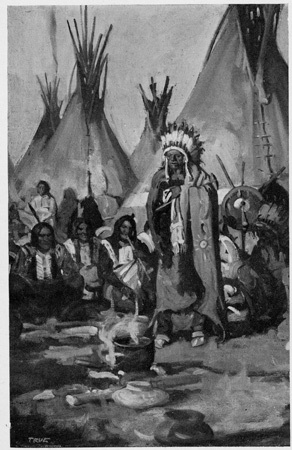
An Indian Chief Addressing the Council.
The bones of human beings are dust by the side of mammals estimated by geologists to be fifty thousand years old. The allotted period of a man's life is three score years and ten. He could be born seven hundred times, live seven hundred lives, die seven hundred deaths in those five hundred centuries. It is not within the compass of the human mind to grasp the infinite detail in the rise and fall of nations within such a period. Read the story of nine generations of men, from Adam to Noah in the first five Chapters of Genesis, for the multiplication of the human race from just two people, and the destruction of a population so numerous that they were like the sands of the ocean's beach. Following on but a few pages, we find that out of the Ark had "grown many nations and many tongues," and they were so crowded that the Lord said unto Abram, "Get thee out of thy country, and from thy kindred, and from thy father's house, unto a land that I will show thee, and I will make of thee a great nation." Abram went, and he took his nephew Lot along, and directly we read that "the land was not able to bear them that they might dwell together," and they separated, one going to the right hand and the other to the left hand. With this historical data before us, do we ask whence came these millions of Indians and their confusion of tongues? There is a touch of similarity between the wandering tribes in early Bible history, with their many languages, their patriarchs, their flocks and herds, their peaceful lives and their dissensions and wars—and that of our Indians, with the earth before them, with their tribal Chiefs, their many dialects and their nomadic lives. If the North American Indians had possessed a written language; if after their discovery, they had been able to make recorded conveyances of vast tracts of lands to the subjects of the different Powers of the Old World; if international law could have been appealed to for the protection of these individual rights, there might have been a world war on this continent that would have made our rivers run red with blood.
When we close our minds to months and years and think in centuries, it is easy to understand the diversity of languages. Tribes going off by themselves, drop words from their vocabulary as time goes on, and use other words that mean the same; after the passing of generations there is an entirely new dialect. It is so in nearly all the countries of the Old World; people living under the same government, neighbors, cannot talk to each other. Climate too has something to do with language. Russians and Eskimos use a speech that requires very little lip movement, so as not to inhale the cold air of those cold regions. In a mild climate there is the open language with many vowels.
When we discovered the Indian, we found a character the like of which has no parallel in all history. It was the untutored mind of a child in the body of an adult; there was respect for each other and scrupulous honesty in their dealings among themselves; there was government by a Chief and his council, comprising the oldest of the tribe, to whom all questions of importance were submitted, the Chief being such because of inheritance, or daring, or possessions; there was the love of the parent for the child, and the teachings that developed the highest efficiency in hearing, tasting, smelling, seeing and touching, for upon these faculties thoroughly trained, depended success in war, and sustenance in peace; there was pride of ancestry and a reverence for the Great Spirit, the maker and ruler of the universe. It seems almost a pity that this Arcadia could not have remained untouched. We asked for a little land to pasture our cows and to use for gardens. It was given by them grandly. We asked for more, and it came cheerfully; we demanded still more, and it came gracefully. Then we quit asking and took it; took it with shot and shell, as we hungrily pressed on, doubling one tribe back upon another; bayonets in front, bows and arrows in the rear, and they fought each other, and they fought us. We called them savages; and they were savage, and so would we all be under like treatment. Justice and diplomacy would have saved thousands of lives and millions in money. We made many treaties with the Indians which were broken by us and this occasioned most of our Indian wars. Canada had the Indians and no wars. Her dealings with them were on principle and along steadfast and unchanging lines. Men grew old and died in the Indian Service, and those next in line took their places. They understood the Indian nature, and knew they possessed a high sense of honor and the dealings were fair to each side. Our politics have been at the bottom of nearly all our troubles. As parties have changed, men have changed. A promise made one day has been broken by the men who came on the morrow. The Interior Department failing to handle the perplexing question, the Indians were turned over to the various church organizations, who failed to get the right proportions in their mixture of morals and business. Then the War Department tried it; and all the time the lands of the red men diminished, and the land of the white man increased. Up to the year of Colorado's admittance into the Union as a Territory, 1861, there had been three hundred and ninety-three treaties made with the one hundred and seventy-five tribes of Indians embraced within the Territory of the United States, by which 581,163,188 acres of land were acquired.
As tribes differed in their languages, so they differed in their customs; and the following traits are applicable to some tribes and not to others.
The stoicism of the Indian is well known; but that trait of his character has its qualifications. He shows the taciturn side of his nature to strangers, but the world is not so serious as his austere countenance would indicate. Among his own people he is a fun-loving, story-telling, game-indulging human being. There are degrees in their social status measured by what they have done and the property they have accumulated. They have their ideas of propriety, and are shocked that a man and woman should dance together. The men dance in a ring by themselves, and the women dance in an outer ring, while a drum gives accents to their movements. Usually they sing something mournful, its weird rhythm following one for days.
A child is usually named by its father, who walks abroad from the tent for that purpose, selecting the name of what he sees first that impresses him most. So they have such peculiar names as Rain in the Face, Yellow Mag-pie, Sleeping Bear, Thunder-cloud, Spotted Horse and White Buffalo. However, there are no white buffalo. They are black until the hot sun of each season fades the black to brown, which later sheds, to come out black again. When a buffalo hide is tanned on both sides, it becomes white, which gives rise to the name White Buffalo. They have but one name other than their tribal name. The name "squaw" was first found in the language of the Naragansett tribe of Indians and is doubtless an abbreviation of the word "Esquaw." Other tribes have their own peculiar name for women. The name squaw came into general use and spread all over the United States and Canada, was carried to the western tribes of Indians by the whites, and was used by all whites and all Indians. A squaw man is one who does a woman's work, or a white man who marries an Indian woman.
A youth does not tell a maiden of his love for her. That is told and answered by heart telepathy in the old, old way. He tells his father, who calls his relatives to a council and a feast, to consider the matter. Then the young man's mother carries the proposal to the mother of the maid, who tells it to the girl's father, and a meeting is called by him of his relatives and friends, where there is much feasting and speaking. The two mothers then meet, and accept for their children. The girl prepares a dish and carries it to the tent of the young man daily as a token of her intention to serve him all her days. When the tepee is ready, and the presents accumulated, and house keeping begins, they are husband and wife, all the former preliminaries having constituted the wedding ceremony.
An Indian never touches a razor to his face, for they are a beardless race. The tribes who occupied the eastern part of the United States, wore their hair clipped short like the Chinamen, excepting that instead of a queue, there was a scalp lock which they adorned with feathers. It was worn in defiance of the Indians of other tribes, who were thus dared to come and take their scalp. The picturesque and warlike appearance of the Indians that comes from painting their faces with deep and varying hues, originated in the preservation of the skin from burning and chapping in the sun and alkali dust. They used compounds made from roots or earth which they ground or baked and mixed with grease. There were many kinds of earth that had different tints which they liked, so this became a permanent custom which made their appearance seem fierce and warlike. They believe that the red men are made of earth, and the white men are made of sea foam.
In surgery they had rude skill and in disease they had a limited knowledge of the proper application of roots and herbs. But they knew nothing of the science of medicine in its complicated form as practiced by the learned of the profession at the present time, who so thoroughly understand prophylaxis, serum therapy, and the role of antibodies in passive immunization. Dentistry was unknown among them; their simple food and outdoor lives kept them well, and the food they ate was thoroughly ground between their well-preserved teeth. The game that was formerly so abundant was their principal food, and its destruction by the whites took from the Indian his chief mode of existence, and occasioned his menacing attitude toward our people. Other food consisted of wild berries, sweet potatoes, rice and nuts, which they would gather and bury. As they had a practiced eye, they found the buried food of the squirrel, the otter and the muskrat, which they would dig up and appropriate to their own use.
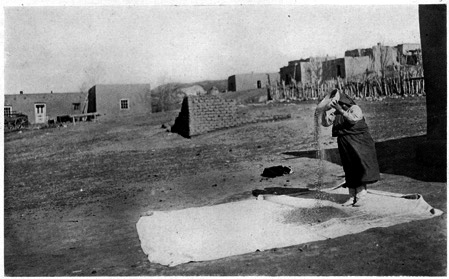
"Behold, he winnoweth barley to-night in the threshing floor." Ruth 3:2.
As they did in biblical times, so do some of the Indian tribes to this day. They beat out the grain with a stick and then pour it out gently for its cleansing by the wind.
They mourn noisily with each other in case of death. Likewise did the tribes of the patriarchs, who "mourned with great and very sore lamentation." The Indians think that it takes four days for the soul to reach the land of the dead. So a light burns on the grave nightly for four nights, that the disembodied may not get lost. They believe that there are two souls, one that soars away in dreams, while the other remains in the body. In the absence of a clock in the wigwam and a watch in the pocket, they measure time in their own way; a sun is a day, a moon is a month, and a snow is a season.
It is said the "hand that rocks the cradle is the lever that moves the world." If this be true, then the Indian mother takes no part in the world's movement, for she never has rocked a cradle. The cradle of a child is an oak board two and one-half feet long, and one and one-half feet wide, to which the babe is strapped in a way that the arms and legs are free for exercise and growth. This board lies on the ground, leans against the wigwam or a tree, is carried on the mother's back, or placed between tent poles like the shafts of a vehicle, to which a pony or dog is attached, leaving two of the ends dragging on the ground. The child is sometimes rocked by the wind when fastened high up among the branches of the trees; and that is where the little song comes from that the mother sings to her child to this day; "Rock-a-bye baby in the tree-top; when the wind blows the cradle will rock."
The speeches of the Indians are always impressive. Their words are simple and direct, and there were developed great orators among them in the days when war between the tribes, and against the United States prevailed. Some of the simple pleas which they made for the land of their fathers, were as fine as could be produced by a higher education and a finer civilization. When the French demanded of the tribe of the Iroquois that they move farther back into the wilderness, the eloquent reply of their Chief has been pronounced by Voltaire to be superior to any sayings of the great men commemorated by Plutarch: "We were born on this spot; our fathers were buried here. Shall we say to the bones of our fathers, arise, and go with us into a strange land?"
The same cannot be said of the Indian literature. Here is one of their classics: "Nike adiksk hwii draxzoq. Geipdet txanetkl wunax. Nike ia leskl txaxkdstge. Nike lemixdet. La Leskl lemixdet, nike haeidetge." Interpreted this means: "Then came the tribes. They ate it all the food. Then they finished eating. Then they sang. When they finished singing then they stopped." It is characteristic of the Indians for their feasting to end when their food is all gone, and for their singing to cease when it stops.
A century ago Malthus, in his great work on the "Principle of Population," prophesied the extinction of the North American Indians. His theory was, that subsistence is the sole governing cause in the ebb and flow of the population of the world. That given pure morals, simple living, and food to support the increase, the inhabitants of any country would double every twenty-five years. He therefore predicted that it was an inevitable law of nature that the Indians, failing to take advantage of the bounties of nature, must of necessity give way before the needs of an ever increasing population.
The Indian had the misfortune to have been improperly named. Columbus had sailed over the trackless ocean for many days; water in front of him, water behind him, to the right and to the left. He had gone so far that finally when he anchored, he thought he had sailed entirely around the world, and had come upon the eastern coast of the very country he had left behind when he sailed west out of Spain. Believing that he had reached the eastern coast of India, he called the Islands where he landed the "West Indies," and the inhabitants thereof "Indians."

CHAPTER XII.
THE LUSTRE OF GOLD.
1858 In the incident of nearly sixty centuries ago, when Joseph's brothers came down two hundred miles from Canaan to Egypt with their sacks to be filled with corn, and of the money being put back with the grain, we have the first record in the civilized world of the ownership of gold. "How then should we steal out of thy Lord's house silver and gold." So its value was then known, though no doubt for decorative purposes only, from which it in time grew into use as money. Cortez found the Aztecs using domestic utensils made of copper, silver and gold.
What made Gold? What deposited it in some parts of the earth's surface and not in others? Why is there not more of it? We do not know. We know it was one of the primitive elements; that it is held in solution in the waters of the ocean; that men have tried to make it and have always failed. It derives its name from its lustre. Though gold and yellow are in a measure synonymous, their difference is best seen in the glory of the sunset which is always golden, never yellow. It is the lustre that makes the lure of gold. Its value arises from the permanency of its lustre; from its imperishable properties; from the fact that so much can be done with it; because it is so limited in quantity; and because it requires so much time and money to find and refine it. If it would corrode it would be valueless for many of the uses to which it is put. Its soft beauty never tires the eye, nor becomes monotonous. It is the only metal that can be welded cold, as we can all testify from our experiences in painless dentistry. It can be spun out like a spider's web, or beaten so that a single grain of it can be spread over a space of seventy-five square inches. If it were as plentiful as earth or sand, it would still have great value because it is so permanent and malleable. The sawing and chiselling of the great blocks of marble and granite that are lifted by derricks into our public buildings, cost much more in their preparation than would the shaping of gold into similar blocks. If it were plentiful, our houses would all be built of gold; they would never burn; never rust; never decay; never need paint; they would endure forever; for even earthquakes that would destroy every other material, would not affect them; the mass of gold would not be destroyed and could be re-shaped and refitted together. However, if it were so plentiful that we could all live in it, it would be so common that its beautiful lustre would probably be debased by ordinary paint.
Mining comes down to us through the centuries. The Romans were operating mines in England before the organization of that country into the British Empire. Africa produces the most gold of any country, and the United States next. Colorado produces the most gold of any state in the union. There is but little gold found in the eastern part of the United States and that mostly in Tennessee and North Carolina. It exists in paying quantities in the Black Hills of South Dakota, in the Rocky Mountains, and in California. Gold is found under two conditions: in veins and in placer formations. As the veins in our bodies are almost endless in their ramifications, so imbedded in the rocky fastnesses deep down in the earth, are the veins of gold which are mined and hoisted to the surface through shafts, or brought out through tunnels; the process of smelting sends the gold to the Mint for its refinement. Deep mining is expensive and requires costly machinery. Shafts are sunk down thousands of feet, sometimes through solid rock, and powerful pumping plants are often necessary. Sometimes hundreds of men are at work in one mine.
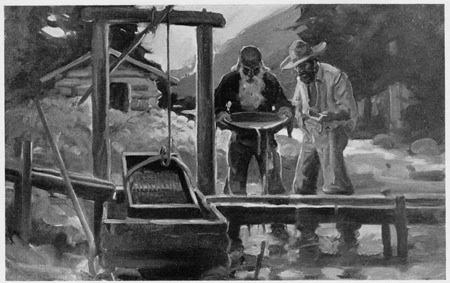
Miners Making a "Clean-up" from Their "Jig-box."
Then there is placer mining, so-called because it is a place on the bank of a river where the gold is found. "Placer" is Spanish and means "pleasure." A prospector's outfit for finding gold by the latter process is very crude. He goes into the mountains with two pack ponies. These pack animals learn to climb over the rocks and along the precipitous mountain sides like Rocky Mountain sheep. On their backs are strapped his tent and simple belongings, among which is a wash basin. The prospector seldom uses it for the purpose for which it was made. He bathes in nature's basin—golden basin; that which a King might envy him—the stream, the rushing, tumbling stream, clear, cold and pure; fortunate man! he bathes in liquid gold. The pan he fills two-thirds full of dirt, then with water, rocks it gently with his hands, letting the water run over the sides, carrying the dirt away and leaving the particles of gold, which are heavy, at the bottom of the pan. When the miner finds it there, he does not call it gold, he calls it "color." This rude device that is simply motion, water, and a receptacle for the particles of gold, is the same process elaborated upon by expensive machinery, that tears up and runs through the mill thousands of tons of material found along streams, and in gulches, where streams ran ages ago, and which, changing their channels, have left their deposits of gold containing the wash from the lump or quartz gold, found in the veins of ore.
A sluice is where water is made to run through a ditch into a trough that has cleats nailed across the bottom to check the water and form ripples. Into this the pay-dirt is shoveled, and the water flowing through it leaves the gold at the bottom and carries the dirt away. Gold dust is not fine like flour. A piece weighing less than a fourth of an ounce is called "dust." Above that it becomes a "nugget." Small counter-scales were kept in the early days by all business men, who weighed the money in, and weighed the flour and bacon out. An ounce of gold was taken over the counter from the miners at sixteen dollars, but when it left the Mint refined, which meant the elimination of all impurities, it brought twenty dollars. It is never entirely pure until refined.
The nearest approach we now have to the hunter, trapper and scout, is the prospector hunting for gold. We find him wandering alone through the mountains, a silent figure, the pack pony, his only companion, sometimes driven ahead, sometimes following on behind. This quiet spoken, unobtrusive, hermit-like man is usually tall, gaunt, bearded, hopeful, always believing in the lucky find that is sure to be his—soon. Mining laws vary with different states and mining communities. But ordinarily they are the same in effect, that a miner must show good faith, do the work required to establish his claim, and must post a notice on the ground claimed by him; the spelling in the notice does not seem to matter. We do not hear that the following were rejected on account of errors or threats:
"Notis—to all and everybody. This is my claim, 50 feet on the gulch. Cordin to Clear Creek District law backed up by shot gun amendments,
(Sgd.) "Thomas Hall."
"To the Gunnison District:
"The undersigned claims this lede with all its driffs, spurs, angels, sinosities, etc., etc., from this staik. a 100 feet in each direcshun, the same being a silver bearing load, and warning is hereby given to awl persons to keepe away at their peril, any person found trespassing on this claim will be persecuted to the full extent of the law. This is no monkey tale butt I will assert my rites at the pint of the sicks shuter if legally Necessary so taik head and good warnin accordin to law I post This Notiss,
(Sgd.) " John Searle."
Singular it is that the laws governing mining claims originated with the miners themselves, and found their way through the Courts and Congress for ratification, which was done with hardly any changes, while the laws covering all other forms of ownership of Government lands originated in Congress. The author of much of our early land legislation, to whom our country can never be grateful enough, was that eminent statesman Alexander Hamilton.
Gold started Colorado's growth; gold kept it growing; but gold is only one of many factors that will forever keep it growing. What busy scenes were enacted here in those memorable years when the attention of the entire country was centered on this region! Pike's Peak was the objective point of the gold seekers—not Denver which was then unknown. When James Purseley, Colorado's earliest white inhabitant, first found gold in 1805, at the foot of Lincoln Mountain, it did not assume the importance of a discovery. He had no use for the gold nuggets he picked up; the Indians did not know or appreciate the value of gold, and there was no one with whom he could utilize it, as he could in the exchange of ponies and furs. It is said that he finally threw the nuggets away because of the uncomfortable weight in his pockets. No doubt he thought he would live his life among the Indians, the wild, free life that was so fascinating, and would never return to the East, and perhaps never see a white man again. He was content with his lot, had no use for gold and why should he hoard it, when the Indian blanket he was now wearing had no convenient place in which to carry it.
Green Russell is said to have found gold on Cherry Creek in August or September, 1858, just ten years after its discovery in California. It was also found by a party of six men on January 15, 1859, on a branch of Boulder Creek, which occasioned the location of the present City of Boulder. George Jackson went into the mountains on January 7, 1859, and discovered gold at the mouth of a branch of Clear Creek, and on April 17th organized at that point the first mining district; later, on May 1st, he found gold at Idaho Springs. But it remained for John H. Gregory to fan into a never dying glow the flame that had been gathering volume by these desultory discoveries. He found gold on Clear Creek, near the sites of Black Hawk and Central City, in February, 1859. Lacking provisions, he went to Golden for supplies, returned May 6th, and started a sluice on May 16th, from which he took as much as nine hundred dollars a day. He sold his discovery for twenty-one thousand dollars and set the country afire with excitement. From nearly every eastern community, the people came, and from many parts of the world. It is estimated that fifty thousand people poured into this mountain region the first year after the discovery of gold. Many of those who remained, and many who came later, made fortunes, some to keep them, some to lose them. Those who hurried out of the country did not witness the growth of Cripple Creek, of Leadville, of Camp Bird or of the San Juan and Clear Creek Districts.
There are two smelters in Denver and one each in Golden, Leadville, Canon City, Pueblo and Salida. None but zinc ores are sent out of this State. The annual output of gold in Colorado is about twenty-two million dollars, or about six million dollars a year greater than California. There are three operated Mints in the United States: Denver, Philadelphia and San Francisco. At Denver there are six hundred million dollars of gold deposited in the vaults beneath the foundations of the Mint, and upon this reserve the paper currency of the Government has been issued. No such amount of gold is stored in any other building in the world. The Denver Mint will always remain the storage depository for the gold reserve of the nation, because of its inland location, where it is remote from attack by sea. Colorado has already produced in gold four hundred and eighty-eight million five hundred thousand dollars, and there is no indication of a diminution in the supply. Of the seven billions of the world's gold, nearly one-fourth, or approximately one billion six hundred million is held by the United States.
When Columbus first started on his voyage of discovery there was less than two hundred million dollars of gold in the world; now, more than double that amount is produced in a single year. In 1500 the annual gold production was four million dollars, and it took two hundred years before the yearly output was doubled. Now, nearly five hundred million dollars in gold is taken out of the earth each year. Only in the past few years has the production of gold assumed such gigantic proportions as to be alarming. In 1800 it was but twelve million dollars annually. In 1900 it was two hundred and sixty-two million dollars yearly, and in the past ten years it reached the enormous output of more than four hundred and fifty-seven million dollars every year. The Transvaal country alone turns out over one hundred and fifty million yearly. This great increase is due to improved methods of mining. Machinery unknown ten years ago, has done away with the primitive methods that kept the production of gold constant and within bounds. In the Transvaal, the hills and valleys are being ground up by powerful machines that separate the gold from the earth and rock. Then, too, a giant stream of water is now turned against the base of a mountain that melts away like mist before the sun, and sends a stream of gold to the mint.
Gold has always been the standard of values among all civilized nations. But its quantity is increasing so fast that its purchasing power is diminishing, and prices of all commodities are increasing correspondingly. When we will be producing one billion dollars of gold annually, which will be in about ten years at the present rate of increase, there must be a new standard of values agreed upon among the nations of the earth to fit the purchasing power of gold, or there will be an upheaval in the financial affairs of the world that will shake it to the very foundations, and affect the lives of every one of its inhabitants.
The over-production of gold is relieved in a measure by the utter disappearance of a part of it. What becomes of all the gold? Nearly one million five hundred thousand dollars a day is taken from the mines of the world. Only a portion of this output is consumed by the arts and in jewelry, and in the natural legal reserve of Governments. From the best information obtainable, much of the surplus goes into the hoarding places of all classes. The people in poor and medium circumstances hide it away, and it is treasured in the vaults of the rich princes of India, and the dynasties of China and Egypt, who for centuries have been building vast burglar proof receptacles underground, where it is stored, and its hiding places are never allowed to become known. It is wrested from out of its hidden recesses in mountain fastnesses, by pick, drill, dynamite and arduous toil, flows through the arteries of trade, and again goes into its burial places to remain hidden for ages.
CHAPTER XIII.
SOME MEN OF VISIONS.
1859 In this story of Colorado it has been the aim of the writer to leave the present, crowded with the interesting events that are passing before us in kaleidoscopic changings, to the enviable writers of a future period; and to keep well within the boundaries of the remote past, touching but briefly, if at all, upon those subjects so ably covered by the historians of the State. They have fully recorded the growth of the country, the towns and cities; the beginning of the railroads and telegraph lines that were such important factors in the development of the state; and the part that men of prominence, living and dead, took in the upbuilding of our commonwealth. It is all found in detail in the following histories:
Frank Fossett's "Colorado," published in 1876; "History of Denver," compiled by W. B. Vickers in 1880; Frank Hall's Four Volumes which began to appear in 1890; Hubert Howe Bancroft's "History of Colorado," published in 1891; William N. Byers "Encyclopedia Biography of Colorado," in 1901; Jerome C. Smiley's elaborate "History of Denver," in 1901; Eugene Parsons "The Making of Colorado," in 1908.
A few names have been selected for mention in these pages which appear in the above publications. Sketches of the lives of these men are here presented in order that the older civilization may be merged into the new, and to bring to the present generation a realization of the charm of the interesting personalities with which the history of our early days are replete. So the sketches in this Chapter will be like unto "Twice Told Tales."
William N. Byers.
Eighty years! Then, the frontier of this country had moved only a little beyond Ohio, the State that in 1831 was the birth place of William N. Byers. As we stand to-day in the midst of all that makes life comfortable and inspiring, and look back to the crude civilization and primitive methods of those early days in our country's history, it is difficult to believe that even in such a progressive age there could have been such developments in the lifetime of some now living. Then, the little hand printing press had only eight years before emerged into its perfected form after four centuries of struggle. Then, the first railroad in the United States had only been built for two years—built of wooden rails to connect Albany and Schenectady, seventeen miles apart. Then, telegraphing was unknown; it was not until 1837 that Morse perfected the first telegraphic instrument, and later listened to the little girl, his child friend, as she reverently touched the key and spelled out the message that went reverberating around the world: "What hath God wrought?"
A United States surveying party enroute to Oregon took with it William N. Byers, a youth of twenty. They were five months crossing the plains. The next year, 1853, saw him starting West from Oregon homeward bound, instead of East. Down the Columbia River by boat, out on the Pacific Ocean and South to Cape Horn he sailed, up through the Atlantic waters North to New York, West by railroad, canal boat, stage coach and horseback, and he was at home in central Iowa on the very edge of western settlements.
But much to the surprise of every one there was still to be a newer West. Out beyond the Missouri River had come a knocking which became so loud and persistent that finally they heard it at Washington, and Nebraska was admitted as a Territory in 1854. It is a short move now from Iowa to Nebraska, but Omaha then seemed far away to the young man who reached there when it comprised "one lone cabin surrounded by savage people." The savages grew less and the town grew more, and Byers, who was a surveyor, was soon at work platting it into a town site. When the gold excitement broke out in California in 1848, and Omaha became the outfitting point for the immense trading business that grew constantly, it kept him busy laying out additions to the town. Thus he experienced the rough side of life in a frontier village. He saw, too, how the Pacific Slope mines made great fortunes and built cities, so when the Colorado mining excitement started, he concluded to be a part of the new country's development and growth. In the early Spring of 1859, he started to Denver, after the fashion of that day, with an ox team and covered wagon.
One of the most pleasing fables in Mythology, is that of Pandora and the box into which every god had put some blessing for her, and which she opened incautiously to see the blessings all escape—save hope. In this covered wagon, drawn by the slow-moving oxen, was a Pandora box containing two blessings, a little printing press which could not fly away—and hope. All the long weeks of journeying across the plains, this far-sighted man was thinking. He thought of the little six hundred pound press that he had with him, which with close work could print twenty-five hundred copies of a small newspaper in a day. He thought of the type that would be used over and over until it was so worn that it would blur the pages. He thought of his paper going to a few scattered strangers in a strange land. He looked ahead out over the plains and saw that strange atmospherical condition that produces the mirage, and which is so clear in its outlines and so misleading in its impressions, that the man on the desert dying of thirst sees a lake of pure water so near him that he seems to hear its waves dashing on the shores. Byers gazed with delight and awe as the mirage seemed to take form and resolve itself into a city; we can imagine that he saw a gilded dome on a towering building of symmetrical form and solidity that was set on an elevation of commanding beauty; that he saw streets and trees and parks; life, movement, bustle, prosperity; thousands of people each with a newspaper. And in imagination he stood beside the giant printing presses of that magic city, presses that were so capable and powerful as to seem endowed with life; so large and heavy that a freight car could not haul one, and which needed a double story beneath all other stories to house it. He sees himself standing beside this mammoth mass of mechanism at its home, while it is resting, at the time of polishing, oiling and testing, like the grooming of the horse at the meet, ere it starts on its record-breaking race. He listens to the telegraphic instruments clicking the news from every portion of the known world. He goes to the composing rooms where the copy grows into the newspaper pages of type, under the skillful fingers of the capable men playing over the keys of the intricate linotype. He follows the locked forms of type to the stereotyping department, where a matrix made of the most perfect and delicate paper that India can produce, is laid over the page of type and pressure sends its minutest imprint transversely into the paper which thus becomes an exact copy of the page of newspaper that is soon to appear. He sees this impress copy bent half way around a cylinder mold, with its duplicate on the other half of its cylinder into which the hot metal flows; pressure transfers from the India paper sheet every detail of the type, and the metal hardens into the exact shape to fit a roller of the great press to which it is to be transferred. He sees the type that was made an hour ago and used, now cast into the glowing furnace, and a minute later becomes a melted mass of metal. And we can imagine his soliloquy.
"Oh! type! I see you boiling, and seething, and dissolving as if in expiation of your sins, for you are cruel and relentless. To-day you tell of men's sins that wreck their lives and they end their struggles in self-destruction. You tell of sickness and death, of poverty and defeat, of misery and crime; but in your purification by fire may all be forgotten, for tomorrow you tell of births and flowers, of love and marriage, of victory and success, and you crown your efforts by the advocacy of wise laws, of good government, of equal justice to all; for right will prevail while the liberty of the press can be maintained."
We imagine that he looks again and sees the electric button pressed; the cogs of the great press begin to turn, the wheels to move, the different colored inks high up in the metal troughs to flow over the rollers that bathe the type, the immense roll of paper begins to unreel into the machine and over the cylinders which are each covered with their mold of type. Faster, faster, as the race horse speeds to victory. Faster, faster, as the colossal machine bends to its work. The folding attachment inside is busy doubling the paper into its proper shape as each printed page flies past. The knife descends like a flash, quicker than thought, and separates the page from the one following. Faster, faster, the completed folded papers drop from the machine into the endless chain elevator that sends them to the distributing room overhead at the rate of forty thousand an hour, where the restless newsboys are crowding, where the express deliveries are waiting, where the warning signals of the locomotives at the depot are heard, ready to hurry away with the papers over the mountains, across the plains, into the valleys—the news for each and all, news of the communities, news of the states, news of the world—this, this is the present-day experiences of the present century's civilization, the finest the world has ever seen, and which William Byers may have seen in the mirage, but which he did not live to see in its perfected form.
He came at a time known as the "days of the reformation," when a handful of peace-loving citizens of Denver were trying to bring order out of that chaotic condition that seems to belong to a settlement on the frontier made up of people from all over the world attracted by the lure of gold. He was the pioneer editor of Colorado, and became spokesman through his paper for those associated with him in the preservation of property rights and in the protection of life. He was fearless as a writer and unsparing in his criticism of the lawless in the community. His editorial in the first issue of his paper shows the character of the man:
"We make our debut in the far West, where the sunny mountains look down upon us in the hottest summer's day as well as in the winter's cold. Here, where a few months ago the wild beasts and wilder Indians held undisputed possession, where now surges the advancing wave of Anglo-Saxon enterprise and civilization, where soon we fondly hope will be erected a great and powerful state, another empire in the sisterhood of empires. Our course is marked out, we will adhere to it, with steadfast and fixed determination, to speak, write, and publish the truth, and nothing but the truth, let it work us weal or woe."
Horace W. Tabor.
From Vermont, that land of stone and marble, it was fitting that Tabor should come to our mountains where similar conditions prevail. He came by the way of Kansas where he farmed with indifferent success from 1855 to 1859. His entrance there into the political arena had a disastrous ending. There used to be the Free Soilers, a party whose battle cry was "free soil, free speech, free labor and free men." No state had more troubles in the way of political happenings than Kansas. One consisted in having this Free Soil party, to which Tabor belonged and which made him a member of the Legislature of that State in 1857, just after its admission into the Union. As Cromwell prorogued the Parliament, so did the Federal Troops under orders of the Secretary of War send every member of that Free Soil Legislature to their homes, robbed of their law-making prerogatives and relegated to common citizenship.
Tabor came to Denver in 1859 and from this point his career reads like a story from the Arabian Nights. In the Spring of 1860 he started to California Gulch, which name gave way later to Leadville; he drove an ox team to a covered wagon that was six weeks in the going. With the close of the first season he had five thousand dollars of gold dust in his pocket. That amount of money suggested merchandising, which he followed in the winters, alternating to the mines every summer. At the end of the second year he had wrested fifteen thousand dollars more in gold from the mines. He was a likeable man, generous, and known to be such, always doing his fellowman a good turn. Two prospectors down on their luck, proposed that he should help them by "grub-staking," as it was called in those days. He was to give them what they would eat and wear, furnish them with tools for digging and powder for blasting. In return they would share with him if they won, while if they lost, it would be his sole loss. It turned out to be a most fortunate alliance for them all. They had no more than started to digging, having reached a depth of only twenty-six feet, when they struck a rich vein of ore, and every inch they went down after that, the rich deposit grew in extent, both in quantity and quality. "Little Pittsburg," they called it, and it began turning out eight thousand dollars a week to the three fortunate owners. In a little while Hook sold his share to his partners for ninety thousand dollars, that being all the money he said he needed. Soon Rische reached the limit of his money-making ambitions which was two hundred and sixty-two thousand dollars, and that sum was paid him by David H. Moffat and J. B. Chaffee. The three new partners, which included Tabor, purchased other mines in the vicinity and consolidated them, taking out over four million dollars in the two years from 1878 to 1880. The other two partners now bought out Tabor for one million dollars, that being as much he thought as he could ever spend. It seemed that these original partners only had to figure out how much they would need to be comfortable on the remainder of their lives, which fixed the price of their investment.
Tabor, however, found that he could not quit this fascinating life, so he bought the Matchless Mine at Leadville for one hundred and seventeen thousand dollars, and in a year he had added nearly seven hundred thousand dollars to his wealth. Field, Leiter & Company of Chicago joined him in a number of mining ventures, all of which were immensely profitable.
In 1879 he began to make purchases in Denver that had much to do with the rapid growth of this city. He paid thirty thousand dollars for the lots at the corner of 16th and Larimer Streets, upon which he erected what was the finest building of that time, known now as the Nassau Block. He sent all the way to Ohio for the sandstone that went into the building, the quarries of beautiful marble and stone in our mountains not then having been opened, or he would have used it, for he always wanted the best. He paid forty thousand dollars for the residence and block of ground, on a portion of which the Broadway Theater now stands; the ground alone so purchased is now worth one million dollars; its value in another thirty years—but that is another story, and it will be told when the hand that moves this pen lies silent. He purchased the location at 16th and Curtis Streets for a Theater Building, and sent Chicago Architects abroad to study the plans of the theaters of the Old World and their furnishings, with the result that a building was erected and equipped that was the talk of the entire country.
The opening of the theater was one of the greatest occasions held in the West up to that time. Emma Abbott came all the way across the Continent with her Opera Company for the event. The newspapers everywhere devoted space to it and Eugene Field celebrated it in verse. The picture of Horace Tabor was placed just over the inner entrance, where it hangs to this day and where it should remain while the building stands. At the time of its erection it was considered to be the most perfect and convenient in arrangement of any theater in the United States. The boxes and proscenium were all finished in solid polished cherry wood. The drop curtain was painted by an eminent artist who came to Denver for that purpose; it was adorned with a picture of moldering ruins of Ancient Temples with a motto underneath containing a sermon in the following impressive quotation from Kingsley:
"So fleet the works of man; Back to the earth again Ancient and holy things Fade like a dream."
All these improvements inaugurated and completed by him alone, attracted almost world-wide attention and advanced Denver to an important place in her business standing throughout the entire East. He became Lieutenant Governor in 1878, and U.S. Senator in 1882, to which position he was appointed to fill out the term of Henry M. Teller, who was invited by President Arthur to enter his cabinet as Secretary of the Interior. Tabor only lacked one vote of being elected to succeed himself, Judge Bowen winning the prize.
Tabor's financial rise was meteoric; his decline was equally rapid when it started. Unfortunate investments, mostly in distant locations, swept his entire fortune away. Though poor indeed, in material things towards the close of his life, it is given to few men to be so rich in experiences. His accomplishments in behalf of Denver will always be held by her citizens in grateful remembrance, and when he died in 1899 there was wide-spread sorrow.
William Gilpin.
1861 One thousand years of traceable ancestry! They spelled it "Guylphyn" in those far-away days of the Roman Empire, and in two hundred years it was softened to "Gilpin." One of this illustrious line was a great General and won a noted battle for Oliver Cromwell. One was Minister Plenipotentiary to The Hague, appointed by Queen Elizabeth. Queen Mary ordered one beheaded because of his religious teachings, but she died herself, after which he was pardoned and went on with his preaching. The ancestors of our own Washington were proud to form a union with the Gilpins by marriage. A meeting-house was erected by one of them and given to William Penn who used to preach in it. The home of one of them was turned over to LaFayette for his headquarters during the Battle of Brandywine. And there was that one who owned the mill that ground the grain for Washington and his army at Valley Forge.
Colorado is to be congratulated that she had for her first Governor one who came bearing such an illustrious name. But no one thought of family, least of all Abraham Lincoln, when he signed the Commission that made William Gilpin Governor of the Territory of Colorado. His selection was under advisement at the first Cabinet meeting and he was chosen in recognition of his signal ability.
As a youth he was tutored by his father who possessed more than ordinary culture. He pursued special studies under the author, Hawthorne; he learned under Lawrence Washington, when the latter was a resident of Mt. Vernon; then he was sent abroad for instructions at Yorkshire; he had the pick of masters at Liverpool; was graduated later at the University of Pennsylvania, and then won high honors in his later graduation from West Point. Such a course of study had made of him an intellectual athlete.
Then he traveled abroad, hurrying home to fight the Spanish in the Everglades of Florida. This chivalrous disciplinarian was Major in the Army of twelve hundred that defeated the Mexican Army of over five thousand at Sacramento City, California, on February 28, 1847. He was an officer in the army, under General S. W. Kearny, that marched into Santa Fe on the 14th of August, 1846, and ran up the Flag of the United States for the first time. Soon after, Charles Bent, who was first Governor of New Mexico, was killed at Santa Fe in an up-rising of the natives. He had built Bent's Fort on the Arkansas River where he had his residence for years. It was at Santa Fe that Gen. Lew Wallace, while Governor of New Mexico from 1878 to 1881, wrote the concluding chapters of his great book Ben Hur.
Gilpin's home was at Independence, Mo., where he practiced law. That place being near the end of the Santa Fe Trail, he often met Kit Carson. Gilpin possessed so much bravery that he started across the plains in 1843, a solitary horseman. Happening in with Fremont, he accompanied him to the Pacific Coast, it being Fremont's second expedition. The next year Gilpin returned by the way of Bent's Fort, thence down the Santa Fe Trail to his home. He was bearing a memorial, from the Oregon people, which he had helped to formulate, and which he was to present to the Administration at Washington. It set forth in detail the resources of the Great Northwest, the desire of the handful of people located there to be taken under the shelter of the Government and to be embraced within the limits of the Territory of the United States. He proceeded to Washington and presented this petition in person to President Polk, and urged in glowing terms, with all the eloquence he possessed, the future value and prospects of that unknown region. He had the freedom of both Houses of Congress and took a prominent part in turning the tide in favor of the Oregon movement.
When President Lincoln started from Springfield to Washington to assume the reins of Government in February, 1861, Gilpin was one of thirteen who made the entire journey in the President's private car. He was a brilliant man and Lincoln recognized his mental gifts and learned minutely from him of his varied experiences, especially of his knowledge of the far West. So it was natural that his name should come before the very first meeting of the cabinet for appointment to the high place of Governor of the territory of Colorado. The next month he was hurrying westward with his commission in his pocket and with his appointment as well of Brigadier-General of the Army.
"Long ago at the end of the route, The stage pulled up and the folks stepped out; They have all passed under the tavern door. The youth and his bride and the gray three-score; Their eyes are weary with dust and gleam For the day has passed like an empty dream. Soft may they slumber and trouble no more For the weary journey, its jolt and its roar In the old stage over the mountains."
So entered William Gilpin into the little City of Denver. It was the days of the stage coach, and the Denver end of the line was kept at the highest point of efficiency. Six horses were used, as fine as money could buy, high stepping and so well groomed that they shone resplendent under their costly harness glittering in the sun. The starting of the stage on its journey East and its return into Denver, was always an interesting event. It came dashing into town with the horses galloping, the whip cracking, the dogs barking and the people shouting. And they cheered when their new Governor stepped out. They cheered again when he stood before them tall and erect, with eyes flashing and head thrown back, and spoke in that matchless flow of language that was the gift of this eloquent and picturesque man. The character of his thought and its style of presentation is best seen in the following, taken from one of his many interesting speeches:
"* * * These events arrive. We are in the midst of them. They surround us as we march. They are the present secretions of the aggregate activities and energies of the people. You, the pioneers of Colorado, have arched with this glorious state the summit ridge and barrier between two hemispheres. You bring to a close the numbered ages of their isolation and their hostility. You have opened and possess the highway, which alone connects, fuses, and harmonizes them together. Of this state, you are the first owners and occupants. You have displayed to the vision, and illustrated to mankind, the splendid concave structure of our continent, and the infinite powers of its august dimensions, its fertility, its salubrious atmosphere and ever resplendent beauty. You have discovered the profound want and necessity of human society, and your labor provides for its relief; gold, I mean; the indefinite supply of sound money for the people by their own individual and voluntary labor. You occupy the front of the pioneer army of the people, absolutely the leaders of mankind, heading the column to the Oriental shores. * * *
"Hail to America, land of our birth; hail to her magnificent, her continental domain; hail to her generous people; hail to her victorious soldiers; hail to her matrons and her maidens; hail to the sacred union of her states; all hail to her as she is! Hail to the sublime mission which bears her on through peace and war, to make the continent her own and to endure forever."
What did he do for Colorado? Much. He confronted unusual conditions; he was the Chief Executive of the Territory at the very beginning of its history when there was not one single beaten path for him to follow, and when there was no money and no credit. There was danger of the territory slipping away from the union through an armed incursion from the South. There were no weapons for either a defensive or an aggressive warfare. He posted notices along the trails, calling for the purchase of fire arms of any kind no matter what the age or condition, if there was accompanying ammunition. There were no soldiers not even a home guard. So as quickly as possible he began to muster in the soldiers, putting into their hands the weapons he had gotten together, bad though they were. The drilling of the men was carried on just outside of Denver; soon he had one Company of Infantry and ten Companies of Cavalry.
The troops that had been in Utah during the Mormon war were returning East, and at Gov. Gilpin's request turned over to him at Laramie eighteen wagons containing eighteen hundred new rifles and a large supply of ammunition. Thus equipped, he marched down on Gen. Sibley and his army who had come up from the South and had captured Santa Fe. The battle of Glorietta was fought, resulting in Sibley's entire wagon train of ammunition and supplies being captured and his army destroyed or scattered.
The expense of the year's military activities was paid by the Governor drawing drafts direct upon the Government at Washington, amounting to two hundred and twenty-seven thousand dollars, all of which drafts were returned unpaid, which occasioned a great deal of trouble, confusion and criticism. They were, however, paid in course of time. Governor Gilpin always claimed that he had verbal instructions from Simon Cameron, the Secretary of War in the beginning of Lincoln's Administration, to handle the payments in this way. No doubt the Governor made the mistake of not having vouchers regularly drawn, itemized, certified and forwarded in the regular course of business, leaving the creditors to await their acceptance, approval, and the remittance of the funds. In extenuation it might be said that we were remote from the center of supplies and money, communication was slow, time was pressing, and he did the best he could. It may be that any other course at that time would have resulted disastrously, not only to this Territory, but the Government as well. Even at this late date, the Legislatures of some states handle in a most informal manner the finances of the State Government, which requires years for adjustment. Because of these financial complications, Gilpin was relieved from his position as Governor in 1862, but he remained true to his State all his life, had no higher ambition than to see it grow, sounded its praises wherever he went, and said on all occasions: "It is the backbone of the Continent, protect and encourage it."
He was one of the first to open up beautiful Capitol Hill, and used to say "I will give you two lots if you will build on one of them." He never valued money, but lived far above the ordinary affairs that surround us. There were times when he did not have the money to pay for a meal, but his interest in his fellowmen, in his State, and in the enjoyment of his mental gifts continued unabated to the end of his life.
Governor Gilpin gave us the beautiful name of Colorado. He was in Washington in the Spring of 1861 when the Bill was before Congress for fixing the boundaries of this new Territory. The name of Jefferson had been proposed, also Idaho and other names. He preferred Colorado and gave that name to Senator Wilson of Massachusetts, on whose motion it was adopted. The name was taken, not from the river of that name in Texas, whose length is nine hundred miles, but from the great river to the west of us that is longer than the distance between Omaha and Ogden and is the King of the Rivers of the West.
John Evans.
"Build me straight, O worthy master! Staunch and strong, a goodly vessel, That shall laugh at all disaster, And with wave and whirlwind wrestle."
1862 Like the perfect ship was the perfect Quaker stock that came to our shores and was absorbed into the body politic, to permeate the arteries of business and statesmanship of our whole country for generations. It was a stock built on simple lines; straight, strong, clear and pure; founded on morality, sobriety, integrity and frugality; and as simple in garb as it was simple and strong in faith. Soon after the arrival of the Plymouth Fathers, there entered at our eastern gateway, a Quaker who invented for us the screw auger; how could our present high civilization have reached its enviable position without that screw auger! Evans was the name of the man to whom we owe this great debt of gratitude and he it was who was the progenitor of Colorado's second Governor, a man of whose memory our State is justly proud.
John Evans reached the zenith of his power and influence through the slow stages of solid preparation and ever broadening experiences. He was born in 1814 in Ohio, the State that is so prolific of good men. He graduated from the Clermont Academy in Philadelphia in 1838, when he was twenty-four years old, and immediately began the practice of medicine. His success was so pronounced, and he attained such standing, both as humanitarian and physician, that he was able at the early age of twenty-seven to impress upon the Legislature of the State of Illinois by his masterful arguments before them, the necessity for the establishment by the State of an institution for the insane. Four years later he was a conspicuous member of the faculty of the Rush Medical College of Chicago, which he served with devotion for eleven years. He founded the "Illinois General Hospital of the Lakes"; was editor of the Northwestern Medical and Surgical Journal; first projector of the Chicago and Fort Wayne Railroad and of its Chicago Terminals; member of the Republican National Convention that nominated Lincoln for the Presidency in 1860; was offered the Governorship of Washington Territory by Lincoln, which he declined.
He was one of the prominent figures in the advancement of Methodism and was always prominent in its councils, both national and local. The writer, once in an eastern City where the general conference of the Methodist Church was being held, attended a session of that interesting assembly. One of the conspicuous members on the floor was pointed out as Governor Evans, who led the delegation from Colorado. At the time, this incident was related of him:
He had settled at Denver in 1862, and having faith in its future, decided, after mature deliberation, the direction the City would take in its growth. He then purchased one hundred and sixty acres at the point where he thought the most benefit would accrue. A friend hearing of his investment and its reason, sought him out, commented on his mistaken rashness in coming to such an unwise decision, and advanced many reasons why the City would grow in exactly the opposite direction. The arguments were so strong that a purchase was made of another one hundred and sixty acres on the side of Denver suggested by his friend; the Governor, however, strong in his faith, clung to his original purchase as well. Friends continued to advise him of his mistakes in these two ventures and he continued to buy where they suggested, until he owned outlying farms on every side of Denver, and the City growing in all directions, his profits were fabulous.
He was conspicuous in establishing the Methodist Episcopal Book Concern and the Northwestern Christian Advocate of Chicago; was one of the original promoters of the Northwestern University at Evanston and the first President of its Board of Trustees in which position he continued for forty-two years. He founded the beautiful City of Evanston, a suburb of Chicago, which was named for him, and he suggested the setting apart of one-fourth of every block in that city as a fund for the University, a movement that resulted in an enormous endowment for that great school; he brought about the purchase of ground in the center of Chicago that grew into millions in value and greatly enriched the University. His contributions to the Church throughout his long, successful and busy life, amounted to hundreds of thousands of dollars in addition to the generous donations made by him to the Denver University located at University Park.
A Territory is under the direct control of the Administration at Washington and its officers may be selected from outside its boundaries. President Lincoln in looking for a suitable successor to Governor Gilpin in 1862, centered on John Evans of Chicago, who was such a marked success as a business man. He received the appointment of Governor and gave to Colorado a most excellent administration. He was a leading factor in the building of the Denver-Pacific Railroad from Denver to Cheyenne, our first railroad, and was its President for years. One of his most gigantic undertakings was the building of the railroad up the South Platte River by the way of South Park to Leadville, in which he had the splendid help of Walter Cheesman, General Bela Hughes, J. W. Smith, William Barth, Brown Brothers, General D. C. Dodge and others. It was not easy to build railroads in those days; money was scarce, there was not much business for a railroad when constructed, and in this remote country whose future was not established, bonds were hard to sell. Many a man would have been discouraged by the efforts necessary for the financing of these railroads. Governor Evans worked unceasingly and showed his faith by putting in large sums of his own money, a fact that finally brought these undertakings to a successful consummation. Always he talked and worked for a line to the Gulf from Denver which would mean cheap freight rates and growth for Colorado, and now it has come and more, for we are to connect the Gulf with the far northwest, an ocean to ocean link.
All his personal investments were so wisely made that his life's work went on smoothly to its close in 1897. In Denver, where he made his home to the end of his eighty-three years, his thoughts were always of the City and State of his choice. His wise counsel and untiring devotion has left its imprint upon many of the successful industries of the State, as well as upon the social, moral and æsthetic life of the community. By his untiring devotion and unflagging loyalty to the Union, he placed himself in the class of War Governors in the great struggle of '61 to '65. He was preeminently a business man and possessed of exceptional ability. He was in the Methodist Church the some powerful factor for good and moral uplift, that William E. Dodge of New York was in the Presbyterian Church. In fact, in sterling business integrity and high quality of christian manhood, the finest thing perhaps that could be said of these two men, is that each was the beautiful complement of the other.
George Francis Train.
1863 A child stared a tragedy in the face as he looked wide-eyed from the window of the family home in New Orleans and saw the rude box containing the body of his little sister pitched into the "dead wagon" with like boxes. There were no undertakers: all were dead. No tenderness or sympathy; only haste and roughness. No flowers; just tears. An epidemic of Yellow Fever was raging and the "dead wagons" were rattling through the streets and stopping at the desolate homes everywhere. Each time the child saw one stop at his home, which would have been eight times if he could have counted, there was one less in the household. And at last a big box was carried out, in which they had placed his mother, and little George Francis Train, a child of four, was left alone. He was put on board a Mississippi River Steamer, with his name and destination pinned to his coat, and was sent on his long journey to relatives near Boston. That was eighty-two years ago.
That child, grown to manhood, became one of the picturesque figures in American History. He absorbed an education while working sixteen hours a day as a grocer's clerk. Then by sheer force of will and capability, he took a man's place in his uncle's shipping house in Boston, when he was but sixteen years of age, and in four years became a partner in the firm and was making ten thousand dollars a year. He revolutionized the shipping industry of the world by increasing the capacity of the largest ship then known, of seven hundred tons, to what then seemed an incredible size of two thousand tons. He had a fleet of forty vessels under him, mostly built up by his own energy. Then he went to Liverpool and at the age of twenty was the resident partner of the firm at that point where he doubled the business in a year. He then enlarged his horizon by going to Australia and establishing a similar business from which his commissions were ninety-five thousand dollars the first year.
He was a man with ideas. They used to cut postage stamps apart with scissors; "perforate the paper," he said, and it was done. In London when the Grande Dames stopped their carriages, a footman appeared with a short step ladder to aid them in their descent; "attach a folding step to the carriage" he advised, and it has been in use ever since. He saw a man write something with a lead pencil, then reach into his pocket for a rubber to make an erasure; "fasten the rubber to the pencil," he told them, and the perfected idea is in the hands of everyone to-day. A dozen men were shoveling coal into sacks and carrying it from the wagon; "use an appliance to raise the front end of the wagon and let the coal run out," he suggested, and the idea carried into effect made a company of millionaires. A man spilled some ink as he poured it from a large bottle into a small one; "give the bottle a nose like a cream pitcher," he told them and the idea gave the man who patented it more money than he could ever use. He saw the Indians spearing salmon out of the Columbia River; "can them," he said, and it started a great industry that is still under way. He accompanied the officials of the Northern Pacific Railroad when they were locating the terminus of that system; "end the line here," he told them and Tacoma will stand on that spot forever. He prophesied, that as much of the soil of the East rested upon a rocky base and was intermixed with stone, it would become inert and of decreasing value; while from the western plains so vast in extent, with their great depths of rich soil, would come the supply for the nation, and an ever increasing value to the farms. The prediction has come true. Today, with one-tenth of the population, we are furnishing one-half the supply of the food of the nation.
He was an observing man always and a student. Besides his own native language, the English, he spoke fluently French, German, Italian, Spanish and Portuguese. His newspaper articles from all over the world were read everywhere. He was an editor, author, and lecturer, speaking at times to houses that netted him in one instance five thousand dollars. He knew many of the greatest men of his own country: Daniel Webster, Henry Clay, Rufus Choate, Zachary Taylor, Abraham Lincoln, Ralph Waldo Emerson, Nathaniel Hawthorne, Nathaniel P. Banks—they were all his friends. He met Queen Victoria, the Duke of Wellington, and many more of the great of the earth. Judges, Bishops and Ambassadors were his intimates. He was offered the Presidency of the Australian Government which he declined. He headed the French Commune and when the government troops were ordered to fire on him, he wrapped himself in the Stars and Stripes and dared them to kill an American citizen protected by the American Flag—and they did not shoot. He led a Third Party against two presidential aspirants for the Presidency, Ulysses S. Grant and Horace Greeley, in the campaign of 1872, and was defeated. He was a great traveler and visited nearly every country on the globe. He went around the world in eighty days, which gave rise to the Romance by Jules Verne, that is read in every language. He kept going around the world just to shorten the time. He had a villa at Newport and his annual expenditure for entertainment there was one hundred thousand dollars. Toward the close of his career he lived on three dollars a week, because he had no more, and he claimed that it was the happiest period of his life.
The first street car lines in England, Switzerland and Denmark were built by him. He was the first to suggest similar enterprises for Australia and India. Maria Christina was Queen of Spain, and Salamanca, a banker, was the Rothschild of that country. They backed him for two million dollars that started the building of the Atlantic and Great Western Railway which was followed later by the construction of a railroad to the Adirondacks. The banker Salamanca was descended from the long line of that name for which the Spanish City Salamanca was named that gave us Coronado. On the line of railroad which Salamanca helped to finance, a City is located in New York State named for him.
All these experiences brought Train gradually to the accomplishment of his life's greatest achievement, the building of the Union Pacific Railroad which he began on December 3, 1863, at Omaha, but which was completed by others May 10, 1869, at Ogden. It was the missing link needed in the welding of the West to the East, and in the development of Colorado, a country rich in every natural resource. Later, when the Kansas Pacific was threatening Denver, and planning to build their road elsewhere if a large amount of money was not raised, the citizens of Denver in their dilemma sent for Train. He came, and made one of his characteristic addresses to a crowded house. "God helps them that help themselves," Benjamin Franklin had poor Richard say; Train said, "Build a line of railroad yourselves to connect with the Union Pacific Railroad at Cheyenne or Julesburg," the road that he had projected. And they did the very thing he told them to do. In the course of time, the Kansas Pacific Railroad was also built to Denver.
Erratic, always. Egotistical, very, Crazy, many said he was. It may be that all his life he saw the "dead wagon" at the door, and heard it rattling through the street; early impressions have their effect upon the character of the mind. He was imprisoned fifteen times and said that he never committed a crime in his whole life. He was fearless as a speaker and writer, and much of his trouble was political. A peculiarity of this many-sided man was, that he would never shake hands with any person—be he king or plain man of the people. In retirement he frequented Madison Square in New York where the birds all knew him and would light upon him and feed out of his hands; where the children all loved him and flocked about him, sitting upon his knee while they listened to his wonder tales of every people of every clime; where memories of his brilliant career filled his thoughts as he saw again his bright vision of a coast to coast line, now fully realized—for the glistening sunlight was glinting the rails from the foot of the Statue of Liberty to the sunny calm of the Golden Gate. He was never without a flower in the lapel of his coat. The wearing of the flower in this way by men everywhere originated with him; he introduced the custom into London, Paris and New York, from which cities it spread all over the world. The idea came to him while in Java, that beautiful country of rare flowers and delicate odors.
On a cold stormy day of January, 1903, the end came to a stormy career; the birds hungrily called to him, but he did not come; the children waited for him, and could not understand; a flower that was alive, was pinned to the shroud of its friend who was dead, and they went away together forever and aye.
CHAPTER XIV.
THE STONE WHICH THE BUILDERS REJECTED.
Colorado was once a waif; a child without parentage; no older brothers and sisters wanting it about; an outcast, unclaimed, lonely, wretched and friendless. No state in the union has had a career anywhere approaching that of Colorado. It was the center of more undefined boundaries, and a part of a greater number of countries, than any other portion of the world.
This is the genealogy of Colorado that has never before been traced, and which has been gleaned with infinite care from many sources. It belonged in turn to each of the following potentates or powers:
The Indians, Pope Alexander VI, Spain, New Spain, France, Louisiana District, Louisiana, No Man's Land, Missouri, The Indian Country, Texas Republic, The Unorganized Territory, Mexico, New Mexico, Upper California, Utah, The Arapahoe and Cheyenne Tribes, Nebraska, Kansas, Jefferson Territory—Colorado.
King Solomon took the child and when he offered to divide it between the two mothers, he found to whom it belonged.
1492 Pope Alexander VI took an imaginary map, drew an imaginary line across it, and parcelled out most of the New Hemisphere, giving one side to Portugal and the other to Spain, but he did not know that he had given Colorado to Spain.
1521 When a Government was established on these shores in 1521 and called "New Spain," Colorado became a part of that country and slumbered for two hundred and eighty years.
1801 La Salle, a French Explorer, in 1762, went on a tour of discovery and found a rich but weed-grown section that Spain was neglecting, which he claimed for France and called it the "Louisiana District" for Louis XIV, a name used by nearly every other King of France in those centuries. Spain expostulated and then became violent. Agitation went on. War was threatened. The trouble was not ended until 1801 when Napoleon, while strangling Spain, forced her to cede the disputed territory to him; it being the tract lying east of the Arkansas River up to a certain point, then crossing the Divide south to the Red River which it followed to its source, thence along the eastern foot-hills of the Rocky Mountains. This divided Colorado, leaving with Spain that portion lying west of the Rocky Mountains, and giving to France what was located east of the mountains. Thus was left "No Man's Land" out of the reckoning, which included these majestic, wealth-producing and health-yielding mountains. They seemed to be too inconsequential to be claimed by either country. Mountains, that by their impassive quietude have soothed into tranquility the restless nerves of thousands of sick; mountains, that brew unceasingly nature's healing balm for ailing lungs; that are the home of twenty-four rivers, whose never ending flood of life giving waters, lure riches from the farms, like the touch of an Aladdin's Lamp; that have produced in furs, lumber, gold, silver, lead, copper, zinc, iron, stone, marble, oil, live stock and agricultural products, nearly five billion dollars.
"The stone which the builders rejected, the same is become the head of the corner."
1803 Two years passed, and for the first time Colorado began to be appreciated. 1803 saw sixteen million dollars in gold flowing to France, and the Louisiana District, which included the eastern half of Colorado, coming to the United States. This brought under the flag of our Government for the first time, that part of Colorado lying east of the mountains.
1812 Louisiana in 1812 was admitted into the union as a territory according to the State boundaries that exist at the present time. Missouri Territory was the name given to what was left of the Louisiana Purchase. Thus Colorado lying east of the mountains fell heir to Missouri. The name is taken from the Missouri's tribe of Indians.
Next to the priceless heritage that came to us as a nation and as individuals in the vast domain that we received from the Indians, was the rich transference of Indian words into our language. It was like the transfusion of new corpuscles into blood emaciated and impoverished by disease. Here was a vacant world. Rivers, mountains, states, cities, towns, boundaries—all a blank. Ready at hand was a new language. It possessed crispness, freshness, strength, romance. We absorbed it and never awoke to the full appreciation of its beauties until Longfellow charmed and thrilled us with his matchless songs.
1823 It was in 1521 that Cortez placed the foot of Spain on the neck of Mexico. Three hundred years later, Mexico rebelled. She had to fight, and succeeded in establishing her independence in 1823. This carried into the fold of Mexico, that part of Colorado lying west of the mountains, which had continued all these centuries to belong to Spain. When Mexico came from under the Dominion of Spain, she wanted to be free from slavery and objected to Texas bringing slaves into Mexican Territory and selling them. This quarrel between Texas and Mexico really brought about the war between Mexico and the United States.
1834 In 1834 that portion of the Missouri Territory lying west of the Missouri River became the Indian Country, which was the official title; presumably "country" because there was no territorial government and it so remained for twenty years. So to the Indian country went all of Colorado east of the mountains, and north of the Arkansas River.
1836 Texas was once a Republic. In 1836 it had a Government of its own separate from both Mexico and the United States, and independent of both. She proceeded to reach into and through Colorado, and claimed that part above the Arkansas River lying between Mexico's line on the west of the mountains, and the Missouri line on the east of the mountains. This made a home for "No Man's Land."
1845 Texas was admitted into the Union in 1845, as a territory in her present form. This threw back into chaos all she had claimed of Colorado, and left it as "Unorganized Territory." In 1846 Texas plunged the United States into War with Mexico, supposedly over the western boundary of Texas. In two years twenty-three noted battles were fought, including Palo Alto, Buena Vista and Vera Cruz. Only twenty-three years after Mexico threw off the yoke of Spain, we marched into Mexico City and took from her practically all the territory north of her present boundary. It was ceded to the United States in 1848, and in 1850 became New or Upper California. It was divided in 1855 into three parts, named California, New Mexico and Utah, the latter called after the tribe of Utah Indians. This brought under the United States Flag for the first time, that portion of Colorado west of the mountains, which had been Mexican Territory, and which now became a part of the Territory of Utah, whose western boundary was California. New Mexico received that part of Colorado lying south of the Arkansas River, and east of the Rio Grande.
1851 In 1851, by the Treaty of Fort Laramie, it was stipulated that the part of Colorado east of the Rocky Mountains and north of the Arkansas River should belong to the tribes of the Arapahoe and Cheyenne Indians, which title was later extinguished by the Treaty of Fort Wise.
1854 Another turn of this endless chain, and 1854 saw the Indian Country legislated out of Colorado, and Nebraska and Kansas ushered in to take its place. Colorado east of the mountains was divided on an east and west line into Kansas and Nebraska, about one mile south of Boulder. So at this time we stood as follows: Utah on the west of the mountains, Nebraska in the northeast, Kansas in the central east, and New Mexico in the southeast. Here the cloud of Civil War, not much larger than a man's hand at first, became ominous, and the rumblings and mutterings grew louder each year until at last the storm broke. Missouri was for the perpetuation of slavery, and jealous of the territory that had been taken from her and given to Nebraska and Kansas, tried to compel those territories to continue pro-slavery, making a strong fight to force it into their Constitutions, which, on account of her work and influence, she succeeded in changing three or four times. Those states strongly objected to slavery, and there were fierce political conflicts, especially in Kansas, which at last broke out in endless raids. Quantrell with his guerillas massacred one hundred and fifty at one time at Lawrence, Kansas, and destroyed two million dollars worth of property. It has been said that every foot of eastern Kansas soil was reddened with the life blood of her anti-slavery citizens. This gave to that State the name of "Bleeding Kansas," and the bleeding did not cease until the close of the Civil War. The Legislature of Kansas created Arapahoe County, a stretch of country several hundred miles long, which included a part of Colorado, which then went by the name of the County.
1859 The early settlers of Colorado, concluding to have a Government of their own, met in 1859, organized a temporary government which they called "Jefferson Territory," but which was never made a permanent government or recognized at Washington.
1861 In the year that the clouds hung low and heavy over the Union; the year that saw the first gun belch forth the shot that cleaved the line between the North and the South; when brother was going to war against brother, father against son, and mothers with blanched faces were wringing their hands in an agony of despair; when the whole civilized world stood breathlessly apart to witness the fiercest human struggle of modern times; in that the most memorable year in our National history, here on this peaceful spot far removed from the noise of the conflict, from the flame and smoke, from the tears and death agonies, there was enacted a scene, picturesque, glorious, historical. Utah, Nebraska, Kansas and New Mexico, generously and loyally stepped aside, going to the east, to the west and to the south, bidding us adieu forever. In their place, Cinderella-like, there burst from its chrysalis the waif of centuries, smiling, gracious, brilliant, like a bride bejeweled and bedecked for her wedding, the fairest and gentlest in all the sisterhood of the Union; and may she bless the land forever—Colorado.
THE END.