CHICORY
Reading edition
SECTION I. INTRODUCTION INTO ENGLAND.—CONTINENTAL PRODUCTION AND CONSUMPTION.
The term chicory is an Anglicised French word, the original being chicorée. The plant is known to botanists by the name of Cichorium Intybus, and belongs to the natural order Compositæ, tribe Cichoreæ. It is an indigenous plant with a perennial root, better known probably to most readers by its English appellation of wild succory. The root is spindle-shaped, with a single or double head; externally it is whitish or greenish yellow; internally, whitish, fleshy, and milky. The roots grown in this country are smaller, and more woody or fibrous than those which are imported from the Continent.
The cultivation and consumption of chicory have now attained a very great importance, not only on the Continent, but also in the United Kingdom. Dating its extended use chiefly from the system pursued by the first Napoleon to substitute home-grown for colonial products, it has gradually become approved and popularised for a beverage, either used alone or more generally mixed with coffee, in numerous countries, where it can be sold far under the price of even the lowest grade coffees.
The manufacture of a factitious coffee from roasted chicory-root would seem to have originated in Holland, where it has been used for more than a century. It remained a secret until 1801, when it was introduced into France by M. Orban of Liége, and M. Giraud of Homing, a short distance from Valenciennes. This root is not superior to many others which possess sweet and mucous principles, but of all the plants which have been proposed as substitutes for coffee, and which, when roasted and steeped in boiling water, yield an infusion resembling the berry, it is the only one which has maintained its ground. The French, not satisfied with chicory, have recently introduced acorn coffee and roasted beetroot. The beet, it is asserted, besides communicating its hygienic qualities, also helps to sweeten the beverage. This new coffee is called “café de betterave,” as the old was called “café chicorée.” These distinctions will soon become as puzzling as those in America, which led the Irish waiter to ask if the gentleman would have coffee-tay or tay-tay.
Mr. George Phillips, when giving evidence before Mr. Scholefield’s Parliamentary Committee on Adulteration, in 1855, stated that, prior to the year 1832, little was heard of the use of chicory in this country, but in the subsequent three years its use had gradually so increased that the Board of Inland Revenue was obliged to take steps against the sale. “I have no doubt (he adds), from my own experience, that a very large bulk of the public prefer the mixture. That, however, is a matter of taste. The trade contend that good coffee, mixed with one-eighth part of chicory, and sold at a moderate price, makes a better beverage than ordinary coffee would do at the same price, and the great mass of the public prefer it. Chicory sold as coffee yields a certain profit, but probably it equalises itself in the general competition of trade. There is a large quantity of chicory sold by itself, and drank as a beverage in the neighbourhood of Manchester and Liverpool. I believe the price of a pound of the cheapest kind of coffee, purchased by the bulk of the poor people, and a pound of the mixture, is about the same. The trade say, when we use a portion of chicory we use a better coffee. I do not know the fact of my own knowledge. Whether the coffee sold in mixtures is of a superior quality to that sold as a pure article would be very difficult to ascertain; it depends upon the question of taste and aroma. The chicory itself is not always pure.”
On the first introduction of chicory into Great Britain a nominal duty of 20 per cent. was levied on it, which, owing to the representations of the coffee-planters, was afterwards increased to the same rate as that then payable on British plantation coffee. The high duty thus levied on foreign-grown chicory soon led to its cultivation in England, but so little was known of the plant that the farmers required the rent to be paid in advance for the use of their land. In the autumn of 1853 we find chicory grown in Kent, Surrey, and Essex, where the article was prepared, and met with a large sale. With the increasing demand for the root, its culture spread to Bedford, Norfolk, Suffolk, Cambridgeshire, Leicestershire, Cheshire, and Yorkshire. At first the price realised was as high as 50l. per ton ground, and 20l. per ton in the root. But as the growth extended the price receded. The admission, duty free, of foreign-grown chicory, in 1854, led to the abandonment of much of the home culture.
In 1842, Mr. McCulloch assumed the growth and consumption of chicory in the United Kingdom to be 6¾ million pounds; in 1850, from careful inquiries I instituted, I estimated the consumption then to be double that amount. Mr. Braithwaite Poole, in his “Statistics of Commerce,” published in 1852, rated the actual production of chicory-root, made into powder in England and Guernsey, then as high as 14,000 tons, worth, at 22l. per ton, 308,000l. The gradually increasing imports of foreign-grown replaces much formerly produced at home, but the changes in legislative enactments have much interfered with the consumption of chicory here, and hence the import is not so remunerative. From 1856 to 1859 the imports of foreign chicory in the root rose from 81,721 cwts. to 267,000 cwts., but there has since been a gradual decline to 45,563 cwts. in 1862. The value has ranged from 6s. to 10s. 6d. per cwt.
The largest quantity comes from Belgium, the next from Holland, and a little from Hamburg and other quarters. There are also some considerable imports of roasted and ground chicory, which is chiefly re-exported; 76,206 lbs. of chicory-powder were imported in 1862.
Roasted and reduced to powder chicory is the most universal substitute for coffee in the chief continental countries, especially in France, Switzerland, Germany, Belgium, Holland, Denmark, Russia, and other Northern States. In Germany, the ground chicory is made up into cakes, and sold in that form. Denmark and the Duchies consume about 3,000,000 lbs. annually. A few years ago the annual import of chicory-root into Hamburg was 24,600 cwts., and of ground chicory and other coffee substitutes 13,000 cwts.
Belgium exports 6,000,000 or 7,000,000 lbs. yearly. The quantity of the dried root consumed in France is about 16,000,000 lbs. a year. Formerly they were able to export 1,000,000 or 2,000,000 lbs., but now enough is not produced for home consumption. In 1860, about 10,000,000 lbs. of chicory-root was imported into France, chiefly from Belgium, and about 660,000 lbs. of chicory in powder was exported, chiefly to Algeria. Till within a few years the cultivation was carried on principally near Valenciennes, but lately manufactories have sprung up in several localities, especially at Arras, Cambray, Lille, Paris, Senlis, in Normandy, Brittany, &c. In some parts of Germany the women are becoming regular chicory-topers, making of it an important part of their daily sustenance.
SECTION II. CULTIVATION, HARVESTING, AND PREPARATION FOR MARKET.
There are many varieties of this plant, the greater part of which have blue flowers; some are white, and others red. In Brunswick they only grow the broad-leaved, or native kind, or the small-leaved, which has long roots, and is a native of Magdeburg. The former is, however, preferred, on account of its being the richest. In Altona they grow a medium variety, which has neither very narrow nor very broad leaves. The plant thrives in all soils that will grow carrots; indeed, the mode of cultivating one is much like that of the other. The roots seem, however, to grow best upon a loamy soil, with a clayey subsoil, dry, deep, and rich. It very seldom thrives in heavy clay land, and never in sand or wet land. It requires much manure. In preparing the land deep ploughing is recommended; but, unless the soil is very deep, it is probable that subsoil ploughing will answer better. The surface must be well worked; indeed, it cannot be reduced to too fine a mould.
As the plants are a long time in coming up, generally five or six weeks from the time of sowing the seed, it is necessary that the land should be very clean, or the weeds (particularly chickweed) are liable to overtop and smother the young plants. The time of sowing varies in different districts; in the midland and eastern counties of England, the second or third week in May is considered best, for if sown earlier, many of the plants will run to seed, in which case they are called “runners” or “trumpeters,” and must be carefully dug out and destroyed when the time for taking up has arrived, because if allowed to become mixed with the bulk, they will spoil the sample. The best crops have been obtained when the seed has been sown broadcast; but the preference is usually given to drilling, the crop being more easily hoed and cleansed. The rows are generally from 9 to 12 inches apart, and about 3 or 4 lbs. of seed per acre is the quantity used.
Most of the cultivators of chicory single out the plants so as to leave spaces between them in the rows, each about 6 or 8 inches long; but there are many who do not do this, fancying that four or five small plants produce more weight of root than one large plant; the expediency of this, however, is very questionable, as it does not allow of the land being nearly so well cleaned as when the practice of singling is adopted.
In October or November, the work of taking up the roots may be commenced, and continued during the winter (if the crop cannot be previously secured), until it is finished. Although the roots penetrate a long way downwards, they become too thin below 14 or 15 inches to be useful, and the utmost care is also required in order to get up that portion of the root which will prove profitable.
In some cases chicory has been ploughed up, about 12 inches deep, with a strong cast-iron plough drawn by six horses, having men to fork each furrow to pieces with common potato-forks before a second furrow is ploughed upon it, and women and children following to pick up the roots and cut off the tops.
But the best method is found to be that of digging up the roots with double-pronged strongly-made iron forks, the blades being about 14 inches in length, and each fork, with shaft and handle complete, weighing about 8 lbs.
The plan of ploughing is liable to bring too much of the subsoil to the surface, and costs quite as much, if not more, than digging.
The advantage which is looked for in ploughing, is to ensure getting the roots up from a greater depth than can be done by digging, as a great number break off about 8 or 9 inches long, unless a boy is employed to assist the diggers, and is very careful to pull the top at the precise time that the man presses the root upward with his fork.
When dug, the tops should be neatly cut off, and the roots conveyed to the washing-house to be cleaned. Sometimes they are earthed in pits, but, generally speaking, they are taken to the washing-house immediately after being dug up.
In the former case, on the Continent, the roots, with the leaves cut off, are thrown, in heaps of from four to six feet in length, width, and height, on the surface of the ground; some straw and then some earth are put around. But generally the growers deliver the roots to the manufacturers from the latter end of August to November, by whom they are immediately dried.
The root is from 2 to 4 inches thick, 3 to 7 inches long, and occasionally, in a good soil, 3 lbs. in weight. In Brunswick they obtain from 4 to 6 tons of root per Brunswick acre.
The weight of the crop depends entirely upon the richness or poverty of the soil, the tillage and manure it has received, and other circumstances. The fault in England is the striving to grow as heavy a crop as possible, to the very great detriment of the quality of the root for powder.
In Brunswick the price of the root in the original state varies from 20s. to 40s. per ton, according as the crops have been good or bad, and an acre will realise from 5l. to 7l. The cost for cultivation is from 3l. 15s. to 4l. 10s.; 1½ to 2 tons is about an average crop.
Mr. William Strickney, who has grown and prepared chicory for the manufacturer to a very great extent, on a large farm near Hull, estimates the expense of the cultivation of chicory there at 4l. 5s. 6d. per acre, and if we add to this 2l. 10s. for rent, manure, &c., it gives 6l. 15s. 6d. The produce on suitable land he states to be from 8 to 12 tons per acre, and it requires 4 tons of green root to make 1 ton of dried. In the dried state the root is worth from 12l. to 24l. per ton. Take 10 tons per acre, at 2l. 10s. per ton, and this would leave a profit per acre of 18l. 4s. 6d.
Another competent agricultural authority states that the price of 2¼ tons of dry root for the acre, at 12l. per ton, would be 27l.; deducting 7l. for rent, labour, and other expenses, this would leave a profit of 20l. per acre.
The roots are cut into small pieces of about half-inch or three-quarter inch lengths by a turnip-cutter, or by hand, the object being to have the pieces of as uniform a size as possible. The slices are then dried in a kiln: this process wasting the chicory from 75 to 80 per cent. It is then marketable, and is usually sold to the drysalters and grocers, who roast and grind it as they do coffee. In the ground state it may be kept for years, but it soon cakes. The roasted root is emptied into iron vessels, and, after cooling, is crushed in vertical stone mills, or between iron cylinders.
The dried roots cut are roasted in this country like coffee. The loss during roasting is from 25 to 30 per cent. The roasters generally introduce into the roasting machine about 2 lbs. of lard for every cwt. of chicory. Some say this is to give the chicory a better face, others state that it renders the powder less hygrometric. Inferior kinds of chicory are alleged to be coloured with Venetian red.
Chicory is occasionally adulterated with roasted pulse (called Hambro’ powder), damaged corn, and coffee husks (“coffee flights,” as they are technically termed). We have also heard of parsnips having been roasted, ground, and mixed with chicory. Dr. Hassall gives a long list of other substances which have been found as adulterants of coffee.
Treacle is sometimes introduced into fictitious chicory, to give the caramel or saccharine odour possessed by real chicory.
Dr. Hassall says the roasted chicory root yields from 45 to 65 per cent. of soluble extractive. Its solution in water is acid, and it does not possess the peculiar bitter taste of the raw root; but the taste of the liquid is more like that of burnt sugar. The copper test shows the presence of from 10 to 13 per cent. of sugar.
SECTION III. STRUCTURE AND CHEMICAL COMPOSITION.
The following analysis represents the per-centage composition of chicory root in its different conditions:
Raw root.Kiln dried.
Hygroscopic moisture77·015·0
Gummy matter (like pectine)7·520·8
Glucose, or grape sugar1·110·5
Bitter extractive4·019·3
Fatty matter0·61·9
Cellulose, inuline, and woody matter9·029·5
Ash0·83·0
100·0100·0
The composition of the roasted root was as follows:
1st species.2nd species.
Hygroscopic moisture14·512·8
Gummy matter9·514·9
Glucose12·210·4
Matter like burnt sugar29·124·4
Fatty matter2·02·2
Brown or burnt woody matter28·428·5
Ash4·36·8
100·0100·0
Dr. Hassall gives the following results of trials instituted to determine the effect of chicory on the human frame.
Three persons partook of a chicory breakfast. The infusion was dark-coloured, thick, destitute of the agreeable and refreshing aroma so characteristic of coffee, and was of a bitter taste.
Each individual experienced for some time after drinking this infusion a sensation of heaviness, drowsiness, a feeling of weight at the stomach, and great indisposition to exertion; in two headache set in, and in the third the bowels were relaxed. In second and third trials of the chicory breakfast the same feelings of drowsiness, weight of the stomach, and want of energy were experienced, but no headache or diarrhœa. Several other trials were subsequently made, with nearly similar results. But chicory, it will be said, is seldom taken alone in this country, and when mixed with coffee these effects are not produced.
Two persons partook, for a considerable period, twice a day, of an article denominated coffee, costing 1s. 6d. a pound, and largely adulterated with chicory; during nearly the whole of this time they both suffered more or less from diarrhœa.
From the results of these trials, therefore, we are warranted in concluding that at least some doubt is attached to the assertion of the wholesome properties of chicory-root as an article of diet.
Several characters, sufficiently simple and easily recognised for general application, have been indicated in different works for detecting the addition of roasted chicory to coffee in the roasted and ground state, but the application of chemical reagents for detecting the presence of the colouring matter of roasted chicory, when added to infusion of coffee, has not yet proved successful.
The brownish-yellow colouring matter which is developed in chicory-root by the process of roasting, when dissolved in water by infusion or decoction, retains its colour, or becomes a little deeper by the action of persalts of iron, without giving rise to any precipitation.
The brown colouring matter of roasted coffee, on the other hand, acquires, from the same reagent, a green colour, and a brownish-green flocculent precipitate is formed. These two different reactions may be applied, not only for distinguishing the pure infusion of coffee and of chicory, but also those which contain a mixture of the soluble principles of the two alimentary substances.
Infusion of pure coffee acquires a green colour, more or less intense, on the addition of some drops of persulphate of iron.
Infusion of pure chicory, under similar circumstances, retains its brownish-yellow colour, which becomes more intense, and acquires a slight greenish tint.
A mixture of the two infusions, containing one-half, a fourth, or a fifth of its volume of infusion of chicory, may be recognised by its brownish-yellow colour, which remains after the deposition of the precipitate produced by the salt of iron, together with part of the colouring matter of the coffee. This separation may be expedited by rendering the coloured liquor slightly alkaline by the addition of a small quantity of weak solution of ammonia, and allowing it to stand in tubes closed at one end. The supernatant liquor, after the precipitate has deposited, will possess a brownish-yellow tint by refracted light, which will be deeper in proportion to the quantity of chicory present.
If the experiment be first made with infusion of pure coffee of a certain strength, and afterwards with additions of known quantities of chicory, keeping these for comparison, the quantity of chicory in a mixed sample may be thus determined.[2]
A simple means of detecting the chicory in ground coffee is as follows:
Throw about a tea-spoonful of the suspected coffee in a wine-glass of water, and stir the mixture with a spoon. If
Plate 10. Fragment of Roasted Chicory.
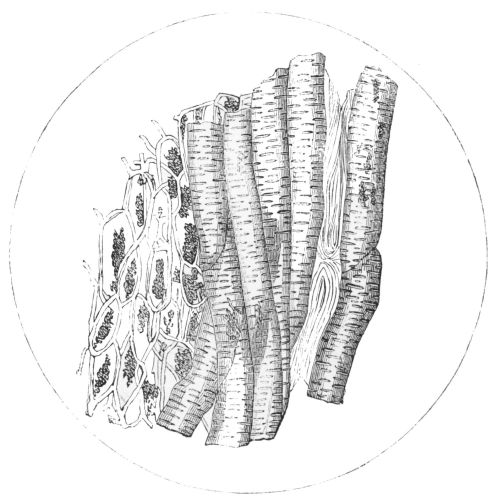
A Fragment of Roasted Coffee, being magnified 140 diameters.
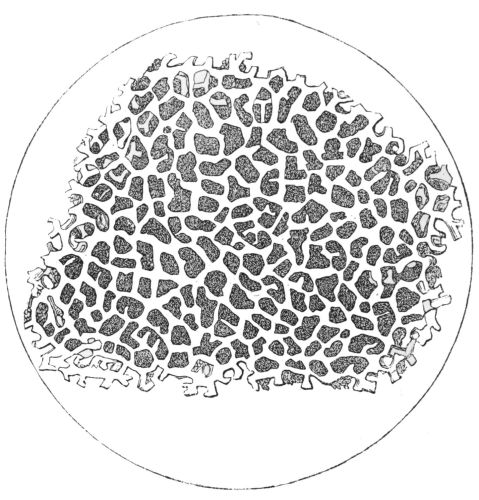
the coffee be pure, it for the most part floats, becomes very slowly moistened, even when shaken up with the water, and communicates scarcely any colour to the liquid; very gradually it imbibes water; the liquid acquires a very pale sherry tint; and at the end of several hours the greater part of the powder is found to have fallen to the bottom of the glass. If, however, it be chicorised, the presence of chicory (genuine or spurious) will be readily detected, by a portion of the suspected powder rapidly sinking and communicating to the liquid a reddish-brown tint, which will be more or less deep according to the amount of chicory present.
If the coffee be adulterated with what is called Hambro’ powder (roasted and ground peas, &c., coloured with Venetian red) or roasted corn, we have a further test in iodine, which communicates a purplish or bluish-red tint to the water to which either of these substances has been added. The preceding test is sufficiently delicate and valuable, in all ordinary cases, for detecting chicory in coffee; but to those familiar with microscopic investigations, the microscope furnishes another mode of proceeding: fragments of dotted ducts being found in chicory, but not in pure coffee. They are not met with, however, in great abundance; and some patience and care, therefore, are requisite in searching for them. The starch grains of Hambro’ powder are readily detected by the microscope, as also the blackening effect of a solution of iodine on them.
Plate 10 represents the structure and character of genuine ground roasted coffee, and of a fragment of roasted chicory-root, showing the dotted or interrupted spiral vessels which pass in bundles through the central parts of the root, magnified 140 diameters; copied, by permission, from Dr. Hassall’s work on “Food and its Adulterations.”
In the raw chicory-root three parts or structures may be distinguished with facility, cells, dotted vessels, and vessels of the latex. These vessels afford useful means of distinguishing chicory from some other roots employed in the adulteration of coffee. The chief part of the root is made up of little utricles or cells. These are generally of a rounded form, but sometimes they are narrow and elongated. The former occur when the pressure is least and the root soft, the latter in the neighbourhood of the vessels.[3]
There are four characters by which adulterated chicory may be distinguished from the genuine.
1st. It yields to cold water a much whiter colour. In using this test it is necessary to have a sample of genuine chicory for comparison.
2ndly. A decoction of chicory containing either roasted grain or pulse, yields when cold a purplish or bluish-black colour, with a solution of iodine; whereas a corresponding decoction of genuine chicory is merely coloured brown by iodine.
3rdly. The microscope detects in adulterated chicory the torrefied starch grains of either corn or pulse. That they are starch grains is shown by the action of a solution of iodine, which blackens them.
4thly. The odour and flavour will sometimes detect adulterations.
Roasted and ground chicory attracts water from the air, and thereby increases in weight and becomes clammy. The grinders are accustomed to return as much by weight of ground chicory as they receive of the unground root, for the loss which the root suffers by grinding is more than compensated by the absorption of water from the air.
THE END.
C. WHITING, BEAUFORT HOUSE, STRAND.
FOOTNOTES: