CLAN TRADITIONS. (continued 2)
Reading edition
One day when he and his sons were ploughing, two of the sons being at Sorabi, as there were few people in the neighbourhood, and his sons were at some distance from him, he had to go himself to the smithy to repair the ploughshare (a ghlasadh an t-suic). It was the beginning of summer, and he left the horses in the plough, eating the wild mustard (sgeallan) in the field where he was ploughing, grass and other herbage being scant. While their father was away at the smithy, the sons who were at Sorabi, on taking a look seawards, observed a boat (bìrlinn) coming in towards the shore. It kept its course for the small bay of boats (port nan long), in Balemartin, and had on board a very strong man called “Dark John Campbell” (Iain Dubh Caimbeul), who was sent to collect the tax from those in the island who were unwilling to pay it. He had an able crew with him in the boat. They landed, and when they reached the place where Dewar was ploughing, the first thing they did was to seize the horses in the plough (na h-eich a bha ’s an t-seisreach), to take them away in the boat as payment of the tax. When they were almost ready to be off, Dewar came in sight on his return from the smithy. On seeing the unwelcome strangers he quickened his steps to intercept them, and took hold of the horses to take them back. Campbell drew his sword, bidding him be off as fast as he could or he would put his head beside his feet. Dewar drew his own sword and said, “Come on and do all you are able.” The fray began between them, and Dewar was driving Campbell, Inveraray, backwards until he put him in among the graves (lic) in the burying-ground, and it so happened that Campbell stumbled on MacLean’s cross and fell backwards. Before he could raise himself Dewar got the upper hand of him. On seeing him fall, his men were certain that he must have been killed, and they went away with the horses to the boat and put off to sea. “Let me rise,” Campbell said, “and I will give you my word that I will never come again on the same errand.” “I will,” Dewar said, “but give me your oath on that, that it will be as that (gu ’m bi sin mar sin).” Campbell gave his word, “and more than that,” he said, “I will send you the value of the horses when I reach Inveraray.” “You will now come with me to my house,” Dewar said, “and you need not have fear or dread; your house-quarters and welcome will not be worse than my own, till you can find a way of returning home.” In the course of some days Campbell got away, and he never returned again to “bullyrag” or intimidate any one. On reaching Inveraray he was as good as his word. He sold the horses and sent the price to Dewar, who was never compelled to pay the tax.
NOTES:
THE BIG LAD OF DERVAIG.
Contemporary with John Dewar of Balemartin, Tiree, the Big Lad was living at Dervaig, Mull, with his father, Charles, son of Fair Neil of Dervaig. This lad, as he grew up to manhood, became noted for his great strength and prowess, as well as for his handsome person. At the same time he was reckless and foolish. Despising his father’s reproofs and heedless of his counsel, advice or admonitions, he went on in his mad career until at last he purloined money from him, with which he bought a ship and went sailing away, none of his friends knew whither. After some years he returned home, broken-down in appearance, empty-handed, and a complete “tatterdemalion,” having wrecked his ship on the coast of Ireland, and lost all the wealth he had accumulated to repay his father, who was now dead. The grieve (an t-aoirean) had the land, and he went where he was. The grieve told him about his father’s death, and advised him to go to his father’s brother, Donald, son of fair Neil, who had Hynish, Tiree, at that time, and whatever advice he would get from him, to follow it, and he (the grieve) would give him clothing and means to take him there, on condition of being repaid when he returned. As there was no other way open to him of redeeming his past errors, he agreed to the grieve’s conditions and went to Tiree to his uncle, by whom he was coldly received. “What business has brought you, and where are you going when you have come here?” “To ask advice from yourself,” he said. “Good was the advice your father had to give, and you did not take it; what I advise you to do is, to go and enlist in the Black Watch, and that will keep you out of harm. You will stay here to-night, and I will give you money to-morrow morning to take you to the regiment,” his uncle said. His uncle was married to a daughter of MacLean, Laird of Coll. Her husband did not tell her of his nephew’s arrival, as he was displeased at his coming. When the Big Lad was leaving the house next morning, she saw him passing the window and asked who the handsome-looking stranger was. On being told, she made him return to the house, gave him food, drink, and clothing, and on parting, money to take him on his way. He returned to Dervaig, paid the ploughman his due, and went off to the wars. At the first place he landed, said to be Greenock, a pressgang was waiting to seize whoever they could get to suit the king’s service, and on seeing this likely man they instantly surrounded him, to carry him off by force. He turned about and asked what they wanted with him. They said, “To take you with us in spite of you.” When he understood their intentions he opened his arms to their widest extent and drove all those before him, eighteen men, backwards into the sea, and left them there floating to get out the best way they could. He then made his way till he enlisted in the Black Watch, then on the eve of leaving for America, where it remained for seven years. During that time the Big Lad (an Gille mòr) won the esteem and commendation of his superiors in rank, by his exemplary conduct and good bearing, as well as the admiration and affection of his equals, to whom he was courteous and forbearing. When the regiment was returning to England, the officers frequently spent their leisure time, on board of the man-of-war that brought it home, playing dice. One day, when they were at their games, the Big Lad was looking on, and he saw a young man, one of the English officers, insolently, but more in jest than in earnest, striking on the ear the colonel of the regiment, who, the Big Lad knew, was a Highlander. When he saw the insult was not resented, he said in Gaelic to the Colonel, “Why did you let him strike you?” (C’ ar son a leig thu leis do bhualadh?). “You are, then, a Highlander,” the colonel said to him, “and you have been with me for seven years without telling me that you are.” “If you would do what I ask you, I will make you one that he will not do the same thing to you again,” he said to the colonel.
“What do you want me to do?” the colonel said. “That you will write out my discharge when we reach London,” he said. “But a soldier cannot get his discharge without an order (stamped) under the crown,” the colonel said. “Write what you can for me and I will not plead for more,” he said. “Anything I can write will not do you any good,” the colonel said. “Write that itself,” he said; and he got it written. Next time the play was going on, the Big Lad looked on, and when he saw the same one striking the colonel again, he went to him and asked why he did it. The reply he got was that soldiers were not allowed to question their officers. “This is my way of excusing myself,” the Big Lad said, giving him a blow he had cause to remember all his life, if he ever recovered from it. The soldier was sentenced to be severely punished, but on arriving in England, he deserted—though desertion of the army is not a custom of Highland soldiers—and became a fugitive. The great esteem in which he was held prevented any one from hindering his flight. He got ashore at night among the baggage, and harbour lights not being numerous in those days, he could not easily be seen making his escape. Whenever he got his foot on land he set off, and during the remainder of the night he ran on flying from pursuit. In the day-time he hid himself under hedges and haystacks, and next night fled on. On the following day he was becoming exhausted, and he ventured to ask food at a wayside house. As his appearance was that of a poor soldier he got scanty fare, but he asked with civility for better food, and it was given to him. While he was taking it two strangers came in to the same room with him, and seeing his table well supplied while their own was poorly furnished, one of them said, “It is strange to see a Highland soldier with good food, while we have next to nothing,” and he went over and swept away all the meat from the soldier’s table to his own. The soldier called the mistress of the house and asked her who the men were. She said they were travellers, and she asked them why they took the meat from the soldier’s table, and told them if they had in a civil manner asked better food for themselves they would have got it, instead of raising a quarrel. The soldier said he would settle the quarrel; and finding a large iron hoop (lùbach mhòr iaruinn) at hand, he straightened it (a fathom in length) and flung it round the head of the one nearest to him, then twisted it in a noose and put the other one’s head in the remainder. He then drew them both out after him, and left them on the high road. “Now,” he said to them at parting, “you can travel on, for you will not come out of that tie till you are put in a smithy fire (teallach gobhainn).” He returned to pay the hostess, who said to him, “You do not appear to have much money.” “I have seven day’s pay of a soldier left, to pay my way,” he said. “Good youth,” she said, “here is double the amount to you, to take you on your journey, and I am sufficiently repaid by your ridding my house of disagreeable guests.” He took the gift thankfully, and turned his face northwards, to come to Scotland (Albainn). The next evening, he saw a fine house, to which he went in the dusk, and asked permission to warm himself. He was allowed to enter, and while standing with his back to the fire, the daughter of the house saw the handsome stranger, and she told her father. He desired food to be given to him, and that he was to be sent where he was. When she went with this request, the soldier asked who her father was. She said he was a nobleman (àrd-dhuin’ uasal). “A soldier is a bad companion for a nobleman,” he said. He went with her and saw her father, a grey-haired man in a chair, looking about him. The soldier was asked to sit down. After conversing some time, the old man said, “Young man, I have a daughter here who gives me much trouble to keep her in company. If you can play cards (iomairt chairtean), take my place at the table; there is a money reward (duais airgid) for every game won.” “I have no money,” the soldier replied. “I will lend you some,” she said. The play went on till he won six games, one after another. He then wanted to stop playing, and offered her back all the winnings, but she would only take the sum she lent him, saying the rest was rightly his own. He was to remain there that night, and was not to go away in the morning without telling them. Being afraid of pursuit, he went away at daybreak. He had not gone far when he knew that a horseman was coming after him. He waited to see if he was sent to get back the money he had won at the card table; but it was a messenger with a request to him from the nobleman to return to the castle. When he appeared the nobleman chid him for leaving the castle unknown to him, and told him how his daughter had fallen in love with him, and had resolved never to marry any one else. The soldier said, “A soldier is a poor husband for her.” The nobleman was convinced that he was not a common soldier whatever circumstances had placed him in that position, and said he preferred his daughter’s happiness to wealth or rank. He remained with them and married the daughter; and when he laid aside the soldier’s dress, there was not his equal to be seen in the new dress provided for him. He was esteemed for the dignity of his demeanour as much as he was admired for his fine appearance, and he lived, without remembrance of his past misadventures, in the enjoyment of happiness and prosperity. In those days news travelled slowly, newspapers appearing only once or twice a year in populous villages, and they did not reach remote places. In one which came to the nobleman at this time, there was an account of two men tied in an iron rod (ann an slait iaruinn) who were being exhibited at a market town in England. He went with the nobleman and his friends to see this wonder, the two who were in the union (an dithis a bha ’s a’ chaigionn). Whenever the men saw the Highlander they said to him “If you were dressed in the kilt, we would say you were the man who put us in this noose.” “If you had been more civil,” he said to them, opening the coil, “when you met me, you would not to-day be fools going through England with an iron rod round your necks.” On this he was cheered by the people, and if he was held in esteem before, he was much more on his return home, where he remained and became a great man (duine mòr), beloved and esteemed to the end of his life.
STORY OF DONALD GORM OF SLEAT.
Donald Gorm was at one time in the Island of Skye with his galley and crew. When returning home to Uist, the day they set out happened to become very stormy, and stress of weather obliged them to return and make straight for Dunvegan, the nearest place of shelter they could reach, where Donald Gorm was not very willing to go if he could in any way avoid landing there, since he had killed MacLeod of Dunvegan in a quarrel[18] which had arisen between them; but there was no alternative. On observing the boat coming and in danger of being lost MacLeod and the men of Dunvegan went to the shore to meet them, and when they were safely landed gave them a kindly reception. MacLeod took them with him to his castle and provided hospitably for them. Donald Gorm was invited to MacLeod’s own table, but refused, saying, “When I am away from home, like this, with my men, I do not separate from them but sit with them.” MacLeod said, “Your men will get plenty of meat and drink by themselves, and come you with me.” “I will not take food but with my men,” he said. When MacLeod saw that Donald Gorm was resolved not to be separated from his own men, and being unwilling to let him sit with his, he asked in preference Donald Gorm’s men to his own company. When dinner was over, drinking commenced, and MacLeod becoming warm said to Donald Gorm by way of remembrance, “Was it not you who killed my father?” “It has been laid to my charge that I killed three contemptible Highland lairds (trì sgrogainich de thighearnan Gaidhealach), and I do not care though I should put the allegation on its fourth foot to-night;” Donald Gorm said, drawing his dirk: “There is the dirk that killed your father; it has a point, a haft (faillein), and is sharp edged, and is held in the second best hand at thrusting it in the west.”[19] MacLeod thought he was the second best hand himself, and he said, “Who is the other?” Donald Gorm shifted the dagger to his left hand, raised it, and said, “There it is.” MacLeod became afraid and did not revive any other remembrance. When Donald Gorm was offered a separate room at night, he said, “Whenever I am from home I never have a separate bed from my men but sleep in their very midst until I return to my own house again.” They told him that his men had a sleeping-place provided for them, and that he would be much better accommodated by himself in the room prepared for him. When they saw he could not be persuaded to alter his determination of passing the night with his men, they made beds for himself and men in the kiln (àth).[20] The men, being wearied, slept without care, but Donald Gorm did not close an eye. He had a friend, somehow, in his time of need (caraid éiginn air chor-eiginn), in the place, who came secretly to the kiln where he and his men lay, and called to him, “Is it a time to sleep, Donald?” (An cadal dhuit, a Dhòmhnuill?) “What if it is?” (’Dé na ’m b’ è?), he answered from within the kiln. “If it is, it will not be” (na ’m b’ è cha bhì), said the one outside. “Waken men, and rise quickly,” he said to his company. They got up at once and with all speed went out, shutting the door of the kiln behind them when they were all through to the outside. They fled straight to the shore and launched their boat; and fortunately for them the wind had calmed and they were able to put out oars and row the galley some distance from the shore before their flight was observed. They had not gone far to sea before they saw the kiln on fire. “In place of your father and grandfather you have left yourself without a house, and Donald Gorm is where you cannot reach him,” Donald Gorm said, and he got safely home to his own house without hurt or injury (gun bheud gun mhilleadh).
NOTES:
DONALD GORM IN MOIDART.
The wife of the laird of Moidart (Bean Mhac ’ic Ailein Mhùideart) once took great umbrage at Donald Gorm. He came to Mac ’ic Ailein’s house, dressed, as was his custom, in a suit of cloth of dun (natural) coloured sheep’s wool, with a stout oaken cudgel in his hand. The laird’s wife happened to be the first person he met, and without any preliminary word he asked, “Is the lad Mac ’ic Ailein at home?” (Bheil am balach Mac ’ic Ailein a stigh?) “No, he is not, at this time,” she answered indignantly resenting his superciliousness. The next question he asked was, “Will it be a long time before he comes home?” “I don’t know,” she said. “You will tell him when he returns home, that I was asking for him here, and that The Herd is the name I get (gur e am Buachaille a their iad rium).” Mac ’ic Ailein came home soon afterwards, and his wife told him about the bold man who was enquiring. At her husband’s request she described the stranger’s appearance and dress, and how “The Herd” was the name he got. “Did you ask him in?” her husband asked. “No,” she said, “he was so impertinent.” “None but me will pay the penalty for that,” he said, “for he was Donald Gorm of Sleat” (Dòmhnull Gorm Shléibhte). Mac ’ic Ailein desired a horse to be saddled, and he rode at full speed after, and overtook, Donald Gorm at the inn. After much entreaty he was persuaded to return to Mac ’ic Ailein’s house. On their arrival his wife made ample apology, and the friendship was not broken.
Mac ’ic Ailein had to hold MacConnel, the Herd of the Isles (Mac Chonnuill Buachaille nan Eileinean) stirrup at every feast and fair.
THE BLACK RAVEN OF GLENGARRY.
The boundary line between the estates of Glengarry and Kintail was, for ages, a winding river (amhuinn cham, literally “crooked river”) which often overflowed its banks, changed its course, and made encroachments on the land, sometimes on one side and as frequently on the other, causing disputes and quarrels, in regard to their respective rights and limits, between the proprietors of the estates which it separated; the tenantry (an tuath) on each property taking the part of their chief when the strife ran high. In order to put an end to the quarrelling the Chief of Glengarry (Mac ’Ic Alasdair) at this time insisted on a straight line being drawn to mark the boundary between them, but MacKenzie of Kintail would not give his assent to any proposal for changing the old line which followed the course of the river, and the feud broke out afresh (bha an tabaid air a bonn a rithist). Glengarry had three sons, and in the skirmish that took place on that occasion the two eldest sons were killed. The youngest having been left at home on account of his youth, escaped the fate of his brothers. He became known afterwards as the Black Raven of Glengarry. When he grew up to manhood his father said to him one day, “An insulting message (fios tàmailteach) has been sent to me from Kintail about the boundary line, and I must accept the challenge and gather the men, and you must go with us.” “If it is fighting you have in view,” said the Raven, “you must do it yourself, for me; my two dear brothers were killed through your foolish quarrels, and I would have been killed also if I had been old enough to be with them at the time, but since I can now understand how trifling the cause is, I will let yourselves be fighting.” His father could only gather his men and go to the contest without him. When they were out of sight, the Raven put on his best suit of armour and took several turns round the hill to elude the notice of any straggler who might have been left, and then set off at his utmost speed to get in advance of his father and men. Before evening closed he was at the head of Loch Duich, where he passed the night. Next day he procured a plaid of MacKenzie tartan which he wrapped round him to disguise the red badge (suaicheantas dearg) of Glengarry, and made his way to the enemy’s headquarters at Donan Isle (Eilean donnan), where the Kintail men were rapidly gathering to the fray. It was customary in those days to set a large long table (bòrd mòr fada) supplied with abundance of food and drink for the entertainment of the men who assembled from far and near. The Chief sat at the head, and every man on taking his place stuck his dirk (biodag) in the edge of the table in front of him before sitting down. The Black Raven got in among the men unnoticed, and when the Chief of Kintail came in, he said to the man who was beside him, “I wish to sit next to Kintail.” His appearance did not betray him, and no one objected to his request, but when he was taking the seat beside the Chief, he threw MacKenzie backwards on the ground and put his foot upon him to keep him down, and the point of his dirk resting on the breast of the prostrate man. His plaid having slipped aside, the red (an dearg) was exposed, and in an instant a hundred dirks were ready to riddle him (g’ a dheanamh ’n a chriathar-tholl); but he said, commanding them, “The moment I am approached, your Chief will be a dead man.” “If I fall,” he said to the Chief, “it will be on the hilt of my own weapon, and you will never rise—its point is on your breast, and any attempt to take my life imperils yours. I did not come here for war but for peace, and unless you will consent to lay aside all animosities, and solemnly promise never to renew this quarrel, your life is forfeited. I have only to press the hilt of this dagger, on which my hand rests, and whatever fate awaits me you will have no more power to do harm.” Kintail agreed to make peace, and gave his oath twice on the cold iron of the dirk on his breast that he would faithfully keep his promise. The Black Raven, after sharing in the hospitalities provided for the occasion, returned home, the Chief and men of Kintail accompanying him part of the way. When he met his father with his band of fighting men, he told them to return home, that he had done alone more than they had ever been able to do with all their boasting and fighting; he had put an end to their fighting, and got a guarantee for a lasting peace without one drop of bloodshed, and henceforth if he found any one among them making or renewing the quarrel, he would give the Chief of Kintail full liberty to treat them as he saw proper.
The friendship then made between the Chieftains was ever afterwards steadily maintained by them, and the Raven became one of the most distinguished men in the service of his country at that time.
CAILLEACH POINT, OR THE OLD WIFE’S HEADLAND,
Is one of the stormiest and most dangerous headlands on the west coast of Scotland. From base to top it is rocky, and for a considerable distance on each side.
It faces the Island of Coll, and commands a view of the Point of Ardnamurchan, from which it is distant about seven or eight miles. At its base there is a strong tidal channel which has never been known to be dry at the lowest ebb tide. From its highest point the spectre of “Hugh of the Little Head” is said to cross on horseback to Coll to give warning, as he is wont to do, to any descendants of the house of Lochbuie of their approaching end. Hugh is said to have had his head cut off by a broad sword in one of the clan skirmishes of old times. He has his head in a blaze of fire, and the tracks of his horse seen on the snow shew only three legs, and the terror of children and credulous people is increased by his being said to drag a chain after him. To the south of the Point there is a cave, which becomes accessible only when the tide has half fallen. Its Gaelic name is Uamh Bhuaile nan Drogh. Wild pigeons tenant it, and are seen emerging when the tide has fallen. The cooing sound of the birds heard under water seems to have led to the name, which means, the Cave of the Cattle-fold of the fairies, and it is noticeable that the word Drogh denotes that it first received its name from a Teutonic source, very possibly from the race that came ultimately to tenant the Orkney islands. It is said, however, that Dutchmen possessed the fisheries on the west coast of Scotland, and it has been suggested that the word Drogh is from Dragnet, which they kept in the cave. The tides which sweep past this point render it more difficult and dangerous to get past in a head wind than even the Point of Ardnamurchan, of which the dangerous character is well known. To the north of the Point in the direction of Croig in Mull, there is an indentation which is called Achlais na Caillich (the old woman’s oxter or armpit) where salmon nets are set. It has been characterised as not the armpit of a smooth woman (Achlais na mnà mìne) and the story which is said to have given its name to the Headland, is, that an old woman was gathering shell-fish in the neighbourhood when the tide began to make, and the woman finding no other means of escape made a last effort by climbing up the rocks. When at the top, and almost out of danger, she said “I am safe now, in spite of God and men” (Tha mi tearuinte nis ge b’ oil le Dia ’s le daoine). She was converted into a stone forming part of the rock distinctly to be seen from the highest point of Cailleach. It is said that the figure of the old woman was very distinctly to be seen at first, and hence the name of the Headland, but time has done its own work and the figure is not now so unmistakable. Even the origin of the name is only known to those who are natives of the neighbourhood.
On one occasion, the writer being himself ensconced under the side deck of a smack, then plying to the island, heard a Tiree boatman, who was conversing with a minister from the south of Argyleshire, and had no fancy for the overly pious talk of the too-zealous stranger, remarking that there was an old woman here and when she gave a snort, she could be heard over in Coll. [“Tha Cailleach an so ’s trà nì i sreothart cluinnidh iad ’an Cola i.”] The minister said that that was most extraordinary, and as it now began to rain the boatman began to exhort him to go below, and professed much regard for the minister’s health. At last he got rid of him.
A TRADITION OF ISLAY.
The western isles according to tradition were thinly inhabited for a long period of years, after the defeat and expulsion of the Norsemen. These invaders had left few of the natives alive and the land remained desolate. The first man then who took possession of the country was powerful John MacConnal who was called, the shepherd of the isles, and the first of the lords of the isles (Iain mòr Maconuil ris an abairteadh buachaille nan eileanan, b’e ceud tighearna nan eileanan). He had seven sons, among whom, when they came of age, he began to divide his possessions, but the Highlands and isles being too limited in his opinion for division among so many, he went away to Ireland with one of his sons, to overthrow one or more of the five kings by whom that country was then governed, and put his son in possession of any territory he might acquire in the contest, leaving his eldest son in Islay, which was the first of the isles possessed by him. In this enterprise he succeeded in seizing that part of Ireland then under the authority of the Earl of Antrim, and gave it to his son, whose nephew came from Islay, when some years had passed, to see him in Antrim. This nephew during one of those visits fell in love with a noblewoman of the country whom he asked in marriage. His proposal being agreed to, he was requested, as was then the custom, to name the dowry he wanted with her. His request was 700 men who had nicknames (far-ainmeannan) to take with him to Islay. In those days, it is said, that great men and nobles only had pseudonyms and he took this method of getting these and their followers to repeople the isles, and their descendants are yet to be found in many parts of the country as well as in the islands.
NOTES:
Islay is separated from the island of Jura by the sound of Islay and lies west of Cantyre in Argyleshire. Its extent is 25 miles long and 17 miles broad. The south west point is called the Rhinns (an roinn Ileach). The island is hilly and penetrated by an arm of the sea, Lochindaal, which is 12 miles long and 8 miles broad. There are good crops grown on the island and cattle are reared and fish is abundant on its coasts. A small quantity of various kinds of ore is found throughout the island, but its distilleries are its chief industry at the present day. It was in former times the chief residence of the Lords of the Isles, and the ruins of castles, forts, and chapels are numerous and interesting as records of a past age.
The Beatons or Bethunes and MacLarty are said to have been among those who came from Ireland with MacConuil. The latter being descendants of grey haired Niel (Nial Liath) who was interpreter (fear-labhairt) for Maconnal, hence the name. It is told of Niel, that being at one time surrounded by his enemies in a battle, he was commanded to deliver his sword. “If I do,” he said, “it will be by the point” (ma liubhras, ’sann an aghaidh a ranna), and cleaving his way through them he escaped and joined his companions.
After his settlement in the western island MacConnal (Iain Mòr MacConuill) is said to have divided his possessions among his seven sons by sending one of them John (Iain) to Glencoe, hence the patronymic Clan of the son of John of Glencoe (Clann ’ic Iain Ghleann-a-comhunn), another son Ronald (Raonull) was sent to Keppoch (a’ Cheapaich), one Allan (Ailean) was sent to Moidart (Mùideart). These were settled on the mainland in the counties of Argyle and Inverness, while the island of Skye was given to another son, Grim Donald of Sleat, (Dòmhnull gorm Shléibhte). Another son got the smaller isles, and another went to Ireland and became Earl of Antrim while the heir remained in Islay and held the adjacent islands as well as portions of the mainland. Of the 700 who returned with his son from Antrim to people the islands after the expulsion of the Norsemen, 22 were heads of families. The person from whom the writer heard this, now above 70 years of age, was certain that Beaton or Bethune was one of the names, but he had forgotten the others.
FAIR LACHLAN, SON OF FAIR NEIL OF DERVAIG. (Lachunn fionn mac Neill bhàin, Fear Dhearbhaig.)
At the time when Lachlan Kattanach was Chief of MacLean (ri linn Mhic-’illeathain Lachunn Cattanach na gruaige), his wife (a bhantighearna) dreamt about an Irish chief of the name of William O’Power (?) (Uilleam O’ buaidh) and in the same way, at the same time, this Irish Chief dreamt about her. It happened then that they began to communicate with each other. (At that time more trade was carried on with Ireland by these Western Isles than with any other place.) One day MacLean discovered that his wife was keeping on a correspondence, unknown to him, with the Irish Chief, and was much distressed about this injury to his honour. In order to test his wife’s affection for her secret lover, he went to her with a penknife in his hand and said, “There is a present O’ buaidh has sent you.” She looked at the knife and said,
“My darling who sent me the knife I weary at his delay in coming across the sea, And may I not enjoy health If I do love it better than the hand that holds it.” (M’ eudail ’chuir thugam an sgian ’S fhada leam a thriall thar muir, ’S na ’n a mheall mi mo shlàint’ Mur docha leam i na’n lamh ’sa bheil).
MacLean was then convinced of his wife’s disgrace, and went away and sent for his kinsman, Fair Lachlan (Lachunn fionn) who was then at Hynish, and who, on receiving a message from his Chief, went immediately to Island House. On reaching, MacLean said to him, “I sent for you to go to Ireland; you are a clever man and you have seven sons, go and bring me the head of O’Power, and any crime you may commit, or any injustice you may from this time do to any one, will be over looked by me (tha thu ’n ad dhuine tapaidh ’s seachdnar mhac agad, falbh ’s thoir g’ am ionnsuidh ceann Uilleam O’ buaidhe ’s aona chron na anaceart sam bith nì thu theid a mhathadh dhuit leamsa). Next day, Lachunn fionn with his sons set off in the galley, and before sundown he was in Islay. The following day he was in Ireland, and asked the first person he met for the man he was tracing (a bha e air a luirg). “If you wish to see him,” the person said, “he is coming this way, in a coach drawn by two white horses, and no one in Ireland has that but himself.” The old man then went on to try and meet him, and after going a short distance he saw him coming towards him to meet him (chaidh an sean duine air aghaidh feuch an tachradh e air, ’s an ceann ceum na dhà chunnaic e e tighinn ’na choinneamh ’s ’na chòmhail). When he came near, O’Power (O’ buaidh) commanded him to stop, and said, “I see you are a stranger in the place?” “Indeed,” he replied, (seadh ars’ esan). “Whence have you come?” the Chief asked, (Co ás a thàinig thu?). “I came from Tiree,” he answered. “Do you know the lady of MacLean there?” “I know her well,” he said. “Will you bring her a message from me?” (An toir thu fios uam g’ a h-ionnsuidh?) “I will,” he said, (bheir, ars’ esan). The chief there and then put the message in order, and put his head out of the coach to deliver it, but the other, while taking it with the one hand, struck off his head with the other hand. (Sin fhéin chuir e ’n teachdaireachd air doigh ’s chuir e mach a cheann g’ a toirt dà, ’s ’nuair bha e ’ga gabhail leis an aona laimh thilg e dheth an ceann leis an laimh eile). The man-servant was stupified (lit. went astray), (chaidh an gille air seacharan), and Fair Lachlan got an opportunity (fhuair e fàth) of taking the head with him to the galley with which he set sail (leig e ri cuain di) and was in Islay on his return journey that evening. Next day after (maireach ’na dheighinn sin) he was in Tiree, and went early in the day to Island House (do ’n eilean). Finding, on reaching, that MacLean and his wife were at breakfast, he went in where they were and put the head of the Irish Chief on the end of the table, with the face towards MacLean’s wife. She looked at it and fell down stone dead at the side of the table (sheall i air ’s thuit i fuar marbh aig taobh a’ bhùird). Some time after this Fair Lachlan’s sons were taking peats home from Moss to Hynish. There were five of them with seven horses, which were fastened together, and went on one after another, having a sort of deep basket (cliabh) slung on each side of each horse for the conveyance of burdens. On account of Big Dewar of Balemartin, who was so fierce, (co fiadhaich) they could not take the straight way by Balemartin to Hynish, but had to take the more rugged path by Hynish hill, where, at Creag nan cliabh (Creel rock) the footpath was so narrow that on these occasions a person was in waiting to be in readiness to take the creels off the horses and carry them past the rock. At that time, there was a mill past Balviceon, with a bridge across the dam which had to be lifted before sundown, and on their way they had to pass across the bridge. It happened on this occasion that the young men, by their own folly (le ’n amaideachd fhein), were later than usual of returning, and the bridge was withdrawn; and with the speed with which they were going on, they did not observe that the bridge was lifted, and the foremost of the horses went headlong into the dam and was choked (air a thachdadh). The lads made their way home, and told their father how the miller had taken away the bridge, and what had happened to them. He said, “If my horse was choked on his account (air a thàillibh), the same thing will be done to him to-night yet”; and that was what happened. He and his sons went back the same way, step by step, (air a’ cheart cheum), and they caught the poor man while he was asleep (rug iad air an duine ’na leabaidh) and took him with them and hung him on the hillock of the cross (bac na croiche), opposite Island House. When a servant went in early next morning to kindle a fire in the room where MacLean was, he asked what sort of day it was. The servant said that it was a good day, but that a strange sight was to be seen (ni a tha cuir ioghnadh mór orm ri fhaicinn). “What is that?” the Chief asked. “It is a man hung on the hillock up yonder (duine air a chrochadh air a’ chroich shuas ud). MacLean said, as he rose up, “Who or what person dared do this without my permission? (Co an aona duine ’san dùthaich aig an robh ’chridh leithid so dheanamh gun chuir ’nam cheadsa?) When he saw the deed that was done, he shed bitter tears, and said that no one had done this but Fair Lachlan (cha d’ rinn duine riamh so ach Lachunn fionn). “It was in the agreement I made with him when he brought me the man’s head from Ireland.” This was the last hanging that was done in the island (b’e so an crochadh mu dheireadh a rinneadh ’s an eilean).
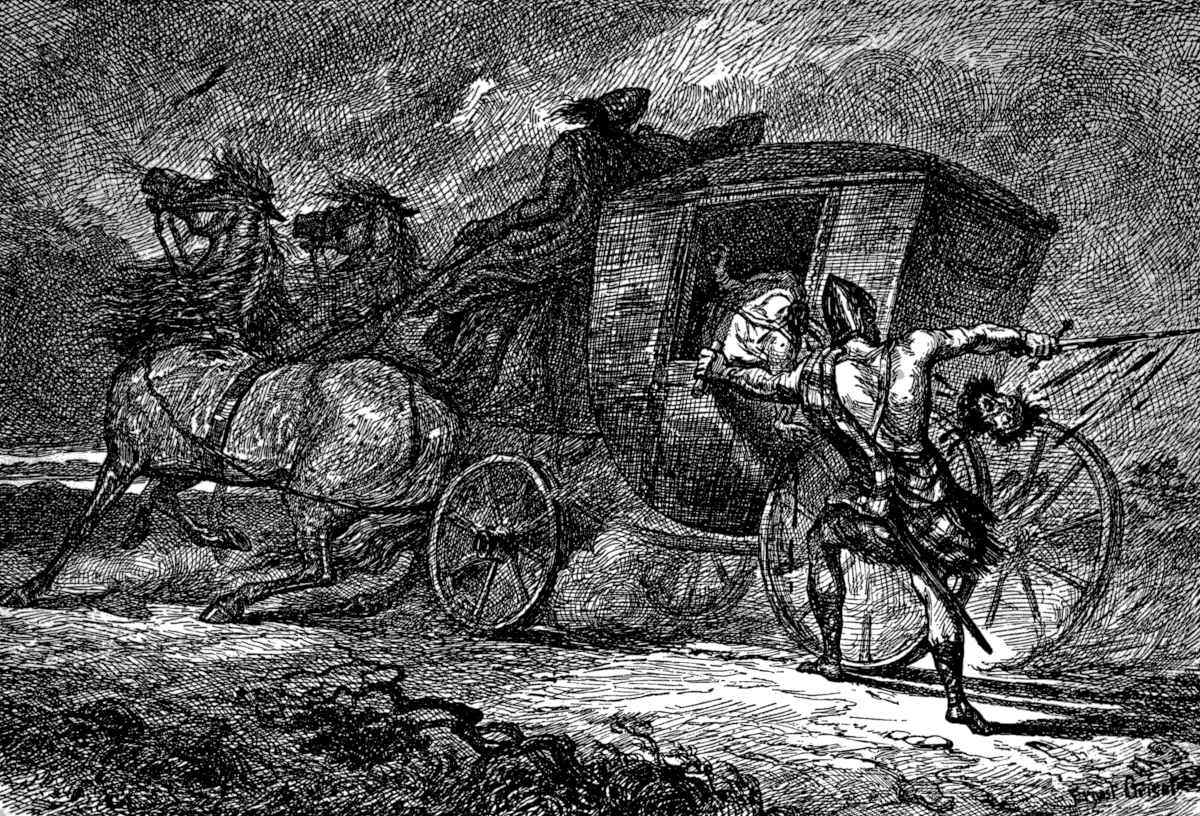
THE MESSAGE DELIVERED TO THE LOVER AND THE MANNER OF HIS DEATH.