BEAST FABLES.
Reading edition
THE WOLF AND THE FOX.
This story, like many others in which the lower animals figure as characters, is very popular in the Highlands, in fact, Mr. Campbell of Islay, by whom it is mentioned, could not help falling in with it. But the version published by him is destitute of several interesting incidents which form a part of the story. The narration depends always upon the knowledge and skill of the person who tells it, and this edition is given because there is to be found in it incidents of much interest and amusement, not to be found in any other version, such as the Fox’s oath and standing in front of the fire. The Gaelic is not given except in the essential expressions, and it is not deemed of much consequence to give more, as their fluency and number depend upon the reciter’s knowledge and tact. In these fables the lower animals appear with the same characteristics as are always assigned to them, and in this tale the fox appears as not only wily and cunning, but also as the most unprincipled scoundrel, indifferent to the interests of others, and also to what is usually of weight with men, the restraint of an unseen power.
The Fox and Wolf were keeping house together near the shore, and as might naturally be expected, were very poor and at times hard up for food. At first the fox kept himself in good condition, and was not so voracious as the wolf. After a heavy storm in winter time the two went along the shore to see what the sea had cast up. This is still done by poor people in the islands, and in those places where wood does not grow. They are often fortunate enough to find logs and planks of wood. On the occasion of the wolf and the fox’s journey they were fortunate enough to find a keg of butter. Probably it had come from Ireland and been swept or thrown overboard in the storm. It was particularly welcome to the poor finders, and the rascally fox at once coveted it for himself. He said to the wolf that, as this was the winter time, they had not so much need of it, but when the hungry summer (samhradh gortach) would come, it would be doubly welcome; they had better bury it, and no one would know of its existence but themselves. They dug a deep hole, buried the keg of butter, and went home with their other provisions. Some days after that the fox came in, and wearily throwing himself on a settle, or seat, which formed part of the furniture, he heaved a deep sigh and said, “Alas! Alas! Woe is me (Och! Och! fhéin thall).”
“Alas! Alas!” said the sympathising wolf, “what is it that troubles you?”
“Dear me,” said the fox, “they are wanting me out to a christening (Och! Och! tha iad ’gam iarraidh mach gu goisteachd),” still pretending a weary indifference, and the Gaelic expression is here noticeable, as, being asked out to a baptism means literally being asked to be god-father, or gossip at the baptism, a practise observed in the Highlands, even where the Roman Catholic and Episcopal systems have disappeared.
“Alas! Alas!” said the wolf, “are you going?”
“Alas! Alas!” said the fox, “I am.” When he came home, the wolf asked what name they had given the child. “A queer enough name,” said the fox, “Blaiseam,” (let me taste).
Some days after that again the same manœuvre was gone through, and when the fox returned and the wolf asked him the child’s name, he said it was as queer a name as the former one,—“Bi ’na mheadhon,” (be in its middle). A third time the manœuvre was gone through and the child’s name was said to be the queerest of all, “Sgrìob an clàr,” (scrape the stave).
At last the “hungry summer” came; and it was such as is well known even in eastern countries when the stores of the preceding harvest are exhausted, and the stores of the year’s harvest are not yet ready. The fox and the wolf went for the keg of butter, but it had disappeared. The fox being prepared for this emergency began at once to accuse the wolf of having taken it, “No one knew it was there but our two selves, and I see the colour of it on your fur.”
The two went away home, the wolf very much cast down, and the fox persisting in his accusation that the wolf had stolen it. The wolf solemnly protested that he had never touched it.
“Will you swear then?” the fox said.
According to a Highland proverb, protestations may be loud till they are solemn oaths (’S mòr facal gu lùghadh). The wolf then held up its paw, and with great solemnity emitted this oath, “If it be that I stole the butter, and it be, and it be, may disease lie heavy on my grey belly in the dust, in the dust,” (Ma ’s mise ghoid an t-ìm, ’s gur mi, ’s gur mi, Galar trom-ghlas air mo bhronnghlas anns an ùir, anns an ùir).
“Swear now yourself,” but the fox was so impressed by the dignity and reverence of the oath, that he tried every means in his power to evade so solemn an ordeal; but the wolf would take no refusal, and at last the fox emitted this oath, “If it be I that stole the butter, and it be, and it be, Whirm, Wheeckam, Whirram, Whycam Whirrim Whew, Whirrim Whew,” (Ma’s mise ’ghoid an t-ìm ’s gur a mi, ’s gur a mi, ciream, cìceam ciream cuaigeam, ciream ciu, ciream ciu). The student of language will observe how the Gaelic C corresponds to the English Wh. This is particularly noticeable here as the difference renders the oath as ludicrous in the translation as in the original, if not more so. The wolf said nothing, but the fox, with that persistence which often accompanies evil-doing, suggested that they should both stand in front of the fire and whoever began to sweat first would be the guilty party, as the butter would be oozing out through him. The wolf thinking no evil, consented, and the fox thought he would get him to stand nearer to the fire than himself. It so turned out however, that the fox, who had kept himself in good condition by repeated visits to the keg of butter, (and they must have been more frequent than the baptisms to which he said he had been called), was getting uncomfortably warm, and said, “We are long enough at this work, we had better go out and take a walk.” When out thus cooling themselves, they passed a smithy door, at which an old white horse was standing with the point of its hind shoe resting on the ground. The wolf having gone over to it, but at a safe distance, and looking intently at the door, said to the fox, “I wish, as your eyesight is better than mine and you can read better than I can, that you would come over and read the name written on the horse shoe.”
The fox came over but could see no writing on the shoe, but flattered by the wolf’s words, and not liking to confess that his eyesight was failing, it went closer and the horse lifting its foot knocked its brains out.
“I see,” said the wolf, “the greatest scholars are not always the wisest clerks,” (Cha ’n i an ro-sgoilearachd a ’s fhearr.—Lit.—Excessive scholarship is not always the best).
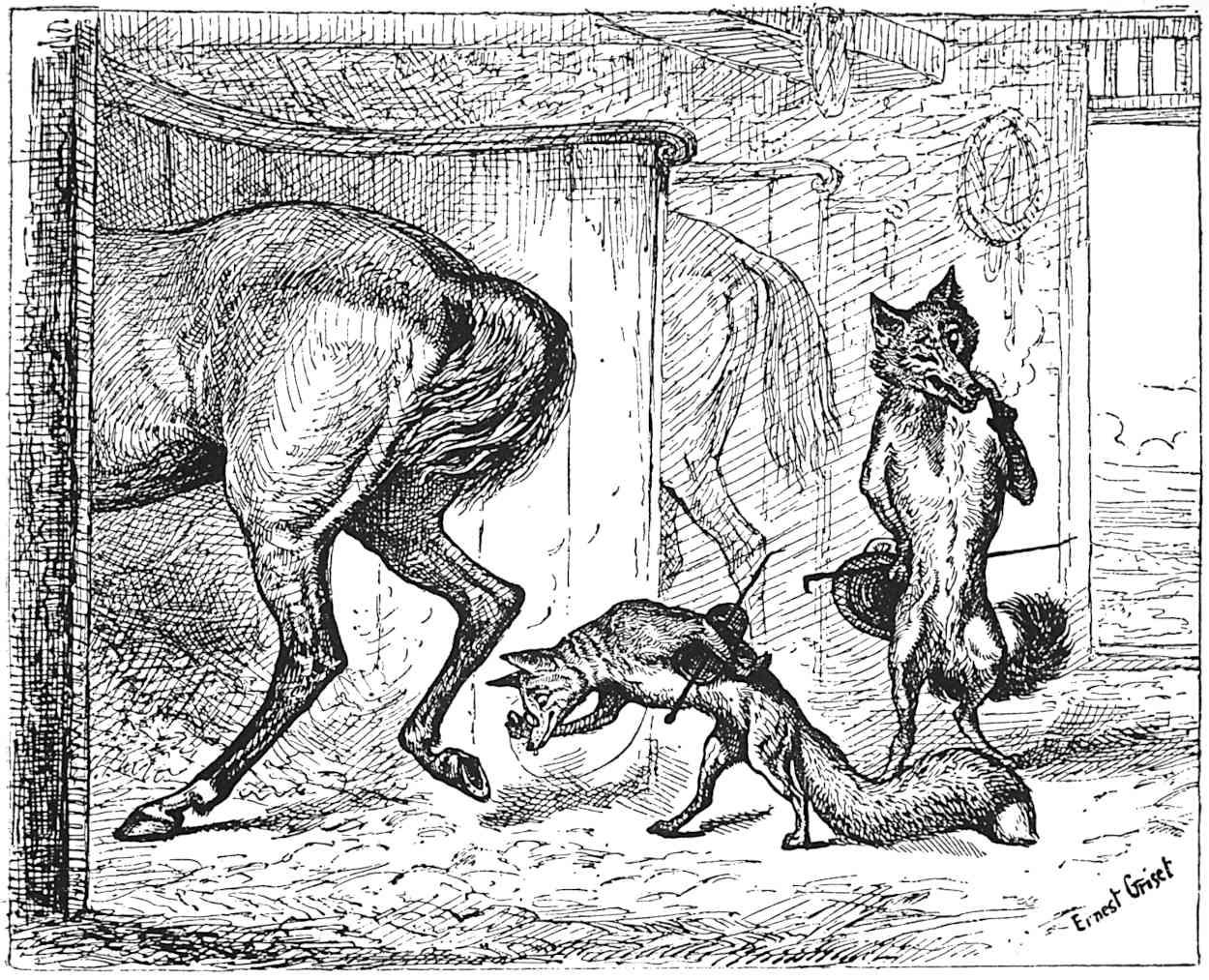
THE FOX AND THE WOLF.
THE FOX AND THE BIRD.
In the foregoing the fox appears true to his character as an unscrupulous, grasping, wily wretch, and in the following he appears as over reached by a bird. Considering the character the fox bears, one is glad when he is paid back in his own coin. The bird in the tale is by some rendered Kestrel Hawk, and by others Hen Harrier. The story was heard in Tiree, in which are no trees on which the bird could sit, and no hawks or foxes to make the story applicable. The lesson which the fable implies is one that is useful everywhere.
A Deargan-allt, Eun Fionn, was dosing by a river side, when a Fox came and caught it, and was going to devour it. “Oh don’t, don’t,” said the bird, “and I will lay an egg as big as your head.”
He protested this so loudly, and so solemnly, that the fox loosened his hold till the bird at last flew up into a tree. Here sitting on a branch, and safe from further injury, it said to the fox, “I will not lay an egg as big as your head, for I cannot do it, but I will give you three pieces of advice, and if you will observe them, they will do you more good in the future. One, first, “Never believe an unlikely story from unreliable authority (Na creid naigheachd mi-choltach fo urrainn mi-dhealbhach). Secondly, “Never make a great fuss about a small matter (Na dean dearmail mhòr mu rud beag), and thirdly”—here the bird seemed to take time, and the fox having his curiosity now excited listened, though it was with firmly clasped teeth and pangs of hunger—“Whatever you get a hold of, take a firm hold of it” (Rud air an dean thu greim, dean greim gu ro-mhath air), saying this, the bird flew away, and the fox, thus neatly sold, was left lamenting.
THE WREN.
In the Fables relating to animals the fox readily takes a lead, and is characterised as an unscrupulous and unprincipled rascal. Next to him the wren, which is the smallest (or at least has the name of being so) of British birds figures, and has got the name not only of being small, but also of being forward and pert. The first or most prominent of these fables is that in which the wren appears as contesting with the eagle the supremacy among birds, and this story may be said to be as widely extended over the Highlands as the birds themselves. There was to be a contest which bird should fly highest, and the wren jumped upon the eagle’s back. When the eagle had soared as high as it could, it said, “Where are you now, brown wren?” (C’ àite bheil thu, dhreathan donn?). The wren jumped up a little higher and said, “Far, far, above you” (Fada fada fos do chionn). In consequence of this extraordinary feat the wren has twelve eggs while the eagle has only two.
Natural historians assert that the number of wren’s eggs in one nest seldom exceed eight, but others have stated that the most number is twelve or even fourteen. In these tales which have been got together in the West Highlands, the number is uniformly said to be twelve, but whether this is actually the case or merely an assumption, there is no call here for enquiring.
The wren and his twelve sons were threshing corn in a barn, when a fox entered and claimed one of the workers for his prize. It was agreed, since he must get some one, that it should be the old wren, if he himself could point him out from the rest. The thirteen wrens were so much alike that the fox was puzzled. At last he said, “It is easy to distinguish the stroke of the old hero himself” (’S fhurasda buille an t-sean laoich aithneachadh). On hearing this, the old wren gave himself a jauntier air, and said, “there was a day when such was the case” (Bha latha dha sin). After this the fox had no difficulty, for boasting was always illfated (bha tubaist air a’ bhòsd riamh) and he took his victim without any dispute.
On another occasion the wren and his twelve sons were going to the peatmoss, when they fell in with a plant of great virtue and high esteem. The old wren caught hold of the plant by the ears, and was jerking it this way and that way, hard-binding it, and pulling it, as if peat-slicing; white was his face and red his cheek, but he failed to pull the plant from the bare surface of the earth: the plant of virtues and blessings—(Bha e ’ga dhudadh null ’s ’ga dhudadh nall, ’ga chruaidh-cheangal ’s ’ga bhuain-mòine; bu gheal a shnuadh ’s bu dhearg a ghruaidh, ’s cha tugadh e Meacain o chraicionn loma na talmhain; Meacan nam buadh ’s nam beannachd).
The wren called for the assistance of one of his sons, saying, “Over here one of my sons to help me” (An so aon eallach mo mhac nall), and they caught the plant in the same way, jerking it this way and that way, hard-binding and peat-slicing with it; white were their faces and red their cheeks, but they could not with all their ardour, and their utmost strength pull the plant from the bare surface of the earth: the plant of virtues and blessings (’S bha iad ’ga dhudadh null ’s ’ga dhudadh nall, ’ga chruaidh-cheangal ’s ’ga bhuain-mòine; bu gheal an snuadh ’s bu dearg an gruaidh ach le ’n uile dhichioll ’s le ’n cruaidh-neart cha tugadh iad am Meacan o chraicionn loma na talmhain: Meacan nam buadh ’s nam beannachd).
“Over here with two of my sons to help me” (An so dà eallach mo mhac nall), and the same operation was again performed unsuccessfully, and in the same way one after another, until the whole twelve sons came to the assistance of the old wren. Then they grasped it altogether, and under the severe strain the plant at last yielded, and all the wrens fell backwards into a peat pond and were drowned.
The old man from whom this story was heard said, that in winter time, when knitting straw ropes for thatching, he could get all the boys of the village to come to assist him, and keep him company, and this they did with cheerfulness on the understanding that the story of “The wren and his twelve sons” would be illustrated at the end. One after another of the boys sat on the floor behind him, and he having a hold of the straw rope was able easily to resist the strain till he choose to let go, then all the boys fell back and the laughter that ensured was ample reward for their labour.
The fame of the wren for its forwardness and impudence is also illustrated by a story current in the south of Scotland, about Robin Redbreast having fallen sick, and the wren paying him a visit, and expressing great condolence when, after making his will, Robin dismissed her, saying, “Gae pack oot at my chamber door, ye cuttie quean.” In Gaelic the wren is also known by the name of Dreòllan, and Dreathan-donn, and the name as applied to human beings means a weakly, imbecile, trifling person, in whatever he takes in hand to do.
All the other birds in the same manner have their own share of actions ascribed to them, and the manner in which several of them made a brag of their own young is amusing—particularly in Gaelic, in which the call ascribed to them is more capable of imitation, and particularly in the light of the manner in which the young of those who make the boast are looked upon.
“Gleeful, gleeful,” said the Gull, “my young is the supreme beauty.”
“Sorry, sorry,” said the Hooded Crow, “but my son is the little Blue Chick.”
“Croak, croak,” said the Raven, “it is my son that can pick the lambs.”
“Click, click,” said the Eagle, “it is my son that is lord over you.”
(“Glìtheag, glitheag,” ors an Fhaoilean, “’se mo mhac-sa an Daogheal Donn.”
“Gurra, gurra,” thuirt an Fheannag, “’se mo mo mhac-sa an Garrach Gorm.”
“Gnog, gnog,” ors am Fitheach, “’s e mo mhac-sa ’chriomas na h-uain.”
“Glig, glig,” thuirt an Iolaire, “’s e mo mhac-sa ’s tighearna oirbh.”)
In the Highlands the young gull is called Sgliùrach which is the regular name for a slatternly young woman. It is seen in the midst of a storm alighting in the hollows, and restfully gliding to the highest summits of the waves.
The hooded crow’s fancy for its own young has passed into a proverb, “The hooded crow thinks its own impertinent blue progeny pretty” (’S bòidheach leis an fheannaig a garrach gorm fhein”).
Of the Raven it is commonly said, that it is so fond of its victim’s eyes that it will not even give them to its own young. Its supernatural knowledge of where carrion is to be found amounts almost to instinct, and is among the vices (Dubhailcean) ascribed to the bard.
The eagle can only fly from an elevated situation, from the difficulty of getting wind under its wings, and in this respect forms a great contrast to the little wren.
Of other tales in which the lower animals figure, the three following are noticeable.
I.—The Two Deer. The young, confident of its own speed and strength, remarked:—
“Sleek and yellow is my skin, And no beast ever planted foot On hillside that could catch me.”
The old deer, who knew better, answered,
“The young dog black-mouthed And yellow: the first dog Of the first litter. Born in March, And fed on quern meal and goat’s milk, There never planted foot on hillside Beast it could not catch.” (Sleamhuinn ’s buidhe mo bhian, ’S cha do chuir e eang air sliabh Beathach riamh ’bheireadh orm.” “An cuilean bus-dubh buidhe, Ceud chù na saighe Rugadh anns a’ Mhàrt ’S a bheathaichte air gairbhean ’S air bainne ghabhair Cha do chuir e eang air sliabh Beathach riamh nach beireadh e air).
Regarding this description of the deer-hound it deserves notice that the word Màrt, translated March, denotes any busy time of the year, there being a màrt, or busy season in harvest as well as in spring, Màrt Fogharaidh as well as in Màrt Earraich, and that in the islands meal made with the Quern (Bràthuin), and from brown oats, which are the kind of oats most common in these islands, is stronger and more nourishing food than common meal. The merits of goat’s milk are well known. This description of the best kind of deer-hound is striking, and was taken down from a reciter in Skye.
II.—The Two Horses. Two horses were standing side by side, ready yoked and ready to commence ploughing, when the youngest, who was but newly broken, and a stranger to field work, said, “We will plough this ridge and then that other ridge and after that the next one, and once we have commenced we will do every ridge in sight, and once we have fairly commenced we will not be long in doing the whole field.” The old horse, who had experience of the work, said, “We will plough this furrow itself first.”
III.—The Two Dogs. There was a big, sleek, honest-looking dog, and a little yelping cur of “low degree” was always annoying him, and barking at him. One day he caught the little cur, and gave him a squeeze and sent it off yelping. When the cur recovered itself it said, “I will not hurt you or touch you, but I will raise an ill report (droch-alla) about you.” In pursuance of his threat the cur went among his acquaintances, and such as he himself was. There are many dogs to be found in every town.
“Both mongrel puppy whelp and hound And curs of low degree.”
and to such the cur related how the big dog for all his smooth appearance and apparent good nature was in reality a cruel, deceitful dog and under all his apparent or seeming good manners, he was ready to fall upon those weaker than himself, whether they gave him cause or not, and if he could do it without being observed give them a bad shaking. He was a dangerous dog and ought to be watched and no wise dog should put himself in his way.
This calumny made its way, found many believers and at last produced its natural fruit. The big honest dog found his company avoided and every body looking upon him with suspicion.
At first the depression, and gloom which haunted him disappeared under a hearty run, and the patting of its master, but it preyed so much on him that he came to avoid society, and to be apparently indifferent to any company. This happens in the experiences of life, and that causeless and evil reports are most dangerous in their consequences. Some time afterwards the cur was similarly dealt with by another cur, who like himself had not very high principles.
THE CAT AND THE MOUSE. A Gaelic Nursery Rhyme.
The Mouse said from her hiding place, “What are you about, Grey Cat?” “Friendship, fellowship and love: You may come out!” “Well I know the hooked claw That is fastened in the sole of your feet You killed my sister yesterday, And with difficulty I myself escaped, You thieving cat, son of the grim grey one, Where were you yesterday when from home?” “I went away on my left hand To hunt for mince-meat in an evil hour; I was noticed by the goodman of the house, My eye being shut and my cheek full; He tightened my throat very hard, And called out to bring him the cheese-knife, He cut off one of my ears And the red root of the ear to the bone.” Thuirt an Luchag, ’s i ’s an fhròig, “’Dé th’ air t’ aire, a Chait Ghlais?” “Càirdeas ’s comunn ’s gaol: Feudaidh tusa tighinn a mach.” “Is eòlach mi air an dubhan chrom ’Tha ’n sàs ann am bonn do chas! Mharbh thu mo phiuthar an dé, ’S ann air éiginn ’fhuair mi-fhéin as. A chaoitein, mhic Ghrìmeich Ghlais, C’ àit an robh thu ’n raoir air chuairt?” “Dh’ fhalbh mi air mo làimh-chlì ’Shealg nan ìsbean ’s an droch uair; Mhothaich fear-an-tighe dhomh, Mo shùìl druidte ’s mo phluic làn; Theannaich e m’ amhach gu cruaidh, ’S ghlaodh e nuas air corc a’ chàis, Thug e dhiom-sa an leth-chluas ’S am faillein ruadh gu ruig an cnàimh.”