Part 6 — CHAPTER XXIV
Reading edition
THE OVERTHROW OF RECONSTRUCTION
The Republican Party in 1874
The Republican party of Alabama went into the campaign of 1874 weakened by dissensions within its own ranks and by the lessening of the sympathy of the northern Radicals. During the previous six years the opposition to the radical Reconstruction policy had gradually gained strength. The industrial expansion that followed the war, the dissatisfaction with the administration of Grant, the disclosure of serious corruption on the part of public officials, and the revelations of the real conditions in the South—these had resulted in the formation of a party of opposition to the administration, which called itself the “Liberal Republican” party and which advocated home rule for the southern states. The Democratic party, somewhat discredited by its course during the war, had now regained the confidence of its former members by accepting as final the decisions of the war on the questions involved and by bringing out conservative candidates on practical platforms. By 1874 nine northern states had gone Democratic in the elections; from 1869 to 1872, five southern states returned to the Democratic columns. The lower house of Congress was soon to be safely Democratic and no more radical legislation was to be expected; the executive department of the government alone was in active sympathy with the Reconstruction régime in the southern states.
The divisions within the party in the state were due to various causes. In the first place, the action of the more respectable of the whites in deserting the party left it with too few able men to hold the organization well together. By 1874 all but about 4000 whites had forsaken the Republicans and returned to the Democrats. These whites were mainly in north Alabama, though there were some few in the Black Belt,—five, for instance, in Marengo County, and fifty in Dallas. A further source of weakness was the disposition of the black politician to demand more consideration than had hitherto been accorded to him. The blacks had received much political training of a certain kind since 1867, and the negro leaders were no longer the helpless dupes of the carpet-bagger and the scalawag. A meeting of the negro politicians, called the “Equal Rights Union,” was held in Montgomery in January, 1874. The resolutions adopted demanded that the blacks have first choice of the nominations in black counties and a proportional share in all other counties. They expressed themselves as opposed to the efforts of the carpet-baggers to organize new secret political societies, “having found no good to result from such since the disbursement [sic] of the Union League.”[2120] If the negroes should be able to obtain these demands, nothing would be left for the white members of the party. The rank and file of the blacks had lost much of their faith in their white leaders and were disposed to listen to candidates of their own color. Closely connected with the negroes’ demands for office were their demands for social rights. The state supreme court had decided that whites and blacks might lawfully intermarry, and there had been several instances of such marriages between low persons of each race.[2121] Noisy negro speakers were demanding the passage of the Civil Rights Bill then pending in Congress. A Mobile negro declared that he wanted to drink in white men’s saloons, ride in cars with whites, and go to the same balls. The white Radicals in convention and legislature were disposed to avoid the subject when the blacks brought up the question of “mixed accommodations.” The negroes constantly reminded the white Radicals that the latter were very willing to associate with them in the legislature and in political meetings. The speeches of Boutwell of Massachusetts and Morton of Indiana in favor of mixed schools were quoted by the negro speakers, who now became impatient of the constant request of their leaders not to offend north Alabama and drive out of the party the whites of that region. Lewis, a negro member of the legislature, declared that they were weary of waiting for their rights; that the state would not grant them, but the United States would; and then they would take their proper places alongside the whites, and “we intend to do it in defiance of the immaculate white people of north Alabama.... Hereafter we intend to demand [our rights] and we are going to press them on every occasion, and preserve them inviolate if we can. The day is not far distant when you will find on the bench of the supreme court of the state a man as black as I am, and north Alabama may help herself if she can.”[2122] An “Equal Rights Convention,” from which white Radicals were excluded, met in Montgomery in June, 1874. The various speakers demanded that colored youths be admitted to the State University, to the Agricultural and Mechanical College, and to all other schools on an equal footing with the whites, “in order that the idea of the inferiority of the negro might be broken up.” Several delegates expressed themselves as in favor of mixed schools, but advised delay in order not to drive out the white members of the party. A negro preacher from Jackson County said that he wanted to hold on to the north Alabama whites “until their stomachs grew strong enough to take Civil Rights straight.”[2123] In 1867 and 1868 there had been some blacks who had opposed the agitation of social matters on the ground that their civil and political rights would be endangered, but these were no longer in politics. The result of the agitation in 1874 was to irritate the whites generally and to cause the defection of north Alabama Republicans.
Another cause of weakness in the Radical party was the quarrel among the Reconstruction newspapers of the state over the distribution of the money for printing the session laws of Congress. The State Journal and the Mountain Home lost the printing, which, by direction of the Alabama delegation in Congress, was given to the Huntsville Advocate and the National Republican, “to aid needy newspapers in other localities for the benefit of the Republican party.” The result was discord among the editors and a lukewarm support of the party from those dissatisfied.[2124]
In 1874 in each county where there was a strong Republican vote discord arose among those who wanted office. Every white Radical wanted a nomination and the negroes also wanted a share. The results were temporary splits everywhere in the county organizations, which were usually mended before the elections, but which seriously weakened the party. The Strobach-Robinson division in Montgomery County may be taken as typical. Strobach was the carpet-bag sheriff of Montgomery County, which was overwhelmingly black. There was reason to believe that Strobach was being purchased by the Democrats.[2125] The stalwarts accused him of conspiring with the Democrats to sell the administration to them. They charged that he would not allow the negroes to use the court-house for political meetings, that entirely too many Republicans were indicted at his instance, and that he summoned as jurors too many Democrats and “Strobach traitors” and too few Republicans. As leader of the regular organization Strobach had considerable influence in spite of these charges, and his enemies undertook to form a new organization. The leaders of the bolters, known as the Robinson faction, were Busteed, Buckley, Barbour, and Robinson. They made the fairest promises and secured the support of the majority of the negroes, though Strobach still controlled many. Between the two factions there was practically civil war during 1874. The bolters organized their negroes in the “National Guards,” a semi-military society—5000 or 6000 strong. This body broke up the Strobach meetings, and serious disturbances occurred at Wilson’s Station, Elam Church, and at Union Springs. At the latter place the bolters attempted to take forcible possession of the congressional nominating convention. The negroes, led by a few whites, invaded the town, firing guns and pistols and making threats until it seemed as if a three-cornered fight would result between the whites and the two factions of the blacks. Rapier, the negro congressman, made peace by agreeing to support the Robinson-Buckley faction provided they kept the peace and allowed him to receive the nomination for Congress from the other faction. They forced him to sign an agreement to that effect, which he repudiated a few days later. The bolters were not admitted to the state convention in 1874, and thus weakness resulted. During the summer and fall of 1874, ten or twelve negroes were killed and numbers injured in the fights between the factions.[2126]
The Democrats naturally did all that was possible to encourage such division in the ranks of the enemy. Bolting candidates and independent candidates, especially negroes, were secretly supported by advice and funds. Carpet-bag and scalawag leaders were purchased, and agreed to use their influence to divide their party. To some of them it was clear that the whites would soon be in control, and meanwhile they were willing to profit by selling out their party.[2127] For two or three years it had been a practice in the Black Belt for the Radical office-holders to farm out their offices to the Democrats, who appointed deputies to conduct such offices. The stalwarts now endeavored to cast these men out of the party, but only succeeded in weakening it.
The Negroes in 1874
In spite of all adverse influence, however, the great majority of the negroes remained faithful to the Republican party and voted for Governor Lewis in the fall elections. They missed the rigid organization of former years, and many of them were greatly dissatisfied because of unfulfilled promises made by their leaders; but the Radical office-holders, realizing clearly the desperate situation, made strong efforts to bring out the entire negro vote. The Union League methods were again used to drive negro men into line. They were again promised that if their party succeeded in the elections, there would be a division of property. Some believed that equal rights in cars, hotels, theatres, and churches would be obtained. Clothes, bacon and flour, free homes, mixed schools, and public office were offered as inducements to voters. In Opelika, A. B. Griffin told the negroes that after the election all things would be divided and that each Lee County negro would receive a house in Opelika. To one man he promised “forty acres and an old gray horse.” Heyman, a Radical leader of Opelika, told the blacks that if the elections resulted properly, the land would be taxed so heavily that the owners would be obliged to leave the state, and then the negroes and northerners would get the land.[2128]
Promises of good not being sufficient to hold the blacks in line, threats of evil were added. Circulars were sent out, purporting to be signed by General Grant, threatening the blacks with reënslavement unless they voted for him. The United States deputy marshals informed the blacks of Marengo County that if they voted for W. B. Jones, a scalawag candidate who had been purchased by the whites, they would be reënslaved. Heyman of Opelika declared that defeat would result in the negroes’ having their ears cut off, in whipping posts and slavery. Pelham, a white congressman, told the blacks that if the Democrats carried the elections, Jefferson Davis would come to Montgomery and reorganize the Confederate government. So industriously were such tales told that many of the negroes became genuinely alarmed, and it was asserted that negro women began to hide their children as the election approached.[2129]
The negro women and the negro preachers were more enthusiastic than the negro men, and through clubs and churches brought considerable pressure to bear on the doubtful and indifferent. They agreed that negro children should not go to schools where the teachers were Democrats. In Opelika a negro women’s club was formed of those whose husbands were Democrats or were about to be. The initiate swore to leave her husband if he voted for a Democrat. This club was formed by a white Radical, John O. D. Smith, and the negroes were made to believe that General Grant ordered it. A similar organization in Chambers County had a printed constitution by which a member, if married, was made to promise to desert her husband should he vote for a Democrat, and a single woman promised not to marry a Democratic negro or to have anything to do with one. The negro women were used as agents to distribute tickets to voters. These tickets had Spencer’s picture on them, which they believed was Grant’s.[2130]
In the negro churches to be a Democrat was to become liable to discipline. Some preachers preferred regular charges against those members who were suspected of Democracy. The average negro still believed that it was a crime “to vote against their race” and offenders were sure of expulsion from church unless, as happened sometimes, the bolters were strong enough to turn the Republicans out. Nearly every church had its political club to which the men belonged and sometimes the women. Robert Bennett of Lee County related his experience to the Coburn Committee. He wanted to vote the Democratic ticket, he said, and for that offence was put on trial in his church. The “ministers and exhorters” told him that he must not do so, saying, “We had rather you wouldn’t vote at all; if you won’t go with us to vote with us, you are against us; the Bible says so.... We can have you arrested. We have got you; if you won’t say you won’t vote or will vote with us, we will have you arrested.... All who won’t vote with us we will kick out of the society—and turn them out of church;” and so it happened to Robert Bennett.[2131]
The efforts made to hold the negroes under control indicate that numbers of them were becoming restless and desirous of change. This was especially the case with the former house-servant class and those who owned property. One negro, in accounting for his change of politics, said, “Honestly, I love my race, but the way the colored people have taken a stand against the white people ... will not do.” Of the white Radicals he said, “They know that we are a parcel of poor ignorant people, and I think it is a bad thing for them to take advantage of a poor ignorant person, and I do not think they are honest men; they cannot be.” He said that the Radicals promised much and gave little; that they never helped him. The Democrats gave him credit and paid his doctor’s bills; so that it was to his interest to vote for the Democrats—“I done it because it was to my interest. I wanted a change.” Another negro explained his change of politics by saying that bad government kept up the price of pork, and allowed sorry negroes to steal what industrious negroes made and saved—eggs, chickens, and cotton. When Adam Kirk, of Chambers County, was asked why be belonged to the “white man’s party,” he answered: “I was raised in the house of old man Billy Kirk. He raised me as a body servant. The class that he belongs to feels nearer to me than the northern white man, and actually, since the war, everything that I have got is by their aid and assistance. They have helped me raise up my family and have stood by me, and whenever I want a doctor, no matter what hour of the day or night, he is called in whether I have got a cent or not. I think they have got better principles and better character than the Republicans.”[2132] There is no doubt that these represented the sentiments of several thousand negroes who had mustered up courage to remain away from the polls or perhaps to vote for the Democrats. And while in white counties the campaign was made on the race issue, in the Black Belt the whites, as Strobach said, “were more than kind” to negro bolters. They encouraged and paid the expenses of negro Democratic speakers, and gave barbecues to the blacks who would promise to vote for the “white man’s party.” Numerous Democratic clubs were formed for the negroes and financed by the whites. Of these there were several in each black county, but none in the white counties. Though safer than ever before since enfranchisement, negro Democrats still received rather harsh treatment from those of their color who sincerely believed that a negro Democrat was a traitor and an enemy to his race. Negro Democratic speakers were insulted, stoned, and sometimes killed. At night they had to hide out. Their political meetings were broken up; their houses were shot into; their families were ostracized in negro society, churches, and schools. One negro complained that his children were beaten by other children at school, and that the teacher explained to him that nothing better could be expected as long as he, the father, remained a Democrat. Some negro Democrats were driven away from home and others were whipped. Most of them found it necessary to keep quiet about politics; and the members of Democratic clubs were usually sworn to secrecy.[2133] The colored Methodist Episcopal Church, which was under the guardianship of the white Methodist Church, suffered from negro persecution; several of its buildings were burned and its ministers insulted.
The Democratic and Conservative Party in 1874
If the Republican party was weaker in this campaign than ever before, the Democrats, on the other hand, were more united and more firmly determined to carry the elections, peaceably if possible, by force if necessary. There are evidences that the state government in Alabama would have been overthrown early in 1874 if the Louisiana revolution of that year had not been crushed by the Federal government. The different sections of the state were now more closely united than ever before, owing to the completion of two of the railroads which had cost the state treasury so much. The people of the northern white counties now came down into central Alabama and learned what negro government really was, and it was now made clear to the Unionist Republican element of the mountain counties that while they had local white government they were supporting a state government by the negro and the alien, both of whom they disliked. In order to gain the support of north Alabama, the opposition of the whites in the Black Belt to a campaign on the race issue was disregarded, and the campaign, especially in the white counties, was made on the simple issue—Shall black or white rule the state?
It may be of interest here to examine the attitude of the whites toward the blacks since the war. In 1865, the whites would grant civil rights to the negro, but would have special legislation for the race on the theory that it needed a period of guardianship; by 1866, many far-sighted men were willing to think of political rights for the negro after the proper preparation; by 1867, there was serious thought of an immediate qualified suffrage for the black, the object being to increase the representation in Congress, to disarm the Radicals,—the native whites believing that they could control the negro vote. This shifting of position was checked by the grant of suffrage to the negroes by Congress, and during the campaigns of 1867 and 1868 the whites held aloof, meaning to try to influence the negro vote later, when the opportunity offered. From 1869 to 1872 there was an increasing tendency, especially in the Black Belt, to appeal to the negro for political support, but, though the former personal relations were to some extent resumed, the effort always ended in practical failure. The result was that by 1873-1874, the whites despaired of dividing the black vote and many of the Black Belt whites were willing to join those of the white counties in drawing the color line in politics.[2134]
The Democrats were aided in presenting the race issue to north Alabama by the attitude, above referred to, of the negroes in demanding office and social privileges and by the fact that a strong effort had been made in Congress and would again be made to enact a stringent civil rights law securing equal rights to negroes in cars, theatres, hotels, schools, etc. The Alabama members of Congress, who were Republicans, had voted for such a bill. The Democrats made the most of the issue. The speeches of Boutwell, Morton, and Sumner were circulated among the whites as campaign documents, and were most effective in securing the unionists and independents of north Alabama.[2135]
The following extracts from state papers will indicate the state of mind of the whites. The Montgomery Advertiser of February 19, 1874, declared that “the great struggle in the South is the race struggle of white against black for political supremacy. It is all in vain to protest that the southern wing of the Radical party is not essentially a party of black men arrayed against their white neighbors in a close and bitter struggle for power. The struggle going on around us is not a mere contest for the triumph of this or that platform of party principles. It is a contest between antagonistic races and for that which is held dearer than life by the white race. If the negro must rule Alabama permanently, whether in person or by proxy, the white man must ultimately leave the state.” “Old Whig” protested in the Opelika Daily Times of June 6, 1874, against the rule of the mob of 80,000 yelling negroes who, at scalawag mandate, and in the name of liberty, deposited ballots against southern white men. Another writer declared that “all of the good men of Alabama are for the white man’s party. Outcasts, libellers, liars, handcuffers, and traitors to blood are for the negro party.” Pinned down by bayonets and bound by tyranny, the whites had been forced to silence and expedients and humiliation until wrath burned “like a seven-fold furnace in the bosom of the people.” The negro must be expelled from the government. The white was a God-made prince; the black, a God-made subordinate. “What right hath Dahomey to give laws to Runnymede, or Bosworth Field to take a lesson from Congo-Ashan? Shall Bill Turner give laws to Watts, Elmore, Barnes, Morgan, and the many mighty men of the South?” “When Alabama goes down the white men of Alabama will go with her.”[2136]
The whites who still remained with the negro party were subjected to more merciless ostracism than ever before. No one would have business relations with a Republican; no one believed in his honor or honesty; his children were taunted by their schoolmates; his family were socially ostracized; no one would sit by them at church or in public gatherings.[2137] In the white counties numerous conventions adopted a series of resolutions in regard to ostracism, known as the “Pike County Platform,” which first was adopted in June, 1874, by the Democratic convention in Pike County. It read in part as follows: “Resolved that nothing is left to the white man’s party but social ostracism of all those who act, sympathize, or side with the negro party, or who support or advocate the odious, unjust, and unreasonable measure known as the Civil Rights Bill; and that henceforth we will hold all such persons as the enemies of our race, and will not for the future have intercourse with them in any of the social relations of life.”[2138]
With the changed conditions in 1874 appeared a considerable number of “independent” candidates and voters. These were (1) those whites who had wearied of radicalism, and, foreseeing defeat, had left their party, yet were unwilling to join the Democrats; (2) certain half-hearted Democrats who did not want to see the old Democratic leaders come back to power; (3) disappointed politicians, especially old Whigs of strong prejudices, who disliked the Democrats from ante-bellum days. These people, foreseeing the defeat of the Radicals, hastened to offer themselves as independent candidates and voters. They hoped to get the votes of the bulk of the Radicals and many Democrats and thus get into power. The Radicals, otherwise certain of defeat, showed some disposition to meet those people halfway, and a partial success was possible if the Democrats could not whip the “independents” into line. This was successfully done. The following dissertation on “independents” is offered as typical: The independent is the Brutus of the South, “the protégé of radicalism, the spawn of corruption or poverty, or passion, or ignorance, come forth as leaders of ignorant or deluded blacks, to attack and plunder for avarice. There may be no God to avenge the South, but there is a devil to punish independents.” The independents are only the tools of the Radicals, they are like bloodhounds,—to be used and then killed, for no sooner than their work is done the Radicals will knife them. “Satan hath been in the Democratic camp and, taking these independents from guard duty, led them up into the mountains and shown them the kingdoms of Radicalism, his silver and gold, storehouses and bacon, and all these promised to give if they would fall down and worship him; and they worshipped him, throwing down the altars of their fathers and trampling them under their feet.”[2139]
The Campaign of 1874
The Democrats nominated for governor George S. Houston of north Alabama, a “Union” man whose “unionism” had not been very strong, and the Republicans renominated Governor D. P. Lewis, also of north Alabama. The Democratic convention met in July, 1874, and put forth a declaration and a platform declaring that the Radicals had for years inflamed the passions and prejudices of the races until it was now necessary for the whites to unite in self-defence. The convention denied the power of Congress to legislate for the social equality of the races and denounced the Civil Rights Bill then pending in Congress as an attempt to force social union. Legislation on social matters was condemned as unnecessary and criminal. The Radical state administration was blamed for extravagance and corruption, and a declaration was made that fraudulent state debts would not be paid if the Democrats were successful.[2140]
The fact that the race issue was the principal one is borne out by the county platforms. In Barbour County the “white man’s party” declared that the issue was “white vs. black”; that if the whites were defeated, the county would no longer be endurable and would be abandoned to the blacks; that a conflict of races would be deplorable, but that the whites must protect themselves, and that though in the past some had stayed away from the polls through disgust, those who did not vote would be reckoned as of the negro party; that the whites would be ready to protect themselves and their ballots by force if necessary. In Lee County the convention declared that the Democrats had long avoided the race issue, but that now it had been forced upon them by the Radicals; that “this county is the white man’s and the white man must rule over it,” and that whites or blacks who aid the negro party “are the political and social enemies of the white race.” In the same county a local club declared that peace was wanted, but not peace purchased by “unconditional surrender of every freeman’s privilege to fraud, Federal bayonets, and intimidation.”[2141]
The Republican state convention in August pronounced itself in favor of the Civil Rights Bill and the civil and political equality of all men without regard to race, declared that the race issue was an invention of the Democrats which would result in war with the United States, and accused the Democrats of being responsible for the bad condition of the state finances. The Equal Rights convention and the Union Labor convention declared for the Civil Rights Bill and indorsed Charles Sumner and J. T. Rapier, the negro congressman.[2142]
In preparation for the fall elections the Radical members of Congress had secured the passage of a resolution by Congress appropriating money for the relief of the sufferers from floods on the Alabama, Warrior, and Tombigbee rivers. The floods occurred in the early spring; the appropriation became available in May, but as late as July the governor had not appointed agents to distribute the bacon which had been purchased with the appropriation. The members of Congress from the state met and agreed upon a division of the bacon without reference to flooded districts, but with reference to the political conditions in the various counties.[2143] Their agents were to distribute the bacon, but the governor was unable to get their names until August. The purpose was to hold the bacon until near the election. The governor and other Republican leaders were opposed to the use of bacon in the campaign, and the state refused to pay transportation; so the agents had to sell part of the bacon to pay expenses. In Lewis’s last message to the legislature, he said pointedly, “Our beloved state has been free from pestilence, floods, and extensive disasters to labor.”[2144] As a matter of fact, there had been the regular spring freshets, but there were no sufferers. The loss fell upon the planters, who were under contract to furnish food, stock, and implements to their tenants. In August, Captain Gentry of the Nineteenth Infantry was sent by the War Department, which was supplying the bacon, to investigate the matter of the “political” bacon. He found no suffering, and no one was able to tell him where the suffering was, though the members of Congress were positive that there was suffering. The crops were doing well. In Montgomery Captain Gentry found that the agents in charge of Congressman Rapier’s share of the bacon were J. C. Hendrix and Holland Thompson (colored), both active politicians. Distribution had been delayed because Rapier thought that he had not received his share. Congressman Hays had bacon sent to Calera, Brierfield, and Marion, none of the places being near flowing water. He sent quantities to Perry, Shelby, and Bibb counties, but none to Fayette and Baker (Chilton). As he wrote to his agent, “Of course the overflowed districts will need more than those not overflowed.” When the War Department discovered the use that had been made of the bacon, Captain Gentry was directed to seize the bacon in dry districts that was being held until the election. At Eufaula, 80 miles from the nearest flooded district, he seized 5348 pounds that Rapier had stored there; at Seale, 7638 pounds were seized; and at Opelika, 9792 pounds; but not all was discovered at either place.[2145]
An Opelika negro thus described the method of using the bacon: It was understood that only the faithful could get any of it. This negro was considered doubtful, but was told, “If you will come along and do right, you will get two or three shoulders.” Bacon suppers were held at negro churches, to which only those were admitted who promised to vote the Republican ticket.[2146]
The use of bacon in the campaign injured the Republican cause more than it aided it; the supply of bacon was too small to go around, and the whites were infuriated because the negroes stopped work so long while trying to get some of it.
In previous campaigns the Republicans had used with success the “southern outrage” issue; stories of murder, cruelty, and fraud by the whites were carried to Washington and found ready believers, and Federal troops and deputy marshals were sent to assist the southern Republicans in the elections by making arrests, thus intimidating the whites and encouraging the blacks. In the campaign of 1874 such assistance was more than ever necessary to the black man’s party in Alabama. The race line was now distinctly drawn and most of the whites had forsaken the black man’s party. The blacks, many of them, were indifferent; the whites were determined to overthrow the Reconstruction rule.
The leaders of the whites were confident of success and strongly advised against every appearance of violence, since it would work to the advantage of the hostile party. There were some, however, who did not object to the tales of outrage, since they would cause investigation and the sending of Federal troops. These would, in the black districts, really protect the whites, and any kind of an investigation would result in damage to the Radical party.
Pursuing its plan of a peaceable campaign, the Democratic executive committee, on August 29, 1874, issued an address as follows: “We especially urge upon you carefully to avoid all injuries to others while you are attempting to preserve your own rights. Let our people avoid all just causes of complaint. Turmoil and strife with those who oppose us in this contest will only weaken the moral force of our efforts. Let us avoid personal conflicts; and if these should be forced upon us, let us only act in that line of just self-defence which is recognized and provided for by the laws of the land. We could not please our enemies better than by becoming parties to conflicts of violence, and thus furnish them plausible pretext for asking the interference of Federal power in our domestic affairs. Let us so act that all shall see and that all whose opinions are entitled to any respect shall admit that ours is a party of peace, and that we only seek to preserve our rights and liberties by the peaceful but efficient power of the ballot-box.”[2147] There is no doubt but that the whites engaged in less violence in this campaign than in former election years and less than was to be expected considering their temper in 1874. But there is also no doubt that very little incentive would have been necessary to have precipitated serious conflict. The whites were determined to win, peaceably if possible, forcibly if necessary. This very determination made them inclined to peace as long as possible and made the opposite party cautious about giving causes for conflict.
The Republican leaders industriously circulated in the North stories of “outrages” in Alabama. The most comprehensive “outrage” story was that of Charles Hays, member of Congress, published in the famous “Hays-Hawley letter” of September 7, 1874. Hays had borne a bad character in Alabama while a slaveholder and had been ostracized for being cruel to his slaves, and as a Confederate soldier he had a doubtful record. Naturally, in Reconstruction he had sided against the whites, and the negroes, with few exceptions, forgot his past history. In order to get campaign material, Senator Joseph Hawley of Connecticut wrote to Hays to get facts for publication,—“I want to publish it at home and give it to my neighbors and constituents as the account of a gentleman of unimpeachable honor.” Hays responded in a long letter, filled with minute details of horrible outrages that occurred within his personal observation. The spirit of rebellion still exists, he said; riots, murders, assassinations, torturings, are more common than ever; the half cannot be told; unless the Federal government interposes there is no hope for loyal men. The letter created a sensation. Senator Hawley sent it out with his indorsement of Hays as a gentleman. The New York Tribune, then “Liberal” in politics, sent “a thoroughly competent and trustworthy correspondent who is a lifelong Republican” to investigate the charges made by Hays. The charges of Hays were as follows: (1) for political reasons, one Allen was beaten nearly to death with pistols; (2) five negroes were brutally murdered in Sumter County, for no reason; (3) “No white man in Pickens County ever cast a Republican vote and lived after;” (4) in Hale County a negro benevolent society was ordered to meet no more; (5) masked men drove James Bliss, a negro, from Hale County; (6) J. G. Stokes, a Republican speaker, was warned by armed ruffians not to make another Radical speech in Hale County; (7) in Choctaw County 10 negroes had been killed and 13 wounded by whites in ambuscade; (8) in Marengo County W. A. Lipscomb was killed for being a Republican; (9) “Simon Edward and Monroe Keeton were killed in Sumter County for political effect;” (10) in Pickens County negroes were killed, tied to logs, and sent floating down the river with the following inscription, “To Mobile with the compliments of Pickens;” (11) W. P. Billings, a northern Republican, was killed in Sumter County on account of his politics, and Ivey, a negro mail agent, was also killed for his politics in Sumter; (12) there were numerous outrages in Coffee, Macon, and Russell counties; (13) near Carrollton, two negro speakers were hanged. Hays also declared that “only an occasional murder leaks out;” Republican speakers were always “rotten-egged” or shot at, while not a single Democrat was injured; the Associated Press agents were all “rebels and Democrats,” and systematically misrepresented the Radical party to the North.
The Tribune after investigation pronounced the Hays-Hawley letter “a tissue of lies from beginning to end.” The correspondent sent to Alabama investigated each reported outrage and found that the facts were as follows: (1) Allen said that he was beaten for private reasons by one person with the weapons of nature; (2) three negroes were killed by negroes and two were shot while stealing corn; (3) since 1867 there had been white Republican voters and officials in Sumter County; (4) the negro societies in Hale County denied that any of them had been ordered to disband; (5) James Bliss himself denied that he had been driven from Hale County; (6) affidavits of the Republican officials of Hale County denied the Stokes story; (7) in regard to the “10 killed and 13 wounded” outrage, affidavits were obtained from the “killed and wounded” denying that the reported outrage had occurred (the truth was, a negro was beaten by other negroes, and when the sheriff had attempted to arrest them, they resisted and one shot was fired; the negroes swore that they had told Hays that none was injured); (8) Lipscomb in person denied that he had been murdered or injured; (9) Edward and Keeton lived in Mississippi and there was no evidence that either had been murdered; (10) the story of the dead negroes tied to floating logs was not heard in Pickens County before Hays published it, and no foundation for it could be discovered; (11) Billings was killed by unknown persons for purposes of robbery, and Republican officials testified that the killing of Ivey was not political; (12) nothing could be found to support the statement about outrages in Coffee, Macon, and Russell counties; (13) the hanging of the two negroes near Carrollton was denied by the Republicans of that district. The Tribune correspondent asserted that Hays “knew that his statements were lies when he made them”; that the whites were exercising remarkable restraint; that they were trying hard to keep the peace; that counties in Hays’s district were showing signs of going Democratic, and since his was the strongest Republican district, desperate measures were necessary to hold the Republicans in line; and that the administration press “had grossly slandered the people of the state.” Governor Lewis and a few of the Republicans had opposed the “outrage” issue, and though troops were sent to the state it was against the wishes of Lewis.[2148]
The Washington administration readily listened to the “outrage” stories and prepared to interfere in Alabama affairs, though Governor Lewis could not be persuaded to ask for troops. President Grant wrote, on September 3, 1874, to Belknap, Secretary of War, directing him to hold troops in readiness to suppress the “atrocities” in Alabama, Georgia, and South Carolina. Early in September Attorney-General Williams began to encourage United States Marshal Healy to make arrests under the Enforcement Acts, and on September 29, 1874, he instructed Healy to appoint special deputies at all points where troops were to be stationed. He promised that the deputies would be supported by the infantry and cavalry. During October the state was filled with deputy marshals, agents of the Department of Justice and of the Post-office Department, and Secret Service men, most of them in disguise, searching for opportunities to arrest whites. Most of these men were of the lowest class, since only men of that kind would do the work required of them. The deputies were appointed, ten to twenty-five in each county, by Marshal Healy on the recommendation of the officials of the Republican party. Charles E. Mayer of Mobile, chairman of the Republican executive committee, nominated and secured the appointment of 217 deputy marshals, vouching for them as good Republicans, all except four Democrats who were warranted to be “mild, i.e. honest.” Robert Barbour of Montgomery and Isaac Heyman of Opelika also nominated deputies.[2149]
The marshals did some effective work during October. In Dallas County, where the Democrats had encouraged a bolting negro candidate with the intention of purchasing his office from him, the negro bolter and General John T. Morgan were arrested for violation of the Enforcement Acts.[2150] In Sumter County, John Little, a negro who had started a negro Democratic club called the “Independent Thinkers,” was arrested and the club was broken up.[2151] From Eufaula several prominent whites were taken, among them General Alpheus Baker, J. M. Buford, G. L. Comer, W. H. Courtney, and E. J. Black.[2152]
In Livingston, where a Democratic convention was being held in the court-house, the deputy marshals came in, pretended to search through the whole room, and finally arrested Renfroe and Bullock, whom, with Chiles, they handcuffed and paraded about the county, exposing them to insult from gangs of negroes. The jailer in Sumter County refused to give up the jail to the use of the deputy marshals and was imprisoned in his own jail.[2153] About the same time Colonel Wedmore, chairman of the Democratic county executive committee, was arrested with forty-two other prominent Democrats, thus almost destroying the party organization in Sumter County. Though there were three United States commissioners in Sumter County, Wedmore and others were carried to Mobile for trial before a United States commissioner there, and, instead of being carried by the shortest route, they were for political effect taken on a long détour via Demopolis, Selma, and Montgomery. Those arrested were never tried, but were released just before or soon after the election.[2154] The whites were thoroughly intimidated in the black districts, but were not seriously molested in the white counties. The houses of nearly all the Democrats in the Black Belt were searched by the deputies and soldiers, and the women frightened and insulted. The officers of the army were disgusted with the nature of the work.[2155]
Such was the intimidation practised by the officials of the Federal government. The Republican state administration took little part in the persecutions, because it was weak, because it was not desirous of being held responsible, and because some of the prominent officials were certain that the intimidation policy would injure their party. In the white counties there was considerably less effort to influence the elections. But by no means was all of the intimidation on the Republican side. In the counties where the whites were numerous the determination was freely expressed that the elections were to be carried by the whites. There were few open threats, very little violence, and none of the kind of persecution employed by the other side. But the whites had made up their minds, and the other side knew it, or rather felt it in the air, and were thereby intimidated. Besides the silent forces of ostracism, etc., already described, the whites found many other means of influencing the voters on both sides. Where Radical posters were put up announcing speakers and principles, the Democrats would tear them down and post instead caricatures of Spencer, Lewis, Hays, or Rapier, or declarations against “social equality enforced by law.” In white districts some obnoxious speakers were “rotten-egged,” others forbidden to speak and asked to leave. One Radical speaker complained that whites in numbers came to hear him, sat on the front seats with guns across their knees, blew tin horns, and asked him embarrassing questions about “political bacon” and race equality under the Civil Rights Bill. “Blacklists” of active negro politicians were kept and the whites warned against employing them; “pledge meetings” were held in some counties and negroes strenuously advised to sign the “pledge” to vote for the white man’s party. “The Barbour County Fever” spread over the state. This was a term used for any process for making life miserable for white Radicals. There was something like a revival of the Ku Klux Klan in the White Leagues or clubs whose members were sworn to uphold “white” principles. In many towns these clubs were organized as military companies. Some of them applied to Governor Lewis for arms and for enrolment as militia. But he was afraid to organize any white militia because it might overthrow his administration, and, on the other hand, he also refused to give arms to negro militia because he feared race conflicts. By private subscription, often with money from the North, the white companies were armed and equipped. They drilled regularly and made long practice marches through the country. They kept the peace, they made no threats, but their influence was none the less forcible. The Democratic politicians were opposed to these organizations, but the latter persisted and several companies went in uniform to Houston’s inauguration. The Republicans found cause for anxiety in the increasing frequency of Confederate veterans’ reunions, and it is said that cavalry companies and squadrons of ex-Confederates began to drill again, much to the alarm of the blacks.[2156] In truth, some of the whites were exasperated to the point where they were about ready to fight again. As one man expressed it: “The attempt to force upon the country this social equality, miscalled Civil Rights Bill, may result in another war. The southern people do not desire to take up arms again, but may be driven to desperation.”[2157]
The feelings of the poorer whites and those who had suffered most from Radical rule are reflected in the following speeches. A negro who was canvassing for Rapier, the negro congressman, was told by a white: “You might as well quit. We have made up our minds to carry the state or kill half of you negroes on election day. We begged you long enough and have persuaded you, but you will vote for the Radical party.” Another white man said to negro Republicans, “God damn you, you have voted my land down to half a dollar an acre, and I wish the last one of you was down in the bottom of hell.”[2158]
The Democratic campaign was managed by W. L. Bragg, an able organizer, assisted by a competent staff. The state had not been so thoroughly canvassed since 1861. The campaign fund was the largest in the history of the state; every man who was able, and many who were not, contributed; assistance also came from northern Democrats, and northern capitalists who had investments in the South or who owned part of the legal bonds of the state. The election officials were all Radicals and with Federal aid had absolute control over the election. If inclined to fraud, as in 1868-1872, they could easily count themselves in, but they clearly understood that no fraud would be tolerated. To prevent the importation of negroes from Georgia and Mississippi guards were stationed all around the state. To prevent “repeating,” which had formerly been done by massing the negroes at the county seat for their first vote and then sending them home to vote again, the whites made lists of all voters, white and black, kept an accurate account of all Democratic votes cast, and demanded that the votes be thus counted. So well did the Democrats know their resources that a week before the election an estimate of the vote was made that turned out to be almost exactly correct. In Randolph County, several days before the election, the Democratic manager reported a certain number of votes for the Democrats; on election day two votes more than he estimated were cast.
Tons of campaign literature were distributed mainly by freight, express, and messengers, the mails having proved unsafe, being in the hands of the Radicals. For the same reason political messages were sent by telegraph. Every man who could speak had to “go on the stump.” Toward the close of the campaign a hundred speeches a day were made by speakers sent out from headquarters. The lawyers did little or no business during October; it is said that of seventy-five lawyers in Montgomery all but ten were usually out of the city making speeches.[2159]
The Election of 1874
The election of 1874 passed off with less violence than was expected; in fact, it was quieter than any previous campaign. The Democrats were assured of success and had no desire to lose the fruits of victory on account of riots and disorder. So the responsible people strained every nerve to preserve the peace. A regiment of soldiers was scattered throughout the Black Belt and showed a disposition to neglect the affairs of the blacks. But here, in the counties where the numerous arrests had been made, the blacks voted in full strength. In fact, with few exceptions, both parties voted in full strength, and, as regards the counting of the votes, it was the fairest election since the negroes began to vote. There were instances in white counties of negroes being forced to vote for the Democrats, while in the Black Belt negro Democrats were mobbed and driven from the polls. But the negro Democrats resorted to expedients to get in their tickets. In one county where the Democratic tickets were smooth at the top and the negro tickets perforated, the Democrats prepared perforated tickets for negro Democrats which went unquestioned. In other places special tickets were printed for the use of negro Democrats with the picture of General Grant or of Spencer on them and these passed the hurried Radical inspection and were cast for the Democrats. In Marengo County the Democrats purchased a Republican candidate, who agreed for $300 that he would not be elected. By his “sign of the button,” sent out among the negroes, the latter were instructed to vote a certain colored ticket which did not conform to law and hence was not counted. Other candidates agreed not to qualify after election, thus leaving the appointment to the governor.
In the Black Belt, now as before, the negroes were marshalled in regiments of 300 to 1500 under men who wrote orders purporting to be signed by General Grant, directing the negroes to vote for him. In Greene County 1400 uniformed negroes took possession of the polls, and excluded the few whites.[2160] A riot in Mobile was brought on by the close supervision over election affairs, which was objected to by a drunken negro who wanted to vote twice, and who declared that he wanted “to wade in blood up to his boot tops.” The negro was killed. A conflict at Belmont, where a negro was killed, and another at Gainesville were probably caused by the endeavor of the whites to exclude negroes who had been imported from Mississippi. By rioting the Republicans had everything to gain and the Democrats everything to lose, and while it is impossible in most cases to ascertain which party fired the first shot or struck the first blow, the evidence is clear that the desperate Radical whites encouraged the blacks to violent conduct in order to cause collisions between the races and thus secure Federal interference. In Eufaula occurred the most serious riot of the Reconstruction period that occurred in Alabama. The negroes came armed and threatening to the polls, which were held by a Republican sheriff and forty Republican deputies. Judge Keils, a carpet-bagger, had advised the blacks to come to Eufaula to vote: “You go to town; there are several troops of Yankees there; these damned Democrats won’t shoot a frog. You come armed and do as you please.” The Democrats were glad to have the troops, who were disgusted with the intimidation work of the previous month. Order was kept until a negro tried to vote the Democratic ticket and was discovered and mobbed by other blacks. The whites tried to protect him and some negro fired a shot. Then the riot began. The few whites were heavily armed and the negroes also. The deputies, it was said, lost their heads and fired indiscriminately. When the fight was over it was found that ten whites were wounded, and four negroes killed and sixty wounded. The Federal troops came leisurely in after it was over, and surrounded the polls. The course of the Federal troops in Eufaula was much as it was elsewhere. They camped some distance from the polls, and when their aid was demanded by the Republicans the captain either directly refused to interfere, or consulted his orders or his telegrams or his law dictionary. At last he offered to notify the white men wanted by the marshal to meet the latter and be arrested. Another commander, who took possession of the polls in Opelika in order to prevent a riot, was censured by General McDowell, the department commander. The troops were weary of such work, and their orders from General McDowell were very vague.[2161] After the election, as was to be expected, an outcry arose from the Radicals that the troops had in every case failed to do their duty.
Larger Image
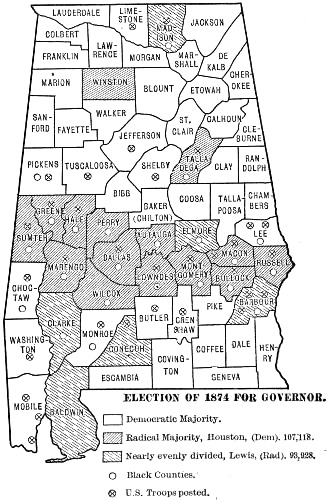
When the votes were counted, it appeared that the Democrats had triumphed. Houston had 107,118 votes to 93,928 for Lewis. Two years before Herndon (Democrat) had received 81,371 votes to 89,868 for Lewis. The presidential campaign in 1872 had assisted Lewis. Grant ran far ahead of the Radical state ticket. The legislature of 1874-1875 was to be composed as follows: Senate, 13 Republicans (of whom 6 were negroes) and 20 Democrats; House, 40 Republicans (of whom 29 were negroes) and 60 Democrats.[2162]
The whites were exceedingly pleased with their victory, while the Republicans took defeat as something expected. There were, of course, the usual charges of outrage, Ku Kluxism, and the intimidation of the negro vote, but these were fewer than ever before. There was considerable complaint that the Federal troops had sided always with the whites in the election troubles. The Republican leaders knew, of course, that for their own time at least Alabama was to remain in the hands of the whites. The blacks were surprisingly indifferent after they discovered that there was to be no return to slavery, so much so that many whites feared that their indifference masked some deep-laid scheme against the victors.
Larger Image
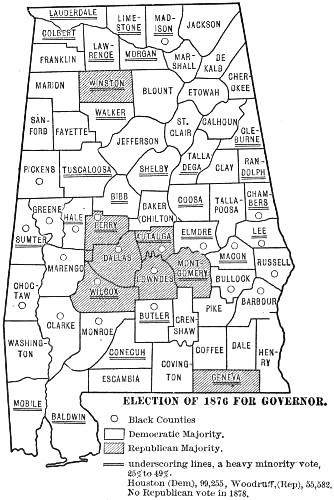
The heart of the Black Belt still remained under the rule of the carpet-bagger and the black. The Democratic state executive Committee considered that enough had been gained for one election, so it ordered that no whites should contest on technical grounds alone the offices in those black counties. Other methods gradually gave the Black Belt to the whites. No Democrat would now go on the bond of a Republican official and numbers were unable to make bond; their offices thus becoming vacant, the governor appointed Democrats. Others sold out to the whites, or neglected to make bond, or made bonds which were later condemned by grand juries. This resulted in many offices going to the whites, though most of them were still in the hands of the Republicans.[2163]
Houston’s two terms were devoted to setting affairs in order. The administration was painfully economical. Not a cent was spent beyond what was absolutely necessary. Numerous superfluous offices were cut off at once and salaries reduced. The question of the public debt was settled. To prevent future interference by Federal authorities the time for state elections was changed from November, the time of the Federal elections, to August, and this separation is still in force. The whites now demanded a new constitution. Their objections to the constitution of 1868 were numerous: it was forced upon the whites, who had no voice in framing it; it “reminds us of unparalleled wrongs”; it had not secured good government; it was a patchwork unsuited to the needs of the state; it had wrecked the credit of the state by allowing the indorsement of private corporations; it provided for a costly administration, especially for a complicated and unworkable school system which had destroyed the schools; there was no power of expansion for the judiciary; and above all, it was not legally adopted.[2164]
The Republicans declared against a new constitution as meant to destroy the school system, provide imprisonment for debt, abolish exemption from taxation, disfranchise and otherwise degrade the blacks. By a vote of 77,763 to 59,928, a convention was ordered by the people, and to it were elected 80 Democrats, 12 Republicans, and 7 Independents. A new constitution was framed and adopted in 1875.[2165]
Later Phases of State Politics
From 1875 to 1889 neither national party was able to control both houses of Congress. Consequently no “force” legislation could be directed against the white people of Alabama, who had control and were making secure their control of the state administration. The black vote was not eliminated, but gradually fell under the control of the native whites when the carpet-bagger and scalawag left the Black Belt. In order to gain control of the black vote, carpet-bag methods were sometimes resorted to, though there was not as much fraud and violence used as is believed, for the simple reason that it was not necessary; it was little more difficult now to make the blacks vote for the Democrats than it had been to make Republicans of them; the mass of them voted, in both cases, as the stronger power willed it. The Black Belt came finally into Democratic control in 1880, when the party leaders ordered the Alabama Republicans to vote the Greenback ticket. The negroes did not understand the meaning of the manœuvre, did not vote in force, and lost their last stronghold. A few white Republicans and a few black leaders united to maintain the Republican state organization in order that they might control the division of spoils coming from the Republican administration at Washington. Most of them were or became Federal officials within the state. It was not to their interest that their numbers should increase, for the shares in the spoils would then be smaller. Success in the elections was now the last thing desired.
Larger Image
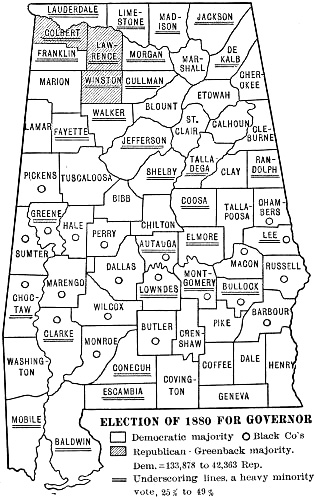
This clique of office-holders was almost destroyed by the two Democratic administrations under Cleveland, and has been unhappy under later Republican administrations; but the Federal administration in the state is not yet respectable. Dissatisfaction on the part of the genuine Republicans in the northern counties resulted in the formation of a “Lily White” faction which demanded that the negro be dropped as a campaign issue and that an attempt be made to build up a decent white Republican party. The opposing faction has been called “The Black and Tans,” and has held to the negro. The national party organization and the administration have refused to recognize the demands of the “Lily Whites”; and it would be exceedingly embarrassing to go back on the record of the past in regard to the negro as the basis of the Republican party in the South. In consequence the growth of a reputable white party has been hindered.
Larger Image
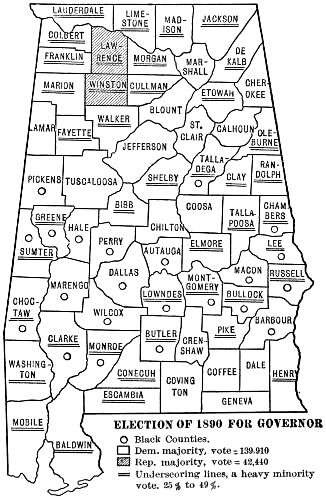
The Populist movement promised to cause a healthy division of the whites into two parties. But the tactics of the national Republican organization in trying to profit by this division, by running in the negroes, resulted in a close reunion of the discordant whites, the Populists furnishing to the reunited party some new principles and many new leaders, while the Democrats furnished the name, traditions, and organization.
To make possible some sort of division and debate among the whites the system of primary elections was adopted. In these elections the whites were able to decide according to the merits of the candidate and the issues involved. The candidate of the whites chosen in the primaries was easily elected. This plan had the merit of placing the real contest among the whites, and there was no danger of race troubles in elections. In the Black Belt the primary system was legalized and served by its regulations to confine the election contests to regularly nominated candidates, and hence to whites, the blacks having lost their organization.
Larger Image
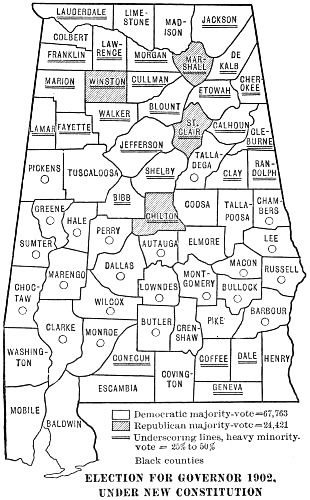
The Fourteenth and Fifteenth amendments in their operation gave undue political influence to the whites of the Black Belt, and this was opposed by whites of other districts. It also resulted in serious corruption in elections. There was always danger in the Black Belt that the Republicans, taking advantage of divisions among the whites, would run in the negroes again. There were instances when the whites simply counted out the negro vote or used “shotgun” methods to prevent a return to the intolerable conditions of Reconstruction. The people grew weary of the eternal “negro in the woodpile,” and a demand arose for a revision of the constitution in order to eliminate the mass of the negro voters, to do away with corruption in the elections and to leave the whites free. The conservative leaders, like Governors Jones and Oates, were rather opposed to a disfranchising movement. The Black Belt whites were somewhat doubtful, but the mass of the whites were determined, and the work was done; the stamp of legality was thus placed upon the long-finished work of necessity, and the “white man’s movement” had reached its logical end.[2166]
The mistakes and failures of Reconstruction are clear to all. Whether any successes were achieved by the Congressional plan has been a matter for debate. It has been strongly asserted that Reconstruction, though failing in many important particulars, succeeded in others. The successes claimed may be summarized as follows: (1) there was no more legislation for the negro similar to that of 1865-66, that following the Reconstruction being “infinitely milder”; (2) Reconstruction gave the negroes a civil status that a century of “restoration” would not have accomplished, for though the right to vote is a nullity, other undisputed rights of the black are due to the Reconstruction; the unchangeable organic laws of the state and of the United States favor negro suffrage, which will come the sooner for being thus theoretically made possible; (3) Reconstruction prevented the southern leaders from returning to Washington as irreconcilables, and gave them troubles enough to keep them busy until a new generation grew up which accepted the results of war; (4) by organizing the blacks it made them independent of white control in politics; (5) it gave the negro an independent church; (6) it gave the negro a right to education and gave to both races the public school system; (7) it made the negro economically free and showed that free labor was better than slave labor; (8) it destroyed the former leaders of the whites and “freed them from the baleful influence of old political leaders”; in general, as Sumner said, the ballot to the negro was “a peacemaker, a schoolmaster, a protector,” soon making him a fairly good citizen, and secured peace and order—the “political hell” through which the whites passed being a necessary discipline which secured the greatest good to the greatest number.[2167]
On the other hand, it may be maintained (1) that the intent of the legislation of 1865-1866 has been entirely misunderstood, that it was intended on the whole for the benefit of the negro as well as of the white, and that it has been left permanently off the statute book, not because the whites have been taught better by Reconstruction, but because of the amendments which prohibit in theory what has all along been practised (hence the gross abuses of peonage); (2) that the theoretical rights of the negro have been no inducement to grant him actual privileges, and that these theoretical rights have not proven so permanent as was supposed before the disfranchising movement spread through the South; (3) that the generation after Reconstruction is more irreconcilable than the conservative leaders who were put out of politics in 1865-1867—that the latter were willing to give the negro a chance, while the former, able, radical, and supported by the people, find less and less place for the negro; (4) that if the blacks were united, so were the whites, and in each case the advantage may be questioned; (5) that the value of the negro church is doubtful; (6) that as in politics, so in education, the negro has no opportunities now that were not freely offered him in 1865-1866, and the school system is not a product of Reconstruction, but came near being destroyed by it; (7) that negro free labor is not as efficient as slave labor was, and the negro as a cotton producer has lost his supremacy and his economic position is not at all assured; (8) that the whites have acquired new leaders, but the change has been on the whole from conservatives to radicals, from friends of the negro to those indifferent to him. In short, a careful study of conditions in Alabama since 1865 will not lead one to the conclusion that the black race in that state has any rights or privileges or advantages that were not offered by the native whites in 1865-1866.
For the misgovernment of Reconstruction, the negro, who was in no way to blame, has been made to suffer, since those who were really responsible could not be reached; so politically the races are hostile; the Black Belt has had, until recently, an undue and disturbing influence in white politics; the Federal official body and the Republican organization in the state have not been respectable, and the growth of a white Republican party has been prevented; the whites have for thirty-five years distrusted and disliked the Federal administration which, until recent years, showed little disposition to treat them with any consideration;[2168] the rule of the carpet-bagger, scalawag, and negro, and the methods used to overthrow that rule, weakened the respect of the people for the ballot, for law, for government; the estrangement of the races and the social-equality teachings of the reconstructionists have made it much less safe than in slavery for whites to reside near negro communities, and the negro is more exposed to imposition by low whites.
In recent years there have been many signs of improvement, but only in proportion as the principles and practices that the white people of the state understand are those of Reconstruction are rejected or superseded. To the northern man Reconstruction probably meant and still means something quite different from what the white man of Alabama understands by the term. But as the latter understands it, he has accepted none of its essential principles and intends to accept none of its so-called successes.
In destroying all that was old, Reconstruction probably removed some abuses; from the new order some permanent good must have resulted. But credit for neither can rightfully be claimed until it can be shown that those results were impossible under the régime destroyed.
APPENDIX I
PRODUCTION OF COTTON IN ALABAMA. 1860-1900
(a) Typical black counties with boundaries unchanged. (b) Typical white counties.
County 1860 1870 1880 1890 1900
bales bales bales bales bales
Autauga 17,329 7,965 7,944 10,431 14,348
Baker (Chilton) —— 1,360 3,534 6,233 9,932
Baldwin 2,172 87 638 1,663 531
Barbour (a) 44,518 17,011 26,063 33,440 29,395
Bibb 8,303 3,973 4,843 5,216 6,535
Blount (b) 1,071 950 4,442 9,748 11,449
Bullock —— 17,972 22,578 30,547 31,774
Butler 13,489 5,854 11,895 18,200 21,147
Calhoun 11,573 3,038 10,848 11,504 11,554
Chambers 24,589 7,868 19,476 27,276 30,676
Cherokee (b) 10,562 1,807 10,777 11,870 12,767
Choctaw (a) 17,252 6,439 9,054 13,586 13,091
Clarke (a) 16,225 5,713 11,097 16,380 16,594
Clay (b) —— 1,143 4,973 8,250 10,459
Cleburne (b) —— 873 3,600 5,389 5,035
Coffee (b) 5,294 2,004 4,788 11,791 16,747
Colbert —— 3,936 9,012 3,956 9,234
Conecuh (b) 6,850 1,539 4,633 8,167 9,801
Coosa 13,990 3,893 8,411 10,141 11,370
Covington (b) 2,021 689 1,158 2,740 5,969
Crenshaw (b) —— 4,638 8,173 13,442 18,909
Cullman (b) —— —— 378 5,268 9,374
Dale (b) 7,836 4,273 6,224 16,259 17,868
Dallas (a) 63,410 24,819 33,534 42,819 48,273
De Kalb (b) 1,498 205 2,859 4,573 9,860
Elmore (b) —— 7,295 9,771 16,871 18,458
Escambia —— 605 94 462 1,131
Etowah (b) —— 1,383 6,571 8,482 11,651
Fayette (b) 5,462 1,909 4,268 6,141 9,128
Franklin 15,592 2,072 3,603 2,669 6,047
Geneva (b) —— 420 1,112 7,158 9,813
Greene (a) 57,858 9,910 15,811 20,901 23,681
Hale —— 18,573 18,093 28,973 28,645
Henry (b) 13,034 7,127 12,573 23,738 27,281
Jackson (b) 2,713 2,339 6,235 5,358 5,602
Jefferson (b) 4,940 1,470 5,333 4,829 7,044
Lamar (Sanford) (b) —— 1,825 5,015 6,998 10,118
Lauderdale 11,050 5,457 9,270 5,156 9,708
Lawrence 15,434 9,243 13,791 9,248 12,541
Lee —— 11,591 13,189 18,332 22,431
Limestone 15,115 7,319 15,724 8,093 14,887
Lowndes (a) 53,664 18,369 29,356 40,388 39,839
Macon (a) 41,119 11,872 14,580 19,099 20,434
Madison 22,119 12,180 20,679 13,150 20,842
Marengo (a) 62,428 23,614 23,481 31,651 38,392
Marion (b) 4,285 463 2,240 4,454 6,309
Marshall (b) 4,931 2,340 5,358 8,118 13,318
Mobile 440 317 1 24 116
Monroe (a) 18,226 6,172 10,421 15,919 17,101
Montgomery (a) 58,880 25,517 31,732 45,827 39,202
Morgan (b) 6,326 4,389 6,133 6,227 9,313
Perry (a) 44,603 13,449 21,627 24,873 29,690
Pickens (a) 29,843 8,263 17,283 18,904 21,485
Pike (b) 24,527 7,192 15,136 25,879 34,757
Randolph (b) 6,427 2,246 7,475 10,348 17,148
Russell (a) 38,728 20,796 19,442 20,521 21,174
Shelby (b) 6,463 2,194 6,643 7,308 10,193
St. Clair (b) 4,189 1,244 6,028 7,136 9,411
Sumter (a) 36,584 11,647 22,211 25,768 31,906
Talladega 18,243 5,697 11,832 15,686 21,563
Tallapoosa (b) 17,399 5,446 14,161 20,337 24,955
Tuscaloosa 26,035 6,458 11,137 13,008 20,041
Walker (b) 2,766 928 2,754 3,211 4,746
Washington 3,449 1,803 1,246 2,030 2,213
Wilcox (a) 48,749 20,095 26,745 32,582 35,005
Winston (b) 352 205 568 1,464 3,686
Totals 989,955 429,482 699,654 915,210 1,093,697
APPENDIX II
REGISTRATION OF VOTERS UNDER THE NEW CONSTITUTION
County Males of Voting Age in 1900 Registered Voters in 1905
White Black White Black
Autauga 1,524 2,311 1,554 35
Baldwin 2,096 991 1,390 206
Barbour 2,889 4,201 2,846 46
Bibb 2,701 1,598 2,725 59
Blount 4,401 417 3,182 —
Bullock 1,415 5,168 1,291 14
Butler 2,766 2,617 2,739 2
Calhoun 5,390 2,380 4,892 130
Chambers 3,441 3,380 3,098 28
Cherokee 3,896 702 3,004 27
Chilton 2,852 707 2,970 1
Choctaw 1,697 1,929 1,496 29
Clarke 2,652 3,103 2,485 158
Clay 3,220 393 3,501 —
Cleburne 2,565 181 2,280 —
Coffee 3,508 996 3,334 —
Colbert 2,927 2,030 2,233 22
Conecuh 2,110 1,608 2,079 7
Coosa 2,338 942 2,134 —
Covington 2,803 786 2,857 3
Crenshaw 3,062 1,156 2,982 —
Cullman 3,359 5 4,641 4
Dale 3,492 1,002 3,021 11
Dallas 2,360 9,871 2,419 52
De Kalb 4,819 226 4,388 —
Elmore 3,202 2,758 3,030 54
Escambia 1,628 821 1,676 46
Etowah 5,140 1,031 4,186 39
Fayette 2,698 338 2,563 7
Franklin 2,989 634 2,600 12
Geneva 3,355 981 2,873 30
Greene 852 4,344 739 104
Hale 1,358 5,370 1,362 92
Henry } 4,904 2,933 2,072 —
Houston } (new county) 2,757 —
Jackson 5,939 731 4,704 73
Jefferson 21,036 18,472 18,315 352
Lamar 2,715 592 2,356 7
Lauderdale 4,235 1,586 3,305 76
Lawrence 2,761 1,426 2,367 49
Lee 2,988 3,472 2,652 12
Limestone 2,832 2,050 2,722 28
Lowndes 1,121 6,455 1,085 57
Macon 1,042 3,782 917 65
Madison 5,788 4,397 4,479 112
Marengo 2,095 6,143 2,043 302
Marion 2,735 144 2,698 25
Marshall 4,595 333 4,251 —
Mobile 7,934 7,371 7,295 193
Monroe 2,307 2,570 2,178 40
Montgomery 5,087 11,429 4,995 53
Morgan 4,987 1,713 4,506 60
Perry 1,574 5,028 1,659 90
Pickens 2,408 2,846 2,217 111
Pike 3,598 2,611 3,126 26
Randolph 3,457 978 3,363 13
Russell 1,433 3,961 1,170 191
Shelby 3,611 1,672 3,712 19
St. Clair 3,777 712 3,340 50
Sumter 1,391 5,304 1,244 57
Talladega 3,934 3,814 3,303 81
Tallapoosa 4,185 2,056 4,166 33
Tuscaloosa 5,100 3,413 4,153 165
Walker 4,582 1,351 4,894 1
Washington 1,386 1,179 1,339 53
Wilcox 1,686 5,967 1,522 41
Winston 1,884 3 1,833 1
Totals 224,212 181,471 205,278 3,654
Number of whites of voting age not registered, estimated at 45,000.
Number of blacks of voting age not registered, estimated at 190,000.
Foreign whites of voting age, 8082.
Number of whites registered but unable to comply with other requirements for voting, estimated at 60,000.
INDEX
Abolition sentiment in Alabama, 10. Agriculture, during the war, 232; since the war, 710-734. Alabama, admitted to Union, 7; secedes, 36; readmitted, 547. Alabama and Chattanooga Railroad, 591-600. American Missionary Association and negro education, 459, 462, 463, 617, 620. Amnesty proclamation of President Johnson, 349; published by military commanders in Alabama, 409. Amusements during the war, 241. Andrew, Bishop, and the separation of the Methodist church, 22. Anti Ku Klux, 690. Anti-slavery sentiment in Alabama, 10. Applegate, A. J., lieutenant-governor, 736. Army, U. S., and the civic authorities, 410; in conflict with Federal court, 414; relations with the people, 417-420; used in elections, 694-701, 746, 756, 789, 794. Athens sacked by Colonel Turchin, 63. Bacon used to influence elections, 785. Banks and banking during the war, 162. Baptist church, separation of, 22; declaration in regard to the state of the country, 222; during Reconstruction, 639; relations with negroes, 642. “Barbour County Fever,” 709. Bingham, D. H., mentioned, 346, 350, 402; in convention of 1867, 526; in Union League, 557. Birney, James G., mentioned, 10. Black Belt, during slavery, 710; at the end of the war, 713; share system in, 722; decadence of, during Reconstruction, 726. “Black Code,” or “Black Laws,” 378. “Black Republican” party arraigned, 20. Blockade-running, 183. Bonded debt of Alabama, 580-586. Bonds, of state, 580; of counties and towns, 580, 581; fraudulent issues, 581, 582; of railroads, 587-607; fraudulent indorsements, 596-606. Boyd, Alexander, killed by Ku Klux, 686. Bragg, W. L., Democratic campaign manager, 793. Brooks, William M., president of convention of 1861, 28; letter to President Davis, 112; advocates limited negro suffrage, 388. Brown, John, plans negro uprising in Alabama, 18. Buchanan, Admiral Franklin, at battle of Mobile Bay, 69. Buck, A. E., carpet-bagger, in convention of 1867, 518; elected to Congress, 750. Buckley, C. W., carpet-bagger, agent of Freedmen’s Bureau, 426, 437, 440, 448, 458; in convention of 1867, 518; elected to Congress, 737; on Ku Klux Committee, 702; sides with the Robinson faction, 774. Bulger, M. J., in secession convention, 29, 31, 33, 38; candidate for governor, 372; in politics, 513. Busteed, Richard, Federal judge, on Fourteenth Amendment, 394; in Radical politics, 511, 744, 774. Byrd, William M., “Union” leader, 15. Calhoun Democrats, 11. Callis, John B., carpet-bagger, agent of Freedmen’s Bureau, 426; in Union League, 557; elected to Congress, 738. Campaign, of 1867, 503-516; of 1868, 493, 747; of 1870, 751; of 1872, 754; of 1874, 782-797. Carpet-bag and negro rule, 571 et seq. Carpet-baggers, in convention of 1867, 517, 518, 530; in Congress, 738, 749, 754, 761. See also Republicans. Chain gang abolished, 393. Charleston convention of 1860, 18. Churches, separation of, 21-24; during the war, 222; seized by the Federal army and the northern churches, 227; condition after the war, 325, 326; attitude toward negro education and religion, 225, 457, 641; during Reconstruction, 636-652. Civil Rights Bill of 1866, 393. Civil War in Alabama, 61-78; seizure of the forts, 61; operations in north Alabama, 62; Streight’s Raid, 67; Rousseau’s Raid, 68; operations in south Alabama, 69; Wilson’s Raid, 71; destruction by the armies, 74. Clanton, Gen. James H., organizes opposition to Radicals, 508, 512; on negro education, 625, 630; on the religious situation, 638. Clay, Senator C. C., speech on withdrawal from U. S. Senate, 25; arrested by Federals, 262. Clayton, Judge Henry D., charge to the Pike County grand jury on the negro question, 385. Clemens, Jere (or Jeremiah), in secession convention, 29, 34, 47; mentioned, 64, 111; deserter, 125, 127, 143; advocates Reconstruction, 125, 144, 145. Clews & Company, financial agents, 592, 596, 597. Cloud, N. B., superintendent of public instruction, 610-632. Cobb, W. R. W., “Union” leader, 16; disloyal to Confederacy, 139. Colleges during the war, 212. Colonies of negroes, 421, 444. Color line in politics, 779. Commercial conventions, 25. Commissioners sent to southern states, 46, 48. Composition of population of Alabama, 3, 4. Concentration camps of negroes, 421, 422, 444. “Condition of Affairs in the South,” 311. Confederate property confiscated, 285. Confederate States, established, 39-42; Congress of, 130; enrolment laws, 92, 98; finance in Alabama, 162-183. Confederate text-books, 217. Confiscation, proposed in secession convention, 48; by United States, 284 et seq.; frauds, 284, 290; of cotton, 290; of lands, 425; supports Freedmen’s Bureau, 431; belief of negroes in, 446, 447; for taxes, 578. Congress, C. S., Alabama delegation to, 130. Congress, U. S., rejects Johnson’s plan, 377, 405; imposes new conditions, 391; forces carpet-bag government on Alabama, 547-552; members of, from Alabama, 737, 749, 754, 761. “Conquered province” theory of Reconstruction, 339. Conscription, 92-108; enrolment laws, 92-98; trouble between state and Confederate authorities, 96-98. Conservative party, 398, 401, 512. See also Democratic party. Constitution, of 1865, 366, 367; of 1868, 535, vote on, 538, rejected, 541; imposed by Congress, 547-552, 797; of 1875, 797; of 1902, 800. Contraband trade, 189. “Convention” candidates in 1868, 493, 530. Convention, of 1861, 27; of 1865, 359; of 1867, 491, 517; of 1875, 797. Coöperationists, 28; policy of, in secession convention, 30; speeches of, 32 et seq. “Cotton is King,” 184. Cotton, exported through the lines, 187, 191-193; confiscated, 290 et seq.; agents prosecuted for stealing, 297, 413; cotton tax, 303; production of, in Alabama, 710-734, 804. County and local officials during Reconstruction, 742, 743, 753, 761, 796. County and town debts, 580, 581, 604, 605. Crowe, J. R., one of the founders of Ku Klux Klan, 661. Curry, J. L., M., in Confederate Congress, 131; defeated, 134; on negro education, 457, 467, 468, 625, 631. Dargan, E. S., in secession convention, 29, 40, 41; on impressment, 175. Davis, Nicholas, in Nashville convention, 14; in secession convention, 29, 33, 38, 54; in Radical politics, 403, 511; opposed by Union League, 564; opinion of Rev. A. S. Lakin, 612. “Deadfalls,” 769. Debt commission, work of, 583-586. Debt of Alabama, 580-586. Democratic party, ante-bellum, 7 et seq.; reorganized, 398, 401; during Reconstruction, 748, 750, 755, 778; Populist influence, 799. Department of Negro Affairs, 421. Deserters, 112-130; outrages by, 119; prominent men, 124; numbers, 127. Destitution, during the war, 196-205; after the war, 277. Destruction of property, 74, 253. Disaffection toward the Confederacy, 108-130, 136, 137. Disfranchisement of whites, 489, 524, 806; of negroes, 801, 806. “Disintegration and absorption” policy of the northern churches, 636. Domestic life during the war, 230-247. Drugs and medicines, 239. Economic and social conditions, 1861-1865, 149-247; in 1865, 251; during Reconstruction, 710-734, 761-770. Education, during the war, 212; during Reconstruction, 579, 606-632, 684; discussion of, in convention of 1867, 522; of the negro, 456-468, 624. Election, of Lincoln, 19, 20; of 1861, 131; of 1863, 134; of 1865, 373-375; of 1867, 491; of 1868, 493, 747; of 1870, 750; of 1872, 754; of 1874, 793; of 1876, 796; of 1880, 798; of 1890, 799; of 1902, 800. Election methods, 748, 751, 754, 755. See also Union League. Emancipation, economic effects of, 710-734. Emigration of whites from Alabama, 769. Enforcement laws, state, 695; Federal, 697. Enrolment of soldiers from Alabama, 78-87; laws relating to, 92, 95. Episcopal church, divided, 24; closed by the Federal army, 325; loses its negro members, 646. Eufaula riot, 794. Eutaw riot, 686. Exemption from military service, 101-108; numbers exempted, 107. Expenditures of the Reconstruction régime, 574, 575, 577. Factories during the war, 149-162. Farms and plantations during the war, 232. Federal army closes churches, 226. Federal courts and the army, 413. Finances during the war, 162-183; banks and banking, 162; bonds and notes, 164; salaries, 168; taxation, 169; impressment, 174; debts, stay laws, sequestration, 176; trade, barter, prices, 178; during Reconstruction, 571-606. Financial settlement, 1874-1876, 583-586. Fitzpatrick, Benjamin, in Nashville convention, 14; arrested, 262; president of convention of 1865, 360. Florida, negotiations for purchase of West Florida, 577. Force laws, state and Federal, 695, 697. “Forfeited rights” theory of Reconstruction, 341. Forsyth, John, on Fourteenth Amendment, 394; mayor of Mobile, 430. “Forty acres and a mule,” 447, 515. Fourteenth Amendment, proposed, 394; rejected, 396, 397; adopted by reconstructed legislature, 552. Fowler, W. H., estimates of number of soldiers from Alabama, 78, 81. Freedmen, see Negroes. Freedmen’s aid societies, 459. Freedmen’s Bureau, 392, 421-470; organization of, in Alabama, 423-427; supported by confiscations, 431; character of agents of, 448; native officials of, 428, 429; relations with the civil authorities, 427; administration of justice, 438-441; the labor problem, 433-438; care of the sick, 441; issue of rations, 442; demoralization caused, 444; effect on negro education, 456-468; connection with the Union League, 557, 567, 568. Freedmen’s codes, 378. “Freedmen’s Home Colonies,” 422, 439, 444. Freedmen’s Savings-bank, 451-455; bank book, 452; good effect of, 453; failure, 455. General officers from Alabama in the Confederate service, 85. Giers, J. J., tory, 119, 147. Gordon, Gen. John B., speech on negro education, 625. Grant, Gen. U. S., letter on condition of the South, 311; elected President, 747; orders troops to Alabama, 789. Haughey, Thomas, scalawag, deserter, elected to Congress, 488. Hayden, Gen. Julius, in charge of Freedmen’s Bureau, 426. Hays, Charles, scalawag, in Eutaw riot, 686; member of Congress, 749, 754; letter to Senator Joseph Hawley on outrages in Alabama, 786-788. Herndon, Thomas H., candidate for governor, 754. Hilliard, Henry W., “Union” leader, 15. Hodgson, Joseph, mentioned, 512; superintendent of public instruction, 631. Home life during the war, 230-247. Houston, George S., “Union” leader, 16; elected to U. S. Senate, 374; on Debt Commission, 582; elected governor, 782, 795. Humphreys, D. C., deserter, 126, 143, 350. Huntsville parade of Ku Klux Klan, 686. Immigration to Alabama, 321, 717, 734; not desired by Radicals, 769. Impressment by Confederate authorities, 174. “Independents” in 1874, 781. Indian question and nullification, 8, 9. Indorsement of railroad bonds, 596-606. Industrial development during the war, 149-162, 234; military industries, 149; private enterprises, 156. Industrial reconstruction, 710-734, 804. Intimidation, by Federal authorities, 789; by Democrats, 791. “Iron-clad” test oath, 369. Jemison, Robert, in secession convention, 28, 29, 40, 49, 54; elected to Confederate Senate, 134. Johnson, President Andrew, plan of restoration, 337; amnesty proclamation, 349; grants pardons, 356, 410; interferes with provisional governments, 375, 419; his work rejected by Congress, 377, 405, 406. Joint Committee on Reconstruction, report on affairs in the South, 313. Jones, Capt. C. ap R., at the Selma arsenal, 152. Juries, of both races ordered by Pope, 480; during Reconstruction, 745. Keffer, John C., mentioned, 506, 518, 524, 554, 737, 751. Kelly, Judge, in Mobile riot, 481, 509. “King Cotton,” confidence in, 184. Knights of the White Camelia, 669, 684. See also Ku Klux Klan. Ku Klux Klan, causes, 653; origin and growth, 660; disguises, 675; warnings, 678; parade at Huntsville, 685; Cross Plains or Patona affair, 685; drives carpet-baggers from the State University, 612-615; burns negro schoolhouses, 628; table of alleged outrages, 705; Ku Klux investigation, 701; results of the Ku Klux revolution, 674. Labor laws, 380, 381. Labor of negroes and whites compared, 710-734. Labor regulations of Freedmen’s Bureau, 433-438. Lakin, Rev. A. S., Northern Methodist missionary, 637, 639, 648, 650; in Union League, 557; elected president of State University, 612; Davis’s opinion of, 612. Lands confiscated for taxes, 578. Lane, George W., Unionist, Federal judge, 125, 127. Lawlessness in 1865, 262. Legislation, by convention of 1861, 49; of 1865, 366; of 1867, 528; about freedmen, 379. Legislature during Reconstruction, 738-741, 752, 755-795. Lewis, D. P., in secession convention, 29; deserter, 126; repudiates Union League, 563; elected governor in 1872, 754. Life, loss of, in war, 251. Lincoln, effect of election of, 20; his plan of Reconstruction, 336. Lindsay, R. B., taxation under, 573-576; action on railroad bonds, 594-600; elected governor, 1870, 751. Literary activity during the war, 211. Loss of life and property, 251. “Loyalists,” during the war, 112, 113; after the war, 316. McKinstry, Alexander, lieutenant-governor, assists to elect Spencer, 756-760. McTyeire, Bishop H. N., on negro education, 457, 467. Meade, Gen. George G., in command of Third Military District, 493; his administration, 493-502; installs the reconstructed government, 552. Medicines and drugs in war time, 239. Methodist church, separation, 22; during Reconstruction, 637; favors negro education, 648. Military commissions, see Military government. Military government, 1865-1866, 407-420; trials by military commissions, 413-415; objections to, 416-417. Military government under the Reconstruction Acts, 473-502; Pope’s administration, 473-493; Meade’s administration, 493-502; control over the civil government, 477, 495; Pope’s trouble with the newspapers, 485; trials by military commissions, 487, 498. Militia system during the Civil War, 88-92; during Reconstruction, 746. Miller, C. A., carpet-bagger, agent of the Freedmen’s Bureau, 425, 426; in convention of 1867, 518; elected secretary of state, 737. Mitchell, Gen. O. M., 62-65. Mobile Bay, battle of, 69. Mobile riot, 481, 509. Mobile schools during Reconstruction, 617. Moore, A. B., governor, calls secession convention, 27; orders forts seized, 61; objects to blockade-running, 184; arrested by Federal authorities, 262. Morgan, John T., in secession convention, 29, 40, 42, 49. Morse, Joshua, scalawag, attorney-general, 737. Mossbacks, tories, and unionists, 112, 113; numbers, 127. Nashville convention of 1850, 14. “National Guards,” a negro organization, 774. National Union movement, 400, 401. Negro Affairs, Department of, 421. See also Freedmen’s Bureau. Negro criminality, 762, 763; negro labor, 710-734; family relations, 763; church in politics, 777; women in politics, 776. Negro education, favored by southern whites, 457, 626, 627; native white teachers, 463; Freedmen’s Bureau teaching, 456-468; opposition to, 628; character of, 464, 465, 625-630. Negroes during the war, 205-212; in the army, 86, 87, 205; on the farms, 209; fidelity of, 210; in the churches, 225; home life, 243. Negroes under the provisional government, test their freedom, 269; suffering among them, 273; colonies of, 421, 444; civil status of, 383, 384; insurrection feared, 368, 412; not to be arrested by civil authorities, 411; attitude of army to, 410-413; negro suffrage in 1866, 386. Negroes during Reconstruction, controlled by the Union League, 553-568; first vote, 514; in the convention of 1867, 518, 521, 530; in the campaign of 1874, 775, 776; negro Democrats, 777, 778; punished by Ku Klux Klan, 682; negro juries, 480, 745; disfranchised, 801, 806. Negroes, social rights of, allowed in street cars, 393; not allowed at hotel table, 417; demand social privileges, 522, 764, 780, 783. Negroes and the churches, 642, 777. Newspapers, during the war, 218; under Pope’s administration, 485. Nick-a-Jack, a proposed new state, 111. Nitre making, 152. Non-slaveholders uphold slavery, 10, 11. Norris, B. W., carpet-bagger, agent Freedmen’s Bureau, 426; elected to Congress, 738. North Alabama, anti-slavery sentiment in, 10; in secession convention, 53; during the Civil War, 109; during Reconstruction, 403, 404, 748, 770, 779. Northern men, treatment of, 318, 400. Nullification, on Indian question, 8, 9; divides the Democratic party, 11. Oath, “iron-clad,” 369; prescribed for voters, 475, 527. Ordinance of Secession, 36, 37; declared null and void, 360. Painted stakes sold to negroes, 448. Pardons by President Johnson, 356, 410. Parsons, L. E., obstructionist and “Peace Society” man, 143, 147, 343; provisional governor, 350, 353; elected to U. S. Senate, 374; speaks in the North, 392, 401; advises rejection of Fourteenth Amendment, 396; originates “White Man’s Movement,” 536; Radical politician, 735, 751, 755-760. Parties in the Convention of 1861, 28; of 1865, 359. Patona, or Cross Plains, affair, 686. Patton, R. M., mentioned, 281; elected governor, 373; vetoes legislation for blacks, 378, 379; on the Fourteenth Amendment, 395-397; advises Congressional Reconstruction, 502. Peace Society, 137-143. Pike County grand jury, Judge Clayton’s charge to, 384. “Pike County Platform,” 781. “Political bacon,” 783-785. Political beliefs of early settlers, 7. Politics, during the war, 130-148; 1865-1867, 398; 1868-1874, 735 et seq. Pope, General John, in command of Third Military District, 473-475; his administration, 473-493; quarrel with the newspapers, 485; removed, 492. Population, composition of, 3, 4. Populist movement, 799. Presbyterian church, separation, 22, 23, 24; during Reconstruction, 640; attitude toward negroes, 645. Prescript of Ku Klux Klan, 664, 665. President’s plan of reconstruction, 333 et seq.; rejected by Congress, 377; fails, 405, 406. Prices during the war, 178. Property, lost in war, 251; decreases in value during Reconstruction, 578. Provisional government, 351, 376. Pryor, Roger A., debate with Yancey, 17. Public bonded debt, 580-586. Publishing-houses during the war, 221. Race question, in convention of 1867, 521; in the campaign of 1874, 679-782. Races, segregation of, see maps in text. Radical party organized, 505. See also Republican party. Railroad legislation and frauds, 587-606. Railroads aided by state, counties, and towns during Reconstruction, 591-606. Railroads, built during the war, 155; destroyed, 259. Randolph, Ryland, a member of Ku Klux Klan, 612, 667, 668; expelled from legislature, 741. Rapier, J. T., negro member of Congress, mentioned, 488, 521, 523, 524; supports Robinson-Buckley faction, 774. Rations issued by Freedmen’s Bureau, 442, 445. Reconstruction, sentiment during the war, 143-148; theories of, 333-339; early attempts at, 341; Reconstruction Acts, 473-475, 490; Reconstruction Convention, 491, 517-530; constitution rejected, 494; completed by Congress, 531, 550-552; its successes and failures, 801. Reconstruction, and education, 606-632; and the churches, 637-653. Registration of voters, 488, 491, 493. Regulators, see Ku Klux Klan. Reid, Dr. G. P. L., on Knights of the White Camelia, 684. Religious conditions, during the war, 222-230; in 1865, 324; during Reconstruction, 637-653. Republican party in Alabama, organized, 402-405; numbers, 735, 765; in the legislature, 738, 752, 755; divisions in, 771, 775; “Lily Whites” and “Black and Tans,” 799. “Restoration,” by the President, 349 et seq.; convention, 358; completed, 367; rejected, 377. Restrictions on trade in 1865, 284. Riot, at Eufaula, 794; at Eutaw, 686; at Mobile, 481, 509. Roddy, Gen. P. D., mentioned, 62, 68. Roman Catholic church and the negroes, 646. Rousseau’s Raid, 68. Salt making, 158. Sansom, Miss Emma, guides General Forrest, 67. Savings-bank, Freedmen’s, 451-455. Scalawags, in convention of 1867, 518, 529, 530. See also Republicans. Schools, see Education. Schurz’s report on the condition of the South, 312. Secession, 14, 15, 19, 27-57; convention called, 27, 28; ordinance passed, 36, 37; debate on, in 1865, 360. Secession convention, parties in, 23, 29; political theories of members, 34; slave trade prohibited, 42; sends commission to Washington, 48; legislation, 49-53. Secessionists, 28; policy in secession convention, 30. Secret societies, see Union League and Ku Klux Klan. Segregation of races, 710-734. See also the maps in the text. Seibels, J. J., favors coöperation, 15; obstructionist, 143, 147, 343. Sequestration of enemies’ property, 176. Share system of farming, 723. Sheets, C. C., tory, 115, 126; in convention of 1865, 365; visited by Ku Klux Klan, 681. Shorter, John G., elected governor, 131; defeated, 134; arrested by Federal authorities, 262. Slaveholders and non-slaveholders, location of, 6. Slavery, and politics, 10-14; upheld by non-slaveholders, 10-11; abolished, 362. Slaves, see Negroes. Slave trade prohibited by secession convention, 42. Smith, William H., deserter, 350, 510, 534; a registration official, 488; first Reconstruction governor, 735; indorses railroad bonds, 591, 595, 601; opinion of Senator Spencer, 692. Smith, William R., “Union” leader, 16; coöperationist leader in secession convention, 29, 33, 43, 49; candidate for governor, 372; president of State University, 612. Social and economic conditions, during the war, 149-247; in 1865, 251 et seq.; during Reconstruction, 710-734, 761 et passim. Social effects of Reconstruction, on whites, 767; on blacks, 761 et seq.; on carpet-baggers, 766. Social rights for negroes, 523, 772, 775. Soldiers from Alabama, numbers, character, organization, 78-87. Southern Aid Society, 23. “Southern outrages,” 399, 555, 786. “Southern theory” of Reconstruction, 334. “Southern Unionists’” convention, 1866, 402. Speed, Joseph H., superintendent of public instruction, 633. Spencer, G. E., carpet-bagger, election to U. S. Senate, 737, 755, 760; Governor Smith’s opinion of, 691. State Rights Democrats, 11, 12; led by Yancey, 12, 13. “State Suicide” theory of Reconstruction, 338. Statistics of cotton frauds, 279. Status, of freedmen, 384; of the provisional government, 376. Steedman and Fullerton’s report on the Freedmen’s Bureau, 449. Stevens’s plan of Reconstruction, 339. Streight, Col. A. D., raids into Alabama, 67. Strobach-Robinson division in the Radical party, 774. Suffrage for negroes in 1866, 387. Sumner’s plan of Reconstruction, 338. Swayne, Gen. Wager, assistant commissioner of Freedmen’s Bureau, 424, 425; on the temper of the people, 315; opinion of the laws relating to freedmen, 379, 380, 384; fears negro insurrection, 369; in command of Alabama, 407, 476; attitude toward civil authorities, 428, 439; forces negro education, 459; enters politics, 404, 511; removed, 492. Sykes, F. W., in Radical politics, 510; elected to U. S. Senate, 757, 760. Taxation during the war, 169; during Reconstruction, 571-579; amounts to confiscation, 578. Temper of the people after the war, 308. Test oath, iron-clad, 369, 370, 527. Text-books, Confederate, 217; Radical, 624. Theories of Reconstruction, 333 et seq. Third Military District, under the Reconstruction Acts, 473-502. Thomas, Gen. G. H., mentioned, 325, 407, 408, 474. Tories and deserters, 108-430; in north Alabama, 109; definition, 112, 113; outrages by, 119; numbers, 127. Trade through the lines, 189. Treasury agents prosecuted, 297. Trials by military commission, 413, 414, 487, 498. Tribune, of New York, investigates the “Hays-Hawley letter,” 788. Truman, Benjamin, report on the South, 312. Turchin, Col. J. B., allows Athens to be sacked, 63. Underground railway in Alabama, 18. Union League of America, 553-568; white members, 556; negroes admitted, 557; ceremonies, 559; organization and method, 561; influence over negroes, 568; control over elections, 514, 515; resolutions of Alabama Council, 307. Union troops from Alabama, 87. Unionists, tories, mossbacks, 112, 113. University of Alabama under the Reconstruction régime, 612. Wages of freedmen, 422, 433, 720, 731. Walker, L. P., in Nashville convention, 14; at Charleston convention, 18; on negro suffrage, 389. Wards of the nation, 421-470. Warner, Willard, carpet-bagger, elected to U. S. Senate, 737. Watts, Thomas H., “Union” leader, 15; in secession convention, 29, 35, 45, 48; defeated for governor, 131; elected, 134; supports the Confederacy, 135; troubles over militia with conscript officials, 91, 97, 104; favors blockade-running, 185; speech in 1865, 341; arrested by Federal authorities, 262. Whig party, appears, 11; its progress on the slavery question, 12; breaks up, 16, 17. White Brotherhood, 708. White Camelia, 670. White counties, agriculture in, 727; destitution in, 196-205; politics in, see maps. White labor superior to negro labor, 726. White League, 709. “White Man’s Government,” 364. “White man’s party,” 536, 778, 779. Wilmer, Bishop R. H., 24; trouble with military authorities, 325-329; suspended, 325. Wilson’s Raid, 71. Women, interest in public questions, 230. Women’s Gunboat, 245. Yancey, William Lowndes, leader of State Rights Democrats, 12, 13; author of Alabama Platform of 1848, 13; advocates secession, 14, 15; debate with Roger A. Pryor, 17; offered nomination for vice-presidency, 19; in secession convention, 29, 31, 36, 39, 44, 46, 57.
PUBLICATIONS OF THE COLUMBIA UNIVERSITY PRESS
The Macmillan Company, Agents, 64-66 Fifth Avenue, New York
Books published at net prices are sold by booksellers everywhere at the advertised net prices. When delivered from the publishers, carriage, either postage or expressage, is an extra charge.
SCIENCE OF STATISTICS. By Richmond Mayo-Smith, Ph.D., Professor of Political Economy and Social Science, Columbia University.
Part I. STATISTICS AND SOCIOLOGY. 8vo, cloth, pp. xvi + 399. Price, $3.00 net.
Part II. STATISTICS AND ECONOMICS. 8vo, cloth, pp. xiii + 467. Price, $3.00 net.
ESSAYS IN TAXATION. By Edwin R. A. Seligman, Professor of Political Economy and Finance, Columbia University. 8vo, cloth, pp. x + 434. Price, $3.00 net.