Part 2 — CHAPTER III
Reading edition
MILITARY AND POLITICAL EVENTS
Sec. I. Military Operations
On January 4, 1861, the Alabama troops, ordered by Governor Andrew B. Moore, seized the forts which commanded the entrance to the harbor at Mobile, and also the United States arsenal at Mount Vernon, thirty miles distant. A few days later the governor, in a communication addressed to President Buchanan, explained the reason for this step. He was convinced, he said, that the convention would withdraw the state from the Union, and he deemed it his duty to take every precaution to render the secession peaceable. Information had been received which led him to believe that the United States government would attempt to maintain its authority in Alabama by force, even to bloodshed. The President must surely see, the governor wrote, that coercion could not be effectual until capacity for resistance had been exhausted, and it would have been unwise to have permitted the United States government to make preparations which would be resisted to the uttermost by the people. The purpose in taking possession of the forts and arsenal was to avoid, not to provoke, hostilities. Amicable relations with the United States were ardently desired by Alabama; and every patriotic man in the state was praying for peaceful secession. He had ordered an inventory to be taken of public property in the forts and arsenal, which were held subject to the control of the convention.[62] A month later, Governor Moore, in a communication addressed to the Virginia commissioners for mediation, stated that Alabama, in seceding, had no hostile intentions against the United States; that the sole object was to protect her rights, interests, and honor, without disturbing peaceful relations. This would continue to be the policy of the state unless the Federal government authorized hostile acts. Yet any attempt at coercion would be resisted. In conclusion, he stated that he had no power to appoint delegates to the proposed convention, but promised to refer the matter to the legislature. However, he did not believe that there was the least hope that concessions would be made affording such guarantees as the seceding states could accept.[63]
The War in North Alabama
For a year Alabama soil was free from invasion, though the coast was blockaded in the summer of 1861. In February, 1862, Fort Henry, on the Tennessee River, fell, and on the same day Commodore Phelps with four gunboats sailed up the river to Florence. Several steamboats with supplies for Johnston’s army were destroyed to prevent capture by the Federals. Phelps destroyed a partly finished gunboat, burned the Confederate supplies in Florence, and then returned to Fort Henry.[64] The fall of Fort Donelson (February 16) and the retreat of Johnston to Corinth left the Tennessee valley open to the Federals. A few days after the battle of Shiloh, General O. M. Mitchell entered Huntsville (April 11, 1862) and captured nearly all the rolling stock belonging to the railroads running into Huntsville. Decatur, Athens, Tuscumbia, and the other towns of the Tennessee valley were occupied within a few days. To oppose this invasion the Confederates had small bodies of troops widely scattered across north Alabama. The fighting was almost entirely in the nature of skirmishes and was continual. Philip D. Roddy, later known as the “Defender of North Alabama,” first appears during this summer as commander of a small body of irregular troops, which served as the nucleus of a regiment and later a brigade. Hostilities in north Alabama at an early date assumed the worst aspects of guerilla warfare. The Federals were never opposed by large commands of Confederates, and were disposed to regard the detachments who fought them as guerillas and to treat them accordingly. In spite of the strenuous efforts of General Buell to have his subordinates wage war in civilized manner,[65] they were guilty of infamous conduct. General Mitchell was charged by the people with brutal conduct toward non-combatants and with being interested in the stealing of cotton and shipping it North. He was finally removed by Buell.[66]
One of Mitchell’s subordinates—John Basil Turchin, the Russian colonel of the Nineteenth Illinois regiment—was too brutal even for Mitchell, and the latter tried to keep him within bounds. His worst offence was at Athens, in Limestone County, in May, 1862. Athens was a wealthy place, intensely southern in feeling, and on that account was most heartily disliked by the Federals. Here, for two hours, Turchin retired to his tent and gave over the town to the soldiers to be sacked after the old European custom. Revolting outrages were committed. Robberies were common where Turchin commanded. His Russian ideas of the rules of war were probably responsible for his conduct. Buell characterized it as “a case of undisputed atrocity.” For this Athens affair Turchin was court-martialled and sentenced to be dismissed from the service. The facts were notorious and well known at Washington, but the day before Buell ordered his discharge, Turchin was made a brigadier-general.[67]
General Mitchell himself reported (May, 1862) that “the most terrible outrages—robberies, rapes, arson, and plundering—are being committed by lawless brigands and vagabonds connected with the army.” He asked for authority to hang them and wrote, “I hear the most deplorable accounts of excesses committed by soldiers.”[68] About fifty of the citizens of Athens, at the suggestion of Mitchell, filed claims for damages. Thereupon Mitchell informed them that they were laboring under a very serious misapprehension if they expected pay from the United States government unless they had proper vouchers.[69] Buell condemned his action in this matter also. Mitchell asked the War Department for permission to send prominent Confederate sympathizers at Huntsville to northern prisons. He said that General Clemens and Judge Lane advised such a measure. He reported that he held under arrest a few active rebels “who refused to condemn the guerilla warfare.” The War Department seems to have been annoyed by the request, but after Mitchell had repeated it, permission was given to send them to the fort in Boston Harbor.[70]
Mitchell was charged at Washington with having failed in his duty of repressing plundering and pillaging. He replied that he had no great sympathy with the citizens of Athens who hated the Union soldiers so intensely.[71]
As the war continued the character of the warfare grew steadily worse. Ex-Governor Chapman’s family were turned out of their home to make room for a negro regiment. A four-year-old child of the family wandered back to the house and was cursed and abused by the soldiers. The house was finally burned and the property laid waste. Governor Chapman was imprisoned and at last expelled from the country. Mrs. Robert Patton they threatened to strip in search of money and actually began to do so in the presence of her husband, but she saved herself by giving up the money.[72] Such experiences were common.
The provost marshal at Huntsville—Colonel Harmer—selected a number of men to answer certain political questions, who, if their answers were not satisfactory, were to be expelled from the country. Among these were, George W. Hustoun, Luke Pryor, and —— Malone of Athens, Dr. Fearn of Huntsville, and two ministers—Ross and Banister. General Stanley condemned the policy, but General Granger wanted the preachers expelled anyway, although Stanley said they had never taken part in politics.[73] The harsh treatment of non-combatants and Confederate soldiers by Federal soldiers and by the tories resulted in the retaliation of the former when opportunity occurred. Toward the end of the war prisoners were seldom taken by either side. When a man was caught, he was often strung up to a limb of the nearest tree, his captors waiting a few minutes for their halters, and then passing on. The Confederate irregular cavalry became a terror even to the loyal southern people. Stealing, robbery, and murder were common in the debatable land of north Alabama.[74]
Naturally the “tory” element of the population suffered much from the same class of Confederate troops. The Union element, it was said, suffered more from the operation of the impressment law. The Confederate and state governments strictly repressed the tendency of Confederate troops to pillage the “Union” communities in north Alabama.[75]
General Mitchell and his subordinates were accustomed to hold the people of a community responsible for damages in their vicinity to bridges, trestles, and trains caused by the Confederate forces. In August, 1862, General J. D. Morgan, in command at Tuscumbia, reported that he “sent out fifty wagons this afternoon to the plantations near where the track was torn up yesterday, for cotton. I want it to pay damages.”[76] When Turchin had to abandon Athens, on the advance of Bragg into Tennessee, he set fire to and burned much of the town, but his conduct was denounced by his fellow-officers.[77] Near Gunterville (1862) a Federal force was fired upon by scouts, and the Federals, in retaliation, shelled the town. This was done a second time during the war, and finally the town was burned. In Jackson County four citizens were arrested (1862) because the pickets at Woodville, several miles away, had been fired upon.[78]
In a skirmish in north Alabama, General R. L. McCook was shot by Captain Gurley of Russell’s Fourth Alabama Cavalry. The Federals spread the report among the soldiers that he had been murdered, and as the Federal commander reported, “Many of the soldiers spread themselves over the country and burned all the property of the rebels in the vicinity, and shot a rebel lieutenant who was on furlough.” Even the house of the family who had ministered to General McCook in his last moments was burned to the ground. The old men and boys for miles around were arrested. The officer who was shot was at home on furlough and sick. General Dodge’s command committed many depredations in retaliation for the death of McCook. A year later Captain Gurley was captured and sentenced to be hanged. The Confederate authorities threatened retaliation, and he was then treated as a prisoner of war. After the close of the war he was again arrested and kept in jail and in irons for many months at Nashville and Huntsville. At last he was liberated.[79]
Later in the war (1864), General M. L. Smith ordered the arrest of “five of the best rebels” in the vicinity of a Confederate attack on one of his companies, and again five were arrested near the place where a Union man had been attacked.[80] These are examples of what often happened. It became a rule to hold a community responsible for all attacks made by the Confederate soldiers.
The people suffered fearfully. Many of them had to leave the country in order to live. John E. Moore wrote to the Confederate Secretary of War from Florence, in December, 1862, that the people of north Alabama “have been ground into the dust by the tyrants and thieves.”[81] The citizens of Florence (January, 1863) petitioned the Secretary of War for protection. They said that they had been greatly oppressed by the Federal army in 1862. Property had been destroyed most wantonly and vindictively, the privacy of the homes invaded, citizens carried off and ill treated, and slaves carried off and refused the liberty of returning when they desired to do so. The harshness of the Federals had made many people submissive for fear of worse things. No men, except the aged and infirm, were left in the country; the population was composed chiefly of women and children.[82] It was in response to this appeal that Roddy’s command was raised to a brigade. But the retreat of Bragg left north Alabama to the Federals until the close of the war, except for a short period during Hood’s invasion of Tennessee.
The Streight Raid
April 19, 1863, Colonel A. D. Streight of the Federal army, with 2000 picked troops, disembarked at Eastport and started on a daring raid through the mountain region of north Alabama. The object of the raid was to cut the railroads from Chattanooga to Atlanta and to Knoxville, which supplied Bragg and to destroy the Confederate stores at Rome. To cover Streight’s movements General Dodge was making demonstrations in the Tennessee valley and Forrest was sent to meet him. Hearing by accident of Streight’s movements, Forrest left a small force under Roddy to hold Dodge in check and set out after the raider. The chase began on April 29. Streight had sixteen miles the start with a force reduced to 1500 men, mounted on mules. As his mounts were worn out, he seized fresh horses on the route. The chase led through the counties of Morgan, Blount, St. Clair, De Kalb, and Cherokee—counties in which there was a strong tory element, and the Federals were guided by two companies of Union cavalry raised in north Alabama. Streight had asked for permission to dress some of his men “after the promiscuous southern style,” but, fortunately for them, was not allowed to do so.[83]
On May 1 occurred the famous crossing of Black Creek, where Miss Emma Sansom guided the Confederates across in the face of a heavy fire. Forrest now had less than 600 men, the others having been left behind exhausted or with broken-down horses. The best men and horses were kept in front, and Streight was not allowed a moment’s rest. At last, tired out, the Federals halted on the morning of May 3. Soon the men were asleep on their arms, and when Forrest appeared, some of them could not be awakened. Men were asleep in line of battle, under fire. Forrest placed his small force so as to magnify his numbers, and Streight was persuaded by his officers to surrender—1466 men to less than 600. The running fight had lasted four days, over a distance of 150 miles, through rough and broken country filled with unfriendly natives. Forrest could not get fresh mounts, the Federals could; the Federals had been preparing for the raid a month; Forrest had a few hours to prepare for the pursuit, and his whole force with Roddy’s did not equal half of the entire Federal force of 9500.[84]
During the summer and fall there were many small fights between the cavalry scouts of Roddy and Wheeler and the Federal foraging parties. In October General S. D. Lee from Mississippi entered the northwestern part of the state, and for two or three weeks fought the Federals and tore up the Memphis and Charleston Railroad. The First Alabama Union Cavalry started on a raid for Selma, but was routed by the Second Alabama Cavalry. The Tennessee valley was the highway along which passed and repassed the Federal armies during the remainder of the war.
During the months of January, February, March, and April, 1864, scouting, skirmishing, and fighting in north Alabama by Forrest, Roddy, Wheeler, Johnson, Patterson, and Mead were almost continuous; and Federal raids were frequent. The Federals called all Confederate soldiers in north Alabama “guerillas,” and treated prisoners as such. The Tennessee valley had been stripped of troops to send to Johnston’s army. In May, 1864, the Federal General Blair marched through northeast Alabama to Rome, Georgia, with 10,500 men. Federal gunboats patrolled the river, landing companies for short raids and shelling the towns. In August there were many raids and skirmishes in the Tennessee valley. On September 23, Forrest with 4000 men, on a raid to Pulaski, persuaded the Federal commander at Athens that he had 10,000 men, and the latter surrendered, though in a strong fort with a thousand men.
Rousseau’s Raid
July 10, 1864, General Rousseau started from Decatur, Morgan County, with 2300 men on a raid toward southeast Alabama to destroy the Montgomery and West Point Railway below Opelika, and thus cut off the supplies coming from the Black Belt for Johnston’s army. General Clanton, who opposed him with a small force, was defeated at the crossing of the Coosa on July 14; the iron works in Calhoun County were burned, and the Confederate stores at Talladega were destroyed. The railroad was reached near Loachapoka in what is now Lee County, and miles of the track there and above Opelika were destroyed, and the depots at Opelika, Auburn, Loachapoka, and Notasulga, all with quantities of supplies, were burned. This was the first time that central Alabama had suffered from invasion.[85]
In October General Hood marched via Cedartown, Georgia, into Alabama to Gadsden, thence to Somerville and Decatur, crossing the river near Tuscumbia on his way to the fatal fields of Franklin and Nashville. “Most of the fields they passed were covered with briers and weeds, the fences burned or broken down. The chimneys in every direction stood like quiet sentinels and marked the site of once prosperous and happy homes, long since reduced to heaps of ashes. No cattle, hogs, horses, mules, or domestic fowls were in sight. Only the birds seemed unconscious of the ruin and desolation which reigned supreme. No wonder that Hood pointed to the devastation wrought by the invader to nerve his heroes for one more desperate struggle against immense odds for southern independence.”[86] A few weeks later the wreck of Hood’s army was straggling back into north Alabama, which now swarmed with Federals. Bushwhackers, guerillas, tories, deserters, “mossbacks,” harried the defenceless people of north Alabama until the end of the war and even after. A few scattered bands of Confederates made a weak resistance.
The War in South Alabama
To return to south Alabama. During the years 1861 and 1862 the defences of Mobile were made almost impregnable. They were commanded in turn by Generals Withers, Bragg, Forney, Buckner, and Maury. The port was blockaded in 1861, but no attacks were made on the defences until August, 1864, when 15,000 men were landed to besiege Fort Gaines. Eighteen war vessels under Farragut passed the forts into the bay and there fought the fiercest naval battle of the war. Admiral Buchanan commanded the Confederate fleet of four vessels—the Morgan, the Selma, the Gaines, and the Tennessee.[87] The Tecumseh was sunk by a torpedo in the bay, and Farragut had left 17 vessels, 199 guns, and 700 men against the Confederates’ 22 guns and 450 men. The three smaller Confederate vessels, after desperate fighting, were riddled with shot; one was captured, one beached, and one withdrew to the shelter of the forts. The Tennessee was left, 1 against 17, 6 guns against 200. After four hours’ cannonade from nearly 200 guns, her smoke-stack and steering gear shot away, her commander (Admiral Buchanan) wounded, one hour after her last gun had been disabled, the Tennessee surrendered. The Federals lost 52 killed, and 17 wounded, besides 120 lost on the Tecumseh. The Tennessee lost only 2 killed and 9 wounded, the Selma 8 killed and 17 wounded, the Gaines about the same.[88] The fleet now turned its attention to the forts. Fort Gaines surrendered at once; Fort Morgan held out. A siege train of 41 guns was placed in position and on August 22 these and the 200 guns of the fleet opened fire. The fort was unable to return the fire of the fleet, and the sharpshooters of the enemy soon prevented the use of guns against the shore batteries of the Federals. The firing was furious; every shell seemed to take effect; fire broke out, and the garrison threw 90,000 pounds of powder into cisterns to prevent explosion; the defending force was decimated; the interior of the fort was a mass of smouldering ruins; there was not a place five feet square not struck by shells; many of the guns were dismounted. For twenty-four hours the bombardment continued, the garrison not being able to return the fire of the besiegers, yet the enemy reported that the garrison was not “moved by any weak fears.” On the morning of August 23, 1864, the fort was surrendered.[89] Though the outer defences had fallen, the city could not be taken. The inner defences were strengthened, and were manned with “reserves,”—boys and old men, fourteen to sixteen, and forty-five to sixty years of age.
In March, 1865, General Steele advanced from Pensacola to Pollard with 15,000 men, while General Canby with 32,000 moved up the east side of Mobile Bay and invested Spanish Fort. He sent 12,000 men to Steele, who began the siege of Blakely on April 2. Spanish Fort was defended by 3400 men, later reduced to 2321, against Canby’s 20,000. The Confederate lines were two miles long. After a twelve days’ siege a part of the Confederate works was captured, and during the next night (April 8), the greater part of the garrison escaped in boats or by wading through the marshes. Blakely was defended by 3500 men against Steele’s 25,000. After a siege of eight days the Federal works were pushed near the Confederate lines, and a charge along the whole three miles of line captured the works with the garrison (April 9). Three days later batteries Huger and Tracy, defending the river entrance, were evacuated, and on April 12 the city surrendered.[90] The state was then overrun from all sides.[91]
Wilson’s Raid and the End of the War
During the winter of 1864-1865, General J. H. Wilson gathered a picked force of 13,500 cavalry, at Gravelly Springs in northwestern Alabama, in preparation for a raid through central Alabama, the purpose of which was to destroy the Confederate stores, the factories, mines, and iron works in that section, and also to create a diversion in favor of Canby at Mobile.[92] On March 22 he left for the South. There was not a Confederate soldier within 120 miles; the country was stripped of its defenders. The Federal army under Wilson foraged for provisions in north Alabama when they themselves reported people to be starving.[93] To confuse the Confederates, Wilson moved his corps in three divisions along different routes. On March 29, near Elyton, the divisions united, and General Croxton was again detached and sent to burn the University and public buildings at Tuscaloosa. Driving Roddy before him, Wilson, on March 31, burned five iron works near Elyton. Forrest collected a motley force to oppose Wilson. The latter sent a brigade which decoyed one of Forrest’s brigades away into the country toward Mississippi,[94] so that this force was not present to assist in the defence when, on April 2, Wilson arrived before Selma with 9000 men. This place, with works three miles long, was defended by Forrest with 3000 men, half of whom were reserves who had never been under fire. They made a gallant fight, but the Federals rushed over the thinly defended works. Forrest and two or three hundred men escaped; the remainder surrendered. When the Federals entered the city, night had fallen, and the soldiers plundered without restraint until morning. Forrest had ordered that all the government whiskey in the city be destroyed, but after the barrels were rolled into the street the Confederates had no time to knock in the heads before the city was captured. The Federals were soon drunk. All the houses in the city were entered and plundered. A newspaper correspondent who was with Wilson’s army said that Selma was the worst-sacked town of the war. One woman saved her house from the plunderers by pulling out all the drawers, tearing up the beds, throwing clothes all over the floor along with dishes and overturned tables, chairs, and other things. When the soldiers came to the house, they concluded that others had been there before them and departed. The outrages, robberies, and murders committed by Wilson’s men, notwithstanding his stringent order against plundering,[95] are almost incredible. The half cannot be told. The destruction was fearful. The city was wholly given up to the soldiers, the houses sacked, the women robbed of their watches, earrings, rings, and other jewellery.[96] The negroes were pressed into the work of destruction, and when they refused to burn and destroy, they were threatened with death by the soldiers. Every one was robbed who had anything worth taking about his person. Even negro men on the streets and negro women in the houses were searched and their little money and trinkets taken.[97]
The next day the public buildings and storehouses with three-fourths of the business part of the town and 150 residences were burned. Three rolling mills, a large naval foundry, and the navy yard,—where the Tennessee had been built,—the best arsenal in the Confederacy, powder works, magazines, army stores, 35,000 bales of cotton, a large number of cars, and the railroad bridges were destroyed. Before leaving, Wilson sent men about the town to kill all the horses and mules in Selma, and had 800 of his own worn-out horses shot. The carcasses were left lying in the roads, streets, and dooryards where they were shot. In a few days the stench was fearful, and the citizens had to send to all the country around for teams to drag away the dead animals, which were strewn along the roads for miles.[98]
Nearly every man of Wilson’s command had a canteen filled with jewellery gathered on the long raid through the richest section of the state. The valuables of the rich Cane Brake and Black Belt country had been deposited in Selma for safe-keeping, and from Selma the soldiers took everything valuable and profitable. Pianos were made into feeding troughs for horses. The officers were supplied with silver plate stolen while on the raid. In Russell County a general officer stopped at a house for dinner, and had the table set with a splendid service of silver plate taken from Selma. His escort broke open the smoke-house and, taking hams, cut a small piece from each of them and threw the remainder away. Everything that could be was destroyed. Soft soap and syrup were poured together in the cellars. They took everything they could carry and destroyed the rest.
On April 10 Wilson’s command started for Montgomery. A negro regiment of 800 men[99] was organized at Selma and accompanied the army, subsisting on the country. Before reaching Georgia there were several such regiments. On April 12 Montgomery was surrendered by the mayor. The Confederates had burned 97,000[100] bales of cotton to prevent its falling into the hands of the enemy. The captors burned five steamboats, two rolling mills, a small-arms factory, two magazines of stores, all the rolling stock of the railways, and the nitre works, the fire spreading also to the business part of the town.[101] Here, as at Selma, horses, mules, and valuables were taken by the raiders.
The force was then divided into two columns, one destined for West Point and the other for Columbus. The last fights on Alabama soil occurred near West Point on April 16, and at Girard, opposite Columbus, on the same day. At the latter place immense quantities of stores, that had been carried across the river from Alabama, were destroyed.[102]
Croxton’s force reached Tuscaloosa April 3, and burned the University buildings, the nitre works, a foundry, a shoe factory, and the Sipsey cotton mills. After burning these he moved eastward across the state, destroying iron works, nitre factories, depots, and cotton factories. Before he reached Georgia, Croxton had destroyed nearly all the iron works and cotton factories that had been missed by Rousseau and Wilson.[103]
Destruction by the Armies
For three years north Alabama was traversed by the contending armies. Each burned and destroyed from military necessity and from malice. General Wilson said that after two years of warfare the valley of the Tennessee was absolutely destitute.[104] From the spring of 1862 to the close of the war the Federals marched to and fro in the valley. There were few Confederate troops for its defence, and the Federals held each community responsible for all attacks made within its vicinity. It became the custom to destroy property as a punishment of the people. Much of the destruction was unnecessary from a military point of view.[105] Athens and smaller towns were sacked and burned, Guntersville was shelled and burned; but the worst destruction was in the country, by raiding parties of Federals and “tories,” or “bushwhackers” dressed as Union soldiers. Huntsville, Florence, Decatur, Athens, Guntersville, and Courtland, all suffered depredation, robbery, murder, arson, and rapine.[106] The tories destroyed the railways, telegraph lines, and bridges, and as long as the Confederates were in north Alabama they had to guard all of these.[107]
Along the Tennessee River the gunboats landed parties to ravage the country in retaliation for Confederate attacks. In the counties of Lauderdale, Franklin, Morgan, Lawrence, Limestone, Madison, and Jackson nearly all property was destroyed.[108]
In 1863, a member of Congress from north Alabama tried to get arms from Bragg for the old men to defend the county against Federal raiders, but failed, and wrote to Davis that all civilized usages were being disregarded, women and children turned out and the houses burned, grain and provisions destroyed, women insulted and outraged, their money, jewellery, and clothing being stolen.
In December, 1863, General Sherman ordered that all the forage and provisions in the country around Bridgeport and Bellefont “be collected and stored, and no compensation be allowed rebel owners.” In April, 1864, General Clanton wrote to Governor Watts that the “Yankees spared neither age, sex, nor condition.” Tories and deserters from the hills made frequent raids on the defenceless population.
General Dodge reported, May, 1863, that his army had destroyed or carried off in one raid near Town Creek, “fifteen million bushels of corn, five hundred thousand pounds of bacon, quantities of wheat, rye, oats, and fodder, one thousand horses and mules, and an equal number of cattle, sheep, and hogs, besides thousands that the army consumed in three weeks; we also brought out fifteen hundred negroes, destroyed five tanyards and six flouring mills, and we left the country in such a devastated condition that no crop can be raised during the year;” and nothing was left that would in the least aid the Confederates. On the night of his retreat Dodge lit up the Tennessee valley from Town Creek to Tuscumbia with the flames of burning dwellings, granaries, stables, and fences. In June Colonel Cornyn reports that in a raid from Corinth to Florence he had destroyed cotton factories, tanyards, all the corn-cribs in sight, searched every house in Florence, burned several residences, and carried off 200 mules and horses.[109] A few days later General Stanley raided from Tennessee to Huntsville and carried off cattle and supplies, but did not lay waste the country. General Buell did all that he could to restrain his subordinates, but often to no avail. After Sherman took charge affairs grew steadily worse. In a remarkable letter giving his views in the matter he says: “The government of the United States has in north Alabama any and all rights which they choose to enforce in war, to take their lives, their houses, their lands, their everything, because they cannot deny that war exists there, and war is simply power unrestrained by constitution or compact. If they want eternal warfare, well and good. We will accept the issue and dispossess them and put our friends in possession. To those who submit to the rightful law and authority all gentleness and forbearance, but to the petulant and persistent secessionists, why, death is mercy and the quicker he or she is disposed of the better. Satan and the rebellious saint of heaven were allowed a continuance of existence in hell merely to swell their just punishment.” He referred to the fact that in Europe, whence the principles of war were derived, wars were between the armies, the people remaining practically neutral, so that their property remained unmolested. However, this present war was, he said, between peoples, and the invading army was entitled to all it could get from the people. He cited as a like instance the dispossessing of the people of north Ireland during the reign of William and Mary.[110] After this no restraint on the plundering and persecution of Confederate non-combatants was even attempted, and hundreds of families from north Alabama “refugeed” to south Alabama.
General Sherman wrote to one of his generals, “You may send notice to Florence that if Forrest invades Tennessee from that direction, the town will be burned; and if it occurs, you will remove the inhabitants north of the Ohio River and burn the town and Tuscumbia also.”[111] All through this section fences were gone, fields grew up in bushes, and weeds, residences were destroyed, farm stock had disappeared. People who lived in the Black Belt report that Wilson’s raiders ate up all the cooked provisions wherever they went, taking all the meat, meal, and flour to their next camping-place, where they would often throw away wagon loads of provisions. Frequently the meal and flour that could not be taken was strewn along the road. The mills were burned, and some families for three months after the close of the war lived on corn cracked in a mortar. All the horses and mules were taken; and only a few oxen were left to work the crops.
Governor Parsons said that Wilson’s men were a week in destroying the property around Selma. Three weeks after, as Parsons himself was a witness, it was with difficulty that one could travel from Planterville to Selma on account of the dead horses and mules. The night marches of the enemy in the Black Belt were lighted by the flames of burning houses. Until this raid only the counties of north Alabama had suffered.[112]
Wilson had destroyed during this raid 2 gunboats; 99,000 small arms and much artillery; 10 iron works; 7 foundries; 8 machine shops; 5 rolling mills; the University buildings; many county court-houses and public buildings; 3 arsenals; a naval foundry and navy yard; 5 steamboats; a powder magazine and mills; 35 locomotives and 565 cars; 3 large railroad bridges and many smaller ones; 275,000 bales of cotton; much private property along the line of march, many magazines of stores; and had subsisted his army on the country.[113] Trowbridge, who passed through Alabama in the fall of 1865, said that Wilson’s route could be traced by burnt gin-houses dotting the way.[114] Three other armies marched through the state in 1865, burning and destroying.
The Federals took horses and mules, cattle and hogs, corn and meat, gold and silver plate, jewellery, and other valuables. Aged citizens were tortured by “bummers” to force them to tell of hidden treasure. Some were swung up by the neck until nearly dead. Straggling bands of Federals committed depredations over the country. Houses were searched, mattresses were cut to pieces, trunks, bureaus, wardrobes, and chests were broken open and their contents turned out. Much furniture was broken and ruined. Families of women and children were left without a meal, and many homes were burned. Cattle and stock were wantonly killed. What could not be carried away was burned and destroyed.[115]
Though two-thirds of the state was untouched by the enemy two months before the close of hostilities, yet when the surrender came. Alabama was as thoroughly destroyed as Georgia or South Carolina in Sherman’s track.
Sec. 2. Military Organization
Alabama Soldiers: Numbers and Character
The exact number of Confederate soldiers enlisted in Alabama cannot be ascertained. The original records were lost or destroyed, and duplicates were never completed. There were on the rolls infantry regiments numbered from 1 to 65, but the 52d and 64th were never organized. Of the 14 cavalry regiments, numbered from 1 to 12, two organizations were numbered 9. There was one battalion of artillery, afterwards transferred to the regular service, and 18 batteries.
In Alabama, as in the other southern states, local pride has placed the number of troops furnished at a very high figure. Colonel W. H. Fowler, superintendent of army records, who worked mainly in the Army of Northern Virginia, estimated the total number of men from Alabama at about 120,000. Governor Parsons, in his inaugural proclamation, evidently following Fowler’s statistics, placed the number at 122,000,[116] while Colonel M. V. Moore placed the number at 60,000 to 65,000.[117] General Samuel Cooper, adjutant and inspector-general of the Confederate States Army, estimated that not more than 600,000 men in the Confederacy actually bore arms.[118] This estimate would make the share of Alabama even less than Colonel Moore estimated. The highest estimates have placed the number at 128,000 and 135,000, but the correct figures are evidently somewhere between these extremes.[119]
The Superintendent of the Confederate Bureau of Conscription estimated that according to the census of 1860 there were in Alabama, from 1861 to 1864, 106,000 men between the ages of eighteen and forty-five, and of these, more than 8000 had been regularly exempted during the year 1864, all former exemptions having been revoked by act of Congress, February 17, 1864.[120] Livermore’s estimate,[121] based on the census of 1860, was: There were in Alabama (1861) between the ages of eighteen and forty-five, 99,967 men, and in the entire Confederacy there were 265,000 between the ages of thirteen and sixteen. Of the latter, a rough estimate would place Alabama’s proportion about one-tenth of the whole, that is, about 26,500. Those men over forty-five who later became liable to military duty he estimates at 20,000, that is, about 2000 in Alabama. Thus there were in Alabama, in 1861, not allowing for deaths, 127,467 persons who would become subject to military service unless exempted. Livermore places the number of boys from ten to twelve years of age and of men from forty-seven to fifty, in the Confederacy in 1861, at 300,000, or about 30,000 in Alabama. These would become liable to service in the state militia before 1865.[122] In 1861 the governor stated that by October 7 there had been 27,000 enlistments in the various organizations. Several of these commands were enrolled for short terms of three months, six months, or one year. Before November, 1862, there had been 60,000 enlistments. Included in this number were several thousand reënlistments and transfers. At the end of 1863, when enlistment and reorganization had practically ceased, there had been 90,857 enlistments of all kinds from Alabama.[123] For two years troops were organized in Alabama much faster than they could be supplied with arms. For months some of the new regiments waited for equipment. Four thousand men at Huntsville were in service several months before arms could be procured, and several infantry regiments were drilled as artillery for a year before muskets were to be had.[124]
Before the close of 1863, Alabama had placed in the Confederate service about all the men that could be sent. The organization of new regiments by original enlistment practically ceased with the fall of 1862. In 1863, only three regiments were thus organized, and two of these were composed of conscripts and men attracted by the special privileges offered.[125] The other regiments, formed after the summer of 1862, were made by consolidating smaller commands that were already in service. The few small regiments of reserves called out in 1864 and 1865 and given regular designations saw little or no service. Those few who were made liable to service by the conscript law and who entered the army at all, as a rule went as volunteers and avoided the conscript camps. The strength of the Alabama regiments came from central and south Alabama, for the full military strength of north Alabama could not be utilized on account of invasion by the enemy. At first there were many small commands—companies and battalions—which were raised in a short time and sent at once to the front before a regimental organization could be effected. Later these were united to form regiments. Nearly all the higher numbered infantry regiments and more than half of the cavalry regiments were formed in this way. The first regiments raised and the strongest in numbers were sent to Virginia. To these went also the largest number of the recruits secured by the recruiting officers sent out by the regiments. On an average, about 350 recruits or transfers were secured by each Alabama regiment in Virginia, though some had almost none. There were numbers of persons who obtained authority to raise new commands for service near their homes, and in order to fill the ranks of their regiments and companies they would offer special inducements of furloughs and home stations. The cavalry and artillery branches of the service were popular and secured many men needed in the infantry regiments.[126] Each commander of a separate company or battalion desired to raise his force to a regiment, and it was to the interest of the state to have as many organizations as possible in the field as its quota. A better show was thus made on paper. Such conditions prevented the recruitment of old regiments, especially those in the armies that surrendered under Johnston and Taylor. Consequently the regiments in the Western Army were, as a rule, much smaller than the ones in the Army of Northern Virginia, to which recruits were sent instead of new regiments.
In each infantry and cavalry regiment there were ten companies.[127] The original strength of each company was from 64 to 100. Later the number was fixed at 104 to the company for infantry, 72 for cavalry, and 70 in the artillery. After the formation of new commands had practically ceased, the number for each company of infantry was raised to 125 men, 150 in the artillery, and 80 in the cavalry.[128] The original strength of each infantry regiment was, therefore, from 640 to 1000, not including officers; of cavalry, 600 to 720. A battery of artillery seems to have had any number from 70 to 150, though usually the smaller number. The size of the regiments varied greatly. Colonel Fowler reported that to February 1, 1865, 27,022 men had joined the 20 Alabama regiments in Virginia, an average of 1351 men to the regiment. Brewer gives the total enrolment of 15 regiments in the Army of Northern Virginia as 21,694, an average of 1446 to the regiment.[129] Four of these regiments had an enrolment of less than 1200;[130] so it is evident that the other 5, not given by Brewer, must have averaged about 1265 to the regiment.[131] These numbers include transfers, details, and reënlistments, the exact number of which it is impossible to ascertain. Brewer lists the transfers and discharges from 15 regiments at 4398, an average of 293 each, of which about one-third seem to have been transfers.[132] There were also many reënlistments from disbanded organizations.[133] Both Brewer and Fowler count each enlistment as a different man and arrive at about the same results.[134]
The enrolment of 8 Alabama regiments in Johnston’s army, as given by Brewer, amounted to 8300, an average to the regiment of 1037.[135] It was the practice, in 1864 and 1865, to unite two or more weaker regiments into one. No Alabama regiments in Virginia were so united, and of the 8 in the Western Army, whose enrolment is given by Brewer, only 1 was afterward united with another.[136] It would then seem that the enrolment of the strongest regiments is known.[137] The total number of enlistments in the Alabama commands in Virginia was, according to Fowler, about 30,000, and these were in 20 infantry regiments, and a few smaller commands. In the armies surrendered by Johnston and Taylor there were 38 Alabama infantry regiments, and 13 of these had been consolidated on account of their small numbers. Eight of them which remained separate and which must have been stronger than the ones united had enrolled an average of 1037 (according to Brewer). Thirty-eight regiments of this strength (which is probably too large an estimate) would give a total enrolment of 39,406. This number, added to Fowler’s estimate of 27,022 in the Army of Northern Virginia, will give 66,428 enlistments of all kinds, for the infantry arm of the service. Add to this 3000 for the 3 regiments of reserves called out in 1864,[138] and the total is 69,428 enlistments in the infantry.
There were 14 cavalry regiments, 7 of which, and possibly more, were formed by the consolidation of smaller commands already in service. The cavalry regiments did not enter the service as early as the infantry, only 1 regiment being organized in 1861. The original strength of each regiment, as has been said, was from 600 to 720. All these regiments served in the commands surrendered by Johnston and Taylor, where recruits were scarce, so 1000 to the regiment is a very large estimate of total enrolment. However, this would give 14,000 in the cavalry regiments.
Of artillery, there were 19 batteries and 1 battalion of 6 batteries, making 25 batteries in all, with an enrolment ranging from 70 to 150 in each. A total enrolment of 3750, or 150 to each battery, would be a large estimate.
Fowler reported about 3000 enlistments in the various smaller commands from Alabama in the Army of Northern Virginia.[139] An additional 2000 would more than account for all similar scattering commands in the other armies.[140]
The total enrolment may then be estimated:—
Army of Northern Virginia (Fowler report) 27,022
Army of Northern Virginia, scattering (Fowler report) 3,000
Armies of the West—infantry (estimate) 39,406
Armies of the West—cavalry 14,000
Scattering 2,500
Artillery 3,750
89,678
This total includes many transfers and reënlistments, which can be only roughly estimated. In the Army of Northern Virginia 464 resigned, 245 were retired, 3639 were discharged, 1815 were transferred to other commands, and 1666 deserted or were unaccounted for. Those who resigned—as a rule to accept higher positions—reëntered the service. Almost all of those who retired or were discharged had to enter the reserves, and many of them again became liable to service. Numbers of soldiers were accustomed to leave one command and go to another without any formality of transfer. Deserters who were driven back to the army nearly always chose to enter other regiments than their own. There were numbers of transfers from the cavalry to the infantry, for each cavalryman had to furnish his own horse, and, should it be killed or die and the soldier be unable to secure another, he was sent to an infantry regiment. There were also smaller infantry organizations, which were mounted and merged into the cavalry regiments. Half of the enlistments in the artillery came from the infantry. One regiment[141] at one time lost 100 men in this way, and it has been estimated that one-fifth of the Alabama soldiers served in more than one command.[142] Counting each name on the rolls as one man, as Brewer and Fowler do,[143] it is difficult to see how more than 90,000 enlistments can be counted, and from this total must be deducted several thousand for transfers and reënlistments. Miller’s estimate of a deduction of one-fifth for names counted twice would make the total number of different men about 75,000, which is probably about the correct number. Not only were the same names counted twice, and even oftener in different commands, but sometimes in the same companies and regiments they were counted more than once. It was to the interest of local and state authorities to have each enlistment counted as a different man, and this was invariably done.[144] Five of the early regiments were reorganized and reënlisted, and thus 5000 at least were added to the total enrolment without securing a single recruit. The three-year regiments reënlisted in 1864,[145] and here again were extra thousands of enlistments to be added to the former total. There were also 19 infantry regiments[146] which were formed by the reorganization of former commands that had already been counted, and upon reënlistment for the war they were again counted. In this same way 7 regiments at least of cavalry were formed.[147] this way it is possible to count up a total enlistment from Alabama of about 120,000.[148] There is no method which will even approximate correctness by which the total number of enlistments may be reduced to enlistments for a certain term, as three years or four years. The history of every enlistment must first be known.
There were three lieutenant-generals who entered the service in command of Alabama troops—John B. Gordon, Joseph Wheeler,[149] James Longstreet[149]; seven major-generals—H. D. Clayton, Jones M. Withers,[149] E. M. Law, C. M. Wilcox, John H. Forney,[149] W. W. Allen, R. E. Rodes[147]; and thirty-six brigadier generals—Tennent Lomax,[150] P. D. Bowles,[149] S. A. M. Wood, E. A. O’Neal, William H. Forney, J. C. C. Sanders,[149, 150] I. W. Garrott,[150] Archibald Gracie,[149, 150] B. D. Fry, James Cantey, J. T. Holtzclaw, E. D. Tracy,[150] E. W. Pettus, Z. C. Deas, G. D. Johnston, C. M. Shelly, Y. M. Moody, Wm. F. Perry, John T. Morgan, M. H. Hannon, Alpheus Baker, J. H. Clanton, James Hagan, P. D. Roddy, John Gregg,[150] L. P. Walker, D. Leadbetter,[149, 150] J. H. Kelley,[149, 150] J. Gorgas, C. A. Battle, John W. Frazer, Alex. W. Campbell, Thomas M. Jones, M. J. Bulger, John C. Reid, James Deshler.[150] Other Alabamians exercised commands in the troops of other states, and several were staff officers of general rank. The naval commanders were Semmes, Randolph, and Glassell, and a few subordinate officers.[151]
During the early months of 1865 a movement was started to enroll negroes as Confederate soldiers, and a number of officers, among whom was John T. Morgan, received permission to raise negro troops. The conference of governors at Augusta in 1864 recommended the arming of slaves, but Governor Watts asked the Alabama legislature to disapprove such a movement.[152] An enthusiastic meeting of citizens, held in Mobile, February 19, 1865, declared that the war must be prosecuted “to victory or death,” and that 100,000 negroes should be placed in the field.[153] It was too late, however, for success. Wilson, on his raid, picked up the Confederate negro troops at Selma, and took them with him.[154] In 1862, the “Creoles” of Mobile applied for permission to enlist in a body. They were mulattoes, but were free by the treaties with France in 1803 and with Spain in 1819, were property holders, often owning slaves, and were an orderly, respectable class, true to the South and anxious to fight for the Confederacy. The Secretary of War was not friendly to the proposal, but in November, 1862, the legislature of Alabama authorized their enlistment for the defence of Mobile. A year later, at the urgent request of General Maury, they were received into the Confederate service as heavy artillery.[155]
The Alabama troops in the Confederate service made a notably good record. The flower of the Alabama army served with Lee in Virginia, but nearly as good were the Alabama troops in the western armies. Brewer says they moved “high and haughty in the face of death.” The regiments of reserves raised late in the war and stationed within the state were not very good. Yet there were instances of regiments, with bad reputation when stationed near home, making splendid records when sent to the front. The spirit of the troops at the front was high to the last. In 1864 an Alabama regiment reënlisted for the war, with the oath that they would “live on bread and go barefoot before they would leave the flag under which they had fought for three years.”[156] On the morning of April 9, 1865, the Sixtieth Alabama (Hilliard’s Legion), then about 165 strong, captured a Federal battery.[157] Fowler, in his report in 1865, asserts that Alabama sent more troops into the service than any other state; also that she sent more troops in proportion to her population than any other state. “I am certain too,” he says, “that when General Lee surrendered his army, the representation from Alabama on the field that day was inferior to no other southern state in numbers, and surely not in gallantry.”[158]
Union Troops from Alabama
To the Union army Alabama furnished about 3000 regular enlistments. Of these 2000 were white men. It is not likely that there were many more, since in 1900 there were in Alabama only 3649 persons, northerners, negroes, and all, drawing pensions, and some of these on account of the Indian and Mexican wars.[159] The white Union troops served in the First Alabama Union Cavalry, in the First Alabama and Tennessee Cavalry (the First Vedette), Kennamer’s Scouts (Cavalry), and in northern regiments—principally those from Indiana. The report of the Secretary of War for 1864-1865 says that no white regiments were regularly enlisted in Alabama for the Union army. But this is evidently not correct, since the report for 1866 says that there were 2576 enlistments in Alabama for various periods of service.[160]
Of negro regiments in the Union army, there were the First Alabama Volunteers, afterward known as the Fifth United States Colored Infantry, the Second Alabama Volunteers (negroes), and the First Alabama Colored Artillery, afterward known as the Sixth United States Heavy Artillery, which served at Fort Pillow. Late in 1864 General Lorenzo Thomas reported that he had recently organized three regiments of colored infantry in Alabama, and Wilson organized several other negro regiments in the state in 1865. Many negroes from north Alabama went into various negro organizations, and were credited to the northern states, the official records showing only 4969 negro enlistments credited directly to Alabama. A conservative estimate would be from 2000 to 2500 whites and 10,000 negroes enlisted in Alabama, not counting those who were enrolled in the spring of 1865.[161] The white Union soldiers from Alabama were mostly poor men from the mountain counties of north Alabama. The Union troops from Alabama received no bounty.[162]
The Militia System
The militia system of Alabama in 1861 existed only in the statute books, and in the persons of a few brigadiers and a major-general, whose entire duty had consisted in wearing uniforms at the inauguration of a governor and ever thereafter bearing military titles. A series of Arabic numbers, something more than a hundred, was assigned to the militia regiments that were unorganized, but which, under favorable circumstances, might be enrolled and called out. The county was the unit. To each county was assigned one regiment or more according to the white population. Several counties formed a militia district under a brigadier-general, and over all was a major-general. Bodies of trained volunteers were not connected with the militia system at all, but these went at once, on the outbreak of war, into the state army, which was soon merged into the Confederate army.
In theory the militia consisted of all the male citizens of Alabama of military age. The enlistments for war service soon reduced the material from which militia regiments could be formed, and the system broke down before it was tried. A few regiments may have been enrolled in 1861 and 1862, but if so, they at once entered the Confederate service. The Forty-eighth Alabama Militia regiment was ordered out to defend Mobile in 1861, and $6000 was appropriated to provide pikes and knives with which to arm them, as it was impossible to get firearms. On March 1, 1862, Governor Shorter appealed to the people to give their shotguns, rifles, bowie-knives, pikes, powder, and lead to state agents, probate judges, sheriffs, and other state officials for the use of the state militia.[163] A few days later he ordered out, for the defence of Mobile and the coast, the militia from the river counties and the southwestern counties—eighteen counties in all. But the militia failed to appear. It seems that the governor expected a hearty response from the people. He asked for too much, and got nothing. On March 12, 1862, he again ordered out the militia, this time specifying the regiments by number.[164] But again the militia failed to respond. The fact was, there was no longer any militia; the officers and men had gone, or were preparing to go, into the Confederate service. Many of the militia regiments could not have mustered a dozen men, and it is doubtful if there was a muster-roll of a militia regiment in all Alabama.[165] In May, 1862, the governor, recognizing that the militia system was worthless as a means of raising troops for home defence, issued a proclamation asking the people to form volunteer organizations. The response, as he said, “was not prompt.” The legislature of that year, not seeing the necessity, refused to reorganize the militia so as to give the governor any effective control. The people seem not to have been worried by any fear of invasion, and many thought that organization into militia companies was merely preliminary to entering the Confederate service. Some did not wish to go until they had to do so, others preferred to go at once to the Confederate army. It appears that all persons, for various reasons, disliked militia service.
December 22, 1862, the governor issued a proclamation, in which, after mentioning the tardy response to his May proclamation and the failure of the legislature to reorganize the system, he again asked the people to volunteer in companies for home defence.[166] He begged the people to drive those who were shirking service to their duty by the force of public scorn. He requested that business houses be closed early in order to give time for drill. The response to this was the same as to his previous proclamation. There was no longer any material for a militia organization. Early in 1863, and in some sections even before, the need began to be felt for a militia force to execute the laws. Under the direction of the governor, small commands were organized here and there of those who were not likely to become subject to service in the Confederate army. These were state and Confederate officials, young boys, and sometimes old men. These organizations were later a source of constant conflict between the state authorities and the Confederate enrolling officers, who wanted to take such commands bodily into the Confederate service, and who usually did so with the full consent of most of the men and to the great indignation of the governor.[167] In August, 1863, the legislature finally passed a law to reorganize the militia system, or rather to establish a new system. By the law an official in each county, appointed by the governor, was to enroll as first-class militia all males under seventeen and over forty-five years of age, including all state and Confederate civil officials, and those physically disqualified for service in the Confederate army. The second class was to consist of those not in the first class, that is, of men between seventeen and forty-five years of age. But men of the second class were subject to enrolment by Confederate conscript officers, and consisted of the few thousand who were specially exempted by the Confederate authorities. Those of the first class who wished to do so might enroll in the second class. The governor was given the usual power over the militia, but it was ordered that the first-class militia was not to go beyond the limits of the county to which it belonged.[168] Presumably the second class might be ordered beyond the county limits, but there were so few in their class that they were not organized. The first-class militia in each county was under a commandant of reserves, militia now being called reserves. He had the power to call it out to repel invasion and execute the laws. Jealousy of Confederate authority had caused the legislature to take legal means of making the militia worthless to the Confederacy, and useful only for local defence and for executing the state laws in particular localities.[169] Still, the system seems to have been practically useless, and the governor continued to organize small irregular commands to execute the laws and to furnish military escorts to civil officials. As has been stated, such commands were highly approved of by the Confederate enrolling officers, who eagerly persuaded them to join the Confederate army, and thus called forth strong remonstrances from Governor Watts. The War Department reasoned that a state could keep troops of war which were not subject to absorption in the Confederate service, but that the militia were subject to the superior claims of the Confederacy.[170] February 6, 1864, Governor Watts, in an address to the people, declared that a raid into the state was threatened and called upon young and old to volunteer for the defence of the state.[171] The reserve system was now worthless. Few of the regiments had more than fifty men, many had none, and the governor was powerless to use them beyond the limits of their respective counties. The state was at the mercy of any invading force, and Rousseau’s Raid, through the heart of the state, showed the woful condition of affairs. On October 7, 1864, the legislature passed an act which prohibited Confederate army officers from commanding the reserves. It was again ordered that the first-class reserves should not serve beyond the limits of the county to which they belonged. At the same time, permission was granted to the harassed citizens of Dale and Henry counties to organize themselves to protect their homes, provided they did so under the direction of the commandant of the first-class militia. Perhaps the legislature was afraid that, if left to themselves, they might cross the county line, or choose a Confederate officer to lead them. In December, 1864, when north Alabama was almost entirely overrun by tories, deserters, and Federals, the citizens of Marion County were authorized to organize into squads and protect themselves.[172] Still the legislature refused to make an effective reorganization of the militia. When the spring campaign in 1865 began, Governor Watts appealed to the people to do what the legislature had failed to do. The first-class militia could not, he said, be ordered beyond the limits of their counties, and in three congressional districts in north Alabama it had not been and, by law, could not be, organized. He estimated that 30,000 men were enrolled in the first-class militia, of whom 4000 were boys, and to the latter he made the appeal to defend the state. Evidently the remaining 26,000 men were, in his estimation, not worth much as soldiers. However, he called upon all first-class militia to volunteer as second class.[173] A few hundred responded to this appeal, and all of them who saw active service were with Forrest in front of Wilson.
The various organizations mentioned in the War Records, the Junior Reserves, Senior Reserves, Mobile Regiment, Home Guards, Local Defence Corps,[174] and others, were, except the reserves, volunteer organizations for local defence, and all that saw active service before 1865, except the Home Guards, were absorbed into the Confederate organization.[175] The stupid conduct of the legislature during the last two years of the war in failing to provide for the defence of the state cannot be too strongly condemned. The final result would have been the same, but a strong force of militia would have enabled Governor Watts to execute the laws in all parts of the state, and to protect the families of loyal citizens from outrage by tories and deserters.
Sec. 3. Conscription and Exemption
Confederate Enrolment Laws
In the spring of 1862, the Confederate Congress passed the Enrolment Act, by which all white men between the ages of eighteen and thirty-five were made liable to military service at the call of the President, and those already in service were retained. The President was authorized to employ state officials to enroll the men made subject to duty, provided the governor of the state gave his consent; otherwise he was to employ Confederate officials. The conscripts thus secured were to be assigned to the state commands already in the field until these organizations were recruited to their full strength. Substitutes were allowed under such regulations as the Secretary of War might prescribe.[176] Five days later, a law was passed exempting certain classes of persons from the operations of the Enrolment Act. These were: Confederate and state officials, mail-carriers, ferrymen on post-office routes, pilots, telegraph operators, miners, printers, ministers, college professors, teachers with twenty pupils or more, teachers of the deaf, dumb, and blind, hospital attendants, one druggist to each drug store, and superintendents and operatives in cotton and wool factories.[177] In the fall of 1862, the Enrolment law was extended to include all white men from thirty-five to forty-five years of age and all who lacked a few months of being eighteen years of age. They were to be enrolled for three years, the oldest, if not needed, being left until the last.[178]
At this time was begun the practice, which virtually amounted to exemption, of making special details from the army to perform certain kinds of skilled labor. The first details thus made were to manufacture shoes for the army.[179] The list of those who might claim exemption, in addition to those named in the act of April 21, 1862, was extended to include the following: state militia officers, state and Confederate clerks in the civil service, railway employees who were not common laborers, steamboat employees, one editor and the necessary printers for each newspaper, those morally opposed to war, provided they furnished a substitute or paid $500 into the treasury, physicians, professors, and teachers who had been engaged in the profession for two years or more, government artisans, mechanics, and other employees, contractors and their employees furnishing arms and supplies to the state or to the Confederacy, factory owners, shoemakers, tanners, blacksmiths, wagon makers, millers, and engineers. The artisans and manufacturers were granted exemption from military service provided the products of their labor were sold at not more than seventy-five per cent profit above the cost of production. On every plantation where there were twenty or more negroes one white man was entitled to exemption as overseer.[180]
In the spring of 1863 mail contractors and drivers of post-coaches were exempted;[181] and it was ordered that those exempted under the so-called “twenty-negro” law should pay $500 into the Confederate treasury; also, that such state officials as were exempted by the governor might be also exempted by the Confederate authorities. The law permitting the hiring of substitutes by men liable to service was repealed on December 28, 1863, and a few days later even those who had furnished substitutes were made subject to military duty.[182]
A law of February 17, 1864,[183] provided that all soldiers between the ages of eighteen and forty-five should be retained in service during the war. Those between the ages of seventeen and eighteen, and forty-five and fifty were called into service as a reserve force for the defence of the state. All exemptions were repealed except the following: (1) the members of Congress and of the state legislature, and such Confederate and state officers as the President or the governors might certify to be necessary for the proper administration of government; (2) ministers regularly employed, superintendents, attendants, and physicians of asylums for the deaf, dumb, and blind, insane, and other public hospitals, one editor for each newspaper, public printers, one druggist for each drug store which had been two years in existence, all physicians who had practised seven years, teachers in colleges of at least two years’ standing and in schools which had twenty pupils to each teacher; (3) one overseer or agriculturist to each farm upon which were fifteen or more negroes, in case there was no other exempt on the plantation. The object was to leave one white man, and no more, on each plantation, and the owner or overseer was preferred. In return for such exemption, the exempt was bound by bond to deliver to the Confederate authorities, for each slave on the plantation between the ages of sixteen and fifty, one hundred pounds of bacon or its equivalent in produce, which was paid for by the government at prices fixed by the impressment commissioners. In addition, the exempt was to sell his surplus produce at prices fixed by the commissioners. The Secretary of War was authorized to make special details, under the above conditions, of overseers, farmers, or planters, if the public good demanded it; also (4) to exempt the higher officials of railroads and not more than one employee for each mile of road; and (5) mail carriers and drivers. The President was authorized to make details of old men for special service.[184] By an act passed the same day free negroes from eighteen to fifty years of age were made liable to service with the army as teamsters. These acts of February 17, 1864, were the last Confederate legislation of importance in regard to conscription and exemption. During the year 1864 the Confederate authorities devoted their energies to construing away all exemptions possible, and to absorbing the state reserve forces into the Confederate army.
Policy of the State in Regard to Conscription
To return to 1861. The state legislature, when providing for the state army, authorized the governor to exempt from militia duty all railway, express, steamboat, and telegraph employees, but even the fire companies had to serve as militia.[185] The operation of the enrolment law stripped the land of men of militia age, and on November 17, 1862, the legislature ordered to duty on the public roads men from sixteen to eighteen years of age, and forty-five to fifty-five, and later all from sixteen to fifty as well as all male slaves and free negroes from fourteen to sixty years of age.[186] Militia officers between the ages of eighteen and forty-five were declared subject to the enrolment acts of Congress,[187] as were also justices of the peace, notaries public, and constables.[188]
Yet, instead of making an effective organization of the militia, the legislature in 1863 proceeded to frame a law of exemptions patterned after that of the Confederacy. It released from militia duty all persons over forty-five years of age, county treasurers, physicians of seven years’ practice or who were in the public service, ministers, teachers of three years’ standing, one blacksmith in each beat, the city police and fire companies, penitentiary guards, general administrators who had been in service five years, Confederate agents, millers, railroad employees, steamboat officials, overseers, managers of foundries, salt makers who made as much as ten bushels a day and who sold it for not more than $15 per bushel. Besides, the governor could make special exemptions.[189] In 1864 millers who charged not more than one-eighth for toll were exempted.[190] It will be seen that in some respects the state laws go farther in exemption than the Confederate laws, and thus were in conflict with them. But it must be remembered that the Confederacy had already stripped the country of nearly all the able-bodied men who did not evade duty. To this time, however, there was no conflict between the state and Confederate authorities in regard to conscription. An act was also passed providing for the reorganization of the penitentiary guards, and only those not subject to conscription were retained.[191] A joint resolution of August 29, 1863, called upon Congress to decrease the list of exemptions, as many clerks and laborers were doing work that could be done by negroes. At the end of the year 1863 the legislature asked that the conscript law be strictly enforced by Congress.[192]
On the part of the state rights people, there was much opposition to the enrolment or conscription laws on the ground that they were unconstitutional. Several cases were brought before the state supreme court, and all were decided in favor of the constitutionality of the laws; furthermore, it was decided that the courts and judicial officers of the state had no jurisdiction on habeas corpus to discharge from the custody of a Confederate enrolling officer persons who had been conscripted under the law of Congress.[193] A test case was carried to the state supreme court, which decided that a person who had conscientious scruples against bearing arms might pay for a substitute in the state militia and claim exemption from state service, but if conscripted he was not exempted from the Confederate service unless he belonged to the religious denominations specially exempted by the act of Congress.[194] The court also declared constitutional the Confederate law which provided that when a substitute became subject to military duty his principal was thereby rendered liable to service.[195] In 1864 the supreme court held that the state had a right to subject to militia service persons exempted by the Confederate authorities as bonded agriculturists under the acts of February 17, 1864, and that only those overseers were granted exemption from militia service under the act of Congress in 1863 who at the time were not subject to militia duty, and not those exempted from Confederate service by the later laws,[196] and that the clause in the act of Congress passed February 17, 1864, repealing and revoking all exemptions, was constitutional.[197] In other cases the court held that a person regularly enrolled and sworn into the Confederate service could not raise any question, on habeas corpus, of his assignment to any particular command or duty,[198] but that the state courts could discharge on habeas corpus from Confederate enrolling officers persons held as conscripts, who were exempted under Confederate laws;[199] that the Confederacy might reassert its rights to the military service of a citizen who was enrolled as a conscript and, after producing a discharge for physical disability, had enlisted in the state militia service;[200] and finally, that the right of the Confederacy to the military service of a citizen was paramount to the right of the state.[201]
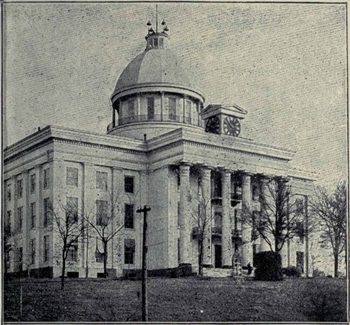
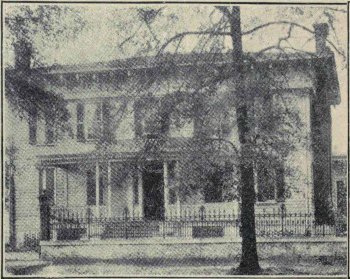
The First Confederate Capitol. The State Capitol, Montgomery. Montgomery Residence of President Davis.
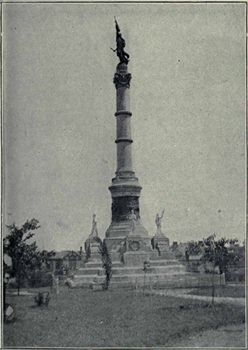
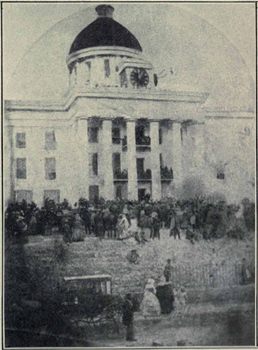
Confederate Monument, Montgomery. The Inauguration of Jefferson Davis. (From an old negative.)
During the year 1864 Governor Watts had much trouble with the Confederate enrolling officers who insisted upon conscripting his volunteer and militia organizations, whether they were subject to duty under the laws or not. The authorities at Richmond held that while a state might keep “troops of war” over which the Confederacy could have no control, yet the state militia was subject to all the laws of Congress. “Troops of war,” as the Secretary of War explained, would be troops in active and permanent service,[202] and hence virtually Confederate troops. A state with troops of that description would be very willing to give them up to the Confederacy to save expense. Thus we find the legislature of Alabama asking the President to receive and pay certain irregular organizations which had been used to support the Conscript Bureau.[203] The legislature, now somewhat disaffected, showed its interest in the operations of the enrolling officers by an act providing that conscript officials who forced exempts into the Confederate service should be liable to indictment and punishment by a fine of $1000 to $6000 and imprisonment of from six months to two years.[204] It went a step further and nullified the laws of Congress by declaring that state officials, civil and military, were not subject to conscription by the Confederate authorities.[205]
Effect of the Enrolment Laws
Few good soldiers were obtained by conscription,[206] and the system, as it was organized in Alabama,[207] did more harm than good to the Confederacy. The passage of the first law, however, had one good effect. During the winter of 1861-1862, there had been a reaction from the enthusiastic war feeling of the previous summer. Those who thought it would be only a matter of weeks to overrun the North now saw their mistake.[208] Many of the people still had no doubt that the North would be glad to make peace and end the war if the government at Richmond were willing. Numbers, therefore, saw no need of more fighting, and hence did not volunteer. Thousands left the army and went home. A measure like the enrolment act was necessary to make the people realize the actual situation. Upon the passage of the law all the loyal population liable to service made preparations to go to the front before being conscripted, which was deemed a disgrace, and the close of the year 1862 saw practically all of them in the army. Those who entered after 1862 were boys and old men.[209] Many not subject to service volunteered, so that when the age limit was extended but few more were secured.
Great dissatisfaction was expressed among the people at the enrolment law. Some thought that it was an attack upon the rights of the states, and the irritating manner in which it was enforced aroused, in some localities, intense popular indignation. Conscription being considered disgraceful, many who would have been glad for various good reasons to remain at home a few months longer went at once into service to escape conscription. Yet some loyal and honest citizens found it disastrous to leave their homes and business without definite arrangements for the safety and support of their families. Such men suffered much annoyance from the enrolling officers, in spite of the fact that the law was intended for their protection. The conscript officials, often men of bad character, persecuted those who were easy to find, while neglecting the disloyal and refractory who might make trouble for them. In some sections such weak conduct came near resulting in local insurrections; this was especially the case in Randolph County in 1862.[210] The effect of the law was rather to stop volunteering in the state organizations and reporting to camps of instructions, since all who did either were classed as conscripts. Not wishing to bear the odium of being conscripted, many thousands in 1862 and 1863 went directly into the regular service.[211]
While the conscript law secured few, if any, good soldiers who would not have joined the army without it, it certainly served as a reminder to the people that all were needed, and as a stimulus to volunteering. Three classes of people suffered from its operations: (1) those rightfully exempted, who were constantly annoyed by the enrolling officers; (2) those soon to become liable to service, who were not allowed to volunteer in organizations of their own choice; and (3) “deadheads” and malcontents who did not intend to fight at all if they could keep from it. It was this last class that made nearly all the complaints about conscription, and it was they whom the enrolling officers left alone because they were so troublesome.
The defects in the working of conscription are well set forth in a letter from a correspondent of President Davis in December, 1862. In this letter it was asserted that the conscript law had proven a failure in Mississippi and Alabama, since it had stopped the volunteering. Governor Shorter was reported to have said that the enforcement of it had been “a humbug and a farce.” The writer declared that the enrolling officers chosen were frequently of bad character; that inefficient men were making attempts to secure “bomb-proof” offices in order to avoid service in the army; and that the exemption of slave owners by the “twenty-negro law” had a bad influence upon the poorer classes. He also declared that the system of substitutes was bad, for many men were on the hunt for substitutes, and others liable to duty were working to secure exemptions in order to serve as substitutes, while large numbers of men connected with the army managed in this way to keep away from the fighting. He was sure, he said, that there were too many hangers-on about the officers of high rank, and that it was believed that social position, wealth, and influence served to get young men good staff positions.[212] Another evil complained of was that “paroled” men scattered to their homes and never heard of their exchange. To a conscript officer whose duty it was to look after them they said that they were “paroled,” and he passed them by. The officers were said to be entirely too lenient with the worthless people and too rigorous with the better classes.[213]
Exemption from Service
After the passage of the enrolment laws, every man with excessive regard for the integrity of his person and for his comfort began to secure exemption from service. In north Alabama men of little courage and patriotism lost confidence after the invasions of the Federals, and resorted to every expedient to escape conscription. Strange and terrible diseases were developed, and in all sections of the state health began to break down.[214] It was the day of certificates,—for old age, rheumatism, fits, blindness, and various physical disabilities.[215] Various other pretexts were given for staying away from the army, while some men hid out in the woods. The governor asked the people to drive such persons to their duty.[216] There was never so much skilled labor in the South as now. Harness making, shoe making, charcoal burning, carpentering—all these and numerous other occupations supposed to be in support of the cause secured exemption. Running a tanyard was a favorite way of escaping service. A pit was dug in the corner of the back yard, a few hides secured, carefully preserved, and never finished,—for more hides might not be available; then the tanner would be no longer exempt. There were purchasing agents, sub-purchasing agents, and sub-sub-agents, cattle drivers, tithe gatherers, agents of the Nitre Bureau, agents to examine political prisoners,[217] and many other Confederate and state agents of various kinds.[218] The class left at home for the enrolling officers to contend with, especially after 1862, was a source of weakness, not of strength, to the Confederate cause. The best men had gone to the army, and these people formed the public. Their opinion was public opinion, and with few exceptions the home stayers were a sorry lot. From them came the complaint about the favoritism toward the rich. The talk of a “rich man’s war and a poor man’s fight” originated with them, as well as the criticism of the “twenty-negro law.” In the minds of the soldiers at the front there was no doubt that the slaveholder and the rich man were doing their full share.[219]
Very few of the slaveholders and wealthy men tried to escape service; but when one did, he attracted more attention and called forth sterner denunciation than ten poor men in similar cases would have done. In fact, few able-bodied men tried to secure exemption under the “twenty-negro law.” It would have been better for the Confederacy if more planters had stayed at home to direct the production of supplies, and the fact was recognized in 1864,[220] when a “fifteen-negro law” was passed by the Congress, and other exemptions of planters and overseers were encouraged.[221]
There is no doubt that those who desired to remain quietly at home—to be neutral, so to speak—found it hard to evade the conscript officers. One of these declared that the enrolling officers “burned the woods and sifted the ashes for conscripts.” Another who had been caught in the sifting process deserted to the enemy at Huntsville. He was asked, “Do they conscript close over the river?” “Hell, stranger, I should think they do; they take every man who has not been dead more than two days.”[222] But the “hill-billy” and “sand-mountain” conscripts were of no service when captured; there were not enough soldiers in the state to keep them in their regiments. The Third Alabama Regiment of Reserves ran away almost in a body. There were fifteen or twenty old men in each county as a supporting force to the Conscript Bureau, and they had old guns, some of which would not shoot, and ammunition that did not fit.[223] Thus the best men went into the army, many of them never to return, and a class of people the country could well have spared survived to assist a second time in the ruin of their country in the darker days of Reconstruction. Often the “fire-eating, die-in-the-last-ditch” radical of 1861 who remained at home “to take care of the ladies” became an exempt, a “bomb-proof” or a conscript officer, and later a “scalawag.”
Some escaped war service by joining the various small independent and irregular commands formed for frontier service by those officers who found field duty too irksome. Though these irregular bodies were, as we have seen, gradually absorbed by the regular organizations, yet during their day of strength they were most unpleasant defenders. The men sometimes joined in order to have more opportunity for license and plunder, and such were hated alike by friend and foe.
Another kind of irregular organization caused some trouble in another way. Before the extension of the age limits to seventeen and fifty, the governor raised small commands of young boys to assist in the execution of the state laws, no other forces being available. Later, when the Confederate Congress extended its laws to include these, the conscript officers tried to enroll them, but the governor objected. The officers complained that, in order to escape the odium of conscription, the young boys who were subject by law to duty in the reserves evaded that law by going at once into the army, or by joining some command for special duty. They were of the opinion that these boys should be sent to camps of instruction. The governor had ten companies of young men under eighteen years of age raised near Talladega, and really mustered into the Confederate service as irregular troops, before the law of February 17, 1864, was passed. After the passage of the law, the enrolling officers wished to disband these companies and send the men to the reserves. Watts was angered and sharply criticised the whole policy of conscription. He said that much harm was done by the method of the conscript officers; that it was nonsense to take men from the fields and put them in camps of instruction when there were no arms for them, and no active service was intended; they had better stay at home, drill once a week with volunteer organizations, and work the rest of the time; to assemble the farmers in camps for useless drill while the crops were being destroyed was “most egregious folly.” The governor also attacked the policy of the Bureau in refusing to allow the enrolment in the same companies of boys under eighteen and men over forty-five.[224] In regard to the attempts to disband his small force of militia in active service, the governor used strong language. To Seddon, the Secretary of War, he wrote in May, 1864: “It must not be forgotten that the states have some rights left, and that the right to troops in the time of war is guaranteed by the Constitution. These rights, on the part of Alabama, I am determined shall be respected. Unless you order the Commandant of Conscripts to stop interfering with [certain volunteer companies] there will be a conflict between the Confederate general [Withers] and the state authorities.”[225] Watts carried the day and the Confederate authorities yielded.
The enrolment law provided that state officials should be exempt from enrolment upon presenting a certificate from the governor stating that they were necessary to the proper administration of the government. In November, 1864, Governor Watts complained to General Withers, who commanded the Confederate reserve forces in Alabama, that the conscript officers had been enrolling by force state officials who held certificates from the governor and also from the commandant of conscripts, and, he added: “This state of things cannot long last without a conflict between the Confederate and state authorities. I shall be compelled to protect my state officers with all the forces of the state at my command.” The enrolling officers referred him to a decision of the Secretary of War in the case of a state official in Lowndes County,—that by the act of February 17, 1864, all men between the ages of seventeen and fifty were taken at once into the Confederate service, and that state officials elected later could not claim exemption. Governor Watts then wrote to Seddon, “Unless you interfere, there will be a conflict between the Confederate and the state authorities.” He denied the right of Confederate officers to conscript state officials elected after February 17, 1864: “I deny such right, and will resist it with all the forces of the state.”[226] The Secretary of War replied by commending the Confederate officers for the way in which they had done their duty, insisting that it was not a political nor a constitutional question, but one involving private rights, and that it should be left to the courts. This was receding from the confident ruling made in the case of the Lowndes County man. There was no more dispute and it is to be presumed that the governor retained his officials.[227] No wonder that Colonel Preston, the chief of the Bureau of Conscription, wrote to the Secretary of War that, “from one end of the Confederacy to the other every constituted authority, every officer, every man, and woman was engaged in opposing the enrolling officer in the execution of his duties.”[228]
But these officers had only themselves to blame. They pursued a short-sighted, nagging policy, worrying those who were exempt—the state officials and the militia—because they were easy to reach, and neglecting the real conscript material.[229] The work was known to be useless, and the whole system was irritating to the last degree to all who came in contact with it. It was useless because there was little good material for conscription, except in the frontier country where no authority could be exerted. During 1862 and 1863 practically nothing was done by the Bureau in Alabama, and at the end of the latter year, Colonel E. D. Blake, the Superintendent of Special Registration, reported that there were 13,000 men in the state between the ages of seventeen and forty-five, and of these he estimated 4000 were under eighteen years of age, and hence, at that time, beyond the reach of the enrolling officers. More than 8000[230] were exempt under laws and orders. This left, he said, 1000 subject to enrolment. Nowhere, in any of the estimates, are found allowances for those physically and mentally disqualified. The number then exempted in Alabama by medical boards is unknown. In other states this number was sometimes more and sometimes less than the number exempted by law and by order.
A year later, after all exemptions had been revoked, the number disqualified for physical disability by the examining boards amounted to 3933. Besides these there were the lame, the halt, the blind, and the insane, who were so clearly unfit for service that no enrolling officer ever brought them before the medical board. The 4000 between the ages of seventeen and eighteen, and also the 4600 between sixteen and seventeen, came under the enrolment law of February 17, 1864, as also several thousand who were over forty-five. But it is certain that many of these, especially the younger ones, were already in the general service as volunteers. It is also certain that many hundreds of all ages who were liable to service escaped conscription, especially in north Alabama. In a way, their places in the ranks were filled by those who did not become liable to enrolment until 1864, or even not at all, but who volunteered nevertheless.
From April, 1862, to February, 1865, there had been enrolled at the camps in Alabama 14,875 men who had been classed in the reports as conscripts. This included all men who volunteered at the camps, all of military age that the officers could find or catch before they went into the volunteer service, details made as soon as enrolled, irregular commands formed before the men were liable to duty, and a few hundred genuine conscripts who had to be guarded to keep them from running away. It was reported that for two years not a recruit was sent by the Bureau from Alabama to the army of Tennessee or to the Army of Northern Virginia, but that the men were enrolled in the organizations of the state. This means that much of the enrolment of 14,875 was only nominal, and that this number included the regiments sent to the front from Alabama in 1862, after the passage of the Enrolment Act in April. Eighteen regiments were organized in Alabama after that date, in violation of the Enrolment Act, many of the men evading conscription, as the Bureau reported, by going at once into the general service. The number who left in these regiments was estimated at more than 10,000.[231] There was not a single conscript regiment.
It is possible to ascertain the number exempted by law and by order before 1865. A report by Colonel Preston, dated April, 1864, gives the number of exempts in Alabama as 8835 to January, 1864.[232] A month later, all exemptions were revoked.[233] In February, 1865, a complete report places the total number exempted by law and order in Alabama at 10,218, of whom 3933 were exempted by medical boards. The state officials exempted numbered 1333,[234] and Confederate officials, 21; ministers, 726; editors, 33, and their employees, 155; public printers, 3; druggists, 81; physicians, 796; teachers, 352; overseers and agriculturists, 1447; railway officials and employees, 1090; mail carriers and contractors, 60; foreigners, 167; agriculture details, 38; pilots, telegraphers, shoemakers, tanners, and blacksmiths, 86; government contractors, 44; details of artisans and mechanics, 570; details for government service (not specified), 218. There were 1046 men incapable of field service who were assigned to duty in the above details, chiefly in the Conscript Bureau, Quartermaster’s Department, and Commissariat.[235] It is certain that many others were exempted by being detailed from service in the army. The list of those pardoned in 1865 and 1866 by President Johnson shows many occupations not mentioned above.
It is interesting to notice the fate of the conscript officers when captured by the Federals. Bradford Hambrick was tried by a military commission in Nashville, Tennessee, in January, 1864, charged with being a Confederate conscript officer and with forcing “peaceable citizens of the United States” in Madison County, Alabama, to enter the Confederate army. He was convicted and sentenced to imprisonment at hard labor for one year, and to pay a fine of $2000 or serve an additional imprisonment of 1000 days.[236]
To sum up: The early enrolment laws served to stimulate enlistment; the later ones probably had no effect at all except to give the Bureau something to do, and the law officers something on which to exercise their wits. The conscript service also served as an exemption board. It secured few, if any, enlistments that the state could not have secured, and certainly lost more than it gained by harassing the people. The laws were constantly violated by the state; this is proved by the enlistment of eighteen new regiments contrary to the law. It finally drove the state authorities into an attitude of nullification by its construction of the enrolment laws.
Neither the state nor the Confederate government had an efficient machinery for securing enlistments. If there ever were laws regarded only in the breaking, the Enrolment Acts were such laws. The conscripts and exempts, like the deserters, tories, and Peace Society men, are important, not only because they so weakened the Confederacy, but also because they formed the party that would have carried out, or at least begun, Reconstruction according to the plans of Lincoln and Johnson as first proclaimed. Many of these people became “scalawags” later, probably influenced to some extent by the scorn of their neighbors.
Sec. 4. Tories and Deserters
In Alabama opposition to the Confederate government took two forms. One was the rebellious opposition of the so-called “unionists” or “tories,” who later joined with the deserters from the army; the other was the legal or constitutional opposition of the old coöperation or anti-secession party, which maintained an unfriendly attitude toward the Confederate administration, though the great majority of its members were loyal to the southern cause. From this second class arose a so-called “Peace Party,” which desired to end the war on terms favorable to the South; and from this, in turn, when later it was known that such terms could not be secured, sprang the semi-treasonable secret order—the “Peace Society.” In 1864, the “tories” and the Peace Society began to work together. Peculiar social and political conditions will in part account for the strength and growth of the opposition in two sections of the state far removed from each other—in north Alabama and in southeast Alabama.