Chapter XX · THE OUTLOOK FOR REFORM
Reading edition
And in the political whirl at present it is impossible to foretell what will be the aim of the Republican party.
As it stands now, however, their aim is not merely to overthrow the despised Manchu Dynasty and to restore China's former glory. It may be said, in a word, that the republican ideal of China is the right of world citizenship for the nation. Dr. Wu Ting Fang, in his masterly address to foreigners, said: "We are fighting to be men in the world; we are fighting to pass off an oppressive, officious, and tyrannous rule that has beggared and disgraced China, obstructed and defied the foreign nations, and set back the hands of the clock of the world."
It will have been seen in this volume—and, indeed, no student of Chinese affairs will need to be told—that the nature and extent of the preparations which the progressive Chinese have been carrying on during the last twenty years are simply astounding. They assuredly are. China, equally as she has been immovable for so many centuries, has shown us that now it is not a question of getting her to move so much as keeping her from moving too quickly.
But, on the other hand, I have been in some parts of interior China where not a single sign of reform in the common life is noticeable. Behind in the village, however, there has invariably been found one or two of the scholarly men who have taken into their being a certain spirit of reform despite the fact that they could not work out the Utopian era which had been promulgated in the revolutionary literature they had been reading and with which the country has for many years been flooded. The time now has come when these floodgates may be opened. In a considerable amount of travel in various parts of China I have often been struck with these Revolutionaries, who appeared, under the then prevailing conditions of government, misguided fanatics. It was because of the restraint placed upon them by the Manchu officials that they were slow in openly pursuing their revolutionary tactics and working out the reforms which their party were constantly agitating. In another work on China, published just six days before the Revolution broke out,[1] the author in a concluding note wrote the following: "I had come to see how far the modern spirit had penetrated into the recesses of the Chinese Empire.... One must begin again, no matter how dimly, to perceive something of the causes which are at work. By the incoming of the European to inland China a transformation is being wrought, not the natural growth of a gradual evolution, itself the result of propulsion from within, but produced, on the contrary, by artificial means, in bitter conflict with inherent instincts, inherited traditions, innate tendencies, characteristics, and genius, racial and individual. In the eyes of the Chinese of the old school these changes in the habits of life infinitely old are improving nothing and ruining much—all is empty, vapid, useless to God and to man. The tawdry shell, the valueless husk of ancient Chinese life is here still, remains untouched in many places; but the soul within is steadily and surely, if slowly, undergoing a process of final atrophy. But yet the proper opening up of the country by internal reform and not by external pressure has as yet hardly commenced in immense areas of the Empire far removed from the Imperial city of Peking.... I cannot but admit that whilst in most parts of my journey there are distinct traces of reform—I speak, of course, of the outlying parts of China—and some very striking traces, too, and a real longing on the part of far-seeing officials to escape from a humiliating international position, it is distinctly apparent that in everything which concerns Europe and the Western world the people and the officials as a whole are of one mind in the methods of procrastination which are so dear to the heart of the Celestial, and that peculiar opposition to Europeanism which has marked the real East since the beginning of modern history."
To a large extent were I to go to the places where I formed the above opinion I should probably be inclined to write to-day the same opinion—perhaps with one point of difference: that point of difference would be worked out by the noticeable presence of the to-day ubiquitous Revolutionary. He was there before, working silently; to-day he is working openly and without fear of decapitation. And if, standing afar off, we are able to look out across China, if we are able to see a beaconlight of revolutionism (which means reform) and are able to estimate rightly the enormous difference in national opinion which they in their teaching are constantly bringing about, and if we are able also to look into the future and imagine a China concentrated towards one final end of resultant progress, assuredly we shall find a nation great in power as she is now in numbers.
But shall we? The reader for himself must answer the question. Would that I could without hesitancy declare that we shall. I hope that we shall; but never, to attain this end, did a nation require more careful steering.
One cannot conclude this volume, however, without expressing the hope that the Chinese will not prove themselves their greatest enemy. Admiring their many admirable traits of national character, willing to sacrifice much to uplift them in the truest sense, there is many a man in China to-day who cannot but see that in the overbearing attitude of the younger generation is there a great danger to the common weal. China needs strong men: her strong men, many of them young, enthusiastic, inexperienced in great things they now have in hand, need to remain strong, they need to recognise Truth first and last. The responsibility of remoulding the national character of a quarter of the human race remains with them. They can only do this by adhering to Truth and to right principles. If they do, they will go from height to height in national reform and progress of the greatest good. Without it, they will fall and be lost. China's end will then be nearer.[2]
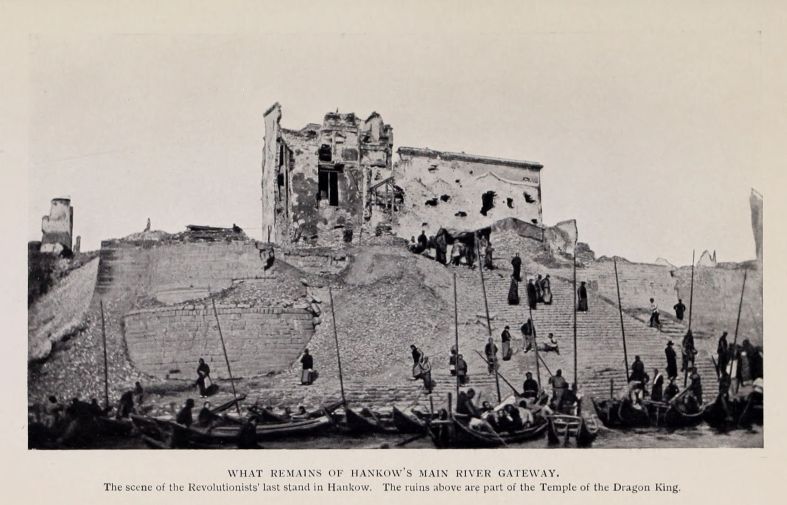
WHAT REMAINS OF HANKOW'S MAIN RIVER GATEWAY. The scene of the Revolutionists' last stand in Hankow. The ruins above are part of the Temple of the Dragon King.
[Transcriber's note: this page was entirely taken up by part of footnote 2, which is now on page 291 in its entirety.]
[Transcriber's note: this page was entirely taken up by part of footnote 2, which is now on page 291 in its entirety.]
[Transcriber's note: this page was entirely taken up by part of footnote 2, which is now on page 291 in its entirety.]
[Transcriber's note: this page was entirely taken up by part of footnote 2, which is now on page 291 in its entirety.]
[Transcriber's note: this page was entirely taken up by part of footnote 2, which is now on page 291 in its entirety.]
[Transcriber's note: this page was entirely taken up by part of footnote 2, which is now on page 291 in its entirety.]
[Transcriber's note: this page was entirely taken up by part of footnote 2, which is now on page 291 in its entirety.]
INDEX
Abdication Edict, the (278-87), text, 278-80
Admiralty, inconvenient regulations of, 123
Anti-foreign feeling, 14; reversal of, 43; see Boxer
Artillery, in action, 64-5, 68-9, 71-2, 74, 98
Awakening of China, 273-4
Boxer rising, 209; due to enmity of North and South, 268; directed against Manchus, yet exploited by the Dowager-Empress, 271-2; collapse of, 272-3
British authorities, weakness of, 119; letter to Consul, 122-3
British Concession, under fire, 108
British trade in China, 25-8
Cantlie, Dr., and the rescue of Sun Yat-sen from the Chinese Legation, 208-09
Canton, outbreak at, 16; conspiracy of 1895, 202-07
Cartoons, anti-foreign, 241
Cecil, Lord William, 30-2
Central China Post on Manchu Dynasty, 260-2
Chang Piao, General, 55, 58; interview with, 61-2; surrenders Nanking, 156-7
Cheng-tu, siege of, 241
Cheo, execution of, 277
China, extent of, 13
"China Under the Empress-Dowager," by Bland and Backhouse, 268
China Press, the, 159; on Republic or Monarchy, 196-200, 230
Chinese, future of the, 19, 291
Christianity in China, 30-1; future of, 43
Chwang-Lieh-ti, Emperor, hangs himself (1644), 259
Civil Service, the Chinese, 262
Clothing trade, the, 22
Concessions, position of the, 118
Concubinism, dangers of, 295
Confucianism, 43
Constitutional Monarchy, reasons in favour of, 143, 296
Constitutional Provisional Republic, the, 214-20
Corruption of Manchu Government, 18
Coup d'état of 1898, 271
Courage of Chinese troops, 111
Court, Chinese, the, 297
Courts of Justice, Republican, 219
Cruelty of Imperialist troops, 140-2
Der Ling, Princess, on causes of Reform, 291-8
Dragon, the, 244
Edict, the famous Revolutionary, of General Li, 276; its provisions carried out, 277
Education, the new, 284-5
Emperor, of China, 31; the child, 295-6
Empress-Dowager, the, 226-32; diverts the Boxers from their original aim, 271, 274, 291-7
Eucken, Professor, on Reform, 286
Extortion by torture, 203-04; under the Manchus, 261
Fleet, Imperial, at Hanyang, 69, 71
Foreign Concessions, at Hanyang, 72, 119-21
Foreign intervention not desired, 265-6
Foreign Loans, 44; feeling against, 238
French, at Hankow, ask for troops, 118, 121; wish to annex Yunnan, 259
German trade in China, 25-8
Gordon, General ("Chinese"), in the Taiping Rebellion, 195, 265
Hai Yung, 112; Chinese cruiser, in action, 114-15
Hankow, 44; premature outbreak in the Russian Concession, 49-50; 53; the Revolution commences in, 54, 58; the burning of, 81-7; looting of, 85; ruin of, 267
Hanyang, the arsenal taken, 57-58, 87; threatened with a second bombardment, 96-8; second battle of, 107-08; final bombardment of, 125-32; fall of, through treachery, 144; 154
Hanyang Hill, captured, 147
Hat trade, captured by Japanese enterprise, 22
Helena, U.S.A. launch, 58
Hokwan, peculates twenty-six million sterling, 261
Hsi-fan tribes, 251
Hsuan Tung, H.I.M., 227
Hsu-Ching-cheng, executed for saving Europeans, 271
Hu Ying, Revolutionary delegate to the Peace Conference, 177-84
Hunan, troops from, fate of deserters, 143; refuse to fight, 148
Hung Siu-tsuan, 263
Hupeh, army of, 47-8, 58, 117
Hwei-ti, Emperor, revolution in days of, 257
Imperial Edict, the, 90-1, 153
Imperialists, at Hanyang, 34, 62, 64; victorious, 67; 71; courage of, 71-2; 73; massacre of refugees from Hankow, 85-6; brutal behaviour of, 88; surround Hankow, 107; attack Hanyang, 128; cruelty of, 138-41; 145-6
Japan, war with, 15; her trade with China, 24-5, 28; revolution in, 130; victory over China, 273
Jung Lu, to be beheaded, 224; 269, 271
Kaifeng, drowned out by Li-Tsi-cheng in 1642, 258
Keen-lung, great Manchu Emperor, 260-2
Kilometre Ten, Battle of, 68-72
Knepper, Captain, 58
Kung Ching, the, 52
Kwang Lu, Emperor, in his Valedictory, hopes Yuan will be beheaded, 227; 293-4
Lee, Homer, General of Reform Cadets, 210
Li Tsi-cheng, ends the Ming Dynasty, 258; turns the Yellow River into the city of Kaifeng (1642), 258; proclaims himself Emperor, 259; his fall, 259, 273
Li Yuan Hung, statement by, 33-5; interview with, 37-45; details of life, 45-6; loth to lead the Revolutionists, 47; 55; his policy of "sit tight," 73; his Edict, 89, 93-5; appeals to Yuan, 103; 107, 116-17; anxious to stop slaughter, 147; 149, 152; asks for an armistice, 159; 164-5
Ling, General, takes Nanking, 158; desires peace, 170; 195; his famous Edict, 276, 282
Liu King, 47; his story, 51-4
Liu King, Mrs., to throw a bomb, 53
Liu Yao-chen, 54
Loans, foreign, literati object to, 238
Lolo tribes, the, 251
London and China Express, 122
London Mission Hospital, 85, 109
Macartney, Sir Halliday, and Sun Yat-sen's capture, 208
McFarlane, Rev. H. J., 78, 80
Machinery, belief that it takes away work and starves people, 238-9
Manchu Dynasty, shaken, 134; 153; objection to, 188; 192; on trial, 229; character of, 260; China under the, 261; universality of protest against, 282; causes of downfall, 291
Manchus, 15; policy of, 17; corruption and tyranny of, 17-18, 103-4; originally called in to revenge a rape, 259; character of, 294-5
Manifesto of the Revolution, 16-19
Marco Polo, 17
Medhurst, C. S., on claims of Republic and Monarchy, 196-200
Ming Dynasty, the last effort of, 194-5
Missionaries, massacres of, 272
Model army, the, 47, see Imperialists
Mohammedan Rebellion, the, 267; apparently successful, 268; suppressed, 268
Monopolies, Manchu, 17
Nanking, fall of, 39; news of fall, 155; account of, 156; Provisional Republic proclaimed at, 210; fall of, in Taiping Rebellion, 264; taken by Gordon, 245
Nanking, Treaty of, 263
National assembly, 215, 229-30
National Convention, 220
Nationalisation of Railways, cause of, Sze-Chuan rebellion, 235
Navy, the, 39
Nestorian tablet, 17
Nou-su tribes, 251
Northern army, the, 75, 97
"One Aim Society," the, 240
Outlawry, 14
Panthays, capture Yunnan, 267
"Patriotic Harmony Bands," see Boxers
Patriotism, in China, 111, 270
Peace Conference, the, 185; disappointment follows, 196; "fizzles out," 196
Pekin, Government, the, 15; strong position of, 189-91; disorders in 1912, 212-13; taken by Allies (1900), 272
People, The, 51-2
"Plum Blossom Fists," 269-70
Powers, European, ignorance of Chinese temper, 270
President of China, the, 39
Privileges, Manchu, 17
Provisional Military Association, the, 210
Provisional Republican Constitution, the, 214-20
Queue, cutting of the, 194
Railways, nationalisation of, 235-7; condition of Chinese, 237
Recognition of the Republic, 220
Redheads, in the Taiping rebellion, 265
Reform, Yuan paralyses, 224-5; 286-7; outlook for, 288-98; inland, 289-90
Reform Cadets, 210
Reform Edict, of 1898, 284
Regent, the, 134; resigns, 230-1
Republic, the, proclaimed, 16; recognition of the, 151; proclamation by Dr. Wu Ting Fang, 151-2; difficulties in way of, 193; general support of, 195; established as a world Power, 281; ideal of the, 288
Revolution of 1400, 257
Revolution of 1911; planned years ago, 15; causes of, 38; outbreak of, 47-8; plans of, 53; movement abroad, 201; sincerity of movement, 283
Revolutionary troops, at Hanyang, reversed, 65; courage of, 73; excellent behaviour of, 89; confidence of, 117; good behaviour at taking of Nanking, 159; general good behaviour of, 282
Run-chung-yung, 54
Sah, Admiral, 40, 62; at Hanyang, 71; his bluff, 72-3; appealed to by students of Hanyang and Hankow, he is converted to Revolution, 100-1
Shanghai, Peace Conference of, 174-5, (185-200)
Shantung, goes over to the Revolutionists, 125
Sian-fu, Nestorian tablet of, 17; massacre of foreigners in, 165
Son of Heaven, ceremonial, 195
Students, influence of, 16
Suffrage, universal, proposed by Sun Yat-sen, 197
Sun Yat-sen, 15, 16, 40, 45, 51; arrives in Shanghai, 196; the coming of, (201-22); character and adventures, 202; the Canton conspiracy, 202; captured in London, 207-8; swindled in Japan, 209; escapes to Annam and returns to America, 210; proclaimed President at Nanking, 210; the price on his head, 211; studies medicine, 212; retires in favour of Yuan, 213; his oath, 213; 282
Sun Wu, causes premature outbreak of revolution, 50, 53
Sze-Chuan, revolt of, against nationalisation of railways, 235; slaughter in, 241; present disorder in, 241-2; tribal element in, 242, 245-6, 252
Ta Ts'ing Dynasty, 256
Taiping Rebellion, 195, 263-5, 267, 269, 273
Tang-Shao-yi, Yuan's delegate at the Peace Conference, 172-6, 186-7; favours a Republic, 188; his powers repudiated by Yuan, 196
Tartars, reaction against the, 193-4
Tibet, Chinese policy in, 248-9
Times, editorial, 55-6; prophesies failure of Revolution, 155
Torpedo-boats at Wuchang, 113-14
Trade, restrictions of, 18; increase to be expected, 21-9
Tribes in Sze-Chuan, 245-6; their hatred of Chinese, 248, 251; China's great weakness, 251
Tuan-Fang, Director-General of Railways, 236; his disgrace, 236; reinstated, 236; killed by his men, 241; sketch of, 252-4; disgrace of, 255; protects missions, 269
United States of America, action of, 155
United States of China, probable, 195
United Universities scheme, 275
Viceroy of Hankow, the, 54-5
Wang-change-hui, 186
Wang-Chao-naing, 186
Wang-Cheng-ting, 186
Ward, General, in the Taiping Rebellion, 265
Wen Tsang-yao, 185
White, Miss T. C. (Princess der Ling), 261
White Lily Society, 269
Winsloe, Rear-Admiral, 72, 123
Women soldiers, 53
Wong, Mr., 163
Woodcock, H.M.S., 109
Wounded at Hanyung, 131-3
Wu, General, 126
Wu San-Kwei, calls in the Manchus to avenge his mistress, 259
Wu Ting Fang, Dr., 40, 152, 173, 185, 187
Wuchang, outbreak at, 16, 33-4, 47, 72-3; stronghold of Revolutionists, 92; fighting round, 98-100, 124; evacuation of, 167-9; modern army of, 224
Yakub Beg, leader of the Mohammedan Revolt, 267
Yangtze River, 189
Yen, Prince (Emperor Ch'eng-Tsu), his rebellion in A.D. 1400, 257
Yin Chang, General, 62
Young China Party, 242-3, 245
Yu Hsien, massacres missionaries, 272
Yuan-Ch'ang, executed for saving Europeans, 271
Yuan-Shih-Kai, 39-40, 75-7, 93; his letter to General Li, 94-5; promises a Constitutional Government and abolition of the Manchu princedoms, 95; his army, 97; Li's appeal to him, 103-06; 117-18, 125; his plea for a monarchy, 135; official statement, 159-61; negotiations at the Peace Conference, 113-15; 190, 196; proclaimed President, but loses hold in Pekin, 213; character-sketch of, 221-2; "Yuan the Reformer," 223; forms the Model Army, 224; betrays the Emperor, 225; the first man in China, 226; his fall, 227; recalled to Pekin as Prime Minister, 228; to form a Reform Government, 229; in favour of limited monarchy, 229, 233; an enigma, 234
Yunnan, Mohammedan rebellion in, 248, 267
UNWIN BROTHERS, LIMITED, THE GRESHAM PRESS, WOKING AND LONDON.