Chapter XIII · THE PEACE CONFERENCE—A MONARCHY OR A REPUBLIC?
Reading edition
The Peace Conference met at Shanghai on December 18th.
Dr. Wu Ting Fang, who was the Chief Commissioner on the Revolutionist side, is well known. He was educated in Hongkong, and afterwards qualified for the Bar in England. He practised in Hongkong for a little time, and also acted as Police Magistrate. Later on he joined the Chinese Government service under the late Marquis Li Hung-chang. He became Minister to the United States, Spain, and Peru in 1896, and was appointed Vice-President of the Board of Commerce and then of the Waiwupu in Peking. In 1906 he became Vice-President of the Board of Punishments, and was engaged in revising the Chinese code of laws. He retired in that year, and in 1907 went to the United States a second time to represent China as Envoy. He is a firm believer in rational diet. He originated and was made President of the Rational Diet Society and anti-Tobacco Movement in Shanghai, which became very popular.
Of the Revolutionary delegates, Wen Tsung-yao also hailed from Hongkong, and was educated in the Government Central School in that colony over twenty years ago. After that he was engaged in the Peiyang University in Tientsin. From 1905 to 1908 he went to Canton as Secretary to ex-Viceroy Tsen Chuan-hsuan, and in June, 1908, he was appointed to Lhassa as Assistant-Amban, and was removed from office after the ex-Dalai Lama was deposed by Edict. Wang Chung-hui is a Cantonese student who graduated from college in America. He also studied in Europe, and is versed in law. Wang Chao-ming is celebrated for his attempt to assassinate the ex-Prince Regent, for which offence he was sentenced to life imprisonment. He was released when the recent pardon was granted to all reformers and political offenders. Wang Cheng-ting, who is a returned student from the United States, and Hu Ying are delegates appointed by General Li Yuan Hung.
#Tang Wu Shao-yi Ting-Fang* +------------------------------+ #Er Kuan | o o | Wen Chan. | o o | Tseng Yao.* | | #Hsu | | Wang Ting Lin. | o o | Chou Wei.* | | #Chao | | Wang Chun Ni. | o o | Chow Ning* | | #Feng | | New Ih Tung. | o o | Yung Kee.* | o | +------------------------------+ Wang Chen Ting.* * Republicans. #Imperialists.
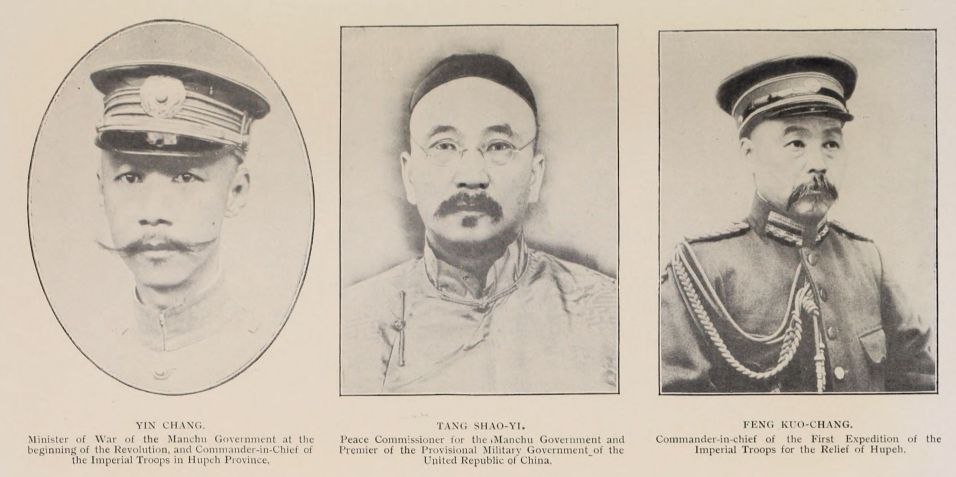
Up to the time my manuscript went forward to the publishers I was unable to get any special information regarding the Imperial delegates. Of Tang Shao-yi, however, much is known. He had played many an important part on the political platform of his country, and was, undoubtedly, a man calculated safely to direct the affairs of the Imperial side into safe channels. At the time he was appointed to represent Yuan Shih K'ai he occupied an important position, and, because he had had a career most successful as a diplomat, was chosen as the man of all the men the Imperial body were able to secure as most likely to commit no political errors. Tang Shao-yi is one of the ablest statesmen in China to-day.
The table at the Conference was arranged as on opposite page.
For more than four hours these two Cantonese—Wu and Tang—with their colleagues, held secret conference in the Town Hall of Shanghai, with the object of deciding on terms of peace which were expected to involve a decision as to the future form of government in China. At the end of the session the following statement, initialed by both commissioners, was handed out as a memorandum of the happenings of the day:—
"1. Exchange of credentials.
"2. Commissioner Tang agrees to wire Yuan Shih K'ai conveying the demand of the Republicans that the order to stop fighting and capturing of places by the Manchu Army should be carried out effectively in Hupei, Shansi, Shensi, Shantung, Anhui, Kiangsu, and Fengtien, and that no further conference should be held until a satisfactory reply from Yuan Shih K'ai has been received.
"3. Commissioner Wu agrees to wire to General Li Yuan Hung of Hupei and the Republican Generals of Shansi and Shensi ordering them to discontinue fighting and further attacks upon the Manchu troops."
At the opening of the Conference Mr. Tang made a short address. He told of his appointment to come to Shanghai for the Conference, and expressed the hope that it would be successful. He then presented his credentials to Dr. Wu. The latter examined them, and then expressed a similar hope that the Conference would result in great good for China. His credentials were then given to Mr. Tang, and the Conference was begun. Although these assistants were admitted to the meeting they had no voice in its affairs, the two commissioners alone carrying on the discussion. No one of Dr. Wu's assistants was allowed to address Mr. Tang directly, nor were any of Mr. Tang's assistants allowed to address Dr. Wu. Instead they could offer suggestions to their leaders, either by written note or by whispers. Tang Shao-yi expressed his personal readiness to accept Dr. Wu's demands for a Republic, but deferred a definite answer until he had communicated with Yuan Shih K'ai. With the exception of an agreement that the armistice should be extended for a week, ending December 31st, this was the result of the Conference, as told in the official statement given out at the end. The statement, headed "Authentic Account of To-day's Peace Conference," was as follows:—
"1. It is mutually agreed that the armistice should be extended for a period of seven days, i.e., from December 24, 8 a.m., to December 31, 8 a.m.
"2. Dr. Wu Ting Fang advocated the necessity of establishing a Republican form of government for China. He believed that China is fully prepared to welcome a new Republic. He said, in substance, as follows:
"The people of China will accept no other form of government than a Republic founded upon the will of the people. Since we can appoint delegates to represent us both in the various provincial assemblies and in the National Assembly at Peking, why are we not qualified to elect a President as the Chief Executive of the nation?
"The Manchus have shown their utter impossibility to govern the people for 267 years. They must go out. A government may be well likened to a trading company: if the manager through incapacity or dishonesty causes the failure of the concern, he has no business to continue in office. A new manager must be elected by the shareholders. The Republican Party does not intend to drive the Manchus out, nor to ill-treat them. On the contrary, they want to place them on perfect equality with the Chinese, enjoying together the blessings of liberty, equality, and fraternity."
The official statement of the day's proceedings, as handed out to the Chinese newspapers, was practically the same as that given to the foreign papers, except that it contained the following additional statement as being made by his Excellency Tang Shao-yi:—
"Personally, I am in favour of a Republic, which is the only solution of the present crisis. But we must not in the Conference overlook the integrity of Manchuria, Mongolia, Tibet, and other dependencies."
To which Dr. Wu replied:—
"The Republic does not denote the integrity and union of the eighteen provinces only."
Tang Shao-yi replied to this:—
"I will have to telegraph to Yuan Shih K'ai as regards the Republican question."
This Conference between the plenipotentiaries of the Peking Government and the Revolutionary groups was looked upon as a meeting of tremendous importance to the nation of China. Indeed, it was not too much to say that the fate of the Empire was to turn on the issue. The whole world would observe the proceedings and criticise the outcome with intense interest. Tang Shao-yi and Wuting-Fang, chief plenipotentiaries of the opposing parties, were to either earn the applause of civilisation or be condemned for having failed to rise to the opportunity of setting China firmly in the path of progress, which was to be presented by this extraordinary collocation of circumstances.
First may be considered what the situation probably would be if hostilities were resumed. At present the Yangtze River approximated a dividing line between territories controlled by the Government and Revolutionaries. Some localities north of the river had been in revolt, but a majority of these had returned to Imperial allegiance, being apparently satisfied with the concessions granted, and others showed a disposition to do the same. It seemed reasonable to assume that if the nation were to have civil war the country would divide north against the south, with the Yangtze River as a general line of demarcation.
The Peking Government had the advantage of being recognised by foreign nations, a condition which would continue while it remained in possession of the capital and any considerable region surrounding it. It had almost all of the modern drilled army, and a great majority of the trained officers. It had better military equipment. The Government still controlled the Imperial railways of North China, the Peking-Hankow Railway, and the Tientsin-Pukou Railway over the greater part. Thus it would be able to concentrate troops at any given point along or north of the Yangtze more easily than the Revolutionists. Moreover, the Imperial troops were accustomed to and equipped to endure a cold climate, and winter had the northern part of the country in its grip. What forces the Revolutionaries could put in the field north of the Yangtze River was not definitely known. Except a few thousand trained troops, any army assembled for the purpose of advancing upon Peking or resisting an advance of the Imperial Army would be composed of raw recruits officered in the main by inexperienced men. Such an army would be ill provided to undertake a winter campaign in the north. Without further analysis the mooted march of a Revolutionary Army to Peking could be dismissed as visionary, unless it was assumed that the Imperial Army was disloyal and would desert the Government. There was now no very tangible basis for such an expectation. Yuan Shih K'ai, the creator of the new army which had always been loyal to him, still held the respect of the soldiers. It was one thing for the new army and its leaders to be dissatisfied with the old order of things at Peking: it was quite another to assume that it was dissatisfied with the form of government proposed by Yuan Shih K'ai, its former and present commander. The army knew Yuan, and what to expect from him. It did not know the Revolutionary leaders, except one here and there, and it did not know what treatment it would receive from a Revolutionary Government after what had happened. If it were assumed that the Northern Army would remain loyal to Yuan Shih K'ai, an early occupation of Peking by the Revolutionists was practically impossible. This was a task which would require a campaign of a year or perhaps more—if it could ever be accomplished. The Imperialists might not have been able to penetrate south of the Yangtze, but they would have had no great difficulty in holding the territory under their control. And in the event of schisms and disintegration of the Republicans, the Government should have been able in time to recover its dominion in all the provinces. This was a phase which the Revolutionists had to consider. Hitherto the processes of disintegration and discontent had worked almost altogether in their favour.
Prolongation of hostilities, therefore, would seem to presage a temporary, perhaps a permanent, division of the Empire into two parts, and the subjection of the country and the people to the horrors and disasters which inevitably attend such internecine struggles. The calamities which would befall under these circumstances were obvious. Six months of such conditions would probably create a counter-revolution in the southern provinces. Conditions in the north would have been somewhat similar, but probably not so bad, as the Government had a firmer grip on affairs and would be able to keep outlawry within bounds. In this discussion it is assumed, of course, that Chinese would be left to fight it out among themselves, without foreign intervention. Foreign intervention, which it would be difficult to avoid if hostilities were to be prolonged indefinitely, would bring its own problems and dangers. Such aspects were presented by the alternative of war.
These were some of the chief considerations which were to weigh upon the plenipotentiaries. There seemed only one point of serious divergence—whether the new Government would follow the Monarchical or the Republican form. If the former were elected, it probably would mean that the present Dynasty would be retained, although perhaps reigning under a different name, for neither Revolutionists nor Monarchists had another emperor to propose. If a Republic were to be decided upon, the Government which would be instituted would differ only in title from a Constitutional Monarchy; therefore, the argument was more about mere terms than about realities. Objections to the retention of the monarchy were based upon two principal theories. One was that with the Manchu Dynasty on the throne the liberty of the Chinese would not be secure—that the Dynasty must be overthrown and the capital removed from Peking in order to shake off for ever the atmosphere and associations of the old regime. Another objection was that, under the monarchical form, Yuan Shih K'ai would be virtual dictator, and then he would use his power to place himself on the throne. In certain quarters Yuan was certainly credited with having this ambition—as one Chinese put it, he wanted to be China's Napoleon, not her George Washington. But it seemed that if Yuan had this ambition, a Republic such as would of necessity exist in China would be exactly what he would want. Napoleon began his rise to power as a Republican. If Yuan desired to make himself emperor, he could adopt no more favourable course than to accept the presidency of a Republic now, biding his time, as Napoleon did, until the inevitable reaction set in, and the transition back to an Empire would be comparatively easy. On the other hand, continuation of the Dynasty and Imperial forms constituted a check on such ambition, if it existed, for it provided a focus for loyalty of the people without in any practical way hampering administration of the Government on constitutional lines. Should Yuan Shih K'ai concede the point at issue and assent to a Republic, what then? A Republic would have the same difficulties as a Constitutional Monarchy, difficulties which well might baffle the ablest statesmanship. If peace should be established, there still would remain all the great problems which make China an invalid among nations, accentuated by famine, and the strain of the Revolution. Could a Republic solve these offhand? Or would a republic have a better prospect? If there were any difference in favour of either of the two forms of government a Constitutional Monarchy would have less difficulty. A Republic would be handicapped in its attempts to restore order, and put the administration of the Government back on a normal basis by expectations of the people which it could not fulfil. To do this it would be compelled to have money. It would be compelled, almost immediately, to make a foreign loan, a policy which Revolutionists had been denouncing in the Peking Government. It would be compelled to continue many forms, conditions, and processes which Revolutionists had criticised in the Manchu Government, and had led the people to expect would be abolished immediately. It would have to resume collection of taxes in localities where the Revolutionary Press had led the people to believe they would be reduced or abrogated altogether. It would, until a new code be devised and put into operation, have to administer the existing laws. In short, a Republican Government would be absolutely compelled to do many of the things which its leaders had been criticising the Manchu Government for permitting. It would have to reckon with a large number of upstart leaders and their henchmen brought forth by the Revolution, and who one and all looked forward to securing good positions in the new Government. What the immediate future of China would be under a Republic none could at the time of the Conference foresee.
And although the issue of the Revolution remains still in doubt, one was at the start of the Conference in a better position to realise the nature and strength of its motive forces. Clearly this Revolutionary movement in China was not inspired solely or even mainly by the desire to press through a reform, too long delayed, of the corrupt Chinese Government. Nor was the general cry that the Manchus must be eliminated due solely or even mainly to a well-grounded disbelief in the will or the power of the Tartar Dynasty to break with its tradition of misrule. The movement, which had spread like wildfire throughout the length of China, from the province of Chihli in the extreme north to that of Kwangtung in the extreme south, was clearly a national uprising of the Chinese against what was regarded as a degrading foreign domination. It had borrowed the political cries of the Liberal West; it had clothed itself, in those centres where it was victoriously established, with the forms of republican government; but its dynamic force was derived, at least among the ignorant masses, for whom constitutional government was a meaningless phrase, from the traditional feelings of a people which had for three hundred years past been restive under the Tartar yoke. Nothing could show this more clearly than what had everywhere been the first act of emancipation—the cutting of the queue, for the shaven head and queue were imposed in the seventeenth century upon the Chinese as a symbol of subjection by the conquering Manchus. Everywhere people had, from the start of the Revolution, been taking off their queues, and, although an Imperial edict had made it optional for the people to discard or retain them, the Imperialists had killed hundreds of peaceable folk merely because they were found without their queues. The rebellion thus took its place in a series of national uprisings against the Tartar rulers, and it was, as will be seen in the later portion of this volume, not without significance that it gained its most conspicuous initial successes precisely in those maritime provinces in which the appearance of the dispossessed Chinese Ming Dynasty held out longest against the Manchu usurpers. If the movement had taken on fresh forms, said a writer in a London journal, this was due to the exigencies of changed conditions. The Kwangsi rebels in 1850 set up as Emperor, with the name of Tien-te ("heavenly virtue") a youth said to be the representative of the last Ming Dynasty. The movement languished until the redoubtable Hung Siu-tsuan swept the Pretender aside, courted foreign favours by declaring himself a Christian, and, after capturing Wuchang and Nanking, proclaimed himself the first Emperor of the Taiping Dynasty as Tien Wang ("heavenly king"). His hideous atrocities, continued the writer quoted, and a too fantastic description of the physical attributes of the deity—the outcome of a "vision" intended to impress the missionaries—alienated all foreign sympathy, and on the eve of his complete success his power was shattered by the Government troops, organised and led by "Chinese Gordon." The secret of his power lay in the absence of the legitimate "Son of Heaven" of the old Dynasty, in his claim to a new commission from Heaven itself.
YIN CHANG. Minister of War of the Manchu Government at the beginning of the Revolution, and Commander-in-Chief of the Imperial Troops in Hupeh Province. TANG SHAO-YI. Peace Commissioner for the Manchu Government and Premier of the Provisional Military Government of the United Republic of China. FENG KUO-CHANG. Commander-in-chief of the First Expedition of the Imperial Troops for the Relief of Hupeh.
Now, General Li Yuan Hung and those associated closely with him made no such claim. The younger Revolutionists were, for the most part, trained in the schools of the West, and their appeal for Western sympathy took a new form. At the time it was impossible to foresee how, in the long run, the idea of a democratic Republic would appeal to a people steeped in the political philosophies of Confucius, with its conception of parental rights and filial duties as the fundamental basis of government.
So far, indeed, the claim that from Chihli to Kwang-tung, and from Shantung to Szechuen, the provinces had approved the Republic seems to have been justified. It would seem, then, that, no scion of the old Imperial house being available, the Chinese would have been able to reconcile themselves to the creation of a United States of China, under an elected President, in which case it was at the time interesting to speculate whether a too patent breach with the past might be avoided by retaining a ceremonial "Son of Heaven," who, like the King Archon at Athens or the Rex Sacrificulus of Rome, would continue to offer the traditional sacrifices to the Fountain of Authority.
It was to decide this and much more that the Peace Conference of last December was convened, but nothing but disappointment followed.
The plenipotentiaries, themselves actually agreeable to the main issue at stake, were overruled by Yuan Shih K'ai. Day after day wires were passing frequently between Yuan and Tang, and all looked anxiously towards Shanghai for the final word of the war. The Republic seemed already to have been born, and the five-coloured flag in Shanghai's streets heralded its dawn. But Yuan was obstinate, obdurate as a mule. In the end, after endless discussions on the situation, he repudiated Tang Shao-yi's power, declared that Tang could not finally negotiate upon any question, although his credentials showed that in him full power had been invested, and in the end the Conference merely "fizzled out."
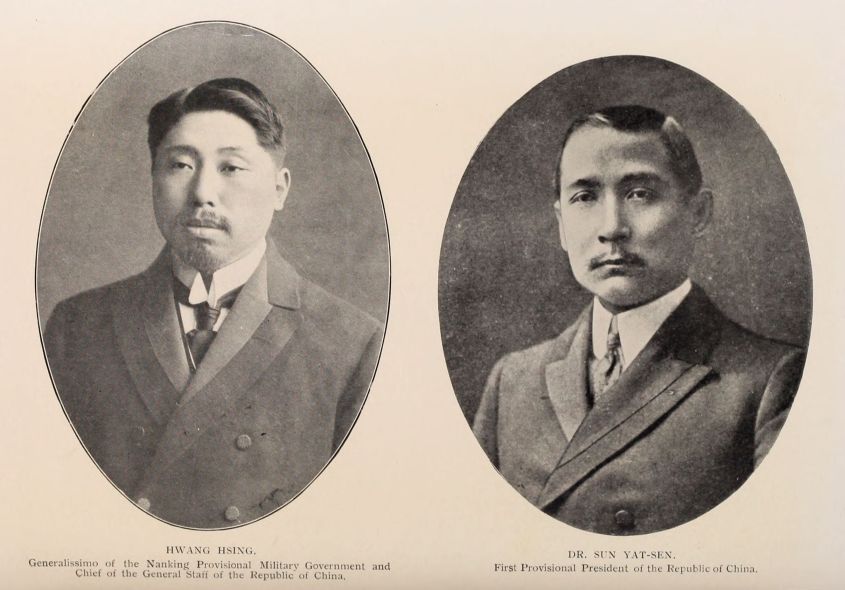
The next scene presents Dr. Sun Yat Sen on the Republican platform. The civilised world then looked to him to solve this political conundrum—and he was voting plump for the Republic. He had now arrived in Shanghai, and his presence totally altered the situation.[1]
[Transcriber's note: this page was entirely taken up by part of footnote 1, which is now on page 196 in its entirety.]
[Transcriber's note: this page was entirely taken up by part of footnote 1, which is now on page 196 in its entirety.]
[Transcriber's note: this page was entirely taken up by part of footnote 1, which is now on page 196 in its entirety.]
[Transcriber's note: this page was entirely taken up by part of footnote 1, which is now on page 196 in its entirety.]
HWANG HSING. Generalissimo of the Nanking Provisional Military Government and Chief of the General Staff of the Republic of China. DR. SUN YAT-SEN. First Provisional President of the Republic of China.