Front matter (continued 6)
Reading edition
"Unfortunately, I do not; but I can find out—by experiment if necessary."
"It might be a good idea," Kinnison suggested. "Go on, Cam."
"Assuming its truth, there is still left the problem of location, which Kit has just made infinitely worse than it was before. Con's and mine were so indefinite that they might possibly have been reconciled with Kat's precisely-known co-ordinates; but yours, Kit, is almost as definite as Kat's, and cannot possibly be made to agree with it. After all, you know, there are many planets peopled by races humanoid to ten places. And if there are four different races, none of them can be the one we want."
"I don't believe it," Kit argued. "Not that I think on that peculiar band. I'm sure enough of my dope so that I want to cross-question Kat on hers. QX, Kat?"
"Surely, Kit. Any questions you like."
"Those minds both had plenty of jets—how do you know that he was telling you the truth? Did you drive in to see? Are you sure even that you saw his real shape?"
"Certainly I'm sure of his shape!" Kathryn snapped. "If there had been any zones of compulsion around, I would have known it and got suspicious right then."
"Maybe, and maybe not," Kit disagreed. "That might depend, you know, on how good the guy was who was putting out the zone."
"Nuts!" Kathryn snorted, inelegantly. "But as to his telling the truth about his home planet—I'm not sure of that, no. I didn't check his channels. I was thinking about other things then." The Five knew that she had just left Mentor. "But why should he want to lie about a thing like that—he would have, though, at that. Good Boskonian technique."
"Sure. In your official capacity of Co-ordinator, Dad, what do you think?"
"The probability is that all those four forms of life belong on one planet. Your location must be wrong, Kat—he gave you the wrong galaxy, even. Too close to Trenco, too—Tregonsee and I both know that region like a book and no such variable is anywhere near there. We've got to find out all about that planet as soon as possible. Worsel, will you please get the charts of Kit's region? Kit, will you check with the planetographers of Klovia as to the variable stars anywhere near where you want them, and how many planets they've got? I'll call Tellus."
The charts were studied, and in due time the reports of the planetographers were received. The Klovian scientists reported that there were four long-period variables in the designated volume of space, gave the spatial co-ordinates and catalogue numbers of each, and all available data concerning their planets. The Tellurians reported only three, in considerably less detail; but they had named each sun and each planet.
"Which one did they leave out?" Kinnison wondered audibly as he fitted the two transparencies together. "This one they call Artonon, no planets. Dunlie, two planets, Abab and Dunster. Descriptions, and so on. Rontieff, one planet that they don't know anything about except the name they have given it. Silly-sounding names—suppose they assemble them by grabbing letters at random? Ploor—"
PLOOR: At last! Only their instantaneous speed of reaction enabled the Five to conceal from the linkage the shrieked thought of what Ploor really meant. After a flashing exchange of thought, Kit smoothly took charge of the conference.
"The planet Ploor should be investigated first, I think," he resumed communication with the group as though his attention had not wavered. "It is the planet nearest the most probable point of origin of that thought-burst. Also, the period of the variable and the planet's distance seem to fit our observations and deductions better than any of the others. Any arguments?"
No arguments. They all agreed. Kinnison, however, demanded action; direct and fast.
"We'll investigate it!" he exclaimed. "With the Dauntless, the Z9M9Z, and Grand Fleet; and with our very special knickknack as an ace up our sleeve!"
"Just a minute, Dad!" Kit protested. "If, as some of this material seems to indicate, the Ploorans actually are the top of the Boskonian culture, even that array may not be enough."
"You may be right—probably are. What, then? What do you say, Tregonsee?"
"Fleet action, yes," the Rigellian agreed. "Also, as you implied, but did not clearly state, independent but correlated action by us five Second-Stage Lensmen, with our various skills. I would suggest, however, that your children be put first—very definitely first—in command."
"We object—we haven't got jets enough to—"
"Overruled!" Kinnison did not have to think to make that decision. He knew. "Any other objections?... Approved. I'll call Cliff Maitland right now, then, and get things going."
That call, however, was never sent; for at that moment the mind of Mentor of Arisia flooded the group.
"Children, attend! This intrusion is necessary because a matter has come up which will permit of no delay. Boskonia is now launching the attack which has been in preparation for over twenty years. Arisia is to be the first point of attack. Kinnison, Tregonsee, Worsel, and Nadreck will take immediate steps to assemble the Grand Fleet of the Galactic Patrol in defense. I will confer at length with the younger Kinnisons.
"The Eddorians, as you know," Mentor went on to the Children of the Lens, "believe primarily in the efficacy of physical, material force. While they possess minds of real power, they use them principally as tools in the development of more and ever more efficient mechanical devices. We of Arisia, on the other hand, believe in the superiority of the mind. A fully competent mind would have no need of material devices, since it could control all material substance directly. While we have made some progress toward that end, and you will make more in the cycles to come, Civilization is, and for some time will be, dependent upon physical things. Hence the Galactic Patrol and its Grand Fleet.
"The Eddorians, after ages of effort, have succeeded in inventing a mechanical generator able to block our most penetrant thoughts. They believe implicitly that their vessels, so protected, will be able to destroy our planet. They may believe that the destruction of our planet would so weaken us that they would be able to destroy us. It is assumed that you children have deduced that neither we nor the Eddorians can be slain by physical force?"
"Yes—the clincher being that no suggestion was made about giving Eddore a planet from nth space."
"We Arisians, during an equally long time, have been aiding Nature in the development of minds much abler than our own. While those minds will not attain their full powers until after many years of work and study, we believe that you will be able, immature as you are, to use the Patrol and its resources to defend Arisia and to destroy the Boskonian fleet. That we cannot do it ourselves is implicit in what I have said."
"But that means ... this is the big show, then, that you have been hinting at so long?"
"Far from it. An important engagement, of course, but only preliminary to the real test, which will come when we invade Eddore. Do you agree with us that if Arisia were to be destroyed now, it would be difficult to repair the damage done to the morale of the Galactic Patrol?"
"Difficult? It would be impossible!"
"Not necessarily. We have considered the matter at length, however, and have decided that a Boskonian success at this time would not be for the good of Civilization."
"I'll say it wouldn't—that's a masterpiece of understatement if there ever was one! Also, a successful defense of Arisia would be about the best thing that the Patrol could possibly do for itself."
"Exactly so. Go, then, children, and work to that end."
"But how, Mentor—how?"
"Again I tell you that I do not know. You have powers—individually, collectively, and as the Unit—about which I know little or nothing. Use them!"
XXV.
The "Big Brass"—socially the Directrix, technically the Z9M9Z—floated through space at the center of a hollow sphere of maulers packed almost screen to screen. She carried the Brains. She had been built around the seventeen million cubic feet of unobstructed space which comprised her "tank"—the three-dimensional chart in which vari-colored lights, stationary and moving, represented the positions and motions of solar systems, ships, loose planets, negaspheres, and all other objects and items in which Grand Fleet Operations was, or might become, interested. Completely encircling the tank's more than two thousand feet of circumference was the Rigellian-manned, multimillion-plug board; a crew and a board capable of handling efficiently more than a million combat units.
In the "reducer," the comparatively tiny ten-foot tank set into an alcove, there were condensed the continuously-changing major features of the main chart, so that one man could comprehend and direct the broad strategy of the engagement.
Instead of Port Admiral Haynes, who had conned that reducer and issued general orders during the only previous experience of the Z9M9Z in serious warfare, Kimball Kinnison was now in supreme command. Instead of Kinnison and Worsel, who had formerly handled the big tank and the board, there were Clarrissa, Worsel, Tregonsee, and the Children of the Lens. There also, in a built-in, thoroughly competent refrigerator, was Nadreck. Port Admiral Raoul LaForge and Vice Co-ordinator Clifford Maitland were just coming aboard.
Might he need anybody else, Kinnison wondered. Couldn't think of anybody—he had just about the whole top echelon of Civilization. Cliff and Laf weren't L2's, of course, but they were mighty good men—besides, he liked them! Too bad that the fourth officer of their class couldn't be there, too—gallant Wiedel Holmberg, killed in action. At that, three out of four was a high average—mighty high.
"Hi, Cliff—Hi, Laf!"
"Hi, Kim!"
The three old friends shook hands cordially, then the two newcomers stared for minutes into the maze of lights flashing and winking in the tremendous space chart.
"Glad I don't have to try to make sense out of that," LaForge commented, finally. "Looks a lot different in battle harness than on practice cruises. You want me on that forward wall there, you said?"
"Yes. You can see it plainer down here in the reducer. The white star is Arisia. The yellows, all marked, are suns and other fixed points, such as the markers along the arbitrary rim of the Galaxy, running from there to there. Reds will be Boskonians when they get close enough to show. Greens are ours. Up in the big tank everything is identified, but down here there's no room for details—each green light marks the location of a whole operating fleet. That block of green circles, there, is your command. It's about eighty parsecs deep and covers everything within two hours—say a hundred and fifty parsecs—of the line between Arisia and the Second Galaxy. Pretty loose now, of course, but you can tighten it up and shift it as you please as soon as some reds show up. You'll have a Rigellian talker—here he is now—when you want anything done, think at him and he'll give it to the right panel on the board. QX?"
"I think so. I'll practice a bit."
"Now you, Cliff. These green crosses, halfway between the forward wall and Arisia, are yours. You won't have quite as much depth as Laf, but a wider coverage. The green tetrahedrons are mine. They blanket Arisia, you notice, and fill the space out to the second wall."
"Do you think that you and I will have anything to do?" Maitland asked, waving a hand at LaForge's tremendous barrier.
"I wish I could hope that we won't, but I can't. I have it from a usually reliable source that they're going to throw the book. That means hyperspatial tubes as well as open space—they'll probably strike everywhere at once."
Then for weeks Grand Fleet drilled, maneuvered, and practiced. All space within ten parsecs of Arisia was divided into minute cubes, each of which was given a reference number. Fleets were so placed that any point in that space could be reached by at least one fleet in thirty seconds or less of elapsed time.
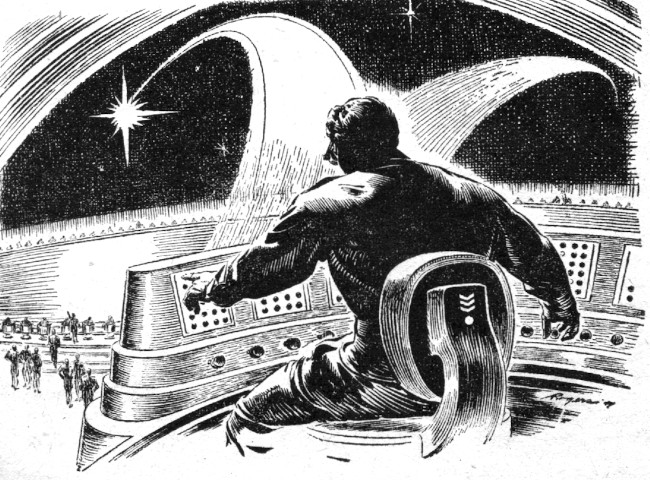
Drill went on until, finally, it happened. Constance, on guard at the moment, perceived the slight "curdling" of space which presages the appearance of the terminus of a hyperspatial tube and gave the alarm. Kit, the girls, and all the Arisians responded instantly—all knew that this was to be a thing which not even the Five could handle unaided.
Not one, or a hundred, or a thousand, but at least two hundred thousand of those tubes erupted, practically at once. Kit could alert and instruct ten Rigellian operators every second, and so could each of his sisters; but since every tube within striking distance of Arisia had to be guarded or plugged within thirty seconds of its appearance, and since all of the work was done out in space and not in the tank, it is seen that the Arisians did practically all of the spotting and placing during those first literally incredible two or three minutes.
If the Boskonians could have emerged from a tube's terminus in the moment of its appearance, it is quite probable that nothing could have saved Arisia. As it was, however, the enemy required seconds, or sometimes even whole minutes, to traverse their tubes, which gave the defenders much valuable time.
One of the observers—an Arisian or a Third-Stage Lensman—at first perception of a terminus erupting, noted the number of the threatened space-cubicle, informed the Rigellian operator upon whose panel the number was, and flashed a message to all other observers that that number had been "handled." The observer flashed the number to the Communications board of the flagship of the fleet covering that space; a flash which was automatically relayed to every Communications and Navigations officer of that fleet, and which also automatically called upon Reserve for another fleet to take the place being vacated. Without further orders, the fleet drove toward its target cube. En route, tube-locators mapped the terminus and marked its exact location upon each vessel's tube plates.
Upon arriving, the fleet englobed the terminus and laced itself, by means of tractors and pressors, into a rigid although inertialess structure. Then, if there was time, and because the theory was that the pirates would probably send a negasphere through first, with an intrinsic velocity aimed at Arisia, a suitably equipped loose planet was tossed into "this end" of the tube. Since they might send a loose or an armed planet through first, however, the Fleet Admiral usually threw a negasphere in, too.
What happened when planet met negasphere, in the unknown medium which makes up the "interior" of a hyperspatial tube, is not and probably never will be surely known. Several highly abstruse mathematical treatises and many volumes of rather gruesome fiction have been written upon the subject—none of which, however, has any bearing here.
If the Patrol fleet did not get there first, the succession of events was different; the degree of difference depending upon how much time the enemy had had. If, as sometimes happened, a fleet was coming through it was met by superatomic bombs and by the concentrated fire of every primary projector that the englobing task force could bring to bear; with consequences upon which it is neither necessary or desirable to dwell. If a planet had emerged, it was met by a negasphere—
Have you ever seen a negasphere strike a planet?
The negasphere is built of negative matter. This material—or, rather, antimaterial—is in every respect the exact opposite of the everyday matter of normal space. Instead of electrons, its ultimate units are positrons—the "Dirac Holes" in an infinity of negative energy. To it a push, however violent, is a pull; a pull is a push. When negative matter strikes positive, then, there is no collision in the usual sense of the word. One electron and one positron neutralize each other and disappear; giving rise to two quanta of extremely hard radiation.
Thus, when the spherical hyper-plane which was the aspect of negasphere tended to occupy the same three-dimensional space in which the loose planet already was, there was no actual collision. Instead, the materials of both simply vanished, along the surface of what should have been a contact, in a gigantically crescendo burst of pure, raw energy. The atoms and the molecules of the planet's substance disappeared; the physically incomprehensible texture of the negasphere's antimass changed into that of normal space. And all circumambient space was flooded with inconceivably lethal radiation; so intensely lethal that any being not adequately shielded from it died before he had time to realize that he was being burned.
Gravitation, of course, was unaffected; and the rapid disappearance of the planet's mass set up unbalanced forces of tremendous magnitude. The hot, dense, pseudoliquid magma tended to erupt as the sphere of nothingness devoured so rapidly the planet's substance, but not a particle of it could move. Instead, it vanished. Mountains fell, crashingly. Oceans poured. Earth-cracks appeared; miles wide, tens of miles deep, hundreds of miles long. The world heaved—shuddered—disintegrated—vanished.
The shock attack upon Arisia itself, which in the Eddorian mind had been mathematically certain to succeed, was over in approximately six minutes. Kinnison, Maitland, and LaForge, fuming at their stations, had done nothing at all. The Boskonians had probably thrown everything they could; the probability was vanishingly small that that particular attack was to be or could be resumed. Nevertheless a host of Kinnison's task forces remained on guard and a detail of Arisians still scanned all nearby space.
"What shall I do next, Kit?" Camilla asked. "Help Connie crack that screen?"
Kit glanced at his youngest sister, who was stretched out flat, every muscle rigidly tense in an extremity of effort.
"No," he decided. "If she can't crack it alone, all four of us couldn't help her much. Besides, I don't believe that she can break through it. That's a mechanical screen, you know, powered by atomic-motored generators. My guess is that it'll have to be solved, not cracked, and the solution will take time. When she comes down off of that peak, Kay, you might tell her so, and both of you start solving it. The rest of us have another job. The moppers-up are coming in force, and there isn't a chance that either we or the Arisians can derive the counter-formula of that screen in less than a week. Therefore the rest of this battle will have to be fought out on conventional lines. We can do the most good, I think, by spotting the Boskonians into the big tank—our scouts aren't locating five per cent of them—for the L2's to pass on to Dad and the rest of the heavy brass so that they can run this battle the way it should be run. You'll do the spotting, Cam, of course; Kat and I will do the pushing. And if you thought that Tregonsee took you for a wild ride—It'll work, don't you think?"
"Of course it will work—and I like wild rides—the faster the better!"
Thus, apparently as though by magic, red lights winked into being throughout a third of the volume of the immense tank; and the three master strategists, informed of what was being done, heaved tremendous sighs of relief. They now had real control. They knew, not only the positions of their own task forces, but also, and exactly, the position of every task force of the enemy. More, by merely forming in his mind the desire for the information, any one of the three could know, with no appreciable lapse of time, the exact composition and the exact strength of any individual one of the horde of Boskonian fleets!
Kit and his two sisters stood close-grouped, motionless; heads bent and almost touching, arms interlocked. Kinnison perceived with surprise that Lenses, as big and as bright as Kit's own, flamed upon his daughters' wrists; a surprise which changed to awe as the very air around those three red-bronze-auburn heads began to thicken, to pulsate, and to glow with that indefinable, indescribable polychromatic effulgence which is so uniquely characteristic of the Lens of the Galactic Patrol. But there was work to do, and Kinnison did it.
Since the Z9M9Z was now working as not even the most optimistic of her planners and designers had dared to hope that she ever could work, the war could now be, and was now being fought strategically; that is, with the object of doing the enemy as much harm as possible with the irreducible minimum of risk. It was not sporting. It was not clubby. There was nothing whatever of chivalry. There was no thought whatever of giving the enemy a break. It was massacre—it was murder—it was war.
It was not ship to ship. No, nor fleet to fleet. Instead, ten or twenty Patrol task forces, under sure pilotage, dashed out to englobe at extreme range one fleet of the Boskonians. Then, before the opposing admiral could assemble a picture of what was going on, his entire command became the center of impact of hundreds or even thousands of detonating superatomic bombs, as well as the focus of an immensely greater number of scarcely less ravaging primary beams. Not a ship nor a scout nor a lifeboat of the englobed fleet escaped, ever. In fact, few indeed were the blobs, or even droplets, of hard alloy or of dureum which remained merely liquefied or which, later, were able to condense.
Fleet by fleet the Boskonians were blown out of the ether; one by one the red lights in the tank and in the reducer winked out. And finally the slaughter was done.
Kit and his two now Lensless sisters unlaced themselves. Karen and Constance came up for air, announcing that they knew how to work the problem Kit had handed them, but that they would need more time on it. Clarrissa, white and shaken by what she had driven herself to do, looked and felt sick. So did Kinnison; nor had either of the other two commanders derived any pleasure from the engagement. Tregonsee deplored it. Of all the Lensed personnel, only Worsel had enjoyed himself. He liked to kill enemies, at close range or far, and he could not understand or sympathize with squeamishness. Nadreck, of course, had neither liked nor disliked any part of the whole affair. To him his part had been merely another task, to be performed with the smallest outlay of physical and mental effort consistent with good workmanship.
"What next?" Kinnison asked then, of the group at large. "I say the Ploorans. They're not like these poor devils were—they probably sent them in. They've got it coming!"
"They certainly have!"
"Ploor!"
"By all means Ploor!"
"But how about Arisia here?" Maitland asked.
"Under control," Kinnison replied. "We'll leave a heavy guard and a spare tank—the Arisians will do the rest."
As soon as the tremendous fleet had shaken itself down into the course for Ploor, all seven of the Kinnisons retired to a small dining room and ate a festive meal. They drank after-dinner coffee. Most of them smoked. They discussed, for a long time and not very quietly, the matter of the Hell Hole in Space. Finally:
"I know it's a trap, as well as you do." Kinnison got up from the table, rammed his hands into his breeches pockets, and paced the floor. "It's got T-R-A-P painted all over it, in bill-poster letters seventeen meters high. So what? Since I'm the only one who can, I've got to go in, if it's still there after we knock Ploor off. And it'll still be there, for all the tea in China. All the Ploorans aren't on Ploor."
Four young Kinnisons flashed thoughts at Kathryn, who frowned and bit her lip. She had hit that hole with everything she had, and had simply bounced. She had been able to block the radiation, of course, but such solid barriers had been necessary that she had blinded herself by her own screens. That it was Eddorian there could be no doubt—warned by her own activities in the other tube—Plooran, of course—and Dad would be worth taking, in more ways than one.
"I can't say that I'm any keener about going in than any of you are about having me to do it," the big Lensman went on, "but unless some of you can figure out a reason for my not going in that isn't fuller of holes than a sponge-rubber cushion, I'm going to tackle it just as soon after we blow Ploor apart as I can possibly get there."
And Kathryn, his self-appointed guardian, knew that nothing could stop him. Nor did anyone there, even Clarrissa, try to stop him. Lensmen all, they knew that he had to go in; and why.
To the Five, the situation was not too serious. Kinnison would probably come through unhurt. The Eddorians could take him, of course. But whether or not they could do anything to him after they got him would depend no little on what the Kinnison kids would be doing in the meantime—and that would be plenty. They couldn't delay Dad's entry into the tube very much without making a smell, but they could and would hurry Arisia up. And even if, as seemed probable, Dad was already in the tube when Arisia was ready for the big business with Eddore, a lot could be done at the other end. Those amoeboid monstrosities would be fighting for their own precious lives, this time, not for the lives of slaves; and the Five promised each other grimly that the Eddorians would have too much else to worry about to waste any time on Kimball Kinnison.
Clarrissa Kinnison, however, fought the hardest and bitterest battle of her life. She loved Kim with a depth and a fervor which very few women, anywhere, have ever been able to feel. She knew with a sick, cold certainty, knew with every fiber of her mind and with every cell of her brain, that if he went into that trap he would die in it. Nevertheless, she would have to let him go in. More, and worse, she would have to send him in—to his death—with a smile. She could not ask him not to go in. She could not even suggest again that there was any possibility that he need not go in. He had to go in. He had to.
And if Lensman's Load was heavy on him, on her it was almost unbearable. His part was vastly the easier. He would only have to die; she would have to live. She would have to keep on living—without Kim—living a lifetime of deaths, one after another. And she would have to hold her block and smile, not only with her face, but with her whole mind. She could be scared, of course, apprehensive, as he himself was; she could wish with all her strength for his safe return: but if he suspected the thousandth part of what she really felt it would break his heart. Nor would it do a bit of good. However brokenhearted at her rebellion against the inflexible Code of the Lens, he would still go in. Being Kimball Kinnison, he could not do anything else.
As soon as she could, Clarrissa went to a distant room and turned on a full-coverage block. She lay down, buried her face in the pillow, clenched her fists, and fought.
Was there any way—any possible way—that she could die instead? None. It was not that simple.
She would have to let him go.
Not gladly, but proudly and willingly—for the good of the Patrol.
Clarrissa Kinnison gritted her teeth and writhed.
She would simply have to let him go into that ghastly trap—go to his absolutely sure and certain death—without showing one white feather, either to her husband or to her children. Her husband, her KIM, would have to die ... and she—would—have—to—live.
She got up, smiled experimentally, and snapped off the block. Then, actually smiling and serenely confident, she strolled down the corridor.
Such is Lensman's Load.
XXVI.
Twenty-odd years before, when the then Dauntless and her crew were thrown out of a hyperspatial tube and into that highly enigmatic nth space, LaVerne Thorndyke had been a Chief Technician. Mentor of Arisia found them, and put into the mind of Sir Austin Cardynge, mathematician extraordinary, the knowledge of how to find the way back to normal space. Thorndyke, working under nervebreaking difficulties, had been in charge of building the machines which were to enable the vessel to return to her home space. He built them. She returned.
He was now again in charge, and every man of his present crew had been a member of his former one. He did not command the spaceship or her regular crew, of course, but they did not count. Not one of these kids would be allowed to set foot on the fantastically dangerous planet to which the inertialess Space Laboratory XII was anchored with tractors and pressors.
Older, leaner, grayer, he was now, even more than then, Civilization's Past Master of Mechanism. If anything could be built, "Thorny" Thorndyke could build it. If it couldn't be built, he could build something that would do the work.
As soon as the Gray Lensman and his son left the vessel, Chief Technician Thorndyke—not the vice admiral of the same name—lined his crew up for inspection; men who, although many of them had as much rank and had had as many years of as much authority as their present boss, had been working for days to forget as completely as possible their executive positions and responsibilities. Each man wore not one, but three personal neutralizers, one inside and two outside of his spacesuit. Thorndyke, walking down the line, applied his test-kit to each individual neutralizer. He then tested his own. QX—all were at max.
"Fellows," he said then, "you all remember what it was like last time. This is going to be the same, except more so and for a longer time. How we did it before without any casualties I'll never know. If we can do it again, it'll be a major miracle—no less. Before, all we had to do was to build a couple of small generators and some controls out of stuff native to the planet, and we didn't find that any too easy a job. This time, for a starter, we've got to build a Bergenholm big enough to free the whole planet; after which we install the Bergs, tube generators, atomic blasts, and other stuff we brought along.
"But that native Berg is going to be a Class A Prime headache, and until we get it running it's going to be hell on wheels. The only way we can get away with it is to check and re-check every thing and every step. Check, check, double-check; then go back and double-check again.
"Remember that the fundamental characteristics of this nth space are such that inert matter can travel faster than light; and remember, every second of the time, that our intrinsic velocity is something like fifteen lights relative to anything solid in this space. I want every one of you to picture himself going inert accidentally. You might take a tangent course or higher—but you might not, too. And it wouldn't only kill the one who did it. It wouldn't only spoil our record. It could very easily kill us all and make a crater full of boiling metal out of our whole installation. So BE CAREFUL! Also bear in mind that one piece, however small, of this planet's material, accidentally brought aboard might wreck the Dauntless. Any questions?"
"If the fundamental characteristics—constants—of this space are so different, how do you know that the stuff will work here?"
"Well, the stuff we built here before worked. The Arisians told Kit Kinnison that two of the fundamentals, mass and length, are about normal. Time is a lot different, so that we can't compute power-to-mass ratios and so on, but we'll have enough power, anyway, to get any speed that we can use."
"I see. We miss the really fancy stuff?"
"Yes. Well, the quicker we get started the quicker we'll get done. Let's go."
The planet was airless, waterless, desolate; a chaotic jumble of huge and jagged fragments of various metals in a nonmetallic continuous phase. It was as though some playful child-giant of space had poured dipperfuls of silver, of iron, of copper, and of other granulated pure metals into a tank of something else—and then, tired of play, had thrown the whole mess away!
Neither the metals nor the nonmetallic substances were either hot or cold. They had no apparent temperature, to thermometers or to the "feelers" of the suits. The machines which these men had built so long before had not changed in any particular. They still functioned perfectly; no spot of rust or corrosion or erosion marred any part. This, at least, was good news.
Inertialess machines, extravagantly equipped with devices to keep them inertialess, were taken "ashore"; nor were any of these ever to be returned to the ship. Kinnison had ordered and reiterated that no unnecessary chances were to be taken of getting any particle of nth-space stuff aboard Space Laboratory XII, and none were taken.
Since men cannot work indefinitely in spacesuits, each man had periodically to be relieved; but each such relief amounted almost to an operation. Before he left the planet his suit was scrubbed, rinsed, and dried. In the vessel's air lock it was air-blasted again before the outer port was closed. He unshelled in the lock and left his suit there—everything which had come into contact with nth-space matter either would be left on the planet's surface or would be jettisoned before the vessel was again inerted. Unnecessary precautions? Perhaps—but Thorndyke and his crew returned unharmed to normal space in undamaged ships.
Finally the Bergenholm was done—by dint of what improvisation, substitution, and artifice only "Thorny" Thorndyke ever knew; at what strain and cost was evidenced by the gaunt bodies and haggard faces of his overworked and under-slept crew. To those experts, and particularly to Thorndyke, the thing was not a good job. It was not quiet, nor smooth. It was not in balance, statically, dynamically, or electrically. The chief technician, to whom a meter jump of one and a half thousandths had always been a matter of grave concern, swore feelingly in all the planetary languages he knew when he saw what those meters were doing.
He scowled morosely. There might have been poorer machines built sometime, somewhere, he supposed—but if so he had never seen any!
But the improvised Berg ran, and kept on running. The planet became inertialess and remained that way. For hours, then, Thorndyke climbed over and around and through the Brobdingnagian fabrication, testing and checking the operation of every part. Finally he climbed down and reported to his waiting crew.
"QX, fellows, a nice job. A good job, in fact, considering—even though we all know that it isn't what any of us would call a good machine. Part of that meter jump, of course, is due to the fact that nothing about the heap is true or balanced, but most of it must be due to this cockeyed ether. Anyway, none of it is due to the usual causes—loose bars and faulty insulation. So my best guess is that she'll keep on doing her stuff while we do ours. One sure thing, she isn't going to fall apart, even under that ungodly knocking; and I don't think that she's going to shake herself off of the planet."
After Thorndyke's somewhat less than enthusiastic approval of his brain-child, the adventurers into that fantastic region attacked the second phase of their project. Two Patrol Bergenholms were landed and were installed. Their meters jumped, too, but the engineers were no longer worried about that. Those machines would run indefinitely; and a concerted sigh of relief arose when the improvised generator was shut down. Pits were dug. Atomic blasts and other engines were installed, as were many exceedingly complex instruments and mechanisms. A few tons of foreign matter on the planet's surface would now make no difference, but there was no relaxation of the extreme precautions against the transfer of any matter whatever from the planet to the spaceship.
When the job was done, but before the clean-up, Thorndyke called his crew into conference.
"Fellows, I know just what a beating you've been taking. We all feel as though we had been on a Delgonian clambake. Nevertheless, I've got to tell you something. Kinnison said that if we could get this one fixed up without too much trouble, it'd be a mighty good idea to have two of them. What do you say? Did we have too much trouble?"
He got exactly the reaction he had expected.
"Lead us to it!"
"Pick out the one you want!"
"Trouble? It's all over—we can tow this scrap heap on a space line, match intrinsics with clamp-on drivers, and plant it anywhere!"
Another metal-studded, barren, lifeless world was therefore found and prepared, and no real argument arose until Thorndyke broached the matter of selecting the two men who were to stay with him and Henderson in the two lifeboats which were to remain for a time near the two loose planets after Space Laboratory XII had returned to normal space. Everybody wanted to stay. Each one was going to stay, too, by all the gods of space, if he had to pull rank to do it!
"Hold it!" Thorndyke commanded. "We'll do the same as we did before, then, by drawing lots. Quartermaster Allerdyce—"
"No!" Uhlenhuth, formerly Atomic Technician 1/c, objected vigorously, and was supported by several others. "He's too clever with his fingers—look what he did to the original draw! We're not squawking about that one, you understand—a little fixing was QX back there—but we want this one to be honest."
"Now that you mention it, I do remember hearing that things were not left entirely to chance." Thorndyke grinned broadly. "So you hold the pot yourself, Uhly, and Hank and I will each pull out one name."
So it was. Henderson drew Uhlenhuth, to that burly admiral's loud delight, and Thorndyke drew Nelson, the erstwhile chief communications officer. The two lifeboats disembarked, each near one of the newly "loosened" planets. Two men would stay on or near each of those planets, to be sure that all the machinery functioned perfectly. They would stay there until the atomic blasts functioned perfectly. They would stay there until the atomic blasts went into action and it became clear that the Arisians would need no help in navigating those tremendous globes through nth space to the points at which two hyperspatial tubes were soon to appear.
Long before the advance scouts of the Grand Fleet were within surveying distance of Ploor, Kit and his sisters had spread a completely detailed chart of its defenses in the tactical tank. A white star represented Ploor's sun; a white sphere the planet itself; white Ryerson string lights marked a portion of the planetary orbit. Points of white light, practically all of which were connected to the white sphere by red string lights, marked the directions of neighboring stars and the existence of sunbeams, installed and ready. Pink globes were loose planets; purple ones negaspheres; red points of light were, as before, Boskonian task-force fleets. Blues were mobile fortresses; bands of canary yellow and amber luminescence showed the locations and emplacements of sunbeam grids and deflectors.
Layer after layer of pinks, purples, and blues almost hid the brilliant white sphere from sight. More layers of the same colors, not quite as dense, surrounded the entire solar system. Yellow and amber bands were everywhere.
Kinnison studied the thing briefly, whistling unmelodiously through his teeth. The picture was familiar enough, since it duplicated in practically every respect the chart of the neighborhood of the Patrol's own Ultra Prime, around Klovia. It did not require much study to make it clear that that defense could not be cracked by any concentration possible of any mobile devices theretofore employed in war.
"Just about what we expected," Kinnison thought to the group at large. "Some new stuff, but not much. What I want to know, Kit and the rest of you, is there anything there that looks as though it was supposed to handle our new baby? Don't see anything, myself."
"There is not," Kit stated definitely. "We looked. There couldn't be, anyway. It can't be handled. Looking backwards at it, they will probably be able to reconstruct how it was done, but in advance? No. Even Mentor couldn't—he had to call in a fellow who has studied ultra-high mathematics for Klono-only-knows-how-many-millions of years to compute the resultant vectors."
Kit's use of the word "they," which, of course, meant Ploorans to everyone except his sisters, concealed his knowledge of the fact that the Eddorians had taken over the defense of Ploor. Eddorians were handling those screens. Eddorians were directing and correlating those far-flung task forces, with a precision which Kinnison soon noticed.
"Much smoother work than I ever saw them do before," he commented. "Suppose they have developed a Z9M9Z?"
"Could be. They copied everything else you invented, why not that?" Again the highly ambiguous "they." "No sign of it around Arisia, though—but maybe they didn't think they'd need it there."
"Or, more likely, they didn't want to risk it so far from home. We can tell better after the mopping-up starts—if the widget performs as per specs. But if your dope is right, this is about close enough. You might tip the boys off, and I'll call Mentor." Kinnison could not reach nth space, but it was no secret that Kit could.
The terminus of one of the Patrol's hyperspatial tubes erupted into space close to Ploor. That such phenomena were expected was evident—a Boskonian fleet moved promptly and smoothly to englobe it. But this was an Arisian tube; computed, installed, and handled by Arisians. It would be in existence only three seconds; the nearest defending task force could not possibly get there in time.
To the observers in the Z9M9Z those three seconds stretched endlessly. What would happen when that utterly foreign planet, with its absolutely impossible intrinsic velocity of over fifteen times that of light, erupted into normal space and went inert? Nobody, not even the Arisians, knew.
Everybody there had seen pictures of what happened when the insignificant mass of a spaceship, traveling at only a hundredth of the velocity of light, collided with a planetoid. That was bad enough. This projectile, however, had a mass of about eight times ten to the twenty-first power—an eight followed by twenty-one zeros—metric tons; would tend to travel fifteen hundred times as fast; and kinetic energy equals mass times velocity squared.
There seemed to be a theoretical possibility, since the mass would instantaneously become some higher order of infinity, that all the matter in normal space would coalesce with it in zero time; but Mentor had assured Kit that operators would come into effect to prevent such an occurrence, and that untoward events would be limited to a radius of ten or fifteen parsecs. Mentor could solve the problem in detail, but since the solution would require some two hundred Klovian years and the event was due to occur in two weeks—
"How about the big computer at Ultra Prime?" Kinnison had asked, innocently. "You know how fast that works."
"Roughly two thousand years—if it could take that kind of math, which it can't," Kit had replied, and the subject had been dropped.
Finally it happened. What happened? Even after the fact none of the observers knew; nor did any except the L3's ever find out. The fuses of all the recorder and analyzer circuits blew at once. Needles jumped instantly to maximum and wrapped themselves around their stops. Charts and ultraphotographic films showed only straight or curved lines running from the origin to and through the limits in zero time. Ploor and everything around it disappeared in an utterly indescribable and completely incomprehensible blast of pure, wild, raw, uncontrolled and uncontrollable energy. The infinitesimal fraction of that energy which was visible, heterodyned upon the ultra as it was and screened as it was, blazed so savagely upon the plates that it seared the eyes.
And if the events caused by the planet aimed at Ploor were indescribable, what can be said of those initiated by the one directed against Ploor's sun?
When the heat generated in the interior of a sun becomes greater than its effective surface is able to radiate, that surface expands. If the expansion is not fast enough, a more or less insignificant amount of the sun's material explodes, thus enlarging by force the radiant surface to whatever extent is necessary to restore equilibrium. Thus come into being the ordinary novae; suns which may for a few days or for a few weeks radiate energy at a rate a few hundreds of thousands of times greater than normal. Since ordinary novae can be produced at will by the collision of a planet with a sun, the scientists of the Patrol had long since completed their studies of all the phenomena involved.
The mechanisms of supernovae, however, remained obscure. No adequate instrumentation had been developed to study conclusively the occasional supernova which occurred naturally. No supernova had ever been produced artificially—with all its resources of mass, atomic energy, cosmic energy, and sunbeams. Civilization could neither assemble nor concentrate enough power.
At the impact of the second loose planet, accompanied by the excess energy of its impossible and unattainable intrinsic velocity, Ploor's sun became a supernova. How deeply the intruding thing penetrated, how much of the sun's mass exploded, never was and perhaps never will be determined. The violence of the explosion was such, however, that Klovian astronomers reported—a few years later—that it was radiating energy at the rate of some five hundred and fifty million suns.
Thus no attempt will be made to describe what happened when the planet from nth space struck the Boskonians' sun.
It was indescribably cubed.
XXVII.
The Boskonian fleets defending Ploor were not all destroyed, of course. The vessels were inertialess. None of the phenomena accompanying the coming into being of the supernova were propagated at a velocity above that of light; a speed which to any spaceship is scarcely a crawl.
The survivors were, however, disorganized. They had lost their morale when Ploor was wiped out in such a spectacularly nerve-shattering fashion. Also, they had lost practically all of their High Command; for the Ploorans, instead of riding the ether as did Patrol commanders, remained in their supposedly secure headquarters and directed matters from afar. Mentor and his fellows had removed from this plane of existence the Eddorians who had been present in the flesh on Ploor. The Arisians had cut all communications between Eddore and the remnants of the Boskonian defensive force.
Grand Fleet, then, moved in for the kill; and for a time the action near Arisia was repeated. Following definite flight-and-course orders from the Z9M9Z, ten or more Patrol fleets would make short hops. At the end of those assigned courses they would discover that they had englobed a task force of the enemy. Bomb and beam!
Over and over—flit, bomb, and beam!
One Boskonian high officer, however, had both the time and the authority to act. A full thousand fleets massed together, their heaviest units outward, packed together screen to screen in a close-order globe of defense.
"According to Haynes, that was good strategy in the old days," Kinnison commented, "but it's no good against loose planets and negaspheres."
Six loose planets were so placed and so released that their inert masses would crash together at the center of the Boskonian globe; then, a few minutes later, ten negaspheres of high antimass were similarly launched. After those sixteen missiles had done their work and the resultant had attained an equilibrium of sorts, very little mopping-up was found necessary.
The Boskonian observers were competent. The Boskonian commanders now knew that they had no chance whatever of success; that to stay was to be annihilated; that the only possibility of life lay in flight. Therefore each remaining Boskonian vice admiral, after perhaps a moment of consultation with a few others, ordered his fleet to drive at maximum blast for his home planet.
"No use chasing them individually, is there, Kit?" Kinnison asked, when it became clear in the tank that the real battle was over; that all resistance had ended. "They can't do anything, and this kind of killing makes me sick at the stomach. Besides, I've got something else to do."
"No. Me, too. So have I." Kit agreed with his father in full.
As soon as the last Boskonian fleet was beyond detector range Grand Fleet broke up, its component fleets setting out for their respective worlds.
"The Hell Hole is still there, Kit," the Gray Lensman said, soberly. "If Ploor was the top—I'm beginning to think there is no top—it leads either to an automatic mechanism set up by the Ploorans or to Ploorans who are still alive somewhere. If Ploor was not the top, this seems to be the only lead we have toward that top. In either case I've got to take it. Check?"
"Well, I—" Kit tried to duck, but couldn't. "Yes, Dad, I'm afraid it's check."
Two big hands met and gripped; and Kinnison went to take leave of his wife.
There is no need to go into detail as to what those two strong souls said or did. He knew that he was going into danger; that he might not return. That is, he knew empirically or academically, as a nongermane sort of fact, that he might die. He did not, however, really believe that he would. No man who is not an arrant coward really believes, ever, that any given event will or can kill him. In his own mind he goes on living indefinitely.
Kinnison expected to be captured, imprisoned, questioned, and perhaps tortured. He could understand all of those things, and he did not like any one of them. That he was more than a trifle afraid and that he hated to leave her now more than he ever had before were both natural enough—he had nothing whatever to hide from her.
She, on the other hand, knew starkly that he would never come back. She knew that he would die in that trap. She knew that she would have to live a lifetime of emptiness, alone. Hence she had much to conceal from him. She must be just as scared and as apprehensive as he was, but no more; just as anxious for their continued happiness as he was, but no more; just as intensely loving, but no more and in exactly the same sense. Here lay the test. She must kiss him good-by as though he were going into mere danger. She must not give way to the almost irresistible urge to act in accordance with what she so starkly, chillingly knew to be the truth, that she would never—never—NEVER kiss her Kim again!
She succeeded. It is a measure of the Red Lensman's quality that she did not weaken, even when her husband approached the boundary of the Hell Hole and sent what she knew would be his last message.
"Here it is—about a second now. Don't worry—I'll be back very shortly. Clear ether, Chris!"
"Of course you will, dear. Clear ether, Kim!"
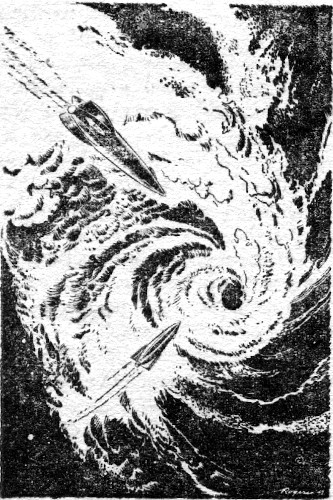
His speedster did not mount any special generators. He had not thought that they would be necessary. Nor were they. He and his ship were sucked into that trap as though it had been a maelstrom.
He felt again the commingled agonies of interdimensional acceleration. He perceived again the formless, textureless, spaceless void of blankly gray nothingness which was the three-dimensionally-impossible substance of the tube. A moment later, he felt a new and different acceleration—he was speeding up inside the tube! Then, very shortly, he felt nothing at all. Startled, he tried to jump up to investigate, and discovered that he could not move. Even by the utmost exertion of his will he could not stir a finger or an eyelid. He was completely immobilized. Nor could he feel. His body was as devoid of sensation as though it belonged to somebody else. Worse, for his heart was not beating. He was not breathing. He could not see. It was as though his every nerve, motor and sensory, voluntary and involuntary, had been separately anaesthetized. He could still think, but that was all. His sense of perception still worked.
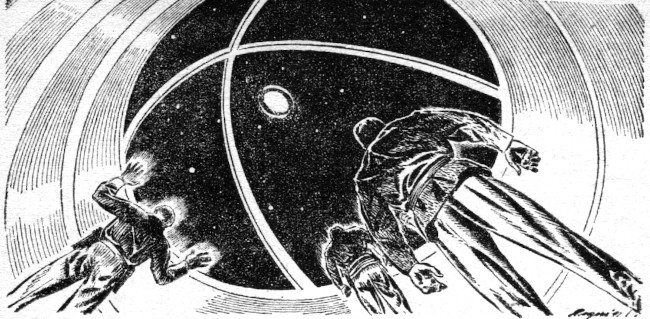
He wondered whether he was still accelerating or not, and tried to find out. He could not. He could not determine whether he was moving or stationary. There were no reference points. Every infinitesimal volume of that enigmatic grayness was like each and every other.
Mathematically, perhaps, he was not moving at all; since he was in a continuum in which mass, length and time, and hence inertia and inertialessness, velocity and acceleration, are meaningless terms. He was outside of space and beyond time. Effectively, however, he was moving; moving with an acceleration which nothing material had ever before approached. He and his vessel were being driven along that tube by every watt of power generable by one entire Eddorian atomic power plant. His velocity, long since unthinkable, became incalculable.
All things end—even Eddorian atomic power was not infinite. At the very peak of power and pace, then, all the force, all the momentum, all the kinetic energy of the speedster's mass and velocity were concentrated in and applied to Kinnison's physical body. He sensed something, and tried to flinch, but could not. In a fleeting instant of what he thought was time he went past, not through, his clothing and his Lens; past, not through, his armor; and past, not through, the hard beryllium-alloy structure of his vessel. He even went past but not through the N-dimensional interface of the hyperspatial tube.
This, although Kinnison did not know it, was the Eddorian's climactic effort. He had taken his prisoner as far as he could possibly reach; then, assembling and concentrating all available power, he had given him a catapultic shove into the absolutely unknown and utterly unknowable. The Eddorian did not know any vector of the Lensman's naked flight; he did not care where he went. He did not know and could not compute or even guess at his victim's probable destination.
In what his spacehound's time sense told him was one second, Kinnison passed exactly two hundred million foreign spaces. He did not know how he knew the precise number, but he did. Hence, in the Patrol's measured cadence, he began to count groups of spaces of one hundred million each. After a few days, his velocity decreased to such a value that he could count groups of single millions. Then thousands—hundreds—tens—until finally he could perceive the salient features of each space before it was blotted out by the next.
How could this be? He wondered, but not foggily; his mind was as clear and as strong as it had ever been. Spaces were coexistent, not spread out like this. In the fourth dimension they were flat together, like pages in a book, except thinner. This was all wrong. It was impossible. Since it could not happen, it was not happening. He had not been and could not be drugged. Therefore some Plooran must have him in a zone of compulsion. What a zone! What an operator the ape must be!
It was, however, real—all of it. What Kinnison did not know, then or ever, was that he was actually outside the boundaries of space; actually beyond the confines of time. He was going past, not through, those spaces and those times.
He was now in each space long enough to study it in some detail. He was an immense distance above this one; at such a distance that he could perceive many globular super-universes; each of which in turn was composed of billions of lenticular galaxies.
Through it. Closer now. Galaxies only; the familiar random masses whose apparent lack of symmetrical grouping is due to the limitations of Civilization's observers. He was still going too fast to stop.
In the next space Kinnison found himself within the limits of a solar system and tried with all the force of his mind to get in touch with some intelligent entity upon one—any one—of its planets. Before he could succeed, the system vanished and he was dropping, from a height of a few thousand kilometers, toward the surface of a warm and verdant world, so much like Tellus that he thought for an instant that he must have circumnavigated total space. The aspect, the ice-caps, the cloud-effects, were identical. The oceans, however, while similar, were different; as were the continents. The mountains were larger and rougher and harder.
He was falling much too fast. A free fall from infinity wouldn't give him this much speed!
This whole affair was, as he had decided once before, absolutely impossible. It was simply preposterous to believe that a naked man, especially one without blood circulation or breath, could still be alive after spending as many weeks in open space as he had just spent. He knew that he was alive. Therefore none of this was happening; even though, as surely as he knew that he was alive, he knew that he was falling.
"Jet back, Lensman!" he thought viciously to himself; tried to shout it aloud.
For this could be deadly stuff, if he let himself believe it. If he believed that he was falling from any such height, he would die in the instant of landing. He would not actually crash; his body would not move from wherever it was that it was. Nevertheless the shock of that wholly imaginary crash would kill him just as dead and just as instantaneously as though all his flesh had been actually smashed into a crimson smear upon one of the neighboring mountain's huge, flat rocks.
"Pretty close, my bright young Plooran friend, but you didn't quite ring the bell," he thought savagely, trying with all the power of his mind to break through the zone of compulsion. "I admit that you're good, but I'm telling you that, if you want to kill me, you'll have to do it physically, and I don't believe that you carry jets enough to swing the job. You might as well cut your zone, because this kind of stuff has been pulled on me by experts, and it hasn't worked yet."
He was apparently falling, feet downward, toward an open, grassy mountain meadow, surrounded by forests, through which meandered a small stream. He was so close now that he could perceive the individual blades of grass in the meadow and the small fishes in the stream, and he was still apparently at terminal velocity.
Without his years of spacehound's training in inertialess maneuvering, he might have died even before he landed, but speed as speed did not affect him at all. He was used to instantaneous stops from light-speeds. The only thing that worried him was the matter of inertia. Was he inert or free?
He declared to himself that he was free. Or, rather, that he had been, was, and would continue to be motionless. It was physically, mathematically, intrinsically impossible that any of this stuff had actually occurred. It was all compulsion, pure and simple, and he—Kimball Kinnison, Gray Lensman—would not let it get him down. He clenched his mental teeth upon that belief and held it doggedly. One bare foot struck the tip of a blade of grass and his entire body came to a shockless halt. He grinned in relief—this was what he had wanted, but had not quite dared wholly to expect. There followed immediately, however, other events which he had not expected at all.
His halt was less than momentary; in the instant of its accomplishment he began to fall normally the remaining eight or ten inches to the ground. Automatically he sprung his space-trained knees, to take the otherwise disconcerting jar; automatically his left hand snapped up to the place where his controls should have been. Legs and arms worked!
He could see with his eyes. He could feel with his skin. He was drawing a breath, the first time he had breathed since leaving normal space. Nor was it an unduly deep breath—he felt no lack of oxygen. His heart was beating as normally as though it had never missed a beat. He was not unusually hungry or thirsty. But all that stuff could wait—where was that Plooran?
Kinnison had landed in complete readiness for strife. There were no rocks or clubs handy, but he had his fists, feet, and teeth; and they would do until he could find or make something better. But there was nothing to fight. Drive his sense of perception as he would, he could find nothing larger or more intelligent than a deer.
The farther this thing went along the less sense it made. A compulsion, to be any good at all, ought to be logical and coherent. It should fit into every corner and cranny of the subject's experience and knowledge. This one did not fit anything or anywhere. It didn't even come close. Yet, technically, it was a marvelous job. He couldn't detect a trace of it. This grass looked and felt real. The pebbles hurt his tender feet so much that he had to wince as he walked gingerly to the water's edge. He drank deeply. The water, real or not, was cold, clear, and eminently satisfying.
"Listen, you misguided what-is-it," he thought probingly, "you might as well open up now as later whatever you've got in mind. If this performance is supposed to be nonfiction, it's a flat bust. If it is supposed to be science-fiction, it isn't much better. If it's a space-opera, even, you're violating all the fundamentals. I've written better stuff myself—Qadgop and Cynthia were a lot more convincing." He waited a moment, then went on:
"Whoever heard of the intrepid hero of a space-opera as big as this one started out to be getting stranded on a completely Earth-like planet and then having nothing happen? No action at all? How about a couple of indescribable monsters of superhuman strength and agility, for me to tear apart with my steel-thewed fingers?"
He glanced around expectantly. No monster appeared.
"Well, then, how about a damsel in distress for me to rescue from a fate worse than death? Better make it two of them—safety in numbers, you know—a blonde and a brunette. No redheads. I'll play along with you part way on that oldie—up to the point of falling for either of them."
He waited again.
"QX, sport, no woman. Suits me perfectly. But I hope you haven't forgotten about the tasty viands. I can eat fish if I have to, but if you want to keep your hero happy, let's see you lay down here, on a platter, a one-kilogram steak, three centimeters thick, medium rare, fried in Tellurian butter and smothered in Venusian superla mushrooms."
No steak appeared, and the Gray Lensman recalled and studied intensively every detail of what had apparently happened. It still could not have occurred. He could not have imagined it. It could not have been compulsion or hypnosis. None of it made any kind of sense.
As a matter of plain fact, however, Kinnison's first and most positive conclusion was wrong. His memories were factual records of actual events and things. He would eat well during his stay upon that nameless planet, but he would have to procure his own food. Nothing would attack him, or even annoy him. For the Eddorian's binding—this is perhaps as good a word for it as any, since "geas" implies a curse—was such that the Gray Lensman could return to space and time only under such conditions and to such an environment as would not do him any iota of physical harm. He must continue alive and in good health for at least fifty more of his years.
And Clarrissa Kinnison, tense and strained, waited in her room for the instant of her husband's death. They two were one, with a oneness no other man and woman had ever known. If one died, from any cause whatever, the other would feel it.
She waited. Five minutes—ten—fifteen—half an hour—an hour. She began to relax. Her fists unclenched, her shallow breathing grew deeper.
Two hours. Kim was still alive! A wave of happy, buoyant relief swept through her; her eyes flashed and sparkled. If they hadn't been able to kill him in two hours, they never could. Her Kim had plenty of jets.
Even the top minds of Boskonia could not kill her Kim!
XXVIII.
The Arisians and the Children of the Lens had known that Eddore must be attacked as soon as possible after the fall of Ploor. They were fairly certain that the interspatial use of planets as projectiles was new; but they were completely certain that the Eddorians would be able to deduce in a short time the principles and the concepts, the fundamental equations, and the essential operators involved in the process. They would find nth space or one like it in one day; certainly not more than two. Their slaves would duplicate the weapon in approximately three weeks. Shortly thereafter both Ultra Prime and Prime Base, both Klovia and Tellus, would be blown out of the ether. So would Arisia—perhaps Arisia would go first. The Eddorians would probably not be able to aim such planets as accurately as the Arisians had, but they would keep on trying and they would learn fast.
This weapon was the sheer ultimate in destructiveness. No defense against it was possible. There was no theory which applied to it or which could be stretched to cover it. Even the Arisian Masters of Mathematics had not as yet been able to invent symbologies and techniques to handle the quantities and magnitudes involved when those interloping masses of foreign matter struck normal space.
Thus Kit did not have to follow up his announced intention of making the Arisians hurry up. They did not hurry, of course, but they did not lose or waste a minute. Each Arisian, from the youngest guardian up to the oldest philosopher, tuned a part of his mind to Mentor, another part to some one of the millions of Lensmen upon his list, and flashed a message.
"Lensman, attend—keep your mind sensitized to this, the pattern of Mentor of Arisia, who will speak to you as soon as all have been alerted."
That message went throughout the First Galaxy, throughout intergalactic space, and throughout what part of the Second Galaxy had felt the touch of Civilization. It went to Alsakan and Vandemar and Klovia, to Thrale and Tellus and Rigel IV, to Mars and Velantia and Palain VII, to Medon and Venus and Centralia. It went to flitters, battleships, and loose planets. It went to asteroids and moonlets, to planets large and small. It went to newly graduated Lensmen and to Lensmen long since retired; to Lensmen at work and at play. It went to every living wearer of the First-Stage Lens of the Galactic Patrol.
Wherever the message went, turmoil followed. Lensmen everywhere flashed questions at all the other Lensmen they knew or had ever met.
"What do you make of it, Fred?"
"Did you get the same thing I did?"
"Mentor! Grinning Noshabkeming, what's up?"
"Must be big for Mentor to be handling it."
"Big! It's immense! Whoever heard of Arisia stepping in before?"
"Big! Colossal! Mentor never talked to anybody except Kinnison before, did he?"
Millions of Lensed questions flooded every base and every office of the Patrol. Nobody, not even the vice co-ordinator, knew a thing.
"You might as well stop sending in questions as to what this is all about, because none of us knows any more about it than you do," Maitland finally sent out a general notice. "Apparently everybody with a Lens is getting the same message, no more and no less. All I can say is that it must be a Class A Prime emergency, and everyone who is not actually tied up in a life-and-death matter will please drop everything and stand by."
Mentor wanted, and had to have, high tension. He got it. Tension mounted higher and higher as eventless hours passed and as, for the first time in history, Patrol business slowed down almost to a stop.
And in a small cruiser, manned by four red-headed girls and one red-headed youth, tension was also building up. The problem of the mechanical screens had long since been solved. Atomic powered counter-generators were in place, ready at the touch of a button to neutralize the mechanically-generated screens of the enemy and thus to make the engagement a mind-to-mind combat. They were as close to Eddore's star-cluster as they could be without giving alarm. They had had nothing to do for hours except wait. They were probably keyed up higher than any other five Lensmen in all of space.
Kit, son of his father, was pacing the floor, chain-smoking. Constance was alternately getting up and sitting down—up—down—up. She, too, was smoking; or, rather, she was lighting cigarettes and throwing them away. Kathryn was sitting, stiffly still, manufacturing Lenses which, starting at her wrists, raced up both bare arms to her shoulders and disappeared. Karen was meticulously sticking holes in a piece of blank paper with a pin, making an intricate and meaningless design. Only Camilla made any pretense of calmness, and the others knew that she was bluffing. She was pretending to read a novel; but instead of absorbing its full content at the rate of one glance per page, she had read half of it word by word and still had no idea of what the story was about.
"Are you ready, Children?" Mentor's thought came in at last.
"Ready!" Without knowing how they got there, the Five found themselves standing in the middle of the room, packed tight.
"Oh Kit, I'm shaking like a fool!" Constance wailed. "I just know I'm going to louse up this whole war!"
"QX, baby, we're all in the same fix. Can't you hear my teeth chatter? Doesn't mean a thing. Good teams—champions—all feel the same way before a big game starts. And this is the capital IT.
"Steady down, kids. We'll be QX as soon as the whistle blows—I hope."
"P-s-s-t!" Kathryn hissed. "Listen!"
"Lensmen of the Galactic Patrol!" Mentor's resonant pseudovoice filled all space. "I, Mentor of Arisia, am calling upon you because of a crisis in which no lesser force can be of use. You have been informed upon the matter of Ploor. It is true that Ploor has been destroyed; that the Ploorans, physically, are no more. You of the Lens, however, already know dimly that the physical is not the all. Know now that there is a residuum of nonmaterial malignancy against which all the physical weapons of all the Universe would be completely impotent. That evil effluvium, intrinsically vicious, is implacably opposed to every basic concept and idea of your Patrol. It has been on the move ever since the destruction of the planet Ploor. Unaided, we of Arisia are not strong enough to handle it, but the massed and directed force of your collective mind will be able to destroy it completely. If you wish me to do so, I will supervise the work of so directing your mental force as to encompass the complete destruction of this menace, which I tell you most solemnly is the last weapon of power with which Boskonia will be able to threaten Civilization. Lensmen of the Galactic Patrol, met as one for the first time in Civilization's long history, what is your wish?"
A tremendous wave of thought, expressed in millions of variant phraseologies, made the wish of the Lensmen very clear indeed. They did not know how such a thing could be done, but they were supremely eager to have Mentor of Arisia lead them against the Boskonians, whoever and wherever they might be.
"Your verdict is unanimous, as I had hoped and believed that it would be. It is well. The part of each of you will be simple, but not easy. You will all of you, individually, think of two things, and of only two. First, of your love for and your pride in and your loyalty to your Patrol. Second, of the clear fact that Boskonia must not and shall not triumph over Civilization. Think these thoughts, each of you with all the strength that in him lies.
"You need not consciously direct those thoughts. Being attuned to my pattern, the force will flow at my direction. As it passes from you, you will replenish it, each according to his strength. You will find it the hardest labor you have ever performed, but it will be of permanent harm to none and it will not be of long duration. One hour will suffice. Are you ready?"
"WE ARE READY!" The crescendo roar of thought must have bulged the Galaxy to its poles.
"Children—strike!"
The Unit struck. The outermost Eddorian screen went down. It struck again, almost instantly. Down went the second. The third. The fourth.
It was that flawless Unit, not Camilla, who detected and analyzed and precisely located the Eddorian guardsman handling each of those far-flung screens. It was the Unit, not Kathryn and Kit, who drilled the pilot hole through each Eddorian's hard-held block and enlarged it into a working orifice. It was the Unit, not Karen, whose impenetrable shield held stubbornly every circular mil of advantage gained in making such ingress. It was the Unit, not Constance, who assembled and drove home the blasts of mental force in which the Eddorians died. No time whatever was lost in consultation or decision. Action was not only instantaneous, but simultaneous with perception. The Children of the Lens were not now five, but one. The UNIT.
"Come in, Mentor!" Kit snapped then. "All you Arisians and all the Lensmen. Nothing specialized—just a general slam at the whole screen. This fifth screen is the works—they've got twenty men on it instead of one, and they're top-notchers. Best strategy now is for us five to lay off for a second or two and show 'em what we've got in the line of defense, while the rest of you fellows give 'em hell!"
Arisia and the massed Lensmen struck, a tidal wave of such tremendous weight and power that under its impact the fifth screen sagged flat against the planet's surface. Any one Lensman's power was small, of course, in comparison with that of any Eddorian, but every First-Stage Lensman of the Galactic Patrol was giving, each according to his strength, and the output of one Lensman, multiplied by the countless millions which was the number of Lensmen then at work, made itself tellingly felt.
Countless? Yes. No one not of Arisia ever knew how many minds contributed to that stupendous flood of force. Bear in mind that in the First Galaxy alone there are over two thousand million suns: that each sun has, on the average, something over one and thirty-seven hundredths planets inhabited by intelligent life; that about one-half of these planets adhere to Civilization; and that Tellus, an average planet, graduates approximately one hundred Lensmen every year.
"So far, Kit, so good," Constance panted. Although she was no longer trembling, she was still highly excited. "But I don't know how many more shots like that I've ... we've ... got left in the locker."
"You're doing fine, Connie," Camilla soothed.
"Sure you are, baby. You've got plenty of jets," Kit agreed. Except in moments of supreme stress these personal, individual exchanges of by-thoughts did not interfere with the smooth functioning of the Unit. "Fine work, all of you, kids. I knew that we'd get over the shakes as soon as—"
"Watch it!" Camilla snapped. "Here comes the shock wave. Brace yourself, Kay. Hold us together, Kit!"
The wave came. Everything that the Eddorians could send. The Unit's barrier did not waver. After a full second of it—a time comparable to days of continuous atomic bombing in ordinary warfare—Karen, who had been standing stiff and still, began to relax.
"This is too, too easy," she declared. "Who is helping me? I can't feel anything, but I simply know that I haven't got this much stuff. You, Cam—or is it all of you?" Not one of the Five was as yet thoroughly familiar with the operating characteristics of the Unit.
"All of us, more or less, but mostly Kit," Camilla decided after a moment's thought. "He's got the weight of an inert planet."
"Not me," Kit denied, vigorously. "Must be you other kids. Feels to me like Kat, mostly. All I'm doing is just sort of leaning up against you a little—just in case. I haven't done a thing so far."
"Oh, no? Sure not!" Kathryn giggled, an infectious chuckle inherited or copied directly from her mother. "We know it, and that you're going to keep on loafing all the rest of the day. You wouldn't think of doing anything, even if you could. Just the same, we're all mighty glad that our big brother is here!"
"QX, kids, seal the chatter. We've had time to learn that they can't crack us—so have they, by the way—so let's get to work."
Since the Unit was now under continuous attack, its technique would have to be entirely different from that used previously. Its barrier must vanish for an infinitesimal period of time, during which it must simultaneously detect and blast. Or, rather, the blast would have to be directed in mid-flight, while the Unit's own block was open. Nor could that block be open for more than the barest possible instant before or after the passage of the bolt. It is true that the attack of the Eddorians compared with that of the Unit very much as the steady pressure of burning propellant powder compares with the disruptive force of detonating duodec; even so it would have wrought much damage to the minds of the Five had any of it been allowed to reach them.
Also, like parachute-jumping, this technique could not be practiced. Since the timing had to be so nearly absolute, the first two shots missed their targets completely; but the Unit learned fast. Eddorian after Eddorian died.
"Help, All-Highest, help!" a high Eddorian appealed, finally.
"What is it?" His Ultimate Supremacy, knowing that only utter desperation could be back of such intrusion, wasted no time.
"It is this new Arisian entity—"
"It is not an entity, fool, but a fusion," came curt reprimand. "We decided that point long ago."
"An entity, I say!" In his urgency the operator committed the unpardonable by omitting the titles of address. "No possible fusion can attain such perfection of timing, of synchronization. Our best fusions have attempted to match it, and have failed. Its screens are impenetrable. Its thrusts cannot be blocked. My message is this: Solve for us, and quickly, the problem of this entity. If you do not or cannot do so, we perish all of us, even to you of the Innermost Circle."
"Think you so?" The thought was a sneer. "If your fusions cannot match those of the Arisians you should die, and the loss will be small."
The fifth screen went down. For the first time in untold ages the planet of Eddore lay bare to the Arisian mind. There were inner defenses, of course, but Kit knew every one; their strengths and their weaknesses. He had long since spread in Mentor's mind an exact and completely detailed chart; they had long since drawn up a completely detailed plan of campaign. Nevertheless, Kit could not keep from advising Mentor:
"Pick off any who may try to get away. Start on Area B and work up. Be sure, though, to lay off of Area K or you'll get your beard singed off."
"The plan is being followed," Mentor assured him. "Children, you have done very well indeed. Rest now, and recuperate your powers against that which is yet to come."
"QX. Unlace yourselves, kids. Loosen up. Unlax. I'll break out a few beakers of fayalin, and all of us—you especially, Con—had better eat ten or fifteen of these candy bars."
"Eat! Why, I couldn't—" Kit insisted, and Constance took an experimental bite. "But say, I am hungry, at that!"
"Of course you are. We've been putting out some stuff, and there's more and worse coming. Now rest, all of you."
They rested. Somewhat to their surprise, they were now seasoned enough campaigners so that they could rest; even Constance. But the respite was short. Area K, the headquarters and the citadel of His Ultimate Supremacy and the Innermost Circle of the Boskonian Empire, contained all that remained of Eddorian life.
"No tight linkage yet, kids," Kit the Organizer went smoothly to work. "Individual effort—a flash of fusion, perhaps, now and then, if any of us call for it, but no Unit until I give the word. Then give it everything you've got. Cam, analyze that screen and set us up a pattern for it—you'll find that it'll take some doing. See whether it's absolutely homogenous—hunt for weak spots, if any. Con, narrow down to the sharpest needle you can possibly make and start pecking. Not too hard—don't tire yourself—just to get acquainted with the texture of the thing and keep them awake. Kay, take over our guard so that Eukonidor can join the other Arisians. Kat, come along with me—you'll have to help with the Arisians until I call you into the Unit.
"You Arisians, except Mentor, blanket this dome. Thinner than that—solider, harder—there. A trifle off-balance yet—give me just a little more, here on this side. QX—hold it right there! SQUEEZE! Kat, watch 'em. Hold them right there and in balance until you're sure that the Eddorians aren't going to be able to put any bulges up through the blanket.
"Now, Mentor, you and the Lensmen. Tell them to give us, for the next five seconds, absolutely everything that they can deliver. When they're at absolute peak, hit us with it all. Hit us dead center, and don't pull your punch. We'll be ready.
"Con, get ready to stick that needle there—they'll think it's just another peck, I hope—and prepare to blast as you never blasted before. Kay, get ready to drop that screen and stiffen the needle—when those Lensmen hit us even you will know that you're not just being patted on the back. The rest of us will brace you and keep the shock from killing us all. Here it comes. Make Unit! GO!"
The Unit struck. The needle of pure force drove against the Eddorians' supposedly absolutely impenetrable shield. The Unit's thrust was, of itself, like nothing ever before known. The Lensmen's pile-driver blow—the integrated sum total of the top effort of every First-Stage Lensman of the entire Galactic Patrol—was of itself irresistible. Something had to give way.
For an instant it seemed as though nothing were happening or ever would happen. Strong young arms laced the straining Five into a group as motionless and as sculpturesque as statuary, while between their bodies and around them there came into being a gigantic Lens—a Lens whose splendor filled the entire room with radiance.
Under that awful concentration of force something had to give way. The Unit held. The Arisians held. The Lensmen held. The needle of force, superlatively braced, neither bent nor broke. Therefore the Eddorians' screen was punctured; and in the instant of its puncturing it disappeared as does a bubble when it breaks.
There was no mopping-up to do. Such was the torrent of force cascading into that citadel that within a moment after its shield went down all life within it was snuffed out.
The Boskonian War was over.
XXIX.
"Did you kids come through QX?" The frightful combat over, the dreadful tension a thing of the past, Kit's first thought was for his sisters.
They were unharmed. None of the Five had suffered anything except mental exhaustion. Recuperation was rapid.
"Better we hunt that tube up and get Dad out of it, don't you think?" Kit suggested.
"Have you got a story arranged that will hold together under examination?" Camilla asked.
"Everything except a few minor details, which we can polish up later."
Smoothly the four girls linked their minds with their brother's; effortlessly the Unit's thought surveyed all nearby space. No hyperspatial tube, nor any trace of one, was there. Tuned to Kinnison's pattern, the Unit then scanned not only normal space and the then present time, but also millions upon millions of other spaces and past and future times; all without finding the Gray Lensman.
Again and again the Unit reached out, farther and farther; out to the extreme limit of even its extraordinary range. Every space and every time was empty. The Children of the Lens broke their linkage and stared at each other, aghast.
They knew starkly what it must mean, but that conclusion was unthinkable. Kinnison—their Dad—the hub of the universe—the unshakable, immutable Rock of Civilization—he couldn't be dead. They simply could not accept the logical explanations as the true one.
And while they pondered, shaken, a call from their Red Lensman mother impinged upon their consciousness.
"You are together? Good! I have been so worried about Kim going into that trap. I have been trying to get in touch with him, but I cannot reach him. You children, with your greater power—"
She broke off as the dread import of the Five's surface thoughts became clear to her. At first she, too, was shaken, but she rallied magnificently.
"Nonsense!" she snapped; not in denial of an unwelcome fact, but in sure knowledge that the supposition was not and could not be a fact. "Kimball Kinnison is alive. He is lost, I know—I last heard from him just before he went into that hyperspatial tube—but I did not feel him die. And if he died, no matter where or when or how, I would most certainly have felt it. So don't be idiots, children, please. Think—really think! I am going to do something—somehow—but what? Mentor the Arisian? I've never called him and I'm terribly afraid that he might not be willing to do anything. I could go there and make him do something, but that would take so long—tell me, what shall I—what can I do?"
"Mentor, by all means," Kit decided. "The most logical, the only possible solution. I am sure that in this case he will act. It is neither necessary nor desirable to go to Arisia." Now that the Eddorians had ceased to exist, intergalactic space presented no barrier to Arisian thought, but Kit did not enlighten his mother upon that point. "Link your mind with ours." She did so.
"Mentor of Arisia!" the clear-cut thought flashed out. "Kimball Kinnison of Klovia is not present in this, his normal space and time, nor in any other continuum which we can reach. We ask assistance."
"Ah, 'tis Lensman Clarrissa and the Five." Imperturbably, Mentor's mind joined theirs on the instant. "I have given the matter no attention, nor have I scanned my visualization of the Cosmic All. It may be that Kimball Kinnison has passed on from this plane of exist—"
"He has NOT!" the Red Lensman interrupted violently, so violently that her thought had the impact of a physical blow. Mentor and the Five alike could see her eyes flash and sparkle; could hear her voice crackle as she spoke aloud, the better to drive home her passionate conviction. "Kim is ALIVE! I told the children so and I now tell you so. No matter where or when he might be, in whatever possible extra-dimensional nook or cranny of the entire macrocosmic universe or in any possible aisle of time between plus and minus eternity, he could not die—he could not possibly die—without my knowing it. So find him, please—please find him, Mentor—or, if you can't or won't, just give me the littlest, tiniest hint as to how to go about it and I will find him myself!"
The Five were appalled. Especially Kit, who knew, as the others did not, just how much afraid of Mentor his mother had always been. To direct such a thought as that to any Arisian was unthinkable; but Mentor's only reaction was one of pleased interest.
"There is much of truth, daughter, in your thought," he replied, slowly. "Human love, in its highest manifestation, can be a mighty, a really tremendous thing. The force, the power, the capability of such a love as yours is a sector of the truth which has not been fully examined. Allow me, please, a moment in which to consider the various aspects of this matter."
It took more than a moment. It took more than the twenty-nine seconds which the Arisian had needed to solve an earlier and supposedly similar Kinnison problem. In fact, a full half hour elapsed before Mentor resumed communication; and then he did so, not to the group as a whole, but only to the Five; using an ultrafrequency to which the Red Lensman's mind could not be attuned.
"I have not been able to reach him. Since you could not do so I knew that the problem would not be simple, but I have found that it is difficult indeed. As I have intimated previously, my visualization is not entirely clear upon any matter touching the Eddorians directly, since their minds were of great power. On the other hand, their visualizations of us were probably even more hazy. Therefore none of our analyses of each other were or could be much better than approximations.
"It is certain, however, that you were correct in assuming that it was the Ploorans who set up the hyperspatial tube as a trap for your father. The fact that the lower and middle operating echelons of Boskonia could not kill him established in the Ploorans' minds the necessity of taking him alive. The fact gave us no concern, for you, Kathryn, were on guard. Moreover, even if she alone should slip, it was manifestly impossible for them to accomplish anything against the combined powers of you Five. However, at some undetermined point in time the Eddorians took over, as is shown by the fact that you are all at a loss: it being scarcely necessary to point out to you that the Ploorans could neither transport your father to any location which you could not reach nor pose any problem, including his death, which you could not solve. It is thus certain that it was one or more of the Eddorians who either killed Kinnison or sent him where he was sent. It is also certain that, after the easy fashion in which he escaped from the Ploorans after they had captured him and had him all but in their hands, the Eddorians did not care to have the Ploorans come to grips with Kimball Kinnison; fearing, and rightly, that instead of gaining information, they would lose everything."
"Did they know that I was in that tube?" Kathryn asked. "Did they deduce us, or did they think that Dad was a superman?"
"That is one of the many points which are obscure. But it made no difference, before or after the event, to them or to us, as you should perceive."
"Of course. They knew that there was at least one third-level mind at work in the field. They must have deduced that it was Arisian work. Whether it was Dad himself, or whether it was coming to his aid at need, would make no difference. They knew very well that he was the keystone of Civilization, and that to do away with him would be the shrewdest move they could make. Therefore, we still do not understand why they didn't kill him out-right and be done with it—if they didn't."
"In exactness, neither do I—that point is the least clear of all. Nor is it at all certain that he still lives. It is sheerest folly to assume that the Eddorians either thought or acted illogically, even occasionally. Therefore, if Kinnison is not dead, whatever was done was calculated to be even more final than death itself. This premise, if adopted, forces the conclusion that they considered the possibility of our knowing enough about the next cycle of existence to be able to reach him there."
Kit frowned. "You still harp on the possibility of his death. Does not your visualization cover that?"
"Not since the Eddorians took control. I have not consciously emphasized the probability of your father's death; I have merely considered it—in the case of two mutually exclusive events, neither of which can be shown to have happened, both must be studied with care. Assume for the moment that your mother's theory is the truth, that your father is still alive. In that case, what was done and how it was done are eminently clear."
"Clear? Not to us!" the Five chorused.
"While they did not know at all exactly the power of our minds, they could establish limits beyond which neither they nor we could go. Being mechanically inclined, it is reasonable to assume that they had at their disposal sufficient energy to transport Kinnison and his vessel to some point well beyond those limits. They would have given control to a director-by-chance, so that his ultimate destination would be unknown and unknowable. He would of course land safely—"
"How? How could they, possibly—?"
"In time that knowledge will be yours. Not now. Whether or not the hypothesis just stated is true, the fact confronting us is that Kimball Kinnison is not now in any region which I am at present able to scan."
Gloom descended palpably upon the Five.
"I am not saying or implying that the problem is insoluble. Since Eddorian minds were involved, however, you already realize that its solution will require the evaluation of many millions of factors and will consume a not inconsiderable number of your years."
"You mean lifetimes!" an impetuous young thought broke in. "Why, long before that—"
"Contain yourself, daughter Constance," Mentor reproved, gently. "I realize quite fully all the connotations and implications involved. I was about to say that it may prove desirable to assist your mother in the application of powers which may very well transcend in some respects those of either Arisia or Eddore." He shifted the band of thought to include the Red Lensman and went on as though he were just emerging from contemplation:
"Children, it appears that the solution of this problem by ordinary processes will require more time than can conveniently be spared. Moreover, it affords a priceless and perhaps a unique opportunity of increasing our store of knowledge. Be informed, however, that the probability is exceedingly great that in this project you, Clarrissa, will lose your life."
"Better not, mother. When Mentor says anything like that, it means suicide. We don't want to lose you, too." Kit pleaded, and the four girls added their pleas to his.
Clarrissa knew that suicide was against the Code—but she also knew that, as long as there was any chance at all, Lensmen always went in.
"Exactly how great?" she demanded, vibrantly. "It isn't absolutely certain—it can't be!"