Front matter (continued 5)
Reading edition
Worsel himself went straight for the Boskonian captain, his pre-selected prey. That wight had a couple of guards with him, but they did not matter—needle-ray men took care of them. He also had a pair of heavy beam guns, which he held steadily on the Velantian. Worsel paused momentarily; then, finding that his screens were adequate, he slammed the control room door shut with a flick of his tail and launched himself, straight and level at his foe, with an acceleration of seven gravities. The captain tried to dodge but could not. The frightful impact did not kill him, but it hurt him, badly. Worsel, on the other hand, was scarcely jarred. Hard, tough, and durable, Velantians are accustomed from birth to knockings-about which would pulverize human bones.
Worsel batted the Boskonian's guns away with two terrific blows of an armored paw, noting as he did so that violent contact with a steel wall did not do their interior mechanisms a bit of good. Then, after cutting off both his enemy's screens and his own, he batted the Boskonian's helmet; at first experimentally, then with all his power. Unfortunately, however, it held. So did the thought-screen, and there were no external controls. That armor was good stuff!
Leaping to the ceiling, he blasted his whole mass straight down upon the breastplate, striking it so hard this time that he hurt his head. Still no use. He wedged himself between two heavy braces, flipped a loop of tail around the Boskonian's feet, and heaved. The armored form flew across the room, struck the heavy steel wall, bounced, and dropped. The bulges of the armor were flattened by the force of the collision, the wall was dented—but the thought-screen still held!
Worsel was running out of time, fast. He couldn't treat the thing very much rougher without killing him, if he wasn't dead already. He couldn't take him aboard; he had to cut that screen here and now! He could see how the armor was put together; but, armored as he was, he could not take it apart. And, since the whole ship was empty of air, he could not open his own.
Or could he? He could. He could breathe space long enough to do what had to be done. He cut off his air, loosened a plate enough to release four or five gnarled hands, and, paying no attention to his involuntarily laboring lungs, set furiously to work. He tore open the Boskonian's armor, snapped off his thought-screen. The creature was not quite dead yet—good! He didn't know a thing, though, nor did any member of his crew, except ... yes, one man—a big shot—had got away. Who or what, was he?
"Tell me!" Worsel demanded, with the full power of mind and Lens, even while he was exploring with all his skill and speed. "TELL ME!"
But the Boskonian was dying fast. The ungentle treatment, and now the lack of air, were taking toll. His patterns were disintegrating by the second, faster and faster. Meaningless blurs, which, under Worsel's vicious probing, condensed into something which seemed to be a Lens.
A Lensman? Impossible—starkly unthinkable! But jet back—hadn't Kim intimated a while back that there might be such things as Black Lensmen?
But Worsel himself wasn't feeling so good. He was only half conscious. Red, black, and purple spots were dancing in front of every one of his eyes. He sealed his suit, turned on his air, gasped, and staggered. Two of the nearest Velantians, all of whom had, of course, been en rapport with him throughout, came rushing to his aid; arriving just as he recovered full control.
"Back to the Velan, everybody!" he ordered. "No time for any more fun—we've got to get that lifeboat!" Then, as soon as he had been obeyed: "Bomb that hulk ... good. Flit!"
Overtaking the lifeboat did not take long. Spearing it with a tractor and yanking it alongside required only seconds. For all his haste, Worsel found in it only something that looked as though it once might have been a Delgonian Lensman. It had blown itself apart with a grenade. Because of its reptilian tenacity of life, however, it was not quite dead; its Lens still showed an occasional flicker of light and its shattered mind was not yet entirely devoid of patterns. Worsel studied that mind until all trace of life had vanished, then again reported to the Co-ordinator.
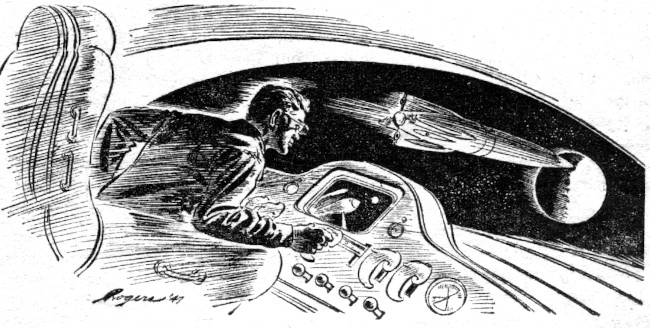
"... so you see I guessed wrong. The Lens was too dim to read, but he must have been a Black Lensman. The only readable thought in his mind was an extremely fuzzy one of the planet Lyrane IX. I hate to have hashed the job up so—especially since I had one chance in two of guessing right."
"Well, no use in squawking now." Kinnison paused in thought. "Besides, he could have done it anyway, and would have. You haven't done so badly, at that. You found a Black Lensman who is not a Kalonian, and you've got confirmation of Boskonian interest in Lyrane IX. What more do you want? Stick around fairly close to the Hell Hole, Slim, and as soon as I can make it, I'll join you there."
XX.
"Boys, take her upstairs," Kinnison-Thyron ordered, and the tremendous raider—actually the Dauntless in disguise—floated serenely upward to a station immediately astern of the vice admiral's flagship. All three courses of multi-ply defensive screen were out, as were full-coverage spy-ray blocks and thought-screens.
As the fleet blasted in tight formation for Kalonia III, Vice Admiral Mendonai tested the Dauntless' defenses thoroughly, and found them bottle-tight. No intrusion was possible. The only open channel was that one plate-to-plate, the other end of which was so villainously fogged that nothing could be seen except Bradlow Thyron's face. Convinced at last of that fact, Mendonai sat back and seethed quietly, his pervasive Kalonian blueness pointing up his grim and vicious mood.
He had never, in all his long life, been insulted so outrageously. Was there anything—anything!—he could do about it? There was not. Thyron, personally, he could not touch—yet—and the fact that the outlaw had so brazenly and so nonchalantly placed his vessel in the exact center of the Boskonian fleet made it pellucidly clear to any Boskonian mind that he had nothing whatever to fear from that fleet.
Wherefore the Kalonian seethed, and his minions stepped ever more softly and followed with ever-increasing punctilio the rigid Boskonian code. For the grapevine carries news swiftly; by this time the whole fleet knew that His Nibs had been taking a God-awful kicking around, and that the first guy who gave him an excuse to blow off steam would be lucky if he only got boiled in oil.
As the fleet spread out for inert maneuvering above the Kalonian stratosphere, Kinnison turned again to the young Lensman.
"One last word, Frank. I am as sure as I can be that I am fully covered—a lot of smart people worked on this problem. Nevertheless, something may happen, so I will send you the data as fast as I get it. Remember what I told you before—if I get the dope we need, I'm expendable and it'll be your job to get it back to Base. No heroics. Is that clear?"
"Yes, sir." The young Lensman gulped. "I hope, though, that it doesn't—"
"So do I," Kinnison grinned as he climbed into his highly special dureum armor, "and the chances are a million to one that it won't. That's why I'm going down there."
In their respective speedsters Kinnison and Mendonai made the long drop to the ground, and side by side they went into the office of Black Lensman Melasnikov. That worthy, too, wore heavy armor; but he did not have a mechanical thought-screen. Arrogantly conscious of his tremendous power of mind, what did any Black Lensman need of mechanical shields? Thyron, of course, did; a fact of which Melasnikov became instantly aware.
"Release your screen," he directed, brusquely.
"Not yet, pal—don't be so hasty," Thyron advised. "There're some things about this here hookup that I don't exactly like. We got quite a bit of talking to do before I open up."
"No talk, worm. Talk, especially your talk, is entirely meaningless. From you I want, and will have, the truth, and not talk. CUT THOSE SCREENS!"
And lovely Kathryn, in her speedster not too far away, straightened up and sent out a call.
"Kit ... Kay ... Cam ... Con—are you free?" They were, for the moment. "Stand by, please, all of you. I'm pretty sure something is going to happen. Dad can handle this Melasnikov easily enough, if none of the higher-ups step in, but they probably will. Their Lensmen are probably important enough to rate protection. Check?"
"Check."
"So, as soon as Dad begins to get the best of the argument, the protector will step in," Kathryn continued, "and whether I can handle him alone or not depends on how high a higher-up they send in. So I'd like to have you all stand by for a minute or two, just in case."
How different was Kathryn's attitude now than it had been in the hyperspatial tube! And how well for Civilization that it was!
"Hold it, kids. I've got a thought," Kit suggested. "We've never done any teamwork since you became able to handle heavy stuff, and we'll have to get in some practice before the big blow-off. What say we link up now, on this?"
"Oh, yes!" "Let's do!" "Take over, Kit!" Three approvals came as one, and:
"QX," came Kathryn's less enthusiastic concurrence, a moment later. Naturally enough, she would rather do it alone if she could; but she had to admit that her brother's plan was the better.
Kit laid out the matrix and the four girls came in. There was a brief moment of snuggling and fitting; then each of the Five caught his breath in awe. This was new—brand new. Each had thought himself complete and full; each had supposed that much practice and at least some give-and-take would be necessary before they could work efficiently as a group. But this! This was the supposedly unattainable—perfection itself! This was UNITY—full; round; complete. No practice was or ever would be necessary. Not one micro-microsecond of doubt or of uncertainty would or ever could exist. This was the UNIT, a thing for which there are no words in any written or spoken language; a thing theretofore undreamed-of save as a purely theoretical concept in an unthinkably ancient, four-ply Arisian brain.
"U.m.n.g.n.k," Kit swallowed a lump as big as his fist before he could think. "This, kids, is really some—"
"Ah, children, you have done it." Mentor's thought rolled smoothly in. "You now understand why I could not attempt to describe the Unit to any one of you. This is the culminating moment of my life—of our lives, we may now say. For the first time in more years than you can understand, we are at last sure that our lives have not been lived in vain. But attend—that for which you are waiting will soon be here."
"What is it?" "Who?" "Tell us how to—"
"We cannot." Four separate Arisians smiled as one—a wash of ineffable blessing and benediction suffused the Five. "We, who made the Unit possible, are almost completely ignorant of the details of its higher functions. But that it will need no help from our lesser minds is certain; it is the most powerful and the most nearly perfect creation this Universe has ever seen."
The Arisians vanished; and, even before Kimball Kinnison had released his screen, a cryptic, utterly untraceable and all-pervasive foreign thought came in.
To aid the Black Lensman? To study this disturbing new element? Or merely to observe? Or what? The only certainty was that that thought was coldly, clearly, and highly inimical to all Civilization.
Again everything happened at once. Karen's impenetrable block flared into being—not instantly, but instantaneously. Constance assembled and hurled, in the same lack of time, a mental bolt of whose size and power she had never dreamed herself capable. Camilla, the detector-scanner, synchronized herself with the attacking thought and steered. And Kathryn and Kit, with all the force, all the will, and all the drive of human heredity, got behind it and pushed.
Nor was this, any of it, conscious individual effort. The children of the Lens were not now five, but one. This was the Unit at work; doing its first job. It is literally impossible to describe what happened; but each of the Five knew that one would-be Protector, wherever he had been in space or whenever in time, would never think again. Seconds passed. The Unit held tense, awaiting the riposte. No riposte came.
"Fine work, kids!" Kit broke the linkage and each girl felt hard, brotherly pats on her back. "That's all there is to this one, I guess—must have been only one guard on duty. You're good eggs, and I like you. How we can operate now!"
"But it was too easy, Kit!" Kathryn protested. "Too easy by far for it to have been an Eddorian. We aren't that good. Why, I could have handled him alone ... I think," she added, hastily, as she realized that she, although an essential part of the Unit, had as yet no real understanding of what that Unit really was.
"You hope, you mean!" Constance jeered. "If that bolt was as big and as hot as I'm afraid it was, anything it hit would have looked easy. Why didn't you slow us down, Kit? You're supposed to be the Big Brain, you know. As it was, we haven't the faintest idea of what happened. Who was he, anyway?"
"Didn't have time," Kit grinned. "Everything got out of hand. All of us were sort of inebriated by the exuberance of our own enthusiasm, I guess. Now that we know what our speed is, though, we can slow down next time—if we want to. As for your last question, Con, you're asking the wrong guy. Was it an Eddorian, Cam, or not?"
"What difference does it make?" Karen asked.
"On the practical side, none. For the completion of the picture, maybe a lot. Come in, Cam."
"It was not an Eddorian," Camilla decided. "It was not of Arisian, or even near-Arisian, grade. Sorry to say it, Kit, but it was another member of that high-thinking race that you've already got down on Page One of your little black book."
"I thought it might be. The missing link between Kalonia and Eddore. Credits to millos it's that dopey planet Ploor that Mentor was yowling about."
"Let's link up and let the Unit find it," Constance suggested, brightly. "That'd be fun."
"Act your age, baby," Kit advised. "Ploor is taboo—you know that as well as I do. Mentor told us all not to try to investigate it—that we'd learn of it in time, so we probably will. I told him a while back that I was going to hunt it up myself, and he told me that if I did he'd tie both my legs around my neck in a lovers' knot, or words to that effect. Sometimes I'd like to half-brain the old buzzard, but everything he has said so far has dead-centered the beam. We'll just have to take it, and try to like it."
Kinnison was eminently willing to cut his thought-screen, since he could not work through it to do what had to be done here. Nor was he over-confident. He knew that he could handle the Black Lensman—any Black Lensman—but he also knew enough of mental phenomena in general and of Lensmanship in particular to realize that Melasnikov might very well have within call reserves about whom he, Kinnison, could know nothing. He knew that he had lied outrageously to young Frank in regard to the odds applicable to this enterprise; that instead of a million to one, the actuality was one to one, or even less.
Nevertheless, he was well content. He had neither lied nor exaggerated in saying that he himself was expendable. That was why Frank and the Dauntless were upstairs now. Getting the dope and getting it back to Base were what mattered. Nothing else did.
He was coldly certain that he could get all the information that Melasnikov had, once he had engaged the Kalonian Lensman mind to mind. No Boskonian power or thing, he was convinced, could treat him rough enough to kill him fast enough to keep him from doing that. And he could and would shoot the stuff along to Frank as fast as he got it. And he stood an even—almost even, anyway—chance of getting away afterward. If he could, QX. If he couldn't ... well, that would have to be QX, too.
Kinnison flipped his switch and there ensued a conflict of wills that made the subether boil. The Kalonian was one of the strongest, hardest, and ablest individuals of his hellishly capable race; and the fact that he believed implicitly in his own complete invulnerability operated to double and to quadruple his naturally tremendous strength.
On the other hand, Kimball Kinnison was a Second-Stage Lensman of the Galactic Patrol.
Back and back, then, inch by inch and foot by foot, the Black Lensman's defensive zone was forced; back to and down into his own mind. And there, appallingly enough, Kinnison found almost nothing of value.
No knowledge of the higher reaches of the Boskonian organization; no hint that any real organization of Black Lensmen existed; only the peculiarly disturbing fact that he had picked up his Lens on Lyrane IX. And "picked up" was literal. He had not seen, nor heard, nor had any dealings of any kind with anyone while he was there.
Since both armored figures stood motionless, no sign of the tremendous actuality of their mental battle was evident. Thus the Boskonians were not surprised to hear their Black Lensman speak.
"Very well, Thyron, you have passed this preliminary examination. I know all that I now need to know. I will accompany you to your vessel, to complete my investigation there. Lead the way."
Kinnison did so, and as the speedster came to rest inside the Dauntless the Black Lensman addressed Vice Admiral Mendonai via plate.
"I am taking Bradlow Thyron and his ship to the space yards on Four, where a really comprehensive study of it can be made. Return to and complete your original assignment."
"I abase myself, Your Supremacy, but ... but I ... I discovered that ship!" Mendonai protested.
"Granted," the Black Lensman sneered. "You will be given full credit in the report for what you have done. The fact of discovery, however, does not excuse your present conduct. Go—and consider yourself fortunate that, because of that service, I forbear from disciplining you for your intolerable insubordination."
"I abase myself, Your Supremacy. I go." He really did abase himself, this time, and the fleet disappeared.
Then, the mighty Dauntless safely away from Kalonia and on her course to rendezvous with the Velan, Kinnison again went over his captive's mind; line by line and almost cell by cell. It was still the same. It was still Lyrane IX and it still didn't make any kind of sense. Since Boskonians were certainly not supermen, and hence could not possibly have developed their own Lenses, it followed that they must have obtained them from the Boskonian counterpart of Arisia. Hence, Lyrane IX must be IT—a conclusion which was certainly fallacious—ridiculous—preposterous—utterly untenable. Lyrane IX never had been, was not, and never would be the home of any Boskonian super-race. Nevertheless, it was a definite fact that Melasnikov had got his Lens there. Also, if he had ever had any special training, such as any Lensman must have had, he didn't have any memory of it. Nor did he carry any scars of surgery. What a hash! How could anybody make any sense out of such a mess as that?
Ever-watchful Kathryn, eyes narrowed now in concentration, could have told him, but she did not. Her visualization was beginning to clear up. Lyrane was out. So was Ploor. The Lenses originated on Eddore; that was certain. The fact that their training was subconscious weakened the Black Lensmen in precisely the characteristics requisite for ultimate strength—although probably neither the Eddorians nor the Ploorans, with their warped, Boskonian sense of values, realized it. The Black Lensmen would never constitute a serious problem. QX.
The time of rendezvous approached. Kinnison, having attended to the unpleasant but necessary job of resolving Melasnikov into his component atoms, turned to his Lensman-aide.
"Hold everything, Frank, until I get back. This won't take long."
Nor did it, although the outcome was not at all what the Gray Lensman had expected.
Kinnison and Worsel, in an inert speedster, crossed the Hell Hole's barrier web at a speed of only miles per hour, and then slowed down. The ship was backing in on her brakes, with everything set to hurl her forward under full drive should either Lensman flick a finger. Kinnison could feel nothing, even though, being en rapport with Worsel, he knew that his friend was soon suffering intensely.
"Let's flit," the Gray Lensman suggested, and threw on the drive. "I probed my limit, and couldn't touch or feel a thing. Had enough, didn't you?"
"More than enough—I couldn't have taken much more."
Each boarded his ship; and as the Dauntless and the Velan tore through space toward far Lyrane, Kinnison paced his room, scowling in black abstraction. Nor would a mind reader have found his thoughts either cogent or informative.
"Lyrane IX ... LYRANE IX ... Lyrane IX ... LYRANE IX ... and something that I can't even feel or perceive, but that kills anybody and everybody else ... KLONO'S tungsten TEETH and CURVING CARBALLOY CLAWS!!!"
XXI.
Helen's story was short and bitter. Human or near-human Boskonians came to Lyrane II and spread insidious propaganda all over the planet. Lyranian matriarchy should abandon its policy of isolationism. Matriarchs were the highest type of life. Matriarchy was the most perfect of all existing forms of government—why keep on confining it to one small planet, when it should by right be ruling the entire Galaxy? The way things were, there was only one Elder Person; all other Lyranians, even though better qualified than the then incumbent, were nothing—and so on. Whereas, if things were as they should be, each individual Lyranian person could be and would be the Elder Person of a planet at least, and perhaps of an entire solar system—and so on. And the visitors, who, they insisted, were no more males than the Lyranian persons were females, would teach them. They would be amazed at how easily, under Boskonian guidance, this program could be put into effect.
Helen fought the intruders with every jet she had. She despised the males of her own race; she detested those of all others. Believing that hers was the only existing matriarchal race, especially since neither Kinnison nor the Boskonians seemed to know of any other, she was sure that any prolonged contact with other cultures would result, not in the triumph of matriarchy, but in its fall. She not only voiced these beliefs as she held them—violently—but also acted upon them in the same fashion.
Because of the ingrained matriarchally conservative habit of Lyranian thought, particularly among the older persons, Helen found it comparatively easy to stamp out the visible manifestations; and, being in no sense a sophisticate, she thought that the whole matter was settled. Instead, she merely drove the movement underground, where it grew tremendously. The young, of course, rebellious as always against the hide-bound, mossbacked, and reactionary older generation, joined the subterranean New Deal in droves. Nor was the older generation solid. In fact, it was riddled by the defection of many thousands who could not expect to attain any outstanding place in the world as it was and who believed that the Boskonians' glittering forecasts would come true.
Disaffection spread, then, rapidly and unobserved; culminating in the carefully-planned uprising which made Helen an Ex-Chief Person and put her into the tower room to await a farcical trial and death.
"I see." Clarrissa caught her lower lip between her teeth. "Very unfunny. I noticed that you didn't mention or think of any of your persons as ringleaders ... peculiar that you couldn't catch them, with your telepathy ... no, natural enough, at that ... but there's one I want very much to get hold of. Don't know whether she was really a leader, or not, but she was mixed up in some way with a Boskonian Lensman. I never did know her name. She was the wom ... the person who managed your airport here when Kim and I were—"
"Cleonie? Why, I never thought ... but it might have, at that ... yes, as I look back—"
"Yes, hindsight is a lot more accurate than foresight," the Red Lensman grinned. "I've noticed that myself, lots of times."
"It did! It was a leader!" Helen declared, furiously. "I shall have its life, too, the jealous cat—the blood-sucking, back-biting louse!"
"She's all of that, in more ways than you know," Clarrissa agreed, grimly, and spread in the Lyranian's mind the story of Eddie the derelict. "So you see that Cleonie has got to be our starting-point. Have you any idea of where we can find her?"
"I haven't seen or heard anything of Cleonie lately." Helen paused in thought. "If, though, as I am now practically certain, it was one of the prime movers behind this brainless brat Ladora, it wouldn't dare leave the planet for very long at a time. As to how to find it, I don't quite know. Anybody would be apt to shoot me on sight. Would you dare fly this funny plane of yours down close to a few of our cities?"
"Certainly. I don't know of anything around here that my screens and fields can't stop. Why?"
"Because I know of several places where Cleonie might be, and if I can get fairly close to them, I can find it in spite of anything it can do to hide itself from me. But I don't want to get you into too much trouble, and I don't want to get killed myself, either, now that you have rescued me—at least, until after I have killed Cleonie and Ladora."
"QX. What are we waiting for? Which way, Helen?"
"Back to the city first, for several reasons. Cleonie probably is not there, but we must make sure. Also, I want my guns—"
"Guns? No. DeLameters are better. I have several spares." In one fleeting mental contact Clarrissa taught the Lyranian all there was to know about DeLameters. And that feat impressed Helen even more than did the nature and power of the weapon.
"What a mind!" she exclaimed. "You didn't have any such equipment as that, the last time I saw you. Or were you ... no, you weren't hiding it."
"You're right; I have developed considerably since then. But about guns—what do you want of one?"
"To kill that nitwit Ladora on sight, and that snake Cleonie, too, as soon as you get done with it."
"But why guns? Why not the mental force you always used?"
"Except by surprise, I couldn't," Helen admitted, frankly. "All adult persons are of practically equal mental strength. But speaking of strength, I marvel that a craft as small as this should be able to ward off the attack of one of those tremendous Boskonian ships of space."
"But she can't! What made you think she could?"
"Your own statement—or were you thinking of purely Lyranian dangers, not realizing that Ladora, of course, called Cleonie as soon as you showed your teeth, and that Cleonie as surely called the Lensman or some other Boskonian? And that they must have ships of war not too far away?"
"Heavens, no! It never occurred to me!"
Clarrissa thought briefly. It wouldn't do any good to call Kim. Both the Dauntless and the Velan were coming, as fast as they could come, but it would be a day or so yet before they arrived. Besides, he would tell her to lay off, which was exactly what she was not going to do. She turned her thought back to the matriarch.
"Two of our best ships are coming, and I hope they get here first. In the meantime, we'll just have to work fast and keep our detectors full out. Anyway, Cleonie won't know that I'm looking for her—I haven't even mentioned her to anyone except you."
"No?" pessimistically. "Cleonie knows that I am looking for it, and since it knows by now that I am with you, it would think that both of us were hunting it even if we weren't. But we are nearly close enough now; I must concentrate. Fly around quite low over the city, please."
"QX. I'll tune in with you, too. 'Two heads,' you know." Clarrissa learned Cleonie's pattern, tuned to it, and combed the city while Helen was getting ready.
"She isn't here, unless she's behind one of those thought-screens," the Red Lensman remarked. "Can you tell?"
"Thought-screens! The Boskonians had a few of them, but none of us ever did. How can you find them? Where are they?"
"One there—two over there. They stick out like big black spots on a white screen. Can't you see them? I supposed that your scanners were the same as mine, but apparently they aren't. Take a quick peek at them with the spy—you work it like so. If they've got spy-ray blocks up, too, we'll have to go down there and blast."
"Politicians only," Helen reported, after a moment's manipulation of the suddenly familiar instrument. "They need killing, of course, on general principles, but perhaps we shouldn't take time for that now. The next place to look is a few degrees east of north of here."
Cleonie was not, however, in that city. Nor in the next, nor the next. But the speedster's detector screens remained blank and the two allies, so much alike physically, so different mentally, continued their hunt. There was opposition, of course—all that the planet afforded—but Clarrissa's second-stage mind took care of the few items of offense which her speedster's defenses could not handle.
Finally two things happened almost at once. Clarrissa found Cleonie, and Helen saw a dim and fuzzy white spot upon the lower left-hand corner of the detector plate.
"Can't be ours," the Red Lensman decided instantly. "Almost exactly the wrong direction. Boskonians. Ten minutes—twelve at most—before we have to flit. Time enough—I hope—if we work fast."
She shot downward, going inert and matching intrinsics at a lack of altitude which would have been suicidal for any ordinary pilot. She rammed her beryllium-bronze torpedo through the first-floor wall of a forbidding, almost windowless building—its many stories of massive construction, she knew, would help no end against the heavy stuff so sure to come. Then, while every hitherto-hidden offensive arm of the Boskone-coached Lyranians converged, screaming through the air and crashing and clanking along the city's streets, Clarrissa probed and probed and probed. Cleonie had locked herself into a veritable dungeon cell in the deepest subbasement of the structure. She was wearing a thought-screen, too, but she had been releasing it, for an instant at a time, to see what was going on. One of those instants was enough—that screen would never work again. She had been prepared to kill herself at need; but her full-charged weapons emptied themselves futilely against a massive lock and she threw her vial of poison across the corridor and into an empty cell.
So far, so good; but how to get her out of there? Physical approach was out of the question. There must be somebody around, somewhere, with keys, or hacksaws, or sledge-hammers, or something. Ha—oxyacetylene torches! Very much against their wills, two Lyranian mechanics trundled a dolly along a corridor, into an elevator. The elevator went down four levels. The artisans began to burn away a barrier of thick steel bars.
By this time the whole building was rocking to the detonation of high explosives. Much more of that kind of stuff and she would be trapped by the sheer mass of the rubble. She was handling six jackass-stubborn people already and that Boskonian warship was coming fast; she did not quite know whether she was going to get away with this or not.
But somehow, from the unplumbed and unplumbable depths which made her what she so uniquely was, the Red Lensman drew more and ever more power. Kinnison, who had once made heavy going of handling two-and-a-fraction Lensmen, guessed, but never did learn from her, what his beloved wife really did that day.
Even Helen, only a few feet away, could not understand what was happening. Left parsecs behind long since, the Lyranian could not help in any particular, but could only stand and wonder. She knew that this queerly powerful Lens-bearing Earth-person—white-faced, sweating, strung to the very snapping-point as she sat motionless at her board—was exerting some terrible, some tremendous force. She knew that the heaviest of the circling bombers sheered away and crashed. She knew that certain mobile projectors, a few blocks away, did not come any closer. She knew that Cleonie, against every iota of her mulish Lyranian will, was coming toward the speedster. She knew that many persons, who wished intensely to bar Cleonie's progress or to shoot her down, were physically unable to act. She had no faint idea, however, of how such work could possibly be done.
Cleonie came aboard and Clarrissa snapped out of her trance. The speedster nudged and blasted its way out of the wrecked stronghold, then tore a hole through protesting air into open space. Clarrissa shook her head, wiped her face, studied a tiny double dot in the corner of the plate opposite the one now showing clearly the Boskonian warship, and set her controls.
"We'll make it—I think," she announced. "Even though we're indetectable, they, of course, know our line, and they're so much faster that they'll be able to find us, even on their visuals, before long. On the other hand, they must be detecting our ships now, and my guess is that they won't dare follow us long enough to do us any harm. Keep an eye on things, Helen, while I find out what Cleonie really knows. And while I think of it, what's your real name? It isn't polite to keep on calling you by a name that you never even heard of until you met us."
"Helen," the Lyranian made surprising answer. "I liked it, so I adopted it—officially."
"Oh. That's a compliment, really, to both Kim and me. Thanks."
The Red Lensman then turned her attention to her captive, and as mind fitted itself precisely to mind her eyes began to gleam in gratified delight. Cleonie was a real find; this seemingly unimportant Lyranian knew a lot—an immense lot—about things that no adherent of the Patrol had ever heard before. And she, Clarrissa Kinnison, would be the first of all the Gray Lensmen to learn of them! Therefore, taking her time now, she allowed every detail of the queer but fascinating picture-story to imprint itself upon her mind.
And Karen and Camilla, together in Tregonsee's ship, glanced at each other and exchanged flashing thoughts. Should they interfere? They hadn't had to so far, but it began to look as though they would have to, now—it would wreck their mother's mind, if she could understand. She probably could not understand it, any more than Cleonie could—but even if she could, she had so much more inherent stability, even than Dad, that she might be able to take it, at that. Nor would she ever leak, even to Dad—and Dad, bless his tremendous boots, was not the type to pry. Maybe, though, just to be on the safe side, it would be better to screen the stuff, and to edit, if necessary, anything about Eddore. The two girls synchronized their minds all imperceptibly with their mother's and Helen's, and learned.
The time was in the unthinkably distant past; the location was unthinkably remote in space. A huge planet circled slowly about a cooling sun. Its atmosphere was not air; its liquid was not water. Both were noxious; composed in large part of compounds even yet unknown to man.
Yet life was there; a race which was even then ancient. Not sexual, this race. Not androgynous, nor hermaphroditic, but absolutely sexless. Except for the many who died by physical or by mental violence, its members lived endlessly. After many hundreds of thousands of years each being, having reached his capacity to live and to learn, divided into two individuals; each of which, although possessing in toto the parents' memories, knowledges, skills, and powers, had also a renewed and increased capacity.
And, since life was, there had been competition. Competition for power. Knowledge was desirable only insofar as it contributed to power. Power for the individual—the group—the city. Wars raged—what wars!—and internecine strifes which lasted while planets came into being, grew old, and died. And finally, to the few survivors, there came peace. Since they could not kill each other, they combined their powers and hurled them outward—together they would dominate and rule solar systems—regions—the Galaxy itself—the entire macrocosmic Universe.
Amorphous, amoeboid, each could assume at will any imaginable form, could call into being members to handle any possible tool. Nevertheless, as time went on they used their bodies less and less. More and more they used their minds, to bring across gulfs of space and to enslave other races, to labor under their direction. By nature and by choice they were bound to their own planet; few indeed were the planets upon which their race could possibly live. Also, it was easier to rejuvenate their own world, or to move it to a younger sun, than to enforce and to supervise the myriads of man-hours of slave labor necessary to rebuild any planet to their needs. Thus, then, they lived and ruled by proxy an ever-increasing number of worlds.
Although they had long since learned that their asexuality was practically unique, that bisexual life dominated the universe, this knowledge served only to stiffen their determination to rule, and finally to change to their own better standards, that universe. They were still seeking a better proxy race; the more nearly asexual a race, the better. One race, the denizens of a planet of a variable sun, approached that idea closely. So did the Kalonians, whose women had only one function in life—the production of men.
Now these creatures had learned of the matriarchs of Lyrane. That they were physically females meant nothing; to the Eddorians one sex was just as good—or as bad—as the other. The Lyranians were strong; not tainted by the weaknesses which seemed to characterize all races believing in even near-equality of the sexes. Lyranian science had been trying for centuries to do away with the necessity for males; in a few more generations, with some help, that goal could be achieved and the perfect proxy race would have been developed.
It is not to be supposed that this story was obtained in such straight-forward fashion as it is presented here. It was dim, murky, confused. Cleonie never had understood it. Clarrissa understood it better, but less accurately; for in the version the Red Lensman received, one minor change was made—in it the Ploorans and the Eddorians were one and the same race! She understood, however, that that actually unnamed and to her unknown race was the highest of Boskone, and the place of the Kalonians in the Boskonian scheme was plain enough.
"I am giving you this story," the Kalonian Lensman told Cleonie coldly, "not of my own free will but because I must. I hate you as much as you hate me. What I would like to do to you, you may imagine. Nevertheless, so that your race may have its chance, I am to take you on a trip and, if possible, make a Lensman out of you. Come with me." And, urged by her jealousy of Helen, her seething ambition, and probably, if the truth were to be known, by an Eddorian mind, Cleonie went.
There is no need to dwell at length upon the horrors, the atrocities, of that trip; of which the matter of Eddie the meteor miner was only a very minor episode. It will suffice to say that Cleonie was very good Boskonian material; that she learned fast and passed all tests successfully.
"That's all," the Black Lensman informed her then, "and I'm glad to see the last of you. You'll get a message when to hop over to Nine and pick up your Lens. Flit—and I hope that the first Gray Lensman you meet will ram his Lens down your throat and turn you inside out."
"The same to you, brother, and many of them," Cleonie sneered. "Or, better, when my race supplants yours as Proxies of Power, I shall give myself the pleasure of doing just that to you."
"Clarrissa! Clarrissa! Pay attention, please!" The Red Lensman came to herself with a start—Helen had been thinking at her, with increasing power, for seconds. The Velan's blunt nose filled half the plate.
In minutes, then Clarrissa and her party were in Kinnison's private quarters in the Dauntless. There had been warm mental greetings; physical demonstrations would come later. Worsel broke in.
"Excuse it, Kim, but seconds count. Better we split, don't you think? You find out what the score around here is, from Clarrissa, and take steps, and I'll chase that Boskonian. He's flitting—fast."
"QX, Slim," and the Velan disappeared.
"You remember Helen, of course, Kim." Kinnison bent his head, flipping a quick grin at his wife, who had spoken aloud. The Lyranian, trying to unbend, half-offered her hand, but when he did not take it she withdrew it as enthusiastically as she had twenty years before. "And this is Cleonie, the ... the wench I've been telling you about. You knew her before."
"Yeah. She hasn't changed much—still as unbarbered a mess as ever. If you've got what you want, Chris, we'd better—"
"Kimball Kinnison, I demand Cleonie's life!" came Helen's vibrant thought. She had snatched one of Clarrissa's DeLameters and was swinging it into line when she was caught and held as though in a vise.
"Sorry, Toots," the Gray Lensman's thought was more than a little grim. "Nice little girls don't play so rough. 'Scuse me, Chris, for dipping into your dish. Take over."
"Do you really mean that, Kim?"
"Yes. It's your meat—slice it as thick or as thin as you please."
"Even to letting her go?"
"Check. What else could you do? In a lifeboat—I'll even show the jade how to run it."
"Oh, Kim—"
"Quartermaster! Kinnison. Please check Number Twelve lifeboat and break it out. I am loaning it to Cleonie of Lyrane II."
XXII.
Kit had decided long since that it was his job to scout the planet Eddore. His alone. He had told several people that he was en route there, and in a sense he had been, but he was not hurrying. Once he started that job, he knew that he would have to see it through with absolutely undisturbed attention, and there had been altogether too many other things popping up. Now, however, his visualization showed a couple of weeks of free time, and that would be enough. He wasn't sure whether he was grown-up enough yet to do a man's job of work or not, and Mentor wouldn't tell him. This was the best way to find out. If so, QX. If not, he would back off, wait, and try again later.
The kids had wanted to go along, of course.
"Come on, Kit, don't be a pig!" Constance started what developed into the last violent argument of their long lives. "Let's gang up on it—think what a grand work-out that would be for the Unit!"
"Uh-uh, Con. Sorry, but it isn't in the cards, any more than it was the last time we discussed it," he began, reasonably enough.
"We didn't agree to it then," Kay cut in, stormily, "and I for one am not going to agree to it now. You don't have to do it today. In fact, later on would be better. Anyway, Kit, I'm telling you right now that if you go in, we all go, as individuals if not as the Unit."
"Act your age, Kay," he advised. "Get conscious. This is one of the two places in the Universe that can't be worked from a distance, and by the time you could get here I'll have the job done. So what difference does it make whether you agree or not? I'm going in now and I'm going in alone. Pick that one out of your pearly teeth!"
That stopped Karen, cold—they all knew that even she would not endanger the enterprise by staging a useless demonstration against Eddore's defensive screens—but there were other arguments. Later, he was to come to see that his sisters had some right upon their side, but he could not see it then. None of their ideas would hold air, he declared, and his temper wore thinner and thinner.
"No, Cam—NO! You know as well as I do that we can't all be spared at once, either now or at any time in the near-enough future. Kay's full of pickles, and you all know it. Right now is the best time I'll ever have.
"Seal it, Kat—you can't be that dumb! Taking the Unit in would blow things wide open. There isn't a chance that I can get in, even alone, without touching something off. I, alone, won't be giving too much away, but the Unit would be a flare-lit tip-off and all hell would be out for noon. Or are you actually nitwitted enough to think that, all Arisia to the contrary, we are ready for the grand showdown?
"Hold it, all of you! Pipe down!" he snorted, finally. "Have I got to bash in your skulls to make you understand that I can't co-ordinate an attack against something without even the foggiest idea of what its actual physical setup is? Use your brains, kids—please use your brains!"
He finally won them over, even Karen; and while his speedster covered the last leg of the flight he completed his analysis.
He had all the information he could get—in fact, all that was available—and it was pitifully meager and confusingly contradictory in detail. He knew the Arisians, each of them, personally; and had studied, jointly and severally, the Arisian visualizations of the ultimate foe. He knew the Lyranian impression of the Plooran version of the story of Eddore. Ploor! Merely a name. A symbol which Mentor had always kept rigorously apart from any Boskonian actuality. Ploor must be the missing link between Kalonia and Eddore. And he knew practically everything about it except the two really important facts—whether or not it really was that link, and where, within eleven thousand million parsecs, it was in space!
He and his sisters had done their best. So had many librarians; who had found, not at all to his surprise, that no scrap of information or conjecture concerning Eddore or the Eddorians was to be found in any library, however comprehensive or exclusive.
Thus he had guesses, hypotheses, theories, and visualizations galore; but none of them agreed and not one of them was convincing. He had no real facts whatever. Mentor had informed him, equably enough, that such a state of affairs was inevitable because of the known power of the Eddorian mind. That state, however, did not make Kit Kinnison any too happy as he approached dread and dreaded Eddore. He was in altogether too much of a dither as to what, actually, to expect.
As he neared the boundary of the star-cluster within which Eddore lay, he cut his velocity to a crawl. An outer screen, he knew, surrounded the whole cluster. How many intermediate protective layers existed, where they were, or what they were like, nobody knew. That information was only a small part of what he had to have.
His far-flung detector web, at practically zero power, touched the barrier without giving alarm and stopped. His speedster stopped. Everything stopped.
Christopher Kinnison, the matrix and the key element of the Unit, had tools and equipment about which even Mentor of Arisia knew nothing in detail; about which, it was hoped and believed, the Eddorians were completely in ignorance. He reached deep into the storehouse toolbox of his mind, arranged his selections in order, and went to work.
He built up his detector web, one infinitesimal increment at a time, until he could just perceive the structure of the barrier. He made no attempt to analyze it, knowing that any fabric or structure solid enough to perform such an operation would certainly touch off an alarm. Analysis could come later, after he had found out whether the generator of this outer screen was a machine or a living brain.
He felt his way along the barrier—slowly—carefully. He completely outlined one section, studying the fashion in which the joints were made and how it must be supported and operated. With the utmost nicety of which he was capable he synchronized a probe with the almost impossibly complex structure of the thing and slid it along a feeder beam into the generator station. A mechanism—they didn't waste live Eddorians, then, any more than the Arisians did, on outer defenses. QX.
A precisely-tuned blanket surrounded his speedster—a blanket which merged imperceptibly into, and in effect became an integral part of, the barrier itself. The blanket thinned over half of the speedster. The speedster crept forward. The barrier—unchanged, unaffected—was behind the speedster. Man and vessel were through!
Kit breathed deeply in relief and rested. This didn't prove much, of course. Nadreck had done practically the same thing in getting Kandron—except that the Palainian would never be able to analyze or to synthesize such screens as these. The real test would come later; but this had been mighty good practice.
The real test came with the fifth, the innermost screen. The others, while of ever-increasing sensitivity, complexity, and power, were all generated mechanically, and hence posed problems differing only in degree, and not in kind, from that of the first. The fifth problem, however, involving a living and highly capable brain, differed in both degree and kind from all the others. The Eddorian would be sensitive to form and to shape, as well as to interference. Bulges were out, unless he could do something about the Eddorian—and the speedster couldn't go through a screen without making a bulge.
Furthermore, this zone had visual and electromagnetic detectors, so spaced as not to let a microbe through. There were fortresses, maulers, battleships, and their attendant lesser craft. There were projectors, and mines, and automatic torpedoes with atomic warheads, and other such things. Were these things completely dependent upon the Eddorian guardian, or not?
They were not. The officers—Kalonians for the most part—would go into action at the guardian's signal, of course; but they would at need act without instructions. A nice setup—a mighty hard nut to crack! He would have to use zones of compulsion. Nothing else would do.
Picking out the biggest fortress in the neighborhood, with its correspondingly large field of coverage, he insinuated his mind into that of one observing officer after another. When he left, a few minutes later, he knew that none of those officers would initiate any action in response to the alarms which he would so soon set off. They were alive, fully conscious, alert, and would have resented bitterly any suggestion that they were not completely normal in every respect. Nevertheless, whatever colors the lights flashed, whatever pictures the plates revealed, whatever noises blared from the speakers, in their consciousnesses would be only blankness and silence. Nor would recorder tapes reveal later what had occurred. An instrument cannot register fluctuations when its movable member is controlled by a couple of steady fingers.
Then the Eddorian. To take over his whole mind was, Kit knew, beyond his present power. A partial zone, though, could be set up—and young Kinnison's mind had been developed specifically to perform the theretofore impossible. Thus the guardian, without suspecting it, suffered an attack of partial blindness which lasted for the fraction of a second necessary for the speedster to flash through the screen. And there was no recorder to worry about. Eddorians, never sleeping and never relaxing their vigilance, had no doubt whatever of their own capabilities and needed no checks upon their own performances.
Christopher Kinnison, Child of the Lens, was inside Eddore's innermost defensive sphere. For countless cycles of time the Arisians had been working toward and looking forward to the chain of events of which this was the first link. Nor would he have much time here: he would have known that even if Mentor had not so stressed the point. As long as he did nothing he was safe; but as soon as he started sniffing around he would be open to detection and some Eddorian would climb his frame in mighty short order. Then blast and lock on—he might get something, or a lot, or nothing at all. Then—win, lose, or draw—he had to get away. Strictly under his own power, against an unknown number of the most powerful and the most ruthless entities ever to live. The Arisian couldn't get in here to help him, and neither could the kids. Nobody could. It was strictly and solely up to him.
For more than a moment his spirit failed. The odds against him were far too long. The load was too heavy; he didn't have half enough jets to swing it. Just how did a guy as smart as Mentor figure it that he, a dumb, green kid, stood a chance against all Eddore?
He was scared; scared to the core of his being; scared as he had never been before and never would be again. His mouth felt dry, his tongue cottony. His fingers shook, even as he doubled them into fists to steady them. To the very end of his long life he remembered the fabric and the texture of that fear; remembered how it made him decide to turn back, before it was too late to retrace his way as unobserved as he had come.
Well, why not? Who would care, and what matter? The Arisians? Nuts! It was all their fault, sending him in half-ready. His parents? They wouldn't know what the score was and wouldn't care. They would be on his side, anyway, no matter what happened. The kids? The kids! Klono's Holy Claws!
They had tried to talk him out of coming in alone. They had fought like wildcats to make him take them along. He had refused. Now, if he sneaked back with his tail between his legs, how would they take it? What would they do? What would they think? Then, later, after he had loused up the big job and let the Arisians and the Patrol and all Civilization get knocked out—then what? The kids would know exactly how and why it had happened. He couldn't defend himself, even if he tried, and he wouldn't try. Did he have any idea how much sheer, vitriolic, corrosive contempt those four red-headed hellions could generate? Or, even if they didn't—or as a follow-up—their condescending, sisterly pity would be a thousand million times worse. And what would he think of himself? No soap. It was out. Definitely. The Eddorians could kill him only once. QX.
He drove straight downward, noting as he did so that his senses were clear, his hands steady, his tongue normally moist. He was still scared, but he was no longer paralyzed.
Low enough, he let his every perceptive sense roam abroad—and became instantly too busy to worry about anything. There was an immense amount of new stuff here—if he only could be granted time enough to get it all!
He wasn't. In a second or so, it seemed, his interference was detected and an Eddorian came in to investigate. Kit threw everything he had, and in the brief moment before the completely surprised denizen died, the young Klovian learned more of the real truth of Eddore and of the whole Boskonian Empire than all the Arisians had ever found out. In that one flash of ultimately intimate fusion, he knew Eddorian history, practically in toto. He knew the enemies' culture; he knew how they behaved, and why. He knew their ideals and their ideologies. He knew a great deal about their organization; their systems of offense and of defense. He knew their strengths and, more important, their weaknesses. He knew exactly how, if Civilization were to triumph at all, its victory must be achieved.
This seems—or rather, it is—incredible. It is, however, simple truth. Under such stresses as those, an Eddorian mind can yield, and the mind of such a one as Christopher Kinnison can absorb, an incredible amount of knowledge in an incredibly brief interval of time.
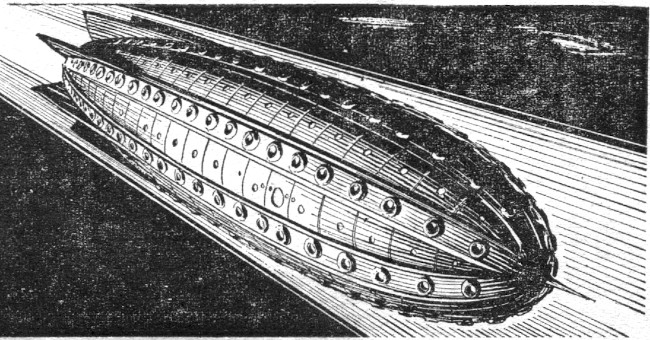
Kit, already seated at his controls, cut in his every course of thought-screen. They would help a little in what was coming, but not much—no mechanical screen then known to Civilization could block third-level thought. He kicked in full drive toward the one small area in which he and his speedster would not encounter either beams or bombs—the fortress whose observers would not perceive that anything was amiss. He did not fear physical pursuit, since his speedster was the fastest thing in space.
For a second or so it was not so bad. Another Eddorian came in, suspicious and on guard. Kit blasted him down—learning still more in the process—but he could not prevent him from radiating a frantic and highly revealing call for help. And although the other Eddorians could scarcely realize that such an astonishing thing as a physical invasion had actually happened, that fact neither slowed them down nor made their anger less violent.
When Kit flashed past his friendly fortress he was taking about all that he could handle, and more and more Eddorians were piling on. At the fourth screen it was worse; at the third he reached what he was sure was his absolute ceiling. Nevertheless, from some hitherto unsuspected profundity of his being, he managed to draw enough reserve force to endure that hellish punishment for a little while longer.
Hang on, Kit, hang on! Only two more screens to go. Maybe only one. Maybe less. Living Eddorian brains, and not mechanical generators, are now handling all the screens, of course; but if Mentor's visualization is worth a tinker's damn, he must have that first screen knocked down by this time and must be working on the second. Hang on, Kit, and keep on slugging!
And grimly—doggedly—toward the end sheerly desperately—Christopher Kinnison, eldest Child of the Lens, hung on and slugged.
XXIII.
If the historian has succeeded in his attempt to describe the characters and abilities concerned, it is not necessary to enlarge upon what Kit went through in escaping Eddore. If he has not succeeded, enlargement would be useless. Therefore, it is enough to say that the young Lensman, by dint of calling up and putting out everything he had, hung on long enough and slugged his way through.
Mentor's visualization had been sound. The Eddorian guardians had scarcely taken over the first screen when it was overwhelmed by a tremendous wave of Arisian thought. It is to be remembered, however, that this was the second time that the massed might of Arisia had been thrown against Eddore's defenses, and the Boskonians had learned much, during the intervening years, from their exhaustive analyses of the offensive and defensive techniques of that earlier conflict. Thus the Arisian drive was practically stopped at the second zone of defense as Kit approached it. The screen was wavering, shifting; yielding stubbornly wherever it must and springing back into place whenever it could.
Under a tremendous concentration of Arisian force the screen weakened in a limited area directly ahead of the hurtling speedster. A few beams lashed out aimlessly, uselessly—if the Eddorians could not hold their main screens proof against the power of the Arisian attack, how could they protect such minor things as gunners' minds? The little ship flashed through the weakened barrier and into the center of a sphere of impenetrable, impermeable Arisian thought.
At the shock of the sudden ending of his terrific battle—the instantaneous transition from supreme to zero effort—Kit fainted in his control chair. He lay slumped, inert, in a stupor which changed gradually into a deep and natural sleep. And as the sleeping man in his inertialess speedster traversed space at full touring blast, that peculiar sphere of force still enveloped and still protected him.
Kit finally began to come to. His first foggy thought was that he was hungry—then, wide awake and remembering, he grabbed his levers.
"Rest quietly and eat your fill," a grave resonant pseudovoice assured him. "Everything is exactly as it should be."
"Hi, Ment ... well, well, if it isn't my old chum Eukonidor! Hi, young fellow! What's the good word? And what's the big idea of letting—or making—me sleep for a week when there's work to do?"
"Your part of the work, at least for the immediate present, is done; and, let me say, very well done."
"Thanks ... but—" Kit broke off, flushing darkly.
"Do not reproach yourself, nor us. Consider, please, and recite, the manufacture of a fine tool of ultimate quality."
"The correct alloy. Hot working—perhaps cold, too. Forging—heating—quenching—drawing—"
"Enough. Think you that the steel, if sentient, would enjoy those treatments? While you did not enjoy them, you are able to appreciate their necessity. You are now a finished tool, forged and tempered."
"Oh, you may have something there, at that. But as to ultimate quality, don't make me laugh." There was no nuance of merriment in Kit's thought. "You can't square that with cowardice."
"Nor is there need. The term ultimate was used advisedly, and still stands. It does not mean or imply, however, a state of perfection, since that condition is unattainable. I am not advising you to try to forget; nor am I attempting to force forgetfulness upon you, since your mind cannot now be coerced by any force presently existing. Be assured that nothing that occurred should irk you; for the simple truth is, that although stressed as no other mind has ever before been stressed, you did not yield. Instead, you secured and retained information which we of Arisia have never been able to obtain; information which will in fact be the means of preserving your Civilization."
"I can't believe ... that is, it doesn't seem—" Kit, knowing that he was thinking muddily and foolishly, paused and pulled himself together. Overwhelming, almost paralyzing as that information was, it must be true. It was true!
"Yes, it is the truth. While we of Arisia have at various times made ambiguous statements, to lead certain Lensmen and others to arrive at erroneous conclusions, you know that we do not lie."
"Yes, I know that." Kit plumbed the Arisian's mind. "It sort of knocks me out of my orbit—that's an awfully big bite to swallow at one gulp, you know."
"It is. That is one reason I am here, to convince you of the truth, which you would not otherwise believe fully. Also to see to it that your rest, without which you might have been hurt, was not disturbed, as well as to make sure that you were not permanently damaged by the Eddorians."
"I wasn't ... at least, I don't think so ... was I?"
"You were not."
"Good. I was wondering—Mentor will be tied up for quite a while, of course, so I'll ask you—they must have got a sort of pattern of me, in spite of all I could do, and they'll be camping on my trail from now on, so I suppose I'll have to keep a solid block up all the time?"
"They will not, Christopher, and you need not. Guided by those whom you knew as Mentor, I myself, as a Guardian, am to see to that. But time presses—I must rejoin my fellows."
"One more question first. You've been trying to sell me a bill of goods that I would like to buy. But, Eukonidor, the kids will know that I showed a streak of yellow a meter wide. What will they think?"
"Is that all?" Eukonidor's thought was almost a laugh. "They will make that eminently plain in a moment."
The Arisian's presence vanished, as did his sphere of force, and four clamoring thoughts came jamming in.
"Oh, Kit, we're so glad!" "We tried to help, but they wouldn't let us!" "They smacked us down!" "Honestly, Kit!" "Oh, if we had only been in there, too!"
"Hold it, everybody! Jet back!" This was Con, Kit knew, but an entirely new Con. "Scan him, Cam, as you never scanned anything before. If they burned out even one cell of his mind, I'm going over there right now and kick every one of Mentor's teeth out!"
"And listen, Kit!" This was an equally strange Kathryn blazing with fury and yet suffusing his mind with a more than sisterly tenderness, a surpassing richness. "If we had had the faintest idea of what they were doing to you, all the Arisians and all the Eddorians and all the devils in all the hells of the macrocosmic Universe couldn't have kept us away. You must believe that, Kit—or can you, quite?"
"Of course, Sis—you don't have to prove an axiom. Seal it, all of you. You're swell people—absolute tops. But I ... you ... that is—" He broke off and marshaled his thoughts.
He knew that they knew, in every minute particular, everything that had occurred. Yet to a girl they thought that he was wonderful. Their common thought was that they should have been in there, too—taking what he took—giving what he gave!
"What I don't get is that you are trying to blame yourselves for what happened to me, when you were on the dead center of the beam all the time. You couldn't have been in there, kids; it would have blown the whole works higher than up. You knew that then, and you know it even better now. You also know that I flew the yellow flag. Didn't that even register?"
"Oh, that!" Practically identical thoughts of complete dismissal came in unison, and Karen followed through:
"The only thing about that is that, since you knew what to expect, we marvel that you ever managed to go in at all—no one else could have, possibly. Or, once in, and seeing what was really there, that you didn't flit right out again. Believe me, brother of mine, you qualify!"
Kit choked. This was too much: but it made him feel good all over. These kids ... the Universe's best—
As he thought, a partial block came unconsciously into being. For not one of those gorgeous, those utterly splendid creatures suspected, even now, that which he so surely knew—that each one of them was very shortly to be wrought and tempered as he himself had been. And, worse, he would have to stand aside and watch them, one by one, walk into it. Was there anything he could do to ward off, or even to soften, what was coming to them? There was not. With his present power, he could step in, of course—at what awful cost to Civilization only he, Christopher Kinnison, of all Civilization, really knew. No. That was out. Definitely. He could come in afterwards to ease their hurts, as each had come to him, but that was all—and there was a difference. They hadn't known about it in advance. It was tough.
Could he do anything?
He could not.
And on clammy, noisome Eddore, the Arisian attackers having been beaten off and normality restored, a meeting of the Highest Command was held. No two of those entities were alike in form; some were changing from one horrible shape into another; all were starkly, indescribably monstrous. All were concentrating upon the problem which had been so suddenly thrust upon them; each of them thought at and with each of the others. To do justice to the complexity or the cogency of that maze of intertwined thoughts is impossible; the best that can be done is to pick out a high point here and there.
"This explains the Star A Star whom the Ploorans and the Kalonians so fear."
"And the failure of our operator on Thrale, and its fall."
"Also our recent quite serious reverses."
"Those stupid—those utterly brainless underlings!"
"We should have been called in at the start!"
"Could you analyze, or even perceive, its pattern save in small part?"
"No."
"Nor could I—an astounding and highly revealing circumstance."
"An Arisian; or, rather, an Arisian development, certainly. No other entity of Civilization could possibly do what was done here. Nor could any Arisian as we know or deduce them."
"They have developed something very recently which we had not visualized."
"Kinnison's son? Bah! Think they to deceive us by the old device of energizing a form of ordinary flesh?"
"Kinnison—his son—Nadreck—Worsel—Tregonsee—what matters it?"
"Or, as we now know, the completely imaginary Star A Star."
"We must revise our thinking," an authoritatively composite mind decided. "We must revise our theory and our plan. It may be possible that this new development will necessitate immediate, instead of later, action. If we had had a competent race of proxies, none of this would have happened, as we would have been kept informed. To correct a situation which may become grave, as well as to acquire fullest and latest information, we must attend the conference which is now being held on Ploor."
They did so. With no perceptible lapse of time or mode of transit, the Eddorian mind was in an assembly room upon that now flooded world. Resembling Nevians as much as any other race with which man is familiar, the now amphibious Ploorans lolled upon padded benches and argued heatedly. They were discussing, upon a lower level, much of the same material which the Eddorians had been considering so shortly before.
Star A Star. Kinnison had been captured easily enough, but had, almost immediately, escaped from an escape-proof trap. Another trap was set, but would it take him? Would it hold him if it did? Kinnison was—must be—Star A Star. No, he could not be, there had been too many unrelated and simultaneous occurrences. Kinnison, Nadreck, Clarrissa, Worsel, Tregonsee, even Kinnison's young son, had all shown intermittent flashes of inexplicable power. Kinnison most of all. It was a fact worthy of note that the beginning of the long series of Boskonian setbacks coincided with Kinnison's appearance among the Lensmen.
The situation was bad. Not irreparable, by any means, but grave. The fault lay with the Eich, and perhaps with Kandron of Onlo. Such stupidity! Such incompetence! Those lower-echelon operators should have had brains enough to have reported the matter to Ploor before the situation got completely out of hand. But they didn't; hence this mess. None of them, however, expressed a thought that the present situation was already one with which they themselves could not cope; nor suggested that it be referred to Eddore before it should become too hot for even the Masters to handle.
"Fools! Imbeciles! We, the Masters, although through no foresight or design of yours, are already here. Know now that you have been and still are yourselves guilty of the same conduct which you are so violently condemning in others." Neither Eddorians nor Ploorans realized that that deficiency was inherent in the Boskonian scheme of things, or that it stemmed from the organization's very top. "Sheer stupidity! Gross overconfidence! Those are the reasons for our recent reverses!"
"But, Masters," a Plooran argued, "now that we have taken over, we are winning steadily. Civilization is rapidly going to pieces. In a few more years we will have smashed it flat."
"That is precisely what they wish you to think. They have been and are playing for time. Your bungling and mismanagement have already given them sufficient time to develop an object or an entity able to penetrate our screens, so that Eddore suffered the disgrace of an actual physical invasion. It was brief, to be sure, and unsuccessful, but it was an invasion, none the less—the first in our long history."
"But, Masters—"
"Silence! We are not here to indulge in recriminations, but to determine facts. Since you do not know Eddore's location in space, it is a certainty that you did not, either wittingly or otherwise, furnish that information. That in turn makes it clear who, basically, the invader was."
"Star A Star?" A wave of questions swept the group.
"One name serves as well as another for what is almost certainly an Arisian entity or device. It is enough for you to know that it is something with which your massed minds would be completely unable to deal. To the best of your knowledge, have you been invaded, either physically or mentally?"
"We have not, Masters; and it is unbelievable that—"
"Is it so?" The Masters sneered. "Neither our screens nor our Eddorian guardsmen gave any alarm. We learned of the Arisian's presence only when he attempted to probe our very minds, at Eddore's very surface. Are your screens and minds, then, so much better than ours?"
"We erred, Masters. We abase ourselves. What do you wish us to do?"
"That is better. You will be informed, as soon as a few last-minute details have been worked out. Although nothing is established by the fact that you know of no occurrences here on Ploor, the probability is that you are still unknown and unsuspected, since it is unthinkable that the enemies' minds are in any real sense as strong as ours. Nevertheless, one of us is now taking over control of the trap which you set for Kinnison, in the belief that he is Star A Star."
"Belief, Masters? It is certain that he is Star A Star!"
"In essence, yes. In exactness, no. Kinnison is, in all probability, merely a puppet through whom an Arisian works at times. If you take Kinnison in that trap, however, the entity you call Star A Star will assuredly kill you all."
"But, Masters—"
"Again, fools, silence!" The thought dripped vitriol. "Remember how easily Kinnison escaped from you? It was the supremely clever move of not following through and destroying you then that obscured the truth for years—that gave them all this additional time. As we have said, you are completely powerless against the one you call Star A Star. Against any lesser force, however—and the probability is exceedingly great that only such forces, if any, will be sent against you—you should be able to win. Are you ready?"
"We are ready, Masters." At last the Ploorans were upon familiar ground. "Since ordinary weapons will be useless against us, they will not attempt to use them—especially since they have developed three extraordinary and supposedly irresistible weapons of attack. First: projectiles composed of negative matter, particularly those of planetary antimass. Second: loose planets, driven inertialess, but inerted at the point at which their intrinsic velocities render collision unavoidable. Third, and worst: the sunbeam. These gave us some trouble, particularly the last, but the problems were solved and if any one of the three, or all of them, are used against us, disaster for the Galactic Patrol is assured.
"Nor did we stop there. Our psychologists, working with our engineers, after having analyzed exhaustively the capabilities of the so-called Second-Stage Lensmen, developed countermeasures against every super-weapon which they will be able to develop during the next century."
"Such as?" The Masters were unimpressed.
"The most probable one is an extension of the sunbeam principle, to operate from a distant sun; or, preferably, a nova. We are now installing fields and grids by the use of which we, not the Patrol, will direct that beam."
"Interesting—if true. Spread in our minds the details of all that you have foreseen and the fashions in which you have safeguarded yourselves."
It was a long operation, even at the speed of thought. At its end the Eddorians were unconvinced, skeptical, and pessimistic.
"We can visualize several other things which the forces of Civilization may be able to develop well within the century," the Master mind said, coldly. "We will assemble data concerning a few of them, for your study. In the meantime, hold yourselves in readiness to act, as we shall issue final orders very shortly."
"Yes, Masters," and the Eddorians went back to their home planet as effortlessly as they had left it. There they concluded their conference.
"It is clear that Kinnison will enter that trap. He cannot do otherwise. Kinnison's protector, whoever or whatever he or it may be, may or may not enter it with him. It may or may not be taken with him. Whether or not the new Arisian figment is taken, Kimball Kinnison must die. He is the very keystone of the Galactic Patrol. At his death, as we will advertise it to have come about, the Patrol will fall apart. The Arisians, themselves unknown, will be forced to try to rebuild it around another puppet; but neither his son nor any other man will ever be able to take Kinnison's place in the esteem of the hero-worshiping, undisciplined mob which is Civilization. Hence the importance of your project. You, personally, will supervise the operation of the trap. You, personally, will kill him."
"With one exception, I agree with everything said. I am not at all certain that death is the answer. One way or another, however, I shall deal effectively with Kinnison."
"Deal with? We said kill!"
"I heard you. I still say that mere death may not be adequate. I shall consider the matter at length, and shall submit in due course my conclusions and recommendations, for your consideration and approval."
Although none of the Eddorians knew it, their pessimism in regard to the ability of the Ploorans to defend their planet against the assaults of Second-Stage Lensmen was even then being justified. Kimball Kinnison, after pacing the floor for hours, called his son.
"Kit, I've been working on a thing for months, and I don't know whether I've got a workable solution at last, or not. It may depend entirely on you. Before I go into it, though, I take it that you check me in saying that when we find Boskonia's top planet we're going to have to blow it out of the ether, and that nothing that we have ever used before will work?"
"Check, on both." Kit thought soberly for minutes. "More, it will have to be practically instantaneous, as well as complete. Like the negabombs or the sunbeam, but a lot faster."
"My thought exactly. I've got something, I think, but nobody except old Cardynge and Mentor of Arisia—"
"Hold it, Dad, while I do a bit of spying and put out some coverage. QX, go ahead."
"Nobody except those two knew anything about the mathematics involved. Even Sir Austin knew only enough to be able to understand Mentor's directions—he didn't do any of the deep stuff himself. Nobody in the present Conference of Science could even begin to handle it. It's that foreign space, you know, that we called the nth space, where that hyperspatial tube dumped us that time. You've been doing a lot of work with some of the Arisians on that sort of stuff. Could you get them to help you compute a tube between Lyrane and there, so that Thorndyke and some of his boys and I could go there and get back?"
"Hm-m-m. Let me think a second. Yes, I can. When do you need it?"
"Today—or even yesterday."
"Too fast. It'll take a couple of days, but it'll be ready for you long before you can get your ship ready and get your gang and the stuff for your gadget aboard her."
"That won't take so long, son. Same ship we rode before. She's still in commission, you know—Space Laboratory XII, her name is now. Special generators, tools, instruments, everything. We'll be ready in two days."
They were, and Kit smiled as he greeted Vice Admiral LaVerne Thorndyke, Principal Technician, and the other surviving members of his father's original crew.
"What a tonnage of brass!" Kit said to Kim, later. "Heaviest load I ever saw on one ship. One sure thing, though, they earned it. You must have been able to pick men, too, in those days."
"What d'ya mean, 'those days,' you disrespectful young ape? I can still pick men, son!" Kim grinned back at Kit, but sobered quickly. "There's more to this than meets the eye. They went through the strain once, and know what it means. They can take it, and just about all of them will come back. With a crew of kids, twenty per cent would be a high estimate."
As soon as the vessel passed System Limits, Kit got another surprise. Even though those men were studded with brass and were, by a boy's standard, old, they were not passengers. In their old Dauntless and well away from port, they gleefully threw off their full-dress uniforms. Each donned the clothing of his status of twenty-odd years back and went to work. The members of the regular crew, young as all regular space crewmen are, did not know at first whether they liked the idea of working watch-and-watch with such heavy brass or not, but they soon found out that they did. Those men were men.
It is an ironclad rule of space, however, that operating pilots must be young. Master Pilot Henry Henderson cursed that ruling sulphurously, even while he watched with a proud, if somewhat jaundiced eye, the smooth performance of his son Henry at his own old board.
They approached their destination—cut the jets—felt for the vortex—found it—cut in the special generators. Then, as the fields of the ship reacted against those of the tube, every man aboard felt a malaise to which no being has ever become accustomed. Most men become immune rather quickly to seasickness, to airsickness, and even to space-sickness. Interdimensional acceleration, however, is something else. It is different—just how different cannot be explained to anyone who has never experienced it.
The almost unbearable acceleration ceased. They were in the tube. Every plate showed blank; everywhere there was the same drab and featureless gray. There was neither light nor darkness; there was simply and indescribably—nothing whatever, not even empty space.
Kit threw a switch. There was a wrenching, twisting shock, followed by a deceleration exactly as sickening as the acceleration had been. It ceased. They were in that enigmatic nth space which each of the older men remembered so well; in which so many of their "natural laws" did not hold. Time still raced, stopped, or ran backward, seemingly at whim; inert bodies had intrinsic velocities far above that of light—and so on. Each of those men, about to be marooned of his own choice in this utterly hostile environment, drew a deep breath and squared his shoulders as he prepared to disembark.
"That's computation, Kit!" Kinnison exclaimed after one glance into a plate. "That's the same planet we worked on before, right there. All our machines and stuff, untouched. If you'd figured it any closer, it'd have been a collision course. Are you dead sure, Kit, that everything's all set?"
"Dead sure, Dad, in full duplicate, and Thorndyke and Henderson both know the board."
"QX. Well, fellows, I'd like to stay here with you, and so would Kit, but we've got chores to do. I don't have to tell you to be careful, but I'm going to, anyway. BE CAREFUL! And as soon as you get done, come back home just as fast as Klono will let you. Clear ether, fellows!"
"Clear ether, Kim!"
Lensman father and Lensman son boarded their speedster and left. They traversed the tube and emerged into normal space, all without a word.
"Kit," the older man ground out, finally. "This gives me the colly wobblies, no less. Suppose some of them—or all of them—get killed out there? Is it worth it? I know it's my own idea, but will we need it badly enough to take the chance?"
"We will, Dad. Mentor says that we will."
And that was that.
XXIV.
Kit had had to get back to normal space as soon as possible, in order to be available in case of need. He wanted to get back in time to help his sisters pull themselves together. Think as he would, he could find no flaw in any one of them; but he knew that Mentor would find something or other the matter with each of them. Not a weakness in any ordinary sense, but a strength which was not the ultimate.
Kinnison had had to get back because his business was really pressing. He had called a conference of all the Second-Stage Lensmen and his children; a conference which, bizarrely enough, was to be held in person and not via Lens.
"Not strictly necessary, of course," the Gray Lensman half-apologized to his son as their speedster neared the point of rendezvous with the Dauntless. "I still think that it's a good idea, though, especially since we were all so close to Lyrane anyway."
"So do I. It's been a mighty long time since we were all together. Everybody's there now except Nadreck—he'll board about the same time we do."
They boarded. Spacehounds both, they saw to it that their speedster was dogged down solidly into her chocks before they went to the main saloon.
"Hi, Mums! Still stopping traffic at all intersections, I see!" Kit lowered his mother's feet to the floor and attempted the physically impossible feat of embracing all four of his sisters at once.
By common consent the Five used only their eyes. Nothing showed. Nevertheless, the girls blushed vividly and Kit's face twisted into a dry, wry grin.
"It was good for what ailed us, though, at that—I guess." Kit did not seem to be at all positive. "Mentor, the lug, told me no less than six times that I had arrived—or at least made statements which I interpreted as meaning that. And Eukonidor just told me that I was a 'finished tool,' whatever that means. Personally, I think that they were sitting back and wondering how long it was going to take us to realize that we never could be half as good as we used to think we were. Suppose?"
"Something like that, probably. We've shivered more than once, wondering whether we are really finished products yet or not."
"We've learned—I hope." Karen, hard as she was, did shiver, physically. "If we aren't it will be ... p-s-s-t—Dad's starting the meeting!"
"... so settle down, all of you, and we'll get going."
What a group! Tregonsee of Rigel IV—stolid, solid, blocky, immobile; looking as little as possible like one of the profoundest thinkers Civilization had ever produced—did not move. Worsel, the ultrasensitive yet utterly implacable Velantian, curled out three or four eyes and looked on languidly while Constance kicked a few coils of his tail onto a comfortable chaise longue, reclined unconcernedly in the seat thus made, and lighted an Alsakanite cigarette. Clarrissa Kinnison, radiant in her Grays and looking scarcely older than her daughters, sat beside Kathryn, each with an arm around the other. Karen and Camilla, neither of whom could ordinarily be described by the adjective "cuddlesome," were on a davenport with Kit, snuggling as close to him as they could get. And in the farthest corner the heavily-armored, heavily-insulated spacesuit which contained Nadreck of Palain VII chilled the atmosphere for yards around.
"QX?" Kinnison began. "We'll take Nadreck first, since he isn't any too happy here, and let him flit—he'll keep in touch from outside after he leaves. Report, please, Nadreck."
"I have explored Lyrane IX thoroughly." Nadreck made the statement and paused. When he used such a thought at all, it meant much. When he emphasized it, which no one there had ever before known him to do, it meant that he had examined the planet practically atom by atom. "There was no life of the level of intelligence in which we are interested to be found on, beneath, or above its surface. I could find no evidence that such life has ever been there, either as permanent dwellers or as occasional visitors."
"When Nadreck settles anything as definitely as that, it stays settled," Kinnison remarked as soon as the Palainian had left. "I'll report next. You all know what I did about Kalonia, and so on. The only significant fact I have been able to find—the only lead to the Boskonian higher-ups—is that Black Lensman Melasnikov got his Lens on Lyrane IX. There were no traces of mental surgery. I can see two, and only two, alternatives. Either there was mental surgery which I could not detect, or there were visitors to Lyrane IX who left no traces of their visits. More reports may enable us to decide. Worsel?"
The Second-Stage Lensmen reported in turn. Each had uncovered leads to Lyrane IX, but Worsel and Tregonsee, who had also studied that planet with care, agreed with Nadreck that there was nothing to be found there.
"Kit?" Kinnison asked then. "How about you and the girls?"
"We believe that Lyrane IX was visited by beings having sufficient power of mind to leave no traces whatever as to who they were or where they came from. We also believe that there was no surgery, but an infinitely finer kind of work—an indetectable subconscious compulsion—done on the minds of the Black Lensmen and others who came into physical contact with the Boskonians. These opinions are based upon experiences which we five have had and upon deductions we have made. If we are right, Lyrane is actually, as well as apparently, a dead end and should be abandoned. Furthermore, we believe that the Black Lensmen have not been and cannot become important."
The Co-ordinator was surprised, but after Kit and his sisters had detailed their findings and their deductions, he turned to the Rigellian.
"What next, then, Tregonsee?"
"After Lyrane IX, it seems to me that the two most promising subjects are those entities who think upon such a high band, and the phenomenon which has been called 'The Hell Hole in Space.' Of the two, I preferred the first until Camilla's researches showed that the available data could not be reconciled with the postulate that the life-forms of her reconstruction were identical with those reported to you as Co-ordinator. This data, however, was scanty and casual. While we are here, therefore, I suggest that we review this matter much more carefully, in the hope that additional information will enable us to come to a definite conclusion, one way or the other. Since it was her research, Camilla will lead."
"First, a question," Camilla began. "Imagine a sun so variable that it periodically covers practically the entire possible range. It has a planet whose atmosphere, liquid, and distance are such that its surface temperature varies from approximately two hundred degrees Centigrade in midsummer to about five degrees absolute in midwinter. In the spring its surface is almost completely submerged. There are terrible winds and storms in the spring, summer, and fall; but the fall storms are the worst. Has anyone here ever heard of such a planet having an intelligent life-form able to maintain a continuing existence through such varied environments by radical changes in its physical body?"
A silence ensued, which Nadreck finally broke.
"I know of two such planets. Near Palain there is an extremely variable sun, two of whose planets support life. All of the higher life-forms, the highest of which are quite intelligent, undergo regular and radical changes, not only of form, but of organization."
"Thanks, Nadreck. That will perhaps make my story believable. From the thoughts of one of the entities in question, I reconstructed such a solar system. More, that entity himself belonged to just such a race. It was such a nice reconstruction," Camilla went on, plaintively, "and it fitted all those other life-forms so beautifully, especially Kat's 'four-cycle periods.' And to prove it, Kat—put up your block, now—you never told anybody the classification of your pet to more than seven places, did you, or even thought about it?"
"No." Kathryn's mind, since the moment of warning, had been unreadable.
"Take the seven. The next three were S-T-R. Check?"
"Check."
"But that makes it solid, Sis!" Kit exclaimed.
"That's what I thought, for a minute—that we had Boskone at last. However, when Tregonsee and I first felt 'X,' long before you met yours, Kat, his classification was TUUV. That would fit in well enough as a spring form, with Kat's as the summer form. What ruins it, though, is that when he killed himself, just a little while ago and long after a summer form could possibly exist—to say nothing of a spring form—his classification was still TUUV. To ten places it was TUUVWYXXWT."
"Well, go on," Kinnison suggested. "What do you make of it?"
"The obvious explanation is that one or all of those entities were planted or primed—not specifically for us, probably, since we are relatively unknown, but for any competent observer. If so, they don't mean a thing." Camilla was not now overestimating her own powers or underestimating those of Boskonia. "There are several others, less obvious, leading to the same conclusion. Tregonsee is not ready to believe any of them, however, and neither am I. Assuming that our data was not biased, we must also account for the fact that the locations in space were—"
"Just a minute, Cam, before you leave the classifications," Constance interrupted. "I'm guarded—what was my friend's, to ten places?"
"VWZYTXSYZY," Camilla replied, unhesitatingly.
"Right; and I don't believe that it was planted, either, so there—"
"Let me in a second!" Kit demanded. "I didn't know that you were on that band at all. I got that RTSL thing even before I graduated—"
"Huh? What RTSL?" Cam broke in, sharply.
"My fault," Kinnison put in then. "Skipped my mind entirely, when she asked me for the dope. None of us thought any of this stuff important until just now, you know. Tell her, Kit."
Kit repeated his story, concluding:
"Beyond four places was pretty dim, but Q P arms and legs—Dhilian, eh?—would fit, and so would an R-type hide. Both Kat's and mine, then, could very well have been summer forms, one of their years apart. The thing I felt was on its own planet, and it died there, and credits to millos the thought I got wasn't primed. And the location—"
"Brake down, Kit," Camilla instructed. "Let's settle this thing of timing first. I've got a theory, but I want some ideas from the rest of you."
"Maybe something like this?" Clarrissa asked, after a few minutes of silence. "In many forms which metamorphose completely the change depends upon temperature. No change takes place as long as the temperature remains the same. Your TUUV could have been flitting around in a spaceship at constant temperature. Could this apply here, Cam, do you think?"
"Could it?" Kinnison exclaimed. "That's it, Chris, sure!"
"That was my theory," Camilla said, still dubiously, "but there is no proof that it applies. Nadreck, do you know whether or not it applies to your neighbors?"