Front matter (continued 2)
Reading edition
Those first leaflets were followed by others, each batch more vitriolic in tone than the preceding one. Apparently they came from empty stratosphere; at least, no ships were to be detected in the neighborhood after any shower of the hand-bills had appeared. But that was not surprising. With its inertialess drive any spaceship could have been parsecs away before the papers touched atmosphere. Or they could have been bombed in from almost any distance. Or, as Kinnison thought most reasonable, they could have been simply dumped out of the mouth of a hyperspatial tube. In any event the method was immaterial. The results only were important; and those results, the Lensman discovered, were entirely disproportionate to the ostensible causes. The subversive literature had some effect, of course, but essentially it must be a blind. No possible tonnage of anonymous printing could cause that much sheer demoralization.
Crackpot societies of all kinds sprang up everywhere, advocating everything from absolutism to anarchy. Queer cults arose, preaching free love, the imminent end of the world, and almost every other conceivable departure from the norm of thought. The Authors' League, of course, was affected more than any other organization of its size, because of its relatively large content of strong and intensely opinionated minds. Instead of becoming one radical group it split into a dozen.
Kinnison joined one of those "Down with Everything!" groups, not as a leader, but as a follower. Not too sheeplike a follower, but just inconspicuous enough to retain his invisibly average status; and from his place of concealment in the middle of the front rank he studied the minds of each of his fellow anarchists. He watched those minds change, he found out who was doing the changing. When Kinnison's turn came he was all set for trouble. He expected to battle a powerful mentality. He would not have been overly surprised to encounter another mad Arisian, hiding behind a zone of hypnotic compulsion. He expected anything, in fact, except what he found—which was a very ordinary Radeligian therapist. The guy was a clever enough operator, of course, but he could not work against even the feeblest opposition. Hence the Gray Lensman had no trouble at all, either in learning everything the fellow knew or, upon leaving him, in implanting within his mind the knowledge that he had made Sybly Whyte into exactly the type of anarchist desired.
The trouble was that the therapist didn't know a thing. This not entirely unexpected development posed Kinnison three questions. Did the higher-ups ever communicate with such small fry, or did they just give them one set of orders and cut them loose? Should he stay in this Radeligian's mind until he found out? If he was in control of the therapist when a big shot took over, did he have jets enough to keep from being found out? Risky business; better scout around first, anyway. He'd do a flit.
He drove his black speedster a million miles. He covered Radelix like a blanket, around the equator and from pole to pole. Everywhere he found the same state of things. The planet was literally riddled with the agitators; he found so many that he was forced to a black conclusion. There could be no connection or communication between such numbers of saboteurs and any higher authority. They must have been sent with one set of do-or-die instructions—whether they did or died was immaterial. Experimentally, Kinnison had a few of the ringleaders taken into custody. As each was arrested another took his place.
Martial law was finally declared, but this measure succeeded only in driving the conspirators underground. What the subversive societies lost in numbers they more than made up in desperation and violence. Crime raged unchecked and uncheckable, murder became an everyday commonplace, insanity waxed rife. And Kinnison, knowing now that no channel to important prey would be opened until the climax, watched grimly while the rape of the planet went on.
The president of Radelix and Lensman Gerrond sent message after message to Prime Base and to Klovia, imploring help. The replies to these pleas were all alike. The matter had been referred to the Galactic Council and to the Co-ordinator. Everything that could be done was being done. Neither office would say anything else, except that, with the galaxy in such a disturbed condition, each planet must do its best to solve its own problems.
The thing built up toward its atrocious finale. Gerrond invited the president to a conference in a downtown hotel room, and there, eyes glancing from moment to moment at the dials of a complete little test-kit held open upon his lap:
"I have just had some startling news, sir," Gerrond said, abruptly. "Kinnison has been here on Radelix for weeks."
"What? Kinnison? Where is he? Why didn't he—?"
"Yes, Kinnison. Kinnison of Klovia. The Co-ordinator himself. I don't know where he is, or was. I didn't ask him." The Lensman smiled fleetingly. "One doesn't, you know. He discussed the situation with me at length. I am still amazed—"
"Why doesn't he stop it, then?" the president demanded. "Or can't he stop it?"
"That's what I've got to explain to you. He can, but the time won't be ripe until the last act."
"Why not? I tell you, if this thing can be stopped it's got to be stopped, and no matter what has to be done it's got to be—"
"Just a minute!" Gerrond snapped. "I know that you're out of control—I don't like to see Radelix torn apart any better than you do—but you ought to know by this time that Galactic Co-ordinator Kimball Kinnison is in a better position to know what to do than any other man in the universe. Furthermore, his word is the last word. What he says, goes."
"Of course," the president apologized. "I am overwrought ... but to see our entire world pulled down around us and upon us, our institutions, the work of centuries, destroyed, millions of lives lost ... all needlessly—"
"It won't come to that, he says, if we all do our parts. And you, sir, are very much in the picture."
"I? How?"
"Are you familiar with exactly what happened upon Antigan IV?"
"Why, no. They had some trouble over there, I recall, but—"
"That's it. That's why this must go on. No planet cares particularly about what happens to any other planet, but the Co-ordinator cares about them all, as a whole. If this trouble is headed off now, it will simply spread to other planets; if it is allowed to come to a climax there is a good chance that we can put an end to the whole trouble, for good."
"But what has that to do with me? What can I, personally, do?"
"Much. The last act upon Antigan IV, the thing that made it a planet of maniacs, was the kidnaping of Planetary President Renwood. It is supposed that he was murdered, since no trace of him has ever been found."
"Oh." The older man's hands clenched, then loosened. "I am willing ... provided—Is the Co-ordinator fairly certain that my death will enable him—"
"It won't get that far, sir. He intends to stop it just before that. He and his associates—I don't know who they are—have been listing every enemy agent they can find, and they will all be taken care of at once. He believes that Boskone will publish in advance a definite time at which they will take you away from us. That was the way it went at Antigan."
"Even from the Patrol?"
"From Base itself. Co-ordinator Kinnison is pretty sure that they can do it, except for something that he can bring into play only at the last moment. Incidentally, that is why we are having this meeting here, with this detector which he gave me. He is afraid that Base is porous."
"In that case ... what can he—" The president fell silent.
"All that I know is that we are to dress you in a certain suit of armor and have you in my private office in Base a few minutes before the time they set. We and the guards leave the office at minus two minutes and walk down the corridor, just fast enough so that at minus one minute we are exactly in front of Room Twenty-four. We are to rehearse it until our timing is perfect. I have no idea what is going to happen then, but I know that something will. We are not to discuss this again, even via Lens, as he is pretty sure that you will very shortly be under surveillance every minute."
Time passed; the Boskonian infiltration progressed strictly according to plan. Upon the surface it appeared that Radelix was going in almost the same fashion in which Antigan IV had gone. Below the surface, however, there was one great difference. Every ship, whether liner or freighter or tramp, which docked at any spaceport of Radelix, brought at least one man who did not leave. Some of these visitors were tall and lithe, some were short and fat. Some were old, some were young. Some were pale, some were burned to the complexion of ancient leather by the fervent rays of space. They were alike only in the "look of eagles" in their steady, quiet eyes. Each landed and went about his ostensible business, interesting himself not at all in any of the others.
Again the Boskonians declared their contempt of the Patrol by setting the exact time at which the president was to be taken. Again the appointed hour was midnight.
Vice Admiral Lensman Gerrond was, as Kinnison had intimated frequently, somewhat of a brass hat. He did not, he simply could not believe that his Base was as pregnable as the Co-ordinator had assumed it to be. Kinnison, knowing that all ordinary defenses would be useless, had not even mentioned them. Gerrond, unable to believe that his hitherto invincible and invulnerable weapons and defenses were all of a sudden useless, mustered them of his own volition.
All leaves had been canceled. Every detector, every beam, every device of defense and of offense was fully manned. Every man was keyed up and alert. And Gerrond, while the least bit apprehensive that something was about to happen which was not in the book, was pretty sure in his stout old war-dog's soul that he and his men had stuff enough.
At two minutes before midnight the armored president and his escorts left Gerrond's private office. One minute later they were passing the door of the specified room. A bomb exploded shatteringly behind them, armored men rushed yelling out of a branch corridor in their rear. Everybody stopped and turned to look. So, the hidden Kinnison assured himself, did an unseen observer in an invisibly hovering, three-dimensional hypercircle.
Kinnison threw the door open, flashed an explanatory thought at the president, yanked him into the room and into the midst of a corps of Lensmen armed with devices not usually encountered even in Patrol bases. The door snapped shut and Kinnison stood where the president had stood an instant before, clad in armor identical with that which the president had worn. The exchange had required less than one second: it had been observed by no one.
"QX, Gerrond and you fellows!" Kinnison drove the thought. "The president is safe—I'm taking over. Double time straight ahead—hipe! Get into the clear—give us a chance to use our stuff!"
The unarmored men broke into a run, and as they did so the door of Room Twenty-four swung open and stayed open. Weapons snouted out, shoved by armored men. Armored men and heavy weapons erupted from other doors and from more branch corridors. The hypercircle, which was, in fact, the terminus of a hyperspatial tube, began to thicken toward visibility.
It did not, however, materialize. Only by the intensest effort of vision could it be discerned as the sheerest wisp, more tenuous than the thinnest fog. The men within the ship, if ship it was, were visible only as striations in air are visible, and no more to be made out in detail. Instead of a full materialization, the only thing that was or became solid or tangible was a dead-black thing which reached purposefully outward and downward toward Kinnison, a thing combined of tongs and coarse-meshed, heavy net.
Kinnison's DeLameters flamed at maximum intensity and minimum aperture. Useless. The stuff was dureum; that unbelievably dense and ultimately refractory synthetic which, saturated with pure force, is the only known substance which can exist as an actuality both in normal space and in that pseudospace which composes the hyperspatial tube. The Lensman flicked on his neutralizer and shot away inertialess; but that maneuver, too, had been foreseen. The Boskonian engineers matched every move he made, within a split second after he made it; the tong-net gripped and closed.
Semiportables flamed then—heavy stuff—but they might just as well have remained cold. Their beams could not cut the dureum linkages; they slid harmlessly past—not through—the wraithlike, figmental invaders at whom they were timed. Kinnison was hauled aboard the Boskonian vessel; its structure and its furnishings and its crew becoming ever firmer and more substantial to his senses as he went from normal into pseudospace.
As the pseudoworld became real, the reality of the base behind him thinned into unreality. In seconds it disappeared utterly, and Kinnison knew that to the senses of his fellow human beings he had vanished without leaving a trace. This ship, though, was real enough. So were his captors.
The net opened, dumping the Lensman ignominiously to the floor. Tractor beams wrenched his blazing DeLameters out of his grasp—whether or not hands and arms came with them was entirely his own lookout. Tractors and pressors jerked him upright, slammed him against the steel wall of the room, held him motionless against it.
Furiously he launched his ultimately lethal weapon, the Worsel-designed, Thorndyke-built, mind-controlled projector of thought-borne vibrations which decomposed the molecules without which thought and life itself could not exist. Nothing happened. He explored, finding that even his sense of perception was stopped a full foot away from every part of every one of those humanoid bodies. He settled down then and thought. A great light dawned; a shock struck sickeningly home.
No such elaborate and super-powered preparations would have been made for the capture of any civilian. Presidents were old men, physically weak and with no extraordinary powers of mind. No—this whole chain of events had been according to plan—a high Boskonian's plan. Ruining a planet was, of course, a highly desirable feature in itself, but it could not have been the main feature.
Somebody with a real brain was out after the four Second-Stage Lensmen and he wasn't fooling. And if Nadreck, Worsel, Tregonsee and himself were all to disappear, the Patrol would know that it had been nudged. But jet back—which of the four other than himself would have taken that particular bait? Not one of them. Weren't they out after them, too? Sure they were—they must be. Oh, if he could only warn them—but after all, what good would it do? They had all warned each other repeatedly to watch out for traps; all four had been constantly on guard. What possible foresight could have avoided a snare set so perfectly to match every detail of a man's physical and mental make-up?
But he wasn't licked yet. They had to know what he knew, how he had done what he had done, whether or not he had any superiors and who they were. Therefore they had had to take him alive, just as he had had to take various Boskonian chiefs. And they'd find out that as long as he was alive he'd be a dangerous buzzsaw to monkey with.
The captain, or whoever was in charge, would send for him; that was a foregone conclusion. He would have to find out what it was that he had caught; he would have to make a preliminary report of some kind. And somebody would slip. One hundred percent vigilance was impossible, and Kinnison would be on his toes to take advantage of that slip, whatever or however slight it might be.
But the captors did not take Kinnison to the captain. Instead, accompanied by half-a-dozen armored men, that worthy came to Kinnison.
"Start talking, fellow, and talk fast," the Boskonian directed crisply in the lingua franca of deep space as the armored soldiers strode out. "I want to know who you are, what you are, what you've done, and everything about you and the Patrol. So talk—or do you want me to pull you apart with these tractors, armor and all?"
Kinnison paid no attention, but drove at the commander with his every mental force and weapon. Blocked. This ape too had a full-body, full-coverage screen.
There was a switch, at the captain's hip, handy for finger-tip control. If he could only move! It would be so easy to flip that switch! Or if he could throw something, or make one of those other fellows brush against him just right, or if the guy happened to sit down a little too close to the arm of a chair, or if there were a pet animal of any kind around, or a spider or a worm or even a gnat—
VI.
Second-Stage Lensman Tregonsee of Rigel IV did not rush madly out into space in quest of something or anything Boskonian in response to Kinnison's call. To hurry was not Tregonsee's way. He could move fast upon occasion, but before he would move at all he had to know exactly how, where, and why he should move.
He conferred with his three fellows, he furnished them with all the data he possessed, he helped integrate the totaled facts into one composite. That composite pleased the others well enough so that they went to work, each in his own fashion, but it did not please Tregonsee. He could not visualize any coherent whole from the available parts. Therefore, while Kinnison was investigating the fall of Antigan IV, Tregonsee was sitting—or rather, standing—still and thinking. He was still standing still and thinking when Kinnison went to Radelix.
Finally he called in an assistant to help him think. He had more respect for the opinions of Camilla Kinnison than for those of any other entity, outside of Arisia, of the two galaxies. He had helped train all five of the Kinnison children, and in Cam he had found a kindred soul. Possessing a truer sense of values than any of his fellows, he alone realized that the pupils had long since passed their tutors; and it is a measure of his quality that the realization brought into Tregonsee's tranquil soul no tinge of rancor, but only wonder. What those incredible Children of the Lens had he did not know, but he knew that they—particularly Camilla—had extraordinary gifts.
In the mind of this scarcely grown woman he perceived depths which he could not plumb, extensions and vistas the meanings of which he could not even vaguely grasp. He did not try either to plumb the abysses or to survey the expanses; he made no slightest effort, ever, to take from any of the children anything which the child did not first offer to reveal. In his own mind he tried to classify theirs; but, realizing in the end that that task was and always would be beyond his power, he accepted that fact as calmly as he accepted the numberless others of Nature's inexplicable facts. Tregonsee came the closest of any Second-Stage Lensman to the real truth, but even he never did suspect the existence of the Eddorians.
Camilla, as quiet as her twin sister Constance was boisterous, parked her speedster in one of the capacious holds of the Rigellian's spaceship and joined him in the control room.
"You believe, I take it, that Dad's logic is faulty, his deductions erroneous?" the girl thought; after a casual greeting. "I'm not surprised. So do I. He jumped at conclusions. But then, he does that, you know."
"Oh, I wouldn't say that, exactly. However, it seems to me," Tregonsee replied carefully, "that he did not have sufficient basis in fact to form any definite conclusion as to whether or not Renwood of Antigan was a Boskonian operative. It is that point which I wish to discuss with you first."
Cam concentrated. "I don't see that it makes any difference, fundamentally, whether he was or not," she decided, finally. "A difference in method only, not in motivation. Interesting, perhaps, but immaterial. It is virtually certain in either case that Kandron of Onlo or some other entity is the motive force and is the one who must be destroyed."
"Of course, my dear, but that is only the first differential. How about the second, and the third? Method governs. Nadreck, concerning himself only with Kandron, tabulated and studied only the Kandronesque manifestations. He may—probably will—eliminate Kandron. It is by no means assured, however, that that step will be enough. In fact, from my preliminary study, I would risk a small wager that the larger and worse aspects would remain untouched. I would, therefore, suggest that we ignore, for the time being, Nadreck's findings and examine anew all the data available."
"I wouldn't bet you a millo on that." Camilla caught her lower lip between white, even teeth. "Check. The probability is that Renwood was a loyal citizen. Let us consider every possible argument for and against that assumption—"
They went into a contact of minds so close that the separate thoughts simply could not be resolved into terms of speech. They remained that way, not for the period of a few minutes which would have exhausted any ordinary brain, but for four solid hours; and at the end of that conference they had arrived at a few tentative conclusions.
Kinnison had said that there was no possibility of tracing a hyperspatial tube after it had ceased to exist. There were millions of planets in the two galaxies. There was an indefinite, quite possibly an infinite number of coexistent parallel spaces, into any one of which the tube might have led. Knowing these things, Kinnison had decided that the probability was infinitesimally small that any successful investigation could be made along those lines.
Tregonsee and Camilla, starting with the same facts, arrived at entirely different results. There were many spaces, true, but the inhabitants of any one space belonged to that space and would not be interested in the conquest or the permanent taking over of any other. Foreign spaces, then, need not be considered. Civilization had only one significant enemy: Boskonia. Boskonia, then, captained possibly by Kandron of Onlo, was the attacker. The tube itself could not be traced and there were millions of planets, yes, but those facts were not pertinent.
Why not? Because "X," who might or might not be Kandron, was not operating from a fixed headquarters, receiving reports from subordinates who did the work. A rigid philosophical analysis, of which few other minds would have been capable, showed that "X" was doing the work himself, and was moving from solar system to solar system to do it. Those mass psychoses in which entire garrisons went mad all at once, those mass hysterias in which vast groups of civilians went reasonably out of control, could not have been brought about by any ordinary mind. Of all Civilization, only Nadreck of Palain VII had the requisite ability; was it reasonable to suppose that Boskonia had many such minds? No. "X" was either singular or a small integer.
Which? Could they decide the point? With some additional data, they could. Their linked minds went en rapport with Worsel, with Nadreck, with Kinnison, and with the principal statistician at Prime Base.
In addition to Nadreck's locus, they determined two more—one of all inimical manifestations, the other of those which Nadreck had not used in his computations. Their final exhaustive analysis showed that there were at least two, and very probably only two, prime intelligences directing those Boskonian activities. They made no attempt to identify either of them. They communicated to Nadreck their results and their conclusions.
"I am working on Kandron," the Palainian replied, flatly. "I made no assumptions as to whether or not there were other prime movers at work, since the point has no bearing. Your information is very interesting, and may perhaps prove valuable, and I thank you for it—but my present assignment is to find and to kill Kandron of Onlo."
Tregonsee and Camilla, then, set out to find "X"; not any definite actual or deduced entity, but the perpetrator of certain closely related and highly characteristic phenomena, viz., mass psychoses and mass hysterias. Nor did they extrapolate. They visited the last few planets which had been affected, in the order in which the attacks had occurred. They studied every phase of every situation. They worked slowly, but—they hoped and they believed—surely. Neither of them had any idea then that behind "X" lay Ploor, and beyond Ploor, Eddore.
Having examined the planet latest to be stricken, they made no effort to pick out definitely the one next to be attacked. It might be any one of ten worlds, or possibly even twelve. Hence, neglecting entirely the mathematical and logical probabilities involved, they watched them all, each taking six. Each flitted from world to world, with senses alert to perceive the first sign of subversive activity. Tregonsee was a retired magnate, spending his declining years in seeing the galaxy; Camilla was a Tellurian business girl on vacation.
Young, beautiful, innocent-looking girls who traveled alone were, then as ever, regarded as fair game by the Don Juan of any given human world. Scarcely had Camilla registered at the Hotel Grande when a well-groomed, self-satisfied man-about-town made an approach.
"Hel-lo, Beautiful! Remember me, don't you—old Tom Thomas? What say we split a bottle of fayalin, to renew old—" He broke off, for the red-headed eyeful's reaction was in no sense orthodox. She was not coldly unaware of his presence. She was neither coy nor angry, neither fearful nor scornful. She was only and vastly amused.
"You think, then, that I am human and desirable?" Her smile was devastating. "Did you ever hear of the Canthrips of Ollenole?" She had never heard of them either, before that instant, but this small implied mendacity did not bother her.
"No, I can't say that I have." The man, while very evidently taken aback by this new line of resistance, persevered. "What kind of a brush-off do you think you're trying to give me?"
"Brush-off? See me as I am, you beast, and thank whatever gods you recognize that I am not hungry, having eaten just last night." In his sight her green eyes darkened to a jetty black, the flecks of gold in them scintillated and began to emit sparks. Her hair turned into a mass of horribly clutching tentacles. Her teeth became fangs, her fingers talons, her strong, splendidly proportioned body a monstrosity out of Hell's grisliest depths.
After a moment she allowed the frightful picture to fade back into her charming self, keeping the Romeo from fainting by the power of her will.
"Call the manager if you like. He has been watching and has seen nothing except that you are pale and sweating. I, a friend of yours, have been giving you some bad news, perhaps. Tell your stupid police all about me, if you wish to spend the rest of your life in a padded cell. I'll see you again in a day or two, I hope. I'll be hungry again by that time." She walked away, serenely confident that the fellow would never willingly come within sight of her again.
She had not damaged his ego permanently—he was not a neurotic type—but she had given him a jolt which he never would forget. Camilla Kinnison nor any of her sisters had anything to fear from any male or males infesting any planet or roaming any depths of space.
The expected and awaited trouble developed. Tregonsee and Camilla landed and began their hunt. The League for Planetary Purity, it appeared, was the primary focal point; hence the two attended a meeting of that crusading body. That was a mistake; Tregonsee should have stayed out in deep space, concealed behind a solid thought-screen.
For Camilla was an unknown. Furthermore, her mind was inherently stable at the third level of stress; no lesser mind could penetrate her screens or, having failed to do so, could recognize the fact of failure. Tregonsee, however, was known throughout all civilized space. He was not wearing his Lens, of course, but his very shape made him suspect. Worse, he could not hide from any mind as powerful as that of "X" the fact that his mind was very decidedly not that of a retired Rigellian gentleman.
Thus Camilla had known that the procedure was a mistake. She intimated as much, but she could not sway the unswerving Tregonsee from his determined course without revealing things which must forever remain hidden from him. She acquiesced, therefore, but she knew what to expect.
Hence, when the invading intelligence blanketed the assemblage lightly, only to be withdrawn instantly upon detecting the emanations of a mind of real power, Cam had a bare moment of time in which to act. She synchronized with the intruding thought, began to analyze it and to trace it back to its source. She did not have time enough to succeed fully in either endeavor, but she did get a line. When the foreign influence vanished she shot a message to Tregonsee and they sped away.
Hurtling through space along the established line, Tregonsee's mind was a turmoil of thought; thoughts as plain as print to Camilla. She flushed uncomfortably—she could, of course, blush at will.
"I'm not half the superman whose picture you are painting," she said. That was true enough; no one this side of Arisia could have been. "You're so famous, you know, and I'm not—while he was examining you I had a fraction of a second to work in. You didn't."
"That may be true." Although Tregonsee had no eyes, the girl knew that he was staring at her; scanning, but not intruding, with his highly developed sense of perception. She lowered her barriers so far that he thought they were completely down. "You have, however, extraordinary and completely inexplicable powers ... but, being the daughter of Kimball and Clarrissa Kinnison—"
"That's it, I think." She paused, then, in a burst of girlish confidence, went on: "I've got something, I really do think, but the trouble is that I don't know what it is or what to do with it. Maybe in fifty years or so I will."
This also was close enough to the truth, and it did serve to restore to Tregonsee his wonted poise. "Be that as it may, I will take your advice next time, if you will offer it."
"Try and stop me—I love to give advice." She laughed unaffectedly. "It might not have turned out any differently this time, though, and it may not be any better next time."
Then, further to quiet the shrewd Rigellian's suspicions, she strode over to the control panel and checked the course. Having done so, she fanned out detectors, centering upon that course, to the fullest range of their power. She swaggered a little when she speared with the CRX tracer a distant vessel in a highly satisfactory location. That act would cut her down to size in Tregonsee's mind.
"You think, then, that 'X' is in that ship?" he asked, quietly.
"Probably not." She could not afford to act too dumb—she could fool a Second-Stage Lensman a little, but nobody could fool one very much. "It may, however, give us a lead."
"It is practically certain that 'X' is not in that vessel," Tregonsee thought. "In fact, it may be a trap. We must, however, make the customary arrangements to take it into custody."
Cam nodded and the Rigellian communications officers energized their long-range beams. Far ahead of the fleeing vessel, centering upon its line of flight, fast cruisers of the Galactic Patrol began to form a gigantic cup. Hours passed, and—a not unexpected circumstance—Tregonsee's superdreadnought gained rapidly upon the supposed Boskonian.
The quarry did not swerve or dodge. Straight into the mouth of the cup it sped. Tractors and pressors reached out, locked on, and were neither repulsed nor cut. The strange ship did not go inert, did not put out a single course of screen, did not fire a beam. She did not reply to signals. Spy rays combed her from needle nose to driving jets, searching every compartment. There was no sign of life aboard.
Spots of pink appeared upon Camilla's deliciously smooth cheeks, her eyes flashed. "We've been had, Uncle Trig—how we've been had!" she exclaimed, and her chagrin was not all assumed. She had not quite anticipated such a complete fiasco as this.
"Score one for 'X,'" Tregonsee said. He not only seemed to be, but actually was, calm and unmoved. "We will now go back and pick up where we left off."
They did not discuss the thing at all, nor did they wonder how "X" had escaped them. After the fact, they both knew. There had been at least two vessels; at least one of them had been inherently indetectable and screened against thought. In one of these latter "X" had taken a course at some indeterminable angle to the one which they had followed.
"X" was now at a safe distance.
"X" was nobody's fool.
VII.
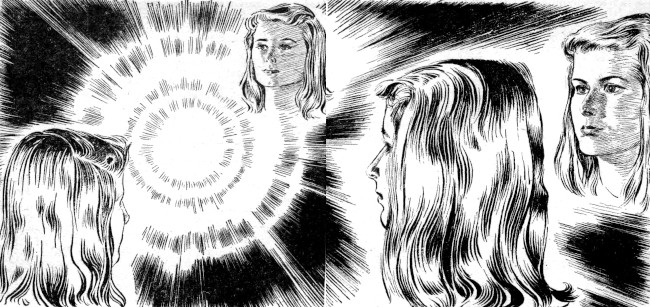
Kathryn Kinnison, trim and taut in black glamourette, strolled into the breakfast nook humming a lilting song. Pausing before a full-length mirror, she adjusted her cocky little black toque at an even more piquant angle over her left eye. She made a couple of passes at her riot of curls and gazed at her reflected self in high approval as, putting both hands upon her smoothly rounded hips, she—"wriggled" is the only possible term for it—in the sheer joy of being alive.
"Kathryn—" Clarrissa Kinnison chided gently, "don't be exhibitionistic, dear." Except in times of stress the Kinnison women used spoken language, "to keep in practice," as they said.
"Why not? It's fun." The tall girl bent over and kissed her mother upon the lobe of an ear. "You're sweet, Mums, you know that? You're the most precious thing—Ha! Bacon and eggs? Goody!"
The older woman watched half-enviously as her eldest daughter ate with the carefree abandon of one who has no cares whatever either for her digestion or for her figure. She had no more understood her children, ever, than a hen can understand the brood of ducklings she has so unwittingly hatched out, and that comparison was more strikingly apt than Clarrissa Kinnison ever would know. She now knew, more than a little ruefully, that she never would understand them.
She had not protested openly at the rigor of the regime to which her son Christopher had been subjected from birth. That, she knew, was necessary. It was inconceivable that Kit should not be a Lensman, and for a man to become a Lensman he had to be given everything which he could possibly take. She was deeply glad, however, that her four other babies had been girls. Her daughters were not going to be Lensmen. She, who had known so long and so heavily the weight of Lensman's load, would see to that. Herself a womanly, feminine woman, she had fought with every resource at her command to make her girl babies grow up into replicas of herself. She had failed.
They simply would not play with dolls, nor play house with other little girls. Instead, they insisted upon "intruding," as she considered it, upon Lensmen; preferably upon Second-Stage Lensmen, if any one of the four chanced to be anywhere within reach. Instead of with toys, they played with atomic engines and flitters; and, later, with speedsters and spaceships. Instead of primers, they read Galactic charts. One of them might be at home, as now, or all of them; or none. She never did know what to expect.
But they were in no sense disloyal. They loved their mother with a depth of affection which no other mother, anywhere, has ever known. They tried their very best to keep her from worrying about them. They kept in touch with her wherever they went—which might be at whim to Tellus or to Thrale or to Alsakan or to any unplumbed cranny of intergalactic space—and they informed her, apparently without reservation, as to everything they did. They loved their father and their brother and each other and themselves with the same whole-hearted fervor they bestowed upon her. They behaved always in exemplary fashion. None of them had ever shown or felt the slightest interest in any one of numerous boys and men; and this trait, if the truth is to be told, Clarrissa could understand least of all.
No. The only thing basically wrong with them was the fact, made abundantly clear since they first toddled, that they should not be and could not be subjected to any jot or tittle of any form of control, however applied.
Kathryn finished eating finally and gave her mother a bright, quick grin. "Sorry, Mums, you'll just have to give us up as hard cases, I guess." Her fine eyes, so like Clarrissa's except in color, clouded as she went on: "I am sorry, Mother, really, that we can't be what you so want us to be. We've tried so hard, but we just can't. It's something here, and here—" She tapped one temple and prodded her midsection with a pink forefinger. "Call it fatalism or anything you please, but I think that we're slated to do a job of some kind, some day, even though none of us has any idea what that job is going to be."
Clarrissa paled. "I have been thinking just that for years, dear ... I have been afraid to say it, or even to think it. You are Kim's children, and mine. If there ever was a perfect, a predestined marriage, it is ours. And Mentor said that our marriage was necessary—" She paused, and in that instant she almost perceived the truth. She was closer to it than she had ever been before or ever would be again. But that truth was far too vast for her mind to grasp. She went on: "But I'd do it over again, Kathryn, knowing everything I know now. 'Vast rewards,' you know—"
"Of course you would," Kat interrupted. "Any girl would be a fool not to. The minute I meet a man like Dad I'm going to marry him, if I have to scratch Kay's eyes out and snatch Cam and Con bald-headed to get him. But speaking of Dad, just what do you think of l'affaire Radelix?"
Gone every trace of levity, both women stood up. Gold-flecked tawny eyes stared deeply into gold-flecked eyes of dark and velvety green.
"I don't know." Clarrissa spoke slowly, meaningfully. "Do you?"
"No. I wish that I did." Kathryn's was not the voice of a girl, but that of an avenging angel. "As Kit says, I'd give four front teeth and my right leg to the knee joint to know who or what is back of that, but I don't. I feel very much in the mood to do a flit out that way."
"Do you?" Clarrissa paused. "I'm glad. I'd go myself, in spite of everything he says, except that I know I couldn't do anything. If that should be the job you were talking about—Oh, do anything you can, dear; anything to make sure that he comes back to me!"
"Of course, Mums." Kathryn broke away almost by force from her mother's emotion. "I don't think it is; at least, I haven't got any cosmic hunch to that effect. And don't worry; it puts wrinkles in the girlish complexion. I'll do just a little look-see, stick around long enough to find out what's what, and let you know all about it. 'Bye."
At high velocity Kathryn drove her indetectable speedster to Radelix, and around and upon that planet she conducted invisible investigations. She learned a part of the true state of affairs, she deduced more of it, but she could not see, even dimly, the picture as a whole. This part, though, was clear enough.
An interdimensional expert, she did not have to be at the one apparent mouth of a hyperspatial tube in order to enter it; she knew that while communication was impossible either through such a tube from space to space or from the interior of the tube to either space, the quality of the tube was not the barrier. The interface was. Wherefore, knowing what to expect immediately and working diligently to solve the whole problem, she waited.
She watched Kinnison's abduction. There was nothing she could do about that. She could not interfere then without setting up repercussions which might very well shatter the entire structure of the Galactic Patrol. When the Boskonian ship had disappeared, however, she tapped the tube and followed it. Almost nose to tail she pressed it, tensely alert to do some helpful deed which could be ascribed to accident or to luck. For she knew starkly that Kinnison's present captors would not slip and that his every ability had been discounted in advance.
Thus she was ready, when Kinnison's attention concentrated upon the switch controlling the Boskonian captain's thought-screen generator. There were no pets or spiders or worms, or even gnats, but the captain could sit down. Around his screen, then, she drove a solid beam of thought, upon a channel which neither the pirate nor the Lensman knew existed. She took over in a trice the fellow's entire mind. He sat down, as Kinnison had so earnestly hoped that he would do, the merest fraction of an inch too close to the chair's arm. The switch-handle flipped over and Kathryn snatched her mind away. She was sure that her father would not suspect that that bit of luck was anything except purely fortuitous. She was equally sure that the thing was safe, for a time at least, in Kinnison's highly capable hands. She slowed down, allowed the distance between the two vessels to increase. But she kept within range, for it was more than probable that one or two more seemingly lucky accidents would have to happen before very long.
In the instant of the flicking of the switch the captain's mind became Kinnison's. He was going to issue orders, to take the ship over in an orderly way, but his first contact with the subjugated mind made him change his plans. Instead of uttering orders, the captain leaped out of the chair toward the beam-controllers.
And not an instant too soon. Others had seen what had happened, had heard that telltale click. All had been warned against that and many other contingencies. As the captain leaped, one of his fellows drew a bullet-projector and calmly shot him through the head.
The shock of that bullet, the death of the mind in his own mind's grasp, jarred the Gray Lensman to the core. It was almost the same as though he himself had been killed. Nevertheless, by sheer force of will he held on, by sheer power of will he made that dead body take those last three steps and forced those dead hands to cut the master circuit of the beams which were holding him helpless.
Freed, he leaped forward; but not alone. The others leaped, too, and for the same switch. Kinnison got there first—just barely first—and as he came he swung his armored fist.
What a dureum-inlaid glove, driven by all the brawn of Kimball Kinnison's mighty right arm and powerful torso backed by all the momentum of body- and armor-mass, will do to a human head met in direct central impact is nothing to dwell upon here. Simply, that head splashed. Pivoting nimbly, considering his encumbering armor, he swung a terrific leg. His massive steel boot sank calf-deep into the abdomen of the foe next in line. Two more utterly irresistible blows disposed of two more of the Boskonians; the last two turned and, frantically, ran. But the Lensman by that time had the juice back on; and when a man has been smacked against a solid armor-plate bulkhead by the full power of a D2P pressor, all that remains to be done must be accomplished with a scraper and a mop—or a sponge.
Kinnison picked up his DeLameters, reconnected them, and took stock. So far, so good. But there were other men aboard this heap—how many, he'd better find out—and at least some of them wore dureum-inlaid armor as capable as his own.
And in her speedster, concluding that this wasn't going to be so bad, after all, Kathryn glowed with pride in her father's prowess. She was no shrinking violet, this Third-Stage Lensman; she held no ruth whatever for Civilization's foes. She herself would have driven that beam as mercilessly as had the Gray Lensman. She could have told Kinnison what next to do; could even have inserted the knowledge stealthily into his mind; but, heroically, she refrained. She would let him handle this in his own fashion as long as he possibly could do so.
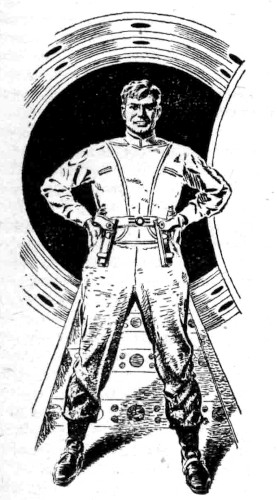
The Gray Lensman sent his sense of perception abroad. Twenty more of them—the ship wasn't very big. Ten aft, armored. Six forward, also armored. Four, unarmored, in the control room. That control room was poison; he'd go aft first. He searched around—surely they'd have dureum space-axes? Oh, yes, there they were. He hefted them, selected one of the correct weight and balance. He strode down the companionway to the wardroom. He flung the door open and stepped inside.
His first care was to blast the communicator panels with his DeLameters. That would delay the mustering of reinforcements. The control room couldn't guess, at least for a time, that one man was setting out to capture their ship single-handed. His second, ignoring the beams of hand-weapons splashing refulgently from his screens, was to weld the steel door solidly to the jamb. Then, sheathing his projectors, he swung up his ax and went grimly to work. He thought fleetingly of how nice it would be to have VanBuskirk, that dean of all ax-men, at his back; but he wasn't too old or too fat to swing a pretty mean ax himself. And, fortunately, these Boskonians, here in their quarters, didn't have axes. They were heavy, clumsy, and for emergency use only; they were not a part of the regular uniform, as upon Valeria.
The space-ax! Formerly that weapon had been forged from the hardest and toughest of alloy steels. For years, however, it had been made universally from dureum. A deceptive little thing, truly! A dainty-looking affair a little larger than a broad-hatchet. Unlike a hatchet, however, it had a mass of some twenty pounds and was equipped with a yard-long, double-gripped shaft. A sharply tapered spear-end for thrusting, gouging, and stabbing; a wickedly curved, needle-pointed beak for rending and tearing; a flatly rounded, razor-sharp blade capable of shearing through neo-carballoy as cleanly as a scalpel through butter.
The first foe swung up his DeLameter involuntarily as Kinnison's ax swept down. When the curved blade, driven as viciously as the Lensman's strength could drive it, struck the ray-gun it did not even pause. Through it it sliced, the severed halves falling to the floor.
The dureum inlay of the glove held, and glove and ax smashed together against the helmet. The Boskonian went down with a crash; but, beyond a broken arm or some such trifle, he wasn't hurt much. And no armor that a man had to carry around could be made of solid dureum. Hence, Kinnison reversed his weapon and swung again, aiming carefully at a point between the inlay strips. The ax's wicked beak tore through steel and skull and brain, stopping only with the sharply ringing impact of dureum shaft against dureum stripping.
They were coming at him now, not only with DeLameters, but with whatever of steel bars and spanners and bludgeons they could find. QX—his armor could take oodles of that. They might dent it, but they couldn't possibly get through. Planting one boot solidly upon his victim's helmet, he wrenched his ax out through flesh and bone and metal—no fear of breakage; not even a Valerian's full savage strength could break that small, fragile-looking tool—and struck again. And struck—and struck.
He fought his way to the door—two of the survivors were trying to unseal it and to get away. They failed; and, in failing, died. A couple of the remaining enemies shrieked and ran in blind panic, and tried to hide; the others battled desperately on. But whether they ran or fought there was only one possible end, if the Patrolman were to survive. No enemy must or could be left alive behind him, to bring to bear upon his back some semiportable weapon with whose energies his armor's screens could not cope.
When the grisly business was over Kinnison, panting, rested briefly. This was the first real brawl he had been in for twenty years; and for a veteran—a white-collar man, a Co-ordinator to boot—he hadn't done so bad, he thought. That was hard work and, while he was maybe a hair short on wind, he hadn't weakened a particle. To here, QX.
And lovely Kathryn, far enough back but not too far and reading imperceptibly his every thought, agreed with him enthusiastically. She did not have a father complex, but in common with her sisters she knew exactly what her father was. With equal exactitude she knew what other men were. Knowing them, and knowing however imperfectly herself, each of the Kinnison girls knew that it would be a physical and psychological impossibility for her to become even mildly interested in any man not at least her father's equal. They each had dreamed of a man who would be her own equal, physically and mentally, but it had not yet occurred to any of them that one such man already existed.
Kinnison cut the door away and again sent out his sense of perception. With it fanning out ahead of him he retraced his previous path. The apes in the control room had done something; he didn't know just what. Two of them were tinkering with a communicator panel; probably the one to the ward room. They probably thought that the trouble was at their end. Or did they? Why hadn't they reconnoitered? He dismissed that problem as being of no pressing importance. The other two were doing something at another panel. What? He couldn't make head or tail of it—hang those full-coverage screens! And Nadreck's fancy drill, even if he had had one along, wouldn't work unless the screen were absolutely steady. Well, it didn't make much, if any, difference. They had called the men back from up forward, and here they came. He'd rather meet them in the corridor than in an open room, anyway, he could handle them a lot easier.
But tensely watching Kathryn gnawed her lip. Should she tell him, or control him, or not? No. She wouldn't—she couldn't—yet. Dad could figure out that pilot room trap without her help—and she herself, with all her power of brain, could not visualize with any degree of clarity the menace which was—which must be—at the tube's end or even now rushing along it to meet that Boskonian ship.
Kinnison met the oncoming six and vanquished them. By no means as easily as he had conquered the others, since they had been warned and since they also now bore space-axes, but just as finally. Kinnison did not consider it remarkable that he escaped practically unscathed—his armor was battered and dinged up, cut and torn, but he had only a couple of superficial wounds. He had met the enemy where they could come at him only one at a time; he was still the master of any weapon known to space warfare; it had been at no time evident that any outside influence was interfering with the normally rapid functioning of the Boskonians' minds.
He was full of confidence, full of fight, and far from spent when he faced about to consider what he should do about that control room. There was plenty of stuff in there—tougher stuff than he had met up with so far.
Kathryn in her speedster gritted her strong white teeth and clenched her shapely hands into hard little fists. This was bad—very, very bad—and it was going to get worse. Closing up fast, she uttered a bitter and exceedingly unladylike expletive.
Couldn't Dad see—couldn't the dumb darling sense—that he was apt to run out of time almost any minute now?
She fairly writhed in an agony of indecision; and indecision, in a Third-Stage Lensman, is a rare phenomenon indeed. She wanted intensely to take over, but if she did, was there any way this side of Palain's purple hells that she could cover up her tracks?
There was none—yet.
VIII.
But Kinnison's mind, while slower than his daughter's and in many respects less able, was sure. The four Boskonians in the control room were screened against his every mental force and it was idle even to hope for another such lucky break as he had just had. One was QX and to be received thankfully, but coincidences simply did not happen. They were armored by this time and they had both machine rifles and semiportable projectors. They were entrenched; evidently intending to fight a delaying and defensive battle, knowing that if they could keep the aggressor at bay until the pseudospace of the tube had been traversed, the Lensman would not have a chance. Armed with all they could use of the most powerful mobile weapons aboard and being four to one, they undoubtedly thought that they could win easily enough.
Kinnison thought otherwise. Since he could not use his mind against them he would use whatever he could find, and this ship, having come upon such a mission, would be carrying plenty of weapons—and those four men certainly hadn't had time to tamper with them all. He might even find some negative-matter bombs.
Setting up a spy-ray block, he proceeded to rummage. They couldn't see him, and, if any one of them had a sense of perception and cut his screen for even a fraction of a second to use it, the battle would end then and there. And, if they decided to rush him, so much the better. They remained, however, forted up, as he had thought that they would, and he rummaged in peace. Various death-dealing implements, invitingly set up, he ignored after one cursory glance into their interiors. He knew weapons—these had been fixed. He went on to the armory.
He did not find any negabombs, but he found plenty of untouched weapons like those now emplaced in the control room. The rifles were beauties, high-caliber, water-cooled things, each with a heavy dureum shield-plate and a single-ply screen. Each had also a beam, but machine-rifle beams weren't so hot. Conversely, the semiportables had lots of screen, but very little dureum. Kinnison lugged one rifle and two semiportables, by easy stages, into the room next to the control room; so placing them that the control panels would be well out of the line of fire.
What gave Kinnison his chance was the fact that the enemies' weapons were set to cover the door. Apparently they had not considered the possibility that the Lensman would attempt to flank them by blasting through an inch and a half of alloy. Kinnison did not know whether he could do it fast enough to mow them down from the side before they could reset their magnetic clamps, or not; but he'd give it the good old college try. It was bound to be a mighty near thing, and the Lensman grinned wolfishly behind the guard plates of his helmet as he arranged his weapons to save every possible fractional second of time.
Aiming one at a spot some three feet above the floor, the other a little lower, Kinnison cut in the full power of his semiportables and left them on. He energized the rifle's beam—every little bit helped—set the defensive screens at "full", and crouched down into the saddle behind the dureum shield. He had checked the feeds long since; he had plenty of rounds.
Two large spots and a small one smoked briefly, grew red. They turned bright red, then yellow, merged into one blinding spot. Metal melted, sluggishly at first, then thinly, then flaring, blowing out in raging coruscations of sparks as the fiercely-driven beams ate in. Through!
The first small opening appeared directly in line between the muzzle of Kinnison's rifle and one of the guns of the enemy, and in the moment of its appearance the Patrolman's weapon began its stuttering, shattering roar. The Boskonians had seen the hot spot upon the wall, had known instantly what it meant, and were working frantically to swing their gun mounts around so as to interpose their dureum shields and to bring their own rifles to bear. They had almost succeeded. Kinnison caught just the bulge of one suit of armor in his sights, but that was enough. The kinetic energy of the stream of metal tore him out of the saddle; he was literally riddled while still in air. Two savage bursts took care of the semiportables and their operators—as has been intimated, the shields of the semis were not designed to withstand the type of artillery Kinnison was using.
That made it cannon to cannon, one to one; and the Lensman knew that those two identical rifles could hammer at each other's defenses for an hour without doing any serious damage. He had, however, one big advantage. Being closer to the bulkhead he could depress his line of fire more than could the Boskonian. He did so, aiming at the clamps, which were not built to take very much of that sort of punishment. One front clamp let go, then the other, and the Lensman knew what to do about the rear pair, which he could not reach. He directed his fire against the upper edge of the dureum plate. Under the awful thrust of that terrific storm of steel the useless front clamps lifted from the floor. The gun mount, restrained from sliding by the unbreakable grip of the rear clamps, reared up. Over it went, straight backward, exposing the gunner to the full blast of Kinnison's fire. That, definitely, was that.
Kathryn heaved a sigh of relief; as far as she could "see", the tube was still empty. "That's my Pop!" she applauded inaudibly to herself. "Now," she breathed, "if the darling has just got jets enough to figure out what may be coming at him down this tube—and sense enough to run back home before it can catch him!"
Kinnison had no suspicion at all that any danger to himself might lie within the tube. He had no desire, however, to land alone in a strange and possibly half-crippled enemy ship in the exact center of an enemy base, and no intention whatever of doing so. Moreover, he had once come altogether too close to permanent immolation in a foreign space because of the discontinuance of a hyperspatial tube while he was in it, and once was once too many. Also, he had just got done leading with his chin, and once of that, too, was once too many. Therefore, his sole thought was to get back into his own space as fast as he could get there, so as soon as the opposition was silenced he hurried into the control room and reversed the vessel's drive.
Behind him, Kathryn flipped her speedster end for end and led the retreat. She left the tube before—"before" is an extremely loose and inaccurate word in this connection, but it conveys the idea better than any other ordinary term—she got back to Base. She caused an officer to broadcast an "evacuation" warning, then hung poised high above Base, watching intently. She knew that Kinnison could not leave the tube except at its terminus, hence would have to materialize inside Base itself. She had heard of what happened when two dense, hard solids attempted to occupy the same three-dimensional space at the same time; but to view that occurrence was not her purpose in lingering. She did not actually know whether there was anything in the tube or not; but she did know that if there were, and if it or they should follow her father out into normal space, even she would have need of every jet she could muster.
Kinnison, maneuvering his Boskonian cruiser to a halt just at the barest perceptible threshold of normal space, in the intermediate zone in which nothing except dureum was solid in either space or pseudospace, had already given a great deal of thought to the problem of disembarkation. The ship was small, as spaceships go, but even so it was a lot bigger than any corridor of Base. Those corridor walls and floors were thick and contained a lot of steel; the ship's walls were solid alloy. He had never seen metal materialize within metal and, frankly, he didn't want to be around, even inside D-armor, when it happened. Also, there were a lot of explosives aboard, and atomic power plants, and the chance of touching off a loose atomic vortex in the very middle of Base and within a few feet of himself was not one to be taken lightly.
He had already rigged a line to a master switch. Power off, with the ship's dureum catwalk as close to the floor of the corridor as the dimensions of the tube permitted, he reversed the controls and poised himself for the running headlong dive. He could not feel Radeligian gravitation, of course, but he was pretty sure that he could leap far enough to get through the interface. He took a short run, jerked the line, and hurled himself through the spaceship's immaterial wall. The ship disappeared.
Going through that interface was more of a shock than the Lensman had anticipated. Even taken very slowly, as it customarily is, interdimensional acceleration brings malaise to which no one has ever become accustomed, and taking it so rapidly fairly turned Kinnison inside out. He was going to land with the rolling impact which constitutes perfect technique in such armored maneuvering. As it was, he never did know how he landed, except that he made a boiler-shop racket and that he brought up against the far wall of the corridor with a climactic clang. Beyond the addition of a few more bruises and contusions to his already abundant collection, however, he was not harmed.
As soon as he could collect himself he leaped to his feet and rapped out orders. "Tractors—pressors—shears! Heavy stuff, to anchor, not to clamp! Hipe!" He knew what he was up against now, and, if they'd just come back, he'd yank them out of that tube so fast it'd break their neck!
And Kathryn, still watching intently, smiled. Her Dad was a pretty smart old duck, but he wasn't using his noggin now—he was cockeyed as Trenco's ether in thinking that they might come back. If anything at all erupted from that hypercircle, it would be something against which the stuff he was mustering would be precisely as effective as so much thin air. And she still had no concrete idea of what she so feared. It would not be essentially physical, she was pretty sure. It would almost have to be mental. But who or what could possibly put it across? And how? And above all, what could she do about it if they did?
Eyes narrowed, brow furrowed in concentration, she thought as she had never thought before; and the harder she thought the more clouded the picture became. For the first time in her triumphant life she felt small—weak—impotent. It was in that hour that Kathryn Kinnison really grew up.
The tube vanished; she heaved a tremendous sigh of relief. They, whoever they were, having failed to bring Kinnison to them—this time—were not coming after him—this time. Not an important enough game to play to the end? No, that wasn't it. Maybe they weren't ready. But the next time—
Mentor the Arisian had told her bluntly, the last time she had seen him, to come to him again when she had found out that she did not know everything there was to be known. Deep down, she had believed that that day would never come. Now, however, it had. This escape—if it had been an escape—had taught her much.
"Mother!" She shot a call to distant Klovia. "I'm on Radelix. Everything's on the green. Dad has just knocked a flock of Boskonians into an outside loop and come through QX. I've got to do a little flit, though, before I come home. 'Bye."
Kinnison stood intermittent guard over Base for four days after the hyperspatial tube had disappeared before he gave up; before he did any very serious thinking upon what he should do next.
Could he and should he keep on as Sybly Whyte? He could and he should, he decided. He hadn't been gone long enough for Whyte's absence to have been noticed; nothing whatever connected Whyte with Kinnison. If he really knew what he was doing, a more specific alias might be better; but as long as he was merely smelling around, Whyte's was the best identity to use. He could go anywhere, do anything, ask anything of anybody, and all with a perfectly good excuse.
And as Sybly Whyte, then, for days that stretched into weeks, he roamed—finding, as he had been afraid that he would find, nothing whatever. It seemed as though all Boskonian activity of the type in which he was most interested had ceased with his return from the hyperspatial tube. Just what that meant he did not know. It was unthinkable that they had given up on him—much more probably they were hatching something brand new. And the frustration of inaction and the trying to figure out what was coming next was driving him not-so-slowly nuts.
Then, striking through the doldrums, came a call from Maitland.
"Kim? You told me to Lens you immediately about any off-color work. Don't know whether this is or not. The guy may be—probably is—crazy. Conklin, who reported him, couldn't decide—neither can I, from Conklin's report. Do you want to send somebody special, take over yourself, or what?"
"I'll take over," Kinnison decided instantly. If neither Conklin nor the Vice Co-ordinator, Gray Lensmen both, could decide, there was no point in sending anyone else. "Where and who?"
"Planet, Meneas II, not too far from where you are now. City, Meneateles; 116-3-29, 45-22-17. Place, Jack's Haven, a meteor miner's hangout at the corner of Gold and Sapphire Streets. Person, a man called 'Eddie'."
"Thanks. I'll check." Maitland did not send, and Kinnison did not want, any additional information. Both knew that since the Co-ordinator was going to investigate this thing himself, he should get his facts, and particularly his impressions, unprejudiced and at first hand.
To Meneas II, then, and to Jack's Haven, Sybly Whyte went, notebook very much in evidence. An ordinary enough space-dive Jack's turned out to be—higher-toned than that Radeligian space-dock saloon of Bominger's; much less flamboyant than notorious Miners' Rest on far Euphrosyne.
"I wish to interview a person named Eddie," he announced, as he bought a bottle of wine. "I have been informed that he has had deep-space adventures worthy of incorporation into one of my novels."
"Eddie? Haw!" The barkeeper laughed raucously. "That space-louse? Somebody's been kidding you, mister. He's nothing but a broken-down meteor miner—you know what a space-louse is, don't you?—that we let clean cuspidors and do such-like odd jobs for his keep. We don't throw him out, like we do the others, because he's kind of funny in one way. Every hour or so he throws a fit, and that amuses people."
Whyte's eager-beaver attitude did not change; his face reflected nothing of what Kinnison thought of this callous speech. For Kinnison did know exactly what a space-louse was. More, he knew exactly what turned a man into one. Ex-meteor miner himself, he knew what the awesome depths of space, the ever-present dangers, the privations, the solitude, the frustrations, did to any mind not adequately integrated. He knew that only the strong survived; that the many weak succumbed. From sickening memory he knew just what pitiful wrecks those many became. Nevertheless, and despite the fact that the information was not necessary:
"Where is this Eddie now?"
"That's him, over there in the corner. By the way he's acting, he'll have another fit pretty quick now."
The shambling travesty of a man accepted avidly the invitation to table and downed at a gulp the proffered drink. Then, as though the mild potion had been a trigger, his wracked body tensed and his features began to writhe.
"Cateagles!" he screamed; eyes rolling, breath coming in hard, frantic gasps. "Gangs of cateagles! Thousands! They're clawing me to bits! And the Lensman! He's sicking them on! OW!! Yow!!!" He burst into unintelligible screams and threw himself to the floor. There, rolling convulsively over and over, he tried the impossible feat of covering simultaneously with his two clawlike hands his eyes, ears, nose, mouth, and throat.
Ignoring the crowding spectators, Kinnison invaded the helpless mind before him. He winced mentally as he photographed upon his own brain the whole atrocious enormity of what was there. Then, while Whyte busily scribbled notes, he shot a thought to distant Klovia.
"Cliff! I'm here in Jack's Haven, and I've got Eddie's data. What did you and Conklin make of it? You agree, of course, that the Lensman is the crux."
"Definitely. Everything else is hop-happy space-drift. The fact that there are not—there can't be—any such Lensman as Eddie imagined, makes him space-drift, too, in our opinion. We called you in on the millionth chance—sorry that we sent you out on a false alarm, but you said we had to be sure."
"You needn't be sorry." Kinnison's thought was the grimmest Clifford Maitland had ever felt. "Eddie isn't an ordinary space-louse. You see, I happen to know one thing that you and Conklin don't, since you've never been there. Did you happen to notice a woman in the picture? Very faint; decidedly in the background?"
"Now that you mention her—yes, there was one. So far in the background and so faint that it never occurred to either Conklin or me that she could be connected. How can she possibly have any bearing, Kim? Most every spaceman has a woman—or a lot of different ones—more or less on his mind all the time, you know. Definitely immaterial and not germane, I'd say."
"So would I, maybe, except for the fact that she isn't really a woman at all, but a Lyranian—"
"A LYRANIAN!" Maitland interrupted. Kinnison could feel the racing of his assistant's thoughts. "That complicates things. But how in Palain's purple hells, Kim, could Eddie ever have got to Lyrane—and if he did, how did he get away alive?"
"I don't know, Cliff." Kinnison's mind, too, was working fast. "But you haven't got all the dope yet. Not only is she a Lyranian, but I know her personally—she's that airport manager who tried her level best to kill me all the time I was on Lyrane II."
"Hm-m-m." Maitland tried to digest that undigestible bit. Tried, and failed. "That would seem to make the Lensman real, too, then—real enough, at least, to investigate—much as I hate to think of the possibility of a Lensman going that far off the beam." Maitland's convictions died hard. "Unless—could there be any possibility of coincidence?"
"Coincidence is out. Don't think it's a trap, either—hasn't got the right earmarks."
"You'll handle this yourself, then?"
"Check. At least, I'll help. There may be people better qualified than I am to do the heavy work. I'll get them at it. Thanks, Cliff—clear ether."
He lined a thought to his wife; and after a short, warmly intimate contact, he told her everything that had happened.
"So you see, Beautiful," he concluded, "your wish is coming true. I couldn't keep you out of this if I wanted to. So check with the girls, put on your Lens, take off your clothes, and go to work."
"I'll do that." Clarrissa laughed and her soaring spirit flooded his mind. "Thanks, my dear."
KIT KINNISON illus9
Then and only then did Kimball Kinnison, master therapist, pay any further attention to that which lay contorted upon the floor. But when Whyte folded up his notebook and left the place, the derelict was resting quietly; and in a space of time long enough so that the putative writer of space operas would not be connected with the cure, those fits would end. Moreover, Eddie would return, whole, to the void: he would become what he had never before been—a successful meteor miner.
Lensmen pay their debts; even to spiders and to worms.
IX.
Her adventure in the hyperspatial tube had taught Kathryn Kinnison much. Realizing her inadequacy and knowing what to do about it, she drove her speedster at high velocity to Arisia. Unlike the Second-Stage Lensmen, she did not even slow down as she approached the planet's barrier; but, as one sure of her welcome, merely threw out ahead of her an identifying thought.
"Ah, daughter Kathryn, again you are in time." Was there, or was there not, a trace of emotion—of welcome, even of affection?—in that usually utterly emotionless thought? "Land as usual."
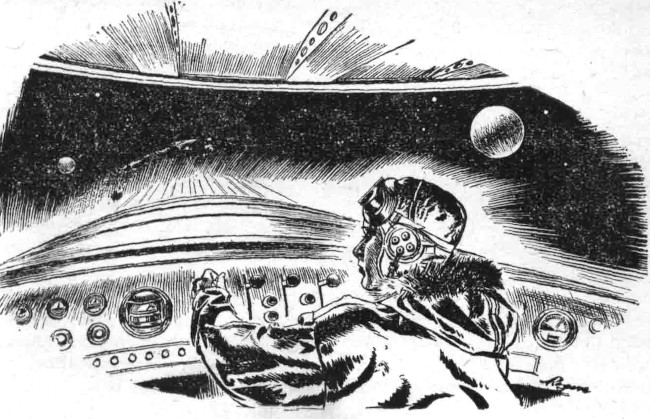
She neutralized her controls as she felt the mighty beams of the landing engine take hold of her little ship. Upon previous visits she had questioned nothing—this time she was questioning everything. Was she landing, or not? Directing her every force inwardly, she probed her own mind to its profoundest depths. Definitely, she was her own mistress throughout—no conceivable mind could take hers over so tracelessly. As definitely, then, she was actually landing.
She landed. The ground upon which she stepped was real. So was the automatic flier—neither plane nor helicopter—which whisked her from the spaceport to her familiar destination, an unpretentious residence upon the grounds of an immense hospital. The graveled walk, the flowering shrubs, and the indescribably sweet and pungent perfume were real; as were the tiny pain and the drop of blood which resulted when a needle-sharp thorn pierced her incautious finger.
Through automatically opening doors she made her way into the familiar, comfortable, book-lined room which she knew was Mentor's study. And there, at his big desk, unchanged, sat Mentor. A lot like her father, but older—much older. About ninety, she had always thought, even though he didn't look over sixty. This time, however, she drove a probe—and got the shock of her life. Her thought was stopped—cold—not by superior mental force, which she could have taken unmoved, but by a seemingly ordinary thought-screen; and her fast-disintegrating morale began visibly to crack.
"Is all this ... are you ... real, or not?" she burst out, finally. "If it isn't, I'll go mad!"
"That which you have tested—and I—are real, for the moment and as you understand reality. Your mind in its present state of advancement cannot be deceived concerning such elementary matters."
"But it all wasn't, before? Or don't you want to answer that?"
"Since the sure knowledge will affect your growth, I will answer. It was not. This is the first time that your speedster has landed physically upon Arisia."
The girl shrank, appalled. "You told me to come to you again when I had learned that I did not know everything there was to know," she finally forced herself to say. "I learned that in the tube; but I did not realize until just now that I don't know anything. Do you really think, Mentor, that there is any use at all in going on with me?" she concluded, bitterly.
"Much," he assured her. "Your development has been eminently satisfactory, and your present mental condition is both necessary and sufficient."
"Well, I'll be a spr—" Kathryn bit off the expletive and frowned. "What were you doing to me before, then, when I thought I got everything?"
"Power of mind," he informed her. "Sheer power, and penetration, and control. Depth, and speed, and all the other factors with which you are already familiar."
"But what is left? I know there is—lots of it—but I can't imagine what."
"Scope," Mentor replied, gravely. "Each of those qualities and characteristics must be expanded to encompass the full sphere of thought. Neither words nor thoughts can give any adequate concept of what it means; a practically wide-open two-way will be necessary. This cannot be accomplished, daughter, in the adolescent confines of your present mind; therefore enter fully into mine."
She did so: and after less than a minute of that awful contact slumped to the floor.
The Arisian, unchanged, unmoved, unmoving, gazed at her until finally she began to stir.
"That ... father Mentor, that was—" she blinked, shook her head savagely, fought her way back to full consciousness. "That was a shock."
"It was," he agreed. "More so than you think. Of all the entities of your Civilization, your brother and now you are the only ones it would not kill instantly. You now know what the word 'scope' means, and are ready for your last treatment, in the course of which I shall take your mind as far along the road of knowledge as mine is capable of going."
"But that would mean ... you're implying—But my mind can't be superior to yours, Mentor! Nothing could be, possibly—it's sheerly, starkly unthinkable!"
"But true, daughter, nevertheless. While you are recovering your strength from that which was but the beginning of your education, I will explain certain matters previously obscure. You have long known, of course, that you five children are not like any others. You have always known many things without having learned them. You think upon all possible bands of thought. Your senses of perception, of sight, of hearing, of touch, are so perfectly merged into one sense that you perceive at will any possible manifestation upon any possible plane or dimension of vibration. Also, although this may not have occurred to you as extraordinary, since it is not obvious, you differ physically from your fellows in some important respects. You have never experienced the slightest symptom of physical illness; not even a headache or a decayed tooth. You do not really require sleep. Vaccinations and inoculations do not 'take'. No pathogenic organism, however virulent; no poison, however potent—"
"Stop, Mentor!" Kathryn gasped, turning white. "I can't take it ... you really mean, then, that we aren't human at all?"
"Yes and no. A partial explanation, while long, may be in order. Many cycles of time ago it became apparent to our more advanced thinkers that the rise and fall of Civilizations was too rhythmic to be accidental. They studied this rhythm, but life was too short. They set out, then, deliberately to prolong their lives. Fewer and fewer in numbers, they lived longer and longer; and the longer each lived, the more he learned. Their visualizations of the Cosmic All became less tenuous, more complete. It became evident that there was some inimical force at work; a force implacably opposed to that which we know as Civilization. Like a mouse in the power of a torturing cat, any Civilization could go just so far, but no farther. For instance, that of Atlantis, upon your father's native planet, Tellus. I was personally concerned in that, and could not stop its fall." The Arisian was showing emotion now; his thought was bleak and bitter.
"Four of us were assigned to the problem of this opposing force. We learned that its final abatement would necessitate the development of a race superior to ours in every respect. We, therefore, selected blood lines in each of the four strongest races of the galaxy and began to eliminate as many as possible of their weaknesses and to concentrate all of their strengths. From your knowledge of genetics you realize the magnitude of the task; you know that it would take much time uselessly to go into the details of its accomplishment. Your father and your mother were the penultimates of long—very long—lines of matings; their procreative cells were such that in their fusion practically every gene carrying any trait of weakness was rejected. Conversely, you carry the genes of every trait of strength ever known to any member of your human race. Therefore, while in outward seeming you are human, in every factor of importance you are not; you are even less human than am I myself."
"And just how human is that?" Kathryn flared, and again her most penetrant probe of force flattened out against the Arisian's screen.
"Later, daughter, not now. That knowledge will come at the end of your education, not at its beginning."
"I was afraid so." She stared at the Arisian, her eyes wide and hopeless; brimming, in spite of her efforts at control, with tears. "You're a monster, and I am ... or am going to be ... a worse one. A monster ... and I'll have to live a million years ... alone ... why? Why, Mentor, did you have to do this to me?"
"Calm yourself, daughter. The shock, while severe, will pass. You have lost nothing, have gained much."
"Gained? Bah!" The girl's thought was loaded with bitterness and scorn. "I've lost my parents—I'll still be a girl long after they have died. I've lost every possibility of ever really living. I want love ... and a husband ... and children ... and I can't have any of them, ever. Even without this, I've never seen a man I wanted, and now I can't ever love anybody. I don't want to live a million years, Mentor—especially alone!" The thought was a veritable wail of despair.
"The time has come to stop this childish thinking." Mentor's thought, however, was only mildly reproving. "Such a reaction is only natural, but your conclusions are entirely erroneous. One single clear thought will show you that you have no present psychic, intellectual, emotional, or physical need of a complement."
"That's true—But other girls of my age—"
"Exactly," came Mentor's dry rejoinder. "Thinking of yourself as an adult Homo sapien, you were judging yourself by false standards. As a matter of fact, you are an adolescent, not an adult. In due time you will come to love a man, and he you, with a fervor and depth which you at present cannot even dimly understand."
"But that still leaves my parents," Kathryn felt much better. "I can apparently age, of course, as easily as I can put on a hat ... but I really do love them, you know, and it will simply break mother's heart to have all her daughters turn out to be—as she thinks—spinsters."
"On that point, too, you may rest at ease. I am taking care of that. Kimball and Clarrissa both know, without knowing how they know it, that your life cycle is tremendously longer than theirs. They both know that they will not live to see their grandchildren. Be assured, daughter, that before they pass from this cycle of existence into the next—about which I know nothing—they shall know that all is to be supremely well with their line; even though, to Civilization at large, it shall apparently end with you Five."
"End with us? What do you mean?"
"You have a destiny, the nature of which your mind is not yet qualified to receive. In due time the knowledge shall be yours. Suffice it now to say that the next forty or fifty years will be but a fleeting moment in the span of life which is to be yours. But time, at the moment, presses. You are now fully recovered and we must get on with this, your last period of study with me, at the end of which you will be able to bear the fullest, closest impact of my mind as easily as you have heretofore borne full contact with your sisters'. Let us proceed with the work."
Work it was, and it went on for weeks. Kathryn took and survived those shattering treatments, one after another; emerging finally with a mind whose power and scope can no more be explained to any mind below the third level than can the general theory of relativity be explained to a chimpanzee.
"It was forced, not natural, yes," the Arisian said, gravely, as the girl was about to leave. "You are many millions of your years ahead of your natural time. You realize, however, the necessity of that forcing. You also realize that I can give you no more formal instruction. I will be with you or on call at all times; I will be of aid in crises; but in larger matters your further development is in your own hands."
Kathryn shivered. "I realize that, and it scares me clear through—especially this coming conflict, at which you hint so vaguely. I wish that you would tell me at least something about it, so that I could get ready for it!"
"Daughter, I can't." For the first time in Kathryn's experience, Mentor the Arisian was unsure. "It is certain that we have been on time; but since the Eddorians have minds of power little, if any, inferior to our own, there are many details which we cannot derive with certainty, and to advise you wrongly would be to do you irreparable harm. All I can say is that if my visualization in that respect is sound, and I am practically sure that it is, sufficient warning will be given by your learning, with no specific effort on your part and from some source other than myself, that there does in fact exist a planet named 'Ploor'—a name which to you is now only a meaningless symbol. Go now, daughter Kathryn, and work."
Kathryn went; knowing that the Arisian had said all that he would say. In truth, he had told her vastly more than she had expected him to divulge; and it chilled her to the marrow to think that she, who had always looked up to the Arisians as demigods of sorts, would from now on be expected to act as their equal—in some ways, perhaps, as their superior! As her speedster tore through space toward distant Klovia she wrestled with herself, trying to shake her new self down into a personality as well integrated as her old one had been. She had not quite succeeded when she felt a thought.
"Help! I am in difficulty with this, my ship. Will any entity receiving my call and possessing the tools of a mechanic please come to my assistance? Or, lacking such tools, possessing a vessel of power sufficient to tow mine to the place where I must immediately go?"
Kathryn was startled out of her introspective trance. That thought was on a terrifically high band; one so high that she knew of no race using it, so high that an ordinary human mind could not possibly have either sent or received it. Its phraseology, while peculiar, was utterly precise in definition—the mind behind it was certainly of precisionist grade. She acknowledged upon the stranger's wave, and sent out a locator. Good—he wasn't far away. She flashed toward the derelict, matched intrinsics at a safe distance, and began scanning, only to encounter a screen around the whole vessel! To her it was porous enough—but if the creature thought that his screen was tight, let him keep on thinking so. It was his move.
"Well, what are you waiting for?" The thought fairly snapped. "Come closer, so that I may bring you in."
"Not yet," Kathryn snapped back. "Cut your screen so that I can see what you are like. I carry equipment for many environments, but I must know what yours is and equip for it before I can come aboard. You will note that my screens are down."
"Of course. Excuse me—I supposed that you were one of our own"—there came the thought of an unspellable and unpronounceable name—"since none of the lower orders can receive our thoughts direct. Can you equip yourself to come aboard with your tools?"
"Yes." The stranger's light was fierce stuff; ninety-eight percent of its energy being beyond the visible. His lamps were beam-held atomics, nothing less, but there was very little gamma and few neutrons. She could handle it easily enough, she decided, as she finished donning her heat-armor and a helmet of practically opaque, diamond-hard plastic.
As she was wafted gently across the intervening space upon a pencil of force, Kathryn took her first good look at the precisionist himself—or herself. She—it—looked something like a Dhilian, she thought at first. There was the squat, powerful, elephantine body with its four stocky legs; the tremendous double shoulders and enormous arms; the domed, almost immobile head. But there the resemblance ended. There was only the one head—the thinking head, and that one had no eyes and was not covered with bone. There was no feeding head—the thing could neither eat nor breathe. There was no trunk. And what a skin!
It was worse than a hide, really—worse even than a Martian's. The girl had never seen anything like it. It was incredibly thick, dry, pliable; filled minutely with cells of a liquid-gaseous something which she knew to be a more perfect insulator even than the fibers of the tegument itself.
"R-T-S-L-Q-P." She classified the creature readily enough to six places, then stopped and wrinkled her forehead. "Seventh place—that incredible skin—what? S? R? T? It would have to be R."
"You have the requisite tools, I perceive," the creature greeted Kathryn as she entered the central compartment of the strange speedster, no larger than her own. "I can tell you what to do, if—"
"I know what to do." She unbolted a cover, wrought briefly with pliers and splicer, and in ten minutes was done. "It doesn't seem to make sense to me that a person of your obvious intelligence, manifestly knowing enough to make such minor repairs yourself, would go so far from home, alone in such a small ship, without any tools. Burnouts and shorts are apt to happen any time, you know."
"Not in vessels of the—." Again Kathryn felt that unpronounceable symbol. She also felt the stranger stiffen in offended dignity. "We of the higher orders, you should know, do not perform labor. We think. We direct. Others work, and do their work well, or suffer accordingly. This is the first time in nine full four-cycle periods that such a thing has happened, and it will be the last. The punishment which I shall mete out to the guilty mechanic will insure that. I shall, at end, have his life."
"Oh, come, now!" Kathryn protested. "Surely it's no life-and-death mat—"
"Silence!" came curt command. "It is intolerable that one of the lower orders should attempt to—"
"Silence yourself!" At the fierce power of the riposte the creature winced, physically and mentally. "I did this bit of dirty work for you because you apparently couldn't do it for yourself. I did not object to the matter-of-course way you accepted it, because some races are made that way and can't help it. But if you insist on keeping yourself placed five rungs above me on any ladder you can think of, I'll stop being a lady—or even a good Girl Scout—and start doing things about it, and I'll start at any signal you care to call. Get ready, and say when!"
The stranger, taken fully aback, threw out a lightning tentacle of thought; a feeler which was stopped cold a full foot from the girl's radiant armor. This was a human female—or was it? It was not. No human being had ever had, nor ever would have, a mind like that. Therefore:
"I have made a grave error," the thing apologized handsomely, "in thinking that you are not at least my equal. Will you grant me pardon, please?"
"Certainly—if you don't repeat it. But I still don't like the idea of your having that mechanic skinned alive." She thought intensely, lip caught between strong white teeth. "Perhaps there is a way. Where are you going, and when do you want to get there?"
"To my home planet," pointing out, mentally, its location in the Galaxy. "I must be there in two hundred of your G-P hours."
"I see." Kathryn nodded her head. "You can—if you promise that you will do nothing whatever to punish your mechanic. And remember that I can tell whether you really mean it or not."
"As I promise, so I do. But suppose that I do not promise?"
"In that case you'll get there in about a hundred thousand G-P years, frozen stiff. For I shall fuse your Bergenholm down so that it can't ever be fixed; then, after welding your ports solidly to the outer shell, I'll attach to your plating the generator of a screen through which you cannot think. Since you have no tools, I'll leave the rest to your imagination. Decide, now, what you wish to do."
"I promise not to harm the mechanic in any way." He surrendered stiffly, and made no undue protest at Kathryn's entrance into his mind to make sure that the promise would be kept.
Flushed by her easy conquest of a mind which she would previously have been unable to touch, and engrossed in the problem of setting her own tremendously enlarged mind to rights, why should it have occurred to the girl that there was anything worthy of investigation concealed in the depths of that chance-met stranger's mentality?
Returning to her own speedster, she shed her armor and shot away; and it was just as well for her peace of mind that she was not aware of the tight-beamed thought even then speeding from the flitter so far behind her to dread and distant Ploor.
"... but it was very definitely not a human female. I could not touch it. It may very well have been one of the accursed Arisians themselves. But since I did nothing to arouse its suspicions, I got rid of it easily enough. Spread the warning!"
X.
While Kathryn Kinnison was working with her father in the hyperspatial tube and with Mentor of Arisia, and while Camilla and Tregonsee were sleuthing the inscrutable "X", Constance was also at work. Although she lay flat upon her back, not moving a muscle, she was working as she had never worked before. Long since she had put her indetectable speedster into the control of a director-by-chance. Now, knowing nothing and caring less of where she and her vessel might be or might go, physically completely relaxed, she drove her "sensories" out to the full limit of their prodigious range and held them there for hour after hour. Worsel-like, she was not consciously listening for any particular thing; she was merely increasing her already incredibly vast store of knowledge. One hundred percent receptive, attached to and concerned with only the brain of her physical body, her mind sped at large sampling, testing, analyzing, cataloguing every item with which its most tenuous fringe came in contact. Through thousands of solar systems that mind went; millions upon millions of entities either did or did not contribute something worth while.