STORIES OF CHILD LIFE. (continued 3)
Reading edition
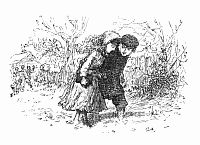
"Yes, it is," answered Oeyvind, and roared with laughter. At that the schoolmaster laughed, Oeyvind's mother laughed; the children understood that they also were allowed to laugh, and so they all laughed together.
So Oeyvind became one of the scholars.
As he was going to find his seat, they all wanted to make room for him. He looked round a long time, while they whispered and pointed; he turned round on all sides, with his cap in his hand and his book under his arm.
"Now, what are you going to do?" asked the schoolmaster, who was busy with his pipe again. Just as the boy is going to turn round to the schoolmaster, he sees close beside him, sitting down by the hearthstone on a little red painted tub, Marit, of the many names; she had covered her face with both hands, and sat peeping at him through her fingers.
"I shall sit here," said Oeyvind, quickly, taking a tub and seating himself at her side. Then she raised a little the arm nearest him, and looked at him from under her elbow; immediately he also hid his face with both hands, and looked at her from under his elbow. So they sat, keeping up the sport, until she laughed, then he laughed too; the children had seen it, and laughed with them; at that, there rung out in a fearfully strong voice, which, however, grew milder at every pause,—
"Silence! you young scoundrels, you rascals, you little good-for-nothings! keep still, and be good to me, you sugar-pigs."
That was the schoolmaster, whose custom it was to boil up, but calm down again before he had finished. It grew quiet immediately in the school, until the water-wheels again began to go; every one read aloud from his book, the sharpest trebles piped up, the rougher voices drummed louder and louder to get the preponderance; here and there one shouted in above the others, and Oeyvind had never had such fun in all his life.
"Is it always like this here?" whispered he to Marit.
"Yes, just like this," she said.
Afterwards, they had to go up to the schoolmaster, and read; and then a little boy was called to read, so that they were allowed to go and sit down quietly again.
"I have got a goat now, too," said she.
"Have you?"
"Yes; but it is not so pretty as yours."
"Why don't you come oftener up on the cliff?"
"Grandpapa is afraid I shall fall over."
"But it is not so very high."
"Grandpapa won't let me, for all that."
"Mother knows so many songs," said he.
"Grandpapa does, too, you can believe."
"Yes; but he does not know what mother does."
"Grandpapa knows one about a dance. Would you like to hear it?"
"Yes, very much."
"Well, then, you must come farther over here, so that the schoolmaster may not hear."
He changed his place, and then she recited a little piece of a song three or four times over, so that the boy learned it, and that was the first he learned at school.
"Up with you, youngsters!" called out the schoolmaster. "This is the first day, so you shall be dismissed early; but first we must say a prayer, and sing."
Instantly, all was life in the school; they jumped down from the benches, sprung over the floor, and talked into each other's mouths.
"Silence! you young torments, you little beggars, you noisy boys! be quiet, and walk softly across the floor, little children," said the schoolmaster; and now they walked quietly, and took their places; after which the schoolmaster went in front of them, and made a short prayer. Then they sung. The schoolmaster began in a deep bass; all the children stood with folded hands, and joined in. Oeyvind stood farthest down by the door with Marit, and looked on; they also folded their hands, but they could not sing.
That was the first day at school.
"The Happy Boy."
BOOTS AT THE HOLLY-TREE INN.
Before the days of railways, and in the time of the old Great North Road, I was once snowed up at the Holly-Tree Inn. Beguiling the days of my imprisonment there by talking at one time or other with the whole establishment, I one day talked with the Boots, when he lingered in my room.
Where had he been in his time? Boots repeated, when I asked him the question. Lord, he had been everywhere! And what had he been? Bless you, everything you could mention, a'most.
Seen a good deal? Why, of course he had. I should say so, he could assure me, if I only knew about a twentieth part of what had come in his way. Why, it would be easier for him, he expected, to tell what he hadn't seen than what he had. Ah! a deal it would.
What was the curiousest thing he had seen? Well! He didn't know. He couldn't momently name what was the curiousest thing he had seen,—unless it was a Unicorn,—and he see him once at a Fair. But supposing a young gentleman not eight year old was to run away with a fine young woman of seven, might I think that a queer start? Certainly! Then that was a start as he himself had had his blessed eyes on,—and he had cleaned the shoes they run away in,—and they was so little that he couldn't get his hand into 'em.
Master Harry Walmers's father, you see, he lived at the Elmses, down away by Shooter's Hill there, six or seven miles from Lunnon. He was a gentleman of spirit, and good-looking, and held his head up when he walked, and had what you may call Fire about him. He wrote poetry, and he rode, and he ran, and he cricketed, and he danced, and he acted, and he done it all equally beautiful. He was uncommon proud of Master Harry as was his only child; but he didn't spoil him, neither. He was a gentleman that had a will of his own, and a eye of his own, and that would be minded. Consequently, though he made quite a companion of the fine bright boy, and was delighted to see him so fond of reading his fairy books, and was never tired of hearing him say my name is Norval, or hearing him sing his songs about Young May Moons is beaming love, and When he as adores thee has left but the name, and that,—still he kept the command over the child, and the child was a child, and it's very much to be wished more of 'em was!
How did Boots happen to know all this? Why, sir, through being under-gardener. Of course I couldn't be under-gardener, and be always about, in the summer time, near the windows on the lawn, a mowing and sweeping, and weeding and pruning, and this and that, without getting acquainted with the ways of the family. Even supposing Master Harry hadn't come to me one morning early, and said, "Cobbs, how should you spell Norah, if you was asked?" and when I give him my views, sir, respectin' the spelling o' that name, he took out his little knife, and he begun a cutting it in print, all over the fence.
And the courage of the boy! Bless your soul, he'd have throwed off his little hat, and tucked up his little sleeves, and gone in at a Lion, he would. One day he stops, along with her (where I was hoeing weeds in the gravel), and says, speaking up, "Cobbs," he says, "I like you." "Do you, sir? I'm proud to hear it." "Yes, I do, Cobbs. Why do I like you, do you think, Cobbs?" "Don't know, Master Harry, I am sure." "Because Norah likes you, Cobbs." "Indeed, sir? That's very gratifying." "Gratifying, Cobbs? It's better than millions of the brightest diamonds, to be liked by Norah." "Certainly, sir." "You're going away, ain't you, Cobbs?" "Yes, sir." "Would you like another situation, Cobbs?" "Well, sir, I shouldn't object, if it was a good 'un." "Then, Cobbs," says that mite, "you shall be our Head Gardener when we are married." And he tucks her, in her little sky-blue mantle, under his arm, and walks away.
Boots could assure me that it was better than a picter, and equal to a play, to see them babies with their long bright curling hair, their sparkling eyes, and their beautiful light tread, rambling about the garden, deep in love. Boots was of opinion that the birds believed they was birds, and kept up with 'em, singing to please 'em. Sometimes they would creep under the Tulip-tree, and would sit there with their arms round one another's necks, and their soft cheeks touching, a reading about the Prince, and the Dragon, and the good and bad enchanters, and the king's fair daughter. Sometimes I would hear them planning about having a house in a forest, keeping bees and a cow, and living entirely on milk and honey. Once I came upon them by the pond, and heard Master Harry say, "Adorable Norah, kiss me, and say you love me to distraction, or I'll jump in head-foremost." On the whole, sir, the contemplation o' them two babies had a tendency to make me feel as if I was in love myself,—only I didn't exactly know who with.
"Cobbs," says Master Harry, one evening, when I was watering the flowers; "I am going on a visit, this present midsummer, to my grandmamma's at York."
"Are you indeed, sir? I hope you'll have a pleasant time. I am going into Yorkshire, myself, when I leave here."
"Are you going to your grandmamma's, Cobbs?"
"No, sir. I haven't got such a thing."
"Not as a grandmamma, Cobbs?"
"No, sir."
The boy looks on at the watering of the flowers for a little while, and then he says, "I shall be very glad indeed to go, Cobbs,—Norah's going."
"You'll be all right then, sir, with your beautiful sweetheart by your side."
"Cobbs," returns the boy, a flushing, "I never let anybody joke about that when I can prevent them."
"It wasn't a joke, sir,—wasn't so meant."
"I am glad of that, Cobbs, because I like you, you know, and you're going to live with us,—Cobbs!"
"Sir."
"What do you think my grandmamma gives me, when I go down there?"
"I couldn't so much as make a guess, sir."
"A Bank of England five-pound note, Cobbs."
"Whew! That's a spanking sum of money, Master Harry."
"A person could do a good deal with such a sum of money as that. Couldn't a person, Cobbs?"
"I believe you, sir!"
"Cobbs," says that boy, "I'll tell you a secret. At Norah's house they have been joking her about me, and pretending to laugh at our being engaged. Pretending to make game of it, Cobbs!"
"Such, sir, is the depravity of human natur."
The boy, looking exactly like his father, stood for a few minutes, and then departed with, "Good night, Cobbs. I'm going in."
If I was to ask Boots how it happened that I was a going to leave that place just at that present time, well, I couldn't rightly answer you, sir. I do suppose I might have stayed there till now, if I had been anyways inclined. But you see, he was younger then, and he wanted change. That's what I wanted,—change. Mr. Walmers, he says to me, when I give him notice of my intentions to leave, "Cobbs," he says, "have you anything to complain of? I make the inquiry, because if I find that any of my people really has anythink to complain of, I wish to make it right if I can."
"No, sir; thanking you, sir, I find myself as well sitiwated here as I could hope to be anywheres. The truth is, sir, that I'm a going to seek my fortun."
"O, indeed, Cobbs?" he says; "I hope you may find it." And Boots could assure me—which he did, touching his hair with his bootjack—that he hadn't found it yet.
Well, sir! I left the Elmses when my time was up, and Master Harry, he went down to the old lady's at York, which old lady were so wrapped up in that child as she would have give that child the teeth out of her head (if she had had any). What does that Infant do—for Infant you may call him, and be within the mark—but cut away from that old lady's with his Norah, on a expedition to go to Gretna Green and be married!
Sir, I was at this identical Holly-Tree Inn (having left it several times since to better myself, but always come back through one thing or another), when, one summer afternoon, the coach drives up, and out of the coach gets them two children. The Guard says to our Governor, "I don't quite make out these little passengers, but the young gentleman's words was, that they was to be brought here." The young gentleman gets out; hands his lady out; gives the Guard something for himself; says to our Governor, "We're to stop here to-night, please. Sitting-room and two bedrooms will be required. Mutton chops and cherry pudding for two!" and tucks her, in her little sky-blue mantle, under his arm, and walks into the house much bolder than Brass.
Sir, I leave you to judge what the amazement of that establishment was, when those two tiny creatures all alone by themselves was marched into the Angel; much more so, when I, who had seen them without their seeing me, give the Governor my views of the expedition they was upon.
"Cobbs," says the Governor, "if this is so, I must set off myself to York and quiet their friends' minds. In which case you must keep your eye upon 'em, and humor 'em, till I come back. But before I take these measures, Cobbs, I should wish you to find from themselves whether your opinions is correct." "Sir to you," says I, "that shall be done directly."
So Boots goes up stairs to the Angel, and there he finds Master Harry on a e-normous sofa,—immense at any time, but looking like the Great Bed of Ware, compared with him,—a drying the eyes of Miss Norah with his pocket-hankecher. Their little legs was entirely off the ground, of course; and it really is not possible to express how small them children looked.
"It's Cobbs! It's Cobbs!" cries Master Harry, and he comes running to me and catching hold of my hand. Miss Norah, she comes running to me on t'other side and catching hold of my t'other hand, and they both jump for joy.
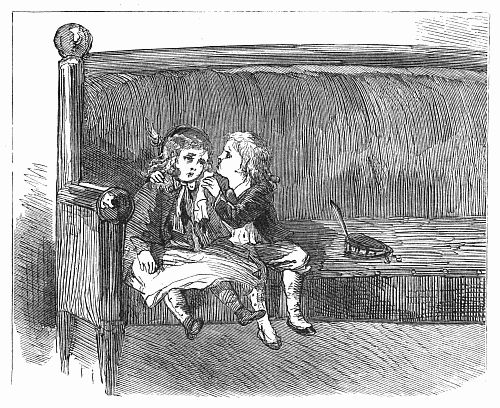
"I see you a getting out, sir," says I. "I thought it was you. I thought I couldn't be mistaken in your heighth and figure. What's the object of your journey, sir?—Matrimonial?"
"We are going to be married, Cobbs, at Gretna Green," returns the boy. "We have run away on purpose. Norah has been in rather low spirits, Cobbs; but she'll be happy, now we have found you to be our friend."
"Thank you sir, and thank you, miss, for your good opinion. Did you bring any luggage with you, sir?"
If I will believe Boots when he gives me his word and honor upon it, the lady had got a parasol, a smelling-bottle, a round and a half of cold buttered toast, eight peppermint drops, and a Doll's hairbrush. The gentleman had got about half a dozen yards of string, a knife, three or four sheets of writing-paper folded up surprisingly small, a orange, and a Chaney mug with his name on it.
"What may be the exact natur of your plans, sir?" says I.
"To go on," replies the boy,—which the courage of that boy was something wonderful!—"in the morning, and be married to-morrow."
"Just so, sir. Would it meet your views, sir, if I was to accompany you?"
They both jumped for joy again, and cried out, "O yes, yes, Cobbs! Yes!"
"Well, sir, if you will excuse my having the freedom to give an opinion, what I should recommend would be this. I'm acquainted with a pony, sir, which, put in a pheayton that I could borrow, would take you and Mrs. Harry Walmers, Junior, (driving myself if you approved,) to the end of your journey in a very short space of time. I am not altogether sure, sir, that this pony will be at liberty till to-morrow, but even if you had to wait over to-morrow for him, it might be worth your while. As to the small account here, sir, in case you was to find yourself running at all short, that don't signify; because I'm a part proprietor of this inn, and it could stand over."
Boots assures me that when they clapped their hands, and jumped for joy again, and called him, "Good Cobbs!" and "Dear Cobbs!" and bent across him to kiss one another in the delight of their confiding hearts, he felt himself the meanest rascal, for deceiving 'em, that ever was born.
"Is there anything you want just at present, sir?" I says, mortally ashamed of myself.
"We should like some cakes after dinner," answers Master Harry, "and two apples—and jam. With dinner we should like to have toast and water. But Norah has always been accustomed to half a glass of currant wine at dessert. And so have I."
"It shall be ordered at the bar, sir," I says.
Sir, I has the feeling as fresh upon me at this minute of speaking as I had then, that I would far rather have had it out in half a dozen rounds with the Governor, than have combined with him; and that I wished with all my heart there was any impossible place where those two babies could make an impossible marriage, and live impossibly happy ever afterwards. However, as it couldn't be, I went into the Governor's plans, and the Governor set off for York in half an hour.
The way in which the women of that house—without exception—every one of 'em—married and single—took to that boy when they heard the story, is surprising. It was as much as could be done to keep 'em from dashing into the room and kissing him. They climbed up all sorts of places, at the risk of their lives, to look at him through a pane of glass. And they were seven deep at the keyhole.
In the evening, I went into the room to see how the runaway couple was getting on. The gentleman was on the window-seat, supporting the lady in his arms. She had tears upon her face, and was lying, very tired and half asleep, with her head upon his shoulder.
"Mrs. Harry Walmers, Junior, fatigued, sir?"
"Yes, she is tired, Cobbs; but she is not used to be away from home, and she has been in low spirits again. Cobbs, do you think you could bring a biffin, please?"
"I ask your pardon, sir. What was it you—"
"I think a Norfolk biffin would rouse her, Cobbs. She is very fond of them."
Well, sir, I withdrew in search of the required restorative, and the gentleman handed it to the lady, and fed her with a spoon, and took a little himself. The lady being heavy with sleep, and rather cross, "What should you think, sir," I says, "of a chamber candlestick?" The gentleman approved; the chambermaid went first up the great staircase; the lady, in her sky-blue mantle, followed, gallantly escorted by the gentleman; the gentleman embraced her at her door, and retired to his own apartment, where I locked him up.
Boots couldn't but feel with increased acuteness what a base deceiver he was, when they consulted him at breakfast (they had ordered sweet milk-and-water, and toast and currant jelly, over night) about the pony. It really was as much as he could do, he don't mind confessing to me, to look them two young things in the face, and think what a wicked old father of lies he had grown up to be. Howsomever, sir, I went on a lying like a Trojan about the pony. I told 'em that it did so unfort'nately happen that the pony was half clipped, you see, and that he couldn't be took out in that state, for fear it should strike to his inside. But that he'd be finished clipping in the course of the day, and that to-morrow morning at eight o'clock the pheayton would be ready. Boots's view of the whole case, looking back upon it in my room, is, that Mrs. Harry Walmers, Junior, was beginning to give in. She hadn't had her hair curled when she went to bed, and she didn't seem quite up to brushing it herself, and its getting in her eyes put her out. But nothing put out Master Harry. He sat behind his breakfast-cup, a tearing away at the jelly, as if he had been his own father.
In the course of the morning, Master Harry rung the bell,—it was surprising how that there boy did carry on,—and said, in a sprightly way, "Cobbs, is there any good walks in this neighborhood?"
"Yes, sir. There's Love Lane."
"Get out with you, Cobbs!"—that was that there boy's expression,—"you're joking."
"Begging your pardon, sir, there really is Love Lane; and a pleasant walk it is, and proud shall I be to show it to yourself and Mrs. Harry Walmers, Junior."
"Norah, dear," says Master Harry, "this is curious. We really ought to see Love Lane. Put on your bonnet, my sweetest darling, and we will go there with Cobbs."
Boots leaves me to judge what a Beast he felt himself to be, when that young pair told him, as they all three jogged along together, that they had made up their minds to give him two thousand guineas a year as head gardener, on account of his being so true a friend to 'em. Well, sir, I turned the conversation as well as I could, and I took 'em down Love Lane to the water-meadows, and there Master Harry would have drowned himself in a half a moment more, a getting out a water-lily for her,—but nothing daunted that boy. Well, sir, they was tired out. All being so new and strange to 'em, they was tired as tired could be. And they laid down on a bank of daisies, like the children in the wood, leastways meadows, and fell asleep.
I don't know, sir,—perhaps you do,—why it made a man fit to make a fool of himself, to see them two pretty babies a lying there in the clear still sunny day, not dreaming half so hard when they was asleep as they done when they was awake. But Lord! when you come to think of yourself, you know, and what a game you have been up to ever since you was in your own cradle, and what a poor sort of a chap you are, after all, that's where it is! Don't you see, sir?
Well, sir, they woke up at last, and then one thing was getting pretty clear to me, namely, that Mrs. Harry Walmerses, Junior's, temper was on the move. When Master Harry took her round the waist, she said he "teased her so"; and when he says, "Norah, my young May Moon, your Harry tease you?" she tells him, "Yes; and I want to go home!"
A billed fowl and baked bread-and-butter pudding brought Mrs. Walmers up a little; but I could have wished, I must privately own to you, sir, to have seen her more sensible of the voice of love, and less abandoning of herself to the currants in the pudding. However, Master Harry, he kep' up, and his noble heart was as fond as ever. Mrs. Walmers turned very sleepy about dusk, and begun to cry. Therefore, Mrs. Walmers went off to bed as per yesterday; and Master Harry ditto repeated.
About eleven or twelve at night comes back the Governor in a chaise, along with Mr. Walmers and a elderly lady. Mr. Walmers says to our missis: "We are much indebted to you, ma'am, for your kind care of our little children, which we can never sufficiently acknowledge. Pray, ma'am, where is my boy?" Our missis says: "Cobbs has the dear child in charge, sir. Cobbs, show Forty!" Then Mr. Walmers, he says: "Ah, Cobbs! I am glad to see you. I understood you was here!" And I says: "Yes, sir. Your most obedient, sir."
"I beg your pardon, sir," I adds, while unlocking the door; "I hope you are not angry with Master Harry. For Master Harry is a fine boy, sir, and will do you credit and honor." And Boots signifies to me, that if the fine boy's father had contradicted him in the state of mind in which he then was, he thinks he should have "fetched him a crack," and took the consequences.
But Mr. Walmers only says, "No, Cobbs. No, my good fellow. Thank you!" and, the door being opened, goes in, goes up to the bedside, bends gently down, and kisses the little sleeping face. Then he stands looking at it for a minute, looking wonderfully like it (they do say he ran away with Mrs. Walmers); and then he gently shakes the little shoulder.
"Harry, my dear boy! Harry!"
Master Harry starts up and looks at his pa. Looks at me too. Such is the honor of that mite, that he looks at me, to see whether he has brought me into trouble.
"I am not angry, my child. I only want you to dress yourself and come home."
"Yes, pa."
Master Harry dresses himself quick.
"Please may I"—the spirit of that little creatur,—"please, dear pa,—may I—kiss Norah, before I go?"
"You may, my child."
So he takes Master Harry in his hand, and I leads the way with the candle to that other bedroom, where the elderly lady is seated by the bed, and poor little Mrs. Harry Walmers, Junior, is fast asleep. There the father lifts the boy up to the pillow, and he lays his little face down for an instant by the little warm face of poor little Mrs. Harry Walmers, Junior, and gently draws it to him,—a sight so touching to the chambermaids who are a peeping through the door, that one of them calls out, "It's a shame to part 'em!"
Finally, Boots says, that's all about it. Mr. Walmers drove away in the chaise, having hold of Master Harry's hand. The elderly lady and Mrs. Harry Walmers, Junior, that was never to be (she married a captain, long afterwards, and died in India), went off next day. In conclusion, Boots puts it to me whether I hold with him in two opinions: firstly, that there are not many couples on their way to be married who are half as innocent as them two children; secondly, that it would be a jolly good thing for a great many couples on their way to be married, if they could only be stopped in time and brought back separate.
Charles Dickens.
AMRIE AND THE GEESE.
Amrie tended the geese upon the Holder Green, as they called the pasture-ground upon the little height by Hungerbrook.
It was a pleasant but a troublesome occupation. Especially painful was it to Amrie, that she could do nothing to attach her charge to her. Indeed, they were scarcely to be distinguished one from another. Was it not true what Brown Mariann had said to her as she came out of the Moosbrunnenwood?
"Creatures that live in herds are all and every one stupid."
"I think," said Amrie, "that this is what makes geese stupid; they can do too many things. They can swim and run and fly, but they can do neither well; they are not at home in the water, nor on the ground, nor in the air; and therefore they are stupid."
"I will stand by this," said Mariann; "in thee is concealed an old hermit."
Amrie was often borne into the kingdom of dreams. Freely rose her childish soul upward and cradled itself in unlimited ether. As the larks in the air sang and rejoiced without knowing the limits of their field, so would she soar away beyond the boundaries of the whole country. The soul of the child knew nothing of the limits placed upon the narrow life of reality. Whoever is accustomed to wonder will find a miracle in every day.
"Listen!" she would say; "the cuckoo calls! It is the living echo of the woods calling and answering itself. The bird sits over there in the service-tree. Look up, and he will fly away. How loud he cries, and how unceasingly! That little bird has a stronger voice than a man. Place thyself upon the tree and imitate him; thou wilt not be heard so far as this bird, who is no larger than my hand. Listen! Perhaps he is an enchanted prince, and he may suddenly begin to speak to thee. Yes," she continued, "only tell me thy riddle, and I will soon find the meaning of it; and then will I disenchant thee."
While Amrie's thoughts were wandering beyond all bounds, the geese also felt themselves at liberty to stray away and enjoy the good things of the neighboring clover or barley field. Awaking out of her dreams, she had great trouble in bringing the geese back; and when these freebooters returned in regiments, they had much to tell of the goodly land where they had fed so well. There seemed no end to their gossipping and chattering.
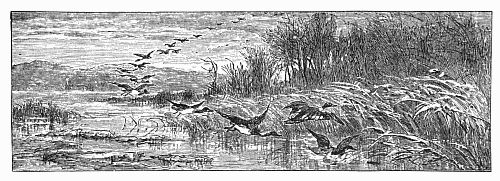
Again Amrie soared. "Look! there fly the birds! No bird in the air goes astray. Even the swallows, as they pass and repass, are always safe, always free! O, could we only fly! How must the world look above, where the larks soar! Hurrah! Always higher and higher, farther and farther! O, if I could but fly!"
Then she sang herself suddenly away from all the noise and from all her thoughts. Her breath, which with the idea of flying had grown deeper and quicker, as though she really hovered in the high ether, became again calm and measured.
Of the thousand-fold meanings that lived in Amrie's soul, Brown Mariann received only at times an intimation. Once, when she came from the forest with her load of wood, and with May-bugs and worms for Amrie's geese imprisoned in her sack, the latter said to her, "Aunt, do you know why the wind blows?"
"No, child. Do you?"
"Yes; I have observed that everything that grows must move about. The bird flies, the beetle creeps; the hare, the stag, the horse, and all animals must run. The fish swim, and so do the frogs. But there stand the trees, the corn, and the grass; they cannot go forth, and yet they must grow. Then comes the wind, and says, 'Only stand still, and I will do for you what others can do for themselves. See how I turn, and shake, and bend you! Be glad that I come! I do thee good, even if I make thee weary.'"
Brown Mariann only made her usual speech in reply, "I maintain it; in thee is concealed the soul of an old hermit."
The quail began to be heard in the high rye-fields; near Amrie, the field larks sang the whole day long. They wandered here and there and sang so tenderly, so into the deepest heart, it seemed as though they drew their inspiration from the source of life,—from the soul itself. The tone was more beautiful than that of the skylark, which soars high in the air. Often one of the birds came so near to Amrie that she said, "Why cannot I tell thee that I will not hurt thee? Only stay!" But the bird was timid, and flew farther off.
At noon, when Brown Mariann came to her, she said, "Could I only know what a bird finds to say, singing the whole day long! Even then he has not sung it all out!"
Mariann answered, "See here! A bird keeps nothing to himself, to ponder over. But within man there is always something speaking on, so softly! There are thoughts in us that talk, and weep, and sing so quietly we scarcely hear them ourselves. Not so with the bird; when his song is done, he only wants to eat or sleep."
As Mariann turned and went forth with her bundle of sticks, Amrie looked after her, smiling. "There goes a great singing bird!" she thought to herself.
None but the sun saw how long the child continued to smile and to think. Silently she sat dreaming, as the wind moved the shadows of the branches around her. Then she gazed at the clouds, motionless on the horizon, or chasing each other through the sky. As in the wide space without, so in the soul of the child, the cloud-pictures arose and melted away.
Thus, day after day, Amrie lived.
"The Little Barefoot."
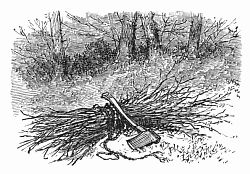
THE ROBINS.
A thing remarkable in my childhood was, that once going to a neighbor's house, I saw on the way a robin sitting on her nest, and as I went near her she went off, but, having young ones, flew about, and with many cries told her concern for them.
I stood and threw stones at her, until, one striking her, she fell down dead. At first I was pleased with the exploit, but after a few minutes was seized with horror for having in a sportive way killed an innocent creature while she was careful of her young. I beheld her lying dead, and thought that these young ones, for which she was so heedful, must now perish for want of their parent to nourish them; and after some painful considerations on the subject, I climbed up the tree, took all the young birds and killed them, supposing that to be better than to leave them to pine away and die miserably. I believed in this case that the Scripture proverb was fulfilled: "The tender mercies of the wicked are cruel."
I then went on my errand, but for some hours could think of little else than the cruelties I had committed, and was troubled.
He whose tender mercies are over all his works hath placed a principle in the human mind which incites to goodness towards every living creature; and this being singly attended to, we become tender-hearted and sympathizing; but being frequently rejected, the mind becomes shut up in a contrary disposition.
I often remember the Fountain of Goodness which gives being to all creatures, and whose love extends to the caring for the sparrow; and I believe that where the love of God is verily perfected, a tenderness toward all creatures made subject to us will be felt, and a care that we do not lessen that sweetness of life in the animal creation which their Creator intended for them.
John Woolman.
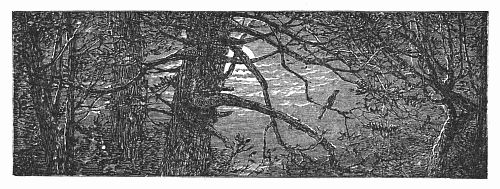
THE FISH I DIDN'T CATCH.
Our old homestead (the house was very old for a new country, having been built about the time that the Prince of Orange drove out James the Second) nestled under a long range of hills which stretched off to the west. It was surrounded by woods in all directions save to the southeast, where a break in the leafy wall revealed a vista of low green meadows, picturesque with wooded islands and jutting capes of upland. Through these, a small brook, noisy enough as it foamed, rippled, and laughed down its rocky falls by our garden-side, wound, silently and scarcely visible, to a still larger stream, known as the Country Brook. This brook in its turn, after doing duty at two or three saw and grist mills, the clack of which we could hear in still days across the intervening woodlands, found its way to the great river, and the river took it up and bore it down to the great sea.
I have not much reason for speaking well of these meadows, or rather bogs, for they were wet most of the year; but in the early days they were highly prized by the settlers, as they furnished natural mowing before the uplands could be cleared of wood and stones and laid down to grass. There is a tradition that the hay-harvesters of two adjoining towns quarrelled about a boundary question, and fought a hard battle one summer morning in that old time, not altogether bloodless, but by no means as fatal as the fight between the rival Highland clans, described by Scott in "The Fair Maid of Perth." I used to wonder at their folly, when I was stumbling over the rough hassocks, and sinking knee-deep in the black mire, raking the sharp sickle-edged grass which we used to feed out to the young cattle in midwinter when the bitter cold gave them appetite for even such fodder. I had an almost Irish hatred of snakes, and these meadows were full of them,—striped, green, dingy water-snakes, and now and then an ugly spotted adder by no means pleasant to touch with bare feet. There were great black snakes, too, in the ledges of the neighboring knolls; and on one occasion in early spring I found myself in the midst of a score at least of them,—holding their wicked meeting of a Sabbath morning on the margin of a deep spring in the meadows. One glimpse at their fierce shining heads in the sunshine, as they roused themselves at my approach, was sufficient to send me at full speed towards the nearest upland. The snakes, equally scared, fled in the same direction; and, looking back, I saw the dark monsters following close at my heels, terrible as the Black Horse rebel regiment at Bull Run. I had, happily, sense enough left to step aside and let the ugly troop glide into the bushes.
Nevertheless, the meadows had their redeeming points. In spring mornings the blackbirds and bobolinks made them musical with songs; and in the evenings great bullfrogs croaked and clamored; and on summer nights we loved to watch the white wreaths of fog rising and drifting in the moonlight like troops of ghosts, with the fireflies throwing up ever and anon signals of their coming. But the Brook was far more attractive, for it had sheltered bathing-places, clear and white sanded, and weedy stretches, where the shy pickerel loved to linger, and deep pools, where the stupid sucker stirred the black mud with his fins. I had followed it all the way from its birthplace among the pleasant New Hampshire hills, through the sunshine of broad, open meadows, and under the shadow of thick woods. It was, for the most part, a sober, quiet little river; but at intervals it broke into a low, rippling laugh over rocks and trunks of fallen trees. There had, so tradition said, once been a witch-meeting on its banks, of six little old women in short, sky-blue cloaks; and if a drunken teamster could be credited, a ghost was once seen bobbing for eels under Country Bridge. It ground our corn and rye for us, at its two grist-mills; and we drove our sheep to it for their spring washing, an anniversary which was looked forward to with intense delight, for it was always rare fun for the youngsters. Macaulay has sung,—
"That year young lads in Umbro Shall plunge the struggling sheep";
and his picture of the Roman sheep-washing recalled, when we read it, similar scenes in the Country Brook. On its banks we could always find the earliest and the latest wild flowers, from the pale blue, three-lobed hepatica, and small, delicate wood-anemone, to the yellow bloom of the witch-hazel burning in the leafless October woods.
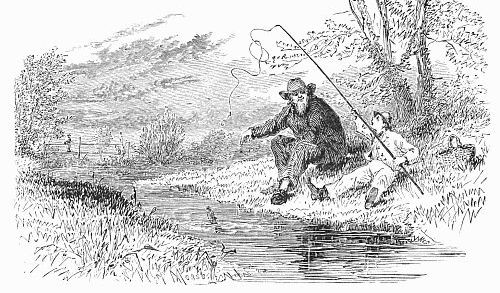
Yet, after all, I think the chief attraction of the Brook to my brother and myself was the fine fishing it afforded us. Our bachelor uncle who lived with us (there has always been one of that unfortunate class in every generation of our family) was a quiet, genial man, much given to hunting and fishing; and it was one of the great pleasures of our young life to accompany him on his expeditions to Great Hill, Brandy-brow Woods, the Pond, and, best of all, to the Country Brook. We were quite willing to work hard in the cornfield or the haying-lot to finish the necessary day's labor in season for an afternoon stroll through the woods and along the brookside. I remember my first fishing excursion as if it were but yesterday. I have been happy many times in my life, but never more intensely so than when I received that first fishing-pole from my uncle's hand, and trudged off with him through the woods and meadows. It was a still sweet day of early summer; the long afternoon shadows of the trees lay cool across our path; the leaves seemed greener, the flowers brighter, the birds merrier, than ever before. My uncle, who knew by long experience where were the best haunts of pickerel, considerately placed me at the most favorable point. I threw out my line as I had so often seen others, and waited anxiously for a bite, moving the bait in rapid jerks on the surface of the water in imitation of the leap of a frog. Nothing came of it. "Try again," said my uncle. Suddenly the bait sank out of sight. "Now for it," thought I; "here is a fish at last." I made a strong pull, and brought up a tangle of weeds. Again and again I cast out my line with aching arms, and drew it back empty. I looked to my uncle appealingly. "Try once more," he said; "we fishermen must have patience."
Suddenly something tugged at my line and swept off with it into deep water. Jerking it up, I saw a fine pickerel wriggling in the sun. "Uncle!" I cried, looking back in uncontrollable excitement, "I've got a fish!" "Not yet," said my uncle. As he spoke there was a plash in the water; I caught the arrowy gleam of a scared fish shooting into the middle of the stream; my hook hung empty from the line. I had lost my prize.
We are apt to speak of the sorrows of childhood as trifles in comparison with those of grown-up people; but we may depend upon it the young folks don't agree with us. Our griefs, modified and restrained by reason, experience, and self-respect, keep the proprieties, and, if possible, avoid a scene; but the sorrow of childhood, unreasoning and all-absorbing, is a complete abandonment to the passion. The doll's nose is broken, and the world breaks up with it; the marble rolls out of sight, and the solid globe rolls off with the marble.
So, overcome by my great and bitter disappointment, I sat down on the nearest hassock, and for a time refused to be comforted, even by my uncle's assurance that there were more fish in the brook. He refitted my bait, and, putting the pole again in my hands, told me to try my luck once more.
"But remember, boy," he said, with his shrewd smile, "never brag of catching a fish until he is on dry ground. I've seen older folks doing that in more ways than one, and so making fools of themselves. It's no use to boast of anything until it's done, nor then either, for it speaks for itself."
How often since I have been reminded of the fish that I did not catch! When I hear people boasting of a work as yet undone, and trying to anticipate the credit which belongs only to actual achievement, I call to mind that scene by the brookside, and the wise caution of my uncle in that particular instance takes the form of a proverb of universal application: "Never brag of your fish before you catch him."
John G. Whittier.
LITTLE KATE WORDSWORTH.
When I first settled in Grasmere, Catherine Wordsworth was in her infancy, but even at that age she noticed me more than any other person, excepting, of course, her mother. She was not above three years old when she died, so that there could not have been much room for the expansion of her understanding, or the unfolding of her real character. But there was room in her short life, and too much, for love the most intense to settle upon her.
The whole of Grasmere is not large enough to allow of any great distance between house and house; and as it happened that little Kate Wordsworth returned my love, she in a manner lived with me at my solitary cottage. As often as I could entice her from home, she walked with me, slept with me, and was my sole companion.
That I was not singular in ascribing some witchery to the nature and manners of this innocent child may be gathered from the following beautiful lines by her father. They are from the poem entitled "Characteristics of a Child Three Years Old," dated, at the foot, 1811, which must be an oversight, as she was not so old until the following year.
"Loving she is, and tractable, though wild; And Innocence hath privilege in her To dignify arch looks and laughing eyes, And feats of cunning, and the pretty round Of trespasses, affected to provoke Mock chastisement, and partnership in play. And as a fagot sparkles on the hearth Not less if unattended and alone Than when both young and old sit gathered round, And take delight in its activity,— Even so this happy creature of herself Was all-sufficient. Solitude to her Was blithe society, who filled the air With gladness and involuntary songs."
It was this radiant spirit of joyousness, making solitude, for her, blithe society, and filling from morning to night the air with gladness and involuntary songs,—this it was which so fascinated my heart that I became blindly devoted to this one affection.
In the spring of 1812 I went up to London; and early in June I learned by a letter from Miss Wordsworth, her aunt, that she had died suddenly. She had gone to bed in good health about sunset on June 4, was found speechless a little before midnight, and died in the early dawn, just as the first gleams of morning began to appear above Seat Sandel and Fairfield, the mightiest of the Grasmere barriers,—about an hour, perhaps, before sunrise.
Over and above my love for her, I had always viewed her as an impersonation of the dawn, and of the spirit of infancy; and this, with the connection which, even in her parting hours, she assumed with the summer sun, timing her death with the rising of that fountain of life,—these impressions recoiled into such a contrast to the image of death, that each exalted and brightened the other.
I returned hastily to Grasmere, stretched myself every night on her grave, in fact often passed the whole night there, in mere intensity of sick yearning after neighborhood with the darling of my heart.
In Sir Walter Scott's "Demonology," and in Dr. Abercrombie's "Inquiries concerning the Intellectual Powers," there are some remarkable illustrations of the creative faculties awakened in the eye or other organs by peculiar states of passion; and it is worthy of a place among cases of that nature, that in many solitary fields, at a considerable elevation above the level of the valleys,—fields which, in the local dialect, are called "intacks,"—my eye was haunted, at times, in broad noonday (oftener, however, in the afternoon), with a facility, but at times also with a necessity, for weaving, out of a few simple elements, a perfect picture of little Kate in her attitude and onward motion of walking.
I resorted constantly to these "intacks," as places where I was little liable to disturbance; and usually I saw her at the opposite side of the field, which sometimes might be at the distance of a quarter of a mile, generally not so much. Almost always she carried a basket on her head; and usually the first hint upon which the figure arose commenced in wild plants, such as tall ferns, or the purple flowers of the foxglove. But whatever these might be, uniformly the same little full-formed figure arose, uniformly dressed in the little blue bed-gown and black skirt of Westmoreland, and uniformly with the air of advancing motion.
Thomas De Quincey.
HOW MARGERY WONDERED.
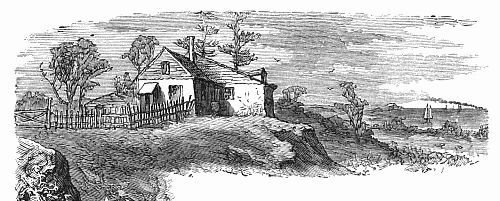
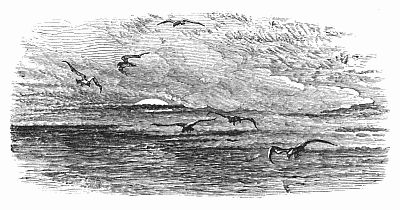
One bright morning, late in March, little Margery put on her hood and her Highland plaid shawl, and went trudging across the beach. It was the first time she had been trusted out alone, for Margery was a little girl; nothing about her was large, except her round gray eyes, which had yet scarcely opened upon half a dozen springs and summers.
There was a pale mist on the far-off sea and sky, and up around the sun were white clouds edged with the hues of pinks and violets. The sunshine and the mild air made Margery's very heart feel warm, and she let the soft wind blow aside her Highland shawl, as she looked across the waters at the sun, and wondered!
For, somehow, the sun had never looked before as it did to-day;—it seemed like a great golden flower bursting out of its pearl-lined calyx,—a flower without a stem! Or was there a strong stem away behind it in the sky, that reached down below the sea, to a root, nobody could guess where?
Margery did not stop to puzzle herself about the answer to her question, for now the tide was coming in, and the waves, little at first, but growing larger every moment, were crowding up, along the sand and pebbles, laughing, winking, and whispering, as they tumbled over each other, like thousands of children hurrying home from somewhere, each with its own precious little secret to tell. Where did the waves come from? Who was down there under the blue wall of the horizon, with the hoarse, hollow voice, urging and pushing them across the beach to her feet? And what secret was it they were lisping to each other with their pleasant voices? O, what was there beneath the sea, and beyond the sea, so deep, so broad, and so dim too, away off where the white ships, that looked smaller than sea-birds, were gliding out and in?
But while Margery stood still for a moment on a dry rock and wondered, there came a low, rippling warble to her ear from a cedar-tree on the cliff above her. It had been a long winter, and Margery had forgotten that there were birds, and that birds could sing. So she wondered again what the music was. And when she saw the bird perched on a yellow-brown bough, she wondered yet more. It was only a bluebird, but then it was the first bluebird Margery had ever seen. He fluttered among the prickly twigs, and looked as if he had grown out of them, as the cedar-berries had, which were dusty-blue, the color of his coat. But how did the music get into his throat? And after it was in his throat, how could it untangle itself, and wind itself off so evenly? And where had the bluebird flown from, across the snow-banks, down to the shore of the blue sea? The waves sang a welcome to him, and he sang a welcome to the waves; they seemed to know each other well; and the ripple and the warble sounded so much alike, the bird and the wave must both have learned their music of the same teacher. And Margery kept on wondering as she stepped between the song of the bluebird and the echo of the sea, and climbed a sloping bank, just turning faintly green in the spring sunshine.
The grass was surely beginning to grow! There were fresh, juicy shoots running up among the withered blades of last year, as if in hopes of bringing them back to life; and closer down she saw the sharp points of new spears peeping from their sheaths. And scattered here and there were small dark green leaves folded around buds shut up so tight that only those who had watched them many seasons could tell what flowers were to be let out of their safe prisons by and by. So no one could blame Margery for not knowing that they were only common things,—mouse-ear, dandelions, and cinquefoil; nor for stooping over the tiny buds, and wondering.
What made the grass come up so green out of the black earth? And how did the buds know when it was time to take off their little green hoods, and see what there was in the world around them? And how came they to be buds at all? Did they bloom in another world before they sprung up here?—and did they know, themselves, what kind of flowers they should blossom into? Had flowers souls, like little girls, that would live in another world when their forms had faded away from this?
Margery thought she should like to sit down on the bank and wait beside the buds until they opened; perhaps they would tell her their secret if the very first thing they saw was her eyes watching them. One bud was beginning to unfold; it was streaked with yellow in little stripes that she could imagine became wider every minute. But she would not touch it, for it seemed almost as much alive as herself. She only wondered, and wondered!
But the dash of the waves grew louder, and the bluebird had not stopped singing yet, and the sweet sounds drew Margery's feet down to the beach again, where she played with the shining pebbles, and sifted the sand through her plump fingers, stopping now and then to wonder a little about everything, until she heard her mother's voice calling her, from the cottage on the cliff.
Then Margery trudged home across the shells and pebbles with a pleasant smile dimpling her cheeks, for she felt very much at home in this large, wonderful world, and was happy to be alive, although she neither could have told, nor cared to know, the reason why. But when her mother unpinned the little girl's Highland shawl, and took off her hood, she said, "O mother, do let me live on the door-step! I don't like houses to stay in. What makes everything so pretty and so glad? Don't you like to wonder?"
Margery's mother was a good woman. But then there was all the housework to do, and if she had thoughts, she did not often let them wander outside the kitchen door. And just now she was baking some gingerbread, which was in danger of getting burned in the oven. So she pinned the shawl around the child's neck again, and left her on the door-step, saying to herself, as she returned to her work, "Queer child! I wonder what kind of a woman she will be!"
But Margery sat on the door-step, and wondered, as the sea sounded louder, and the sunshine grew warmer around her. It was all so strange, and grand, and beautiful! Her heart danced with joy to the music that went echoing through the wide world from the roots of the sprouting grass to the great golden blossom of the sun.
And when the round, gray eyes closed that night, at the first peep of the stars, the angels looked down and wondered over Margery. For the wisdom of the wisest being God has made ends in wonder; and there is nothing on earth so wonderful as the budding soul of a little child.
Lucy Larcom.
THE NETTLE-GATHERER.
Very early in the spring, when the fresh grass was just appearing, before the trees had got their foliage, or the beds of white campanula and blue anemone were open, a poor little girl with a basket on her arm went out to search for nettles.
Near the stone wall of the churchyard was a bright green spot, where grew a large bunch of nettles. The largest stung little Karine's fingers. "Thank you for nothing!" said she; "but, whether you like it or not, you must all be put into my basket."
Little Karine blew on her smarting finger, and the wind followed suit. The sun shone out warm, and the larks began to sing. As Karine was standing there listening to the song of the birds, and warming herself in the sun, she perceived a beautiful butterfly.
"O, the first I have seen this year! What sort of summer shall I have? Let me see your colors. Black and bright red. Sorrow and joy in turn. It is very likely I may go supperless to bed, but then there is the pleasure of gathering flowers, making hay, and playing tricks." Remembrance and expectation made her laugh.
The butterfly stretched out its dazzling wings, and, after it had settled on a nettle, waved itself backwards and forwards in the sunshine. There was also something else upon the nettle, which looked like a shrivelled-up light brown leaf. The sun was just then shining down with great force upon the spot, and while she looked the brown object moved, and two little leaves rose gently up which by and by became two beautiful little wings; and behold, it was a butterfly just come out of the chrysalis! Fresh life was infused into it by the warm rays of the sun, and how happy it was!
The two butterflies must have been friends whom some unlucky chance had separated. They flew about, played at hide-and-seek, waltzed with each other, and seemed to be thoroughly enjoying themselves in the bright sunshine. One flew away three times into a neighboring orchard. The other seated itself on a nettle to rest. Karine went gently towards it, put her hands quickly over it, and got possession both of the butterfly and the nettle. She then put them into the basket, which she covered with a red cotton handkerchief, and went home happy.
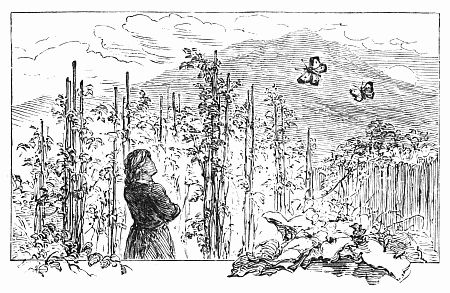
The nettles were bought by an old countess, who lived in a grand apartment, and had a weakness for nettle soup. Karine received a silver piece for them. With this in her hand, the butterfly in her basket, and also two large gingercakes which had been given to her by the kind countess, the happy girl went into the room where her mother and little brother awaited her. There were great rejoicings over the piece of silver, the gingercakes, and the butterfly.
But the butterfly did not appear as happy with the children as the children were with the butterfly. It would not eat any of the gingerbread, or anything else which the children offered, but was always fluttering against the window-pane, and when it rested on the ledge it put out a long proboscis, drew it in again, and appeared to be sucking something; however, it found nothing to suit its taste, so it flew about again, and beat its wings with such force against the window-pane, that Karine began to fear it would come to grief. Two days passed in this way. The butterfly would not be happy.
"It wants to get out," thought Karine; "it wants to find a home and something to eat." So she opened the window.
Ah, how joyfully the butterfly flew out into the open air! it seemed to be quite happy. Karine ran after it to see which way it took. It flew over the churchyard, which was near Karine's dwelling. There little yellow star-like flowers of every description were in bud; among them the spring campanula, otherwise called the morning-star. Into the calyxes of these little flowers it thrust its proboscis, and sucked a sweet juice therefrom; for at the bottom of the calyx of almost every flower there is a drop of sweet juice which God has provided for the nourishment of insects,—bees, drones, butterflies, and many other little creatures.
The butterfly then flew to the bunch of nettles on the hill. The large nettle which had stung Karine's finger now bore three white bell-shaped flowers, which looked like a crown on the top of the stalk, and many others were nearly out. The butterfly drew honey from the white nettle-blossoms and embraced the plant with its wings, as children do a tender mother.
"It has now returned to its home," thought Karine, and she felt very glad to have given the butterfly its liberty.
Summer came. The child enjoyed herself under the lime-trees in the churchyard, and in the meadows where she got the beautiful yellow catkins, which were as soft as the down of the goslings, and which she was so fond of playing with, also the young twigs which she liked cutting into pipes or whistles. Fir-trees and pines blossomed and bore fir-cones; the sheep and calves were growing, and drank the dew, which is called the "Blessed Virgin's hand," out of the trumpet moss, which with its small white and purple cup grew on the steep shady banks.
Karine now gathered flowers to sell. The nettles had long ago become too old and rank, but the nettle butterflies still flew merrily about among them.
One day Karine saw her old friend sit on a leaf, as if tired and worn out, and when it flew away the child found a little gray egg lying on the very spot where it had rested, whereupon she made a mark on the nettle and the leaf.
She forgot the nettles for a long time, and it seemed as if the butterfly had also forgotten them, for it was there no more. Larger and more beautiful butterflies were flying about there, higher up in the air. There was the magnificent Apollo-bird, with large white wings and scarlet eyes; also the Antiopa, with its beautiful blue and white velvet band on the edge of its dark velvet dress; and farther on the dear little blue glittering Zefprinner, and many others.
Karine gathered flowers, and then went into the hay-field to work; still, it often happened that she and her little brother went supperless to bed. But then their father played on the violin, and made them forget that they were hungry, and its tones lulled them to sleep.
One day, when Karine was passing by the nettles, she stopped, rejoiced to see them again. She saw that the nettles were a little bent down, and, upon examination, found a number of small green caterpillars, resembling those which we call cabbage-grubs, and they seemed to enjoy eating the nettle leaves as much as the old countess did her nettle soup. She saw that they covered the exact spot where she had made a mark, and that the leaf was nearly eaten up by the caterpillars, and Karine immediately thought that they must be the butterfly's children. And so they were, for they had come from its eggs.
"Ah!" thought Karine, "if my little brother and I, who sometimes can eat more than our father and mother can give us, could become butterflies, and find something to eat as easily as these do, would it not be pleasant?" She broke off the nettle on which the butterfly had laid its eggs,—but this time she carefully wound her handkerchief round her hand,—and carried it home.
On her arrival there, she found all the little grubs had crawled away, with the exception of one, which was still eating and enjoying itself. Karine put the nettle into a glass of water, and every day a fresh leaf appeared. The caterpillar quickly increased in size, and seemed to thrive wonderfully well. The child took great pleasure in it, and wondered within herself how large it would be at last, and when its wings would come.
But one morning it appeared very quiet and sleepy, and would not eat, and became every moment more weary, and seemed ill. "O," said Karine, "it is certainly going to die, and there will be no butterfly from it; what a pity!"
It was evening, and the next morning Karine found with astonishment that the caterpillar had spun round itself a sort of web, in which it lay, no longer a living green grub, but a stiff brown chrysalis. She took it out of the cocoon; it was as if enclosed in a shell. "It is dead," said the child, "and is now lying in its coffin! But I will still keep it, for it has been so long with us, and at any rate it will be something belonging to my old favorite." Karine then laid it on the earth in a little flower-pot which stood in the window, in which there was a balsam growing.
The long winter came, and much, very much snow. Karine and her little brother had to run barefooted through it all. The boy got a cough. He became paler and paler, would not eat anything, and lay tired and weary, just like the grub of the caterpillar shortly before it became a chrysalis.
The snow melted, the April sun reappeared, but the little boy played out of doors no more. His sister went out again to gather nettles and blue anemones, but no longer with a merry heart. When she came home, she would place the anemones on her little brother's sick-bed. And as time went on, one day he lay there stiff and cold, with eyes fast closed. In a word, he was dead. They placed him in a coffin, took him to the churchyard, and laid him in the ground, and the priest threw three handfuls of earth over the coffin. Karine's heart was so heavy that she did not heed the blessed words which were spoken of the resurrection unto everlasting life.
Karine only knew that her brother was dead, that she had no longer any little brother whom she could play with, and love, and be loved by in return. She wept bitterly when she thought how gentle and good he was. She went crying into the meadows, gathered all the flowers and young leaves she could find, and strewed them on her brother's grave, and sat there weeping for many hours.
One day she took the pot with the balsam in it, and also the chrysalis, and said, "I will plant the balsam on the grave, and bury the butterfly's grub with my dear little brother." Again she wept bitterly while she thought to herself: "Mother said that my brother lives, and is happy with God; but I saw him lying in the coffin, and put into the grave, and how can he then come back again? No, no; he is dead, and I shall never see either of them again."
Poor little Karine sobbed, and dried her tears with the hand that was free. In the other lay the chrysalis, and the sun shone upon it. There was a low crackling in the shell, and a violent motion within, and, behold! she saw a living insect crawl out, which threw off its shell as a man would his cloak, and sat on Karine's hand, breathing, and at liberty. In a short time wings began to appear from its back. Karine looked on with a beating heart. She saw its wings increase in size, and become colored in the brightness of the spring sun. Presently the new-born butterfly moved its proboscis, and tried to raise its young wings, and she recognized her nettle butterfly. And when, after an hour, he fluttered his wings to prepare for flight, and flew around the child's head and among the flowers, an unspeakably joyful feeling came over Karine, and she said, "The shell of the chrysalis has burst, and the caterpillar within has got wings; in like manner is my little brother freed from his mortal body, and has become an angel in the presence of God."
In the night she dreamed that her brother and herself, with butterfly's wings, and joy beaming in their eyes, were soaring far, far away, above their earthly home, towards the millions of bright shining stars; and the stars became flowers, whose nectar they drank; and over them was a wondrous bright light, and they heard sounds of music,—so grand and beautiful! Karine recognized the tones she had heard on earth, when their father played for her and her little brother in their poor cottage, when they were hungry. But this was so much more grand! Yet it was so beautiful, so exceedingly beautiful, that Karine awoke. A rosy light filled the room, the morning dawn was breaking, and the sun was looking in love upon the earth, reviving everything with his gentleness and strength.
Karine wept no more. She felt great inward joy. When she again went to visit the nettles, and saw the little caterpillars crawling on the leaves, she said in a low voice, "You only crawl now, you little things! By and by you will have wings as well as I, and you know not how glorious it will be at the last."
From the Swedish.
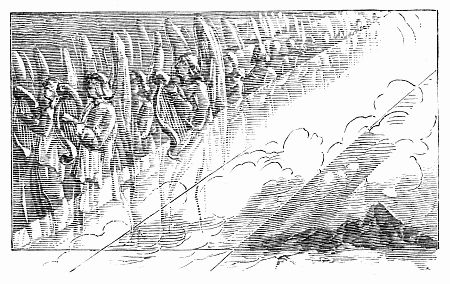
LITTLE ARTHUR'S PRAYER.
The little school-boys went quietly to their own beds, and began undressing and talking to one another in whispers; while the elder, amongst whom was Tom, sat chatting about on one another's beds, with their jackets and waistcoats off. Poor little Arthur was overwhelmed with the novelty of his position. The idea of sleeping in the room with strange boys had clearly never crossed his mind before, and was as painful as it was strange to him. He could hardly bear to take his jacket off; however, presently, with an effort, off it came, and then he paused and looked at Tom, who was sitting at the bottom of his bed, talking and laughing.
"Please, Brown," he whispered, "may I wash my face and hands?"
"Of course, if you like," said Tom, staring; "that's your washhand-stand under the window, second from your bed. You'll have to go down for more water in the morning if you use it all." And on he went with his talk, while Arthur stole timidly from between the beds out to his washhand-stand, and began his ablutions, thereby drawing for a moment on himself the attention of the room.
On went the talk and laughter. Arthur finished his washing and undressing, and put on his night-gown. He then looked round more nervously than ever. Two or three of the little boys were already in bed, sitting up with their chins on their knees. The light burned clear, the noise went on. It was a trying moment for the poor little lonely boy; however, this time he did not ask Tom what he might or might not do, but dropped on his knees by his bedside, as he had done every day from his childhood, to open his heart to Him who heareth the cry and beareth the sorrows of the tender child, and the strong man in agony.
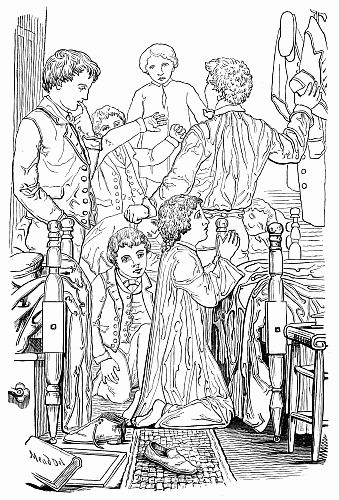
Tom was sitting at the bottom of his bed unlacing his boots, so that his back was towards Arthur, and he did not see what had happened, and looked up in wonder at the sudden silence. Then two or three boys laughed and sneered, and a big brutal fellow who was standing in the middle of the room picked up a slipper, and shied it at the kneeling boy, calling him a snivelling young shaver. Then Tom saw the whole, and the next moment the boot he had just pulled off flew straight at the head of the bully, who had just time to throw up his arm and catch it on his elbow.
"Confound you, Brown; what's that for?" roared he, stamping with pain.
"Never mind what I mean," said Tom, stepping on to the floor, every drop of blood in his body tingling; "if any fellow wants the other boot, he knows how to get it."
What would have been the result is doubtful, for at this moment the sixth-form boy came in, and not another word could be said. Tom and the rest rushed into bed and finished their unrobing there, and the old verger, as punctual as the clock, had put out the candle in another minute, and toddled on to the next room, shutting their door with his usual "Good night, genl'm'n."
There were many boys in the room by whom that little scene was taken to heart before they slept. But sleep seemed to have deserted the pillow of poor Tom. For some time his excitement, and the flood of memories which chased one another through his brain, kept him from thinking or resolving. His head throbbed, his heart leapt, and he could hardly keep himself from springing out of bed and rushing about the room. Then the thought of his own mother came across him, and the promise he had made at her knee, years ago, never to forget to kneel by his bedside, and give himself up to his Father, before he laid his head on the pillow, from which it might never rise; and he lay down gently, and cried as if his heart would break. He was only fourteen years old.
It was no light act of courage in those days for a little fellow to say his prayers publicly, even at Rugby. A few years later, when Arnold's manly piety had begun to leaven the school, the tables turned; before he died, in the schoolhouse at least, and I believe in the other houses, the rule was the other way. But poor Tom had come to school in other times. The first few nights after he came he did not kneel down because of the noise, but sat up in bed till the candle was out, and then stole out and said his prayers, in fear lest some one should find him out. So did many another poor little fellow. Then he began to think that he might just as well say his prayers in bed, and then that it did not matter whether he was kneeling, or sitting, or lying down. And so it had come to pass with Tom, as with all who will not confess their Lord before men; and for the last year he had probably not said his prayers in earnest a dozen times.
Poor Tom! the first and bitterest feeling which was like to break his heart was the sense of his own cowardice. The vice of all others which he loathed was brought in and burned in on his own soul. He had lied to his mother, to his conscience, to his God. How could he bear it? And then the poor little weak boy, whom he had pitied and almost scorned for his weakness, had done that which he, braggart as he was, dared not do. The first dawn of comfort came to him in vowing to himself that he would stand by that boy through thick and thin, and cheer him, and help him, and bear his burdens, for the good deed done that night. Then he resolved to write home next day and tell his mother all, and what a coward her son had been. And then peace came to him as he resolved, lastly, to bear his testimony next morning. The morning would be harder than the night to begin with, but he felt that he could not afford to let one chance slip. Several times he faltered, for the Devil showed him first, all his old friends calling him "Saint," and "Squaretoes," and a dozen hard names, and whispered to him that his motives would be misunderstood, and he would only be left alone with the new boy; whereas it was his duty to keep all means of influence, that he might do good to the largest number. And then came the more subtle temptation, "Shall I not be showing myself braver than others by doing this? Have I any right to begin it now? Ought I not rather to pray in my own study, letting other boys know that I do so, and trying to lead them to it, while in public at least I should go on as I have done?" However, his good angel was too strong that night, and he turned on his side and slept, tired of trying to reason, but resolved to follow the impulse which had been so strong, and in which he had found peace.
Next morning he was up and washed and dressed, all but his jacket and waistcoat, just as the ten minutes' bell began to ring, and then in the face of the whole room he knelt down to pray. Not five words could he say,—the bell mocked him; he was listening for every whisper in the room,—what were they all thinking of him? He was ashamed to go on kneeling, ashamed to rise from his knees. At last, as it were from his inmost heart, a still small voice seemed to breathe forth the words of the publican, "God be merciful to me a sinner!" He repeated them over and over, clinging to them as for his life, and rose from his knees comforted and humbled, and ready to face the whole world. It was not needed; two other boys besides Arthur had already followed his example, and he went down to the great school with a glimmering of another lesson in his heart,—the lesson that he who has conquered his own coward spirit has conquered the whole outward world; and that other one which the old prophet learned in the cave at Mount Horeb, when he hid his face, and the still small voice asked, "What doest thou here, Elijah?" that however we may fancy ourselves alone on the side of good, the King and Lord of men is nowhere without his witnesses; for in every society, however seemingly corrupt and godless, there are those who have not bowed the knee to Baal.
He found, too, how greatly he had exaggerated the effect to be produced by his act. For a few nights there was a sneer or a laugh when he knelt down, but this passed off soon, and one by one all the other boys but three or four followed the lead.
"School-Days at Rugby."
FAITH AND HER MOTHER.
Aunt Winifred went again to Worcester to-day. She said that she had to buy trimming for Faith's sack.
She went alone, as usual, and Faith and I kept each other company through the afternoon,—she on the floor with her doll, I in the easy-chair with Macaulay. As the light began to fall level on the floor, I threw the book aside,—being at the end of a volume,—and, Mary Ann having exhausted her attractions, I surrendered unconditionally to the little maiden.
She took me up garret, and down cellar, on top of the wood-pile, and into the apple-trees; I fathomed the mysteries of Old Man's Castle and Still Palm; I was her grandmother; I was her baby; I was a rabbit; I was a chestnut horse; I was a watch-dog; I was a mild-tempered giant; I was a bear, "warranted not to eat little girls"; I was a roaring hippopotamus and a canary-bird; I was Jeff Davis, and I was Moses in the bulrushes; and of what I was, the time faileth me to tell.
It comes over me with a curious, mingled sense of the ludicrous and the horrible, that I should have spent the afternoon like a baby and almost as happily, laughing out with the child, past and future forgotten, the tremendous risks of "I spy" absorbing all my present, while what was happening was happening, and what was to come was coming. Not an echo in the air, not a prophecy in the sunshine, not a note of warning in the song of the robins that watched me from the apple-boughs.
As the long, golden afternoon slid away, we came out by the front gate to watch for the child's mother. I was tired, and, lying back on the grass, gave Faith some pink and purple larkspurs, that she might amuse herself in making a chain of them. The picture that she made sitting there on the short dying grass—the light which broke all about her and over her at the first, creeping slowly down and away to the west, her little fingers linking the rich, bright flowers, tube into tube, the dimple on her cheek and the love in her eyes—has photographed itself into my thinking.
How her voice rang out, when the wheels sounded at last, and the carriage, somewhat slowly driven, stopped!
"Mamma, mamma! see what I've got for you, mamma!"
Auntie tried to step from the carriage, and called me: "Mary, can you help me a little? I am—tired."
I went to her, and she leaned heavily on my arm, and we came up the path.
"Such a pretty little chain, all for you, mamma," began Faith, and stopped, struck by her mother's look.
"It has been a long ride, and I am in pain. I believe I will lie right down on the parlor sofa. Mary, would you be kind enough to give Faith her supper and put her to bed?"
Faith's lip grieved.
"Cousin Mary isn't you, mamma. I want to be kissed. You haven't kissed me."
Her mother hesitated for a moment; then kissed her once, twice; put both arms about her neck, and turned her face to the wall without a word.
"Mamma is tired, dear," I said; "come away."
She was lying quite still when I had done what was to be done for the child, and had come back. The room was nearly dark. I sat down on my cricket by her sofa.
"Did you find the sack-trimming?" I ventured, after a pause.
"I believe so,—yes."
She drew a little package from her pocket, held it a moment, then let it roll to the floor forgotten. When I picked it up, the soft, tissue-paper wrapper was wet and hot with tears.
"Mary?"
"Yes."
"I never thought of the little trimming till the last minute. I had another errand."
I waited.
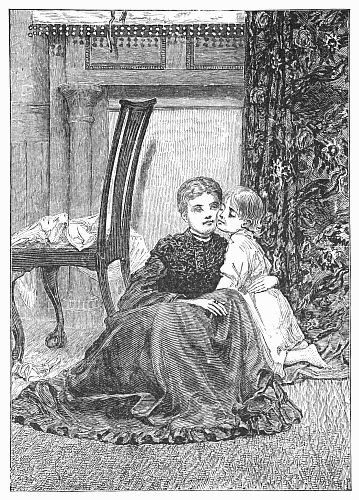
"I thought at first I would not tell you just yet. But I suppose the time has come; it will be no more easy to put it off. I have been to Worcester all these times to see a doctor."
I bent my head in the dark, and listened for the rest.
"He has his reputation; they said he could help me if anybody could. He thought at first he could. But to-day—"
The leaves rustled out of doors. Faith, up stairs, was singing herself to sleep with a droning sound.
"I suppose," she said at length, "I must give up and be sick now; I am feeling the reaction from having kept up so long. He thinks I shall not suffer a very great deal. He thinks he can relieve me, and that it may be soon over."
"There is no chance?"
"No chance."
I took both of her hands, and cried out, "Auntie, Auntie, Auntie!" and tried to think what I was doing, but only cried out the more.
"Why, Mary!" she said; "why, Mary!" and again, as before, she passed her soft hand to and fro across my hair, till by and by I began to think, as I had thought before, that I could bear anything which God, who loved us all,—who surely loved us all,—should send.
So then, after I had grown still, she began to tell me about it in her quiet voice; and the leaves rustled, and Faith had sung herself to sleep, and I listened wondering. For there was no pain in the quiet voice,—no pain, nor tone of fear. Indeed, it seemed to me that I detected, through its subdued sadness, a secret, suppressed buoyancy of satisfaction, with which something struggled.
"And you?" I asked, turning quickly upon her.
"I should thank God with all my heart, Mary, if it were not for Faith and you. But it is for Faith and you. That's all."
When I had locked the front door, and was creeping up here to my room, my foot crushed something, and a faint, wounded perfume came up. It was the little pink and purple chain.
"The Gates Ajar."
THE OPEN DOOR.
Poor Mrs. Van Loon was a widow. She had four little children. The eldest was Dirk, a boy of eight years.
One evening she had no bread, and her children were hungry. She folded her hands, and prayed to God; for she served the Lord, and she believed that he loved and could help her.
When she had finished her prayer, Dirk said to her, "Mother, don't we read in the Bible that God sent ravens to a pious man to bring him bread?"
"Yes," answered the mother, "but that's long, long ago, my dear."
"Well," said Dirk, "then the Lord may send ravens now. I'll go and open the door, else they can't fly in."
In a trice Dirk jumped to the door, which he left wide open, so that the light of the lamp fell on the pavement of the street.
Shortly after, the burgomaster passed by. The burgomaster is the first magistrate of a Dutch town or village. Seeing the open door, he stopped.
Looking into the room, he was pleased with its clean, tidy appearance, and with the nice little children who were grouped around their mother. He could not help stepping in, and approaching Mrs. Van Loon he said, "Eh, my good woman, why is your door open so late as this?"
Mrs. Van Loon was a little confused when she saw such a well-dressed gentleman in her poor room. She quickly rose and dropped a courtesy to the gentleman; then taking Dirk's cap from his head, and smoothing his hair, she answered, with a smile, "My little Dirk has done it, sir, that the ravens may fly in to bring us bread."
Now, the burgomaster was dressed in a black coat and black trousers, and he wore a black hat. He was quite black all over, except his collar and shirt-front.
"Ah! indeed!" he exclaimed cheerfully. "Dirk is right. Here is a raven, you see, and a large one too. Come along, Dirk, and I'll show you where the bread is."
The burgomaster took Dirk to his house, and ordered his servant to put two loaves and a small pot of butter into a basket. This he gave to Dirk, who carried it home as quickly as he could. When the other little children saw the bread, they began dancing and clapping their hands. The mother gave to each of them a thick slice of bread and butter, which they ate with the greatest relish.
When they had finished their meal, Dirk went to the open door, and, taking his cap from his head, looked up to the sky, and said, "Many thanks, good Lord!" And after having said this, he shut the door.
John de Liefde.
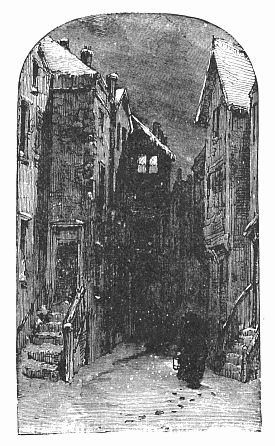
THE PRINCE'S VISIT.
It was a holiday in the city, for the Prince was to arrive. As soon as the cannon should sound, the people might know that the Prince had landed from the steamer; and when they should hear the bells ring, that was much the same as being told that the Mayor and Aldermen and City Councillors had welcomed the Prince, by making speeches, and shaking hands, and bowing, and drinking wine; and that now the Prince, dressed in splendid clothes, and wearing a feather in his cap, was actually on his way up the main street of the city, seated in a carriage drawn by four coal-black horses, preceded by soldiers and music, and followed by soldiers, citizens in carriages, and people on foot. Now it was the first time that a Prince had ever visited the city, and it might be the only chance that the people ever would get to see a real son of a king; and so it was universally agreed to have a holiday, and long before the bells rang, or even the cannon sounded, the people were flocking into the main street, well dressed, as indeed they ought to be, when they were to be seen by a Prince.
It was holiday in the stores and in the workshops, although the holiday did not begin at the same hour everywhere. In the great laundry it was to commence when the cannon sounded; and "weak Job," as his comrades called him, who did nothing all day long but turn the crank that worked a great washing-machine, and which was quite as much, they said, as he had wits to do, listened eagerly for the sound of the cannon; and when he heard it, he dropped the crank, and, getting a nod from the head man, shuffled out of the building and made his way home.
Since he had heard of the Prince's coming, Job had thought and dreamed of nothing else; and when he found that they were to have a holiday on his arrival, he was almost beside himself. He bought a picture of the Prince, and pinned it up on the wall over his bed; and when he came home at night, tired and hungry, he would sit down by his mother, who mended rents in the clothes brought to the laundry, and talk about the Prince until he could not keep his eyes open longer; then his mother would kiss him and send him to bed, where he knelt down and prayed the Lord to keep the Prince, and then slept and dreamed of him, dressing him in all the gorgeous colors that his poor imagination could devise, while his mother worked late in her solitary room, thinking of her only boy; and when she knelt down at night, she prayed the Lord to keep him, and then slept, dreaming also, but with various fancies; for sometimes she seemed to see Job like his dead father,—strong and handsome and brave and quick-witted,—and now she would see him playing with the children, or shuffling down the court with his head leaning on his shoulder.
To-day he hurried so fast that he was panting for want of breath when he reached the shed-like house where they lived. His mother was watching for him, and he came in nodding his head and rubbing his warm face.
"The cannon has gone off, mother," said he, in great excitement. "The Prince has come!"
"Everything is ready, Job," said his mother. "You will find all your things in a row on the bed." And Job tumbled into his room to dress himself for the holiday. Everything was there as his mother had said; all the old things renewed, and all the new things pieced together that she had worked on so long, and every stitch of which Job had overlooked and almost directed. If there had but been time to spare, how Job would have liked to turn round and round before his scrap of looking-glass; but there was no time to spare, and so in a very few minutes he was out again, and showing himself to his mother.
"Isn't it splendid!" said he, surveying himself from top to toe, and looking with special admiration on a white satin scarf that shone round his throat in dazzling contrast to the dingy coat, and which had in it an old brooch which Job treasured as the apple of his eye. Job's mother, too, looked at them both; and though she smiled and did not speak, it was only—brave woman!—because she was choking, as she thought how the satin was the last remnant of her wedding-dress, and the brooch the last trinket left of all given to her years back.
"If you would only have let me wear the feather, mother!" said Job, sorrowfully, in regretful remembrance of one he had long hoarded, and which he had begged hard to wear in his hat.
"You look splendidly, Job, and don't need it," said she, cheerfully; "and, besides, the Prince wears one, and what would he think if he saw you with one, too?"
"Sure enough," said Job, who had not thought of that before; and then he kissed her and started off, while she stood at the door looking anxiously after him. "I don't believe," said he, aloud, as he went up the court, "that the Prince would mind my wearing a feather; but mother didn't want me too. Hark! there are the bells! Yes, he has started!" And Job, forgetting all else, pushed eagerly on. It was a long way from the laundry to his home, and it was a long way, too, from his home to the main street; and so Job had no time to spare if he would get to the crowd in season to see the grand procession, for he wanted to see it all,—from the policemen, who cleared the way, to the noisy omnibuses and carts that led business once more up the holiday streets.
On he shambled, knocking against the flag-stones, and nearly precipitating himself down areas and unguarded passage-ways. He was now in a cross street, which would bring him before long into the main street, and he even thought he heard the distant music and the cheers of the crowd. His heart beat high, and his face was lighted up until it really looked, in its eagerness, as intelligent as that of other people quicker witted than poor Job. And now he had come in sight of the great thoroughfare; it was yet a good way off, but he could see the black swarms of people that lined its edges. The street he was in was quiet, so were all the cross streets, for they had been drained of life to feed the great artery of the main street. There, indeed, was life! upon the sidewalks; packed densely, flowing out in eddies into the alleys and cross streets, rising tier above tier in the shop-fronts, filling all the upper windows, and fringing even the roofs. Flags hung from house to house, and sentences of welcome were written upon strips of canvas. And if one at this moment, when weak Job was hurrying up the cross street, could have looked from some house-top down the main street, he would have seen the Prince's pageant coming nearer and nearer, and would have heard the growing tumult of brazen music, and the waves of cheers that broke along the lines.
It was a glimpse of this sight, and a note of this sound, that weak Job caught in the still street, and with new ardor, although hot and dusty, he pressed on, almost weeping at thought of the joy he was to have. "The Prince is coming," he said, aloud, in his excitement. But at the next step, Job, recklessly tumbling along, despite his weak and troublesome legs, struck something with his feet, and fell forward upon the walk. He could not stop to see what it was that so suddenly and vexatiously tripped him up, and was just moving on with a limp, when he heard behind him a groan and a cry of pain. He turned and saw what his unlucky feet had stumbled over. A poor negro boy, without home or friends, black and unsightly enough, and clad in ragged clothing, had sat down upon the sidewalk, leaning against a tree, and, without strength enough to move, had been the unwilling stumbling-block to poor Job's progress. As Job turned, the poor boy looked at him beseechingly, and stretched out his hands. But even that was an exertion, and his arms dropped by his side again. His lips moved, but no word came forth; and his eyes even closed, as if he could not longer raise the lids.