FANCIES OF CHILD LIFE.
Reading edition
THE HEN THAT HATCHED DUCKS.
Once there was a nice young hen that we will call Mrs. Feathertop. She was a hen of most excellent family, being a direct descendant of the Bolton Grays, and as pretty a young fowl as you should wish to see of a summer's day. She was, moreover, as fortunately situated in life as it was possible for a hen to be. She was bought by young Master Fred Little John, with four or five family connections of hers, and a lively young cock, who was held to be as brisk a scratcher and as capable a head of a family as any half-dozen sensible hens could desire.
I can't say that at first Mrs. Feathertop was a very sensible hen. She was very pretty and lively, to be sure, and a great favorite with Master Bolton Gray Cock, on account of her bright eyes, her finely shaded feathers, and certain saucy dashing ways that she had, which seemed greatly to take his fancy. But old Mrs. Scratchard, living in the neighboring yard, assured all the neighborhood that Gray Cock was a fool for thinking so much of that flighty young thing,—that she had not the smallest notion how to get on in life, and thought of nothing in the world but her own pretty feathers. "Wait till she comes to have chickens," said Mrs. Scratchard. "Then you will see. I have brought up ten broods myself,—as likely and respectable chickens as ever were a blessing to society, —and I think I ought to know a good hatcher and brooder when I see her; and I know that fine piece of trumpery, with her white feathers tipped with gray, never will come down to family life. She scratch for chickens! Bless me, she never did anything in all her days but run round and eat the worms which somebody else scratched up for her!"
When Master Bolton Gray heard this he crowed very loudly, like a cock of spirit, and declared that old Mrs. Scratchard was envious because she had lost all her own tail-feathers, and looked more like a worn-out old feather-duster than a respectable hen, and that therefore she was filled with sheer envy of anybody that was young and pretty. So young Mrs. Feathertop cackled gay defiance at her busy rubbishy neighbor, as she sunned herself under the bushes on fine June afternoons.
Now Master Fred Little John had been allowed to have these hens by his mamma on the condition that he would build their house himself, and take all the care of it; and, to do Master Fred justice, he executed the job in a small way quite creditably. He chose a sunny sloping bank covered with a thick growth of bushes, and erected there a nice little hen-house, with two glass windows, a little door, and a good pole for his family to roost on. He made, moreover, a row of nice little boxes with hay in them for nests, and he bought three or four little smooth white china eggs to put in them, so that, when his hens did lay, he might carry off their eggs without their being missed. The hen-house stood in a little grove that sloped down to a wide river, just where there was a little cove which reached almost to the hen-house.
This situation inspired one of Master Fred's boy advisers with a new scheme in relation to his poultry enterprise. "Hullo! I say, Fred," said Tom Seymour, "you ought to raise ducks,—you've got a capital place for ducks there."
"Yes,—but I've bought hens, you see," said Freddy; "so it's no use trying."
"No use! Of course there is! Just as if your hens couldn't hatch ducks' eggs. Now you just wait till one of your hens wants to set, and you put ducks' eggs under her, and you'll have a family of ducks in a twinkling. You can buy ducks' eggs, a plenty, of old Sam under the hill; he always has hens hatch his ducks."
So Freddy thought it would be a good experiment, and informed his mother the next morning that he intended to furnish the ducks for the next Christmas dinner; and when she wondered how he was to come by them, he said, mysteriously, "O, I will show you how!" but did not further explain himself. The next day he went with Tom Seymour, and made a trade with old Sam, and gave him a middle-aged jack-knife for eight of his ducks' eggs. Sam, by the by, was a woolly-headed old negro man, who lived by the pond hard by, and who had long cast envying eyes on Fred's jack-knife, because it was of extra-fine steel, having been a Christmas present the year before. But Fred knew very well there were any number more of jack-knives where that came from, and that, in order to get a new one, he must dispose of the old; so he made the trade and came home rejoicing.
Now about this time Mrs. Feathertop, having laid her eggs daily with great credit to herself, notwithstanding Mrs. Scratchard's predictions, began to find herself suddenly attacked with nervous symptoms. She lost her gay spirits, grew dumpish and morose, stuck up her feathers in a bristling way, and pecked at her neighbors if they did so much as look at her. Master Gray Cock was greatly concerned, and went to old Doctor Peppercorn, who looked solemn, and recommended an infusion of angle-worms, and said he would look in on the patient twice a day till she was better.
"Gracious me, Gray Cock!" said old Goody Kertarkut, who had been lolling at the corner as he passed, "a'n't you a fool?—cocks always are fools. Don't you know what's the matter with your wife? She wants to set,—that's all; and you just let her set! A fiddlestick for Doctor Peppercorn! Why, any good old hen that has brought up a family knows more than a doctor about such things. You just go home and tell her to set, if she wants to, and behave herself."
When Gray Cock came home, he found that Master Freddy had been before him, and established Mrs. Feathertop upon eight nice eggs, where she was sitting in gloomy grandeur. He tried to make a little affable conversation with her, and to relate his interview with the Doctor and Goody Kertarkut, but she was morose and sullen, and only pecked at him now and then in a very sharp, unpleasant way; so, after a few more efforts to make himself agreeable, he left her, and went out promenading with the captivating Mrs. Red Comb, a charming young Spanish widow, who had just been imported into the neighboring yard.
"Bless my soul!" said he, "you've no idea how cross my wife is."
"O you horrid creature!" said Mrs. Red Comb; "how little you feel for the weaknesses of us poor hens!"
"On my word, ma'am," said Gray Cock, "you do me injustice. But when a hen gives way to temper, ma'am, and no longer meets her husband with a smile,—when she even pecks at him whom she is bound to honor and obey—"
"Horrid monster! talking of obedience! I should say, sir, you came straight from Turkey!" And Mrs. Red Comb tossed her head with a most bewitching air, and pretended to run away, and old Mrs. Scratchard looked out of her coop and called to Goody Kertarkut,—
"Look how Mr. Gray Cock is flirting with that widow. I always knew she was a baggage."
"And his poor wife left at home alone," said Goody Kertarkut. "It's the way with 'em all!"
"Yes, yes," said Dame Scratchard, "she'll know what real life is now, and she won't go about holding her head so high, and looking down on her practical neighbors that have raised families."
"Poor thing, what'll she do with a family?" said Goody Kertarkut.
"Well, what business have such young flirts to get married," said Dame Scratchard. "I don't expect she'll raise a single chick; and there's Gray Cock flirting about fine as ever. Folks didn't do so when I was young. I'm sure my husband knew what treatment a setting hen ought to have,—poor old Long Spur,—he never minded a peck or so now and then. I must say these modern fowls a'n't what fowls used to be."
Meanwhile the sun rose and set, and Master Fred was almost the only friend and associate of poor little Mrs. Feathertop, whom he fed daily with meal and water, and only interrupted her sad reflections by pulling her up occasionally to see how the eggs were coming on.
At last "Peep, peep, peep!" began to be heard in the nest, and one little downy head after another poked forth from under the feathers, surveying the world with round, bright, winking eyes; and gradually the brood was hatched, and Mrs. Feathertop arose, a proud and happy mother, with all the bustling, scratching, care-taking instincts of family life warm within her breast. She clucked and scratched, and cuddled the little downy bits of things as handily and discreetly as a seven-year-old hen could have done, exciting thereby the wonder of the community.
Master Gray Cock came home in high spirits and complimented her; told her she was looking charmingly once more, and said, "Very well, very nice!" as he surveyed the young brood. So that Mrs. Feathertop began to feel the world going well with her,—when suddenly in came Dame Scratchard and Goody Kertarkut to make a morning call.
"Let's see the chicks," said Dame Scratchard.
"Goodness me," said Goody Kertarkut, "what a likeness to their dear papa!"
"Well, but bless me, what's the matter with their bills?" said Dame Scratchard. "Why, my dear, these chicks are deformed! I'm sorry for you, my dear, but it's all the result of your inexperience; you ought to have eaten pebble-stones with your meal when you were setting. Don't you see, Dame Kertarkut, what bills they have? That'll increase, and they'll be frightful!"
"What shall I do?" said Mrs. Feathertop, now greatly alarmed.
"Nothing as I know of," said Dame Scratchard, "since you didn't come to me before you set. I could have told you all about it. Maybe it won't kill 'em, but they'll always be deformed."
And so the gossips departed, leaving a sting under the pinfeathers of the poor little hen mamma, who began to see that her darlings had curious little spoon-bills different from her own, and to worry and fret about it.
"My dear," she said to her spouse, "do get Doctor Peppercorn to to come in and look at their bills, and see if anything can be done."
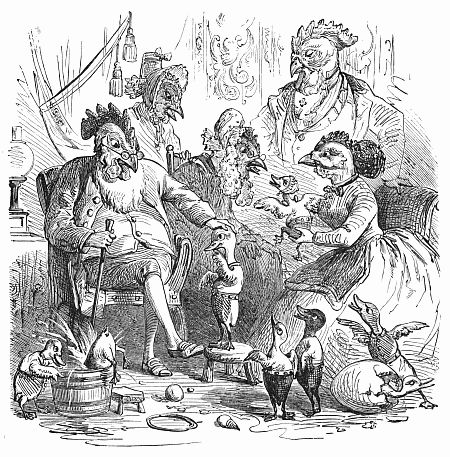
Doctor Peppercorn came in, and put on a monstrous pair of spectacles, and said, "Hum! Ha! Extraordinary case,—very singular!"
"Did you ever see anything like it, Doctor?" said both parents, in a breath.
"I've read of such cases. It's a calcareous enlargement of the vascular bony tissue, threatening ossification," said the Doctor.
"O, dreadful!—can it be possible?" shrieked both parents. "Can anything be done?"
"Well, I should recommend a daily lotion made of mosquitoes' horns and bicarbonate of frogs' toes, together with a powder, to be taken morning and night, of muriate of fleas. One thing you must be careful about: they must never wet their feet, nor drink any water."
"Dear me, Doctor, I don't know what I shall do, for they seem to have a particular fancy for getting into water."
"Yes, a morbid tendency often found in these cases of bony tumification of the vascular tissue of the mouth; but you must resist it, ma'am, as their life depends upon it." And with that Doctor Peppercorn glared gloomily on the young ducks, who were stealthily poking the objectionable little spoon-bills out from under their mother's feathers.
After this poor Mrs. Feathertop led a weary life of it; for the young fry were as healthy and enterprising a brood of young ducks as ever carried saucepans on the end of their noses, and they most utterly set themselves against the doctor's prescriptions, murmured at the muriate of fleas and the bicarbonate of frogs' toes, and took every opportunity to waddle their little ways down to the mud and water which was in their near vicinity. So their bills grew larger and larger, as did the rest of their bodies, and family government grew weaker and weaker.
"You'll wear me out, children, you certainly will," said poor Mrs. Feathertop.
"You'll go to destruction,—do ye hear?" said Master Gray Cock.
"Did you ever see such frights as poor Mrs. Feathertop has got?" said Dame Scratchard. "I knew what would come of her family,—all deformed, and with a dreadful sort of madness, which makes them love to shovel mud with those shocking spoon-bills of theirs."
"It's a kind of idiocy," said Goody Kertarkut. "Poor things! they can't be kept from the water, nor made to take powders, and so they get worse and worse."
"I understand it's affecting their feet so that they can't walk, and a dreadful sort of net is growing between their toes; what a shocking visitation!"
"She brought it on herself," said Dame Scratchard. "Why didn't she come to me before she set? She was always an upstart, self-conceited thing, but I'm sure I pity her."
Meanwhile the young ducks throve apace. Their necks grew glossy like changeable green and gold satin, and though they would not take the doctor's medicine, and would waddle in the mud and water,—for which they always felt themselves to be very naughty ducks,—yet they grew quite vigorous and hearty. At last one day the whole little tribe waddled off down to the bank of the river. It was a beautiful day, and the river was dancing and dimpling and winking as the little breezes shook the trees that hung over it.
"Well," said the biggest of the little ducks, "in spite of Doctor Peppercorn, I can't help longing for the water. I don't believe it is going to hurt me,—at any rate, here goes." And in he plumped, and in went every duck after him, and they threw out their great brown feet as cleverly as if they had taken rowing lessons all their lives, and sailed off on the river, away, away, among the ferns, under the pink azalias, through reeds and rushes, and arrow-heads and pickerel-weed, the happiest ducks that ever were born; and soon they were quite out of sight.
"Well, Mrs. Feathertop, this is a dispensation," said Mrs. Scratchard. "Your children are all drowned at last, just as I knew they'd be. The old music-teacher, Master Bullfrog, that lives down in Water-Dock Lane, saw 'em all plump madly into the water together this morning; that's what comes of not knowing how to bring up a family."
Mrs. Feathertop gave only one shriek and fainted dead away, and was carried home on a cabbage-leaf, and Mr. Gray Cock was sent for, where he was waiting on Mrs. Red Comb through the squash-vines.
"It's a serious time in your family, sir," said Goody Kertarkut, "and you ought to be at home supporting your wife. Send for Doctor Peppercorn without delay."
Now as the case was a very dreadful one, Doctor Peppercorn called a council from the barn-yard of the Squire, two miles off, and a brisk young Doctor Partlett appeared, in a fine suit of brown and gold, with tail-feathers like meteors. A fine young fellow he was, lately from Paris, with all the modern scientific improvements fresh in his head.
When he had listened to the whole story, he clapped his spur into the ground, and, leaning back, laughed so loud that all the cocks in the neighborhood crowed.
Mrs. Feathertop rose up out of her swoon, and Mr. Gray Cock was greatly enraged.
"What do you mean, sir, by such behavior in the house of mourning?"
"My dear sir, pardon me,—but there is no occasion for mourning. My dear madam, let me congratulate you. There is no harm done. The simple matter is, dear madam, you have been under a hallucination all along. The neighborhood and my learned friend the doctor have all made a mistake in thinking that these children of yours were hens at all. They are ducks, ma'am, evidently ducks, and very finely formed ducks, I dare say."
At this moment a quack was heard, and at a distance the whole tribe were seen coming waddling home, their feathers gleaming in green and gold, and they themselves in high good spirits.
"Such a splendid day as we have had!" they all cried in a breath. "And we know now how to get our own living; we can take care of ourselves in future, so you need have no further trouble with us."
"Madam," said the Doctor, making a bow with an air which displayed his tail-feathers to advantage, "let me congratulate you on the charming family you have raised. A finer brood of young healthy ducks I never saw. Give claw, my dear friend," he said, addressing the elder son. "In our barn-yard no family is more respected than that of the ducks."
And so Madam Feathertop came off glorious at last; and when after this the ducks used to go swimming up and down the river like so many nabobs among the admiring hens, Doctor Peppercorn used to look after them and say, "Ah! I had the care of their infancy!" and Mr. Gray Cock and his wife used to say, "It was our system of education did that!"
Harriet Beecher Stowe.
BLUNDER.
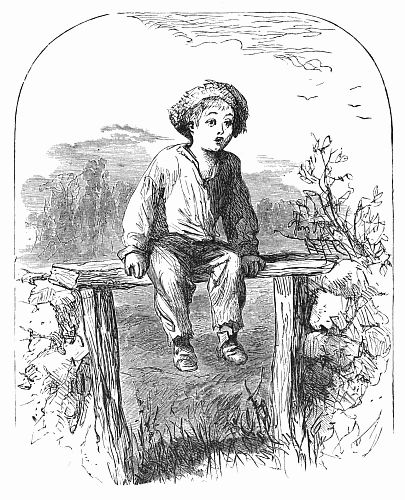
Blunder was going to the Wishing-Gate, to wish for a pair of Shetland ponies, and a little coach, like Tom Thumb's. And of course you can have your wish, if you once get there. But the thing is, to find it; for it is not, as you imagine, a great gate, with a tall marble pillar on each side, and a sign over the top, like this, WISHING-GATE,—but just an old stile, made of three sticks. Put up two fingers, cross them on the top with another finger, and you have it exactly,—the way it looks, I mean,—a worm-eaten stile, in a meadow; and as there are plenty of old stiles in meadows, how are you to know which is the one?
Blunder's fairy godmother knew, but then she could not tell him, for that was not according to fairy rules and regulations. She could only direct him to follow the road, and ask the way of the first owl he met; and over and over she charged him, for Blunder was a very careless little boy, and seldom found anything, "Be sure you don't miss him,—be sure you don't pass him by." And so far Blunder had come on very well, for the road was straight; but at the turn it forked. Should he go through the wood, or turn to the right? There was an owl nodding in a tall oak-tree, the first owl Blunder had seen; but he was a little afraid to wake him up, for Blunder's fairy godmother had told him that this was a great philosopher, who sat up all night to study the habits of frogs and mice, and knew everything but what went on in the daylight, under his nose; and he could think of nothing better to say to this great philosopher than "Good Mr. Owl, will you please show me the way to the Wishing-Gate?"
"Eh! what's that?" cried the owl, starting out of his nap. "Have you brought me a frog?"
"No," said Blunder, "I did not know that you would like one. Can you tell me the way to the Wishing-Gate?"
"Wishing-Gate! Wishing-Gate!" hooted the owl, very angry. "Winks and naps! how dare you disturb me for such a thing as that? Do you take me for a mile-stone! Follow your nose, sir, follow your nose!"—and, ruffling up his feathers, the owl was asleep again in a moment.
But how could Blunder follow his nose? His nose would turn to the right, or take him through the woods, whichever way his legs went, and "what was the use of asking the owl," thought Blunder, "if this was all?" While he hesitated, a chipmunk came skurrying down the path, and, seeing Blunder, stopped short with a little squeak.
"Good Mrs. Chipmunk," said Blunder, "can you tell me the way to the Wishing-Gate?"
"I can't, indeed," answered the chipmunk, politely. "What with getting in nuts, and the care of a young family, I have so little time to visit anything! But if you will follow the brook, you will find an old water-sprite under a slanting stone, over which the water pours all day with a noise like wabble! wabble! who, I have no doubt, can tell you all about it. You will know him, for he does nothing but grumble about the good old times when a brook would have dried up before it would have turned a mill-wheel."
So Blunder went on up the brook, and, seeing nothing of the water-sprite, or the slanting stone, was just saying to himself, "I am sure I don't know where he is,—I can't find it," when he spied a frog sitting on a wet stone.
"Mr. Frog," asked Blunder, "can you tell me the way to the Wishing-Gate?"
"I cannot," said the frog. "I am very sorry, but the fact is, I am an artist. Young as I am, my voice is already remarked at our concerts, and I devote myself so entirely to my profession of music, that I have no time to acquire general information. But in a pine-tree beyond, you will find an old crow, who, I am quite sure, can show you the way, as he is a traveller, and a bird of an inquiring turn of mind."
"I don't know where the pine is,—I am sure I can never find him," answered Blunder, discontentedly; but still he went on up the brook, till, hot and tired, and out of patience at seeing neither crow nor pine, he sat down under a great tree to rest. There he heard tiny voices squabbling.
"Get out! Go away, I tell you! It has been knock! knock! knock! at my door all day, till I am tired out. First a wasp, and then a bee, and then another wasp, and then another bee, and now you. Go away! I won't let another one in to-day."
"But I want my honey."
"And I want my nap."
"I will come in."
"You shall not."
"You are a miserly old elf."
"And you are a brute of a bee."
And looking about him, Blunder spied a bee, quarrelling with a morning-glory elf, who was shutting up the morning-glory in his face.
"Elf, do you know which is the way to the Wishing-Gate?" asked Blunder.
"No," said the elf, "I don't know anything about geography. I was always too delicate to study. But if you will keep on in this path, you will meet the Dream-man, coming down from fairyland, with his bags of dreams on his shoulder; and if anybody can tell you about the Wishing-Gate, he can."
"But how can I find him?" asked Blunder, more and more impatient.
"I don't know, I am sure," answered the elf, "unless you should look for him."
So there was no help for it but to go on; and presently Blunder passed the Dream-man, asleep under a witch-hazel, with his bags of good and bad dreams laid over him to keep him from fluttering away. But Blunder had a habit of not using his eyes; for at home, when told to find anything, he always said, "I don't know where it is," or, "I can't find it," and then his mother or sister went straight and found it for him. So he passed the Dream-man without seeing him, and went on till he stumbled on Jack-o'-Lantern.
"Can you show me the way to the Wishing-Gate?" said Blunder.
"Certainly, with pleasure," answered Jack, and, catching up his lantern, set out at once.
Blunder followed close, but, in watching the lantern, he forgot to look to his feet, and fell into a hole filled with black mud.
"I say! the Wishing-Gate is not down there," called out Jack, whisking off among the tree-tops.
"But I can't come up there," whimpered Blunder.
"That is not my fault, then," answered Jack, merrily, dancing out of sight.
O, a very angry little boy was Blunder, when he clambered out of the hole. "I don't know where it is," he said, crying; "I can't find it, and I'll go straight home."
Just then he stepped on an old, moss-grown, rotten stump; and it happening, unluckily, that this rotten stump was a wood-goblin's chimney, Blunder fell through, headlong, in among the pots and pans, in which the goblin's cook was cooking the goblin's supper. The old goblin, who was asleep up stairs, started up in a fright at the tremendous clash and clatter, and, finding that his house was not tumbling about his ears, as he thought at first, stumped down to the kitchen to see what was the matter. The cook heard him coming, and looked about her in a fright to hide Blunder.
"Quick!" cried she. "If my master catches you, he will have you in a pie. In the next room stands a pair of shoes. Jump into them, and they will take you up the chimney."
Off flew Blunder, burst open the door, and tore frantically about the room, in one corner of which stood the shoes; but of course he could not see them, because he was not in the habit of using his eyes. "I can't find them! O, I can't find them!" sobbed poor little Blunder, running back to the cook.
"Run into the closet," said the cook.
Blunder made a dash at the window, but—"I don't know where it is," he called out.
Clump! clump! That was the goblin, half-way down the stairs.
"Goodness gracious mercy me!" exclaimed cook. "He is coming. The boy will be eaten in spite of me. Jump into the meal-chest."
"I don't see it," squeaked Blunder, rushing towards the fireplace. "Where is it?"
Clump! clump! That was the goblin at the foot of the stairs, and coming towards the kitchen door.
"There is an invisible cloak hanging on that peg. Get into that," cried cook, quite beside herself.
But Blunder could no more see the cloak than he could see the shoes, the closet, and the meal-chest; and no doubt the goblin, whose hand was on the latch, would have found him prancing around the kitchen, and crying out, "I can't find it," but, fortunately for himself, Blunder caught his foot in the invisible cloak, and tumbled down, pulling the cloak over him. There he lay, hardly daring to breathe.
"What was all that noise about?" asked the goblin, gruffly, coming into the kitchen.
"Only my pans, master," answered the cook; and as he could see nothing amiss, the old goblin went grumbling up stairs again, while the shoes took Blunder up chimney, and landed him in a meadow, safe enough, but so miserable! He was cross, he was disappointed, he was hungry. It was dark, he did not know the way home, and, seeing an old stile, he climbed up, and sat down on the top of it, for he was too tired to stir. Just then came along the South Wind, with his pockets crammed full of showers, and, as he happened to be going Blunder's way, he took Blunder home; of which the boy was glad enough, only he would have liked it better if the Wind would not have laughed all the way. For what would you think, if you were walking along a road with a fat old gentleman, who went chuckling to himself, and slapping his knees, and poking himself, till he was purple in the face, when he would burst out in a great windy roar of laughter every other minute?
"What are you laughing at?" asked Blunder, at last.
"At two things that I saw in my travels," answered the Wind;—"a hen, that died of starvation, sitting on an empty peck-measure that stood in front of a bushel of grain; and a little boy who sat on the top of the Wishing-Gate, and came home because he could not find it."
"What? what's that?" cried Blunder; but just then he found himself at home. There sat his fairy godmother by the fire, her mouse-skin cloak hung up on a peg, and toeing off a spider's-silk stocking an eighth of an inch long; and though everybody else cried, "What luck?" and, "Where is the Wishing-Gate?" she sat mum.
"I don't know where it is," answered Blunder. "I couldn't find it";—and thereon told the story of his troubles.
"Poor boy!" said his mother, kissing him, while his sister ran to bring him some bread and milk.
"Yes, that is all very fine," cried his godmother, pulling out her needles, and rolling up her ball of silk; "but now hear my story. There was once a little boy who must needs go to the Wishing-Gate, and his fairy godmother showed him the road as far as the turn, and told him to ask the first owl he met what to do then; but this little boy seldom used his eyes, so he passed the first owl, and waked up the wrong owl; so he passed the water-sprite, and found only a frog; so he sat down under the pine-tree, and never saw the crow; so he passed the Dream-man, and ran after Jack-o'-Lantern; so he tumbled down the goblin's chimney, and couldn't find the shoes and the closet and the chest and the cloak; and so he sat on the top of the Wishing-Gate till the South Wind brought him home, and never knew it. Ugh! Bah!" And away went the fairy godmother up the chimney, in such deep disgust that she did not even stop for her mouse-skin cloak.
Louise E. Chollet.
STAR-DOLLARS.
Once upon a time there was a little girl whose father and mother were dead; and she became so poor that she had no roof to shelter herself under, and no bed to sleep in; and at last she had nothing left but the clothes on her back, and a loaf of bread in her hand, which a compassionate person had given to her.
But she was a good and pious little girl, and when she found herself forsaken by all the world, she went out into the fields, trusting in God.
Soon she met a poor man, who said to her, "Give me something to eat, for I am so hungry!" She handed him the whole loaf, and with a "God bless you!" walked on farther.
Next she met a little girl crying very much, who said to her, "Pray give me something to cover my head with, for it is so cold!" So she took off her own bonnet, and gave it away.
And in a little while she met another child who had no cloak, and to her she gave her own cloak! Then she met another who had no dress on, and to this one she gave her own frock.
By that time it was growing dark, and our little girl entered a forest; and presently she met a fourth maiden, who begged something, and to her she gave her petticoat. "For," thought our heroine, "it is growing dark, and nobody will see me; I can give away this."
And now she had scarcely anything left to cover herself. But just then some of the stars fell down in the form of silver dollars, and among them she found a petticoat of the finest linen! And in that she collected the star-money, which made her rich all the rest of her lifetime.
Grimm's Household Tales.
THE IMMORTAL FOUNTAIN.
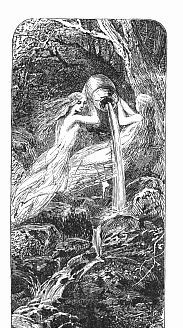
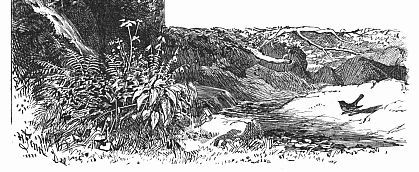
In ancient times two little princesses lived in Scotland, one of whom was extremely beautiful, and the other dwarfish, dark colored, and deformed. One was named Rose, and the other Marion. The sisters did not live happily together. Marion hated Rose because she was handsome and everybody praised her. She scowled, and her face absolutely grew black, when anybody asked her how her pretty little sister Rose did; and once she was so wicked as to cut off all her glossy golden hair, and throw it in the fire. Poor Rose cried bitterly about it, but she did not scold, or strike her sister; for she was an amiable, gentle little being as ever lived. No wonder all the family and all the neighbors disliked Marion, and no wonder her face grew uglier and uglier every day. The Scotch used to be a very superstitious people; and they believed the infant Rose had been blessed by the Fairies, to whom she owed her extraordinary beauty and exceeding goodness.
Not far from the castle where the princesses resided was a deep grotto, said to lead to the Palace of Beauty, where the queen of the Fairies held her court. Some said Rose had fallen asleep there one day, when she had grown tired of chasing a butterfly, and that the queen had dipped her in an immortal fountain, from which she had risen with the beauty of an angel.[A] Marion often asked questions about this story; but Rose always replied that she had been forbidden to speak of it. When she saw any uncommonly brilliant bird or butterfly, she would sometimes exclaim, "O, how much that looks like Fairy Land!" But when asked what she knew about Fairy Land she blushed, and would not answer.
Marion thought a great deal about this. "Why cannot I go to the Palace of Beauty?" thought she; "and why may not I bathe in the Immortal Fountain?"
One summer's noon, when all was still save the faint twittering of the birds and the lazy hum of the insects, Marion entered the deep grotto. She sat down on a bank of moss; the air around her was as fragrant as if it came from a bed of violets; and with the sound of far-off music dying on her ear, she fell into a gentle slumber. When she awoke, it was evening; and she found herself in a small hall, where opal pillars supported a rainbow roof, the bright reflection of which rested on crystal walls, and a golden floor inlaid with pearls. All around, between the opal pillars, stood the tiniest vases of pure alabaster, in which grew a multitude of brilliant and fragrant flowers; some of them, twining around the pillars, were lost in the floating rainbow above. The whole of this scene of beauty was lighted by millions of fire-flies, glittering about like wandering stars. While Marion was wondering at all this, a little figure of rare loveliness stood before her. Her robe was of green and gold; her flowing gossamer mantle was caught upon one shoulder with a pearl, and in her hair was a solitary star, composed of five diamonds, each no bigger than a pin's point, and thus she sung:—
The Fairy Queen Hath rarely seen Creature of earthly mould Within her door, On pearly floor, Inlaid with shining gold. Mortal, all thou seest is fair; Quick thy purposes declare!
As she concluded, the song was taken up, and thrice repeated by a multitude of soft voices in the distance. It seemed as if birds and insects joined in the chorus,—the clear voice of the thrush was distinctly heard; the cricket kept time with his tiny cymbal; and ever and anon, between the pauses, the sound of a distant cascade was heard, whose waters fell in music.
All these delightful sounds died away, and the Queen of the Fairies stood patiently awaiting Marion's answer. Courtesying low, and with a trembling voice, the little maiden said,—
"Will it please your Majesty to make me as handsome as my sister Rose."
The queen smiled. "I will grant your request," said she, "if you will promise to fulfil all the conditions I propose."
Marion eagerly promised that she would.
"The Immortal Fountain," replied the queen, "is on the top of a high, steep hill; at four different places Fairies are stationed around it, who guard it with their wands. None can pass them except those who obey my orders. Go home now: for one week speak no ungentle word to your sister; at the end of that time come again to the grotto."
Marion went home light of heart. Rose was in the garden, watering the flowers; and the first thing Marion observed was that her sister's sunny hair had suddenly grown as long and beautiful as it had ever been. The sight made her angry; and she was just about to snatch the water-pot from her hand with an angry expression, when she remembered the Fairy, and passed into the castle in silence.
The end of the week arrived, and Marion had faithfully kept her promise. Again she went to the grotto. The queen was feasting when she entered the hall. The bees brought honeycomb and deposited it on the small rose-colored shells which adorned the crystal table; gaudy butterflies floated about the head of the queen, and fanned her with their wings; the cucullo, and the lantern-fly stood at her side to afford her light; a large diamond beetle formed her splendid footstool, and when she had supped, a dew-drop, on the petal of a violet, was brought for her royal fingers.
When Marion entered, the diamond sparkles on the wings of the Fairies faded, as they always did in the presence of anything not perfectly good; and in a few moments all the queen's attendants vanished, singing as they went:—
The Fairy Queen Hath rarely seen Creature of earthly mould Within her door, On pearly floor, Inlaid with shining gold.
"Mortal, hast thou fulfilled thy promise?" asked the queen.
"I have," replied the maiden.
"Then follow me."
Marion did as she was directed, and away they went over beds of violets and mignonette. The birds warbled above their heads, butterflies cooled the air, and the gurgling of many fountains came with a refreshing sound. Presently they came to the hill, on the top of which was the Immortal Fountain. Its foot was surrounded by a band of Fairies, clothed in green gossamer, with their ivory wands crossed, to bar the ascent. The queen waved her wand over them, and immediately they stretched their thin wings and flew away. The hill was steep, and far, far up they went; and the air became more and more fragrant, and more and more distinctly they heard the sound of waters falling in music. At length they were stopped by a band of Fairies clothed in blue, with their silver wands crossed.
"Here," said the queen, "our journey must end. You can go no farther until you have fulfilled the orders I shall give you. Go home now; for one month do by your sister in all respects as you would wish her to do by you, were you Rose and she Marion."
Marion promised, and departed. She found the task harder than the first had been. She could not help speaking; but when Rose asked her for any of her playthings, she found it difficult to give them gently and affectionately, instead of pushing them along. When Rose talked to her, she wanted to go away in silence; and when a pocket-mirror was found in her sister's room, broken into a thousand pieces, she felt sorely tempted to conceal that she did the mischief. But she was so anxious to be made beautiful, that she did as she would be done by.
All the household remarked how Marion had changed. "I love her dearly," said Rose, "she is so good and amiable."
"So do I," said a dozen voices.
Marion blushed deeply, and her eyes sparkled with pleasure. "How pleasant it is to be loved!" thought she.
At the end of the month, she went to the grotto. The Fairies in blue lowered their silver wands and flew away. They travelled on; the path grew steeper and steeper; but the fragrance of the atmosphere was redoubled, and more distinctly came the sound of the waters falling in music. Their course was stayed by a troop of Fairies in rainbow robes, and silver wands tipped with gold. In face and form they were far more beautiful than anything Marion had yet seen.
"Here we must pause," said the queen; "this boundary you cannot yet pass."
"Why not?" asked the impatient Marion.
"Because those must be very pure who pass the rainbow Fairies," replied the queen.
"Am I not very pure?" said the maiden; "all the folks in the castle tell me how good I have grown."
"Mortal eyes see only the outside," answered the queen, "but those who pass the rainbow Fairies must be pure in thought, as well as in action. Return home; for three months never indulge an envious or wicked thought. You shall then have a sight of the Immortal Fountain." Marion was sad at heart; for she knew how many envious thoughts and wrong wishes she had suffered to gain power over her.
At the end of three months, she again visited the Palace of Beauty. The queen did not smile when she saw her; but in silence led the way to the Immortal Fountain. The green Fairies and the blue Fairies flew away as they approached; but the rainbow Fairies bowed low to the queen, and kept their gold-tipped wands firmly crossed. Marion saw that the silver specks on their wings grew dim; and she burst into tears. "I knew," said the queen, "that you could not pass this boundary. Envy has been in your heart, and you have not driven it away. Your sister has been ill, and in your heart you wished that she might die, or rise from the bed of sickness deprived of her beauty. Be not discouraged; you have been several years indulging in wrong feelings, and you must not wonder that it takes many months to drive them away."
Marion was very sad as she wended her way homeward. When Rose asked her what was the matter, she told her she wanted to be very good, but she could not. "When I want to be good, I read my Bible and pray," said Rose; "and I find God helps me to be good." Then Marion prayed that God would help her to be pure in thought; and when wicked feelings rose in her heart, she read her Bible, and they went away.
When she again visited the Palace of Beauty, the queen smiled, and touched her playfully with the wand, then led her away to the Immortal Fountain. The silver specks on the wings of the rainbow Fairies shone bright as she approached them, and they lowered their wands, and sung, as they flew away:—
Mortal, pass on, Till the goal is won,— For such, I ween, Is the will of the queen,— Pass on! pass on!
And now every footstep was on flowers, that yielded beneath their feet, as if their pathway had been upon a cloud. The delicious fragrance could almost be felt, yet it did not oppress the senses with its heaviness; and loud, clear, and liquid came the sound of the waters as they fell in music. And now the cascade is seen leaping and sparkling over crystal rocks; a rainbow arch rests above it, like a perpetual halo; the spray falls in pearls, and forms fantastic foliage about the margin of the Fountain. It has touched the webs woven among the grass, and they have become pearl-embroidered cloaks for the Fairy queen. Deep and silent, below the foam, is the Immortal Fountain! Its amber-colored waves flow over a golden bed; and as the Fairies bathe in it, the diamonds on their hair glance like sunbeams on the waters.
"O, let me bathe in the fountain!" cried Marion, clasping her hands in delight. "Not yet," said the queen. "Behold the purple Fairies with golden wands that guard its brink!" Marion looked, and saw beings lovelier than any her eye had ever rested on. "You cannot pass them yet," said the queen. "Go home; for one year drive away all evil feelings, not for the sake of bathing in this Fountain, but because goodness is lovely and desirable for its own sake. Purify the inward motive, and your work is done."
This was the hardest task of all. For she had been willing to be good, not because it was right to be good, but because she wished to be beautiful. Three times she sought the grotto, and three times she left in tears; for the golden specks grew dim at her approach, and the golden wands were still crossed, to shut her from the Immortal Fountain. The fourth time she prevailed. The purple Fairies lowered their wands, singing,—
Thou hast scaled the mountain, Go, bathe in the Fountain; Rise fair to the sight As an angel of light; Go, bathe in the Fountain!
Marion was about to plunge in, but the queen touched her, saying, "Look in the mirror of the waters. Art thou not already as beautiful as heart can wish?"
Marion looked at herself, and saw that her eye sparkled with new lustre, that a bright color shone through her cheeks, and dimples played sweetly about her mouth. "I have not touched the Immortal Fountain," said she, turning in surprise to the queen. "True," replied the queen, "but its waters have been within your soul. Know that a pure heart and a clear conscience are the only immortal fountains of beauty."
When Marion returned, Rose clasped her to her bosom, and kissed her fervently. "I know all," said she, "though I have not asked you a question. I have been in Fairy Land, disguised as a bird, and I have watched all your steps. When you first went to the grotto, I begged the queen to grant your wish."
Ever after that the sisters lived lovingly together. It was the remark of every one, "How handsome Marion has grown! The ugly scowl has departed from her face; and the light of her eye is so mild and pleasant, and her mouth looks so smiling and good-natured, that to my taste, I declare, she is as handsome as Rose."
L. Maria Child.
THE BIRD'S-NEST IN THE MOON.
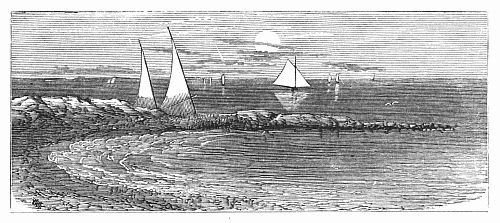
I love to go to the Moon. I never shake off sublunary cares and sorrows so completely as when I am fairly landed on that beautiful island.[A] A man in the Moon may see Castle Island, the city of Boston, the ships in the harbor, the silver waters of our little archipelago, all lying, as it were, at his feet. There you may be at once social and solitary,—social, because you see the busy world before you; and solitary because there is not a single creature on the island, except a few feeding cows, to disturb your repose.
I was there last summer, and was surveying the scene with my usual emotions, when my attention was attracted by the whirring wings of a little sparrow, that, in walking, I had frightened from her nest.
This bird, as is well known, always builds its nest on the ground. I have seen one, often, in the middle of a cornhill, curiously placed in the centre of the five green stalks, so that it was difficult, at hoeing time, to dress the hill without burying the nest.
This sparrow had built hers beneath a little tuft of grass more rich and thickset than the rest of the herbage around it. I cast a careless glance at the nest, saw the soft down that lined it, the four little speckled eggs which enclosed the parents' hope. I marked the multitude of cows that were feeding around it, one tread of whose cloven feet would crush both bird and progeny into ruin.
I could not but reflect on the dangerous condition to which the creature had committed her most tender hopes. A cow is seeking a bite of grass; she steps aside to gratify that appetite; she treads on the nest, and destroys the offspring of the defenceless bird.
As I came away from the island, I reflected that this bird's situation, in her humble, defenceless nest, might be no unapt emblem of man in this precarious world. What are diseases, in their countless forms, accidents by flood and fire, the seductions of temptation, and even some human beings themselves, but so many huge cows feeding around our nest, and ready, every moment, to crush our dearest hopes, with the most careless indifference, beneath their brutal tread?
Sometimes, as we sit at home, we can see the calamity coming at a distance. We hear the breathing of the monster; we mark its great wavering path, now looking towards us in a direct line, now capriciously turning for a moment aside. We see the swing of its dreadful horns, the savage rapacity of its brutal appetite; we behold it approaching nearer and nearer, and it passes within a hairbreadth of our ruin, leaving us to the sad reflection that another and another are still behind.
Poor bird! Our situations are exactly alike.
The other evening I walked into the chamber where my children were sleeping. There was Willie, with the clothes half kicked down, his hands thrown carelessly over his head, tired with play, now resting in repose; there was Jamie with his balmy breath and rosy cheeks, sleeping and looking like innocence itself. There was Bessie, who has just begun to prattle, and runs daily with tottering steps and lisping voice to ask her father to toss her into the air.
As I looked upon these sleeping innocents, I could not but regard them as so many little birds which I must fold under my wing, and protect, if possible, in security in my nest.
But when I thought of the huge cows that were feeding around them, the ugly hoofs that might crush them into ruin, in short, when I remembered the bird's-nest in the Moon, I trembled and wept.
But why weep? Is there not a special providence in the fall of a sparrow?
It is very possible that the nest which I saw was not in so dangerous a situation as it appeared to be. Perhaps some providential instinct led the bird to build her fragile house in the ranker grass, which the kine never bite, and, of course, on which they would not be likely to tread. Perhaps some kind impulse may guide that species so as not to tread even on a bird's-nest.
There is a merciful God, whose care and protection extend over all his works, who takes care of the sparrow's children and of mine. The very hairs of our head are all numbered.
New England Magazine.
DREAM-CHILDREN: A REVERY.
Children love to listen to stories about their elders when they were children; to stretch their imagination to the conception of a traditionary great-uncle or grandame, whom they never saw. It was in this spirit that my little ones crept about me the other evening to hear about their great-grandmother Field, who lived in a great house in Norfolk (a hundred times bigger than that in which they and papa lived) which had been the scene—so, at least, it was generally believed in that part of the country—of the tragic incidents which they had lately become familiar with from the ballad of the Children in the Wood. Certain it is that the whole story of the children and their cruel uncle was to be seen fairly carved out in wood upon the chimney-piece of the great hall, the whole story down to the Robin Redbreasts! till a foolish rich person pulled it down to set up a marble one of modern invention in its stead, with no story upon it.—Here Alice put out one of her dear mother's looks, too tender to be called upbraiding.
Then I went on to say how religious and how good their great-grandmother Field was, how beloved and respected by everybody, though she was not indeed the mistress of this great house, but had only the charge of it (and yet, in some respects, she might be said to be the mistress of it too), committed to her by the owner, who preferred living in a newer and more fashionable mansion which he had purchased somewhere in the adjoining county; but still she lived in it in a manner as if it had been her own, and kept up the dignity of the great house in a sort while she lived, which afterwards came to decay, and was nearly pulled down, and all its old ornaments stripped and carried away to the owner's other house, where they were set up, and looked as awkward as if some one were to carry away the old tombs they had seen lately at the Abbey, and stick them up in Lady C.'s tawdry gilt drawing-room.
Here John smiled, as much as to say, "That would be foolish indeed." And then I told how, when she came to die, her funeral was attended by a concourse of all the poor, and some of the gentry, too, of the neighborhood for many miles round, to show their respect for her memory, because she had been such a good and religious woman; so good, indeed, that she knew all the Psaltery by heart, ay, and a great part of the Testament besides.—Here little Alice spread her hands.
Then I told what a tall, upright, graceful person their great-grandmother Field once was; and how in her youth she was esteemed the best dancer,—here Alice's little right foot played an involuntary movement, till, upon my looking grave, it desisted,—the best dancer, I was saying, in the county, till a cruel disease, called a cancer, came, and bowed her down with pain; but it could never bend her good spirits, or make them stoop, but they were still upright, because she was so good and religious.
Then I told how she was used to sleep by herself in a lone chamber of the great lone house; and how she believed that an apparition of two infants was to be seen at midnight gliding up and down the great staircase near where she slept, but she said "those innocents would do her no harm"; and how frightened I used to be, though in those days I had my maid to sleep with me, because I was never half so good or religious as she,—and yet I never saw the infants.—Here John expanded all his eyebrows and tried to look courageous.
Then I told how good she was to all her grandchildren, having us to the great house in the holidays, where I in particular used to spend many hours by myself, in gazing upon the old busts of the twelve Cæsars, that had been Emperors of Rome, till the old marble heads would seem to live again, or I to be turned into marble with them; how I never could be tired with roaming about that huge mansion, with its vast empty rooms, with their worn-out hangings, fluttering tapestry, and carved oaken panels, with the gilding almost rubbed out,—sometimes in the spacious old-fashioned gardens, which I had almost to myself, unless when now and then a solitary gardening man would cross me,—and how the nectarines and peaches hung upon the walls, without my ever offering to pluck them, because they were forbidden fruit, unless now and then,—and because I had more pleasure in strolling about among the old melancholy-looking yew-trees, or the firs, and picking up the red berries, and the fir-apples, which were good for nothing but to look at,—or in lying about upon the fresh grass with all the fine garden smells around me,—or basking in the orangery, till I could almost fancy myself ripening too, along with the oranges and the limes in that grateful warmth,—or in watching the dace that darted to and fro in the fish-pond, at the bottom of the garden, with here and there a great sulky pike hanging midway down the water in silent state, as if it mocked at their impertinent friskings; I had more pleasure in these busy-idle diversions than in all the sweet flavors of peaches, nectarines, oranges, and such-like common baits of children.—Here John slyly deposited back upon the plate a bunch of grapes, which, not unobserved by Alice, he had meditated dividing with her, and both seemed willing to relinquish them for the present as irrelevant.
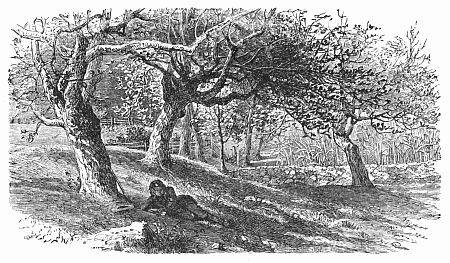
Then, in a somewhat more heightened tone, I told how, though their great-grandmother Field loved all her grandchildren, yet in an especial manner she might be said to love their uncle, John L——, because he was so handsome and spirited a youth, and a king to the rest of us; and instead of moping about in solitary corners, like some of us, he would mount the most mettlesome horse he could get, when but an imp no bigger than themselves, and make it carry him half over the county in a morning, and join the hunters when there were any out; and yet he loved the old great house and gardens too, but had too much spirit to be always pent up within their boundaries; and how their uncle grew up to man's estate as brave as he was handsome, to the admiration of everybody, but of their great-grandmother Field most especially; and how he used to carry me upon his back, when I was a lame-footed boy,—for he was a good bit older than me,—many a mile, when I could not walk for pain; and how in after life he became lame-footed too, and I did not always (I fear) make allowances enough for him when he was impatient and in pain, nor remember sufficiently how considerate he had been to me when I was lame-footed; and how when he died, though he had not been dead an hour, it seemed as if he had died a great while ago, such a distance there is betwixt life and death; and how I bore his death, as I thought, pretty well at first, but afterwards it haunted and haunted me; and though I did not cry or take it to heart as some do, and as I think he would have done if I had died, yet I missed him all day long, and knew not till then how much I had loved him. I missed his kindness, and I missed his crossness, and wished him to be alive again, to be quarrelling with him (for we quarrelled sometimes), rather than not have him again, and was as uneasy without him as he their poor uncle must have been when the doctor took off his limb.
Here the children fell a-crying, and asked if their little mourning which they had on was not for their Uncle John; and they looked up, and prayed me not to go on about their uncle, but to tell them some stories about their pretty dead mother.
Then I told how, for seven long years, in hope sometimes, sometimes in despair, yet persisting ever, I courted the fair Alice W——n; and, as much as children could understand, I explained to them what coyness, and difficulty, and denial meant in maidens,—when suddenly, turning to Alice, the soul of the first Alice looked out at her eyes with such a reality of representment that I became in doubt which of them stood there before me, or whose that bright hair was; and while I stood gazing, both the children gradually grew fainter to my view, receding, and still receding, till nothing at last but two mournful features were seen in the uttermost distance, which, without speech, strangely impressed upon me the effects of speech: "We are not of Alice, nor of thee, nor are we children at all. The children of Alice call Bartrum father. We are nothing; less than nothing, and dreams. We are only what might have been, and must wait upon the tedious shores of Lethe millions of ages before we have existence and a name";—and immediately awaking, I found myself quietly seated in my bachelor arm-chair, where I had fallen asleep, with the faithful Bridget unchanged by my side,—but John L—— (or James Elia) was gone forever.
Charles Lamb.
THE UGLY DUCKLING.
It was beautiful in the country; it was summer-time; the wheat was yellow; the oats were green, the hay was stacked up in the green meadows, and the stork paraded about on his long red legs, discoursing in Egyptian, which language he had learned from his mother. The fields and meadows were skirted by thick woods, and a deep lake lay in the midst of the woods. Yes, it was indeed beautiful in the country! The sunshine fell warmly on an old mansion, surrounded by deep canals, and from the walls down to the water's edge there grew large burdock-leaves, so high that children could stand upright among them without being perceived. This place was as wild and unfrequented as the thickest part of the wood, and on that account a duck had chosen to make her nest there. She was sitting on her eggs; but the pleasure she had felt at first was now almost gone, because she had been there so long, and had so few visitors, for the other ducks preferred swimming on the canals to sitting among the burdock-leaves gossiping with her.
At last the eggs cracked, one after another, "Tchick! tchick!" All the eggs were alive, and one little head after another peered forth. "Quack, quack!" said the Duck, and all got up as well as they could; they peeped about from under the green leaves; and as green is good for the eyes, the mother let them look as long as they pleased.
"How large the world is!" said the little ones, for they found their present situation very different from their former confined one, while yet in the egg-shells.
"Do you imagine this to be the whole of the world?" said the mother; "it extends far beyond the other side of the garden to the pastor's field; but I have never been there. Are you all here?" And then she got up. "No, not all, but the largest egg is still here. How long will this last? I am so weary of it!" And then she sat down again.
"Well, and how are you getting on?" asked an old Duck, who had come to pay her a visit.
"This one egg keeps me so long!" said the mother, "it will not break. But you should see the others! they are the prettiest little ducklings I have seen in all my days; they are all like their father,—the good-for-nothing fellow, he has not been to visit me once!"
"Let me see the egg that will not break!" said the old Duck; "depend upon it, it is a turkey's egg. I was cheated in the same way once myself, and I had such trouble with the young ones; for they were afraid of the water, and I could not get them there. I called and scolded, but it was all of no use. But let me see the egg. Ah, yes! to be sure, that is a turkey's egg. Leave it, and teach the other little ones to swim."
"I will sit on it a little longer," said the Duck. "I have been sitting so long that I may as well spend the harvest here."
"It is no business of mine," said the old Duck, and away she waddled.
The great egg burst at last. "Tchick! tchick!" said the little one, and out it tumbled; but O, how large and ugly it was! The Duck looked at it. "That is a great, strong creature," said she; "none of the others are at all like it. Can it be a young turkey-cock? Well, we shall soon find out; it must go into the water, though I push it in myself."
The next day there was delightful weather, and the sun shone warmly upon the green leaves when Mother Duck with all her family went down to the canal; plump she went into the water. "Quack, quack!" cried she, and one duckling after another jumped in. The water closed over their heads, but all came up again, and swam together in the pleasantest manner; their legs moved without effort. All were there, even the ugly, gray one.
"No! it is not a turkey," said the old Duck; "only see how prettily it moves its legs! how upright it hold itself! it is my own child: it is also really very pretty, when one looks more closely at it. Quack! quack! now come with me, I will take you into the world, introduce you in the duck-yard; but keep close to me, or some one may tread on you; and beware of the cat."
So they came into the duck-yard. There was a horrid noise; two families were quarrelling about the remains of an eel, which in the end was secured by the cat.
"See, my children, such is the way of the world," said the Mother Duck, wiping her beak, for she, too, was fond of eels. "Now use your legs," said she; "keep together, and bow to the old duck you see yonder. She is the most distinguished of all the fowls present, and is of Spanish blood, which accounts for her dignified appearance and manners. And look, she has a red rag on her leg! that is considered extremely handsome, and is the greatest distinction a duck can have. Don't turn your feet inwards; a well-educated duckling always keeps his legs far apart, like his father and mother, just so,—look! now bow your necks, and say, 'quack.'"
And they did as they were told. But the other ducks who were in the yard looked at them, and said aloud, "Only see! now we have another brood,—as if there were not enough of us already; and fie! how ugly that one is! we will not endure it." And immediately one of the ducks flew at him, and bit him in the neck.
"Leave him alone," said the mother; "he is doing no one any harm."
"Yes, but he is so large, and so strange-looking, and therefore he shall be teased."
"These are fine children that our good mother has," said the old Duck with the red rag on her leg. "All are pretty except one, and that has not turned out well; I almost wish it could be hatched over again."
"That cannot be, please your highness," said the mother. "Certainly he is not handsome, but he is a very good child, and swims as well as the others, indeed rather better. I think he will grow like the others all in good time, and perhaps will look smaller. He stayed so long in the egg-shell, that is the cause of the difference"; and she scratched the Duckling's neck, and stroked his whole body. "Besides," added she, "he is a drake; I think he will be very strong, therefore it does not matter, so much; he will fight his way through."
"The other ducks are very pretty," said the old Duck. "Pray make yourselves at home, and if you find an eel's head you can bring it to me."
And accordingly they made themselves at home.
But the poor little Duckling who had come last out of its egg-shell, and who was so ugly, was bitten, pecked, and teased by both Ducks and Hens. "It is so large!" said they all. And the Turkey-cock, who had come into the world with spurs on, and therefore fancied he was an emperor, puffed himself up like a ship in full sail, and marched up to the Duckling quite red with passion. The poor little thing scarcely knew what to do; he was quite distressed because he was so ugly, and because he was the jest of the poultry-yard.
So passed the first day, and afterwards matters grew worse and worse; the poor Duckling was scorned by all. Even his brothers and sisters behaved unkindly, and were constantly saying, "The cat fetch thee, thou nasty creature!" The mother said, "Ah, if thou wert only far away!" The Ducks bit him, the Hens pecked him, and the girl who fed the poultry kicked him. He ran over the hedge; the little birds in the bushes were terrified. "That is because I am so ugly," thought the Duckling, shutting his eyes, but he ran on. At last he came to a wide moor, where lived some Wild Ducks; here he lay the whole night, so tired and so comfortless. In the morning the Wild Ducks flew up, and perceived their new companion. "Pray, who are you?" asked they; and our little Duckling turned himself in all directions, and greeted them as politely as possible.
"You are really uncommonly ugly!" said the Wild Ducks; "however, that does not matter to us, provided you do not marry into our families." Poor thing! he had never thought of marrying; he only begged permission to lie among the reeds and drink the water of the moor.
There he lay for two whole days; on the third day there came two Wild Geese, or rather Ganders, who had not been long out of their egg-shells, which accounts for their impertinence.
"Hark ye!" said they, "you are so ugly that we like you infinitely well; will you come with us, and be a bird of passage? On another moor, not far from this, are some dear, sweet Wild Geese, as lovely creatures as have ever said 'hiss, hiss.' You are truly in the way to make your fortune, ugly as you are."
Bang! a gun went off all at once, and both Wild Geese were stretched dead among the reeds; the water became red with blood; bang! a gun went off again; whole flocks of wild geese flew up from among the reeds, and another report followed.
There was a grand hunting party; the hunters lay in ambush all around; some were even sitting in the trees, whose huge branches stretched far over the moor. The blue smoke rose through the thick trees like a mist, and was dispersed as it fell over the water; the hounds splashed about in the mud, the reeds and rushes bent in all directions; how frightened the poor little Duck was! he turned his head, thinking to hide it under his wings, and in a moment a most formidable-looking dog stood close to him, his tongue hanging out of his mouth, his eyes sparkling fearfully. He opened wide his jaws at the sight of our Duckling, showed him his sharp white teeth, and splash, splash! he was gone,—gone without hurting him.
"Well! let me be thankful," sighed he; "I am so ugly that even the dog will not eat me."
And now he lay still, though the shooting continued among the reeds, shot following shot.
The noise did not cease till late in the day, and even then the poor little thing dared not stir; he waited several hours before he looked around him, and then hastened away from the moor as fast as he could; he ran over fields and meadows, though the wind was so high that he had some difficulty in proceeding.
Towards evening he reached a wretched little hut, so wretched that it knew not on which side to fall, and therefore remained standing. The wind blew violently, so that our poor little Duckling was obliged to support himself on his tail, in order to stand against it; but it became worse and worse. He then remarked that the door had lost one of its hinges, and hung so much awry that he could creep through the crevice into the room, which he did.
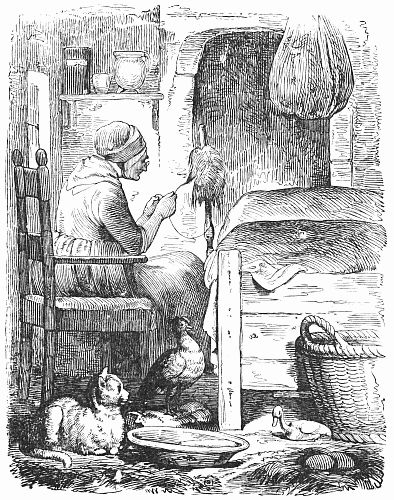
In this room lived an old woman, with her Tom-cat and her Hen; and the Cat, whom she called her little son, knew how to set up his back and purr; indeed, he could even emit sparks when stroked the wrong way. The Hen had very short legs, and was therefore called "Cuckoo Short-legs"; she laid very good eggs, and the old woman loved her as her own child.
The next morning the new guest was perceived. The Cat began to mew and the Hen to cackle.
"What is the matter?" asked the old woman, looking round; however, her eyes were not good, so she took the young Duckling to be a fat Duck who had lost her way. "This is a capital catch," said she; "I shall now have ducks' eggs, if it be not a drake: we must try."
And so the Duckling was put to the proof for three weeks, but no eggs made their appearance.
Now the Cat was the master of the house, and the Hen was the mistress, and they used always to say, "We and the world," for they imagined themselves to be not only the half of the world, but also by far the better half. The Duckling thought it was possible to be of a different opinion, but that the Hen would not allow.
"Can you lay eggs?" asked she.
"No."
"Well, then, hold your tongue."
And the Cat said, "Can you set up your back? can you purr?"
"No."
"Well, then, you should have no opinion when reasonable persons are speaking."
So the Duckling sat alone in a corner, and was in a very bad humor; however, he happened to think of the fresh air and bright sunshine, and these thoughts gave him such a strong desire to swim again, that he could not help telling it to the Hen.
"What ails you?" said the Hen. "You have nothing to do, and therefore brood over these fancies; either lay eggs or purr, then you will forget them."
"But it is so delicious to swim!" said the Duckling; "so delicious when the waters close over your head, and you plunge to the bottom!"
"Well, that is a queer sort of pleasure," said the Hen; "I think you must be crazy. Not to speak of myself, ask the Cat—he is the most sensible animal I know—whether he would like to swim, or to plunge to the bottom of the water. Ask our mistress, the old woman,—there is no one in the world wiser than she; do you think she would take pleasure in swimming, and in the waters closing over her head?"
"You do not understand me," said the Duckling.
"What, we do not understand you! So you think yourself wiser than the Cat and the old woman, not to speak of myself. Do not fancy any such thing, child, but be thankful for all the kindness that has been shown you. Are you not lodged in a warm room, and have you not the advantage of society from which you can learn something? But you are a simpleton, and it is wearisome to have anything to do with you. Believe me, I wish you well. I tell you unpleasant truths, but it is thus that real friendship is shown. Come, for once give yourself the trouble to learn to purr, or to lay eggs."
"I think I will go out into the wide world again," said the Duckling.
"Well, go," answered the Hen.
So the Duckling went. He swam on the surface of the water, he plunged beneath, but all animals passed him by on account of his ugliness. And the autumn came, the leaves turned yellow and brown, the wind caught them and danced them about, the air was very cold, the clouds were heavy with hail or snow, and the raven sat on the hedge and croaked, the poor Duckling was certainly not very comfortable!
One evening, just as the sun was setting with unusual brilliancy, a flock of large, beautiful birds rose from out the brushwood; the Duckling had never seen anything so beautiful before; their plumage was of a dazzling white, and they had long slender necks. They were swans; they uttered a singular cry, spread out their long, splendid wings, and flew away from these cold regions to warmer countries, across the open sea. They flew so high, so very high! and the little Ugly Duckling's feelings were so strange; he turned round and round in the water like a mill-wheel, strained his neck to look after them, and sent forth such a loud and strange cry that it almost frightened himself. Ah! he could not forget them, those noble birds! those happy birds! When he could see them no longer, he plunged to the bottom of the water, and when he rose again was almost beside himself. The Duckling knew not what the birds were called, knew not whither they were flying, yet he loved them as he had never before loved anything; he envied them not, it would never have occurred to him to wish such beauty for himself; he would have been quite contented if the ducks in the duck-yard had but endured his company,—the poor, ugly animal!
And the winter was so cold, so cold! The Duckling was obliged to swim round and round in the water, to keep it from freezing; but every night the opening in which he swam became smaller and smaller; it froze so that the crust of ice crackled; the Duckling was obliged to make good use of his legs to prevent the water from freezing entirely; at last, wearied out, he lay stiff and cold in the ice.
Early in the morning there passed by a peasant, who saw him, broke the ice in pieces with his wooden shoe, and brought him home to his wife.
He now revived; the children would have played with him, but our Duckling thought they wished to tease him, and in his terror jumped into the milk-pail, so that the milk was spilled about the room; the good woman screamed and clapped her hands; he flew thence into the pan where the butter was kept, and thence into the meal-barrel, and out again, and then how strange he looked!
The woman screamed, and struck at him with the tongs, the children ran races with each other trying to catch him, and laughed and screamed likewise. It was well for him that the door stood open; he jumped out among the bushes into the new-fallen snow,—he lay there as in a dream.
But it would be too melancholy to relate all the trouble and misery that he was obliged to suffer during the severity of the winter. He was lying on a moor among the reeds, when the sun began to shine warmly again, the larks sang, and beautiful spring had returned.
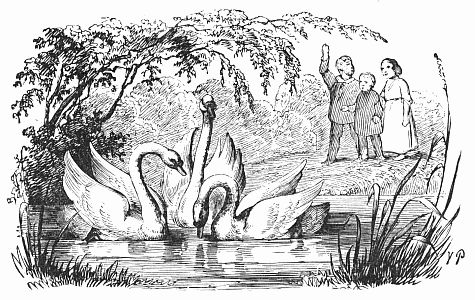
And once more he shook his wings. They were stronger than formerly, and bore him forwards quickly, and, before he was well aware of it, he was in a large garden where the apple-trees stood in full bloom, where the syringas sent forth their fragrance, and hung their long green branches down into the winding canal. O, everything was so lovely, so full of the freshness of spring! And out of the thicket came three beautiful white Swans. They displayed their feathers so proudly, and swam so lightly, so lightly! The Duckling knew the glorious creatures, and was seized with a strange melancholy.
"I will fly to them, those kingly birds!" said he. "They will kill me, because I, ugly as I am, have presumed to approach them. But it matters not; better to be killed by them than to be bitten by the ducks, pecked by the hens, kicked by the girl who feeds the poultry, and to have so much to suffer during the winter!" He flew into the water, and swam towards the beautiful creatures; they saw him and shot forward to meet him. "Only kill me," said the poor animal, and he bowed his head low, expecting death; but what did he see in the water? He saw beneath him his own form, no longer that of a plump, ugly, gray bird,—it was that of a Swan.
It matters not to have been born in a duck-yard, if one has been hatched from a Swan's egg.
The good creature felt himself really elevated by all the troubles and adversities he had experienced. He could now rightly estimate his own happiness, and the larger Swans swam around him, and stroked him with their beaks.
Some little children were running about in the garden; they threw grain and bread into the water, and the youngest exclaimed, "There is a new one!" the others also cried out, "Yes, there is a new Swan come!" and they clapped their hands, and danced around. They ran to their father and mother, bread and cake were thrown into the water, and every one said, "The new one is the best, so young and so beautiful!" and the old Swans bowed before him. The young Swan felt quite ashamed, and hid his head under his wings; he scarcely knew what to do, he was all too happy, but still not proud, for a good heart is never proud.
He remembered how he had been persecuted and derided, and he now heard every one say he was the most beautiful of all beautiful birds. The syringas bent down their branches towards him low into the water, and the sun shone so warmly and brightly,—he shook his feathers, stretched his slender neck, and in the joy of his heart said, "How little did I dream of so much happiness when I was the ugly, despised Duckling!"
Hans Christian Andersen.
THE POET AND HIS LITTLE DAUGHTER.
It was a June morning. Roses and yellow jasmine covered the old wall in the Poet's garden. The little brown mason bees flew in and out of their holds beneath the pink and white and yellow flowers. Peacock-butterflies, with large blue eyes on their crimson velvet wings, fluttered about and settled on the orange-brown wall-flowers. Aloft, in the broad-leaved sycamore-tree, the blackbird was singing as if he were out of his senses for joy; his song was as loud as any nightingale, and his heart was glad, because his young brood was hatched, and he knew that they now sat with their little yellow beaks poking out of the nest, and thinking what a famous bird their father was. All the robins and tomtits and linnets and redstarts that sat in the trees of the garden den shouted vivas and bravuras, and encored him delightfully.
The Poet himself sat under the double-flowering hawthorn, which was then all in blossom. He sat on a rustic seat, and his best friend sat beside him. Beneath the lower branches of the tree was hung the canary-bird's cage, which the children had brought out because the day was so fine, and the little canary loved fresh air and the smell of flowers. It never troubled him that other birds flew about from one end of the garden to the other, or sat and sung on the leafy branches, for he loved his cage; and when the old blackbird poured forth his grand melodies, the little canary sat like a prince in a stage-box, and nodded his head, and sang an accompaniment.
One of the Poet's children, his little daughter, sat in her own little garden, which was full of flowers, while bees and butterflies flitted about in the sunshine. The child, however, was not noticing them; she was thinking only of one thing, and that was the large daisy-root which was all in flower; it was the largest daisy-root in the whole garden, and two-and-fifty double pink-and-white daisies were crowded upon it. They were, however, no longer daisies to the child's eyes, but two-and-fifty little charity children in green stuff gowns, and white tippets, and white linen caps, that had a holiday given them. She saw them all, with their pink cheeks and bright eyes, running in a group and talking as they went; the hum of the bees around seeming to be the pleasant sound of their voices. The child was happy to think that two-and-fifty charity children were let loose from school to run about in the sunshine. Her heart went with them, and she was so full of joy that she started up to tell her father, who was sitting with his best friend under the hawthorn-tree.
Sad and bitter thoughts, however, just then oppressed the Poet's heart. He had been disappointed where he had hoped for good; his soul was under a cloud; and as the child ran up to tell him about the little charity children in whose joy she thought he would sympathize, she heard him say to his friend, "I have no longer any hope of human nature now. It is a poor miserable thing, and is not worth working for. My best endeavors have been spent in its service,—my youth and my manhood's strength, my very life,—and this is my reward! I will no longer strive to do good. I will write for money alone, as others do, and not for the good of mankind!"
The Poet's words were bitter, and tears came into the eyes of his best friend. Never had the child heard such words from her father before, for he had always been to her as a great and good angel.
"I will write," said he, "henceforth for money, as others do, and not for the good of mankind."
"My father, if you do," said the child, in a tone of mournful indignation, "I will never read what you write! I will trample your writings under my feet!"
Large tears rolled down her cheeks, and her eyes were fixed on her father's face.
The Poet took the child in his arms and kissed her. An angel touched his heart, and he now felt that he could forgive his bitterest enemies.
"I will tell you a story, my child," he said, in his usually mild voice.
The child leaned her head against his breast, and listened.
"Once upon a time," he began, "there was a man who dwelt in a great, wide wilderness. He was a poor man, and worked very hard for his bread. He lived in a cave of a rock, and because the sun shone burning hot into the cave, he twined roses and jessamines and honeysuckles all around it; and in front of it, and on the ledges of the rock, he planted ferns and sweet shrubs, and made it very pleasant. Water ran gurgling from a fissure in the rock into a little basin, whence it poured in gentle streams through the garden, in which grew all kinds of delicious fruits. Birds sang in the tall trees which Nature herself had planted; and little squirrels, and lovely green lizards, with bright, intelligent eyes, lived in the branches and among the flowers.
"All would have gone well with the man, had not evil spirits taken possession of his cave. They troubled him night and day. They dropped canker-blight upon his roses, nipped off his jasmine and honeysuckle-flowers, and, in the form of caterpillars and blight, ate his beautiful fruits.
"It made the man angry and bitter in his feelings. The flowers were no longer beautiful to him, and when he looked on them he thought only of the canker and the caterpillar.
"'I can no longer take pleasure in them,' he said; 'I will leave the cave, and go elsewhere.'
"He did so; and travelled on and on, a long way. But it was a vast wilderness in which he dwelt, and thus it was many and many a weary day before he came to a place of rest; nor did he know that all this time the evil spirits who had plagued him so in his own cave were still going with him.
"But so they were. And they made every place he came to seem worse than the last. Their very breath cast a blight upon everything.
"He was footsore and weary, and very miserable. A feeling like despair was in his heart, and he said that he might as well die as live. He lay down in the wilderness, so unhappy was he, and scarcely had he done so, when he heard behind him the pleasantest sound in the world,—a little child singing like a bird, because her heart was innocent and full of joy; and the next moment she was at his side.
"The evil spirits that were about him drew back a little when they saw her coming, because she brought with her a beautiful company of angels and bright spirits,—little cherubs with round, rosy cheeks, golden hair, and laughing eyes between two dove's wings as white as snow. The child had not the least idea that these beautiful spirits were always about her; all she knew was that she was full of joy, and that she loved above all things to do good. When she saw the poor man lying there, she went up to him, and talked to him so pityingly, and yet so cheerfully, that he felt as if her words would cure him. She told him that she lived just by, and that he should go with her, and rest and get well in her cave.
"He went with her, and found that her cave was just such a one as his own, only much smaller. Roses and honeysuckles and jasmine grew all around it; and birds were singing, and goldfish were sporting about in the water; and there were beds of strawberries, all red and luscious, that filled the air with fragrance.
"It was a beautiful place. There seemed to be no canker nor blight on anything. And yet the man saw how spiders had woven webs like the most beautiful lace from one vine-branch to another; and butterflies that once had been devouring caterpillars were flitting about. Just as in his own garden, yellow frogs were squatted under the cool green strawberry leaves. But the child loved both the frogs and the green lizards, and said that they did her no harm, and that there were plenty of strawberries both for them and for her.
"The evil spirits that had troubled the man, and followed him, could not get into the child's garden. It was impossible, because all those rosy-cheeked cherubs and white-robed angels lived there; and that which is good, be it ever so small, is a great deal stronger than that which is evil, be it ever so large. They therefore sat outside and bit their nails for vexation; and as the man stayed a long time with the child, they got so tired of waiting that a good number of them flew away forever.
"At length the man kissed the child and went back to his own place; and when he got there he had the pleasure of finding that, owing to the evil spirits having been so long away, the flowers and fruits had, in great measure, recovered themselves. There was hardly any canker or blight left. And as the child came now very often to see him,—for, after all, they did not live so very far apart, only that the man had wandered a long way round in the wilderness,—and brought with her all the bright company that dwelt with her, the place was freed, at least while she stayed, from the evil ones.
"This is a true story, a perfectly true story," added the Poet, when he had brought his little narrative to an end; "and there are many men who live like him in a wilderness, and who go a long way round about before they can find a resting-place. And happy is it for such when they can have a child for their neighbor; for our Divine Master has himself told us that blessed are little children, and that of such is the kingdom of heaven!"
The Poet was silent. His little daughter kissed him, and then, without saying a word about the little charity children, ran off to sit down beside them again, and perhaps to tell them the story which her father had just related to her.
Mary Howitt.
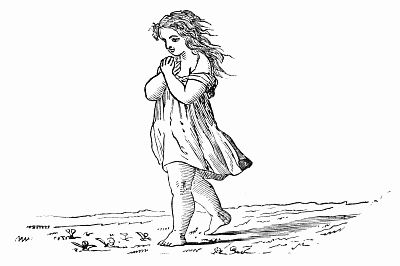
THE RED FLOWER.
What it was, where it grew, I should find it difficult to tell you. I had seen it once, when a little child, in a stony road, among the thorns of a hedge; and I had gathered it. Ah! that was certain! It waved at the end of a long stalk; its petals were of a flame-like red; its form was unlike anything known, resembling somewhat a censer, from which issued golden stamens.
Since those earliest days, I had often sought it, often asked for it. When I mentioned it, people laughed at me. I spoke of the flower no more, but I sought for it still.
"Impossible!" Experience writes the word in the dictionary of the man. In the child's vocabulary, it has no existence. The marvellous to him is perfectly natural. Things which he sees to be beautiful arrange themselves along his path; why should he have a doubt of this or of that? By and by, exact bounds will limit his domain. A faint line, then a barrier, then a wall: erelong the wall will rise and surround the man,—a dungeon from which he must have wings to escape.
Around the child are neither walls nor boundary lines, but a limitless expanse, everywhere glowing with beautiful colors. In the far-off depths, reality mingles with revery. It is like an ocean whose blue waves glimmer and sparkle on the horizon, where they kiss the shores of enchanted isles.
I sought the red flower. Have you never searched for it too?
This morning, in the spring atmosphere, its memory came back to my heart. It seemed to me that I should find it; and I walked on at random.
I went through solitary footpaths. The laborers had gone to their noonday repose. The meadows were all in bloom. Weeds, growing in spite of wind and tide spread a golden carpet beside the rose-colored meadow-grass. In the wet places were tangles of pale blue forget-me-nots; beyond them, tufts of the azure veronica, and over the stream hung the straw-colored lotus. Under the grain, yet green, corn-poppies were waving. With every breeze a scarlet wave arose, swelled, and vanished.
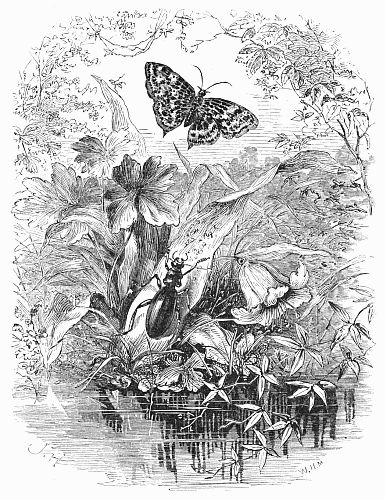
Blue butterflies danced before me, mingling and dispersing like floating flower-petals in the air. Under the umbelled plants was a pavement of beetles, of black and purple mosaic. On the tufts of the verbena gathered insects with shells blazoned like the escutcheons of the knights of the Middle Ages. The quail was calling in the thickets; three notes here, and three there. I found myself on the skirt of a pine forest, and I seated myself on the grass.
The red flower! I thought of it no longer. The butterflies had carried it away. I thought how beautiful life is on a spring morning; what happiness it is to open the lips and inhale the fresh air; what joy to open the eyes and behold the earth in her bridal robes; what delight to open the hands and gather the sweet-smelling blossoms. Then I thought of the God of the heavens, that, arching above me, spoke of his power. I thought of the Lord of the little ones,—of the insects that, flitting about me, spoke of his goodness. All these accents awoke a chord in harmony with that which burst forth from the blossoming meadows.