STORIES OF CHILD LIFE. (continued 2)
Reading edition
Few flowers bloomed for me upon the lonesome rock; but I made the most of all I had, and neither knew of nor desired more. Ah, how beautiful they were! Tiny stars of crimson sorrel threaded on their long brown stems; the blackberry blossoms in bridal white; the surprise of the blue-eyed grass; the crowfoot flowers, like drops of yellow gold spilt about among the short grass and over the moss; the rich, blue-purple beach-pea, the sweet, spiked germander, and the homely, delightful yarrow that grows thickly on all the islands. Sometimes its broad clusters of dull white bloom are stained a lovely reddish-purple, as if with the light of sunset. I never saw it colored so elsewhere. Dandelions, buttercups, and clover were not denied to us; though we had no daisies nor violets nor wild roses, no asters, but gorgeous spikes of golden-rod, and wonderful wild morning-glories, whose long, pale ivory buds I used to find in the twilight, glimmering among the dark leaves, waiting for the touch of dawn to unfold and become each an exquisite incarnate blush,—the perfect color of a South Sea shell. They ran wild, knotting and twisting about the rocks, and smothering the loose boulders in the gorges with lush green leaves and pink blossoms.
Many a summer morning have I crept out of the still house before any one was awake, and, wrapping myself closely from the chill wind of dawn, climbed to the top of the high cliff called the Head to watch the sunrise. Pale grew the lighthouse flame before the broadening day as, nestled in a crevice at the cliff's edge, I watched the shadows draw away and morning break. Facing the east and south, with all the Atlantic before me, what happiness was mine as the deepening rose-color flushed the delicate cloud-flocks that dappled the sky, where the gulls soared, rosy too, while the calm sea blushed beneath. Or perhaps it was a cloudless sunrise with a sky of orange-red, and the sea-line silver-blue against it, peaceful as heaven. Infinite variety of beauty always awaited me, and filled me with an absorbing, unreasoning joy such as makes the song-sparrow sing,—a sense of perfect bliss. Coming back in the sunshine, the morning-glories would lift up their faces, all awake, to my adoring gaze. It seemed as if they had gathered the peace of the golden morning in their still depths even as my heart had gathered it.
Celia Thaxter.
THE CRUISE OF THE DOLPHIN.
Every Rivermouth boy looks upon the sea as being in some way mixed up with his destiny. While he is yet a baby lying in his cradle, he hears the dull, far-off boom of the breakers; when he is older, he wanders by the sandy shore, watching the waves that come plunging up the beach like white-maned sea-horses, as Thoreau calls them; his eye follows the lessening sail as it fades into the blue horizon, and he burns for the time when he shall stand on the quarter-deck of his own ship, and go sailing proudly across that mysterious waste of waters.
Then the town itself is full of hints and flavors of the sea. The gables and roofs of the houses facing eastward are covered with red rust, like the flukes of old anchors; a salty smell pervades the air, and dense gray fogs, the very breath of Ocean, periodically creep up into the quiet streets and envelop everything. The terrific storms that lash the coast; the kelp and spars, and sometimes the bodies of drowned men, tossed on shore by the scornful waves; the shipyards, the wharves, and the tawny fleet of fishing-smacks yearly fitted out at Rivermouth,—these things, and a hundred other, feed the imagination and fill the brain of every healthy boy with dreams of adventure. He learns to swim almost as soon as he can walk; he draws in with his mother's milk the art of handling an oar: he is born a sailor, whatever he may turn out to be afterwards.
To own the whole or a portion of a row-boat is his earliest ambition. No wonder that I, born to this life, and coming back to it with freshest sympathies, should have caught the prevailing infection. No wonder I longed to buy a part of the trim little sail-boat Dolphin, which chanced just then to be in the market. This was in the latter part of May.
Three shares, at five or six dollars each, I forget which, had already been taken by Phil Adams, Fred Langdon, and Binny Wallace. The fourth and remaining share hung fire. Unless a purchaser could be found for this, the bargain was to fall through.
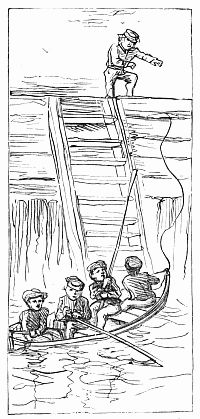
I am afraid I required but slight urging to join in the investment. I had four dollars and fifty cents on hand, and the treasurer of the Centipedes advanced me the balance, receiving my silver pencil-case as ample security. It was a proud moment when I stood on the wharf with my partners, inspecting the Dolphin, moored at the foot of a very slippery flight of steps. She was painted white with a green stripe outside, and on the stern a yellow dolphin, with its scarlet mouth wide open, stared with a surprised expression at its own reflection in the water. The boat was a great bargain.
I whirled my cap in the air, and ran to the stairs leading down from the wharf, when a hand was laid gently on my shoulder. I turned, and faced Captain Nutter. I never saw such an old sharp-eye as he was in those days.
I knew he wouldn't be angry with me for buying a row-boat; but I also knew that the little bowsprit suggesting a jib, and the tapering mast ready for its few square yards of canvas, were trifles not likely to meet his approval. As far as rowing on the river, among the wharves, was concerned, the Captain had long since withdrawn his decided objections, having convinced himself, by going out with me several times, that I could manage a pair of sculls as well as anybody.
I was right in my surmises. He commanded me, in the most emphatic terms, never to go out in the Dolphin without leaving the mast in the boat-house. This curtailed my anticipated sport, but the pleasure of having a pull whenever I wanted it remained. I never disobeyed the Captain's orders touching the sail, though I sometimes extended my row beyond the points he had indicated.
The river was dangerous for sail-boats. Squalls, without the slightest warning, were of frequent occurrence; scarcely a year passed that six or seven persons were not drowned under the very windows of the town, and these, oddly enough, were generally sea-captains, who either did not understand the river, or lacked the skill to handle a small craft.
A knowledge of such disasters, one of which I witnessed, consoled me somewhat when I saw Phil Adams skimming over the water in a spanking breeze with every stitch of canvas set. There were few better yachtsmen than Phil Adams. He usually went sailing alone, for both Fred Langdon and Binny Wallace were under the same restrictions I was.
Not long after the purchase of the boat, we planned an excursion to Sandpeep Island, the last of the islands in the harbor. We proposed to start early in the morning, and return with the tide in the moonlight. Our only difficulty was to obtain a whole day's exemption from school, the customary half-holiday not being long enough for our picnic. Somehow, we couldn't work it; but fortune arranged it for us. I may say here, that, whatever else I did, I never played truant in my life.
One afternoon the four owners of the Dolphin exchanged significant glances when Mr. Grimshaw announced from the desk that there would be no school the following day, he having just received intelligence of the death of his uncle in Boston. I was sincerely attached to Mr. Grimshaw, but I am afraid that the death of his uncle did not affect me as it ought to have done.
We were up before sunrise the next morning, in order to take advantage of the flood tide, which waits for no man. Our preparations for the cruise were made the previous evening. In the way of eatables and drinkables, we had stored in the stern of the Dolphin a generous bag of hardtack (for the chowder), a piece of pork to fry the cunners in, three gigantic apple-pies (bought at Pettingil's), half a dozen lemons, and a keg of spring-water,—the last-named article we slung over the side, to keep it cool, as soon as we got under way. The crockery and the bricks for our camp-stove we placed in the bows with the groceries, which included sugar, pepper, salt, and a bottle of pickles. Phil Adams contributed to the outfit a small tent of unbleached cotton cloth, under which we intended to take our nooning.
We unshipped the mast, threw in an extra oar, and were ready to embark. I do not believe that Christopher Columbus, when he started on his rather successful voyage of discovery, felt half the responsibility and importance that weighed upon me as I sat on the middle seat of the Dolphin, with my oar resting in the row-lock. I wonder if Christopher Columbus quietly slipped out of the house without letting his estimable family know what he was up to?
How calm and lovely the river was! Not a ripple stirred on the glassy surface, broken only by the sharp cutwater of our tiny craft. The sun, as round and red as an August moon, was by this time peering above the water-line.
The town had drifted behind us, and we were entering among the group of islands. Sometimes we could almost touch with our boat-hook the shelving banks on either side. As we neared the mouth of the harbor, a little breeze now and then wrinkled the blue water, shook the spangles from the foliage, and gently lifted the spiral mist-wreaths that still clung alongshore. The measured dip of our oars and the drowsy twitterings of the birds seemed to mingle with, rather than break, the enchanted silence that reigned about us.
The scent of the new clover comes back to me now, as I recall that delicious morning when we floated away in a fairy boat down a river like a dream!
The sun was well up when the nose of the Dolphin nestled against the snow-white bosom of Sandpeep Island. This island, as I have said before, was the last of the cluster, one side of it being washed by the sea. We landed on the river side, the sloping sands and quiet water affording us a good place to moor the boat.
It took us an hour or two to transport our stores to the spot selected for the encampment. Having pitched our tent, using the five oars to support the canvas, we got out our lines, and went down the rocks seaward to fish. It was early for cunners, but we were lucky enough to catch as nice a mess as ever you saw. A cod for the chowder was not so easily secured. At last Binny Wallace hauled in a plump little fellow crusted all over with flaky silver.
To skin the fish, build our fireplace, and cook the dinner, kept us busy the next two hours. The fresh air and the exercise had given us the appetites of wolves, and we were about famished by the time the savory mixture was ready for our clam-shell saucers.
I shall not insult the rising generation on the seaboard by telling them how delectable is a chowder compounded and eaten in this Robinson Crusoe fashion. As for the boys who live inland, and know naught of such marine feasts, my heart is full of pity for them. What wasted lives! Not to know the delights of a clam-bake, not to love chowder, to be ignorant of lobscouse!
How happy we were, we four, sitting cross-legged in the crisp salt grass, with the invigorating sea-breeze blowing gratefully through our hair! What a joyous thing was life, and how far off seemed death,—death, that lurks in all pleasant places, and was so near!
The banquet finished, Phil Adams drew forth from his pocket a handful of sweetfern cigars; but as none of the party could indulge without risk of becoming sick, we all, on one pretext or another, declined, and Phil smoked by himself.
The wind had freshened by this, and we found it comfortable to put on the jackets which had been thrown aside in the heat of the day. We strolled along the beach and gathered large quantities of the fairy-woven Iceland moss, which, at certain seasons, is washed to these shores; then we played at ducks and drakes, and then, the sun being sufficiently low, we went in bathing.
Before our bath was ended a slight change had come over the sky and sea; fleecy-white clouds scudded here and there, and a muffled moan from the breakers caught our ears from time to time. While we were dressing, a few hurried drops of rain came lisping down, and we adjourned to the tent to await the passing of the squall.
"We're all right, anyhow," said Phil Adams. "It won't be much of a blow, and we'll be as snug as a bug in a rug, here in the tent, particularly if we have that lemonade which some of you fellows were going to make."
By an oversight, the lemons had been left in the boat. Binny Wallace volunteered to go for them.
"Put an extra stone on the painter, Binny," said Adams, calling after him; "it would be awkward to have the Dolphin give us the slip and return to port minus her passengers."
"That it would," answered Binny, scrambling down the rocks.
Sandpeep Island is diamond-shaped,—one point running out into the sea, and the other looking towards the town. Our tent was on the river side. Though the Dolphin was also on the same side, it lay out of sight by the beach at the farther extremity of the island.
Binny Wallace had been absent five or six minutes, when we heard him calling our several names in tones that indicated distress or surprise, we could not tell which. Our first thought was, "The boat has broken adrift!"
We sprung to our feet and hastened down to the beach. On turning the bluff which hid the mooring-place from our view, we found the conjecture correct. Not only was the Dolphin afloat, but poor little Binny Wallace was standing in the bows with his arms stretched helplessly towards us,—drifting out to sea!
"Head the boat in shore!" shouted Phil Adams.
Wallace ran to the tiller; but the slight cockle-shell merely swung round and drifted broadside on. O, if we had but left a single scull in the Dolphin!
"Can you swim it?" cried Adams, desperately, using his hand as a speaking-trumpet, for the distance between the boat and the island widened momently.
Binny Wallace looked down at the sea, which was covered with white caps, and made a despairing gesture. He knew and we knew, that the stoutest swimmer could not live forty seconds in those angry waters.
A wild, insane light came into Phil Adams's eyes, as he stood knee-deep in boiling surf, and for an instant I think he meditated plunging into the ocean after the receding boat.
The sky darkened, and an ugly look stole rapidly over the broken surface of the sea.
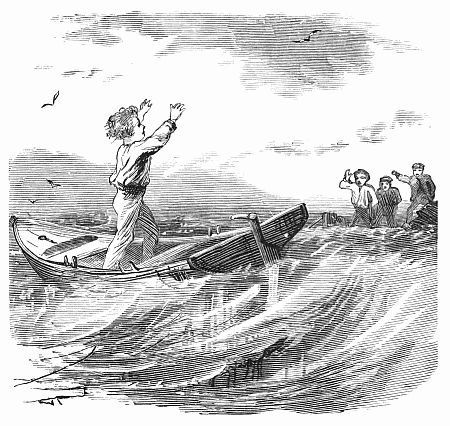
Binny Wallace half rose from his seat in the stern, and waved his hand to us in token of farewell. In spite of the distance, increasing every instant, we could see his face plainly. The anxious expression it wore at first had passed. It was pale and meek now, and I love to think there was a kind of halo about it, like that which painters place around the forehead of a saint. So he drifted away.
The sky grew darker and darker. It was only by straining our eyes through the unnatural twilight that we could keep the Dolphin in sight. The figure of Binny Wallace was no longer visible, for the boat itself had dwindled to a mere white dot on the black water. Now we lost it, and our hearts stopped throbbing; and now the speck appeared again, for an instant, on the crest of a high wave.
Finally it went out like a spark, and we saw it no more. Then we gazed at each other, and dared not speak.
Absorbed in following the course of the boat, we had scarcely noticed the huddled inky clouds that sagged down all around us. From these threatening masses, seamed at intervals with pale lightning, there now burst a heavy peal of thunder that shook the ground under our feet. A sudden squall struck the sea, ploughing deep white furrows into it, and at the same instant a single piercing shriek rose above the tempest,—the frightened cry of a gull swooping over the island. How it startled us!
It was impossible to keep our footing on the beach any longer. The wind and the breakers would have swept us into the ocean if we had not clung to each other with the desperation of drowning men. Taking advantage of a momentary lull, we crawled up the sands on our hands and knees, and, pausing in the lee of the granite ledge to gain breath, returned to the camp, where we found that the gale had snapped all the fastenings of the tent but one. Held by this, the puffed-out canvas swayed in the wind like a balloon. It was a task of some difficulty to secure it, which we did by beating down the canvas with the oars.
After several trials, we succeeded in setting up the tent on the leeward side of the ledge. Blinded by the vivid flashes of lightning, and drenched by the rain, which fell in torrents, we crept, half dead with fear and anguish, under our flimsy shelter. Neither the anguish nor the fear was on our own account, for we were comparatively safe, but for poor little Binny Wallace, driven out to sea in the merciless gale. We shuddered to think of him in that frail shell, drifting on and on to his grave, the sky rent with lightning over his head, and the green abysses yawning beneath him. We fell to crying, the three of us, and cried I know not how long.
Meanwhile the storm raged with augmented fury. We were obliged to hold on to the ropes of the tent to prevent it blowing away. The spray from the river leaped several yards up the rocks and clutched at us malignantly. The very island trembled with the concussions of the sea beating upon it, and at times I fancied that it had broken loose from its foundation, and was floating off with us. The breakers, streaked with angry phosphorus, were fearful to look at.
The wind rose higher and higher, cutting long slits in the tent, through which the rain poured incessantly. To complete the sum of our miseries, the night was at hand. It came down suddenly, at last, like a curtain, shutting in Sandpeep Island from all the world.
It was a dirty night, as the sailors say. The darkness was something that could be felt as well as seen,—it pressed down upon one with a cold, clammy touch. Gazing into the hollow blackness, all sorts of imaginable shapes seemed to start forth from vacancy,—brilliant colors, stars, prisms, and dancing lights. What boy, lying awake at night, has not amused or terrified himself by peopling the spaces round his bed with these phenomena of his own eyes?
"I say," whispered Fred Langdon, at length, clutching my hand, "don't you see things—out there—in the dark?"
"Yes, yes,—Binny Wallace's face!"
I added to my own nervousness by making this avowal; though for the last ten minutes I had seen little besides that star-pale face with its angelic hair and brows. First a slim yellow circle, like the nimbus round the moon, took shape and grew sharp against the darkness; then this faded gradually, and there was the Face, wearing the same sad, sweet look it wore when he waved his hand to us across the awful water. This optical illusion kept repeating itself.
"And I, too," said Adams. "I see it every now and then, outside there. What wouldn't I give if it really was poor little Wallace looking in at us! O boys, how shall we dare to go back to the town without him? I've wished a hundred times, since we've been sitting here, that I was in his place, alive or dead!"
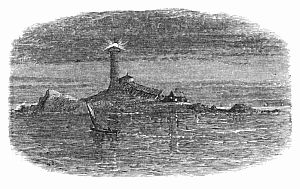
We dreaded the approach of morning as much as we longed for it. The morning would tell us all. Was it possible for the Dolphin to outride such a storm? There was a lighthouse on Mackerel Reef, which lay directly in the course the boat had taken, when it disappeared. If the Dolphin had caught on this reef, perhaps Binny Wallace was safe. Perhaps his cries had been heard by the keeper of the light. The man owned a life-boat, and had rescued several people. Who could tell?
Such were the questions we asked ourselves again and again, as we lay in each other's arms waiting for daybreak. What an endless night it was! I have known months that did not seem so long.
Our position was irksome rather than perilous; for the day was certain to bring us relief from the town, where our prolonged absence, together with the storm, had no doubt excited the liveliest alarm for our safety. But the cold, the darkness, and the suspense were hard to bear.
Our soaked jackets had chilled us to the bone. To keep warm, we lay huddled together so closely that we could hear our hearts beat above the tumult of sea and sky.
We used to laugh at Fred Langdon for always carrying in his pocket a small vial of essence of peppermint or sassafras, a few drops of which, sprinkled on a lump of loaf-sugar, he seemed to consider a great luxury. I don't know what would have become of us at this crisis, if it hadn't been for that omnipresent bottle of hot stuff. We poured the stinging liquid over our sugar, which had kept dry in a sardine-box, and warmed ourselves with frequent doses.
After four or five hours the rain ceased, the wind died away to a moan, and the sea—no longer raging like a maniac—sobbed and sobbed with a piteous human voice all along the coast. And well it might, after that night's work. Twelve sail of the Gloucester fishing fleet had gone down with every soul on board, just outside of Whale's-back Light. Think of the wide grief that follows in the wake of one wreck; then think of the despairing women who wrung their hands and wept, the next morning, in the streets of Gloucester, Marblehead, and Newcastle!
Though our strength was nearly spent, we were too cold to sleep. Fred Langdon was the earliest to discover a filmy, luminous streak in the sky, the first glimmering of sunrise.
"Look, it is nearly daybreak!"
While we were following the direction of his finger, a sound of distant oars fell on our ears.
We listened breathlessly, and as the dip of the blades became more audible, we discerned two foggy lights, like will-o'-the-wisps, floating on the river.
Running down to the water's edge, we hailed the boats with all our might. The call was heard, for the oars rested a moment in the row-locks, and then pulled in towards the island.
It was two boats from the town, in the foremost of which we could now make out the figures of Captain Nutter and Binny Wallace's father. We shrunk back on seeing him.
"Thank God!" cried Mr. Wallace, fervently, as he leaped from the wherry without waiting for the bow to touch the beach.
But when he saw only three boys standing on the sands, his eye wandered restlessly about in quest of the fourth; then a deadly pallor overspread his features.
Our story was soon told. A solemn silence fell upon the crowd of rough boatmen gathered round, interrupted only by a stifled sob from one poor old man, who stood apart from the rest.
The sea was still running too high for any small boat to venture out; so it was arranged that the wherry should take us back to town, leaving the yawl, with a picked crew, to hug the island until daybreak, and then set forth in search of the Dolphin.
Though it was barely sunrise when we reached town, there were a great many people assembled at the landing, eager for intelligence from missing boats. Two picnic parties had started down river the day before, just previous to the gale, and nothing had been heard of them. It turned out that the pleasure-seekers saw their danger in time, and ran ashore on one of the least exposed islands, where they passed the night. Shortly after our own arrival they appeared off Rivermouth, much to the joy of their friends, in two shattered, dismasted boats.
The excitement over, I was in a forlorn state, physically and mentally. Captain Nutter put me to bed between hot blankets, and sent Kitty Collins for the doctor. I was wandering in my mind, and fancied myself still on Sandpeep Island: now I gave orders to Wallace how to manage the boat, and now I cried because the rain was pouring in on me through the holes in the tent. Towards evening a high fever set in, and it was many days before my grandfather deemed it prudent to tell me that the Dolphin had been found, floating keel upwards, four miles southeast of Mackerel Reef.
Poor little Binny Wallace! How strange it seemed, when I went to school again, to see that empty seat in the fifth row! How gloomy the play-ground was, lacking the sunshine of his gentle, sensitive face! One day a folded sheet slipped from my algebra; it was the last note he ever wrote me. I couldn't read it for the tears.
What a pang shot across my heart the afternoon it was whispered through the town that a body had been washed ashore at Grave Point,—the place where we bathed. We bathed there no more! How well I remember the funeral, and what a piteous sight it was afterwards to see his familiar name on a small headstone in the Old South Burying-Ground!
Poor little Binny Wallace! Always the same to me. The rest of us have grown up into hard, worldly men, fighting the fight of life; but you are forever young, and gentle, and pure; a part of my own childhood that time cannot wither; always a little boy, always poor little Binny Wallace!
T. B. Aldrich.
A YOUNG MAHOMETAN.
The bedrooms in the old house had tapestry hangings, which were full of Bible history. The subject of the one which chiefly attracted my attention was Hagar and her son Ishmael. I every day admired the beauty of the youth, and pitied the forlorn state of his mother and himself in the wilderness.
At the end of the gallery into which these tapestry rooms opened was one door, which, having often in vain attempted to open, I concluded to be locked. Every day I endeavored to turn the lock. Whether by constantly trying I loosened it, or whether the door was not locked, but only fastened tight by time, I know not; but, to my great joy, as I was one day trying it as usual, it gave way, and I found myself in this so long-desired room.
It proved to be a very large library. If you never spent whole mornings alone in a large library, you cannot conceive the pleasure of taking down books in the constant hope of finding an entertaining one among them; yet, after many days, meeting with nothing but disappointment, it becomes less pleasant. All the books within my reach were folios of the gravest cast. I could understand very little that I read in them, and the old dark print and the length of the lines made my eyes ache.
When I had almost resolved to give up the search as fruitless, I perceived a volume lying in an obscure corner of the room. I opened it. It was a charming print; the letters were almost as large as the type of the family Bible. Upon the first page I looked into I saw the name of my favorite Ishmael, whose face I knew so well from the tapestry in the antique bedrooms, and whose history I had often read in the Bible.
I sat myself down to read this book with the greatest eagerness. I shall be quite ashamed to tell you the strange effect it had on me. I scarcely ever heard a word addressed to me from morning till night. If it were not for the old servants saying, "Good morning to you, Miss Margaret," as they passed me in the long passages, I should have been the greater part of the day in as perfect a solitude as Robinson Crusoe.
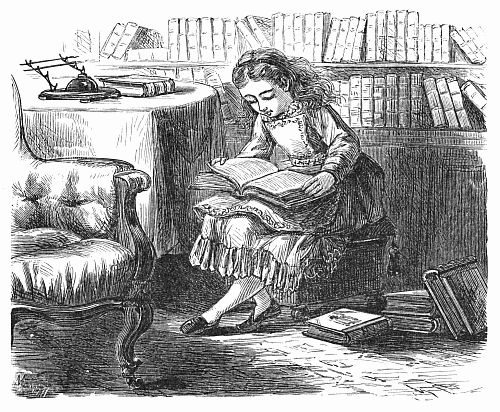
Many of the leaves in "Mahometanism Explained" were torn out, but enough remained to make me imagine that Ishmael was the true son of Abraham. I read here, that the true descendants of Abraham were known by a light which streamed from the middle of their foreheads, and that Ishmael's father and mother first saw this light streaming from his forehead as he was lying asleep in the cradle.
I was very sorry so many of the leaves were gone, for it was as entertaining as a fairy tale. I used to read the history of Ishmael, and then go and look at him in the tapestry, and then return to his history again. When I had almost learned the history of Ishmael by heart, I read the rest of the book, and then I came to the history of Mahomet, who was there said to be the last descendant of Abraham.
If Ishmael had engaged so much of my thoughts, how much more so must Mahomet! His history was full of nothing but wonders from the beginning to the end. The book said that those who believed all the wonderful stories which were related of Mahomet were called Mahometans, and True Believers; I concluded that I must be a Mahometan, for I believed every word I read.
At length I met with something which I also believed, though I trembled as I read it; this was that, after we are dead, we are to pass over a narrow bridge, which crosses a bottomless gulf. The bridge was described to be no wider than a silken thread; and all who were not Mahometans would slip on one side of this bridge, and drop into the tremendous gulf that had no bottom. I considered myself as a Mahometan, yet I was perfectly giddy whenever I thought of passing over this bridge.
One day, seeing the old lady who lived here totter across the room, a sudden terror seized me, for I thought how she would ever be able to get over the bridge. Then, too, it was that I first recollected that my mother would also be in imminent danger. I imagined she had never heard the name of Mahomet, because, as I foolishly conjectured, this book had been locked up for ages in the library, and was utterly unknown to the rest of the world.
All my desire was now to tell them the discovery I had made; for I thought, when they knew of the existence of "Mahometanism Explained," they would read it, and become Mahometans to insure themselves a safe passage over the silken bridge. But it wanted more courage than I possessed to break the matter to my intended converts. I must acknowledge that I had been reading without leave; and the habit of never speaking, or being spoken to, considerably increased the difficulty.
My anxiety on this subject threw me into a fever. I was so ill that my mother thought it necessary to sleep in the same room with me. In the middle of the night I could not resist the strong desire I felt to tell her what preyed so much on my mind. I awoke her out of a sound sleep, and begged she would be so kind as to be a Mahometan. She was very much alarmed;—she thought I was delirious, and I believe I was; for I tried to explain the reason of my request, but it was in such an incoherent manner that she could not at all comprehend what I was talking about.
The next day a physician was sent for, and he discovered, by several questions that he put to me, that I had read myself into a fever. He gave me medicines, and ordered me to be kept very quiet, and said he hoped in a few days I should be very well; but as it was a new case to him, he never having attended a little Mahometan before, if any lowness continued after he had removed the fever, he would, with my mother's permission, take me home with him to study this extraordinary case at leisure. He added, that he could then hold a consultation with his wife, who was often very useful to him in prescribing remedies for the maladies of his younger patients.
In a few days he fetched me away. His wife was in the carriage with him. Having heard what he said about her prescriptions, I expected, between the doctor and his lady, to undergo a severe course of medicine, especially as I heard him very formally ask her advice as to what was good for a Mahometan fever, the moment after he had handed me into his carriage.
She studied a little while, and then she said, a ride to Harlow Fair would not be amiss. He said he was entirely of her opinion, because it suited him to go there to buy a horse.
During the ride they entered into conversation with me, and in answer to their questions, I was relating to them the solitary manner in which I had passed my time, how I found out the library, and what I had read in that fatal book which had so heated my imagination,—when we arrived at the fair; and Ishmael, Mahomet, and the narrow bridge vanished out of my head in an instant.
Before I went home the good lady explained to me very seriously the error into which I had fallen. I found that, so far from "Mahometanism Explained" being a book concealed only in this library, it was well known to every person of the least information.
The Turks, she told me, were Mahometans. And she said that, if the leaves of my favorite book had not been torn out, I should have read that the author of it did not mean to give the fabulous stories here related as true, but only wrote it as giving a history of what the Turks, who are a very ignorant people, believe concerning Mahomet.
By the good offices of the physician and his lady, I was carried home, at the end of a month, perfectly cured of the error into which I had fallen, and very much ashamed of having believed so many absurdities.
Mary Lamb.
THE LITTLE PERSIAN.
Among the Persians there is a sect called the Sooffees, and one of the most distinguished saints of this sect was Abdool Kauder.
It is related that, in early childhood, he was smitten with the desire of devoting himself to sacred things, and wished to go to Bagdad to obtain knowledge. His mother gave her consent; and taking out eighty deenars (a denomination of money used in Persia), she told him that, as he had a brother, half of that would be all his inheritance.
She made him promise, solemnly, never to tell a lie, and then bade him farewell, exclaiming, "Go, my son; I give thee to God. We shall not meet again till the day of judgment!"
He went on till he came near to Hamadan, when the company with which he was travelling was plundered by sixty horsemen. One of the robbers asked him what he had got. "Forty deenars," said Abdool Kauder, "are sewed under my garment." The fellow laughed, thinking that he was joking him. "What have you got?" said another. He gave the same answer.
When they were dividing the spoil, he was called to an eminence where their chief stood. "What property have you, my little fellow?" said he. "I have told two of your people already," replied the boy. "I have forty deenars sewed up carefully in my clothes." The chief desired them to be ripped open, and found the money.
"And how came you," said he, with surprise, "to declare so openly what has been so carefully hidden?"
"Because," Abdool Kauder replied, "I will not be false to my mother, whom I have promised that I will never conceal the truth."
"Child!" said the robber, "hast thou such a sense of duty to thy mother, at thy years, and am I insensible, at my age, of the duty I owe to my God? Give me thy hand, innocent boy," he continued, "that I may swear repentance upon it." He did so; and his followers were all alike struck with the scene.
"You have been our leader in guilt," said they to their chief, "be the same in the path of virtue!" and they instantly, at his order, made restitution of the spoil, and vowed repentance on the hand of the boy.
Juvenile Miscellany.
THE BOYS' HEAVEN.
Harry and Frank had a hearty cry when an ill-natured neighbor poisoned their dog. They dug a grave for their favorite, but were unwilling to put him in it and cover him up with earth.
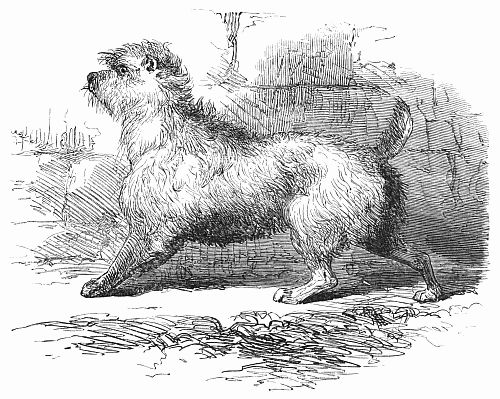
"I wish there was one of the Chinese petrifying streams near our house," said Frank. "We could lay Jip down in it; and, after a while, he would become a stone image, which we would always keep for a likeness of him."
Harry, who had been reading about the ancient Egyptians, remarked that it was a great pity the art of embalming was lost.
But Frank declared that a mummy was a hideous thing, and that he would rather have the dead dog out of his sight forever, than to make a mummy of him.
"It seems very hard never to see him again," said Harry, with a deep sigh.
"But perhaps Jip has gone to some dog-heaven; and when we go to the boys' heaven, we may happen to see our old pet on the way."
"If he should get sight of us he would follow us," said Frank. "He always liked us better than dogs. O yes, he would follow us to the boys' heaven, of that you may be sure; and I don't think boys would exactly like a heaven without any dogs. Mother, what kind of a place is a boys' heaven?"
His mother, who had just entered the room, knew nothing of what they had been talking about; and, the question being asked suddenly, she hardly knew what to answer.
She smiled, and said, "How can I tell, Frank! You know I never was there."
"That makes no difference," said he. "Folks tell about a great many things they never saw. Nobody ever goes to heaven till they die; but you often read to us about heaven and the angels. Perhaps some people, who died and went there, told others about it in their dreams."
"I cannot answer such questions, dear Harry," replied his mother. "I only know that God is very wise and good, and that he wills we should wait patiently and humbly till our souls grow old enough to understand such great mysteries. Just as it is necessary that you should wait to be much older before you can calculate when the moon will be eclipsed, or when certain stars will go away from our portion of the sky, and when they will come back again. Learned men know when the earth, in its travels through the air, will cast its long dark shadow over the brightness of the moon. They can foretell exactly the hour and the minute when a star will go down below the line which we call the horizon, where the earth and the sky seem to meet; and they know precisely when it will come up again. But if they tried ever so hard, they could never make little boys understand about the rising and the setting of the stars. The wisest of men are very small boys, compared with the angels; therefore the angels know perfectly well many things which they cannot possibly explain to a man till his soul grows and becomes an angel."
"I understand that," said Harry. "For I can read any book; but though Jip was a very bright dog, it was no manner of use to try to teach him the letters. He only winked and gaped when I told him that was A. You see, mother, I was the same as an angel to Jip."
His mother smiled to see how quickly he had caught her meaning.
After some more talk with them, she said, "You have both heard of Martin Luther, a great and good man who lived in Germany a long time ago. He was very loving to children; and once, when he was away from home, he wrote a letter to his little son. It was dated 1530; so you see it is more than three hundred years old. In those days they had not begun to print any books for children; therefore, I dare say, the boy was doubly delighted to have something in writing that his friends could read to him. You asked me, a few minutes ago, what sort of a place the boys' heaven is. In answer to your question, I will read what Martin Luther wrote to his son Hansigen, which in English means Little John. Any boy might be happy to receive such a letter. Listen to it now, and see if you don't think so.
"To my little son, Hansigen Luther, grace and peace in Christ.
"My heart-dear little Son: I hear that you learn well and pray diligently. Continue to do so, my son. When I come home I will bring you a fine present from the fair. I know of a lovely garden, full of joyful children, who wear little golden coats, and pick up beautiful apples, and pears, and cherries, and plums under the trees. They sing, and jump, and make merry. They have also beautiful little horses with golden saddles and silver bridles. I asked the man that kept the garden who the children were. And he said to me, 'The children are those who love to learn, and to pray, and to be good.' Then said I, 'Dear sir, I have a little son, named Hansigen Luther. May he come into this garden, and have the same beautiful apples and pears to eat, and wonderful little horses to ride upon, and may he play about with these children?' Then said he, 'If he is willing to learn, and to pray, and to be good, he shall come into this garden; and Lippus and Justus too. If they all come together, they shall have pipes, and little drums, and lutes, and music of stringed instruments. And they shall dance, and shoot with little crossbows.' Then he showed me a fine meadow in the garden, all laid out for dancing. There hung golden pipes and kettle-drums and fine silver crossbows; but it was too early to see the dancing, for the children had not had their dinner. I said, 'Ah, dear sir, I will instantly go and write to my little son Hansigen, so that he may study, and pray, and be good, and thus come into this garden. And he has a little cousin Lena, whom he must also bring with him.' Then he said to me, 'So shall it be. Go home, and write to him.'
"Therefore, dear little son Hansigen, be diligent to learn and to pray; and tell Lippus and Justus to do so too, that you may all meet together in that beautiful garden. Give cousin Lena a kiss from me. Herewith I recommend you all to the care of Almighty God."
The brothers both listened very attentively while that old letter was read; and when their mother had finished it, Frank exclaimed, "That must be a very beautiful place!"
Harry looked thoughtfully in the fire, and at last said, "I wonder who told all that to Martin Luther! Do you suppose an angel showed him that garden, when he was asleep?"
"I don't know," replied Frank. "But if there were small horses there with golden saddles for the boys, why shouldn't Jip be there, too, with a golden collar and bells?"
"Now, wouldn't that be grand!" exclaimed Harry. And away they both ran to plant flowers on Jip's grave.
L. Maria Child.
BESSIE'S GARDEN
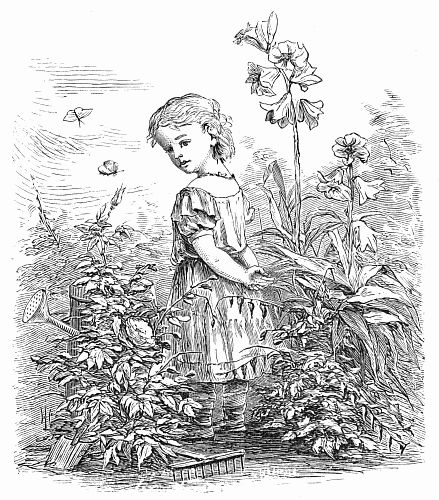
Above all things, Bessie loved flowers, but wild flowers most. It seemed so wonderful to her that these frail things could find their way up out of the dark ground, and unfold their lovely blossoms, and all their little pointed leaves, without any one to teach or help them.
Who watched over the dear little wild flowers, all alone in the field, and on the hillside, and down by the brook? Ah, Bessie knew that her Heavenly Father watched over them; and she loved to think he was smiling down upon her at the same time that his strong, gentle hand took care of the flowers and of her at once. And she was not wrong, for Bessie was a kind of flower, you know.
One day the little girl thought how nice it would be to have a wild garden; to plant ever so many flowering things in one place, and let them run together in their pretty way, until the bright-eyed blossoms should gaze out from the whole tangled mass of beautiful green leaves.
So into the house she ran to find Aunt Annie, and ask her leave to wander over on a shady hillside where wild flowers grew thickest.
Yes, indeed, she might go, Aunt Annie said; but what had she to carry her roots and earth in while making the garden?
O, Bessie said, she could take a shingle, or her apron.
Aunt Annie laughed, and thought a basket would do better; they must find one. So they looked in the closets and attics, everywhere; but some of the baskets were full, and some were broken, and some had been gnawed by mice; not one could they find that was fit for Bessie's purpose.
Then dear Aunt Annie poured out the spools and bags from a nice large work-basket, and told Bessie she might have that for her own, to fill with earth or flowers, or anything she chose.
Pleased enough with her present, our young gardener went dancing along through the garden,—Aunt Annie watched her from the balcony,—dancing along,—and crept through a gap in the hedge, and out into the field, that was starred all over with dandelions, and down the hollow by the brook, and up on the hillside, out of sight among the shady trees.
And how she worked that afternoon,—singing all the while to herself as she worked! How she heaped together the rich, dark mould, and evened it over with her little hands! How she dug up roots of violets, and grass, and spring-beauty, and Dutchmen's breeches, travelling back and forth, back and forth, never tired, never ceasing her song.
The squirrels ran up out of their holes to look at Bessie; the birds alighted over her head and sang.
While Bessie was bending over her garden so earnestly, thump! came something all at once, something so cold and heavy! How quickly she jumped upon her feet, upsetting her basket, and making it roll down the hill, violet-roots and all!
And then how she laughed when she saw a big brown toad that had planted himself in the very centre of her garden, and stood there winking his silly eyes, and saying, "No offence, I hope!"
The squirrel chattered as if he were laughing too; the bird sang, "Never mind, Bessie, never mind; pick up your violets, and don't hurt the poor old toad!"
"O no; it's God's toad; I shouldn't dare to hurt him," said Bessie.
Just at that moment she heard a bell ringing loudly from her father's house. She knew it was calling her home; but how could she leave her basket! She must look for that first; the hillside was steep and tangled with bushes, yet she must make her way down and search for the lost treasure.


"Waiting, waiting, waiting!" suddenly sang the bird, from out of sight among the boughs; "waiting, Bessie," sang the bird.
"True enough," said Bessie; "perhaps I'm making my mother or dear Aunt Annie wait,—and they are so good! I'd better let the basket wait; take care of it, birdie!—and none of your trampling down my flowers, Mr. Toad!" And she climbed back again from bush to bush, and skipped along among the trunks of the great tall trees, and out by the brook through the meadow, hedge, garden,—up the steps, calling, "Mother, mother! Aunt Annie! who wants me?"
"I, dear," said her mother's voice; "I am going away for a long visit, and if you had not come at once, I couldn't have bidden my little girl good by." So Bessie's mother kissed her, and told her to obey her kind aunt, and then asked what she would like brought home for a present.
"O, bring yourself, dear mother; come home all well and bright," said Bessie, "and I won't ask any more." For Bessie's mother had long been sick, and was going now for her health.
Her mother smiled and kissed her. "Yes, I will bring that if I can, but there must be something else; how would you like a set of tools for this famous garden?"
Bessie's eyes shone with joy. "What! a whole set,—rake, and hoe, and trowel, such as the gardener uses?"
"Exactly, only they'll be small enough for your little hands; and there'll be a shovel besides, and a wheelbarrow, and a water-pot."
So Bessie did not cry when her mother went away, though she loved her as well as any one possibly could. She thought of all the bright things, of the pleasant journey and the better health; and then,—then of her pretty set of tools, and the handsome garden they would make!
It was too late to go back to the hill that evening; and on the morrow Bessie awoke to find it raining fast. She went into her Aunt Annie's room with such a mournful face. "O aunty, this old rain!"
"This new, fresh, beautiful rain, Bessie; what are you thinking about? How it will make our flowers grow! and what a good time we can have together in the house!"
"I know it, Aunt Annie, but you'll think me so careless!"
"To let it rain!"
"No,—don't laugh, aunty,—to leave your nice basket out-of-doors all night, and now to be soaked and spoiled in this—this—beautiful rain." Bessie's countenance did not look as though the beautiful rain made her very happy.
And good Aunt Annie, seeing how much she was troubled, only said, "You must be more careful, dear, another time; come and tell me all about it. Perhaps my Bessie has some good excuse; I can see it now in her eyes."
"Yes, indeed, I have," said Bessie, wiping away her tears. And the little girl crept close to her aunty's side, and told her of her beautiful time the day before, and of the bird, and squirrel, and toad; and how the basket rolled away down hill in the steepest place, and then how the bell rang, and she couldn't wait to find it.
"And you did exactly right, dear," said Aunt Annie. "If you had lingered, your mother would have had to wait a whole day, or else go without seeing you. When I write, I shall tell her how obedient you were, and I know it will please her more than anything else I shall have to say."
Dear Aunt Annie, she had always a word of excuse and of comfort for every one! Bessie was too small to think much about it then. She only pressed her little cheek lovingly against her aunty's hand, and resolved that, when she grew up to a young lady, she would be just as kind and ready to forget herself as Aunt Annie was.
Ah, it was not Bessie's lot to grow up to a woman in this world! Before the ground was dry enough for her to venture out in search of her basket, she was seized with a fever, and in a few days shut up her sweet eyes, as the flowers shut their leaves together, and never opened them again.
Then the summer passed, and the grass grew green and faded, and snow-flakes began to fall on a little grave; and Aunt Annie quietly laid aside the set of garden tools that had come too late for Bessie's use, and only made her mother feel sad and lonely when she looked upon them now. And all this time, what had become of the basket?
As it fell from Bessie's hands that bright spring afternoon, it had lodged in a grassy hollow, that was all wound about, like a nest, with roots of the tall birch and maple trees; close among the roots grew patches of the lovely scented May-flower; and all the rest was long fine grass, with a tiny leaf or a violet growing here and there.
The roots in the basket dried away, and died for want of water; but the earth that Bessie had dug with them was full of little seeds, which had been hiding in the dark for years, awaiting their chance to grow.
Broader and darker grew the leaves on the shady boughs above, higher and higher grew the grass, and all but hid Bessie's basket. "Coming, coming, coming!" the bird sang in the boughs; but Bessie never came.
So the summer passed; and when autumn shook the broad leaves from the trees, and some went whirling down the hill, and some sailed away in the brook, some lodged in Bessie's basket; a few to-day, and a few the next day, till the snow came, and it was almost full to the brim.
Sometimes there would come a hoar-frost, and then it was full of sparkling flowers so airy that the first sunbeam melted them, but none the less lovely for that; and they melted, and went down among the leaves, and seed, and sand, and violet-roots.
In spring the May-flowers perfumed the hollow with their sweet, fresh breath; but no one gathered them. The leaves and the grass nestled close to Bessie's basket, as if they remembered her; and drops of rain dripped into it from the budding boughs, and sparkled as they dropped, though they were full of tiny grains of dust and seed; and thus another summer passed, and no one knew what had become of Bessie's basket.
The bird sang, "Coming, coming!" but she never came.
So the third spring came round; and Aunt Annie was putting her closet in order one day, rolling up pieces, and clearing boxes, and smoothing drawers, when she came upon a little bundle. It was the bags, and work, and spools of thread—all old and yellow now—which she had poured out that morning in spring, in order to give the basket to her little niece.
"Dear child!" said Aunt Annie, "why have I never looked for the lost basket? The poor little garden must be swept away, but it would be pleasant to go where her sweet footsteps trod on that happy afternoon."
So she went, all by herself, in the same direction which she had watched Bessie take; and it seemed as if the little one were skipping before her through the garden, the gate,—the gap in the hedge was not large enough for Aunt Annie,—across the meadow that shone again with starry dandelions, along by the brook, and up the hill, till she was lost from sight among the trees.
How sweet and fresh it was in the lonely wood, with the birds, and the young leaves, and starry wild flowers, and patches of pretty moss! Did Bessie wait here and rest? Did she climb this rock for columbines? Did she creep to the edge of this bank, and look over?
So Aunt Annie seated herself to rest among the moss and roots and leaves; she picked columbines, climbing by help of the slender birch-trees; she went to the edge of the bank, and looked down past all the trees, and stones, and flowers, to the little brook below. And what do you think she saw?
What do you think made the tears come in Aunt Annie's eyes so quickly, though she seemed so glad they must have been tears of joy?
After a while Aunt Annie turned to go home. Why did she put the boughs aside so gently, and step so carefully over the soft moss, as if she feared making any sound. Can you think?
She found Bessie's mother seated at work with a sad face, and her back turned towards the window.
"O," said Aunt Annie, "how dark the room is, with all these heavy curtains! and how still and lonesome it seems here! You must come this moment and take a walk with me out in the sunshine; it will do you good."
Bessie's mother shook her head. "I don't care for sunshine to-day; I would rather be lonely."
Then Aunt Annie knelt by her sister, and looked up with those sweet eyes none could ever refuse. "Not care for sun, because our dear little Bessie has gone to be an angel! O, you must see the field all over buttercups and dandelions, like a sky turned upside down,—it would have pleased her so! and you must see the brook and woods; and then I have such a surprise for you, you'll never be sorry for laying aside your work."
"Is it anything about Bessie?" the mother asked, as they went down the steps, out into the bright, beautiful sunshine.
"Yes, yes! Everything makes you think of her to-day; I can almost see her little footsteps in the grass. A bird somewhere in the wood sung her very name,—and so sweetly, as if he loved her,—'Bessie, Bessie, Bessie,' as if he were thinking of her all the while!"
They reached the wood soon, for Aunt Annie seemed in haste, and hurried Bessie's mother on; though she had grown so happy all at once, that she wanted to wait and look at everything,—the little leaves in the ground, and the grass-blades, and clover, and bees even, seemed to please her.
When you find people sad, there is nothing in all the world so good as to take them out in the sun of a summer day. You must remember this; it is better than most of the Latin prescriptions doctors write.
When they were fairly within the wood, at the brow of the steep bank, Aunt Annie parted the branches with both her hands, and said, "You must follow me down a little way; come."
O, as Aunt Annie looked back, it seemed as if she had brought all the sunshine in her dear face! "Don't think of being afraid," she said; "why, Bessie came down here once! I have found her basket, I've found her beautiful garden!"
Yes, that was the secret! You remember the spot into which Bessie's basket fell; all intertwined like a bird's-nest with roots of the great tall trees; all green and soft with the fine grass that grows in the woods. Here it had lain ever since. Here it was.—
But you cannot think how changed! The violet-roots, the leaves, dust, rain, frost, seed,—you remember how they filled it, and withered to leave room for more, day by day, week by week.
Now these had mingled together, and made rich earth; and the seeds had grown, the tiny seeds, and were dear little plants and flowers, that hung about the edge, and crept through the open-work sides, with their delicate green leaves, and tendrils, and starry blossoms!
Violet, chickweed, anemone, spring-beauty, and dicentra, that children call "Dutchman's breeches," with its pearly, drooping flowers,—these had tangled into one lovely mass of leaves and blossoms, just such as would have made our Bessie sing for joy.
Yet you have not heard the best; Aunt Annie's footsteps on the moss would not have disturbed these. Right in the midst of the flowers in Bessie's basket a little gray ground-sparrow had built her nest of hair and moss, and there she was hatching her eggs! As they drew nearer, the little bird looked up at the ladies with his bright brown eye, and seemed to say, "Don't hurt me; don't, for Bessie's sake!"
No, they would not hurt Bessie's bird for the whole wide world. They went quietly home, and left him there watching for his mate, who had flown up towards the sky to stretch her wings a little.
Slowly, hand in hand, the sisters passed once more through the wood. They could not bear to leave so sweet a place. And all the while Bessie's bird sang to them his strange song, "Coming, coming, coming!" They heard it till the wood was out of sight.
"Yes, there are always good things coming as well as going," Aunt Annie said, softly, "if we are patient and wait. The dear child's basket has grown more useful and lovely because she lost it that bright day."
"And our lost darling?" Bessie's mother began to ask, and looked in Aunt Annie's eyes.
"Our Bessie's flowers do not fade now; there is no cold winter in heaven; she cannot lose her treasures there. And hasn't she grown more useful and lovely, living among the angels all this while?"
Then, from afar in the woods, they heard the low, sweet voice, that thrilled forth, "Coming, coming!" and Bessie's mother smiled, and said, "She cannot come to us, but we soon shall go to her; and O, our darling's hand in ours, how gladly shall we walk in the Eternal Garden!"
Caroline S. Whitmarsh.
HOW THE CRICKETS BROUGHT GOOD FORTUNE.
My friend Jacques went into a baker's shop one day to buy a little cake which he had fancied in passing. He intended it for a child whose appetite was gone, and who could be coaxed to eat only by amusing him. He thought that such a pretty loaf might tempt even the sick. While he waited for his change, a little boy six or eight years old, in poor, but perfectly clean clothes, entered the baker's shop. "Ma'am," said he to the baker's wife, "mother sent me for a loaf of bread." The woman climbed upon the counter (this happened in a country town), took from the shelf of four-pound loaves the best one she could find, and put it into the arms of the little boy.
My friend Jacques then first observed the thin and thoughtful face of the little fellow. It contrasted strongly with the round, open countenance of the great loaf, of which he was taking the greatest care.
"Have you any money?" said the baker's wife.
The little boy's eyes grew sad.
"No, ma'am," said he, hugging the loaf closer to his thin blouse; "but mother told me to say that she would come and speak to you about it to-morrow."
"Run along," said the good woman; "carry your bread home, child."
"Thank you, ma'am," said the poor little fellow.
My friend Jacques came forward for his money. He had put his purchase into his pocket, and was about to go, when he found the child with the big loaf, whom he had supposed to be half-way home, standing stock-still behind him.
"What are you doing there?" said the baker's wife to the child, whom she also had thought to be fairly off. "Don't you like the bread?"
"O yes, ma'am!" said the child.
"Well, then, carry it to your mother, my little friend. If you wait any longer, she will think you are playing by the way, and you will get a scolding."
The child did not seem to hear. Something else absorbed his attention.
The baker's wife went up to him, and gave him a friendly tap on the shoulder. "What are you thinking about?" said she.
"Ma'am," said the little boy, "what is it that sings?"
"There is no singing," said she.
"Yes!" cried the little fellow. "Hear it! Queek, queek, queek, queek!"
My friend and the woman both listened, but they could hear nothing, unless it was the song of the crickets, frequent guests in bakers' houses.
"It is a little bird," said the dear little fellow; "or perhaps the bread sings when it bakes, as apples do."
"No, indeed, little goosey!" said the baker's wife; "those are crickets. They sing in the bakehouse because we are lighting the oven, and they like to see the fire."
"Crickets!" said the child; "are they really crickets?"
"Yes, to be sure," said she, good-humoredly. The child's face lighted up.
"Ma'am," said he, blushing at the boldness of his request, "I would like it very much if you would give me a cricket."
"A cricket!" said the baker's wife, smiling; "what in the world would you do with a cricket, my little friend? I would gladly give you all there are in the house, to get rid of them, they run about so."
"O ma'am, give me one, only one, if you please!" said the child, clasping his little thin hands under the big loaf. "They say that crickets bring good luck into houses; and perhaps if we had one at home, mother, who has so much trouble, wouldn't cry any more."
"Why does your poor mamma cry?" said my friend, who could no longer help joining in the conversation.
"On account of her bills, sir," said the little fellow. "Father is dead, and mother works very hard, but she cannot pay them all."
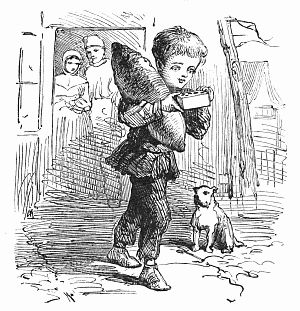
My friend took the child, and with him the great loaf, into his arms, and I really believe he kissed them both. Meanwhile the baker's wife, who did not dare to touch a cricket herself, had gone into the bakehouse. She made her husband catch four, and put them into a box with holes in the cover, so that they might breathe. She gave the box to the child, who went away perfectly happy.
When he had gone, the baker's wife and my friend gave each other a good squeeze of the hand. "Poor little fellow!" said they both together. Then she took down her account-book, and, finding the page where the mother's charges were written, made a great dash all down the page, and then wrote at the bottom, "Paid."
Meanwhile my friend, to lose no time, had put up in paper all the money in his pockets, where fortunately he had quite a sum that day, and had begged the good wife to send it at once to the mother of the little cricket-boy, with her bill receipted, and a note, in which he told her she had a son who would one day be her joy and pride.
They gave it to a baker's boy with long legs, and told him to make haste. The child, with his big loaf, his four crickets, and his little short legs, could not run very fast, so that, when he reached home, he found his mother, for the first time in many weeks with her eyes raised from her work, and a smile of peace and happiness upon her lips.
The boy believed that it was the arrival of his four little black things which had worked this miracle, and I do not think he was mistaken. Without the crickets, and his good little heart, would this happy change have taken place in his mother's fortunes?
From the French of P. J. Stahl.
PAUL AND VIRGINIA.
On the eastern coast of the mountain which rises above Port Louis in the Mauritius, upon a piece of land bearing the marks of former cultivation, are seen the ruins of two small cottages. Those ruins are situated near the centre of a valley, formed by immense rocks, and which opens only toward the north. On the left rises the mountain, called the Height of Discovery, whence the eye marks the distant sail when it first touches the verge of the horizon, and whence the signal is given when a vessel approaches the island. At the foot of this mountain stands the town of Port Louis. On the right is formed the road, which stretches from Port Louis to the Shaddock Grove, where the church bearing that name lifts its head, surrounded by its avenues of bamboo, in the midst of a spacious plain; and the prospect terminates in a forest extending to the farthest bounds of the island. The front view presents the bay, denominated the Bay of the Tomb; a little on the right is seen the Cape of Misfortune; and beyond rolls the expanded ocean, on the surface of which appear a few uninhabited islands, and, among others, the Point of Endeavor, which resembles a bastion built upon the flood.
At the entrance of the valley which presents those various objects, the echoes of the mountain incessantly repeat the hollow murmurs of the winds that shake the neighboring forests, and the tumultuous dashing of the waves which break at a distance upon the cliffs; but near the ruined cottages all is calm and still, and the only objects which there meet the eye are rude steep rocks, that rise like a surrounding rampart. Large clumps of trees grow at their base, on their rifted sides, and even on their majestic tops, where the clouds seem to repose. The showers, which their bold points attract, often paint the vivid colors of the rainbow on their green and brown declivities, and swell the sources of the little river which flows at their feet, called the river of Fan-Palms.
Within this enclosure reigns the most profound silence. The waters, the air, all the elements, are at peace. Scarcely does the echo repeat the whispers of the palm-trees spreading their broad leaves, the long points of which are gently agitated by the winds. A soft light illumines the bottom of this deep valley, on which the sun shines only at noon. But even at break of day the rays of light are thrown on the surrounding rocks; and their sharp peaks, rising above the shadows of the mountain, appear like tints of gold and purple gleaming upon the azure sky.
Here two mothers, widowed by death and desertion, nursed their children, with the sight of whom the mutual affection of the parents acquired new strength.
Madame de la Tour's child was named Virginia; her friend Margaret's, Paul. They loved to put their infants into the same bath, and lay them in the same cradle; and sometimes each nursed at her bosom the other's babe.
"My friend," said Madame de la Tour, "we shall each of us have two children, and each of our children will have two mothers."
Nothing could exceed the attachment which these infants early displayed for each other. If Paul complained, his mother pointed to Virginia, and at that sight he smiled and was appeased. If any accident befell Virginia, the cries of Paul gave notice of the disaster, and then the dear child would suppress her complaints when she found that Paul was unhappy. When I came hither, I used to see them tottering along, holding each other by the hands and under the arms, as we represent the constellation of the Twins. At night these infants often refused to be separated, and were found lying in the same cradle, their cheeks, their bosoms, pressed close together, their hands thrown round each other's neck, and sleeping locked in one another's arms.
When they began to speak, the first names they learned to give each other were those of brother and sister, and childhood knows no softer appellation. Their education served to increase their early friendship, by directing it to the supply of each other's wants. In a short time, all that regarded the household economy, the care of preparing the rural repasts, became the task of Virginia, whose labors were always crowned with the praises and kisses of her brother. As for Paul, always in motion, he dug the garden with Domingo, or followed him with a little hatchet into the woods; and if in his rambles he espied a beautiful flower, fine fruit, or a nest of birds, even at the top of a tree, he would climb up, and bring it home to his sister.
When you met one of these children, you might be sure the other was not far off. One day, as I was coming down the mountain, I saw Virginia at the end of the garden, running toward the house, with her petticoat thrown over her head, in order to screen herself from a shower of rain. At a distance, I thought she was alone; but as I hastened toward her, in order to help her on, I perceived that she held Paul by the arm, almost entirely enveloped in the same canopy, and both were laughing heartily at being sheltered together under an umbrella of their own invention. Those two charming faces placed within the swelling petticoat recalled to my mind the children of Leda enclosed within the same shell.
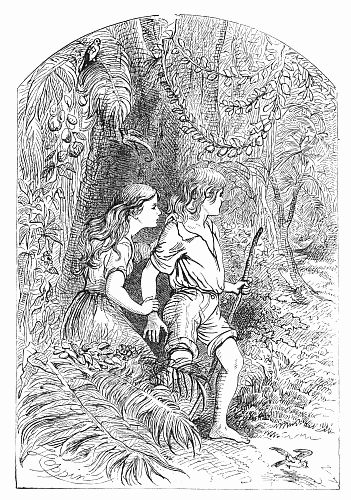
Their sole study was how to please and assist each other; for of all other things they were ignorant, and knew neither how to read nor write. They were never disturbed by inquiries about past times, nor did their curiosity extend beyond the bounds of their mountain. They believed the world ended at the shores of their own island, and all their ideas and affections were confined within its limits. Their mutual tenderness, and that of their mothers, employed all the activity of their souls. Their tears had never been called forth by tedious application to useless sciences. Their minds had never been wearied by lessons of morality, superfluous to bosoms unconscious of ill. They had never been taught not to steal, because everything with them was in common; or not to be intemperate, because their simple food was left to their own discretion; or not to lie, because they had no truth to conceal. Their young imaginations had never been terrified by the idea that God has punishments in store for ungrateful children, since with them filial affection arose naturally from maternal fondness.
Thus passed their early childhood, like a beautiful dawn, the prelude of a bright day. Already they partook with their mothers the cares of the household. As soon as the crow of the cock announced the first beam of the morning, Virginia arose, and hastened to draw water from a neighboring spring; then, returning to the house, she prepared the breakfast. When the rising sun lighted up the points of the rocks which overhang this enclosure, Margaret and her child went to the dwelling of Madame de la Tour, and offered up together their morning prayer. This sacrifice of thanksgiving always preceded their first repast, of which they often partook before the door of the cottage, seated upon the grass, under a canopy of plantain; and while the branches of that delightful tree afforded a grateful shade, its solid fruit furnished food ready prepared by Nature; and its long glossy leaves, spread upon the table, supplied the want of linen.
Perhaps the most charming spot of this enclosure was that which was called Virginia's Resting-place. At the foot of the rock which bore the name of the Discovery of Friendship is a nook, from whence issues a fountain, forming, near its source, a little spot of marshy soil in the midst of a field of rich grass. At the time Margaret brought Paul into the world, I made her a present of an Indian cocoa which had been given me, and which she planted on the border of this fenny ground, in order that the tree might one day serve to mark the epoch of her son's birth. Madame de la Tour planted another cocoa, with the same view, at the birth of Virginia. These nuts produced two cocoa-trees, which formed the only records of the two families: one was called Paul's tree; the other, Virginia's tree. They both grew in the same proportion as their two owners, a little unequally; but they rose, at the end of twelve years, above the cottages. Already their tender stalks were interwoven, and their young clusters of cocoas hung over the basin of the fountain. Except this little plantation, the nook of the rock had been left as it was decorated by Nature. On its brown and moist sides large plants of maidenhair glistened with their green and dark stars; and tufts of wave-leaved hart's-tongue, suspended like long ribbons of purpled green, floated on the winds. Near this grew a chain of the Madagascar periwinkle, the flowers of which resemble the red gillyflower; and the long-podded capsicum, the seed-vessels of which are of the color of blood, and more glowing than coral. Hard by, the herb of balm, with its leaves within the heart, and the sweet basil, which has the odor of the gillyflower, exhaled the most delicious perfumes. From the steep side of the mountain hung the graceful lianas, like floating drapery, forming magnificent canopies of verdure upon the sides of the rocks. The sea-birds, allured by the stillness of those retreats, resorted thither to pass the night. At the hour of sunset we could see the curlew and the stint skimming along the sea-shore; the black frigate-bird poised high in air; and the white bird of the tropic, which abandons, with the star of day, the solitudes of the Indian Ocean. Virginia loved to rest upon the border of this fountain, decorated with wild and sublime magnificence. She often seated herself beneath the shade of the two cocoa-trees, and there she sometimes led her goats to graze. While she was making cheeses of their milk, she loved to see them browse on the maidenhair which grew upon the steep sides of the rock, and hung suspended upon one of its cornices, as on a pedestal. Paul, observing that Virginia was fond of this spot, brought thither, from the neighboring forest, a great variety of bird's-nests. The old birds, following their young, established themselves in this new colony. Virginia, at certain times, distributed among them grains of rice, millet, and maize. As soon as she appeared, the whistling blackbird, the amadavid bird, the note of which is so soft, the cardinal, with its plumage the color of flame, forsook their bushes; the paroquet, green as an emerald, descended from the neighboring fan-palms; the partridge ran along the grass; all came running helter-skelter toward her, like a brood of chickens, and she and Paul delighted to observe their sports, their repasts, and their loves.
Amiable children! thus passed your early days in innocence, and in the exercise of benevolence. How many times, on this very spot, have your mothers, pressing you in their arms, blessed Heaven for the consolations that you were preparing for their declining years, and that they could see you begin life under such happy auspices! How many times, beneath the shade of those rocks, have I partaken with them of your rural repasts, which cost no animal its life! Gourds filled with milk, fresh eggs, cakes of rice placed upon plantain leaves, baskets loaded with mangoes, oranges, dates, pomegranates, pine-apples, furnished at once the most wholesome food, the most beautiful colors, and the most delicious juices.
The conversation was gentle and innocent as the repasts. Paul often talked of the labors of the day and those of the morrow. He was continually planning something useful for their little society. Here he discovered that the paths were rough; there that the seats were uncomfortable; sometimes the young arbors did not afford sufficient shade, and Virginia might be better pleased elsewhere.
In the rainy season the two families met together in the cottage, and employed themselves in weaving mats of grass and baskets of bamboo. Rakes, spades, and hatchets were ranged along the walls in the most perfect order; and near these instruments of agriculture were placed its products,—sacks of rice, sheaves of corn, and baskets of plantains. Some degree of luxury is usually united with plenty, and Virginia was taught by her mother and Margaret to prepare sherbet and cordials from the juice of the sugar-cane, the lemon, and the citron.
When night came, they all supped together by the light of a lamp; after which Madame de la Tour or Margaret told stories of travellers lost during the night in forests of Europe infested by banditti; or of some shipwrecked vessel, thrown by the tempest upon the rocks of a desert island. To these recitals their children listened with eager sensibility, and earnestly begged that Heaven would grant they might one day have the joy of showing their hospitality towards such unfortunate persons. At length the two families would separate and retire to rest, impatient to meet again the next morning. Sometimes they were lulled to repose by the beating rains which fell in torrents upon the roofs of their cottages, and sometimes by the hollow winds, which brought to their ear the distant murmur of the waves breaking upon the shore. They blessed God for their own safety, of which their feeling became stronger from the idea of remote danger.
Bernardin de Saint Pierre.
OEYVIND AND MARIT.
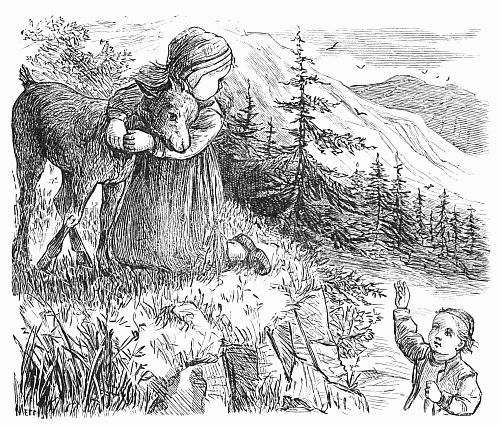
Oeyvind was his name. A low barren cliff overhung the house in which he was born; fir and birch looked down on the roof, and wild-cherry strewed flowers over it. Upon this roof there walked about a little goat, which belonged to Oeyvind. He was kept there that he might not go astray; and Oeyvind carried leaves and grass up to him. One fine day the goat leaped down, and—away to the cliff; he went straight up, and came where he never had been before. Oeyvind did not see him when he came out after dinner, and thought immediately of the fox. He grew hot all over, looked around about, and called, "Killy-killy-killy-goat!"
"Bay-ay-ay," said the goat, from the brow of the hill, as he cocked his head on one side and looked down.
But at the side of the goat there kneeled a little girl.
"Is it yours, this goat?" she asked.
Oeyvind stood with eyes and mouth wide open, thrust both hands into the breeches he had on, and asked, "Who are you?"
"I am Marit, mother's little one, father's fiddle, the elf in the house, grand-daughter of Ole Nordistuen of the Heide farms, four years old in the autumn, two days after the frost nights, I!"
"Are you really?" he said, and drew a long breath, which he had not dared to do so long as she was speaking.
"Is it yours, this goat?" asked the girl again.
"Ye-es," he said, and looked up.
"I have taken such a fancy to the goat. You will not give it to me?"
"No, that I won't."
She lay kicking her legs, and looking down at him, and then she said, "But if I give you a butter-cake for the goat, can I have him then?"
Oeyvind came of poor people, and had eaten butter-cake only once in his life, that was when grandpapa came there, and anything like it he had never eaten before nor since. He looked up at the girl. "Let me see the butter-cake first," said he.
She was not long about it, took out a large cake, which she held in her hand. "Here it is," she said, and threw it down.
"Ow, it went to pieces," said the boy. He gathered up every bit with the utmost care; he could not help tasting the very smallest, and that was so good, he had to taste another, and, before he knew it himself, he had eaten up the whole cake.
"Now the goat is mine," said the girl. The boy stopped with the last bit in his mouth, the girl lay and laughed, and the goat stood by her side, with white breast and dark brown hair, looking sideways down.
"Could you not wait a little while?" begged the boy; his heart began to beat. Then the girl laughed still more, and got up quickly on her knees.
"No, the goat is mine," she said, and threw her arms round its neck, loosened one of her garters, and fastened it round. Oeyvind looked up. She got up, and began pulling at the goat; it would not follow, and twisted its neck downwards to where Oeyvind stood. "Bay-ay-ay," it said. But she took hold of its hair with one hand, pulled the string with the other, and said gently, "Come, goat, and you shall go into the room and eat out of mother's dish and my apron." And then she sung,—
"Come, boy's goat, Come, mother's calf, Come, mewing cat In snow-white shoes. Come, yellow ducks, Come out of your hiding-place; Come, little chickens, Who can hardly go; Come, my doves With soft feathers; See, the grass is wet, But the sun does you good; And early, early is it in summer, But call for the autumn, and it will come."
There stood the boy.
He had taken care of the goat since the winter before, when it was born, and he had never imagined he could lose it; but now it was done in a moment, and he should never see it again.
His mother came up humming from the beach, with wooden pans which she had scoured: she saw the boy sitting with his legs crossed under him on the grass, crying, and she went up to him.
"What are you crying about?"
"O, the goat, the goat!"
"Yes; where is the goat?" asked his mother, looking up at the roof.
"It will never come back again," said the boy.
"Dear me! how could that happen?"
He would not confess immediately.
"Has the fox taken it?"
"Ah, if it only were the fox!"
"Are you crazy?" said his mother; "what has become of the goat?"
"Oh-h-h—I happened to—to—to sell it for a cake!"
As soon as he had uttered the word, he understood what it was to sell the goat for a cake; he had not thought of it before. His mother said,—
"What do you suppose the little goat thinks of you, when you could sell him for a cake?"
And the boy thought about it, and felt sure that he could never again be happy in this world, and not even in heaven, he thought afterwards. He felt so sorry, that he promised himself never again to do anything wrong, never to cut the thread on the spinning-wheel, nor let the goats out, nor go down to the sea alone. He fell asleep where he lay, and dreamed about the goat, that it had gone to Heaven; our Lord sat there with a great beard as in the catechism, and the goat stood eating the leaves off a shining tree; but Oeyvind sat alone on the roof, and could not come up.
Suddenly there came something wet close up to his ear, and he started up. "Bay-ay-ay!" it said; and it was the goat, who had come back again.
"What! have you got back?" He jumped up, took it by the two fore-legs, and danced with it as if it were a brother; he pulled its beard, and he was just going in to his mother with it, when he heard some one behind him, and, looking, saw the girl sitting on the greensward by his side. Now he understood it all, and let go the goat.
"Is it you, who have come with it?"
She sat, tearing the grass up with her hands, and said,—
"They would not let me keep it; grandfather is sitting up there, waiting."
While the boy stood looking at her, he heard a sharp voice from the road above call out, "Now!"
Then she remembered what she was to do; she rose, went over to Oeyvind, put one of her muddy hands into his, and, turning her face away, said,—
"I beg your pardon!"
But then her courage was all gone; she threw herself over the goat, and wept.
"I think you had better keep the goat," said Oeyvind, looking the other way.
"Come, make haste!" said grandpapa, up on the hill; and Marit rose, and walked with reluctant feet upwards.
"You are forgetting your garter," Oeyvind called after her. She turned round, and looked first at the garter and then at him. At last she came to a great resolution, and said, in a choked voice,—
"You may keep that."
He went over to her, and, taking her hand, said,—
"Thank you!"
"O, nothing to thank for!" she answered, but drew a long sigh, and walked on.
He sat down on the grass again. The goat walked about near him, but he was no longer so pleased with it as before.
The goat was fastened to the wall; but Oeyvind walked about, looking up at the cliff. His mother came out, and sat down by his side; he wanted to hear stories about what was far away, for now the goat no longer satisfied him. So she told him how once every thing could talk: the mountain talked to the stream, and the stream to the river, the river to the sea, and the sea to the sky; but then he asked if the sky did not talk to any one; and the sky talked to the clouds, the clouds to the trees, the trees to the grass, the grass to the flies, the flies to the animals, the animals to the children, the children to the grown-up people; and so it went on, until it had gone round, and no one could tell where it had begun. Oeyvind looked at the mountain, the trees, the sky, and had never really seen them before. The cat came out at that moment, and lay down on the stone before the door in the sunshine.
"What does the cat say?" asked Oeyvind, pointing. His mother sang,—
"At evening softly shines the sun, The cat lies lazy on the stone. Two small mice, Cream thick and nice, Four bits of fish, I stole behind a dish, And am so lazy and tired, Because so well I have fared,"
says the cat.
But then came the cock, with all the hens. "What does the cock say?" asked Oeyvind, clapping his hands together. His mother sang,—
"The mother-hen her wings doth sink, The cock stands on one leg to think: That gray goose Steers high her course; But sure am I that never she As clever as a cock can be. Run in, you hens, keep under the roof to-day, For the sun has got leave to stay away,"
says the cock.
But the little birds were sitting on the ridge-pole, singing. "What do the birds say?" asked Oeyvind, laughing.
"Dear Lord, how pleasant is life, For those who have neither toil nor strife,"
say the birds.
And she told him what they all said, down to the ant, who crawled in the moss, and the worm who worked in the bark.
That same summer, his mother began to teach him to read. He had owned books a long time, and often wondered how it would seem when they also began to talk. Now the letters turned into animals, birds, and everything else; but soon they began to walk together, two and two; a stood and rested under a tree, which was called b; then came c, and did the same; but when three or four came together, it seemed as if they were angry with each other, for it would not go right. And the farther along he came, the more he forgot what they were: he remembered longest a, which he liked best; it was a little black lamb, and was friends with everybody; but soon he forgot a also: the book had no more stories, nothing but lessons.
One day his mother came in, and said to him,—
"To-morrow school begins, and then you are going up to the farm with me."
Oeyvind had heard that school was a place where many boys played together; and he had no objection. Indeed, he was much pleased. He had often been at the farm, but never when there was school there; and now he was so anxious to get there, he walked faster than his mother up over the hills. As they came up to the neighboring house, a tremendous buzzing, like that from the water-mill at home, met their ears; and he asked his mother what it was.
"That is the children reading," she answered; and he was much pleased, for that was the way he used to read, before he knew the letters. When he came in, there sat as many children round a table as he had ever seen at church; others were sitting on their luncheon-boxes, which were ranged round the walls; some stood in small groups round a large printed card; the schoolmaster, an old gray-haired man, was sitting on a stool by the chimney-corner, filling his pipe. They all looked up as Oeyvind and his mother entered, and the mill-hum ceased as if the water had suddenly been turned off. All looked at the new-comers; the mother bowed to the schoolmaster, who returned her greeting.
"Here I bring a little boy who wants to learn to read," said his mother.
"What is the fellow's name?" said the schoolmaster, diving down into his pouch after tobacco.
"Oeyvind," said his mother; "he knows his letters, and can put them together."
"Is it possible!" said the schoolmaster; "come here, you Whitehead!"
Oeyvind went over to him: the schoolmaster took him on his lap, and raised his cap.
"What a nice little boy!" said he, and stroked his hair. Oeyvind looked up into his eyes, and laughed.
"Is it at me you are laughing?" asked he, with a frown.