Chapter XXVII · A SHORT SKETCH AND MARKS OF JAPANESE PORCELAIN AND POTTERY
Reading edition
Although we do not possess any complete documentary evidence on Ceramics in Japan, and although much of what we do know has been obtained by Englishmen in that country, there is no doubt that this art had its origin in remote antiquity, and that the Japanese seem always to have possessed in a high degree a very vivid sentiment of decoration, happily combined with an extraordinary facility of execution.
The making of porcelain only dates from the beginning of the sixteenth century, when Shonsui, returning from China, where he had learned the secrets of the trade, constructed several furnaces in localities where he found the necessary materials. He settled at Arita, in Hizen, the nearest port to which is Imari, a name familiar to all collectors as a common name for all Japanese porcelain. But this old Imari is always white with designs painted in blue under the glaze.
A hundred years after an Imari potter learnt, under the direction of a Chinese established at Nagasaki, the art of painting and decorating in various colours the porcelain which he sold to Chinese merchants. They in their turn exported it to Europe through the East India Company, so that considerable quantities arrived in England, where it is found to-day in a large number of families which have preserved the tastes of their forefathers. Arita or Imari were names indifferently applied to this porcelain.
Amongst the other numerous works where pottery and porcelain were made the following list comprises the chief: Awata, Banko or Imbe, Kaga or Kutani, with beautiful red and gold decoration; Kioto, Kishu, Nabeshima, Satsuma, Soma, Sanda, Séto (in the province of Owari, to-day one of the largest centres of production), and Tokio.
Japanese porcelain is distinguished from Chinese by a closer imitation from nature in the flowers and birds, and, above all, by much more correct design, more chaste and elegant in the representation of the human figure. The marks are often impressed or stamped in a circle, oblong or oval, and frequently, too, Chinese marks are imitated.
It will be useful to indicate some characteristics of the chief of the factories mentioned above.
Imari, Arita, Or Hizen Porcelain.
The oldest Imari has been referred to before. The period of the seventeenth century is noted for decoration with enamels over the glaze. The paste or body was fine and pure, the glaze milk-white, soft, yet not wanting in brilliancy, forming a ground harmonising with the severely simple decoration. The enamel colours were few, but clear and rich in tone, chiefly a dull red, a grass-green, and a lilac-blue. The decorative subjects were, most commonly, floral medallions; but the dragon, Phœnix, bamboo plum (prunus flower), birds fluttering over a sheaf of corn, and various diaper patterns were constantly used. The designs, sparsely scattered over the surface, give each as wide a margin as possible. The Imari ware, "old Japan ware" exported in the eighteenth and nineteenth centuries, was a distinct type, made to please European taste. The decoration is usually violet, red, and gold added to a plain white glaze or to the blue and white.
Hirado Blue and White Porcelain.
This is said to mark the highest degree of perfection and beauty ever attained. The paste is fine, pure, and white, free from the dark gritty particles found nearly always in Imari ware. The blue—the only colour employed, with rare exceptions—is exquisitely soft and clear and seems to float in the milk-white, velvet-like glaze. The designs are of many subjects, etched with wonderful skill. Only within the last few years in Europe did the passion for blue and white induce Japanese owners to sell, and the supply was soon exhausted. It is well to note that modern imitations are not pure white, but greenish, and they are less perfectly potted. It was from Hirado porcelain that Bow and Plymouth modelled their pieces with raised shells and seaweed, and Dresden, too, copied the figures, birds, and flowers in relief. Hirado was a private kiln where the workmen were forbidden to sell without permission.
Nabeshima Ware.
The feudal chief of Hizen at his private kilns produced blue and white porcelain of fine paste and colour, and generally with a characteristic combination of red. The potters did not, as a rule, use marks, but they copied Chinese marks on pieces which were reproductions of Chinese patterns. Like Hirado, Nabeshima had no occasion to mark as though the porcelain was intended for sale.
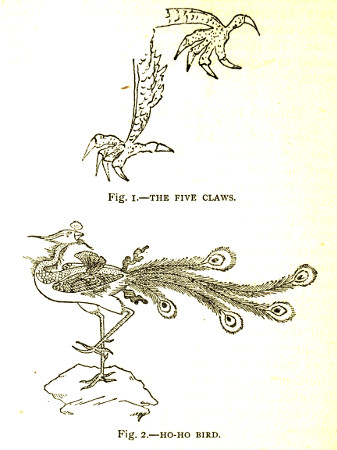
Fig. 1.—THE FIVE CLAWS.
Fig. 2.—HO-HO BIRD.
The designs and symbolical marks copied from China have the same meaning to the Japanese.
The dragon is often found as a design, in various colours and in gold. The place of dragons in Buddhism explains their frequent appearance—indeed, they are "the masters of the world." If they are offended they punish men with plague, pestilence, and famine. Hence they must be propitiated.
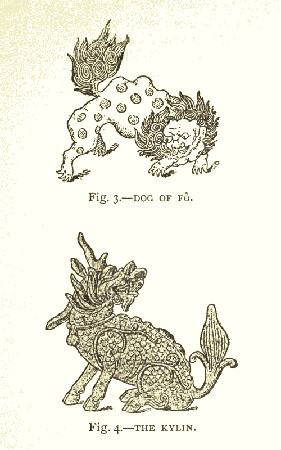
Fig. 3.—DOG OF FÔ.
Fig. 4.—THE KYLIN.
Fig. 1 shows the five claws of the best kind of dragon-decorated Oriental, said to be made for Imperial use.
Fig. 2 is the Fong-Hoang, sometimes called the Ho-Ho bird. This was the symbol of the sovereigns of China before the five-clawed dragon. Drawings of this bird vary very much; when represented in the air the feet are thrown back.
Fig. 3 is the dog of Fô, or Buddha, often called the Korean lion, still more often, and wrongly, the kylin. The one is the lion transformed, and
Fig. 4, the kylin, is more like the unicorn. Its head resembles that of a dragon. Often its body is covered with scales, and its hoofs are cloven.
XXVIII SATSUMA POTTERY, &c.
CHAPTER XXVIII SATSUMA POTTERY
Whilst in porcelain Japan copied Chinese patterns, in pottery native talent had full scope for its original and personal character, so ably shown both in shape and decoration. Amongst all the pottery Satsuma takes the first place; indeed, no collection is complete unless it has a specimen, although fine pieces are very rare. Much of what is called old Satsuma has been produced at Kyoto and Yokohama for export, and has very little in common with the ware so highly prized by collectors in Japan. Showy, brilliant, and decorative reproductions are met with frequently, but neither in paste or painting are they comparable. Real old Satsuma, at first sight, looks like ivory, and the designs display infinite care, the colours being low in tone, whilst the gold is pencilled with such a multitude of minute lines as to be truly wonderful.
The glazes are often enamelled; yellow and black, both remarkable, but exceedingly rare, are monochromes; so, too, is olive-green, which is seldom used alone, but in conjunction with a dark yellow or dark brown. Various articles, such as tea jars, teapots, and incense boxes, have usually these glazes. Another glaze, called "Flambées," or "Flammées," is like shot-silk, e.g., red jasper and violet, and violet and blue. The colouration, no doubt at first accidental, was later obtained by the combination of metals with the oxygen in the air and during the firing, so that the results were defined and certain.
The old potters confined their decorations to diapers, floral subjects, landscapes, and the Chinese subjects—the Ho-Ho birds, the mythical lion, the dragon, and the kylin.
Two kinds of pottery were made at Satsuma, and the self-glazes, either monochrome or flambée, are, for the most part, applied to the red, and not to the white kind. In other words, the paste or body of the piece is red, and by comparing a few specimens the difference between that and the white can soon be determined.
When the potter cuts the turned piece from the clay on the wheel he uses a string; and in Satsuma ware the string-mark can be detected on the bottom of the piece. Again, the Satsuma potter turned the throwing-wheel with the left foot, but other potters used the right; hence the spiral in the paste is from left to right in Satsuma, from right to left in other factories. Pure white faïence, cleverly moulded and reticulated, was a celebrated and favourite product of the ancient potters.
Spurious Satsuma is one of the most common and disfiguring features of both public and private collections.
Kyoto Pottery.
Much of the later pottery from Kyoto was made in imitation of Satsuma. At the Paris Exhibition of 1878, such imitations of pieces decorated in relief had a great success. But Kyoto has one name which stamps the seventeenth century productions as marking the adoption of the representative Japan style. There was Ninsei, who shook himself free from the influence of China and Korea, and, having acquired the secrets of decoration with enamels, he set to work to practice and impart them in the various factories at Kyoto where he worked.
He introduced a crackle, which of itself is a test between old and modern ware. The glaze was of a light buff or cream colour, and the crackle was nearly circular and very fine, and is best described as "fish-roe crackle." The paste of his pieces varied from hard, close brick-red clay to a fine-textured yellowish grey. The coloured glazes—blue, green, red, black, and gold—were also introduced by him to the Kyoto kilns. The black glaze was run over a grass-green one, so as to give brilliancy of effect, whilst panels of cream crackle on the surface were painted in diaper patterns or with floral designs in gold, silver, or coloured enamels. Another glaze, since imitated successfully, was a pearl white with a kind of pink blush spreading through it.
As a rule Ninsei marked his pieces; the mark is given. Two or three hundred dollars are readily paid in Japan for a small bowl of the best type, so genuine specimens are exceedingly rare in Europe. It is well to reiterate two tests which may be easily applied to Ninsei pieces—the paste is hard and brick-red or yellowish grey in colour, and the crackles are equal and circular in shape.
Awata Ware.
Here, too, Satsuma ware has in recent years been largely imitated. At the Amsterdam Exhibition a fine collection was on view. But Awata had kilns as early as the beginning of the seventeenth century, and a clever workman, Kinkôzan, about a century later, did much to bring back the reputation lost after Ninsei's influence had passed away. The glaze under his treatment was creamy and lustrous. The enamels, which harmonised so well with the glaze, were grass-green, ultramarine, and red. Gold was almost invariably used in decoration. Silver, purple, and yellow are most uncommon.
It must be borne in mind that the majority of the Awata pieces were unmarked.
Generally, three rules are equally valuable in judging the age of all Kyoto wares, including Awata and other places close by. First, the paste of the old pieces is close-grained and hard; second, the glaze has a lustre, which may be due to atmospheric influence long continued; third, the enamel colours are carefully painted, and are very bright and clear.
Marks:—
(1) The chrysanthemum, arms or crest of the Mikado.
(2) The kiri, said to be stamped on articles for royal use exclusively.
(3)(4)(5) Satsuma marks.
(6) The marshmallow, crest of Tokougava Satsuma ware.
(7) Ninsei's name; stamped with sunk letters, Kyoto.
(8) Shimizu, a maker's name, in a long oval. Kyoto.
(9) Taizan, a potter of Kyoto.
(10)(11) Used at Kyoto by Yeiraku.
(12) Awata ware, also used in a small size.
(13) Awata, mark of another factory.
(14) On pottery made in imitation of Satsuma.
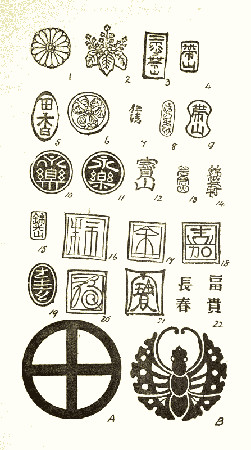
(15) Awata. Kinkôzan's mark stamped.
(16) Seal character, "Prosperity."
(17) Seal character, "Gold."
(18) Seal character, "Felicity."
(19) Shigen, a maker's name, probably Kyoto.
(20) Seal character, "Happiness."
(21) Seal character, "Precious."
(22) Inscribed mark, "An eternal spring of riches and honours."
(A) Crest of Shimadzou, Prince of Satsuma.
(B) Crest of Ikeda, Prince of Bizen.
Other blasons of Japanese princes.
The sale prices of "Old Japanese" will, for a little, vary the subject under consideration. The demand is great, the supply limited; so prices will rise higher yet.
Old Imari dish, painted with vase of flowers, having shaped panels on dark blue and gold ground, £7 7s.
Set of three octagonal vases—old Imari—similar decoration, with festoons and tassels on the shoulders, £36 5s.
A pair octagonal vases—old Imari—similar decoration, £65 2s.
Another dish, old Imari, vase of flowers in centre, Ho-Ho birds round the border, with flowers. Colours: red, blue, and gold. £12 12s.
From the Hayashi Collection.—Hirado cat, life-size, couching. £20 8s.
(Note.—Hirado, Hirato, or Harito are used indifferently.)
At the same sale.—Two Arita porcelain cups, £5; two scent or incense burners, £4 4s.
Other sales.—Bowl, in Ninsei pottery, £26; scent burner, Satsuma, £28 16s.; vase, Bizen ware, £26; blue, red, and gold ground, probably Imari, £10; another vase, decorated with Ho-Ho birds, same colours as the last, Hôtel Drouot, Paris, £100; bottles, pair of old Imari, fluted and painted in red, blue, and gold, £27 6s.; vases and covers, pair, old Hizen, decorated with birds, flowers, wheels, and scrolls in rich colours and gold, £35 14s.
It must be remembered that the finest Japanese, copied from Chinese models, is sold frequently as Chinese.
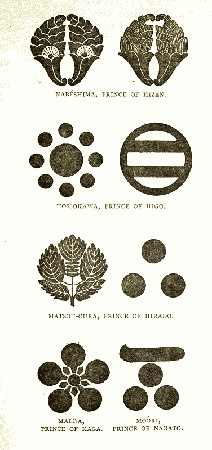
NABÉSHIMA, PRINCE OF HIZEN.
HOSSOKAWA, PRINCE OF HIGO.
MATSOU-OURA, PRINCE OF HIRADO.
MALDA, PRINCE OF KAGA.
MOÔRI, PRINCE OF NAGATO
XXIX BIZEN OR IMBE, &c.
CHAPTER XXIX BIZEN OR IMBE
The chief objects made at Bizen were vases, incense-burners, and numerous figures of animals and persons. Amongst the last are found a number of mythical divinities illustrating the two religions of Japan, Shintoism and Buddhism, especially the latter. Before me, as I write, is a good specimen of old Bizen. It is the figure of Hotei, the god of Contentment. Brown glazed ware with a paste of fine, hard red clay. He is standing on a wind-bag with his dress open to his waist, and his laugh is typical of the wonderful facial expression often to be found in Oriental figures. The pottery of Bizen was made at a very early date, but the early specimens were of a coarse, gritty red paste with no glaze, and only common articles were made. Then, in the sixteenth century, more attention was paid to the preparation of the clay, and Chinese copies were imitated. The most valued pieces of this old Bizen are those stamped with a new moon or a cherry blossom. A century later a white-brown paste, fine and nearly as hard as porcelain, was used largely for figures. This was followed by the use of the red clay. It is interesting to notice the glaze applied to this kind of Bizen. The figure of Hotei illustrates this unique bronzing, as it were. The colour and metallic lustre are so good that the figure has often been mistaken for bronze. Choice specimens are to be found with salt glazes, brown, grey, and white, and of these the last is rarest. One other peculiarity of all Bizen is that the glaze is absorbed into the paste; this is said to be due to continued firing. When struck the pieces ring very clearly, whilst the modern production has a dead, dull sound. The Bizen pottery of our own time is degenerate. The monstrosities to be found in curiosity shops are neither artistic nor interesting.
Kutani Porcelain and Pottery.
Kutani, in the province of Kaga, produced pottery of dark clay with a light chocolate glaze about the middle of the seventeenth century. Later, one of the potters, who was sent to Hizen for the purpose, brought back information which led to great improvement. At the end of that century, and early in the next, two wares were produced. One is marked by a deep green glaze, which formed an effective and striking decoration, but other glazes were also used on these other wares, notably deep purple, yellow, and a soft blue. The other class was an imitation of Hizen ware, with the difference that blue under the glaze was not associated with enamel colours over the glaze. In addition to the colours mentioned a beautiful red was introduced and gold was added.
The artistic designs were purely Japanese bits of nature-painting, tiny landscapes, birds on plum branches, and other simple but striking subjects of this kind. The contrast to the Imari ware, with its bold masses of blossoms and colours, is as great as it is with modern Kutani. The latter often has peacocks, groups of brilliant peonies and chrysanthemums, brightly dressed women and wonderful old men, cocks upon barrels, and other well-known subjects. The only figures on old Kutani are children playing.
The paste is of a bad colour, a kind of dirty white. It passes from stoneware to porcelain, according to the nature of the clay, much of which was imported, and which was sometimes mixed with the clay found at Kutani. The other makers of porcelain frequently sent their pieces in a white state to be decorated here, and this was done especially from Arita. From this it will be seen that the Kutani mark appears on porcelain varying in composition. Thus there are stoneware and excellent porcelain. Some of it will bear comparison with the best Hizen egg-shell. What tests should be applied to find out whether the specimen submitted is old Kutani or not? One has been given—it is this: blue under the glaze is not employed in conjunction with enamel decoration. Then there is the tone of the blue. Reference has been made to the rich blue of Imari, the exquisite soft and clear blue of Hirado, but the Kutani blue is, like the paste often is, inferior in quality. The glaze, however, has a wax-like surface which is distinctive. In the coloured specimens the severe nature of the decoration and the beauty and lustre of the enamels are characteristic features.
But Kutani copied Chinese originals in the best style, so that if such specimens were bought in China they would pass for good examples of the best period. But in Japan, as in China, porcelain is made of two earths, one fusible, the other infusible, and owing to the difference in the matter of firing, most Japanese porcelain has spur-marks or small projections on the bottom, produced by the supports used in the process of firing. Otherwise, the same means are employed in making and decorating porcelain in both countries.
Kenzan Ware.
Ninsei and Kinkozan have been mentioned as celebrated potters, Kenzan and Yeiraku must be added to them. Kenzan at first imitated the Ninsei ware of Kyoto, but, being himself an artist and a brother of the celebrated painter Ogato Korin, he soon developed an original and genuine Japanese style in which striking results were produced with a seeming absence of laboured detail. The simplicity of a branch of prunus blossoms, a few nodding reeds or grasses, a little group of birds amidst the foliage, the distant hill seen through the midst, suited the space available for decoration. He used black, brown, green, blue, and purple in plain colours, and enamels as well as gold. His early work was done on Awata pottery, but his style is unmistakable, and he marked all his pieces with his name "Kenzan." Other specimens of his bold outline sketches are found on a coarse ware with a gritty paste. At a later period he went to Iriya, in Tokio, but owing to unsatisfactory materials for the making of pottery nothing very great was accomplished. His productions are exceedingly rare and proportionately valuable. His family still have a kiln near Kyoto, and his son and grandson imitated his style, including the mark, with some success.
Yeiraku Ware.
There is an ancient pottery at Kyoto, founded by a family named Sozen and later Yeiraku, a title bestowed upon them by the Prince of Kü or Kishu. The present potter is of the same name and he still makes earthenware and porcelain. It was about 1600 when Yeiraku—then Zengoro-Hozen—began to make unglazed tea urns as his ancestors had done. As a recreation he tried experiments with pastes and glazes, which attracted considerable attention, and secured for him an invitation from the Prince of Kishu to come to his province. Here Yeiraku ware was made, so called from the stamp it bears. Zengoro made glazes his special study, and produced rich combinations of turquoise, blue, purple, and yellow, but more than these was his successful coral-red glaze, made in imitation of the old Chinese "vivid red" of the Yung-lo period. This last achievement gained for him the gift of a golden stamp, "Yeiraku," and the name which the family has borne for so many years. Yeiraku's skill was often tested by orders to copy all sorts of Chinese, Korean, and even Dutch pieces, which he did so well that the original and its imitation could not be distinguished. Yeiraku was wealthy now, and could have gone into easy retirement. Yet such was his love of his art that he worked on. He had produced the purple, yellow, turquoise, green, and the blue and white, also the coral red and enamelled porcelains of China, but he tried fruitlessly to get the tin glaze of Delft and the various glazes of lakes of the Chinese.
The illustrations given of the goddess Kuwanon, in Chinese Kouanyin or Kwan Yin, show one of the most interesting of the Buddhist deities. She was reincarnated at least thirty-three times, as a man, a woman, a demon, and so on, for the greatest good of humanity. Still, it is in the feminine form that her figure is most frequently found in Japanese porcelain and pottery, as well as in Chinese. Her hair is in the style of Louis XIV., she wears a necklace bearing an ornament in the form of a cross, and, being "the giver of children," she is holding a little child, whilst Loung-nou and Hoang-tchen-sai, her two servants, stand at her right and left. Perhaps the rarest of these figures is in the cream-white porcelain of Nankin. A figure of this goddess was recently sold for £45.
XXX KISHU PORCELAIN AND POTTERY, &c.
CHAPTER XXX KISHU PORCELAIN AND POTTERY, ETC.
Both porcelain and pottery were made at Wakayama, and are known as Kishu ware. The ornamentation consisted of formal patterns in low relief, the intervening spaces being filled with coloured glazes, chiefly blue, deep purple, and yellow, though green and white were not unfrequently used. Perhaps the most common was a ground of purple, with the scroll-work in relief and some parts of it covered with turquoise-blue. Some very fine pieces had a rich green glaze marbled with purple with medallions in other colours. These glazes are amongst the finest produced in Japan.
The paste varied from porcelain to stoneware, and, like many factories, was sometimes white, sometimes a red grey. It was fine in texture, and hard.
Yeiraku's work was largely done in this private kiln, and many of the pieces bear his stamp. It is said that he made from five to ten specimens of any object he undertook to produce, that the best was chosen and the rest destroyed.
Banko Pottery.
As early as 1680 a factory was established at a village near Tokio, and produced articles which resembled some of the Kutani wares, but towards the end of the eighteenth century a rich amateur, Gozayemon, who had previously acquired a great reputation as a copyist, was induced by the then Shogun to leave Isé and to continue his work in Tokio, where his productions became the fashion, partly because of their merits, partly owing to the difficulty experienced in securing them.
He now adopted the purely Japanese style, and combined with it the beauty of the Chinese glazes in different colours, and it was when he ceased to be an imitator and became an originator that he became an artist. He imitated every kind of ware, from coarse Korean pottery and the brilliant colours of China to the severe styles of Ninsei and Kenzam. His pieces were generally marked. He also made many imitations of Dutch delft.
After his death, the son of a dealer of Isé, into whose hands the formula of Gozayemoné had fallen, assumed the name of Banko, after having bought the stamp from his grandson. He made a peculiar kind of stoneware, unglazed, in which the mould, made up of several sections, was placed inside the clay to be modelled. Hence, on the outside, the lines of the skin of the hand are shown, and the designs are as sharp, if not sharper, inside as outside the pottery, which from this method of working had to be very thin. He also decorated pieces with storks, dragons, &c., in relief and other pieces, with clever designs in coloured slips on a green or deep brown ground. This Isé Banko ware is nearly always stamped.
Soma Ware.
This is a most peculiar ware, which consisted chiefly of small teacups or bowls, having a rough indented surface on the outside, but remarkably smooth to the lips, with a horse in relief or painted, sometimes tied to a stake. The name of the ware and the badge were derived from the Prince of the territory. The ceremony of tea-drinking amongst the Japanese was almost a cult. The rites were followed under the direction of a Tchadjin, or master of the ceremonies, and, amongst other usages, the shape and decoration of the cups varied with the season. Some were made by hand instead of by the aid of a wheel, and most of the factories tried to satisfy the native connoisseur.
Sanda Ware.
In 1690 a kiln was erected by the Prince of the province of Setsu to imitate Chinese Celadon. At first pottery was made, but towards the end of the eighteenth century porcelain methods were brought from Arita with such successful results that the excellent sea-green Celadon of Sanda attained great celebrity, in some degree owing to the considerable quantity of it which was made. In colour Sanda Celadon is bright green, less warm than that of China and less delicate than the Nabeshima ware.
Sheba Ware.
The eggshell porcelain of Japan is not ancient, but near Tokio a factory produces saki cups which are exceedingly pretty, being elegant in shape and decoration and having a thin delicate paste. Sometimes they are covered outside with basket-work, very finely woven.
Notes on Other Wares.
At Seto, in Owari province, both porcelain and pottery were made; the former was an importation from Arita, which has now become so important that porcelain in Japan is known as Seto-mono or Seto ware. Here, too, was made a kind of stoneware much esteemed by the tea clubs.
At Inuyama, also in Owari, imitations of Chinese porcelain were made, and called Agaye. Many kilns are still at work here.
At Karatsu, in Hizen, was an ancient factory, now closed, which had a great reputation for the manufacture of the utensils required by the tea clubs.
At Nagano-mura, a pottery produced ware with a streaky glaze, but not painted. Close by, Iga made a singularly rough ware.
At Sobara-mura, Takatori ware, chiefly vases to hold incense, of a rich brown glazed stoneware, was manufactured. Many makers in various kilns made the bowls for drinking tea, which was the finest green tea, ground to powder, frothed up with a brush, and passed in a bowl from hand to hand. Raku ware, so called from the inscribed mark Raku (happiness), consisted chiefly of tea-bowls.
Nothing need be said of the modern Japanese potters. The greater part of the modern imports is too bad for words, and none need be wasted on it. Yet, amidst much that is thoroughly bad, there are still some master potters in Kyoto, Tokio, Yokohama, Seyfou, and elsewhere, whose work is well worth buying.
It will be well to remember that old Japanese has two classes, one with a white, semi-transparent paste with very simple designs—a plum-tree and two quails, the tortoise with the hairy tail, the phœnix, a few storks, or more rarely a Japanese lady in full dress. The colours used were red, a pale but bright blue, an apple-green, and an unusual lilac often with the butterfly mark. Dresden, Chelsea, St. Cloud, and other works imitated this class.
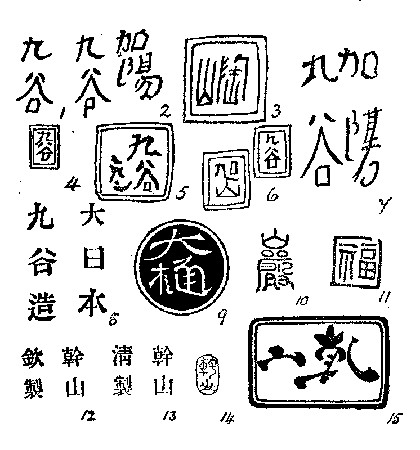
The second class, also imitated in Europe, as at Derby, for example, had the chrysanthemum and peony decoration; the ornaments are in compartments or panels, enclosing mythical animals. Specimens before me are decorated with a deep blue and gold. The other colours chiefly used are a deep red and a bright black and green. The kiri or kiku flower, with seventeen blossoms and three leaves, is frequently used. It is the Imperial badge. The covers of the vases and jars have figures in Japanese dress or Korean lions on the top. Most of the beautifully decorated specimens were made for export, the Japanese value the rough, artistic, but characteristic work.
Marks.
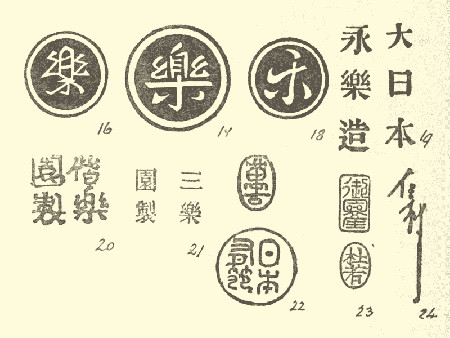
(1) Kutani, or Kaga, often with other marks. This is the Prince's mark.
(2-5) Kutani ware; red, blue, and gold.
(6-7) Kutani porcelain, usually very fine.
(8) "Made at Kutani in Great Japan."
(9) Ohi Ware Kaga.
(10) Ohi ware, Kaga.
(11) "Happiness," Kaga. The open window mark.
(12-13) Kenzan, inscribed marks.
(14) Kenzan, stamped, letters sunk.
(15) Kenzan painted in brown.
(16-18) Yeiraku. The Nagano-mura is an offshoot in Awaji, same mark.
(19) "Made by Yeiraku in Great Japan."
(20-21) Kishu. Both marks stamped in the paste.
(22) Banko. Two stamped marks. On thin teapots, greyish brown ware.
(23) Banko. Two stamped marks.
(24) Nishina, a family name.
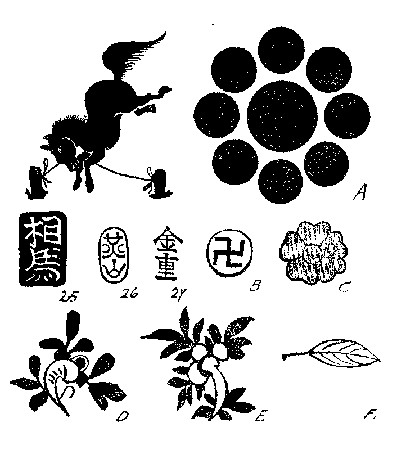
(25, 26, 27) Soma. Stamped in oblong or oval panel, the oval being the older. On the outside of some pieces with these marks the crest of the Prince of Soma (A) is found with a prancing horse tied between two stakes.
Marks in the Form of Symbols.
This is a common form of marking Chinese porcelain and Chinese symbolical ornaments, and were often copied. The five examples given (B to F) are frequently found on Japanese porcelain:
(B) A swastika, Buddhist symbol, also a family crest.
(C) A flower with five leaves, in red.
(D and E) Two varieties of a plant.
(F) A leaf, in blue outlined in gold.