Chapter I · INTRODUCTORY (continued 2)
Reading edition
Perhaps the most—and here adjectives fail: charming, lovely, famous are words which arise in the mind—ruby, pink, rose eggshell plates really should be seen rather than described. These all belong to the "famille rose." But eggshell was not confined to this family. Dated specimens seem to indicate that the two earlier reigns had seen the origin and progress of this beautiful ruby porcelain, but there is no doubt that many of the finest of the marked pieces belonged to the Keen-lung period, though Yung-ching produced excellent specimens.
Let us give a few examples from the sale-rooms. But first we could wish that all who will read this chapter could betake themselves to the Victoria and Albert Museum, to the British Museum, to Duveen's or Gorer's in Bond Street, and see for themselves what Chinese eggshell plates really are. The Salting Collection in the Museum at South Kensington has very fine specimens, and the British Museum has similar specimens in two flat cases, which, unfortunately, do not allow the full value of the ruby back to be appreciated. At Duveen's there are two cases filled with the loveliest specimens ranged before a looking-glass, which enables the visitor to see both the design on the front of the plate and the lovely colour at the back.
It is surprising, and yet not astonishing from the point of view of the collector who will have the best, to notice the prices which have been paid for these plates, which are quite small, ranging from 7-3/4 in. to 8-1/2 in. diameter. A few examples will help in enabling us to estimate their value. One eggshell plate, enamelled with chrysanthemums and a sparrow, and with sprays of peonies round the border, on pink diaper-pattern ground, 8 in. in diameter, sold at the sale of Louis Huth's Collection for £105. The other prices realised at the same sale are no less striking. Saucer dishes, pair, eggshell, with ruby backs, enamelled with branches of chrysanthemums and peonies on a white ground, 8 in. in diameter, sold for £80, but a better pair, enamelled with cocks and peonies in the centre on white ground, with pale green trellis border, 7-3/4 in. in diameter, realised £400. One saucer dish, enamelled with a pheasant, quail and peonies in the centre, and a pale green marble border with pink prunus blossom, and three panels containing flowers, 8 in. in diameter, brought £135. The first and last of these were not pink-backed, but they were certainly beautiful.
Other eggshell plates at the same sale with ruby backs, which we will describe shortly, even at the risk of appearing monotonous, were: one enamelled with ladies and children in the centre, diaper border, with three panels of flowers, 8-3/4 in. in diameter, which realised £150; another, enamelled with quails and chrysanthemums in the centre, with pink and green diaper borders and three panels of flowers, £155; another, enamelled with a lady and two children by a table, in a leaf-shaped panel, on gold ground, with border of various coloured diapers, 8-1/4 in. in diameter, £200. Two saucer dishes, enamelled with peonies and persimmon fruit in the centre, and shaped border of diaper ground, the border on green ground, with pale pink trellis edge, 7-5/8 in. in diameter, £310. A similar pair, but enamelled with ladies and children and vases in the centre, on a white ground, with pale green trellis pattern border, and three panels of black, 7-3/4 in. in diameter, fetched the same price, £310. The gem of the whole collection was a plate, finely enamelled with a group of ladies and children, vases and utensils in the centre, with seven borders of various diapers and small panel of flowers, 8-1/8 in. in diameter, £280.
The plate with the seven borders is the most famous of these eggshell ruby-back plates. The centre panel or reserve is leaf-shaped, having in enamel colours, very delicately painted, a lady seated with two boys; near her is a table on which are books; vases behind her and two vases on her left. This panel is surrounded by six diaper borders of various widths, of which the two chief are a deep ruby, interrupted by four reserves in blue enamel, and the other a pale lilac with four reserves enclosing flowers. Between reserves are four dragons in white. The diaper around the leaf is the seventh border. There are other diaper patterns in the five and four border plates which have in the leaf-shaped central panel a decoration which is very similar. Some, however, of these eggshell plates have no diaper work, the sole decoration consisting of two cocks, beautifully enamelled, near rocks and foliage. Indeed, these birds are often found in plates with borders. Similar eggshell plates may have landscapes or flowers as the central decoration with or without diaper borders. The name ruby back is given to these plates because the whole of the back, excepting the centre inside the rim, is enamel with a beautiful ruby tint. Indeed, we may say that these plates are amongst the very finest creations of the Yung-ching and Keen-lung periods. To the eggshell china belong the delicate Mandarin vases which, probably, were made for exportation.
XI MANDARIN PORCELAIN
CHAPTER XI MANDARIN PORCELAIN—KEEN-LUNG PERIOD (1736-1795) AND LATER
A mandarin is a Chinese official, either civil or military, but the word itself is not Chinese. It is a name given indiscriminately by foreigners to designate any Chinese official of whatever rank. The recognised official grades of mandarins are nine, each distinguished by its dress. The so-called button on the hat—the mandarin button—is conspicuous. It is really a very valuable jewel, and, like the rest of the dress, is worn under precise regulations. It will be interesting to notice how the mandarin's rank is shown by the dress. The coats were always embroidered with gold and were of coloured silk.
In the first order, the button on the hat was a bead and above that an oblong button of transparent ruby red—transparent red. The coat was violet, with a square plaque on the breast and back decorated, in the civil class with a pelican, in the military class with a kylin, whilst the belt was ornamented with four agate stones set in rubies. In the second class, the button was a red coral button resting on the ruby bead—red opaque. The coat had embroidered plaques decorated with a hen for the civil class, and a lion for the military class. The belt was ornamented with four embroidered plaques with rubies. The third class had a sapphire button—blue transparent. The coat had embroidered plaques decorated with peacock's plumes, each feather having only one eye. The symbolical peacock represented the civil class, and the panther the military class. The belt was ornamented with four plaques of worked gold. In the fourth class an azure-coloured button of lapis lazuli—blue opaque—rested upon a small sapphire bead. The coat had embroidered plaques decorated with the crane for the civil, and the tiger for the military mandarins. The belt was ornamented with four plaques and a silver button.
The fifth class had a rock crystal button—white transparent—resting on the small sapphire bead; the embroidered plaques were decorated with the white pheasant for the civil, and the bear as the symbolical emblems. The belt was similar to the last class. The sixth class had a button of white polished opalescent shell—white opaque—with a blue feather. On the embroidered plaques of the coat were the emblems of a stork for the civil, and a little tiger for the military divisions. Four tortoise-shell plaques and a silver button ornamented the belt. The seventh class had a button of plain gold—yellow brilliant—on a crystal bead. The embroidered coat had a partridge for the decoration of the civil division, and a rhinoceros for the military. The belt was ornamented with four round silver plaques. The eighth class had two buttons, one upon the other, of worked gold—yellow opaque. The embroidered plaque of the coat bore the quail as the symbol of the civil division, and the stork as the symbol of the military division. The belt had four ram's head plaques and a silver button. The ninth or last class had the second button of worked silver—blank opaque. The embroidered coat showed the sparrow as the emblem of the civil mandarins, and the sea-horse as the emblem of the military. Four black horn plaques and a silver button decorated the belt.
It will be seen that Chinese porcelain decorated with figures such as these dressed in their robes received the name of Mandarin china. The actual word comes from the Portuguese "Mandar, to command." Much could be said upon the subject of Chinese dress, as applied to porcelain in decoration, but it is only necessary to contrast the style of the Ming and the Tartar dresses.
The Ming long, flowing robes are held up with sashes, and the hair, turned up over the head, is either covered with a soft head-dress or with the Court ceremonial head-dress.
The Mandarin dress of the Tartar shows the robe principally, but there are besides the pantaloons and the high boots with thick soles. The hair is dressed in pigtail fashion, for from their earliest youth the Chinese children are shaved. The boys are shaved all over the head except at the top, and in the case of girls two tufts are left, one over each ear. These facts, while furnishing no actual clue to the age of Mandarin china, showed that at least it could not have been manufactured before the Tartars came into power in 1644. Probably the date of its manufacture is later.
We can understand that these Tartars, who had enforced their own dress upon the conquered people, but who had at the same time adopted their religion, would continue copying the holy persons such as the eight immortals, the genii, &c., in the same dresses which had been in use for hundreds of years. More than this, there seems to be a strong element of truth in the statement that the Mandarin decoration was due to the desire of the European traders to carry home porcelain which should illustrate the people, and the style and the colour of their clothes. If this is so, then the Yung-ching period would be the first in which Mandarin china was produced. At any rate we do know that most of it was made in Keen-lung's reign, and that the potters of the later Emperors, to our own times, have been manufacturing large quantities for commercial purposes.
In Mandarin china the figures vary in boldness and in general character, but the colouring is of one class—pinks, reds, yellows, blues, and greens, so distinct in tone as to receive the name of Mandarin colours. The decoration of this kind of china includes boys and men at games, such as kite-flying; warriors fighting, marching, or resting; men and children in masks; figures walking, riding on horses or on vehicles; lantern shows with scores of people, besides many other designs. This Mandarin decoration is associated with great varieties in the ground colours and patterns. Such are the swastika ground, the red ground, the blue ground mottled over the glaze, and the scroll ground. There are also many diaper patterns and a variety of borders of flowers, butterflies, dragons, sometimes in low relief, whilst often examples are met with in which the vases are recessed so as to furnish a flat surface in which the decorative painting of figures, flowers, and birds lies flat in a shaped compartment or reserve, which may be joo-e-shaped, leaf-shaped, kakemono-shaped, or makemono-shaped. In studying the vases given as illustrations these varieties of shaped panels should be noted, as they are constantly used in catalogue descriptions of the decoration. Amongst the most beautiful vases of this period are the conical-shaped eggshell vases with short necks, covered with the most delicate scroll work in gilt, having large reserves decorated with Mandarin figures painted with the utmost delicacy, and the small reserves with rose and other flowers most carefully drawn.
The question has been raised as to whether transfer printing as a mechanical process was ever applied to Oriental porcelain. In England, Dr. Wall, of Worcester, is said to have invented transfer printing as early as 1751, and Sadler and Green, of Liverpool, lay claim to the honour of its discovery at about the same time, whilst on the Continent a similar honour is claimed for the factory at Marieberg in 1760. There is no proof that any blue and white Oriental china, except during the most recent times, was ever decorated on a transfer-printed ground. All of the blue and white Nankin and Canton ware was painted by hand under the glaze. When we consider the immense amount of labour necessary to keep up the supply of porcelain to Europe, and also to the United States early in the nineteenth century, it is astonishing that no process work showing transfer printing can be discovered, although the invention must have spread to China before 1796 when Keen-lung died.
We shall treat of "blanc de chine" later, when we discuss the colours of Oriental china, but it must be remembered that most of the Chinese ware of this type was made during this period. Such were the statuettes of Kwan-Yin and many other gods and goddesses. This cream-white porcelain may date from any period even before Kang-he. The earliest specimens are distinguished by being transparent, although thick, and by the creamy smoothness of their glaze. Some authors, however, ascribe the origin of this ware to the Keen-lung period.
XII KEA-KING, TAOU-KWANG, AND THE LATER EMPERORS
CHAPTER XII KEA-KING, TAOU-KWANG, AND THE LATER EMPERORS
Kea-King (1796-1821).
When any country is disturbed by internal divisions or by external invasion, the inhabitants pay less and less devotion to art. The reign of this king was certainly disturbed. The people suffered from misrule, and though the traditions of the Chinese potters did still keep up, in a measure, the high standard of the previous reign, the neglect of the governing bodies, of the Emperor and Court, took away much of their devotion to the development of the porcelain so conspicuous in Keen-lung's reign. The porcelain, however, remained good in the quality of its paste, and now and then it reached excellence with regard to the decoration, which became characterised by conventional designs. Coloured enamels and gold were largely used for ornamentation, the turquoise blue, "famille rose," and a good blue-green were conspicuous. Mandarin china still continued to be made, though the modelling was comparatively clumsy and the paste thick, still, however, having the wavy surface always noticeable in Mandarin china, which was, as we have said, largely made for the European market. The influence of Western art made itself felt in the decoration. Many scenes were painted with European subjects, especially in the small reserves or vignettes. Some of the finest forms, too, of the early Sèvres and early Wedgwood and Adams' styles were copied and decorated with festoons of raised husks with a landscape in a medallion. This wavy porcelain seems to be specially connected with a comparatively thick blue enamel and a style of decoration usually called Lowestoft. Of course it is not Lowestoft. Lowestoft was a soft paste porcelain imitating early Bow and Worcester. The porcelain of the Keen-lung period, then, might be named the porcelain of commerce. European forms of pieces not used by the Chinese themselves are often found. The process seemed to have been something like this. The East India Company, all the captains and officers of the East India Company's ships, when visiting China took with them orders for services to be decorated with crests or armorial bearings, with English landscapes, or with sporting or religious subjects. Blue and white was made in vast quantities owing to the demand from Europe. It needs but one sentence of description. It was poor. About this time the Chinese potters copied the Japanese. Imari ware, with its flowers in conventional forms, various Celadons in blue, lilac, grey-white on good fine porcelain, are traced to this reign. Perhaps it was most celebrated for the reproductions of the porcelain of earlier periods in which both pattern and mark were constantly recopied.
Taou-Kwang (1821-1851).
In this period there was a special development of the enamelled rice bowl, although beautiful vases so decorated with enamel as to cover the whole surface are not uncommon. The use of two shades of green produces a very pleasing and comparatively new effect. Unfortunately, the Chinese potteries, as in the previous reign, seemed to have devoted much of their time to reproductions. The rice bowls were often decorated in graviata, graffito, or sgraffito patterns, in which the enamel was scratched with a point into a variety of twists and turns, forming beautiful variations from the ordinary plain enamel surface. This surface was also painted with flowers and figures. The process seems to have been first adopted by Keen-lung, and many pieces have the Keen-lung mark. In a set of four very fine examples which came under our notice three had the Keen-lung mark, and the fourth that of Taou-kwang. In all probability the majority of them were made in the later reign and the earlier mark was copied. The copying during this reign included all the older forms from the Kang-he period, and it excelled in reproducing the "famille verte" and the "famille rose." Perhaps the Yung-ching green enamel received the most special attention, for the outline of the design is often found first painted in blue under the glaze, so that the blue shows through the transparent surface enamels and gives a bluish tint to the decoration generally, which was quite the effect produced by a similar decoration in Yung-ching's reign.
To the same class of rice bowls belong the pierced porcelains with patterns filled with glaze. Here the rice pattern is cut through the paste while the paste was soft. Then as usual the blue decoration was applied painted on by hand, and certain parts received a coating of white enamel before the whole was carefully glazed. The skilful glazing is shown by the evenness with which the pattern, in glaze, matches the general surface of the piece itself. The rice or star pattern is the most common of all these pierced porcelains. Some specimens have, however, a diaper pattern, and more rarely a dragon design with flowers and leaves, so cut that portions only are filled with glaze, which gives a very unusual and striking effect. These pierced specimens are not supposed to be earlier than the eighteenth century, and of course they may be very much later.
Heen-Fung (1851-1862).
Very little porcelain was made during this reign, owing to the Tai-ping rebellion, during which King-te-chin was destroyed. The first Chinese war with England took place in 1860. The rebellion ended in the next reign.
Tung-Che (1862-1875).
With peace after the wars the manufacture of porcelain was resumed. Generally, the best pieces were copied from the antique, though a pale turquoise ground with decoration of flowers and butterflies was made for exportation. Sepia drawings showed some distinction, but there was no new departure of importance. This period is modern, and these later Emperors are only mentioned in order to bring the history up to date, and to call attention to the marks both on ordinary and seal character.
Kwang-Shiu (1875- ).
In the present reign much more importance has been given to the improvement of porcelain, which is largely made for export, high prices being obtained for imitations which are sold as antiques. The largest customer is the United States of America. The intense conservatism of the Chinese has been largely broken down by the influence of outside pressure. The almighty dollar holds the field. Yet, if it is still true that "for ways that are dark and tricks that are vain," "the heathen Chinee" is "peculiar," he holds no monopoly of such qualities. Western civilisation runs him close. On the other hand, the honour of a Chinese in trade is generally of a high standard, and the people have a natural instinct for artistic decoration, which has come to them as the legacy of ages past. And with this power they have, too, an unlimited supply of the very finest kaolin. Let us hope that happier times will bring back the glories of the past.
XIII CHINESE WHITE PORCELAIN
CHAPTER XIII CHINESE WHITE PORCELAIN
M. Gasnault, the friend and pupil of M. Jacquemart, has put on record the results of their united work in the Museum at Limoges. The collector is able to see how he has tried to reconcile and combine the elements of a complete history of Oriental china, how he has collected specimens of all the manufactures, even the smallest, how Oriental porcelain holds the first place in the collection, being represented by most remarkable specimens of industry which in the Celestial Empire to-day is on the decline, after having had a brilliant career through so many ages, that it seemed as if nothing could have led to its failure.
If the Chinese have not yet returned to that state where they have forgotten entirely the art of making porcelain, at least they have lost the secret of those admirable productions—the forms so pure, the glazes so marvellous, the enamels so sparkling, the decoration so diversified, and the paintings so exquisite—which remained with us as monuments of an age when there must have been such art in the Ceramic world as has never been seen since. It will be advantageous to say something about the collections at Limoges and the lessons we may learn from them. The first place in the collection is given to the white china known throughout the world as "blanc de chine." This kind of porcelain was highly esteemed in France, and the Oriental artists and potters from a material which seemed to offer but little resource proceeded to work wonders. By the side of the small sacrificial cups destined for religious uses with the glassy glaze and a tone which recalls that of wax or ivory, in the form of the horn of the rhinoceros or of the flowers of the lotus, which was the plant pre-eminently sacred, one is able to admire examples perfect in execution of which the texture is so thin and fine that it seems dangerous even to touch them. The greater part is decorated with ornaments in white or in white slip, which by a few simple strokes, or by a delicate tracery, almost inconceivably beautifies the limited surface. Garlands and detached bouquets of flowers have been engraved upon the wet or the dry clay so finely—indeed, so exquisitely, that they cannot be seen unless held up to the light. Here the sacred dragon winds round the cup as if he wished to defend it from profane hands, and a Buddhist god only appears when a coloured liquid is poured into the cup, which then shows up the lines, before invisible, engraved in the paste.
Again, we find little bottles decorated with dragons and symbolical dogs of Fô or Buddha cut deeply into the paste with a patience and an art unequalled in the productions of the Western Hemisphere. The statuettes of the gods and goddesses are also made in this white porcelain, amongst whom is one to whom we have before referred, Kwan-Yin, a mysterious being, the personification of mercy and goodness, who protects the sailors and saves them from shipwreck, who takes pity on those who suffer in hell and intercedes for them. She also gives children to those who are sterile.
Kwan-Yin has many attributes and emblems. Sometimes she has a diadem on her head ornamented with images of Buddha, or she rests seated on a throne of lotus in memory of the miraculous bridge which the gods constructed to enable her to cross the sea. The god of riches is often found as a white statuette, so is Poutai, the god of contentment, with a broad smile and round, uncovered stomach; Cheou, or Chow, the god of longevity, with an enormous bald head. Other figures of emperors and empresses are all of the same type, with the accompanying Ho-Ho birds.
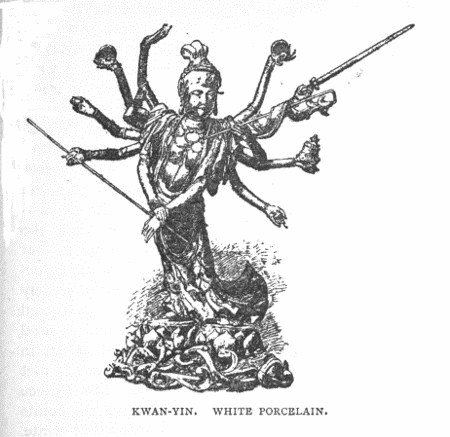
KWAN-YIN. WHITE PORCELAIN.
Amongst the finest white porcelain is one kind having a hard and compact paste which lends itself easily to the mould, but is not suitable to the turning wheel. Nearly all the pieces of this ware are moulded into figures, incense burners, &c., and on looking into the interior the roughness and unevenness of the paste can be easily seen, even the marks left by the fingers of the workmen are quite plain, whilst the bottom always preserves the imprint of the canvas on which these pieces are placed after having been moulded. Then there is a white biscuit class, very rare, often having two walls or divisions, of which the outer one only is biscuit, reticulated or pierced with a fine network or trellis of various patterns, through which the interior wall can be seen. Amongst the trellis many Chinese characters are to be found, such as the emblem of longevity, the mark called Cheou, Chow, or Show. We shall have more to say of reticulated porcelain later on, but here we may mention that the reticulation on the outer wall is often elaborate, and the cover glazes give a variety of colours equal to that found upon ordinary china. The whole white porcelain family, whether we consider the beautiful creamy ivory ware, or the dead white, or the blue tinged white, is rarely marked, and when a mark is used generally it is a seal character moulded or cut in the paste. A very rare form of decoration is met with in white, but only occasionally. The surface is covered with minute white points like the points shown in shagreen, only it is not green, but white. Such china has been termed "chair de poule," or chicken skin. It may be noticed that these points are not enamelled, either because they were applied upon the glaze or because the enamel ran off them in the firing.
XIV SINGLE OR SELF-COLOUR GLAZES
CHAPTER XIV SINGLE OR SELF-COLOUR GLAZES
Following the white in order is the remarkable series of single colour glazes of various hues, beginning with the sea-green or Celadon, which is a pale green, or even a greyish green; and the yellow, especially the Imperial yellow, which is reserved for the Emperors of the Tsing dynasty; camellia-green like the leaves of that plant, painted in proper colours; light brown, a bright colour with quite a metallic lustre, was known as "feuille morte," or dead leaf colour. So copper-reds give various self-colours such as haricot, various flambés, and through a long range it reaches eventually a pure black. Then there are the blues, covering a range no less varied and interesting. Turquoise-blue, a tint which can only be obtained by applying it upon the biscuit china which has already passed through the kiln; the other blues, fouetté, soufflé, trempé, are brushed on, blown on, or dipped according to the method used in applying the colour glaze. Another way of applying the glaze was by its being powdered on through a fine gauze or dabbed on by means of a wet swab dipped in the colour which was to be used as the single colour glaze.
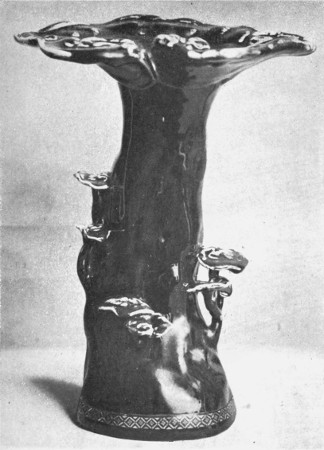
"SANG DE BŒUF." SELF-COLOUR.
A tall sang de bœuf fungus-growth, wonderfully true to nature. Yung Ching period. This example bears on the base the mark of Ching-hwa (1465-1488). Round the base and under the feet it is lacquered. The fungus, which grows at the root of trees, when dried, was so durable that it became the symbol of longevity and immortality. Hence large specimens are preserved in the temples, and it is both painted and modelled with figures of the immortals. It may also be found in the mouth of the deer, another emblem of longevity. The example given is in the finest sang de bœuf with all the characteristics of that lovely Celadon colour. This brilliant red was a Kang-he discovery. It is included in the Lang-yao class, being so called after Lang Ting-tso, superintendent of King-te-chin.
The special point to which attention should be given is the lacquered pattern round the base, which is inlaid with pearl shells, in the style known as "Lac burgauté." In Chinese porcelain this process is uncommon, but in Japanese porcelain and pottery cloisonné enamel is frequent, applied either with or without the metal cloisons. Lacquer, too, may be frequently found as a coating—black with flowers in gold and silver; black with Ho-Ho birds and flowers; a rich red; brown; green; gold, &c. Nearly all of these pieces are comparatively modern Japanese ware, being made largely at Kioto, Seto, Yashima, Yamato, and other factories in Japan. To this class, which includes porcelain in combination with other substances, must be ascribed those delicate Japanese, egg-shell, covered cups and saucers, painted with flowers in colours, and having an outside covering of the finest basket-work. These are made chiefly at Yamato.
The purples as glazes are no less rich in variations, and in these tints the Chinese have never been rivalled. These self-colour pieces are decorated with symbolical figures or sacred animals, whilst flowers and inscriptions from the sacred books are found as a decoration in gold, which unfortunately lies upon the glaze and is more or less easily removed by hard wear. Again, similar designs are engraved in the paste, or modelled in relief and painted with such colours as are able to resist the temperature of the furnace. Many pieces have spaces reserved in white for further decoration, and sometimes the decoration is executed in white slip on the paste itself after its first firing has brought it to the biscuit state. These lovely single colour glazes are certainly amongst the finest Oriental specimens of porcelain which are worthy of the collector's attention; their softness, their brilliancy, their range of colour alike entitle them to a high place in any scheme of decorative treatment either in the home or on the collector's shelves. We call them china or porcelain vases, &c., and in that we are only following the Chinese usage, though the colour glaze is often so thick as to hide the material or body of the paste altogether. The thickness prevents any transmission of light; they have an opaque more or less coarse clay white or red body, and amongst our English products would be classified as stoneware. But the colour is the thing, and here we shall repeat ourselves a little, because it is necessary to really understand not alone what the colours are, but generally the order of their invention. The oldest colour was, as we have said, Celadon, or sea-green, which reached a high state of perfection about 1500. No doubt there are many Celadon pieces of great antiquity still awaiting identification. It was in the Seuen-tih period of the Ming dynasty that this Celadon became a famous product. The porcelain is very thick, and to this thickness it owes its preservation. Like the English ironstone china, it stands hard wear. All the Persians and the Turks value Celadon not for its intrinsic beauty, but because they thought it to be infallible as a test for poison in their food.
The yellow glaze is the colour adopted by the present Tsing dynasty as the Imperial colour. Fine specimens covered with yellow may then be regarded as having been destined principally for the use of the Emperors, but it does not follow that the use of this colour was proscribed in the decoration, either as a yellow or as a partial tint. Blue was one of the highly esteemed colours as well as one of the earliest. We have dealt with blue as an under-glaze decoration. It was not alone used for decorative purposes in drawings of figures, birds, animals, foliage, and landscape, but it was used in various forms as a body colour either on the biscuit itself, before glazing, for with the glaze as a self-colour, as a Celadon, in fact—that is, the blue was applied in the glaze or in the enamel.
We read that in 954 A.D. the Emperor Chin-Tsung ordered some vases to be made which should be "blue as the sky after rain when seen between the clouds," and it is said that his celebrated porcelain was of this blue, fine like a looking-glass, thin as paper, and giving a sound like a musical stone, the only defect being that the feet of the pieces were of a coarse yellow clay. Alas for the romantic story!
The most recent catalogue of the Musée Guimet at Paris, drawn up by the national experts with the assistance of such Chinese experts as were available, states that the story is all a mistake. The word which was translated "blue" should have been translated "green," which brings us back again to Celadon.
During the Sung dynasty (960-1279 A.D.) it appears that a fine red was discovered from which porcelain was made resembling chiselled red jade. This may be the celebrated "sang de bœuf," which is red, but, as we have seen, red with qualifications.
The purple or lilac glaze before referred to seems to have been made quite as early as the Sung dynasty, but with this, as with all the other glazes, colour alone is no indication of age.
About the year 1600 there lived that famous potter called Chow, whose fame was obtained by his excellence in skilfully imitating ancient vases. All the records that have come to us show very clearly that from the earliest times the potters were in the habit of copying the works of their predecessors. So well was this continually done that they were able to impose upon the best experts of their own country.
The brown glazes, according to Père d'Entrecolles in a letter dated 1712, were at that time quite recent inventions, and he applied the same remarks to the coffee-colour glazes. The black glaze has been noted. It has several varieties—the dull black itself, the dull black glazed over with green so as to make a bright black giving a green tinge only at the edges, and the Tsing black, which is an uncommon brilliant black familiarly known as mirror black.
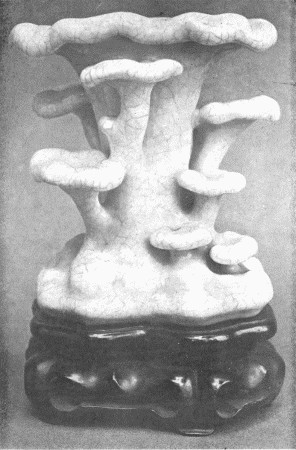
"CLAIRE DE LUNE" SELF COLOUR. CRACKLE PORCELAIN
Another production of the Chinese which has never been successfully produced in Europe is this crackled or crackle ware. They were very proficient in producing regulated crackles, large, small, or medium, and that which was no doubt at first accidental became one of the most important and successful means of decoration. Some pieces, indeed, are really marvellous, showing successive bands of crackle ornament, coloured decoration, self-colour, and white, others have a double network—double réseau—with the crackle coloured simultaneously in two tones. Historically this ware is of great antiquity, being noted during the Sung dynasty (960-1270). As a rule, the clay employed is very coarse, of a buff or a pale red colour merging into white. It comes under the designation of porcelain because the Chinese do not differentiate between that which is opaque and translucent.
The illustration, unfortunately, does not show the colour, the beautiful claire de lune, which is so rare and so indescribable. The specimen of sang de bœuf given under "Self-colours" is, like this, a fungus of the genus Agaricus, the emblem of longevity, because it was practically indestructible. It was also emblematical of fertility. Emerson wrote, "Nobody cares for planting the poor fungus; so Nature shakes down from the gills of one poor agaric countless spores." The fungus is used as a mark, as decoration, and, as we have shown, in vase form. Probably its shape and symbolism gave rise to the Joo-e sceptre and to the wide adoption of the Joo-e-head form in ornament. Note that red-coloured crackle glazes are rarely found, and that apple-green, turquoise-blue, and clair de lune are the most desirable colours in crackle. Feen-lung.
There are many other self-colours or single glazes to which fanciful names are given. We have referred to "clair de lune" and the peach bloom. It is very doubtful whether there is any real value in the names themselves, so we advise our readers to examine specimens in the Museums, when such colours as liver colour, pigeon's blood, crushed strawberry, &c., will be found to be purely arbitrary. Perhaps the widest term applied to these variegated self-colours with a single glaze is splashed or shot silk. These various mottled or splashed glazes are named by the Chinese Yao-pien, by the French flammé or flambé. They have curious yet very beautiful veinings like flames of a fire, hence the name given to them by the French. One colour runs into the other in the most capricious and yet in the most charming manner. The first results were no doubt accidental, but soon experience gave certainty to the master mind of the potter, who was able to define and measure the combination of the various metallic oxides which would give him exactly the colouration he desired. The glaze of these pieces was usually applied upon the dried vessel by dipping or brushing or powdering, or, as some say, by blowing on with a tube. Or, again, it may have been a combination of these processes. The potter now had the means of producing an endless variety of splashing by the proper application of the prepared glazes: of violet and blue; of turquoise passing into green; of sea-green, brown, and blue; of maroon, green, and white; of, in fact, any colours within the range of his knowledge. He only had to be sure of the furnace. He had to know how his metallic oxides would combine under the action of heat. The glaze upon vessels having intricate designs in relief was applied only after the potter was sure that the pot in its biscuit state was suitable and correct in form. With most ornaments the danger of damage was thus considerably reduced. When the biscuit was withdrawn from the kiln the coloured glaze could be easily applied before the second firing took place. We have noticed that a much lower temperature was needed in the second firing and that the heat of a muffle-kiln would suffice. As in the case of the single glazes, a number of fanciful names have been applied to the ware, such as tiger-skin, iron rust, &c.
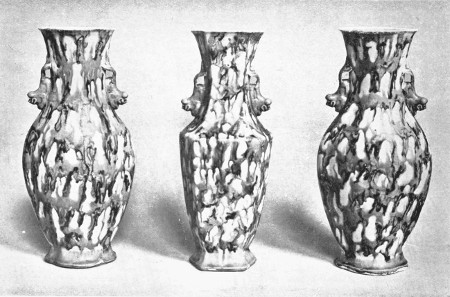
CELADON GLAZES. SINGLE COLOURS AND SPLASHED.
The coloured glazes in the pieces of one colour which we have described are called "self" or "whole" colour, and they were applied directly on the dry paste or body so that the whole was fired at one time. The great heat required for this process caused variations in the tints, which were partly due to the running of the glaze itself. Where the glaze lay thickest, the colour would be deepest. Practice led to perfection, so that the Chinese potters acquired skill in using the colour with precision and, further, they were able to extend the range of their operations by using several colours on one piece. Greens of many hues, blues in various shades, all kinds of reds and yellows, purples and browns gave to this class great variety and brilliancy. It must be borne in mind that these coloured glazes were also applied to biscuit porcelain, that is, to white porcelain, without any glaze, which had been fired in the kiln for the purpose of fixing the shape. In this division the paste is generally much thinner than in ordinary pieces of Celadon, and much more elaboration was given to engraved and embossed patterns and to reticulated or pierced work. Moreover, it, was easy to leave some parts of the design in untouched biscuit.
Our illustration shows a set of three splashed Vases (two flat-shaped and one hexagonal) painted with enamels of green, yellow, and aubergine, in blotches on a white ground. The handles, which are monsters, are in apple-green. This style of decoration is known as tiger-spotted or splashed. Kang-he period.
The process of decoration by blowing is said to produce a curious colouring. Take, for instance, red blown on blue. Pieces so decorated appear to be covered with a soft violet glaze, but on examination it will be found that the opaque blue is sown all over with minute red rings formed as a network resembling the finest lace. By the use of a simple magnifying-glass these rings can be easily traced. It seems difficult to produce such a marvellous decoration, and yet it is quite simple. The colour blown on that is the red, which is driven with force sufficient to form minute bubbles, which burst by the heat of the kiln, and by their bursting form little rings varying from the size of a pin's head to that of a pea.
It will be well to give just a little time to a summary of the colours which are used on Oriental porcelain of all kinds, first in the under-glaze blue and red, second in the single colour glazes, including all those which are known by the terms splashed, variegated, transmuted, or flammé or flambé. Preserving the same order set out in the colour enamels which are used in over-glaze decorations, we find that the blacks, as before stated, were three in number—a common dull black, a mirror or metallic black, and the first of these covered by a thin transparent green glaze, so as to make a shining black. The dull black was produced from manganese which had some impurities in it, whilst the mirror black was made of manganese having cobalt in it mixed with white glaze and an earth containing iron.
The various greens, such as the dark green or gros vert, sea-green or Celadon, apple-green, emerald-green, pea-green, cucumber, and snake-skin were all derived from iron, copper, and a little cobalt.
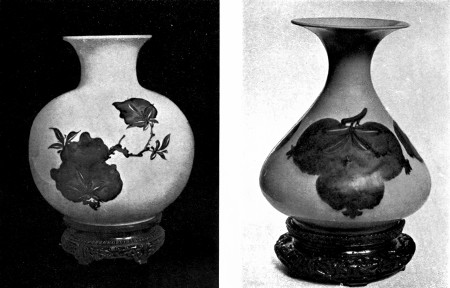
PEACH-BLOOM, OR PEACH-BLOW.
The under-glaze reds belonging to the Celadon class differ from the under-glaze painted reds. The Celadon colours are applied in and with the glaze, and the other class is, like under-glaze blue, painted on the biscuit china and then glazed. The range of Celadon reds is very great, from "Peach-blow," commonly termed "Peach-bloom," to "sang de bœuf." About sixteen of these beautiful shades are within this range. "Peach-blow" is used as a self-colour glaze, covering the whole of the piece, but, like all other colours, it is employed also with other coloured glazes in the decoration of porcelain—white or Celadon. Dr. Bushell describes peach-blow as "a pale red, becoming pink in some parts; in others, mottled with russet spots displayed upon a background of light green Celadon tint." This and many other colours were invented by Ts'ang Yeng-hsüan, the director of the Imperial works towards the end of Kang-he's reign. Around the feet of many fine vases of the Yung-Ching period there are waves in this darkish red, with occasional flecks of green. In these cases the body of the vases is white. Examples occur where peach-blow is used as a Celadon colour in pieces decorated with blue under the glaze.
On the left is a Vase with large bulging body and short expanding neck of a clear white glaze, on which are blossoms painted in peach-bloom, with leaves and branches in blue. Kang-he period (1661-1722). Height with stand, 10-1/2 in.
A circular shaped Vase with tapering neck, expanding mouth, and a bulbous body. This is decorated with pomegranate fruits in peach-bloom; the leaves and stalks in rich blue; the whole on a Celadon ground. Kang-he.
The many shades of blue—dark blue and that peculiar tint known as mazarine, powder-blue, sapphire-blue, sky-blue, turquoise-blue, peacock-blue, "clair de lune," and kingfisher-blue—were all secured from cobalt and copper mixed in various proportions.
In dealing with the important red family we have to distinguish between the reds derived from copper and those derived from iron and from gold. The range of tints is very extensive. Those derived from copper give the more or less fanciful names of "sang-de-bœuf," "sang de poulet," "sang de pigeon," crimson, crushed strawberry, maroon, liver colour, and that curious tint known as peach bloom or peach blow. The reds secured from iron are vermillion, the well-known coral and the tomato tints. From gold, those beautiful shades of colour to which we have referred as being crowning triumphs of the Yung-ching and Keen-lung periods were procured. These, known as ruby, rose, and pink, were really covering a large range of colours from a very faint pink to a red purple.
The yellows have a no less extended range. At the head of the list we find Imperial yellow, then citron or lemon-yellow, eel-skin yellow, straw, canary, mustard, orange, and sulphur-yellow. Thus we see the yellows vary from a faint tinge of that colour to a strong shade which seems to include a little red. All these yellows were derived from antimony, and the variation was largely secured by the addition of iron.
The next class, the brown colour, was derived from iron or from clay in which iron in various proportions was present. These browns include various shades such as bronze, chestnut, chamois, chocolate, coffee, "café-au-lait," dead leaf—"morte feuille"—old gold.
The colours on English china for the purposes of contrast are given next. They were derived from oxides of various metals in various proportions. The blacks are secured from cobalt, nickel, manganese, iron, and chromium. The greens are variously derived; the yellow-green and the emerald-green are secured from chromium and sodium; the blue-green or celest from chromium, cobalt, silicon, and zinc; whilst other greens are derived from copper and chromium.
Blues come from cobalt and silicon, except the mat blue, which was procured from cobalt, lime, and zinc. The reds were made from gold and iron, which secured many shades of those colours. The blacks were derived from chromium, iron, and manganese. Another class of European colours—the purples—came from cobalt, chromium, tin, and calcium.
XV CHINESE CRACKLE
CHAPTER XV CHINESE CRACKLE
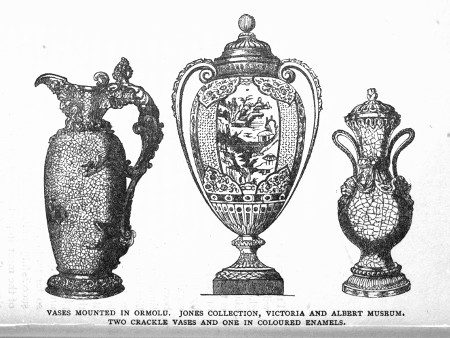
VASES MOUNTED IN ORMOLU. JONES COLLECTION, VICTORIA AND ALBERT MUSEUM. TWO CRACKLE VASES AND ONE IN COLOURED ENAMELS.
The crackle porcelain is a distinct class, though it will be found that many of the pieces having a single glaze are also crackled. They are covered with a clay or enamel which having been burnt in the kiln is taken out and subjected to the action of a current of cold air, or they are dipped in cold water, so that by unequal contraction cracks are formed with a regularity which, although in the first place accidental, became, in the skilful hands of the Chinese, science. Small crackles like the herring's roe, and large crackles like the ice cracks, could be produced by the potter as he chose. The cracks were filled with Indian ink, red or black, which made them stand out clearly. By further burning, possibly at a lower temperature, the entire surface seems to be covered with a clear glaze quite transparent, which to the touch offers no unequalities of surface. These wonderful potters have so far pushed this unique form of decoration, never successfully imitated in Europe, that it became one of the most important and striking means of decoration. Some of their work in this direction is marvellous and shows successive bands of enamel or glaze, crackled, self-colour and white all in one piece. Other pieces show a crackled network of two tints. Some of our English potters are making good attempts to imitate the fine old Chinese "famille verte," and surely for crackled porcelain there is still inspiration to be drawn from the East. The glaze was of white or coloured; the body was somewhat coarse in paste, resembling red or white stoneware. History takes us back to the Sung dynasty, when this kind of ware was first known, and the accidental discovery was converted into an exact method of working. A pretty form of crackle resembles the scales of a trout, and is by the French called truité. All the colours that were employed as single glazes in that class seem to have been similarly employed as crackle glazes, with the possible exception of red, which did not lend itself to this process; all the Celadon shades and the blues, including turquoise-blue. The most celebrated crackle is that known as apple-green crackle. This ware has, in addition to the beautiful effect of the crackling, a lovely soft tint of green, which was applied as the glaze.
XVI BLUE UNDER THE GLAZE
CHAPTER XVI BLUE UNDER THE GLAZE. NANKIN BLUE
Many collectors are immensely attracted by what is known as the old blue and white. It is such a widely distributed product, extending over a long series of reigns. We noted before that it reached its highest excellence in the Kang-he period. It was at first reserved for the Court, for Emperors and high dignitaries, but since Kang-he's reign blue and white may be said to belong to all dates, and the blue and white ginger jars of the present time which may be bought for one or two guineas show how the demand has been a constant one throughout the whole of the time. At a very early period after the Dutch had imported this blue and white from China their potters set about imitating it and produced the fine old blue and white delft which is now valuable, but there is no specimen of delft which reaches anything like the price of the old Chinese blue and white from which it was copied. The honorific inscriptions, the sacred emblems, the immortals and their attendants were quite meaningless to the mind of the Dutch potter, just as they were to the Italian, who was also an Oriental copyist. To the Oriental the decoration of each piece meant something, something it may be of their history or of their religion. High thoughts were set out as inscriptions, and inspirations were given by the story on the vase or dish, which when represented on a European copy became only a scheme of decoration, or at its best a germ from which an original scheme of native work might have its birth. So the Dutch, though they at first made delft ware in servile imitation of Chinese patterns, soon saw their way to utilise purely Dutch designs and with these to produce work as fine as that which they had made under the inspiration of the Chinese model.
At King-te-chin, the classical home of porcelain, a city with 3,000 kilns, the best of the blue and white was made; and although there is a large class called Nankin blue which must not be neglected, the latter, in decoration, is immensely inferior to the products of the Imperial factories. It is quite certain that there were many other factories besides those at King-te-chin which produced porcelain, but history leaves few records of them, so that it would be quite fair to include Nankin blue as a product of King-te-chin perhaps decorated at Nankin. It is quite interesting to note how at first this blue and white, now so valued, was not esteemed by Europeans with the exception of the Dutch. Much of it was redecorated on the glaze and the pattern burnt in so as to hide the decoration.
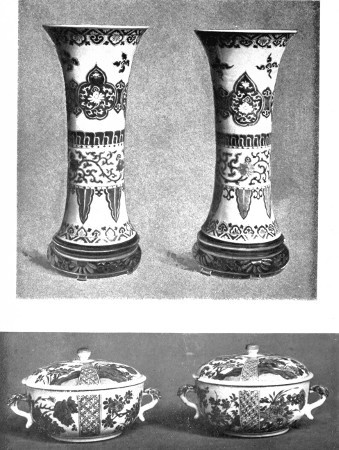
BLUE AND WHITE.
(a) A pair of tall blue and white trumpet-shaped Beakers. Under the neck are four shield-shaped panels connected with an arabesque design; below this is a broad band ornamented with conventional flowers running round the body. Towards the feet are the stiff leaves of the sweet-flag running down to the base. The whole done in a liquid, translucent blue on a most beautiful white ground. Kang-he period. The sweet-flag is often used for the decoration of porcelain vases, &c., and because its leaves are long and slender and come to a point the Chinese use them to represent swords, which, indeed, they resemble in general shape. On the morning of the first day of the fifth month every family nails up a few leaves of this plant on each side of the doors and windows of the house, so that when the evil spirits come near, they see the leaves, which they mistake for swords, and are thus frightened off. The superstitions of the people as well as their religion are put under obligation to furnish designs for the potter, in which the same idea is represented in a permanent form. In fact, only when we are fully cognisant of Chinese mythology shall we fully appreciate the wonderful stories set out in their porcelain. When will the Chinese connoisseur place before us his stores of knowledge?
(b) A pair of Butter Dishes and Covers in fine quality blue and white. The dishes and lids have the four seasons design, which are separated with a trellis-work diaper pattern. Note the difference between the two diaper patterns. The handles are coming from the mouth of a monster. Kang-he period.
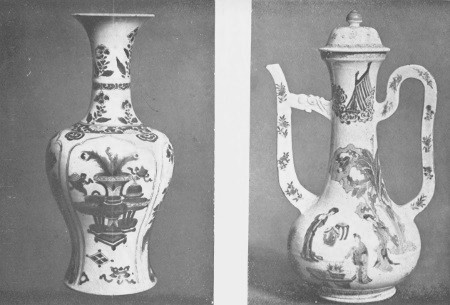
BLUE AND WHITE.
(a) A fine quality blue and white Beaker vase with expanding neck and bulging body. The neck is ornamented with blue bands and flowers; the body divided into four panels and filled in alternately with domestic utensils, flowers, and foliage. Kang-he.
(b) A blue and white Water-ewer and Cover, of fine quality and elegant shape, decorated with "Lange-Lysen," domestic utensils, and landscapes. Seal mark, "Ching-Hwa." Kang-he period.
Blue was employed for under-glaze decoration amongst the Chinese from time immemorial, though scarcely a specimen earlier than the Ming period can be identified with certainty, owing to the copying and recopying that has been continually practised by the Chinese. True, we often see the Ming marks, say of Ching-hwa or Kea-tsing, but probably the best of them are of Kang-he origin. Even if the pieces are really old they will be often found re-decorated with modern colours. Perhaps amongst the blue and white of the Ming period, those pieces decorated with the soft but rich "Mohammedan" blue, as it is called, are the best. Yet, though the colour is never flat or dead, there are certain qualities missing which are quite charming in the later Kang-he. The gradation and modulation of the blue, indeed, even the quality of the blue itself, are all better in the later pieces. Whether, again, the fine Kang-he blue was made early or late in the period, lasting from 1662-1722, is a further matter of doubt. Our readers will remember that in 1677 and for some years after no date marks were allowed to be inscribed, so that only patient study and careful observation will enable any one to place the old blue and white.
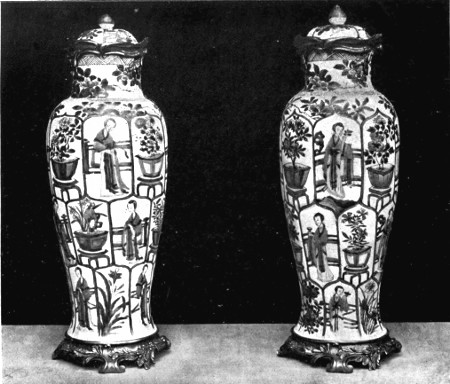
BLUE AND WHITE.
These specimens of blue and white Vases answer the tests which are applied to the best porcelain decorated with different designs of flowers, trees, birds, &c., in blue, painted under the glaze. What are the tests? First, the material forming the paste or body must be so fine as to give a perfect surface. The surface must be a brilliant white when covered by the glaze. The drawing and painting should reveal the best qualities of cobalt blue. The shape of the piece must leave nothing to be required. Now, it is well known that blue and white was, and is, the most common of all Oriental porcelain, and modern work is good, so that it becomes quite easy to make mistakes; in fact, it would not be too much to say that old blue and white is most difficult to judge. Though the glaze is so much a part of the paste that it lasts practically for ever, yet it does get slightly dulled; the extreme brilliancy of the new pieces contrasts with the softer and more beautiful old porcelain. The glaze should not be too thick, for the fine, even quality of the paste is just as much an element as the glaze in giving the old lustre. The blue decoration under the glaze shows a perfect command of outline as well as colour. There is no soaking in of the colour, but the outline is applied by the brush with absolute equality.
The two specimen vases show "Lange-Lysen" or "Long Elizas" and flowers in fluted lotus-shaped medallions covering the whole surface, except under the lip and neck, where there are two bands of triangle-work diaper pattern. The mounts are in French ormolu, Louis XVI. Kang-he period.
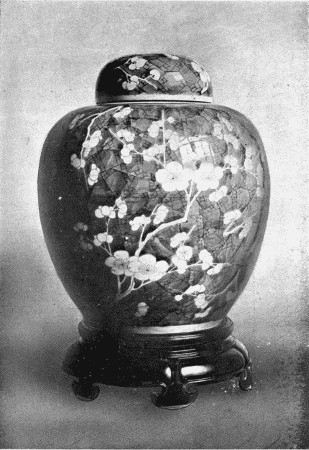
BLUE AND WHITE. GINGER JARS.
There are several varieties of prunus (so-called hawthorn) blossom in the well-known blue and white ginger jars. The one given in the illustration has the pattern known as the "ascending stem" hawthorn. Then there is a "descending stem," and a third pattern showing the head or centre of the blooms arranged in groups. This is "blob hawthorn," and may consist of three small blooms around a central larger one, forming, roughly, a triangular group; or four blooms again around a central one, forming a cross-shaped group. This pattern is also known as "spray hawthorn." The ground is a brilliant cobalt, in which the colour is laid on very much as if it had been rubbed on by the thumb, or still more, as if the colour, when wet, had been so rubbed. Afterwards a network of blue lines was added on the blue ground. The suggestion is that the "blob pattern" imitates the fallen prunus blossoms resting upon the crackled ice in the early spring.
Our illustration shows a Ginger Jar with dome cover. The body decorated with large and small sprays of white prunus, rising from the base and falling from the shoulder. Very brilliant crackled ice ground of deep cobalt; a narrow band of white encircling the mouth, with a line of blue within, the space between decorated with a formal ornament. The lid with similar decoration to that on the jar, the top encircled with a ring of white. Height, 10 in. Period Kang-he. Value, about £2,000. Record price, 5,900 guineas.
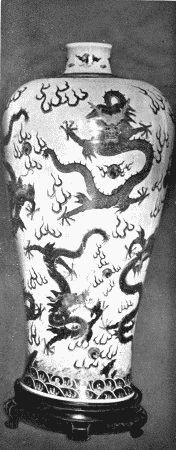
BLUE AND OTHER COLOURS, UNDER-GLAZE.
The finest quality of blue and red painted under the glaze were made during the Tsing dynasty, though during the Ching-hwa period (1465-1488) of the Ming dynasty many good pieces having this decoration must have been manufactured, as the mark of that reign is frequently found in reproductions. Even Kang-he and Yung-ching copies have the Ching-hwa mark.
The illustration—a conical Vase with short neck—shows the four-claw dragons of the sky. These are drawn in blue, as far as the head and body are concerned; the scales are in a soft red. The curious forms meant to indicate clouds are in blue, whilst the fireballs are in red. Variations occur where the nebulæ are in red, or even the whole under-glaze may be covered with a bright coral-coloured ground, with the decoration in blue. When this is so the pieces are classified as "coral-red." Again, amongst the various shades of red and brown under the glaze some are found in peach-coloured red. These form a class of "peach ware." Notice the care with which the scales on the dragons are drawn, and even from the photograph the white seems wonderfully pure. Yung-ching period.
The dragon decoration sometimes represents the li or dragon of the sea swimming in the water or rising from the waves. It was from such a dragon that Fuh-hi (2852-2738 B.C.) learnt and developed the eight diagrams or symbols called the Pa-kwa, which see under "Symbols." The Pa-kwa is used for decoration, usually as a raised design, seldom as a mark. The dragon is never used as a mark.
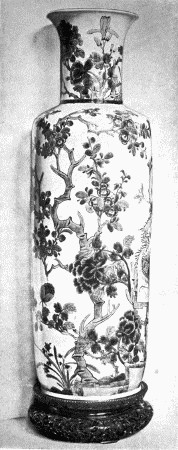
RED UNDER THE GLAZE.
This magnificent, tall, cylindrical Vase is an example of red—rouge de fer—under the glaze, with enamel colours in exquisite harmony applied over the glaze. The merest glance will reveal how artistically the decorator applied his design to the surface at his disposal. Each branch, each leaf, has its value in the scheme of ornamentation. The surface is well covered, but there is no overcrowding. The Vase is of exquisite proportions, decorated on pure white glaze with a bold design of Ho-Ho birds, the plumage of rouge de fer, green, yellow, and aubergine; one bird is partly hidden by rocks drawn in various greens, aubergine, and blue, whilst springing from the back are large flowering branches of the peony flowers and blossoms. The drawing throughout is of the highest merit. The flowers and boughs are shown in yellow, blue, aubergine, creamy white, and black. Underneath the rocks and on the left of the large bird is a large peony in rouge de fer and foliage in various greens, whilst on the right are two other flowers, one of rouge de fer and the other of fine stippled yellow with an aubergine centre. The rest of the vase is decorated with a bold design of flowering peach-bloom branches and other large flowers in deep rouge de fer, aubergine, green, and yellow; the neck, which is divided from the body of the vase by a narrow black band, contains peonies and other flowers decorated in colours similar to the remainder of the vase. Period, Kang-he.
XVII CLOBBER WARE, OR REDECORATED PORCELAIN
CHAPTER XVII CLOBBER WARE, OR REDECORATED PORCELAIN
Many lovely specimens of blue and white with the Kang-he marks, with the double rings or with the leaf symbol inside the double rings under the glaze, genuine specimens of old Kang-he, have been irretrievably spoilt by being plastered over with thick enamels of red, green, blue, &c. The old English word "clobber" means a paste to conceal cracks in shoes, and the pity of the clobber decoration was that the enamels, having been burnt in, are to all intents and purposes irremovable. Before me, as I write, is a Kang-he vase with a leaf symbol within the double circle, showing a real old Kang-he blue and white production, but unfortunately the clobberer has plastered coloured enamel over the blue decoration, now faintly visible, and only where a transparent green or pink glaze has been applied; the rest is absolutely hidden by opaque glazes of rose and yellow, white, lilac, and blue, until the character of the Oriental piece has been entirely destroyed. The number of pieces so spoiled seemed to indicate that there was a demand for clobber ware, or that, as we noted, blue and white was not popular, or that it was imported for redecoration in the absence of white ware which could be used for the same purpose. Chinese porcelain in its white state was freely imported into Europe and decorated in the factories of Holland, France, Germany, and Italy, as well as in this country.
Every one who collects china is familiar with the so-called Lowestoft decoration, not a thousandth part of which ever saw Lowestoft; in fact, that researches which have been made at Lowestoft indicate that the manufacture was soft paste resembling early Bow and Worcester. Of course, some white Oriental china may have been decorated there, though no traces of broken hard paste seem to have been found in the excavations. It may be that Bow, Chelsea, and Worcester did decorate white Oriental china, but the information we have on this point is singularly weak and inconclusive. The clobber decoration is not alone in enamel colours or gold, but even lacquer is used for the same purpose. It is needless to say that the change is never to the advantage of the piece, and often the under-glaze blue may be seen peeping, as it were, reproachfully from beneath the overlying transparent enamel.
Another, but similar name, is sometimes applied to this style of decoration. It is said that an enameller named Globber—hence Globber ware—redecorated white and blue porcelain with enamels at Soho during the latter part of the eighteenth century.
XVIII RETICULATED PORCELAIN
CHAPTER XVIII RETICULATED PORCELAIN
The porcelain called reticulées comes into the category of blue and white because some of it was decorated with blue under the glaze. The pieces have double walls, of which the outside one is pierced with a pattern, often a network of exceeding fineness, a lace-work in porcelain through which may be seen the exquisite blue design upon the internal wall. It seems just as if the potter had two pieces made to fit at the top and bottom only. On the foundation piece—the internal wall—he expended the art of decoration in blue. On the other piece, even more care must have been shown in cutting the clay into delicate tracery, so minute as to be marvellous. Then the fitting of the two walls together was completed, and finally the firing process took place. Such pieces are pre-eminent in curiosity, in interest and in skill, and their variations are wonderful. Some are only blue and white, some are blue and white with reserves in biscuit. All had the outside wall pierced with a pattern. We are giving as illustrations two magnificent pieces of reticulated porcelain, but these are coloured with enamel colours.
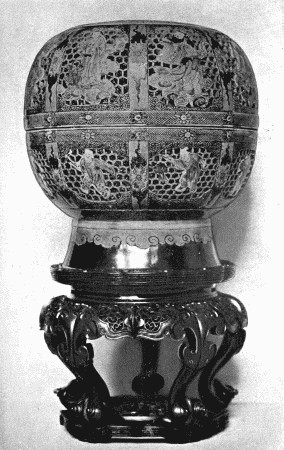
RETICULATED INCENSE BURNER.
Of Very Fine Quality.
Specially interesting and exceedingly valuable, this vase deserves careful study. It is a pity that it cannot be given in all the beauty of its colouring. At the top is a large panel containing the figure of a man offering the "Fruit of Life" to one of the immortals, at whose side is a deer; the remainder of this has rocks, foliage, a tree, and clouds, richly enamelled in green, aubergine, blue, and rouge de fer; the whole surrounded by a border of formal design in rouge de fer. The remainder contains sixteen panels. Each of the top eight contains a figure of the eight immortals with their various insignia; the robes of the figures are enamelled in rouge de fer, aubergine, blue, black, yellow, and various greens; whilst the lower portion has figures of boys playing various games, similarly enamelled. Dividing each panel is a broad band containing formal flowers and leaves in blue, green, and black, on bright yellow, whilst at the top of the base and bottom of the cover are aubergine bands with black tracery design and formal flowers in rouge de fer, blue, and yellow. The whole of the reticulated work is of brilliant yellow enamel. At the base is a broad plain black band, above which is a design of Joo-e-heads in apple-green.
Note.—This example is believed to be the largest specimen of reticulated work of the Ming period known to exist, and is equally remarkable for the high quality of its artistic work.
From the Collection of G. R. Davies, Esq.
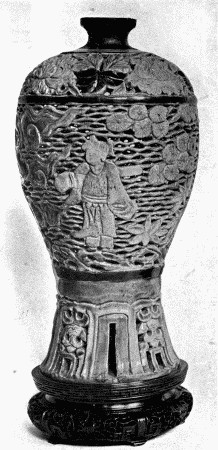
VASE. RETICULATED PORCELAIN.
A very rare and fine quality reticulated bulbous-shaped Vase with short neck. The body is decorated with figures, trees, &c., in a bold design. The shoulder, which is supported from the top by a band of blue, is decorated with various flowers and leaves. The base, which is a conventional design, is also supported from the centre by dark and light blue bands. The whole vase is brilliantly enamelled in aubergine, blue, yellow, &c. Ming period. This piece is a specimen of the coloured glazes on biscuit in which, after the piercing of the pattern on the air-dried clay has been carried out, it is fired in the kiln before being glazed. In classification this would be in the "Celadon biscuit" class. The reticulation in this specimen, though not so fine as in the other example which we have given, is very wonderful. How skilful the potter must have been to carve such an intricate pattern from a sun-dried vase! How each stroke of the tool must have had careful attention, so that, whilst aiming at a lace-like effect, the body of the vase should still be strong enough to bear the biscuit firing without breaking! Of course care had to be exercised in the painting, which was rarely in monochrome; generally, yellow, green, blue, maroon, and aubergine were employed. Then the second firing took place. In nearly all biscuit Celadon the paste or body is thinner than in ordinary Celadon, because the pattern had to be cut into and through it. To this class belongs the Ming Celadon, having the figures and other ornament in relief.
XIX DECORATED WITH COLOURED ENAMELS
CHAPTER XIX DECORATED WITH COLOURED ENAMELS
The section of porcelain which deals with decoration in colours is a revelation of the ingenuity, art, and industry of the Chinese potter. The difference between the Chinese productions and European china are striking; in fact, they cannot be compared. With the Chinese, the porcelain manufacture was a matter of custom, almost of religion. The gift of a piece of porcelain marked every solemn ceremony—the new year, the birthday, the marriage never passed without the presentation of a cup or vase which bore an inscription or a symbol of good wishes, or a character meaning either longevity or earthly happiness. Indeed, the visitor to the Chinese home could see not only cups and vases, but teapots, dishes, and plates with varied decoration and brilliant colouring, each telling its own story. Sometimes the teapots were made in the form of Chinese characters. On some pieces were the familiar scenes of the home life or of the public life which give us glimpses of the manners of a people, still imperfectly known and less understood, who for centuries opposed the strongest barriers to the curiosity of Europeans. On other pieces were depicted subjects drawn from the sacred legends or from the principal scenes of well-known wars.
Then the birds and animals each with its meaning, each a symbol! The peach blossom, the lotus, the dragon of the Emperors or of the princes appear side by side with the kylin, the Korean lion or dog of Fô, the sacred Ho-Ho birds, or Fong-Hoang, &c. On the plates and dishes specimens of the Oriental flowers were spread out in all the glory of vivid colour—peonies and chrysanthemums, lotus and azalea, with insects and butterflies no less gorgeous and certainly no less emblematical. Other specimens had for decoration rocks and trees with birds of rich plumage, and fishes with scales of golden hue.
Amongst these dazzling enamel colours four are most attractive and seem to dominate over all the others. Arranging them in families and placing them in order of age, we should take the black family, the green family, the yellow family, and the rose family. These all show the brilliant tones of a perfected production, and singularly enough they were, with one exception, ascribed to the Tsing dynasty; they began to be made in the Kang-he period of that dynasty. Such was the generally received opinion. Further investigation has shown that, with the exception of the "famille rose," most of these were made during the Ming dynasty, and attention is being drawn to this fact more and more as time reveals many undoubtedly fine pieces of the older dynasty. It may be objected that these fine pieces are later Chinese copies with the old dates, and the objection has certainly some grounds, but we must remember that the invention of translucid porcelain and its decoration was quite fabulous with regard to its antiquity, and we must further bear in mind that the regulations of the social and political life of the Chinese, the organisation of the family, which scarcely permitted the son to follow any other profession than that of his father, perpetuated the trades of a calling or trade. The routine practice, if this expresses the idea better, forbade all initiative in the mere worker. Inspiration creating new forms and colours depended upon the genius who presided over the Imperial manufactories. These and other causes brought this result, that art and industry rested almost stationary, reproducing the same types, the same forms, the same decoration, which responded to the demands, habits and customs of a people whose needs scarcely varied. Under these conditions, which furnish food for reflection, when we inquire, "Is this old china or not?" we must note that the mere inspection of hard porcelain made of kaolin, which is almost unalterable with time, will never reveal to the most expert the date of its creation. It is true that certain pieces bear an inscription indicating this or that date, but the number of these is very limited, for the use of date marks does not appear to have been adopted by the Chinese before the end of the fifteenth century. Although it may be objected that these marked specimens are later Chinese copies, and that similarly decorated specimens have simply the old dates recopied, it is quite possible that many of them which are thought to have been imitations may be really old. It will be difficult even for the expert to be certain in his differentiation between fine old Ming and Kang-he.
Coming in the same period as the three Kang-he enamel colours are the two underground glaze grounds powder-blue and coral-red. True powder-blue is Kang-he, but it has been copied, and badly, right on to our own times, whilst in coral red—"rouge de fer"—the later Keen-lung specimens can fairly be said to rival those of the earlier period. It is doubtful whether this rivalry would apply to any other class of porcelain.
A.—The Black Family—"Famille Noir."
This magnificent production, of which we give examples in our illustrations, is usually ascribed to Kang-he, possibly it may be earlier. Its characteristic quality was a black ground covered with almost invisible green glaze. The body of these pieces was decorated with flowers in yellow, green, and white, and with butterflies. A common form of decoration—if any can be called common in dealing with such a rare product—was that the panels were decorated with emblems of the seasons. A tree of peony with green, white, and grey blossoms appears to us to be fantastic, but the peony in China grew to the height of 12 ft. The chrysanthemum with flowers of similar colours formed a second panel, the guelder rose with green and white blossoms made the third, whilst the fourth had the lotus flower with tall green and grey flowers growing at the foot of green rocks at the edge of a green lake. The prunus blossom in white or pale green was often used for floral decoration, and yellow finches with green wings, white storks, white butterflies and bees are often found. So, too, is a green-faced dragon with a long brilliant green body in coils, sporting itself in mid-air. Reference to our illustrations will bring out other forms of decoration treated at some length.
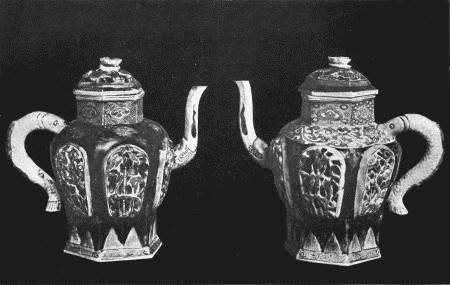
BLACK FAMILY—"FAMILLE NOIRE."
This rare class, which is well exemplified by the fine specimens in the Salting Collection in the Museum at South Kensington, seems to have had the decoration applied in outline or in colour to white porcelain, and then the black ground was filled in. The black is thin and the tint is not intense. The decoration may be left white, or "famille verte" or "famille rose," &c. In these respects it differs from the modern ware, in which the enamel is thick, and the painting of the flowers and insects is far from being brilliant. Such pieces have no value.
The illustration shows a rare pair of hexagonal Teapots, divided into six pierced panels, which are decorated with hawthorn blossom, bamboo plant, and the peach-tree, on each side; the ground of brilliant black enamel. Springing from the base are acantha leaves, decorated in rouge de fer, in high relief; the base decorated with a light tracery design on apple-green; the necks divided into six panels in apple-green, bright green, and yellow, on which are Joo-e-heads in aubergine on various shades of green. The covers reticulated with design of hawthorn and branches; the stems in aubergine on green and rouge de fer. The handles are formed as dolphins; the head of each is in aubergine, the back in rouge de fer, and the body in yellow. The spouts are seen issuing from monster heads, the latter in aubergine, the former in brilliant yellow. Kang-he.
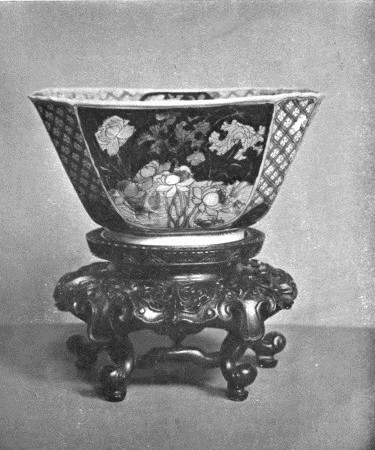
BLACK FAMILY—"FAMILLE NOIRE."
A very artistic octagonal-shaped Bowl, divided into four panels, on which are represented the flowers of the four seasons, decorated in green, white, and aubergine, on a brilliant black background. Dividing the panels are four sections of a diamond diaper design in green and yellow; at the base of each of these is a Joo-e-head in green and black. Surrounding the whole of the panels at the base is a light tracery design in black on yellow ground. At the bottom of the interior is an octagonal panel, decorated with rocks, flowers, and foliage in green, aubergine, and yellow, on black ground. Inside the rim is decorated with four panels of diaper design in green and yellow, in the centre of each of which there is a small reserve containing flowers in various colours on black ground, the outer portion of each having an aubergine border. Dividing these four panels are four small reserves, containing flowers in various colours on a seeded yellow ground. Supported on a carved wood stand. In this piece the diaper decoration, in green and yellow, which distinguishes early Ming and Kang-he, is again prominent. These diapers are largely used in borders too. Many of them can be traced in our illustrations, such as the key pattern, the T, the swastika, Joo-e-head, trellis, triangle, herring-bone, honeycomb, ring, diamond, as here, plain, sometimes it is flowered; lozenge, coin, scroll, fish-roe, octagons and squares, net-work, petal-work, speckled-work to imitate fish-skin, scale, curl, Y-work. They should be studied. Kang-he period.
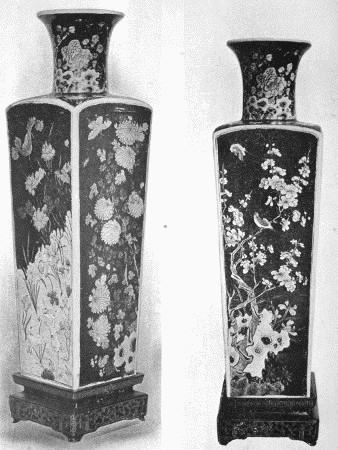
BLACK FAMILY—"FAMILLE NOIRE."
The pair of square-shaped tapering Vases of brilliant black enamel. Three of the four seasons are shown, in which are depicted the flowers of the seasons in green, yellow, white, and aubergine. On the shoulders there are flowers in similar colours, whilst each neck is decorated with peonies in green, yellow, and aubergine, all having the same brilliant black ground. On the vase showing a single face there is the spring scene of peach-trees with flowers and birds. The rocks are conventional in form, whilst the branches and trunks of the trees in aubergine show the darker markings in sepia. To the left of the other vase we find the summer flower, the lotus, in full bloom, with storks wading in the water; to the right the autumn flower, the chrysanthemum, bears a gorgeous display of bloom. In the top left corner, a butterfly—emblem of conjugal felicity—is flitting round the flowers. The fourth season—the plum and early rose—is not shown.
The black glaze used here must not be confounded with that which was invented in the Keen-lung period, because the Keen-lung glaze was applied in one process. The Kang-he black was a dull black glazed over with green. The painting of the flowers, &c., was first carried out in proper colours, then the black was applied to block out the design, and finally the thin but brilliant green was painted over the black. Variations in the colour scheme may be found. Some have the flowers, &c., left in white upon the black ground. Others have similar drawing white with black ground, only the green glaze was carried all over the piece, so that whilst the ground remained black the decoration was all coloured green. The examples are of the Kang-he period.
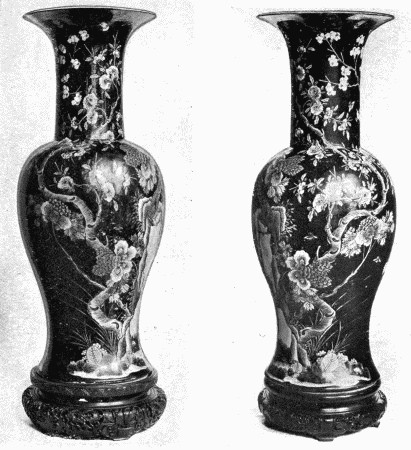
BLACK FAMILY—"FAMILLE NOIRE."
A pair of large-sized pear-shaped Beaker Vases.
This quality of old Chinese porcelain is very rare and valuable. The two vases are so shown as to exhibit the usual method adopted by the Chinese in decorating two objects similar in shape. The European style is to decorate the two objects making a pair in precisely the same way. The Orientals reversed the patterns so as to give a right and a left view of them. In these vases the tree trunk and the floral pattern on the one vase takes an opposite direction in the other, so that when they are placed side by side, as in the illustration, they make a balanced design. These are most extraordinary examples of the rare "famille noire" porcelain, and of their kind are undoubtedly the finest known specimens. The background is of a brilliant black, decorated with rocks in bright green, and two birds in various brilliant colours. Coming from the back of the rock is a peony, exquisitely drawn and brilliantly enamelled in yellow. The flowers on the corresponding side to this are bright green with white stalks. The reverse has peonies. The base and the upper part is almost covered with white hawthorn in a brilliant vitreous white; the neck decorated with sprays of flowers and hawthorn in white and brilliant coloured enamels. A great feature of the body of the vase is the branches of trees on either side, carried out in aubergine in the most perfect gradation of colour. The designs are opposite in each vase, and thus form a complete pair. The vases are in perfect condition, and of the Kang-he period. Extreme height, 27 inches; height of stand, 3-1/2 inches. Value, £10,000.
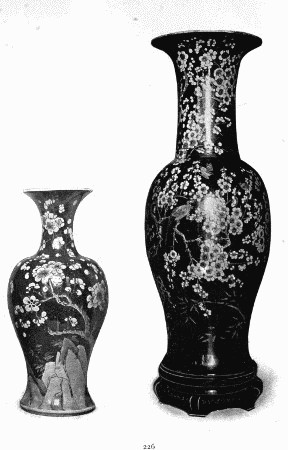
BLACK FAMILY—"FAMILLE NOIRE."
(a) A small oviform bottle-shaped Vase, with expanding neck, decorated with rocks, prunus blossom, and branches, in various greens, white, aubergine, and yellow, on a brilliant black enamel ground.
(b) An oviform beaker-shaped Vase decorated with prunus blossom and branches, similar to the above in colour. Birds in brilliant colours. Black ground. Neither M. Jacquemart nor Franks nor Gulland give very much information about this class of porcelain—black ground covered with an almost invisible green glaze. As in the blue and white class, there are found sprays or branches of white prunus with the "ascending" and the "descending" stem in what has been so long miscalled the "hawthorn pattern." The difference is, of course, one of ground colour. The blue in the one is under the glaze, and in the other the black is painted on the white china in its biscuit state when the other decoration has first been burnt in. The process appears to be this. First the white or coloured pattern is burnt in, in the first firing in the kiln, leaving the ground white. To this the black ground is applied and again burnt in. Over this black ground the green wash is painted, and at the same time coloured decoration added where necessary, causing another visit to the kiln. Finally the whole is covered with a fine transparent glaze and receives its final firing. It seems that unless a process similar to this were adopted the smoothness and beauty of the magnificent decoration could never be attained. Note in one illustration the "ascending" stem and in the other the stem is "descending" over the body and ascending in the neck. Both pieces are Kang-he.
B.—The Green Family—"Famille Verte."
The green family in its finest form is undoubtedly a Kang-he production, but all of the decoration was not in green. Brilliant enamel colours were combined with gilding, and flowers such as the white chrysanthemum, the lotus, the prunus are frequently found in conjunction with black speckled diapers and large panels decorated with various subjects with small reserves decorated with fishes, crabs, and prawns. Figure painting in the green family is not uncommon. Si-Wang-Mu on the borders of the Lake of Gems, mounted warriors in a battle scene or simply marching, and various other military subjects are not uncommon. The ancient pine-tree and the peony are frequently met with, but it is the green, one of the most beautiful enamel colours ever used, which constitutes the attraction in this "famille verte" class, to which family belong many of the figures now known as Ming figures, such as the dog of Fô, having a white body with yellow, green and gold protuberances, green head and green, grey, and red mane and tail. The bases of such figures are usually in diamond or other diapers, which may be further decorated with a single red peach blossom. The earlier Ming figures as a rule have the flesh, face, arms, and hands unglazed.
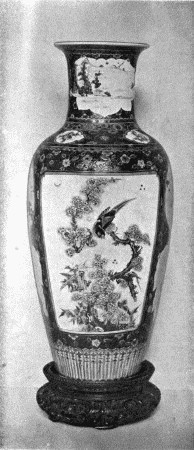
GREEN FAMILY—"FAMILLE VERTE."
A rare and very beautiful oviform Vase, containing on the body two large panels, one with a bird on the branch of a plum-tree, the other with a peony on the branch of a tree under which is a large chrysanthemum and foliage. On each side there are two other panels, one circular, the other leaf shape; these contain as to the former, insects, and the latter, cocks. All the panels are surrounded with a narrow border of yellow, black, and aubergine; the body of the vase richly enamelled with flowers and foliage in blue, green, and aubergine, on a bright black ground. At the base is a broad band of formal design in aubergine, yellow, and rouge de fer, on apple-green. At the bottom of the neck is a broad band with flowers in rouge de fer, green, blue, and aubergine, on a stippled black ground; this is divided by four reserves containing carp and other fishes in rouge de fer, green, and black, on white, the borderings of green and yellow; under this is a band of Joo-e-heads in aubergine, blue, and green, alternately, depending from a narrow margin containing a formal design in rouge de fer and green on a black ground. The neck has two leaf-shaped panels containing river scenes; the remainder decorated in uniformity to the vase. At the top of the neck is a key design in black on green; depending from this a wave pattern border in aubergine, black, and green; this is repeated at the base of the neck, having under it a narrow band containing chrysanthemums and foliage in rouge de fer, aubergine, green, and yellow on stippled green ground. The whole of the panels in rich "famille verte" colours. Kang-he period.
Note.—The connoisseur will at once detect in this vase qualities hardly ever met with in Chinese porcelain. The technique leaves nothing to be desired, and the quality of the enamels and porcelain is of the very highest.
From the Collection of G. R. Davies, Esq.
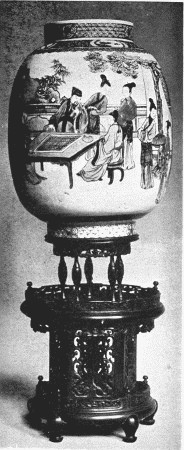
GREEN FAMILY—"FAMILLE VERTE."
The long, slim ladies' figures so often found in the decoration of very fine Kang-He blue and white represent what were known to the Dutchmen as Lange Lijsen, Lange Lysen, or "slender damsels." This name is familiar in its English form of "Long Elizas." The older pieces gave these figures very large heads, which later were drawn smaller. The style of hairdressing is also different. Bearing in mind the fact that imitations continued right down through the dynasties, drawing alone cannot be relied on as an indication of age.
Our illustration is an egg-shell Lantern, one of a pair, in the finest quality "famille verte" on white. It shows a court lady and gentleman playing "Go," seated upon a terrace. At the table is also seated a nobleman of high rank, five other female figures being attendants. The remainder of the decoration is of trees with flowering branches, clouds, rocks, &c. Surrounding the neck is a diaper design in aubergine and black on a bright green ground, this band being intersected with four small reserves containing flowers in green and yellow on a white ground; the neck has trellis design in rouge de fer on a white ground, relieved with four flowers in green and black; the base is similarly treated, and above this is a broad band of brilliant green enamel decorated with a pencilled Grecian key design in black. Kang-he period.
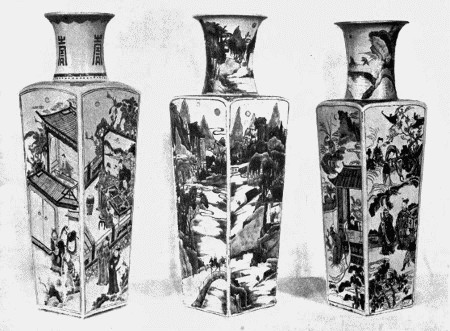
GREEN FAMILY—"FAMILLE VERTE."
The illustration is a set of three Vases of the highest quality "famille verte," square-shaped, tapering towards the base, decorated with enamel colours in which green predominates, but with fine blues, soft yellows, and black. The middle vase represents two views. On the left is a mountain stream running through a deep gorge with rocks and mountain peaks rising in the middle and far distance. In the foreground is one man riding and another walking across the bridge over the stream. On the right is a similar background of mountains. Down the stream is a boatman steering his laden boat by the aid of a pole. Nearer is a house with a lady looking out at the door. Below is a man fishing.
On the left vase there are two scenes from everyday life. One represents a man playing the Kin, or Chinese lute; below a man is talking to a boy; a horse stands behind them. The other shows two men playing "go bang" whilst a lady looks on; near them, on the other side of the hedge, two men are conversing during a walk. On the neck of the vase is a cheou or show character, meaning longevity.
On the right vase, left side, is a house in the foreground with a mountain scene stretching away in the distance. From the window of the house a Taoist is speaking with Leu Tung-pin, one of the eight immortals, whose feet are on the clouds, whilst his sword is as usual slung across his back. On the other side, high up amongst the hills, are Lange Lyzen, one of whom is dancing. Below are two dignitaries in conversation with a servant standing near. In the foreground of both sides are trees in a landscape. Kang-he period.
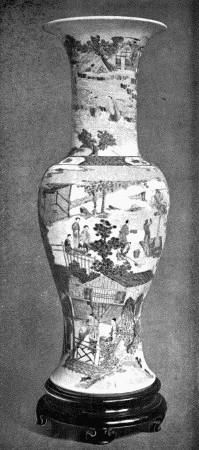
GREEN FAMILY—"FAMILLE VERTE."
This example shows how faithfully the Chinese could utilise the scenes of their daily life for illustration. In this respect it is well worthy of careful study. It belongs to the Kang-he period.
A large beaker-shaped Vase of the highest quality "famille verte," finely drawn, and decorated with subjects illustrating the rice industry. Near the base is the figure of a man ploughing the rice field, with a water buffalo, in aubergine and yellow. Just above, inside a building, which is of aubergine and green, is a man sorting the rice. Again, above this, on the left, are two girls, one in a yellow robe, the other in blue, preparing the twine necessary for laying out the field. On the other side are children and women in green, yellow, and blue robes, gathering the rice; whilst underneath these are two men showing the process of weighing. In the centre, above this, are three other figures, one carrying the rice in a tray, and the others showing the process of winnowing. The remainder of the body of the vase has finely drawn trees with flowering branches thickly enamelled, whilst at the top is a broad diaper-pattern band with yellow flowers on a green ground; this band has at top and bottom a narrow margin of aubergine, and is intersected with four small reserves containing utensils in green, yellow, aubergine, and black, on a white ground. The neck is similarly enamelled, and shows on one side men sowing the rice, and on the other a lady is reclining, whilst in front of her are two attendants.
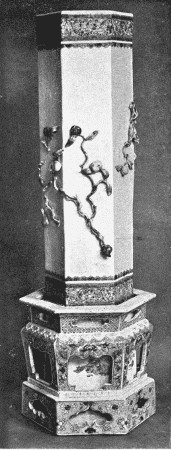
GREEN FAMILY—"FAMILLE VERTE."
Large hexagonal Arrow Stand.
Although the Chinese think very highly of a life free from worldly turmoil, yet they were warriors too. Here we have a fine example of a porcelain arrow stand, decorated with raised ornament, with pierced ornament, and with fine enamel colouring. We note the peach branch—emblem of marriage and long life—to which magic virtues were attributed. Possibly this emblem indicated the reward of the warrior, when his work as a soldier was finished. The presence of the immortals, again, was the expression of the universal desire for long life which has always existed in China, and the immortals, who had eaten the peach—the fruit of immortality—represent this ever-to-be-coveted object. Referring to the illustration, the arrow stand is decorated in high relief, with peaches on branches in aubergine, rouge de fer, green, and yellow, on a white ground. At the top is a broad band richly enamelled in "famille verte" colours with flowers and foliage on a stippled ground bordered with the key design in black on bright green. Separating a band of Joo-e-heads, enamelled in yellow, blue, green, and black, is a narrow margin in plain apple-green. At the base are six reclining figures of immortals in "famille verte" colours, whilst above these is a band similar to that at the top. This is supported on a hexagonal base richly enamelled with flowers in "famille verte" colours. Period, Kang-he.
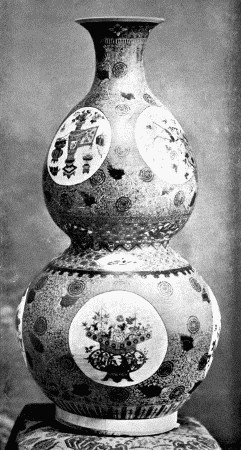
GREEN FAMILY—"FAMILLE VERTE."
The Vase given as an illustration belongs to the "famille verte" class, and deserves careful attention from the fact that it is useful to be able to read off the points in any given piece. Take the shape first. It is a gourd-shaped bottle with spreading mouth. On it are seen three circular panels, called also reserves or compartments. The bottom one, as may be easily seen, contains a basket of flowers with a ribbon on the top. The one on the left is filled with utensils—a word used for this kind of decoration. Note the vases with flowers, the books bound with a filet and the leaf symbol. The other round panel shows a bird on a branch of the peony in flower. Butterflies, &c., are also shown.
The groundwork of the two bulging bodies is a diaper pattern of the most elaborate curl-work, through which runs a conventional pattern of stems, leaves, and flowers of the peony.
Now begin at the spreading mouth and trace the diapers downwards. The first pattern is the "flowered honeycomb," then a small rectangular diaper. Passing to the base of the first bulge, we find a narrow "Joo-e-head" band, below that "flowered octagons and squares," then flowered "triangle-work" in another band. Still more "flowered octagons and squares" follow, having next below a diaper of "treble scale" pattern. Last of all comes alternately a light and dark rectangular pattern. It will be noted that the diapers are broken by small "Joo-e-head" reserves painted with utensils, flowers, and views. Kang-he period. Decoration of the reserves in "famille verte."
C.—The Powdered Blue, with Enamel Colours.
The powder or powdered blue family has been referred to already and the manner in which the blue is applied has been explained. Though this colour, like the others, had perhaps its rise, and its greatest perfection, in the Kang-he period, yet many specimens of extremely fine quality are ascribed to Yung-ching and Keen-lung. There are, however, no specimens of true powder-blue that belong to any other than the Kang-he period. The art was evidently lost, and when it was attempted, in the reign of the Emperor Keen-lung, the nearest approach was what is known as mazarine blue, which is entirely different, being much heavier in tone and not powdered, and it is these pieces which have "famille-rose" decoration, and this places beyond all doubt the period to which they belong. Where the powder-blue has reserves, as is almost always the case, they may be filled with decoration in blue under the glaze, or with "famille verte" applied over the glaze. Or again, and in the later periods of Yung-ching and Keen-lung, the various shaped white reserves may have "famille rose" decoration. Similar flowers were used in decorating these pieces in reserves, as we have mentioned before. A general test of the older pieces is the presence of the joo-e head, which either ornaments the rims in small panels or is the shape adopted for the large panels. These are decorated with garden landscapes with figures, and official emblems in various colours such as green, yellow, grey, red, and even other blue enamel colours. Other scenes represent the god of longevity presenting the red peach of long life to a child held by a person of rank. Generally, however, the subjects used have decorations varying comparatively little, although the treatment of these subjects differs considerably in the colour scheme.
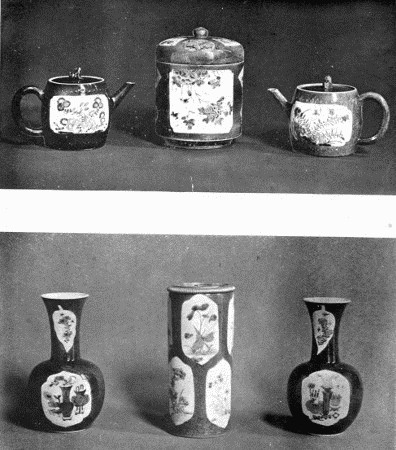
POWDER-BLUE WITH "FAMILLE VERTE" AND WITH BLUE AND WHITE DECORATION.
(a) A powder-blue Pot and Cover. The body has two large square-shaped panels decorated with flowers, birds, &c., in "famille verte"; it also has two panels form of pomegranate fruit decorated in greens and red, and two fan-shaped panels with flowers in black on a yellow ground. The lid has two panels form of peach fruit in greens and red, and two fan-shaped panels with flowers, &c., in "famille verte" Very unusual specimen. Kang-he.