Chapter I · INTRODUCTORY (continued 3)
Reading edition
A pair of powder-blue teapots relieved with panels decorated with flowers in "famille verte." The lids are surmounted with so-called kylins, dogs of Fô, or Corean lions. Kang-he.
(b) An elegant-shaped powder-blue Vase, relieved with various Joo-e-head panels, decorated with flowers, &c., beautifully enamelled in "famille verte," with gold pencilling between panels. Mounted with a rim of ormolu. Kang-he.
A pair of powder-blue bottle-shaped Vases with three Joo-e-head-shaped panels on the body, decorated with vases, utensils, &c., in blue and white, and three leaf-shaped panels decorated with flowers, butterflies, &c., on the neck, also in blue and white. Kang-he period. The panels of vases, &c., are often decorated with emblems of the seasons by means of flowers and landscapes. Thus, spring may be shown by a mountain scene with the prunus or peach in bloom before its leaves appear, or by another with two ladies under the willow. Spring flowers are the large white magnolia or the yulan with the peony. The yulan magnolia is often confounded with the guelder-rose, though the former, like the peach, blossoms before its leaves appear. It is a magnolia, one of eighty-five species. Summer is pictured by pines, poplars, reeds, lotus, hydrangea, pinks, and flags; autumn by chrysanthemums, birds, butterflies, russet leaves of the oak and its acorns, by scenes of ladies gathering fruit, and of swollen rivers and autumn tints generally. Winter is indicated by the prunus or plum, by early roses or winter scenes.
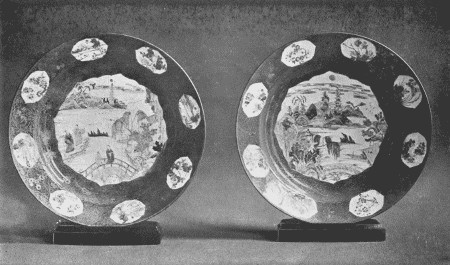
POWDER-BLUE WITH "FAMILLE VERTE" DECORATION.
A pair of very fine quality, large size, powder-blue Plates with Joo-e-shaped panels in the centre, and eight small panels or reserves round the border. It will be noticed that the patterns of the decoration on the two plates is not the same. The central panel on the left has a fine landscape with figures in conversation. The smaller panels are alternately decorated with a small landscape, and with flowers. The gilt pattern, too, so often used with powder-blue, and so quickly lost, is clearly shown on the blue ground, giving a further decoration of flowers not alone in compartments, but also over all the blue surface. The other plate has the central panel decorated with a landscape and some striking cloud forms. The small panels are all decorated with flowers. There are only traces of the formal golden chrysanthemum pattern, which, besides, is again different to that on the other plate. Both have a mountainous coast scene in the distance with a pagoda and trees. Both, too, in middle distance a house and a weeping willow. Besides this class of powder-blue with green family decoration, it is also very effective, though not so brilliant, with blue under-glaze landscapes, figures, and flowers in similar panels to those we have described-that is, the Joo-e-head panel. Special attention should be paid to the variation of the Joo-e outline. The Joo-e-head itself is given amongst the symbolical marks. The catalogue description is sometimes like this, "Joo-e head-shaped reserves," or again "Joo-e-head-shaped Y diaper." Kang-he period.
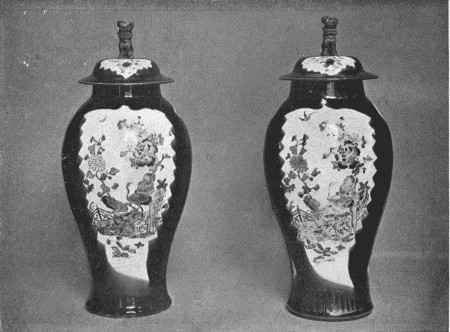
MAZARINE BLUE.
A pair of mazarine blue Jars and Covers, having two leaf-shaped panels. These are from a set of five, three vases and two beakers. These are finely decorated with storks and other birds and flowers in "famille rose" enamel. Various small panels as on the covers are similarly decorated with flowers. The covers themselves are surmounted by dogs of Fô or Corean lions. These are ascribed to Keen-lung, and may be taken as an attempt to copy Kang-he powder-blue. They are covered with a rich blue enamel named mazarine, after the cardinal of that name. This is opaque and generally darker in colour than the powder-blue. One is applied as a colour enamel—that is mazarine; the other is colour powdered or dabbed on—that is powder-blue. The mazarine blue comes really under the Celadon class as a "self" colour. The leaf-shaped panels or reserves are in white surrounded by a faint dull red outline of the leaf. The blue enamel is not alone used with "famille rose" decoration as in the illustration, but it is also combined with "famille verte" either with or without red scroll-work as a ground diaper. The vases made in pairs have usually a right and a left—that is, the pattern is reversed. Here we have an example of the contrary, the two specimens are identical. The leaf-panel runs down from the top to the point at the bottom on the right in both, and birds, flowers, and trees are as nearly alike as possibly could be expected.
Note.—The decoration in blue enamel colour was an addition of the early part of the Tsing dynasty; no Ming specimen has been identified having the blue over the glaze.
D.—Green and Yellow Family—"Famille Jaune."
An elegant combination is found in this early product, where the two prominent colours are green and yellow. Sometimes the body may have a black ground covered with almost invisible green glaze, but the main decoration is green, aubergine, and yellow, although other colours such as red, especially red triangle work, is frequently found. These pieces probably originated in the Ming period, but were recopied later. They have reserves such as those mentioned before, decorated with Buddhist emblems or with subjects such as a prince and princess of the Imperial house walking in a garden with two Ho-Ho birds, and a landscape where ladies are conversing and men are in attendance. Amongst the symbols are to be found the official one of the branch of coral with the peacock's feathers. The diapers are very varied and the joo-e-head decoration is frequently found. The frontispiece gives a good idea of this form of decoration, and its description should be noted.
In speaking of the rare examples, yellow-ground, as well as black and green, could be ranked quite in the first order; in fact, they are almost the rarest kind. Specimens of these families were made at the end of the Ming period, and it is a very moot point to-day whether the fine examples, which we know, belong to the end of the Ming or the beginning of the Kang-he.
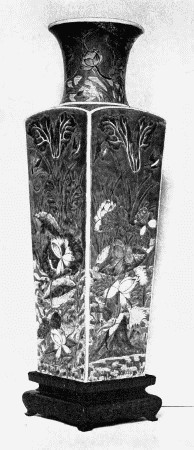
GREEN AND YELLOW FAMILY—"FAMILLE JAUNE."
A tall square taper-shape Vase, decorated with a bold design of lotus flowers, foliage, and birds, in various greens, aubergine, and black on brilliant yellow; on the shoulders in each corner is a Joo-e-head design in aubergine and green; the edgings in white biscuit with black borderings. This is a very interesting decoration. The surface of the water is represented by the numerous short horizontal lines. In the water, the lotus, the sweet-flag, and other water-loving plants are growing, just as if the artist had made his drawing from the banks of an actual pond in the open air. Besides being beautiful, the lotus is the sacred flower of Buddha. Its large tulip-like flowers may be white or tinted pink, blue or yellow, and they hang over broad leaves, in shape like the nasturtium leaf. It does not lie upon the water like the water-lily, but stands up from it upon a strong stem. The drawing shows bud, flower, and seed-pod. It is the last which is usually carried as an emblem by the goddess, Ho Seen-koo, though it may be a bud or a full-blown flower. The lotus belongs to the water-lily family, and the sacred lotus was anciently used in religious rites in Egypt and Assyria, whilst the Greeks dedicated it to the nymphs. Its constant use as an emblem seems to come from its wheel-like form. Like the Chakra, or "Wheel of the Law," it typifies the doctrine of perpetual cycles of existence. In fact, the spokes of the Chakra are often lotus-shaped. Kang-he period.
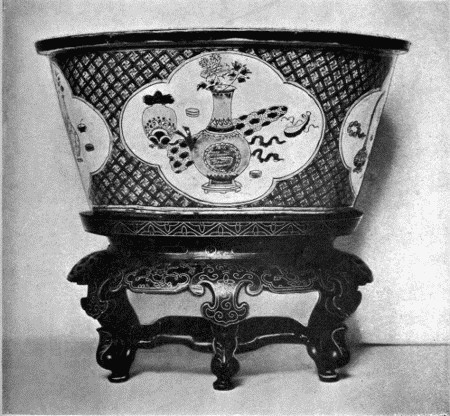
GREEN AND YELLOW FAMILY—"FAMILLE JAUNE."
An oval-shaped Jardinière, decorated with a diaper design in brilliant green and yellow enamels. The body is divided into four quatrefoil-shaped panels containing altar utensils and vases, which are most artistically drawn and enamelled in various greens, yellows, aubergine, and black, on a white ground. The diaper pattern which forms the groundwork is the diamond design, but the double lines cutting the diamond are so arranged to form the swastika. The swastika—"the ten thousand things"—is sometimes found as a mark upon blue and white or painted Chinese porcelain of fine quality. It may occur alone, or with a border of two oblongs like a seal shape, or four swastikas may be found in a similar border. In the front of the quatrefoil-shaped panel on the vases is another symbol, one of the hundred Cheous or Shows, the emblem of longevity. The curious instrument lying behind the vases is the lute wrapped in its cover. This stringed instrument consists of a board four feet long eighteen inches wide, convex above and flat below, where two holes open into hollows. There are seven strings. It is very ancient and constitutes an emblem of harmony. As Confucius writes: "Happy union with wife and children is like the music of lutes and harps." The other instrument represents a guitar, which was made in many forms, from the bamboo stick thrust into a cylinder of the same material, having only two strings, to the pipa, having four strings, like those of the violin. Kang-he.
E.—Coral Red Ground.
If there is another class which deserves mention it is that having a coral red ground thickly powdered it may be with white chrysanthemum leaves and flowers, decorated with joo-e-head ornaments or ornamented with deep rose, grey and white, yellow and white, pale blue and white, prunus blossom powdered upon a golden iced diaper, the emblem of the coming spring. This coral red ground—"rouge de fer"—differs from all the others in this class because it is an under-glaze decoration. It is essentially a Kang-he production, although some very fine specimens have the Keen-lung mark.
The reader has no doubt noticed the rivalry between these periods, and the values of coral red specimens are more affected by quality than perhaps by age.
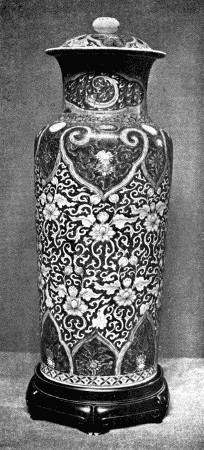
CORAL RED GROUND—"ROUGE DE FER."
The piece of coral was an emblem of the official class, and this coral-red ground is, as its name implies, an imitation of this. It is an under-glaze ground, in which the colour was derived from iron. Over-glaze enamels were used for decoration with fine effect, such as the greens, the yellows, and the reds from gold. Blue over the glaze dates from Kang-He, and it is early.
Our illustration shows a very fine cylindrical Jar, with receding neck and spreading lid with knob. The body decorated with formal scroll and leaf pattern, with a double band of conventional white lotus. The shoulder and base decorated with a broad band of Joo-e-shaped reserves, bordered alternately with narrow bands of blue and grey edged with green; the smaller space between edged with a paler green. Red reserves, so formed, decorated with conventional chrysanthemums with brilliant green leaves. On the shoulder above, four circular, green-edged, white medallions, and four oval, green-edged, red spaces ornamented with chrysanthemum flowers. At the base a narrow band of green and red diamond rice diaper on a white ground. The neck decorated with two shaped oval red medallions, edged with grey on a speckled green ground powdered with red chrysanthemum. The reserve decorated with coiled white fire dragons (mang) among white fire-forms on a coral-red ground. Above and below this decoration, narrow bands of scroll and flower diaper patterns. Lid with a slightly decorated white knob, ornamented with similar pattern to that on the shoulder of the vase. Height, 21 in. Period, Kang-he.
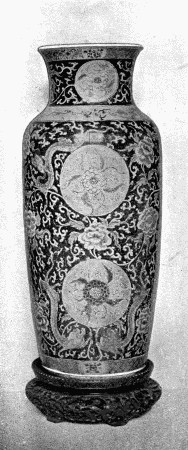
CORAL RED GROUND—"ROUGE DE FER."
The dragon is the Emperor's emblem, as the phœnix or Fong-Hoang is that of the Empress. We find the "lung" or "long" dragon of the sky, the "li" dragon of the sea, and the "kiau" dragon of the marshes. There are scaly dragons, and others winged, horned, hornless, and rolled. The four highest ranks of princes are permitted to use the five-clawed dragon, but the fifth rank of the princes and the mandarins use a dragon or serpent with four claws. This, treated conventionally, is the well-known "mang" which is shown in the body and necks of the vase used as an illustration. The expressions, "dragon's seat," "dragon's bed," "dragon's face," "dragon's head," &c., are easily understood when "emperor" is substituted for "dragon."
A tall, rouleau-shaped Vase, containing six circular panels with formal floral design in "rouge de fer," blue, and white, on apple-green; the body of the vase with dragons and formal flowers in yellow, blue, green, white, and aubergine, on deep "rouge de fer." At the base is a narrow band of diaper design with black lines on green ground; this contains four small reserves with a flower and foliage in "rouge de fer" and green on a white ground, the bordering of yellow and blue. The band separating the neck has a running dragon and clouds in blue; yellow, "rouge de fer," and white, on apple-green; whilst the neck is treated uniformly with the body of the vase, excepting that at the top there is a narrow band of diaper pattern in aubergine, green, and black, with four small reserves containing fruit and foliage in "rouge de fer" and green on white ground. Period, Kang-he.
F.—The Rose Family—"Famille Rose."
We noted that the rose enamel was used in decoration by Yung-ching. The same rose decoration was continued by Keen-lung, which had an especial form of decoration consisting of the rose and white peony with the prunus—the so-called hawthorn. Frequently, too, there is a swastika trellis. We have dealt somewhat fully with the ruby-back plates as a branch of the rose family. This ruby and peach blossom rose ground was applied to vases with very telling effect. As, in the black family, the ground was a black covered with an almost invisible green glaze, so in this family we get a peach blossom rose ground often powdered with pale blue, yellow, grey and white chrysanthemum blossoms. The reserves are often fan-shaped, and the decoration in these reserves consists of the usual subjects or emblems in brilliant enamel colours. Similar flowers to those noted before as the emblems of the seasons are frequently found. These include pale rose and blue and white peony, pale rose and white rose, peach blossom, chrysanthemums, the oleander with single rose and white prunus blossom. These rose pieces are extremely elegant and very rare. They date from the Yung-ching period, in which they reached their highest perfection, under Keen-lung the standard of excellence was nearly as high.
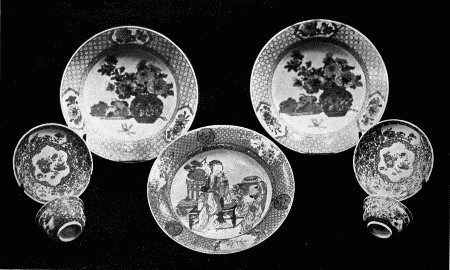
ROSE FAMILY—"FAMILLE ROSE."
Egg-Shell Porcelain. Ruby-Back Plates.
The central Plate has the rim decorated with the noted octagon and square diaper pattern so often found on egg-shell pieces, and used on every piece shown in the photograph. This pattern is often intercepted by reserves. The plate has three leaf-shaped reserves decorated with white peony, ruby peach, and yellow persimmon. There are three other reserves having formal golden flowers with green leaves. The whole centre of the plate represents a domestic scene where a lady of high rank, seated, is giving instructions to two children. In the background are vases and a table on which is a plant. The back of the rim is ruby coloured. Diameter, 8-1/4 inches. Period, Keen-lung. The two other plates are also ruby-backed. They have on the rim three Joo-e-head reserves containing fruit and flowers in brilliant colours. The central decoration consists of vases of flowers in enamels of the finest quality. The octagon and square diaper pattern is blue on the inner rim and pink on the broad band forming the outer rim. The cups and saucers are no less beautiful. The border is relieved with reserves, and the inner rim of octagon and square diaper surrounds a hexagonal central reserve of Joo-e-head design. In this reserve there are baskets of flowers and bouquets in brilliant colours enamelled on a white ground. This group shows many of the peculiarities of the rose family decoration with regard to diaper pattern, shape of the reserves, and the general character of the ornament.
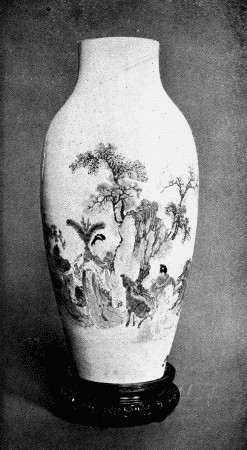
EGG-SHELL PORCELAIN.
An oviform egg-shell Vase, beautifully painted, with ladies in the landscape carrying vases. The whole in rich enamel colours. Yung-ching period. Height, 19-1/2 in. without stand. This is one of the largest known examples of egg-shell porcelain. This vase is painted in the most elaborate and beautiful style, which was brought to great perfection under Keen-lung. Some collectors are inclined to attribute such egg-shell with delicate pencillings to the Yung-ching era, though specimens which have been found with marks have been Keen-lung, and as time passes on Yung-ching will secure more and more support.
The lady carrying the vase is looking to her companion. Between them is an animal, either a deer or a kylin. The vase contains a branch of coral and two peacock's feathers, indicating a mandarin who has risen three steps at a time, as the coral and four feathers indicate a rise of five steps. The paintings of the figures and the vegetation are most minutely executed, and the rich enamels are delicately shaded with "verte," "rose," and other tints, showing tree-stems and rocks in their natural colours. As in all classes, some specimens are better than others, but this piece is one of unsurpassed excellence. To this egg-shell class belong the ruby-back plates, which are amongst the most desirable specimens of Chinese art. The same delicate handling in painting and colouring distinguishes them all. Figures are enamelled in pale green, pink, yellow, &c.; trees with green foliage have their trunks and branches with sepia on a pale lavender ground, whilst the cloud forms, slightly defined, fade away into the distance.
G.—Other Enamel Colours.
The decorations of the green family are rather severe in character. They might be termed Chinese classical, because they are so largely influenced by religion. The same remarks apply to the black family. The rose family, on the contrary, with its lovely borders and varied designs, generally represents familiar Chinese subjects and scenes from social life.
The enamel colours which follow are amongst the rarest and most beautiful products of China, taking rank with those pieces which are never dear, though the prices at which they are sold may be astonishing.
APPLE-GREEN GROUND.
The coloured glazes are very numerous, but the apple-green ground is rare and consequently very much valued. Besides the painting, these pieces, having coloured grounds, are further decorated by ornament raised in relief, or pierced, when the paste is soft, with reticulations.
The Chinese made puzzle cups with a small figure of a man inside, which would hold a liquid till it reached his shoulder, when the whole of the contents were syphoned out through a hole in the bottom of the cup. They also made puzzle vases or jugs, having a raised hollow coil round the neck, which, through the handle, was connected with the interior of the vessel. The old English puzzle jug had a similar device, in which the difficulty was to drink the contents without spilling them.
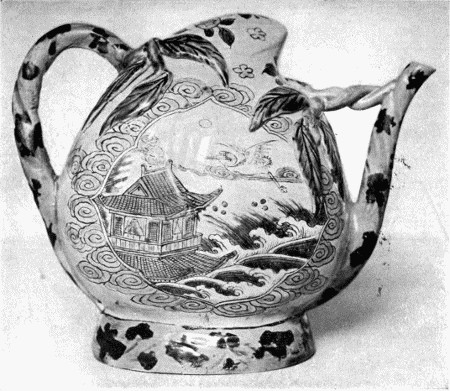
Here is a Puzzle Teapot or Wine-pot in the form of a peach, the Fruit of Life; the groundwork of pale apple-green decorated with flowers in yellow, aubergine, green, and black. In the centre on either side is a large white panel containing in the one a gentleman of rank with an attendant bringing him tea; this is decorated in various greens, yellow, and aubergine. On the other side is a house towards which is coming a flying stork; this is enamelled in similar colours, and both panels are surrounded by a cloud design in yellow, green, aubergine, and black. The base, spout, and handle have black patches on aubergine ground; while both the latter are held to the body by branches of leaves which are in high relief and enamelled in brilliant green. Ming biscuit, so-called.
APPLE-GREEN GROUND. LANG-YAO.
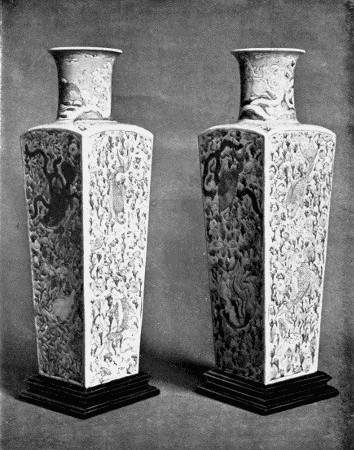
An unusual form of decoration is shown in this illustration. In China the carp and perch are often found in the decoration of small reserves. Indeed, the immortals are often drawn standing upon a fish, and modelled as figures standing on fishes, crabs, or crawfish. The effects of fish culture as carried on by the Chinese is very marked in the case of the carp, which are often seen with monster-like projecting eyes and tufted or lobed tails. They are kept in garden ponds or in large jars in which are placed rocks covered with moss and water-plants, which furnish the decoration in the illustration. The wonderful drawing of the fish in all sorts of positions is to be noted. So, too, is the marvellous arrangement of the water-plants, which fall gracefully into the scheme of decoration. All is still in the deep water, but on the shoulders are the water-lilies, and above them are the waves seemingly agitated by the rough wind. To recapitulate and to give the colours we specially call attention to this fine pair of square taper-shaped vases which are in all probability unique as a pair, decorated with fishes and aquatic plants in aubergine, green, yellow, black, and white, on a pale apple-green ground; the edges and borderings of yellow enamel. At the shoulders over each corner is a water-lily with foliage in green, yellow, and black; the necks decorated with horses in yellow and aubergine, going through waves of green and white enamel; the upper portion of pale apple-green. Called Lang-yao to indicate that it was discovered by Lang Ting-tso, superintendent of the Imperial works at King-te-chin. This piece is Kang-he.
DELICATE GREEN GROUND.
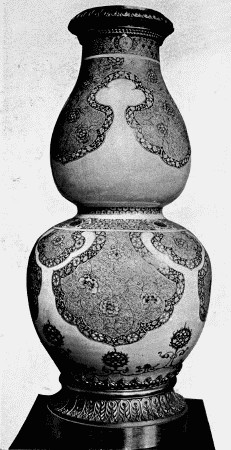
A double gourd-shaped Vase, of noble proportions, one of a pair, decorated with an imposing Vandyke design, containing peonies and a formal floral design in rich yellow and black enamels on a pale green ground. Each section is surrounded by a broad band of "rouge de fer" containing formal flowers in white. The top of the lower portion of the vase has a broad band of diaper design containing formal flowers on various colour grounds; this band is divided with four reserves, each containing a formal design in green and "rouge de fer" on bright yellow ground. The waist of the vase has a half-section diaper design in green and "rouge de fer." Around the neck is a deep band of a bold trellis design in "rouge de fer," blue, yellow, and black. They are supported on finely chased ormolu bases of Louis XVI. period; the mounts for the lips en suite. Period, Kang-he.
Here, again, we note diaper designs. On the top of the neck is a honey-comb diaper cut with sectors of a circle forming a geometrical flower pattern, which is further decorated by white and coloured formal flowers with six petals. The top of the lower portion has the honey-comb and square pattern decorated with geometrical flowers, whilst the lower part of the upper section has the honey-comb diaper with lines radiating from the centre so as to give a formal flower design.
Fine pieces of old Chinese porcelain are often found mounted in French ormolu. The examples from the Jones Collection, Victoria and Albert Museum, are fine pieces of old Crackle porcelain with finely chased ormolu mounts.
DELICATE GREEN GROUND.
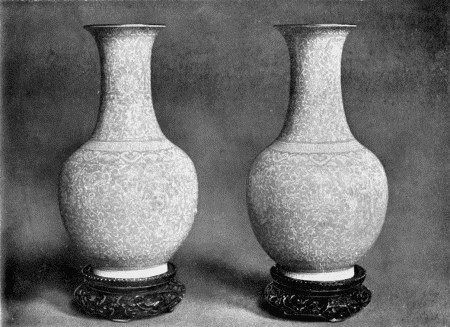
A pair of Imperial hedge-sparrow egg tint and white Vases with a very beautiful clear glaze. The white is a series of scrolls and flowers, and geometrical designs over the whole of the body and neck. Marked on base "Kea-king." Period, 1796-1821. In these two vases may be seen some of the most delicate and beautiful work of the later period. In paste, colour, and decoration they are exquisite. The green class includes apple-green, camellia-green, Celadon, pea-green, sea-green, and turquoise-green. The delicate green, indicated by the term "hedge-sparrow egg tint," is just a shade different from all of the others, and the application of the white enamel decoration over the green is most artistic and delicate. The conventional design is based upon a flower and its leaves, though the Joo-e-head and swastika are easily seen, the former below the central flower, and two swastikas, one on each side. At the top of the neck below the lip is a diaper of Joo-e-heads. The bottom of the neck has a Greek key pattern, so has the bottom rim. On the shoulder is a border of Joo-e-heads and conventional bats. The swastika is a mystical sign, with which is associated a hidden meaning of a religious kind. It is regarded as the emblem of the heart of Buddha—that is, his inner true teaching. It has also a further signification: it indicates ten thousand years. The bat and the Joo-e-head are treated in the section on Symbols, but we may say that the bat is an emblem of felicity, and the Joo-e of amity and goodwill.
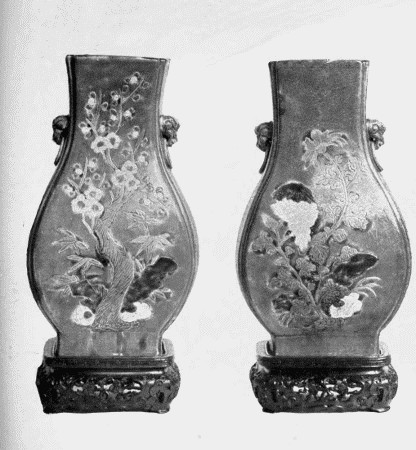
AUBERGINE ENAMEL GROUND.
A very remarkable pair of aubergine flat-shaped Vases with lion-head ring handles; the decoration is a spray of chrysanthemums in blue, green, and white, on the one side; and a spray of hawthorn in white, aubergine, green, and blue, on the reverse, in brilliant enamels in sunk relief. Supported on carved wood stands. Extreme height, including stand, 12-1/2 inches. Ming. Aubergine is a very difficult colour to describe. It is the colour of the fruit of the egg-plant, from which the name is derived. It has a remarkable range of tints, but the predominant one is purple, on the one side it becomes almost sepia and on the other almost orange. It is rarely used as a ground colour as it is in this case, but it is a delightful thin wash applied when thick enamels cannot be used, and it is so transparent that a darker colour can be seen through it. Hence its frequent use in the trunks of trees and in branches of flowers where the markings of the bark may be made visible. Again, it is frequently employed in painting the roofs of houses where a wide wash gives a bold and highly decorative effect, the purple shade being transparent allows the black, in which the design is sketched, to show through. In the example given not alone is the ground of aubergine, but other shades of the same colour are used in the decoration, which has this unusual feature, it is not raised, but depressed or sunk in.
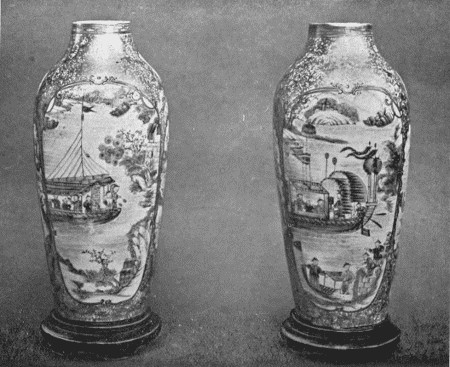
MANDARIN CHINA.
Painted in colours over the glaze, with gilt scroll-work. This pair of conical egg-shell Vases with short necks is 18 in. high. There is no mark. M. Jacquemart divides the Mandarin class into seven sections, which he distinguishes by the decoration:—
(1) Pieces having painted in compartments with Indian ink backgrounds and gold borders.
(2) Where the spaces between the reserves or compartments are covered with gilt scroll-work diaper or pattern as in the illustration.
(3) With black borders and key pattern in gilt, usually having iron-red grounds.
(4) With variegated grounds, designs in iron-red and black, pink and other colour filagree-work.
(5) With spaces between the reserves covered with round dots or points resembling shagreen either green or white. When the dots and ground are white the Chinese name it "chicken's flesh."
(6) With indented wreaths or flowers traced in the paste and decoration in under-glaze blue and over-glaze enamelled medallions.
(7) In camaieu or in a single colour under or over the glaze, usually mandarin, blue and white.
The egg-shell Mandarin is the best of this class. Generally the porcelain is rather thick than thin. Often it has the wavy surface which shows that it has been cast and moulded. Then, too, the decoration is usually painted, not enamelled. This process changes the tone of the colouring. The rose tints derived from gold become purplish; lilac, water-green, bright iron-red, and a curious rust-colour called chamois are common. Stippling and hatching are applied to the flesh and to the folds of the draperies. Often the ground-work with its dotted surface is covered with turquoise-green or turquoise-blue. The paintings on the reserves of the examples given will show the miniature-like character of the decoration. The examples given are Keen-lung.
XX PORCELAIN OF THE EAST INDIA COMPANY
CHAPTER XX PORCELAIN OF THE EAST INDIA COMPANY
After having passed in review the different products of purely Chinese taste in which the shapes, the style of decoration, and the painting were all local and national, we will examine another class of porcelain holding for us considerable interest, because it includes a whole series of pieces made in vast quantities for the European market. It is usually known under the name of the "porcelain of the East India Companies." By what aberration of taste or by what commercial necessity had the representatives of the famous East India Companies—English and Dutch—sought to impose new models upon Chinese potters? Here was a people with the highest technical skill in potting, endowed with a sense of decoration equally pure and developed, set to imitate examples which were considerably outside the sphere of their proper work. It was the fashion during the eighteenth century for noble families and their imitators to possess a service of porcelain made in China or Japan, the decoration of which consisted of coats of arms or crests. Other reproductions of the period included copies of engravings by men who threw away treasures of patience and ability without understanding what they had to execute. They simply imitated, and therefore never produced real artistic work except when, as sometimes happened, they painted grotesque figures instead of the persons whom they were supposed to copy on their porcelain. Still, apart from this criticism, there are many interesting pieces amongst these copies. England, France, and Holland were all eager for such Chinese specimens. Even the figures such as "The Dutch Skipper and the Chinese Lady" were exceedingly interesting if somewhat uncommon. Then there is a set of five small statuettes representing Louis XIV. (1643-1715) and four members of his family. The Chinese artist had probably only an engraving to guide him, from which he had to produce a portrait figure of a great monarch. In his ignorance he translates the Marshal's baton into the sacred rôle of the Buddhist divinities. Grotesque as these figures are, they are none the less remarkable because of the richness of the costumes, though the ugly little heads and the general wide-awake air seem somewhat ridiculous. The Dauphin, for instance, with his mouth wide open, has certainly an uncommon manner, yet one feels a pleasure that these five little good-tempered men were able to stand upon their legs, even if it was with difficulty. Such statuettes are rare. By far the greater part of the East India porcelain is decorated with coats of arms, crests, figure subjects, or monograms surrounded by roses. On the plates and dishes were reproduced "The fables of La Fontaine," which are found side by side with scenes from the Old and New Testament, such as the Nativity and the Crucifixion. Then there are decorations taken from mythology, allegories, celebrated personages, fêtes galantes, &c. Though sometimes failing in colour, the great majority of the decoration being drawn in Indian or Chinese ink with very indifferent hatchings for the shading, these plates and dishes show the carefulness of the Chinese decorator. Even in unfamiliar surroundings, the figures may be, and are, deplorable, and how they suffer by contrast with the borders and the ornaments which surround them, which have all the perfect taste, admirable composition, and brilliant execution which distinguish the native work!
The East India Companies brought to Europe much porcelain in white, which was meant to be decorated notably at Venice, Delft, and perhaps at Chelsea. Such decoration had then nothing Oriental about it. This explains why some specimens with Chelsea decoration have a hard paste. The decoration only is Chelsea, quite typical of that factory, but the form and body are Oriental.
Another method of ornamenting Chinese porcelain was practised at the end of the eighteenth century, mainly in Holland, which consisted in the removal of the glaze in parts, as in engraving upon glass, so as to design elegant arabesques and garlands in which the white of the china or body itself appeared through the thickness of the colour glaze, the white being tinted more or less according to the depth of the cutting.
XXI IMITATIONS OF ORIENTAL PORCELAIN
CHAPTER XXI IMITATIONS OF ORIENTAL PORCELAIN
Chinese potters imitated Chinese potters and their productions for hundreds of years, but it has remained for later times to produce such imitations in hard paste as to be almost beyond detection, except by the expert. Closely studied, however, there are certain differences—a peculiarity of the tint of the paste, a loss of brilliance in the colour—which reveal the European origin. M. Sampson, of Paris, has been responsible for deceiving more beginners than perhaps any other maker by his wonderful imitations of Oriental enamel porcelain. In our own early English factories we often met with imitations of Chinese porcelain with regard to decoration. For instance, the early blue and white Worcester, the red and blue under the glaze Worcester, and many other patterns were direct imitations from the Chinese; in fact, the square mark used upon Worcester china was only a copy of a mandarin's seal, and other Oriental characters are to be found as marks upon Worcester china, such as the disguised numerals, which, more recently, have been ascribed to Caughley. Of course, the soft paste of Worcester makes the imitation very easy to detect. The Dresden factory, which brought Chinese style into prominence in Europe, in its oldest specimens, produced a hard paste with purely Oriental decoration, and copied even the intricate borders and medallions in Chinese style. Under the patronage of Augustus Rex, otherwise Augustus the Strong, Elector of Saxony, Dresden china became celebrated.
Coming again to later times, we find that at Herend, in Hungary, a manufacturer named Fischer, at about 1839, made a special feature of the imitation of Oriental porcelain, and his finest specimens are most deceptive. It is a great shame that pieces from this factory are so frequently used fraudulently by unscrupulous dealers. Again, at Talavera, near Toledo, in the later eighteenth century, perfect imitations of Oriental china were made, which, even as imitations, are valued everywhere for the beauty of the glaze and brilliance of the colour.
It is the slavish attention and too faithfully carrying out the detail that reveals the forgery to the expert. On this point one might almost say that the very skilful forgery of a five pound Bank of England note would deceive an expert, but there is always some apparently trivial point and detail, either omitted or added, which makes the forgery clear to those who really know.
Although various marks were copied in the seventeenth and eighteenth centuries from porcelain belonging to earlier periods, it was not done with the idea of forgery or deception, but as a mark of reverence and appreciation of former masters. The mark most copied was in the reign of Yung-ching, when the Ching-hwa mark was often introduced into self-colour pieces.
It may further interest students to learn that many examples of the old porcelain, which are broken and yet put together without any of the portions being lost, are the result of the duty which was levied in the beginning of the eighteenth century on porcelain imported into England. Perfect specimens were liable to heavy charges, damaged ones came in free, and as at that time the values were in all probability what is paid to-day for a good modern plate or vase, or even less, pieces wanted for decoration were broken without any compunction, the pieces saved, and afterwards stuck together. Such examples are well worth acquiring, and the fact of the damage reduces the price, but so long as there are no portions missing, or the original beauty of the decoration impaired, the collector will be well advised not to pass such articles by on account of the break as there are many very fine examples which were thus ruthlessly treated.
XXII SYMBOLICAL DESIGNS
CHAPTER XXII SYMBOLICAL DESIGNS
A.—Emblems in Animals.
We have already remarked how the Chinese employed ornament to their works in porcelain, not alone to please the eye, but to elevate the mind at the same time. It is evident that the realisation of these two aims must have been dependent not alone upon the highest technical skill, but upon the religious knowledge either possessed by the artist or handed down in traditional form from generation to generation. Hence the character of their work was determined and imbued by religious influences.
In every age pottery has been a vehicle for the display of art, and the wonderful productions of the East embody in symbolised form the highest aspirations of religions with which we are but imperfectly acquainted.
The deer (Chinese luh, Japanese roku) is also an emblem of longevity. A white stag frequently accompanies the god of longevity. It sometimes carries in its mouth another emblem, the fungus. A deer, however, is also used as a symbol of official emolument or prosperity, having the same sound as the word for the latter (luh). It is probably for this reason that we find a fawn accompanying the Japanese god of talent, Toshitoku.
The fox (Chinese hu, Japanese kitsu-ne) is considered, especially in Japan, as a very mysterious animal. There are several wonderful legends concerning it in Mitford's "Tales of Old Japan." It is said to attain the same age as the hare, when it is admitted to the heavens and becomes the celestial fox. It controls the official seals of high officials.
The hare (Chinese tu, Japanese usagi) is sacred to the moon, where the Taoists believe it to live, pounding the drugs that form the elixir of life. It is stated to live one thousand years, and to become white when it has reached the first five hundred years. The hare, often miscalled a rabbit, occurs on porcelain, both as a decoration and as a mark.
The stork (Chinese ho, Japanese tsuru) is one of the commonest emblems of longevity. It is said to reach a fabulous age, and when six hundred years old to drink, but no longer eat; after two thousand years to turn black. It occurs as a mark.
The tortoise (Chinese kwei, Japanese ki or kame) was also a supernatural animal, and its shell was used in divination. The tortoise with a hairy tail is depicted in Japan as an attendant on the god of old age, and is used as an emblem of longevity. A Chinese phrase, Kwei-ho-tung-chun, signifies "May your days be as long as the tortoise and stork."
B.—Emblems in Trees.
Among plants are three trees, which, though not all, strictly speaking, emblems of longevity, are closely connected with it; these are the pine-tree, bamboo, and plum. These three trees are termed by the Japanese in combination Sho-chiku-bai. The Chinese say "the pine, bamboo, and plum are like three friends, because they keep green in cold weather."
The bamboo (Chinese chuh, Japanese take) is another emblem, owing probably to its durability. Its elegant form causes it frequently to be depicted on works of art, both in China and Japan.
The gourd (Chinese hu-lu, Japanese hiotan or fuku be) is also an emblem of longevity, especially in Japan, owing perhaps to its durability when dried.
The peach (Chinese tao, Japanese momo) is a symbol of marriage, but also of longevity. Great virtues were attributed to the peach, especially that which grew near the palace of Si-Wang-Mu, Queen of the Genii, on which the fruit ripened but once in three thousand years. It is represented with a bat as a mark.
The pine-tree (Chinese sung, Japanese matsu) is a very common emblem, and to be found on many specimens. Its sap was said to turn into amber when the tree was one thousand years old.
The plum-tree or prunus (Chinese mei, Japanese mume), though not properly an emblem of longevity, is indirectly connected with it, as the philosopher, Lao Tsze, the founder of the Taoist sect, is said to have been born under a plum-tree. It forms the decoration of the porcelain erroneously termed "may flower" or "hawthorn pattern."
C.—Emblems in Flowers.
Artemesia.—The artemesia was used by the Chinese with the sweet flag to allay pain and to drive away demons.
Azalea.—The azalea, without having any special symbolical signification, was eminently useful for decorative purposes, because, as a common flower on the hills of the north-east provinces, it gave brightness to a scene of surpassing beauty in the central flowery land.
Camellia.—The camellia bears the same name as the tea plant, and the term cha is used to denote any infusion, just as the word "tea" is with us, as when we speak of beef-tea, camomile-tea, and so on.
Chrysanthemum.—Chrysanthemums, like the asters, were reared for their beauty. They are, perhaps, the commonest form of flower decoration on Oriental china, and we cannot be surprised at this when we consider the variety and the richness of the colour of this beautiful plant. It was an emblem of mid-autumn—more than that, it was a symbol of pleasurable enjoyment—hence its presence on a piece of porcelain given as a token of esteem, also a wish that all should be well with the recipient.
Cockscomb.—The cockscomb was very much admired by the Chinese, and was not alone used as a decoration for porcelain, but for many of those interesting pictures on glass which portray birds and flowers, and which, though painted in a similar way to the early paintings on glass known to Western nations, exceeded them by the brilliancy of their colours and by their exact resemblance to nature.
Convolvulus.—The convolvulus was painted around the edges of tanks and pools, not alone for decoration, but because the leaves of some varieties made a very succulent green food.
Flag, or Iris.—The flag, or iris, known as the sweet flag, was placed at the doors of houses to prevent all manner of evil from entering, but it had a material use as a medicine much used for its spicy warmth.
Fungus.—The fungus when dried was very durable. It grew at the roots of trees, and many imitations of it in gilt wood, or even dried specimens of the fungus itself, were frequently used as decoration in the temples. In pictures of Lao-tsze and the Immortals it is used as a symbol of longevity or immortality, hence it is found carried in the mouth of the white stag, which is also an emblem of immortality. Occasionally it is used as a mark on the bases of specimens of old Kang-he blue, in which case it often has lines around its base to represent the grass through which it grows.
Jasmine.—The jasmine, a sweet-smelling white flower, is largely grown for its scent, but still more as a favourite flower amongst the Chinese women for personal ornament, its twigs and clusters or blossoms being wound in the hair, and it was planted in the pots in the houses.
Lotus, or Nelumbium.—The lotus, or nelumbium, was a sacred flower representing the creative power in the Buddhist religion. Representations of it frequently occurred not alone in connection with Buddhism, but also with Taoism. Kwan-Yin is often shown seated upon the lotus. Ho Seen-koo has the lotus as her emblem; and, generally, whether considered with regard to its utility or to its beauty the sacred lotus was placed by the Chinese at the head of the cultivated flowers. It has a very close resemblance to our English water lily, having the stock inserted near the centre of the leaf. Both seeds and root are articles of food, and, when cultivated for that purpose rather than for ornament, covers large areas of lakes and marshes.
Narcissus.—The narcissus is an emblem of good luck for the coming year. Just as with us in England the narcissus is a harbinger of spring, so in the new year at Canton the budding flowers of the narcissus, almond, plum, peach, and bellflower, all are emblematic, all express a wish for coming prosperity.
Magnolia.—The magnolia has immense flowers and has been selected as the emblem of sweetness and beauty. The name in Chinese means "secretly smiling," and to the Chinese it suggests the lovely smile of a sweet maiden. Where in designs on porcelain beautiful women are drawn this flower usually accompanies them. China furnishes several species of this lovely flowering plant. Its medicinal use is secured from the bark employed as a febrifuge.
Myrtle.—The myrtle grows as a wild plant with lovely rose-coloured flowers, one species of it produces clusters of berries, which are eaten as fruit.
Oleander.—This flower is prized because of its beauty and fragrance. The tender rose pink lends itself easily to schemes of porcelain decoration. Members of the same group, less attractive, but still pretty, are the yellow milk-weed and the red periwinkle.
Olive.—The olive is noted for the fragrance of the clusters of minute flowers of white and yellow. This plant flowers through a great part of the year. A branch of sweet-smelling olive was a reward of literary merit. It was also symbolical of studious pursuits, and of sweetness generally.
Peach.—The peach blossoms were placed in doorways at the New Year as the "peach charm." A branch of the tree, covered with blossoms, was supposed to prevent the entry of evil demons into the home.
Peony.—Next to the chrysanthemum the peony was effective in the decoration of Chinese porcelain. It was a tree in that land, valued for its fine and variegated flowers. It was emblematical of good fortune, but if the plant did not supply beautiful flowers and green leaves, if the leaves fell off and its flowers suddenly faded, such a change foreshadowed poverty or some overwhelming disaster. It was also an emblem of love and affection, and therefore eminently appropriate for use on presentation pieces of porcelain.
Poppy.—The poppy was not alone grown for the production of opium, but for its beautiful flowers.
Rose.—This flower was as great a favourite with the Chinese as with all other nations. Many species and varieties were natives of this country. Like the jasmine, it was used by the women for personal adornment.
Tobacco.—This plant was grown almost everywhere in China, but its strength varied according to soil and climate. In the north it was of a pale colour, while further south it is said to owe its reddish colour to being steeped in a solution of opium.
XXIII DATE MARKS ON ORIENTAL PORCELAIN
CHAPTER XXIII DATE MARKS ON ORIENTAL PORCELAIN
There was no regular method employed in either China or Japan for indicating either the time or place at which the porcelain was made. Neither was there any mark by which the workman or artist could be identified. Where marks are used they indicate the period in a dynasty; still it must be constantly borne in mind that the old marks were continually copied in reproductions of a later period made by the Chinese themselves, and other reproductions produced with much fidelity in Paris and elsewhere. So that the collector has to be very careful, especially in buying fine specimens. There seems to be scarcely nothing worth copying that has not received full attention at the hands of the forger. Of course, when these copies are simply offered as reproductions of old pieces, the purchaser, even if he pays a large price, has not much to complain of, but the trouble arises when they are foisted on the public as genuine. The work is so cleverly done, the imitation is so accurate that only the specialist is able to detect the fraud. The texture of the porcelain is closely imitated, and every care is taken to reproduce the scratches and even the dirt. More than that, old pieces that have been damaged are restored so as to appear perfectly genuine throughout, whilst real old pieces, that were originally plain, have been enamelled with the finest "famille verte" or "famille rose" decoration so as to deceive all but the most skilful expert. Such a case occurred within the author's own experience. An old dish, early Keen-lung, was so decorated with the finest rose decoration, and only the most careful examination revealed the fact that both decoration and glaze had been applied in comparatively recent times—in fact, within a very few years. The owner was indignant when he was informed of this. However, he afterwards came back with the information that he had sold the dish for £20, but he forgot that if the dish had been really old it would have been worth not £20 but £120! Too much dependence, therefore, must not be placed upon the marks or upon the decoration; it is upon the education of the eye, the tout ensemble, really upon the merits of the specimens themselves, that dealers and collectors must rely. No training is as good as the handling of fine old pieces, in which the grain of the porcelain, the colours of both the porcelain and the decoration can be studied, and the knowledge thus gained becomes the experience which is, above everything else, the necessary equipment to any one who collects old china.
The Chinese write in characters, each represents a word, and the commencement is made from the top of the right-hand side. The columns are read downwards, but when the characters are in a line they are read from right to left. The marks may be in the seal characters, in plain characters as employed in books, or in grass-text as used for rapid writing; but all are read in the same way, though the last are very difficult to read. As there are many variations in English handwriting, so the Chinese characters will be found to vary, yet the word would be the same. It is in the forgeries that we noted the most slavish attention to accuracy and the most infinite pains taken to reproduce the old marks given in the books. The marks themselves are either painted on the bases, usually in blue, though on some late pieces it is found in red, or they may be engraved or embossed. The Chinese have no centuries for measuring time, they use instead a cycle of sixty years, and the precise date as indicated by the cycle is so seldom used on porcelain that it may be disregarded, as only four or five examples of the cyclical dates have ever been found. The marks on porcelain indicate only the reign of the emperor, who when he comes to the throne adopts two words as his title or Nien-hao. Before the coming of the Ming dynasty, in 1368, these titles were changed in order to commemorate any striking event, but since then only one Emperor, who lost his throne in 1450 and regained it after seven years, has changed his Nien-hao, and only one Emperor, Kang-he, reigned a whole sixty years, and a cyclical date may have been used when the thirty-eighth year of the sixty-eighth cycle recurred. See Mark 1 in date marks. The Nien-hao was the honorific designation of the Emperor; Taou-kwang (1821-1851) was "reason's lustre," and Kwang-hsiu (1875) means "inherited lustre." Following the seal marks, which are read in the same way, note that the list gives a number of marks having six characters. Reading these it will be noted that the one in the top right hand and the next one below it, marked (1) and (2), are always the same for the same dynasty—"Ta Ming" or "Ta Tsing" show the "great Ming" or "great Tsing" dynasty. The bottom sign of the first column (3) and the top sign of the second column (4) give the Emperor's title or Nien-hao, whilst the two remaining signify in descending order "year" or "period" (5), "made" (6). In six-mark characters, arranged in two lines, the reading is similar, as marked by the figures (1), (2), &c. In four-mark character the signs for the dynasty—that is, "Ta Ming" or "Ta Tsing"—are left out, and the first two marks show the period. As before remarked, the forgeries and imitations have been so numerous that the date marks cannot be accepted as proof of age. The old blue porcelain—Nankin ware so called—was marked with six characters until 1677, as mentioned elsewhere. After that we have the double circle in blue, either empty or having a symbol in the middle.
The Ming productions have not yet received due recognition with regard to their beauty of shape and decoration, but the two periods which are most represented by the marks are Seuen-Tih (1426-1436) and Ching-hwa (1465-1488). In the British Museum are two Celadon bowls with the Seuen-tih mark, with deep mouldings; to these is affixed on the label "probably Kang-he." Then, again, immense quantities of china appear to have been brought to Europe during the seventeenth and eighteenth centuries, much of which was marked "Ching-hwa." Whether during the eighteenth century such porcelain could be collected in China for cargo purposes is a matter of doubt. If not, this is an illustration of the fact that from an early period the Chinese copied old forms, decoration, and marks.
Honorific Marks.
The word tang often occurs in inscribed marks, which seem to indicate a place of origin. In the list given it is marked Tang or Hall Marks. These marks are found on pieces differing considerably in character, age, and quality. The general opinion is that the Hall named is the title of the residence of the Tao-tai, or superintendent of the porcelain works belonging to the Emperor. Other inscribed marks simply set out praises of the porcelain itself, stating that it is "a gem among precious vessels of rare jade," "a gem rare as jade," "an elegant rarity," "fine vase for the rich and honourable," and so on. Some pieces are found with a seal character embodying a wish, as "happiness," "prosperity," "longevity," and "harmonious prosperity." See the list of specimen Hall Marks, &c., and two others, last on the bottom line, praising the porcelain.
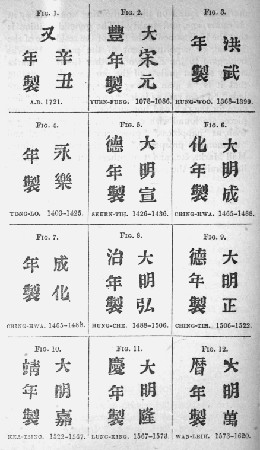
Fig. 1.
A.D. 1721.
Fig. 2.
YUEN-FUNG. 1078-1086.
Fig. 3.
HUNG-WOO. 1368-1399.
Fig. 4.
YUNG-LO. 1403-1425.
Fig. 5.
SEUEN-TIH. 1426-1436.
Fig. 6.
CHING-HWA. 1465-1488.
Fig. 7.
CHING-HWA. 1465-1488.
Fig. 8.
HUNG-CHE. 1488-1506.
Fig. 9.
CHING-TIH. 1506-1522.
Fig. 10.
KEA-TSING. 1522-1567.
Fig. 11.
LUNG-KING. 1567-1573.
Fig. 12.
WAN-LEIH. 1573-1620.
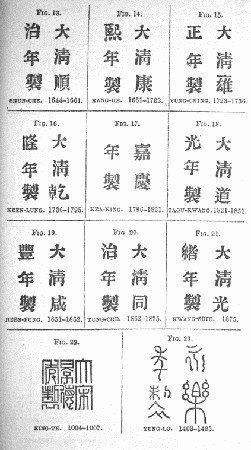
Fig. 13.
SHUN-CHE. 1644-1661.
Fig. 14.
KANG-HE. 1661-1722.
Fig. 15.
YUNG-CHING. 1723-1736.
Fig. 16.
KEEN-LUNG. 1736-1795.
Fig. 17.
KEA-KING. 1796-1821.
Fig. 18.
TAOU-KWANG. 1821-1851.
Fig. 19.
HEEN-FUNG. 1851-1862.
Fig. 20.
TUNG-CHE. 1862-1875.
Fig. 21.
KWANG-SHIU. 1875.
Fig. 22.
KING-TE. 1004-1007.
Fig. 23.
YUNG-LO. 1403-1425.
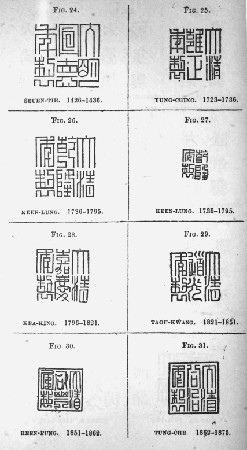
Fig. 24.
SEUEN-TIH. 1426-1436.
Fig. 25.
YUNG-CHING. 1723-1736.
Fig. 26.
KEEN-LUNG. 1736-1795.
Fig. 27.
KEEN-LUNG. 1736-1795.
Fig. 28.
KEA-KING. 1796-1821.
Fig. 29.
TAOU-KWANG. 1821-1851.
Fig. 30.
HEEN-FUNG. 1851-1862.
Fig. 31.
TUNG-CHE. 1862-1875.
MARKS.
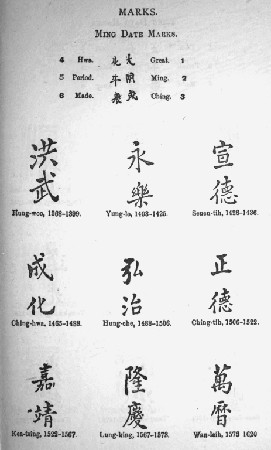
Ming Date Marks.
Hung-woo, 1368-1399.
Yung-lo, 1403-1425.
Seuen-tih, 1426-1436.
Ching-hwa, 1465-1488.
Hung-che, 1488-1506.
Ching-tih, 1506-1522.
Kea-tsing, 1522-1567.
Lung-king, 1567-1573.
Wan-leih, 1573-1620.
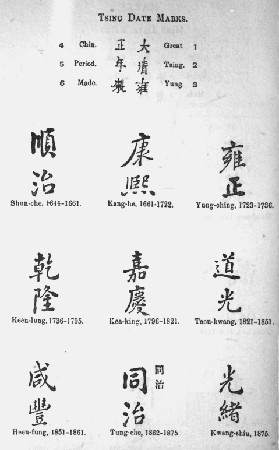
Tsing Date Marks.
Shun-che, 1644-1661.
Kang-he, 1661-1722.
Yung-ching, 1723-1736.
Keen-lung, 1736-1795.
Kea-king, 1796-1821.
Taou-kwang, 1821-1851.
Heen-fung, 1851-1861.
Tung-che, 1862-1875.
Kwang-shiu, 1875.
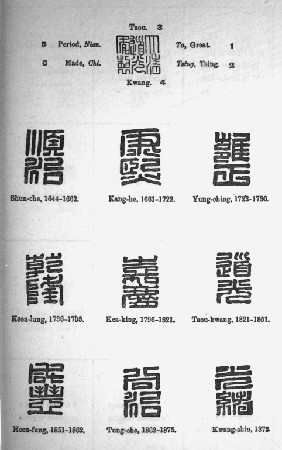
Shun-che, 1644-1662.
Kang-he, 1661-1722.
Yung-ching, 1723-1736.
Keen-lung, 1736-1795.
Kea-king, 1796-1821.
Taou-kwang, 1821-1851.
Heen-fung, 1851-1862.
Tung-che, 1862-1875.
Kwang-shiu, 1875.
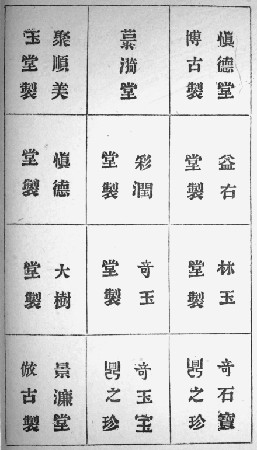
"Made at the Tseu-shun Hall," of beautiful jade. "The Luh-i or waving bamboo Hall." "Antique made at the Shun-tih, or cultivation of vertue Hall."
"Made at the Shun-tih, or cultivation Hall." "Made at the Tsai-jun or brilliant colours Hall. "Made at the I-yew, or advantage Hall."
"Made at the Ta-shu, or great tree Hall." "Made at the Ki-yuh, or rare jade Hall." "Made at the Lin-yuh, or abundant jade Hall."
"Imitations of antiques made at the King-lien Hall." "A gem among precious vessels, of rare jade." "A gem among precious vessels, of rare stone."
XXIV SYMBOLICAL MARKS AND ORNAMENTS
CHAPTER XXIV SYMBOLICAL MARKS AND ORNAMENTS
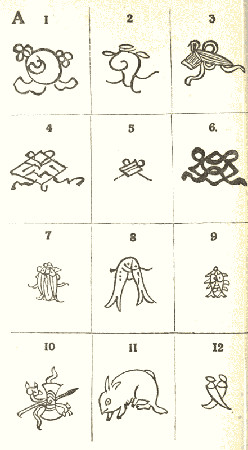
"Every picture tells its story" is true when applied to Oriental decoration where history and mythology furnish many of the designs, and almost every flower and colour has its own meaning. On the porcelain many of these devices are used either as marks or ornaments; sometimes they have ribbons or fillets entwined around them, and they vary considerably in style and shape. Those given are from Sir A. W. Franks's book, "The Catalogue of the Franks' Collection of Oriental Porcelain and Pottery," exhibited at the Bethnal Green Museum.
The symbols set out are found on blue and white porcelain as well as on pieces of "famille verte," powdered blue, and old specimens decorated with coloured enamels generally of a very good quality.
A.
No. 1. The pearl, which as an ornament is frequently represented in the air with dragons.
No. 2. The conch shell, a well-known Buddhist emblem which signifies a prosperous journey.
No. 3. A musical instrument. According to Mr. Gulland, who searched Mr. Salting's Collection at the Museum, South Kensington, 18 pieces, mostly blue and white, have this mark.
Nos. 4, 5, 6. Three of the varieties of a lozenge shape; sometimes it has the swastika in the centre.
Nos. 7, 8, 9. Various fish symbols. Sometimes a pair of fishes is found in a vase form, but this Buddhist symbol is an emblem of domestic happiness.
No. 10. A group comprising a pencil, cake of ink, and sceptre of longevity, the whole expressing the wish, "May things be fixed as you wish."
No. 11. The hare, an emblem of longevity. The hare is connected by legend with the moon, and the mark is found on pieces coloured black and yellow, and on blue and white of good quality.
No. 12. A pair of rhinoceros horns used as a mark and in other forms as a symbol. Mr. Gulland's examination gave a rather striking result. About 960 pieces are in the Salting Collection, perhaps the finest of its kind in the world. Of these 130 pieces had date marks, 52 being on coloured pieces and 78 on blue and white. The other marks, mostly symbol marks, were found on 169 pieces, of which 77 were coloured and 92 blue and white. This gives a total of 299 marked pieces.
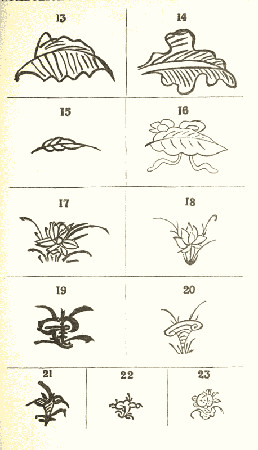
Nos. 13, 14, 15, 16. Varieties of leaves. Sometimes the leaves are filleted. In the Salting Collection 45 pieces had the leaf mark, which is chiefly found on blue and white.
Nos. 17, 18. The lotus flower, without fillets, the specimens in the same collection were coloured.
Nos. 19, 20, 21, 22. Varieties of the Che plant mostly found on blue and white, a kind of fungus used as an emblem of longevity and occasionally found in vase form, of natural shape, in self-colour, such as "sang-de-bœuf."
No. 23. The peach and conventional bat. The peach signifies longevity, and the bat happiness. The two together embody the wish for "A two-fold perpetuation of happiness and long life."
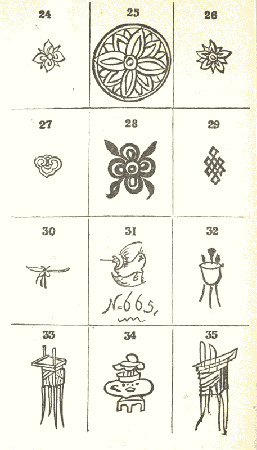
No. 24. Four-leaved flower, on blue and white.
No. 25. Flower with eight or sixteen leaves.
No. 26. Five-leaved flower, on blue and white. A six-leaved flower is also found on blue and white.
No. 27. Joo-e-head. There is no form so universal for decorative purposes as the Joo-e, here given as a mark on blue and white. Panels and borders have modifications of this form in endless variety. The fungus as emblem of longevity was adopted in this form as the head of the sceptre of longevity, and the Joo-e has remained a classical pattern.
No. 28. Five circles with fillets, found on old coloured specimens.
No. 29. A knot (chang) said to signify longevity, found on blue and white.
No. 30. An insect, found on blue and white.
No. 31. Stork or heron without a tail. Note the Dresden engraved number below.
Nos. 32, 33, 34, 35. Varieties of incense burners (tings), found on blue and white. Several other marks are to be found, notably on porcelain of good quality.
B.
The Ordinary Symbols.
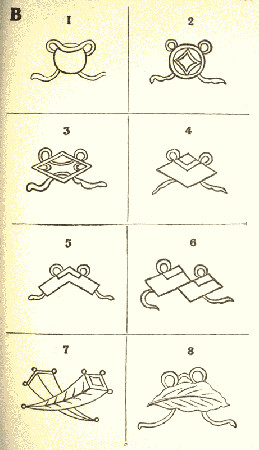
These symbols are sometimes, as we have seen, used as marks. But they are also used in decoration, being coloured in enamel colours and often placed in shaped reserves. The number eight seems to have an attraction for the Chinese. Here we have what are termed "the eight precious things," and, later, the Buddhist emblems, "the eight lucky emblems," are given. It is not necessary to do more than name these ordinary symbols:—
No. 1. A pearl.
No. 2. A coin, symbol of riches, often forms a border to plates and dishes.
No. 3. Lozenge with open frame. Two lozenges with overlapping ends are used to express the dual symbol.
No. 4. A mirror.
No. 5. A sounding-plate used as a bell.
No. 6. Books placed close together, probably another dual symbol.
No. 7. Rhinoceros horns—conventional form.
No. 8. A leaf.
Some or all of these objects may frequently be seen carried in processions or on pictures of such processions.
C.
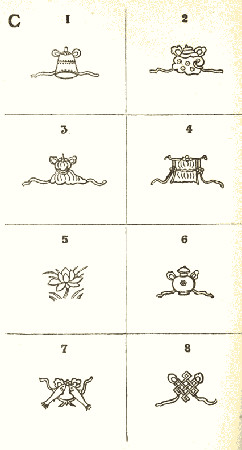
The Buddhist Symbols.
Here, again, we have some forms which have been dealt with as marks.
No. 1. A bell. In place of this, the wheel of the law is frequently used.
No. 2. The conch shell, the chank shell of the Buddhists.
No. 3. A state umbrella.
No. 4. A canopy.
No. 5. The lotus flower again.
No. 6. A vase with cover.
No. 7. Two fishes. Connubial felicity.
No. 8. A knot said to represent the intestines and to be an emblem of longevity.
Other Symbols.
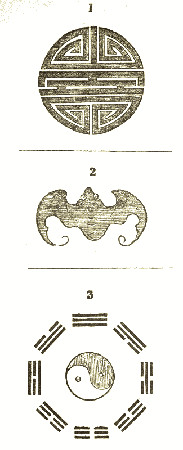
A silver ingot, a cake of ink or a branch of coral may be found as emblems of riches, scholarship, or power, but there remain three devices which deserve a few words. The first is the Pa-kwa, consisting of eight diagrams of entire and broken lines. The entire lines represent the male, strong or celestial element in nature; and the broken ones the female weak, terrestrial element. An entire system of Chinese philosophy is built upon this combination, and not only so, but they furnish a "clue to the secrets of nature and of being." The trigrams are often represented upon specimens of porcelain, especially on raised decorations, with or without a central circular device, the Yang and the Yin, another representation of the male and female elements in nature. The second device is the bat. The word in Chinese has exactly the same sound as the word meaning "happiness," so that the bat has come to be regarded as a symbol of happiness. The figure of a bat is sometimes used alone; chiefly, however, we find four or five bats surrounding the seal character for longevity. This is the third of the devices. The character for longevity (show in Chinese) is regarded as very auspicious, and it is written in no less than a hundred different ways. When used with the five bats surrounding it, the five great blessings are symbolised—longevity, riches, peacefulness, love of virtue, and a happy death.
A
B
C
XXV THE IMMORTALS, OR CHENS
CHAPTER XXV THE IMMORTALS, OR CHENS
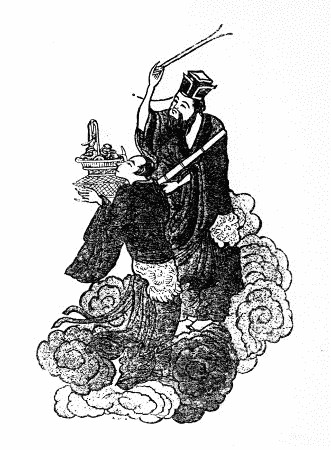
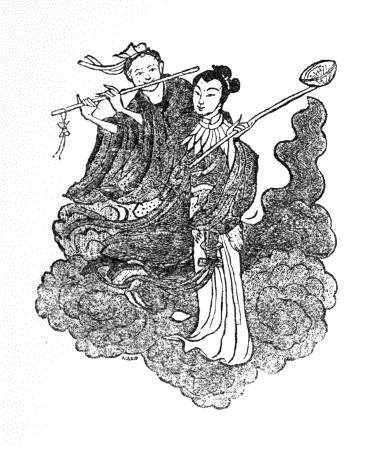
The Pa Sien, or eight Immortals, were followers of the Taoist religion founded by Lao Tsze, who lived about the time of Confucius. They seemed to be noted for a combination of pure Taoism, which taught contempt for riches and worldly power, and advocated complete subjugation of all bodily passions, and such practice of magic and alchemy as gave them the power they affected to despise. These eight lived at various times and attained immortality through the mysterious elixir of immortality.
1. Han Chung-le, who lived in the Chow dynasty (B.C. 1122-249), is represented as a fat man, either with bare stomach or fully clothed. His emblem is a fan with which he revives the spirits of the dead.
2. Leu Tung-pin (about A.D. 755). He learnt the mysteries from Han Chung-le whilst wandering in the mountain gorges. Tempted ten times, he overcame the temptations, and with a sword, which is his emblem, he slew evil monsters and rid the earth of them for more than four hundred years.
3. Le Tee-kwae (period unknown) was a scholar of Han Chung-le in the celestial regions which he visited in spirit, leaving his body under charge of a disciple on the earth below. On returning from one visit, he found his body was gone, and the only way in which he could continue his existence was by taking refuge in the body of a lame beggar, whose crutch and gourd are his symbols.
4. Tsaou Kwo-kiu (circa A.D. 999) is generally represented with a court head-dress, being connected by birth with the Emperor. His symbol is a pair of flappers or castanets, which he carries in one hand.
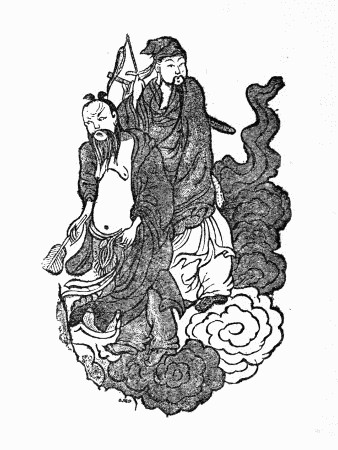
5. Lan Tsae-ho is rather a myth of myths, for neither the sex nor period is given. The figure is represented bearing a flower-basket or wine-pot, either of which is the emblem.
6. Chang Ko-laou (close of seventh to middle of eighth centuries) was a great magician, whose white mule carried him immense distances, and when not in use was folded up and put away. His symbol is a bamboo tube drum, carried on either arm, with two rods, the ends of which are usually projecting from the upper opening of the drum in which they are placed.
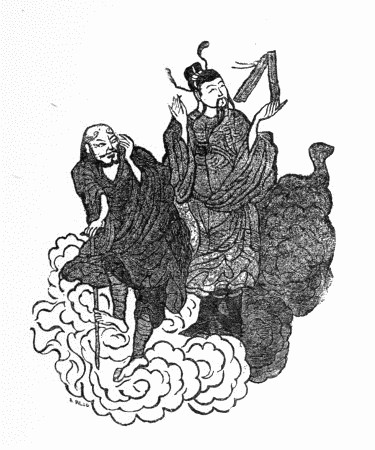
7. Han Seang-tsze (about the same period as the last) was a pupil of Leu Tung-pin. His symbol is a flute carried in either hand, usually end upwards. The story says that his master carried him to the famous peach-tree of the genii from which he fell.
8. Ho Seen-koo (A.D. 690-705) was an example of filial piety. The legend tells how vast were the distances she travelled to get dainty bamboo shoots for her sick mother, how she conquered the desire for mortal food, sustaining herself with the powder of mother-of-pearl, and how finally she disappeared with the promise of coming back again. This she did, on occasion when a good genius was necessary, appearing in the clouds and bringing blessings. Hers is the flower symbol—the lotus.
Here, before me, are two vases on each of which is depicted a feast of the immortals in the celestial regions. Under the spreading pine-tree, emblem of longevity, sits Han Chung-le, listening to the music of the flute. Around him are the others with wine-cups set on a rock table. Lan Tsae-ho is bearing the wine-pot, whilst in the clouds, over the pine-tree, the gracious Ho Seen-koo gazes down upon the scene. Not only in decoration, on vases, and other pieces, are these gods depicted either singly, in pairs, or all in one group, but also in single figures and as a group of figures. Sometimes eight, and sometimes nine are found in one group, the ninth being Lao Tsze himself, the founder of Taoism. Many of these figures, as in the illustrations, are very beautiful in colour, and so entirely quaint and curious in modelling, often with faces and hands, in white biscuit, and so rare. Old Ming figures, early Celadon figures, later enamelled figures, in sets of eight, standing or sitting, are often worth a knight's ransom.
XXVI THE DRESDEN COLLECTION
CHAPTER XXVI THE DRESDEN COLLECTION
The Dresden Collection of porcelain is probably the most ancient in Europe as far as the Oriental portion is concerned. According to its learned Director, Dr. Theodore Graesse, it was chiefly brought together by Augustus the Strong, King of Poland and Elector of Saxony, between the years 1694-1705. These specimens were afterwards made use of to decorate the Dutch, or, as it was subsequently called, the Japanese, Palace. After being for many years stored away in the vaults of the Palace, they have now been set out in the Johanneum Palace, where they are well seen.
In order, it is said, to prevent the courtiers from making away with the royal property, every specimen in the old collection was marked with numbers, accompanied by various signs, engraved through the glaze on the lathe, and therefore indelible. To avoid high numbers and to facilitate classification, a particular sign was used for each kind of porcelain. These marks must have been put on at an early date, as they are only to be found on the more ancient specimens of Meissen porcelain in the collection at Dresden.
The classes and marks were as follows:—
Japanese porcelain, distinguished by the addition of a cross to the number.
"Green Chinese porcelain" (that is, principally painted in green enamel), marked by an I.
White Chinese porcelain, marked with a triangle.
"Red Chinese porcelain" (that is, principally decorated in red), marked with an arrow.
Blue and white "Indian porcelain" (chiefly Chinese blue and white), including crackle, marked with a zig-zag line. See symbolical mark 31.
"Old Indian porcelain," marked with a parallelogram.
"Indian and Saxon black porcelain," marked with a P.
The cross mark is of value as showing the opinion entertained in Europe at so early a time as to what was Japanese, but must of course be accepted with some reserve. It may be added that nearly all the Japanese specimens are what we know as "Old Japan," made in Imari for exportation. The triangle is useful to help us in distinguishing white Oriental from early Dresden, Fulham, or Plymouth porcelain, which were close copies of the first. The most curious specimens are those marked with a parallelogram, and are called Old Indian. Many of these appear to be Oriental porcelain, originally white, and decorated in Europe, probably in Holland. The same style of painting is to be found on five vases bearing the arms and initials of Augustus the Strong, said to have been ordered for the King by the Dutch in 1703, but probably executed in Holland. These vases seem to be Chinese porcelain with ornaments in very low relief, over which the arms have been painted, together with a decoration in the Japanese style.