GLOSSARY (continued 3)
Reading edition
Champion goes on to make a most vital point in upholding his claim to protection that he
"has no objection to the use which the potters of Staffordshire may make of his or any other raw materials provided earthenware only, as distinguished by that title, is made from it."
Here, then, is the reason of the visit of Wedgwood and Turner to the West, in search of the natural earths that half the potters in Europe had been hunting for since Böttcher, of Dresden, made his great discovery of white clay.
But the story of cream ware is not ended. Wedgwood to this printed "Reply" by Champion entered the lists with some printed "Remarks," which he circulated to members of parliament. In this—and we must bear in mind that he was holding a brief on behalf of all the Staffordshire potters—we find the following statement:—
"When Mr. Wedgwood discovered the art of making Queen's Ware, which employs ten times more people than all the china works in the kingdom, he did not ask for a patent for this important discovery. A patent would greatly have limited its public utility. Instead of one hundred manufactories of Queen's Ware there would have been one; and instead of an exportation to all quarters of the world, a few pretty things would have been made for the amusement of the people of fashion in England."
In spite of the opposition of Staffordshire, the Bill enabling Champion to obtain his patent rights passed both houses of parliament, and in the last stage a clause was inserted throwing open the free use of raw materials to potters for any purpose except for the manufacture of porcelain; practically this patent was to be enjoyed by Champion for nearly twenty-two years.
Two extraordinarily important effects upon the pottery industry in Staffordshire were the result of this controversy: (1) The Staffordshire potter confined himself to earthenware. (2) Growan stone and Cornish Kaolin were added to the cream ware body, which enabled earthenware to compete successfully with china.
It may have struck an inquiring spirit as singular that the Staffordshire potters as a body were content to imitate English porcelain and compete with it. At first, of course, the remoteness of the Potteries from the West accounted for this, but clay was brought by sea from Bideford to Chester and carried overland to Staffordshire, but not the growan stone nor Cornish kaolin. Chelsea and Bow did not have natural earths to hand. But the additional reason seems to be the one we have given—that practically Champion's patent precluded them from making porcelain. When, in or about 1769, cream ware was perfected there was no need to cast about for new bodies. Staffordshire earthenware had found itself, and all other improvements after that date, for fifty years, until early nineteenth-century days, mainly concerned enamelling, printing, glazing, and the exterior, or developments in mechanical production, or attempts at higher artistic effects.
In the illustrations we give of cream ware it will be seen that it was of varying form and it received a variety of decoration.
It was plain or undecorated, relying chiefly on its symmetry of form as an artistic asset. The cut and pierced designs and many other shapes followed those of the silversmith, and in dessert dishes and centre-pieces considerable beauty was exhibited in modelling—a style which was closely followed by the Leeds potters, who made excellent cream ware.
A beautiful example of the perforated basket ware is illustrated (p. 225). It is a dessert dish of most pleasing shape, and is a rare specimen of the pierced work in Wedgwood's cream ware.
Wedgwood, as early as 1775, still experimenting with a view to make his cream ware better, determined to make a whiter body by the addition of more china clay and flint and to kill the yellow tone by the use of blue (oxide of cobalt). This later white ware he termed "Pearl ware." Among the most noticeable productions in this whiter ware are the dessert services modelled from shells. We know that Wedgwood had a collection, although he was not a conchologist, yet it is not improbable that the contemplation of these beautiful forms suggested ideas and he derived many of his artistic shapes from the forms of shells. The use of shell forms was not unknown. Salt-glaze pieces repeatedly show the pecten shell design, and Plymouth porcelain had adopted shell designs in salt cellars and similar pieces. We illustrate (p. 225) a remarkable example of a centre-piece in the form of a nautilus shell. Some of the shell dishes have a faint wash in pink, and yellow radiating bands, hardly perceptible, but conveying the suggestion of the interior of the shell.
Queen's ware, when decorated, was of two classes: (1) painted; (2) transfer-printed in red or puce or black.
It is not necessary to go into details in regard to these two forms of decoration. It is interesting in regard to the enamelling in colour to know that Wedgwood sent his ware to Mrs. Warburton's factory at Hot Lane to be painted. He also employed a band of enamellers at Chelsea who had been trained in the china factory. We reproduce an illustration (p. 233) of two painted queen's-ware plates from the celebrated service executed for Catherine II. of Russia. The enamel painting of the views and borders cost Wedgwood over £2,000. In the centre of each piece is a scene representing some place of interest in the country. Each view in this series of British scenery is different, and there are some twelve hundred. The body is in pale brimstone and the view painted in a brownish purple; the border was a wreath of mauve flowers and green leaves, and, as will be seen in the illustrations, each plate has a green frog in a reserve. This design has puzzled many writers, but as the Messalina of the North intended to place this service in her palace of La Grenouillère, near St. Petersburg—Grenouillère meaning a marshy place full of frogs—explains the whimsical design of the frog on each plate.
This dinner and dessert service was completed in 1774 at a cost of about £3,000. It was exhibited in London, and set the town agog with amazement. The rooms in Greek Street, Soho, were thronged with fashionable people, and, as may be imagined, it gave a great impetus to the manufacture of Wedgwood's ware.
The other decoration employed by Wedgwood on his cream ware was transfer printing. He availed himself at once of the new style of printing by Sadler and Green on the glazed surface of his ware, which was periodically sent to Liverpool to be so decorated. In the earlier pieces the tile design is evident, quite unsuitable for a round plate, in spite of Wedgwood's addition of wreaths and ribbons in enamel painting to help out the incongruity. In early books illustrated by Bewick with square woodcuts a similar use of garlands and ribbons as an ornamental border is observed.
Nor was the cream body confined to strictly domestic ware. Among his multifarious productions Wedgwood made some fine coloured figures, remarkable for strong modelling and subdued and harmonious colouring. The large figures, such as Fortitude, Charity, Ceres, Juno, Prudence, and many others, are not always marked. "Fortitude" and "Charity" both bear the impressed mark Wedgwood, the latter belonging to the series Faith, Hope, and Charity designed for Wedgwood by Mrs. Landré, and a marked example is in the Willett Collection. Many small coloured cream-ware busts were made. We illustrate two typical examples (p. 233) of Rousseau and Voltaire. They were evidently intended for the French market, and are very dainty though somewhat highly-coloured likenesses of two great Frenchmen. Jean-Jacques is portrayed in Armenian costume, after the well-known portrait. The coat is a chocolate brown and the stand is marbled. Voltaire has a blue surcoat, a terra-cotta cloak, and lilac vest.
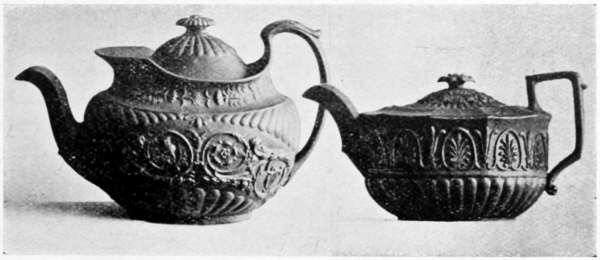
WEDGWOOD BLACK BASALT TEAPOTS.
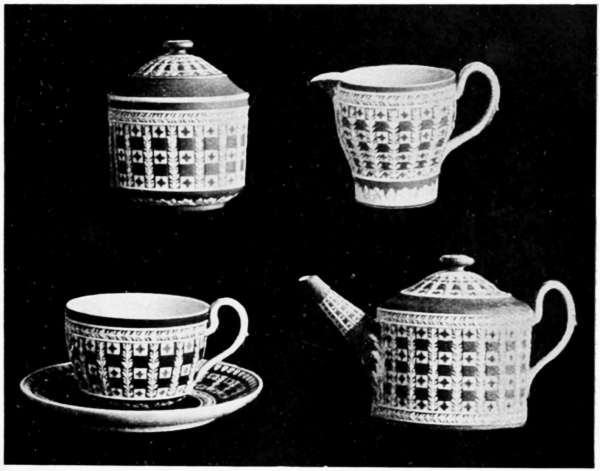
WEDGWOOD JASPER WARE DICED PATTERN TEA SET.
By the courtesy of Messrs. Josiah Wedgwood & Sons.
Jasper Ware.—As early as 1773 Wedgwood was experimenting with a view to producing jasper body. It is here that his greatest triumph in the ceramic art was won. Nothing like it had ever been seen in pottery before, and the ware he produced in an endless variety of forms which were termed "ornamental" by him to distinguish them from the queen's ware, or "useful" ware. About 1775—a great date in Wedgwood's history—the jasper ware was perfected, and from 1780 to 1795 is the period when it was at its best, when he poured forth from Etruria, then filled with a highly-trained body of workmen and artists, his jasper ware, exquisite with grace and beauty of form and fascinating in its charm of dainty and subtle colour.
The spirit of classicism was in the air in the days of Wedgwood. Dr. Johnson had imposed his ponderous latinity on the world of letters. Alexander Pope was still writing when Josiah was apprenticed and known already as a "fine thrower." Homer's Iliad and Odyssey had appeared in many editions just prior to Wedgwood's manhood. The statues of naval and military commanders in Westminster Abbey were in Roman costume. The Brothers Adam were in the heyday of their popularity. From sedan chairs to silver-plate their style was the vogue. The classical mouldings, capitals, and niches, the shell flutings and the light garlands in the Adam style are welcome sights in many otherwise dreary streets in London. In furniture, the Adam style is as severe as the French prototypes which had absorbed some of the ancient spirit of Rome and Greece. As early as 1763 Grimm wrote, "For some years past we are beginning to inquire for antique ornaments and forms. The interior and exterior decorations of houses, furniture, materials of dress, work of the goldsmiths, all bear alike the stamp of the Greeks. The fashion passes from architecture to millinery; our ladies have their hair dressed à la Grecque." Men of thought joined in clamouring for simplicity, and Diderot lent his powerful aid in heralding the dawn of the revival of the antique long before the France of Revolution days.
But eyes other than French were fixed on the remote past. The excavations of Herculaneum and Pompeii had given a new stimulus to archæological research. In this country Sir William Hamilton, as early as 1765, promoted the publication of the magnificent work, "Greek, Roman, and Etruscan Antiquities," illustrated from his collection. It was a specially valuable exposition of the system and methods and æsthetic value of classic art, especially plastic art; and in promulgating this sumptuous illustrated disquisition on the ancient potter's art Sir William Hamilton laid modern workers in the same field under a heavy debt. Incidentally it may be mentioned that Sir William was the husband of the beautiful Lady Hamilton.
So that in the midst of this eighteenth-century classic revival Josiah Wedgwood was but the child of his age, and, associated in partnership with Bentley, a man of refined and scholarly tastes, he entered into the new spirit with willing mind. Adroitly seizing classic models, Wedgwood in his art adapted all that was most suited to modern requirements. Pope translated Homer into English verse, and Wedgwood translated classic designs into English pottery.
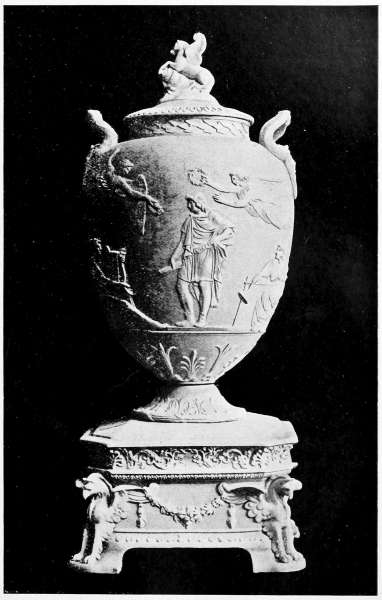
WEDGWOOD JASPER VASE. Subject—representing the Apotheosis of Virgil; surmounted by Pegasus cover.
By the courtesy of Messrs. Josiah Wedgwood & Sons.
Wedgwood's jasper ware is of various colours—blue in various tones, sage-green, olive-green, lilac, pink, yellow, and black, and, of course, white, which is its natural body without the addition of metallic oxides. It is capable of taking a polish on the lapidary's wheel. In use it was mainly employed for ware of a highly ornamental character, though it was also employed for utilitarian objects, such as tea and coffee services, dishes, and flower vases, and in plaques it was used as interior decorations in fireplaces and in furniture. We illustrate (p. 241) a jasper ware diced pattern Tea Set, which shows how wide a field Wedgwood covered with his new ware.
It is usually found with a ground of one colour, such as blue, lilac, et cetera—one of the seven—and the ornament applied in relief is, as a rule, white. It was Wedgwood's appreciation of antique gems that suggested the idea of reproducing them in earthenware, and in the period prior to Bentley's death, in 1780, cameos, portrait medallions, and plaques were mostly made.
There are two classes of jasper ware—solid jasper and jasper dip. The difference is similar to that between solid agate and surface agate. Solid jasper is coloured throughout. That which is coloured only on the surface is jasper dip. This latter gives more delicate effects, and was employed, after 1780, in the important series of classic vases which required translucency and greater delicacy in the white reliefs, which is especially effective in the filmy garments and flowing draperies of the classic figures.
Considerable progress had been made in Staffordshire since Elers left in 1710, but it is the Elers method of stamping the ornaments and applying them to the body of the ware that Wedgwood adopted. But there was more than enough originality of invention in this jasper ware to carry his fame to the confines of Europe. Blue and white porcelain in imitation of his jasper was made at Sèvres, and other continental factories, such as Meissen, Furstenburg, and Gros Breitenbach, made similar echoes of this wonderful English jasper ware of Josiah Wedgwood.
No illustrations can do justice to the charm and tender colour of some of the finer examples of this Wedgwood jasper ware, varying from pale lemon colour to delicate mauve as a ground, and having translucent diaphonous draperies in white standing in relief in the groups of figures.
To the sense of touch fine old specimens of this jasper ware are as soft as satin. Usually the dull matt surface of this ware is left without polish, though it is so dense and hard as to receive a high polish, which was occasionally employed in the inside of basins and cups and on the bevelled edges of some of his cameos.
His classic subjects were no feeble echoes of ancient art, but were executed from designs by a band of great artists working together and saturated with the spirit of the new classic revival. John Flaxman, James Tassie, John Bacon, William Hackwood, Thomas Stothard, George Stubbs, William Greatbach, were all employed by Wedgwood. And distinguished amateurs such as Lady Diana Beauclerk and Lady Templeton supplied him with designs, and it is interesting to note that Mrs. Wilcox, an accomplished painter of figures and borders on his Etruscan ware, was a daughter of Fry, the mezzotint engraver and founder of the Bow porcelain factory.
We illustrate (p. 245) a fine jasper vase representing The Apotheosis of Virgil, the cover surmounted by a Pegasus. The square pedestal has griffins at the corners. A companion vase, The Apotheosis of Homer, changed owners at eight hundred guineas, and is now in the possession of Lord Tweedmouth.
Wedgwood himself regarded his copy of the celebrated Barberini vase, which was lent to him by the Duke of Portland, as his masterpiece. This vase is a cameo glass vase, which was discovered in the middle of the seventeenth century in a marble sarcophagus on the road to Frascati, two miles from Rome. This vase belongs to the early part of the third century. It was bought by Sir William Hamilton for £1,000, and subsequently purchased by the Duke of Portland. This vase, of rich dark blue glass, almost black, is decorated with opaque white enamel cameos in relief cut with the most extraordinary skill, and it stands as a superb example of classic art. Strictly speaking, Wedgwood's copy of this was at best a copy in one material of the technique of another. But if it be not the highest art to copy thus in intricate detail, yet it must be admitted that such masterly elaboration had never before been attempted by the potter, and the early copies of Wedgwood (he set out to make only fifty) stand unequalled as specimens of potting by the hands of trained workmen directed by genius.
Wedgwood and his influence.—As a final word on Wedgwood and his influence, something should be said as to the charge laid against him that he inaugurated the factory system as applied to pottery. There is no doubt that he organised what was before his day a somewhat chaotic industry. And it is certain that he trained his workmen to become specialists, and that the system of the division of labour was the order of the day at Etruria. But how else could such an output as his be handled? It has been advanced that the quaintness of the peasant potter and his later development was submerged, and that all individuality was lost under the new system. There was a growing tendency to develop mechanical perfection and to introduce labour-saving appliances, but this was the spirit of the oncoming modern age. Other factories, his contemporaries, were adopting the same principles, and those who think Wedgwood unoriginal or uninventive are quite willing to credit him with all the inventiveness and originality necessary to overturn the old system. The truth lies between these two extremes. Wedgwood, in common with his contemporaries, not unwillingly embraced all the newest devices known. It was Sadler and Green, of Liverpool, who together in one day by their invention printed as many tiles as it would have taken a hundred painters to do in the same time. Similarly all over the country artisans in the china trade were becoming specialised. There were the enamellers at Chelsea and other places, and a little examination will show that Wedgwood did not inaugurate this modern factory method, but without doubt, in common with all other master potters, he had to go with the times. Trade rivalry was very strong, and competition was not unknown when every potter in Staffordshire was jealously watching the latest improvement of his neighbour. But to saddle Josiah Wedgwood with the responsibility of stamping out original talent is beside the mark. His life-work stands impregnable against petty assault. "In a word, no other potter of modern times has so successfully welded into one harmonious whole the prose and the poetry of the ceramic art."
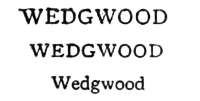
WEDGWOOD MARKS.
1.—This mark occurs upon a very early specimen of "Queen's Ware," a teapot, painted with flowers, &c., supposed to have been made by Wedgwood at Burslem: each letter apparently stamped singly with printers' type.
2, 3, 4.—These marks, varying in size, were, it is thought, used by Wedgwood up to the accession of Bentley as his partner, 1768–9, and are found upon specimens said to have been purchased about that period.
5.—The circular stamp, without the inner and outer rings, and without the word Etruria, is doubtless the earliest form of the Wedgwood and Bentley stamp, and is found upon a set of three early painted vases, in imitation of natural stone, with gilt serpent and scroll handles. No other example of this mark is known: it may have been an experimental one, afterwards changed for No. 6, and never in general use.
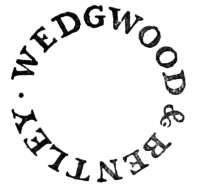
6.—This mark, with the word Etruria, is made upon a wafer, or bat, and fixed in the corner, inside the plinth of old basalt vases, reversing for candelabra and some large specimens; it is sometimes found on the pedestal of a bust or large figure.
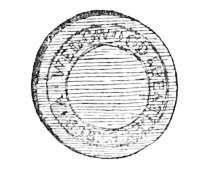
7.—The well-known circular stamp, with an inner and outer line, always placed round the screw of the basalt, granite, and Etruscan vases, but is never found upon the jasper vases of any period.
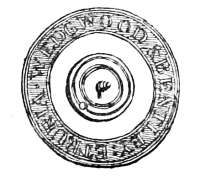
8, 9, 10, 11.—These marks, varying in size, are found upon busts, granite, and basalt vases, figures, plaques, medallions, and cameos, from the largest tablet to the smallest cameo for a ring (the writer has one, only half an inch by three-eighths of an inch, fully marked); also found upon useful ware of the period.
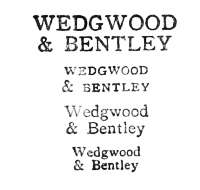
12.—Marks upon the Wedgwood and Bentley intaglios, with the catalogue number, varying in size. Very small intaglios are sometimes marked W. & B. with the catalogue number, or simply with number only.
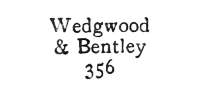
13.—This rare mark is found only upon chocolate and white seal intaglios, usually portraits, made of two layers of clay; the edges polished for mounting. It may be noted that the word "and" in every Wedgwood and Bentley mark is always contracted "&," that no punctuation or other points, excepting those in marks No. 5, 6, 7, and 13, are ever used.

14, 15, 16, 17, 18, 19, 20.—Marks, varying in size, attributed to the period after Bentley's death, and probably used for a time after Wedgwood died. These marks and others were used by chance—a small piece often bearing a large stamp, and a large one a minute stamp.
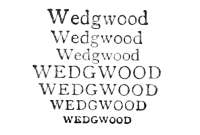
21.—This rare mark exists upon some large square plateaux in cane-coloured jasper. It may have been one adopted upon the change of partnership in 1790, but little used. The circular announcing the change says: "The mark 'WEDGWOOD' will be continued without any addition."
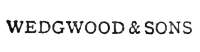
22, 23, 24.—These marks rarely found upon pieces of very high character—usually upon dark blue stoneware, vases, and glazed ware. Adopted about 1840, but soon disused.
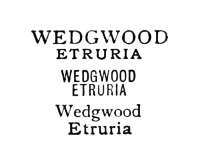
25.—The mark upon Wedgwood Porcelain made from 1805–1815. Always printed either in red or blue, sometimes in gold. An impressed mark cannot be used with certainty upon soft-paste porcelain, being so apt to diffuse out in firing.
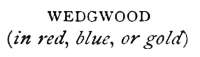
26, 27.—These marks, varying in size, are still used at Etruria for the modern jasper and useful ware of all varieties.
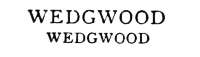
28.—The manufacture of fine porcelain was revived at Etruria, 1878, and is still continued. This mark, printed in black and other colours, is used.
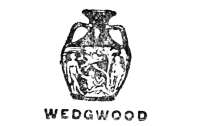
29.—The word England was added to the mark Wedgwood in 1891, to comply with the new American Customs Regulations, known as the McKinley Tariff Act.

The occurrence of three capital letters, ANO, REP, &c., in addition to name appears on ware after 1840. The first two letters are workmen's marks, and the third is a date letter, e.g., O = 1855, P = 1856, and so on, as in hall-marks on silver.
PRICES.
Wedgwood.£s.d.
Oval. Ganymede feeding Eagle (6¼ in. by 5¼ in.), marked Wedgwood & Bentley Christie, June, 1906 40 19 0
Oblong oval. Marriage of Cupid and Psyche (6 in. by 7¾ in.), marked Wedgwood & Bentley. Christie, June, 1906 54 12 0
Busts, Minerva and Mercury, black basalt, 18 in. high. Christie, November, 1906 16 16 0
Oval portrait, in jasper, white on blue ground, of Captain Cook (10 in. by 8 in.), marked Wedgwood & Bentley. Sotheby, February, 1907 16 16 0
Jasper vase, blue, with Venus and Cupid in relief, handles coiled with serpents. Christie, February, 1908 33 12 0
A pair of splashed mauve Nautilus Shells, marked Wedgwood. Sotheby, December, 1908 3 10 0
The above prices are for ordinary collectors' examples of old Wedgwood. But exceptional pieces bring exceptional prices. The largest known example of a blue and white jasper plaque (11 in. by 26 in.) sold for £415 at Christie's in 1880, and the fine jasper vase The Apotheosis of Homer (now in the Tweedmouth Collection) realised 800 guineas.
VIII THE SCHOOL OF WEDGWOOD
CHAPTER VIII THE SCHOOL OF WEDGWOOD 1760–1810
William Adams (of Greengates) (1789–1805)—John Turner (of Lane End) (1739–1786)—The plagiarists of Wedgwood—The Wedgwood influence—The passing of classicism—Table of Marks—Prices.
Potters who followed Wedgwood may be divided into three classes. Men such as John Turner and William Adams, who were competitors with him in friendly rivalry, each striving to emulate the successes of the other, and each doing original and independent work. Indebted, and greatly indebted to Wedgwood as these potters were, they produced work equal with his in technique. The blue jasper of William Adams, if anything, is rather finer than that of his master. John Turner, of Lane End, made jasper from a different formula to Wedgwood, being more porcellanous in character. These men, his friends and intimates, and Palmer, of Hanley, who was first to apply bas-reliefs to his black vases, in 1769, may be said to represent original research, as compared with uninventive copying.
The second class, which includes contemporaries such as Elijah Mayer, and Palmer, of Hanley, who must be included here (in spite of his streak of originality above alluded to, and his fine use of gilding to granitic ware), and Neale, his brother-in-law, and Voyez, the modeller, and Hollins, may all be said to be plagiarists who lived largely on Wedgwood's jasper and basalt ware, as well as several schools such as Hartley Greens (of Leeds), and Swansea and Spode, and many others who followed his cream-ware designs. In regard to Palmer and Neale and Voyez the case is very strong, as they are stated to have forged the mark "Wedgwood & Bentley" in some of their medallions; but against the others the case must not be pressed too closely, as they undoubtedly displayed a fertility of invention and an originality after they had once learned the Wedgwood manner. Leeds, in particular, having caught the spirit that Wedgwood had transplanted from the silversmith to his dessert services, produced cream-ware rivalling that of Etruria.
Tennyson had a set of verses which illustrate this situation. He tells of him who "cast to earth a seed" which grew so tall "it wore a crown of light."
"But thieves from o'er the wall Stole the seed by night."
Sown far and wide in every town, it won universal admiration, and, says the poet—who, by the way, was thinking of plagiarists of his own style—
"Most can raise the flowers now, For all have got the seed."
We must make one other point; it was Wedgwood who lighted the way even to his source of inspiration. He made no secret of his indebtedness to the art of the silversmith, and in recognising in the antiquarian works of Count Caylus and Sir William Hamilton a new field, he left it open for others to go to the same original sources, nor were his contemporaries slow in doing this. So that, in a measure, this second class of potters may be exonerated from the charge of plagiarism when we find them striking out for themselves.
Chippendale, when he promulgated his "Director" giving designs for furniture, straightway started a school of cabinet-makers, who worked after his designs in every locality in England. These early pioneers in art—Chippendale, the masterly adapter of all that was best on the Continent, and Wedgwood, translator of classicism into English pottery—worked with broad and generous spirit, and their contemporaries and those who came immediately after them helped themselves liberally to the overflowing profusion of ideas.
The third class is the great crowd of lesser men, potters who claim little attention for original work, but who are remembered as producing, as an echo to the great classic revival, designs and shapes and copies of Wedgwood's ware, sometimes in stoneware for jugs, and more often in cream-ware, without an added touch of originality. In this decadent period, when not only in Staffordshire but in other parts of the country this was being largely done, and not always done well, though there are exceptions to which we shall allude later, one is reminded of the pregnant words of Goethe: "There are many echoes, but few voices."
William Adams (1745–1805).—The Adams family are renowned in Staffordshire as being among the oldest potters in the country. In connection with classic ware William Adams, of Greengates, is pre-eminent. At his death, in 1805, the works were carried on by Benjamin Adams till 1820. There is considerable confusion between contemporary members of this family, both of the same name, William Adams (of Cobridge), William Adams (of Greenfield), and the subject of the present remarks, William Adams, of Greengates, who commenced as master potter there in 1789. There were other firms, such as J. Adams & Co., or Adams & Bromley, who made jasper ware between about 1870 and 1886, and who stamped their ware "Adams," or "Adams & Co." This, of course, does not come into the realm of collecting, and this latter firm has nothing to do with the old-established family of Adams. But collectors cannot be too careful when auction catalogues describe such ware as "Adams."
The beautiful Adams blue which is of a violet tone is much admired, and in the finely-modelled classic reliefs the style is less frigid than Wedgwood, as William Adams drew his inspiration more from Latin than Greek models. As a rule his jasper is a trifle more waxen than that of Wedgwood, but never glossy. William Adams was a favourite pupil of Wedgwood, and was doubtless indebted to him for the guidance that set the young potter to work in friendly and amicable rivalry with his late master.
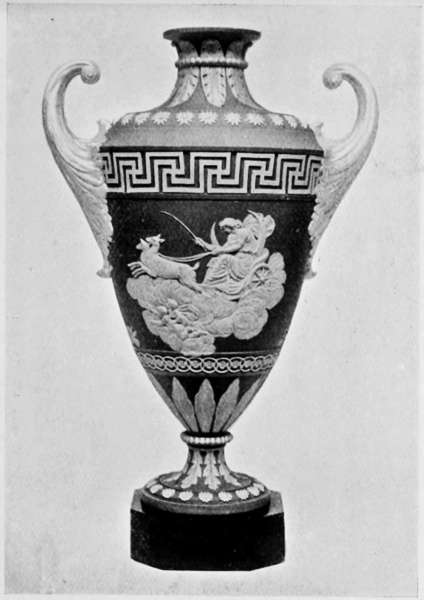
BLUE AND WHITE JASPER VASE. Impressed mark Turner. Subject—Diana in her Chariot. (John Turner, of Lane End, 1762–1786.)
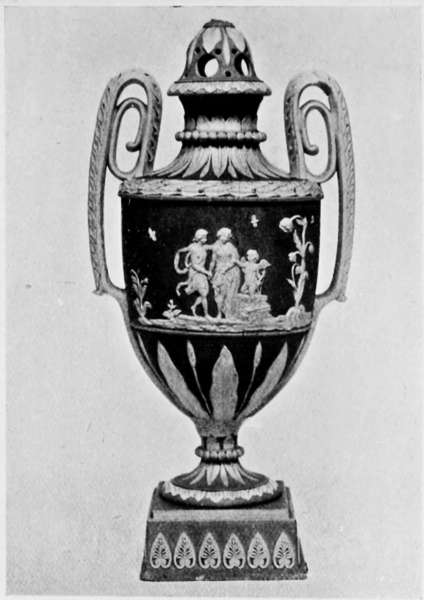
BLUE AND WHITE JASPER VASE. Impressed mark Adams. (About 1790.) (William Adams, of Greengates, made jasper 1787–1805.)
(At British Museum.)
As a modeller he was of exceptional merit, and it is known that he designed, himself, several of his finest pieces, such as the Seasons, his Venus Bound, and Cupid Disarmed, his Pandora, Psyche trying one of Cupid's Darts, and the Muses. Monglott, a Swiss artist, was employed by him on jasper vases, and it is believed that Enoch Wood is responsible for designing the hunting scenes which appear on the fine stoneware jugs and tankards similar in style to the Turner jug illustrated (p. 267). Many of his jugs had silver mounts.
In regard to marks, that usually found is Adams impressed. Sometimes, though rarely, the mark is Adams & Co.; and later his son, Benjamin Adams, had the impressed mark B. Adams, which appears on stoneware and blue printed ware.
To those who desire to familiarise themselves with the genius of William Adams, there is a special volume by Mr. William Turner, entitled "William Adams, an Old English Potter" (Chapman & Hall, 1904), which is a full and learned monograph, dealing in thorough manner with the productions of William Adams and of his kinsfolk, the Adams family of potters.
We illustrate one of a pair of jasper vases in blue and white by Adams, in date about 1790. The classic figure subjects, as will be seen, display a simplicity and exquisite grace of modelling and arrangement not surpassed even by Wedgwood (see p. 261).
John Turner, of Lane End (1739–1786).—Wedgwood and Turner were intimates, and in considering Turner we must regard him as a friendly neighbour, as well as a rival potter. He made some remarkably fine jasper, though it differed in its body very greatly from that of Wedgwood, being more closely allied with porcelain. It contained no barytes in its composition. In design Turner, though not imitative, followed the Greek school and produced, as a modeller himself, some exquisitely proportioned pieces. We illustrate a fine vase in blue-and-white jasper which is especially graceful in design, the severity being relieved by the delicacy of the fine subject in relief of Diana in her Chariot drawing a pair of goats and accompanied by flying cherubs (see p. 261). This subject, it will be noticed, is reproduced in a transfer-printed jug illustrated in a later chapter (p. 319).
But it is in the unglazed stoneware that he surpassed anything his contemporaries had done. It was about 1780 that he discovered, after hunting for clay even so far afield as Cornwall, the precise earth he wanted in his own neighbourhood at Longton. In colour it was a warm biscuit tone, and it was capable of being modelled with exactitude into fine sharp designs in relief. In stoneware jugs with classic figures in relief he set the fashion for half a century. His teapots and coffee-pots are models of graceful design. We illustrate a fine example of a Teapot (p. 267), with the lid perfectly fitting, made to slide in a groove, and showing in clear relief the style of ornamentation for which Turner became so renowned. The other illustration, on the same page, of an equally perfect Stoneware Jug with metal mounts, shows a slight departure from classic ornament. The figures are in old English costume, and are engaged in archery. It will thus be seen that even in the early days there was exhibited a tendency to depart from classic figure design and turn to equally graceful but homelier subjects. Possibly this influence may have been due to Enoch Wood, who is believed to have been employed by Turner as a modeller; but accurate information regarding Turner's modellers is not known.
Besides the above-mentioned wares, Turner also made black basalt of very high quality, being preferred by some connoisseurs to that of Wedgwood. He also was the first to introduce under-glaze printing into Staffordshire, and although he did not introduce the "willow pattern" (Spode brought that from Caughley), he made ware with this pattern printed in under-glaze blue, and his plates and dishes have perforated borders. We illustrate a fine example of this ware (p. 331).
The Plagiarists of Wedgwood.—We have seen that John Turner, of Lane End, that William Adams, of Greengates, came under the strong influence of Wedgwood, but were no more imitators, in the broad sense, than Gainsborough and Romney may be said to be imitators of Sir Joshua Reynolds. It must be allowed in art that a school may arise under the guidance of some remarkable genius who tinges the originality of his contemporaries with his own master mind. Wedgwood had the inspiration to transplant classic decoration into Staffordshire—the rest was easy; having shown the way, crowds of lesser men seized the new ideas with avidity.
Chief among the direct copyists was Henry Palmer. He had a spark of originality, as we have seen, anticipating Wedgwood by some five years in applying bas-reliefs to his black vases, and the sprinkled marbled ware touched with gold was another success of his, but here his ingenuity ended. He must have been a great thorn in Wedgwood's side, for he is said to have procured every new pattern on its appearance and copied it. Voyez, who was a modeller and not a potter, assisted in this nefarious traffic; but Voyez, in spite of his rascality, was a clever modeller, and struck out a new line in his rustic or "Fair Hebe" jugs. He was employed at one time by Wedgwood, and probably by Ralph Wood. Voyez specialised on the intaglio seals, and added Wedgwood and Bentley's names to his handiwork. On other intaglios, equally imitative, and on vases is the name Palmer or the initials H. P.
Wedgwood himself—as do collectors nowadays—was obliged to acknowledge the fine quality of the work of Palmer and of Neale, for he admitted to Bentley that they were "serious competitors," and he evidently feared their activity, as he says, "We must be progressing or we shall have them treading on our heels."
The sagacity of Wedgwood's remark is obvious, for an examination of the Neale-and-Palmer jasper and other ware reveals an amazing mastery of technique. It is finely potted and well balanced in ornament and design. If it were not for the impressed mark such vases might readily pass as Wedgwood. It is not improbable that in the middle nineteenth century the names both of Adams and Palmer and Neale were ground out of the bases of some of their finer vases by ingenious persons, who passed them off as the work of Wedgwood.
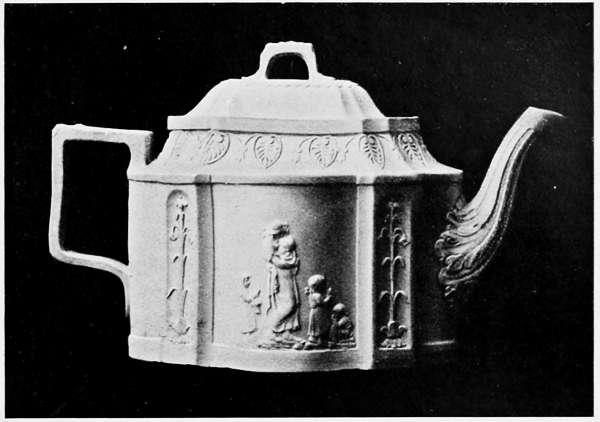
TURNER STONEWARE TEAPOT, UNGLAZED. With ornament in relief and classic figure subjects. Mark impressed Turner. (Height 4½ inches.) (In the collection of Mrs. L. Scott.)
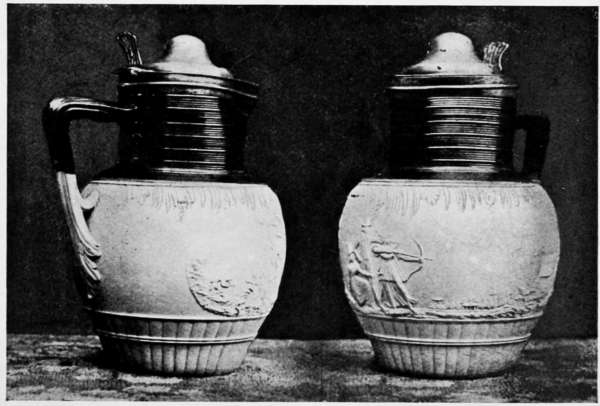
TURNER STONEWARE JUG, UNGLAZED. With decoration in relief of archery. Silver lid and rim. Mark impressed Turner. (Height 9 inches.) (In the collection of Mr. John Watson Bradley.)
Marks—Palmer, Neale, Wilson.—In regard to marks, H. Palmer or Palmer. Hanley is the earliest—sometimes only the initials H. P. About 1776 he entered into partnership with his brother-in-law, and sometimes the mark Neale alone is found and often Neale & Co. These marks are usually in circles; on one piece appears I. Neale, with the word Hanly (spelt wrongly) beneath. About 1778 Robert Wilson joined the firm, and after 1788 his name alone appears. Stoneware jugs—drab ground with cupids in relief—baskets, and cream-ware are often found marked Wilson surmounted by a crown with the letter C above. Sometimes this is present without the name. Wilson, too, is remembered for having introduced chalk into the body of his cream-ware, which was of exceptional value in whitening the ware and rendering it more adapted for under-glaze printing. At Wilson's death, in 1802, David Wilson succeeded to the pottery, and the firm shortly after became D. Wilson & Sons. These Wilsons made pink lustre, similar to that of Wedgwood, and also silver lustre, upon some of which the name of Wilson is impressed. This brings the factory down to 1820, when it passed into other hands.
We have seen that Adams and Turner and Palmer and Neale came more or less into touch with Wedgwood as contemporary rivals. Before coming to the crowd of lesser men, or lesser-known men, we must not omit Josiah Spode, who was a colleague of Wedgwood under Whieldon; Elijah Mayer, whose black basalt was almost equal to that of Wedgwood, and whose enamel cream-ware stands artistically very high; and Samuel Hollins, of Shelton, with fine red or chocolate ware, having as dense a character as Wedgwood's imitations of the Elers ware, and Hollins in his jasper produced some fine examples with original combinations of colours.
Josiah Spode the First (there are three potters in succession of that name) made, in common with other potters, the black basalt ware from 1770, when he commenced as potter, and he produced stoneware jugs similar in character to those of Adams and Turner, following the sporting subjects in relief and departing from the ultra-classical subjects of Wedgwood. This class of jug and mug was made by many potters—its character was English, and it was evidently popular. An illustration of the type appears on page 277. Davenport, of Longport, made the same pattern; it was made at Castleford, near Leeds, and Hollins and others adopted the design in relief of a fox-hunt, with horsemen dismounted preparing to join others at the "kill," which is shown on the reverse. In fact, it was almost as much copied in stoneware as the "willow pattern" was in blue-printed ware.
But Josiah Spode is best known as devoting considerable skill in the improvement of under-glaze blue-printing cream-ware. In 1783 he brought two workmen into Staffordshire from Caughley, where under-glaze blue-printing under Thomas Turner was in full swing. Spode was not the first to introduce under-glaze blue-printing into Staffordshire; this is due to John Turner, of Lane End (whom we have described, maker of the fine jasper-ware and stoneware teapots and jugs), not to be confounded with Thomas Turner, the maker of porcelain at Caughley, who introduced the "willow pattern" in 1780, which same design was introduced into Staffordshire in 1784 by Spode—a year after his two men came over from Caughley. But this and blue transfer-printing is dealt with in a subsequent chapter.
Something should be said of Josiah Spode the Second (1797–1827), who continued the blue-printed ware, and produced a great number of stoneware jugs with decoration in relief similar to those we have alluded to, and produced jasper ware in blue and white with the familiar subjects of Wedgwood's day. To him must be given the credit of introducing colour into Staffordshire earthenware, colour such as it had never before attempted. His fine imitations of the Derby-Japan porcelain designs mark a new era in Staffordshire earthenware.
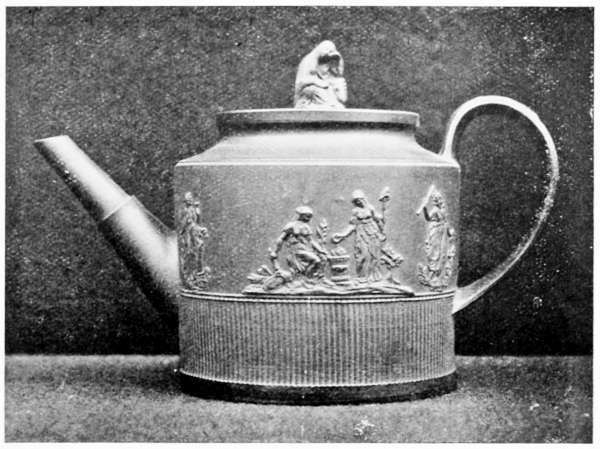
BLACK BASALT TEAPOT, UNGLAZED. Impressed mark E. Mayer. (1770–1813.) (About 1786.) (At British Museum.)
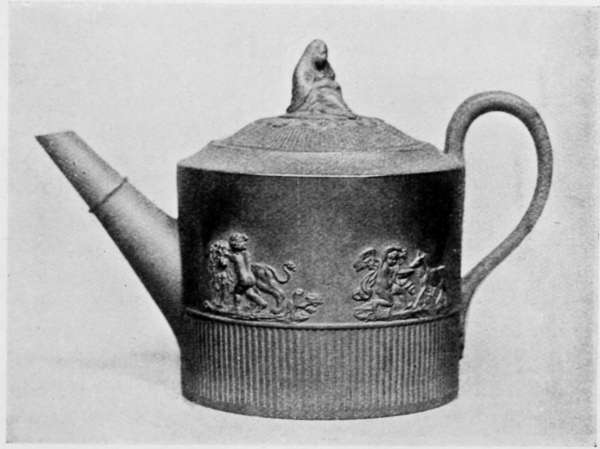
BLACK BASALT TEAPOT, UNGLAZED. Impressed mark Birch. (About 1802.) (In the possession of Mr. F. W. Phillips, Hitchin.)
These illustrations show the imitativeness of this school of potters and the difficulty of identification.
The Spodes brought something new into Staffordshire earthenware. The elder Spode evidently had a strong love for Oriental subjects, as in the "willow pattern," which he "lifted" from Caughley porcelain. He broke away—and others followed him readily enough—from the cupids and psyches and gods and goddesses of the old world, and followed the newer-imported ideas in Chinese taste, now the fashion at Worcester, Bow, and other china factories. Leeds and Swansea were not slow in snatching at this new Oriental style of decoration.
In the Staffordshire cream-ware jug we previously illustrated painted in under-glaze colours, somewhat brown owing to the imperfect knowledge of the Staffordshire potter in under-glaze work submitted to great heat, we see an example of painted design in Oriental style, which came shortly to be more perfectly done in under-glaze blue, as in the painted plate of Leeds ware illustrated (p. 303).
But much in the same manner work such as the painted scenery on services like that made by Wedgwood for Catherine II. was shortly supplanted by black and purple and red transfer-printing done at Liverpool, so the short-lived under-glaze blue painting on earthenware was quickly killed by Spode and the other Staffordshire potters when they rapidly developed the under-glaze transfer-printing in blue.
It was quite an original departure, and owed nothing to Josiah Wedgwood (who never employed transfer-printing in blue), though it was adopted very successfully by the firm after his death. And Josiah Spode the elder most certainly had a strong influence in the potters of his day in acclimatising the "willow pattern" in Staffordshire, and in assimilating the best efforts of Chinese decoration as applied to blue-and-white ware. And Josiah Spode the Second, with equal originality, took up the next stage in adopting the gorgeous colouring of Japan.
This brings the story of the development of Wedgwood's cream-ware up to modern times. And the same chain of development might be traced in the history of some of the other great potters whose descendants still carry on the manufacture. Cream-ware at first painted, then transfer-printed in black or red, then painted in blue under-glaze—which was killed by the blue under-glaze printing—finally emulated the rich colours and gilding of porcelain.
To return to Elijah Mayer (1770–1813). From 1786 he appears to have produced black basalt tea ware; his fine teapots with the seated figure at the apex are well known, and his unglazed cane-coloured ware is much prized, with its simple decorations in lines of green and blue. We illustrate (p. 271) an example of a Black Basalt Teapot, and beneath it an illustration of a similar model by Birch, showing the imitativeness of this school of potters and how difficult it is to identify specimens. His cream-ware deserves especial attention, as his enamelling was in very artistic manner, and it stands out prominently among a crowd of imitators of Wedgwood's cream-ware borders. Every maker not only took the body of the ware, but in so doing he followed the designs by Flaxman or some of Wedgwood's other artists, still found in the old pattern-books to-day at Etruria. As an example of this imitation in detail, see the Swansea cream-ware plate illustrated (p. 397).
Mayer made black glazed tea ware, and this, when unmarked, is very commonly attributed by beginners to Turner. The marks impressed are E. Mayer, and after 1820 E. Mayer & Son. At a later period the mark was Joseph Mayer.
Samuel Hollins (1774–1816), with his red and chocolate unglazed ware decorated with ornament in the Elers manner and made from the clay at Bradwell Wood, is deservedly noteworthy as well as for several important departures in colour in the stoneware teapots and coffee-pots which he made of green, with touches of applied ornament in blue jasper. He followed silver designs, and avoided the cold, classic forms of Wedgwood. He departed from the straight lines of the Turner teapot. He loved ornament, and there is a touch of elaboration in his design, as though attempting to shake off the severe formality of the Brothers Adam style of design, and he strongly loved colour.
Samuel Hollins was one of the proprietors in the New Hall china works, and his successors were T. and J. Hollins, who continued to make jasper ware in the style of Wedgwood. Their names are impressed on many examples.
The Wedgwood influence.—In the latter days of the eighteenth century and the early days of the nineteenth, the direct influence of Wedgwood became something more remote. But even in early nineteenth-century days there were undeniable traces of the old models and the old form of ware. Take, for example, the unmarked early nineteenth-century Black Basalt Teapot in the form of a barrel, with the grape-vine ornament in relief, and the pine cone at top of lid (illustrated p. 277). Undoubtedly this has left all classic form, but it has retained the technique of Wedgwood. In some of the buff-coloured, unglazed stoneware jugs which are unmarked, there is the inclination to follow the sporting subjects in relief, which Adams and Turner and Spode so successfully adopted, and the twisted snake-handle and reptilian-modelled mouth become original in treatment. In general, it may be said, that the classic influence remained for a considerable time in the stoneware of various kinds, but in the cream-ware which is the main stream of English earthenware, the forms and the ornamentation more rapidly departed from the styles of Wedgwood's queen's ware.
Hence we find two opposing influences working against each other in the Staffordshire potters' minds. The best of them in their highest flights essayed to make jasper, or to copy or emulate Wedgwood's classic style in vases and important ornamental pieces. Most of them largely made the stoneware of various colours, and also the black basalt. All of them made cream-ware, which was the staple ware of Staffordshire, in a thousand different forms. As time went on all except cream-ware began to deteriorate from the earliest prototypes, and the later forms are debased in design and inferior in potting.
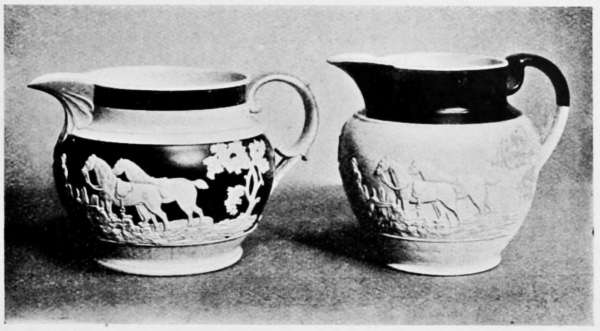
SPODE STONEWARE JUG. Rich blue glazed ground with decoration of hunting scene in white relief. DAVENPORT STONEWARE JUG. Same design as adjacent jug, but having white ground with subject in relief. (In the possession of Mr. Hubert Gould.)
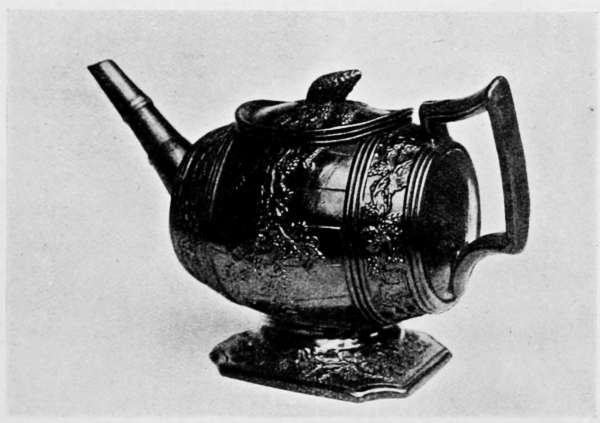
BLACK BASALT TEAPOT. In the form of a barrel, with grape-vine decoration in relief. (Early nineteenth century.)
The passing of classicism.—From the first there were those who were classic only by compulsion. Wedgwood was regarded as too classic for vulgar tastes. The cream-ware and the coloured figures display a ready appreciation of public wants. Even Voyez descended to rusticity in his jugs. Spode had a leaning for Oriental subjects in his blue printed ware, which was quickly adopted by Leeds. Adams leaned to landscape subjects after Claude and English scenery. Nor was this all. The cream-ware figures and the mugs and jugs provided full scope for the potter's fancy in political, satirical, patriotic, and humorous and fancy subjects. From Sunderland to Swansea the cream-ware took to itself more homely sentiments and more characteristic design. It became, during the last quarter of the eighteenth century and the first quarter of the nineteenth, as English as if the gods and goddesses had never descended into Staffordshire, and as though Wedgwood had never been.
Most of this cream-ware was transfer-printed, the Caxtons of Staffordshire had found blank spots enough to fill on their white ware, and in filling them they have left us a permanent record of popular feeling which was at the time strong enough to induce them to rush into print on every conceivable subject with queer engraved decoration and whimsically illiterate verse.
Marks.—The following are some of the names, mostly found as impressed marks, on ware of the Wedgwood school, in date from 1760 to 1835, a period of three-quarters of a century. In many cases in addition to ware bearing traces of a classic influence, the potters made cream ware with blue-printed decoration, a style which was not employed at Etruria until the second Wedgwood period, on the death of Josiah Wedgwood in 1795.[4]
The names are arranged alphabetically, and, where of interest, the class of ware associated with the potter is given.
William Adams (of Greengates) 1787–1805 Fine jasper ware of the highest quality. Stoneware and blue-printed ware.
J. Aynsley 1790–1826 Silver lustre. Transfer-printed ware. Melon- and barrel-shaped teapots.
Batty & Co. Vases and jugs, classic figures as frieze, printed in under-glaze blue touched with vermilion.
E. J. Birch Black basalt ware of good quality (sometimes marked with E.I.B. impressed).
Bott & Co. Busts painted in colours. Vases transfer-printed.
J. Clementson 1832–1867 White ware blue-printed with foreign scenery. (Marked with name and phœnix.)
Clews 1814–1836 Stoneware jugs. Blue-printed cream ware. Picturesque views and subjects after Wilkie's pictures, Rowlandson's Dr. Syntax, Don Quixote, &c.
Close & Co. (Successors to W. Adams & Sons, of Stoke.) from 1843 Cream ware with printed decoration in brown.
Cookson & Harding C. & H. (late Hackwood.) 1856–1862 Cream ware blue transfer-printed.
Davenport (Longport) (Firm continued till 1886.) 1793–1834 Cream ware painted and printed. Handles in form of dolphins. Plates and dishes—dragons and fret border printed in blue; ground pencilled in scale pattern.
Eastwood 1802–1830 Vases small, jasper, Wedgwood style; stoneware blue and buff. W. Baddeley, of Eastwood, is believed to have used this mark, frequently found.
Hackwood 1842–1856 Cream ware painted with knights and armed figures.
Harding 1862–1880 Blue glazed earthenware, white ornaments in relief. Brown glazed jugs and teapots in Rockingham style.
Harley about 1809 Teapots, white glazed stoneware; cover surmounted.
Heath 1770–1777
Heath & Bagnall 1777–1785
Heath, Warburton & Co. 1786–
S. Hollins 1774–1816 Jasper ware, white ground cameo figures in blue.
T. & J. Hollins 1802–1820 Similar ware to above.
A. & E. Keeling 1786–1828 Black basalt and cream ware.
Lakin Cream ware blue-printed with English landscape subjects, &c.
Lakin & Poole 1770–1846 Dishes and cream ware. Centres often finely painted with exotic birds in Worcester style.
J. & T. Lockett 1786–1829 White stoneware and salt-glaze.
E. J. Mayer 1770–1813 Black basalt tea services, &c., with animals in relief; silver lustre.
E. Mayer & Son 1813–1830
Mayer & Newbold 1823–1837 Made porcelain as well as earthenware (marked M. & N.).
Mayer & Elliott Cream ware, blue-printed.
F. Meir White glazed earthenware services, English landscapes printed in blue, dishes with pierced border.
Morr & Smith
Moseley 1802–1825 Black basalt ware; teapots, &c.
Myatt 1802–1840 Unglazed red ware coffee-pots in Elers style. Engine-turned with wavy patterns. Sometimes marked with an oval enclosing letter W.
H. Palmer 1760–1775 Fine jasper ware, granitic vases; figures.
Neale & Palmer 1776–1778 Jasper ware strongly imitative of Wedgwood.
Neale & Co. 1778–1788 Jasper ware and classic figures.
Phillips (Longport) 1760–1830 Small dishes; salt cellars, cream ware, Oriental decoration, blue-printed.
Pratt Vases and jugs, white stoneware, with blue figures in relief; border of vine.
Ridgway 1790–1854 Various elaborate marks used. W. Ridgway and W. Ridgway & Son. In 1836 the firm became W. Ridgway, Morley, Wear & Co.
Riley
Rogers 1786–1829 Blue-printed stoneware. Inferior imitations of Wedgwood.
Salt 1820–1864 Figures enamelled in colour.
Shorthose 1783–1802 Black basalt vases and flower jars.
Shorthose & Heath 1802– White glazed earthenware, transfer printed in red over-glaze. Subjects—children at play, &c. Cream ware embossed with wicker pattern pierced border. (Mark printed in red, also impressed.)
Sneyd about 1850 Imitations of Portland vase, &c.
Josiah Spode (the First) 1770–1797 Black basalt ware. Stoneware jugs with sporting subjects in relief.
Steel 1780–1824 Jasper and ornamental ware, white relief on blue, dark blue figures in relief on pink ground, &c.
W. Stevenson about 1828 White glazed ware, classic figures in relief on pale blue ground; impressed mark W. Stevenson, Hanley.
John Turner (of Lane End) 1739–1786 Fine Jasper ware of excellent quality. Stoneware jugs, &c., of warm biscuit colour unglazed. Black basalt, and under-glaze, blue-printed ware.
Walton 1806–1839 Figures-classical Lions, Fishwife, Gardener, &c.
Warburton 1751–1828 Rarely marked. Mrs. Warburton, of Cobridge, in 1751 made great improvements in cream ware prior to Wedgwood's queen's ware. In 1828 the firm was J. Warburton & Co.
Wilson 1788–1820 Stoneware jugs with classic figures in relief. Ornamental vases in Wedgwood style. Copper lustre ware.
E. Wood 1784–1790 Cream ware, basket pattern, &c. Busts.
Wood & Caldwell 1790–1818 White glazed earthenware. Figures, coloured busts, &c.
Enoch Wood & Sons 1820–1846 Figures of classic form.
PRICES.
School of Wedgwood.
Adams.£s.d.
Jug (with old Sheffield plate lid), chocolate band with Bacchanalian subject. Escritt & Barrett, Grantham, April, 1907 220
Jug, blue jasper, with figure subjects of Seasons in white relief, old Sheffield plate cover. Sotheby, May, 1908 650
Sucrier and Cover, marked "Adams & Co." Sotheby, November, 1908 2140
Turner.
Female figure of a "Water Carrier" in black basalt, marked Turner. Sotheby, December, 1905 350
Teapot and Cover, blue ground with classical subjects in high relief; impressed mark, Turner. Sotheby, November, 1908 260
Teapot, of different form, similar decoration, unmarked. Sotheby, November, 1908 240
Sucrier and Cover, similar decoration; impressed mark, Turner. Sotheby, November, 1908 3120
Cake Plate with classic decorations in relief; impressed mark, Turner. Sotheby, November, 1908 4100
Coffee Pot and Cover, similar style; impressed mark, Turner. Sotheby, November, 1908 400
Neale & Palmer.
Vase and Cover with medallions, wreaths and masks in relief, in gilt on mottled grey-blue ground, marked Neale, Hanley. Puttick & Simpson, Nov., '08 4100
Vase and Cover, urn-shaped, with medallion and figure subject in white relief; ram's head handles, wreaths and borders in gilt on mottled-blue ground, marked H. Palmer, Hanley. Puttick & Simpson, November, 1908 3100
Ralph Wood.
Figure of Apollo with lyre. Sotheby, May, 1908 250
Figures, Boy and Girl Harvesters, square bases; one marked R. Wood. Sotheby, May, 1908 1050
E. Wood.
Bust of John Wesley, signed Enoch Wood. Sotheby, June, 1906 200
E. Mayer.
Four plaques of Cupids in relief; mark impressed, E. Mayer, and dated 1784. Sotheby, November, 1905 1180
Heath.
Plate of cream ware, crudely decorated for the Dutch market, subject—Abraham offering up Isaac (Hodgkin Collection). Sotheby, December, 1903 030
Lakin.
Dish decorated with border of rose, shamrock, and thistle. Prince of Wales' feathers and lion over crown in centre. Made for the Prince Regent (George IV.); marked "Lakin." Sotheby, February, 1906 200
Pair of Lakin plates from above service. Sotheby, November, 1907 300
Lakin & Poole.
Mug, with mask head on front, marked "Lakin & Poole," and four shell dishes. Sotheby, June, 1906 160
IX LEEDS AND OTHER FACTORIES
CHAPTER IX LEEDS AND OTHER FACTORIES
Leeds Marks—The best period of Leeds—Leeds Cream Ware—Blue and White Ware—Leeds Ware decorated at Lowestoft, Castleford, Jackfield, Rockingham, Sunderland, and Newcastle—Table of Marks—Prices.
Leeds claims notice mainly on account of its fine cream ware that was produced in the period from 1783 to about 1800 when the factory was at its zenith. The date which commences its known history is the year 1760, a most pregnant year in the history of pottery. Before that there always exists some doubt as to the exact date or the particular maker. "Early Staffordshire" or "Whieldon" are as definite as most collectors dare go.
In 1762 Wedgwood's cream ware was perfected, and all Staffordshire was aflame with the prospects of something that at last was to stand artistically side by side with Bow and Chelsea and Worcester and Derby and Plymouth. It did nothing of the sort, but still it was the dream of the Staffordshire potters that it should by reason of its cheapness smash the new china factories, and it seems to have had no little share in doing this.
In 1775 the Leeds pottery was in the hands of Humble and Green. In 1783 it was known as Hartley, Greens & Co., and for the next ten years some splendid examples of cream ware were produced rivalling the best productions of Wedgwood, at first imitative, but later strikingly original, and possessed of extraordinary artistic qualities. Down to the opening days of the nineteenth century the trade in cream ware was considerable. Pattern books and catalogues were issued in French and German and Spanish, and the output from Leeds was very considerable, and the continental trade very extensive, especially with Northern Europe.
From 1825 to 1832 the firm was known as Samuel Wainwright & Co. From 1832 to 1840 the name changed again to the Leeds Pottery Company, under the managership of Stephen Chapel, who, together with his brother James, held the pottery till 1847. In 1850 Warburton, Britton & Co. were proprietors until 1863, and Richard Britton & Sons carried on the works until 1878 when the factory closed.
Forgeries of Leeds Ware.—Leeds ware has appealed, on account of its artistic qualities, to so wide a circle of collectors and admirers that it has had the honour of being forged with intent to deceive. Nearly all these pieces are marked either "Leeds Pottery," "L.P.," or "Leeds P." In addition to being copied for sale to unwary collectors some of the basket and other patterns have been of recent years made in Germany for sale in this country. But to any one who has had the opportunity of handling genuine old Leeds ware the lightness in weight, the fine finish, and the peculiar colour of the body, especially the slightly green tinge in the old Leeds glaze are never to be mistaken. The modern copies lack the fine potting, and they are slightly heavier in weight, and always without exception have a thick white, glassy glaze which fills the corners of the pierced work, and shows the touch of modern haste.
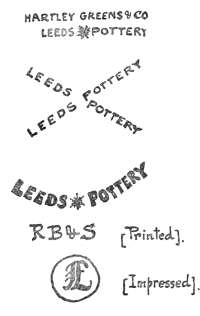
Leeds Marks.—The following marks occur on Leeds ware, largely on the blue-printed ware which was after 1791, for many of the finest examples of cream ware are unmarked. However, these marks used may be a guide: Leeds * Pottery (often printed twice over and crossing at right angles), Hartley, Greens, & Co., Leeds Pottery (either in two lines or in a semicircle), also the initials L.P. In its latter stage (1863–1878) R. Britton and Sons marked their ware R. B. & S. with the initial L enclosed in a circle.
The Don pottery at Swinton near Leeds, established about 1790, came in prominence about 1800, when one of the brothers Green, of Leeds, became owner. It passed through various vicissitudes of fortune, a comparison of the old pattern books show that many pieces made at the Don pottery were originated at Leeds. In 1834 it was purchased by Samuel Barker, and in 1882 it was still known as Samuel Barker and Sons.
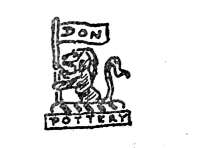
The Don Pottery mark was both printed and impressed Don Pottery in its early days prior to 1834, and sometimes the word Green appears above. Later in the Barker régime a demi-lion rampant holding in his paws a pennon with the words "Don Pottery" was used, sometimes with the word Barker, and sometimes with the initials S. B. & S.
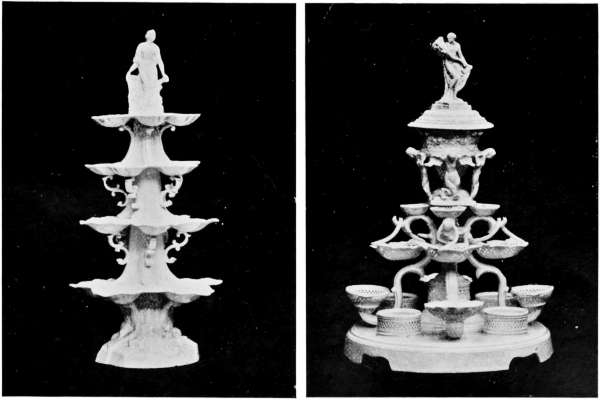
LEEDS CREAM WARE CENTRE-PIECES. Made to take into four parts. (Height 4 feet.) Pierced baskets, removable. (Height 2 feet 6 inches.) (In the collection of Mr. Richard Wilson.)
The best period.—But it is chiefly the best period, that is, Hartley, Greens & Co., from 1781 to about 1805, which appeals to collectors of old Leeds, though a pattern book was issued as late as 1814, which still maintained the old traditions, but when Hartley died in 1820 the factory practically went to pieces. The two brothers Green and William Hartley nobly carried on the manufacture of cream ware. At first they looked to Wedgwood for inspiration, but very shortly introduced a lightness of design in the exquisite and intricately pierced patterns in the borders, and original touches in the feather edges in relief and twisted handles and the floral terminals. The gadrooned or fluted edges of Leeds plates were sometimes painted in blue. The ware is extremely light in weight, and varies in colour from a pale, sometimes a very pale, cream colour to a light buff. We have seen how Wedgwood invented punches at first for his pierced cream ware. But he at a later stage had the perforations punched en bloc. But in Leeds ware each perforation is done separately by hand, and the edges are sharp and clean-cut. These are in the shape of diamonds, squares, ovals, and hearts, arranged in geometrical patterns. The characteristic feature of Leeds ware is the varied use of this pierced work in the rims of plates and dishes and trays and cups. This work was carried into such unlikely portions of the ware such as bases of candlesticks or plinths of massive candelabra. In conception no doubt it followed the work of the silversmith, but as it developed it acquired the character of some of the finest Oriental types of this class of ware, and in particular the Leeds potters achieved a ceramic triumph when they made, in the delicately pierced work with small apertures, something not dissimilar to the rice-grain form found on old Chinese white ware which in the case of Chinese wine-cups of white porcelain is filled with glaze. This especially fine style is at the present day being carried out by the potters at the Copenhagen porcelain factory. When held up to the light this porcelain of China and of Denmark is singularly beautiful, and looks as though it is perforated—but is not.
If Leeds at first copied Wedgwood and the Staffordshire cream-ware patterns the Staffordshire potters were not slow to return the compliment when they saw that Leeds had a note of originality, consequently we find many salt-glaze pieces of identical shape to some of Hartley, Greens & Co.'s patterns. It is improbable that salt-glaze ware was ever made at Leeds, though before salt-glaze was as well understood as it is now much of it was wrongly attributed to Leeds.
We give an illustration (p. 319) of a salt-glaze plate which has the typical perforated edge of Leeds cream ware, and is decorated with a transfer-print of a fable subject, illustrating "Hercules and the Waggoner." But Leeds very early did its own printing, and only the early examples were sent to Liverpool to Sadler and Green. At this time salt-glaze ware was in a bad way, and every effort was being made to compete with cream ware its new rival, and with porcelain which had struck the first blow at its supremacy as domestic ware. When cream ware was decorated by transfer-printing salt-glaze followed the new fashion, and leaving its lofty ideals of undecorated form it hastily assumed the enamel colouring of the English porcelain.
Leeds Cream Ware.—The various classes of Leeds cream ware may be roughly divided into two classes:
(1) Plain or undecorated, in which (especially by reason by the grace and lightness of structure imparted by the nicely balanced perforations) artistic excellence is reached by form alone.
(2) Decorated cream ware. Decorated with enamel colours, green, red, lilac, and yellow being usually found, or transfer-printed in the early manner of Liverpool—black, puce, or red, or later by printing in blue.
In regard to the finer specimens of the cream ware dependent on form and exhibiting especial delicacy in the treatment of the pierced work, the illustrations here given convey a pictorial representation of the great variety and fertility of the design.
The two magnificent centre-pieces represent Leeds cream ware at its highest. The favourite form of the centre-piece is that in which tiers of escallop shells are supported by dolphins or by ornamental brackets. The left-hand centre-piece illustrated (p. 291) is in the form of the trunk of a tree, supporting four tiers of leaf-shaped dishes. The piece is surmounted by a classical draped figure. It is noticeable that the brackets have every resemblance to metal design. These large centre-pieces are made to take apart. This example illustrated takes into four pieces, which fit into each other with great accuracy, showing great technical perfection in potting. It is no less than 4 feet in height, and one of the largest pieces known. Its rich cream colour, the perfection of the glaze, and the graceful proportion in the structure, and the modelled figure have won for this and similar creations of Leeds the admiration of all connoisseurs.
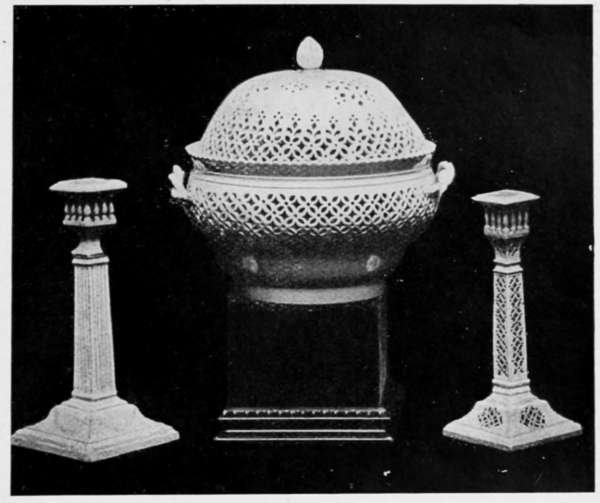
CHESTNUT BASKET AND CANDLESTICKS. Pierced Leeds cream ware. (In the collection of Mr. Richard Wilson.)
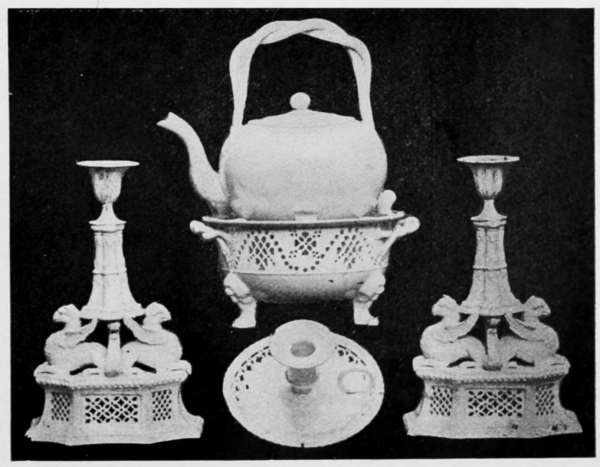
LEEDS CREAM WARE CANDLESTICKS AND KETTLE AND STAND. With fine pierced work. (In the collection of Mr. Richard Wilson.)
The other centre-piece illustrated is 30 inches in height, and is constructed in the form of hanging baskets separate and removable. These baskets, which are of exquisite pierced work, are in three tiers supported from the central column. The top consists of a vase resting upon four winged figures. The piece is surmounted by a classical draped figure of Flora with a cornucopia.
Such pieces as these hold the blue riband of Leeds cream ware, and collectors who wish to find specimens only approximating to them in grace and beauty have to search as far afield as Russia and Sweden before they can hope to gratify their desire.
Another class typical of Leeds cream ware in its highest moods is the large class consisting of handsome cruets, baskets, and a great variety of candlesticks. The pierced work in these articles is of very fine character, and the design is happily lightened by this style of decoration. In regard to imitations of this cream ware, as has already been mentioned, they are heavier, are thickly coated with white glaze, whereas old Leeds pieces are extremely dainty and light in weight, and when the glaze is seen in the crevices where it may have run it is of a peculiar green, due to the use of arsenic.
We illustrate two groups of Leeds cream ware, exhibiting the perfection of its pierced work. The chestnut basket in the upper group is partly derived from Wedgwood's model. There is an indication in the use of the sphinx in the pair of candlesticks of one of Wedgwood's models in basalt. But the treatment here is more graceful, and the character imparted by Leeds to its cream ware is peculiarly its own.
Leeds cream ware undecorated plates have a great variety of patterns in the pierced borders, and are always attractive to collectors. Some of the Leeds plates, with blue painted feathered edge, had either a crest or printed design in middle. In regard to colour, there are fine under-glaze blue plates in which there is as strong a leaning to Oriental pagoda designs as at Bow and Worcester. We illustrate a fine plate of this nature (p. 303), similar in design to plates impressed Astbury of Staffordshire. Under-glaze blue-printing (black printing over-glaze was done, but not to the same extent as in Staffordshire) was introduced about 1790. The willow pattern, among others, was a favourite design, and most of these printed blue plates are marked.
It may be of interest to the collector to know that there are marks on the old blue-printed Leeds ware which tell their own story. These marks were made by the "cockspurs" placed between each plate to keep them separate in the kiln. There were three of these little tripods of earthenware placed between each plate. They made, as they had only one point at their apex, only three "spur" marks on the front of the plates in the border, and nine "spurs" at the back, in groups of three.
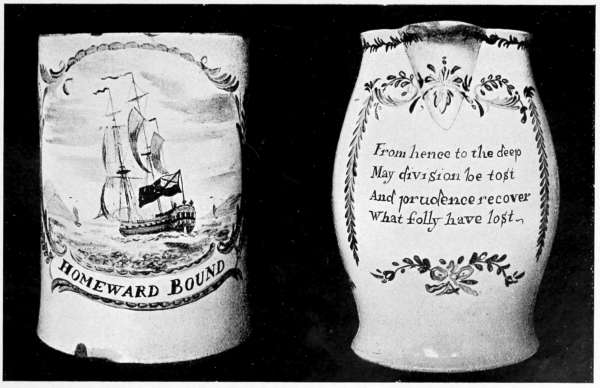
LEEDS CREAM WARE. Seascape, and floral decoration in puce, green, red, &c. Painted by Allen at Lowestoft and refired there. (In the collection of Mr. Merrington Smith, Lowestoft.)
In regard to subjects in colour it may be mentioned that a good many Leeds jugs bear names and dates upon them, from about 1769 to 1786. These enamel colours are green, red, lilac, and buff, and are not dissimilar to those employed at Lowestoft. We illustrate a fine Leeds mug with the characteristic twisted handle (p. 303), having Oriental figure in colour and dated and inscribed. The following curious and gruesome verses appear on it. Inside the mug is a modelled frog, as found in Sunderland examples.
"In marriage are two happy things allowed A wife in wedding-sheets and in a shroud. How can a marriage state be then accurs'd Since the last days are happy as the first."
Then follows "I. C. U. B. YY for me" (I see you be too wise for me). "Samuel Cudworth, 1777."
Leeds Ware decorated at Lowestoft.—There is a connection between Leeds and Lowestoft. It appears that some of the Leeds ware was sent undecorated to Allen, of Lowestoft, who decorated it there and refired it, disposing of it on his own account. The fine Leeds mug having the painted decoration, over-glaze of course, of a vessel, and entitled "Homeward Bound" (illustrated, p. 299), is typical of this work of Allen at its best. He appears to have procured ware from Turner and other Staffordshire potters for decoration and sale by himself. We illustrate (p. 303), a Staffordshire jug painted by Allen, of Lowestoft, representing a local scene, recognisable by the tower in the background. He inscribed it "A Trifle from Lowestoft." This is enamel work over-glaze, the key pattern at the rim is under-glaze and was done in Staffordshire.
Another Leeds jug decorated by Allen is that illustrated (p. 299), bearing the verses:—
"From hence to the deep May division be tost And prudence recovre What folly have lost."
The "have" is a peculiarly Suffolk idiom. The floral scrolls are in the usual low tones of Lowestoft colouring.
Castleford (1790–1820).—This factory, some twelve miles from Leeds, was established about 1790, contemporary with the establishment of the Don Pottery near Doncaster. This Castleford factory, under the proprietor, David Dunderdale, commenced to make cream ware, black basalt, and the usual stoneware teapots with ornaments in relief. The mark employed by this factory, when it was used, is D. D. & Co., Castleford. This is impressed, and is found on various imitative ware, such as clouded tortoiseshell plates in the Whieldon manner. One of the characteristics of Castleford teapots with raised figures is the use of a blue line at the edge and the tops of these vessels depart from the straight lines of Turner and are scalloped, as in the illustration (p. 307) of a Castleford black ware jug and cover, having the impressed mark of the factory.
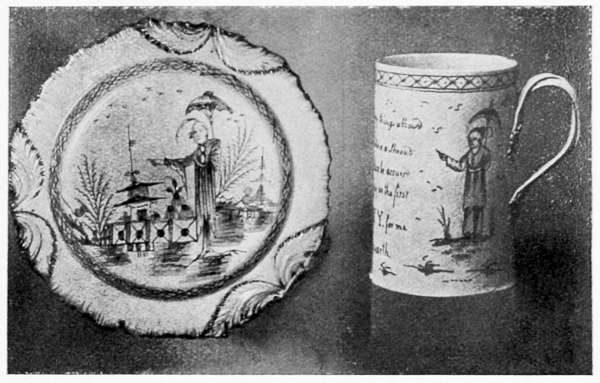
LEEDS CREAM WARE PLATE. Painted with Oriental figures in under-glaze blue. (In the collection of Miss Feilden.) LEEDS CREAM WARE MUG. With Oriental figure and set of verses. (In the collection of Mr. Robert Bruce Wallis.)
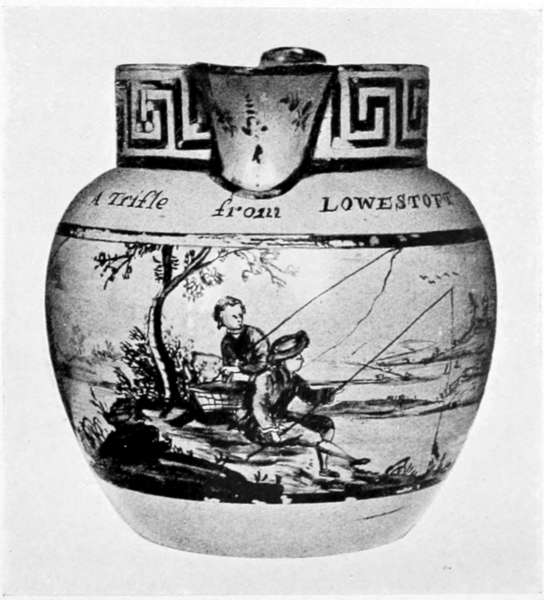
STAFFORDSHIRE JUG. Painted and inscribed by Allen at Lowestoft. (In the collection of Mr. Merrington Smith, Lowestoft.)
Rockingham.—At Swinton, near Rotherham, as early as 1778 a factory was started by Messrs. Thomas Bingley & Co., who began to manufacture cream ware. The Leeds factory, apparently jealous of rivals, as in the case of the Don Pottery, soon had an active interest in this factory. In 1790 it became Greens, Bingley & Co., and the ware then made was blue printed and the highly glazed black pottery associated with Jackfield, of which we shall speak later. At this time a brown glazed earthenware became widely known and appreciated. It was cream ware which had received a heavy lead glaze richly and warmly coloured in brown. From 1796 to 1806 this glaze became extensively used, not only by Swinton or, as it afterwards came to be known, as "Rockingham," taking the name from the Marquis of Rockingham, upon whose estate the works were situated.
This "Rockingham ware," of smooth surface and fine reddish brown colour, was very popular, and a teapot was made, known as the "Cadogan," which was an imitation of the Chinese puzzle teapot. It was made without a lid and was filled by turning it upside down. An opening, very much in the manner of the safety glass inkpot, admitted the tea, and on reversing the vessel it could be poured out. Some of these teapots are marked "Rockingham," or "Brameld," or "Brameld & Co.," and sometimes "Mortlock," a London dealer for whom they were made. In 1806 the Leeds interest passed out of the firm, and the factory remained in the hands of John and William Brameld. In 1826 it assumed the name of the Rockingham Works, and used the crest of the Fitzwilliam family. China was made there from 1820, and the factory obtained considerable reputation and was still in the hands of the Brameld family till the close of the works in 1842. A gorgeous Rockingham china dessert service made for William IV. costing £5,000.
We illustrate a "Cadogan" teapot, with its rich brown glaze, and moulded in the form of a peach, with smaller peaches applied at the top. It is a remarkably un-English design, and it is singular that it became so fashionable.
Jackfield.—We mention Jackfield here, as it has become among collectors quite a generic term for all highly glazed black ware, especially little teapots and cream jugs. It is certain that Elijah Mayer and other Staffordshire potters largely made this ware, and Bingley & Co. (Swinton) among a crowd of others. Jackfield is in Shropshire. Its history as a pot works is as old as any in the country, but it is chiefly in the period between 1760 and 1765, when Maurice Thursfield carried on the little factory, that it became renowned for its black ware. It is quite unlike black basalt. It is red clay, covered with a bright and highly lustrous black glaze. This is ornamented with oil gilding, which in use has almost disappeared. Some of the ware is decorated with raised ornaments of vine leaves. The lids of teapots often have a bird, with outstretched wings. The designs were not original, and are found in salt-glaze and in Whieldon ware, and some of this so-called "Jackfield" ware may be attributed to him.
Newcastle and Sunderland.—On the Tyne, the Wear, and the Tees there were a group of potters working at Gateshead, at Hylton, at Stockton-on-Tees, but mainly at Newcastle and Sunderland. There is nothing exceptionally artistic in any of these productions. Some of these transfer-printed mugs were made by Dixon & Co., of Sunderland, to commemorate the building of the Iron Bridge over the Wear, which was begun in 1793 and completed in 1796.
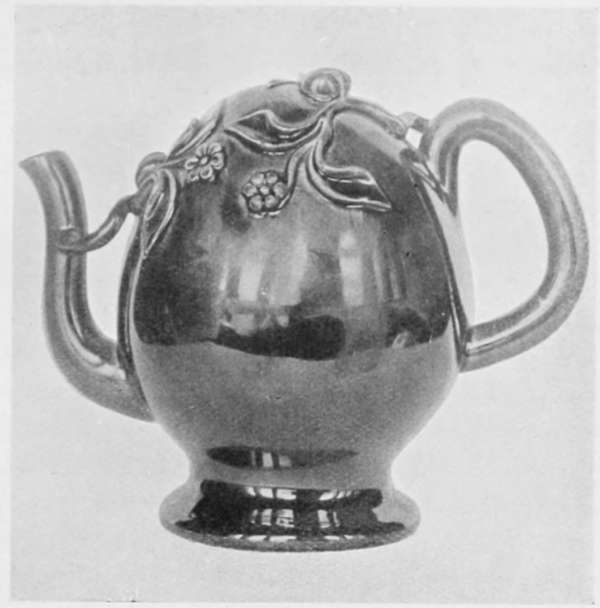
ROCKINGHAM TEAPOT. Known as the "Cadogan" pattern. In form of peach. Having no lid and being filled from bottom. Copied from Chinese rice-spirit pot. (At Victoria and Albert Museum.)
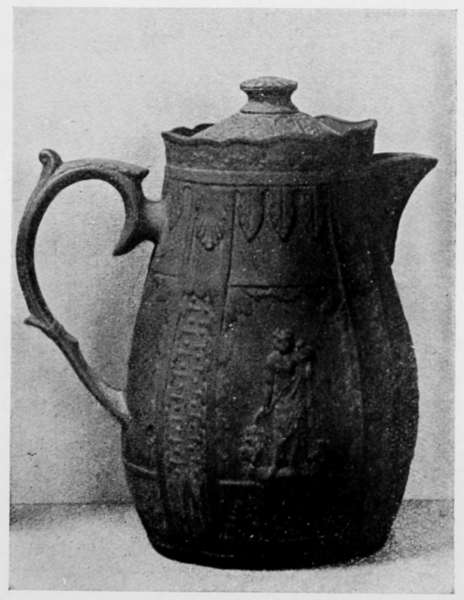
BLACK BASALT JUG. Castleford Pottery. Impressed mark D D & Co. (Height 6 inches.) (In the collection of Mr. F. W. Phillips, Hitchin.)
Among the names found on this ware are impressed: Sewell, or Sewells & Donkin, or Sewells & Co., sometimes with the addition of St. Anthony's. These were made at St. Anthony's, near Newcastle, in date about 1780 to 1790.
Fell, or Fell Newcastle, made at St. Peter's, Newcastle, about 1815.
Scott, or Scott Bros., made ware at Southwick, Sunderland, 1789–1803, when they were succeeded by Moore & Co.
J. Phillips, Hylton Pottery, appears on some Sunderland pieces. This firm was established as early as 1765.
Ford is another name in connection with the South Hylton works about 1800.
Dixon, Austin & Co., sometimes with the addition of Sunderland, is found at the beginning of the nineteenth century.
W. S. & Co., with the word Wedgewood (having an additional "e") was the mark used by William Smith & Co., of Stockton-on-Tees, or even "Wedgwood & Co." Against this firm Messrs. Josiah Wedgwood & Sons, of Etruria, obtained in 1848 an injunction to restrain the use of their name.
Another equally confusing mark to collectors is that of a firm near Pontefract, who marked their ware "Wedgwood & Co." sometimes with the word name of the factory, "Ferrybridge," and sometimes "Tomlinson & Co." Their ware is mainly cream ware of an ordinary type.
In regard to the productions of Newcastle and Sunderland these are best known by the familiar mugs and jugs having a nautical flavour, with ships in black transfer decoration, and never without verses appropriate to the clientèle of sailors, for whom they were made. These mugs and jugs are frequently decorated with pink lustre at the rims and in bands around the body. A feature which associates these northern factories with Leeds is the frequent use of a modelled frog crawling up the inside of the vessel, which was intended as a practical joke on the person who was lifting the jug to his lips. These frog mugs were previously made at Leeds, and the one illustrated (p. 303) has a frog so affixed in the inside.
The ware, as a whole, is rather crude in its potting and slightly inferior to similar Staffordshire ware, but all these northern factories are now closed, and the quaint doggerel, the queer nautical allusions, and the strain of patriotism found on much of this humble earthenware always appeal strongly to the collector.
MARKS USED AT LEEDS, CASTLEFORD, ROCKINGHAM, NEWCASTLE, AND SUNDERLAND.
Leeds. From 1783, Hartley, Greens & Co. 1825–1832, Samuel Wainwright & Co. 1832–1840, Leeds Pottery Co. 1840–1847, Stephen and James Chapel. 1850–1863, Warburton, Britton & Co. 1863–1878, Richard Britton & Sons. After which the works closed.
Don Pottery (at Swinton near Leeds). 1790–1834, at one time in hands of John Green, of Leeds Pottery.

1834–1850, Samuel Barker, and 1851–1882, Samuel Barker & Sons.

Late Marks used by the Barkers during above period:— In addition to the lion with pennon the word Barker was added later, when the mark was printed.
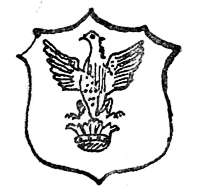
Another printed mark was an eagle and ducal coronet, used when the firm became Samuel Barker & Sons in 1851. But was shortly discontinued, and the lion-printed mark again used.
Castleford (near Leeds), 1790–1820. David Dunderdale & Co., and the impressed mark in margin is found on some of the productions of the Castleford Pottery.

Rockingham. The name of the factory at Swinton, established 1757. Came into the hands of the Bramelds in 1807. Ceased, 1842. The "Cadogan" lower glazed teapots sometimes bear the impressed mark "Mortlock," the London agent for whom some of them were made.

The crest of the Fitzwilliam family was printed as a mark after 1826, and is also found printed on porcelain made at the Rockingham factory.
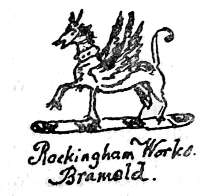
Newcastle-on-Tyne . Fell of Newcastle (about 1815), impressed cream ware mugs and jugs with this mark. Various figures appear underneath, denoting the particular pattern.


Sunderland. Messrs. Sewell, established about 1780, after Sewell & Donkin, used these marks. Other Sunderland makers—Dixon, Austin & Co., Dixon & Co., Scott Brothers & Co. (established 1788), Phillips & Co. (established about 1800), J. Phillips, Hylton (established, 1780), Dawson (about 1810)—impressed their names on ware.


PRICES.
Leeds. £s.d.
Coffee Pot and Cover, with mask under spout, twisted handles, decorated in colours. Sotheby, June, 1906 220
Basket dish, with stand and covers with embossed and open work. Sotheby, June, 1906 220
Jug, painted with flowers, inscribed "John Barnes, Chadlington, 1769." Sotheby, July, 1907 2100
Teapot and cover, painted with portraits of George III. and Queen Charlotte. Sotheby, November, 1908 280
Teapot and cover, printed in red, with lady and gentleman taking tea, with negro servant at side; on reverse, a shepherd and sheep. Sotheby, November, 1908 1100
Jug, printed with transfer medallions of ladies seated in a garden, blue and black bands at rim. Sotheby, November, 1908 1140
Castleford.
Loving cup with handles, painted with fruit and roses, made for David Dunderdale. Escritt & Barrett, April, 1907 3150
Jackfield.
Figure of Diana (height 10 in.). Escritt & Barrett, April 1907 350
Jugs, brown glazed, two. Sotheby, November, 1907 110
Rockingham.
Small "Cadogan" Teapot, marked Brameld, richly gilt upon brown, and another without gilding. Sotheby, June, 1906 1140
Milk jug modelled as cow, brown glaze; Figure of Horse; Jug, brown glaze, with twisted handles, marked Rockingham. Sotheby, June, 1906 250
"Cadogan" Teapot, rich brown glazed; impressed mark. Sotheby, May, 1908 120
Sunderland.
Sugar Basin and Cover and six cups and saucers, painted with figure subjects on yellow ground, marked Sewell. Sotheby. November, 1905 1130
Newcastle.
Frog mugs and jugs vary in price from 10s. to £2, according to the style of decoration.
X TRANSFER-PRINTED WARE
CHAPTER X TRANSFER-PRINTED WARE
Its origin—Liverpool—Its adoption in Staffordshire—What is Transfer-printing?—Over-glaze printing—Under-glaze printing—The Staffordshire Transfer-printers—Other Transfer-printers—Leeds, Swansea, Sunderland, and Newcastle—The Mission of black Transfer-printed Ware—Types of Blue-printed Ware—The Willow Pattern—Table of Marks—Prices.
Before the year 1756, all ware, whether it be porcelain or delft or earthenware, was painted, or, to follow the term used in popular phraseology, it was "hand painted." It is an essentially English art, and something which stands with salt-glaze and with Wedgwood's jasper ware as being famous throughout Europe.
The subject of transfer-printing is surrounded with a certain amount of conjecture in regard to its invention. Quite a dozen persons were credited with having originated it. Mr. William Turner, in his volume, "Transfer Printing on Enamels, Porcelain, and Pottery," published by Messrs. Chapman and Hall, in 1907, has thoroughly investigated the various claims set up for the discovery of transfer-printing and, with no little research extending over a wide area, has for the first time settled the relative position of the various claimants and factories for which this honour is claimed. It is impossible, covering the same ground as Mr. William Turner, to say anything new on transfer-printing, and we must express our indebtedness to him in making use of his original investigations and embodying them in this chapter on transfer-printed ware.
In regard to over-glaze printing, including copper enamels such as Battersea, porcelain such as Worcester, and earthenware such as Liverpool delft—it was at Battersea where enamels were first printed in 1753; Liverpool, with Sadler and Green's invention, comes second with printed delft tiles in 1756. A year after, in 1757, we have Worcester with transfer-printed porcelain. This Worcester printed ware is well known from the early transfer-printed design known as Hancock's "Tea party" and the "King of Prussia" jugs and mugs.
After Worcester all the other porcelain factories followed with transfer-printed ware. There was Derby in 1764, and Caughley in the same year.
It will be seen that, so far as Liverpool is concerned as representative of the earthenware factories (cream ware being printed here to the order of the Staffordshire potters), earthenware over-glaze printing is slightly ahead of the porcelain factories. But in under-glaze printing porcelain stands easily first. Worcester commenced under-glaze printing in the same year (1757) that over-glaze was employed there, and Derby is the second in the field in under-glaze printing in 1764.
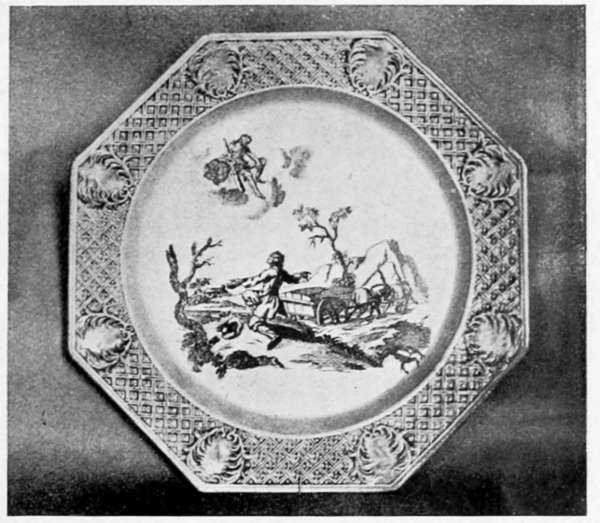
SALT-GLAZED PLATE. Transfer-printed in red. Fable subject—Hercules and the Waggoner.
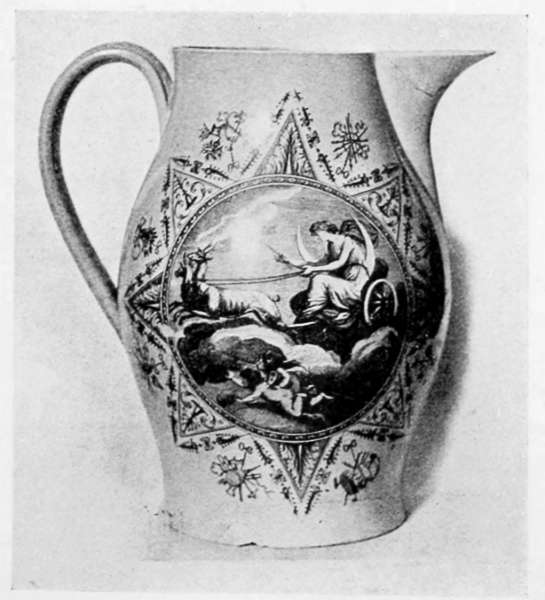
LIVERPOOL TRANSFER-PRINTED JUG. Medallion representing Diana in her Chariot. (Height 9¼ inches.) (In the possession of Mr. S. G. Fenton.)
It has already been shown that Liverpool did the printing on the Staffordshire cream ware for the potters who sent it there to be printed, and the same method was followed by Leeds. But there came a time when it was no longer necessary to ask Liverpool to employ a secret process for the decoration of Staffordshire or Leeds work. The secret known at Worcester, and Derby and Battersea, was not many years a secret. The Staffordshire potters undertook to do their own printing, and every pottery soon learned the new process of transfer-printing, and it was not long before improvements were made and newer forms of printing adopted.
Its adoption in Staffordshire.—Allusion has been made to the awkward form of the square tile decoration of fable subjects at Liverpool as applied to circular plates. But Staffordshire in its adoption of the new process made the transfer fit the object to be decorated. In the illustration of the salt-glaze Staffordshire plate with the black transfer-printed design of "Hercules and the Waggoner" from Æsop's Fables (p. 319), the engraver has departed from the four corners of his circumscribed tile, and we may put this piece down as of Staffordshire printing.
It is often largely a matter of conjecture as to what was printed at Liverpool and what was printed elsewhere (with the exception of Worcester, where the engraving and printing were more delicate).
The Staffordshire jug showing a full-length portrait of His Royal Highness Frederick, Duke of York, having on the reverse the Dragoon in the uniform of the period, tells its own story as regards date. Frederick was the second son of George III. and was born in 1763 and died in 1827. As this portrait represents him as being advanced into manhood and as at that date—say about 1786—the Liverpool printers had been at work twenty years, the transfer-printing may very reasonably be attributed to Staffordshire.
But it is not always easy to fix the date of the printing, and determine whether by that time Staffordshire had embarked on its own transfer-printing in black; of course, blue transfer-printing is later. The difficulty usually arises in connection with black transfer-printed ware. Liverpool was still engaged in printing for Staffordshire potters as well as printing cream ware of its own potting, and Leeds was producing similar transfer-printed over-glaze ware, so that in unmarked pieces there must always be an uncertainty in coming to a definite conclusion. In all probability the jug (illustrated p. 323) and bearing the inscription "Success to Trade" and having a typical eighteenth century rural subject on the reverse entitled "The Faithless Lover," was actually printed by Sadler and Green at Liverpool.
Another finely decorated printed jug is that illustrated (p. 318), the subject representing Diana on crescent moon driving a pair of goats in her chariot. The date of this piece is about 1780 to 1800, and is strongly suggestive of Wedgwood cream ware. It will be observed that the design is identical with that in the Turner jasper vase (illustrated p. 261).
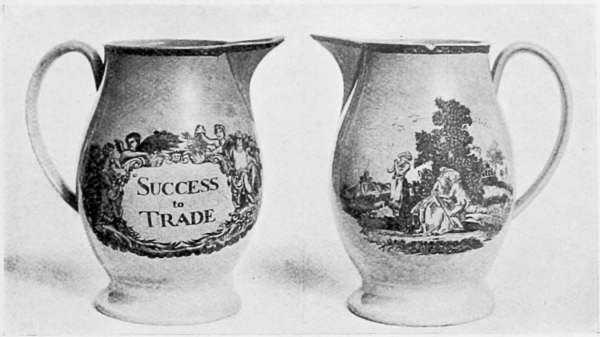
JUG, TRANSFER-PRINTED IN BLACK. Emblems and inscribed "Success to Trade." Subject on reverse—"The Faithless Lover." (Height 7 inches.)
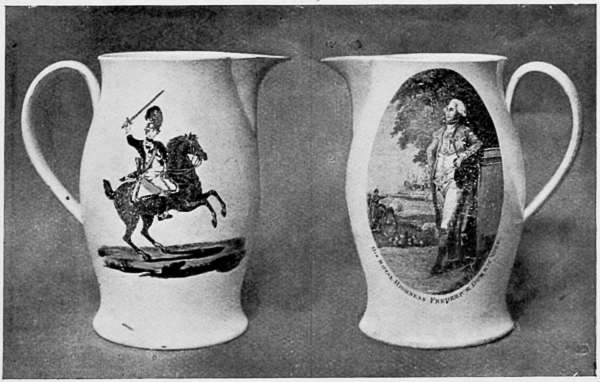
JUG, TRANSFER-PRINTED IN BLACK. Portrait of Duke of York, and mounted dragoon on reverse. (Height 7 inches.) (In the possession of Mr. Hubert Gould.)
What is Transfer-printing?—A piece of pottery may be plain or undecorated, it may be painted, or it may be printed. The process of printing consists of affixing an engraved print from a copper plate and transferring an impression to the pottery to be decorated. It is this latter process which claims our attention in this chapter. When transfer-printing was first used, subjects such as portraits (King of Prussia), costume subjects (series of actors and actresses on Liverpool delft tiles), fancy or pastoral scenes (such as Æsop's Fables, &c.), were produced in black, puce, or reddish brown. These were at first culled from contemporary volumes with engraved copper-plate prints as illustrations. We find Wedgwood in quite early days searching London for suitable prints of views and similar small subjects for decorative purposes. Probably at first the copper plates which had been used in books were bought up by the potters, and did service again for their ware. Later they employed engravers, who no doubt copied or adapted other people's engraved work to suit their purpose, and as the art advanced it gained in originality, and a band of engravers worked for the potters in designing subjects strictly applicable to the limitations in the technique of earthenware.
This process of transfer-printing is roughly as follows. The copper-plate is inked, and a sheet of tough tissue paper, wetted with a mixture of soap, is applied to its surface and printed in a press. The paper is taken off, showing an impression or print, which is carefully laid on the surface of the piece of earthenware to be decorated. The inked design on the paper transfers itself to the earthenware.
Over-glaze Printing.—The difference between over-glaze and under-glaze decoration always seems to puzzle the beginner, but the explanation is simple enough. A piece of pottery is produced by the following steps. The clay is "thrown," that is, it is spun into shape on the potter's wheel, or it may be made in a mould. When in this soft state, say in the form of a basin, it could be crushed by the hand into the shapeless mass of clay whence it sprung. It is next put aside to dry sufficiently to allow handling. It may receive some of its decoration at this stage as it is possible to paint on the more or less damp clay, but as a general rule that is left till the next stage.
It is now placed in the "biscuit" oven and receives the most intense heat, and is here stacked in fireproof saggers or boxes to protect it from the flames, and it is fired for about three days before being taken out in the state known as "biscuit." Wedgwood's jasper ware, black basalt, and all unglazed stoneware stop at this biscuit or unglazed stage.
It is next dipped in liquid glaze and goes again to be fired, this time into the "glost" or glaze oven, which is lower in temperature. After coming from this second oven it is no longer "biscuit" in appearance, but is covered with a skin or coating of glass or glaze, which has amalgamated with the body underneath.
It is now ready for painting with enamel colours or for transfer-printing, which obviously is "over-glaze" decoration.
Lastly, after this decoration has been made, it goes to be fired for a third time, and is put into the enamel or "muffle" kiln, which is the lowest temperature of the three.
In effect, then, the "over-glaze" decoration is on top of everything, and obviously, when the piece is scratched in use, this decoration wears away first. This at once gives the reason for another process, known as under-glaze decoration, where the work receives the protection of the glaze.
As a postscript to this description of the three firings, it may be noted in passing that, in true porcelain, such as Chinese, Dresden, and Bristol (all hard pastes), the body and glaze are fired at one operation, the glaze receiving as high a temperature as the body.
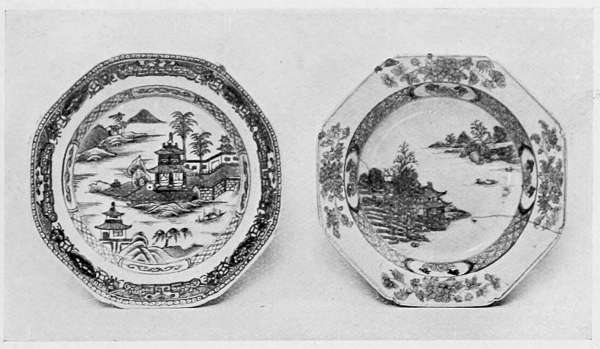
CHINESE BLUE AND WHITE PORCELAIN PLATES. Painted in dark blue under-glaze. Painted in light blue under-glaze. The types from which English potters made their copies. (In the collection of the Author.)
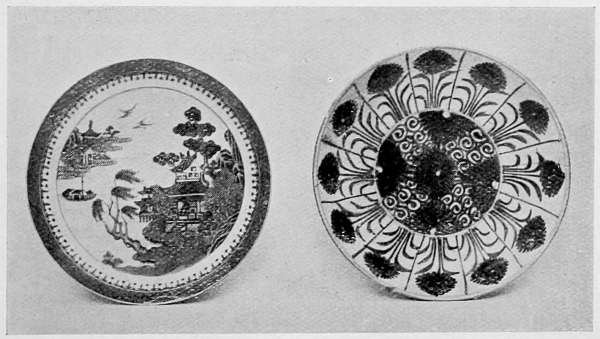
CHINESE BLUE AND WHITE PORCELAIN PLATES. Painted in rich blue under-glaze. The "Willow pattern" and the "Aster pattern." The types from which English potters made their copies. (In the collection of the Author.)
Under-glaze Printing.—This is printing which is transferred to the ware, either porcelain or earthenware, when in its "biscuit" state prior to being dipped in glaze. Blue was the most frequent colour used in under-glaze transfer-printing, as of course it was the earliest colour used in the painted under-glaze decorations at Worcester and Caughley. There are other colours, obtained from metallic compounds, used both on porcelain and earthenware under the glaze, and owing to the temperature required for firing in this manner the range is limited, being usually confined to cobalt blue, green, brown, lilac, black, and a few others. But blue is the chief under-glaze colour to be considered in connection with under-glaze transfer-printing. There was a great demand for deep blue and for a lighter blue, both of which came to the Staffordshire earthenware printers and potters from English porcelain factories such as Caughley, where Thomas Turner, an apprentice at Worcester under Robert Hancock, made in 1780 his famous under-glaze blue "Willow-pattern"; or the idea may have been derived straight from the Chinese blue porcelain under-glaze of Nankin, so much in vogue in middle eighteenth-century days.
Staffordshire Transfer-printers.—It has been shown how the Staffordshire potters at first turned to Liverpool, and readily sought the aid of Sadler and Green in the decoration of their salt-glaze and their cream ware, in order to compete with the porcelain factories with Worcester and Caughley at their head. But trade secrets found their way into Staffordshire. The over-glaze printing as practised by Sadler and Green was soon mastered, and later the under-glaze blue printing was imported by workmen from Caughley.
Among the Staffordshire potters the following are the principal pioneers in regard to transfer-printing in its various developments. William Adams, of Cobridge, in 1775 first introduced transfer-printing into Staffordshire. John Turner, of Lane End (not to be confounded with Thomas Turner, of Caughley) was the first to print under-glaze blue in Staffordshire. Josiah Spode, about 1784, introduced his under-glaze blue "willow pattern," a copy of the Caughley pattern. William Adams, of Greengates, in 1787 brought out his under-glaze blue, which in richness and mellowness has never been surpassed; and Josiah Wedgwood, although he never deserted Liverpool for some of his patterns, had a press at work at Etruria, in 1787; and Thomas Minton, now a master potter at Stoke, formerly an apprentice at Caughley with Thomas Turner, designed the celebrated "Broseley Dragon" pattern tea service for porcelain in 1782 (following the willow pattern, 1780), and produced in the late years of the eighteenth century, about 1793, some fine blue-printed ware at Stoke.
These may be termed the earlier exponents of transfer-printing in Staffordshire, but there were others whose blue-printed ware was of great merit in Staffordshire, and Leeds and Swansea, held no insignificant place.
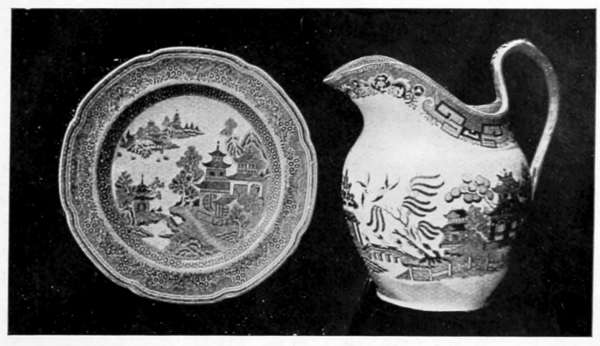
SPODE EARTHENWARE. Transfer-printed under-glaze blue. "Bridge pattern" Plate and "Willow pattern" Jug.
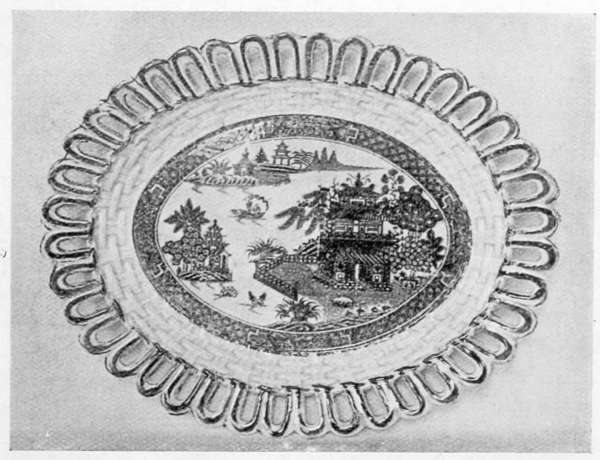
CREAM WARE DISH WITH IMPRESSED MARK "TURNER." With pierced border and band of embossed wickerwork. Centre printed in blue with "Willow pattern." (At Victoria and Albert Museum.)
Other Transfer Printers.—Staffordshire did not long have the monopoly of under-glaze blue-printed ware. Leeds and Swansea both produced similar work, and in both cases there is a strong attachment to Oriental design. Black transfer-printing was also executed at both these factories, and at Swansea some exceptionally fine engraved work was turned out (see illustration of Swansea plate, p. 397). At Sunderland and Newcastle the black transfer-printed mugs and jugs with the Wear Bridge and with nautical subjects became quite the vogue, and in these two factories the jugs and mugs often had a frog modelled in the interior, and pink lustre decoration was used in combination with the transfer design usually at the borders or at the rims.
The Mission of Black-printed Ware.—In the designs and inscriptions of the black transfer-printed ware the Staffordshire potter used his jugs and his mugs as a medium to record events and to ventilate grievances, not in "imperishable verse," but in the fickle body of the clay. This class of ware from 1760 to 1860 stands for a century as typically English in character. It reflects the political, social, and religious events, and in matter-of-fact, humorous, or satirical fashion. The black transfer-printed or earlier period, (though some of this class come down as late as the railway mugs of 1830), may be said to depict events and chronicle popular sentiment in black and white. The blue transfer-printer strove to be decorative, and mainly represented scenery and topography, and much of it was bound down to formal designs of Oriental nature.
At first fable subjects, as on Wedgwood's cream ware, were employed, and it has been seen how the square tile form was discarded by the engraver who made his engraving fit the object to be decorated. This perfect mastery of the technique of transfer-printing is shown very clearly in the old blue Spode service of the "Tower" pattern (illustrated, p. 335). It will be seen how, as the shape of each vessel differed, the engraver has altered his bridge to fit the new circumstances. At one time, on a broad, flat dish, it appears as a wide bridge, and in the circular plate the trees appear at greater height and the viaduct assumes a more circular form. In the jug of the same design the bridge is narrow, as though spanning a deep ravine.