GLOSSARY (continued 2)
Reading edition
Stoneware in point of date is prior to delft in its beginnings, and it had in its subsequent development a longer life than delft. It has already been shown (Chapter II.) how broken is the history of the evolution of the potter's art in England in the Middle Ages. There are great gaps which divide the period of the mediæval tiles from the more or less peasant pottery known as slip ware. It is not until the seventeenth century had well advanced that the manufacture of stoneware took its place as an industry.
To the beginner it should be explained that stoneware is coated with a glaze by means of common salt. It is extremely hard, and has a surface in old and admired specimens like the skin of an orange being pitted with minute depressions, or in finer and thinner ware being like the surface of leather or chicken skin. The ordinary ginger-beer bottle is stoneware, and although serving in a humble capacity, is often found to be perfect in the technique of salt glazing. In old jugs of seventeenth-century manufacture, the mottled colouring and distinctly pleasing surface varying in tone from warm brown to reddish-yellow, is exceptionally attractive to collectors who import a love for technique into their hobby.
Undoubtedly the Bellarmine, or Greybeard, jug was in use in this country for a considerable period. References abound in old plays. Ben Jonson, in his "Bartholomew Fair" (Act IV.), makes Captain Whit say, "He has wrashled so long with the bottle here, that the man with the beard hash almosht streek up hish heelsh," in simulation of the speech of a man who has well drunken. But it must be concluded that this stoneware, or Cologne ware, was largely imported, and was never greatly made in this country until John Dwight, of Fulham, took out his patent in 1671. There are pieces bearing Elizabethan dates and coats of arms, as, for instance, the small brown cruche in the Schreiber Collection at the Victoria and Albert Museum, with the initials "E. R." and the date 1594; and the fine Bellarmine jug in the British Museum, with the arms of Queen Elizabeth, and dated 1594. We illustrate a fine stoneware Bellarmine jug, of the late sixteenth century, having a coat of arms with crown and Tudor roses. The character of some of these jugs differs from continental examples. This may have been due to a desire on the part of the consumer for vessels of that type, but there seems some likelihood that the commoner sorts were made here, and it is conjectured that Fulham was the chief place of their manufacture.
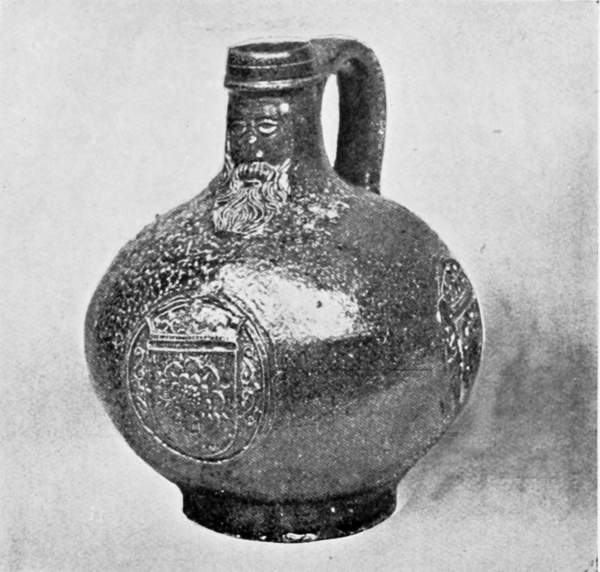
STONEWARE JUG. BELLARMINE OR GREYBEARD. Having arms with Tudor roses. (Late sixteenth century.) (At British Museum.)
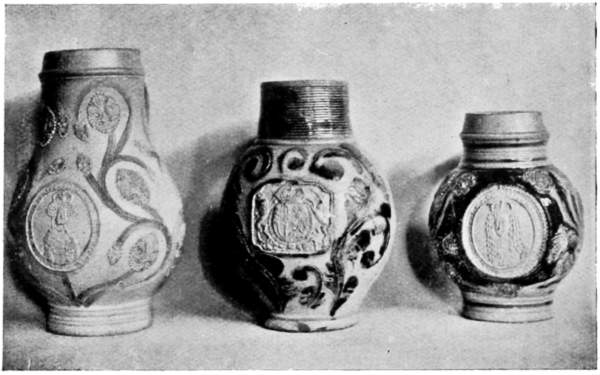
STONEWARE JUGS WITH ROYAL ARMS AND PORTRAIT MEDALLIONS OF WILLIAM AND MARY. The left-hand jug with portrait of Queen Mary is attributed to Dwight. (In the collection of Mr. F. W. Phillips, Hitchin.)
In the group of fine Bellarmine jugs illustrated, the characteristics of the ware are shown. The decorations begin to assume a national feeling, and the jugs differ in form from the continental type. The fine specimen of grey stoneware with the portrait medallion of Queen Mary is attributed to Dwight. The inscription runs "Maria. D. G. Mag. Brit. Franc, et. Hib. Regina." The right hand jug in the group has a raised medallion portrait of William III.
The Bellarmine, or Greybeard or Longbeard, is so called from the head which appears on the neck of the jug, which mask is always referred to in a satirical manner as being the likeness of Cardinal Robert Bellarmin, who rendered himself obnoxious by his opposition to the reformed religion in the Low Countries.
These old examples of foreign stoneware, miscalled
grès de Flandres
, are known to have been made at Raren, at Siegburg, at Grenzhausen, near Coblenz, and later in the seventeenth century they were made at Namur.
The fact that they were imported and not made here appears from the petition of William Simpson, merchant (Lansdowne MSS.) to Queen Elizabeth: "Whereas one Garnet Tyne, a strainger living in Acon, in the parte beyond the seas, being none of her Majestie's subjects, doth buy up all the pottles made at Culloin called Drinkynge Stonepottes & he onlie transporteth them into this realme of England & selleth them; It may please your Majestie to graunt unto the sayd William Simpson full power & only license to provyde, transport, & bring into this realme, the same or such like Drynkynge pots"; the petitioner adds that "no Englishman doth transport any potte into this realme," he also gives a promise "as in him lieth" to attempt to "drawe the making of such like potte into some decayed town within this realme, whereby many a hundred poore men may be set a worke." Thirty years later Letters Patent were granted to Thomas Rous and Abraham Cullyn in 1626 for the sole making "of the stone pottes, stone juggs, & stone bottles, for the terme of fourteene years for a reward for their invention."
Here, then, are sufficient facts to show how largely the importation and manufacture was in foreign hands, and the finer specimens must undoubtedly be assigned to foreign potters.
John Dwight.—In 1671 a patent was taken out by John Dwight for "the mistery of transparent earthenware, commonly knowne by the names of porcelaine or China and Persian ware, as alsoe the misterie of the stoneware vulgarly called Cologne ware." It appears from this patent that he had "invented and sett up at Fulham, several new manufactories." There is no doubt that John Dwight was one of the greatest, if not the greatest of English potters. His magnificent life-size bust in stoneware of Prince Rupert, now in the British Museum, excites the wonder and admiration of modern potters. The technical excellence he displays in his fine stoneware, which is of a grey-white or pale fawn colour, and is salt glazed, is as remarkable a triumph of modelling as it is of skill in potting. To quote Professor Church in regard to Dwight's busts and figures, "They stand absolutely alone in English ceramics. They are the original and serious work of an accomplished modeller. The best of them are instinct with individuality and strength, yet reticent with the reticence of noble sculpture."
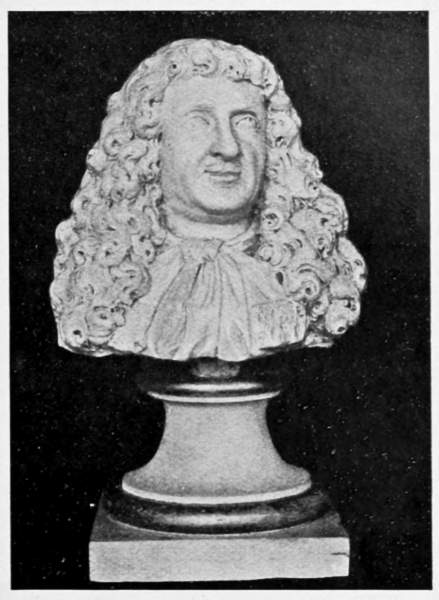
STONEWARE BUST OF JAMES II. By Dwight, of Fulham. (About 1686.) (At Victoria and Albert Museum.)
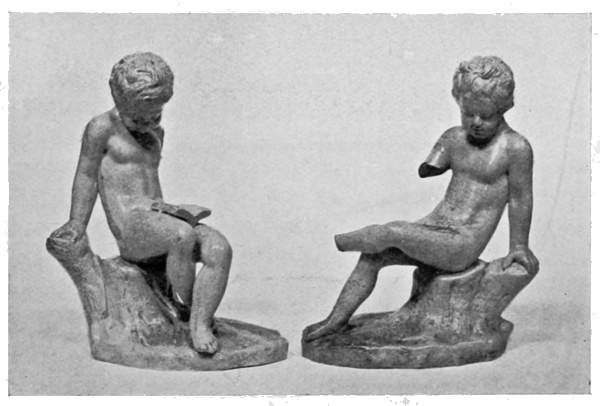
DWIGHT STONEWARE FIGURES. Children reading. (At British Museum.)
The illustration of the bust of James II. (p. 139) is not so well known as the famous Prince Rupert, nor is it of the same superlative power; but it is a fine example of stoneware.
The two figures illustrated of Children Reading have just been added to the national collection, and exhibit the mastery of Dwight over his medium.
There is no doubt that John Dwight is coming into his own. Among the fathers of English pottery there are Dwight and Elers, and Astbury and Whieldon, and Josiah Wedgwood, and the greatest of these is unquestionably Dwight. Dr. Plot, in his "History of Oxfordshire," published in 1677, passes this eulogy upon him: "He has so advanced the Art Plastick, that 'tis dubious whether any man since Prometheus have excelled him, not excepting the famous Damophilus and Gorgasus of Pliny." And yet this Dwight is reported to have destroyed most of his formulæ and many of his papers connected with his inventions in the hope that his descendants would not engage in so unprofitable a business.
It is not known when Dwight was born; 1638 is the conjectured date. He was M.A. and B.C.L. of Christ Church, Oxford, and was secretary to the Bishop of Chester. Between 1671 and 1676 he settled at Fulham. It appears that he had previously established a factory at Oxford with considerable success. He died in 1703, and the pottery was continued by his son Samuel, who died in 1737. The works were carried on by his widow, and subsequently by William White, who married her, and the pottery remained in the hands of the White family until 1862.
Of his portrait busts and statuettes, the Victoria and Albert Museum and the British Museum have about thirteen examples, and there is a fine statuette of Jupiter in the Liverpool Museum. Besides this class of ware, he certainly made stoneware jugs of the Cologne type, and red-ware teapots. He was known to use small raised ornaments on this ware, produced by the use of metal stamps. His vases have marbled decorations, and he was fully aware of the use of pounded flint, which gave his ware a porcellanous character, "a discovery which was not apparently known to the Staffordshire potters until about 1720."[1]
In relation to Dwight and his patents, new light has been thrown upon the originality of the work of the Brothers Elers in their secretly-guarded factory at Bradwell Wood. All earnest students are indebted to Professor Church for his recent researches to establish Dwight's reputation, which go a great way towards dethroning the two Dutch brothers Elers, who have been hitherto regarded as the pioneers of Staffordshire fine pottery.
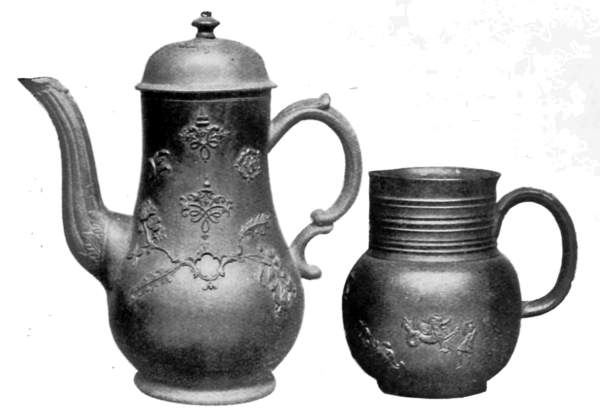
COFFEE POT, ELERS RED UNGLAZED WARE. MUG, RED UNGLAZED WARE, PROBABLY MADE BY ELERS OR DWIGHT. (At British Museum.)
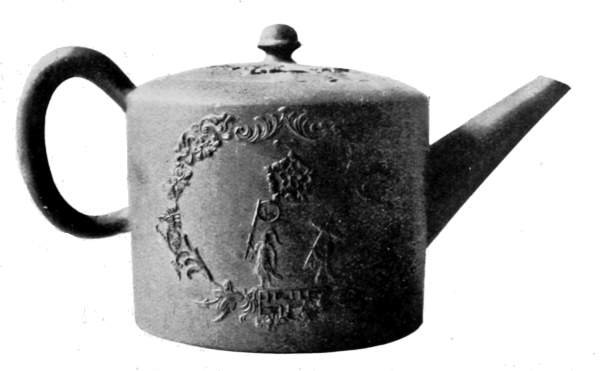
ELERS RED WARE TEAPOT. (In the collection of Mr. F. W. Phillips, Hitchin.)
Elers Ware (1690–1710).—There is a great deal of mystery surrounding the name and fame of the two Dutchmen, John Philip Elers and David Elers. They came to this country as did so many of their countrymen in the latter part of the seventeenth century. Earlier, Dutch refugees had fled hither on account of religious persecution, and later, when William of Orange came over, his court attracted many of his countrymen of distinguished birth. Martin Elers, the father of our two Dutchmen, had been ambassador to several European courts. John Philip his son was "the godson of the Elector of Mentz, after whom he was named, and was held at the baptismal font by Queen Christina of Sweden." [2]
There is no reason to believe that they had any patronage from the court themselves, but their sister was granted a pension of £300 a year by William, and she subsequently became the second wife of Sir William Phipps, founder of the house of Mulgrave, the title of Earl of Mulgrave is now borne by the Marquis of Normanby, whose family name is Phipps.
However aristocratic they were, it is certain that they had considerable practical knowledge in order to embark in business and carry on a pottery.
They prepared the red clay of Bradwell in a far more scientific manner than had any Staffordshire potters prior to that date, and by the lathe they turned forms far thinner than could be done on the wheel. Wherever they had gained their technical skill, they placed for the first time the wares of Staffordshire on the same plane as Böttcher's work of Meissen, or the models of the old Chinese potters.
We have already shown that they engaged some of Dwight's workmen from Fulham, and that they infringed Dwight's patents in respect to the Cologne jugs and red teapots. This does not accord with the fables hitherto industriously repeated in every succeeding volume dealing with china, that the Elers employed imbeciles in their factory, in order that their trade secrets might be jealously guarded. It is true that Twyford and John Astbury learned all that they wanted to know by gaining employment at the Elers pottery at Bradwell, and there is little doubt that in so doing they simulated a stupid indifference as to the new methods of stamping china ornaments by metal stamps and of the lathe work employed on the red teapots.
Both black and red teapots were made by Elers and ornaments in Chinese style added in relief. These ornaments were stamped with a metal die and laid on the vessel, several dies were used for portions of the same teapot. The connecting portions such as the stalks between two sprigs were finished by hand. This red ware was unglazed. As most people are familiar with Wedgwood's black, basaltes ware, it is useful to know that, except in colour, the wares are almost identical in point of external appearance and to the sense of touch. Some of this red tea and coffee ware or "old china," as it was called, is marked with a seal in imitation of Chinese marks. The red teapots of small dimensions sold for ten to twenty-five shillings apiece, and David Elers had a shop in the Poultry in Cheapside, where he sold them.
The Elers left Staffordshire in 1710, so that their pottery lasted only twenty years. In view of the fact that Dwight complained about their manufacture of stoneware jugs and mugs as being subsequent to his, it would seem doubtful if they can still be accredited with the invention of this old ware or with the introduction of salt glaze into England. Undoubtedly this early class of hard red stoneware, almost approaching porcelain in character, will have to be thoroughly reviewed with the object of assigning to Dwight what is his, and to the Elers, and to Aaron, Thomas, and Richard Wedgwood what is theirs, to say nothing of Richard Garner, and of John Morley, of Nottingham, who confessed to copying Dwight's "browne muggs."
The subsequent history of the Elers may be interesting in passing. John Philip is believed to have been in some way connected with the foreign glass works at Chelsea, established by Italian workmen, under the patronage of the Duke of Buckingham, as early as 1676. He afterwards, with the assistance of Lady Barrington, set up as a glass and china merchant in Dublin, and became successful. David Elers remained in London.
John Astbury.—We have seen that the Elers' secret became known in Staffordshire to Twyford, and to John Astbury, and this latter together with his son carried on the same style of manufacture. As a general rule it is held that the ware of the earlier Astbury is not so sharp in its details as was the careful work of the Elers. His ware is of red, fawn, chocolate, and orange colour. His ornaments followed the style of Elers in being stamped, but he made them of Devon or pipe-clay, which has a cruder effect in white upon the darker grounds. He died in 1743. His son Thomas Astbury commenced potting in 1723, and his work is so similar to that of his father, that considerable doubt exists as to which pieces may safely be attributed to the father. It is certain that the son experimented with the bodies of clays until he produced a "cream colour," afterwards improved by Josiah Wedgwood in his renowned cream ware. We illustrate (p. 149) an Astbury teapot in date about 1740, with an orange-coloured glaze body having design in relief in white. The other Astbury ware teapot is of slightly later date, and has a coffee-brown body with white and green floral ornaments in relief. The Porto Bello bowl in the British Museum, of red clay with white stamped ornaments in relief of a group of miniature ships in battle array, made to celebrate the capture of Porto Bello by Admiral Vernon in 1739, is held to be a typical example of the work of the elder Astbury.
As a rule, black or red specimens having the name of Astbury impressed upon them are attributed to Astbury the second. But it must be borne in mind that for want of more exact knowledge, all red ware with stamped ornaments applied in relief and with indications of plain engine turning has been generically termed Elers ware, and it is quite certain that later than Astbury junior's day red ware with wavy lines was made. Similarly the type of ware with white applied ornament in relief has been termed Astbury ware. The elder Astbury, in addition to the stoneware, made crouch ware, a term employed for the earlier forms of the fine delicate stoneware known as salt glazed. The younger Astbury introduced the use of flint into his ware in or about 1723. Collectors should be cautioned not to assign plates and dishes marked Astbury, to Thomas Astbury. They are cream ware, and decorated in blue with Chinese patterns, and belong to a much later period.
Mention should be made of Ralph Shaw, of Burslem, who made brown or chocolate ware dipped in white pipe-clay, which afterwards was worked upon with a tool to display the dark body beneath. There is a jug in the British Museum (Franks Collection) which is thus decorated with birds and foliage. Twyford, the colleague of Astbury the elder, when with the Elers, seems to have applied himself to the use of white decoration, sometimes the red and brown ware is wholly coated inside with pipe-clay, and this is supposed to be his work.
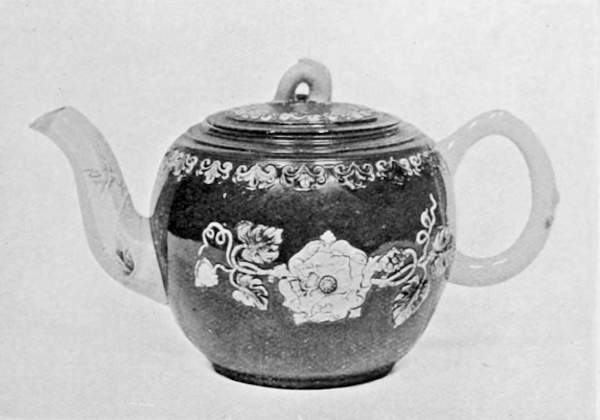
ASTBURY TEAPOT. Orange glazed body, pattern in relief. (About 1740. Height 4 inches.) (At British Museum.)
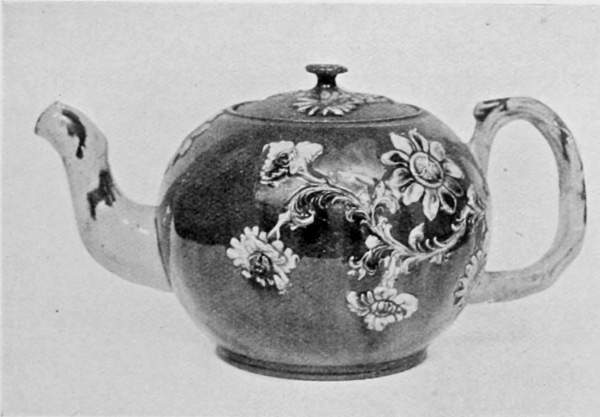
ASTBURY WARE TEAPOT. Coffee brown body, white and green floral ornament in relief. (About 1750.) (At British Museum.)
With the advent of Josiah Wedgwood came the strong classic influence upon his plastic art, and in his various classes of stoneware (dealt with in Chap. VII.) considerable variety was introduced both in design and in colouring. Among the most notable of the contemporaries and successors of Wedgwood who successfully produced high-class stoneware, the following may be mentioned: William Adams, Turner, Elijah Mayer, Neale, Palmer, Birch, Keeling, and Toft, Hollins, Wilson, Spode, Davenport, and Dunderdale of Castleford, and the Leeds Pottery and the Swansea Pottery both made basalt in black ware (see Chap. VIII., The School of Wedgwood).
Fulham Stoneware.—In the eighteenth century Fulham became noticeable for a type of mug similar to that illustrated (p. 153), bearing the initials "W.G." and the date 1725. Another series made at Fulham are the jugs usually marked with the initials "A.R." and "G.R." belonging to the days of Anne and of George I. A great many exist of the fuller-bodied shape, with initials inscribed "G.R." Formerly on museum shelves these were attributed to Fulham, but it is now generally held that this form was imported from the Continent, and belongs to the Grès-de-Flandres class. The true Fulham contemporary form is that which we illustrate (p. 153).
The manufacture of stoneware continued for a century, and in the nineteenth century many fine specimens were being made by various potters, and Messrs. Doulton, of Lambeth, still continue to make stoneware vases and jugs and other vessels of an ornamental character.
Nottingham Stoneware.—John Morley, of Nottingham, was cited in 1693, as one of the persons who infringed Dwight's patent for stoneware. Evidently the same family of potters carried on the business, for in 1726, Charles Morley was a maker of brown stoneware jugs and mugs. There is a brown bowl at the Victoria and Albert Museum bearing this date. The Castle Museum at Nottingham possesses some fine examples of brown stoneware. The dates of jugs and mugs vary from as early as 1700 to the last quarter of the eighteenth century. Nottingham ware is smoother in its surface than old Staffordshire, only slightly showing the orange skin texture so noticeable in the other stoneware. It is rich warm brown, sometimes inclining to red and sometimes to yellow in colour. Bear jugs are a feature of Nottingham stoneware, but they are not peculiar to that pottery, as they were also made in Derbyshire and Staffordshire. The Nottingham stoneware is excellently potted and, of course, is salt glazed, the glaze having a slightly lustrous appearance.
The examples most familiar to collectors belong to the late eighteenth and early nineteenth centuries. The bear jugs may be either of plain surface or may have the rough grained exterior formed by minute particles of clay. They frequently have a collar around the neck, and a chain to which is attached a rattle. A rarer form represents a Russian bear hugging Bonaparte, who wears a big plumed hat. Puzzle jugs with incised ornament, and tall loving-cups of large size, are another noticeable production; many of these are inscribed with names and dates.
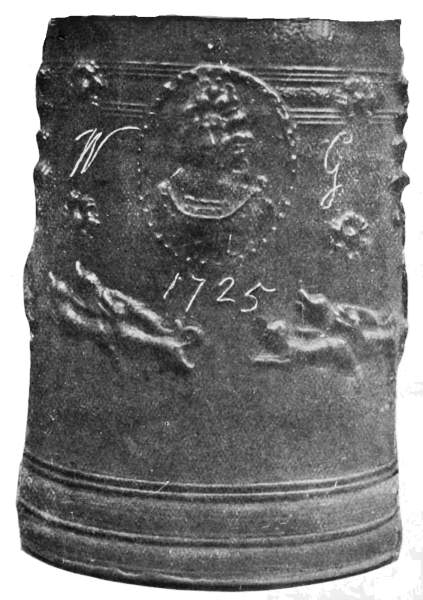
FULHAM STONEWARE MUG. (Dated 1725. Period of George I.) With embossed ornament of dogs, &c., and medallion portraits.
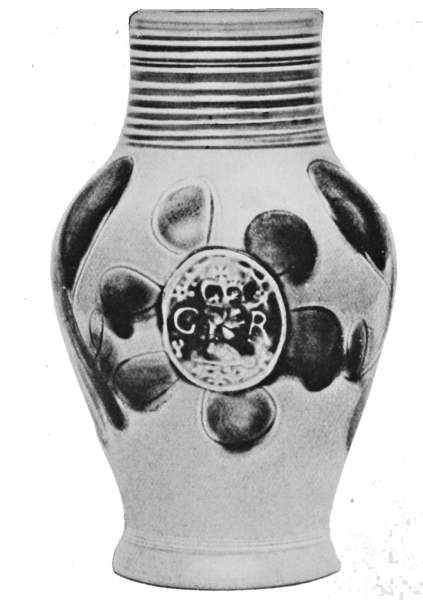
FULHAM STONEWARE JUG. Raised medallion with crown and G.R. (Period of George I.) Incised decoration filled with blue.
STONEWARE—PRICES.
Bellarmines.£s.d.
The prices of this class vary in ordinary examples, plain, or of slight decoration, from 15s. to 1 10 0
Bellarmines with English arms of especial interest are of considerably greater value, though not always of English origin. Exceptional pieces bring exceptional prices.
Dwight.
All specimens of Dwight are extremely rare. It is impossible to say what a Dwight stoneware figure or bust would realise at auction, but certainly a very high figure.
Elers.
Elers teapots, &c., are rare. The smaller lighter coloured teapots of the true Elers ware are worth as many half-sovereigns as the later coarser examples are worth shillings.
Astbury.
A similar difficulty arises in attempting to state prices for Astbury stoneware. Fine examples rarely come into the market.
Fulham.
G. R. jugs ascribed to Fulham may be bought from 15s. to £1 10s., according to condition and decoration. The large jugs and mugs with medallion busts of William and Mary, inscribed and dated, vary in price from £3 to £5 and upwards.
Nottingham.
Bear jugs of coarse type may be procured from £1 10s. to 2 10 0
Tall Loving Cups, inscribed with name and date, vary from £2 to 5 0 0
The Russian Bear model hugging Bonaparte is worth £5 or more.
Nottingham ale jugs, dated and inscribed, have realised £12 under the hammer.
V EARLY STAFFORDSHIRE WARE THOMAS WHIELDON: His Contemporaries and his Successors
CHRONOLOGICAL TABLE. XVIIITH CENTURY.
Anne (1702–1714) 1704Gibraltar taken by Sir George Rooke. Marlborough gained victory of Blenheim.
1711–1714Addison published the Spectator.
George I. (1714–1727) 1715Rebellion in Scotland. The Old Pretender landed at Peterhead.
1715–1719 Pope translated Homer's Iliad into English verse.
1719 Defoe's Robinson Crusoe published.
1721 The South Sea Bubble burst; thousands of families ruined.
George II. (1727–1760) 1742Fielding's Joseph Andrews published.
1748 Richardson's Clarissa Harlowe.
1749 Gray's Elegy in a Country Churchyard.
1750 Fielding's Tom Jones published.
1755 Dr. Johnson's Dictionary published.
1757 Clive laid the foundation of the Indian Empire.
George III. (1760–1820) 1759–67Sterne's Tristram Shandy.
1766 Goldsmith's Vicar of Wakefield.
1768 Sir Joshua Reynolds first president of the Royal Academy.
1775 The American War.
1777 Sheridan's School for Scandal.
1779 Gainsborough at the height of his fame.
1782 The Independence of the United States recognised.
1786 Gillray's caricatures commenced to appear.
1790 Burke's Reflections on the French Revolution.
1791 Burns's Tam O' Shanter.
1792 Thomas Paine's Age of Reason.
1795 War with Holland. Capture of the Cape of Good Hope.
1801 Union of Great Britain and Ireland.
CHAPTER V EARLY STAFFORDSHIRE WARE
THOMAS WHIELDON: HIS CONTEMPORARIES AND HIS SUCCESSORS
The forerunners of Whieldon—The position of Staffordshire Ware—Whieldon as a potter—Early Staffordshire Art—The rivalry with salt glaze—Form versus Colour—The last years of the Eighteenth century—The English spirit—Prices.
"Early Staffordshire" is a generic term used to include much of the unknown ware of the early period between about 1720 to 1760. It is not early enough to go back to the butter-pot days of Charles II. nor to include the school of Toft and his contemporaries, with their quaint native humour. But it is an important period when earthenware was in a transitional stage. It is, in fact, the period when Staffordshire may be regarded as the great nursery of potters in swaddling clothes who came into their majority later with full honours.
The chronological table at the head of this chapter shows the great events that were shaping the destiny of this country, and, in politics, in art, and in letters, it must be admitted that the age of Anne and the first two Georges was prolific enough in incident. It was during the greater portion of the first half of the eighteenth century that English earthenware was finding itself. Attempts at classification nearly always leave the borders overlapping. In trying to gather in our net a band of representative potters with work peculiarly illustrative of this period which was essentially English—as English as Toft—but progressing towards something that should stand as worthy of our art, several great potters, such as the Woods, have escaped, and will be treated separately later. It must be granted that the influence of the Whieldon school was not obliterated even by the great rise of the classic school of design as exemplified by Wedgwood, Turner, and Adams. The strong English robustness and the national insularity of design never wholly died out in the eighteenth century. It was eclipsed by classic frigidities from across the Alps, and it suffered discomfiture from the rococo insipidities from France first naturalised at Chelsea and at Derby. But it lingered in the hearts of the common people like the tunes of some of the old ballads in spite of the fashions of Gluck and of Handel. Thus it comes to pass that, side by side with the Iphigenias, the Andromaches, the Venuses, the Minervas, and the other esoteric personages from among the gods and goddesses of Olympus, with their accompaniment of foreign fauns and satyrs, there were the very English (founded on Gillray and Rowlandson), almost Rabelaisian, grotesques in the army of Toby Jugs and the sporting, rural, nautical, historic, commemorative, and satiric jugs and mugs and figures, with English doggerel and with idiosyncrasies enough to make our earthenware essentially national.
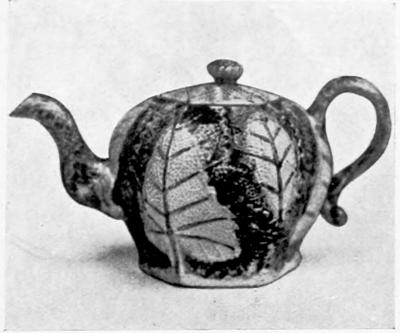
WHIELDON WARE CAULIFLOWER TEAPOT. With vivid green and yellow colouring.
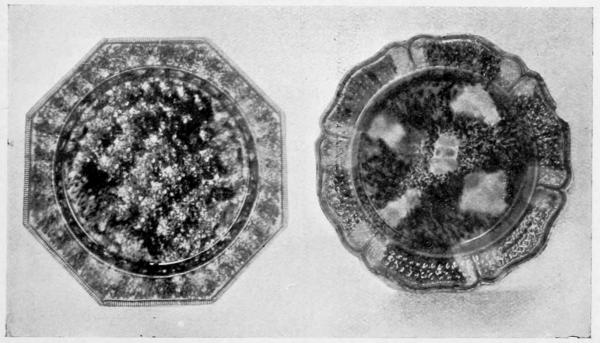
TORTOISESHELL WARE PLATES. Richly glazed, producing clouded and mottled effects. (At Victoria and Albert Museum.)
Unfortunately in the early days it is impossible with any degree of certainty to assign many of these older pieces to any particular potter. The collector can only lament "the iniquity of oblivion blindly scattering her poppy," as Sir Thomas Browne puts it. It is without doubt rightly believed that Thomas Whieldon had a great and lasting influence upon the potters of his generation, but his own actual work has been swallowed up by the covering phrase "Whieldon ware," which, like "Elers ware" and "Astbury ware," has come to mean a good many things, and these are names of types rather than persons.
The forerunners of Whieldon.—It is necessary briefly to recapitulate the events immediately from the commencement of the eighteenth century to the day when Whieldon established his status.
There was a continuous chain of potters working in Staffordshire from the days of the Elers (1690–1710), to the period when Josiah Wedgwood became a master potter on his own account in 1760; he was then thirty years of age.
Wedgwood's own estimate of the Elers is interesting. Speaking of what Elers did for Staffordshire he says, "It is now about eighty years since Mr. Elers came amongst us ... the improvements made (by him) in our manufactory were precisely these—glazing our common clays with salt which produced Pot d'grey or stoneware, and this after they had left the country was improved into white stoneware by using the pipe clay of this neighbourhood and mixing it with flint stones calcin'd and reduced by pounding in to a fine powder."
There is not a word about Dwight in all this; evidently Josiah seems not to have known of the legal action against Elers and one of his own kinsmen amongst others. The invention of flint is an allusion to Thomas Astbury about 1720, but Dwight also knew of this formula as his recorded notes prove.
To continue, "The next improvement by Mr. Elers was the refining of our common red clay by sifting and making it into tea and coffee ware in imitation of the Chinese red porcelain by the casting it in plaster moulds and turning it on the outside upon Lathes, and ornamenting it with the tea branch in relief, in imitation of the Chinese manner of ornamenting the ware. For these improvements—and very great ones they were—we are indebted to the very ingenious Messrs. Elers, and I shall gladly contribute all in my power to honour their memories and transmit to posterity the knowledge of the obligations we owe to them."
This is in respect to a jasper medallion portrait of John Philip Elers. Wedgwood is wrong in one or two particulars. The salt glaze question is open to doubt, and most certainly Elers never used moulds for their ware.
We give this as showing the continuity which existed between Elers and Wedgwood, the latter certainly owed his application of the ornamentation in relief to the method which Elers had introduced into Staffordshire. We do not say invented, because there is always Dwight standing in the background.
To give Elers his due he certainly set Staffordshire talking and wondering, and he unwittingly filled Twyford and Astbury with new ideas which they were not slow to adopt. Astbury comes as the echo which Elers left behind in Staffordshire, a substantial enough echo, for Astbury took his master's ideas and created a ware with white stamped ornaments in relief, to which his own name is given as a generic term. John Astbury the elder died in 1743, and Thomas, his son, commenced potting as early as 1723. And the Astburys rub shoulders with Thomas Whieldon, whose apprentice and sometime partner (1752–1758) was Josiah Wedgwood.
It will thus be seen that Thomas Whieldon (1740–1780) came upon the scene in the history of the Staffordshire potteries when the art was in a somewhat transitional stage. New fields were opening and new ideas developing that were shortly to bring English pottery into line with that on the Continent.
The position of Staffordshire Ware.—It is necessary to show the stage at which English pottery had arrived in order to place Whieldon aright and to show the various impulses which led to the outburst of potting which stirred Staffordshire. Stoneware in crude form or in highly finished foreign style in Cologne ware had been gaining ground since Tudor days. Later the use of delft had won favour and was still in full swing at Lambeth, at Bristol, and at Liverpool when Whieldon commenced potting. It had also become acclimatised in Staffordshire. Toft's and other slip ware was contemporary with delft as a native art. And now, looking forward, we see the oncoming triumph of stoneware, in its finely potted and highly artistic Staffordshire form, which was to overthrow delft and slip ware, and in turn be stamped out by the utilitarian cream ware of Whieldon's apprentice, Josiah Wedgwood, who built up his fortune at Etruria on this domestic ware.
The Whieldon period (1740–1780) was an important one in ceramic events. In 1744 Bow commenced to make porcelain. In 1745 is the earliest dated piece of Chelsea porcelain, the year that the Pretender won the battle of Preston Pans, near Edinburgh, and invaded England, bringing his army as far as Derby. In 1750, Derby made earthenware, and in 1751 commenced to make porcelain, which is the same year in which Worcester commenced a glorious record in the making of porcelain. Longton Hall, Bristol, and Liverpool continued the same story, and transfer-printing was practised at Worcester by Hancock on porcelain, and at Liverpool on delft tiles by Sadler and Green. Lowestoft opened a kiln in 1756. Leeds ware was made in 1760, and, finally, Wedgwood's queen's ware in 1762, and four years before Whieldon gave up his work Wedgwood had invented his jasper ware.
Whieldon as a potter.—Not a great deal is known of Whieldon's personality. He must have commenced in a small way of business as he tramped from place to place with specimens of his wares on his back in pedlar fashion. But he became of considerable importance as he held the office of High Sheriff of Staffordshire in 1786, some six years after he retired from his pottery. Whieldon numbered among his apprentices some young men who afterwards became famous. There was Josiah Wedgwood, who became his partner from 1753 to 1759, Josiah Spode, and William Greatbach, Edge, Heath, Marsh, and there was Aaron Wood, who was employed at Little Fenton for some time. On account of his apprentices having become famous, it has been suggested that he was probably indebted to them for much of his fame. On reflection it may possibly be seen that the opposite conclusion may very well be true, and it is not improbable that Wedgwood and Spode and Greatbach and the others owed a considerable debt to Whieldon for having received a highly technical training at his hands.
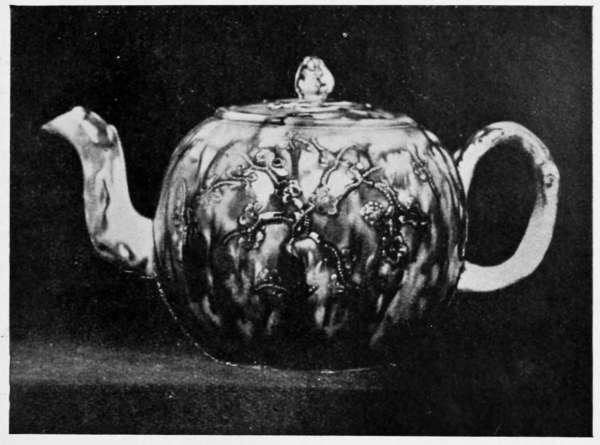
TEAPOT, TORTOISESHELL WARE. Embossed with hawthorn pattern. (At the Royal Scottish Museum, Edinburgh.)
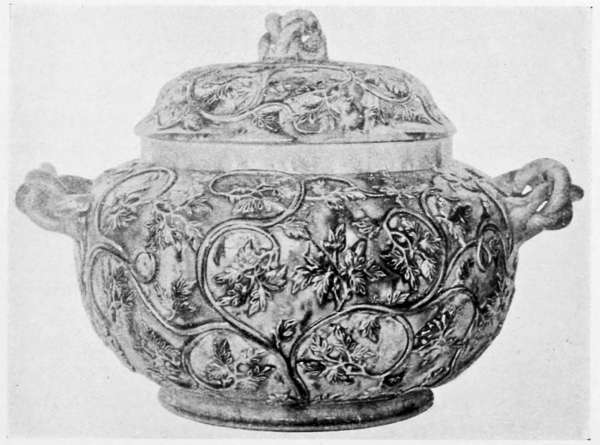
BOWL AND COVER, TORTOISESHELL WARE. Embossed with floral pattern. (At the Victoria and Albert Museum.)
In regard to cream ware, undoubtedly this was in an experimental stage, and Whieldon in common with Astbury made those queer little figures with yellow heads and red or yellow bases, but the tortoiseshell flown colouring apparently denotes some of the specimens made by Whieldon. He made salt glaze, he made tea and coffee pots with the Astbury decorations, but with a strong leaning to the earlier Elers style in his avoidance of too strong contrast between white pipe-clay ornament on a dark body. Whieldon toned his ornaments with touches of his own in green and yellow and brown. His solid agate ware and his tortoiseshell and clouded wares, and his cauliflower ware have become so memorable in the cabinets of collectors that they have won him fame, and he has in consequence been credited with all specimens of these classes of ware. We illustrate (p. 161) an example of the Whieldon Cauliflower Teapot with vivid green and yellow colouring.
Of this early period, the fine group we illustrate (p. 171) with a coffee-pot of glazed red ware, a kaolin of deep cream colour decorated in red, may not unreasonably be attributed to John Astbury, while the little Figure of flown colouring, with red base and brown shoes, may be either by Whieldon or possibly by Thomas Astbury.
The "solid agate" of Whieldon is something far more artistic than the combed ware of earlier days or the very rough attempts at solid agate made by clumsier hands than his own prior to his experiments.
Surface decoration in imitation of agate had been produced by employing two different coloured clays on the surface of a vessel, and when in a wet state combing them to represent the desired veining of the stone to be simulated. "Solid agate" is another process of placing layers of clay of different colours and cutting them in section to show the bands of colour. In Whieldon's hands the layers were thin and the waves and twists, cut off the clay with a wire like cheese is cut, showed in the finished result something more artistic than had ever been attempted before. He made jugs and sauceboats, teapots, teapoys, and other table utensils of this ware, including knife handles. No two pieces are exactly alike, and there is a considerable variety in the breadth of the veining and in the ware, some being intentionally coarser in order to suit the subject potted.
There is no doubt that this ware, standing in a measure in a cul de sac of ceramic art, is highly effective, and Wedgwood used with great skill both the solid agate and the surface colour for his ornamental pieces and vases of classic type, in imitation of granite, Egyptian pebble, jasper, porphyry, and several kinds of agate. His range of colour was more extended than that of Whieldon, but there is little doubt that he gained his first knowledge of the properties and possibilities of this variegated ware when he was with Whieldon.
Casting about for something equally effective with possibly less technical difficulties, Whieldon evolved his celebrated clouded wares. Here he took advantage of the new cream ware as a body, the surface of which is splashed or sponged with various tints in imitation of tortoiseshell, although many of the colours introduced depart from tortoiseshell tones and introduce something fresh and original in earthenware decoration.
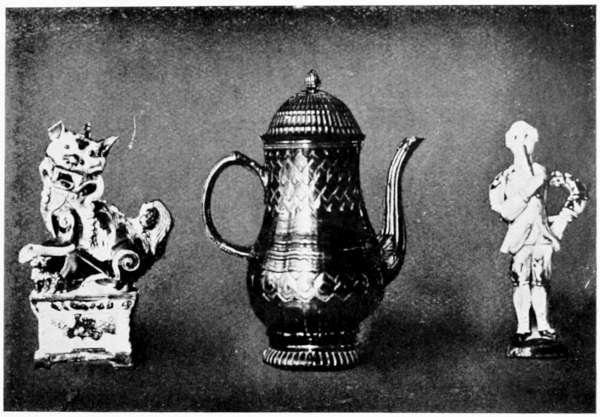
Group of Astbury Ware. KYLIN. Chiefly red and deep cream colour. COFFEE POT. Glazed red ware. FIGURE. Flown colouring, red base and brown shoes. (In the collection of Col. and Mrs. Dickson.)
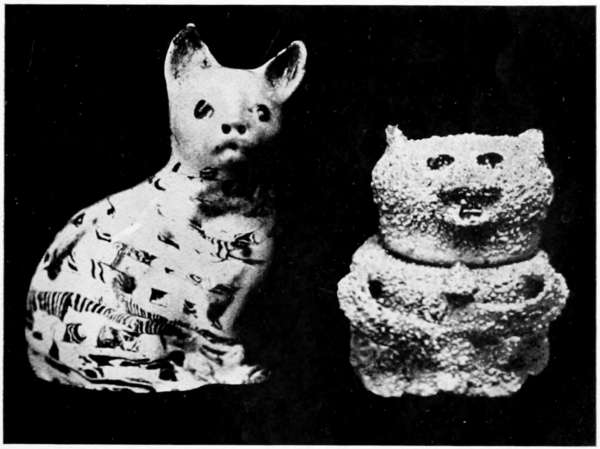
AGATE CAT. (4 inches high.) Grey, with brown solid marbling, and splashed with blue on body and ears. SALT-GLAZED BEAR JUG. (Height 3⅛ inches.) (In the collection of Mr. Robert Bruce Wallis.)
There is the patent taken out by Redrich and Jones, Staffordshire potters in 1724, for "staining, veining, spotting, clouding, or damasking earthenware, to give it the appearance of various kinds of marble, porphyry, and rich stones, as well as tortoiseshell." And Ralph Wood, of Burslem, made variegated ware of a particular kind which may well be termed "tesselated," as small pieces of tinted clay were affixed or inlaid on the surface of vessels to be decorated, and subsequently glazed. This mosaic work in imitation of granite was employed also at Leeds.
To return to Whieldon. There is no doubt that he found this variegated ware in a somewhat inchoate state in regard to technique, and the more scientific exactitude which he employed has gained for his wares their fame. We illustrate (p. 167) two fine examples of tortoiseshell ware, a Teapot embossed with hawthorn pattern design, and a finely decorated Bowl and Cover having a running floral pattern in relief.
The many coloured dessert plates, sometimes of octagonal shape, made by Whieldon in this later mottled manner, in which the surface only is decorated, are well known to collectors. In Whieldon's own examples the potting is more perfect than in those of other potters. His plates are to be recognised not only by their colour, but in the very subtle way he has handled it. The deft touch of blue or yellow or green, has in other hands become a patch of obvious crudity, striking a discordant note at once. The deep grey octagonal plates by him are loved by connoisseurs as exhibiting his subtlety at its best. We illustrate two examples of this class of Whieldon tortoiseshell plates with rich brown colouring flecked with green and yellow (see p. 161).
The mechanical mottling by his imitators, seemingly dabbed on in spots by a sponge, should not be easy to distinguish after having seen one of his best examples. In regard to the potting, Whieldon ware plates have a flat broad rim, which almost invariably has a border of applied strips laid crosswise.
But it must not be forgotten that, when once the fashion for "Whieldon ware" became general, other potteries came into line. At Liverpool this class of mottled and clouded ware was made, and also at the Castleford pottery, near Leeds, and consequently many unmarked examples may be attributed to these potteries. Some of the Castleford tortoiseshell plates are impressed "D.D. & Co."
Early Staffordshire Art.—Among the earlier figures of the Astbury pottery the elder Astbury worked from 1736 to 1743, and his son continued his traditions later. There are a number of quadrupeds and birds which are assigned by collectors to the elder Astbury, which are, although crude, extremely interesting as showing the experiments in coloured clays and in lead glazing. Agate figures of cats of intermingled clays, and diminutive figures of men, some six inches in height, with splashed or clouded decoration, all come into this indeterminate period. The figure in the group (p. 171) already referred to is a case in point.
In the illustration of a fine specimen of an agate cat, in height only 4 inches, the body colour is light grey with dark brown solid marbling, and the front and ears are splashed with blue. Another miniature animal figure belonging to this period is the salt-glaze jug in form of a bear, only 3⅛ inches high (see illustration, p. 171).
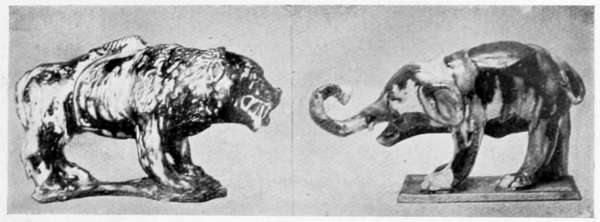
WHIELDON TORTOISESHELL ANIMAL. (In the collection of Col. and Mrs. Dickson.) SPLASHED CREAM WARE ELEPHANT. (Staffordshire, about 1750. Height 3¾ inches.) (At British Museum.)
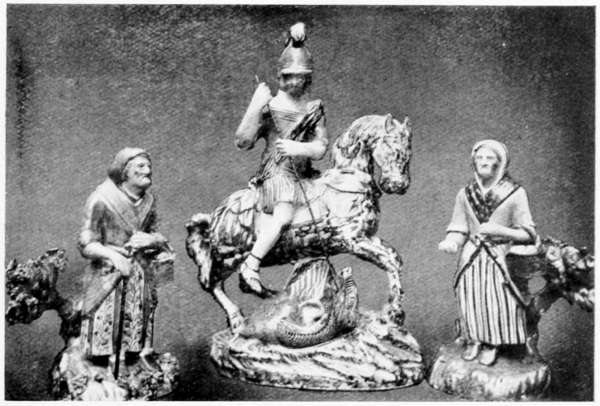
Whieldon Group. ST. GEORGE AND THE DRAGON. Knight in green and cream; horse and base tortoiseshell. EARLY STAFFORDSHIRE FIGURES. Old Women Hucksters. (In the collection of Mr. James Davies, Chester.)
We illustrate two animals, one of the tortoiseshell variety, a beast of formidable appearance and having considerable power in the modelling and strongly suggestive of the jaguar, but it must be remembered that beasts as depicted in contemporary books have an inclination towards heraldic monsters such as "never were on land or sea." The splashed cream ware elephant, only 3¾ inches in height, is fairly well modelled. But these, in common with the many diminutive figures of a like nature, belong to a period when Staffordshire was endeavouring to found an English school of potters, blindly groping along in almost untutored fashion—lame in design and feeble in inventiveness. From out of this chaos it seems impossible that there should arise soul enough to set the fashion later—nearly fifty years later—to the continent of Europe, and make English earthenware the formidable rival in point of cheapness, and often in point of beauty, to anything produced on the Continent. But the earthenware of Staffordshire was able to teach new points in technique concerning body and glaze to the continental potter.
In the illustration showing the group of St. George and the Dragon it will be seen that the modelling begins to assume a more pretentious character. The prevailing colours of the knight are green and cream, the horse and the base of the group are of the familiar tortoiseshell colouring. Beside this St. George are two early Staffordshire figures representing two old women as hucksters. Here the feeling is instinctively English, as national as are the Dutch beggars of the seventeenth-century Dutch etchers. Pity it is that this class of figure, recording national and local types, did not develop on uninterrupted lines. It is true, and of these we shall speak later, that the family of Wood in their types carried on the tradition, but the unfortunate classic influence monopolised the talents of the best modellers.
We illustrate two fine examples of Toby Jugs belonging to the Whieldon period. There is a strong family likeness between the two. The left-hand one is richly glazed and mottled in tortoiseshell markings. The other has the fine translucent colouring and glazing so noticeably prominent in this school. They are both remarkably good specimens of the Whieldon manner, and of unusual interest, as they represent the Toby jug in its earliest form.
The rivalry with Salt-glaze.—This "Whieldon ware" (of course it must not be forgotten that Whieldon made salt-glaze too) was contemporaneous with undecorated salt-glaze ware, which at its best exhibited in no small degree a complete knowledge of the strength and beauty of form unaided by colour. But in this school of Whieldon there is a distinct appeal to colour as a leading feature of the ware as opposed to form. There is a fine artistic blending of the colours and the variation of the glazes which palpitate with life and give extraordinary power to pieces possessed of the "Whieldon" touch. Not only on flat surfaces such as the well-known octagonal plates, but in figures and groups such as we have illustrated, these colour effects were employed with considerable dexterity. So that, in the contemplation of black-and-white illustrations of "Whieldon ware," everything is lost which gave the beauty and richness and mellowness which have an irresistible charm to those collectors who confine themselves to this early school of colourists.
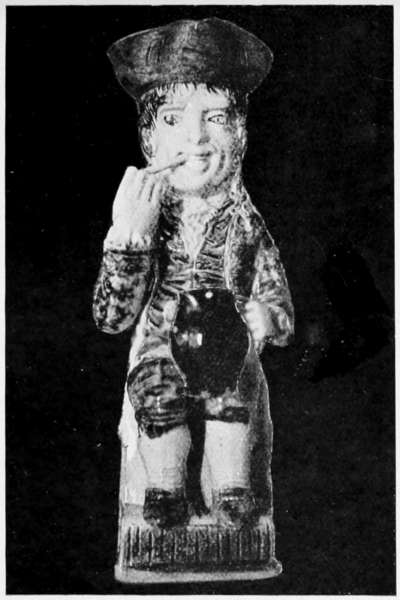
WHIELDON TOBY JUG. Richly mottled and glazed. (In the collection of Col. and Mrs. Dickson.)
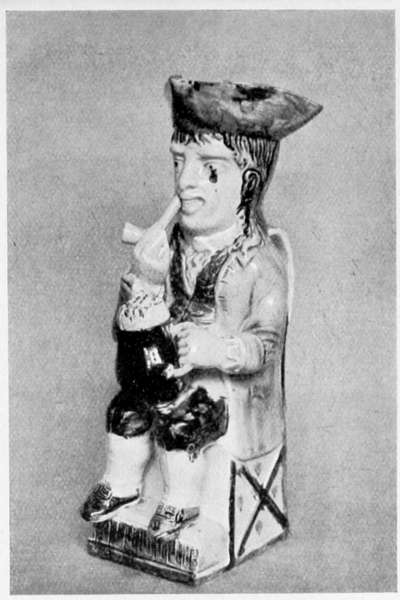
WHIELDON TOBY JUG. Fine translucent colouring and glazing. (In the collection of Mr. A. H. Baldwin.)
Form versus Colour.—The salt-glaze potters, when they left their ideals of form and essayed to become colourists as well, made this attempt chiefly for two reasons.
(1) They had a very laudable desire to emulate the coloured porcelain made at Worcester, Bow, Chelsea, and Derby, which had become a serious competitor in their markets.
(2) They recognised a certain weakness in their ware in regard to its inapplicability to figures and groups. Unless the modelling is of the highest order the salt-glaze figures are insipid.
With regard to enamelled salt-glaze in general this is dealt with in another chapter, but it may here be remarked as touching the second point—the salt-glaze figure—that the salt-glaze potter brought himself directly in comparison with the figures and groups of earthenware of the later Whieldon school. Realising that if he must stand at all as a figure potter his modelling must be superlative, we find the salt-glaze figures, which are mainly small in size, taken direct from the antique or from porcelain models. But feeling the lack of colour he added touches here and there by applying reliefs of different coloured clays to heighten the effect. The salt-glaze potter rarely enamelled his figures in colours. In the illustration of a salt-glazed figure (p. 351) there are slight touches of blue.
So that in the contest between salt-glaze (the pre-eminent art of the Staffordshire potter in early eighteenth-century days) and its two great rivals, English porcelain and Staffordshire coloured earthenware, in other words—Form versus Colour—the first fall it received was at the hands of "Whieldon ware." The coloured and exquisitely clouded tortoiseshell plate, with its fine gradations of tone throbbing with colour, more than holds its own with the salt-glaze plate, even although its clear-cut arabesque designs and intricate patterns exhibit the excellence of its potting.
The Last Years of the Eighteenth Century.—Enough has been said to show that this typically English school had firmly established itself in Staffordshire. Whieldon, Dr. Thomas Wedgwood, Aaron Wood (block cutter to Whieldon), Josiah Spode the first, Greatbach, Enoch Booth, and many others, firmly adhered to their love of colour and their desire to see cream ware triumphant. The struggle for the supremacy of earthenware over English porcelain was still waging. And Wedgwood, with his marvellous invention of jasper ware and his equally stupendous innovation in the introduction of severe classic ornament, did not impose his style on all Staffordshire. We shall see in a later chapter how he had a crowd of followers and imitators, but at the same time many, very many, productions were potted contemporary with him that owed nothing in design to him, and on the face of them bear no traces of the classic influence.
It is this overlapping period, during which so many examples are unmarked, which is so puzzling to the collector. "Old Staffordshire," they certainly are, "Early Staffordshire" they may not be, but they exhibit a national and original feeling which it is impossible not to recognise and value.
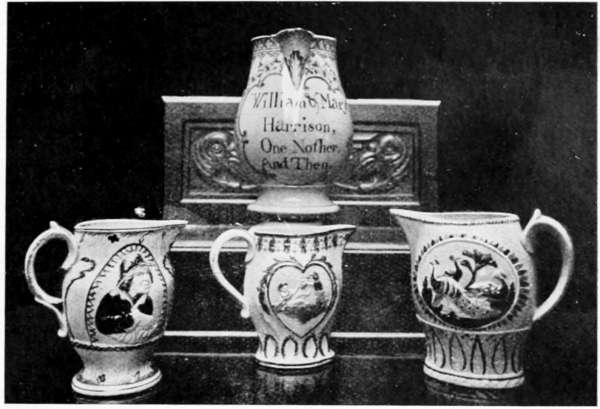
GROUP OF EARLY STAFFORDSHIRE JUGS. 1. Jug. Pencilled floral decoration in blue. Inscribed "William and Mary Harrison. One Nother and Then." 2. Jug. Panel with Miser each side in relief. 3. Jug. Heart-shaped panel in low relief, Children at Play. 4. Jug. Panels of Peacocks in relief.
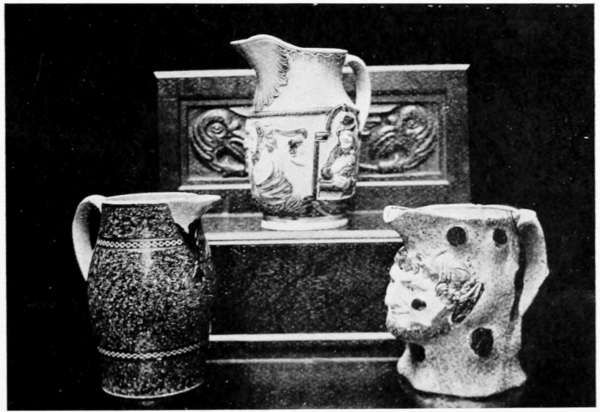
GROUP OF EARLY STAFFORDSHIRE JUGS. 1. Finely mottled granite jug. 2. Whieldon jug. Figures in coloured relief. 3. Jug. Moulded in form of satyr's head. (The above groups are in the collection of Mr. James Davies, Chester.)
We illustrate two groups of jugs which belong to this period. In the top jug of the upper group, which is pencilled with blue floral decoration, the spout betrays a trace of Worcester and a tinge of classicism in the acanthus leaf ornamentation at its base. But the inscription drops at once into the homely vernacular, "William and Mary Harrison One Nother and Then." The quaint phonetic spelling tells its own story of the mission of the ale-house jug, with its invitation to another burst of hospitality.
The three jugs below are of the same species. The handles vary slightly, showing the inclination to adopt silver models. The left-hand one has a panel with figure of Miser in relief each side. The middle jug, with the heart-shaped panel, is decorated in relief with group of Children at play. Such subjects had not appeared on jugs before Wedgwood's day, but the idea might easily have been derived from contemporary prints of the pretty school of Bartolozzi and Angelica Kauffman. The right-hand jug, with its Peacocks in relief, is evidently derived from the exotic birds of Worcester.
In the other group of jugs, the uppermost betrays in the spout and neck distinct traces of its indebtedness to classic forms. It is translucent green in colour, and with coloured figures in high relief. At the front is Shakespeare, with figures of Miser and Spendthrift each side. Between these (one is just visible in illustration) are classic medallions. This is an incongruous style of decoration, and shows how little the Staffordshire potter who made it understood the meaning of ornament. He realised that the classic style was becoming popular, and so he half hesitatingly affixed two cameos to his otherwise harmonious production. The granite-ware jug, finely mottled, with two black-and-white bands as ornament round body, is the newer development of the early variegated ware. The right-hand jug is, in its gnarled and bulgy protuberances, known as the crabstock variety, the moulding, in the form of satyr's head crowned with vines, is an addition and is extraneous to the usual crabstock form. Obviously this is a welding together of the English and classic grotesque, and the combination is not too harmonious.
The early Staffordshire potters, apart from the splashed and variegated ware associated with Whieldon, made a variety of ware in pre-Wedgwood days and in the late eighteenth century. Obviously such a jug as that illustrated (p. 189) is an Oriental design taken straight from the contemporary English porcelain, or even from the actual Chinese original. But the Staffordshire potter was conservative in his shapes. Similarly, such jugs as that illustrated (p. 189) with the rustic design in crude painting, or seemingly in parts applied with a sponge, must have been general in the latter half of the eighteenth century. The scene is suggestive of Herrick and maypoles and haywains and rustic junketings, and such early cream-ware cider-mugs and ale-jugs are not uncommon. The Mug (illustrated p. 189) shows distinctive qualities. It is by Enoch Wood. It is decorated with translucent bands at top and base, and ornamented with a diaper-pattern stamped and coloured brown, with alternate lines of grey. These jugs and mugs are here illustrated to impress upon the reader the fact that in the Whieldon period (1740–1780) other forms than variegated ware were being made, and much unidentified early Staffordshire ware belongs to the later years of the eighteenth century.
The English spirit.—These forms—and the field is a great one for detailed study—were growing up in spite of foreign and un-English fashions, and long after Wedgwood's day they existed. It seems as though it was a dogged and obstinate attempt on the part of the potter to ignore classic models, and produce something "understanded of the people." Obviously such ware did not rise to elaborate ornamental vases, but confined itself to mugs and jugs and useful articles in common use. So that, in spite of the enormous influence of Wedgwood, both in technique, but more especially in decoration, upon his contemporaries and his successors, it would seem that there was always an undercurrent of pottery which, even if crude, was extremely national. It appealed to no cosmopolitan clientèle, and the potters who made it were not important enough to issue price lists in three or four languages. Their message—as conveyed by their quaint inscriptions, "One Nother and Then," "I drink to you with all my hart, Mery met and mery part," and a host of other naïve sentiments—comes direct from the heart of the potter to his friend and neighbour who bought his wares. In a word, we may say that much that is native, much that is racy of the soil, in the long line of queer Staffordshire figures of animals and birds and of homely individuals, grotesque in their diminutive personality, owe direct kinship to Whieldon and the pre-Wedgwood school of potters, forgetful of the cold classic day, and, in the words of William Blake, snug by the glad sunshine of "the Alehouse so healthy and pleasant and warm."
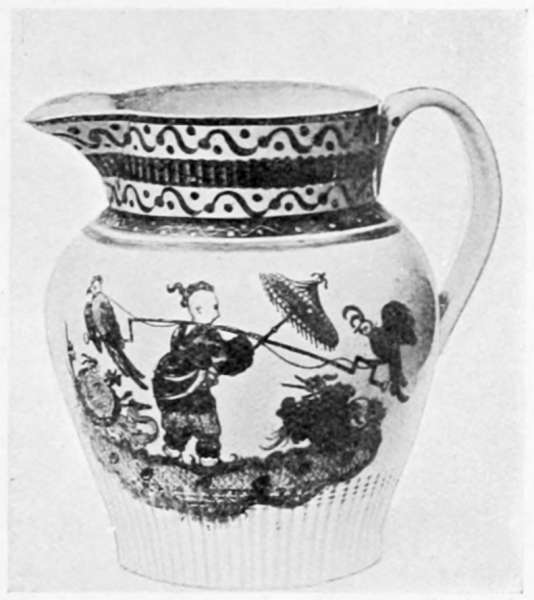
CREAM WARE JUG. Painted decorations in under-glaze colours. Typical example of Oriental influence on earthenware. (In the possession of Mr. W. L. Yeulett.)
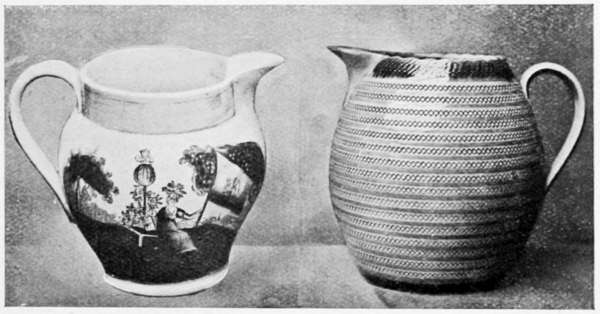
STAFFORDSHIRE CREAM WARE JUG. Crudely painted in colours with English subject. Typical of earthenware of latter part of eighteenth century. (In the collection of Mrs. M. M. Fairbairn. BARREL-SHAPED MUG BY ENOCH WOOD. Decorated with translucent green at top and base. Diaper pattern stamped and coloured brown, and alternate lines of grey. (In the collection of Mr. Robert Bruce Wallis.
PRICES—EARLY STAFFORDSHIRE WARE.
Whieldon. £ s.d.
Teapoy, square, cream coloured, splashed with green, having female embossed figures, and inscribed "Abraham Randell, Alice Randell 1779," 5¼ in. high. Bond, Ipswich, April, 1906. 7 10 0
Plates, pair, foliage in blue on mottled ground, inscribed "LBC 1739." Christie, June, 1906 14 3 6
Teapot, agate ware, modelled with shells. Christie, June, 1906 12 1 6
Figures of musicians (three). Christie, November, 1906 13 2 6
Plaque. Portrait of Sarah Malcolm Saunders, executed in 1733 (very rare), taken from picture by Hogarth. Sotheby, November, 1906 2 10 0
Teapot and cover and milk ewer and cover, mottled. Puttick & Simpson, November, 1906 4 4 0
Figure of "Hope," with splashed and mottled base. Sotheby, February, 1907 1 15 0
Toy Teapot and cover, with vine-leaves and grapes in relief, decorated in rich translucent colours. Sotheby, February, 1907 2 18 0
Teapot and cover, agate ware, modelled with shells. Christie, April, 1907 5 15 6
Teapot, with roses in colours on blue ground, and another with rosebuds and strawberries on pink ground. Christie, April, 1907 27 6 0
Teapot, teacup, and two saucers, with flowers in colours in Chinese style. Christie, April, 1907 11 0 6
Group of two birds in tree, translucent colours. Sotheby, July, 1907 2 18 0
Teapot and cover, with peasant figures in colours. Christie, July, 1907 13 13 0
Figure of Stag at rest, mottled brown and white, on green pedestal (10½ in. high). Christie, November, 1907 10 10 0
Group of Lovers, pair, with birdcage, lamb, and dog (10 in. and 11 in. high). Christie, January, 1908 22 1 0
St. George and Dragon figure (11 in. high), and group nearly similar. Christie, January, 1908 10 10 6
Figures, pair, Peasant Boy and Girl, emblematic of Autumn and Winter, on octagonal plinths (7¼ in. high), and a Figure of Man with Bagpipes (8¼ in. high). Christie, January, 1908 13 13 0
"King David" Figure (12½ in. high), and "Neptune" (11½ in. high), on square pedestals, with medallions in relief. Christie, January, 1908 14 3 6
Cauliflower-pattern Teapot, cream-jug, and canister. Christie, February, 1908 11 0 6
Teapot and cover, solid agate ware, very large size. Sotheby, May, 1908 10 0 0
Teapot and cover, formed of leaves, with rabbit on cover. Sotheby, May, 1908 4 4 0
Astbury Ware.
Teapot and cover, dark buff body, decorated in relief with grapes, tendrils, and leaves in cream colour. Sotheby, November, 1907 3 10 0
Teapot and cover, brown hexagonal shape, with panels of Chinese subject in relief, lid surmounted by rabbit. Sotheby, November, 1907 3 15 0
Astbury and early Whieldon figures, which are of small size as a rule, range in price from £4 to £10. Exceptional examples command much higher prices.
VI SALT-GLAZED WARE— STAFFORDSHIRE
CHAPTER VI SALT-GLAZED WARE—STAFFORDSHIRE
The originality of English Salt-glazed Ware—What is Salt glaze?—Early Salt-glaze—The classes of Salt-glaze—Its decadence and its extinction—Prices of Salt-glazed Ware.
The fine salt-glazed stoneware of Staffordshire which was made during the greater part of the eighteenth century is something in art of which the English potter may very justly be proud. It is remotely derived from the fine Flemish and Rhenish decorated stoneware, but the connection ends with the common qualities of being glazed with salt and of being extremely hard, almost so hard as to resist a file. But in the Staffordshire salt-glazed ware the body became almost of a porcelain-like quality. It was able to be made as thin as stamped silver, and in the thinnest portions of the pieces it is translucent like porcelain. Indeed, since the days of Elers (whom Dwight termed a silversmith) earthenware, or rather stoneware, took some of its details in form and in ornament from the worker in silver.
The applied ornament of Elers stamped with a brass die suggests the metal worker, and, with the models of the school of Astbury before them, Staffordshire potters followed the same methods. It is not astonishing to find the moulded designs with their intricate patterns in the newer school of potters of salt-glaze ware—which in its best period (1720–1740) relied solely on form and not on colour, being a dull, creamy white—emulating the fine work of the silversmith. It was only a natural striving in the new generation of potters of the Whieldon school, with fresh inventions in clays and glazes and moulds, to cast about them for better and worthier ideals than Toft had, and fresher models than stoneware Bellarmines which had been in circulation in the country since Tudor days.
Silver models provided many a fine shape for Wedgwood, his cream ware and his basalt teapots are bodily taken from Sheffield. But imitativeness has always been the curse of English potters. Wedgwood copied in jasper ware the cameo work of the classic world, and the whole of Staffordshire to a man commenced to pot on similar lines. Through the last decades of the eighteenth century, and well into the nineteenth, thousands of vases and jugs were turned out as echoes of Etruria in Staffordshire which, as its name denotes, was but an echo of something centuries earlier. Bow called itself "New Canton," and Worcester slavishly copied Chinese mandarins and exotic birds, coined in the brain of some Oriental potter. Chelsea copied Dresden, and Lowestoft copied the Bow and Worcester copies of Chinese originals, and the list could be prolonged ad nauseam.
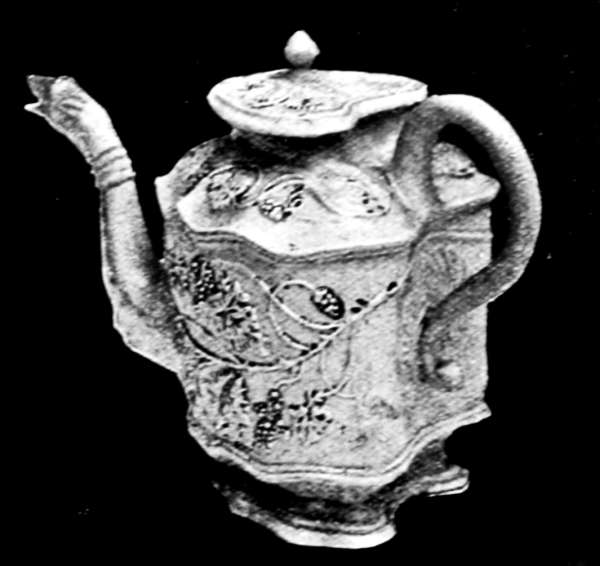
SALT-GLAZED LOVERS' TEAPOT. In the shape of a heart. Floral decoration slightly gilded. (At Victoria and Albert Museum.)
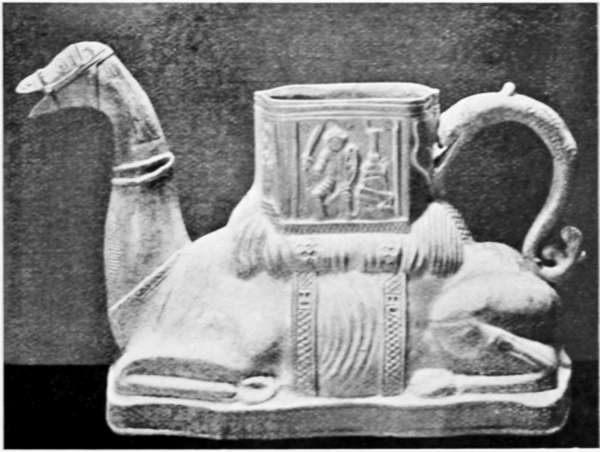
SALT-GLAZED TEAPOT. In the form of a camel. (In the possession of Mr. F. W. Phillips, Hitchin.)
Indeed, this curse lies very heavy on the collector who has to devote a great portion of his energy to research in order to determine who first made certain models. This, unfortunately, tends to divert the study of old earthenware, its artistic qualities and its technical triumphs, into channels more or less contentious. The literature of English ceramics is rapidly becoming like many of the editions of Shakespeare, where a few lines of text stand as an oasis in a desert of commentators' controversial opinions.
It is, therefore, refreshing to find, as one does undoubtedly find in Staffordshire salt-glazed ware, one of the most remarkable and original outbursts in English art pottery that has taken place. This delicate stoneware is as thin as some of the Oriental porcelain, and possesses a grace and symmetry peculiarly its own. In some of its decorations it bears a likeness to Chinese work. This does not detract from its high place as a ceramic record. On the contrary, this similitude is a tribute to pay to its artistic excellence, for there is very little earthenware that came out of Staffordshire that will bear comparison with the work of the Chinese potter.
What is Salt glaze?—We know that many of the stoneware Bellarmines and Rhenish jugs were glazed with salt. It was a process known on the Continent at a very early date, some authorities place it as early as the twelfth century. But it was not until the second half of the sixteenth century that German and Flemish potters used this salt glaze to any great extent. We have seen, in the chapter on stoneware, that the appearance in the mottling and in the orange-skin-like surface is due to the action of salt glaze.
To cover pottery with an outer surface has been practised from earliest times either by the use of some glassy material or by powdered lead. Glazing with common salt was quite a new departure by the English potters. In order for this salt glaze to be used there must be a very high temperature, so high, as a matter of fact, that it would melt or soften in the kiln most English earthenware. This is where stoneware in its body differs from earthenware; it is what is termed "refractory," that is to say, it is not readily fusible. Stoneware is not always glazed. Elers did not glaze his red ware, and Wedgwood did not glaze his basalt or black ware. Stoneware can also be glazed with other processes than the salt glaze, but, as a rule, stoneware is associated with salt glaze.
Without entering too tediously into the exact steps by which salt glazing is performed, it may be roughly described as follows. Other glazes, such as lead, are applied to the surface of the ware prior to its entry into the kiln for firing, but in salt glaze the glaze is incorporated with the ware while it is actually in the kiln. Towards the end of the firing common salt (chloride of sodium) is thrown into the kiln, which is packed with the ware, through apertures in the kiln which has to be specially designed for salt-glaze use. At the high temperature of the kiln (about 2,190° Fahr.) the salt is volatised and its vapour penetrates the saggers (that is, the earthen vessels containing the pieces being made), which have perforated sides to enable this vapour to form on the surface of the pieces being fired. This vapour chemically unites with the silica largely present in the body of the stoneware, and forms a silicate on the surface of the ware. That is to say, the stoneware becomes coated with a thin layer or glaze of sodic silicate or soda-glass.
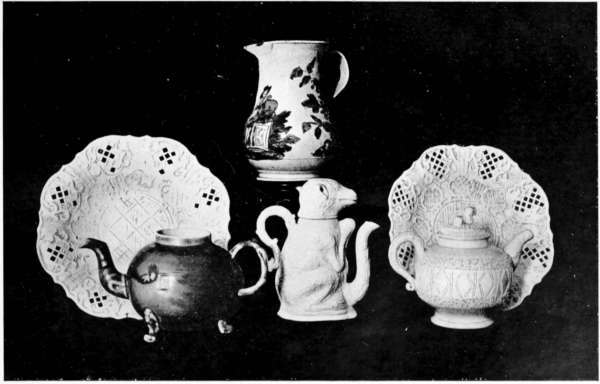
GROUP OF SALT-GLAZED WARE. Jug enamelled in colours. Teapot blue enamel by Littler. (In the collection of Col. and Mrs. Dickson.)
This chemical action taking place simultaneously with the final firing of the ware before its removal from the kiln incorporates the glaze with the body of the ware itself. It is this combination which causes the minute depressions or tiny pin-holes in all stoneware from Bellarmines down to the finely and nearly translucent salt-glazed Staffordshire ware which has a surface like that of leather. The same multitudinous pin-hole surface is characteristic of Oriental porcelain, which like stoneware is fired at a very high temperature, and the glaze and the body completed at one firing in the grand feu. Though, of course, this is not salt glaze, nor is the surface other than as smooth as glass to the touch, although under a strong glass or even to the naked eye these pin-holes are easily discernible.
At the present day salt glaze is mainly used for such ware as ink-pots, drain pipes, insulators for telegraphic instruments, and common ginger-beer bottles. The connection between John Dwight, of Christ Church, Oxford (Master of Arts), the creator of the magnificent bust of Prince Rupert, the glory of the ceramic collection at the British Museum, and between John Philip Elers, godson of Queen Christina, and this sad array of utilitarian nondescripts, is not a pleasing subject for reflection. It is sad to think that these triumphs have been won in vain by the genius of the old potters over the plastic clay. What an ignoble ending to the long chain of experiments! When Dwight destroyed his secret memoranda it is as though he foresaw the era of the drainpipe.
Early Salt-glaze.—The early stages of the manufacture of salt-glazed ware were crude and experimental. There is some connection between the finely potted lustrous stoneware of Nottingham and "Crouch ware," the undeveloped form of the later phase of finely-potted Staffordshire salt-glaze ware. This "Crouch" ware represents the transitional stage between the ordinary brown stoneware and the later drab or greyish white examples. Crouch ware at its earliest was not made in Staffordshire till 1690, and there is presumptive evidence to show that salt-glaze brown ware was made at some pot-works at Crich, near Matlock, Derbyshire; and that the same or similar clay was used by the Staffordshire potters who gave it that name, and there is proof that the Crich pottery existed as early as 1717, and Nottingham has dated pieces as early as 1700.
On the face of it, in spite of Josiah Wedgwood's letter in connection with the medallion to John Philip Elers, there is little evidence to go upon to credit the Elers with having made salt-glaze ware at all. Excavations on the site of their factory at Bradwell Wood have only resulted in the discovery of fragments of their unglazed red ware, "red porcelain" as it was called, and experts have pronounced their oven as being unfitted for salt-glaze operations.
On the whole, therefore, in accordance with the latest research, one is inclined to come to the conclusion that the Brothers Elers did not invent Staffordshire salt-glazed ware. If they made it at all, they made very few examples. The red ware is theirs as far as Staffordshire is concerned, although Dwight had something to say on that score when he charged them and Nottingham potters and others with infringing his patents.
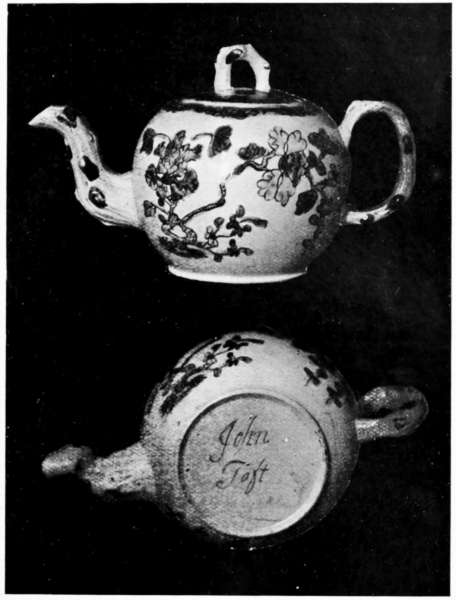
SALT-GLAZED TEAPOT. Enamelled in colours. Marked "John Toft." (In the collection of Col. and Mrs. Dickson.)
Among the early makers of salt-glazed ware were Astbury and Twyford, and Thomas Astbury, son of the former, being associated with the introduction of ground flint into the body in 1720. Thomas Billing in 1722, and Ralph Shaw in 1732, made further improvements in the body. Dr. Thomas Wedgwood and Aaron Wood, and Thomas Whieldon and Ralph Daniel, of Cobridge, were all well-known makers of this ware, the latter having introduced plaster-of-paris moulds in lieu of alabaster, and being further notable for his enamelled decorations in colour, in the period 1743 to 1750, which attempted to vie with the contemporary coloured porcelain. William Littler, of Longton, used a similar blue to that which he used on the porcelain at Longton Hall.
At this date the ware became white in colour, and took its pleasing forms so dear to connoisseurs.
The Classes of Salt-glaze.—In its various styles salt-glazed ware may be roughly divided into periods. The experimental stage was over in 1720. From 1720 to 1740 the undecorated or white examples were made, depending on form for their beauty. These had applied ornamentation stamped with metal dies, or made in separate moulds and affixed to the body to be decorated (similar to the Elers style). It is during this period that some of the finest pieces were made with sharp, clear-cut designs. Later, when moulds were made of plaster-of-paris in place of alabaster, the design became blurred.
Among the most beautiful designs in this plain white ware having raised ornament are sauceboats, pickle trays, sweetmeat dishes, teapoys or tea canisters, and teapots; these latter are of a great variety of shapes, many having shell ornament, very exquisitely moulded, and others being of hexagonal shape divided into compartments. There is, too, a trace of the grotesque discernible in some of these teapots and a subtle humour too rarely found in English pottery. There are those of the camel form, such as the specimen illustrated (p. 197). The peculiar handle made by hand is very noticeable, usually such handles are snipped off at the end. Others are of the shape of a house, and many types of this design occur. Some are in the form of a squirrel. Then there are the heart-shaped teapots with the spout incongruously representing an arm resting on the neck of a swan. These teapots were supposed to have been made for lovers. We give an illustration (p. 197) of one of these heart teapots, and it will be seen how a slight touch of gilding has been added to heighten the effect on the embossed portions showing the fruit. Of course the cauliflower teapot exhibits a touch of humour, too, but this form is rarely found in salt glaze. The bright natural colours of that interesting vegetable were reproduced by Whieldon, who made this type as well as melon and pineapple teapots and coffee-pots. The vivid green and yellow glaze of this cauliflower ware is of the period when Josiah Wedgwood was with Whieldon and is held to be young Josiah's invention. He afterwards made similar ware himself.
The next stage was the slight use of colour in what is termed "scratched" blue. This style of decoration is the opposite of the relief ornaments. The pattern was incised with a sharp instrument on the piece, in the lines thus cut cobalt blue was applied with a sponge. Birds and foliage are the typical form of decorations to pieces of this style from 1740 to about 1750.
From 1745 to 1750 William Littler introduced his cobalt blue ware over which decorations in black or white were enamelled or gilded, and such pieces are rare. (See illustration p. 201.)
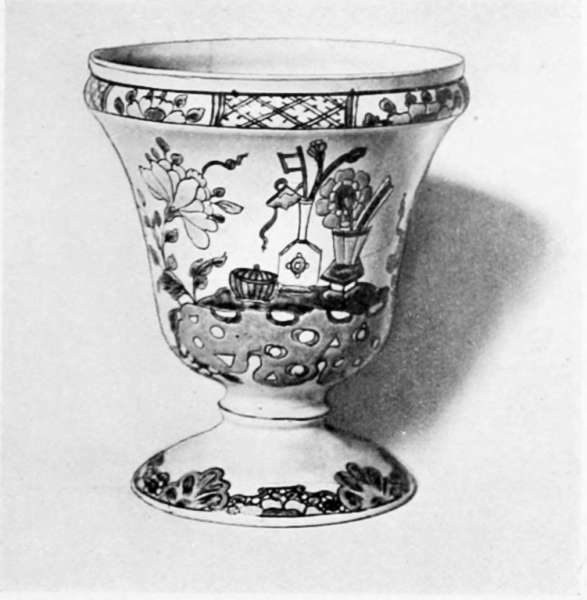
SALT-GLAZED VASE. Enamelled in colours—turquoise blue, yellow. (Height 5¾ inches.)
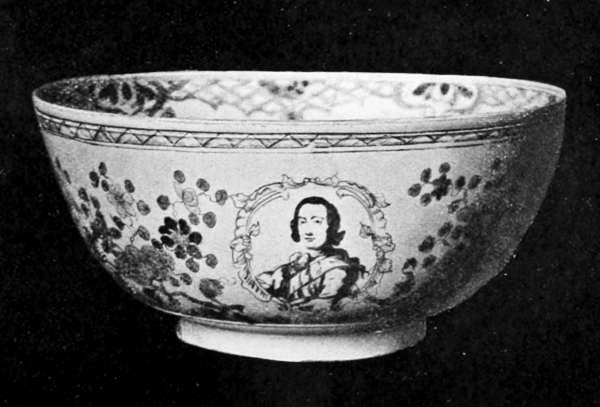
SALT-GLAZED PUNCH BOWL. Enamelled in colours, with portrait of the Young Pretender. (Diameter 10 inches.) (In the possession of Mr. S. G. Fenton.)
Then comes the period in which colour was in full swing. From 1740 to 1760 enamelling in colours was extensively used. It was employed on plain surfaces, or as a touch of colour to ornaments in relief. There is no doubt that some of these coloured examples are very beautiful. It is not necessary to dethrone the plain white ware from its place of honour. With later developments it was found that colour could be used with artistic advantage, nor is there any deterioration of the ware from an æsthetic point of view in this colour work when in the hands of skilled craftsmen.
Similarly transfer-printing was recognised as a suitable means of decoration, and pieces are found with printed designs of black or red or puce. The head of the King of Prussia is found on some specimens of this type. Of course this is later in date, and must have been subsequent to 1760, when Sadler and Green invented transfer-printing at Liverpool. Doubtless these pieces entered into competition with the new colour ware then in vogue, which drove the salt-glaze ware from the market, and killed the most artistic and original productions the English potter had ever made.
The industry had by this time grown to great dimensions, and apparently the Staffordshire potters were turning out this salt-glazed ware as fast as they could, no very good sign that good work was to last much longer. Nor is all the enamel work English; two Dutchmen were secretly employed at Burslem to do this enamelling in colour. But the secret spread, and we find two Leeds painters, Robinson and Rhodes, doing enamelling on the salt-glazed ware for the Staffordshire potters.
We are enabled to reproduce a very fine example of enamelled salt-glaze ware having the inscription "James and Martha Jinkcuson," and dated 1764. It stands as a fine specimen of its class. The colours of the flowers and insects are very rich, being, as is usual, enamelled over the salt-glaze ground. Dated salt-glazed ware is always uncommon, and an example of such fine colouring in such perfect condition stands as a rare and splendid specimen.
There is yet another style in salt-glaze in which the whole surface of the piece to be decorated is coated with a slip of another colour, and the decoration cut through it to show the white body beneath. This belongs to the last period, 1760 to 1780, as also does the basket work for which Aaron Wood, and R. J. Baddeley, of Shelton, are noted for their fine patterns. Incised work in imitation of Japanese work was also prevalent during the last period of salt-glaze work.
We illustrate another very important salt-glazed piece, a teapot enamelled in colours having what is known as a "crabstock" handle, spout, and lid. It is remarkable as being incised with the name "John Toft" (see p. 205). Undoubtedly this is a member of the celebrated Toft family, whose dishes, marked "Ralph Toft" and "Thomas Toft" in slip-ware, gave the generic name to a class of ware. It is not improbable that one of the Tofts modelled the celebrated salt-glaze "pew group" in the Victoria and Albert Museum. It exhibits the peculiarly quaint doll-like faces with beady eyes associated with Toft dishes.
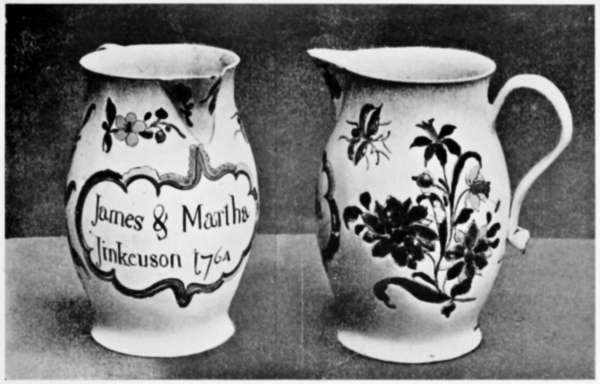
SALT-GLAZED JUG. Richly enamelled in colours, and inscribed 'James & Martha Jinkcuson 1764.' (In the collection of Mr. Frederick Rathbone, South Kensington.)
In the group illustrated (p. 201) there is one enamelled jug. The two dishes show another type of plain salt-glaze. The teapot shows incised work on the broad band around it, but no indication of colour. The coffee-pot is the well-known squirrel form, and the dark teapot on left is enamelled in blue by Thomas Littler, and is a rare example.
In colouring the salt-glazed vase in bright turquoise blue and pink and green, with its Oriental design, strongly suggests the enamel work of Limoges (see p. 209). It stands in the eighteenth century in the same relationship to the metal enameller as does a modern French factory at Bordeaux, Messrs. Viellard & Cie., whose work in coarse earthenware simulates the cloisonné enamel.
The punch bowl illustrated has a portrait of the Young Pretender. In date it is, of course, not earlier than 1745, the year of the Rebellion in Scotland on behalf of the Pretender, and when his son Charles Edward landed and defeated the royal forces near Edinburgh. This punch bowl tells its story of stirring days, when Jacobites secretly met at night in quiet manor houses and drank a toast to the Stuart claimant. In public by a kind of subtle jest when they were driven to drink the health of "the king," they by a specious mental reservation flourished their glasses over any water on the table, the hidden meaning being "the King—over the water." But here is a punch bowl which was probably brought out for the sworn partisans to drink to the pious memory of the exiled Stuarts. There was always, even when the Stuart cause was a lost one, a tender recollection of "Prince Charlie," the "Young Chevalier." The lilting lines of Bobbie Burns in the last quarter of the eighteenth century, always awaken romantic associations, and bowls such as this were relics of something that had been, and without doubt in its day this same bowl has filled the glasses of a loyal company who drank the health of his Gracious Majesty George the Third.
As we have pointed out in the introductory note there are many monuments in clay on the collector's shelf which punctuate the sonorous phrases of the historian. Such pieces are exceptionally interesting in aiding the reflective mind to recreate the events of a former day which touched the life roots of the nation.
PRICES.
Salt Glaze.£s.d.
Teapoy, square shaped, decorated with scratched flowers in blue. With female half-length figure (within a Chippendale frame), inscribed "Martha Saymore September ye 25th 1770" (5¼ in. high). Bond, Ipswich, April, 1906 11 0 0
Bowl and cover and milk jug decorated, rich blue ground. Sotheby, June, 1906 26 0 0
Teapot, brilliantly enamelled in colour with roses, auriculas, &c., with turquoise handle and spout. Sotheby, June, 1906 50 0 0
Teapot, crimson ground, with white panels with flowers in colour. Sotheby, June, 1906 26 0 0
Teapot and cover, modelled as house with royal arms over door. Sotheby, February, 1907 5 12 6
Teapot and cover, modelled as a camel. Sotheby, February, 1907 6 6 0
Jug and cover, hexagonal, with subjects in relief. Sotheby, February, 1907 4 4 0
Teapot, enamelled in colours, with portrait of Frederick King of Prussia; on reverse, spread eagle holding ribbon with inscription, "Semper Sublimis." Sotheby, March, 1907 21 10 0
Milk jug and cover, enamelled in colours in a continuous landscape with castle, obelisk, and other buildings. Sotheby, March, 1907 7 15 0
Vessel, modelled as a Bear, head forming cup. Sotheby, March, 1907 4 4 0
Basin with raised subjects in panels. Sotheby, July, 1908 13 5 0
Teapot and cover, enamelled in colours, with roses, &c. Sotheby, July, 1908 8 0 0
Teapot and cover, dark blue ground. Sotheby, July, 1908 8 5 0
Coffee-pot and cover (small), decorated in enamel colours with Chinese figures. Sotheby, July, 1908 14 15 0
VII JOSIAH WEDGWOOD
CHAPTER VII JOSIAH WEDGWOOD 1730–1795
Josiah Wedgwood's place in the ceramic world—His business abilities—Josiah Wedgwood's wares—Cream Ware and its invention—Jasper Ware and its imitation—The influence of Josiah Wedgwood—Wedgwood Marks—The Prices of Wedgwood.
The time is now ripe to form a mature judgment as to the exact niche in the temple of fame which Josiah Wedgwood is to occupy permanently. His immediate successors were in too close proximity to his own day to form an opinion as to his life-work in relation to what had gone before and what has succeeded him.
The inquiry into the origins of certain inventions attributed to him have been pursued of late years with a scientific thoroughness, and many facts have come to light which tend to raise the reputation of other lesser known potters who immediately preceded him or were his contemporaries.
John Dwight (of Fulham) has come into his own. The Elers (of Staffordshire) have been dethroned from the unique position they occupied as pioneers of salt-glaze ware. In regard to the Astburys, father and son, credit has been given them for great work, and Whieldon is held to have had an immense influence on his contemporaries. During the great outburst in salt-glazed ware, cream ware, its later rival and conqueror, was in a transitional stage. This transitional period embraces a great field of pioneer workers who experimented unceasingly with clays and glazes. The days of salt-glaze were drawing to a close, it had many obvious defects; the ware would not readily stand hot liquids—and this in an age when tea drinking was becoming fashionable. The artistic side for the moment was cast aside in these experiments, the uppermost question in the Staffordshire potters' minds was the invention of some ware that could hold its own against the competition of the new English porcelain factories.
It thus came about that this period of great technical activity (1720–1740) was immediately succeeded by an almost simultaneous exhibition of work, suggesting a renaissance of earthenware in England (1740–1800) and establishing the European reputation of Staffordshire.
Josiah Wedgwood with John Turner, of Lane End, and William Adams, of Greengates, stand as a trio of master potters who developed the classic spirit in jasper and kindred ornamental ware. In regard to developing the manufacture of cream ware and stone ware for domestic use, and in building up a continental and American trade which won for British earthenware the supremacy of the world's trade in pottery, Josiah Wedgwood takes an equal prominence together with Warburton and the Baddeleys and the Adamses and Turner.
In roughly detailing the stages which led up to the manufacture of the main classes of ware for which Wedgwood was famous, it will be shown how with a masterly mind for realising broad results he combined the patient industry of a practical potter. He commenced with a capital of twenty pounds and died worth half a million. In spite of his ill-health and the loss of his leg, his unflagging energy and his keen foresight enabled him to build up an important business which is still carried on by his descendants. His love of organisation and the system of control which he exercised over his own enormous output had a lasting effect on the methods of the Staffordshire potteries.
The genius of Josiah Wedgwood has won the continued admiration of succeeding generations. It may be that he has somewhat overshadowed many of his contemporaries, and his successors have been termed imitators. In order to adjust matters there is a tendency in some quarters to belittle the work of the great Josiah. But surely the pendulum has swung too far the other way when it is advanced that "Wedgwood himself was no artist, he was a tradesman pure and simple."
This is not the opinion of critics with nicer balanced judgment and of cosmopolitan taste. The epitaph upon his monument in the parish church of Stoke-upon-Trent, which bears the inscription that he "converted a rude and inconsiderable Manufactory into an elegant Art," has been assailed in order to prove it to be a "travesty of the fact," and to state that "what he really did was to convert an Art—rude it may be, and inconsiderable, but still an Art—into a manufacture. In other words, he inaugurated an entirely new order of things in the production of pottery, and a less desirable one."
The truth is that it is not necessary to belittle Wedgwood in order to put his great contemporaries in the order of their merit. The later and more corrected opinion may be arrived at quite judicially by crediting them with some of the artistic impulses he possessed. While he lived he worked harmoniously and in close friendship with his fellow potters, and a century after his death it should not be difficult to determine their relative positions without bespattering his epitaph with mud.
Wedgwood's business abilities.—He was undoubtedly a keen man of affairs. When in partnership with Whieldon he had travelled to London, to Manchester, to Birmingham, to Sheffield, and to Liverpool, which brought him into touch with silversmiths and metal workers in connection with the agate knife-handles and similar Whieldon ware. He evidently realised that Staffordshire was behind other districts in many respects. Although only a young man, he interested the influential people in the neighbourhood of the potteries and the roads were improved and water transit provided as an outlet for goods. He cut the first sod of the Trent and Mersey Canal.
In 1759 he was master potter, but he made most of his own models, prepared his own mixtures, superintended firing, and was his own clerk and warehouseman. Less than ten years afterwards, on the advice of the Duke of Marlborough, Lord Gower, and Lord Spencer, he opened showrooms in London in Newport Street.
A year after this the demand for his fine jasper ware and expensive ornamental productions had so increased that he found the greatest difficulty in finding sufficient workmen.
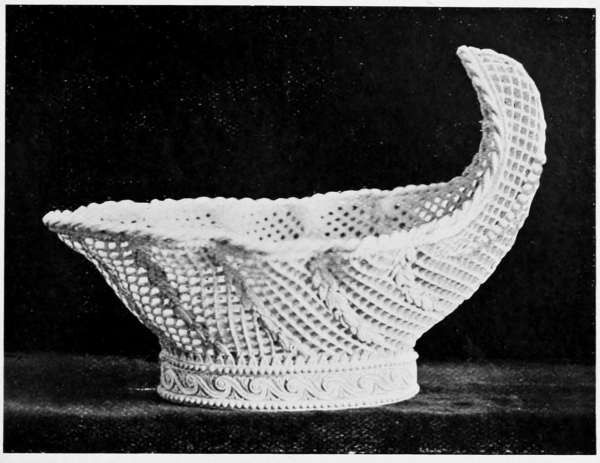
WEDGWOOD CREAM WARE DESSERT BASKET. Showing fine pierced work.
By the courtesy of Messrs. Josiah Wedgwood & Sons.
WEDGWOOD CREAM WARE DESSERT CENTRE-PIECE. Designed from Josiah Wedgwood's collection of shells. (In Museum at Etruria.)
By the courtesy of Messrs. Josiah Wedgwood & Sons.
His catalogues were printed in several languages, and he had the shrewd common sense to add some forewords of his own to indicate the lines on which he was working as a potter and to bring the attention of likely buyers to his ware.
Wedgwood as a potter.—There is no doubt that Wedgwood always had in view the improvement of whatever ware he engaged to make. When with Whieldon he perfected the green glaze in the cauliflower and kindred ware, and when he became a master potter in 1759, he produced pieces which were eminently remarkable for their fine technique. There is no doubt that his connection with silversmiths induced him to follow their designs. Some of his early ware, such as teapots, have punched perforated ornament in the rims for which he invented tools. In the museum at Etruria are some six thousand trial pieces, some few inches in length, covering a wide period when Josiah was pursuing his way towards his crowning achievement, the invention of his jasper ware.[3]
He claims credit for great improvements, both as an inventor and as a ready and masterly adapter, quick to seize the salient points of a half-perfected ware and by a few touches of genius make it his own. He was made a Fellow of the Royal Society for his invention of a pyrometer, an instrument for registering high temperatures in the kilns. His experiments led him into new fields in connection with bodies, glazes, and colours, and he introduced for the first time in pottery certain minerals such as barytes in his pastes.
Josiah Wedgwood's wares.—It will be seen, in the enumeration of the various classes of ware which were produced by him, in what respect he added improvements which in their turn were improved upon by later potters, and to what extent his productions were entirely original, adding a new note in English pottery, creating an entire school, and leaving the mark of his genius on his successors for nearly a century.
Variegated ware.—The agate, the cauliflower, and melon ware, the clouded and mottled glaze, and the various imitations of marbling, came into vogue in the days of Whieldon. But Wedgwood was more ambitious in his designs. We have already seen, in dealing with Whieldon ware, how the "solid" agate ware was produced by means of fine layers of clays of different colours, which after careful manipulation produced a series of waves resembling the natural ornamentation of the stone. Wedgwood also employed "surface" colouring for this variegated ware, the body being of the common cream-coloured earthenware and the veining and mottling being applied to the surface. In such pieces the handles and the plinths were usually oil gilded; later he used a white semi-porcelain for plinths of such ware.
Two agate vases and ewers marked "Wedgwood and Bentley" belong to the period 1768 to 1780. The plinths of the agate vases show the white undecorated body. Wedgwood imitated Egyptian pebble, jasper, porphyry, and various kinds of granite speckled with grey, black, white, or green. Much of this is a flight higher than the agate ware.
Black basalt Ware.—In this ware, which was termed "Egyptian black," Wedgwood triumphed over his predecessors. We know the black ware made by Elers and by Twyford (two fine black Twyford teapots are in the Hanley Museum), but the ware into which Wedgwood infused his genius is worthy to be called what he termed it—"black porcelaine." With its rich black, smooth surface it was capable of varied use, including useful as well as ornamental ware. In the former, we find tea services and coffee or chocolate pots strictly adopting the severe Queen Anne silver shapes, and in vases he followed bronze prototypes. See illustration (p. 241) of two Black basalt Teapots. It was used in fine manner for life-size busts and for medallion portraits of "illustrious Ancients and Moderns."
This basalt ware Wedgwood further used in combination with other processes. He imitated the ancient Greek vase paintings by decorating the black surface with unglazed colours, or he had ornaments in relief in red. Another replica of classic art was his simulation of bronze, and this black ware formed the groundwork to which he added the bronze metallic colouring in his rare bronze examples.
The two black basalt ewers, entitled Wine and Water, designed by Flaxman, are well known. It is at once evident that they owe no inconsiderable debt to the metal worker. It requires no great stretch of imagination to believe them to be in bronze. Technically, as specimens of earthenware, they are perfect, but it is open to question whether the potter has not trespassed on the domain of the worker in metal. There are canons which govern the art of pottery; form and ornamentation strictly appropriate in metal are utterly unfitted for the worker in clay. Branched candelabra are false in porcelain though extremely beautiful in silver. In passing this criticism, which applies to some of Wedgwood's work, we are incidentally brushing aside the contention of those critics who find him unoriginal. As a matter of fact he was so original and so responsive to the suggestion of allied arts that he often undertook the creation of pieces in his kilns the like of which no potter had ever attempted before.
Red Ware.—It is not to be supposed that Wedgwood would allow the fine red Elers ware to stand as representative of the uttermost that Staffordshire had produced without attempting to emulate this early ware. Accordingly, we find in what he terms his rosso antico, a red ware of extraordinary beauty. Some of the engine-turned pieces of this red ware are exceptionally fine. There is in the Hanley Museum a coffee-pot of great technical and æsthetic value. Wine-coolers and other useful creations, with classic ornamentation in relief, show the wide range of this red terra-cotta or unglazed ware. The Elers style was simple, with applied stamped ornament of small dimensions and Oriental rather than classical in motif. The red stoneware of Böttcher, of Dresden, was by this time fairly well known, and Wedgwood had both Elers and Böttcher to serve as models, although he does not seem to have employed this red ware to any great extent. Nor did Wedgwood confine himself to red in this type of ware; he made chocolate-coloured examples, and in his cane-coloured and bamboo ware he made articles for domestic use, such as tea and coffee services as well as mugs and jugs of this type, which differed from the black basalt inasmuch as the basalt was an especially hard body, whereas these others were porous and soft. As was usual with Wedgwood, not only did he have a series of wares of different colours, but he often worked with a combination of these colours in the same piece.
Cream Ware.—Something must be said concerning the development of cream ware before it can be accurately determined how much Staffordshire was indebted to Wedgwood for its development. At the outset it must be granted that he did not invent the ware. But he improved it. Similarly it was further improved subsequent to his day by other potters who made it finer and whiter.
But to this day, a hundred and fifty years after the introduction of this cream ware, his descendants, still trading under the name of Messrs. Josiah Wedgwood and Sons, produce this cream ware exactly as it was then produced. Dinner services are made with Flaxman's designs on the border, essentially English in character and feeling. Last year Messrs. James Powell and Sons, of the Whitefriars Glass Works, near the Temple, which were flourishing in 1710, and still continue to produce the finest glass in England, held an exhibition of Wedgwood ware. Considerable interest was drawn to the subject of this revival of the old patterns of 1775 from the designs of Josiah Wedgwood's band of artists. Those connoisseurs who love old furniture and old eighteenth-century glass ware, as made by Messrs. Powell, welcomed the Wedgwood queen's ware designs as being something eminently fitted to strike the right note of harmony, and accordingly, by arrangement with the firm at Etruria, some of the finest patterns of the old ware are exclusively made for Messrs. Powell. The English dinner table may now be as English as it was in Georgian days, and, happily, this æsthetic revival has met with a warm response by the patronage of the royal family, the nobility, and by all those who love the old-world charm of the domestic art of our forefathers.
Before Wedgwood's day cream ware was made. Astbury used an addition of white clay and flint to his bodies about 1720. In 1726 the grinding of flint stones into powder for the potters' use became so important that Thomas Benson took out a patent for a machine to do this. In 1750 we find cream ware being largely made. Aaron Wedgwood and William Littler introduced about this time a fluid lead glaze instead of the old manner of using powdered galena (native sulphide of lead). Body and glaze were at this period fired at one operation. Enoch Booth improved this by revolutionising the method of glazing. He fired the pieces to a biscuit state and then dipped them in this fluid lead glaze (ground flint and white lead), and refired them at a lower temperature. At this date two other potters, Warburton (of Hot Lane) and Baddeley (of Shelton), followed Booth's practice, and cream ware may be said to have been in a fairly flourishing condition.
These facts are all important and cannot be ignored in arriving at a satisfactory conclusion. Wedgwood commenced as a master potter in 1759, that is, about nine years after the latest inventions in cream ware had brought the ware into something more than an experimental stage. In 1761 Wedgwood's cream ware, both by its variety of beautiful form and its finer glaze and body, had surpassed that of his rival potters.
In 1762 Wedgwood presented to Queen Charlotte a caudle and breakfast service of the ware; this was painted by Thomas Daniel and David Steele. The Queen and the King were so pleased with the ware that complete table services were ordered, and Wedgwood received the Queen's command to call himself "Potter to Her Majesty" in 1765, and from that date he termed the ware "Queen's Ware."
WEDGWOOD CREAM WARE PLATES. Painted with English scenery. From service made for Catherine II. of Russia, 1774. Having green frog in reserve on each plate. (In Museum at Etruria.) (At British Museum.)
WEDGWOOD BUSTS OF ROUSSEAU AND VOLTAIRE. Enamelled in colours. (Height 6½ inches and 6 inches.) (At Victoria and Albert Museum.)
Though the invention of cream ware may not be his, there must have been something essentially more pleasing in his productions to have made such strides in so short a time. Perhaps Wedgwood, "the tradesman pure and simple," had something to do with this achievement, but we prefer to think it was the master hand of Wedgwood the potter and Wedgwood the artist.
We cannot leave this cream ware question without referring to an old legal controversy. This brings us down to the year 1775 when Wedgwood, in company with John Turner (of Lane End) journeyed to Cornwall and jointly leased some clay mines. The reason for their visit was that the whole of the Staffordshire potters were up in arms. Salt glaze was coming to an end in spite of the enamelling in colours in emulation of English porcelain. And now Cookworthy, the potter of Plymouth, the maker of the first hard porcelain in England, had sold his patent rights to Champion of Bristol, who, in 1775, applied for a further patent for fourteen years to use certain natural materials for making porcelain. The Staffordshire potters elected Josiah Wedgwood and John Turner as their representatives and petitioned against the granting of this patent, and Wedgwood urged that
"the manufacture of earthenware in Staffordshire has of late received many essential improvements, and is continually advancing to higher degrees of perfection; that the further improvement of the manufactory must depend upon the application and the free use of the various raw materials that are the natural products of this country."
He further adds that "the natural productions of the soil ought to be the right of all."
Incidentally, this controversy throws light on the position of Wedgwood as a maker of cream ware, and it had a lasting effect, as we shall show in the improvement of cream ware itself and upon the class of ware turned out in Staffordshire.
Champion, in his reply to the Staffordshire outburst in petitioning parliament not to grant his patent, pays Wedgwood a great compliment:
"Mr. Champion most cheerfully joins in the general praise which is given to Mr. Wedgwood for the many improvements which he has made in the Staffordshire earthenware, and the great pains and assiduity with which he has pursued them. He richly deserves the large fortune he has made from these improvements."