"Charge!" (continued 7)
Reading edition
“I know, sir,” said the Sergeant, nodding his head. “When you talk in that bitter way I know it isn’t my brave, clever young officer speaking; and I say to myself, ‘Wait a bit, old man; he’ll soon come round.’”
“Thank you, Sergeant; thank you,” said Denham, holding out his hand, which Briggs grasped, shook warmly, then turned to me to go through the same business; he did so hotly, for my hand felt crushed, and I vainly tried to respond as heartily, while the tears of pain rose in my eyes, but did not dim them so much that I could not see my torturer’s eyes were also moist.
“Well, what are you looking at?” he growled. “I say, don’t squeeze a man’s hand like that. Why, you’ve made my eyes water, lad. Look, they’re quite wet. Phew! You did squeeze.”
“It’s because he has so much vice in him, Briggs,” said Denham, smiling.
“That’s it, Mr Denham. Well, we must wait, for there’s nothing to be done but send one or two smart fellows to creep through the enemy’s ranks in the night, on foot. You can’t get horsemen through.”
“You mean, send for help from the nearest British force?” said Denham.
“That’s it, sir—some one to tell the officer in command that we shall soon be on our last legs here; but if he’ll como on and attack them in the rear, we’ll be out and at ’em as soon as we hear the shooting; and if we didn’t polish off the Doppies then, why, we should deserve to lose.”
“Briggs,” said Denham warmly, “of course that’s the plan. You ought to have been in command of the corps yourself.”
“Ah! now your head’s getting a bit the better of you again, sir,” replied the Sergeant, “or you wouldn’t talk like that. What I say’s only second-hand. That’s the chief’s plan.”
“Then why doesn’t he carry it out?” I said indignantly.
“You hold your tongue,” growled the Sergeant. “You’re only a recruit yet, and your head’s getting the better of you too.—Yes, Mr Denham, that’s the Colonel’s own plan, and he’s tried it every night for the last twelve nights.”
“What!” I cried.
“Yes, my lad; called quietly for volunteers, and sent out twelve of our lads; but so far there don’t seem to be one that has got through, and the game gets expensive. There, I must go down again now and get to duty. I saw you two coming up while I was going through the exercise, and I’m very glad to see you both looking so much better.—Well, Joe Black,” he said as he turned away, “how’s Mr Moray’s horse?”
“Um? Coat shine beautiful,” said Joeboy.
“And enough to make it, my lad, seeing the way you rub him down.”
“Denham,” I said that night as we lay wakefully gazing up at the stars, “do you feel any stronger yet?”
“I don’t know. I seem to fancy I do. Why?”
“I thought you did because you’ve been so quiet ever since we had that talk with the Sergeant. I feel stronger.”
“Why do you ask?” he said.
“Because I’ve been thinking that I ought to do that job, and you ought to be on the lookout again, to come to my help if I succeed.”
“No,” he said quickly; “it’s a job for two. I’d go with you.”
“But I should take Joeboy.”
“Then it’s a job for three, Val; we can take our time, and the slower we go perhaps the better. If we get stopped by the Boers, we’re wounded and getting away from the fighting.”
“Yes, that might do. We do look bad.”
“Horribly bad, Val. You look a miserable wreck of a fellow.”
“And you, I won’t say what,” I retorted, a little irritably.
“So much the better. When shall we go—to-night?”
“No. Let’s have a good sleep to-night, and talk to Joeboy about it in the morning. To-morrow night as soon as it’s dark we’ll be off,” I said.
“The Colonel won’t let us go if we volunteer.”
“Of course not. Let’s go without leave; but that will look like deserting.”
“I don’t care what it looks like so long as we can get through and bring help.”
“The same here.”
“But we ought to steal away to-night,” said Denham.
“No; let’s have Joeboy. Ha!” I said, with a sigh of relief. “I seem to see my way now, and I shall sleep like a top.”
“I’m so relieved, Val, old chap, that I’m half-asleep now. Quite a restful feeling has come over me. Good-night.”
“Good-night,” I replied; and I have some faint recollection of the rays of a lantern beating down and looking red through my eyelids, and then of feeling a soft hand upon my temples. But the next thing I fully realised was that it was a bright, sunny morning, and that Denham was sitting up in his sack-bed.
“How do you feel?” he cried eagerly.
“Like going off as soon as it’s dark.”
“So do I,” he said. “I’m a deal better now. What’s the first thing to do—smuggle some meal to take with us?”
“I don’t know,” I replied. “Yes, perhaps we’d better take some; and, I say, we must have bandages on our heads as well as the sticking-plaster.”
“Of course. Then, I say, as soon as ever we’ve had breakfast we’ll talk to Joeboy.”
“Exactly,” I replied. “He’ll be half-mad to go, and when we’ve said all we want to him we’ll come back and lie down again.”
“Oh! What for?”
“So as to rest and sleep all we possibly can, for if all goes well we shan’t have a wink to-night.”
“Perhaps you’re right,” said Denham.
“There’s one more thing to think about.”
“What’s that?”
“Our going off without leave,” I said—“you an officer, I a private.”
“Oh! I say, don’t get raising up obstacles.”
“I don’t want to,” I said; “but this is serious.”
“Very, for us to run such risks; and of course it isn’t according to rule. But it’s an exception. Let’s argue it out, for it does look ugly.”
“Go on,” I said, “for I want my conscience cleared.”
“Look here, then; what are we going to do?”
“Try and get help, of course.”
“Then I consider that sufficient excuse for anything—in a corps of irregulars. Old Briggs would say it was mutinous in the regular army. To go on: if we asked leave, the Colonel or Major would say we were mad, and that we are not fit. Then— Oh, look here, I’m not going to argue, Val. I confess it’s all wrong, only there’s one thing to be said: we’re not going to desert our ranks, for we’re both on the sick-list; and, come what may, I mean to go and bring help somehow. You’re not shirking the job after sleeping on it?”
“No,” I said emphatically. “Now for breakfast, and then we’ll have a talk with Joeboy.”
Chapter Forty.
Joeboy is Missing Again.
“What a breakfast!” groaned Denham half-an-hour later.
“Never mind,” I said; “we’ll get something better, perhaps, to-morrow.”
“That we will, even if we commando it at the point of the sword, which is another way of saying we shall steal it. I say, though, the thought of all this is sending new life into me.”
“I feel the same,” I said; then we sat back waiting till the doctor visited us, examined our injuries, and expressed himself satisfied.
“Another week,” he said, “and then I shall dismiss you both. Nature and care will do the rest.”
The doctor then left us; and, watching for an opportunity, we called to one of the men passing the hospital, and told him to find the black. However, ten minutes later we found that this might have been saved, for the Sergeant paid us a morning call, and on leaving promised to go round by the horses and send Joeboy to us.
“What news of the messengers?” we asked. The Sergeant shook his head sadly, and replied, “Don’t ask me, gentlemen. It looks bad—very bad. The Boers ain’t soldiers, but they’re keeping their lines wonderfully tight.”
“That’s our fault,” said Denham. “We gave them such lessons by our night attack and the capture of the six wagons and teams.”
“I say,” said the Sergeant, and he looked from one to the other.
“Well, what do you say?” cried Denham.
“Doctor been changing your physic?”
“Why?” I said.
“Because you both look fifty pounds better than you did yesterday.”
“It’s the hope that has come, Briggs,” cried Denham, his face lighting up.
“Haven’t got a bit to spare, have you, sir?” said the Sergeant; “because I should like to try how it would agree with my case, for I’m horribly down in the mouth at present. I don’t like the look of things at all.”
“What do you mean?” asked Denham.
“I had a look round at the horses, sir, last night.”
“Not got the horse-sickness, Briggs?”
“No, sir, not so bad as that; but, speaking as an old cavalry man, I say that they mustn’t be kept shut up much longer. But there, I shall be spoiling your looks and knocking your hope over. Good-morning, gentlemen—I mean, lieutenant and private. Glad to see you both look so well. I’ll tell Joe Black you want him.”
“Yes, he’d upset our hopefulness altogether, Val, if it wasn’t for one thing—eh?” said Denham as the wagon-tilt swung to after the Sergeant. “But, I say, that fellow of yours ought to be here by now.”
“Yes,” I said. But we waited anxiously for quite an hour before the man we had sent came back.
“Can’t find the black, sir,” he said.
“Did you go to the horses?”
“Yes, sir, and everywhere else.”
“You didn’t go to the butcher’s?” I asked.
“Yes, I did; but he hadn’t been there.”
“Perhaps he’s gone out with the bullock drove.”
“No,” said the man; “the oxen are being kept in this morning because the Boers have come a hundred yards nearer during the night. They’re well in opposite the gateway, and the Colonel’s having our works there strengthened.”
“The Sergeant didn’t say a word about that,” Denham said to me.
I shook my head, and turned to the messenger.
“Is he asleep somewhere about the walls?” I asked.
“No; I looked there,” was the reply. “He always snoozes up on the inner wall, just above the water-hole. There’s a place where a big stone has fallen out and no bullets can get at him. I looked there twice.”
“Hasn’t fallen down one of the holes, has he?” said Denham.
“Not he, sir,” replied the man, laughing. “He’d go about anywhere in the dark, looking like a bit o’ nothing, only you couldn’t see it in the darkness, and never knock against a thing. It’s his feet, I think; they always seem to know where to put theirselves. He wouldn’t tumble down any holes.”
“Keep a sharp lookout for him, and when you see him send him to me directly.”
“Yes, sir,” replied the man. “I dessay he’ll turn up in the course o’ the morning. He’s always hiding himself and coming again when you don’t expect it.”
“I say, Val,” cried Denham as soon as we were alone, “we didn’t reckon on this. Why, if he doesn’t turn up our plan’s done.”
“Not at all,” I said.
“Eh? What do you mean? We couldn’t go without him.”
“Indeed, but we could; and what’s more, we will,” I said firmly. “I would rather have had him with us; but we’re going to-night—if we can.”
Denham seized my hand and wrung it warmly.
“I like that,” he said; “but you shouldn’t have put in that ‘if we can.’”
“Obliged to,” I replied. “We may be stopped.”
“Oh, but I shall give the password.”
“We may find even that will not be enough. The orders are very strict now. Besides, if we did not come back the guard would report us missing, and then there’d be great excitement at once.”
“What would you do, then?” he asked.
“Take a lesson out of that Irishman’s book.”
“Knock two or three sentries on the head with a stone?”
“No, no,” I cried, laughing. “Get a couple of reins, tie them together, and then slide down from the wall.”
“Good!” exclaimed Denham; and, after a pause: “Better! Yes, that will do. Start from the far corner?”
“No, from just up here where Joeboy arranged the stones. We can tie up to one of those big ones that you stand on to look over. You feel strong enough to slide down?—it isn’t far.”
“Oh yes.”
“Then, once on the ground, we can crawl away. That’s how I mean to go all along.”
“What about the tethering-ropes?”
“We’ll go and have a look at our horses towards evening, slip the coils over our shoulders, and bring them away. No one will interfere.”
“Val,” he cried, “you ought to be a commissioned officer.”
“I don’t want to be,” I said, laughing. “I want the war to be over, and to be able to find my people, and settle down again in peace. This fighting goes against the grain with me.”
“But you always seem to like it, and fight like a fury when we’re in for it.”
“I suppose it’s my nature,” I said; “but I don’t like it any the better.”
We said no more, but waited anxiously in the hope that Joeboy would return, and waited in vain, the time gliding by, some hours being passed in sleep, till we were suddenly aroused by firing. There were two or three fits of excitement in the course of the afternoon, and a smart exchange of shots which at one time threatened to develop into a regular attempt to assault the fort; but it died out at last, direct attack of entrenchments not being in accord with the Boers’ ideas of fighting. It is too dangerous for men who like to be safely in hiding and to bring down their enemies as if they were wild beasts of the veldt.
No Joeboy appeared, and in the dusk of evening we went across the yard, had a good look at our horses, stopped patting and caressing them for some time, then went back to the hospital unquestioned and, I believe, unseen, with the coils of raw-hide rope. From that time everything seemed to me so delightfully easy that it prognosticated certain success.
The doctor came at dusk and had a chat; then the Sergeant looked us up to tell us that he had seen nothing of Joeboy, but that the butcher told him he had missed some strips of beef hung up in the sun to make biltong, and that he believed the black had taken them.
“Why?” I asked sharply.
“Because he was so fond of eating; and he said the black would be found curled up amongst the stones somewhere in the kopje among the baboons, sleeping off his feed.”
“It isn’t true,” I said warmly. “Joeboy wouldn’t steal unless he knew we were starving, and then it would be to bring it to his master and his master’s friend.”
“That’s what I like in you, Val,” said Denham as soon as the Sergeant had left us. “You always stick up for a friend when any one attacks him behind his back.”
“Of course,” I replied angrily.
“Don’t be cross, old man,” he cried. “I didn’t mean to insult you by calling a black fellow your friend.”
“That wouldn’t insult me. Joeboy is a humble friend, who would give his life to save mine.”
“I wish he was with us, then, so as to make a present of it to somebody if we should be in very awkward quarters.”
“I can’t understand it,” I said; “but we mustn’t worry about that now. What about arms?”
“Revolvers under our jackets, out of sight, and a few cartridges in our pouches along with the cake and beef we saved.”
“No rifle, bandolier, or sword?” I said thoughtfully.
“Neither one nor the other, my lad. We’re going to get through the lines as sick men tired of it all, and whose fighting is done.”
“Perhaps to be taken as spies,” I said.
“Ugh! Don’t talk about it,” cried Denham. “We’re invalids, and no one can doubt that who looks at your battered head.”
“Or yours,” I replied. “But look here, Denham; we must give up all idea of capturing wagons. What we have to do is to fetch help.”
“Yes, I think so too—get through the Boer lines and find the General’s quarters. The other idea was too mad.”
We sat in silence for a while, till we felt that the time had come; then we passed our coils of rope over our chests like bandoliers, and strolled out into the dark court, to saunter here and there for a few minutes, listening to the lowing of the oxen or the fidgety stamp of a horse annoyed by a fly. Here Denham exchanged a few words with some of the men. Finally, after a glance at the officers’ quarters, from which a light gleamed dimly, Denham led the way to the rough ascent, and with beating heart I followed right up on to the wall. So intense was the darkness that we had to go carefully, not seeing the first sentry till he challenged us and brought us up.
Denham gave the word, and stood talking to the man, who lowered his rifle and rested the butt on the stones.
“How are they to-night?” said Denham. “Quiet?”
“No, sir; they seem to have been having a good eat and drink. More wagons came up from their rear; so the man I relieved told me. It’s been a sort of feast, I think. Wouldn’t be a bad time for a good attack on the beggars, sir. The boys are, as one of them said, spoiling for a fight.”
“Let them wait a bit,” said Denham shortly. “It will come.”
“The sooner the better, sir,” said the sentry; and we went on as far as the next sentry, passing the stones where we had sat to sun ourselves. We talked with this second man about the Boers, received a similar account of the proceedings of the enemy, said “Good-night,” and then strolled back to the stones, to sit down for a few minutes, my heart beating harder than ever.
“Now,” said Denham at last, in a low tone of voice; “off with your rope, and give me one end. I’ll make your line fast to mine, while you secure the other end to that big stone. Tight, mind; I don’t want to fall sixty feet and break my neck.”
“Nor I,” was my reply. “Be sure of your knot, too.”
“Right.”
Then, in the silence, we each did our part of the task, ending by Denham letting the strong thin rope glide over the edge of the great stones which formed the breastwork. The next minute we stood listening to the sounds from the court, and narrowly watched for our sentries. Far out in the darkness a feeble light or two showed where a lantern burned in the Boer lines. Everything seemed to favour our design, even to the end, and I was breathing hard with excitement, waiting to begin. Just then a hand touched my arm and glided down over my wrist. I knew what it meant, and grasped Denham’s hand.
“Good luck to us!” he whispered. “I’ll go first and test the rope—hush! I will. As soon as I’m down I shall lie flat and hold on. Ready?”
“Yes.”
“Off!”
Chapter Forty One.
Our Wild Attempt.
Denham’s words sounded so loud that, as I dropped on one knee to hold the knot of the rope round the stone to prevent it from slipping, I felt sure that the sentries to right and left must have heard him speak. But it was only due to my excited way of looking at things. For the next minute, after a preliminary rustling, I felt a peculiar thrill run along the hide rope. This went on while I wondered if my companion had made the joining of the two ropes secure, my imagination working so rapidly that I seemed to see the knot stretching and yielding till one of the ends slipped through the loop of the knot, and—
The thrilling sensation had ceased; and the rope, which felt in my hands like some living, vibrating thing, hung loose. The next moment a kink ran up it and dissolved in my hands. It was Denham’s way of saying “All right,” and I knew my turn had come.
The starting was the difficulty—that creeping over the breastwork, just at a time when my strength was far from at its best; but I tackled the business at once, stepped up on to a stone, seated myself on the top of the breastwork, took tight hold of the rope, raised my legs so that I could lie down, turned upon my face, and then softly swung my legs round so that I could twist my feet about the rope and reduce the weight on my arms. The next minute I was hanging at full length, holding the rope with one hand, the edge of the breastwork with the other, and afraid to move; for, to my horror, tramp, tramp came the sound of the approaching sentry to my loft. The perspiration began to ooze out on my face and temples now, and I prepared for a rapid descent, fully expecting the man would see the rope, stop, and, under the impression that I was one of the Boers trying to get into the fort by escalade, would strike me from my hold with the butt of his rifle.
I might have spared myself the horror of those few moments of anxiety; for even when he came nearer I could not see him, and with my head beneath the level of the rough parapet he could not see me, but passed on. I counted the steps, and at the sixth began to let the hide rope glide slowly through my moist hands.
Soon I felt the knot over my boots stop my progress, and had to slacken the rope off my feet, gliding down till my hands touched the knot. This was, I thought, so very loose that I had either to tighten it or slide quickly down. I chose the latter, and went on so swiftly that my hands were hot with the friction when my feet touched Denham’s hands, as he held the rope, and then the ground. I dropped to my knees at once, then lay, panting as if I had run a mile.
Denham placed his lips close to my ear and whispered, “I was afraid the sentry would see you. Here, give me your knife.”
I answered by taking it out and placing it in his hands, listening, and wondering then what he was about to do, for he rose to his feet, and I heard a peculiar sound as of cutting something and Denham breathing hard.
He was down by me when the noise ceased, and once more his lips were at my ear.
“Get up and join hands,” he whispered. “There’s a light straight ahead, and another about a quarter of a mile to the right. We’ll make for this last one. Mind, not a sound.”
The order was not needed. We rose silently. There, as he had stated, right in front and away to the right, were two of the tiniest sparks of light; they were almost invisible, the nearest being fully a thousand yards off.
Then, hand in hand and step by step, we went on through the pitchy darkness straight for the light on our right. We moved very cautiously, for our first fear was that we might be heard from the walls; and, setting aside the extreme doubtfulness of receiving a bullet in the back from a friend, there was the danger of one shot bringing many, as the sentries carried on the alarm, with the result that every Boer in front would be on the qui vive and our venture rendered impossible. But all was perfectly still, while the darkness overhead seemed to press down upon us.
In about ten minutes Denham whispered, “Don’t take any notice.”
When he had spoken there was a faint, rustling sound, and I knew he had thrown something from him, to fall with a dull sound upon the ground.
“Bother!” he whispered. “I didn’t think it would make such a row.”
“What was it?” I asked.
“About a dozen feet of hide rope. I cut it off as high as I could reach; but, my word, wasn’t it hard!”
“Why did you cut it?”
“So that no Boer, exploring, should run against it and take it into his head to climb up. How do you feel?”
“Rather hot.”
“So do I. We’re precious weak yet. Now, look here; we’ll keep on walking as long as we dare; then we must go down on hands and knees; last of all, we must creep on our chests, helping ourselves along with our elbows.”
“It will be very slow work,” I said.
“Yes, but it’s the only way. We shall do it, for it’s gloriously dark. If we come suddenly upon a sentry we must drop on our faces and lie still till I see the way to circumvent him.”
“I understand,” I said.
“Not all yet. If we get close up you’ll have to take the lead; and the thing to do is to get close up among the sleeping Boers. That means safety, for if any one wakes up and speaks you must answer in Dutch, with your face close to the ground.”
“It seems very risky,” I said.
“So did your going to cut out six wagons with their teams; but you did it. Now, don’t talk; come on.”
We moved forward again very slowly in what seemed to be a tedious journey, though I knew perfectly well that, taken diagonally, it could not be more than twelve hundred yards, it having been reckoned that the Boers’ advance-parties were about a thousand yards from the walls of the fort. But we were getting nearer, for the lights seemed to grow, not brighter, but less dim, and during the last few minutes we had noticed a third light away to the right. I wanted to say that we were getting pretty near to the enemy at last; but talking was now out of the question, and I had to telegraph to my companion, by a pressure of the hand, that we must be on the alert.
Then, with a suddenness that startled my composure, I heard an impatient stamp close by on my left, followed by the sound of reins jerked, and an angry adjuration growled out in Dutch between the teeth by a mounted sentry. He was invisible; and, taking advantage of the startled movements of the horse consequent upon the punishment it had received, Denham dragged heavily upon my right hand with his left, when, as I yielded, he bore off to his right, walking very slowly, till we had left the sentry some distance behind.
Directly after that incident Denham seemed to alter our course again, and once more we were walking straight for the dim lantern. This went on for a short time, and then we had another check, for the sound of tramping feet arose to our right—not the regular beat, beat of well-drilled military, but a rough, heavy, anyhow walk of about a dozen men. They were very near, and the chances were that, whether we stood still, went back, or hurried forward, they might come right upon us. But my companion did not hesitate. He chose to advance, hurrying me forward half-a-dozen steps, and then lay down upon his face. For a few moments I thought we were discovered, and that our attempt was a failure; but the men just missed us, going on twenty or thirty yards, and then a gruff Boer called “Halt!”
From what followed we knew that guard was being changed.
Everything was still succeeding, for, instead of walking right upon a dismounted sentry, we had passed him to our left, and learned not only where the new one was placed, but that we had succeeded in passing the outer line of mounted men and an inner one of foot.
As if telling me of the delight he felt, Denham’s pressure on my hand was like the working of some military code; and I responded the best way I could, as we lay listening to the resumed tramp of the guard.
Just as Denham signalled me to rise, there was a sharp crack, a flash of light, and we dropped down again, to look in the direction of the flash, and saw a pair of big hands lighted up as they were held lantern fashion; and, directly after we had glimpses of the lower part of a bearded face, at first seen distinctly, then it grew darker, and again seen plainer as its owner puffed at the big pipe he was lighting. Then all was in darkness once more, and the pungent smoke of coarse tobacco floated to our nostrils.
We started again, crawling on all-fours side by side, and pressing close like sheep so as to keep in touch; but always forward now towards the lantern, which seemed suddenly to be very near.
Denham’s lips were close to my ear directly, and he whispered, “We must keep more away from the light. Now you take the lead, crawling very slowly. I shall keep up by touching your heel regularly. If I leave off, stop till I begin again.”
I nodded, though it occurred to me directly afterwards that he could not see the nod; but I showed him that I fully understood by bearing off to the left, crawling steadily and softly, and feeling Denham’s hand come tap, tap regularly upon my heel. All the time I had a presentiment that the Boers must be lying around by the hundred.
In another minute I knew we must be close to oxen, for I could hear them ruminating; and, convinced that a wagon would be before us, with perhaps a dozen men underneath, I bore still more to my left, with Denham following close, till I stopped once more, knowing that horses must be just in front.
I made a short pause now, longing to ask my comrade’s advice; but I dared not whisper. So, feeling that probably there would only be about fifty yards of perilous ground to pass over before we had cleared the Boer lines, I did what I imagined was best—bore off a little to the right as I advanced—my idea being to get back towards the oxen and pass softly by the side of the wagon which I believed must be close at hand.
“They’ll be asleep,” I thought, “and I may get past.”
It was all a chance, I knew; but we had been lucky so far, and I hoped that fortune would still favour us. In this spirit I still kept on, crawling now very slowly, till suddenly I let myself subside, for my hand had come in contact with the butt of a rifle lying on the ground.
Denham too must have taken the alarm, for I felt him drawing steadily at my heel, which I read to mean retreat. But I felt there was no retreat, knowing that we had crept right in among a number of sleeping men. So I let myself slowly subside, lying on my chest; and in the effort to cross my arms and let them rest beneath my chin my left elbow struck sharply against a sleeper’s face, making him start so violently that he kicked his neighbour, and in an instant there was a furious burst of Boer Dutch oaths and imprecations.
“Quiet!” said a deep, severe voice in Dutch. “There, you’ve roused the patrol.”
My heart sank, for there was the hurried tramp of footsteps approaching, and, worse than all, the gleaming of a lantern, which lit up the heavy body of a man lying right across the way I sought to go, while right and left, and within a foot of me, were two more burly figures. They were all in motion now, and as the lantern was borne closer it was thrown open, and, in what one of my neighbours would have called an augenblick, I saw in the background on one side the tilt of a wagon, and on the other the dim forms of horses.
My agony, in spite of feeling Denham’s hand pressing firmly on my heel, seemed to have culminated; but the worst was to come, and I shivered, for a high-pitched voice cried in Dutch:
“Hwhat’s all this? Didn’t I tell ye to loy still and slape till it was time to start? Why, ye blundering, thick-headed idiots, you have made enough noise to rouse the Englanders.”
Denham pressed my heel now so that it was painful; but I did not stir, only listened to the grumbling apology of the two men.
“Don’t go to sleep again,” said the abusing voice. “We start in an hour, if you haven’t put the enemy on the alert.”
Just then the light was softened, for the door of the lantern was closed and the fastening clicked.
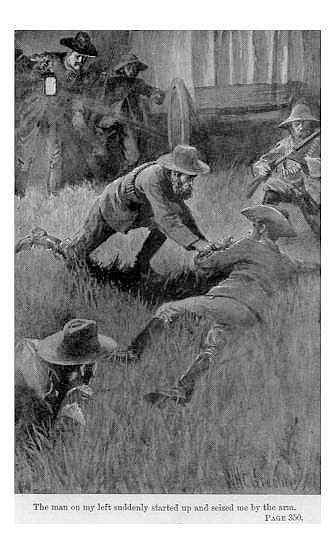
Then I felt that all was over, for the man on my left suddenly started up and seized me by the arm.
“Open that lantern again, Captain Moriarty,” he cried. “I want to see who this is we’ve got here.”
“Yes,” said another voice; “two of them. I’ll swear they weren’t here when we lay down.”
Chapter Forty Two.
In the Trap.
If either Denham or I had felt the slightest disposition to run, it was checked by the brotherly feeling that one could not escape without the other; but even if we had made the attempt it would have been impossible, for the words uttered by the big Boer at my side acted like the application of a spark to a keg of gunpowder. In an instant there was an explosion. Men leaped to their feet, rifle in hand; there was a roar of voices; yells and shouts were mingled with bursts of talking which rose into a hurricane of gabble, out of which, mingled with oaths and curses delivered in the vilest Dutch, I made out, “Spies—shoot—hang them;” and it seemed that after thrusting ourselves into the hornets’ nest we were to be stung to death.
The noise was deafening, and as we were held men plucked and tore at us, while the roar of voices seemed to run to right and left all along the line, alarm spreading; with the result that those outside the narrow space where the facts were known took it to be a sudden attack from the rear, and began firing at random in the darkness. In spite of the despair that came over me, I even then could not help feeling a kind of exultation—satisfaction—call it what you will—at the surprise we had given the blundering Boers, and thinking that if the Colonel had been prepared with our men to charge into them at once, the whole line of the enemy for far enough to right and left would have turned and fled, after an ineffectual fire which must have done far more harm to their friends than to their foes, and then scattered before our fellows like dead leaves before a gale.
However, we were not to be torn to pieces just then by the infuriated Boers, for we were each held firmly by two burly fellows, while Moriarty, yelling at the excited crowd in his highly-pitched voice, opened and held the lantern on high, so as to get a good look at our disfigured faces. The light fell upon his own as well, and I saw him start and shrink, as if for the moment he fancied that we had returned from the dead. But his dismay was only momentary. Then a malevolent grin of exultation came over his countenance, his eyes scintillated in the lantern light, and he yelled orders to those around till he obtained comparative silence.
“Pass the word all along the line,” he shouted. “False alarm. Only spies, and we have got them. Cease firing.”
His words had but little effect for a few minutes; but by degrees the tumult was stilled and the firing ceased. The men about us readily obeyed the Irish captain’s orders.
“They’re old fr’inds of mine,” he said, with a peculiar grin—“dear fr’inds who have come after me to join our ranks; and I’m going to make them take the oaths properly.”
There was a groan of dissent at this, but Moriarty paid no heed; he only showed his teeth at us in a savage grin like that of some wild beast about to spring.
“Yes,” he continued, “they’re old fr’inds of mine—dear fr’inds. That one”—he pointed to me—“is a deserter from our forces, and the other miserable brute is an officer who has been fighting against us and helping his companion. Be cool and calm, dear boys, and as soon as it is light you shall have the pleasure of shooting the young scoundrels. For we’re all soldiers now, and we must behave like military min, unless you would like to set a Kaffir to hang them both from a tripod of dissel-booms at the two ends of a rein.”
“Shoot them! Shoot them!” came in a burst of voices.
“Very well, we’ll shoot them; but we must do it properly. We’ll have a court-martial upon them, and teach the spies to crawl into our camp like snakes.”
“It’s a lie!” I shouted. “We are no spies.”
“Ah! you understand the beautiful language of my fr’inds,” cried Moriarty. “You are not spies, then?”
“No, neither of us,” I said in Dutch.
“Indade?” said Moriarty. “And perhaps you are not a deserter from our troops?”
Amidst hootings, groans, and yells, I managed to make myself heard.
“No,” I said, “I am not a deserter. I am English, and I refused to fight against my own countrymen.”
A savage yell greeted my plain words; but Moriarty held up his hand.
“Let him condemn himself out of his own lips, brethren,” he cried.—Then, to me, “You preferred to fight against and shoot down the people among whom you dwelt?” he cried.
“I joined my own people,” I replied; “and this gentleman with me is no spy.”
“What is he, then?” said Moriarty, holding up his hand in the light of the lantern he kept aloft, so as to secure silence.
“An officer and a gentleman of the Light Horse.”
“Indade!” said Moriarty sneeringly. “Then you have both had enough of the British forces, and have desarted to ours?”
“No,” I said coolly. “We have both been badly wounded, as you can see, and we wanted to break through the lines and get away.”
“What for?” said Moriarty fiercely. “What for?”
“We are too weak to fight,” I said.
“Bah!” roared Moriarty, “you are both spies; and do you hear? You shall both be shot by-and-by.”
A yell of triumph, which sounded like a chorus of savage beasts in anticipation of blood, rose from all around.
“Get reins and tie their arms behind them, my brothers. They’re English, and can spake nothing but lies.”
As some of the men hurried away to fetch the necessary cords, I turned to one of the big Boers who held me.
“Is it a lie,” I said, “that my friend has been badly wounded? Is it a lie that I have been hurt?”
There was a low growl for reply from one, and the other—the man who had first discovered my presence—only said, “But you are spies.”
“What are they all saying, Val?” said Denham coolly. “I don’t seem to get on at all in this game.”
“They say we’re spies,” I replied.
“Let ’em. A set of thick-headed pigs. Don’t be downhearted over it all, old chap. We played our game well, and we’ve lost. We’re prisoners; that’s all. They daren’t shoot us.”
I looked him fixedly in the eyes, but made no reply.
“Well,” said Denham hurriedly, “it’s murder if they do. But I don’t believe they will. Whatever they do, we won’t show the white feather, Val. I say, shall we give ’em the National Anthem?”
“Hush!” I said. “You’re a gentleman; don’t do anything to insult them; we’re in their power.”
“Yes; but I want them to see that we’re ready to die game. I say, Val, we’ve made a mess of it this time, and we might have been lying comfortably asleep over yonder.”
“No,” I said; “we should have lain awake thinking of how to get help for our friends.”
“True, O Calif! so we should.—Ugh! You ugly brutes. Tie our hands behind our backs, would you?—Here, Mr Irishman, there’s no need for this. We didn’t serve you so.”
“Oh yes,” said Moriarty. “Spies like to get all the news they can, and then to run away with their load.”
“After treacherously trying to murder the sentry on duty, and then treacherously striking down two people in the dark.”
“Hwhat!” cried Moriarty fiercely.
“I mean you, you cowardly hound!—you disgrace to the name of Irishman!”
There was the sound of a smart blow, and Denham staggered back against the men who were binding his wrists.
A cheer rose from some of the fierce men around us, a murmur of disapprobation from others, as Denham recovered himself and stood upright, with his chest expanded and a look of scorn and contempt in his eyes.
“Yes,” he said quietly, “you are a disgrace to a great name. I am a prisoner, and my hands are tied.”
“Silence, spy!” cried Moriarty fiercely, and a dead silence fell.
“I’ll not be silent,” said Denham. “Val, if we die for it, repeat my words in Dutch. But if I live I’ll kill that man, or he shall kill me.—Moriarty, you’re a treacherous coward and a cur, to strike a helpless, wounded man.”
“A treacherous coward and a cur, to strike a helpless, wounded man,” I said aloud in the Boer tongue, the words seeming to come from something within me over which I had no power whatever.
Moriarty, white with fury, turned upon me, but one of the two men who held me interfered, saying bluntly, “Let him talk, Captain; his tongue will soon be still.”
“Yes, yes,” said Moriarty, with a forced laugh; “his tongue will soon be still. Putt them in the impty wagon, and bind their legs too. Then put four men over them as guards. You’ll answer for them, Cornet.”
The grim looks of the two speakers and the horrible nature of their words, which meant a horrible death, ought to have sent a chill through me; but just then I was so excited, so hot with rage against the cowardly wretch who had struck my friend, that I did not feel the slightest fear as to my fate; and, obeying the order to march, I walked beside Denham with my head as erect as his, till we were by the tail of a great empty wagon, into which two of the Boers scrambled so as to seize us by the pinioned arms, causing great pain, as they stooped, and then dragged us in as if we had been sacks of corn, and then let us down.
“Look here,” said my captor, speaking from the tail-end of the wagon, “there are four men on duty with rifles, and their orders are to shoot you both through the head if you try to escape. Now you know.”
While he was speaking one of the men who had dragged us in reached out his hand for a lantern, which he took and hung from a hook in the middle of the tilt.
Then he and his companion dropped down from the end of the dimly-lit wagon, and we were alone for a few moments. But the two men who had left us returned directly with two more reins and set to work binding our ankles together as tightly as they could.
“There,” said one of them, in Dutch, as soon as they had finished, “we can see you well from outside, and you know what will come if you try to get away.”
Then we were alone again, and as the curtain of stout canvas at the end ceased to vibrate, Denham as he lay back began to laugh merrily.
“Denham!” I cried.
“I can’t help it, old chap,” he said. “It’s very horrible, but there’s a comic side to it. Blows hit terribly hard.”
“Yes, the coward!” I cried passionately, “to strike you like that!”
“I wasn’t thinking of that, old chap,” he replied. “Yes, that was as nasty a thing as the savage could do; but I was thinking of how hard you can hit a sensitive man with your tongue.”
“What do you mean?” I said.
“Moriarty! Why, I spoke quite quietly, but if I had given him a cut across the face from the left shoulder with my sabre, which cuts like a razor, it wouldn’t have hurt the brute half as much.”
“Don’t—don’t talk about the business,” I said bitterly.
“Why not? I’m just in the condition that makes my tongue run. But I say, old chap, we’ve made a pretty mess of our scheme. Never told a soul what we were going to do, so we can’t get any help.”
“And left a hanging rope to show our people that we have run away and deserted them in their terrible strait.”
“Yes; that’s about the worst of the whole business, my lad. Well, we meant well, and it’s of no use to cry over spilt milk. I don’t think it will be spilt blood; but it may, and if it does I’m going to die like a soldier with his face to the enemy, and so are you.”
“I’m going to try,” I said simply.
“Then you’ll do it, like a true-born Englishman,” he said cheerily. “How does that song go? I forget. There, never mind. I won’t act like a sham, even if I am where there’s so much Dutch courage. Now, look here, Val.”
“Yes?” I said gravely.
“We’re weak from our long sickness, and done up with the exertion of what we’ve gone through.”
“Yes,” I said; “I feel as weak as a rat.”
“Then we’re going to sleep, so as to be ready to face them in the morning.”
“What!” I said. “Can you sleep at a time like this?”
“My dear old Val, as you said about facing the muzzles of the Dutch rifles, I’m going to try.”
Chapter Forty Three.
In the Dark Watches.
“I can’t sleep,” I said to myself, feeling that history was repeating itself, as I lay on my side in the lit-up wagon, with my wrists tied behind my back and my torture increased by having my legs served in the same way just above the ankles and again above the knees. “No one could sleep in such a position,” I thought to myself; but I did not speak to my companion in misery. I was too weary and heart-sore, thinking that I should never see father, brother, aunt, or home again. “Poor old home is gone for ever,” I remember, was the thought that occurred to me. Next I fell to wondering what had become of my people, and whether they had fled to Natal. Then my thoughts turned quickly to something else: to the heavy, regular breathing of Denham, who was fast asleep and suffering from a bad dream, for he began muttering angrily. Then he was silent, but only to begin again. I believed I knew the subject of his dream, for he suddenly exclaimed, “Coward—coward blow!” Then he was silent for a few minutes, breathing hard and fast as if his growing excitement had worked up to fierce passion, for he was going over the scene of an hour ago, ending with “I’ll kill you—or you shall kill me.” He was suffering as if from a nightmare; and, unable to lie there listening, I managed to work myself along over the rough, cage-like bottom of the wagon till I could get my face close to his, just as he was panting and sobbing as if in a desperate encounter in which his strength was rapidly ebbing away.
“Denham!” I whispered. “Denham!”
“Ha!” he sighed softly, and ceased to struggle; while, as I lowered my head from the painful position into which I had strained it, I felt relieved to know that the poor, overwrought companion of my adventure could forget his sorrows for the time in sleep.
“I wish I could sleep, and never wake again; for when the time comes I shall be a coward”—such was the train of my thoughts. “Yes, I am sure to be a coward. One doesn’t think of the bullets when one is fighting and they ping and whiz by one’s head; but to stand up and face a row of rifles, waiting for the order to fire—I’m afraid I shall be a coward then.”
I shivered now; and a minute later, as I listened to Denham’s breathing, I shivered again. Perhaps it was from fear, perhaps it was from being cold, for the night wind, not far removed from freezing, blew up through the openings in the bottom of the wagon. I told myself it was from dread, and a peculiar feeling of shame and despair attacked me as the thought of what would occur on the coming morning rose up so vivid and clear that I strained my eyes round a little so as to look up at the hanging lantern, but lowered them again with a shudder, for I seemed to see a row of rifle-muzzles with the orifices directed down at me.
A noise occurred at the end of the wagon almost immediately, and upon looking back there was in reality the barrel of a rifle forcing back the canvas curtain, and then a second barrel appeared; but the owners only used their weapons to hold back the curtain while their big-bearded faces peered in to see if the prisoners were safe. They disappeared directly, and I could hear muttering, and could smell the fumes of their strong tobacco.
I was thinking with something like envy of the Boers’ lot as compared with mine, and the envy had to do with Denham, who was sleeping soundly; and then something happened—the something which I had thought impossible; but it was quite true. I was staring painfully up at the lantern which shed its yellowish glow all around, and then it seemed to have gone out, and I was fast asleep, with the restful sensation which comes of utter exhaustion. I dreamed, and it was of home and the beautiful orchard I had helped to plant, of driving in the cattle, of chasing the ostriches over the veldt; and then it was of having Bob and Denham with me in a wagon, for we were after lions. It was night, and the moon shone in through the front of the wagon with a yellowish light like that of a lantern hanging from the top of the tilt. The wind was blowing up icily through the bottom, and I had just been awakened by the distant deep barking roar of one of the great sand-coloured brutes. His roar had startled our oxen and made them low uneasily, as if they knew what the fate of one of them would be unless a flash of fire came from beneath the wagon-tilt just as the lion had crawled up and gathered himself together for a spring. The night was very cold, and somehow the thought occurred to me that it would be a good thing if that lion made a bound right on to the wagon-box, and then jumped in to seize me and carry me off as a cat does a rat; and when its roar sounded again, nearer, all dread and pain died out, for it seemed as if it would be far better to be killed by a lion than to stand up before the muzzles of a dozen rifles and be shot as a spy, while Moriarty stood smiling malignantly at my fate. It was all very vivid as the oxen bellowed softly now, and Bob whispered into my ear, his breath feeling quite hot after the chilling iciness of the night wind. “Cheer up, old Val,” he said; “they won’t dare to shoot you. I shall be there, and if they attempt it, and that Irishman gives the order—you know how true I can aim? I’ll send a bullet right through his head, if father isn’t first.”
I started violently and made an effort to rise; but I only succeeded in making a noise, as I looked up, to see the yellow lantern sending down its feeble light; but a lion was barking faintly in the distance, and some oxen close at hand were lowing uneasily. There was another sound, too, at the back of the wagon—that of some one climbing up—and in a wild fit of anxiety I listened for Bob’s voice again. But it was only that of the Boer who had first seized me, and he spoke in a gruff but not unkindly way, as he said in his own tongue:
“Hullo! What’s the matter? Lion scare you?”
“I’ve—I’ve been dreaming,” I faltered heavily, my heart beating all the time with big, regular thumps.
“Oh!—He’s dreaming too. You’re two brave boys to sleep like that the night before you’re both to be shot for spies.”
“Ah!” I sighed as he dropped back heavily from the back of the wagon, “and it was all a dream. Ugh!” I shuddered. I lay still again, my mind going over the fantasy of the night, which came back so vividly, yet was so strangely mixed and absurd; but all the time Denham slept on, breathing heavily, dead to all the sorrows and horror of our unlucky situation.
The night was cold—bitterly cold—and I was dreadfully wide awake, wishing now that I could sleep again, but wishing in vain. I lay and listened to the sound of talking outside, two of the Boers engaging in a conversation in which I heard the word “cold.” Then there came the sound of the drawing aside of the back curtains, and a big, soft bundle was pitched in, then another. Directly afterwards two of our guard climbed in, opened one of the bundles, and spread it out on the floor beyond us. It was a great skin karosse, or rug, such as the Kaffirs make up of the hides of the big game.
“It’s a cold night,” said the man who had spoken before; and, one at my head and the other at my feet, they lifted me between them on the big rug.
“Now, sleepy,” he said, “rouse up.”
But Denham was perfectly insensible in his deep sleep of exhaustion, and unconscious of what was going on as he was laid beside me. Then the second bundle was opened and thrown over us.
“There,” said the big Boer; “we don’t want you to be too cold to stand up like men in the morning. Can you go to sleep now?”
“Yes; thank you,” I said hoarsely, and I lay and listened as they got out of the wagon.
“Can I sleep?” I thought. “No. But if I could, and dream all that again! Poor old Bob!” I murmured to myself as a peculiar sensation of warmth began to creep through my numbed limbs, and once more I lay thinking about that strangely confused and realistic dream of which fragments began to flit before me, and for a time made me more wakeful, but not for long. Then the morning, the thoughts of my coming fate, the recollection of the night-alarm which seemed to have put an end to what must have been intended for a night-attack, even the sense of pain—all these died away, and I was soundly asleep once more; this time without a dream.
Chapter Forty Four.
In the Queer Prison.
I was roused up by the great skin-rug being jerked off me. I tried to rise, but sank back, just able to repress a groan, and stared wildly at the four bearded faces looking down at me. The curtains at front and rear had been thrown back, and the sun was shining in from the front, the horizontal rays striking right through the wagon. For a few moments I was so much confused and stupefied by sleep that I could not grasp the meaning of the scene. Then like a flash it all came. These four Boers were going to lead us out to execution—to be shot—the fate of spies!
I set my teeth, and felt as if getting hardened now. My eyes turned to Denham, who was seeking mine. He did not speak, but nodded and smiled faintly, the look giving encouragement. Clenching my teeth, together, I mentally vowed I would not let him be ashamed of me.
Just then my attention was diverted by one of our morning visitors, who differed in appearance from the others. He was better dressed, wore his hair short, and his moustache and beard were clipped into points. His hands, which he laid upon my shoulders, were white. To my surprise, this man examined my head, with its bandages and traces of injuries. Then he looked hard in my eyes, and turned me a little over to examine my tightly-bound wrists and ankles. Next he examined Denham in the same way, my comrade gazing straight away, with his brow knit and lips tightened into a thin red line, but he never once glanced at the examiner.
“Well,” said the latter, rising from one knee, “even if they are spies, you need not treat them as if they were wild beasts.”
“Captain Moriarty’s orders,” said the Boer, whom I recognised as my captor of the previous night.
“Bah!” growled the other angrily. “You are soldiers now; act like them.”
I was listening with a feeling of gratitude that this man spoke differently from the others, and he saw my eyes fixed upon him.
“Do you speak German?” he asked sharply.
“No,” I replied; “but I understood you just now.”
He nodded, and then turned to the others to speak in a low tone. The result of this was that two of the men knelt down and set our arms free, placing them before us, for they were perfectly numb and dead. Mine looked as if the thongs had cut almost to the bone, the muscle having swollen greatly.
The party then went out at the back; but my captor, who was last, turned back and said:
“There are two sentries with loaded rifles at each end, and they have orders to fire.”
“What did he say, Val?” asked Denham as soon as we were alone.
I told him, and he laughed softly.
“What is it?” I said wonderingly.
“I was only thinking,” he replied. Then quickly, “Will they bind our hands again—at the last?”
“I don’t know,” I said in a low, husky voice. “Perhaps not.”
“Let’s hope not; and we must rub some feeling into them first.”
“What are you thinking about?” I asked.
“Don’t you know, old fellow? Guess.”
I shook my head.
“Well, it is hard work; but look here: they didn’t search us last night, only tied us hand and foot. We’ve got our revolvers inside our shirts. Let’s have one shot each at Moriarty before we die.”
I looked at him wonderingly, for the vivid dream of the night came back, and my brother’s words seemed to be thrilling hotly in my ear once more.
Denham looked at me curiously.
“Well,” he said, “wouldn’t you like to shoot the wretch?”
“No,” I said; “not now. If we are to die I don’t want to try to kill any more.”
Denham frowned, and sat gently rubbing his wrists. I followed his example during nearly an hour. While thus employed we could hear a good deal of bustle and noise going on in the neighbourhood of the wagon, and sundry odours which floated in suggested that the Boers in camp did not starve themselves. Meanwhile we were very silent and thoughtful, expecting that at any moment we might be summoned to meet our fate.
At last there was the sound of approaching steps, and I drew my breath hard as an order was given to halt, followed by the rattle of rifles being grounded.
I was unable to speak then, but held out my hand quickly to Denham, who seized it in both of his, and his lips parted as if to say good-bye, yet no words were uttered. The next moment he let my hand drop and turned his eyes away, for the big Boer who had become so familiar now climbed into the wagon, glanced at us, and then reached down outside for two large pannikins of hot coffee, which he carefully lifted inside.
“Here,” he said gruffly; “help to keep up your spirits.”
He set the tins beside us, then went to the back of the wagon and reached down again for a couple of large, newly-baked cakes, which he handed to us.
“The Irish captain didn’t give any orders,” he said; “but we don’t starve our prisoners to death.”
With that he scowled at us in turn, and left the wagon.
“Toll me what he said, Val,” whispered Denham in a tone of voice which sounded very strange.
With difficulty I repeated in English what the man had said; I felt as if choking.
“I wish they hadn’t done this, Val,” said Denham after a minute’s interval. “It seems like a mockery.”
I nodded, then remarked, “That man seems to have some feeling in him.”
“Yes; but we can’t eat and drink now.”
“No,” I replied. “I feel as if food would choke me.”
Denham nodded, and sat gazing out at the bright sunshine.
“Think it would give us a little Dutch courage if we had some breakfast?”
“I don’t want any,” I said desperately. “I want them to put us out of our misery before that wretch Moriarty comes back.”
“But we want to face them like men,” said Denham suddenly. “We’re so weak and faint now that we shall be ready to drop. Let’s eat and drink, and we will show the Boers that English soldiers are ready to lace anything.”
“I can’t,” I replied desperately.
“You must,” cried Denham. “Como on.” He took up his pannikin, raised it to his lips, and took a long deep draught before setting the vessel down and taking up the cake.
“Come, Val,” he said firmly, “if you leave yours the Boers will think you are too much frightened to eat.”
“So I am,” I said gravely, “It is very awful to face death like this.”
“Yes; but it would be more awful if we stood before the enemy trembling and ready to drop.”
I nodded now. Then catching up the tin in desperation, I raised it to my lips and held it there till it was half-empty. Setting the pannikin down, I took up the cake, broke a piece off, and began to eat. The animal faculties act independently of the mental, I suppose; so, as I sat there thinking of our home and our approaching fate, I went on eating slowly, without once glancing at my companion, till the big cake was finished; then I raised and drained the pannikin.
It was while I was swallowing the last mouthful or two that Denham spoke in a low tone. Looking in his direction, I noticed that he had also finished the rough breakfast.
“They’re watching us, Val,” he said softly.
I glanced round to back and front, and saw that the big Boer and four others were looking in, the sight making the blood flush to my face.
Directly after the big fellow climbed in, to stand by us with a grim smile.
“Have some more?” he asked.
“No, thank you,” I replied.
“Hungry—weren’t you?” was his next question.
I bowed my head.
“Well, it’ll put some courage into you.”
He picked up the two pannikins, and stepped out again.
“I’m glad we took it,” said Denham. “It’s better than looking ready to show the white feather.”
“I don’t think we should have faltered even without the food,” I replied.
We both relapsed into silence now, for talking seemed to be impossible. We had to think of the past and of the future. One minute I felt in despair, and the next I was filled with a strange kind of hope that was inexplicable.
It was during one of these oft-recurring intervals, as the time wore on, that Denham turned to me suddenly and said, just as if in answer to something I had said, for his thoughts were very much the same as mine:
“There, I can’t make anything else of it, Val: we were doing our duty, and trying to save the lives of our friends.”
“Yes,” I said quietly; then, both shrinking from speaking again, we sat listening to the sounds outside. From time to time one or other of the men on guard looked in to see that we were safe, though for the matter of that we had hardly thought of stirring, as escape seemed to be quite impossible.
It was about midday, after a very long silence, when Denham suddenly remarked, “It went against the grain at first, Val; but I won’t attempt to fire at that brute. He’ll get his deserts one of these days. You’re right; we don’t want to go out like that. I want us to be able to stand up before the enemy quite calm and steady. We must show them what Englishmen can do.”
I could not speak, but I gave him a long and steadfast look.
The sound of footsteps was again heard, and I was not surprised this time when our friendly Boer brought us two good rations of freshly-roasted mutton and two cakes. These he put down before us without a word, together with a tin of water, and then left us.
Denham looked at me, and I looked at him, as—each feeling something akin to shame—we ate the food almost ravenously. Then the afternoon was passed in listening to the busy movements of the Boers; but we never once tried to look out of our strange prison.
At sunset, as I looked at the glorious orange colour of the sky, a curious feeling of sadness came over me, for I realised it was the last time I should behold the sun go down. There was such a look of calm beauty everywhere that I could hardly realise the fact that we were surrounded by troop upon troop of armed men ready to deal out fire and destruction at a word; but once more my musing was interrupted by the big Boer. He brought us coffee again, and this time cake and butter.
“There,” he remarked as he placed all before us, “make much of it, boys, for I shan’t see you again.”
A chill ran through me; but I don’t think my countenance changed.
“I’m going away with our men to the other side yonder, and the Irish captain’s coming back. Good-bye, lads,” he said after a pause. “I’m sorry for you both, for I’ve got two boys just such fellows as you. I’m sorry I caught you, for you’re brave fellows even if you are spies.”
“We are not spies,” I replied quietly. I was determined to speak now; I wanted that Boer to look on us as honest and manly.
He shook his head. I repeated the words passionately.
“Look here,” I said; “we have been wounded, and were on the sick-list. We could do no good, so we said we’d try and got through your lines and fetch help.”
“Ah!” cried the Boer slowly and thoughtfully. “Yes, I see. But you were caught, and I can do nothing, boys. Moriarty will have you shot in the morning when he comes back, and begin to rage because it is not done. Well, life’s very short, and we must all die. I’m going to fight to-night, and perhaps I shall start on the long journey too, for your men fight well. God knows best, lads; and there is no fighting yonder—all is peace.”
He bowed his head down and went out of the wagon without a word. When Denham asked me a few minutes later what the Boer had said, my voice in reply sounded hoarse and strange, quite unlike my usual tones.
We were now in darkness. The coffee was cold; the cakes lay untouched. We were both sunk in a deep interval of musing; but Denham broke the silence at last.
“Then we have another night of life, Val,” he remarked.
“Yes,” I replied; “and then the end.”
“Look here,” he said thoughtfully, after he had taken up the coffee-tin and drunk; “that Boer said that he was going over yonder to-night to fight, and that perhaps he would be where we were.”
“Yes—dead,” was my reply.
“Perhaps, Val. What do the doctors say?—‘While there’s life there’s hope.’”
“I see no hope for us,” I said gloomily.
“I do,” Denham whispered in a low, earnest tone. “We’ve been too ready to give up hope.”
I smiled sadly, stretching out my swollen legs.
“Yes, I know,” said Denham; “but my hands are not powerless now, and I have still a knife in my pocket—the one with which I cut the reins—and it will cut these.”
His words sent a thrill through me, and I glanced at the two openings in the wagon.
“Be careful,” I whispered.
“All right; but the Boers don’t understand English. Look here, Val; if the big friendly fellow is going to fight to-night, what does it mean?”
“Of course,” I replied excitedly, “an attack upon the fort. They’re going to get in when it’s dark; and if they do there’ll not be half of our poor fellows left by morning.”
“Couldn’t we slip off as soon as it’s dark, and warn them? Once we were outside the lines we might run.”
“Might run?” I said bitterly. “I don’t believe we could even stand.”
“Ah! I forgot that,” he muttered, with a groan. “Well, nothing venture, nothing have. It’ll be dark enough in a few minutes, and then I shall slip the knife under your ankles and set your legs free. When that’s done you can do the same for me.”
“Suppose the Boers come and examine us?”
“We must risk that. Perhaps they’ll just come and look at the cords with a lantern. We must sit quite still until they come.”
“No,” I said eagerly; “don’t let’s cut the rope till they’ve been. I dare say they’ll come for the pannikins, and perhaps that Boer has told them to bring us those rugs again.”
Chapter Forty Five.
A Damper For Our Plans.
I had hardly ceased speaking when a couple of our guards appeared at the back of the wagon, and climbed in after they had tossed in the two big rugs they had taken away when the German doctor came to examine us.
Though anxious to dart a quick glance at Denham, I dared not, for at the first glance I saw that each man was provided with a rein. Taking our tins and passing them to two men whose rifle-barrels appeared above the back of the wagon, they returned to where we sat up and carefully examined our bonds, one of them giving a grunt and speaking to his companion as he pointed to them. They next dragged our arms roughly behind us, slipping our hands through running nooses, which they drew tight before winding the thongs round and round, securing them as firmly as ever.
“You needn’t have done that,” I said angrily to the man who, while tying me up, had roused my resentment by his brutality.
“We’ll take them off in the morning, when the Captain comes,” he replied. The other man laughed. They had finished their task deftly enough.
“That’s the way we tie up a Kaffir,” said the first one.
“Yes,” replied the other; “and it does just as well for a spy. There, you may thank the field-cornet, Piet Zouter, for the skin-rugs. You wouldn’t have got them from us.”
“Then we won’t thank you,” I said bitterly.
“And look here; we’ve six men with loaded rifles about the wagon, and they’ve orders to shoot if you try to get away.”
I nodded my head. One of the Boers lifted down the lantern, passed it out, and received a fresh one from a comrade. After this the men retired; and we were alone, listening to their talk, with the sentries placed over us. When the conversation ceased I whispered to Denham an interpretation of all that had passed.
“The brutes!” he muttered. “Lucky we hadn’t cut our ropes; they would have found us out. Now, what’s to be done? We must get away.”
“How?” I asked sadly.
“Let’s draw the rugs over us, lie down, and keep on trying till we can wriggle out of the thongs.”
“How are we to get the rugs over us?”
“As a bird makes a nest—with the beak.”
I laughed bitterly. Then we each tried in turn, but vainly, and afterwards lay back panting and in great pain.
“I know,” I said. I called aloud to the sentries.
There was a rush, and a man appeared at once, his rifle rattling against the back of the wagon. I told him what we wanted, and in a grumbling way he climbed in and did as requested, spreading one karosse and drawing the other as a cover up to our chins.
“Now loosen the reins about our wrists,” I said; “they hurt dreadfully.”
The man laughed.
“It isn’t for long,” he answered brutally. “Do you want to try to escape, so as to be shot before morning?”
With this parting sally, he climbed out of the wagon, leaving us alone. We lay still for about half-an-hour, when the sentries looked in from front and back to see us lying as if asleep; but as soon as they had gone we began a hard struggle to get our wrists free. In this attempt we only gave ourselves excruciating pain, and found, to our despair, that the knots of the Boers were far too well tied to be loosened. At last, with a groan, Denham gave up the attempt. I desisted then, having only waited for him to set the example.
“What does that sound mean?” asked Denham after a time.
“Moving horses,” I replied.
“Yes; they’re going to take advantage of the darkness for an advance against the fort. Oh dear! We shall have to lie here and listen to the firing soon. Val, I don’t think I’d mind being shot in the morning if I could only warn the Colonel. Do you think you could gnaw through my rein?”
“I’ll try,” I said; and Denham was about to turn his back to me when we heard a sound behind us—that is to say, at the front of the wagon—which we knew to be caused by one of the sentries looking in. It soon ceased; but just as I was going to fix my teeth in the thong which bound my companion’s wrists there came another noise at the foot, and then again there was silence. But not so at a short distance, for we could hear whispered orders plainly enough as we lay still, followed by the tramp of horses’ feet, and now and then the clink of bit or buckle, which gave ample intimation that the Boers were slowly making an advance, not to invest the fort more closely in a contracted ring, but, as far as we could make out, in our direction.
“They’re marching in troops, I believe,” whispered Denham, “and they must be making for the gateway. Then they’ll dismount and deliver an attack. They mean to take the place by assault.”
“And we are to go through the agony of lying here and listening all the while, perfectly helpless. Oh Denham, they’ll never carry the place—will they?”
“Not unless it’s quite a surprise,” he replied. “Oh no,” he added more confidently; “our lads will be too smart for that.”
“They’ll try hard,” I said, “and fail, losing a great number of men, and they’ll come back at daybreak mad with rage.”
“And shoot us,” said Denham coolly. “That’s it.”
“Let me try at your knots now.”
“No. Listen; the sentries are coming in again.”
He was right; for, as if suspicious, the sentries climbed in, four strong, two standing with rifles at the ready, while the others stripped down the top rug and carefully examined our wrists and ankles, then spread the karosse over us once more, uttering grunts of satisfaction as they did so.
Alone again, we lay listening for the movements of the Boer troops: but the sounds had nearly died out.
Then the sentries began to talk together earnestly, and it seemed as if the man on duty in front of the wagon had joined those at the back, with the result that the conversation was becoming excited.
“They’re on the lookout after the advance,” whispered Denham. “It seems to be very dark outside. I believe it will not be long before we hear the attack begin.”
“No; they’ll wait till our men are asleep.”
“Perhaps,” said Denham; “but it must be getting late. Our fellows may be asleep now.”
“Yes,” I replied, with a sigh; and then irritably, “Why did you do that? You can whisper.”
“What do you mean?” he asked after a pause.
“Hitting me on the hands like that. You hurt me dreadfully.”
“I didn’t—” he began; but I stopped him with an excited “Hush!” and lay perfectly still, the perspiration starting out all over me.
“What is it?” whispered Denham, after waiting for some time. “What’s that gnawing and tearing sound?”
“Something under the wagon,” I replied very softly.
“A lion?” he whispered.
“No; some one as brave as a lion. He has been cutting a long slit in the karosse, and now he has hold of my wrists with one hand, and he’s sawing with a knife through the thong with the other.”
“Val!” panted the poor fellow wildly.
The hot perspiration on my face turned icily cold at this cry, for I heard a quick movement among the sentries, and two of them sprang up on the wagon to look at us lying there upon our backs beneath the upper karosse, under the yellow light of the lantern. I thought now all was over; the new hope had faded out into darkness; but a measure of confidence returned when Denham, feigning sleep, muttered, and uttered a sob which ended in a low, uneasy groan.
My eyes not being quite shut, I could dimly see through the narrow slit the faces of two of the Boers, one showing his teeth in a grin as they drew back and returned to their companions, when the talking began again. As this went on I felt the sawing movement of the knife being resumed, the two active hands which had been passed between the slits in the wagon-bottom working more rapidly. Then there was a pause, and I felt terrible pain as something thin and hard was passed under one of the bands before the sawing recommenced. I could hardly repress a cry of pain; but silence meant perhaps liberty and life. I knew, too, that it was a piece of iron that had been thrust in for the knife to cut down upon and save my wrist from a wound.
Just then Denham whispered, “I couldn’t help it, old chap; but I cheated them afterwards. Is he still cutting?”
“Yes; he has gone through the reins on my wrists, and has begun at my ankles.”
“Val,” whispered Denham again, with his face below the great rug, “it’s that big black angel of a fellow, Joeboy.”
“No,” I said softly, though I could hardly utter my thoughts, my voice panting with emotion. “It’s not Joeboy: the hands are too small. It’s my brother come to our help.”
I knew now that my previous night’s experience was not a dream, and that Bob really was in the Boer camp with my father, and had crept under the wagon and whispered hope.
“Are there two Val Morays in the world?” murmured poor Denham, with something which sounded very much like a sob.
Lying perfectly still, I made no answer. I knew that the knife had set my ankles free; but they were still tethered, not by raw-hide rope but with insensibility, as if perfectly dead.
“They will come right in time,” I thought, my heart meanwhile beating fast. “Bob will tell us what to do. Will it be to make our escape when the attention of the Boer sentries is taken off us by the coming attack upon the fort?”
Then I was listening to a low tearing sound as of the knife passing once more through the skin-rug, and directly after I heard Denham begin to breathe hard. I understood what that meant. Making a slight effort, as I lay covered up, I brought my arms out from beneath me, numbed and aching but not powerless, and thrust my left hand inside my flannel shirt, my fingers coming in contact with the butt of my revolver.
“My hands are free, Val,” Denham whispered faintly.
“Feel for your revolver,” I whispered back. “Hist! Careful”—for I could plainly hear the Boer sentries coming towards the wagon again, and the faint cutting noise ceased as the talking stopped.
One of the men placed his hand on the back of the great vehicle, and was in the act of climbing in, doubtless to examine our fastenings again. My left hand now clutched my revolver tightly, though I knew that we could do nothing, in our helpless state, to save ourselves.
“Oh, how hard!” I thought; “just when there was a chance of life!”
Then my breath seemed to stop short, for the sound of a shot came to us from out of the distance where the Boer advance must be. This checked the climbing Boer. Then another shot, and another. He had dropped back to join his companions, who were doubtless gazing towards the fort, where the firing was rapidly increasing into a perfect storm.
I heard no more of the cutting; but Denham whispered that his feet were free, and almost at the same moment a hand felt for my face and then seized my ear as if to pull it down to the owner of that hand.
Understanding what was wanted, I turned over on my right side and laid my ear against the opening, listening.
“Don’t try to get up,” buzzed into it, and seemed to set my brain whirling. “The Boers are making a great attack on the fort, and you two must try and creep out while the sentries are listening to the firing. Can you both run?”
“We could not stand up to save our lives,” I whispered. “Our legs are quite numb and dead.”
“Then I must carry you to where father is waiting,” was whispered.
I uttered a low sigh of misery, for I knew that was impossible. The Boers must hear the movements, even if so young a lad as my brother had possessed sufficient strength.
“Lie still, and sham sleep,” was the advice from below. “Your legs will get better. The Boers won’t be back for hours yet. Hark!”
There was no need to speak, for the firing grew louder and louder, as if echoing from the walls of the fort, not much more than half a mile from where we lay; and I was thinking that a terrible assault might be made, when my brother whispered again:
“The Boers mean to take the place to-night. Now, do as I say. Pretend to sleep. I’m going to fetch father.”
He had hardly ceased speaking when there was a rush of feet, and one of our guards scrambled up at the back, rifle in hand; but he contented himself with looking in when he saw us lying apparently unmoved beneath the rug.
“Hear that?” he said loudly.
“Yes,” I replied as calmly as I could.
“There’ll be hundreds more prisoners to shoot in the morning. Lie still, you two, for if you try to move we’ll serve you like jackals on the veldt.”
At that moment he turned sharply to listen, and I listened too. As the Boer suddenly leaped down, uttering a warning cry, I sat up, and Denham followed my example; for there was a rushing sound in the darkness from the side opposite that fronting the fort, and the tramp of many feet, followed by the ringing notes of a bugle, taken up by another and another, succeeded by so close a volley that the wagon lantern looked dim in the flashes from the rifles. Then came a ringing cheer, bugle-notes sounding the charge; and in the darkness, with cheers that thrilled us through and through, a couple of regiments rushed the Boer lines from the rear with the bayonet.
Chapter Forty Six.
How we were saved.
“Hurrah!”
“Hurrah!”
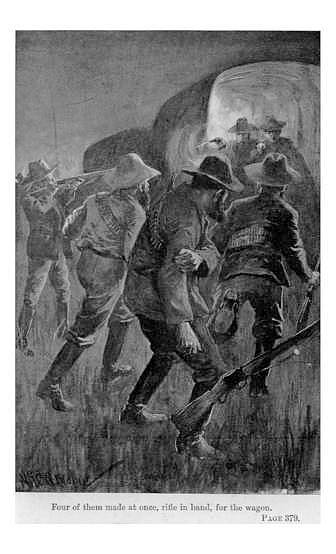
We yelled together with all our might; but our cheers sounded like whispers amidst the noises of firing in front and the rush of men from the rear. The Boer sentries, however, were true to their duty even in the midst of the terrible confusion in their lines; and four of them made at once, rifle in hand, for the wagon. But we were mad with excitement now, and crack, crack, our revolvers began to speak. Our shots and the rapid advance of the soldiers made them turn and flee.
Then came the crash: the cheering and bayonet-work of the charge, as our men dashed through the Boer lines, scattering them, horse and man, across the veldt, panic-stricken.
“Denham,” I cried excitedly; “my friends!” He said nothing for a moment; then, unable to give me comfort, he said, “Oh, if the Colonel could only bring our fellows out now and charge!”
Just then bugles rang out the recall, and in the midst of the many sounds Bob’s voice rose from the front of the wagon: “In here, father—quick!”
The pair had only just clambered in when we heard the shouting of an order and tramping of feet, and half a company of foot with fixed bayonets dashed up to the wagon, the light within having attracted attention. At the moment it looked like escaping from one great peril to plunge into another; but, frantic with excitement, Denham saved us by his shout: “Hurrah! Prisoners; help!”
A young officer sprang into the wagon, sword in hand, followed by half-a-dozen of his men with bayonets levelled at us; but the officer halted the men.
“Prisoners,” he cried excitedly, “or a ruse?”
“Get out!” shouted Denham. “Do you take me for a Dutchman? Look at our hands and feet.”
A sergeant sprang forward and took the swinging lantern from the hook, opened its door, and, as he held it down, they saw our horribly swollen and useless limbs, with the hide-thongs just freshly cut through.
“Who did that?” asked the young officer.
“My young brother here,” I said quickly; “we were just going to try and escape.”
“Ah!” cried the young man sharply, as an angry murmur ran round the group. “You couldn’t escape with feet like that. I mean, who tied you up in that brutal way?”
“The Boers!” cried Denham passionately, for his face was convulsed, and he looked hysterical and weak now.
The soldiers uttered a fierce yell, and as others crowded to back and front I heard a burst of excited ejaculations, oaths, and threats.
“’Tention!” shouted the officer.
“Now then,” he cried, “who are you? Oh, I see you both belong to the Light Horse.”
“Yes,” I said, for Denham was speechless. “They took us last night as we were trying to creep through their lines to come to you for help.”
“Ah!” cried the officer.
“They said we were spies, and we were to be shot at daybreak.”
“We’ve come and shot them instead,” said the officer. His men inside and out burst into a wild cheer. “But who are these? Boers?”
“No,” I cried quickly. “My father and brother, who came to help us to escape.”
“That’s right,” cried the officer, and the firing and cheering went on near at hand. Then he added hastily, “Sergeant and four men stop and help these gentlemen to the rear. Now, my lads, forward!”
He sprang out into the darkness, followed by his men, and we were left together, with my father down upon his knees holding me to his breast, and his lips close by my ear murmuring softly two words again and again—“Thank God! Thank God!” while Bob held on to one of my hands, jerking it spasmodically; and then I heard him cry out to one of the soldiers, “Don’t stare at me like that! I can’t help it. You’d be as bad if you were as young.”
“What!” cried a rough voice. “Why, I’m ’most as bad, and I’m six-and-thirty; and here’s big George wiping one eye on his cuff.”
“Sweat, Sergeant, sweat,” growled a rough voice, and there was a laugh from other three men.
“That was a lie, George,” said the Sergeant. “Why don’t you own up like a man?”
“Well, ’nuff to make any one turn soft when he’s cooling down after a fight like this. Look at them two poor fellows here.”
“Ah!” came in chorus, as the men standing around bent down in sympathy.
“’Tention!” cried the Sergeant. “Here. Files one and three mount guard front and rear of this dropsical timber-wagon. Two and four get some water. First aid here. Stop a minute. No; kneel down and just rub their legs gently as if you were trying to take out those furrows made by the ropes.—Why, your legs and feet are like stone, sir.”
“Are they?” said Denham, quietly now, as he reached forward to shake the Sergeant’s hand. “I didn’t know—I don’t feel as if I had any legs at all. There,” he added excitedly, “I want to shake hands with you all round. It’s so much better than being shot in the morning.”
“Ay—ay!” cried the men eagerly.
“Oh, never mind our hurts.”
“But we must, sir. I didn’t know you were an orfficer at first,” said the Sergeant. “I say, look at your head.”
“I can’t,” said Denham, with a faint attempt at mirth which was very pitiful.
“Well, I can, sir, and you can look at your comrade’s. Did the Boers do that too?”
“No,” cried Denham fiercely; “it was a brute of a renegade Irishman serving with the Boers.”
“Is he out yonder now, sir?” said the Sergeant, giving his head a side jerk in the direction from which, in the darkness, came the sound of cheering and scattered shots.
“Yes, I believe so,” said Denham.
“Then I’m sorry for him, that’s all,” said the Sergeant dryly.
“Ah! Do you think your men are whipping them?”
“Think!” cried the Sergeant scornfully. “Think, sir? Why, we’ve got at ’em at last with the bay’net. They’ve been playing at shooting behind a stone and firing at a target—targets being us—till we’ve been sick of it, and then up on horse and gallop away; but we’ve got at ’em at last with the bay’net, and there’s no need to think.”
“But,” I cried excitedly, as I strained my ears to listen, “they’re coming back.”
“Eh?” cried the Sergeant. “Here, files two and four support one and three. Hold your fire till they’re close in, and then receive ’em on your bay’nets.”
The two men who were chafing our deadened ankles sprang to their places, while my brother reached out of the side of the wagon and dragged in two rifles, evidently their own, and Denham and I cocked the revolvers we had thrust back into our breasts.
“That’s good business, gentlemen,” said the Sergeant grimly. “I like to see reinforcements when one’s in a tight place.”
He patted Bob on the shoulder as my brother took his place beside the two soldiers at the front of the wagon, my father going to the back.
“You can shoot, then, my lad?”
“Oh yes,” said Bob quietly. “My father taught me five years ago.”
“That’s right,” said the Sergeant, and he set the lantern on one side and covered it closely with one of the rugs. “Now, silence. We don’t want to invite attack. Here they come! They’re mounted men, and they may sweep past. Hear that bugle?” he said to me.
“Yes,” I replied, almost below my breath.
“Officers hear them coming. Prepare for cavalry. Here they come. They’ve rallied, and— No, no. Hark! Hark! Hurrah! No, no; don’t cheer, my lads. They’re racing for their lives, and there’s a line of cavalry after them.”
“Hurrah, Val!” shouted Denham wildly. “Our Light Horse out and at ’em at last!”
“Oh,” I groaned, “and we not with them now!”
“But they’re sweeping after them in full charge, and sabring right and left. Look—look! I can see it all. No, no,” he groaned; “it’s as dark as pitch.—But they’re scattering them, Sergeant?”
“Like chaff, sir, and— Hark at that!”
Crack! crack! Two volleys rang out.
“I hope that has not gone through to friends,” growled the Sergeant. “Ah, all right, gentlemen; there goes the ‘Cease firing.’ They know your Light Horse have been let loose. The Boers won’t stand after this, so we may sing ‘God save the Queen!’ ‘Rule Britannia!’ and the rest of it. This fight’s won, boys. Silence in the ranks!”
He was just in time to stop a cheer, after which we listened to the sounds of the engagement or pursuit, now growing more distant, and I asked a question or two of my father, who now returned to my side.
“Your aunt, my boy? She is safe in Pietermaritzburg. The farmhouse was burned to the ground, all the sheep and cattle commandeered, and your brother and I forced into the Boer ranks.”
I could ask no more questions for a few moments; but Denham was not restrained by his feelings, and I heard him ask the Sergeant:
“But how was it you came to the help of the Light Horse, Sergeant? Did you know we were shut up?”
“Not till yesterday morning or this morning at daybreak, sir. The General knew your corps was missing, and that there was a strong force of Boers camped out this way; but we were precious badly shut up ourselves, and could get no proper communications for want of cavalry. Our officers did nothing but swear about your corps for keeping away when they would have been so useful.”
“But how did you get to know at last?”
“Through a big nigger dressed up in two white ostrich-feathers, a bit of skin, and an assagai and shield for walking-stick and cloak. He brought the news, and as soon as the General had proved him a bit, two foot-regiments, ours and ‘Yallow Terror Tories,’ were sent off to make a forced march. That black—Joeboy he called himself—brought us up within striking distance, and then he went off to warn them in that old ruin that we were coming, so that they might be ready to copyrate with us.”