"Charge!" (continued 4)
Reading edition
“Um!” cried a familiar voice. “Don’t shoot. On’y Joeboy. Want Boss Val.”
Chapter Nineteen.
Bathing in Hot Water.
“Why, Joeboy,” I cried excitedly, “how in the world did you manage to get here?”
“Um! Walk very fas’. Then crawly till Doppies hear and shoot. Then run very, very fas’. Water: Joeboy thirsty.”
The faithful fellow had followed the troop as soon as he returned from his mission; and as he afterwards told me, with a broad smile upon his face, he tracked us by following the Boers.
“Joeboy know they try to ketch sojers,” he said. Soon after this, the Boers having withdrawn to their former position, as was carefully tested by the scouts sent out, the Colonel and the officers held a little council of war, at which Denham was present. And then the Colonel announced his plans to this effect: He had made up his mind it was impossible to hold the ruined fortress without provisions, though he would have much liked to keep it as a base from which to make a series of attacks upon the enemy. It was perhaps possible to get help; butt this was doubtful, for the General’s hands were very full. Then, by sending out several messengers with a despatch, one of them would be sure to reach headquarters; but, even if he did, the reply would probably be to the effect that it would be madness to despatch a detachment of infantry right out into the veldt at a time when the force at disposal was so very small. So the Light Horse must make a dash to extricate themselves from their awkward position. These, Denham said, were the details of the Colonel’s plan.
“‘That’s how matters stand,’ said the Colonel in conclusion, ‘and I propose starting about two hours before daylight, going due east in column, and as quietly as possible, till we come in touch with their outposts, and then charge and cut our way through them before they have recovered from their surprise. Now,’ he said, ‘I am open to consider any better suggestion if either of the senior officers can propose one.’”
“Did any one make a suggestion?” I asked.
“Of course not. Every one thought the plan splendid,” replied Denham.
“Then we’re going to try it?” I said.
“We’re going to do it,” cried my companion warmly; “but I don’t like giving up a rich gold-mine like this now we’ve found it.”
“No,” I said thoughtfully; “and, besides the gold, it is such a grand archaeological discovery.”
“Well, yes, I suppose it is,” replied Denham; “but I was thinking of the gold. I say, though, you’ll have to sit fast, squire—regularly grow to your saddle.”
“Of course; but I’m afraid we shall leave a lot of our poor fellows behind.”
“Not we,” cried Denham warmly. “Our fellows can ride, and there’ll be no firing. The Doppies won’t try to shoot for fear of hitting their own men, as it will be too dark for them to aim for us. Besides, we may steal through without being discovered.”
“Not likely,” I said. “They’ll be too cunning. Depend upon it, they’ll have vedettes out all along the line.”
“Then the vedettes had better look out, for those we meet when we charge through in column will be in a very awkward position.”
“Yes, very,” I said thoughtfully.
“The Colonel then said all those not on duty were to lie down and sleep till they were roused up half-an-hour before the start.”
“Oh yes,” I said bitterly; “we shall all feel quite ready for and enjoy a good sleep with a ride like this in prospect.”
“Well, why not? I know I shall sleep,” said Denham. “So will you. So here goes.”
As he spoke I noticed that the men were lying down in the soft sandy patches among the stones; and, after seeing to my horse—just as a matter of course, though there was no need, for Joeboy had gone to his side—I returned to where I had left Denham, and found him wrapped in his cloak, fast asleep, and announcing the fact gently to all around in what sounded like an attempt to purr.
“I may as well lie down,” I thought, after seating myself on a block of stone, and gazing round at the high walls which encompassed us, and at the bright stars overhead looking down peacefully upon our camp, as if there were no such thing as war in the world. Then I began thinking about home again, and wondered what they were all doing there, and whether the Boers had interfered with my father because he was an Englishman. This brought up the thought that if the war went against the Boers they might go so far as to commandeer both my father and Bob. The thought was horrible.
“It doesn’t matter so much about me,” I meditated; “but for them to be dragged off, perhaps to fight against us—oh! it would be terrible.”
There had until now been a sad feeling of restfulness about my position; but as I drew a mental picture of two forces drawn up against each other, with my father and brother forced to fight on one side, and myself a volunteer on the other, the rock upon which I was seated began to feel horribly hard, and I changed my position, to lie down on the soft sand at my feet.
Well, I had been very hard at work all day; and Nature intended the lying-down position to be accompanied by sleep. In less than a minute, I suppose—in spite of home troubles, risks in the future, and, above all, that one so very close at hand—my eyes closed for what seemed to be about a moment. Then some one was shaking my shoulder, and the some one’s voice announced that it was Sergeant Briggs going round to all the men of his troop.
“Come, rouse up, my lad! rouse up!” he whispered. “We’re off in less than half-an-hour.”
I sprang to my feet, just as Denham came up. “Oh, there you are,” he said drowsily. “I was just coming to wake you. I say, get right up beside me. We may as well go through it close together, and give one another a help—if we can.”
That was a weird and strange business, moving about in the darkness, with the horses snorting and sighing as the saddle-girths were tightened, and bits and curbs adjusted for a ride where everything depended upon horse and man being well in accord; but the preparations did not take long, and we were soon all standing in our places, bridle upon arm, and in as regular order as the roughness of the stone-littered court would allow.
I now learned that the men posted upon the walls had been withdrawn, and that every one was in his place, waiting for the command to start upon a ride at the end of which many would not answer to their names.
Then, from out of the darkness, the Colonel’s voice rose low and clear, giving the order “March!” and in single file the men moved off, leading their horses towards the openings, through which they passed; then they bore off to their right to take up position in line till all were out, our troop being last. Next came the order, softly given to the first troop, to mount; and the same order was quietly passed along from troop to troop till it reached us, and we sprang into our saddles almost without a sound.
“First come first served,” said Denham to me in a whisper. “I should have liked to be in front so as to do some of the scouting and feeling for the enemy, besides having first go at them before they grew thick. I say, Val, we must mind that we don’t get cut off and taken prisoners.”
“Ugh! Yes,” I said, with a shiver. “I say, isn’t it rather chilly?”
“Be warm enough presently,” said Denham bitterly. “Bah! This is too bad. I did want to be first in the column.”
“Form fours—left!” came from the front.
I felt electrified as, quite accustomed to the command, the horses swung round to the left.
Then came the word “March!” and our column moved off, with Denham whispering to me.
“Talk about luck,” he said. “Why, we’re going round the other way, and we are to open the ball after all.”
For so it was. We had made up our minds that we were to be last, but the Colonel’s determination was to bear round to the left instead of the right; and in consequence of the movement the rear troop led. We rode on at a walk till we had passed round by the rocks which harboured the baboons, and then on till we were nearly opposite the opening by which we had entered the old stronghold.
Then the order came, “Right!” and we struck off straight away for the Boer force opposite, an advance-guard and supports being sent out far ahead; while the silence of the night was only broken by the softly-muffled tread of the horses, and once in a way by an impatient snort.
“That’s the danger,” said Denham to me softly. “Just at the nick of time our nags ’ll be telling the Doppies we’re coming.”
“Perhaps not,” I replied. “Where they are they have horses about them in all directions; and if they heard a snort, why shouldn’t they think it was from one of their own ponies?”
“I hope they will,” said Denham impatiently. “But, I say, the chief isn’t going to keep us at this snail’s-pace—is he? I want to gallop, and get it done.—Hullo! old Dark Night; I didn’t know you were there.”
This was to Joeboy, who was walking with one hand on the cantle of my saddle.
“Um!” said Joeboy; “come along take care of Boss Val.”
“Good boy!” said Denham banteringly. “Take care of me too.”
“Um! Yes! Take care too,” replied the black; and just then an idea struck me, and I hastened to communicate it to my companion at once.
“Why, Denham,” I said, “we ought to send Joeboy right on in front, away in advance of the guard. He wouldn’t be noticed in the dark, and would be able to get close to the outposts and let us know when it is time to charge.”
“Silence in the ranks there!” said a stern voice. “Not a word there! Who’s here?”
“Denham, sir,” replied my companion.
“Then you had better go to the rear. I want trustworthy officers in front during this emergency.”
“Yes, sir,” said Denham bitterly; and he was in the act of falling out from his place when, feeling unable to contain myself, I broke out:
“I beg pardon, sir; it was my fault. I spoke to propose—”
“To propose what?—Silence!”
I was mutinous in my excitement, for I continued:
“To send on this black we have with us right in front. He could get close up to the outposts without being seen.”
I expected a severe rebuke before I had finished; but, to my surprise, the Colonel—for it was he who had ridden up to the front—heard me to the end.
“A black?” he said. “Is he to be trusted?”
“I’ll answer for him, sir,” I said eagerly.
“Here, Mr Denham,” said the Colonel, “stay in your place. Yes—send the black scout on at once to creep forward far in advance of the column, and tell him to come back and give us full warning of how near we are to the enemy.”
The Colonel drew rein as soon as he had spoken, and we passed on, while as soon as we were getting out of hearing Denham gripped my arm.
“You brick!” he whispered. “Now then, send on your Joeboy.—Do you understand what for?” he now asked the black.
“Um!” replied Joeboy. “Find the Doppies, and come back.”
“That’s right,” said Denham eagerly. “Creep up as close as you can, and then come and warn us. Oh, what a blessing to have a black skin, and no clothes to hide it!”
“Joeboy go now?”
“Yes. Off,” whispered Denham, and the black uttered a peculiar click with his tongue, leaped out sidewise, and then bounded forward without a sound. One moment we saw his black figure dimly; the next he seemed to have melted away or been absorbed into the blackness right ahead, and for some time we were following the track of what had been like a shadow.
I listened as our horses tramped quietly on through what was, now that the kopje had been left behind, like a sandy desert, whose soft surface completely muffled the hoofs. Once in a while there was a faint rustling as the horses brushed through a patch of thick bush or the yellow-flowered thorn; but not a stone was kicked away or sent forth a sharp metallic sound. So quiet was it that Denham turned to me and whispered:
“Who’d ever think there were four hundred of our fellows on the march behind us?”
“And somewhere about twelve or fifteen hundred of the enemy in a circle round about.”
“Yes; but they’re standing still,” he said. “Think your Joeboy will make them out?”
“I’m sure of it,” I said.
“That’s right. Then in a few minutes we shall be at them with a rush. I don’t like this fighting in the dark.”
“It will be a shout, a rush, and we shall cut our way right through,” I said.
“Perhaps; but don’t you cut, young fellow. If you come at any one there in front, you give point; don’t waste time in cutting. I say, Val; if I don’t get through, and you can get to where I’m found—”
“What are you talking about?” I whispered sharply.
“About my will,” he said quietly. “I leave you my watch and my sword.”
“And I’ll leave you my rifle and Sandho. He’s a splendid fellow to go.”
“Stuff and nonsense!” said Denham, interrupting me. “You won’t be hurt.”
“That’s more than you know,” I said peevishly, for his words upset me; and when he went on I made no reply. Even if I had replied I should not have been able to finish my speech, for Joeboy now came up at a long loping run. He caught at Denham’s bridle, checking the horse, while Sandho and the three troopers on my right stopped short, and the whole line of horsemen suddenly halted.
“What is it?” said Denham.
“Doppies all along,” said Joeboy. “All this way; all that way,” he continued, gesticulating.
“How far?” I whispered.
Joeboy shook his head, and seemed to feel puzzled how to answer the question. At last he raised his face and whispered, as he pointed forward:
“Far as two sojers over dah,” he said, “and far again.”
“Twice as far as the advance-guard,” I interpreted his words to mean.
At that moment the Colonel rode up, and Denham repeated the black’s words.
“That’s right,” he said in a low tone, with his face turned so that as many of the troop as possible should hear. “Lieutenant Denham, I shall not alter our formation. Your orders are, ‘Forward’ at a walk, and as silently as if the horses were grazing, till the advance-posts give the alarm. Then gallop straight away. Not a shot to be fired. Forward!”
There was a low murmur as of many drawing a deep, long breath. Then the column was in motion, and I felt a thrill of excitement running through me like a wave, while unconsciously I nipped Sandho’s sides so that he began to amble. This brought back the knowledge that I must be cool, so I gently checked the brave little horse, and softly patted his arching neck, when he promptly slowed to a walking pace like the others. Then I found that Joeboy had crept round to my right side, between me and the next trooper, and, assagai in hand, was holding on to my saddle with his left hand.
All was perfectly still; and though we had gone on fully a hundred yards, there was nothing to be heard or seen of the enemy in front.
Suddenly Denham leaned towards me, and gripped my shoulder for a moment before loosening his grasp and holding his right hand before me.
“Shake,” he said in a low whisper.
Our hands pressed one another for a brief moment or two, and then we both sat upright, listening.
All was yet silent. Then, far away, but so loudly that the air seemed to throb, came the deep, thunderous, barking roar of a lion, followed from out of the darkness ahead by the rush and plunge of a startled horse.
“Quiet, you cowardly brute, or I’ll pull your head off!” came loudly in Dutch, as a horse somewhere to our left uttered a loud, challenging neigh. This was answered directly by Denham’s charger; and in an instant a horse in front followed the first horse’s example.
I heard a faint rustle as every man threw his right arm over the reins to seize the hilt of his sabre, and the feeling of wild excitement began to rush through me again as I gripped my own and waited for the order to draw.
Now the darkness was cut by a bright flash of light right in front; there was the sharp crack of a rifle, and right and left flash, crack, flash, crack, ran along a line.
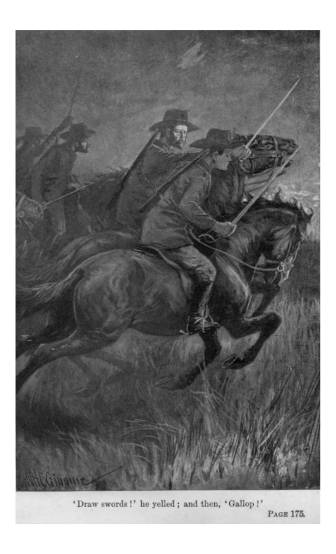
As the first report was heard Denham rose in his stirrups. “Draw swords!” he yelled; and then, “Gallop!”
There was the rasping of blades against the scabbards, three or four closely following digs into the soft sandy ground, with our horses’ muscles quivering beneath us, and then we were off at full speed, tearing after the outposts, which had wheeled round and galloped back, while with our sabres at the ready we went straight ahead.
“Keep together, lads,” cried Denham in a low, hoarse voice; but the order was needless, for, after the manner of their nature, our chargers hung together; and as we raced along it seemed to me that we should pass right through the enemy’s lines without a check.
Vain thought! Away in front, as we galloped on, a low, deep hum seemed to be approaching; and I knew the alarm had spread, and that the Boers were rapidly preparing for us. More than that, we had convincing proof that they were prepared.
Suddenly, flashing, glittering lights, as of hundreds of fireflies playing about a hedge extending right and left as far as I could see, began to sparkle and scintillate; but only for a moment, for now came the crackling roar of irregular firing, the flashes being partially obscured. Then, in a few brief moments more, we were closing up to the long line of riflemen.
“Now for it!” cried Denham close to my loft ear, his voice sounding like a husky whisper as we raced on knee to knee, and then our horses rose, as it were, at a fire-tipped hedge to clear the smoke.
There was a crash, yells of rage and defiance, and we were through, tearing away with the roar of our long line of galloping horses close after us. There was no time to think of danger—of shots from the enemy, or being crushed down by the hoofs of the troopers tearing after us; all was one wild state of fierce excitement, which made me feel as if I must shout in triumph at the result of our successful charge.
Contrary to expectation, there was now a new sound—the buzzing hiss of bullets overhead. Then, away to my left, yet another peculiar announcement of what might happen; for, clearly above the heavy thud of horses’ hoofs and the loud jingle of bits and chains, I could hear a curious zip, zip, zip, zip—a sound I had learned to know perfectly well: it was the striking of the Boers’ bullets upon inequalities of the ground, and their ricochetting to hit again and again, as though a demoniacal game of “Dick, duck, and drake” were being played upon the surface of the ground instead of upon the water from off the shore.
Suddenly some one tore along to the side of our column, and a voice shouted, followed by the clear notes of a trumpet.
The horses wanted no touch from rein or spur. Those right and left of me bore round, and naturally mine went with them. Left incline, and we tore on still in as wild and reckless a race through the darkness as was ever ridden by a body of men.
The bullets overhead buzzed, and the ricochets sounded zip, zip; but, as far as we could tell, no one was hit, nor had a man gone down from the false stop of a horse.
Unexpectedly, though, I heard a cry from somewhere behind, then a heavy fall, and another, as a couple of horses went down, and caused some confusion; but to stop to help the unfortunates was impossible at such a time. It was the fortune of war, as we all knew; and we tore on, till a note from the trumpet rose from our left; then another, and the fierce gallop was changed to a trot, and evolution after evolution was executed to bring the retiring regiment into formation of troops. Soon after this was completed a fresh call brought us to a walk, and directly after to a halt to breathe the panting horses.
“Dismount, my lads,” cried the Colonel. This order was to enable the brave beasts to have the full advantage of our halt.
“Hurt?” was asked excitedly on all sides; but every answer was in the negative, and we stood there by our troopers and chargers in the darkness, listening to the wild excitement from the distance.
The firing was still going on, but in a confused, desultory way; and for the moment it seemed as if we had made good our escape, and had nothing to do but mount and ride quietly away. That was how it struck me, and I said so to Denham.
“Oh no,” he said anxiously. “Didn’t you see?”
“See what?” I asked.
“Why, we were riding straight on into another body of the enemy after we had cut through the first.”
“No,” I said. “Who could see through this darkness?”
“Well, I didn’t at first; but when the Colonel dashed up with the trumpeter and turned us off to the left, I looked out for the reason, and there it was: a long line of the brutes, blazing away in our direction. You must have heard the bullets.”
“Yes, I heard them,” I said, “but I thought they came from behind.”
“Some of them did, my lad, and I’m afraid we’ve left a good many poor fellows behind. But them, it can’t be helped. The thing now to be settled is which way we are to go next. Listen; the officers are nearly all with the chief now, and the whole plain seems to be dotted with the enemy.”
Denham had hardly done speaking when a movement a short distance from us resulted in the officers joining their troops and squadrons. Then the order to mount was passed softly from troop to troop, and we waited for the little force to be put in motion again.
“It’s of no use for the chief to try the same ruse again,” whispered Denham. “It was right enough as a surprise; but the enemy is on the alert now. It seems to me we are as completely surrounded as before.”
“Never mind,” I said, as cheerily as I could; “we shall do it yet.”
“Oh yes, we shall do it yet,” replied my companion; “but it must be done quietly and quickly, while it’s dark. I say, though, what about your black boy? He couldn’t have kept up with our mad gallop.”
“Joeboy?” I said in an excited whisper. “Joeboy? I forgot all about him;” and a pang of misery shot through me.
“He was holding on by your saddle—wasn’t he?”
“Yes,” I said huskily; “but from the moment I drew my sword and we charged, I never thought about the poor fellow till you spoke.”
“Advance at a walk!” was the next order; and as we started, the Colonel came up to where Denham and I rode at one end of the leading troop.
“Here,” cried the Colonel; “where’s that Matabele fellow? He may lead us out of this crowd.”
“Gone, sir,” said Denham quietly. “We lost him in the gallop.”
“Tut, tut, tut!” muttered the Colonel; “he would have been more useful than ever now. Forward at a walk! They can’t see us, nor tell us from one of their friendly troops riding about the veldt. Silence in the ranks!”
“He needn’t have spoken,” said Denham in a low voice, as the Colonel drew rein and let us pass. “We shall get through yet, as you say.”
However, the odds seemed to be terribly against us, for whichever way we turned large bodies of the enemy were evidently in front; and after changing our direction again and again during the next two hours, the Colonel at last halted the corps.
“It’s of no use,” I heard him say to one of the senior officers. “We’re only tiring out the horses and men. We must stand fast till daybreak, then select our route, make for it, and try what a good charge will do. We shall clear ourselves then.”
Directly afterwards the order was passed for the men to dismount and refresh themselves with such water and provisions as they had, and silence once more reigned among us; for, not far off, large bodies of the mounted Boers were in motion, and twice we were passed at apparently some two hundred yards’ distance, our presence not being detected.
“We ought to be able to get through,” whispered Denham to me soon after the second body had gone by. “They must be thinking by this time that we have got right away. Where do you think we are facing now? North, I should say.”
“East,” I replied, pointing away straight in front. “That’s the morning breaking.”
“For the beginning of another day,” said Denham softly. “Well, I shan’t be unhappy when this one’s work is done.”
“Nor I,” was my reply. “I half-wish we had stayed among the ruins.”
“To be starved,” said Denham bitterly. “No; this is far better. It gives us something to do.”
“Yes,” I replied; “and there’s some more, for the Colonel’s coming up.”
Chapter Twenty.
What People Think Brave.
The Colonel was coming up, and it was quite time, for day was breaking fast, and the black darkness which had been our friend during the night was gradually dying away.
There was but one thing to be done: to select the best direction for making our dash; and, glass in hand, the Colonel stood near us, carefully scanning the country round. We who were waiting did the same, and saw the distant hills which seemed to turn the broad plain which had been the scene of our night’s encounter into a vast amphitheatre. It was too dark yet to make out much of the enemy’s position; but right away to our left, and not many miles distant, was the heavy-looking mass of the great kopje and the ancient buildings we had left.
For some time we sat waiting, with the grey dawn broadening, and at last I could clearly make out bodies of the mounted Boers in nearly every direction; while, as I still scanned the distance, I gradually grew less surprised that we were evidently so thoroughly hemmed in, for the plain seemed to be alive with the enemy, though the nearest party must have been about half a mile off. Still there was no movement on the part of the enemy towards us, as doubtless, in the dim morning light, our dust-coloured jackets and broad-brimmed felts caused us to be mistaken for some of their own people.
However, it was only a few minutes before a change took place. The Colonel had made up his mind, and the horses’ heads were turned for the open country, where there was a gap in the hills; and away we went at a steady walk, orders being given for the corps to break up its regular military order and ride scattered in a crowd, after the fashion of our enemies. This served us for a few minutes, during which we covered a mile in the direction we were to go; but the light had grown stronger, and it became evident that a body on our right was moving slowly to cut us off. Before another minute had passed another body was advancing from the left; and, ignorant as I was of military evolutions, it was plain enough to me that, long before we reached them, the two bodies would meet and join in line to impede our advance.
I was right, though I did not feel certain; for the orders were given, “Trot!” and then “Gallop!” and away we went for the closing-up gap in front.
“We shall never do it,” said Denham to me as we galloped on.
“We must,” I cried, and then no more words were spoken. To a man we knew, as we went along at a steady hand-gallop, that every body of Boers within sight was aware of what was going on, and moving forward to take us in a gigantic net whose open meshes were closing in.
There was no cheer, but a savage sound as if every man had suddenly uttered the word “Ha!” in token of his satisfaction; for, as the two bodies of the enemy in front were racing over the veldt to meet and crush us as we tried to get through, our trumpeter sounded a blast which sent us along at full speed; and then another call was blown, and we swept round till, going at right angles to our former course, we were riding exactly in the opposite direction to the detachment of Boers on the right. Our object was, of course, to get round by their rear; and, being an irregular and only partially drilled body, the result of the Colonel’s manoeuvre was that the enemy, in their efforts to reverse their advance, fell into confusion. Some were trying to pull up, others tried to sweep round to right or left and meet us; while, to add to their confusion and turn them into a mob of galloping horsemen, the left body charged full among their own men. The result was that we came upon the struggling rear of the enemy’s right wing, scattering and riding over them; and had the country beyond been clear, we could have made our escape.
Unluckily it was the fortune, of war that, just as we had cleared the scattering mob, with every man riding for his life, there appeared in front another and stronger line, with bodies of the enemy coming in from right and left.
Our chief turned in his saddle to glance backward; but it was only to see the two bodies we had passed struggling to got into something like order, so as to pursue us. For another minute no alteration was made in our course; but the attempt was hopeless, for we should have been outnumbered twenty times over, while the enemy in front now opened fire, their bullets whizzing overhead.
The trumpet rang out, and we wheeled round as upon a pivot, our well-drilled horses never losing their formation; and away we went as soon as we were facing our loosely-formed, mob-like pursuers, straight for their centre.
The trumpet again rang out; and, sword in hand, every man sat well down in his saddle, prepared for the shock of the encounter which in another minute would have taken place.
This, however, was not the style of fighting the Boers liked; and, already upset by the collision of the two bodies resulting in a confused mob, they declined our challenge, and pulled up, tried to ride off to right and left, and again got themselves into a disorderly crowd; but as they opened out we dashed through them, tumbling over men and horses, and with, a cheer galloped to reach an open part of the plain.
It was a wild and exciting rush before we got through; and I have but little recollection of what took place beyond the fact that I struck out right and left in mêlée after mêlée, wherein blows were aimed at us with the butts and barrels of rifles, and shots fired at close quarters, but in almost every case I believe without effect. Then the call rang out, “Halt!” and, with our enemies at a distance, we formed up again, to give our panting horses breathing-time.
It was then, I remember, that Denham—who had not been missed—almost breathless, and with uncovered head, edged in to my side, and as soon as he was able to speak panted out:
“Glorious, Val! Glorious! Oh! we did let them have it; but there’s nothing for it except to die game or surrender, and I’ll be hanged if I’ll do either, and so I tell them.”
“Which way are we going now?” I said, taking off my soft hat and offering it to him, as I wiped the perspiration from my face with my hand.
“Do you want to insult a fellow?” he cried, laughing. “Who’s going to wear your old hats?” Then, seriously: “No, no; keep it, old chap. Which way next? Who knows? I’m sure the Colonel doesn’t. It’s all chance. I don’t like running; but run we must if they’ll only open a hole for us.”
“It’s horrible,” I said.
“Not a bit of it. They’re getting it worse than we are.”
“Yes; but look at their numbers.”
“I’ve been looking, old fellow, and there’s more than I can count. I didn’t think there were so many Doppies in the country. There are too many for us to kill, and so many that they won’t run away. Why, we’re nowhere. Yah! Cowards! That’s the Boer all over. Look at them, lying down at a distance to pick us off. I don’t call that fighting. Oh, Colonel, Colonel, this won’t do!”
He said the words to me, and the men within hearing laughed. There was, however, good cause for Denham’s words, the bullets beginning to fall about us, aimed from different directions; and it was quite plain that, if we stood grouped together in troops, it would not be long before a perfect hail of bullets would be pattering among us, many of them going straight to their goals, and decimating our little force, or worse.
The officers needed no telling; and in a few minutes we were off again, first in one direction, then in another, our leader giving up as hopeless the idea of making straight for any particular opening in the dense ranks, but picking out the smaller parties of the enemy—that is to say, mobs not more than double our own strength; and when we could get within striking distance they were punished and scattered like chaff before the wind, in spite of the scattered volleys they sent at us before they fled.
This could not last, of course, for it was always at the cost of some of our poor fellows and of many horses, who had to be left to fall into the enemy’s hands.
At last we managed to charge home right into a body of our foes at least three times our strength—numerous enough, in fact, to surround us as we fought our way through them, thus rendering us more and more helpless; but our men fought desperately, till about half of the corps forced their way through, and, making an attempt to keep well in formation, dashed on.
I was with about a dozen quite fifty yards in the rear, half-mad with pain and excitement, for one of the Boers had clubbed his rifle in the midst of the mêlée and struck at my head. I was too quick for him, wrenching myself sidewise; but the rifle glanced all down one side, giving me for the moment a terrible numbing sense of pain. Yet my head was quite clear, and I rode on, feeling a wild kind of exhilaration from the knowledge that with one quick thrust I had passed my sword through his shoulder. Now I was urging on poor bruised and frightened Sandho to keep up with the dozen or so of our men who were trying to overtake the main body. We were in no formation, only a galloping party; and, consequent upon my injury, I was last. As we tore on we passed one of the corps trying to drag himself from under his fallen horse, which was lying across his legs. I couldn’t let him lie like that; so I pulled up, leaped down, and, shouting to Sandho to stand, dashed at the fallen and wounded horse’s head, caught him by the bit, and dragged at him to make him rise. The poor beast made a desperate effort, and got upon three legs; but sank back again with a piteous groan, for it had stepped into some burrow and snapped its off hind-leg right in two. However, the horse’s effort had saved its rider, who struggled to his feet, his face blackened with powder and bleeding, and passed his hand across his eyes. To my astonishment I saw who it was, the long drooping moustache telling me in spite of his disfigured face.
“Well done!” he said hoarsely; “but I’m hurt, and you can’t help me. Mount and be off. I’m done.”
I glanced behind me, and saw that the Boers were getting together again as if to come in pursuit, while a long line was coming up from the left at a steady trot, and bullets were whizzing by. It was only a momentary glance to see what our chances were; and in answer to the Colonel’s words I shouted to Sandho to come round to my side.
“Poor wretch!” groaned the Colonel; “you’ve done your part. I can’t see you suffer like this;” and, to my horror, he took out his revolver, placed it to his charger’s forehead, and fired. The shot had a double effect that was nearly fatal to our chance, for at the clear-cutting report the Colonel’s charger laid his head slowly down, and a quiver ran through his frame; but Sandho reared up, made a bound, and was in the act of dashing off. Almost instinctively I gave out a shrill whistle, which brought him up, and he trotted back to my side.
“Now,” I cried, half-wild with excitement and the feeling of exaltation which had come over me, “mount and gallop after our men.”
“What! No, boy, I can’t do that,” he said, smiling, as he clapped me on the shoulder. “I’ve played my part, and if it means exit I’ll go off the stage like a man, for I suppose the brutes will shoot me for what I’ve done.”
“Nonsense!” I cried, wildly now. “Jump on, and gallop.”
“No,” he said, recocking his revolver. “Mount, my lad, and ride for your life.”
“I won’t,” I said. “You get up and go.”
“What!” he shouted, with his face lowering. “Mount, sir. I order you.”
“Don’t be a fool,” I yelled at him. “They’ll be after us directly. There, some of them are firing already. Get up, or you’ll lose my poor old horse.”
He turned upon me in a rage, with his revolver raised.
“Bah!” he cried. Then a change came over him, and he turned to look back at the enemy. “Can you run?” he said. “I can’t; my right leg’s cut.”
That was plain enough, for his breeches were gashed above the knee, and there was a great patch of blood spreading.
“Yes, I can run,” I said stubbornly; “but I won’t.”
“You shall,” he said, as he thrust his foot into the stirrup and swung himself up on Sandho’s back. “Now then, on my right here. Catch hold of the holster-strap, and we’ll escape together, or fall: the brave lad and the fool.”
Chapter Twenty One.
I have my Doubts.
“Too late; too late,” I muttered through my teeth as, sword in hand, I made a bound to keep up with Sandho, who dashed forward. It was lucky for me I did so; as it was, I nearly lost my hold. The poor beast had been sadly punished in the mêlée; and between temper and dread he was hardly controllable, and bearing hard against the curb in a wild desire to rush off. In fact, I fully expected at any moment to be shaken from my grasp, as, oddly enough, even in that time of peril, I recalled the gymnastic sport of giant strides of my schooldays, and held on; but I was certain we were now too late, and that it was only a matter of moments before we should be overtaken and cut down or taken prisoners by a strong party of the Boers who were in full pursuit.
Then my exaltation increased, and I thought that Sandho would be able to go faster if relieved of my clinging hand, and so save the Colonel; and in another instant I should have let go, when—as he told me afterwards—the Colonel seemed to divine my thoughts, and I felt his sword strike against my back as it hung loosely by the knot to his wrist, while his strong right hand was thrust under and gripped my leather cartridge-belt.
“Hold on tightly, my lad, and we’ll do it somehow,” he cried.
These words drove all the heroic thoughts out of my brain, and I tried to look back to see how near our pursuers were; but I could not turn my head round, but only listen to the shouts, while crack, crack, crack came the reports of rifles—badly aimed by the mounted men, who fired from the saddle, holding their weapons pistol-wise—the bullets from which went whizzing and buzzing past our ears.
“It’s all over,” I thought, and a deep sense of depression was coming on at the thought of the Colonel falling wounded and a prisoner into the Boers’ hands; but the depression was only momentary, being chased away by a wild feeling of excitement as I thought I had misjudged the gallant lads of the Light Horse. For as soon as they had pulled themselves together, under command of their remaining officers, and had discovered the loss of their chief, in response to our Major’s orders they drew rein and divided into two squadrons, which swung round into line, with a short distance between them, and gallantly charged down upon our pursuers.
They were none too soon. I remember feeling a strange choking sensation as, with a wild cheer, they swept round us, and, sword in hand, rode over and cut down those of the enemy who stopped to face them, the majority taking flight. Then our men came thundering back, seeming to sweep us up and carry us along with them, while the Boers in our rear and on both sides began to fire at our hurrying troopers.
I was nearly breathless, and must have dropped but for the Colonel’s strong grasp; and I was curiously giddy till I heard his voice just above me give the word for the men to halt. His orders were echoed by the troop-leaders, who and the racing retreat was checked.
“Bring one of those horses here for me,” shouted the Colonel; and I now noticed that just ahead were half-a-dozen of the brave beasts whose saddles had been emptied but had kept their places in retreat, charge, and retreat again.
“That’s right,” cried the Colonel as he released my belt, so that I stood, hardly able to keep my feet as, with swimming eyes, I saw him stagger forward and mount the fresh charger, though evidently experiencing great suffering.
“Now then, my lad—Moray—what’s your name?—mount.”
His words seemed to galvanise and bring me back to a knowledge of my position, while Sandho helped to rouse me by turning and coming close up.
I hardly know how I did it, but I managed to climb into the saddle, and from that moment, as we cantered away together, with the bullets whizzing after us, the terrible burning sensation of exhaustion from which I suffered began to die out, and the throbbing of my brain steadied down.
“What are we going to do now, Denham?” I said at last, as, gazing straight ahead, I leaned over a little towards the left.
“Eh? Denham?” said a voice. “I’m not—”
“Ah!” I cried excitedly; “don’t, say the Lieutenant’s down!”
“Well, I won’t if you don’t want me to,” said the private at my side; “but he is, and pretty well half our poor fellows too.”
I uttered a groan, and down came the horrible feeling of depression again—a feeling I now knew to mean despair.
“Can’t be helped,” continued my fellow-trooper. “We’ve fought as plucky a fight as could be; but they’ve been too many for us, and I suppose we shall have to surrender at last, or all be shot down. Ah! there goes another,” he cried. “No; it’s only one of the empty saddle-horses.”
As we swept past it, I looked at the poor beast struggling to get upon its feet again; and then it was in our rear, and my companion said bitterly the one word, “Down!”
“Why, that’s the old fort and the kopje yonder, a mile ahead,” I said suddenly. “Are we going there?”
“Eh? Yes, I suppose so,” was the reply, “if the Doppies’ll let us. They’re coming on again.”
He was quite right, for upon glancing to my left I could see a perfect swarm of the Boers galloping as if to cut us off, while I learned from the right that they were also coming on there. Then came the news that they were advancing in force behind; and from that moment the crackling of rifle-fire ceased, and it became a hard ride for the haven of comparative safety ahead.
“They’ll reach the old place just about the same time as we do,” said my companion on the left, “unless something’s done.”
Something, however, was done, for the Colonel seemed to have recovered himself, so that he was ready for the emergency; and as we neared the place that offered safety he gave his orders, and these were cleverly carried out. Half of our flying troops drew rein and faced round, unslung the rifles from their shoulders, and proceeded to fire volley after volley with terrible effect upon the nearest of the Boers. Then this troop retired past the other one in reserve, who had halted to take their turn, and another half-dozen well-aimed volleys went hurtling through the Boer ranks with such terrible effect upon horse and man that, upon the repetition of the evolution, the pursuit was checked, and the enemy began firing in turn.
We were in rapid motion again, so their shots had no effect; and a little more firing enabled us to reach and dash round the great walls to the entrance to the old fort, where our men sprang from their horses, which filed into safety of their own accord, while their riders put in practice the Boers’ tactics, seeking the shelter of fallen stones and mounting the great walls, the steady fire from the ruins soon sufficing to send our enemies cantering back.
“Water for the horses at once,” cried the Colonel as he entered the court, where I was standing examining poor Sandho. “Ah, Moray!” he said as he saw me; “not hurt, I hope?”
“Only battered and bruised, sir,” I said. “Nothing serious.”
“Humph! I’m glad of it, boy. You did splendidly. But I’m a fool, am I?”
My words, uttered in the wild excitement of our adventure, had slipped but of my memory; and as he brought them back to my mind so suddenly, I stood staring at him as if thunder-struck.
“A nice way to address your commanding officer! Why, you insolent, mutinous young dog! you ought to be court-martialled. What do you mean!”
“Not that, sir,” I said, recovering myself. “I was half-mad with pain and excitement then, and I wanted to save your life.”
“Yes, I know; I know,” he said, changing his manner. “I forgive you, for no one else heard; and now, thank you, my lad; thank you. If I survive to write to my poor wife and girls again, I shall tell them when they pray for me to put the name of some one else in their prayers—the some one who saved my life. Thank you, my lad, and God bless you!”
I felt astonished and at the same time overcome by his words, and in my confusion could not find words to reply, till, lowering my eyes, I found exactly what I ought to say; for they fell upon the great patch of blood-stain which had been spreading terribly upon his right leg, till his knee was suffused, and ugly marks were visible right down his brown leather boot.
In an instant my hand went up to my throat, and I loosened the silk handkerchief knotted there.
“Your wound’s bleeding dreadfully, sir; let me tie it up.”
“No, no; not till I’ve seen to the men, my lad,” he replied peevishly as he turned away, only, however, to turn back.
“Yes,” he said, with a smile; “thanks, lad. First aid, and—here! Water, some one. Ugh! I feel sick as a dog.”
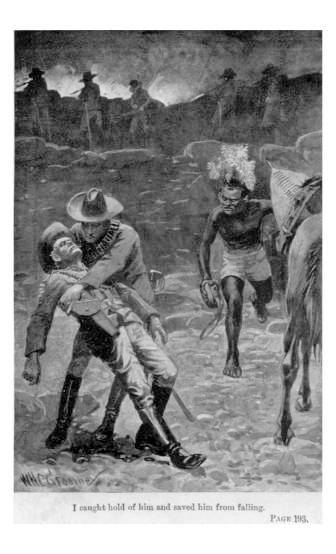
I caught hold of him and saved him from falling by lowering him down upon a stone, just as there was the soft pad, pad of naked feet behind me, and a familiar voice said:
“Water, Boss. Here water, sah!”
“Joeboy!” I whispered as I turned and caught a waterbottle from an extended black hand. “You here!”
“Um? Yes, Boss Val. Couldn’t run no more, and come away back.”
I handed the water to the Colonel, who drank with avidity; then I tightly bound up the cut on his leg, for he impatiently refused to have it examined by one of the officers who had hurried up; and then, as soon as I was at liberty, I turned to the black.
“Have you seen the Lieutenant, Joeboy?” I said excitedly.
“Um? Boss Denham!” he replied. “No; all a rush and gallop. Lost Boss Denham. Lost Boss Val. Lost ebberybody. Joeboy said, ‘All come back to water. Boss Denham come soon.’”
“I pray to Heaven he may!” I said sadly; but I had my doubts.
Chapter Twenty Two.
Making the Best of it.
That was a terrible night which followed. We had plenty of water; but our scraps of food were sadly inadequate for the wants of the men, who, many of them wounded, were sick and despondent, and dropped down here and there to fall asleep as soon as their injuries were roughly dressed. Meanwhile the walls were as strongly manned as could be contrived under the circumstances; and the weary horses were now watered and given the last handful of grain in the bags, after which they stood snuffing about among the stones, every now and then uttering an impatient neigh—Sandho as bad as any of them, though he had fared better, for I had given him half my biscuits and a piece of bread-cake.
By nightfall the entrance had been strongly fortified with a massive wall of stones, a narrow side-opening being left, large enough to admit any straggler who might manage to reach our camp; and then all but the sentries, after a last look at the Boers’ fires in the distance, lay down anywhere to sleep; but pain and weariness kept me as wakeful as a group of officers, among whose voices I was glad to hear that of Sergeant Briggs, who spoke the most cheerily of them all.
“If you’ll not mind, gentlemen,” he said, “I should like to say that our position isn’t so bad as you think.”
“Why, it couldn’t be worse,” said the Major.
“Begging your pardon, sir, yes,” said Sergeant Briggs. “We’ve plenty of water, and our marksmen can keep the Boers at a distance as long as you like. They won’t face our rifles.”
“But the horses, man!”
“They can be taken out to graze, sir, covered by our rifle-fire. There’s a good patch of green out yonder.”
“But we can’t go and graze,” said another officer.
“No, sir; but we shall be hungry enough by to-morrow night to be ready for a raid on the Boers’ provision wagons. There’ll be plenty, and we must cut one out, fasten a dozen reins to it, and bring it up here.”
“Humph! We might try,” said the Major.
“And we will,” said one of our captains. “Why, we might capture some of their ammunition too,” he added.
“Yes, sir. They’ve got pack-mules with their small-arms ammunition; and with a bit of scheming and a night surprise it might be done,” said the Sergeant. “And there’s another thing I had my eyes on to-day.”
“What’s that, Briggs?” said the Major.
“A train of bullocks, sir; and if one of you gentlemen can shoot the train with a field-glass just before sunset to-morrow night, if we’re here, and give me half-a-dozen men and that black chap as come along with young Mr Moray, I shouldn’t wonder if we had grilled steak for supper just by way of a change.”
“Why, Sergeant,” cried the Major, “if you’re not our adjutant before this war’s over it shan’t be my fault.”
“Thank ye, sir,” said Briggs stolidly; “but I should like to get the beef for the boys and a load of mealies for the horses before we talk about that. And now, if you wouldn’t mind, I’ll have a couple of hours’ sleep.”
I felt for a few minutes so much brightened up that I was ready to go off too; but the thoughts of poor Denham lying out dead or wounded somewhere on the veldt kept me awake, and I was in greater pain than ever from the blow I had received. And there I lay in my misery till about midnight, when there was an alarm from the sentries of horsemen approaching, and I sprang to my feet.
Chapter Twenty Three.
“Il Faut Manger.”
I felt dizzy, and every movement was painful when I arose. The air was so cold that I was half-numbed; and in addition to my bruised side I ached from the tightness of my belts, and my sword-hilt and revolver seemed to have made great dents into my flesh. However, with an effort I lifted my rifle, which had been my bedfellow on the sandy earth, and hurriedly joined the others in making good the defence of the great gateway, with its newly-made protecting screen of stones.
There was no desperate encounter, however, to send the blood rushing through our veins; for, as we reached the entrance, we heard the men on duty removing stones while they carried on a desultory conversation with the new arrivals; and directly afterwards a thrill of joy ran through me, and a curious choking sensation rose in my throat, for somewhere in front where it was darkest I heard the Major say:
“That’s grand news, Denham—thirty of you, and forty horses?”
Then his voice was drowned in the loud, spontaneous cheer which rose from those about me, in which at the moment I felt too weak to join.
“Here, get in, all of you,” cried the Major as soon as he could make himself heard. “You’re sure there is no pursuit?”
“Quite,” came in Denham’s familiar voice. “We have had a very long round since we wore cut off, and have not heard a soul as we came through the darkness.”
“How about wounds?” said the Major.
“Pretty tidy, sir,” said Denham. “The poor horses have got the worst of it. But we’re all starving, and choked with thirst.”
“We can manage water for you,” said the Major; “but I’m afraid to say anything about food.”
“Never mind,” said Denham cheerfully; and then he seemed to turn away, for his voice sounded distant as he said—to the men with him, of course—“Tighten your belts another hole, lads. We’ll forage for food to-morrow.”
“That we will,” cried the Major; and then out of the darkness came the trampling of horses’ feet, followed by a few neighs, which were answered from where the horses stood together in the court. Meanwhile I tried to get to the front, but could not, and had to wait till the men began to file in after the homes; but at last I heard Denham’s voice again.
“Not a bad wound?” he said.
“A nasty but clean cut from some Boer who had one of our swords.”
“But tell me,” said Denham eagerly—“young Val Moray? Did he get in safely?”
“Any one would think he was a cousin or brother,” said the Major pettishly. “Yes, he managed all right, after giving up his horse to the Colonel and getting him in after he had been down.”
“Val did?” cried Denham eagerly. “I am glad!”
I did not wait to hear any more, and did not try to force my way through the dense pack of our men, but worked hard to get back to the spot where I had been lying down; and upon reaching it, with the satisfactory feeling that there was to be no more fighting that night, I dropped into my old place, after shifting hilt and belt so as not to lie upon them again. Then, in spite of hunger and pain, a comfortable and exhilarating sensation stole over me, which I did not know to be the approach of sleep till I was roused by the reveille, and sprang up in a sitting posture, when the first man my eyes fell on was Denham, who was peering about among the troopers as if for something he had lost.
“Oh, there you are!” he cried as he caught sight of me; and the next minute we were standing together, hand grasping hand.
“Denham, old fellow,” I said huskily, “I thought you were either a prisoner or dead.”
“Not a bit of it,” he replied; “but it wasn’t the Boers’ fault. Just look at my head.”
“I was looking,” I said, for a closely-folded handkerchief was tied diagonally across his forehead. “Is the cut deep?”
“Deep? No,” he replied. “Deep as the beast could make it—that is, to the bone. I say, what a blessing it is to have a thick skull! My old schoolmaster used to tell me I was a blockhead, and I thought he was wrong; but he was right enough, or I shouldn’t be here.”
“The loss is bad enough without that,” I replied.
“Horrible; but they’ve paid dearly for it,” he said. “But I say, what about rations? We can’t starve.”
I told him what I had overheard during the officers’ talk with the Sergeant.
“Yes,” said Denham peevishly; “but that means waiting till to-morrow morning. We must make a sally and get something.”
“I wish we could,” I said, for now that my mind was at rest I felt ravenously hungry. “Hullo! what’s going on there?”
Denham turned sharply, and, to our astonishment, Sergeant Briggs was coming from the gate leading half-a-dozen men stripped to shirt and breeches, carrying in half-quarters of some newly-killed animal.
“Why, hullo!” I cried, “what luck! They’ve found and been slaughtering an ox.”
“Yes,” said Denham dryly, “and there’s more meat out yonder. We shan’t starve. I’d forgotten.”
“Forgotten! Forgotten what?”
“It isn’t beef,” he said quietly. “It’s big antelope.”
“What! eland?” I cried joyously.
“No; the big, solid-hoofed antelope that eats like nylghau or quagga.”
“What do you mean?” I said wonderingly, as I mentally ran over all the varieties of antelope I had seen away on the veldt.
“The big sort with iron soles to their hoofs. Two poor brutes, bleeding to death, dropped about a hundred yards away as we came in last night.”
“Horse!” I exclaimed. “Ugh!”
“Oh yes, it’s all very well to say ‘Ugh!’ old proud stomach; but I feel ready to sit down to equine sirloin and enjoy it. Why shouldn’t horse be as good as ox or any of the antelopes of the veldt? You wouldn’t turn up your nose at any of them.”
“But horse!” I said. “It seems so—so—so—”
“So what? Oh, my grandmother! There isn’t a more dainty feeder than a horse. Why, he won’t even drink dirty water unless he’s pretty well choking with thirst. Horse? Why, I wouldn’t refuse a well-cooked bit of the toughest old moke that ever dragged a cart.”
“But what about fire?” I said.
“Oh, there’s plenty of stuff of one kind and another to get a fire together. They break up a box to start it, and then keep it going with bones and veldt fuel. Look; they’re coming in with a lot now.”
“I say,” I cried, as a sudden thought struck me. “Here, Sergeant!”
“What do you say?” cried Denham.
I said it to the Sergeant, proposing that he should make a roasting fire under the chimney of the old furnace; and as I spoke his face expanded into a genial smile.
“Splendid!” he said, and hurried away to shout to Joeboy; and in a very short time the smoke was rolling out of the top of the furnace chimney for probably the first time since the ancient race of miners ceased to smelt their gold-ore in the place marked on the maps of over a century ago as the Land of Ophir, but which has lain forgotten since, till our travellers rediscovered it within the last score of years.
Chapter Twenty Four.
A Very Wild Scheme.
“Well,” said Denham some two hours later, “it isn’t bad when a fellow’s hungry.”
“No,” I agreed, speaking a little dubiously; “but it would have been much better if we had not known what we were eating.” I did not hear any other opinions; for the men were ravenously hungry when the cooking was over, and we had all so many other things to think about.
It had been a very busy morning. Wounds had to be dressed, the uninjured had the task of strengthening the force upon the walls, and another party led the horses out a quarter of a mile to graze. This they were allowed to do in peace, the Boers paying no heed to the proceedings. Then the lookouts, who were furnished with the officers’ glasses, gave warning that strong parties were quietly on the move about a mile away—evidently making a circuit for the purpose of disarming our suspicions—with the intention of swooping round and cutting off the grazing horses. But, as Denham said, they had not all the cunning on their side, for we had taken our precautions. A red flag was hung out, and in answer to the signal the horses were headed in for the gateway at once.
That was sufficient. The Boers, instead of riding along across our position, suddenly swooped round, and came on, five hundred strong, at full gallop, getting so near that they would have cut off some of our valuable horses had not fire been opened upon them from the walls, quite in accordance with the Boers’ own tactics; our men lying down and taking deliberate aim, with the result that saddles were emptied and horses galloping riderless in all directions.
However, the party gradually came nearer, till they found that our firing grew hotter and more true; then, utterly discouraged by its deadly effect, they wheeled round again, and went off as hard as their horses could gallop.
“Let them try the same ruse again,” said the Colonel, as he turned from where he had limped to watch the little action, and stood closing his glass. “Let them come again if they like; but they had the worst of it this time. Splendidly done, my lads! Excellent!”
The Boers rode right away, then turned and rode back as if about to renew the attack; but suddenly they drew rein, and a small body came on at a canter, one of them waving a handkerchief.
“Yes,” said the Colonel sternly. “Hold your fire, my lads; they want to pick up their wounded.”
This was soon proved to be the case, and we looked on, thinking how much better their wounded fared than did ours.
“Yes,” said Denham when I said something of the kind to him; “but I hope they are behaving decently to our poor lads, wounded and prisoners. Let’s give them credit for a little humanity.”
The Colonel waited till the enemy had retired with their injured men, leaving a couple of dead horses on the plain. Already I could see that the carrion-birds had caught sight of the dead, and were winging their way to an anticipated feast; but they were disappointed, for the order had been given, and the horses were being led out again to graze, while four men, with strong raw-hide plaited reins attached to their saddles, rode out quickly to play the part of butchers to the beleaguered force, and shortly after came slowly back drawing a fresh supply of meat for the garrison. Then the vultures descended to clear away everything left.
“It makes one shudder,” said Denham to me as we sat perched upon a broken portion of the wall, resting after the previous day’s exertion, and nursing our rifles.
“Why?” I said, though I felt that I knew what he was about to say.
“Makes one think how it would be if one lay somewhere out on the veldt, dead and forgotten after a fight.”
“Bah! Don’t talk about it,” I cried.
“Can’t help it,” he replied. “It makes me want to practise my shooting upon those loathsome crows.”
“Why should you?” I replied. “They are only acting according to their nature, and— Hullo! Look yonder; what’s the matter with the baboons?”
Away to our left a loud chattering had begun amongst the ridges of ironstone and blocks of granite which formed the kopje. The drove, herd, flock, family, or whatever it was, of the dog-faced apes was running here and there, chattering, grimacing, and evidently in a great state of excitement. There were some five or six big fellows, evidently the leaders, and these kept on making rushes right down to the bottom of the stones, followed by others; while the females with their young, which they hugged to their sides in a curiously human way, kept back, partly in hiding, but evidently watching the males, and keeping up a chorus of chattering.
“Why, the beggars are going to attack our butchers.”
“Yes; but they think better of it,” I said, laughing; for the leaders of the troop turned back and began leaping up the hill again, but only to come charging down once more to the bottom of their little stony home, and stand chattering and grimacing menacingly.
“They’re hungry,” said Denham.
“Oh no, I don’t think they’d behave as badly as we do,” I replied. “I don’t think they’d eat horse.”
“What do they eat, then?”
“It always seemed to me when I’ve seen them that they ate fruit, nuts, and corn. There used to be a pack of them in a big kopje not far from our place, and they would come down and make raids upon the farm till we had to make it too hot for them with small-shot, and then they went right away.”
“They don’t like to see those horses dragged in,” replied Denham.
“Not used to it,” I said. “There, they are going back into hiding now.”
The horses had now been drawn in to be treated as if they were oxen, and in a few minutes not one of the baboons was to be seen. There were two or three alarms in the course of the day, but no direct attack; and the whole of the horses had a good long graze, the vegetation after the late rains being fairly abundant in places, though for the most part the veldt in the neighbourhood of the old fortress was very dry and bare. There was abundance of water, however, for a stone tied to the end of four reins carefully joined did not suffice to plumb the well-like hole.
That evening, as Denham and I sat playing the part of voluntary sentry, my companion lent me his glass to watch the distant troops of Boers, which I did diligently. We were seated on the top of the wall, for the simple reason that both of us were terribly stiff and bruised, and consequently extremely disinclined to stir. Then I uttered a loud exclamation.
“What’s the matter?” said Denham quickly.
“Take the glass,” I said; “the sloping sun lights up that part clearly. There, sight it upon the line below that flat-topped hill in the distance.”
“Yes,” he said, taking the glass and focussing it to suit. “What of it? Boers, Boers, hundreds of Boers.”
“But there’s something in motion.”
“Ah! Yes, I see now: one, two—why, there must be half-a-dozen ox-wagons with long teams.”
“What does that mean?” I said.
“Ox-wagons.”
“Yes; but what are they laden with?”
“I dunno,” he said, peering through the glass.
“Corn for the horses; provisions for the Boers’ camp.”
“Of course! Oh dear, if we could only get one of them across here!”
“Well, could it be done?” I said.
Denham shook his head.
“It could only be done in the dark. You mean stampede the bullocks; but they’d be outspanned at night, and we could never get them inspanned and away without being beaten off.—Can’t see it, Solomon the Wise.”
“It does seem difficult,” I assented.
“Yes; and, suppose we had got a team hitched on all right, see how they move: two miles an hour generally. But it does look tempting.”
“But we might get a team of oxen away without a wagon by making a bold dash.”
“Might,” replied Denham; “but bullocks are miserably obstinate brutes to drive. It would mean a good supply of beef, though—wouldn’t it?”
“Splendid.”
“Yes; but we want meal too. I say, I dare say there’s coffee and sugar in those wagons as well.”
“Most likely,” I said; “the Boers like eating and drinking.”
“The pigs! Yes, and we’re to starve. I say, couldn’t we make a bold night-attack and drive them away, compelling them to leave their stores?”
“Well, after last night’s experience I should say, ‘No; we could not,’” I replied.
“You’re quite right, Val,” said Denham, with a sigh. “Hullo! here’s your black Cupid come up to have a look at us.”
For Joeboy, whom a good hearty meal had made very shiny and happy-looking, came climbing up to where we sat, and stood looking down at us as if waiting for orders.
“Here, Joeboy,” I said; “look through this.”
“Um? Yes, Boss,” he said; and, from long usage when out hunting with my father or with me, he took the glass handily and sat down to scan the distant Boer line.
“Lot o’ Doppie,” he said in a low tone, as if talking to himself. “Lot o’ horse feeding; lot o’ wagon and bullock. Plenty mealie, coffee, sugar.”
“Yes, Joeboy,” I said; “and we want one of those wagons and teams.”
“Um? Yes, Boss,” he said thoughtfully, without taking his eyes from the glass. “Joeboy know how.”
“You do?” said Denham quickly. “Tell us, then.”
“Boss Colonel send Boss Val and hundred sojer fetch um.”
“It wouldn’t do, Joeboy,” I said sadly. “There would be another big fight, and we should lose a lot of men and horses without getting the wagon.”
“Um? Yes. Too many Doppie.”
“That’s right, Shiny,” said Denham.
“Yes,” I said; “we must wait till we see a team making for the kopje, and then the Colonel can send out a party and cut them off.”
“Then the Boer General will send out a bigger party and cut us off,” said Denham bitterly. “I don’t want another set-to like yesterday’s for a week or so. So we must take to horse and water for the present, I suppose.”
“Joeboy know,” said the black, with his eyes still fixed on the glass.
“You know?” I cried, staring at the black’s calm, imperturbable countenance.
“Um? Yes.”
“Why, what could be done?” I said, excited by the black’s cool and confident way, knowing as I did from old experience how full of ingenuity the brave fellow was.
“Um?” he said thoughtfully, as he still watched the Boer lines. “No good to fight; Doppie too many.”
“Yes,” said Denham impatiently. “You said so before.”
“Um?” said Joeboy, taking his eyes from the glass a moment or two to glance at the speaker, but turning away and raising the glass again; “Joeboy know.”
“Let’s have it, then,” said Denham, “for hang me if I can see how it could be done.”
“Big fool black fellow drive wagon,” said Joeboy, still gazing through the glass, as if he could see those of whom he spoke. “’Nother big fool black fellow vorloper. Both fast sleep under wagon. Boss Val talk like Boer: double-Dutch.”
“Is that right?” said Denham.
“Oh yes,” I said. “I can speak like a Boer if it is necessary.”
“Um? Yes,” said Joeboy quietly. “Think Doppie talky, Boss Val take Joeboy and go in a dark night up to wagon. Stoop down and kick big black fool driver and big black fool vorloper. ‘Get up!’ he say. ‘Want sleep alway? Get up, big fool! Trek!’”
“What?” I cried excitedly.
“Um? Talk like Doppie, Boss Val talk. Big fool get up an’ inspan. Boss Val get up on box an’ keep call driver big black fool, like Doppie. Joeboy walk ’long o’ vorloper. Tell ’im Joeboy ’tick assagai in um back if he talk, and drive right ’way.”
“Ha!” I said, with a heavy expiration of the breath. “But do you understand what he means?”
“Oh yes, I understand,” said Denham, laughing; “but where are the Doppies going to be all the while?”
“Lying somewhere about, of course, asleep,” I said excitedly; “but there would be no sentries over the wagons; and, as he says, the black foreloper and driver would be sleeping underneath.”
“Oh, that’s right enough,” said Denham impatiently. “But the noise, the rattle of the wagon, the getting of the oxen, and all the rest of it?”
“The oxen would be all lying down with the trek-rope between them, and they’ll quietly do what their black driver and foreloper wish. I think it could be done.”
“My dear boy, it’s madness.”
“It isn’t,” I said angrily. “Joeboy is right, and a trick like this would perhaps succeed when force would fail. We must capture one of those wagons.”
“Oh, I’d have the lot while I was about it,” cried Denham, laughing.
“Be sensible,” I cried pettishly. “Joeboy is right. Can’t you see that it is the sheer impudence of the thing that would carry it through?”
“No, old chap,” he replied; “that I can’t.”
“Well, I can,” I said firmly. “The black driver and foreloper could be roused out of their sleep, and they take it as a matter of course that they were to drive the wagon somewhere else, and obey at once, especially if they are hurried by some one who speaks like a Boer.”
“Well, I grant that’s possible,” said Denham; “but what about the Boer sentries and outposts? They’d stop you before you’d gone straight away for a hundred yards.”
“I shouldn’t go straight away,” I said, “but along by the front; and if we were stopped, Joeboy could tell the outpost we were ordered to change position—to go on to the other end of the line. What would the outpost care or think about it? All he would think would be that a wagon-load of stores was being shifted, and let us pass. Then I should tell Joeboy to begin creeping out towards the east yonder, and keep on till we were out of bearing before striking away for the kopje here. Once we had got clear off we could keep steadily on all through the night, and at daybreak you would be watching for us, and send out a detachment to bring us in.”
“Splendid, my boy—in theory,” said Denham; “but it would not work out in practice.”
“Think not?”
“A hundred to one it wouldn’t,” cried Denham firmly.
“Well, I think it would,” I said—“and from the cool daring of the thing.”
“And what about your horse? That would be enough to betray you.”
“No take Sandho,” said Joeboy, who had been listening attentively.
“Of course not,” I said. “We should walk right across to the Boer lines, getting off as soon as it was dark.”
“Why not go in disguise as a minstrel?” said Denham banteringly—“like King Alfred did when he went to see about the Danes? Have you got a harp, old chap?”
“No,” I said coolly.
“Well, it doesn’t matter, because I don’t believe you could play it. But a banjo would be better for the Doppies, or—I have it—an accordion! Haven’t one in your pocket, I suppose?”
“Why can’t you be serious?” I said.
“I am, old fellow. Banjo, concertina, or accordion, either would do; and if you could sing them one or two of their popular Dutch songs it would be the very thing.”
“Don’t banter,” I said dryly.
“Then don’t you propose impossibilities. There, they are cooking supper again, so let’s get down and see about a bit of—ahem! you know. Whatever it is, we must eat. I almost wish I were a horse, though, and could go out on the veldt and browse on the herbage. Here, I say, I’ve got a far better Utopian scheme than yours.”
“What is it?” I replied quietly, for I felt that he was going to chaff me.
“Well,” he said, “it’s this. You know how imitative monkeys are?”
I nodded.
“Then all we have to do is to make a ring of our men round the kopje there, and drive the baboons into the court here. From the court we could turn them into one of the passages between the walls, stop up the ends, and capture the lot.”
“To eat?” I said sarcastically.
“Eat, man? No; to drill, and teach them to forage for us, just as the Malays teach the monkeys to pick coco-nuts for them.”
“Drill them? Ah! there is a baboon called a ‘drill.’ Yes, go on,” I said.
“We could send them out every night, and they’d come back laden with mealies for us; and there you are.”
“Nice evening, gentlemen,” said Sergeant Briggs, who had just climbed to our side. “I’ve been using the Major’s glass. My word! they’ve got wagon after wagon loaded with stores across yonder. Is there any way of cutting out one or two, for we must not go on living upon horse?”
I looked hard at the speaker, and then at Denham, and the result was that we astonished the Sergeant, for both Denham and I burst out laughing, and Joeboy smiled as widely as he could.
Chapter Twenty Five.
A Forlorn-Hope for Food.
Sergeant Briggs stared, and looked so puzzled that we laughed the more.
“Beg pardon, gentlemen,” he said, speaking as if huffed, “have I said something stoopid?”
“Tell him, Val,” cried Denham; and I explained why we laughed.
“Oh, I see,” he said good-humouredly. “I thought I was being laughed at. Well, I don’t know, Mr Denham, sir; I don’t think the idee’s quite so wild as you fancy.”
“Oh, it’s impossible, Sergeant.”
“No, sir, begging your pardon, it isn’t. It’s the cheek of the thing might carry it off. I like it.”
“Yes; your mouth waters for the stores, Sergeant.”
“Maybe, sir; but if I was you I should go straight to the Colonel and tell him.”
“So as to be laughed at for a fool,” said Denham. “The chief’s in no laughing humour, sir,” said the Sergeant stolidly. “He ought to be in hospital with that cut on the leg he got; but he won’t give up, though I’ve seen him turn whitey-brown and come out all over the face with big drops. That means pain. No; he won’t laugh.”
“Then he’ll growl at us, and tell us to be off for a pair of idiots.”
“Well, I’ll risk it,” I said firmly.
“Will you? Young fellow,” cried Denham, “don’t you presume on my friendliness and forget that you’re a private in my troop.”
“It’s my duty to let the Colonel know,” I said warmly.
“Yes, through your superior officer. Well, look here; perhaps you’re right. Let’s go to him at once.”
We descended after another look at the Boer lines, and found the Colonel resting against a block of granite, with his injured leg lying in a bed of sand. He listened attentively, after Denham’s introduction, to all I had to say. Then he sat in perfect silence, frowning, and tugging at his long moustache. I was as uncomfortable as ever I had been, and wished I had not come; but soon a change came over me, for the Colonel spoke.
“Capital,” he said sharply. “But—”
My hopes went down to zero again, but rose as he went on, taking the right line of thought: “It can only be done by sheer bravado. It is the utter recklessness of the ruse that would carry it through. Do you think, Moray, you could do this without breaking down at the supreme moment?”
“I think so, sir.”
“That’s good,” said the Colonel; “there’s a frank modesty about that ‘think.’ But do you dare to run the risk for the sake of your officers and brother-privates, who are in a very tight place?”
“I don’t think now, sir,” I said: “I dare go.”
“Then you shall, Moray.”
“To-night, sir?”
“No: have a night’s sleep and a quiet day to-morrow to think out your plans. You will be fresher then. There, I’m in pain, and I want a few hours’ rest to set me up. One minute,” he added as I turned to go. “How many know about this?”
“Only Sergeant Briggs, sir, and the black, of course.”
“Keep the black quiet,” said the Colonel, “and tell Sergeant Briggs from me that the expedition is to be kept secret.”
“Yes, sir.”
“You are not to go on sentry work to-night.”
I saluted, and went away with Denham, who began to growl:
“The chief’s as cracked over it as you are. But, look here, Val, you must alter your plans.”
“I can’t,” I replied. “I shall go.”
“Of course you will; but you must reshape them so as to take me with you.”
“That’s impossible,” I replied. “But would you go?”
“Would I go? Of course. I should like the fun of it. Here, you must go and tell the chief you feel as if you can’t curry out the business properly unless you have my help.”
I looked at him, laughing.
“I say, who’s cracked now?” I said.
“Well, I believe I am—half,” he replied. “I say, Val, I would like to go with you.”
“What! upon such a mad expedition?” I said.
“Yes. It doesn’t look so mad when you come to think a little more about it. Look here; I know. I’ll go as a Dutch driver.”
“You’ll stop along with your troop, and I’ll ask the chief to let you come to my help in the morning when we’re coming along with the wagon—if—if we carry it off.”
Denham was silent for a few moments before he said any more. Then, with a sigh:
“Yes, you might do that; but I should have liked to be in the thick of the business.”
Many of the men went hungry to bed that night, and Denham and I lay talking for long enough before sleep came; but when it did, nothing could have been more restful and refreshing.
We rose at the “Wake up” to find that there had been no alarm in the night, and our first act was to climb to the top of the wall and use a glass, to see that the Boers wore in the same positions, and the outposts were just riding in, so that I had some insight as to the way in which the enemy guarded their front during the night.
“Here, I say, look!” cried Denham suddenly. “You ought to have gone last night.”
“Why?” I asked as I took the glass; and then, “Oh!” I exclaimed in a tone of disappointment.
“Yes, you may well groan,” cried my companion. “Why didn’t the chief let you go?”
There was good reason. We could see plainly enough that the Boers were unloading the wagons, and the Kaffirs hard at work carrying bags which no doubt contained mealies or flour. To me the sight was maddening, for it now seemed one of the easiest things in the world for us to have captured and carried off one of the laden wagons.
“There, it’s of no use to cry after spilt milk,” said Denham, with a groan.
“Nor is it of any use to despair,” I replied as I watched the unloading. “Perhaps they may leave one of the wagons full.”
“Oh, they will, of course!” said Denham mockingly. “They’ll pick out the best one, containing a nice assortment, and label it, ‘Reserved for the use of the Natal Light Horse. To wait until called for by Don Quixoto Valentino Morayo and his henchman Sancho Panzo Joeboyo.’ I never thought of that.”
“Let’s go and report what we have seen,” I said bitterly; and we went and found the Colonel.
“Humph!” he said shortly; “unfortunate.” That was all.
Then the day glided by, with our men always on the alert, their only work being to man the walls and keep a sharp lookout while the horses were driven out to graze; but though the Boers showed in force in different directions, they made no attack. In spite of a false alarm or two, the poor brutes managed to pick up a pretty good feed; though, considering the work they had to do, it was poor and unsustaining as compared to corn.
As for the men, they made the best of things; but several knots gathered together trying to allay the desire for different food by the agency of their pipes. However, instead of endeavouring to get accustomed to the food pretty plentifully prepared for their meals—other two horses having to be shot on account of their wounds—some of the men preferred to fast; and it was these men who discussed the probability of the Colonel making a dash again that night, to cut a way through and escape.
Sergeant Briggs favoured this idea.
“I hope the chief will make another try to-night,” he said to Denham and me. “The Boers mean to starve us out; and in another day or two all the fight will be gone out of the poor lads.”
However, the sun often peeps out on the cloudiest days; and towards evening, just when we were feeling most despondent, Joeboy came up to Denham and me just as we were going up to our old place of observation, glass in hand. As we mounted, it was to see the horses led in, with the guard behind them; the lines of the enemy being descried very distinctly in the horizontal rays of the low-down sun. Denham was using the glass and making comments the while.
“There’s a famous great gap out yonder,” he said, “just to the right of where we saw those unlucky wagons, Val. I will just go and tell some one. The enemy will not be likely to fill it up; and I believe we might go softly that way and make a dash through.—Oh, you disgusting, sybaritish, gluttonous brutes! I always did think the Boers were pigs at eating. Look at their fires all along their lines. Here are we starving, and they’re doing nothing but cook and eat—eat—eat.”
I took the glass and looked at the opening he had noticed, but said nothing, remembering how terrible was our experience on the previous occasion. I saw too—as enviously as my companion, but in silence—how the fires were sending up their clouds of smoke in the clear, calm air all along the line, telling of preparations for the coming meal.
“The empty wagons are gone,” I said at last.
“If you say wagon again I shan’t be able to contain myself,” cried Denham passionately. “I don’t want to kick you, Val; but I shall be obliged. Look here, if I feel as bad to-morrow evening as I do now, I’ll mount and desert to the Boer ranks.”
“Not you,” I said.
“But I will, just for the sake of eating as much as ever I can. Then I’ll desert again and join our own ranks.”
“Why, Denham—” I exclaimed excitedly, and then I was silent.
“Why, Denham—” he replied.
“Wait a minute,” I cried; “let me make sure.”
“Sure of what?” he said, growing excited in turn on hearing the elation in my voice.
“Wagons!” I cried.
“Ah, would you?” he shouted. “Didn’t I say that if you spoke of wagons again—”
“One—two—three—four—five—six!” I cried, with the glasses to my eyes. “Hurrah! There’s a fresh lot coming into camp, right into that opening you saw. Be quiet and let me watch”—for Denham had given me such a slap between the shoulders that I nearly dropped the glass.
“Say it again, old man—say it again.”
“There’s no need,” I replied. “Yes, I can make them out quite plainly—six wagons, with their long teams of oxen and black drivers and forelopers. You can see the black bodies and white cloths.”
“I don’t want to see them,” cried Denham wildly. “I’ll take your word. Six teams of oxen!—that’s all beef. Six wagons!—that means bread. There, you be off and tell the Colonel you’re going to start; and I’ll see about the troop that’s to follow and bring you in. I say, pick out a wagon of meal; not one of mealies. I don’t know, though. Couldn’t you bring both?”
“There’s plenty of time,” I said.
“Time? The Colonel ought to know by now. Here, give me that glass.”
“Be quiet,” I said, angry with excitement. “I want to watch and make sure where the wagons are drawn up.”
Denham ceased speaking, and during the next half-hour I watched till I had seen tin; six wagons drawn up pretty close together, and their black drivers moving about attending to the oxen; now all grew faint and indistinct, then completely faded out of sight; not, however, until I had made up my mind that I could go straight away from the old fort and find the place, though there were minutes when the task in the dark seemed impossible.
Turning to Joeboy, who had twice looked through the glass, I asked:
“Do you think we could find those wagons in the dark?”
“Um? Joeboy could,” he replied promptly. “Go right straight.”
I breathed more freely then, and suggested to Denham that I should go and report to the Colonel what I had seen.
“Yes; at once,” he said. “Come along; and I want to have command of one of the troops sent out to bring you in.”
We had commenced the descent when Denham stopped me.
“Look here,” he said; “I have a good thought. We ought to arrange some signal to let me know your whereabouts when you are returning with the wagon.”
“I haven’t got it yet,” I said.
“No, but you’re going to get it,” he said confidently; “and I want to be able to come to you with fifty men, and to make sure of bringing you in. Now then, what will your signal be? Because, if I hear it out on the veldt we can ride straight off to you. Can you yell like a hyena?”
“No,” I said promptly. “Joeboy can.”
“Wouldn’t do,” said my companion, upon second thoughts. “Those beasts are singing all over the place sometimes, and they might lead us wrong.”
“So would the cry of any animal.”
“Yes,” said Denham thoughtfully. “I don’t know, though. Here, can you suggest something?”
“I can’t do it; but Joeboy can roar like a lion splendidly.”
“Wouldn’t that scare and stampede the bullocks?”
“Oh no,” I said; “the cry would cheat the Boers, perhaps; the bullocks would know better—wouldn’t they, Joeboy?”
“Um? Big trek-ox laugh, and say ‘Gammon,’” replied the black, showing his glistening teeth.
“Very well, then; when you are getting within earshot let Joeboy give three roars half-a-minute apart.”
“Right,” I said.—“You understand, Joeboy?”
“Um? Yes, Boss Val.”
“Here, give us a specimen,” said Denham. “Don’t make a bully row. Just roar gently so that I shall know it again.”
Joeboy dropped upon his hands and knees, placed his lips close to the surface of the wall, and a low, deep, thunderous roar seemed to make the air quiver and shudder. Directly afterwards there was an excited stamping and neighing amongst the horses.
“That’ll do splendid,” whispered my companion. “Three times, mind. Hark! they’re talking about it all over the place. There’ll be an alarm directly about a lion getting into the laager.”
By the time we had reached the spot where the officers made their bare, unsheltered camp, the alarm had already died away; and, after being challenged, we had leave to advance.
The Colonel heard what we had to say in silence, and then remained for a minute or two without speaking.
“It is a very risky and daring business, Moray, my lad,” he said; “but we are in a desperate strait. I did mean to make another dash for liberty to-night; but since this piece of good fortune has turned up I’ll wait twenty-four hours and see what you do. If you succeed I promise you that—”
“Please don’t promise me anything, sir,” I said quickly. “Let me go and try my best. If I fail—”
“And the Boers take you prisoner,” said the Colonel quickly, “I shall, like every one in the corps, thank you all the same for a very dashing and plucky venture.—As for you, Denham; yes, certainly. Take fifty men, and go out to meet him and bring him in. You need not, of course, start till well on towards morning; and when you are gone I shall order out nearly all the rest of the force to your support, so as to bring you all in, if you are pressed.”
“Thank you, sir,” I said eagerly; but Denham replied in rather a grumpy tone, for he was all on fire to begin doing something almost at once.
“Then I may start when I like, sir?”
“Certainly, my lad. Of course you will take your rifle?”
“Yes, sir.”
“Take two revolvers instead of one. You may want them at a pinch; but you must depend upon scheming in this, and not on strength. By the way, there are a few biscuits in my haversack; you can take them.”
“Oh no, sir—” I began; but he interrupted me.
“Take them,” he said shortly, and in a way that meant a command; but I compromised the matter with my conscience by only taking half.
I now left the Colonel’s quarters with Denham and Joeboy, and only waited till it was as dark as it seemed likely to be before having a few final words with my companion and Briggs, who were the only men in the secret of what was about to be undertaken. Then, filling my water-bottle and placing the biscuits in my pocket—after Denham had refused a share—I saw that my bandolier was quite full of cartridges, slung my rifle, and placed one revolver in its holster-pocket and thrust the other in my breast. We now walked towards the well-barricaded gateway, gave the word, and Joeboy and I stepped out, with Denham and Briggs; but stopped to shake hands with Denham, who held mine tightly.