"Charge!" (continued 5)
Reading edition
“Good luck to you, Val, lad!” he said softly. “Don’t take any notice of what I said before—I mean of all that cold water I poured on your scheme. It’s splendid. Go in and win; and when you’re half-way back, or if you’re pursued, make old Joeboy fill his bellows and roar. I’ll come to your help, even if there’s a thousand Doppies after you.”
“I know you will,” I said warmly as I returned the pressure of his hand. “There, good-bye.”
“Good-bye, old boy! You’ll do it. Oh! I wish I were coming too.”
“Good-bye, Mr Private Moray,” said Briggs softly, in his deep tones. “I wish you everything in the way of luck. You’ll do it, my lad, I know.—Here, Joeboy, you stick to your boss.”
“Um! Me stick to Boss Val—um!—alway.”
“Good-bye,” I said again, trying to free my hands, for Denham and the Sergeant each held one tightly and in silence.
At last, as we stood there in the darkness, they let my fingers slip through theirs, and I stepped out into the open, following Joeboy’s steps, for he at once took the lead, without making a sound.
“Ah!” I said to myself, after drawing a very long breath, “this is going to be the most exciting thing I ever did.”
Chapter Twenty Six.
Successful Beyond Expectation.
“Boss Val come close up to Joeboy,” said the black a minute or two later.
I had but to take two steps, and then I could touch the speaker, who was standing with his back towards me.
“Joeboy no turn round,” he said. “Boss Val keep close. Joeboy got to keep seeing wagons, and not lose them.”
“But you can’t see the wagons now,” I said softly.
“Um? Joeboy see um inside um head. Can’t see with eyes. Too far away. But Joeboy know jus’ where they are, and feel see um. Come along and no talk. Take hold, and no let go.”
I grasped the long handle of Joeboy’s assagai, which had touched me lightly on the side as he spoke; so there was no chance of our being separated in the dark and having to call to each other with probably Boer outposts within hearing. The plunge had been made, and now I began to see how terrible was the responsibility I had undertaken. For a few minutes after leaving our friends I began to ask myself whether Denham had not been right in calling it a mad project; but these thoughts soon passed away as I pulled myself together with the determination to do what my friends had told me: “Go in and win.” There was too much to do and too much excitement now to leave room for hesitation and thoughts about risk and chances of discovery. Joeboy, too, was a splendid fellow for a companion: he went steadily on as if the whole business was some exciting game in which he played the chief part.
Fortune seemed to be favouring us so far as the weather was concerned, for a brisk wind was blowing, and the clouds overhead veiled every star; so the night was profoundly dark.
After tramping on for about ten minutes, Joeboy stopped and stood motionless; then he whispered to me to come close up, without turning his head when he spoke.
“Boss Val lissum with both ears,” he said. “Tell Joeboy when he hear Doppie. Joeboy tell Boss Val too.”
“Right,” I said; and we went on again so silently that I did not hear my own footsteps in the sandy earth.
There was no risk of meeting with any impediment, for the veldt from the old fortress right away to the place where I had marked down the wagons was a smooth, undulating plain. What we had to dread was coming across a Boer outpost or patrol; but I had little fear of that without ample warning, for I had had frequent experience in hunting expeditions of the keenness of Joeboy’s senses of sight and hearing. I was just beginning to wonder how long it would be before he gave me warning of any danger being near, when he stopped short again. I closed up so that I could lay my hands upon his shoulders. Then he whispered very softly:
“Hear Doppie soon. Boss Val go down when Joeboy kneel.”
“Right,” I said again, straining my eyes right and left to get sight of the Boer camp; and, though I judged that their fires would be all out, I expected to get a glimpse before long of one of their lanterns. All, however, remained dark, and the time dragged slowly in the same monotonous way, making me wish I could walk side by side with my companion, who seemed to be far more cautious in the darkness than I thought necessary.
We must have gone, as I hoped in a perfectly straight direction, for what appeared to be nearly an hour, and I was getting desperate about our slow progress, when suddenly the assagai-shaft was jigged sharply and then dragged; and for a moment I saw a faint spark of light far ahead, due to the fact that Joeboy had gone down suddenly upon hands and knees. I followed suit, and lay flat, listening, but only hearing my heart throbbing slowly and heavily. Not a sound was to be heard for fully half-a-minute; and then came the familiar click of iron against iron, caused, as I well knew, by a horse champing at his bit and moving the curb-chain. Directly after there was the dull thud, thud of horses’ hoofs coming from our right, and I knew that mounted men were approaching us at right angles to our course, and thought we must be discovered the next minute or else trampled on by the horses.
For a moment or two my heart seemed to stand still and then to go at a gallop, for the horses came nearer and nearer; and I tried to press myself closer and closer to the sand as one horse passed within two or three yards of my feet, and another a little way in front.
I could hardly believe the men had gone by without seeing us, though I had not seen them, and still crouched down, expecting to hear the riders turn and come back. Hence it was like a surprise when I heard a faint rustling which indicated that Joeboy was getting up; and, warned by a jerk of the spear-shaft, I sprang up too.
“All ride by,” said the black; and I realised now that a patrol must have passed, with the men riding two or three horse-lengths apart to keep guard against any surprise parties of our troop.
We went on again for a short distance, and then there was another stoppage; for from the front came the murmur of voices talking in a low tone, suggestive of a little outpost in front.
Joeboy made a brief halt, and then we went down on hands and knees, and crawled to the right for about fifty yards before turning again in the direction of the wagons; and this movement was kept up for quite a hundred yards; then the black rose to his foot, and our walk recommenced.
We must now, I thought, have kept on for above an hour, though I dare say it was not more than half that time; but I fully believed it was nearer three hours than two after we had left the fort when Joeboy suddenly dropped down flat; and, as I followed his example, he backed himself, walking quadrupedally on his hands and toes till he was able to subside close to where I lay on my face.
“Boss Val tired?” he whispered. “Um?”
“Not a bit,” I replied. “Are we near the wagons?”
“Um? Done know,” he replied. “Close by Doppie. All quiet. Fas’ asleep. Lissum.”
I listened, and all was very still. Now and then from a distance came a faint squeal and a stamp from some horse; but there was no talking going on, and it was hardly possible there in the darkness to conceive that probably a thousand men were lying near at hand, spread out to right and left, and ready at a call to spring up, mount, and dash across the plain.
“I can hear nothing,” I replied at last, with my lips close to his ear. “Think they are gone, Joeboy?”
“Um? Gone?” he whispered back. “Gone ’sleep. Joeboy going to look for wagons.”
“Stop a moment,” I whispered. “Are you going to leave me here?”
“Um? Boss Val lie still and have good rest. Joeboy come back soon.”
“But do you think you can find me again?” I said.
He put his lips close to my ear again and laughed softly.
“Um? Oh yes, Joeboy find um sure enough. See a lot in the dark. Boss Val lie quite still.”
Before I could remonstrate against a plan which, it seemed to me, might, ruin our expedition, he had crept away; and from the direction he took I knew he had gone off to the left, going quite fast, and progressing in a style which, in old days, I had often laughingly said was like that of the crocodiles of the Limpopo. This time I did not hear him make a sound, and I could, of course, do nothing but lie still, feeling in my utter misery that all was over, and that I could only lie there till near daybreak, waiting to be found again by Joeboy, and waiting in vain. Then I would have to run the gauntlet of the outposts, and make a desperate effort to return, shamefaced and miserable, to the camp.
I tried hard to fix my attention on listening and endeavouring to make out how near I was to the Boer lines; but I could not hear a sound. Again and again I fretted at my miserable position as the time glided away and there was no sign of Joeboy.
“I should have stopped him,” I reflected. “I ought not to have let him take the lead.”
Just then, however, my heart seemed to give a great jump; for without a sound the black was alongside again, touching my leg, and then gliding up till his lips were level with my ear.
“Boss Val ’sleep—um?”
“Asleep!” I whispered back indignantly. “No.”
“Um!” he whispered. “Joeboy been very long way. No wagon there. Now go this way.”
“No, no!” I whispered back. “You must stay with me, or we must go together, Joeboy!”
There was no reply, and in alarm I stretched out my left hand to seize hold of him; but he had gone. I half-fancied I heard a faint rustle some distance off as of a great serpent gliding across in front of my head; but I dared not raise my voice to stop him. Now I realised that he must have glided away from me the moment he had uttered the words “this way;” and again I had to go through all that agony of expectation and dread. Still, I began to feel a little more confidence in Joeboy, and for the next half-hour I waited anxiously, hoping against hope, till I was in despair and half-mad.
I was just at my worst again, and picturing the looks of Denham, and his disappointment if I managed to get anywhere near where he was on the lookout for us, when I jumped violently, quite startled, for Joeboy seemed to rise out of the black earth on my light.
“Um?” he said softly. “Joeboy getting tired. Couldn’t find wagon.”
“Then it’s all over?” I whispered, my heart sinking with despair.
“Um? Couldn’t find at first,” he said. “Joeboy went behind um. All out before Doppies.”
“Then you did find them?” I whispered joyfully.
“Um? Yes, Joeboy find um. Went long way and then come back.”
“But how did you manage to find them in the dark?”
“Um? Smell um,” he said quietly. “Now, wait bit. Boss Val know what to say?”
“Oh yes, I know,” I said.
“Get up,” he whispered. “No Doppie here.”
I was startled by his words, but I obeyed; and as soon as I was erect I felt his hands about me, feeling whether my rifle was slung across my shoulder, my bandolier in place, and my revolvers ready. Apparently satisfied, he gave a grunt, and taking my hand, he whispered again:
“No Doppie here. Over this way and that way.”
I yielded to his guidance, with my heart throbbing heavily now; but the feeling of excitement returned as I began to act, and in a few minutes I found that something big and dark had loomed up in front, which I knew to be a great tilted wagon.
Joeboy bore to the left, and we walked silently on together till we had passed the rears of six of the great vehicles drawn up at a fair distance apart, but pretty regularly side by side. I now realised that, though the wagons, as seen through the glass, had appeared to be in touch with the Boer troops, they really formed a line some distance in front.
From that moment everything seemed to be like a curious waking dream, in which I was the chief actor; for, passing the last tail and going forward, I walked with Joeboy to the front, all being silent about the wagons. From beyond these came the peculiarly soft, chewing sound of working jaws; and I made out, partly by hearing and partly by the peculiar but not unpleasant odour, that there were the teams in their places, all the great oxen crouching down, from the pair on either side of the dissel-boom or pole to the foremost couple right in front, pair after pair, along the trek-tow—that is, the great rope which, for the team, serves as a continuation of the pole.
“Um?” whispered Joeboy as I stood listening to the dull cud-chewing of the resting beasts. “Now make um come out.”
I hesitated for a moment or two; then I made the great effort to play my part as I felt it ought to be acted, and stood alongside the black and close up to the wagon, between the wheels. Then taking a long breath, and wondering at myself the while, I stooped down so that my voice might go well beneath; but paused as I was about to speak, for I could hear in duplicate a deep guttural snore. At that moment Joeboy pinched my arm; and, drawing a deep breath, I growled out in the best imitation I could of the Boer Dutch:
“Now then; rouse up, you lazy black beggars! Rouse up and trek!”
My heart sank as the last word passed my lips.
“Suppose they are not Kaffirs?” I thought.
There was not a sound, and Joeboy again pinched my arm.
I knew what he wanted; so, raising my voice, I said hoarsely, and in an angry tone:
“Rouse up! Trek!”
There was a loud rattling noise at the same moment, for Joeboy had reached under the wagon to strike here and there with the shaft of his assagai.
In an instant, following a dull thud or two, there came low remonstrant growls, there was a scuffle and a rush, and two big figures rose near us; one Kaffir ran towards the front box of the wagon, and the feet of the other went pat, pat till he stopped by the foremost pair of oxen in the team. Then the great beasts began to get upon their feet and shake themselves.
“It’s all over now,” I thought, as I stood appalled by the noise made by the bullocks, one of them lowing loudly; and, as if my despair was not deep enough, I found from what I could hear that I had fired a train, started a conflagration, or—to use another simile—touched one end of a row of card houses and set all in motion. The action of rousing up the blacks asleep beneath this one had communicated itself from wagon to wagon on to the end. “Open sesame!” caused the cave of the Forty Thieves to open; the magic word “Trek!” had started the wagon-drivers and forelopers; and now I expected the next thing would be a rush of Boer cavalry to surround us, unless Joeboy and I could hide.
“Yah! hor! whoo-oop! Trek!” cried Joeboy in his hoarsest voice, and he ran from me towards the foreloper, leaving me half-stunned at the turn matters had taken.
“Trek!” cried the black, who had climbed on to the box; then there was a tremendous crack of the huge whip he wielded, the oxen jerked at the trek-tow, the wheels creaked, and as I involuntarily took my rifle from where it was slung and cocked it, the huge wagon began to lumber heavily through the soft earth, and I walked by its side uninterrupted, finding that in turn first one and then another of the six wagons started and followed, till the entire row were in motion, following the lead of Joeboy with the first foreloper, the whole business growing, in the darkness, more and more like a feverish dream.
Chapter Twenty Seven.
Night Work.
By a sudden effort I threw off the dreamy sensation—the feeling that I was half-stunned by the pressure of the task I had undertaken, now that it had suddenly grown so much greater than I had anticipated—and I walked alongside the wagon-box, breathing hard, and planning that at the first sound of approaching enemies I would rush forward to where Joeboy was tramping beside the foreloper, assagai in hand, and make a dash with him for liberty. But the minutes glided by, as the line of wagons, all going on with the regularity of some great, elongated machine, rolled easily along over the soft earth, the rested bullocks pulling steadily under the guidance of their leaders and drivers.
In vain I listened for the furious rush of horses and the challenges and orders to stop; then, by degrees, I began to grasp the fact that, though hundreds of Boers must have heard the wagons start, not one gave heed to the crack of whip, the cries of the black drivers, or the creaking and rumbling of the wheels. The moving of wagons of stores was quite a matter of course; somebody had given orders for their position to be changed, and that was all. These sounds were nothing to the weary men, rolled up in their warm blankets, making the most of their night’s rest. Doubtless it awoke many; but they only listened for a moment, and then turned over to sleep again. Oxen, their drivers, and the wagons had nothing to do with the enemy. Had there been a trumpet-call, a single shot, or a loud order, to a man they would have sprung up to rush to their horses, saddled, and been ready to attack or defend; but the shifting of some wagons during the night—what was that? Nor was the Boer force a carefully drilled cavalry brigade, with its transport-corps under the strictest discipline, every man part of a machine which only moved by order, and whose stores and supplies were under the most severe regulation and guard; it was a loose, irregular horde, whose officers had to permit the men to fight very much as they pleased, so long as they fought well and advanced and retreated at the word.
It took time to reason all this out, and to get to believe that our bold ruse was succeeding to a far greater extent than I had ever dared to hope. There it was all plainly enough—all real; the wagons were going steadily along, the first guided by Joeboy, and the rest following with their black conductors quite as a matter of course.
As far as I could make out in the darkness, we were going along parallel with the lines of the sleeping Boers. Growing more excited now, I began to wonder how soon Joeboy would turn the heads of the leading bullocks and strike out for the fortress; then my thoughts drifted into a fresh rut, and I speculated as to how long it would be before we came upon some outpost and were turned back.
Hardly had this idea crossed my mind, sinking my spirits almost to despair, when a great figure loomed up before me. Joeboy was at my side.
“Got um all, Boss Val,” he said in a low tone. “Doppies come and stop us soon. Say, ‘Where you go?’”
“Yes; and we shall be turned back,” I replied quickly.
“Um? No. Joeboy say, ‘Big boss tell us to go right away other end.’ Joeboy hear and know how Doppie talk, and Joeboy say right words.”
“Are you sure?” I said in Boer Dutch, to test him.
“Um? Yes. Know what to say, like Boss Val know. Always talk like Boer before Joeboy come and live with Boss Val.”
“Of course,” I whispered, with a feeling of relief.
“Um! Boss Val jump in wagon and say nothing. Go to sleep like. Doppie coming.”
He gave me a push towards the wagon and went forward at a trot. Yielding to his influence, I climbed in at the front, past the driver, and drew the curtains before me, only leaving a slit through which I could hear what passed. I was not kept waiting long. As far as I could judge, about a dozen mounted men cantered up, and a thrill ran through me as a familiar, highly-pitched voice cried in English, with the broadest of Irish accents:
“Whisht now, me sable son of your mother! What does this mane?”
“Moriarty,” I said to myself; and, with my heart beating fast, and a strange feeling of rage flushing up to my head, my right hand went to my revolver and rested upon the butt as I strained my ears to listen for every word. My thoughts, of course, flashed through my brain like lightning; but the answer to the renegade captain’s words came slowly, Joeboy replying in deep guttural tones, using Boer Dutch, to say:
“I don’t know what you mean, Boss?”
“Ugh! You soot-coloured, big-lipped baste!” snarled Moriarty; and then in Boer Dutch, “Where are you taking the wagons?”
“Over yonder,” replied Joeboy.
“Why? Who told you?”
“Big boss officer man,” replied Joeboy calmly enough. “Say want more mealies there. Make haste and be quick. Ought to have gone there last night. Wake all up and say come along.”
“Oh,” said Moriarty thoughtfully; and then, as I waited with my trepidation increasing, to my great surprise and relief he said a few words to those with him, which I could not catch; then aloud, in Dutch, “All right. Go on.”
When he began speaking Moriarty did not stop the wagons, which had crawled on in their slow and regular ox-pace, so that I was taken nearer and nearer till I was in line with the group of horsemen, and then past them; then the voices grew more indistinct. As the last words were uttered the patrol or outpost, whichever it was, trotted off, leaving me wondering what the broad-shouldered black just before me on the wagon-box might be thinking about what had passed, and my peculiar conduct in taking refuge inside. “A shout from him, if he is suspicious, might bring them back,” I mused; so, under the circumstances, I decided to keep up the appearance of having got in for the sake of a rest, and sat back upon one of the sacks.
However, I was not permitted to stay long inside, for as soon as the mounted Boers were out of hearing Joeboy came to the front of the wagon and called to me in his deep tones—speaking in Boer Dutch—to come out.
I stepped out past the driver, yawning as if tired, and leaped down, to walk on with the black.
“Hadn’t you better turn the heads of the leading bullocks now towards the laager, Joeboy?” I said.
“Um? Did,” he replied, “soon as Doppie captain went away. Going straight home now.”
“Ah!” I ejaculated. “Capital! But we shall be stopped again and sent back.”
“Um? Joeboy don’t think so. Doppie over there, and Doppie over there,” he said, pointing in opposite directions with his assagai.
“You think we shall not meet another party, then?”
“Um? Can’t hear any,” he replied.
“But about the drivers and forelopers? When they find where we’re going they’ll want to go back to the lines.”
“Um? No,” said Joeboy decidedly. “Black Kaffir chap. Not think at all. Very sleepy, Boss Val. Jus’ like big bullock. You an’ Joeboy tell um go along and they go along.”
“But suppose they turned suspicious and said they wouldn’t go with us?”
“Um?” said Joeboy, and I heard him grind his teeth. “They say that, Joeboy kill um all: ’tick assagai in back an’ front. All big ’tupid fool. Ha! ha! Joeboy almost eat um.” He laughed in a peculiar way that was not pleasant, and it moved me to say:
“Don’t attempt to touch them if they turn against us. I’ll threaten them with my pistol.”
“Um? Boss Val think better shoot one? No; Boss Val mustn’t make Doppie come. Joeboy say ‘Trek,’ and they no trek, he ’tick assagai in um back.”
“No, no; there must be no bloodshed.”
“Um? Blood? No; only ’tick in little way. Make um go like bullock. Make um go like what Boss Val call ‘’tampeed.’ Black Kaffir boy not say ‘Won’t go.’ Be ’fraid o’ Joeboy.”
I thought it very probable, and said no more. Leaving him with the foreloper of the first wagon, I stood fast and listened intently while the whole of the six great lumbering wagons, drawn by their teams averaging four-and-twenty oxen, crept past me. The forelopers walked slouching along, shouldering a bamboo sixteen or eighteen feet long, without so much as turning their heads in my direction; and the drivers on the wagon-boxes were sitting with heads down and shoulders raised, apparently asleep and troubled about nothing. They all trusted to the front wagon for guidance, as their teams, until the oxen were tired, needed no driving whatever, but followed stolidly in the track of those in front.
So slow!—so awfully slow! when I wanted them to go in a thunderous gallop! Yet I knew this was folly. I wanted to play the hare, though I knew that in this case the tortoise would win the race; for to have hurried meant some accident, some breaking of the heavy wains: a wheel off or broken, the giving way of trek-tow or dissel-boom. There was nothing for it, I knew, but to proceed at the oxen’s steady crawl, which had this advantage: the wagons made very little noise passing over the soft earth, the oxen none at all worth mention. But it was agonising, now that we had started and actually been passed on by the enemy’s patrol, to keep on at that dreadful pace, which suggested that, even if we did go on without further cheek, when day broke we should still be within sight of the Boer lines and bring them out in a swarm to turn us back.
It seemed to me we must have been creeping along for an hour, though perhaps it was not half that time, when suddenly the first team of oxen was stopped, the wheels of the first wagon ceased to move, and the whole line came, in the most matter-of-fact way, to a stand. No one seemed to heed, and the oxen went on contemplatively chewing their cud.
“What is it?” I said, running up to Joeboy.
“Um! Cist!” he whispered. “Doppie coming.”
I could hear nothing, and it was too dark to see, so I stood listening for quite a minute, knowing well that the black must be right, for his hearing was wonderfully acute. Then in the distance I heard the sound of trotting horses coming along at right angles towards us; and as it occurred to me that the patrol would come into contact with us about the middle of our long line, I began to wonder whether Joeboy would be able to get the better of the Boer leader again.
Nearer and nearer they came, and a snort or the lowing of a bullock would have betrayed us; but the stolid beasts went on ruminating, and, to my utter astonishment, the little mounted party rode past a couple of hundred yards behind the last wagon, as near as I can tell, and the sound of the horses’ hoofs and chink of bit against ring died away.
“Ha!” I ejaculated, with a sigh.
“Um?” said Joeboy, who had come by me unheard. “Yes, all gone. Doppie big fool. No see, no hear. Joeboy hear; Joeboy see wagon and bullock long way off. Doppie got wool in um ear an’ sand in um eyes.”
“So have I, as compared with you, my big black friend,” I thought to myself; “but I don’t want you to call me or think me a big fool, so I’ll hold my tongue.”
“Doppie can’t hear now,” said Joeboy. “All agone. Not hear any more.—Go on. Trek!” he cried in his deep, guttural tones; and the bullocks dragged at the great tow-ropes, the axles groaned, and away we went again in the same old crawl hour after hour, but without further alarm, though in one prolonged agony of anxiety, during which I was always looking or listening for pursuers.
Then came another trouble: the darkness was greater than ever. It was a cloak, certainly, for our proceedings; but there was not a star visible to guide us in our course towards the old stronghold.
“Think we’re going right?” I asked again and again.
“Um? Joeboy think so,” he always replied. “Wait till light come. Soon know then.”
Words of wisdom these, of course; but though we kept on in what we believed a straight line for our goal, the line we were taking might be right away from the camp, or we might be proceeding in a curve which would bring us within easy reach of the enemy—perhaps as near as when we started. Truly we were in the dark; and as the air grew colder towards daybreak, everything looked, if possible, blacker still.
“Morrow morning,” said Joeboy, suddenly coming back to where I trudged alongside one of the wagons, whose drivers appeared to be all asleep.
I looked in the direction he indicated, and there was a faint dawn low down on the horizon.
“Then we’re going wrong, Joeboy,” I said; “that’s the east.”
“Um!” he said. “Too much that way. Going right now.”
I looked back in the direction of the Boer camp, but nothing was visible there. It seemed as if the darkness lay like a cloud upon the earth; but, upon turning again to look in the way the heads of the oxen were pointed, I could see what looked like a hillock in the distance. Fixing my eyes upon it, I could gradually see it more distinctly, and in a few minutes’ time made out that what had seemed like one hillock was really two—the one natural, the other artificial: in other words, the pile of ironstone and granite in one case, the built-up stronghold in the other.
“Joeboy,” I said, beckoning him to one side after a furtive glance at the black foreloper, “we’re a long way off, and the Boers will miss the wagons and see us soon.”
“Um? Yes,” he said coolly.
“Do you think that you can get the bullocks to go faster?”
“Um? No,” he said. “Must go like this.”
“But the Boers will come after us as soon as they see us.”
“Um? Yes; but can’t see us yet. When Doppie see us Boss Denham see us too, and come along o’ fighting boys.”
“Yes; I had half-forgotten that,” I replied. Not thinking of anything more to say, I trudged on. At last, as the light grew stronger, Joeboy turned to me to say:
“Boss Val see Doppie now?”
I looked back in the direction of the enemy’s lines and shaded my eyes; but nothing was discernible.
“I can’t see them yet,” I said.
“Um? No. Joeboy can. Can’t see a wagons yet.”
“They can’t see the wagons?” I cried. “How do you know?”
“Come on horses after us,” he said. “Gallop fast.”
“Of course,” I replied, and looked anxiously at our great, lumbering prizes, wishing I could do something to hurry the bullocks on; but wishing was vain, and I knew all the time it would be madness to attempt to hasten the animals’ pace, and likely only to end in disaster.
The darkness, which had appeared to be low between us and the Boer lines, now began to turn of a soft grey, which minute by minute lightened more and more, and rose till it looked like a succession of horizontal streaks, beneath which lay something disconnected and strange, but which gradually took the form of a long line of horses, broken here and there by little curves which, by straining my eyes, I made out to be wagon-tilts seen through the soft pale-bluish air. Next, on turning sharply to look in the direction of our comrades, there were the old piled-up walls of our stronghold clearly marked against the sky.
“It’s a long, long way yet, Joeboy,” I said.
“Yes, long way,” he replied.
“Can you see the Boers on the move?”
He shook his head, and then hurried to the foreloper, a heavy-looking black, who was signalling to him.
Chapter Twenty Eight.
An Unexpected Obstacle.
“What does he want?” I muttered to myself as I looked on curiously, for I could not hear what was said; but, to my horror, there appeared to be something like a quarrel, as the foreloper suddenly threw down the long bamboo he carried and then squatted upon the ground.
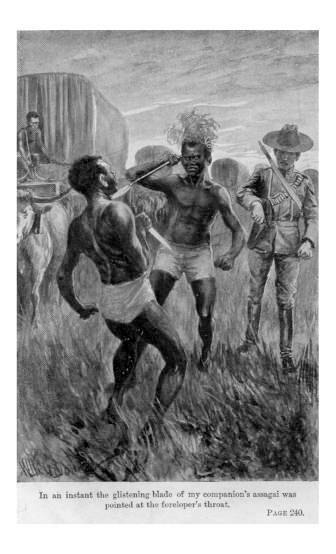
In an instant the shaft of Joeboy’s assagai fell with a sounding thwack across the man’s bare shoulders, making him spring to his feet and snatch a knife out from his waistcloth. My hand went to my revolver, and I ran to Joeboy’s aid; but there was no need. In an instant the glistening blade of my companion’s assagai was pointed at the foreloper’s throat, making him recoil; and then, in response to a threatening thrust or two, the man picked up his long, thin bamboo and replaced his knife, while Joeboy, pointing fiercely to me, rated the man in his own tongue.
“What is it, Joeboy?” I asked as the man went back to the head of the bullock-team.
“Um? Say want to ’top and rest bullocks and make fire for breakfast, Boss. I say he go on till we get to laager. Say he won’t, and Joeboy make um. Boss Val put little ’volver pistol away and unsling gun; pretend to shoot um.”
I did as Joeboy suggested, and the man went down upon his knees and laid his forehead upon the earth. I needed no telling what to say next.
“Get up! Trek!” I shouted as fiercely as I could. The man leaped to his feet and urged the bullocks on, while the driver on the box made his great two-handed whip crack loudly in the quiet of the morning. The actions of these two being taken up by the men with the wagons behind, the bullocks for a time went on at the rate of quite another half-mile an hour extra.
“Um!” ejaculated Joeboy, with a look of satisfaction in his eyes; “rifle gun reach long way. Boss Val see boy not driving well, pretend to send bullet in um head, and make um jump along. Ha!”
Noticing that the black was using his hands like a binocular glass, and looking back, I asked anxiously, “What is it?”
“Um? See Doppie coming now?”
I looked, but could make out nothing; yet I was satisfied it was so. I now gazed eagerly in the direction of our goal, for Joeboy had first turned his eyes there.
“Can you see help coming, Joeboy?” I asked anxiously.
“Um? No,” he replied.
“Then it’s all over,” I said in despair.
“Um? Yes, here um come.”
“Ah!” I cried, remembering now the signal agreed upon. “Is it the Lieutenant—Mr Denham?”
“Joeboy can’t see so far as that,” replied the black. “Only see horses coming fas’. Coming to fetch wagons and plenty mealies and flour. Boys all say ‘Hurrah!’ and make all horses laugh.”
“But do you think they will get here first?”
“Um? Yes. Doppie got longer way to come.”
“Ha!” I ejaculated, with a sigh of relief.
A few minutes later the foreloper on whom so much depended—guided, no doubt, by our anxious looks in one direction—made out the coming of our friends, and I saw his eyes open widely till there was a great opal ring round the dark pupils. Looking at me despairingly, he pointed with his long bamboo in the direction of the galloping troop.
I nodded, and pointed forward. After an uneasy glance at my gun, he went on with his team in the direction we wished.
“Black boy run away fas’,” said Joeboy, suddenly laughing merrily, “but ’fraid lead bullet run fasser.”
“I suppose so,” I said slowly as I turned to look back. The light being now much increased, I readily detected a strong troop of the Boers in motion, and doubtless coming in our direction. I drew my breath hard as I looked at the long lines of slowly plodding oxen and then in the direction of our rescuers, who must have seen we were pursued, for they were galloping. Then, to my horror, Joeboy turned to me and nodded, after gazing back.
“Um?” he said in a long, slow, murmuring way, “’nother lot o’ Doppie coming. Big lot.”
I darted a look at our comrades, who came sweeping along over the veldt; but they were still far distant, and we seemed to be creeping along more slowly than ever.
“Not enough; not enough,” I thought; but I wasted no time in regret. There were fully fifty friends, all good horsemen and able shots, coming to our help; so I need not despair. Thinking of what would be the best tactics under the circumstances, there seemed to be two ways open to us: for the troop to fall in on either side of the last wagon, and keep up a running fight; or, if the Boer party proved too strong, the six wagons could be drawn up laager-wise and turned into a temporary fort, with the bullocks outside, our men firing, till help came, from behind an improvised shelter formed by the sacks of grain and meal.
Then I reasoned despairingly that the Boers would send forward troop after troop to recover, the wagons. “If they can,” I now muttered through my teeth. For I was more hopeful now, as it soon became evident that the enemy had twice as far to come as our men had. At last, when the mental strain had become almost unbearable, Denham and his troop dashed forward, cheering madly.
“Bravo! bravo, Val!” he shouted to me, pulling his horse up so suddenly that it nearly went back on its haunches. “Here, you, Joeboy, keep the teams going. Fall in, my lads! Dismount!”
The troop sprang from their saddles, swung round their rifles, and waited. In obedience to Denham’s next order I followed the last wagon, rifle in hand. Seeing the uneasy glances the drivers and forelopers directed at it from time to time, I felt convinced that if it had not been for this they would have played some trick with the bullocks, or have done something to stop the further progress of our prize-convoy, now that they fully understood what was wrong.
For me the suspense was over, though the plodding of the oxen still seemed maddening; but I had active work to do yet, with Joeboy for my aid, keeping the blacks well to their work. This we did vigorously, being called upon very soon even to threaten and command.
Just when least expected, and following upon a determined charge made by our pursuers, there was a rattling volley delivered standing by our men, who, steadying their rifles upon their horses’ backs, emptied many a saddle. But the Boers came on till within about a hundred yards, when a second volley was poured into them, sending horses and men struggling to the ground. The troop now divided in two, swinging round to right and left and dashing back towards the second party, who were now well in sight.
It was at the first volley that the alarmed black drivers nearly got out of hand, while the teams began to huddle together and threatened a stampede. The black boys, however, soon saw they had more to fear from us than from the Boers; and by the time our friends had remounted and trotted up to us the wagon-train was steadied again.
“Can’t you get any more speed out of them, Val?” shouted Denham.
“No,” I said; “this is the best they can do with the loads. You fellows must save the prize now.”
“And we will,” cried Denham, waving his hat, with the result that his men cheered.
Meanwhile the detachment of the enemy we sent to the right-about in a headlong gallop had settled down to a trot to meet the reinforcements coming up; but we had also a force coming to join us; so, when the enemy had joined hands and came on again, we of the wagon-train had two troops for our protection, who, coming on at a walk behind, readily faced round, dismounted, and poured forth a withering fire, which again sent the enemy scuttling away on their shambling ponies.
So the march went on for the next hour, during which troop after troop of the Boers reinforced our pursuers, but always to find that our force had been strengthened. Then the Colonel joined us with all he could command, and a fierce little battle raged. Again the Boers were repulsed. There being no cover for their men, which is so necessary for the practice of their marksmanship to the best advantage, the clever cavalry manoeuvres of the Light Horse proved too much for them.
Unsuccessful attempts to recapture the wagons were kept up till they were drawn as close to the opening in the old fortress walls as they could be got, the enemy being kept at bay while the bullocks were driven in. Then followed troop after troop of our men, who dismounted and hurried to the top of the walls, where they covered the retirement of their comrades so effectually that the enemy were soon in full retreat, gathering up their wounded as they passed without molestation from us.
That afternoon the Boers’ wagons, surmounted by a white flag, were seen coming across the plain, their attendants being engaged for a long time in the gruesome task of collecting the dead.
It must not be supposed, however, that our men had not suffered; we had a dozen slightly wounded. Inside the walls that evening there was a triumphant scene of rejoicing, in which to a man the wounded took part. The wagons had been emptied, and grain and meal stored under cover; horses and bullocks had a good feed, and one of the wagons was demolished for firewood, our whole force revelling in what they called a glorious roast of beef.
I never felt so much abashed in my life, I could not feel proud; though, of course, I had done my best. I tried to explain that it was poor old black Joeboy we had to thank for the success of the raid; but the men would not listen. If ever poor fellow was glad when the sentries had been relieved and the fires were out, so that rest and silence might succeed the wild feast, I was that person. I felt utterly exhausted, and I have only a vague recollection of lying down upon some bags of mealies, and of Denham, who was by me, saying:
“Hurrah, old fellow! The chief must make you a sergeant for this.”
I don’t think I made any reply, for I was nearly asleep; and that night seemed to glide away in a minute and a half.
Chapter Twenty Nine.
Another Discovery.
Denham and I went out early next day with a small party and an empty wagon to go over the ground between our laager and the Boer lines, following the route taken with the captured wagons, to make sure that no wounded and helpless men were left on the veldt, and to collect such rifles and ammunition as had been left.
A sharp lookout was kept against surprise; but there was no need. Denham’s glass showed that the Boers, probably satisfied with their reverses of the previous day, were keeping to their lines.
We went as far as the spot where the first attack on us was made, finding only a few rifles as we went, noticing on our way sixteen dead horses—ghastly-looking objects, for near every one numerous loathsome birds rose heavily, flying to a short distance; and footprints all around in the soft earth showed that hyenas had been at the miserable banquet. The ground here and there also showed the unmistakable tracks of lions; but I am not sure they had been partakers.
“Well, I’m precious glad there’s no burying of the dead, or bringing in wounded Boers as prisoners,” said Denham as we rode back slowly side by side. “I don’t mind the fighting when my monkey’s up—it all seems a matter of course then; but the afterwards—the poor dead chaps with all the enemy gone out of them, and the suffering wounded asking you for water, and whether you think they’ll die—it makes me melancholy.”
“It’s horrible,” I said; “but it was none of our seeking.”
“No; it’s the Boers’ own fault—the beasts! Fighting for their liberty and patriotism, they call it. They won’t submit to being slaves to the Queen. Such bosh! Slaves indeed! Did you ever feel that you led the life of a slave under the reign of our jolly good Queen?”
“Pooh!” I exclaimed.
“Pooh! puff! stuff!—that’s what it is, old fellow. They’re about the most obstinate, stupid, ignorant brutes under the sun. They don’t know when they’re well off as subjects of Great Britain, so they’ll have to be taught.”
“Of course,” I said. “But they are brave.”
“Well, yes, in a way,” said Denham grudgingly. “They’ll fight if they’re ten or a dozen to one, and can get behind stones or wagons to pot us; but they haven’t got sense enough to know when they’re well off, nor yet to take care of six wagon-loads of good grain and meal, and nearly a hundred and fifty oxen.”
“Well, no; they were stupid there,” I said.
“Stupid, Lieutenant Moray!”
“What!” I exclaimed. “Do you know what you’re saying?”
“Oh yes; all right. You’re not a commissioned officer yet, but you will be. Promoted for special bravery and service in the field.”
“Nonsense!” I said, flushing up.
“Oh, but you will be, sure. Not that I think you deserve it. There wasn’t much risk.”
“Oh no,” I said; “only the risk of being taken, and shot for a traitor, a thief, and a spy.”
“That’s only what the Doppies would call it, and they’re idiots.”
“If a fellow is going to be shot,” I said, “it doesn’t make much difference to him whether he’s shot by a wise man or a fool.”
“Oh, I don’t know,” said Denham quickly. “I’d rather be shot by a wise man than by a Boer pig. But there was no risk. You and that big nigger went in the dark, and you had luck on your side, and— Oh, I say, Val, you did it splendidly! I had a good tuck-out of mealie-porridge this morning, and three big slices of prime beef frizzled. I feel quite a new man with all that under my jacket, and ready to take two Boers single-handed.”
“Yes, a good meal does make a difference,” I said, smiling with pleasant recollections of my own breakfast.
“Difference! Oh, it was splendid! I felt as if I could have voted for you to be made colonel on the spot, and black Joeboy adjutant, when I caught sight of you coming with six wagons and teams instead of one. My dear boy, you’ve won the affection of every one in the corps, from the Colonel right down to the cooks. It’s only cupboard-love, of course; but they’re very fond of you now. We were going to chair you round the big court last night, but the Colonel stopped it. ‘Let the poor fellow have a good rest,’ he said. But we did all drink your health with three times three—in water. Here—hullo! What game do you call that?”
He pointed to where, half a mile away, a dozen of our men were riding out, closely followed by the bullocks we had captured overnight.
“Taking the teams out to graze, I suppose. The poor beasts must be well fed to keep them in condition.”
“Of course. But how do we know that they won’t all bolt back for the Boers’ camp? They’re Boer bullocks, you know. Oh! I’ll never forgive the Colonel if he loses all that beef.”
“The poor brutes will only make for the nearest patches of grass and bush,” I said, “and their guard will take care to head them back if they seem disposed to stray.”
“But is any one on the lookout with a glass on the wall?”
“Sure to be,” I said.
“I’m not so sure,” cried Denham impatiently. “Why, there must be going on for six hundred sirloins there, without counting other tit-bits; and if the bullocks are taken care of, each one is a sort of walking safe full of prime meat for the troops.”
“There—look!” I said; “they’re settling down to graze, and the guard is spreading out between them and the open veldt.”
“Yes, I see,” said Denham anxiously; “but I hope they’ll take great care. That job ought to be ours.”
But it was not, and I did not want it. I said so, too.
“That’s bosh,” replied Denham. “You say so because you’re not hungry; but just wait till you are, and then you’ll be as fidgety about the bullocks as I am.”
“But you’re not hungry now,” I said laughingly.
“Well, no—not at present; but I shall be soon. I haven’t made up the balance of two days’ loss yet. Ugh! only fancy—grilled cat’s-meat for a commissioned officer in Her Majesty’s service! Ugh! To think that I was compelled by sheer hunger to eat horse! I’d swear off all flesh-feeding for good if it wasn’t for that beef.”
He burst into a hearty fit of laughing then, and we rode on, chatting about our position and the fact that the Boers seemed to consider they could not do better for their side than keep us shut up as we were till we surrendered as prisoners of war.
“That’s it, evidently,” said Denham. “They hate us horribly, for we’d been doing a lot of mischief amongst them before you joined, as well as ever since.”
“Shall we be able to cut our way through before long?” I asked.
“I don’t know, old fellow,” he replied.
“We ought to,” I said, “because we could be of so much use to the General’s troops.”
“Well, I don’t know so much about that,” said Denham as we neared the fortified gateway, with its curtain of empty wagons. “I’m beginning to think that we’re being a great deal of help to the General here.”
“How?” I asked wonderingly. “Our corps is completely useless.”
“Oh no, it isn’t, my little man. Look here; I’m of opinion that we’re surrounded by quite a couple of thousand mounted men.”
“Yes, perhaps there are,” I said, “at a guess.”
“Well, isn’t that being of use to the British General? We’re keeping these fellows fully occupied, so that they can’t be harassing his flanks and rear with all this mob of sharpshooters, who know well how to use their rifles.”
“I say,” I cried, “what’s the matter yonder?”
“Nothing! Where?”
“Look at the baboons right at the far end of the kopje. They’re racing about in a wonderful state of excitement.”
“Smell cooking, perhaps,” said Denham. “Here, Sergeant,” he continued, calling up Briggs, “take Mr Moray and a couple of men. Canter round yonder and see if you can make anything out. Scout. Perhaps the brutes can see the Boers advancing.”
In another minute we were cantering round the ragged outskirts of the great pile of stones, where they came right down to the plain, among which were plenty of grassy and verdant patches, little gorges and paths up amongst the tumbled-together blocks; and as we rode along we startled apes by the dozen from where they were feeding, and sent them shrieking and chattering menacingly, as they rushed up to the higher parts.
It was away at the extreme end where the main body of the curious-looking, half-dog, half-human creatures were gathered, all in motion, and evidently much exercised by something below them on the side farthest from where we approached.
“They’re playing some game, Mr Moray,” said the Sergeant, speaking quite respectfully to me, and, as I thought, slightly emphasising the “Mister,” which sounded strange. “Tell you what it is: one of the young ones has tumbled into a gully and broken his pretty little self.”
“Give the order to unsling rifles, Sergeant,” I said quietly, “and approach with caution.”
“Eh? What! You don’t think there’s an ambuscade—do you?”
“No,” I said as I watched the actions of the apes keenly; “but I do think there’s a lion lying up somewhere.”
“A lion!”
“Yes; one of the brutes that were feeding on the dead horses in the night. He has made for the shelter yonder, and is in hiding.”
“And the monkeys have found him, and are mobbing the beggar now he’s sleeping off his supper?”
“That’s it, I think,” I replied.
“Then let’s get his skin if we can. Steady, all, and don’t fire till you get a good chance.”
We checked our horses so as to approach at a walk, the Sergeant sending me off a few yards to his left, and the other men opening out to the right.
I fully expected to see the baboons go scurrying off as we approached; but, on the contrary, they grew more excited as, with rifle ready and Sandho’s rein upon his neck, I picked my way alongside the others in and out among the great blocks of stone at the foot of the kopje, where there was ample space for a couple of score of lions to conceal themselves. But I felt sure that as soon as we came near enough, and after sneaking cautiously along for some distance, the one we sought would suddenly break cover and bound off away across the veldt.
Wherever I came to a bare patch of the sandy earth I scanned narrowly in search of “pug,” as hunting-men call the traces; but I could not make out a single footprint. There were those of the baboons by the dozen, and the hoof-tracks of horses, probably those of some of our men when they made a circuit of the rocky hillock. Every hoof-mark was made by horses going in the direction we were; but still no sign of a lion.
“Keep a sharp lookout,” said the Sergeant softly; and I remember thinking his words unnecessary, seeing that every one was keenly on the alert.
“Seems to me a mare’s-nest,” said the Sergeant to me dryly, as he cocked his eye and pointed down at the footprints.
“No,” I said; “the baboons have got something below them on the other side, or they wouldn’t keep on like that. Ah! look out!”
“What can you see?” cried the Sergeant.
“Marks of blood on the ground here. The lion has caught one of the baboons, I expect, and he’s devouring it over yonder under where the rest are dancing about and chattering.”
“And enough to make them,” said the Sergeant between his teeth. “Shoot the beggar if you can, sir.”
“I’ll try,” I replied; and Sandho advanced cautiously, with the cover getting more dense, till, just as I was separated from the Sergeant by a few big blocks of ironstone, from out of whose chinks grew plenty of brushwood, Sandho stopped short, threw up his muzzle, and neighed.
“What is it, old fellow?” I said softly, as I debated whether I should dismount so as to make sure of my shot. “There, go on.”
The horse took two steps forward, and then stopped again.
“Here’s something, Sergeant,” I said. “Push on round the end of that block and you’ll see too.”
“Lion?”
“No, no. Go on.”
Sergeant Briggs pushed on, and uttered a loud ejaculation.
“One of the Boers’ horses?” I said.
“One of the Boers, my lad,” he cried. “Close in there.”
The two men drew nearer, and the next minute we were all gazing down at where one of the enemy’s wounded horses had evidently pitched forward upon its knees and thrown its wounded rider over its head to where he lay, a couple of yards in advance, with a terrible gash across his forehead, caused by falling upon a rough stone. But that was not the cause of his death, for his jacket and shirt were torn open and a rough bandage had slipped down from the upper part of his chest, where a bullet-wound showed plainly enough that his lungs must have been pierced, and that he had bled to death.
“Poor chap!” said the Sergeant softly; “he’s got it. Well, he died like a brave man. Came up here, I s’pose, for shelter.”
“There’s another over yonder,” I said excitedly, for about fifty yards away from where we were grouped, and high above us, the baboons were leaping about and chattering more than ever.
“Shouldn’t wonder,” said the Sergeant; “and he aren’t dead. Trying to scare those ugly little beggars away.”
“I’ll soon see,” I said; and as I urged Sandho on, the shrinking beast cautiously picked his way past the dead group, and we soon got up to a narrow rift full of bushes, the path among the rocks running right up to the highest point, towards which the baboons began to retire now, chattering away, but keeping a keen watch on our proceedings.
“Another dead horse, Sergeant,” I shouted back.
“Never mind the horse,” cried Briggs. “Be ready, and shoot the wounded man down at sight if he doesn’t throw up his hands. ’Ware treachery.”
I pressed on into the gully, at whose entrance the second dead horse lay, and the next minute, as Sandho forced the bushes apart with his breast, I saw marks of blood on a stone just beneath where the apes had been chattering in their excitement; and then I drew rein and felt completely paralysed, for a faint voice, whose tones were unmistakable, cried:
“Help! Wather, for the love of Heaven!”
Chapter Thirty.
Briggs’s Irish Lion.
“Why, it’s an Irish lion!” cried the Sergeant, who was now close behind me.
I was too much surprised to say anything then; but I felt afterwards that I might have said, “Irish jackal! The Irish lions are quite different.” But somehow the sight of the badly-wounded man disarmed me, and I dismounted to part the bushes and kneel down beside where my enemy lay back with his legs beneath the neck and shoulders of his dead horse, blood-smeared and ghastly, as he gazed wildly in my face.
“Wather!” he said pitifully. “I am a dead man.”
“Are you, now, Pat?” cried the Sergeant, in mocking imitation of the poor wretch’s accent and high-pitched intonation.
“Don’t be a brute, Sergeant,” I said angrily as I opened my water-bottle and held it to the man’s lips. “Can’t you see he’s badly hurt?”
“Serve him right,” growled the Sergeant angrily. “What business has he fighting against the soldiers of the Queen? Ugh! he don’t deserve help; he ought to be stood up and shot for a traitor.”
“Be quiet!” I said angrily as I held the bottle, and the wounded man gulped down the cool water with terrible avidity.
“All!” he moaned, “it putts life into me. Pull this baste of a horse aff me. I’ve got a bullet through my showlther, and I’m nearly crushed to death and devoured by those imp-like divils o’ monkeys.”
“Here, you two,” cried the Sergeant surlily, “uncoil your reins, and make them fast round this dead horse’s neck.”
Our two followers quickly executed the order, and then, the other ends of the plaited raw-hide ropes being secured to rings in their saddles, they urged on their horses, which made a plunge or two and dragged their dead fellow enough on one side for the Sergeant, with my help, to lift the poor rider clear.
“The blessing of all the saints be upon you both!” he moaned. “There’s some lint in my pouch; just put a bit of a bandage about my showlther. I’m Captain Moriarty, an officer and a gintleman, who yields as a prisoner, and I want to be carried to yer commanding officer.”
He spoke very feebly at first; but the water and the relief from the pressure of the horse revived him, and he began to breathe more freely, his eyes searching my face in a puzzled way as if he thought he had seen me before.
I took no heed, but did as he suggested; and, finding the lint and a bandage, roughly bound up the wound, which had long ceased bleeding.
“Can ye fale the bullet in the wound, me young inimy?” he said, with a sigh.
“No,” I replied, looking him full in the eyes. “Our doctor will see to that.”
“Then ye’ve got a docthor with ye?” he said, pretty strongly now.
“Of course we have,” growled the Sergeant, whose countenance seemed to me then to bear a remarkable resemblance to that of a mastiff dog who was angry because his master spoke civilly to a stranger he wanted to hunt off the premises. “Do you take us for savages?”
“Silence, sor!” cried our prisoner, “or I’ll report ye to yer officer.”
“Silence yourself!” cried the Sergeant. “What do you want with a doctor, you Irish renegado turncoat? You said you were a dead man.”
“Whisht! I’m a prisoner; but I’m an officer and a gintleman.—Here, boy, ordher your min to carry me out of this.”
“My men!” I said, laughing. “I’m only a private, and this is my sergeant.”
“Thin ye ought to change places, me boy.—Give orders to your min to carry me out of this, Serjint.”
“I’m about ready to tell the lads to put an end to a traitor to his country.”
“Tchah! Ye daren’t do annything o’ the kind, Serjint, for it would be murther. This is my counthry, and I’m a prisoner of war.”
“Let him be, Sergeant, and we’ll get him into the camp.—Can you sit on a horse, sir?” I said.
“Sure, how do I know, boy, till I thry? I’ve been lying under that dead baste till I don’t seem to have any legs at all, at all. Ye must lift me on.”
“Officer and a gentleman!” said the Sergeant scornfully. “I never heard an Irish gentleman with a brogue like that. I believe you’re one of the rowdy sort that call themselves patriots.”
“Sure, and I am,” cried our prisoner. “But here, I don’t want any wurruds with the like o’ ye.—Help me up gently, boy, and let me see if I can’t shtand.”
“Take hold of him on the other side,” I said to the Sergeant, and he frowningly helped, so that we got our prisoner upon his feet.
“Ah!” he said, with a groan. “I think I can manage it if ye lift me on a horse.”
Sandho was led up, and with a good deal of difficulty and a repetition of groans and allusions to the state of his lower members, the Captain was hoisted into the saddle, and after another draught of water he declared that he could “howld” out till we got him to the “docthor.”
“He doesn’t look as if he could try to make a bolt of it,” growled the Sergeant; “but you’d better throw the reins over your horse’s head and lead him.—And look here, Mr Officer and Gentleman, I’m very good with the revolver, so don’t try to spur off.”
Our prisoner waved his hand contemptuously and turned to me.
“Sure, me wound and me fall put it all out of me head; but I had a man with me when I was hit, and we were cut off in the fight.”
“Yes,” I said; “the poor fellow lies close here—dead.”
“Thin lade the horse round another way, boy. I don’t want to look at the poor lad. Ah! I don’t fale so faint now. To think of me bad luck, though. Shot down like this, and not in battle, but hunting a gang of wagon-thieves.”
“Ha, ha, ha! ha, ha, ha!” roared the Sergeant, slapping his thigh again and again as he laughed. “Come, I like that, Mr Moray.—Here, Mr Captain, let me introduce you to the gentleman who so cleverly carried off your stores last night.”
I was scarlet with indignation at being called a cattle-thief, and turned angrily away.
“What!” said the prisoner; “him? Did—did he—did—But Moray—Moray? Sure, I thought I knew his face again. Here, I arrest ye as a thraitor and a deserter from the commando, boy;” and his hand went to the holster to draw his revolver, which had not been interfered with.
“Drop that!” roared the Sergeant roughly, and he dragged the prisoner’s hand from the holster, wrenching the revolver from his grasp, and nearly making him lose his balance and fall out of the saddle. “I’ve heard all about it. So you’re the Irish scoundrel who summoned that poor lad, and when he refused to turn traitor and fight against his own country, you had his hands lashed behind his back and treated him like a dog. Why, you miserable renegado! if you weren’t a wounded man I’d serve you the same. An officer and a gentleman! Why, you’re a disgrace to your brave countrymen.”
“Whisht! whisht!” cried our prisoner contemptuously.
“Whisht! whisht! I’d like to whisht you with a Boer’s sjambok,” cried the Sergeant. “Here he finds you wounded and where you’d have lain and died, and the carrion-birds would have come to the carrion; and when the brave lad’s helped you, given you water, bound up your wound, and put you on his own beast, like that man did in Scripture, you turn round in the nastiness of your nature and try to sting him. Bah! I’d be ashamed of myself. You’re not Irish. I don’t even call you a man.”
The Sergeant’s flow of indignation sounded much poorer at the end than at the beginning; and, his words failing now, I had a chance to get in a few.
“That’s enough, Sergeant,” I said. “You forget he’s a wounded man and a prisoner.”
“Not half enough, Mr Moray,” cried the Sergeant. “I’m not one of your sort, full of fine feelings; only a plain, straightforward soldier.”
“And a brave man,” I said, “who cannot trample on a fallen enemy.”
Sergeant Briggs gave his slouch felt hat a thrust on one side, while he angrily tore at his grizzled shock of closely-cut hair: it was too fierce to be called a scratch.
“All right,” he said—“all right; but the sight of him trying to get out a pistol to hold at the head of him as—as—”
“Be quiet, Sergeant,” I said, smiling in spite of myself. “Look: the poor fellow’s turning faint. Let’s get him to the camp. Ride alongside him and hold him up or he’ll fall.”
“If I do may I—”
“Sergeant!” I shouted.
“Oh, all right, all right. I— But here, I’m not going to let you begin to domineer over your officer.”
“Sergeant,” I said gently, and without a word he pressed his horse close alongside the prisoner, thrust a strong arm beneath him, and we went out into the open, passing, after all, the prisoner’s Boer companion, whose fighting was for ever at an end; and at last we reached the entrance to the old fort, with our wounded prisoner nearly insensible. After the horses had been led in, the prisoner had to be lifted down and placed in the temporary hospital made in a sheltered portion of the passage. Here the surgeon saw him at once, and extracted a rifle-bullet, which had nearly passed through the shoulder.
The Colonel was soon made acquainted with all that had passed, the Sergeant being his informant, and men were sent out to give a soldier’s funeral to the dead Boer, who, with the Captain, must have dashed out in one of our skirmishes, after being wounded, and tried to escape by going right round the kopje, but had fallen by the way.
“Here, Moray,” said the Colonel to me the next time he passed, “you’ve been heaping coals of fire upon your enemy’s head, I hear?”
“Oh, I don’t know, sir,” I said uneasily.
“I’ve heard all about it, my lad; and a nice sort of a prisoner you’ve brought me in. If he had been a Boer I’d have put him on one of the captured horses and sent him to his laager, but I feel as if I must keep this fellow. There, we shall see.”
“A brute!” said Denham that same night. “He’s actually had the impudence to send a message to the Colonel complaining of his quarters and saying that he claims to be treated as an officer and a gentleman.”
“Pooh! The fellow only merits contempt,” I said.
“There are fifteen Irishmen in the corps, and they’re all raging about him. They say he ought to be hung for a traitor. He doesn’t deserve to be shot.”
“But there isn’t an Irishman in the corps would put it to the proof,” I said.
“Humph! Well,” said Denham, “I suppose not, for he is a prisoner after all. Officer and a gentleman—eh? One who must have left his country for his country’s good.”
Chapter Thirty One.
Denham’s bad luck.
The men of the corps were in high glee during the following days, the Boers making two or three attempts to cut off our grazing horses and oxen, but smarting terribly for being so venturesome. In each case they were sent to the right-about, while our cattle were driven back into safety without the loss of a man.
The enemy still surrounded us, occupying precisely the same lines; and, thoroughly dissatisfied with a style of fighting which meant taking them into the open to attack our stronghold, they laagered and strengthened their position, waiting for us to attack them. This could only be done at the risk of terrible loss and disaster, for the Boers were so numerous that any attempt to cut through them might only result in our small force being surrounded and overwhelmed by sheer weight of numbers. Therefore our Colonel decided not to make an attack.
“The Colonel says they’re ten to one, Val; and as we’ve plenty of water and provisions, he will leave all ‘acting on the aggressive’ to the Doppies.”
This remark was made by my companion Denham when we had been in possession of the old fortress for nearly a fortnight.
At first, while still suffering a little from the injuries I had received, the confinement was depressing; but as I gradually recovered from my wrenches and bruises, and as there was so much to do, and we were so often called upon to be ready for the enemy, the days and nights passed not unpleasantly. Discipline was strictly enforced, and everything was carried out in the most orderly way. Horses and cattle were watered and sent out to graze in charge of escorts, and a troop was drawn up beyond the walls, ready to dash out should the Boers attempt to cut them off; guard was regularly mounted; and the men were set to build stone walls and roofs in parts of the old place, to give protection from the cold nights and the rain that might fall at any time.
As for the men, they were as jolly as the proverbial sandboys; and at night the walls echoed with song and chorus. Then games were contrived, some played by the light of the fires and others outside the walls. Bats, balls, and stumps were made for cricket; of course very roughly fashioned, but they afforded as much amusement as if they had come straight from one of the best English makers.
There was, however, a monotony about our food-supply, and the officers more than once banteringly asked me when I was going to cut out another half-dozen wagons.
“Bring more variety next time,” they said merrily. “Pick out one loaded with tea, coffee, sugar, and butter.”
“Yes,” cried Denham, laughing; “and when you are about it, bring us some pots and kettles and potatoes. We can eat the big ones; and, as we seem to be settled here for the rest of our days, we’re going to start a garden and plant the little ’taters in that.”
“To be sure,” said another officer; “and I say, young fellow, mind and choose one of the next teams with some milch-cows in it. I feel as if I should like to milk.”
I laughed too, but I felt as if I should not much like to undertake such another expedition as the last, and that it would be pleasanter to remain content with the roast beef and very decent bread our men contrived to make in the old furnace after it had been a bit modified, or with the “cookies” that were readily made on an iron plate over a fire of glowing embers. Oh no! I don’t mean damper, that stodgy cake of flour and water fried in a pan; they were the very eatable cakes one of our corporals turned out by mixing plenty of good beef-dripping with the flour, and kneading all up together. They were excellent—or, as Denham said, would have been if we had possessed some salt.
One of our greatest difficulties was the want of fuel, for it was scarce around the old stronghold when we had cut down all the trees and bushes growing out of the ledges and cracks about the kopje; and the question had been mooted whether we should not be obliged to blast out some of the roots wedged in amongst the stones by ramming in cartridges. But while there was any possibility of making adventurous raids in all directions where patches of trees existed, and the men could gallop out, halt, and each man, armed with sword and a piece of rein, cut his faggot, bind it up, and gallop back, gunpowder was too valuable to be used for blasting roots. This was now, however, becoming a terribly difficult problem, for the enemy—eagerly seizing upon the chance to make reprisals when these were attended by no great risk to themselves—had more than once chased and nearly captured our foraging parties.
Consequently all thoughts of fires for warmth during the cold nights, when they would have been most welcome, were abandoned; while the men eagerly volunteered for cooks’ assistants; and the officers were not above gathering in the old furnace-place of a night, after the cooking was over, for the benefit of the warmth still emitted by the impromptu oven.
Meanwhile every economy possible was practised, and the fuel store jealously guarded. The said fuel store consisted of every bone of the slaughtered animals that could be saved, and even the hides; these, though malodorous, giving out a fine heat when helped by the green faggots, which were in turn started ablaze by chips of the gradually broken-up wagons.
Then, too, the veldt was laid under contribution, men going out mounted, and furnished with sacks, which they generally brought back full of the scattered bones of game which had at one time swarmed in the neighbourhood, but had been ruthlessly slaughtered by the Boers.
So the days glided on, with not the slightest prospect, apparently, of our escape.
“Every one’s getting precious impatient, Val,” said Denham one day when we were idling up on the walls with his field-glass, after lying listlessly chatting about the old place and wondering what sort of people they were who built it, and whether they did originally come gold-hunting from Tyre and Sidon. “Yes,” he added, “we are impatient in the extreme.”
“It doesn’t seem like it,” I replied; “the men are contented enough.”
“Pooh! They’re nobody. I mean the officers. The chief’s leg’s pretty nearly right again, and he was saying at mess only yesterday that it was a most unnatural state of affairs for British officers to be forced by a set of low-bred Dutch Boers, no better than farm-labourers, to eat their beef without either mustard, horse-radish, or salt.”
“Horrible state of destitution,” I said quietly.
“None of your sneers, Farmer Val,” he cried. “He’s right, and I’m getting sick of it myself. He says it is such an ignoble position for a mounted corps to suffer themselves to be shut up here, and not to make another dash for freedom.”
“Well, I shall be glad if we make another attempt to get through their lines,” I said thoughtfully.
“That’s what the Major said, when, hang me! if the chief didn’t turn suddenly round like a weathercock, and say that what we were doing was quite right, because we held this great force of Boers occupied so that the General might carry out his plans without being harassed by so large a body of men.”
“That’s right enough,” I said.
“Don’t you get blowing hot and cold,” cried Denham, with impatience. “Then some one else sided with the Colonel. It was the doctor, I think. He said the General must know when, where, and how we were situated, and that sooner or later he would attack the Boers, rout them, and set us at liberty.”
“That sounds wise,” I hazarded.
“No, it doesn’t,” said my companion; “because we shouldn’t want setting at liberty then. Do you suppose that if we heard the General’s guns, and found that he was attacking the enemy, we should sit still here and look on?”
“Well, it wouldn’t be right,” I replied.
“Right? Of course not. As soon as the attack was made we should file out and begin to hover on the enemy’s flank or rear, or somewhere else, waiting our time, and then go at them like a wedge and scatter them. Oh, how I do long to begin!”
“It seems to me,” I said thoughtfully, “that the General ought to have sent some one to find us and bring us a despatch ordering the Colonel what to do.”
“I dare say he has—half-a-dozen by now—and the Boers have captured them; but it doesn’t matter.”
“Doesn’t matter?” I said wonderingly.
“No; because, depend upon it, he’d have ordered us to sit fast till he came.”
“Well, but oughtn’t the Colonel to have sent out a despatch or two telling the General how we are fixed?”
“Yes—no—I don’t know,” said Denham sourly. “I’m only a subaltern—a bit of machinery that is wound up sometimes by my superior officers, and then I turn round till I’m stopped. Subalterns are not expected to have any brains, or to think for themselves.”
“Now you are exaggerating,” I said.
“Not a bit of it, my little man. But I know what I should have done if I had been chief.”
“What’s that?”
“Sent out a smart fellow who could track and ride.”
“With a despatch for the General?”
“No; a message that couldn’t fall into the enemy’s hands. I’d have gone like a shot.”
“You couldn’t send yourself,” I said dryly.
“Eh? What do you mean?”
“You were telling me what you would have done if you had been chief.”
“Bah! Yah! Don’t you pretend to be so sharp. That’s what the old man ought to do, though—send out a messenger, and if he didn’t find the General he’d find out how things are going. I believe the Boers are licking our regular troops.”
“Oh, nonsense!” I said, looking startled. “Impossible.”
“Nothing’s impossible in war, my boy. I’m getting uncomfortable. You’d go with a message if you were ordered?”
“Of course,” I said.
“Of course you would. That’s what the chief ought to do, and I’ve a good mind to tell him so. But I say,” he added, in alarm, “don’t you go and tell any one what I’ve been talking about.”
I looked him in the face and laughed.
“Of course you will not,” said Denham confidently. “Hullo! Going?”
“Yes; I want to go and see how the great Irish captain is,” I replied.
“What do you want to go and see him for?” said my companion angrily.
“I hardly know,” I replied. “I like to see that he’s getting better.”
“Well, you are a rum chap,” cried Denham. “I should have thought you would like to go and sit upon the bragging brute. Why, last time, when I went with you, he talked to both of us as if we were two privates in his Boer corps.”
“Yes, he’s a self-satisfied, inflated sort of fellow; but he’s wounded and a prisoner.”
“What of that? It’s only what he ought to be. I want to know what’s to be done with him.”
“The Colonel won’t send him to the Boer lines when he’s well enough to move, I hope.”
“Not he. I expect he’ll be kept till he can be handed over to the General. Here, I’ll come with you.”
I was quite willing, and we descended to the hospital, as the shut-off part of one of the passages was called; and there sat the only patient and prisoner, with an armed sentry close at hand to prevent any attempt at escape.
The Captain turned his head sharply on hearing our footsteps, and gave us both a haughty stare, which amused Denham, making him look to me and smile.
“Oh, you’ve come at last,” said the patient. “I’ve been wanting you.”
“What is it?” I said. “Water?”
“Bah!” he replied, his upper lip curling. “I want you to bring your chief officer here.”
“I dare say you do, my fine fellow,” cried Denham. “Pretty good for a prisoner! You don’t suppose he’ll come—do you? Here, what do you want? Tell me, and I’ll carry your message to the chief.”
Moriarty gave the young officer a contemptuous glance, and then turned to me.
“Go and tell the Colonel, or whatever he is, that I am greatly surprised at his inattention to my former message.”
“Did you send a message?” I asked, surprised by his words.
“Of course I did, two days ago, by the surgeon. It’s not gentlemanly of your Colonel. Go and tell him that I feel well enough to move now, and that I desire him to send me with a proper escort, and under a white flag, to make an exchange of prisoners.”
“Well, I’ll take your message,” I said; “but—”
“Yes, go at once,” said Moriarty, “and bring me back an answer, for I’m sick of this place.”
He turned away, and, without so much as a glance at Denham, lay back, staring up at the sky.
“Well,” said Denham when we were out of hearing, “of all the arrogance and cheek I ever witnessed, that fellow possesses the most. Here, what are you going to do?”
“Take the message to the Colonel,” I replied.
“Going to do what?” cried Denham. “Nothing of the kind.”
“But I promised him.”
“I know you did; but you must have a fit of delirium coming on. It’s being too much up in the sun.”
“Nonsense,” I said. “I’ve no time for joking.”
“Joking, my dear boy? Nothing of the kind. I’m going to take you to the doctor; he’ll nip your complaint in the bud.”
“Absurd,” I cried. “Come with me to the Colonel.”
“What! To deliver the message?”
“Of course.”
“No, Val, my boy. I like you too well to let you go to the old man. Do you know what he’d do?”
“Send me back to our friend there with a message as sharp as a sword. Of course I know he will not send him across to the Boers.”
“My dear Val,” said Denham solemnly, “let me inform your ignorance exactly what would happen. I know the chief from old experience. He’ll sit back and listen to you with one of those pleasant smiles he puts on when he’s working himself up into a rage. He’ll completely disarm you—as he did me once—and all the time, as he hears you patiently to the end, he’ll think nothing about my lord Paddy there, but associate you, my poor boy, with what he will consider about the most outrageous piece of impudence he ever had addressed to him. Then suddenly he’ll spring up and say— No, I will not spoil the purity of the atmosphere this beautiful evening by repeating a favourite expletive of his—he’ll say something you will not at all like, and then almost kick you out of his quarters.”
“I don’t believe it,” I said.
“That’s giving me the lie, Val, my boy. He’ll be in such a rage that he’ll forget himself; for, though he’s a splendid soldier, and as brave a man as ever crossed a charger, he is one of the—”
“What, Mr Denham?” said the gentleman of whom he spoke, suddenly standing before us. “Pray speak out; I like to hear what my officers think of me.”
Chapter Thirty Two.
Denham Shivers.
I wanted to dash off—not from fear, but to indulge in a hearty roar of laughter—for Denham’s countenance at that moment wore the drollest expression I have ever seen upon the face of man.
“I—I—I beg your pardon, Colonel,” he stammered at last.
“For backbiting me, sir,” said the Colonel shortly. “I could not help hearing your last sentence, for you raised your voice and forced it upon me. Now, if you please, I am one of the—what?”
“I was—I was only telling Moray here, sir, that you were—er—er—very passionate, and that if—”
“Passionate, am I?”
“Yes, sir,” stammered Denham. “No, no; I beg your pardon, sir. I didn’t mean to say that.”
“I presume you are saying what you consider to be the truth, Mr Denham,” said the Colonel coldly. “Now, pray go on: and that if—”
“If he came to you with—with a message, sir, that he has just received, you would kick him out of your presence.”
“Humph!” said the Colonel sternly. “Just this minute, sir, you said of me what you believed to be the truth; but now you have been saying what you must know to be false.—Pray, what was the message Moray?” he added, turning to me.
There was only one thing to do, and I did it, giving Moriarty’s message to the end.
“The insolent, conceited idiot!” said the Colonel scornfully. “You need not go back to him with my answer; but if you come across him again and he asks what I said, you can tell him this: that at the first opportunity I shall hand him over to my superior officers, as one of Her Majesty’s subjects found with arms in his hand fighting against the British force after taking service with her enemies, and doing his best to impress Englishmen to serve in the same ranks.—Mr Denham, I should like a few words with you in the morning.”
He turned upon his heel and strode heavily away, with his spurs clinking loudly and the guard at the end of his scabbard giving a sharp chink every now and then, as, field-glass in hand, he climbed to the top of the wall to take a look round at the positions of the enemy before the evening closed in.
“Well,” said Denham at last, looking the while as if all the military starch had been taken out of him, “you’ve done it now.”
I could keep back my laughter no longer.
“Somebody has,” I cried merrily.
“Yes,” he said dolefully; “somebody has. Oh, I say, Val, you oughtn’t to have told tales like that.”
“What?” I cried. “How could I help it?”
“Well, I suppose you couldn’t,” said my companion. “But there never was such an unlucky beggar as I am. What did he want to come upon us just at that moment for? Oh dear! oh dear! and I got to face him to-morrow morning! I say, can’t we do something to put it off—something to make him forget it?”
“Impossible,” I said.
“Oh, I don’t know; try and think of a good dodge—a sortie, or doing something to make the Boers come on to-night. If we had a jolly good light he’d forget all about it, and I shouldn’t hear any more about the miserable business. Here, what can we do to make the Boers come on? I might get killed in the set-to, and then I should escape this awful wigging.”
“Who ought to go and see the doctor now?” I said. “Who’s going mad?”
“I am, I believe, old fellow; and enough to make me. It’s enough to make a fellow desert. Here, I know; I’ll do something. It’s all the fault of that miserable renegade. I’ll go in and half-kill him—an insolent, insulting brute!”
Just then Denham, who was as fearless as any man in the ranks when out with the corps, started violently in his alarm; for a hail came from high up on the wall in the Colonel’s familiar voice; and upon looking up, there he was, glass in hand, looking down at us.
“Denham,” cried the Colonel, “run to the Major. Tell him to come here to me at once, and bring his glass.”
“Yes, sir,” cried my companion.—“Come with me, Val. My word! He gave me such a turn, as the old women say; I thought he’d heard me again. Hurrah, old fellow! there’s something up, and no mistake. I shan’t get that tongue-flogging after all.”
Chapter Thirty Three.
Denham Proves to be Right.
In a few minutes the Major had joined the Colonel, and soon every officer and man in the old fortification was waiting breathlessly for information as to what intelligence regarding the movements of the enemy the two stern-looking men up on the wall were gathering into their brains through their glasses—intelligence far beyond the ken of the sentries, whose duty it was to keep strict watch upon the great circle which was formed by the Boer lines.
There was no hurry or bustle; but our trumpeter had buckled his sword-belt and taken down his instrument from where it hung, and then stationed himself upon one of the blocks of stone in the great courtyard, watching his chiefs, and holding his instrument ready, while his eyes seemed about to start out of his head in his excitement. Everywhere it was the same. Men glided about here and there, after a glance at the ranges of rifles against the wall, with their well-filled bandoliers, and only paused at last where each could dart to his horse, ready to saddle and bridle the tethered beast. The officers were also silently preparing—buckling on their swords, taking revolvers from their belt-holsters, and filling the chambers from their cartridge-pouches, quite mechanically, without taking their eyes off the watchers on the wall. But in spite of all these preparations no sounds were heard save those made by the horses—an impatient stamp or pawing at the stones, followed by a snort or a whinnying neigh.
I did as the rest had done. Meeting Denham after his return from the sheltered spot occupied by the officers, we stood together, looking up at the wall.
“What a long time they are taking!” whispered Denham impatiently. “The Doppies can’t be coming on, or they’d have been seen before now.”
Almost as he spoke the two officers strode to one end of the rampart and began to inspect the veldt again. The next minute they were making for the opposite side of the great building, to examine the country in that direction; and here they stood for a long time.
“Oh dear!” groaned Denham at last. “What’s-its-name deferred makes the heart sink into your boots. It’s a false alarm.”
“Not it,” I said, “for there has been no alarm.”
“Well, you know what I mean. It’s all over. I did hope the chief would be so busy that he’d forget all about what I said. There never was such a miserably unlucky beggar born as I am. Now we shall—”
Just then the Major left the Colonel’s side, came to the edge of the wall, and looked down into the court, gave a nod of satisfaction, and made a sign to the trumpeter, whose bugle went with a flip to his lips, and there was a sound as if the pent-up breath of some four hundred men had been suddenly allowed to escape. Then the walls were echoing to the call “Boot and Saddle,” and every man sprang to his hung-up saddle and then to his horse, the willing beasts seeming all of a tremor with an excitement as great as that of their riders. Long practice had made us quick; and in an incredibly short time I was standing like the rest with my rifle slung across my back, holding Sandho’s bridle ready to lead him out through the gateway, military fashion, though he would have walked at my side like a dog.
“We’re only going for a bit of a reconnaissance,” said Sergeant Briggs gruffly as, after a sharp, non-com glance at his men, he settled down close to my side.
“How do you know?” I asked, speaking as if to a friend, and not to a superior officer on parade.
“No orders for water-bottles and rations, my lad. I was in hopes that we were going to make a dash through them and get out of this prison of a place.”
“What! and leave all that splendid beef, Briggs?” said Denham, who came up in time to hear the Sergeant’s words.
“Yes; and the gold-mine too, sir. We could come back and take possession of that.”
“But the bullocks?”
“They’d find their way out and get their living on the veldt. Needn’t trouble about them, sir. Look out.”
We were looking out, for our two chief officers had now descended from the walls and crossed to where their servants were holding their chargers.
Directly after a note was sounded, followed by a sharp order or two, and horse and man, troop after troop, filed out into position and stood ready to mount.
The order was not long in coming, and we sprang into our saddles, all in profound ignorance of what was before us, save that we were soon to return. About fifty men had been left as garrison.
Then an order was given, and we divided into two bodies. One detachment, under the Major, moved off, to pass round by the kopje; the other, in which I served, taking the opposite direction, but turning after passing round the stronghold, and meeting the other detachment about half a mile to the east. There we sat, obtaining in the clear evening light a full view of the enemy’s proceedings.