Feeding and Management
Reading edition
No branch of dairy farming can compare in importance with the management of cows. The highest success will depend upon it, whatever breed be selected, and whatever amount of care and attention be given to the points of the animals; for experience will show that very little milk comes out of the bag, that is not first put into the throat. It is poor economy, therefore, to attempt to keep too many cows for the amount of feed one has; for it will generally be found that one good cow well-bred and well fed will yield as much as two ordinary cows kept in the ordinary way; while a saving is effected both in labor and room required, and in the risks on the capital invested. If an argument for the larger number on poorer feed is urged on the ground of the additional manure—which is the only basis upon which it can be put—it is enough to say that it is a very expensive way of making manure. It is not too strong an assertion, that a proper regard to profit and economy would require many an American farmer to sell off nearly half of his cows, and to feed the whole of his hay and roots hitherto used into the remainder.
An animal, to be fully fed and satisfied, requires a quantity of food in proportion to its live weight. No feed is complete that does not contain a sufficient amount of nutritive elements; hay, for example, being more nutritive than straw, and grains than roots. The food, too, must possess a bulk sufficient to fill up to a certain degree the organs of digestion of the stomach; and, to receive the full benefit of its food, the animal must be wholly satisfied—since, if the stomach is not sufficiently distended, the food cannot be properly digested, and of course many of the nutritive principles which it contains cannot be perfectly assimilated. An animal regularly fed eats till it is satisfied, and no more than is requisite. A part of the nutritive elements in hay and other forage plants is needed to keep an animal on its feet—that is, to keep up its condition—and if the nutrition of its food is insufficient for this, the weight decreases, and if it is more than sufficient the weight increases, or else this excess is consumed in the production of milk or in labor. About one sixtieth of their live weight in hay, or its equivalent, will keep horned cattle on their feet; but, in order to be completely nourished, they require about one thirtieth in dry substances, and four thirtieths in water, or other liquid contained in their food. The excess of nutritive food over and above what is necessary to sustain life will go, in milch cows, generally to the production of milk, or to the growth of the fœtus, but not in all cows to an equal extent; the tendency to the secretion of milk being much more developed in some than in others.
With regard, however, to the consumption of food in proportion to the live weight of the animal, it must be taken, in common with all general principles, with some qualifications. The proportion is probably not uniform as applied to all breeds indiscriminately, though it may be more so as applied to animals of the same breed. The idea of some celebrated stock-raisers has been that the quantity of food required depends much upon the shape of the barrel; and it is well known that an animal of a close, compact, well-rounded barrel, will consume less than one of an opposite make.
The variations in the yield of milch cows are caused more by the variations in the nutritive elements of their food than by a change of the form in which it is given. A cow, kept through the winter on mere straw, will cease to give milk; and, when fed in spring on green forage, will give a fair quantity of milk. But she owes the cessation and restoration of the secretion, respectively, to the diminution and increase of her nourishment, and not at all to the change of form, or of outward substance in which the nutriment is administered. Let cows receive through winter nearly as large a proportion of nutritive matter as is contained in the clover, lucerne, and fresh grass which they eat in summer, and, no matter in what precise substance or mixture that matter be contained, they will yield a winter's produce of milk quite as rich in caseine and butyraceous ingredients as the summer's produce, and far more ample in quantity than almost any dairyman with old-fashioned notions would imagine to be possible. The great practical error on this subject consists, not in giving wrong kinds of food, but in not so proportioning and preparing it as to render an average ration of it equally rich in the elements of nutrition, and especially in nitrogenous elements, as an average ration of the green and succulent food of summer.
We keep too much stock for the quantity of good and nutritious food which we have for it; and the consequence is, that cows are, in nine cases out of ten, poorly wintered, and come out in the spring weakened, if not, indeed, positively diseased, and a long time is required to bring them into a condition to yield a generous quantity of milk.
It is a hard struggle for a cow reduced in flesh and in blood to fill up the wasted system with the food which would otherwise have gone to the secretion of milk; but, if she is well fed, well housed, well littered, and well supplied with pure, fresh water, and with roots, or other moist food, and properly treated to the luxury of a frequent carding, and constant kindness, she comes out ready to commence the manufacture of milk under favorable circumstances.
Keep the cows constantly in good condition, ought, therefore, to be the motto of every dairy farmer, posted up over the barn, and on and over the stalls, and over the milk-room, and repeated to the boys whenever there is danger of forgetting it. It is the great secret of success; and the difference between success and failure turns upon it. Cows in milk require more food in proportion to their size and weight than either oxen or young cattle.
In order to keep cows in milk well and economically, regularity is next in importance to a full supply of wholesome and nutritious food. The animal stomach is a very nice chronometer, and it is of the utmost importance to observe regular hours in feeding, cleaning, and milking. This is a point, also, in which very many farmers are at fault—feeding whenever it happens to be convenient. The cattle are thus kept in a restless condition, constantly expecting food when the keeper enters the barn; while, if regular hours are strictly adhered to, they know exactly when they are to be fed, and they rest quietly till the time arrives. If one goes into any well-regulated dairy establishment an hour before feeding, scarcely an animal will rise to its feet; while; if it happens to be the hour of feeding, the whole herd will be likely to rise and seize their food with an avidity and relish not to be mistaken.
With respect to the exact nurture to be pursued, no rule could be prescribed which would apply to all cases; and each individual must be governed much by circumstances, both regarding the particular kinds of feed at different seasons of the year, and the system of feeding. It has been found—it may be stated—in the practice of the most successful dairymen, that, in order to encourage the largest secretion of milk in stalled cows, one of the best courses is, to feed in the morning, either at the time of milking—which is preferred by many—or immediately after, with cut feed, consisting of hay, oats, millet, or cornstalks, mixed with shorts, and Indian linseed, or cotton-seed meal, thoroughly moistened with water. If in winter, hot or warm water is far better than cold. If given at milking-time, the cows will generally give down their milk more readily. The stalls and mangers should first be thoroughly cleansed.
THE FAMILY PETS.
Roots and long hay may be given during the day; and at the evening milking, or directly after, another generous meal of cut feed, well moistened and mixed, as in the morning. No very concentrated food, like grains alone, or oil-cakes, should be fed early in the morning on an empty stomach, although it is sanctioned by the practice in the London milk-dairies. The processes of digestion go on best when the stomach is sufficiently distended; and for this purpose the bulk of food is almost as important as the nutritive qualities. The flavor of some roots, as cabbages and turnips, is more apt to be imparted to the flesh and milk when fed on an empty stomach than otherwise. After the cows have been milked and have finished their cut feed, they are carded and curried down, in well-managed dairies, and then either watered in the stall—which, in very cold or stormy weather, is far preferable—or turned out to water in the yard. While they are out, if they are let out at all, the stables are put in order; and, after tying them up, they are fed with long hay, and left to themselves till the next feeding time. This may consist of roots—such as cabbages, beets, carrots, or turnips sliced—or of potatoes, a peck, or—if the cows are very large—a half-bushel each, and cut feed again at the evening milking, as in the morning; after which, water in the stall, if possible.
The less cows are exposed to the cold of winter, the better. They eat less, thrive better, and give more milk, when kept housed all the time, than when exposed to the cold. A case is on record, where a herd of cows, which had usually been supplied from troughs and pipes in the stalls, were, on account of an obstruction in the pipes, obliged to be turned out thrice a day to be watered in the yard. The quantity of milk instantly decreased, and in three days the diminution became very considerable. After the pipes were mended, and the cows again watered, as before, in their stalls, the flow of milk returned. This, however, must be governed much by the weather; for in very mild and warm days it may be judicious not only to let them out, but to allow them to remain out for a short time, for the purpose of exercise.
Any one can arrange the hour for the several processes named above, to suit himself; but, when once fixed, it should be rigidly and regularly followed. If the regular and full feeding be neglected for even a day, the yield of milk will immediately decline, and it will be very difficult to restore it. It may be safely asserted, as the result of many trials and long practice, that a larger flow of milk follows a complete system of regularity in this respect than from a higher feeding where this system is not adhered to.
One prime object which the dairyman should keep constantly in view is, to maintain the animal in a sound and healthy condition. Without this, no profit can be expected from a milch cow for any considerable length of time; and with a view to this, there should be an occasional change of food. But, in making changes, great care is requisite in order to supply the needful amount of nourishment, or the cow will fall off in flesh, and eventually in milk. It should, therefore, be remembered that the food consumed goes not alone to the secretion of milk, but also to the growth and maintenance of the bony structure, the flesh, the blood, the fat, the skin, and the hair, and in exhalations from the body. These parts of the body consist of different organic constituents. Some are rich in nitrogen, as the fibrin of the blood and albumen; others destitute of it, as fat; some abound in inorganic salts, phosphate of lime, and salts of potash. To explain how the constant waste of these substances may be supplied, a celebrated chemist observes that the albumen, gluten, caseine, and other nitrogenized principles of food, supply the animal with the materials requisite for the formation of muscle and cartilage; they are, therefore, called flesh-forming principles.
Fats, or oily matters of the food, are used to lay on fat, or for the purpose of sustaining respiration.
Starch, sugar, gum, and a few other non-nitrogenized substances, consisting of carbon, oxygen, and hydrogen, supply the carbon given off in respiration, or they are used for the production of fat.
Phosphate of lime and magnesia in food principally furnish the animal with the materials of which the bony skeleton of its body consists.
Saline substances—chlorides of sodium and potassium, sulphate and phosphate of potash and soda, and some other mineral matters occurring in food—supply the blood, juice of flesh, and various animal juices, with the necessary mineral constituents.
The healthy state of an animal can thus only be preserved by a mixed food; that is, food which contains all the proximate principles just noticed. Starch or sugar alone cannot sustain the animal body, since neither of them furnishes the materials to build up the fleshy parts of the animal. When fed on substances in which an insufficient quantity of phosphates occurs, the animal will become weak, because it does not find any bone-producing principle in its food. Due attention should, therefore, be paid by the feeder to the selection of food which contains all the kinds of matter required, nitrogenized as well as non-nitrogenized, and mineral substances; and these should be mixed together in the proportion which experience points out as best for the different kinds of animals, or the particular purpose for which they are kept.
Relative to the nutrition of cows for dairy purposes, milk may be regarded as a material for the manufacture of butter and cheese; and, according to the purpose for which the milk is intended to be employed, whether for the manufacture of butter or the production of cheese, the cow should be differently fed.
Butter contains carbon, oxygen, and hydrogen, and no nitrogen. Cheese, on the contrary, is rich in nitrogen. Food which contains much fatty matter, or substances which in the animal system are readily converted into fat, will tend to increase the proportion of cream in milk. On the other hand, the proportion of caseine or cheesy matter in milk is increased by the use of highly nitrogenized food. Those, then, who desire much cream, or who produce cream for the manufacture of butter, select food likely to increase the proportion of butter in the milk. On the contrary, where the principal object is the production of milk rich in curd—that is, where cheese is the object of the farmer—clover, peas, bran-meal, and other plants which abound in legumine—a nitrogenized organic compound, almost identical in properties and composition with caseine, or the substance which forms the curd of milk—will be selected.
And so the quality, as well as the quantity, of butter in the milk, depends on the kind of food consumed and on the general health of the animal. Cows fed on turnips in the stall always produce butter inferior to that of cows living upon the fresh and aromatic grasses of the pastures.
Succulent food in which water abounds—the green grass of irrigated meadows, green clover, brewers' and distillers' refuse, and the like—increases the quantity, rather than the quality, of the milk; and by feeding these substances the milk-dairyman studies his own interest, and makes thin milk without diluting it with water—though, in the opinion of some, this may be no more legitimate than watering the milk.
But, though the yield of milk may be increased by succulent or watery food, it should be given so as not to interfere with the health of the cow.
Food rich in starch, gum, or sugar, which are the respiratory elements, an excess of which goes to the production of fatty matters, increases the butter in milk. Quietness promotes the secretion of fat in animals and increases the butter. Cheese will be increased by food rich in albumen, such as the leguminous plants.
BUYING CATTLE.
The most natural, and of course the healthiest, food for milch cows in summer, is the green grass of the pastures; and when these fail from drought or over-stocking, the complement of nourishment may be made up with green clover, green oats, barley, millet, or corn-fodder and cabbage-leaves, or other succulent vegetables; and if these are wanting, the deficiency may be partly supplied with shorts, Indian-meal, linseed or cotton-seed meal. Green grass is more nutritious than hay, which always loses somewhat of its nutritive properties in curing; the amount of the loss depending chiefly on the mode of curing, and the length of exposure to sun and rain. But, apart from this, grass is more easily and completely digested than hay, though the digestion of the latter may be greatly aided by cutting and moistening, or steaming; and by this means it is rendered more readily available, and hence far better adapted to promote a large secretion of milk—a fact too often overlooked even by many intelligent farmers.
In autumn, the best feed will be the grasses of the pastures, so far as they are available, green-corn fodder, cabbage, carrot, and turnip leaves, and an addition of meal or shorts. Toward the middle of autumn, the cows fed in the pastures will require to be housed regularly at night, especially in the more northern latitudes, and put, in part at least, upon hay. But every farmer knows that it is not judicious to feed out the best part of his hay when his cattle are first put into the barn, and that he should not feed so well in the early part of winter that he cannot feed better as the winter advances.
At the same time, it should always be borne in mind that the change from grass to a poor quality of hay or straw, for cows in milk, should not be too sudden. A poor quality of dry hay is far less palatable in the early part of winter, after the cows are taken from grass, than at a later period; and, if it is resorted to with milch cows, will invariably lead to a falling off in the milk, which no good feed can afterward wholly restore.
It is desirable, therefore, for the farmer to know what can be used instead of his best English or upland meadow hay, and yet not suffer any greater loss in the flow of milk, or in condition, than is absolutely necessary. In some sections of the Eastern States, the best quality of swale hay will be used; and the composition of that is as variable as possible, depending on the varieties of the grasses of which it was made, and the manner of curing. But, in other sections, many will find it necessary to use straw and other substitutes. Taking good English or meadow hay as the standard of comparison, and calling that one, 4.79 times the weight of rye-straw, or 3.83 times the weight of oat-straw, contains the same amount of nutritive matter; that is, it would take 4.79 times as good rye-straw to produce the same result as good meadow hay.
In winter, the best food for cows in milk will be good sweet meadow hay, a part of which should be cut and moistened with water—as all inferior hay or straw should be—with an addition of root-crops, such as turnips, carrots, parsnips, potatoes, mangold-wurtzel, with shorts, oil-cake, Indian meal, or bean meal.
It is the opinion of most successful dairymen that the feeding of moist food cannot be too highly recommended for cows in milk, especially to those who desire to obtain the largest quantity. Hay cut and thoroughly moistened becomes more succulent and nutritive, and partakes more of the nature of green grass.
As a substitute for the oil-cake, hitherto known as an exceedingly valuable article for feeding stock, there is probably nothing better than cotton-seed meal. This is an article whose economic value has been but recently made known, but which, from practical trials already made, has proved eminently successful as food for milch cows. Chemists have decided that its composition is not inferior to that of the best flaxseed cake, and that in some respects its agricultural value surpasses that of any other kind of oil-cake.
It has been remarked by chemists, in this connection, that the great value of linseed-cake, as an adjunct to hay, for fat cattle and milch cows, has been long recognized; and that it is undeniably traceable, in the main, to three ingredients of the seeds of the oil-yielding plants. The value of food depends upon the quantities of matters it contains which may be appropriated by the animal which consumes the food Now, it is proved that the fat of animals is derived from the starch, gum, and sugar, and more directly and easily from the oil of the food. These four substances, then, are fat-formers. The muscles, nerves, and tendons of animals, the brine of their blood and the curd of their milk, are almost identical in composition with, and strongly similar in many of their properties to, matters found in all vegetables, but chiefly in such as form the most concentrated food. These blood (and muscle) formers are characterized by containing about fifteen and a half per cent. of nitrogen; and hence are called nitrogenous substances. They are, also, often designated as the albuminous bodies.
The bony framework of the animal owes its solidity to phosphate of lime, and this substance must be furnished by the food. A perfect food must supply the animal with these three classes of bodies, and in proper proportions. The addition of a small quantity of a food, rich in oil and albuminous substances, to the ordinary kinds of feed, which contain a large quantity of vegetable fibre or woody matter, more or less indigestible, but, nevertheless, indispensable to the herbivorous animals, their digestive organs being adapted to a bulky food, has been found highly advantageous in practice. Neither hay alone nor concentrated food alone gives the best results. A certain combination of the two presents the most advantages.
Some who have used cotton-seed cake have found difficulty in inducing cattle to eat it. By giving it at first in small doses, mixed with other palatable food, they soon learn to eat it with relish. Cotton-seed cake is much richer in oils and albuminous matters than the linseed cake. A correspondingly less quantity will therefore be required. Three pounds of this cotton-seed cake are equivalent to four of linseed cake of average quality.
During the winter season, as has been already remarked, a frequent change of food is especially necessary, both as contributions to the general health of animals, and as a means of stimulating the digestive organs, and thus increasing the secretion of milk. A mixture used as cut feed and well moistened is now especially beneficial, since concentrated food, which would otherwise be given in small quantities, may be united with larger quantities of coarser and less nutritive food, and the complete assimilation of the whole be better secured. On this subject it has been sensibly observed that the most nutritious kinds of food produce little or no effect when they are not digested by the stomach, or if the digested food is not absorbed by the lymphatic vessels, and not assimilated by the various parts of the body. Now, the normal functions of the digestive organs not only depend upon the composition of the food, but also on its volume. The volume or bulk of the food contributes to the healthy action of the digestive organs, by exercising a stimulating effect upon the nerves which govern them. Thus the whole organization of ruminating animals necessitates the supply of bulky food, to keep the animal in good condition.
Feed sweet and nutritious food, therefore, frequently, regularly, and in small quantities, and change it often, and the best results may be confidently anticipated. If the cows are not in milk, but are to come in in the spring, the difference in feeding should be rather in the quantity than the quality, if the highest yield is to be expected from them during the coming season.
The most common feeding is hay alone, and oftentimes very poor hay at that. The main point is to keep the animal in a healthy and thriving condition, and not to suffer her to fail in flesh; and with this object, some change and variety of food are highly important.
CALLING IN THE CATTLE.
Toward the close of winter, a herd of cows will begin to come in, or approach their time of calving. Care should then be taken not to feed too rich or stimulating food for the last week or two before this event, as it is often attended with ill consequences. A plenty of hay, a few potatoes or shorts, and pure water will suffice.
In spring, the best feeding for dairy cows will be much the same as that for winter; the roots in store over winter, such as carrots, mangold wurtzel, turnips, and parsnips, furnishing very valuable aid in increasing the quantity and improving the quality of milk. Toward the close of this season, and before the grass of pastures is sufficiently grown to make it judicious to turn out the cows, the best dairymen provide a supply of green fodder in the shape of winter rye, which, if cut while it is tender and succulent, and before it is half grown, will be greatly relished. Unless cut young, however, its stalk soon becomes hard and unpalatable.
All practical dairymen agree in saying that a warm and well-ventilated barn is indispensable to the promotion of the highest yield of milk in winter; and most agree that cows in milk should not be turned out, even to drink, in cold weather; all exposure to cold tending to lessen the yield of milk.
In the London dairies, in which, of course, the cows are fed so as to produce the largest flow of milk, the treatment is as follows: The cows are kept at night in stalls. About three A. M. each has a half-bushel of grains. When milking is finished, each receives a bushel of turnips (or mangolds), and shortly afterward, one tenth of a truss of hay of the best quality. This feeding occurs before eight A. M., when the animals are turned into the yard. Four hours after, they are again tied up in their stalls, and have another feed of grains. When the afternoon milking is over (about three P. M.), they are fed with a bushel of turnips, and after the lapse of an hour, hay is given them as before. This mode of feeding usually continues throughout the cool season, or from November to March. During the remaining months they are fed with grains, tares, and cabbages, and a proportion of rowen, or second-cut hay. They are supplied regularly until they are turned out to grass, when they pass the whole of the night in the field. The yield is about six hundred and fifty gallons a year for each cow.
Mr. Harley—whose admirable dairy establishment was erected for the purpose of supplying the city of Glasgow with a good quality of milk, and which has contributed more than any thing else to improve the quality of the milk furnished to all the principal cities of Great Britain—adopted the following system of feeding with the greatest profit: In the early part of the summer, young grass and green barley, the first cutting especially, mixed with a large proportion of old hay or straw, and a good quantity of salt to prevent swelling, were used. As summer advanced, less hay and straw were given, and as the grass approached ripeness, they were discontinued altogether; but young and wet clover was never given without an admixture of dry provender. When grass became scarce, young turnips and turnip leaves were steamed with hay, and formed a good substitute. As grass decreased, the turnips were increased, and at length became a complete substitute. As the season advanced, a large proportion of distillers' grains and wash was given with other food, but these were found to have a tendency to make the cattle grain-sick; and if this feeding were long-continued, the health of the cows became affected. Boiled linseed and short-cut wheat straw mixed with the grains, were found to prevent the cows from turning sick. As spring approached, Swedish turnips, when cheap, were substituted for yellow turnips. These two roots, steamed with hay and other mixtures, afforded safe food till grass was again in season. When any of the cows were surfeited, the food was withheld till the appetite returned, when a small quantity was given, and increased gradually to the full allowance.
But the most elaborate and valuable experiments in the feeding and management of milch cows, are those made, not long since, by Mr. T. Horsfall, of England, and published in the Journal of the Royal Agricultural Society. His practice, though adapted more especially, perhaps, to his own section, is nevertheless of such general application and importance as to be worthy of attention. By his course of treatment he found that he could produce as much and as rich butter in winter as in summer.
His first object was to afford a full supply of the elements of food adapted to the maintenance, and also to the produce of the animal; and this could not be effected by the ordinary food and methods of feeding, since it is impossible to induce a cow to consume a quantity of hay requisite to supply the waste of the system, and keep up, at the same time, a full yield of the best quality of milk. He used, to some extent, cabbages, kohl rabi, mangolds, shorts, and other substances, rich in the constituents of cheese and butter. "My food for milch cows," says he, "after having undergone various modifications, has for two seasons consisted of rape cake five pounds, and bran two pounds, for each cow, mixed with a sufficient quantity of bean-straw, oat-straw, and shells of oats, in equal proportions, to supply them three times a day with as much as they will eat. The whole of the materials are moistened and blended together, and, after being well steamed, are given to the animal in a warm state. The attendant is allowed one pound to one pound and a half per cow, according to circumstances, of bean-meal, which he is charged to give to each cow in proportion to the yield of milk; those in full milk getting each two pounds per day, others but little. It is dry, and mixed with the steamed food on its being dealt out separately. When this is eaten up, green food is given, consisting of cabbages, from October to December, kohl rabi till February, and mangold till grass time, with a view to nicety of flavor. I limit the quantity of green food to thirty or thirty-five pounds per day for each. After each feed, four pounds of meadow hay, or twelve pounds per day, is given to each cow. They are allowed water twice a day, to the extent which they will drink."
Bean-straw uncooked having been found to be hard and unpalatable, it was steamed to make it soft and pulpy, when it possessed an agreeable odor, and imparted its flavor to the whole mass. It was cut for this purpose just before ripening, but after the bean was fully grown, and in this state was found to possess nearly double the amount of albuminous matter, so valuable to milch cows, of good meadow or upland hay. Bran or shorts is also vastly improved by steaming or soaking with hot water, when its nutriment is more readily assimilated. It contains about fourteen per cent. of albumen, and is rich in phosphoric acid. Rape-cake was found to be exceedingly valuable. Linseed and cotton-seed cake may probably be substituted for it in this country.
Mr. Horsfall turned his cows in May into a rich pasture, housing them at night, and giving them a mess of the steamed mixture and some hay morning and night; and from June to October they had cut grass in the stall, besides what they got in the pasture, and two feeds of the steamed mixture a day. After the beginning of October the cows were kept housed. With such management his cows generally yielded from twelve to sixteen quarts of milk (wine measure) a day, for about eight months after calving, when they fell off in milk, but gained in flesh, up to calving-time. In this course of treatment the manure was far better than the average, and his pastures constantly improved. The average amount of butter from every sixteen quarts of milk was twenty-five ounces—a proportion far larger than the average.
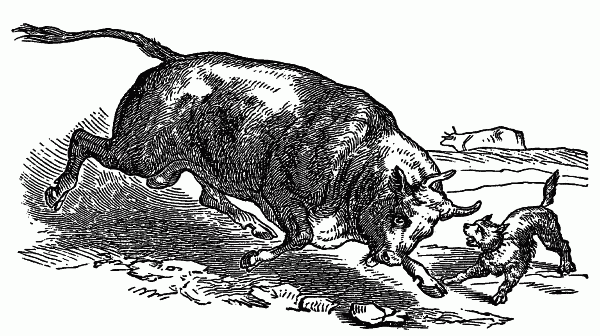
"ON THE RAMPAGE."
How widely does this course of treatment differ from that of most farmers! The object with many seems to be, to see with how little food they can keep the cow alive. From a correct point of view, the milch cow should be regarded as an instrument of transformation. The question should be—with so much hay, so much grain, so many roots, how can the most milk, or butter, or cheese, be made? The conduct of a manufacturer who owned good machinery, and an abundance of raw material, and had the labor at hand, would be considered very senseless, if he hesitated to supply the material, and keep the machinery at work, at least so long as he could run it with profit.
Stimulate the appetite, then, and induce the cow to eat, by a frequent change of diet, not merely enough to supply the constant waste of her system, but enough and to spare, of a food adapted to the production of milk of the quality desired.
SOILING.
Of the advantages of soiling milch cows—that is, feeding exclusively in the barn—there are yet many conflicting opinions. As to its economy of land and feed there can be no question, it being generally admitted that a given number of animals may be abundantly fed on a less space; nor is there much question as to the increased quantity of milk yielded in stall feeding. Its economy, in this country, turns rather upon the cost of labor and time; and the question raised by the dairyman is, whether it will pay—whether its advantages are sufficient to balance the extra expense of cutting and feeding, over and above cropping on the pasture. The importance of this subject has been strongly impressed upon the attention of farmers in many sections of the country, by a growing conviction that something must be done to improve the pastures, or that they must be abandoned altogether.
Thousands of acres of neglected pasture-land in the older States are so poor and worn out that from four to eight acres furnish but a miserable subsistence for a good-sized cow. No animal can flourish under such circumstances. The labor and exertion of feeding are too great, to say nothing of the vastly inferior quality of the grasses in such pastures, compared with those on more recently seeded lands. True economy would dictate that such pastures should either be allowed to run to wood, or be devoted to sheep-walks, or ploughed and improved. Cows, to be able to yield well, must have plenty of food of a sweet and nutritious quality; and, unless they find it, they wander over a large space, if at liberty, and thus deprive themselves of rest.
If a farmer or dairyman unfortunately owns such pastures, there can be no question that, as a matter of real economy, he had better resort to the soiling system for his milch cows; by which means he will largely increase his annual supply of good manure, and thus have the means of improving, and bringing his land to a higher state of cultivation. A very successful instance of this management occurs in the report of the visiting committee of an agricultural society in Massachusetts, in which they say: "We have now in mind a farmer in this county who keeps seven or eight cows in the stable through the summer, and feeds them on green fodder, chiefly Indian corn. We asked him his reasons for it. His answer was: 1. That he gets more milk than he can by any other method. 2. That he gets more manure, especially liquid manure. 3. That he saves it all, by keeping a supply of mud or mould under the stable, to be taken out and renewed as often as necessary. 4. That it is less troublesome than to drive his cows to pasture; that they are less vexed by flies, and have equally good health. 5. That his mowing land is every year growing more productive, without the expense of artificial manure.—He estimates that on an acre of good land twenty tons of green fodder may be raised. That which is dried is cut fine, and mixed with meal or shorts, and fed with profit. He believes that a reduced and worn-out farm—supposing the land to be naturally good—could be brought into prime order in five years, without any extra outlay of money for manure, by the use of green fodder in connection with the raising and keeping of pigs; not fattening them, but selling at the age of four or five months." He keeps most of his land in grass, improving its quality and productiveness by means of top-dressing, and putting money in his pocket—which is, after all, the true test both for theory and practice.
Another practical case on this point is that of a gentleman in the same State who had four cows, but not a rod of land on which to pasture them. They were, therefore, never out of the barn—or, at least, not out of the yard—and were fed with grass, regularly mown for them; with green Indian corn and fodder, which had been sown broadcast for the purpose; and with about three pints of meal a day. Their produce in butter was kept for thirteen weeks. Two of them were but two years old, having calved the same spring. All the milk of one of them was taken by her calf for six weeks out of the thirteen, and some of the milk of the other was taken for family use, the quantity of which was not measured. These heifers could not, therefore, be estimated as equal to more than one cow in full milk. And yet from these cows no less than three hundred and eighty-nine pounds of butter were made in the thirteen weeks. Another pound would have made an average of thirty pounds a week for the whole time.
It appears from these and other similar instances of soiling, or stall-feeding in summer on green crops cut for the purpose, that the largely increased quantity of the yield fully compensates for the slightly deteriorated quality. And not only is the quantity yielded by each cow increased, but the same extent of land, under the same culture, will carry double or treble the number of ordinary pastures, and keep them in better condition. There is also a saving of manure. But with us the economy of soiling is the exception, and not the rule.
In adopting this system of feeding, regularity is required as much as in any other, and a proper variety of food. A succession of green crops should be provided, as near as convenient to the stable. The first will naturally be winter rye, in the Northern States, as that shoots up with great luxuriance. Winter rape would probably be an exceedingly valuable addition to the plants usually cultivated for soiling in this country, in sections where it would withstand the severity of the winter. Cabbages, kept in the cellar or pit, and transplanted early, will also come in here to advantage, and clover will very soon follow them; oats, millet, and green Indian-corn, as the season advances; and, a little later still, perhaps, the Chinese sugar-cane, which should not be cut till headed out. These plants, in addition to other cultivated grasses, will furnish an unfailing succession of succulent and tender fodder; while the addition of a little Indian, linseed, or cotton-seed meal will be found economical.
In the vicinity of large towns and cities, where the object is too often to feed for the largest quantity, without reference to quality, an article known as distillers' swill, or still-slop, is extensively used. This, if properly fed in limited quantities, in combination with other and more bulky food, may be a valuable article for the dairyman; but, if given—as it too often is—without the addition of other kinds of food, it soon affects the health and constitution of the animals fed on it. This swill contains a considerable quantity of water, some nitrogenous compounds, and some inorganic matter in the shape of phosphates and alkaline salts found in the different kinds of grain of which it is made up, as Indian corn, wheat, barley, rye, and the like. Where this forms the principal food of milch cows, the milk is of a very poor quality—blue in color, and requiring the addition of coloring substances to make it saleable. It contains, often, less than one per cent. of butter, and seldom over one and three-tenths or one and a half per cent.—while good, saleable milk should contain from three to five per cent. It will not coagulate, it is said, in less than five or six hours; while good milk will invariably coagulate in an hour or less, under the same conditions. Its effect on the system of young children is, therefore, very destructive, causing diseases of various kinds, and, if continued, death.
So pernicious have been the consequences resulting from the use of this "swill-milk," as it is called, in the largest city of this country, that the Legislature of the State of New York, at a recent session (1861-2), interfered in behalf of the community by making the sale of the article a penal offence.
CULTURE OF GRASSES FOR FODDER.
As has been already stated, the grasses in summer, and hay in winter, form the most natural and important food for milch cows; and, whatever other crops come in as additional, these will form the basis of all systems of feeding.
The nutritive qualities of the grasses differ widely; and their value as feed for cows will depend, to a considerable extent, on the management of pastures and mowing-lands. Some considerations bearing upon the subject of the proper cultivation of these leading articles of food are, therefore, proposed in this article.
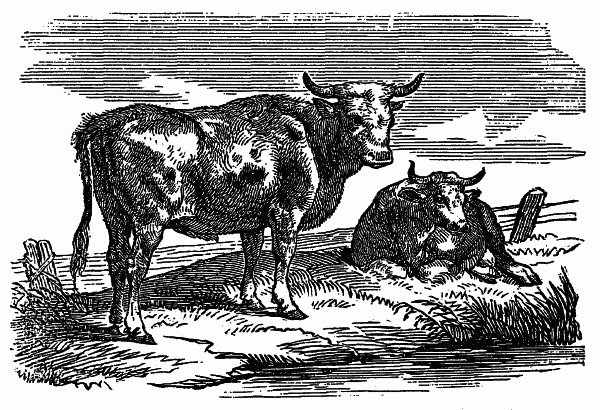
PATIENTLY WAITING.
If the turf of an old pasture is carefully examined, it will be found to contain a large variety of plants and grasses adapted for forage; some of them valuable for one purpose, and some for another. Some of them, though possessing a lower percentage of nutritive constituents than others, are particularly esteemed for an early and luxuriant growth, furnishing sweet feed in early spring, before other grasses appear; some of them, for starting more rapidly than others, after having been eaten off by cattle, and, consequently, of great value as pasture grasses. Most grasses will be found to be of a social character, and do best in a large mixture with other varieties.
In forming a mixture for pasture grasses, the peculiar qualities of each species should, therefore, be regarded: as the time of flowering, the habits of growth, the soil and location on which it grows best, and other characteristics.
Among the grasses found on cultivated lands in this country, the following are considered as among the most valuable for ordinary farm cultivation; some of them being adapted to pastures, and others almost exclusively to mowing and the hay-crop: Timothy, Meadow Foxtail, June or Kentucky Blue Grass, Fowl Meadow, Rough-stalked Meadow, Orchard Grass, Perennial Rye Grass, Italian Rye Grass, Redtop, English Bent, Meadow Fescue, Tall Oat Grass, Sweet-scented Vernal, Hungarian Grass, Red Clover, White or Dutch Clover, and some others.
Of these, the most valuable, all things considered, is Timothy. It forms a large proportion of what is commonly called English, or in some sections meadow, hay, though it originated and was first cultivated in this country. It contains a large percentage of nutritive matter, in comparison with other agricultural grasses. It thrives best on moist, peaty, or loamy soils, of medium tenacity, and is not well suited to very light, sandy lands. On very moist soils, its root is almost always fibrous; while on dry and loamy ones it is bulbous. On soils of the former description, which it especially affects, its growth is rapid, and its yield of hay large, sometimes amounting to three or four tons the acre, depending much, of course, upon cultivation. But, though very valuable for hay, it is not adapted for pasture, as it will neither endure severe grazing, nor is its aftermath to be compared with that of meadow foxtail, and some of the other grasses.
June Grass, better known in some sections as Kentucky Blue Grass, is very common in most sections of the country, especially on limestone lands, forming a large part of the turf, wherever it flourishes, and being held in universal esteem as a pasture grass. It starts early, but varies much in size and appearance, according to the soil; growing in some places with the utmost luxuriance, and forming the predominant grass; in others, yielding to the other species. If cut at the time of flowering, or a few days after, it makes a good and nutritious hay, though it is surpassed in nutritive qualities by several of the other grasses. It starts slowly after having been cut, especially if not cut very early. But its herbage is fine and uniform, and admirably adapted to lawns, growing well in almost all soils, though it does not endure very severe droughts. It withstands, however, the frosts of winter better than most other grasses.
In Kentucky—a section where it attains its highest perfection and luxuriance, ripening its seeds about the tenth of June—and in latitudes south of that, it sometimes continues green through the mild winters. It requires three or four years to become well set, after sowing, and it does not attain its highest yield as a pasture grass till the sod is even older than that. It is not, therefore, suited to alternate husbandry, where land usually remains in grass but two or three years before being ploughed up. In Kentucky, it is sown any time in winter when the sun is on the ground, three or four quarts of seed being used to the acre. In spring the seeds germinate, when the sprouts are exceedingly fine and delicate. Stock is not allowed on it the first year.
The Meadow Foxtail is also an excellent pasture grass It somewhat resembles Timothy, but is earlier, has a softer spike, and thrives on all soils except the dryest. Its growth is rapid, and it is greatly relished by stock of all kinds. Its stalks and leaves are too few and light for a field crop, and it shrinks too much in curing to be valuable for hay. It flourishes best in a rich, moist, and rather strong soil, sending up a luxuriant aftermath when cut or grazed off, which is much more valuable, both in quality and nutritive value, than the first crop. In all lands designed for permanent pasture, therefore, it should form a considerable part of a mixture. It will endure almost any amount of forcing, by liquid manures or irrigation. It requires three or four years, after soiling, to gain a firm footing in the soil. The seed is covered with the soft and woolly husks of the flower, and is consequently light; weighing but five pounds to the bushel, and containing seventy-six thousand seeds to the ounce.
The Orchard Grass, or Rough Cocksfoot, for pastures, stands pre-eminent. This is a native of this country, and was introduced into England, from Virginia, in 1764, since which time its cultivation has extended into every country of Europe, where it is universally held in very high estimation. The fact of its being very palatable to stock of all kinds, its rapid growth, and the luxuriance of its aftermath, with its power of enduring the cropping of cattle, have given it a very high reputation, especially as a pasture grass. It blossoms earlier than Timothy; when green, is equally relished by milch cows; requires to be fed closer, to prevent its forming tufts and growing up to seed, when it becomes hard and wiry, and loses much of its nutritive quality. As it blossoms about the same time, it forms an admirable mixture with red clover, either for permanent pasture or mowing. It resists drought, and is less exhausting to the soil than either rye grass or Timothy. The seed weighs twelve pounds to the bushel, and when sown alone requires about two bushels to the acre.
The Rough-Stalked Meadow Grass is somewhat less common than the June grass, but is considered equally valuable. It grows best on moist, sheltered meadows, where it flowers in June and July. It is readily distinguished from June grass by its having a rough sheath, while the latter has a smooth one, and by having a fibrous root, while the root of the other is creeping. It possesses very considerable nutritive qualities, and comes to perfection at a desirable time, and is exceedingly relished by cattle, horses and sheep. For suitable soils it should form a portion of a mixture of seeds, producing, in mixture with other grasses which serve to shelter it, a large yield of hay, far above the average of grass usually sown on a similar soil. It should be cut when the seed is formed. Seven pounds of seed to the acre will make a good sward. The grass loses about seventy per cent. of its weight in drying. The nutritive qualities of its aftermath exceed very considerably those of the crop cut in the flower or in the seed.
Fowl Meadow Grass is another indigenous species, of great value for low and marshy grounds, where it flourishes best; and, if cut and properly cured, makes a sweet and nutritious hay, which, from its fineness, is eaten by cows without waste. According to Sinclair—who experimented, with the aid of Sir Humphrey Davy, to ascertain its comparative nutritive properties—it is superior in this respect to either meadow foxtail, orchard grass, or tall meadow oat grass; but it is probable that he somewhat overrates it. If allowed to stand till nearly ripe, it falls down, but sends up innumerable flowering stems from the joints, so that it continues green and luxuriant till late in the season. It thrives best in mixture with other grasses, and deserves a prominent place in all mixtures for rich, moist pastures, and low mowing-lands.
Rye Grass has a far higher reputation abroad than in this country, and probably with reason; for it is better adapted to a wet and uncertain climate than to a dry and hot one. It varies exceedingly, depending much on soil and culture; but, when cut in the blossom to make into hay, it possesses very considerable nutritive power. If allowed to get too ripe, it is hard and wiry, and not relished by cows. The change from a juicy and nutritious plant to a woody fibre, containing but little soluble matter, is very rapid. Properly managed, however, it is a tolerably good grass, though not to be compared to Timothy, or orchard grass.
Redtop is a grass familiar to every farmer in the country. It is the Herd's grass of Pennsylvania, while in New York and New England it is known by a great variety of names and assumes a great variety of forms, according to the soil in which it grows. It is well adapted to almost every soil, though it seems to prefer a moist loam. It makes a profitable crop for spending, in the form of hay, though its yield is less than that of Timothy. It is well suited to our permanent pastures, where it should be fed close, otherwise it becomes wiry and innutritious, and cattle refuse it. It stands the climate of the country as well as any other grass, and so forms a valuable part of any mixture for pastures and permanent mowing-lands; but it is, probably, rather over rated by us.
English Bent, known also by a number of other names, is largely cultivated in some sections. It closely resembles redtop, but may be distinguished from it by the roughness of the sheaths when the hand is drawn from above downward. It possesses about the same qualities as redtop.
Meadow Fescue is one of the most common of the fescue grasses, and is said to be the Randall grass of Virginia. It is an excellent pasture grass, forming a very considerable portion of the turf of old pasture lands and fields; and is more extensively propagated and diffused from the fact that it ripens its seeds before most other grasses are cut, and sheds them to spring up and cover the ground. Its long and tender leaves are much relished by cattle. It is rarely sown in this country, notwithstanding its great and acknowledged value as a pasture grass. If sown at all, it should be in mixture with other grasses, as orchard grass, and rye grass, or June grass. It is of much greater value at the time of flowering than when the seed is ripe.
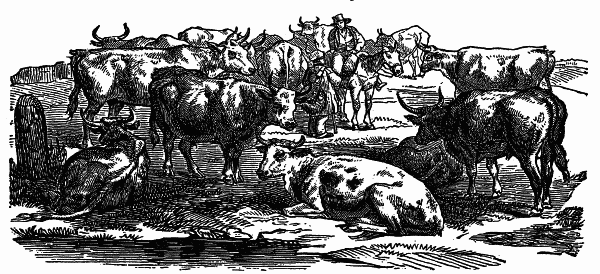
A CHANCE FOR A SELECTION.
The Tall Oat Grass is the Ray grass of France. It furnishes a luxuriant supply of foliage, is valuable either for hay or for pasture, and has been especially recommended for soiling purposes, on account of its early and luxuriant growth. It is often found on the borders of fields and hedges, woods and pastures, and is sometimes very plenty in mowing-lands. After having been mown it shoots up a very thick aftermath, and, on this account, partly, is regarded of nearly equal excellence with the common foxtail.
It grows spontaneously on deep, sandy soils, when once naturalized. It has been cultivated to a considerable extent in this country, and is esteemed by those who know it mainly for its early, rapid, and late growth, making it very well calculated as a permanent pasture grass. It will succeed on tenacious clover soil.
The Sweet-Scented Vernal Grass is one of the earliest in spring and one of the latest in autumn; and this habit of growth is one of its chief excellencies, as it is neither a nutritious grass, nor very palatable to stock of any kind, nor does it yield a very good crop. It is very common in New England and all over the Middle States, coming into old worn-out fields and moist pastures spontaneously, and along every roadside. It derives its name from its sweetness of odor when partially wilted or crushed in the hand, and it is this chiefly which gives the delicious fragrance to all new-mown bay. It is almost the only grass that possesses a strongly-marked aromatic odor, which is imparted to other grasses with which it is cured. Its seed weighs eight pounds to the bushel. In mixtures for permanent pastures it may be of some value.
Hungarian Grass, or millet, is an annual forage plant, introduced into France in 1815, and more recently into this country. It germinates readily, and withstands the drought remarkably, remaining green when other grasses are parched and dried up. It has numerous succulent leaves which furnish an abundance of sweet fodder, greatly relished by stock of all kinds. It attains its greatest luxuriance on soils of medium consistency and richness, but does very well on light and dry plains.
Red Clover is an artificial grass of the leguminous family, and one of the most valuable cultivated plants for feeding to dairy cows. It flourishes best on tenacious soils and stiff loams. Its growth is rapid, and a few months after sowing are sufficient to supply an abundant sweet and nutritious food. In the climate of New England, clover should be sown in the spring of the year, while most of the natural grasses do far better when sown in the fall. It is often sown with perfect success on the late snows of March or April, and soon finds its way down into the soil and takes a vigorous hold with its root. It is valuable not only as a forage plant, but as shading the ground, and thereby increasing its fertility.
The introduction of clover among the cultivated plants of the farm has done more, perhaps, for modern agriculture than that of any other single plant. It is now considered indispensable in all good dairy districts.
White Clover, often called Honeysuckle, is also widely diffused over this country, to which it is undoubtedly indigenous. As a mixture in all pasture grasses it holds a very high rank, as it is exceedingly sweet and nutritious, and relished by all kinds of stock. It grows most luxuriantly in moist grounds and moist seasons, but easily accommodates itself to a great variety of circumstances.
With respect to the mixtures of grass-seeds most profitable for the dairy farmer, no universal rule can be given, as they depend very much upon the nature of the soil and the locality. The most important point to be observed, and the one as to which, probably, the greatest deficiency exists, is to use a large number of species, with smaller quantities of each than those most commonly used. This is Nature's rule; for, in examining the turf of a rich old pasture, a large number of different species will be found growing together, while, if the turf of a field sown without two or three species is examined, a far less number of plants is found to the square foot, even after the sod is fairly set. In the opinion of the most competent judges, no improvement in grass culture is more important than this.
As an instance of what he would consider an improvement on the ordinary mixtures for permanent pastures, Mr. Flint, in his "Milch Cows and Dairy Farming," suggests the following as likely to give satisfactory results, dependent, of course, to a considerable extent, on the nature and preparation of the soil:
Meadow Foxtail,floweringinMay and June,2pounds
Orchard Grass,"" " "6"
Sweet-scented Vernal,""April and May,1"
Meadow Fescue,""May and June,2"
Redtop,""June and July,2"
June Grass,""May and June,4"
Italian Rye Grass,""June,4"
Perennial do.,"" "6"
Timothy,""June and July,3"
Rough-stalked Meadow Grass, " "2"
Perennial Clover,floweringinJune,3"
White Clover,""May to September5-40"
For mowing-lands the mixture would, of course, be somewhat changed. The meadow foxtail and sweet-scented vernal would be left out entirely, and some six or eight pounds added to the Timothy and red clover. The proper time to lay down lands to grass in the latitude of New England is August or September, and no grain crop should be sown with the seed.
Stiff or clayey pastures should never be overstocked, but when fed pretty close the grasses are far sweeter and more nutritious than when they are allowed to grow up rank and coarse; and if, by a want of sufficient feeding, they get the start of the stock, and grow into rank tufts, they should be cut and removed, when a fresh grass will start up, similar to the aftermath of mowing-lands, which will be eaten with avidity. Grasses for curing into hay should be cut either at the time of flowering, or just before, especially if designed for milch cows. They are then more succulent and juicy, and, if properly cured, form the sweetest food.
Grass cut in the blossom will make more milk than if allowed to stand later. Cut a little before the blossoming; it will make more than when in blossom, and the cows prefer it, which is by no means an unimportant consideration, since their tastes should always be consulted. Grass cut somewhat green, and properly cured, is next to fresh, green grass in palatable, nutritive qualities. Every farmer knows the milk-producing properties of rowen, or second crop, which is generally cut before it ripens.
No operation on the farm is of greater importance to the dairyman than the cutting of his grass and the manner of curing hay; and in this respect the practice over the country generally is susceptible of very marked improvement. The chief object is to preserve the sweetness and succulence of the grass in its natural state, so far as possible; and this object cannot be attained by exposing it too long to the scorching suns and drenching rains to which our climate is liable. As a general thing, farmers try to make their hay too much.
As to the best modes of curing clover, the following, among others, is adopted by many successful farmers: What is mown in the morning is left in the swath, to be turned over early in the afternoon. At about four o'clock, or while it is still warm, it is put into small cocks with a fork, and, if the weather is favorable, it may be housed on the fourth or fifth day, the cocks being turned over on the morning of the day in which it is to be carted. By this method all the heads and leaves are saved, and these are more valuable than the stems. For new milch cows in winter scarcely any food is better. It will cause them to give as great a flow of milk as any hay, unless it be good rowen.
Indian Corn makes an exceedingly valuable fodder, both as a means of carrying a herd of milch cows through our severe droughts of summer, and as an article for soiling cows kept in the stall. No dairy farmer will neglect to sow an extent in proportion to the number of cows which he keeps. The most common practice is, to sow in drills from two and a half to three feet apart, on land well tilled and thoroughly manured, making the drills from six to ten inches wide with the plough, manuring in the furrow, dropping the kernels about two inches apart, and covering with the hoe. In this mode of culture, the cultivator may be used between the rows when the corn is from six to twelve inches high, and, unless the ground is very weedy, no other after culture is needed. The first sowing usually takes place about the middle of May, and this is succeeded by other sowings, at intervals of a week or ten days, till July, in order to have a succession of green fodder; but, if it is designed to cut it up to cure for winter use, an early sowing is generally preferred, in order to be able to cure it in warm weather, in August or early in September. Sown in this way, about three or four bushels of corn are required for an acre; since, if sown thickly, the fodder is better, the stalks smaller, and the waste less.
The chief difficulty in curing corn cultivated for this purpose, and after the methods just spoken of, arises from the fact that it comes at a season when the weather is often colder, the days shorter, and the dews heavier, than when the curing of hay takes place. Nor is the curing of corn cut up green so easy and simple as that of the drying of stalks of Indian corn cut above the ear, as in the common practice of topping. The plant is then riper, less juicy, and cures more readily.
The method sometimes adopted is to cut and tie into small bundles, after it is somewhat wilted, and then to stook upon the ground, where it is allowed to stand, subject to all the changes of weather, with only the protection of the stook itself. The stooks consist of bunches of stalks first bound into small bundles, and are made sufficiently large to prevent the wind from blowing them over. The arms are thrown around the tops to bring them as closely together as possible, when the tops are broken over or twisted together, or otherwise fastened, in order to make the stook "shed the rain" as well as possible. In this condition they remain out until they are sufficiently dried to be put in the barn. Corn fodder is very excellent for young dairy stock.
Common Millet is another very valuable crop for fodder in soiling, or to cure for winter use, but especially to feed out during the usual season of drought. Many varieties of millet are cultivated in this country, the ground being prepared and treated as for oats. If designed to cut for green fodder, half a bushel of seed to the acre should be used; if to ripen seed, twelve quarts, sown broadcast, about the last of May or early in June. A moist loam or muck is the best soil adapted to millet; but very great crops have been grown on dry upland. It is very palatable and nutritious for milch cows, both green and when properly cured. The curing should be very much like that of clover, care being taken not to over-dry it. For fodder, either green or cured, it is cut before ripening. In this state all cattle eat it as readily as green corn, and a less extent will feed them. Millet is worthy of a widely-extended cultivation, particularly on dairy farms. Indian millet is another cultivated variety.
Rye, as a fodder plant, is chiefly valuable for its early growth in spring. It is usually sown in September or October—from the middle to the end of September being, perhaps, the most desirable time—on land previously cultivated and in good condition. If designed to ripen only, a bushel of seed is required to the acre, evenly sown; but, if intended for early fodder in spring, two or two and a half bushels of seed per acre should be used. On warm land the rye can be cut green the last of April or the first of May. Care should be taken to cut early; since, if it is allowed to advance too far towards maturity, the stalk becomes hard and unpalatable to cows.
Oats are also sometimes used for soiling, or for feeding green, to eke out a scanty supply of pasture feed; and for this purpose they are valuable. They should be sown on well-tilled and well-manured land, about four bushels to the acre, towards the last of April or the first of May. If the whole crop is to be used as green fodder, five bushels of seed will not be too much for good, strong soil. They will be sufficiently grown to cut by the first of July, or in some sections earlier, depending upon the location.
The Chinese Sugar-Cane also may deserve attention as a fodder plant. Experiments thus far made would seem to show that when properly cultivated, and cut at the right time, it is a palatable and nutritious plant, while many of the failures have been the result of too early cutting. For a fodder crop the drill culture is preferable, both on account of the larger yield obtained and because it is thus prevented from becoming too hard and stalky.
Of the root crops the Potato is the first to be mentioned. This produces a large quantity of milk, though the quality is inferior. The market value of this root is, at times, too great to allow of feeding extensively with it, even in milk dairies, where it is most valuable as a food for cows; still, there are locations where it may be judicious to cultivate this root for dairy feed, and in all circumstances there is a certain portion of the crop of unmarketable size, which will be of value fed to milch cows or swine. It should be planted in April or May, but in many sections in June, on good mellow soil, first thoroughly plowed and harrowed, then furrowed three feet apart, and manured in the furrows with a mixture of ashes, plaster of Paris, and salt. The seed may be dropped in the furrows, one foot apart, after the drill system—or in hills, two and a half or three feet apart—to be covered with the plough by simply turning the furrows back, after which the whole should be rolled with the field-roller, when it can be done.
If the land is not already in good heart from continued cultivation, a few loads of barnyard manure may be spread, and plowed under, by the first plowing. Used in this way it is far less liable to cause the rot, than when it is put in the hill. If a sufficient quantity of wood-ashes is not at hand, sifted coal-ashes will answer the purpose, and these are said to be valuable as a preventive of rot. In this way, one man, two boys, and a horse can plant from three to four acres a day on mellow land.
By another method two acres a day on the sod have been planted. The manure is first spread upon the grass, and then a furrow made by a yoke of oxen and one man, another following after and dropping, a foot apart, along the outer edge of the furrow on the grass. By quick work, one hand can nearly keep up with the plow in dropping. When arrived at the end of the piece, a back furrow is turned up to the potatoes, and a good plowman will cover nearly all without difficulty. On the return furrow, the man or boy who dropped follows after, covering up any that may be left or displaced, and smoothing off the top of the back-furrows when necessary. Potatoes thus planted have come out finely.
The cost of cultivation in this mode, it must be evident, is but trifling, compared with the slower method of hand-planting. It requires a skillful ploughman, a quick, active lad, and a good yoke of oxen, and the extent of the work will depend somewhat upon the state of the turf. The nutritive equivalent for potatoes in a hundred pounds of good hay is 319 pounds; that is, it will take 3.19 pounds of potatoes to afford the same amount of nourishment as one pound of hay. The great value of roots is as a change or condiment calculated to keep the animal in a healthy condition.
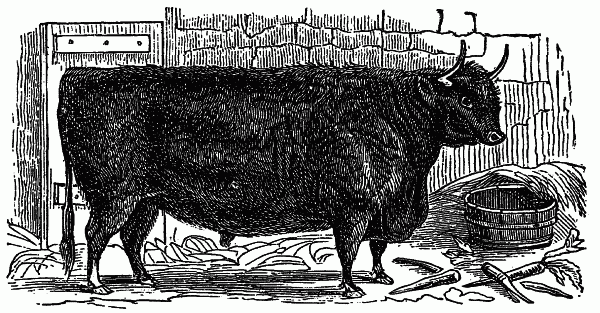
A WEST HIGHLAND OX.
The Carrot is somewhat extensively fed, and is a valuable root for milch cows. This, like the potato, has been cultivated and improved from a wild plant. Carrots require a deep, warm, mellow soil, thoroughly cultivated, but clean, and free from weed-seed. The difference between a very good profit and a loss on the crop depends much upon the use of land and manures perfectly free from foul seeds of any kind. Ashes, guano, seaweed, ground bones, and other similar substances, or thoroughly-rotted and fermented compost, will answer the purpose.
After plowing deep, and harrowing carefully, the seed should be planted with a seed-sower, in drills about eighteen inches apart, at the rate of four pounds to the acre, about the middle of May. The difference between sowing on the fifteenth of May and on the tenth of June in New England is said to be nearly one-third in the crop on an average of years. In weeding, a little wheel hoe is invaluable, as with it a large part of the labor of cultivation is saved. A skillful hand can run this hoe within a half an inch of the young plants without injury, and go over a large space in the course of a day, if the land was properly prepared in the first place.
The American farmer should always plan to economize labor, which is the great item of expense upon a farm. By this is not meant that he should strive to shirk or avoid work, but that he should make the least amount of work accomplish the greatest and most profitable results. Labor-saving machinery on the farm is applied, not to reduce the number of hours of labor, or to make the owner a man of leisure—who is, generally, the unhappiest man in the world—but to enable him to accomplish the greatest results in the same time that he would be compelled to obtain smaller ones.
Carrots will continue to grow and increase in size late into the fall. When ready to dig, plow around as near to the outside rows as possible, turning away the furrow from the row. Then take out the carrots, pulling off the tops, and throw the carrots and tops into separate heaps on the plowed furrows. In this way a man and two boys can harvest and put into the cellar upwards of a hundred bushels a day.
The Turnip, and the Swedish turnip, or ruta baga, are also largely cultivated as a field crop to feed to stock; and for this purpose almost numberless varieties are used, furnishing a great amount of succulent and nutritious food, late into winter, and, if well-kept, late into spring. The chief objection to the turnip is, that it taints the milk. This may be remedied—to a considerable extent, if not wholly—by the use of salt, or salt hay, and by feeding at the time of milking, or immediately after, or by steaming before feeding, or putting a small quantity of the solution of nitre into the pail, and milking upon it.
Turnips may be sown any time in June, in rich land, well mellowed by cultivation. Very large crops are obtained, sown as late as the middle of July, or the first of August, on an inverted sod. The Michigan, or double-mould-board plow leaves the land light, and in admirable condition to harrow, and drill in turnips. In one instance, a successful root-grower cut two tons of hay to the acre, on the twenty-third of June, and after it was removed from the land spread eight cords of rotten kelp to the acre, and plowed in; after which about three cords of fine old compost manure were used to the acre, which was sown with ruta baga seed, in drills, three feet apart, plants thinned to eight or ten inches in the drill. No after cultivation was required. On the fifteenth of November he harvested three hundred and seventy bushels of splendid roots to the acre, carefully measured off.
The nutritive equivalent of Swedish turnips as compared with good meadow hay is 676, taking hay as a standard at 100; that is, it would require 6.76 pounds of turnips to furnish the same nutriment as one pound of good hay; but fed in connection with other food—as hay, for example—perhaps five pounds of turnips would be about equal to one pound of hay.
The English or round turnip is usually sown broadcast after some other crop, and large and valuable returns are often obtained. The Swede is sown in drills. Both of these varieties are used for the production of milk.
The chief objection to the turnip crop is that it leaves many kinds of soil unfit for a succession of some other crops, like Indian corn, for instance. In some sections, no amount of manuring appears to make corn do well after turnips or ruta bagas.
The Mangold Wurtzel, a variety of the common beet, is often cultivated in this country with great success, and fed to cows with advantage, furnishing a succulent and nutritive food in winter and spring. The crop is somewhat uncertain. When it does well, an enormous yield is often obtained; but, not rarely, it proves a failure, and is not, on the whole, quite as reliable as the ruta baga, though a more valuable crop when the yield is good. It is cultivated like the common beet in moist, rich soils; three pounds of seed to the acre The leaves may be stripped off, towards fall, and fed out, without injury to the growth of the root. Both mangolds and turnips should be cut with a root-cutter, before being fed out.
The Parsnip is a very sweet and nutritious article of fodder, and adds richness and flavor to the milk. It is worthy of extended culture in all parts of the country where dairy husbandry is pursued. It is a biennial, easily raised on deep, rich, well-cultivated and well-manured soils, often yielding enormous crops, and possessing the decided advantage of withstanding the severest winters. As an article of spring feeding, therefore, it is exceedingly valuable. Sown in April or May, it attains a large growth before winter. Then, if desirable, a part of the crop may be harvested for winter use, and the remainder left in the ground till the frost is out, in March or April, when they can be dug as wanted, and are exceedingly relished by milch cows and stock of all kinds. They make an admirable feed at the time of milking, and produce the richest cream, and the yellowest and finest-flavored butter, of any roots used among us. The best dairy farmers on the Island of Jersey often feed to their cows from thirty to thirty-five pounds of parsnips a day, in addition to hay or grass.
Both practical experiment and scientific analysis prove this root to be eminently adapted to dairy stock, where the richness of milk or fine-flavored butter is any object. For mere milk-dairies, it is not quite so valuable, probably, as the Swedish turnip. The culture is similar to that of carrots, a rich, mellow, and deep loam being best; while it has a great advantage over the carrot in being more hardy, and rather less liable to injury from insects, and more nutritive. For feeding and fattening stock it is eminently adapted.
To be sure of a crop, fresh seed must be had, as it cannot be depended on for more than one year. For this reason the largest and straightest roots should be allowed to stand for seed, which, as soon as nearly ripe, should be taken out and spread out to dry, and carefully kept for use. For field culture, the hollow-crowned parsnip is the best and most profitable; but on thin, shallow soils the turnip-rooted variety should be used. Parsnips may be harvested like carrots, by plowing along the rows. Let butter or cheese dairymen give this crop a fair and full trial, and watch its effect in the quality of the milk and butter.
The Kohl Rabi is also cultivated to a considerable extent in this country for the purpose of feeding stock. It is supposed to be a hybrid between the cabbage and the turnip and is often called the cabbage-turnip, having the root of the former, with a turnip-like or bulbous stem. The special reason for its more extensive cultivation among us is its wonderful indifference to droughts, in which it seems to flourish best, and to bring forth the most luxuriant crops. It also withstands the frosts remarkably, being a hardy plant. It yields a somewhat richer quality of milk than the ordinary turnip, and the crop is generally admitted to be as abundant and profitable. Very large crops of it have been produced by the ordinary turnip or cabbage cultivation. As in cabbage-culture, it is best to sow the seed in March or April, in a warm and well-enriched seed-bed; from which it is transplanted in May, and set out after the manner of cabbages in garden culture. It bears transplanting better than most other roots. Insects injure it less than the turnip, dry weather favors it, and it keeps well through winter. For these reasons, it must be regarded as a valuable addition to our list of forage plants adapted to dairy farming. It grows well on stronger soils than the turnip requires.
Linseed Meal is the ground cake of flaxseed after the oil is pressed out. It is very rich in fat-forming principles, and given to milch cows increases the quality of butter, and keeps them in condition. Four or five pounds a day are sufficient for cows in milk, and this amount will effect a great saving in the cost of other food, and at the same time make a very rich milk. It is extensively manufactured in this country, and largely exported, but it is worthy of more general use here. It must not be fed in too large quantities to milch cows, for it would be liable to give too great a tendency to fat, and thus affect the quantity of the milk.
Cotton-seed Meal is an article of comparatively recent introduction. It is obtained by pressing the seed of the cotton-plant, which extracts the oil, when the cake is crushed or ground into meal, which has been found to be a very valuable article for feeding stock. From analysis it is shown to be equal or superior to linseed meal. Practical experiments only are needed to establish it. It can be procured in market at a reasonable price.
The Manures used in this country for the culture of the above named plants are mostly such as are made on the farm, consisting chiefly of barnyard composts of various kinds, with often a large admixture of peat-mud. There are few farms that do not contain substances, which, if properly husbanded, would add very greatly to the amount of manure ordinarily made. The best of the concentrated manures, which it is sometimes necessary to use, for want of time and labor to prepare enough upon the farm, is, unquestionably, Peruvian guano. The results of this, when properly applied, are well known and reliable, which can hardly be said of any other artificial manure offered for the farmer's notice. The chief objection to depending upon manures made off the farm is, in the first place, their great expense; and in the second—which is equally important—the fact, that, though they may be made valuable, and produce at one time the best results, a want of care in the manufacture, or designed fraud, may make them almost worthless, with the impossibility of detecting the imposition, without a chemical analysis, till it becomes too late, and the crop is lost.
It is, therefore, safest to rely mainly upon the home manufacture of manure. The extra expense of soiling cattle, saving and applying the liquid manure, and thus bringing the land to a higher state of cultivation, when it will be capable of keeping more stock and furnishing more manure, would offer a surer road to success than a constant outlay for concentrated fertilizers.
THE BARN.
The farm barn, next to the farm house, is the most important structure of the farm itself, in the Northern and Middle States; and even at the South and Southwest, where barns are less used, they are of more importance in the economy of farm management than is generally understood. Indeed, to the eyes of a person of taste, a farm or plantation appears incomplete, without good barn accommodations, as much as without good household appointments—and without them, no agricultural establishment can be complete in all its proper economy.
The most thorough barn structures, perhaps, to be seen in the United States, are those of the State of Pennsylvania, built by the German farmers of the lower and central counties. They are large, and expensive in their construction; and, in a strictly economical point of view, are, perhaps, more costly than is required. Yet, there is a substantial durability about them, that is exceedingly satisfactory, and, where the pecuniary ability of the farmer will admit, they may well furnish models for imitation.
In the structure of the barn, and in its interior accommodation, much will depend upon the branches of agriculture to which the farm is devoted. A farm cultivated in grain chiefly requires but little room for stabling purposes. Storage for grain in the sheaf, and granaries, will require its room; while a stock farm requires a barn with extensive hay storage, and stables for its cattle, horses, and sheep, in all climates which do not admit of such stocks living through the winter in the field, as is the case in the great grazing districts west of the Alleghanies. Again, there are wide districts of country where a mixed husbandry of grain and stock is pursued, which require barns and outbuildings accommodating both.
It may be well here to remark that many designers of barns, sheds, and other outbuildings for the accommodation of farm stock, have indulged in fanciful arrangements for the comfort and convenience of animals, which are so complicated that when constructed, as they sometimes are, the practical, common-sense farmer will not use them; and by reason of the learning which is required for their use, they are altogether unsuitable for the treatment and use which they generally receive from those who have the daily care of the stock for which they are intended, and for the rough usage which they experience from the animals themselves. A very pretty and plausible arrangement of stabling, feeding, and all the other requirements of a barn establishment may be thus got up by an ingenious theorist at the fireside, which will work charmingly as he dilates upon its good qualities, untried; but, which, when subjected to experiment, will be utterly worthless for practical use. There can be no doubt that the simplest plan of construction, consistent with an economical expenditure of the material of food for the consumption of stock, is by far the most preferable.
Another item to be considered in this connection, is the comparative value of the stock, the forage fed to them, and the labor expended in feeding and taking care of them. To illustrate: Suppose a farm to lie in the vicinity of a large town or city. Its value is, perhaps, a hundred dollars an acre. The hay cut upon it is worth fifteen dollars a ton, at the barn, and straw and coarse grains in proportion, and hired labor ten or twelve dollars a month. Consequently, the manager of this farm should use all the economy in his power, by the aid of cutting-boxes and other machinery, to make the least amount of forage supply the wants of his stock; and the internal economy of his barn should be arranged accordingly, since labor is his cheapest item, and food his dearest. Therefore, any contrivance by which to work up his forage the closest—by way of machinery, or manual labor—so that it shall serve the purposes of keeping his stock, is true economy; and the making and saving of manures are items of the first importance. His buildings and their arrangements throughout should, for these reasons, be constructed in accordance with his practice.
If, on the other hand, lands are cheap and productive, and labor comparatively dear, a different practice will prevail. The farmer will feed his hay from the mow without cutting. The straw will be stacked out, and the cattle turned to it, to pick what they like of it, and make their beds of the remainder; or, if it is housed, he will throw it into racks, and the stock may eat what they choose. To do this requires but one-third, or one-half of the labor which is required by the other mode, and the saving in this makes up, and perhaps more than makes up, for the increased quantity of forage consumed.
Again, climate may equally affect the mode of winter-feeding the stock. The winters may be mild. The hay may be stacked in the fields when gathered, or put into small barns built for hay storage alone; and the manure, scattered over the fields by the cattle, as they are fed from either of them, may be knocked to pieces with the dung-beetle, in the spring, or harrowed and bushed over the ground; and with the very small quantity of labor required in all this, such practice will be more economical than any other which can be adopted.
In latitudes, however, in which it becomes necessary to stall-feed during several months of the year, barns are indispensable. These should be warm, and at the same time well ventilated. The barn should be arranged in a manner suitable to keeping hay and other fodder dry and sweet, and with reference to the comfort and health of the animals, and the economy of labor and manure. The size and finish will, of course, depend on the wants and means of the farmer or dairyman; but many little conveniences, it should not be forgotten, can be added at comparatively trifling cost.
The accompanying cut of a barn is given merely as an illustration of a convenient arrangement for a medium-sized dairy, and not as being adapted to all circumstances or situations. This barn is supposed to stand upon a side-hill or an inclined surface, where it is easy to have a cellar, if desired; and the cattle-room, as shown in the cut, is in the second story, or directly over the cellar, the bottom of which should be somewhat dished, or lower in the middle than around the outer sides, and carefully paved, or laid in cement.
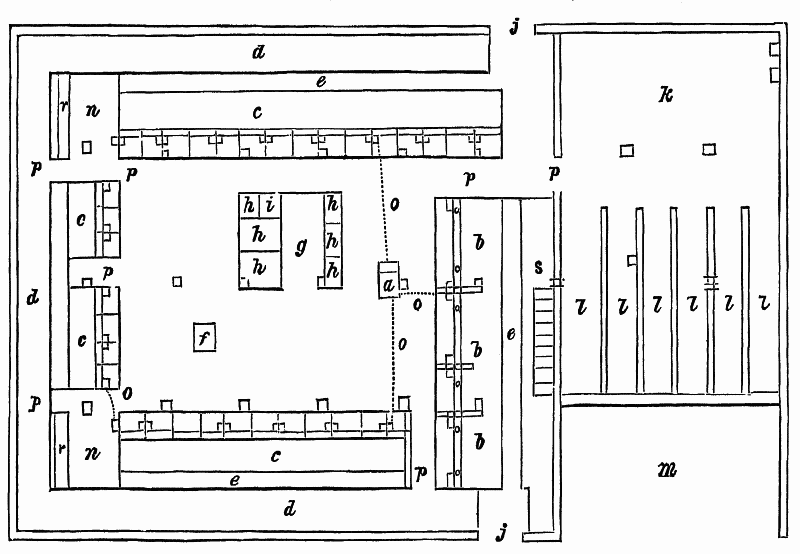
BARN FOR THIRTY-FOUR COWS AND THREE YOKE OF OXEN.
On the outside is represented an open shed, m, for carts and wagons to remain under cover, thirty feet by fifteen, while l l l l l l are bins for vegetables, to be filled through scuttles from the floor of the story above, and surrounded by solid walls. The area of this whole floor equals one hundred feet by fifty-seven. k, is an open space, nearly on a level with the cow-chamber, through the door p. s, stairs to the third story and to the cellar, d d d, passage next to the walls, five feet wide, and nine inches above the dung-pit. e e e, dung-pit, two feet wide, and seven inches below the floor where the cattle stand. The manure drops from this pit into the cellar below, five feet from the walls, and quite around the cellar. c c c, plank floor for cows, four feet six inches long. b b b, stalls for three yoke of oxen, on a platform five feet six inches long, n n, calf-pens, which may also be used for cows in calving. r r, feeding-troughs for calves. The feeding-boxes are made in the form of trays, with partitions between them. Water comes in by a pipe, to cistern a. This cistern is regulated by a cock and ball, and the water flows by dotted lines, o o o, to the boxes; each box being connected by lead pipes well secured from frost, so that, if desired, each animal can be watered without leaving the stall, or water can be kept constantly before it. A scuttle, through which sweepings and refuse may be put into the cellar, is seen at f. g is a bin receiving cut hay from the third story, or hay-room, h h h h h h, bins for grain-feed. i is a tunnel to conduct manure or muck from the hay-floor to the cellar. j j, sliding-doors on wheels. The cows all face toward the open area in the centre.
This cow-room may be furnished with a thermometer, clock, etc., and should always be well ventilated by sliding windows, which at the same time admit the light.
The next cut is a transverse section of the same cow-room; a being a walk behind the cows, five feet wide; b, dung-pit; c, cattle-stand; d, feeding-trough, with a bottom on a level with the platform where the cattle stand; k, open area, forty-three feet, by fifty-six.

TRANSVERSE SECTION.
The story above the cow-room—as represented in the next cut—is one hundred feet by forty-two; the bays for hay, ten on each side, being ten feet front and fifteen feet deep; and the open space, p, for the entrance of wagons, carts, etc., twelve feet wide. b, hay-scales. c, scale beam. m m m m m m, ladders reaching almost to the roof. l l l, etc., scuttle-holes for sending vegetables directly to the bins, l l l, etc., below. a a b b, rooms on the corners for storage. d, scuttles; four of which are used for straw, one for cut hay, and one for muck for the cellar. n and the other small squares are eighteen-feet posts. f, passage to the tool-house, a room one hundred feet long by eighteen wide. o, stairs leading to the scaffold in the roof of the tool-house. i i, benches. g, floor. h, boxes for hoes, shovels, spades, picks, iron bars, old iron, etc. j j j, bins for fruit. k, scuttles to put apples into wagons, etc., in the shed below. One side of this tool-house may be used for plows and large implements, hay-rigging, harness, etc.
Proper ventilation of the cellar and the cow-room avoids the objection that the hay is liable to injury from noxious gases.
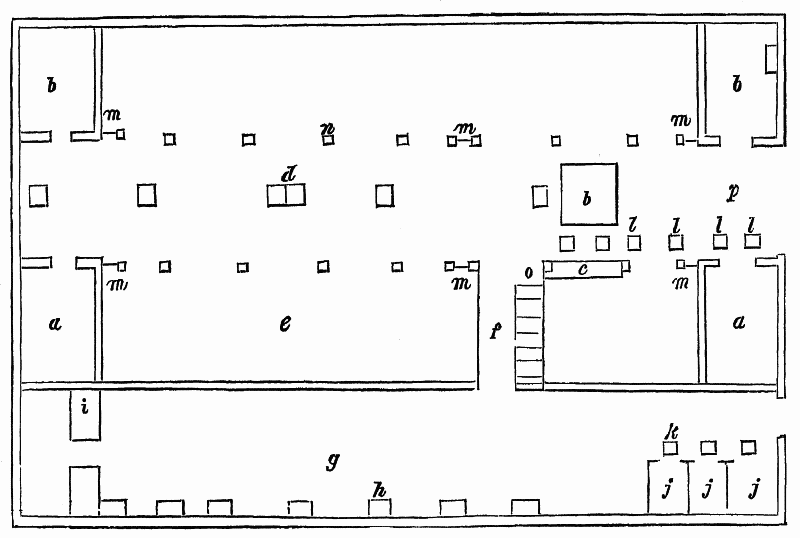
ROOM OVER THE COW-ROOM.
The excellent manure-cellar beneath this barn extends only under the cow-room. It has a drive-way through doors on each side. No barn-cellar should be kept shut up tight, even in cold weather. The gases are constantly escaping from the manure, unless held by absorbents, which are liable not only to affect the health of the stock, but also to injure the quality of the hay. To prevent this, while securing the important advantages of a manure-cellar, the barn may be furnished with good-sized ventilators on the top, for every twenty-five feet of its length, and with wooden tubes leading from the cellar to the top.
There should also be windows on different sides of the cellar to admit the free circulation of air. With these precautions, together with the use of absorbents in the shape of loam and muck, there will be no danger of rotting the timbers of the barn, or of risking the health of the cattle or the quality of the hay.
The temperature at which the cow-room should be kept is somewhere from fifty to sixty degrees, Fahrenheit. The practice and the opinions of successful dairymen differ somewhat on this point. Too great heat would affect the health and appetite of the herd; while too low a temperature is equally objectionable, for various reasons.
The most economical plan for room in tying cattle in their stalls, is to fasten the rope or chain, whichever is used—the wooden stanchion, or stanchel, as it is called, to open and shut, enclosing the animal by the neck, being objectionable—into a ring, which is secured by a strong staple into a post. This prevents the cattle from interfering with each other, while a partition effectually prevents any contact from the animals on each side of it, in the separate stalls.
There is no greater benefit for cattle, after coming into winter-quarters, than a systematic regularity in every thing pertaining to them. Every animal should have its own particular stall in the stable, where it should always be kept. The cattle should be fed and watered at certain fixed hours of the day, as near as may be. If let out of the stables for water, unless the weather is very pleasant—when they may be permitted to lie out for a short time—they should be immediately put back, and not allowed to range about with the outside cattle. They are more quiet and contented in their stables than elsewhere, and waste less food than if permitted to run out; besides being in every way more comfortable, if properly bedded and attended to, as every one will find upon trial. The habit which many farmers have, of turning their cattle out of the stables in the morning, in all weathers—letting them range about in a cold yard, hooking and annoying each other—is of no possible benefit, unless it be to rid them of the trouble of cleaning the stables, which pays more than twice its cost in the saving of manure. The outside cattle, which occupy the yard—if there are any—are all the better that the stabled ones do not interfere with them. They become habituated to their own quarters, as do the others, and all are better for being, respectively, in their proper places.