Feeding and Management (continued 2)
Reading edition
MILKING.
The manner of milking exerts a more powerful and lasting influence on the productiveness of the cow than most farmers are aware. That a slow and careless milker soon dries up the best of cows, every practical farmer and dairyman knows; but a careful examination of the beautiful structure of the udder will serve further to explain the proper mode of milking, in order to obtain and keep up the largest yield.
The udder of a cow consists of four glands, disconnected from each other, but all contained within one bag or cellular membrane; and these glands are uniform in structure. Each gland consists of three parts: the glandular, or secreting part, tubular or conducting part, and the teats, or receptacle, or receiving part. The glandular forms by far the largest portion of the udder. It appears to the naked eye composed of a mass of yellowish grains; but under the microscope these grains are found to consist entirely of minute blood-vessels forming a compact plexus, or fold. These vessels secrete the milk from the blood. The milk is abstracted from the blood in the glandular part; the tubes receive and deposit it in the reservoir, or receptacle; and the sphincter at the end of the teat retains it there until it is wanted for use.
This must not be understood, however, as asserting that all the milk drawn from the udder at one milking is contained in the receptacle. The milk, as it is secreted, is conveyed to the receptacle, and when that is full, the larger tubes begin to be filled, and next the smaller ones, until the whole become gorged. When this takes place, the secretion of the milk ceases, and absorption of the thinner or more watery part commences. Now, as this absorption takes place more readily in the smaller or more distant tubes, it is invariably found that the milk from these, which comes last into the receptacle, is much thicker and richer than what was first drawn off. This milk has been significantly styled afterings, or strippings; and should this gorged state of the tubes be permitted to continue beyond a certain time, serious mischief will sometimes occur; the milk becomes too thick to flow through the tubes, and soon produces, first irritation, then inflammation, and lastly suppuration, and the function of the gland is materially impaired or altogether destroyed. Hence the great importance of emptying these smaller tubes regularly and thoroughly, not merely to prevent the occurrence of disease, but actually to increase the quantity of milk; for, so long as the smaller tubes are kept free, milk is constantly forming; but whenever, as has already been mentioned, they become gorged, the secretion of milk ceases until they are emptied. The cow herself has no power over the sphincter at the end of her teat, so as to open it, and relieve the overcharged udder; neither has she any power of retaining the milk collected in the reservoirs when the spasm of the sphincter is overcome.
Thus is seen the necessity of drawing away the last drop of milk at every milking; and the better milker the cow, the more necessary this is. What has been said demonstrates, also, the impropriety of holding the milk in cows until the udder is distended much beyond its ordinary size, for the sake of showing its capacity for holding milk—a device to which many dealers in cows resort.
Thus much of the internal structure of the udder. Its external form requires attention, because it indicates different properties. Its form should be spheroidal, large, giving an idea of capaciousness; the bag should have a soft, fine skin, and the hind part upward toward the tail be loose and elastic. There should be fine, long hairs scattered plentifully over the surface, to keep it warm. The teats should not seem to be contracted, or funnel-shaped, at the inset with the bag. In the former state, teats are very apt to become corded, or spindled; and in the latter, too much milk will constantly be pressing on the lower tubes, or receptacle. They should drop naturally from the lower parts of the bag, being neither too short, small, or dumpy, or long, flabby, and thick, but, perhaps, about three inches in length, and so thick as just to fill the hand. They should hang as if all the quarters of the udder were equal in size, the front quarters projecting a little forward, and the hind ones a little more dependent. Each quarter should contain about equal quantities of milk; though, in the belief of some, the hind quarters contain rather the most.
Largely developed milk-veins—as the subcutaneous veins along the under part of the abdomen are commonly called—are regarded as a source of milk. This is a popular error, for the milk-vein has no connection with the udder; yet, although the office of these is to convey the blood from the fore part of the chest and sides to the inguinal vein, yet a large milk-vein certainly indicates a strongly developed vascular system—one favorable to secretions generally, and to that of the milk among the rest.
Milking is performed in two ways, stripping and handling. Stripping consists in seizing the teat firmly near the root between the face of the thumb and the side of the fore-finger, the length of the teat passing through the other fingers, and in milking the hand passes down the entire length of the teat, causing the milk to flow out of its point in a forcible stream. The action is renewed by again quickly elevating the hand to the root of the teat. Both hands are employed at the operation, each having hold of a different teat, and being moved alternately. The two nearest teats are commonly first milked, and then the two farthest. Handling is done by grasping the teat at its root with the fore-finger like a hoop, assisted by the thumb, which lies horizontally over the fore-finger, the rest being also seized by the other fingers. Milk is drawn by pressing upon the entire length of the teat in alternate jerks with the entire palm of the hand. Both hands being thus employed, are made to press alternately, but so quickly following each other that the alternate streams of milk sound to the ear like one forcible, continued stream. This continued stream is also produced by stripping. Stripping, then, is performed by pressing and passing certain fingers along the teat; handling, by the whole hand doubled, or fist, pressing the teat steadily at one place. Hence the origin of both names.
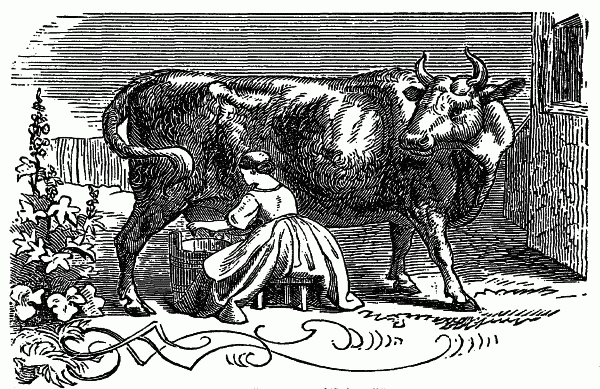
THE PREFERABLE METHOD.
Of these two modes, handling is the preferable, since it is the more natural method—imitating, as it does, the suckling of the calf. When a calf takes a teat into its mouth, it makes the tongue and palate by which it seizes it, play upon the teat by alternate pressures or pulsations, while retaining the teat in the same position. It is thus obvious that handling is somewhat like sucking, whereas stripping is not at all like it. It is said that stripping is good for agitating the udder, the agitation of which is conducive to the withdrawal of a large quantity of milk; but there is nothing to prevent the agitation of the udder as much as the dairymaid pleases, while holding in the other mode. Indeed, a more constant vibration could be kept up in that way by the vibrations of the arms than by stripping. Stripping, by using an unconstrained pressure on two sides of the teat, is much more apt to press it unequally, than by grasping the whole teat in the palm of the hand; while the friction occasioned by passing the finger and thumb firmly over the outside of the teat, is more likely to cause heat and irritation in it than a steady and full grasp of the entire hand. To show that this friction causes an unpleasant feeling even to the dairymaid, she is obliged to lubricate the teat frequently with milk, and to wet it at first with water; whereas the other mode requires no such expedients. And as a further proof that stripping is a mode of milking which may give pain to the cow, it cannot be employed, when the teats are chapped, with so much ease to the cow as handling.
The first requisite in the person that milks is, of course, the utmost cleanliness. Without this, the milk is unendurable. The udder should, therefore, be carefully cleaned before the milking commences.
Milking should be done fast, to draw away the milk as quickly as possible, and it should be continued as long as there is a drop of milk to bring away. This is an issue which cannot be attended to in too particular a manner. If any milk is left, it is re-absorbed into the system, or else becomes caked, and diminishes the tendency to secrete a full quantity afterward. Milking as dry as possible is especially necessary with young cows with their first calf; as the mode of milking and the length of time to which they can be made to hold out, will have very much to do with their milking qualities as long as they live. Old milk left in the receptacle of the teat soon changes into a curdy state, and the caseous matter not being at once removed by the next milking, is apt to irritate the lining membrane of the teat during the operation, especially when the teat is forcibly rubbed down between the finger and thumb in stripping. The consequence of this repeated irritation is the thickening of the lining membrane, which at length becomes so hardened as to close up the orifice at the end of the teat. The hardened membrane may be easily felt from the outside of the teat, when the teat is said to be corded. After this the teat becomes deaf, as it is called, and no more milk can afterward be drawn from the quarter of the udder to which the corded teat is attached.
The milking-pail is of various forms and of various materials. The Dutch use brass ones, which are brilliantly scoured every time they are in use. Tin pitchers are used in some places, while pails of wood in cooper-work are employed in others. A pail of oak, having thin staves bound together by bright iron hoops, with a handle formed by a stave projecting upward, is convenient for the purpose, and may be kept clean and sweet. One nine inches in diameter at the bottom, eleven inches at the top, and ten inches deep, with an upright handle or leg of five inches, has a capacious enough mouth to receive the milk as it descends; and a sufficient height, when standing on the edge of its bottom on the ground, to allow the dairymaid to grasp it firmly with her knees while sitting on a small three-legged stool. Of course, such a pail cannot be milked full; but it should be large enough to contain all the milk which a single cow can give at a milking; because it is undesirable to rise from a cow before the milking is finished, or to exchange one dish for another while the milking is in progress.
The cow being a sensitive and capricious creature, is, oftentimes so easily offended that if the maid rise from her before the milk is all withdrawn, the chances are that she will not again stand quietly at that milking; or, if the vessel used in milking is taken away and another substituted in its place, before the milking is finished, the probability is that she will hold her milk—that is, not allow it to flow. This is a curious property which cows possess, of holding up or keeping back their milk. How it is effected has never been satisfactorily ascertained; but there is no doubt of the fact that when a cow becomes irritated, or frightened from any cause, she can withhold her milk. Of course, all cows are not affected in the same degree; but, as a proof how sensitive cows generally are, it may be mentioned that very few will be milked so freely by a stranger the first time, as by one to whom they have been accustomed.
There is one side of a cow which is usually called the milking side—that is the cow's left side—because, somehow custom has established the practice of milking her from that side. It may have been adopted for two reasons: one, because we are accustomed to approach all the larger domesticated animals by what we call the near side—that is, the animal's left side—as being the most convenient one for ourselves; and the other reason may have been, that, as most people are right-handed, and the common use of the right hand has made it the stronger, it is most conveniently employed in milking the hinder teats of the cow, which are often most difficult to reach on account of the position of the hind legs and the length of the hinder teats, or of the breadth of the hinder part of the udder. The near side is most commonly used in this country and in Scotland; but in many parts of England the other side is preferred. Whichever side is selected, that should uniformly be used, as cows are very sensitive to changes.
In Scotland it is a rare thing to see a cow milked by any other person than a woman, though men are very commonly employed at it in this country and in England. One never sees a man milking a cow without being impressed with the idea that he is usurping an office which does not become him; and the same thought seems to be conveyed in the terms usually applied to the person connected with cows—a dairy-maid implying one who milks cows, as well as performs the other duties connected with the dairy—a dairy-man meaning one who owns a dairy. There can be but little question that the charge of this branch of the dairy should generally be entrusted to women. They are more gentle and winning than men. The same person should milk the same cow regularly, and not change from one to another, unless there are special reasons for it.
Cows are easily rendered troublesome on being milked; and the kicks and knocks which they usually receive for their restlessness, only render them more fretful. If they cannot be overcome by kindness, thumps will never make them better. The truth is, restless habits are continued in them by the treatment which they receive at first, when, most probably, they have been dragooned into submission. Their teats are tender at first; but an unfeeling, horny hand tugs at them at stripping, as if the animal had been accustomed to the operation for years. Can the creature be otherwise than uneasy? And how can she escape the wincing but by flinging out her heels?—Then hopples are placed on the hind fetlocks, to keep her heels down. The tail must then be held by some one, while the milking is going on; or the hair of its tuft be converted into a double cord, to tie the tail to the animal's leg. Add to this the many threats and scoldings uttered by the milker, and one gets a not very exaggerated impression of the "breaking-in."
Some cows, no doubt, are very unaccomodating and provoking; but, nevertheless, nothing but a rational course toward them, administered with gentleness, will ever render them less so. There are cows which are troublesome to milk for a few times after calving, that become quite quiet for the remainder of the season; others will kick pertinaciously at the first milking. In this last case the safest plan—instead of hoppling, which only irritates—is for the dairymaid to thrust her head against the flank of the cow, and while standing on her feet, stretch her hands forward, get hold of the teats the best way she can, and send the milk on the ground; and in this position it is out of the power of the cow to hurt her. These ebullitions of feeling at the first milking after calving, arise either from feeling pain in a tender state of the teat, most probably from inflammation in the lining membrane of the receptacle; or they may arise from titillation of the skin of the udder and teat, which becomes the more sensible to the affection from a heat which is wearing off.
At the age of two or three years the milking glands have not become fully developed, and their largest development will depend very greatly upon the management after the first calf. Cows should have, therefore, the most milk-producing food; be treated with constant gentleness; never struck, or spoken harshly to, but coaxed and caressed; and in ninety-nine cases out of a hundred, they will grow up gentle and quiet. The hundredth had better be fatted and sent to the butcher. Harshness is worse than useless. Be the cause of irritation what it may, one thing is certain, that gentle discipline will overcome the most turbulent temper. Nothing does so much to dry a cow up, especially a young cow, as the senseless treatment to which she is too often subjected.
The longer the young cow, with her first and second calf, is made to hold out, the more surely will this habit be fixed upon her. Stop milking her four months before the next calf, and it will be difficult to make her hold out to within four or six weeks of the time of calving afterward. Induce her, if possible, by moist and succulent food, and by careful milking, to hold out even up to the time of calving, if you desire to milk her so long, and this habit will be likely to be fixed upon her for life. But do not expect to obtain the full yield of a cow the first year after calving. Some of the very best cows are slow to develop their best qualities; and no cow reaches her prime till the age of five or six years.
The extreme importance of care and attention to these points cannot be overestimated. The wild cows grazing on the plains of South America, are said to give not more than three or four quarts a day at the height of the flow; and many an owner of large herds in Texas, it is said, has too little milk for family use, and sometimes receives his supply of butter from the New York market. There is, therefore, a constant tendency in milch cows to dry up; and it must be guarded against with special care, till the habit of yielding a large quantity, and yielding it long, becomes fixed in the young animal, when, with proper care, it may easily be kept up.
Cows, independently of their power to retain their milk in the udder, afford different degrees of pleasure in milking them, even in the quietest mood. Some yield their milk in a copious flow, with the gentlest handling that can be given them; others require great exertion to draw the milk from them even in streams no larger than a thread. The udder of the former will be found to have a soft skin and short teats; that of the latter will have a thick skin, with long rough teats. The one feels like velvet; the other is no more pleasant to the touch than untanned leather. To induce quiet and persuade the animal to give down her milk freely, it is better that she should be fed at milking-time with cut feed, or roots, placed within her easy reach.
If gentle and mild treatment is observed and persevered in, the operation of milking, as a general thing, appears to be a pleasure to the animal, as it undoubtedly is; but, if an opposite course is pursued—if at every restless movement, caused, perhaps, by pressing a sore teat, the animal is harshly spoken to—she will be likely to learn to kick as a habit, and it will be difficult to overcome it ever afterward.
Whatever may be the practice on other occasions, there can be no doubt that, for some weeks after calving, and in the height of the flow, cows ought, if possible, to be milked regularly three times a day—at early morning, noon, and night. Every practical dairyman knows that cows thus milked give a larger quantity of milk than if milked only twice, though it may not be quite so rich; and in young cows, no doubt, it has a tendency to promote the development of the udder and milk-veins. A frequent milking stimulates an increased secretion, therefore, and ought never to be neglected in the milk-dairy, either in the case of young cows, or very large milkers, at the height of the flow, which will commonly be for two or three months after calving.
There being a great difference in the quality as well as in the quantity of the milk of different cows, no dairyman should neglect to test the milk of each new addition to his dairy stock, whether it be an animal of his own raising or one brought from abroad. A lactometer—or instrument for testing the comparative richness of different species of milk—is very convenient for this purpose; but any one can set the milk of each cow separately at first, and give it a thorough trial, when the difference will be found to be great. Economy will dictate that the cows least to the purpose should be disposed of, and their places supplied with better ones.
THE RAISING OF CALVES.
It has been found in practice that calves properly bred and raised on the farm have a far greater intrinsic value for that farm, other things being equal, than any that can be procured elsewhere; while on the manner in which they are raised will depend much of their future usefulness and profit. These considerations should have their proper weight in deciding whether a promising calf from a good cow and bull shall be kept, or sold to the butcher. But, rather than raise a calf at hap-hazard, and simply because its dam was celebrated as a milker, the judicious farmer will prefer to judge of the peculiar characteristics of the animal itself. This will often save the great and useless outlay which has sometimes been incurred in raising calves for dairy purposes, which a more careful examination would have rejected as unpromising.
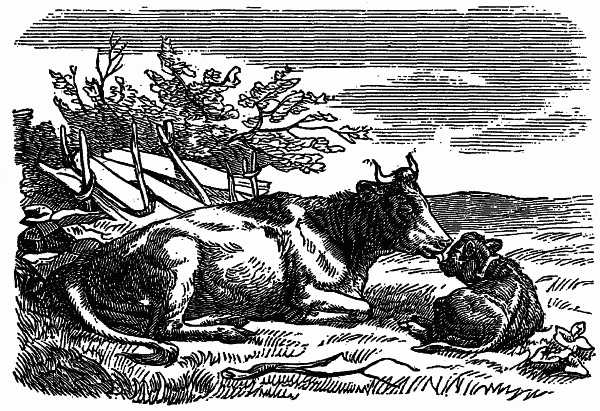
MATERNAL AFFECTION.
The method of judging stock which has been recommended in the previous pages is of practical utility here, and it is safer to rely upon it to some extent, particularly when other appearances concur, than to go on blindly. The milk-mirror on the calf is, indeed, small, but no smaller in proportion to its size than that of the cow; while its shape and form can generally be distinctly seen, particularly at the end of ten or twelve weeks. The development of the udder, and other peculiarities, will give some indication of the future capacities of the animal, and these should be carefully studied. If we except the manure of young stock, the calf is the first product of the cow, and as such demands our attention, whether it is to be raised or hurried off to the shambles. The practice adopted in raising calves differs widely in different sections of the country, being governed very much by local circumstances, as the vicinity of a milk-market, the value of milk for the dairy, the object of breeding, whether mainly for beef, for work, or for the dairy, etc.; but, in general, it may be said, that, within the range of thirty or forty miles of good veal-markets, which large towns furnish, comparatively few are raised at all. Most of them are fattened and sold at ages varying from three to eight or ten weeks; and in milk-dairies still nearer large towns and cities they are often hurried off at one or two days, or, at most, a week old. In both of these cases, as long as the calf is kept it is generally allowed to suck the cow, and, as the treatment is very simple, there is nothing which particularly calls for remark, unless it be to condemn the practice entirely, upon the ground that there is a more profitable way of fattening calves for the butcher, and to say that allowing the calf to suck the cow at all is objectionable on the score of economy, except in cases where it is rendered necessary by the hard and swollen condition of the udder.
If the calf is so soon to be taken away, it is better that the cow should not be suffered to become attached to it at all: since she is inclined to withhold her milk when it is removed, and thus a loss is sustained. The farmer will be governed by the question of profit, whatever course it is decided to adopt. In raising blood-stock, however, or in raising beef cattle, without any regard to economy of milk, the system of suckling the calves, or letting them run with the cow, may and will be adopted, since it is usually attended with somewhat less labor.
The other course, which is regarded as the best where the calf is to be raised for the dairy, is to bring it up by hand. This is almost universally done in all countries where the raising of dairy cows is best understood—in Switzerland, Holland, some parts of Germany, and England. It requires rather more care, on the whole; but it is decidedly preferable, since the calves cost less, as the food can be easily modified, and the growth is not checked, as is usually the case when the calf is taken off from the cow. Allusion is here made, of course, to sections where the milk of the cow is of some account for the dairy, and where it is too valuable to be devoted entirely to nourishing the calf. In this case, as soon as the calf is dropped the cow is allowed to lick off the slimy moisture till it is dry, which she will generally do from instinct, or, if not, a slight sprinkling of salt over the body of the calf will immediately tempt her. The calf is left to suck once or twice, which it will do as soon as it is able to stand. It should, in all cases, be permitted to have the first milk which comes from the cow, which is of a turbid, yellowish color, unfit for any of the purposes of the dairy, but somewhat purgative and medicinal, and admirably and wisely designed by Nature to free the bowels and intestines of the new-born animal from the mucous, excrementitious matter always existing in it after birth. Too much of this new milk may, however, be hurtful even to the new-born calf, while it should never be given at all to older calves. The best course would seem to be—and such is in accordance with the experience of the most successful stock-raisers—to milk the cow dry immediately after the calf has sucked once, especially if the udder is painfully distended, which is often the case, and to leave the calf with the cow during one day, and after that to feed it by putting the fingers into its mouth, and gently bringing its muzzle down to the milk in a pail or trough when it will imbibe in sucking the fingers. No great difficulty will be experienced in teaching the calf to drink when taken so young, though some take to it much more readily than others. What the calf does not need should be given to the cow. Some, however, prefer to milk immediately after calving; and, if the udder is overloaded, this may be the best course, though the better practice appears to be, to leave the cow as quietly to herself as possible for a few hours. The less she is disturbed, as a general thing, the better. The after-birth should be taken from her immediately after it is dropped. It is customary to give the cow, as soon as convenient after calving, some warm and stimulating drink—a little meal stirred into warm water, with a part of the first milk which comes from her, seasoned with a little salt.
In many cases the calf is taken from the cow immediately; and before she has seen it, to a warm, dry pen out of her sight, and there rubbed till it is thoroughly dry; and then, when able to stand, fed with the new milk from the cow, which it should have three or four times a day, regularly, for the first fortnight, whatever course it is proposed to adopt afterwards. It is of the greatest importance to give the young calf a thrifty start. The milk, unless coming directly from the cow, should be warmed.
Some object to removing the calf from the cow in this way, on the ground of its apparent cruelty. But the objection to letting the calf suck the cow for several days, as they do, or indeed of leaving it with the cow for any length of time, is, that she invariably becomes attached to it, and frets and withholds her milk when it is at last taken from her. She probably suffers much more, after this attachment is once formed, at the removal of the object of it, than she does at its being taken at first out of her sight. The cow's memory is far more retentive than many suppose; and the loss and injury sustained by removing the calf after it has been allowed to suck her for a longer or shorter period are never known exactly, because it is not usually known how much milk the calf takes; but it is, without doubt, very considerable. If the udder is all right, there seems to be no good reason for leaving the calf with the cow for two or three days, if it is then to be taken away.
The practice in Holland is to remove the calf from its mother even before it has been licked, and to take it into a corner of the barn, or into another building, out of the cow's sight and hearing, put it on soft, dry straw, and rub it dry with some hay or straw, when its tongue and gums are slightly rubbed with salt, and the mucus and saliva removed from the nostrils and lips. After this has been done, the calf is made to drink the milk first taken as it comes from the mother. It is slightly diluted with water, if taken last from the udder; but, if the first of the milking, it is given just as it is. The calf is taught to drink in the same manner as in this country, by putting the fingers in its mouth, and bringing it down to the milk, and it soon gets so as to drink unaided. It is fed, at first, from four to six times a day, or even oftener; but soon only three times, at regular intervals. Its food for two or three weeks is clear milk, as it comes warm and fresh from the cow. This is never omitted, as the milk during most of that time possesses certain qualities which are necessary to the calf, and which cannot be effectually supplied by any other food. In the third or fourth week the milk is skimmed, but warmed to the degree of fresh milk; though, as the calf grows a little older, the milk is given cold, while less care is taken to give it the milk of its own mother, that of other cows now answering equally well. In some places, calves are fed on buttermilk at the age of two weeks and after; but the change from new milk, fresh from the cow, is made gradually, some sweet skimmed milk and warm water being first added to it.
At three weeks old, or thereabouts, the calf will begin to eat a little sweet, fine hay, and potatoes cut fine, and it very soon becomes accustomed to this food. Many now begin to give linseed-meal mixed into hot water, to which is added some skim-milk or buttermilk; and others use a little bran cooked in hay-tea, made by chopping the hay fine and pouring on boiling-hot water, which is allowed to stand awhile on it. An egg is frequently broken into such a mixture. Others still take pains at this age to have fresh linseed-cake, broken into pieces of the size of a pigeon's egg; putting one of these into the mouth after the meal of milk has been finished, and when it is eager to suck at any thing in its way. It will very soon learn to eat linseed-meal. A little sweet clover is put in its way at the age of about three weeks, and it will soon begin to eat that also.
In this manner the feeding is continued from the fourth to the seventh week, the quantity of solid food being gradually increased. In the sixth or seventh week the milk is by degrees withheld, and water or buttermilk used instead; and soon after this, green food may be safely given, increasing it gradually with the hay to the age of ten or twelve weeks, when it will do to put them upon grass alone, if the season is favorable. A lot as near the house as possible, where they can be easily looked after and frequently visited, is the best. Calves should be gradually accustomed to all changes; and even after having been turned out to pasture, they ought to be put under shelter if the weather is not dry and warm. The want of care and attention relative to these little details will be apparent sooner or later; while, if the farmer gives his personal attention to these matters, he will be fully paid in the rapid growth of his calves. It is especially necessary to see that the troughs from which they are fed, if troughs are used, are kept clean and sweet.
But there are some—even among intelligent farmers—who make a practice of turning their calves out to pasture at the tender age of two or three weeks—and that, too, when they have sucked the cow up to that time—and allow them nothing in the shape of milk and tender care. This, certainly, is the poorest possible economy, to say nothing of the manifest cruelty of such treatment. The growth of the calf is checked, and the system receives a shock from so sudden a change, from which it cannot soon recover. The careful Dutch breeders bring the calves either skimmed milk or buttermilk to drink several times a day after they are turned to grass, which is not till the age of ten or twelve weeks; and, if the weather is chilly, the milk is warmed for them. They put a trough generally under a covering, to which the calves may come and drink at regular times. Thus, they are kept tame and docile.
In the raising of calves, through all stages of their growth, great care should be taken neither to starve nor to over-feed. A calf should never be surfeited, and never be fed so highly that it cannot be fed more highly as it advances. The most important part is to keep it growing thriftily without getting too fat, if it is to be raised for the dairy.
The calves in the dairy districts of Scotland are fed on the milk, with seldom any admixture; and they are not permitted to suck their dams, but are taught to drink milk by the hand from a dish. They are generally fed on milk only for the first four, five, or six weeks, and are then allowed from two to two and a half quarts of new milk each meal, twice in the twenty-four hours. Some never give them any other food when young except milk, lessening the quantity when the calf begins to eat grass or other food, which it generally does when about five weeks old, if grass can be had; and withdrawing it entirely about the seventh or eighth week of the calf's age. But, if the calf is reared in winter, or early in spring, before the grass rises, it must be supplied with at least some milk until it is eight or nine weeks old, as a calf will not so soon learn to eat hay or straw, nor fare so well on them alone as it will on pasture. Some feed their calves reared for stock partly with meal mixed in the milk after the third or fourth week. Others introduce gradually some new whey into the milk, first mixed with meal; and, when the calf gets older, they withdraw the milk, and feed it on whey and porridge. Hay-tea, juices of peas and beans, or pea or bean-straw, linseed beaten into powder, treacle, etc., have all been sometimes used to advantage in feeding calves; but milk, when it can be spared, is, in the judgment of the Scotch breeders, by far their most natural food.
In Galloway, and other pastoral districts, where the calves are allowed to suck, the people are so much wedded to their own customs as to argue that suckling is much more nutritious to the calves than any other mode of feeding. That it induces a greater secretion of saliva, which, by promoting digestion, accelerates the growth and fattening of the young animal, cannot be doubted; but the secretion of that fluid may likewise be promoted by placing an artificial teat in the mouth of the calf, and giving it the milk slowly, and at the natural temperature. In the dairy districts of Scotland, the dairymaid puts one of her fingers into the mouth of the calf when it is fed, which serves the purpose of a teat, and will have nearly the same effect as the natural teat in inducing the secretion of saliva. If that, or an artificial teat of leather, be used, and the milk be given slowly before it is cold, the secretion of saliva may be promoted to all the extent that can be necessary; besides, secretion is not confined to the mere period of eating, but, as in the human body, the saliva is formed and part of it swallowed at all times. As part of the saliva is sometimes seen dropping from the mouths of the calves, it might be advisable not only to give them an artificial teat when fed, but to place, as is frequently done, a lump of chalk before them to lick, thus leading them to swallow the saliva. The chalk would so far supply the want of salt, of which cattle are often so improperly deprived, and it would also promote the formation of saliva. Indeed, calves are very much disposed to lick and suck every thing which comes within their reach, which seems to be the way in which Nature teaches them to supply their stomachs with saliva.
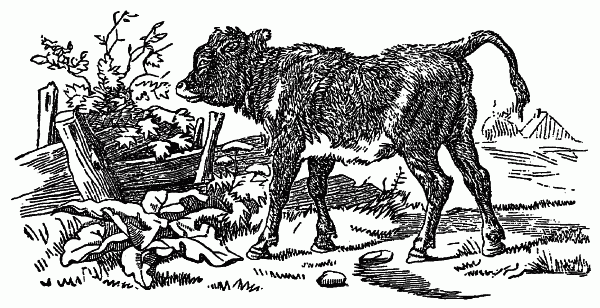
FROLICKSOME.
But though sucking their dams may be most advantageous in that respect, yet it has also some disadvantages. The cow is always more injured than the calf is benefited by that mode of feeding. She becomes so fond of the calf that she does not, for a long time after, yield her milk freely to the dairyman. The calf does not when young draw off the milk completely, and when it is taken off by the hand, the cow withholds a part of her milk, and, whenever a cow's udder is not completely emptied every time she is milked, the lactic secretion—as before stated—is thereby diminished.
Feeding of calves by hand is also, in various respects, advantageous. Instead of depending on the uncertain, or perhaps precarious supply of the dam, which may be more at first than the young animal can consume or digest, and at other times too little for its supply, its food can, by hand-feeding, be regulated to suit the age, appetite, and the purposes for which the calf is intended; other admixtures or substitutes can be introduced into the milk, and the quantity gradually increased or withdrawn at pleasure. This is highly necessary when the calves are reared for stock. The milk is in that case diminished, and other food introduced so gradually that the stomach of the young animal is not injured as it is when the food is too suddenly changed. And, in the case of feeding calves for the butcher, the quantity of milk is not limited to that of the dam—for no cow will allow a stranger-calf to suck her—but it can be increased, or the richest or poorest parts of the milk given at pleasure.
Such are, substantially, the views upon this subject which are entertained by the most judicious farmers in the first dairy districts of Scotland.
In those districts—where, probably, the feeding and management of calves are as well and as judiciously conducted as in any other part of Great Britain—the farmers' wives and daughters, or the female domestics, have the principal charge of young calves; and they are, doubtless, much better calculated for this duty than men, since they are more inclined to be gentle and patient. The utmost gentleness—as has been already remarked, in another connection—should always be observed in the treatment of all stock; but especially of milch cows, and calves designed for the dairy. Persevering kindness and patience, will, almost invariably, overcome the most obstinate natures; while rough and ungentle handling will be repaid in a quiet kind of way, perhaps, by withholding the milk, which will always have a tendency to dry up the cow; or, what is nearly as bad, by kicking and other modes of revenge, which often contribute to the personal discomfort of the milker. The disposition of the cow is greatly modified, if not, indeed, wholly formed, by her treatment while young; and therefore it is best to handle calves as much as possible, and make pets of them, lead them with a halter, and caress them in various ways. Calves managed in this way will always be docile, and suffer themselves to be approached and handled, both in the pasture and in the barn.
With respect to the use of hay-tea—often used in this country, but more common abroad, where greater care and attention are usually bestowed upon the details of breeding—Youatt says: "At the end of three or four days, or perhaps a week, or near a fortnight, after a calf has been dropped, and the first passages have been cleansed by allowing it to drink as much of the cow's milk as it feels inclined for, let the quantity usually allotted for a meal be mixed, consisting, for the first week, of three parts of milk and one part of hay-tea. The only nourishing infusion of hay is that which is made from the best and sweetest hay, cut by a chaff-cutter into pieces about two inches long, and put into an earthen vessel; over this, boiling water should be poured, and the whole allowed to stand for two hours, during which time it ought to be kept carefully closed. After the first week, the proportions of milk and hay-tea may be equal; then composed of two-thirds of hay-tea and one of milk; and at length, one-fourth part of milk will be sufficient. This food should be given to the calf in a lukewarm state at least three, if not four times a day, in quantities averaging three quarts at a meal, but gradually increasing to four quarts as the calf grows older. Toward the end of the second month, beside the usual quantity given at each meal—composed of three parts of the infusion and one of milk—a small wisp or bundle of hay is to be laid before the calf, which will gradually come to eat it; but, if the weather is favorable, as in the month of May, the beast may be turned out to graze in a fine, sweet pasture, well sheltered from the wind and sun. This diet may be continued until toward the latter end of the third month, when, if the calf grazes heartily, each meal may be reduced to less than a quart of milk, with hay-water; or skimmed milk, or fresh buttermilk, may be substituted for new milk. At the expiration of the third month, the animal will hardly require to be fed by hand; though, if this should still be necessary, one quart of the infusion given daily—which, during the summer, need not be warmed—will suffice." The hay-tea should be made fresh every two days, as it soon loses its nutritious quality.
This and other preparations are given, not because they are better than milk,—than which nothing is better adapted to fatten a calf, or promote its growth,—but simply to economize by providing the simplest and cheapest substitutes. Experience shows that the first two or three calves are smaller than those which follow; and hence, unless they are pure-bred, and to be kept for the blood, they are not generally thought to be so desirable to raise for the dairy as the third or fourth, and those that come after, up to the age of nine or ten years. Opinions upon this point, however, differ.
According to the comparative experiments of a German agriculturist, cows which as calves had been allowed to suck their dams from two to four weeks, brought calves which weighed only from thirty-five to forty-eight pounds; while others, which as calves had been allowed to suck from five to eight weeks, brought calves which weighed from sixty to eighty pounds. It is difficult to see how there can be so great a difference, if, indeed, there be any; but it may be worthy of careful observation and experiment, and as such it is stated here. The increased size of the calf would be due to the increased size to which the cow would attain; and if as a calf she were allowed to run in the pasture with her dam for four or five months, taking all the milk she wanted, she would doubtless be kept growing on in a thriving condition. But taking a calf from the cow at four or even eight weeks must check its growth to some extent; and this may be avoided by feeding liberally, and bringing up by hand.
After the calf is fully weaned, there is nothing very peculiar in the general management. A young animal will require for the first few months—say up to the age of six months—an average of five or six pounds daily of good hay, or its equivalent. At the age of six months, it will require from four and a half to five pounds; and at the end of the year, from three and a half or four pounds of good hay, or its equivalent, for every one hundred pounds of its live weight; or, in other words, about three and a half or four per cent. of its live weight. At two years old, it will require three and a half, and some months later, three per cent. of its live weight daily in good hay, or its equivalent. Indian-corn fodder, either green or cured, forms an excellent and wholesome food at this age.
The heifer should not be pampered, nor yet poorly fed or half starved, so as to receive a check in her growth. An abundant supply of good healthy dairy food and milk will do all that is necessary up to the time of her having her first calf—which should not ordinarily be till the age of three years, though some choose to allow them to come in at two, or a little over, on the ground that it early stimulates the secretion of milk, and that this will increase the milking propensity through life. This is undoubtedly the case, as a general rule; but greater injury is at the same time done by checking the growth, unless the heifer has been fed up to large size and full development from the start—in which case she may perhaps take the bull at fifteen or eighteen months without injury. Even if a heifer comes in at two years, it is generally deemed desirable to let her run barren for the following year, which will promote her growth and more perfect development.
The feeding which young stock often get is not such as is calculated to make good-sized or valuable cattle of them. They are often fed on the poorest of hay or straw through the winter, not infrequently left exposed to cold, unprotected and unhoused, and thus stinted in their growth. This is, surely, the very worst economy, or rather it is no economy at all. Properly viewed, it is an extravagant wastefulness which no farmer can afford. No animal develops its good points under such treatment; and if the starving system is to be followed at all, it had better be after the age of two or three years, when the animal's constitution has attained the strength and vigor which may, possibly, enable it to resist ill treatment.
To raise up first-rate milkers, it is absolutely necessary to feed on dairy food even when they are young. No matter how fine the breed is, if the calf is raised on poor, short feed, it will never be so good a milker as if raised on better keeping; and hence, in dairy districts, where calves are raised at all, they ought to be allowed the best pasture during the summer, and good, sweet and wholesome food during the winter.
POINTS OF FAT CATTLE.
Whatever theoretical objections may be raised against over-fed cattle, and great as may be the attempts to disparage the mountains of fat,—as highly-fed cattle are sometimes designated,—there is no doubt of the practical fact, that the best butcher cannot sell any thing but the best fatted beef; and of whatever age, size, or shape a half-fatted ox may be, he is never selected by judges as fit for human food. Hence, a well-fatted animal always commands a better price per pound than one imperfectly fed, and the parts selected as the primest beef are precisely the parts which contain the largest deposits of fat. The rump, the crop, and the sirloin, the very favorite cuts,—which always command from twenty to twenty-five per cent. more than any other part of the ox,—are just those parts on which the largest quantities of fat are found; so that, instead of the taste and fashion of the age being against the excessive fattening of animals, the fact is, practically, exactly the reverse. Where there is the most fat, there is the best lean; where there is the greatest amount of muscle, without its share of fat, that part is accounted inferior, and is used for a different purpose; in fact, so far from fat's being a disease, it is a condition of muscle, necessary to its utility as food,—a source of luxury to the rich, and of comfort to the poor, furnishing a nourishing and healthy diet for their families.
Fattening is a secretive power which grazing animals possess, enabling them to lay by a store of the superfluous food which they take for seasons of cold or scarcity. It collects round the angular bones of the animal, and gives the appearance of rotundity; hence the tendency to deposit fat is indicated, as has been stated, by a roundness of form, as opposed to the fatness of a milk-secreting animal. But its greatest use is, that it is a store of heat-producing aliment, laid up for seasons of scarcity and want. The food of animals, for the most part, may be said to consist of a saccharine, an oleaginous, and an albuminous principle. To the first belong all the starchy, saccharine, and gummy parts of the plants, which undergo changes in the digestive organs similar to fermentation before they can be assimilated in the system; by them also animal heat is sustained. In indolent animals, the oily parts of plants are deposited and laid up as fat; and, when vigor and strength fail, this is taken up and also used in breathing to supply the place of the consumed saccharine matter. The albuminous, or gelatinous principle of plants is mainly useful in forming muscle; while the ashes of plants, the unconsumable parts, are for the supply, mainly, of bone, hair, and horn, but also of muscle and of blood, and to supply the waste which continually goes on.
Now, there are several qualities which are essentially characteristic of a disposition to fatten. There have not, as yet, been any book-rules laid down, as in the case of M. Guénon's indications of milking-cows; but there are, nevertheless, marks so definite and well understood, that they are comprehended and acted upon by every grazier, although they are by no means easy to describe. It is by skillful acumen that the grazier acquires his knowledge, and not by theoretical rules; observation, judgment, and experience, powerful perceptive faculties, and a keen and minute comparison and discrimination, are essential to his success.
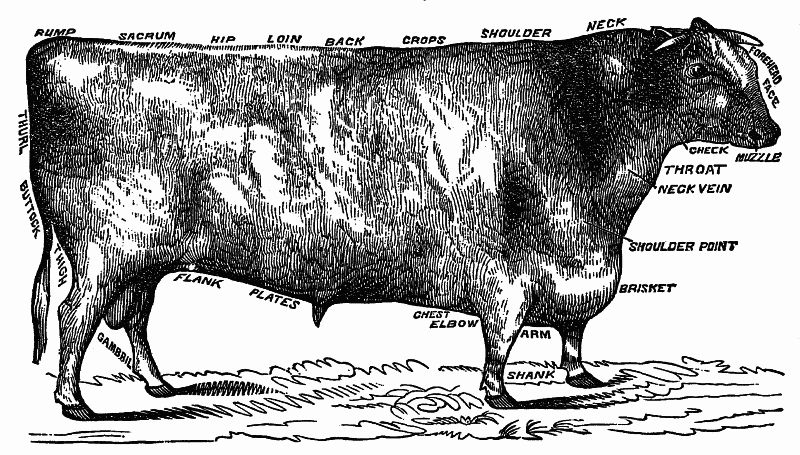
POINTS OF CATTLE.
The first indication upon which he relies, is the touch. It is the absolute criterion of quality, which is supposed to be the keystone of perfection in all animals, whether for the pail or the butcher. The skin is so intimately connected with the internal organs, in all animals, that it is questionable whether even our schools of medicine might not make more use of it in a diagnosis of disease. Of physiological tendencies in cattle, however, it is of the last and most vital importance. It must neither be thick, nor hard, nor adhere firmly to the muscles. If it is so, the animal is a hard grazer, a difficult and obstinate feeder—no skillful man will purchase it—such a creature must go to a novice, and even to him at a price so low as to tempt him to become a purchaser. On the other hand, the skin must not be thin, like paper, nor flaccid, nor loose in the hand, nor flabby. This is the opposite extreme, and is indicative of delicateness, bad, flabby flesh, and, possibly, of inaptitude to retain the fat. It must be elastic and velvety, soft and pliable, presenting to the touch a gentle resistance, but so delicate as to give pleasure to the sensitive hand—a skin, in short, which seems at first to give an indentation from the pressure of the fingers, but which again rises to its place by a gentle elasticity.
The hair is of nearly as much importance as the skin. A hard skin will have straight and stiff hair; it will not have a curl, but be thinly and lankly distributed equally over the surface. A proper grazing animal will have a mossy coat, not absolutely curled, but having a disposition to a graceful curl, a semifold, which presents a waving inequality; but as different from a close and straightly-laid coat, as it is from one standing off the animal at right angles, a strong symptom of disease. It will also, in a thriving animal, be licked here and there with its tongue, a proof that the skin is duly performing its functions.
There must be, also, the full and goggle eye, bright and pressed outward by the fatty bed below; because, as this is a part where Nature always provides fat, an animal capable of developing it to any considerable extent, will have its indications here, at least, when it exists in excess.
So much for feeding qualities in the animal, and their conformations indicative of this kindly disposition. Next come such formations of the animal itself as are favorable to the growth of fat, other things being equal. There must be size where large weights are expected. Christmas beef, for instance, is expected to be large as well as fat. The symbol of festivity should be capacious, as well as prime in quality. But it is so much a matter of choice and circumstance with the grazier, that profit alone will be his guide. The axiom will be, however, as a general rule, that the better the grazing soil the larger the animal may be; the poorer the soil, the smaller the animal. Small animals are, unquestionably, much more easily fed, and they are well known by experienced men to be best adapted to second-rate feeding pastures.
But, beyond this, there must be breadth of carcass. This is indicative of fattening, perhaps, beyond all other qualifications. If rumps are favorite joints and produce the best price, it is best to have the animal which will grow the longest, the broadest, and the best rump; the same of crop, and the same of sirloin; and not only so, but breadth is essential to the consumption of that quantity of food which is necessary to the development of a large amount of fat in the animal. Thus, a deep, wide chest, favorable for the respiratory and circulating functions, enables it to consume a large amount of food, to take up the sugary matter, and to deposit the fatty matter,—as then useless for respiration, but afterwards to be prized. A full level crop will be of the same physiological utility; while a broad and open framework at the hips will afford scope for the action of the liver and kidneys.
There are other points, also, of much importance; the head must be small and fine; its special use is indicative of the quick fattening of the animal so constructed, and it is also indicative of the bones being small and the legs short. For constitutional powers, the beast should have his ribs extended well towards the thigh-bones or hips, so as to leave as little unprotected space as possible. There must be no angular, or abrupt points; all must be round, and broad, and parallel. Any depression in the lean animal will give a deficient deposit of flesh and fat at that point, when sold to the butcher, and thus deteriorate its value; and hence the animal must be round and full.
But either fancy, or accident, or skill—it is unnecessary to decide which—has associated symmetry with quality and conformation, as a point of great importance in animals calculated for fattening; and there is no doubt that, to a certain extent, this is so. The beast must be a system of mathematical lines. To the advocate of symmetry, the setting-on of a tail will be a condemning fault; indeed the ridge of the back, like a straight line, with the outline of the belly exactly parallel, viewed from the side, and a depth and squareness when viewed from behind,—which remind us of a geometrical cube, rather than a vital economy,—may be said to be the indications of excellence in a fat ox. The points of excellence in such an animal are outlined under the subsequent head, as developed in the cutting up after slaughter.
Now, these qualities are inherent in some breeds; there may be cases and instances in all the superior breeds, and in most there may be failures.
DRIVING AND SLAUGHTERING.
It is necessary that cattle which have been disposed of to the dealer or butcher, or which are intended to be driven to market, should undergo a preparation for the journey. If they were immediately put to the road to travel, from feeding on grass or turnips, when their bowels are full of undigested vegetable matter, a scouring might ensue which would render them unfit to pursue their journey; and this complaint is the more likely to be brought on from the strong propensity which cattle have to take violent exercise upon feeling themselves at liberty after a long confinement. They in fact, become light-headed whenever they leave the barn or enclosure, so much so that they actually "frisk and race and leap," and their antics would be highly amusing, were it not for the apprehension that they may hurt themselves against some opposing object, as they seem to regard nothing before them.
On being let out for the first time, cattle should be put for awhile into a larger court, or on a road well fenced with enclosures, and guarded by men, to romp about. Two or three such allowances of liberty will render them quiet; and, in the mean time, to lighten their weight of carcass, they should have hay for a large proportion of their food. These precautions are absolutely necessary for cattle which have been confined in barns; otherwise, accidents may befall them on the road, where they will at once break loose. Even at home serious accidents sometimes overtake them, such as the breaking down of a horn, casting off a hoof, spraining a tendon, bruising ribs, and heating the whole body violently; and, of course, when any such ill luck befalls, the animal affected must be left behind, and become a drawback upon the value of the rest, unless kept for some time longer.
Having the cattle prepared for travel, the drover takes the road very slowly for the first two days, not exceeding seven or eight miles a day. At night, in winter, they should be put into an open court, and supplied with hay, water, and a very few turnips; for, if roots are suddenly withdrawn from them,—since it is taken for granted that these have formed a staple portion of their food,—their bellies will become shrunken up into smaller dimensions—a state very much against favorable appearance in market. After the first two days they may proceed faster, say twelve or thirteen miles a day, if very fat; and fifteen, if moderately so. When the journey is long and the beasts get faint from travel, they should have corn to support them. In frosty weather, when the roads become very hard, they are apt to become shoulder-shaken, an effect of founder; and if sleet falls during the day, and becomes frozen upon them at night, they may become so chilled as to refuse food, and shrink rapidly away. Cattle should, if possible, arrive the day before in the neighborhood of a distant market, and be supplied with a good feed of roots and hay, or grass, to make them look fresh and fill them up again; but if the market is at but short distance, they can travel to it early in the morning.
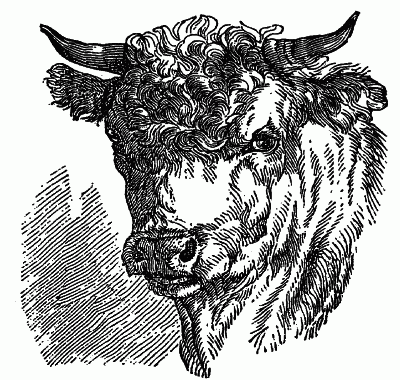
A FRONTISPIECE.
In driving cattle the drover should have no dog, which will only annoy them. He should walk either before or behind, as he sees them disposed to proceed too fast or to loiter upon the road; and in passing carriages, the leading ox, after a little experience, will make way for the rest to follow. On putting oxen on a ferry-boat the shipping of the first one only is attended with much trouble. A man on each side should take hold of a horn, or of a halter made of any piece of rope, should the beast be hornless, and two other men, one on each side, should push him up behind with a piece of rope held between them as a breeching, and conduct him along the plank into the boat; if it have low gunwales, a man will be required to remain beside him until one or two more of the cattle follow their companion, which they will most readily do. From neglecting this precaution in small ferry-boats, the first beast sometimes leaps into the water, when it becomes a difficult task to prevent some of the rest doing the same thing.
Whatever time a lot of cattle may take to go to a market, they should never be overdriven. There is great difference of management in this respect among drovers. Some like to proceed upon the road quietly, slowly, but surely, and to reach the market in a placid, cool state. Others, again, drive smartly along for some distance, and then rest to cool awhile, when the beasts will probably get chilled and have a staring coat when they reach their destination; while others like to enter the market with their beasts in an excited state, imagining that they then look gay; but distended nostrils, loose bowels, and reeking bodies are no recommendations to a purchaser. Good judges are shy of purchasing cattle in a heated state, because they do not know how long they may have been in it; and to cover any risk, will give at least five dollars a head below what they would have offered for them in a cool state. Some drovers have a habit of thumping at the hindmost beast of the lot with a stick while on the road. This is a censurable practice, as the flesh, where it is thumped, will bear a red mark after the animal has been slaughtered,—the mark receiving the appropriate name of blood-burn—and the flesh thus affected will not take on salt, and is apt to putrefy. A touch up on the shank, or any tendonous part, when correction is necessary, is all that is required; but the voice, in most cases, will answer as well. The flesh of overdriven cattle, when slaughtered, never becomes properly firm, and their tallow has a soft, melted appearance.
A few large oxen in one lot look best in a market on a position rather above the eye of a spectator. When a large lot is nearly alike in size and appearance, they look best and most level on a flat piece of ground. Very large fat oxen never look better than on ground on the same level with the spectator. An ox, to look well, should hold his head on a line with the body, with lively ears, clear eye, dewy nose, a well-licked hide, and should stand firmly on the ground on all his feet. These are all symptoms of high health and good condition. Whenever an ox shifts his standing from one foot to another, he is foot-sore, and has been driven far. Whenever his head hangs down and his eyes water, he feels ill at ease inwardly. When his coat stares, he has been overheated some time, and has got a subsequent chill. All these latter symptoms will be much aggravated in cattle that have been fed in a barn.
Cattle are made to fast before being slaughtered. The time they should stand depends upon their state on their arrival at the shambles. If they have been driven a considerable distance in a proper manner, the bowels will be in a tolerably empty state, so that twelve hours may suffice; but if they are full and just off their food, twenty-four hours will be required. Beasts that have been overdriven, or much struck with sticks, or in any degree infuriated, should not be immediately slaughtered, but allowed to stand on dry food, such as hay, until the symptoms disappear. These precautions are absolutely necessary that the meat may be preserved in the best state.
The mode of slaughtering cattle varies in different countries. In the great slaughter-houses at Montmartre, in Paris, they are slaughtered by bisecting the spinal cord of the cervical vertebræ; and this is accomplished by the driving of a sharp-pointed chisel between the second and third vertebræ, with a smart stroke of a mallet, while the animal is standing, when it drops, and death or insensibility instantly ensues, and the blood is let out immediately by opening the blood-vessels of the neck. The plan adopted in England is, first to bring the ox down on his knees, and place his under-jaw upon the ground by means of ropes fastened to his head and passed through an iron ring in the floor of the slaughterhouse. He is then stunned with a few blows from an iron axe made for the purpose, on the forehead, the bone of which is usually driven into the brain. The animal then falls upon his side, and the blood is let out by the neck. Of the two modes, the French is apparently the less cruel, for some oxen require many blows to make them fall. Some butchers, however, allege that the separation of the spinal cord, by producing a general nervous convulsion throughout the body, prevents the blood from flowing as rapidly and entirely out of it as when the ox is stunned in the forehead. The skin is then taken off to the knees, when the legs are disjointed, and also off the head. The carcass is then hung up by the tendons of the hough on a stretcher, by a block and tackle, worked by a small winch, which retains in place what rope it winds up by means of a wheel and ratchet.
After the carcass has hung for twenty-four hours, it should be cut down by the back-bone, or chine, into two sides. This is done either with the saw, or chopper; the saw making the neatest job in the hands of an inexperienced butcher, though it is the most laborious; and with the chopper is the quickest, but by no means the neatest plan, especially in the hands of a careless workman. In London, the chine is equally divided between both sides; while in Scotland, one side of a carcass of beef has a great deal more bone than the other, all the spinous processes of the vertebræ being left upon it. The bony is called the lying side of the meat. In London, the divided processes in the fore-quarters are broken in the middle when warm, and chopped back with the flat side of the chopper, which has the effect of thickening the fore and middle ribs considerably when cut up. The London butcher also cuts the joints above the hind knee, and, by making some incisions with a sharp knife, cuts the tendons there, and drops the flesh of the hind-quarter on the flank and loins, which causes it to cut up thicker than in the Scotch mode. In opening the hind-quarter he also cuts the aitch bone, or pelvis through the centre, which makes the rump look better. Some butchers in the north of England score the fat of the closing of the hind-quarter, which has the effect of making that part of both heifer and ox look like the udder of an old cow. There is far too much of this scoring practised in Scotland, which prevents the pieces from retaining—which they should, as nearly as possible—their natural appearance.
In cutting up a carcass of beef the London butcher displays great expertness; he not only discriminates between the qualities of its different parts, but can cut out any piece to gratify the taste of his customers. In this way he makes the best use of the carcass and realizes the largest value for it, while he gratifies the taste of every grade of customers. A figure of the Scotch and English modes of cutting up a carcass of beef will at once show the difference; and upon being informed where the valuable pieces lie, an opinion can be formed as to whether the oxen the farmer is breeding or feeding possess the properties which will enable him to demand the highest price for them.
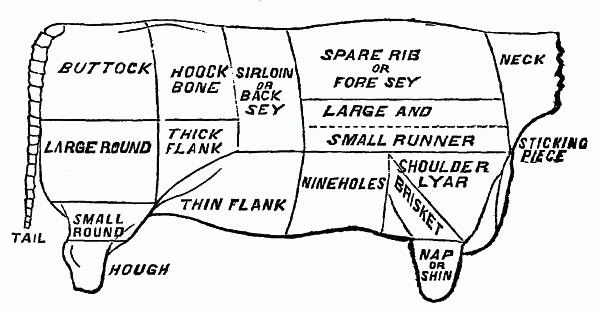
SCOTCH MODE OF CUTTING UP BEEF.
The sirloin is the principal roasting-piece, making a very handsome dish, and is a universal favorite. It consists of two portions, the Scotch and English sides; the former is above the lumbar bones, and is somewhat hard in ill-fed cattle; the latter consists of the muscles under these bones, which are generally covered with fine fat, and are exceedingly tender. The better the beast is fed, the larger is the under muscle, better covered with fat, and more tender to eat. The hook-bone and the buttock are cut up for steaks, beefsteak pie, or minced collops, and both these, together with the sirloin, bring the highest price. The large round and the small round are both well known as excellent pieces for salting and boiling, and are eaten cold with great relish. The hough is peculiarly suited for boiling down for soup, having a large proportion of gelatinous matter. Brown soup is the principal dish made of the hough, but its decoction forms an excellent stock for various dishes, and will keep in a state of jelly for a considerable time. The thick and the thin flank are both admirable pieces for salting and boiling. The tail, insignificant as it may seem, makes a soup of a very fine flavor. Hotel-keepers have a trick of seasoning brown soup or rather beef-tea, with a few joints of tail, and passing it off for genuine ox-tail soup. These are all the pieces which constitute the hind-quarter; and it will be seen that they are valuable both for roasting and boiling, not containing a single coarse piece.
In the fore-quarter, is the spare rib, the six ribs of the back end of which make an excellent roast, and when taken from the side opposite to the lying one, being free of the bones of the spine, it makes a large one; and it also makes excellent beefsteaks and beefsteak pie. The two runners and the nineholes make salting and boiling pieces; but, of these, the nineholes is much the best, as it consists of layers of fat and lean without any bone; whereas the fore parts of the runners have a piece of shoulder-blade in them, and every piece connected with that bone is more or less coarse-grained. The brisket eats very well boiled fresh in broth, and may be cooked and eaten with boiled greens or carrots. The shoulder-lyar is a coarse piece, and fit only for boiling fresh to make into broth or beef-tea. The nap, or shin, is analogous to the hough of the hind-leg, but not so rich and fine, there being much less gelatinous matter in it. The neck makes good broth; and the sticking-piece is a great favorite with some epicures, on account of the pieces of rich fat in it. It makes an excellent stew, as also sweet barley-broth, and the meat eats well when boiled in it.
These are all the pieces of the fore-quarter; and it will be seen that they consist chiefly of boiling-pieces, and some of them none of the finest—the roasting-piece being confined to the six ribs of the spare rib, and the finest boiling-piece, corned, only to be found in the nineholes.
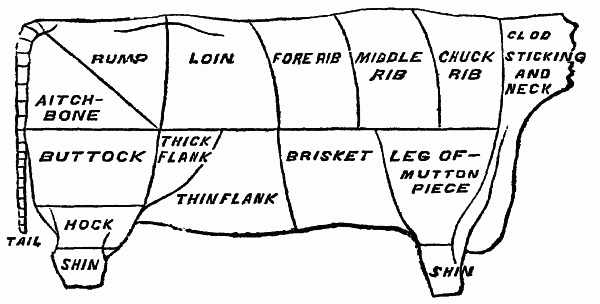
ENGLISH MODE OF CUTTING UP BEEF.
The loin is the principal roasting-piece; the rump is the favorite steak-piece; the aitch-bone, the favorite stew; the buttock, the thick flank, and the thin flank are all excellent boiling-pieces when corned; the hock and the shin make soup and afford stock for the various requirements of the culinary art; and the tail furnishes ox-tail soup—a favorite English luncheon. These are all the pieces of the hind-quarter, and they are valuable of their respective kinds.
In the fore-quarter, the fore-rib, middle-rib, and chuckle-rib are all roasting-pieces, not alike good; but in removing the part of the shoulder-blade in the middle-rib, the spare-ribs below make a good broil or roast; the neck makes soup, being used fresh, boiled; the back end of the brisket is boiled, corned, or stewed; the leg-of-mutton piece is coarse, but is as frequently stewed as boiled; the shin is put to the same use as the shin and hock of the hind-quarter.
On comparing the two modes of cutting-up, it will be observed that in the English there are more roasting-pieces than in the Scotch, a large proportion of the fore-quarter being used in that way. The plan, too, of cutting the loin between the rump and aitch-bone in the hind-quarter, lays open the steak-pieces to better advantage than in the Scotch bullock. Extending the comparison from one part of the carcass to the other, in both methods, it will be seen that the most valuable pieces—the roasting—occupy its upper, and the less valuable—the boiling—its lower part. Every beast, therefore, that lays on beef more upon the upper part of its body is more valuable than one that lays the same quantity of flesh on its lower parts.
It is deemed unnecessary to enter into details as to the modes of cutting-up most in vogue in this country, as there is a needlessly great want of uniformity.
Of the qualities of beef obtained from the different breeds of cattle in England, there is no better meat than from the West Highlanders for fineness of grain and cutting up into convenient pieces for family use. The Galloways and Angus, when fattened in English pastures, are great favorites in the London market. The Short Horns afford excellent steaks, being thick of flesh, and the slice deep, large and juicy, and their covered flanks and nineholes are always thick, juicy, and well-mixed. The Herefords are somewhat similar to the Short Horns, and the Devons, may, perhaps, be classed among the Galloways and Angus, while the Welsh cannot be compared to the West Highlanders. Taking, then, the breeds of Scotland as suppliers of good beef, they seem to be more valuable for the table than those of England.
There are, perhaps, not sufficient data in existence to determine the true proportion of offal of all kinds to the beef of any given fat ox; but approximations have been made, which may serve the purpose until the matter is investigated by direct experiment, under various circumstances. The dead weight bears to the live weight a ratio varying between .571 and .605 to 1; and on applying one or the other multiplier to the cases of the live weight, a pretty correct approximation is reached. The tallow is supposed to be eight one-hundredths of the live weight; so that the multiplier is the decimal .08. The hide is supposed to be five one-hundredths of the live weight; so to obtain its weight, a multiplier, .05, is used. The other offals are supposed to be in a proportion of about one-fourth of the live weight; so that the multiplier, .28, is as near as can be proposed under existing experience.
Beef is the staple animal food of this country, and it is used in various states—fresh, salted, smoked, roasted, and boiled. When intended to be eaten fresh, the ribs will keep the best, and with care will keep five or six days in summer, and in winter ten days. The middle of the loin is the next best, and the rump the next. The round will not keep long, unless it is salted. The brisket is the worst, and will not keep more than three days in summer, and in winter a week.
In regard to the power of the stomach to digest beef, that which is eaten boiled with salt only, is digested in two hours and forty-five minutes. Beef, fresh, lean, and rarely-roasted, and a beefsteak broiled, takes three hours to digest; that fresh, and dry-roasted, and boiled, eaten with mustard, is digested in three and a half hours. Lean fresh beef fried, requires four hours, and old hard salted beef boiled, does not digest in less than four and a quarter hours. Fresh beef-suet boiled takes five and a half hours.
The usual mode of preserving beef is by salting; and, when intended to keep for a long time, such as for the use of shipping, it is always salted with brine; but for family use it should be salted only with good salt; for brine dispels the juice of meat, and saltpetre only serves to make the meat dry, and give it a disagreeable and unnatural red color. Various experiments have been made in curing beef with salt otherwise than by hand-rubbing, and in a short space of time, and also to preserve it from putrefaction by other means than salt. Some packers put meat in a copper which is rendered air-tight, and an air-pump then creates a vacuum within it, thereby extracting all the air out of the meat; then brine is pumped in by pressure, which, entering into every pore of the meat formerly occupied by the air, is said to place it in a state of preservation in a few minutes. The carcass of an ox was preserved, in France, for two years from putrefaction by injecting four pounds of saline mixture into the carotid artery. Whether any such contrivance can be made available for family purposes, seems doubtful.
Cattle, when slaughtered, are useful to man in various other ways than by affording food from their flesh,—their offal of tallow, hides, and horns, forming extensive articles of commerce. Of the hide, the characteristics of a good one for strong purposes are strength in its middle, or butt, as it called, and lightness in the edges, or offal. A bad hide is the opposite of this—thick in the edges and thin in the middle. A good hide has a firm texture; a bad one, loose and soft. A hide improves as the summer advances, and it continues to improve after the new coat of hair in autumn until November or December, when the coat gets rough from the coldness of the season, and the hide is then in its best state. It is surprising how a hide improves in thickness after the cold weather has set in. The sort of food does not seem to affect the quality of the hide; but the better it is, and the better cattle have been fed, and the longer they have been well fed, even from a calf, the better the hide. From what has been said of the effect of weather upon the hide, it seems a natural conclusion that a hide is better from an ox that has been fed in the open air, than from one that has been kept in the barn. Dirt adhering to a hide injures it, particularly in stall-fed animals; and any thing that punctures a hide, such as warbles arising from certain insects, is also injurious. The best hides are obtained from the West Highlanders. The Short Horns produce the thinnest hides, the Aberdeenshire the next, and then the Angus. Of the same breed, the ox affords the strongest hide; but, as hides are applied to various uses, the cow's, provided it be large, may be as valuable as that of the ox. The bull's hide is the least valuable. Hides are imported from Russia and South America.
Hides, when deprived of their hair, are converted into leather by an infusion of the astringent property of bark. The old plan of tanning used to occupy a long time; but, such was the value of the process, that the old tanners used to pride themselves upon producing a substantial article—which is more than can be said in many instances under modern improved modes, which hasten the process, much to the injury of the article produced. Strong infusions of bark make leather brittle; one hundred pounds of skin, quickly tanned in a strong infusion, produce one hundred and thirty-seven pounds of leather; while a weak infusion produces only one hundred and seventeen and a half,—the additional nineteen and a half pounds serving only to deteriorate the leather, and causing it to contain much less textile animal solid. Leather thus highly charged with tanning is so spongy as to allow moisture to pass readily through its pores, to the great discomfort and injury of those who wear shoes made of it. The proper mode of tanning lasts a year, or a year and a half, according to the quality of the leather wanted and the nature of the hides. A perfect leather can be recognized by its section, which should have a glistening marbled appearance, without any white streaks in the middle. The hair which is taken off hides in tanning, is employed to mix with plaster, and is often surreptitiously put into hair-mattresses.
The principal substances of which glue is made are the parings of ox and other thick hides, which form the strongest article and the refuse of the leather-dresser. Both afford from forty-five to fifty-five per cent. of glue. The tendons, and many other offals of slaughter-houses, also afford materials, though of an inferior quality, for this purpose. The refuse of tanneries—such as the ears of oxen and calves—are better articles. Animal skins also, in any form, uncombined with tannin, may be worked into glue.
Ox-tallow is of great importance in the arts. Candles and soap are made of it, and it enters largely into the dressing of leather and the use of machinery. Large quantities are annually exported from Russia. Ox-tallow consists of seventy-six parts of stearine and twenty-four of oleine, out of one hundred parts.
The horns of oxen are used for many purposes. The horn consists of two parts: an outward horny case, and an inward conical-shaped substance, somewhat intermediate between indurated hair and bone, called the fluid of the horn. These two parts are separated by means of a blow upon a block of wood. The horny exterior is then cut into three portions by means of a frame saw. The lowest of these, next the root of the horn, after undergoing several processes by which it is rendered flat, is made into combs.
The middle of the horn, after having been flattened by heat, and its transparency improved by oil, is split into thin layers, and forms a substitute for glass in lanterns of the commonest kind. The tip of the horns is used by makers of knife-handles and of the tops of whips, and for other similar purposes. The interior, or core of the horn, is boiled down in water. A large quantity of fat rises to the surface; this is put aside, and sold to the makers of yellow soap. The itself is used as a kind of glue, and is purchased by the cloth-draper for stiffening. The bony substance remaining behind is then sent to the mill, and, after having been ground down, is sold to farmers for manure.
Besides these various purposes to which the different parts of the horn are applied, the clippings which arise in comb-making are sold to the farmer for manure, as well as the shavings which form the refuse of the lantern-makers. Horn, as is well known, is easily rendered soft and pliant in warm water; and by this peculiarity and its property of adhering like glue, large plates of horn can be made by cementing together the edges of small pieces rendered flat by a peculiar process, as a substitute for glass. Imitation of tortoise-shell can be given to horn by means of various metallic solutions. Horn, also, when softened, can be imprinted with any pattern, by means of dies.