Introductory material (continued 7)
Reading edition
August 17
Still the same weather conditions, with a little more wind and, strange to tell, a heavy ground-swell from the southwest. Imagine how hard the gale must have been to drive the swell through thirty degrees of latitude, as it is not probable that a wind strong enough to raise such a sea would prevail north of 40° south. Soon, indeed, now we will enter upon the last quarter of our voyage, and that portion of the Pacific between the line and 40° north is at this season often responsible for more long passages than any other part of the Cape Horn voyage. Many a flyer has rolled booming across the equator on a record-breaking trip, struck the Doldrums north of the line like running into a stone wall, and added fifty days more to the passage before sighting the Farallones. Just a year ago the “Shenandoah,” one of our fastest vessels, was forty-six days sailing up to ’Frisco from the equator.
Last night in the first watch I had a long talk with the second mate. It seems that he and Mr. Goggins have had words several times lately, and as Mr. Rarx knows what we think of the mate, he unburdened his mind in a very unusual manner. He says that Goggins would make a tip-top mate of a garbage-dumper, but that he isn’t fit for a geordie brig, much less a clipper ship, or what passes for a clipper in these days. “But the worst of it is, he’s no seaman; and when my watch on deck comes ain’t there a h—— of a fine mess, and I’ve got to do it all over again. And look at his men, the state he’s got ’em into; there’s not a man-jack o’ the whole lot that’ll turn a finger for him, with his shoutin’ and hollerin’ and swearin’. I wonder the captain shipped such a —— —— old cripple, for he knew him before. I’m gettin’ bloody sick o’ the voyage. What’s the matter with the mate is that he came in through the cabin-windows instead o’ the hawse-pipes.”
All this and much more did Mr. Rarx pour forth, working himself into quite a rage as he went along, and embellishing his discourse with regular handspike oaths.
In the American merchant service a mate always rises to that position through the various grades from ordinary seaman up; but on British ships boys (frequently gentlemen’s sons) sign for three years as apprentices, live aft, and are taught navigation and seamanship perfectly and practically by captains who are often privileged to write R. N. R. after their names, paying, I think, about one hundred guineas for this instruction. When this course is over they are fit for second mate, and in another two years pass for mate and then master. How different in America, where the law requires no examination for a man before he goes in command of a sailing vessel! How Mr. Goggins could rise to be mate from a cabin-boy without passing through the forecastle is quite marvellous, as he has always sailed in Yankee ships. He is a very obscure individual, though, and no doubt landed in the cabin in some inscrutable manner.
Mr. Rarx, on the other hand, would make a good mate of a large yacht were it not for his temper, which is very violent, and he has a way of harboring up revenge for petty trifles. We have seen more bad treatment of the men at the hands of Goggins; but my belief is that the second mate does considerable hammering on his own account the other side of the forecastle-house. It is a curious fact that so many bright men stick at second mate all their lives, never rising any higher, simply because they have never learned the use of a sextant, or how to copy figures from an epitome, for that’s all that navigation amounts to as carried on at sea. This is the great dividing line between first and second mate, which a man like Rarx could overcome in a few weeks of application. When a second mate has passed his thirty-fifth year his pristine ardor and zeal begin to wane, for by that time his aspirations for improvement are not so keen as they were; and if he is not a mate shortly afterward, he never will be. Similarly, when a mate has passed that age and never has had a command, he settles down in the capacity of chief officer, and by the time he is forty he performs his duties thereafter with no more ambition than the ox that hauls the plough. Many ship-masters refuse to take either a mate or a second mate who is more than thirty-five years old. Reference is made to sailing craft only, as men in the transatlantic mail service not infrequently reach fifty years before succeeding to one of the greyhounds. In the early days of Yankee clippers scores of men went out as master at twenty-one, and capable ones at that, as the records show.
Whenever there is a pause in the conversation at meals now, Captain Scruggs always fills in with some remarks about Nansen (or Naysen, as he always calls him) and Arctic expeditions. It is remarkable with what regularity he does this, and the mate as regularly asks in a grieved tone, addressing no one in particular, “And will yer tell me wot good hit’s a-goin’ to do when they do find the pole?” Then the skipper indignantly asks him if he supposes that an expedition is idle all the time in the ice; to which the mate replies, “Well, I know there’s nothin’ to be found out about the land up there, cause there hain’t none.” And then they go at it like a pair of quarrelsome cats, till suddenly the old man fetches the table a whack and cries out, “Very well, sir; you’re not here to argue; that’ll do, sir,” in his fiercest tones. At such times he looks like the ogre of childhood. These set-tos are extremely amusing, though, for neither knows anything about the subject, and the air throbs with “magnetic poles,” “Arctic circles,” and “phemomemoms.” By the way, it is interesting to know that England held the record for the highest latitude for two hundred and seventy-five years, or since Hudson’s voyage in 1607 to 1882, when the record passed to the United States, to be wrested from her thirteen or fourteen years later by the Norwegians. Let us hope that Peary, whom Sir Clements Markham calls “the greatest living ice-traveller,” will regain what we have lost, and this time succeed in attaining that geographical point, the quest of which has resulted in the loss of such splendid men as Franklin and de Long.
Almost all of the painting aloft has been finished except the lower masts. The topmast and lower mast-heads all glitter in the glory of a coat of dark reddish-brown, and the rigging fairly scintillates in the sun in its dress of glossy tar. Mr. Goggins says that he well remembers the first wire-rigged sailing vessel seen in the United States. She was a full-rigged London brig, and when she arrived in New York she looked so neat and trim aloft that even the old shell-backs, who doubted the efficacy of wire, were obliged to admit that in appearance, anyhow, she was away ahead of the old style. “But you wait till she strikes a gale o’ wind,” said these Solons, “and then you’ll see.” And they didn’t have long to wait, for on her return voyage to England she was totally dismasted three hundred miles west of Cape Clear. Latitude, 8° 19′ south; longitude, 105° 40′ west.
August 18
A still fresher breeze to-day, but it is dead aft. But we are moving so steadily in the same direction, northwest, that we slip through the water without appreciating how fast we are going; and as each noon puts us two degrees farther north, we ought to cross the line next Saturday. Gradually, too, we have been gliding into warmer weather, and last night we experienced, for the first time in the Pacific, the tremendous heat of the equatorial regions. There is something inexpressibly depressing to many people after a few days’ sojourn in the tropics; something that seems to drain the vitality. Personally I have never experienced this feeling, and exercise should never be omitted in hot weather by robust persons, although it should not be severe, and ought never be taken when the sun is more than ten degrees above the horizon.
This morning as we were hanging over the side in the shade, watching the copper slipping smoothly through the water, while a perfect cataract of cool wind poured over us out of the lee side of the cross-jack, we saw a disk of vivid green resting upon the surface of the clear, blue depths. We thought it was a cluster of sea-grass till the captain said, “Hello, there’s our first turtle.” So it proved to be, and as the ship passed within a few feet of him we had an excellent view of his broad, corrugated back, fully three feet across; he was reposing in peaceful slumber as we slid past, with head retracted, but feet and tail extended like a starfish, and he looked immeasurably comfortable, resting so placidly on the water, indolently rising and falling in the quiet sea; and we envied him, lying there in his clear, cool element. Latitude, 6° 38′ south; longitude, 107° 44′ west.
August 19
One hundred days at sea, and we celebrated the circumstance in real old-fashioned, long-approved Yankee style. Last evening, immediately after supper, we went up on the cabin-house and sat down to enjoy the sunset. All at once we heard angry voices forward, and then Louis, the Frenchman, shot head first out of the lee door of the carpenter-shop, followed by the massive body of Chips himself, who held in his hand a bludgeon. They were both in a passion. Louis dropped his hat as he flew through the doorway, and as he stooped to pick it up, smack! came the truncheon upon his flank. Then Louis straightened up, shot out his fist, and smote Chips painfully on the chin; the latter returned the blow, and in a second they were at it tooth and nail. Now, Louis is a very active, powerful man, and in a long spell he would, no doubt, wear the other out, but in close quarters he was no match for the carpenter’s weight; for a few seconds Louis prevailed, but Chips recovered, and, being a foot taller than the Gaul, he seized him by the throat and backed him over towards the rail, against which he caused Louis’s head to come into such frequent and violent contact that we could hear the tattoo where we sat. Then Louis began his national, low habit of kicking, but was unsuccessful in his contemptible trick, and they were still in the throes of battle when the mate appeared and cautiously hauled them apart. The shirts of both were in shreds and the Frenchman was in a fearful rage. By and by Chips came aft to supper; he bore no facial marks of the encounter save that he was very pale.
At seven o’clock I went up to one of the men, Charlie, and asked him what the row was about. He said that, as far as he knew, Louis went into the carpenter-shop to get some kerosene to cleanse the paint from his hands, and, having no business in there without permission, Chips had thrown him out. The carpenter, by the way, hasn’t been fair to the men lately with their water. One day off Cape Horn, when he went into the forecastle with the men’s allowance, one of them said to him, thereby exhibiting an unusually good spirit, “Say, Chips, there’s no good o’ givin’ us all that water in cold weather, we can’t drink it.” Then when the hot weather came and the men grew thirsty, Chips refused to give them more than they asked for off the Horn, though each man is entitled here to four quarts per day.
Well, then, we continued to sit where we were till after dark, discussing the event; presently eight bells went, MacFoy came aft with, “The watch is aft, sir,” to which the mate replied with the usual growl, “All right; relieve the wheel and lookout,” and the starboard watch came on deck. At about 8.15, in the midst of that deep, wonderful silence that pervades a sailing ship at night, we were startled by loud voices up near the main-mast, just where we couldn’t tell, as it was pitch dark; immediately afterward, however, we recognized the voices of Mr. Rarx and Louis, which quickly rose to shouting. The first sentence that we caught was from the second mate, the words coming in jerks, as though he had a man by the neck and was shaking him: “So you were in there tryin’ to steal oil eh? You —— —— French —— —— ——.” To which Louis answered in a loud voice, “I deed not, sair.” Then came another broadside from Rarx, and again, “Etees not so, sair.”
At this point several voices broke in, and the old man then ran down the weather poop-ladder to see what was the matter. Suddenly a death-like silence reigned for a few moments; then came a sound of scuffling, and all at once Rarx cried out, “God! He’s stuck me, cap’n!”
“What’s that?” yelled the skipper.
“The damned French hound’s put a knife into me, sir!”
Paralysis instantly fell upon all hands. The tension was fearful, but was relieved somewhat by the steward’s opening the port cabin door, allowing a broad path of light to stream forth into the darkness, which had hitherto rendered the affair mysterious and horrible. It fell upon a group of startled men by the main-mast, with the skipper in the centre supporting the second mate, while the latter, pressing his hands above his left hip, shuffled painfully aft. He was led into the cabin, where he sat down upon the coal-box, and I pulled up his shirt and exposed the wound. It was a wide gash in his side, a little to the front of and just above the pelvis. The blow had evidently been aimed at the groin, but in the darkness Louis had slightly missed. Rarx’s clothes were somewhat blood-soaked, but the flow had ceased, showing that probably none of the large arteries had been punctured. Still, there was more than a probability that he had been dangerously, nay, fatally, hurt, and even at that moment might be bleeding to death internally, and we could not tell whether or no any of the vital organs had been touched. The skipper ran at once for listerine, and together we contrived to bind up the wound and put the man to bed. Then the old man stepped out on the main-deck and shouted,—
“Send that Frenchman aft, Mr. Goggins, and put the irons on him.”
The mate went gingerly up to Louis, who, in the midst of a knot of men, was raving like a maniac, and, seizing him gently by the arm, led him aft. Oh, how that man raged and blasphemed! He was like an angry bull, and his loud voice rang out far over the peaceful ocean and echoed and reverberated high up overhead in the hollows of the upper sails.
“Did you hear what ’ee call me, sair?” in shrill tones. “I, who have bose fazair and mozair. I weel not stand zat, sair. I die fairst; you can keel me, sair. And I, I stuck ’eem; I would cut ’eem again, sair, or any one else, that call me zat name. I am a man, sair.” This last in a perfect shriek.
Never a word said the old man. Then Louis turned on him, and, insolently sneering, his head thrown back scornfully and one foot advanced, he cried,—
“And you, Capitaine Scruggs! What are you? I have been to sea twenty year and nevair saw a capitaine like you before. You starve us! you starve us! Why do you starve us? When we fairst left New York we ’ad plentee to eat, zee food was waste, and now for seex wicks we have had nossing at all. Bah! Peef! You, a man like you, a capitaine!”
At this juncture the skipper said abruptly, but without the least show of anger, for which great credit is due him,—
“Where’s the knife you cut the second mate with?”
“Where zee knife, eh? Here zee knife. Now you see it, now you don’t. Ha, ha!” And he jerked it over the side into the sea.
All this time the mate was fussing with the irons, trying to find a pair that would encircle his great wrists; but at length a pair was found, locked on his arms, and he was led aft to the wheel-house, several other pairs of irons in the mate’s hand clanking mournfully as he walked. Into the after-division where the tiller works Louis was hustled, and his hands were then fastened with a rope to a ring-bolt in a carlin overhead, so that he had to stand upright all night.
And what was my wife doing all this time? When Rarx had cried that he had been stabbed she had fled to her room, locking herself in, and sat shivering until curiosity compelled her to open the door on a crack and peep out; and when Louis and the mate stumbled along the alley-way by our windows, it sounded to her like the tramp of a ball-and-chain gang.
As soon as Louis was secured we turned our attention to the second mate again, and after reaching the conclusion that there was no internal hemorrhage, or, at least, none that our slight skill could detect, we drew the edges of the wound together, into which you might easily have thrust a plum, securing them with adhesive plaster, and then bound up the cut with listerine-soaked cloths. Poor fellow! he had a bad night. Two heavy doses of laudanum and a five-grain opium pill had no more effect on him than so much nitre; and it was not until shortly before eight this morning that he dozed away, only to be aroused by the clang of the huge breakfast-bell just without his door. He is suffering dreadfully, has a high fever, and has conceived the notion that he is in slivers inside.
At 8.15 this morning the after wheel-house door was opened, and the captain asked Louis if there was anything that he wanted, to which the Frenchman answered by turning his back with a shrug. Then the skipper said to him, “I just came to tell you that you’re no longer a seaman aboard this ship. You’re a prisoner, and will remain so till I hand you over to the authorities in San Francisco.” Then breakfast, consisting of burgoo, hard bread, salt beef, and coffee, was taken to him, and he was left alone till one o’clock, when a pannikin of soup was carried to him, which he refused, although he ate another piece of salt beef and a huge piece of soft bread. The manacles are knocked off when he eats, after which they are locked on again, and he is then left utterly alone. He is not allowed to enter the forecastle upon any pretext, and when it is necessary for him to go forward, the mate follows immediately behind.
At a little before nine this morning, as I was reading by the wheel-house, Paddy, who was steering, leaned out and whispered, “Look, the old man’s goin’ to read the riot act.” I glanced forward, and saw that the ship’s company had been mustered aft on the main-deck, with the captain glaring at them, but not in the least excited. I reached the break of the poop just in time to hear what it was about. Said the skipper: “I hear you men are finding fault with the food and say I’m starving you; is that so?”
Tim, with a villanous twist, came forward, and said, “It is, sor; and we don’t get enough wather to wash our hands wid,” holding out two dirty paws.
“Not enough to wash your hands with, eh?” said the old man. “It looks to me as if there was plenty of water over the side, and I believe you’ve got enough salt-water soap. Is that all you’ve got to say?”
“It is, sor,” said Tim.
“Is there any one else in the same fix?” asked the skipper.
Coleman then stepped out and said the same thing about the food and water. Every one else seemed to find something mighty interesting in the deck-seams.
“All right. Mr. Goggins, you will see that the men are put on government allowance from now till I see fit to stop it. You can go forrad,” he added to the men.
It must be explained that on Yankee ships it is not customary to put men on the allowance prescribed by law as it is on foreign ships. On some of our ships the men are fed very well and on others miserably. We began here by giving all sorts of extra things to the men, apple-sauce, cheap jam, butter, etc., and when these “delicacies” ran out the men thought it strange, and then by and by, according to some of the most trustworthy of the sailors, the bread and meat themselves began to grow less and less. It would be much better if long-voyage American ships would adhere to the government allowance, and not give the men sweets one month and then suddenly stop them entirely; such a course always breeds discontent; and I have noticed that the mates have not been able to get any more work out of the men here even when they were luxuriating in their jam and butter, etc., than they did on the English “Mandalore,” where everything was weighed out to the ounce, and no “fixins.”
The serenity that ought to accompany a sea-voyage has been savagely dissipated, for go on deck and approach the wheel-house, and you instinctively recoil when you think that it perhaps contains a murderer. Go below to meals, and the smile vanishes from your face as your thoughts revert to the wounded man groaning in his dingy cavern. Over the ship hovers a silence such as falls upon a community when Death stalks through its midst. The men look grave, the mate gives his orders in low tones, and instead of the ringing chanties, the halliards are tautened up to a muffled “oh ho”; and the pumps would revolve in utter silence but for their own grinding clank.
As for the day, it was magnificent, and we continue to surge along over a sparkling ocean. Latitude, 4° 30′ south; longitude, 109° 58′ west.
August 20
After the excitement and turmoil incident to such an affair as happened yesterday, or rather the night before last, it is hard to get at the real facts of the case until the agitation calms down. Therefore it was not until a little while ago that we learned the truth about the row between Louis and Chips. It appears that before stowing away the heavy suit of sails when they had been unbent, some slight repairs were necessary on the lower foretop-sail. They were completed day before yesterday, and the sail was carefully rolled and tied up. The men were ordered to rinse the paint off their hands with kerosene, furnished them by the carpenter, so that they should leave no finger-marks on the white duck. Afterward, for some unknown reason, Louis wanted more oil, and personally went into the carpenter-shop to get it. Now, it is one of the strictest rules aboard all ships that no sailor shall ever enter the carpenter-shop in the absence of Chips; and when the latter, no doubt in an ugly mood, found Louis in there, he threw him out. After the fight the Frenchman was in a blind passion, and there were probably two reasons for his taking summary vengeance upon the second mate. In the first place, I have often seen him flush up with anger at the way in which some of the men have been treated, this being his first American ship; and he probably determined that if either mate laid hand on him unlawfully, he would show them that there was at least one man forward with the courage to defend himself. The second mate took him by the throat (Rarx admits that) while he, Louis, was quietly standing by the chicken-coop cutting off a plug of tobacco, being at the time perfectly well behaved, and the Frenchman, remembering his comrades, used his knife, ready in his hand. In the second place, the name which the second mate called him was the last straw. English, German, Scandinavian, and American sailors do not seem to care what they are called by the mates; but any one of the violent Latin races always resents this epithet with all the fury of which they are possessed. It is inconceivable, anyhow, why Rarx should have stirred up the row again. Chips ejected Louis from his shop. All right; he is there to guard that part of the ship, and did right in heaving him out of it; yet the second mate must needs rake it all up again two hours afterward, when he didn’t even see the original disturbance. Gradually I am beginning to lean toward the belief that Rarx and Louis have had a grudge against each other for a long time, and mayhap that little incident in the South Atlantic while the sails were being shifted, during which Rarx nearly threw the Frenchman off one of the mizzen-top-sail-yards, was not so much of an accident as it seemed.
By far the gravest question now is, was the knife that did the deed rusty? It was a sheath-knife such as all sailors carry in a little leathern scabbard by the hip. It must have been fairly bright, though, as there has been a great deal of use lately for sheath-knives in cutting away old chafing gear, and therein lies Rarx’s salvation. His sufferings are very great now; at long intervals he is somewhat easier, but he groans almost continuously in what seems to be excruciating agony, his breath comes in gasps, and perspiration oozes from his face in large beads, as he wallows and squirms in his narrow, hot bunk, almost crying aloud sometimes when the ship rolls.
And what of Louis? He has been removed to the lazarette and fastened, still handcuffed, to a thick stanchion. There he sits brooding in the gloom, for no light penetrates the apartment save by the booby-hatch that leads into it, secured with a chain heavy enough for a maintop-sail-sheet. He has, however, plenty of air and good food, including soft bread, which is no longer given to the men; but there is not space enough for him to stand upright in, a kneeling posture being the most elevated that he can assume. Still, there’s nothing else to do with him, for he certainly couldn’t be allowed at large. Three times a day the mate carries him his food, liberates him when he has finished and marches him forward, walking about five feet behind him, his hand gripping a pistol in his hip-pocket, ready for the least false move on the part of the Frenchman or any one else. The latter’s face is a study as he walks rapidly forward, his heavy, dark brows hanging sulkily over flashing eyes which he never raises from the deck. Through the midst of his shipmates he strides silently with bare feet, his immovable face shrouded in deep scowls, looking neither to the right nor left. They make way for him with averted heads as he passes through, followed by his jailer, and the men close up again as after the passage of a blood-hound in leash. Then in a moment back again he hurries along the deck, mounts the poop-ladder, descends into the dusky recess, holds out his hands, the irons are snapped on, with the chains between, and he is left for another five or six hours to muse in solitude upon his bloody deed. His face shows as yet no indication of relenting; but as day after day drags on in all its awful loneliness even his nature, however dauntless, must at last succumb to that most terrible of all punishments, solitary confinement.
As for the rest of the men, they have recovered somewhat and go about their work much as usual, bar the chanties, and I had lately another chance for a word with honest Paddy. “What do you think of this affair?” I asked him. “Well, I can’t say I’m surprised,” he answered. “How is that?” wishing to sound him. “Mr. Rarx has always seemed a pretty decent fellow.” “Decent fellow!” he replied. “Say, look here, I didn’t say much about him to you the other day, but I’ll tell you what now, there’s not a single man in the fo’c’s’l what’ll say a good word for him, ’ceptin’ that he’s a fine sailor-man. His temper’s hell,” he went on, and I expected to hear of some more fine examples of discipline, for we were on the fore-castle-head and not likely to be seen, when “Come, come, Paddy, this ain’t the dog-watch,” broke sharply in, and we perceived the stalwart shoulders of the bosun rise above the ladder, which, of course, ended the conversation.
My wife is rapidly recovering from her nervousness, having in this respect exhibited almost miraculous recuperative powers. What a trying, not to say a terrible, position for a woman to be placed in! What a miserable termination to a voyage undertaken solely for pleasure! Indeed, though, while we have enjoyed the sea as much, perhaps more, than we ever did before, there have been so many adverse conditions on board with which we have had to contend, that, after all, this is a more or less appropriate termination to the passage. When Louis was first put into the lazarette my wife didn’t like it at all, as our room adjoins it, though separated by a stout partition or bulkhead; we have allayed her fears, though, and we never hear so much as the clink of the chain from the Frenchman, even at night. It is fortunate that our relatives have no suspicion of our position.
We are now permanently three hands short, for old Neilsen is still so seedy that his most arduous tasks are making sennit and mats and pointing and putting Turk’s-heads on ropes. At noon we found that a strong southwesterly current had retarded us, and we are not as far north by half a degree as we supposed. Precisely the same weather conditions prevail, this great ocean being still in a state of absolute rest. The wind is now east; an advantage, as it allows every sail to draw. Latitude, 2° 49′ south; longitude, 112° 30′ west.
August 21
Mr. Rarx is somewhat improved, we think, and this afternoon he is not in so much pain. When I went in to see him yesterday I was shocked at his appearance. His face was swollen and puffed and glistening with perspiration; he twitched suddenly in jerks and was so exhausted that a dozen consecutive words wore him completely out. The worst of all, however, was his rambling speech, due to five-grain doses of opium; these seem to me to be prodigious amounts to administer, and perhaps account for the excessive cardiac palpitation from which he suffers. During breakfast this morning he had a dreadful spasm of pain, and we could hear him crying, “Oh, oh, oh, oh!” and it was miserable to see this powerful man stricken down at one blow.
Louis still conducts himself with the grim indifference of a Sioux Indian; his chains have been double-riveted and shackled, and an idea of the massiveness of the gear may be obtained when it is said that the stanchion to which he is secured is five inches square and only four feet high, that being the amount of head-room in the lazarette. The skipper has to stand the second mate’s watches now, which is hard on him, as he is suffering acutely from rheumatism. Lately, or since we took the southeast Trades, he has been most astonishingly affable. We don’t know what to think of him; his argumentativeness has disappeared and he insists on conversing pleasantly at meals; in short, he has assumed a gracious benignity as surprising as it is welcome, and it proves that he knows quite well how to talk and act, and that his surly manner is simply the result of a morose temper. I expect that he wants to leave a good impression on our minds at the end of the voyage.
Our southwesterly current gave rise to a most astounding lie from the mate, to illustrate what he believes to be the erratic movements of the currents in the North Pacific. The incident happened on a bark in the San Francisco-Honolulu trade, of which he was mate at the time. This vessel carried no freight, but did a large passenger trade, and always carried cows along for fresh milk. “Well, sir, wot I’m a-tellin’ yer of ’appened onct on the houtward passage; one of our cows took sick and died, and of course we ’ad to ’eave ’er over the side, which we did in the northeast Trades. We reached ’Onolulu all right, and started back ag’in for San Francisco, when one mornin’ in the Trades the cap’n he says to me, ‘Mr. Goggins,’ says he, ‘wot’s that?’ ‘Wot’s wot?’ says I. ‘That there,’ says ’e, a-pointin’ over the weather-quarter. I looked, sir, and strike me blind if there warn’t the body o’ that cow, and we two ’undred mile to the north’ard o’ where we chucked ’er hoverboard. She’d drifted there nearly dead ag’in the Trades in twenty-seven days.” When I told this singular experience to the old man, he said, “The principal thing that’s the matter with Goggins is that he’s a d—— old fool.” This being the first occasion on which I ever knew a captain to omit the handle to a mate’s name.
However, Captain Scruggs himself told us a strange story later; but as he is painfully accurate and never enlarges on facts or figures, it is most likely true. He was bound from Seattle to Manila, master of the “Judas Dowes,” and while rolling down through the southeast Trades he fell in with a German ship which asked for the longitude. They had a little talk together with the flags, and it turned out that she was from Vancouver for Callao and that she was then one hundred and nine days out. Nor was this the most remarkable part of the affair, for she was thirteen hundred miles out of her course! Her chronometers were out and she had been drifting about in the strong currents for weeks, working by dead-reckoning. But if this is extraordinary, what shall be said of the voyage of the ship “Ravenscrag,” which arrived at Callao not many months ago, one hundred and eighty-four days from New Whatcom! This place with the musical name is on Puget Sound, so that the distance which the “Ravenscrag” had to traverse was not more than six thousand miles in a straight line, yet so extremely difficult is it to make the coast of South America on account of the Trades that she was half a year at sea. Sailing ships have to practically cross the Pacific before they can fetch a port on the Peruvian coast. Another instance of the delay of this voyage is afforded by one of our rear-admirals, retired, who told me that he was once almost one hundred days from San Francisco to Callao in a training-ship, which shows that the long passage of the “Ravenscrag” was not due to indolence and bad navigation. The latter vessel’s voyage was infinitely more extraordinary in comparison than the “T. F. Oakes’s” passage of two hundred and fifty-nine days from Hong-Kong to New York.
It is a pity that vessels have to stand so far to the westward here when bound north in order to get the northeast Trades, but unless they do they will fall into a great calm region that extends from the Central American coast to the one hundred and twentieth meridian, and which reaches as far north as the thirtieth parallel. This is also a cyclonic zone, which, at certain seasons (particularly in September), renders the voyage from Panama to San Francisco a very dangerous one even for large steamers.
The longest voyage that it is possible to make both in time and distance is that from Great Britain or New York to the Japanese and Chinese ports during the northeast monsoon, when vessels sail completely around Australia and the whole length of the Asian coast to 35° north rather than beat up through the Sunda Straits, the total length of the voyage being twenty-one thousand miles. The following recent passages taken from London “Fair-play” serve to show the duration of the voyage in days:
“Ladakh,” New York to Hong-Kong 181
“Falls of Dee,” New York to Hong-Kong 182
“John R. Kelley,” New York to Hong-Kong 182
“Torrisdale,” New York to Hong-Kong 190
“Emily F. Whitney,” New York to Shanghai 197
“Musselcrag,” New York to Shanghai 197
“Ancona,” New York to Shanghai 240
“Eureka,” Philadelphia to Nagasaki 186
“George Curtis,” Philadelphia to Nagasaki 197
“Vimeira,” Philadelphia to Hiogo 189
“Englehorn,” Philadelphia to Yokohama 180
The “Whitney,” “Curtis,” “Kelley,” and “Eureka” are American ships, their average being one hundred and ninety days; the rest are English, with an average of one hundred and ninety-four, the miserable passage of the “Ancona” having spoiled the record of the Britishers. It will be seen, however, that not one of the ships went out in less than six months; compare this with the run of the American bark “St. James,” from New York to Shanghai, of ninety-eight days in the southwest monsoon, which was not a very wonderful passage.
The weather is as usual, save that there is a great increase in the humidity. Latitude, 1° south; longitude, 114° 40′ west.
August 22
North latitude! At nine o’clock this morning we crossed the equator in 115° 35′ west, and once more entered the Northern Hemisphere. Our passage of one hundred and three days from New York to this position is an average one, and we have yet twenty-seven days in which to reach San Francisco without breaking what the skipper says is his record of never having been at sea one hundred and thirty days.
A remarkable circumstance in connection with this part of the world is the low temperature of both sea and air; the former at noon was 77° and the latter only 70°, or about the same as the sea in August at New York. In the Indian and Atlantic Oceans the sea temperature at the equator is 84° and the air 86°.
We certainly made a fine run up from Cape Horn. Four weeks ago to-morrow we were in 60° south, and have, therefore, sailed thirty-six hundred miles of latitude and forty degrees of longitude in twenty-seven days. But the wind has been very, very light for twenty-four hours. We did only one hundred and one miles and just did contrive to wriggle across the line. Perhaps this is only a light spell in the Trades, as this wind at this season ought to carry us seven or eight degrees farther north.
Sufficient unto the day, etc. The memory of that miserable night last Wednesday is already beginning to grow dim. Mr. Rarx is improving; the terrific palpitation of his heart has ceased, and he has had much natural sleep lately. He did a strange thing last night in the middle watch: he got up out of his bed and sat for an hour in a chair; his heart was much relieved, he said, and he certainly does look better.
This being Sunday I had a long talk in the afternoon watch with MacFoy, who confirmed what Paddy said of Rarx’s temper. Then happening to mention Coleman, the bosun remarked, “He’s been pretty quiet since Mr. Rarx laid him out.” “Laid him out when?” I asked. “Why, didn’t you know he near killed him when we were towin’ to sea? No? Oh, dear! We were haulin’ aft the foresheet and Coleman turned his head to say a word to the man behind him, when the second mate come around the house and kicked him pretty hard in the legs. ‘What are yer kickin’ me for, sir? I didn’t do nothin’.’ ‘You lie,’ said Mr. Rarx. ‘What are you sayin’ to that man? Givin’ me back talk, too.’ Well, sir, with that he jumped on him when he was stoopin’ over, and I thought his ribs ’ud go afore he got through with him. Now, look; a bosun’s supposed to be on the mate’s side. But I say there’s no bit o’ use in a-smashin’ a man all up that didn’t deserve it, as I’ve seen dozens o’ times in American ships. I must say there’s some tough cases sails in Yankee ships, but whose fault is that? It’s the fault o’ the cap’ins and mates themselves. What man with a little bit o’ self-respec’s goin’ to allow himself to be knocked around the decks when he can sail in other ships, even if he is only a foremast hand? A dog won’t stand that, but he can run away from the man what beats him; but the sailor can’t. But the worst of the whole thing is that American mates don’t make any difference atween a blackguard and a man what’s doin’ his best. Some men’s got to be thumped, it’s the only way to handle ’em; but what’s the good o’ hittin’ a man with a block like the second mate did to Karl and then hazin’ him for the rest o’ the passage. It’s mighty little you know what’s been goin’ on here up forrad; they’ve kep’ it quiet, for I guess the old man told the mates not to let out afore you and the lady. But there was a hot time under the forecastle-head some days off the Horn. I was goin’ out in the ‘S. G. Alley’ a couple o’ year ago to Japan. ‘Black Taylor’ was mate of her, the toughest man in the toughest ship under the flag. We were makin’ sail off the Hook and there was a man surgin’ up on a rope at a capstan; the rope was wet and wouldn’t render easy, but paid out in short jerks, which, of course, the sailor couldn’t help. Taylor spotted him, and sung out that if he did it again he’d come over and fix him. In a minute or so the rope slipped an inch again, and with that Taylor runs over to him and kicks him into the water-ways, and was goin’ to lep on his stummick when the man all at once jumped up, whipped out a knife and drew it up the mate’s vest. His insides fell out on the deck and he died in a little while. Of course the ship couldn’t go to sea without a mate, so we turned back to New York. The sailor was jugged, and what d’ye think he got? Six months! He pleaded self-defence and Taylor’s black record decided the jury. I’ll bet this Frenchman of ours’ll get nothin’ at all if only one man’ll stand by him and tell what he’s seen Mr. Rarx do. I’ve sailed in a good many American ships, and in every one of them some one was cut up afore we got in. I’m thinkin’ o’ the Snug Harbor or you’d never see me in another one.” Latitude, 0° 7′ north; longitude, 115° 47′ west.
August 23
We went along pretty slowly last night, for only the faintest of breezes came whispering over the Pacific; and it was so still that we could plainly hear the sighing of porpoises as they rolled languidly through the water alongside, a brilliant flash of phosphoric light showing where each disappeared. At daylight this morning, though, a delightful breeze came singing out of the east-southeast, and by nine o’clock we were making seven knots, doing twenty-nine miles in the forenoon watch,—no mean speed for the equatorial ocean. It seems that the light spell was only a lull in the Trades, for there are plenty of indications of wind round about.
At 4.30 yesterday, after pumping, I had yet another conversation with the doughty Scot. “Have ye taken notice of the way the mate’s slacked up on the men?” he asked; “that’s a bad sign, now. Here’s this man cut; before ye’ll remember how he used to shout and charge around the decks. What do ye hear from him now? Nothin’ at all. I haven’t heard him raise his voice to one o’ the men since Wednesday night. Why? ’Cause he’s scared. He’s in a funk; and I have the task o’ keepin’ the ship in order forrad. One o’ them, Tim, was goin’ to get ugly this forenoon; but I turned on him sharp and says, ‘See here, now, drop that; you’ve laid one man out, haven’t you? You have; but I’m d—— if you’re goin’ to lay me out,’ says I, and that settled it for the time. Who’ve I got to depend on if they do break out? The mate’s no good, and t’other bosun’s only a child. When Mr. Rarx gets up again you’ll see some fireworks. Did ye ever hear anythin’ about Cap’n Slocum in the ‘D. G. Tillie’? He’s another hard nut. I was comin’ around in her once from Baltimore, bound to ’Frisco with a load o’ coal. One o’ the men forgot to say ‘sir’ to the second mate one day in a hard squall; so Slocum clapped the irons on him, and then near beat the life out of him with a fid. This little bit o’ fun, though, I heard cost him near two thousand dollars. I’ll tell ye the ships you’d ought to sail in if ye make another voyage,—one of the Loch Line; they’re grand ships, and run like men-o’-war; I’ve been in them, and they’re the best that sails the seas.”
They are, doubtless, the best run sailing ships in the world, and were built not alone to carry agricultural implements and wool in the London-Melbourne trade, but to take out passengers as well. There are fifteen of them, and all named after Scottish lochs, and they vary in size from twelve hundred to two thousand tons. If all ships were as fast as the “Loch Torridon,” tramp steamers would be at a discount. This vessel goes wherever she can find a charter, and has made a number of wonderful records. She holds the best record for a deep-loaded ship from Newcastle, Australia, to San Francisco,—forty-six days. In 1891 she made the passage from Sydney to London, wool-laden, in eighty days, beating a fleet of seventy-eight vessels, similarly loaded and bound to the United Kingdom. It was on this voyage that Captain Pattman, who has commanded the ship for sixteen years, made a record that is simply marvellous, by sailing from the Diego Ramirez to the Lizard in forty-one days! In 1892 the “Loch Torridon,” in ballast, went out to Melbourne from London in sixty-nine days, and the consecutive runs for nine days were, in knots, 302, 290, 288, 272, 285, 282, 270, 327, and 341; and from Saturday noon to Saturday noon the ship made 2119 knots, an average of 303 knots per day, or about thirteen miles per hour. Another fast passage of this gallant ship was from Newcastle, Australia, to Valparaiso in thirty days. It is easy to imagine the intense pride that a ship-master must feel in such a vessel. Her picture appears on the opposite page. It is a pity that her royals are clewed up.
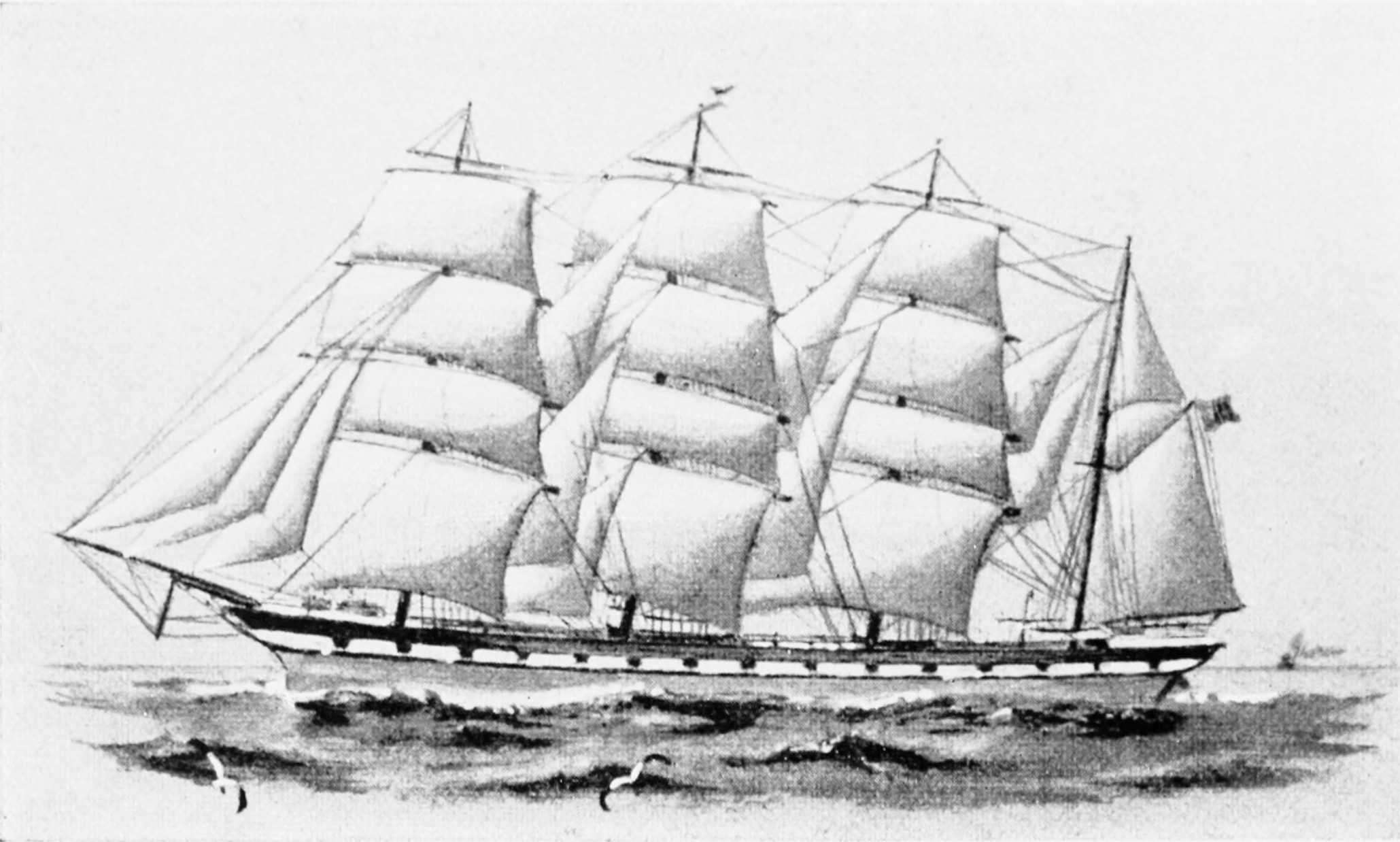
The four-masted British ship “Loch Torridon”
Last evening Louis’s coat and a change of clothes were brought aft by Charlie, one of the jolly, good-tempered fellows. “Lemme see them duds,” growled the mate, standing by the wheel-house, who then went carefully through the pockets for concealed weapons, but found only a lump of tobacco, which some one had slipped into the pocket, as Louis is a great masticator of the weed. The mate subsequently transferred the tobacco to his own pocket, whereupon Charlie actually expostulated with him, at which Mr. Goggins said never a word! The second mate is now doing quite well, and ate his first solid food to-day, a bit of dry toast, but his rations still consist mostly of arrow-root gruel. The captain told us to-day that last Friday he didn’t think that Mr. Rarx would live through that day, but a robust constitution has apparently pulled him past the crisis. The more we ponder on the stabbing affair the more remarkable it seems that the second mate should have started the row. If the truth were known, both Rarx and Louis were perhaps getting a little rusty from disuse and tried to brighten matters up a little; but Rarx’ll never take another Dago by the throat again (at sea Frenchmen, Spaniards, and Italians are Dagos; Scandinavians, Hollanders, and Germans are Dutchmen). Louis will have a very strong case against the second mate if he can get Karl and some of the others to testify as to their treatment at the hands of Mr. Rarx; and self-defence is an excellent plea when a man takes another by the throat, especially if the said man has been in the habit of utilizing belaying-pins for other purposes than those for which they were intended. Latitude, 1° 45′ north; longitude, 117° 15′ west.
August 24
Two hundred and two miles! How’s that for one day’s run in the southeast Trades two hundred and fifty miles north of the equator? Indeed, this is the best that we have done for a fortnight, and it has put all hands in a happy mood. A powerful current setting west-northwest, two and one-half knots an hour, has been responsible for about sixty miles of the distance, but the wind is strong at south-southeast and should give us another good run to-morrow. Except the Gulf Stream, I do not know of a current in the open sea as strong as this one, which, if in a harbor, would at times, half bury a small can-buoy. The heat, though, is very severe now, the humidity and oppressiveness being extreme.
The second mate was carried out of his room this forenoon and laid in a reclining chair on the main-deck. His respiration is improving, though it is still labored, and he says that he really feels but little better. The probability of his being able to resume his duties before we reach port is very remote, which is fortunate for the men, for if Mr. Rarx should sufficiently recover to stand his watches, there would be a terrific thumping of sailors.
The mate went below to put a fresh pair of irons on Louis, and in doing so handled him very roughly (a courageous performance), so that the Frenchman sobbed two or three times. “Ha,” quoth Goggins, “blubberin’, eh? That’s just like you Dagos. You’re nothin’ but a lot of old women with no more sand than a—a—a—jelly-fish, you ain’t.” People in glass houses occurred to me then, and I thought how Louis could, any day, pick up this miserable creature when he went down with his food, and shake the life out of him with just one of those mighty arms of his. The Frenchman is unlucky in having such wrists, for there is not a pair of irons in the ship nearly large enough, and each wrist is encircled by a ringlet of raw skin where the handcuffs have gripped and chafed it as though it had been seared with a hot bracelet. I cannot help feeling sorry for him, in spite of his deed; for it is improbable that a man whose general character is so good and whose face is so frank and honest is a villain at heart. Like the rest of his nation, he is very quick-tempered, and upon the second mate’s catching him by the throat his hand instantly flew to his weapon, the common sailor’s sheath-knife. On the other hand, both Tim and Coleman look like typical hard cases, with restless eyes and evil, discontented, sinister faces. Why is it that such men are seldom maltreated at sea? It is only such inoffensive creatures as Karl and Brün who are kicked about a ship’s deck like curs in an alley-way. Such men as I have mentioned first are thoroughly wide-awake, too, and know just how far to go in irritating captains and mates without laying themselves open to punishment; and when mates cannot detect them, they (the mates) “take it out” on others.
The most intelligent man forward is a New Yorker, Dick Broadhead, and, as he has been very willing to talk, we have had some interesting conversations. He is going out to ship in one of the Pacific mail steamers as quartermaster, which accounts for so respectable a young man’s signing in an American vessel. What a splendid lot of young, native Americans we would have in our merchant marine if boys at sea in our deep-water ships were treated as they are in the vessels of other nations! The real American sailor, as he has proved in our naval achievements, has no superior, and if even the mildest inducements were offered to young men of decent antecedents to sail in our ships, we would soon have a merchant service that would be the envy of the rest of the world. Look at the training-ship “St. Mary’s,” which is supposed to supply young men to officer our steamers and sailing ships. I have yet to meet with a single graduate of this excellent institution on a sailing vessel, for they absolutely refuse to sign in them even as second mate, saying that until blood and belaying-pins cease to fly in our long-voyage ships, they would leave them severely alone. The existing condition of things actually prevents our boys and young men from joining the merchant service. Why have we not a Plimsoll to strip our ships of the unprincipled wretches who command and officer them? Although not a sailor, this excellent man spent most of his life and ten thousand pounds in ameliorating the condition of English seamen. If our sailors were treated as they are in the foreign services, we should have gentlemen’s sons as captains and mates, as they have in Great Britain and Germany, and not the miserable examples of humanity that are to be found on the quarter-decks of the majority of our deep-water-men. The second mate of a ship once said to me, speaking of the captain of one of our crack San Francisco wind-jammers, “What! Cap’n B——? Why, he don’t know who his father and mother were.” If this is the captain, what can you expect?
But I have drifted away from Broadhead. This is the second ship under the stars and stripes that he ever served in, having been shanghaied on board the “Virago” once two or three years before in a Chinese port. It was this ship’s maiden voyage, and she came home around South America from Hong-Kong, instead of around Africa. Concerning Captain Jones, Broadhead remarked, “I’ve seen dummies in command of ships, but he beats the deck. The first bad squall we had off the Horn, I was steering, and he was so scared he just held on to the rail and yelled, and I heard the mate say to him, ‘Why don’t you get the t’-ga’nt-s’ls off her?’ She went down to the sheer-poles in that squall, and they do say he hasn’t had anything above the topsails on her since. I’ll give you a tip: the ‘Virago’s’ got three masts too many for Cap’n Jones.” Latitude, 4° 24′ north; longitude, 119° 20′ west.
August 25
So joyous a breeze has wafted us along for twenty-four hours that at noon to-day we were two hundred and two miles from where we were at the same time yesterday. We have no current now, and our run was due solely to good, honest winds from south-southeast. At about noon to-day, though, the breeze shifted to south-southwest, and now (4 P.M.) it is at southwest and not strong. It is probable that we have lost the Trades, after holding them for thirty-five degrees of latitude,—a remarkable piece of luck. It was grand sailing then; the very finest that we ever had. But hence to 15° north will no doubt be a trying week. It was a matter of some surprise to us when we first learned that the light southwesterly wind that blows between the Trades in the Atlantic and Pacific is called a monsoon. It is generally supposed that the term monsoon, which is from the Arabian mawsun, signifying season, is applied to certain winds on the southeast coast of Asia only.
Gracious, how hot it is here now! What a difference in a few hours! At noon, with the sky heavily overcast and on the coolest part of the deck, the thermometer stood at 84°. In equatorial regions it is only when far removed from salt-water that the mercury rises to such altitudes as 130°; this fearful temperature is experienced in many localities, such as Northern India, Mojave Desert, in Southern California, and in parts of Australia. In such places as Para, Singapore, and Madras, though close to the equator, the temperature seldom rises more than two or three degrees above 90°. Anything higher than 80° in such places, as well as at sea, would be considered almost unbearable by most people.
While my wife and I were reading on the deck-house this morning we observed the wee cook in transports of delight, the cause of which became apparent when he held up a fine bonito. We went down to look at it, and then perceived two men on the jib-boom end fishing for them, so we climbed up on the top-gallant forecastle-head to watch the sport. It was delightful up there, cool and breezy from the gush that whirled out of the curve of the foresail. We braced ourselves against the knight-heads and, looking down over the lofty, flaring bows, we could see dozens of bonitos darting swiftly about the cut-water as we swept grandly on through the blue, transparent sea. Far out on the tapering end of the spar were Charley and Olsen; the former with the line in his hand, the hook being concealed by that singular and universal deep-sea bait, a bit of white cotton cloth. Charley kept the hook just touching the surface, except when he jerked it sharply upward, in imitation of the flight of the flying-fish, which form the principal food of the voracious bonito. It would be all but impossible to conceive a more beautiful scene than that which fascinated us for half an hour. The fish themselves were of the most exquisite colors, some brilliant blue, some magenta, others of a rich purple; and as they flashed through the water with incredible speed, twisting and twirling about in pursuit of their prey, with now and then a gleam of silvery white from their under parts, they looked not unlike segments of a vivid rainbow. Presently one would shoot clear out of the water for the bait, straight and swift as a dart, and seize it in his toothless but greedy jaws. A great churning and splashing would follow, and then Charlie, almost hysterical with excitement, would haul up the lithe, handsome creature, quivering and vibrating as though galvanized. No sooner would he be hooked than perhaps a hundred flying-fish would break through the surface and sail gleaming away for a few rods, only to fall into the rapacious mouths of their enemies. The spectacle was one long to be cherished: the whizzing flight of the glittering little fish, the lustrous-hued bonitos, the tranquil surface of the ocean, broken here and there with foaming ripples, and the lofty tiers of canvas rearing themselves higher and higher toward the clouds.
Captain Scruggs continues his quiet, almost agreeable manner, answers pleasantly, and has little to say at meals. It is aggravating to think that the skipper knew quite well how he ought to have behaved during the voyage, and that he simply didn’t care “whether school kept or not.” Now and then the silence is broken during dinner by a shattering crash of the old man’s ponderous foot upon the oil-cloth floor, while he simultaneously yells, “Get out o’ here, you homely thing!” This is an exhortation to the gaunt, pop-eyed cat, which sometimes slinks into the cabin at meals. It seems impossible to fatten this singular animal, and it skulks and stalks about the decks as lank and ribbed as a Calcutta jackal, with its huge saffron eyes fixed motionlessly upon you in so startling a fashion that it looks like an incarnation of one of Cruikshank’s drawings. Its notions of sport are equally strange; Tommie, the sleek Maltese, has been trying to teach it how to play, but when Tom rushes sportively at it, the other executes a series of prodigious, vertical leaps, with its legs flat out at right angles, and in another moment vanishes with an eldrich cry.
Mr. Rarx is about the same; two of the men supported him to-day while he tried to hobble about the deck; but he cannot for an instant even stand alone. Latitude, 6° 56′ north; longitude, 121° 15′ west.
August 26
We are now certain that we have lost the Trades. The wind has been steady at southwest for twenty-four hours, and, though not a strong breeze, we made more than two degrees of latitude, which is not bad going for this region, and three days of it would take us into the northeast winds. It is intensely hot and moist, and heavy showers pelt us every half-hour; but it is a fine chance for cleaning ship, and all hands are at work scrubbing off the old paint from the bulwarks and deck-houses preparatory to the new coat.
How I wish we could get a photograph in colors of that villain, Tim Powers! I never supposed that one of the human species could so nearly in appearance approach the simian race. His head and jaws are covered with a thick growth of bright-red hair, which continues down his throat till it meets a shaggy breast. The body, powerfully made, is curved forward like an ape’s, and long, thick arms, hair-covered to the knuckles, swing loosely well below the middle; and he waddles in his gait like a monkey endeavoring to walk upright. The best possible description of this animal is to say that he is ever so much more like a chimpanzee than a chimpanzee is. Besides all this, he is so dirty that the rest of the men follow him with their eyes as he moves about the deck.
Those who are not especially interested in the well-being of our sailors may find the following dissertation somewhat tiresome; but the facts about to be set forth ought to be known to the public, as they certainly are not, so that I will not begin these remarks with an apology for their length.
In every port of any size in the United States there are a number of men whose business it is to maintain boarding-houses for sailors,—that is, they are known to the outside world as boarding-house-keepers, but in reality they form one of the most extensive aggregations of criminals, thieves, and persecutors to be met with in any country of the world that boasts a high civilization. Their technical name is crimps. The Encyclopædic Dictionary defines a crimp as “one who keeps a low lodging-house, into which sailors and others are decoyed and then robbed”; but it would be impossible to present properly, in so small a space, the different phases and extensions of a system which for generations has eluded and defied investigation and has baffled the attempts of well-meaning but incapable legislators. New York is the hot-bed of crimps, for there are more than fifty boarding-houses in the city near the water-front. Take the case of a vessel just in from a long voyage. No sooner does the anchor touch bottom than her decks are suddenly and mysteriously filled with strange men, who pay no attention to the captain or mates, but go at once into the forecastle among the sailors. They are the runners for the crimps,—men whose business it is to supply the sailors with grog which they have brought on board for the purpose, and then decoy and persuade them to their respective establishments. Every sailor at the end of a voyage has but half of his wages coming to him (more of this by and by), say about forty dollars. The crimp at once takes a week’s board in advance and then, having drenched the unfortunate with the vilest of rum, it is a matter of but two or three days until the crimp has wheedled him out of the rest of his hard-earned gains, and then he gets in his finest work by opening an account with the sailor for lodging, meals, drinks, etc. He then at once becomes the slave of the crimp and must do his bidding; not only can the latter prevent him from securing employment (in this free country!), but can actually prevent a ship-master from getting a crew, unless he signifies his willingness to deal with him; and as I have said, so powerful (politically) is the crimping organization in New York that it successfully defies all effort at checking it and controls absolutely the shipping of sailors in New York. When a captain wishes to engage a crew, not finding one at the shipping commissioners, where they are supposed to be, he is compelled to apply to a crimp, and if sailors are scarce at the time, he will charge the captain so much per head! If the sailors are plentiful, though, he will not charge the captain anything for supplying him with a crew; in fact, he will go to the extremity of paying the latter a bonus for the privilege of shipping his men, in order to prevent some other crimp from securing his business, taking the precaution of charging the sailors a fee sufficiently large to make up the deficiency. This fee is known among sailors as “blood-money,” and it varies from one to twenty dollars per capita; in our own case, the amount that each foremast hand had to pay for being allowed to sail in this ship was five dollars; and though their wages are so small (about eighteen dollars a month) it would be useless for them to object to the blood-money; alternative, starvation in the streets. This practice of paying ship owners and masters for the privilege of supplying them with sailors has grown so common that it is regarded by many owners and captains as a legitimate source of income; so much so, that the majority refuse to sign other than a crimp’s crew. The shipping commissioner, a federal officer, is supposed to look after the gathering together of a ship’s company; the men, it is true, sign the articles in his presence, but that is the sum total of his connection with the shipment of sailors. Why doesn’t the commissioner stop the crimping? He is well aware, of course, that it goes on; but he does not seek to prevent it because he is instructed not to interfere with the accredited “agents” of the owners, and it must not be forgotten that under the fee system in vogue at present the commissioners are, to a great extent, dependent upon the good-will of the owners for their income. Any attempt of the commissioner to interfere with the “agents” of the latter would evoke a strong protest from them, and would, perhaps, end in the suppression of the office of commissioner; therefore the majority of the owners insist that their “agents” shall be respected.
In many instances the commissioners have been utterly unfit for the office they have held, for they are supposed to look after the welfare of seamen, besides their shipment. It is even said that some have been appointed from the forces of the crimps themselves. Others have been common ward politicians (those who know New York will appreciate this), and even a metal-worker has in the past held the office at New York; while the most influential candidate for the position now at one of our greatest ports is a sign-painter! It will be appreciated at once how much men of this sort know of the grievances of sailors whom they are supposed to protect.
The allotment system which obtains now when sailors are about to go to sea is a most iniquitous arrangement. The law says that “a sailor may stipulate in his shipping agreement for the allotment of any portion of his wages which he may earn to his wife, mother, or other relative, or to an original creditor in liquidation of any just debt for board or clothing which he may have contracted prior to an engagement.” This law was evidently framed to the advantage of the sailor, but in its ambiguity lies its detriment to seamen. Of course, the “original creditor” is the crimp (which was obviously not what the law intended), who has turned the words “may stipulate” into “must stipulate.” When a ship-master makes known to a crimp that he wants a crew, the crimp rounds up the required number of men, marches them to the shipping commissioner’s, where they sign the articles and are paid usually two months’ advance wages (which is not lawful until it is turned into an “allotment”). This money, forty dollars in round numbers, is given to the crimp (“the original creditor”), who then extracts from the sum an amount three or four times in excess of what the man is really indebted to him, arranges for the blood-money, and hands the rest (if any money remains) to the victim. Frequently all of his advance is necessary to liquidate this “just debt,” and the man goes to sea without a cent. On the voyage he gets in debt to the ship for the slop-chest account, clothing, oil-skins, boots, tobacco, etc., and at the end of the voyage, if it lasts four months, generally not more than a month’s wages are due him. This is secured by the crimp at the destination, and the old story of robbery and persecution is repeated. No foreign nation that I know of, at least none of the highest rank, allows crimping. The government has charge of the procuring of crews, and any infringement or interference by an outsider is a criminal offence, and, more than that, it is always punished as such. The United States government has never attempted to stamp out the crimps, and they, in turn, have never experienced any difficulty in prosecuting their lawless and miserable business.
Every time that a sailor signs articles any one or all of the following laws are violated, which the commissioner placidly disregards, and of which other government officials seem to be in complete ignorance:
1st. The payment of advance prohibited under penalty, fine, and imprisonment. 23 St. at L., page 55, Section 10, Dingley act, June 26, 1884; pages 66, 67 of U. S. Navigation Laws, also subdivision, Section 4522, U. S. R. S.
2d. Misuse of allotment notes. See 24 St. at L., page 80, Section 3, act June 19, 1886, and page 67, U. S. Navigation Laws.
3d. Payment of blood-money strictly forbidden. Section 4609, U. S. R. S.
4th. Withholding wages four or five days to bring seamen into the power of crimps. Section 4529, U. S. R. S.
5th. Withholding seamen’s baggage to prevent them from seeking employment on their own account. Prohibition and penalty, Section 4536, U. S. R. S., as amended February 18, 1895; page 68, U. S. Navigation Laws.
6th. Soliciting lodgers (employment of runners) on inward-bound ships. Section 4607, U. S. R. S; page 71, U. S. Navigation Laws.
All these violations tend directly to the demoralization and degradation of sailors, and ought to be immediately abolished.
Why our shipping laws should be so frequently broken, and with the utmost impunity, is, I think, partly due to their ambiguous construction, for many of them were prepared by either ship-owners or crimps with an abundance of political influence, and also partly to our lax method of carrying out the laws that we have framed; and they are disregarded because it would not be to the advantage of any one save the sailor, for whom they were supposed to have been enacted, to enforce them. The grievances of seamen are not popular subjects with the authorities, because of the peculiar obstacles generally met with in efforts to prove them; while the amount of damages awarded to sailors, except in unusual cases, do not offer sufficient inducements to the sort of maritime lawyers who would be likely to bring the cases to a successful issue.
As that able writer on the subject and champion of sailors, Mr. James H. Williams, says, “The complaining seaman has usually arrayed against him the combined powers of the wealthy ship-owners; the cunning, unscrupulous, and designing crimp; the sagacity and ability of the most experienced lawyers; and sometimes the traditional prejudice of the judicial mind is often turned against him. With this combination to overcome on the merits of his case alone, the allegations of the sailor must be well sustained indeed to enable him to win.” As for the cases of sailors suing for damages for maltreatment at sea, the difficulties encountered by them when seeking justice lie in the facilities afforded the offender—that is, the master or mate—to escape; the obstacles that the owners put in the way of his apprehension; and the disposal of the witnesses—“shanghaiing”—either by bribery or intimidation by the crimps.
Mr. Williams has accurately and truthfully summed up the seaman’s condition in the United States as follows: “The sailor is degraded to be more effectually robbed; he is cheated for want of official protection; he is not protected because of his own utter helplessness, and because we have no recognized shipping system such as exists in Great Britain, for instance. In this country the sailor is often despised because of his nationality; in European countries he is usually honored for the same reason. When this nation rises to a realizing sense of its own responsibility and manifest duty to the sailor, and provides proper laws for his protection and adequate means for their enforcement, both our merchant marine and navy will become Americanized, seamanship will become an honorable calling, and American boys will go to sea.”
Over against this wretched treatment allowed to exist by the government of the United States, for its commissioners make no attempt to prevent it, stands forth the protection accorded the sailors of Great Britain and Germany. Seamen are well taken care of in the latter country; but in Great Britain there exists a system of sailor protection ashore, so perfect as to leave little or nothing to be desired; and the perfection of its detail has led me to show the workings of this scheme in the next few pages, a scheme that is facile princeps, and that ought to be a model for the rest of the world. The shipment of seamen in Great Britain is conducted under the superintendence of the Board of Trade; this is a separate department of the government, and upon it devolves the supervision and control of the entire merchant marine,—i.e., commerce and navigation. The president of the Board of Trade is a cabinet minister, and of course occupies a seat in Parliament; and the duties of the Board are defined and guided by acts of Parliament. Among other specific functions, the Board of Trade must provide for the shipment, care, and protection of seamen, and must frame and enforce (that’s the great point) proper laws for the suppression of crimping and similar abominations. Inasmuch as the Board was organized solely with reference to the interests of sailors and commerce, its officers have been, in nearly every case, judiciously chosen for their peculiar fitness and natural aptitude for the work rather than for any political views they may have held, or because of any influence exercised in favor of their appointment. As a result of this common-sense arrangement a most efficient and reliable body of officials has been secured, and for this reason the Board of Trade, from being considered at first a very troublesome innovation by maritime people, has succeeded in forming relations so close as to be almost indispensable with ship-owners and merchants throughout Great Britain; and what is even more remarkable, and certainly just as important, it has secured the confidence, improved the character, and protected the rights, interests, and persons of seamen to an extent which no other institution in any country has ever attained.
In all ports of Great Britain subdivisions of the Board of Trade, called Local Marine Boards, are established, each having authority over local maritime affairs. Seamen are entitled to direct representation on these local Boards, which are now maintained by the home government at various foreign seaports between Hamburg and Brest.
In Great Britain the shipping and discharging of seamen is conducted and superintended by government officers, and no person other than duly appointed officials of the Board of Trade are permitted to enter the shipping office under any pretext whatever while business is being transacted between master and crew under severe penalty. Crimps and all manner of “beach pirates” are particularly objectionable, and if found on the premises occupied by an official shipping bureau, are incarcerated without the slightest ceremony. Every shipment of seamen must take place at a government office except in extraordinary cases provided for in the law. When crews are wanted, notices to that effect are posted at the shipping office, on the vessels requiring them, and in other places where sailors will be likely to see them. Men desiring employment then proceed to the shipping office, present their discharges to the official, who in turn hands them to the captain. In this way crews are selected, and it will be perceived what an excellent body of men a captain can thus gather together. A seaman without his discharges generally finds great difficulty in obtaining a berth in England unless he can offer proof as to his previous service and character. These discharges are usually enclosed in a sort of wallet furnished by the government for a small sum, and are always accepted as evidence of the men’s rating, ability, and conduct. They are retained by the master until the end of the voyage, when they are returned to the owners with a new one added.
Aside from the mere formal engagement and official protection from “water-front parasites,” the Board of Trade is of immense importance and value to British sailors in a variety of ways altogether too numerous for enumeration here. Suffice it to say, then, that the many shining features of this splendid institution have proved of incalculable benefit to English sailors and their families, while the practical results obtained by means of its beneficent influence have contributed in no small degree to the present maritime greatness and power of the British nation.
Compare this method with the American fashion of throwing a dozen or more poor, wretched, half-starved, drunken creatures on board a ship, who have been robbed of their small pittance, gained often when looking into death’s jaws without so much as a flinch; and frequently stripped of every garment save the underclothes which alone cover them, the hapless victims of the laxity and the passive indifference of the United States government, commence the voyage of four or six months in a ship commanded in many, many instances by men little short of devils, and officered by men worse than beasts, conscious that for themselves it is merely a case of “out of the pan into the fire.” Latitude, 8° 53′ north; longitude, 122° west.
August 27
Last night was one of terrific heat. Imagine a temperature of 87° at one in the morning, with an atmosphere so oppressive with humidity that instead of sustaining a weight of fifteen pounds per square inch the body seems to be supporting at least thirty. It was hotter than any night that I ever remember afloat or ashore. There was a peculiar, smothering quality in the atmosphere, which was so heavy and moist that it seemed as though you ought to be able to seize a handful and squeeze the water out of it. The very essence of humidity seemed to be instilled into the air, and my wife, who readily withstood the heat in the Bay of Bengal at the close of the wet season, nearly fainted in the middle watch. It must not be supposed that because the air is pure that people do not suffer in hot weather at sea; that is an idea held only by those who have never crossed the equator. If the hygrometer would drop even to eighty-five or ninety the temperature could be conveniently borne; but this almost continual saturation is exceedingly trying. Think of the sufferings of passengers in the Red Sea, when steamers often have to alter their course and proceed against the wind to prevent people from dying of heat apoplexy!
The captain has once more donned his white drill suits, the jackets of which button closely up under the throat, like soldiers’ tunics in the tropics. By this arrangement it is not necessary to wear an ordinary shirt underneath; and at first glance the skipper looks to be most suitably and airily attired, and you envy him the possession of his gossamer tunics, until at meals, when there is an expansion of his corporeal sphericity which opens the spaces between the tunic buttons. And then, oh, horrors! the sight is blasted by the lurid glare of a red flannel undershirt! Red flannel on the equator! It is enough to throttle you, and the temperature instantly rises several degrees. No man ought to be allowed to so afflict his fellow-creatures.
Last night when I went on deck at 9.30 the skipper was on the lee side, looking at the heavens. On seeing me he said, “Well, there’s our old friend, the pole star; we haven’t seen him for many a day.” Now, I ought to have known better than to attempt any joke, but it seemed likely that he would surely know this ancient pleasantry of mariners, so I answered,—
“Yes; as the saying is, the pole star is the first land you make coming up from Cape Horn.”
This threw him into a grave meditation, at the end of which he ominously observed, “I don’t see what you mean.” I had by this time forgotten all about the star, and had to ask him in turn what he meant.
“Why, how do you mean that the pole star is the first land you make?” he demanded, bristling; “you often see Juan Fernandez.”
“Oh, well,” I answered, desiring propitiation, “sailors used to say that in the old days, meaning that it reminded them that they were once more in northern latitudes.”
“Well, I never heard it,” he returned; “and, anyhow, we don’t know whether hit’s land or water.” Here I fled, unable to withstand the strain any longer.
At dinner to-day he unexpectedly relapsed into his usual morose, contrary humor, and came strutting and stamping into the dining-room, glaring at every object, till his eye lit on a plate of rather stale hard bread on the table; then he grabbed some, fiercely bit an enormous piece out of it, threw the rest back into the platter, dropped into his seat with a crash that shook the tumblers, and shouted at the quaking steward, “Ain’t I told yer not to put nothin’ on the table but what’s fit for a white man to eat?” Deep silence followed as he dashed the soup around in the tureen with the ladle and fell upon his dinner; and my wife, without thinking, observed, “Well, this is the hottest we have had yet.” “No,” said Captain Scruggs, “it ain’t, hit’s nice and cool.” Angry at this flat contradiction, I told him that the thermometer, unlike many people, always told the truth, and that it was 88° on deck. “In the sun,” he replied, which he knew wasn’t so; while that devilish Goggins smiled blandly at us, as if to say, “You can’t catch him”; but I stood by for developments. Presently the old man began to shift about in his seat; then he made the curious remark that it was too warm for rain; in ten minutes more the perspiration began to stream from his face, and in another five minutes he got up and left the cabin, almost prostrated with the heat on this cool and pleasant day; though as he departed he attributed it to “them beans bein’ too heavy eatin’.” The mate followed him, with a face like a worn-out wet carriage sponge.
We have crossed the sun and he is at last south of us and casts shadows in the opposite direction from yesterday. We haven’t had the racks on the table for two days, which means a phenomenally smooth sea; the ocean often appears quiet enough to the eye, but there is nearly always a swell present that would play havoc with glasses and bottles. This is the first time that we haven’t used the fiddles since leaving New York. Latitude, 10° 44′ north; longitude, 122° 35′ west.
August 28
Another very hot day and night, but not comparable with yesterday, when a draught of air out of the sails was more like a blast from Tophet than a breath from this great ocean. It was possible to get considerable sleep last night, and on the whole we did very well; for even if we made only seventy-five miles, it was in the right direction. During the whole of the first watch last night there wasn’t even a suspicion of wind and the silence that reigned was wonderfully impressive, so that we were deeply awed by the solemnity of the scene. All about the zenith was a large area of perfectly clear sky thickly dusted with stars that shone with a calm splendor not to be seen except near the equator.
“By night those soft, lasceevious stars Leer from those velvet skies,”
saith Kipling.
About 45° from the zenith a mist commenced, thickening gradually into clouds dense and black, their lofty cones and dark abysses brought forth with startling clearness by great ceaseless surges of heat-lightning that enveloped the horizon like undulating, violet flames. On board no sound broke the stillness, which was that of the Arctic icefields, for minutes at a time, except now and then the creak of a yard that broke harshly on the ear, or the pleasant sound of a light swell at long intervals that chuckled to itself under the counter; and we floated motionless upon the deep, wrapped in an absolute and breathless calm. And the golden, bell-like tones of the exquisite andante from the Sonata Appassionata seemed to dwell in the air; tones which Beethoven said was his own conception of the music of the spheres, for the movement occurred to him one night in the hills, while contemplating the stellar glories of a clear, tranquil sky. Oh, what majesty in such a night! Oh, the solemn grandeur of this phase of nature! Indeed, it is difficult to say which exerts the more powerful influence over the mind: a gale of wind or a great, soundless calm, when every star in the firmament seems reflected in the motionless sea.
Throughout this forenoon, too, the wind was of the lightest sort, though this fact was productive of some little diversion. Shortly after ten o’clock the captain called our attention to several sharks wandering about far down in the blue depths under the stern, and presently several dolphin appeared hovering about the rudder, offering, with their agility and marvellous coloring, a striking contrast to the slothful, sombre sharks. All at once the old man ran off, and then returned with a formidable engine of destruction, consisting of a huge iron hook strong enough to sustain an ox, with a short length of wire rope attached to it. His other hand clutched a mass of oleaginous pork, from which liquid fat exuded in the rays of a baking sun. This delicacy, the mere sight of which would revolt the stomach of an emu, the skipper gayly secured on the hook, and then bent the whole affair to a long line as big as the main-brace. This gear would really have been suitable for the capture of nothing smaller than a ninety-barrel whale; but the captain surveyed his arrangements with much urbanity and dropped the contrivance over the stern. There was no shark in sight, but one speedily appeared, and propelled himself with great caution toward the bait; his eye caught the cable then to which it was fastened, and he sheered off. When he had manœuvred thus several times, he seemed to summon his friends, for three more of the creatures mysteriously appeared. They, too, were very shy at first; but at length they began to turn slightly on their backs as they approached, a sure sign that before long they would seize the bait. At last the largest one swam boldly up to it, turned over, opened his wicked jaws, his double row of triangular teeth closed upon the extreme edge of the meat, and he deftly tore the whole piece off the hook, while he seemed to smile as he leisurely rejoined his companions.
Then the skipper fetched another lump of pork-fat, which he kneaded and squelched in his hand as he walked along. Again the same wily beast took the bait, and once more we drew up the naked hook. After a repetition of this, the skipper, with much pomposity, rigged the harpoon and bade me stand by with it while he endeavored to entice the sharks close under the counter with another pound of pork. Several times I hove the weapon without the least risk to any of the sharks, though I all but followed the harpoon overboard at every lunge, and once contrived to stand in the bight of the rope, which nearly cut me in two; and we could perceive the iron plunge down fathom after fathom in the transparent water. Finally I did strike one in the middle of the back, but the harpoon bounded off his tough hide and he glided away unharmed. This was discouraging, and we desisted soon afterward, as we had to carry on the attack under a terrific sun. The sharks looked unspeakably comfortable, sauntering around below the rudder, now sinking out of sight, now cleaving the surface at a distance with their sharp dorsal fins, upright like sabres, and I was secretly well pleased that we didn’t kill one, for I must confess that the sight of a shark does not throw me into convulsions of horror, nor does it consume me with the fanatical thirst for slaughter, which is the general effect produced by the appearance of one of these beasts.
Each of these sharks was attended by the familiar little pilot-fish, about the size of a small mackerel, with his body wonderfully marked with bands of dark blue and black, as sharply defined as the turning-post of a croquet set; strange it surely is to see these tiny fellows fearlessly maintain their position just under the gaping mouth.
As indicated elsewhere, Mr. Goggins hasn’t much to say these days, although he has recovered somewhat from the cataleptic state into which the stabbing of the second mate threw him. He was quite talkative last night in his watch, and congratulated me upon my not smoking, saying, “I’m glad to see you don’t use these cigareets; they’re bad things, and I can tell you why,—’cause they’re full o’ nicoline.”
The second mate is pulling slowly along, with sunken cheeks and hollow eyes, an ill-looking man, and what is more miserable than a sick sailor? Every one aboard ship has his own duties to perform, and scant attention and no sympathy is vouchsafed to the luckless man confined to his room. Latitude, 11° 49′ north; longitude, 123° 5′ west.
August 29
The northeast Trades! Yes, the northeast Trades! Even the skipper is pretty sure that they have arrived, though we are still three degrees south of where they generally are in August. It is a piece of very good luck, for we all expected to be several days more in the Doldrums, and those who were on deck when the wind came in a squall at sunrise hardly dared to breathe or move for fear that it would be nothing but a puff. But as the hours wore on and the breeze momentarily increased, it was soon apparent that the Trades had reached us. How vastly different to-day is from yesterday! Then, all stagnation and blighting, withering heat; now, all motion and joy and sparkling sea. We had not a breath of air for eight solid hours last night, though, and the wrath of Abner Scruggs was very, very great. From eight to ten, during his watch on deck, we, sitting on the cabin-house, could hear him muttering and thumping away by the wheel-house, and we privately smiled thereat. Finally, after a couple of hours of this harlequin act, my wife went below; and then I went over to him and listened to the liveliest sort of arguments that he had with himself for nearly an hour. In vain he tried to draw me into them, and as a last resort he began on Central Park. “That’s a queer kind of a park, that is, where they won’t let people walk on the grass. Why don’t they have it like the park in Sydney? What’s a park for, anyway? Why don’t they put the thing in a glass case?” But I let him gibber on, and when I turned in, a little later, he had wrought himself into one of his passions.
A day or two ago I was reading at the wheel-house door. The hour was ten in the morning, and hardly a sound was to be heard. The old man was below asleep and the mate was at work on the main-deck. Old Kelly was steering, and suddenly he leaned over and said, “Can you tell me about where she is, sir?” in a whisper. Then he went on, “I want to tell you somethin’; if ’twasn’t for you and the lady there’d be trouble in this ship.” “There has been trouble,” said I. Kelly glanced askance at me and answered disdainfully, “Ho! I don’t call that trouble; that’s what you expect when you ship in a Yankee. What I mean is real trouble that begins with M. But the men, even the worst of ’em, have got such a regard for your lady for the way she behaved off Cape Horn, and all through the voyage for that matter, that they’re holdin’ in for her sake.” Whether this was said with some ulterior motive it is impossible to tell; but Kelly spoke in a calm voice as if he meant what he said. What he suggested by his mysterious M. was a word that I have never heard a sailor pronounce,—mutiny. To them it is a word too full of deadly meaning for ordinary conversation. For, generally speaking, there are only two things aboard ship,—one is duty, and the other is mutiny. All that a seaman is ordered to do is duty; all that he refuses to do is mutiny. Rarx is beginning to lose heart as well as flesh, and says that if he lives to see the Farallones he’ll surprise himself. This is unfortunate, and we are doing all we can to cheer him up. Latitude, 12° 30′ north; longitude, 124° 30′ west.