Introductory material (continued 2)
Reading edition
And this was the dear old “Mandalore” which carried us so happily across thirteen thousand miles of ocean only a short time ago! We had absolutely no suspicion of those accidents before, and I asked the bosun if he couldn’t be mistaken, but he answered, “I never forget a ship, sir; this one I mean is a London ship built at Stockton nine years ago.” That settled it; but how strange that we should never have heard of either case!
There are two boxes of Sicilian oranges on board which are holding out remarkably well; for though they are getting a little dry, not one has so far spoiled. We also have good cool water to drink yet; for in spite of the great heat of the last two days, it has not penetrated the big galvanized iron tanks below. Indeed, the water is so much cooler than the air that a blur forms on the outside of a tumbler. But this will soon change, and we will have drinking-water at a temperature of ninety degrees for a fortnight. Latitude, 6° 5′ north; longitude, 30° 30′ west.
May 30
This afternoon was very hot and calm, and we had the first hard rain of the voyage. As we had had no wind at all previous to this shower, the courses had been hauled up to prevent chafing; but some of the buntlines and clew-lines had been let go when the rain came, although as there was not much wind in the squall, the men were allowed to drop braces and everything else and run for tubs and buckets to be filled with fresh water, so that for the next thirty minutes the decks presented a remarkable sight. The head-yards were braced up, while the main- and after-yards were still squared, with the starboard clew of the foresail, both clews of the mainsail, and the port-clew of the cross-jack hauled up, while the decks were covered with a wonderful snarl of ropes. However, we filled every bucket, tub, and cask on board, while the men ran for their soiled clothes and spread them out all over the forward deck to soften in the warm rain, the mate producing three pairs of old trousers which he carefully deposited on the after-hatch. Odd notion, this washing of ordinary clothes; I had never heard of such a thing. The rain lasted for an hour, and the captain had the bathtub filled and I had a delightful fresh-water bath, the temperature of the rain being 79°. Only those who have been compelled to bathe for weeks in brine can appreciate the luxury of fresh water.
Our calm reminded the mate at dinner of a curious circumstance which happened once in the Pacific. Quite a fleet of ships started out together from San Francisco bound around the Horn; and, keeping well together, they all fell into a calm streak just north of the line which lasted for twelve days. During this time several ships passed this fleet about fifty miles to the westward of them (among which was the “Wandering Jew,” an American ship, since burned) with half a gale of wind! This story seems to be quite true, as the “Jew’s” log-book for that day showed that she was a degree west of the becalmed vessels, and mentioned that they stowed the fore and mizzentop-gallant sails. A fact of this sort shows what different weather conditions may exist at a distance of less than one hundred miles.
We witnessed a punishment this afternoon which I thought was never resorted to except in the navy; and, even there, the construction of a modern war-ship necessarily precludes it. We were sitting at the break of the poop, when we saw a man coming down from aloft in a hurry, as though he were especially anxious to reach the deck; when, to our surprise, no sooner had he done so than MacFoy gruffly said to him, “Back you go; and this time to the sky-sail-yard; d’ye hear?”
So up he went again (it was Louis Eckers, the youngest and dullest seaman in the ship) till he reached the main-royal, when of course he had to “shin” up to the sky-sail-yard, as there are never any ratlines above the royals. Presently, though, he stood upon the yard, one hundred and eighty feet above the water, grasping the slender sky-sail pole with one arm, and surveying the deck quite comfortably. When he had been there about half an hour, the bosun roared out “Come down”; and it was not till then that we realized that he had been mast-headed for bad conduct. It seems incredible that a punishment so humane should be resorted to on a Yankee ship.
The eating on board, aft at any rate, is still extremely good, particularly the coffee, which is put up in convenient packages for sea use and labelled “Best Maracaibo”; thus there is no deception, the greater part of “Mocha” having its origin in Central or South America. Every day at meals the mate seems to grow more hideous and grotesque, and he is the only man whom I ever saw to whom the latter adjective could be applied. His nose, which is enormous, is canted far over to the right; one nostril is the size of a slate-pencil, while the other would fit a small gas-pipe, and his dense, kinky moustache becomes at meals the lurking place of various liquids and solids; while ears like water-lilies expand from his head like those of a bat. His table manners are actually shocking, though in some ways he is perhaps not much worse than the skipper, who contrives to decorate the lapels of his coat with a spray of soup at each dinner. Some men embellish the region of their waist-bands with various fluids, but Captain Scruggs is dexterous enough to decorate his entire front with such things.
Mr. Goggins has a stock phrase which is simply too absurd, when he declines anything further at table. Suppose the captain to say, “Have some more potatoes, sir?” he will reply, closing one eye and leering at the dish with the other, “No-o-o, sir, I thank you, sir; I’ve ’ad sufficient, sir, I thank you, sir.” This answer is invariable, and it is never abbreviated or curtailed in any way. He has also of late acquired the extremely objectionable habit of coming to the table with bare feet, which I am going to ask the skipper if he cannot prevent. Latitude, 5° 16′ north; longitude, 30° 5′ west.
May 31
Our progress for this twenty-four hours was not such as would delight the heart of a steam-yachtsman, for our difference of latitude was precisely nothing, and we made twenty-five miles of westing, which would indicate a current. The heat, of course, is great, and also the oppressiveness, everything being indescribably sticky and soft. The temperature of the sea has risen to correspond with that of the air, both standing at about eighty-four degrees; severe rain-squalls with little or no wind necessitate oil-skins on deck, for if your clothes get wet they will be hours drying in this weather; indeed, they will not dry at all, unless you put them on, when the heat of the body evaporates the moisture. As we have been several days now in very hot weather, we have had plenty of opportunity of comparing the cabins of a wooden and an iron ship in the tropics. As might have been expected, that of the “Higgins” is cooler than that of the iron “Mandalore”; but the difference is surprisingly little, not more than two or three degrees. The principal disparity we notice at night, as the “Mandalore’s” top-sides used to retain the heat of the sun for so long a period that it was frequently two o’clock in the morning before the temperature fell perceptibly. The thermometer now in our room stands at about 85° day and night as against 87° and 88° in the other ship.
Yesterday we caught a dolphin. It was a true dolphin, delphinus delphis, a mammal, the bottle-nose of sailors; seafaring people giving the name to a small beautifully-colored fish, coryphœna hippuris, which isn’t a dolphin at all.
Scores of the big, graceful creatures had been disporting themselves around the ship for several hours, as many as a dozen sometimes simultaneously breaking the water in a space which apparently could have been covered with a table-cloth. By and by they aroused the blood-loving propensities of the mate, who forthwith rigged his harpoon and stationed himself on the bowsprit-shrouds to watch for his prey. Presently a dolphin shot under the martingale-boom, when zip, the heavy iron flew through the air and passed completely through the unhappy creature, whose blood instantly transformed the lovely blue of the sea to a rich crimson. Here Mr. Goggins showed indications of insanity and bawled for the watch, who came running up on the forecastle-head with beaming faces. A dozen hands seized the harpoon-line, and a few hearty pulls landed the dolphin alongside the starboard anchor amid the wildest acclamations from the men. As he was to furnish fresh food for them for several days, however, their joy was natural, and he was dragged down on the main deck, cleaned, and skinned, which latter process was accomplished by slitting the hide into longitudinal sections, and then, starting each strip, three hands would take a strong hold and with a hard wrench the strip or ribbon would be ripped off with a noise like the tearing of heavy silk; one of the men, the facetious Charley Neilsen, suggesting the propriety of starting a chanty. After this had been accomplished, the carcass was suspended from the mainstay, bearing a singular resemblance to a hind-quarter of beef.
This morning we had dolphin liver for breakfast, which could scarcely have been detected from calf’s liver, and this, with some new-laid eggs and salt mackerel, afforded us much the same breakfast which we would have had ashore. “And the flesh you won’t know from beef; eh, cap’n?” said Mr. Goggins. But we hardly believed this and our distrust was justified when a strange dish was placed before the skipper at dinner. “What on earth is that?” I asked.
“Oh, this is a dolphin stew,” quoth Captain Scruggs, with much satisfaction, “and that’s just pork fat on top to flavor it.”
Whatever it was, the thing was in a deep yellow dish and looked like a wretched meat pie, the slabs of pork taking the place of crust. But yet stranger things were to be disclosed; for when the captain inserted a spoon and sculled around in the recesses of the cavernous redoubt, he brought to light and placed upon our plates irregular lumps of what seemed to be coke, while some of the fragments were of that dead black that pitch assumes, smooth in places, and in others sharp and ragged. I can assure the reader that a dolphin ragout is a strange thing.
It will no doubt surprise some people to know that the largest steamship line in the world is the Hamburg-American Company. That is, its vessels, which number one hundred and twenty-four, aggregate the greatest number of tons. The new freight steamers “Pennsylvania” and “Pretoria” of this line are mammoth vessels, and two more of the same class are now building by the Vulcan Works at Stettin. Their gross tonnage is about twelve thousand five hundred, with a displacement of twenty-three thousand tons, and a carrying capacity of twenty thousand tons. It is marvellous that a vessel should be able to carry, safely, twenty-twenty-thirds of her own weight. The new White Star freighter “Cymric” slightly exceeds these vessels in carrying capacity, and it requires six hundred and twenty-five carloads of freight to fill her enormous hull.
Below will be found a list of the five largest steamship lines, with the aggregate tonnage of each.
Tons
Hamburg American 341,000
British India 295,000
North German Lloyd 266,000
Peninsular and Oriental 251,000
Messageries Maritimes 279,000
The Cunard Line is simply swallowed up in these figures, and even the White Star Line, with all its freighters, falls below them; while the Japanese Nippon Yusen Kabushiki, with one hundred and sixty-two thousand tons, exceeds the Cunard, which the average citizen would perhaps place first on the list. Latitude 5° 16′ north; longitude, 30° 30′ west.
June 1
Three weeks at sea this day, and we are involved in the vortex, so to speak, of the Doldrums, with all which the name implies: intense heat, sultry, humid atmosphere, a baking sun which glares down between heavy showers and an almost total absence of wind. We were congratulating ourselves last night, for at 8.30 we took a northeasterly wind, which sent us along at seven knots through a sea spangled with phosphoric jewels and leaving a wake of silvery light astern, like the trail of a meteor.
“About, about, in reel and route, The death-fires danced at night.”
But on issuing from the companion-way this morning, lo! a great calm was lying upon the waters; while the sun, like a globe of incandescent gold, sent down terrible rays of heat, trebly intensified by the brassy glare from the ocean. Perspiration dripped from the faces of the weather-hardened seamen upon the least exertion, the pigs breathed in short gasps and the poultry stalked about the deck with open bills.
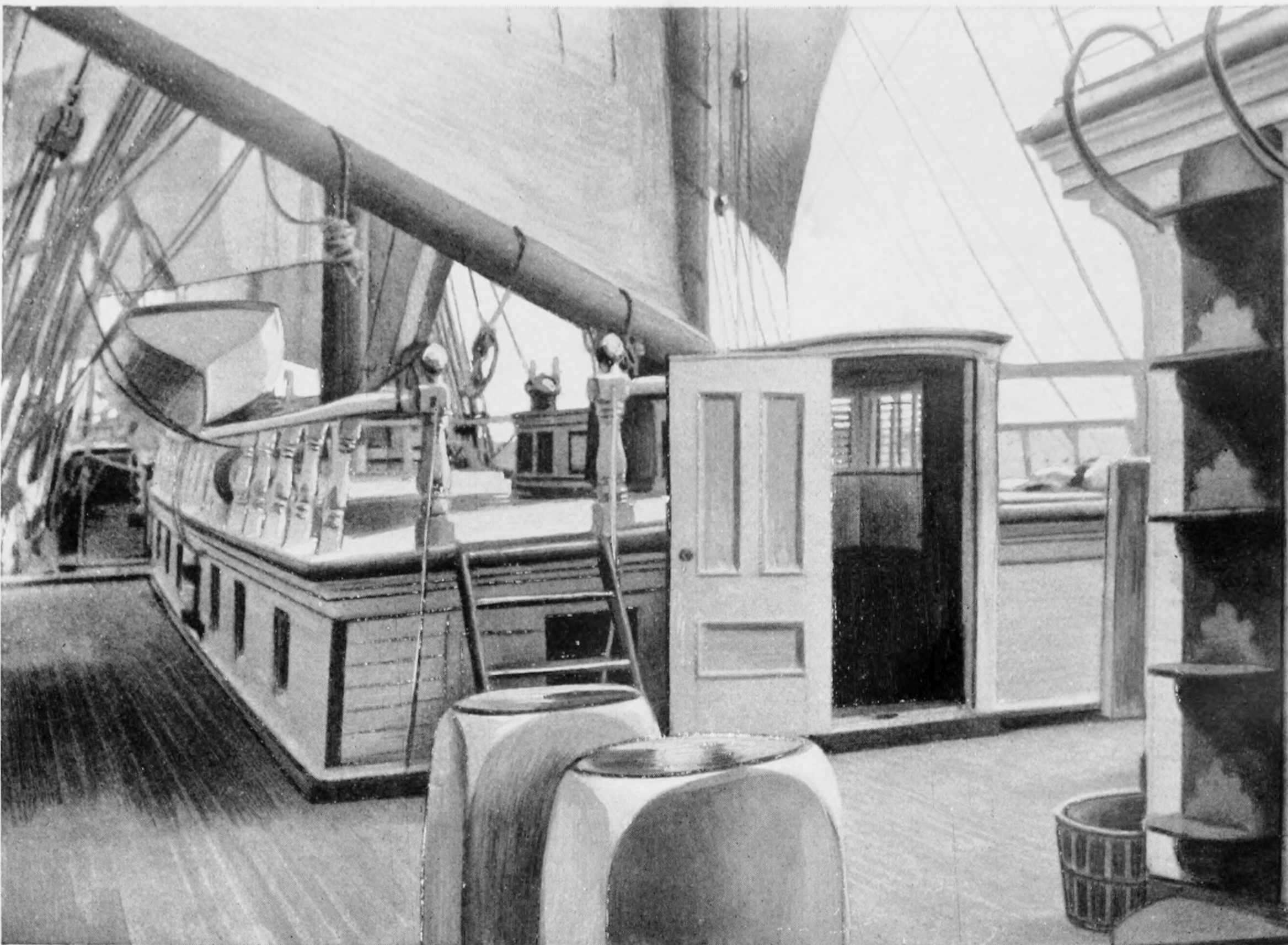
The companion-way
“Down dropt the breeze, the sails dropt down, ’Twas sad as sad could be, And we did speak only to break The silence of the sea. “All in a hot and copper sky The bloody sun at noon Right up above the masts did stand, No bigger than the moon.”
A typical day of the low latitudes this. To me there is ever something wonderfully impressive in an absolute calm, when no breath of wind tarnishes the surface, and the only evidence that the ship is not resting upon a plane of glass is to be found in an occasional slow, deep surge, hardly ever absent when in the profound depths of the ocean.
All around the northern and eastern horizon hung superb, dense masses of violet cloud, descending at intervals in steaming showers, while broad on the port bow lay becalmed a large square rigger, hull down, but lifting at times on the swell till we could see her courses hanging in the buntlines in easy, graceful curves. Nearer and nearer, by imperceptible degrees, she approached, till at eleven o’clock she lay not more than three miles distant,—a magnificent four-masted bark, bearing the stamp of the Clyde upon her powerful iron hull, and presenting, with her double top-gallant-yards and splendid sheer, a perfect illustration of the modern sailing ship, of the largest and finest class. How beautiful and stately and proud she looked as she floated along, apparently conscious that she was homeward bound, and fully aware that she was one of the “swift shuttles of an empire’s loom” which Kipling mentions in those fine verses “The Coastwise Lights of England!”
“I’ll bet there’s nothin’ ter eat aboard there but rice, hard bread, and water,” said a croaking voice at my elbow, and the greasy countenance of the grizzly old mate was thrust suddenly into the foreground, totally destroying the beauty of the scene. Mr. Goggins (always Mr.) never loses a chance to blackguard his native country, which shows better than anything else what sort of creature he is. We made our number to the ship, to which she replied with her own name, but which we unfortunately could not make out, though, owing to the position of our flags, she may have been able to do so.
It is pleasant to study a great vessel like this, and to wonder how old she is and what great gales she must have witnessed in her career, walking up and down the world; now perhaps carrying five thousand tons of grain from California to the starving multitudes in India; now beating her way round tempestuous Agulhas, full to the hatches with tea and silk; now struggling against the thunderous southwesterly monsoon in the Bay of Bengal, homeward bound from Calcutta with twenty thousand bales of flossy jute in her great body. God speed the gallant ship! Latitude, 4° 24′ north; longitude, 29° 35′ west.
June 2
This afternoon was a perfect scorcher, even worse than yesterday, and the sun glittered down from a sky absolutely cloudless. Half a dozen albacores gambolled lazily around the ship all day, sometimes casting themselves several feet out of the water and then falling back with such a splitting crack that it was marvellous how their skins withstood it; and as these fish usually weigh about two hundred pounds and are some five or six feet in length, they made quite a fascinating display.
Last night we had what will probably be our last look at the pole-star for a couple of months. The sky was very clear then in the north, showing Polaris just above the horizon; theoretically, the altitude of this star is the approximate latitude in, and it ought to be visible at, the equator; but owing to vapors, etc., the polar star is generally not visible south of 5° north.
My wife is remarkably well in all this heat, a fact well illustrated by her hearty appetite at meals, considering that what we eat for dinner is usually supposed to be the accompaniments of cold weather. Our noon repast to-day, as an example, comprised a liberal portion of dense, steaming pea soup, hot Boston baked beans, and brown bread, followed, topped off with, oh, heavens! smoking plum pudding and Edam cheese in lumps as large as walnuts! Most people would consider this a throttling diet on the equator, and so it is, more or less; but our appetites are so fine that just now we don’t mind such a little inconvenience as Boston beans bubbling in pork fat.
At supper the heat was worse than ever and we were hurrying to get on deck, when my wife called attention to the strange, yellow tinge of a cloud-bank right ahead, which we could see through the cabin door.
“Oh, it’s nothing at all,” said the skipper; but, as if to nail his words, there came a blast of cold wind, which heeled the ship over to the scuppers and sent the captain and mate flying on deck. We followed instantly, and beheld a thrilling sight. Ahead, from southwest to east, the sky was covered with thick, windy-looking, saffron clouds, rushing rapidly toward us; while the sea, as black as beneath a summer thunder-squall, was whipped into angry, spitting white-caps, through which we were just beginning to force our way. In the northwest, over against this gloomy scene of dun vapor and dark, foam-flecked water, gleamed the sun, just setting in golden splendor, encircled with wonderful clouds of the most delicate blues and grays.
Meanwhile, the ship was in the wildest uproar which we had seen yet. The newly washed clothes had been hung in lines across the poop, and they were thrashing about like tattered flags; while ever and anon detached clothespins whistled by, necessitating very lively dodging. On the main-deck sixteen sailors were doing absolutely nothing but casting off the wrong braces; while ropes were flying, sails were slatting and booming, the bosuns were jumping about sulphurous with profanity, and Mr. Goggins in five minutes had so far lost command of himself as to lean helplessly against a capstan, quite speechless. Captain Scruggs stood at the weather poop-ladder shouting commands, to which no one paid any attention, such as, “Brace up those head-yards there; what’s the matter with you, Mr. What’s-your-name? Come out o’ that trance and git a watch-tackle on the foresheet. Hurry up that handy-billy now; or maybe you want me to show you what a handy-billy is.” (This with blighting sarcasm.) “Bosun, get that jib-topsail in!” The trumpeting of a rogue elephant couldn’t have been worse than the roar in which these orders were given, and the relief was infinite when objects began to straighten themselves out and the skipper went below. At seven o’clock we were doing eight knots, steering southwest by the wind. “The southeast Trades,” said the captain, positively; “they always come in a squall like that.” But, so far from this being the truth, the wind had let go entirely at eleven, and we were once more lying idly on a motionless sea. Latitude, 3° 50′ north; longitude, 29° 3′ west.
June 3
Even Captain Scruggs’s proverbial good luck seems to have vanished, for we have not made more than fifty miles per diem for several days, usually drifting about all over the ocean without steerage-way, until a squall comes along every two hours or so and sends us ahead four or five miles. The skipper lately has kept his temper well for so intolerant a man, but it is now oozing rapidly away, and he rolls out a reverberating oath at the men every few minutes, at whom he rages for apparently nothing. He seems to think that the most laborious tasks ought to be accomplished instantaneously, and he stuns Jimmie Rumps now and then with something like, “I’ll learn yer to obey with the end of a rope, for yer can’t pull any more than somebody’s d—— cow”; and constantly asks him, “Ain’t yer got a mouth on yer to answer with?”
I had a talk with Coleman the other day. This man is the graven image of the conventional Mephistopheles, and arrived, together with Olsen, at New York, on the American ship “S. P. Hitchcock” a fortnight before we sailed, ninety-two days from Honolulu. Coleman couldn’t say enough in favor of Captain Gates (indeed, every one speaks well of him), adding, “She’s a bloody sight different from this packet.” In saying which he alluded to Captain Scruggs’s abusive manner when talking to the men, which is entirely unnecessary and doesn’t do any good. Sailors, of course, can’t bear this when they are doing their best, and will make it just as hard as they can for a captain in return. In the face of several recent outrageous pieces of cruelty on our ships, I do not think that our skipper will personally lay hands on the men. Still, you cannot tell to what length he will go when we have been together three or four months.
The mate approached us last evening and gave it as his opinion that we’d never see the big steel Bath ship “Dirigo” again. “Why not?” said I; “she had not been more than one hundred and sixty days at sea when we sailed.”
“I know; that’s all right,” he answered; “but she was spoken off the Horn by the Briddish ship ‘Howth,’ that arrived a month before we left. Oh, you’ll never see her again.” That’s the way with this individual,—he always thinks that something is going to happen. Then he suddenly asked,—
“Do you know wot Dirigo means?”
I told him that I did know what it meant,—“I direct.”
“Naw,” he replied; “hit’s the motto of the State of Maine, and means ‘go ahead’”; and when I tried to tell him that that was a very free translation of it, he said, “I don’t care for no translation; in the Greek language it means ‘go ahead.’” Such incontrovertible evidence was, of course, indisputable.
Mr. Rarx, the second mate, is of an altogether different type from Mr. Goggins. He has more natural intelligence, is very neat and clean, and is, besides, a far better seaman, and handles the men in such a way as to get twice as much work accomplished in a watch as the mate. But I am inclined to think that he has a very bad temper, from the motion he made with a fid the other day at two of the sailors who had made a mistake with a splice; and when he told me about an easy voyage which he had just made in the “William H. Smith,” and added, “I didn’t have to speak cross to the men once from Singapore to New York,” he looked at me very hard, and it seemed as though he were “sounding” me, to see whether I would believe improbable yarns. Still, I may be doing him injustice.
Perhaps the most agreeable man in the ship is David MacFoy, and we talked together for half an hour yesterday at about six o’clock. “This is a tedious place, mister,” said he; “we were three weeks here in the Doldrums a couple of months ago in the ‘P. N. Blanchard,’ from Manila to Boston. We’ll be awhile here now if signs count; and what’s that we’ve got ahead of us?—the Horn in mid-winter! Oh dear, dear! The last time I went round to the westward was in the ‘Tam o’ Shanter,’ a couple of years ago now, and we were forty-nine days off Cape Horn, and that much snow that in half an hour the lee decks would be full o’ drift. But d’ye know, I’d rather double the Horn to the west’ard than run the eastin’ down goin’ out to China and Australia. If yer do get heavier sou’west gales there, you’re hove to comfortable-like; but runnin’ to the east’ard, it’s a terrible thing to have them greyhounds a-chasin’ yer. On the last passage out to Wellington two hands were washed overboard out o’ the waist, another was washed away from the wheel off the poop, and a fourth poor fellow fell from the upper mizzen-top-sail-yard, and only lived ten minutes. Oh! that other’s a crool cape, sir. No, I’m not married; there’s too many grog-shops around. Now, look: when I landed in Boston a few weeks ago from the ‘Blanchard’ I had a hundred and seventy-six dollars comin’ to me. That was on a Friday. The next Monday I landed in New York with fifty cents, and signed here next day; but that was pretty quick work.”
This, and much more, did the big, handsome Scot reveal to me, in the pleasant accents of his native land, and with that knack of story-telling which so many ship-masters imagine that they possess, to the chagrin and distraction of their friends. I expect many more agreeable half-hours with this interesting fellow, for he instils much individuality into his tales. Nor will I ever forget him as he leaned against the pin-rail in the dusk this evening, his clean checked jumper lying open across his brown chest, as round as a barrel, and his head shaded by a wide-brimmed felt hat. He is an ideal bosun.
Being now in one of the great ocean cross-roads, we are constantly sighting vessels, both steamers and wind-jammers, bound north and south, the steamers being those on the voyage to and from the river Plate and Brazil to the United States and Europe. Yesterday we sighted five vessels, but none near enough to speak. Latitude, 3° 40′ north; longitude, 27° 50′ west.
June 4
Our calm hot weather continues with no indications of a break, and the sun is continuously obscured by heavy, cumulus clouds, though the heat is scarcely so overpowering as it was a day or two ago. But the humidity is suffocating, and as we have no sun, rugs, towels, and everything else feel almost wet to the touch. Last evening we had a sharp squall at 6.30, for which we lowered the sky-sails and luffed smartly at the same time. Very heavy rain fell too, making the fourteenth hard shower of the day. In the middle watch last night, the mate said that the heaviest rain fell which he had ever seen, together with a single dazzling lightning-flash and a simultaneous crash of thunder.
In our lives we have witnessed many scenes of great tumult, but never have I seen any to compare with that on board this ship this afternoon at four o’clock. Captain Scruggs had been growling and yapping around the main-deck all day, cursing everything, and particularly the light air which came fanning along, whenever it fanned at all, straight out of the south. Thus far we had not once tacked ship, though several times the wind had shifted so as to bring it on the other side. We were crawling along then this afternoon toward the east when eight bells went and both watches came on deck; while in another minute, without previous warning, the skipper yapped out, “All hands ’bout ship.” Paint-brushes and serving-mallets were dropped and tar-pots stowed away, while every one hastened to obey the summons.
Now, there is always more or less confusion the first time that a square-rigger tacks or wears on a voyage, though if everybody keeps his head there ought not to be so very much; and if our skipper had only let Mr. Goggins attend to the small details there wouldn’t have been a tenth of the disorder here. From the moment that the helm was put down, however, until we filled away on the other leg the ship was like a mad-house at recess. I don’t believe that there ever was heard on a vessel’s deck such yelling, or howling, which is a more comprehensive word. Nearly every order given by either mate the captain at once countermanded, sometimes without knowing it, often on purpose. The main-deck was full of capstan-bars, lead blocks and braces, which had been cast off when the order came to ’bout ship; and over and among these encumbrances eighteen men wrangled, stamped, and swore to an accompaniment of chattering blocks and thrashing canvas, as the ship came up to the wind, the mates cuffing and thumping the awkward ones with unflagging diligence, Mr. Goggins lumbering heavily aft to administer a painful booting to that hapless creature, Neils Brün, who has been in almost continuous trouble since the mate nearly pulled his ear off, a fortnight ago.
And where was the master of the ship all this time? Behold him at the break of the poop raging like the heathen, while at times he shook both fists together above his head and swore like a pirate, as his voice went booming and crashing above the noise of battle. But the full glory of the scene was reached when, a few moments after he had roared out “Maintop-sail, haul!” the main-brace jammed in the brace-block and wouldn’t render. His passion was almost fearful as he called upon the blank-blank-blankety who fouled the brace to show himself; while he jumped off the poop and raged away, tearing the braces apart as though he were wringing some one’s neck. Even the second mate lost his head once as the old man shouted to his bosun, “I told yer to let go that t’gallant-brace, didn’t I? Do yer want me to show yer how it’s done? I will; but I’ll wipe the deck with yer first. Where are yer steerin’ the ship to, yer at the wheel? Maybe yer’d like to have her aback?”
Now, if we had never been to sea before, we might have supposed that this was the necessary and proper manner of putting a ship about; but as we had seen the “Mandalore” under similar conditions several times, where there was almost perfect order during such evolutions, this scene was positively astounding, and disgusted us with Captain Scruggs. He is manifestly a fine seaman (American ship-masters are invariably that), but he loses command of himself and every one else as soon as there is anything to be done.
Although the American sailing ships have decreased in numbers amazingly in the last twenty-five years, there being in 1871 twenty-four hundred and sixty-six square-rigged vessels under the flag, as against four hundred and fifty-six at the present time, there seems to be good reason to think that an increase in this branch of ship-building is about to commence. Arthur Sewall, the great Bath ship-owner, has a large three-thousand-ton vessel completed and the keel of another one laid down, both of steel, while it is not improbable that he will build a fleet of such sailing ships. Think of our immense trade to the East fifty years since, and then ponder on the fact that not long ago the only vessel which entered the port of Calcutta flying the American flag for a period of four years was a British-built steam-yacht! That sailing vessels in general are not passing away as rapidly as people suppose, however, was shown by a circumstance that occurred about six months ago, when the freight-steamer “Massachusetts” arrived one day at New York from London and reported that in twelve hours she passed fifty-four sailing vessels of various rigs, all close-hauled on the starboard tack! Her approximate position then was latitude 48°, longitude 27°.
For several days the men have been setting up the rigging fore and aft, and they are now finishing the mizzen-top-gallant, royal and sky-sail backstays. It was a tedious job, but intensely interesting to watch, and I had never seen it done before on a square-rigger, as the other ship’s rigging was set up with turnbuckles. Latitude, 3° 22′ north; longitude, 27° 50′ west.
June 5
We think that we have taken the southeast Trades, though the wind as yet is nothing to the eastward of south. Last evening the dense rain-clouds and vapory masses of the Doldrums gave way to a clear sky dotted with trade clouds, and a lovely night followed, the moon in the first quarter being visible for the first time in many days. We had also a magnificent view of the southern heavens, with the golden Cross now well up, wheeling slowly through the sky, the finest constellation in the south. Immediately beneath, though a little to the left of, the Cross a strange thing is to be observed in the shape of what seems to be a large pear-shaped blot in the surrounding stars, bearing a close resemblance to a dark cloud, about the same size as the Cross itself. Within this space, which sailors call the Black Cloud, not a single star can be observed with the naked eye, though the sky round about the Cross in every other direction is thick with stars of the third and fourth magnitude.
At eight o’clock this evening we tacked ship for the third or fourth time to-day, and by reason of so much practice this herculean task was accomplished with a little less noise than before. Still, the disturbance was very great, with a prodigious amount of shouting and bad language from the skipper, which once more rose to a climax when one of the fore buntlines caught on something, just after he had sung out “Let go and haul.” Captain Scruggs, who was standing at the extreme forward end of the cabin-house, here executed a few fantastic steps to relieve his mind, and being clearly outlined in the moonlight, he made a very idiotic appearance. The manœuvre of tacking on this occasion, by the way, was a very impressive one, the white moon-beams transforming the dull gray canvas into cloths of satiny sheen as the great yards revolved to maintop-sail haul.
It must be said that the captain was justified to-day in kicking at the weather. The breeze was of the very faintest sort, and as often as we tacked ship the wind actually seemed to jump around and head us off, so that, after we were once more braced up on the port tack this evening and the wind shifted back and into the south, heading us off to nearly west, we really began to pity the skipper.
The phosphoric display here is the most beautiful which we have ever seen. Our wake every night is a swirling, gyrating, writhing path of liquid fire, in which glitter thousands of apparently incandescent globes as large as billiard-balls, with now and then a suggestion of fiery serpents twisting and wriggling through the glowing mass.
“Beyond the shadow of the ship I watched the water-snakes; They moved in tracks of shining white, And when they reared, the elfish light Fell off in hoary flakes. “Within the shadow of the ship I watched their rich attire; Blue, glossy green, and velvet black, They coiled and swam; and every track Was a flash of golden fire.”
How singularly devoid some men are of decent feelings! I talked last evening at the pumps with Murphy (he whose nose was pulled) and Rumps. The latter was boasting as to how long he could stay drunk without seeing startling visions, and rejoiced in saying that he had been in the lock-up of more than one city in the United States. Murphy, however, bowled him completely over by remarking quite calmly, “I been in the jail of every large seaport in the world.”
Though the temperature is just as high, 84° at noon on deck, the humidity has almost disappeared and the weather seems clear and settled. Latitude, 2° 49′ north; longitude, 27° west.
June 6
Indications seem to point with certainty to our having taken the southeast Trades, for a strong breeze sprang up at six this morning, descending upon us in a squall. We trembled lest it should prove naught but a puff; but we had the satisfaction of seeing it steadily increase, so that four hours later we had logged thirty-four miles, close-hauled, laying our course, the wind being strong and true at southeast. It might not be thought amiss if I state here what the origin of the trade-winds is. They are due to the inrush of cold air from the poles towards the equator to take the place of the warm current which rises from the latter. Owing to the easterly rotation of the earth on its own axis the air from the north becomes a northeast wind, and that from the south a southeast wind. The hot air flows to the poles as an upper current, and, having been cooled there, it descends to the surface of the earth to form the westerly or anti-trade-winds.
At 8.30 this morning a vessel was sighted to windward, bound north, which soon resolved itself into a tramp steamer. Here was an excellent chance to be reported; so telling the helmsman to hold her up as much as possible, the captain hauled out the flags DRHF, bent them on to the signal-halliards, and when he thought that the steamer had opened out our monkey-gaff, he told the mate to hoist away; which, being a very simple operation, he accomplished without accident; and in a few seconds the flags which spelled our name were fluttering merrily away a hundred feet above the deck. Anxiously we waited, but no answering pennant showed from the steamer, and we were about to blast her skipper with deep-sea anathemas, when she was observed to alter her course at right angles and come bearing down upon us, pushing a big snow-bank of foam ahead of her bluff bows. On she came, as if to lay us aboard, until she was within half a mile, when she shifted her helm again, describing a deep circle, while at the same instant the familiar little red-and-white-striped pennant flew up to her triatic stay, meaning “I understand you”; down came our flags on the run and “Report me all well” was hoisted instead, or rather it wasn’t hoisted until after the skipper had discovered that the miserable Goggins had run up “Steer after me” by mistake, which necessitated some lightning changes, as the stranger was moving rapidly away. Again the gay little triangle fluttered from the latter, while we ran the stars and stripes to the gaff and dipped three times, the other reciprocating with the scarlet ensign of Great Britain. The steamer then kept away, and in half an hour was a blot in the northeast; from her course the skipper thinks that she was from Pernambuco bound to the Cape de Verde. Now, here is a man who deserves to be publicly commended, and I wish that we had caught the steamer’s name, that it might appear in these pages. How many steamer captains are there who will alter the course for the purpose of speaking a mere wind-jammer? This incident seems to refute the assertion which is often made about the careless and what-are-you-to-me-spirit of British ship-masters, for no one could be more civil or polite than the captain of this tramp; rivalling in this respect the Germans, who are said to be the most painstaking of all the nationalities in the reporting of vessels.
I nearly forgot an agreeable break in the monotony of yesterday. We sighted a brig in the forenoon ahead and to windward; and though she had a lot of fore and aft canvas set, which ought to have held her up well, we rapidly ate up towards her, so that at four o’clock she was ahead and a little to leeward. We gradually crawled up on her then, and in another fifteen minutes had her abeam, so close that the features of her helmsman were clearly visible. Then I thought of our megaphone, presented to us just before we sailed, and here was a grand opportunity of putting it to practical use. So I brought it up on deck and the following conversation ensued:
“Hello! what brig is that?”
“The ‘Venturer,’ of Nova Scotia, from Philadelphia for——” Here followed a terrific aggregation of syllables which we couldn’t catch.
“When did you sail?”
“May 7, from Delaware Breakwater. What ship is that?”
“The ‘Hosea Higgins,’ from New York for San Francisco. Please report us all well.” A flourish of the arm from a man on her poop answered our request, which ended the interview. The megaphone worked beautifully, though they are of no use in windy weather. Of course, the mate, never having seen one, felt it his duty to jeer at it, which he did by saying, “That thing, whatever yer call it, ’s no good; I could hear better’n you without it.”
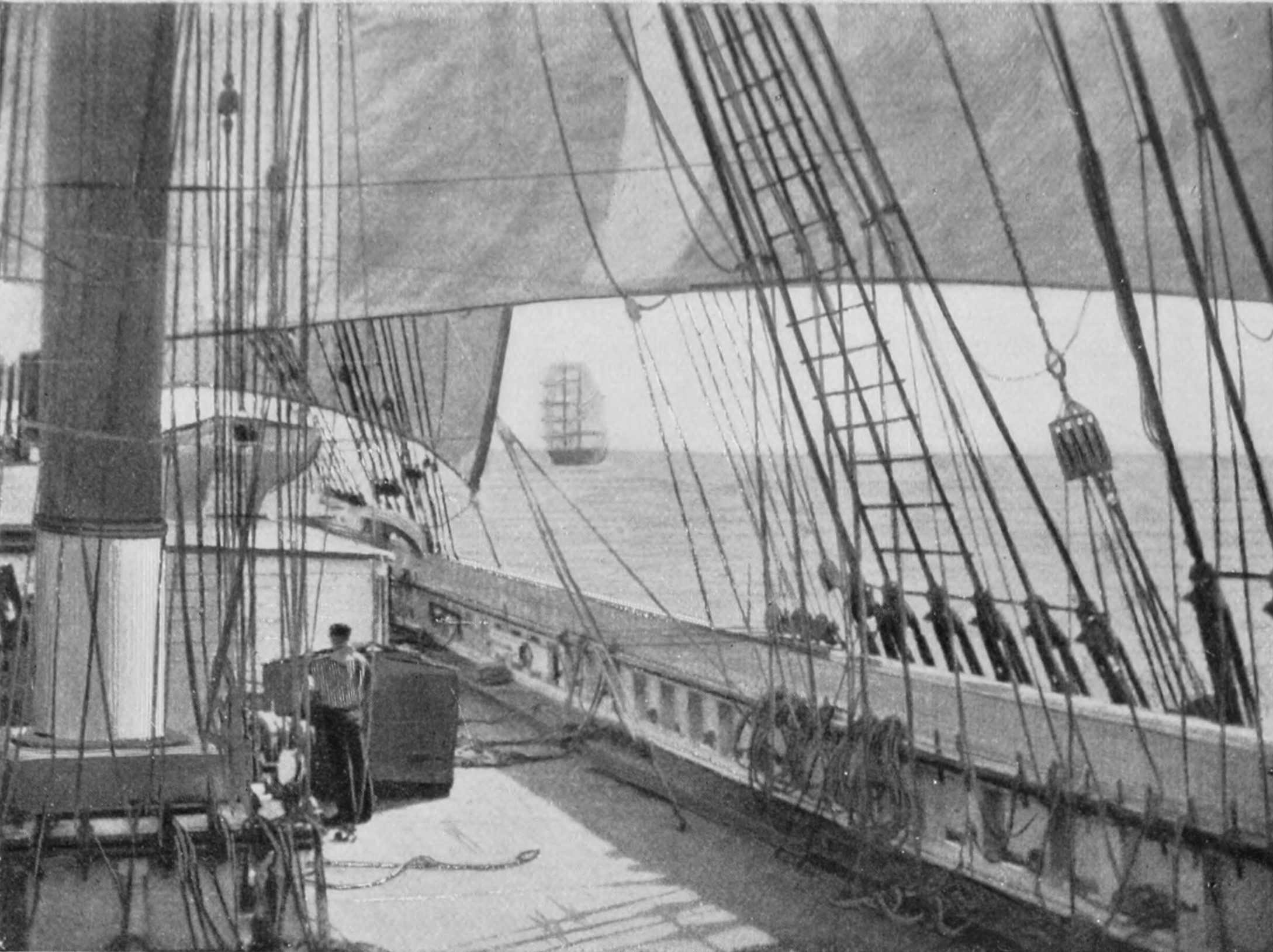
Overhauling the “Venturer”
Reference to a copy of the Maritime Register on board showed that the “Venturer” was of one hundred and ninety-three tons, hailed from Weymouth, Nova Scotia, and was bound to Margem do Torquary, Brazil; small wonder that we couldn’t understand it before. It reminds me of an Italian bark which sailed from New York a short time ago for Alexandretta, the “Nostra Signora del Sacro Cuoro di Jesu.”
The “Venturer” was what is usually known as a tidy little vessel, and she made a really fine picture as she surged buoyantly along over the watery hillocks. Accurately, she was a brigantine, and we got several very fair photographs of her, though the light was bad. Altogether, we sight about a dozen vessels a day now, which shows how densely populated the Atlantic is near the equator.
A circumstance quite surprising is the frequency with which the mates leave the poop when on watch; indeed, a good deal more than half of their time is spent on the main-deck; whereas on ships of foreign nations it is the general rule that the officer of the watch shall never leave the poop unless he has some excellent reason; common sense shows the desirability of always keeping an officer where he will have full command of the ship.
Well, we’re doing grandly now, and at noon were only ninety-five miles from the equator, and should cross it between one and two o’clock to-morrow morning. Latitude, 1° 35′ north; longitude, 27° 52′ west.
June 7
South latitude! Our expectations were fulfilled, for we entered the Southern Hemisphere in the morning watch, crossing the great circle which circumscribes the earth at fifteen minutes past four. Thus we have entered upon the second stage of our voyage; and while the first quarter was certainly not everything which could be desired, we reached the line in very good time, twenty-seven days from New York. If we had had even a little better luck in the Doldrums, four days could have been stricken from the twenty-seven; this is a far better passage, though, than we made in the “Mandalore,” when we had been forty-nine days at sea before we finally cut the equator. Perhaps the most comforting part is the fact that the skipper seems to have exhausted his supply of aguardiente, for he has been very solemn and strictly sober for three or four days. Heaven grant that he has no more grog!
This weather is so magnificent now that the memory of our late smothering calms, during which we were eight days in making four degrees of southing, has entirely passed away, for we are humming through the water at eight knots, close-hauled, with streaming scuppers, while the superb southeast trade-wind sings a blithesome tune in the rigging. It is the grandest wind that blows; so cool and steady, and the ocean so sparkles under its influence, with a snow-white crest topping each sea, reflecting the splendid blue of the heavens in its azure depths, that existence becomes an unbounded delight. I think, too, that the finest cloud effects which we saw on our first voyage were in the southeast Trades. True to precedence, yesterday afternoon at four o’clock the northeastern sky was obscured by a huge dark cloud of the color of indigo, and rendered doubly so by the sun shining upon it; this cloud extended almost to the sea-rim, black and frowning, while immediately beneath it, on the horizon, appeared some faraway masses of cumulus cloud of a most beautiful cream color, enchanting the mind with their loveliness and resembling great yellow icebergs.
As we were contemplating this spectacle, MacFoy sung out something which I thought was “Vessel on the lee.” The mate then went aloft for a better view, and when he had come down I asked him if he could see the vessel, to which he replied, “St. Paul’s Rocks.” This excited us at once, and I went up to the cross-jack-yard, from which elevation I plainly saw against a dark cloud what appeared to be twin light-houses, like Thatcher’s Island lights at Cape Ann, Massachusetts. Although fifteen miles distant at the time, and the weather was slightly hazy, these two rocky columns rising from a depth of two thousand fathoms, the only land within hundreds of miles, produced an effect wonderfully majestic and solemn. The exact position of the rocks is 0° 55′ 30′′ north and 29° 22′ west, and they are five in number, though only two are of considerable altitude, the loftiest being one hundred feet in height. They are separated from each other only by narrow chasms, so that until you approach very close the appearance is that of a single island. The whole space occupied by St. Paul’s Rocks does not exceed five hundred yards in length and three hundred in breadth; and while Darwin concluded that they were not of volcanic origin, more modern scientists—Renard, Geikie, and Wadsworth—have decided that they are eruptive. These rocks are totally devoid of vegetation, but are the resort of incredible numbers of sea-birds, both gannets and noddies, as well as a certain spider, while the water in the vicinity swarms with fish, seven varieties having been taken by the “Challenger” during a very short stay.
Captain (afterward Admiral) Fitzroy, when in command of the “Beagle” during her celebrated five years’ voyage, visited these rocks, and wrote an admirable description thereof. Among his observations is the following: “The multitude of birds covering the rocks was astonishing, and they suffered themselves to be kicked about and killed with sticks; at the same time those on the wing even darkened the sky. Numbers of fine fish, like the grouper of Bermuda, bit eagerly at baited hooks; but as soon as a fish was caught a rush of voracious sharks was made at him, and notwithstanding blows of oars and boat-hooks, the ravenous monsters could not be deterred from seizing and taking away more than half the fish that were hooked.”
Had it been earlier in the day we would have stood in toward the rocks to behold the surf which rages incessantly against the weather-side. But it was too late; and even as we looked the lofty obelisks began to fade away, and at 6.15 we had what I hope will not be our last look at the lonely St. Paul’s Rocks. The Atlantic Ocean near the equator, between the meridians of 18° and 23°, is subject to frequent and violent earthquakes, which have the effect upon a vessel like that of being dragged over a reef, or that of a heavy chain-cable being suddenly run out through the hawse-pipes.
The most singular fact in relation to the component parts of sea-water is the variation in the proportion of salt; for every ton of Atlantic water evaporated there is yielded eighty-one pounds of salt; ditto Pacific, seventy-nine pounds; ditto Arctic, eighty-five; while the Dead Sea heads the list with one hundred and eighty-seven pounds, though I have never seen such statistics in regard to our Great Salt Lake.
Although the temperature in the shade to-day was very agreeable, the sun’s heat was terrific. It is customary to refer to a “baking sun,” but I should call that of to-day a boiling sun, on account of the moisture; and it is strange that on a day like this the sun’s rays will not dry out a wet towel, though exposed to them for several hours during the hottest part of the day, so great is the humidity. Latitude, 0° 49′ south; longitude, 29° 53′ west.
June 8
These are fine Trades, though the squalls are severe and sudden. A few words here, in passing, as to squalls. What landsmen often call a squall sailors call a puff, such as are experienced along our coasts with a northwest wind, lasting a few seconds. A sailor’s squall often lasts for thirty minutes and is accompanied with heavy rain, while it can be observed approaching in the form of a nimbus cloud touching the ocean a long while before it reaches the ship.
In this twenty-four hours we did two hundred and thirteen knots, an average of more than nine within the hour, while in many of the squalls we must have been going nearly twelve. How many yachts are there which can equal this on a bowline? Ship-masters, however, cannot realize how fast a yacht can sail with a light wind; they all seem to think that a yacht sails best in a gale. Captain Kingdon often used to say to us in the Southern Ocean, when we were doing twelve knots before a fresh gale, “Ah! this is where I’d like to see an able yacht! Sixteen knots, eh?” And he couldn’t understand that under those conditions a smart yacht could sail but little, if any, faster than we were doing. But what is even more difficult for them to grasp is the speed of a racing yacht in what they call a light air. Sometimes when we were fanning along at, say, five knots, I used to worry Captain Kingdon by telling him that a seventy-footer would run him out of sight in that breeze in a few hours. He refused to believe that any yacht could make nearly ten knots while the “Mandalore” was doing perhaps five.
This morning we had a heavy sunrise squall, for which we had to let go the royal halliards, the sky-sails having been stowed during the night. But, quick as the men were, the wind was swifter yet; for before the clew-lines and buntlines could be manned a great rent was made in the mizzen-royal, and in a few minutes the second mate reported that the upper foretop-sail was in the same condition; both were, therefore, unbent and lowered as such, while a brand new mizzen-royal was sent up, the first of the strong new sails which will be bent before we reach the bad weather. It was the hardest squall which we have had yet, and the wind and rain made a thunderous noise while it lasted; yet, high above the din, could be heard the powerful voice of Mr. Rarx, shouting to the men to bear a hand with the mizzen-royal clew-lines. Though there were plenty of squalls throughout the night, the sky was perfectly clear between them, and thickly studded with fine constellations, while the moon silvered the great wool-packs as they sailed serenely up out of the southeast. Quite a sea had made by eight bells this morning, in which we wallowed a good deal, but lost none of our way. Sea-birds have been very scarce lately, though a single large frigate-bird has sailed all day on motionless wing in wide circles overhead.
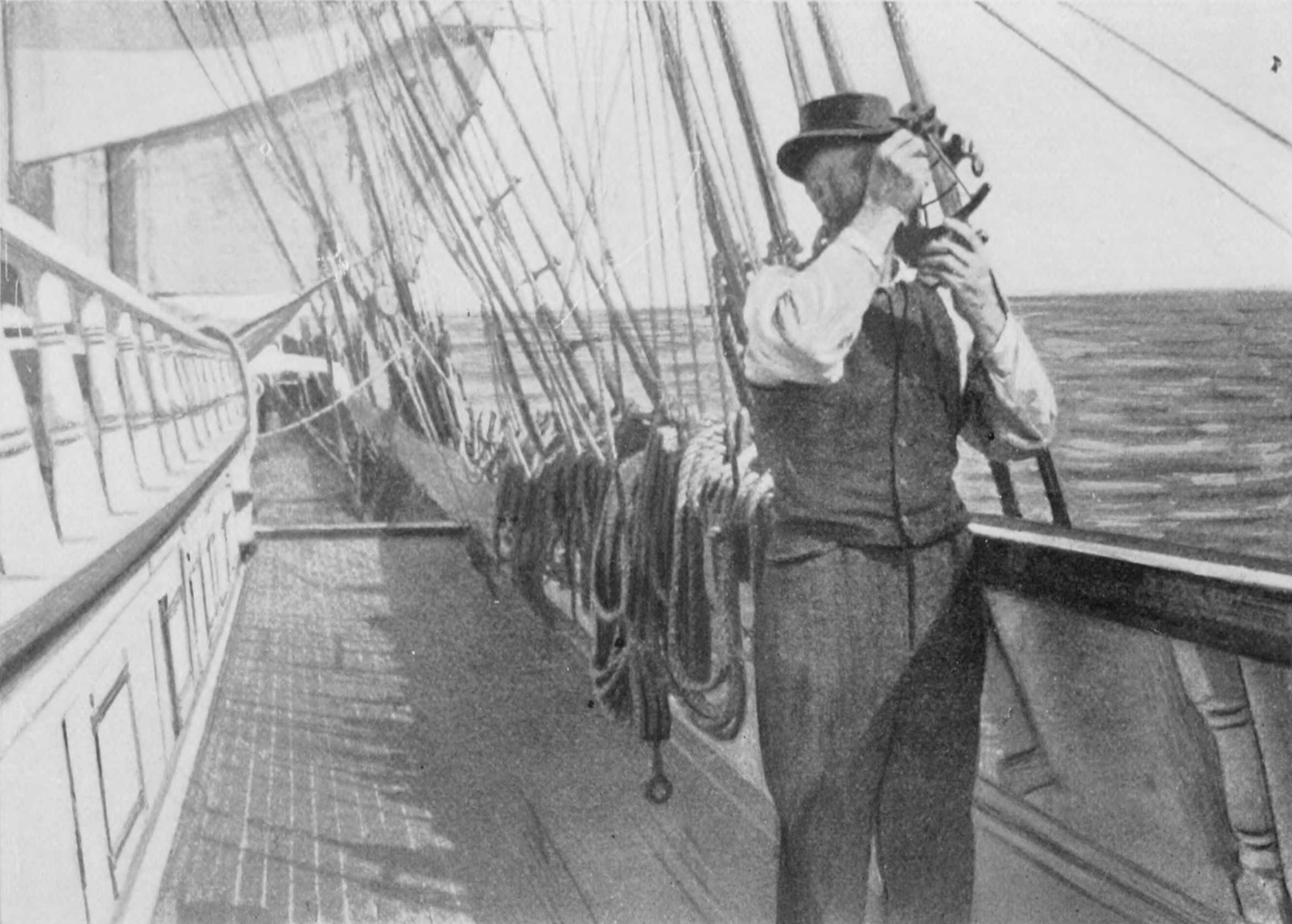
“Eight bells”
I wonder how many perfectly well and healthy deep-water captains there are? This sounds absurd at first, as it is the general opinion that sea-captains are always thoroughly hearty and strong. Of course some of them are, for long-voyage skippers not infrequently live to a very advanced age, proving that they must have always been sound men; yet in most instances it will be found that they suffer from some malady brought about in their profession. Perhaps the most common is liver trouble in conjunction with dyspepsia in some form. Captain Kingdon’s death, it will be remembered, was caused by a cancer or abscess in the liver. Such complaints are due to an inactive life for months at a stretch, for captains, on account of their dignity, cannot take part in the working of a ship or in pumping her out, so that walking the poop must constitute all their exercise. Rheumatism, produced by bad food and exposure, divides the honors with the liver, while from heart-disease but comparatively few long-voyage captains are free. It generally develops in those of a nervous temperament, induced by worry in gales and dread of trouble with the crew if they are unruly, besides a score of reasons only understood by the initiated. Even in my very limited experience, I have known three master-mariners afflicted with cardiac disease. One, a splendid fellow, Coalfleet, of Hantsport, Nova Scotia, died in his bunk in the North Atlantic; another, in the Ward Line service, was grievously stricken in Cuba, and had to retire from the sea; while the third suffered from dreadful intermittent attacks of angina, but I have lost track of him for several years. Latitude, 3° 50′ south; longitude, 31° 35′ west.
June 9
Late yesterday afternoon Captain Scruggs came up and said that Fernando de Noronha was visible to leeward from aloft, and that if we looked hard enough we might be able to see it from the deck. So we gazed long and earnestly over to the westward, and there, sure enough, arose a soft, rose-colored cloud through the mist; and in another half-hour we could perceive the various islands which constitute this group, together with the lofty pyramidal rock one thousand feet above the sea, which crowns the loftiest of the islands, giving it a peculiar individuality, so that it is not possible to mistake this cluster for any other known group. We were near enough to count four distinct islands, the largest of them being twenty miles in circumference, and we could just make out the tremendous walls of sheer, unbroken rock falling into the sea; but beyond this it was not given us to penetrate even with the strongest glasses on board. Would that we had been fifteen miles nearer, that we might have compared this group with Trinidad, which rears its desolate summit two thousand and twenty feet above the sea, fifteen degrees farther south. The spectacle of the surf breaking on Fernando de Noronha must be even grander than on St. Paul’s Rocks; for, lying in the very heart of the strong southeast trade-wind, the full force of the mighty South Atlantic surge dashes ceaselessly against its basaltic walls.
Last evening was very fine indeed, the wind having let go sufficiently to make the deck agreeable; and as the moon shone with great power, it was a night of remarkable beauty even for the Tropics, although some ragged scud which blew swiftly across the moon presaged plenty of wind for to-day. The indications were fulfilled, for it has been very squally since early this morning; all the royals came in at eleven o’clock, and we have been plunging along in a broken sea, through savage blasts which roar in the rigging with an angry voice. The most unfortunate thing is that the wind is heading us by hauling to the southward, and for the greater part of the past twenty-four hours we have been steering well to the westward of southwest; so that, in spite of our weatherly position on the line, we are going to have trouble in getting past that portion of Brazil lying to the southward of San Roque. Indeed, at noon we were only seventy-five miles from the land, a little south of the Great Bugbear, as Maury pertinently styled the famous cape.
For dinner to-day we had canned lobster, which came from the far-distant Cape of Good Hope; at least, the skipper called them lobsters, but the mate disgustedly muttered “Crawfish.” This sort of thing the skipper cannot stand, as he considers it a crime for Mr. Goggins to know more than he does, and actually resents any information which the mate volunteers at table. He generally doesn’t care to exhibit his knowledge in the skipper’s presence, and it is hard to see why to-day he forgot himself in so unusual a manner. Yesterday, for instance, I remarked what a particularly hot day it was for the Trades, and the skipper promptly denied it on principle until furnished with ocular proof by thermometers, while the mate discreetly observed, “I feel like gettin’ out me warmer coat.”
Mr. Goggins is occupied during the first watch every other night in teaching two of the men where the different ropes lead to on deck. One of these hapless individuals is Louis Eckers, who doesn’t understand much English, and the other is John Pettersen, an immensely tall, lean Dane, who lives in such terror of the mate that he utterly loses his head at every command. He is, besides, pitifully anxious to please, and his awkwardness is really remarkable. If there happens to be a rope yarn in his path he is sure to trip on it, and when he starts to move in obedience to an order, he first stares all about as though just recovering consciousness, and then suddenly perceiving that the men are some distance off by this time, he laboriously gets his lank frame under way after heavily tripping over some object, and, with elbows squared and head bent low, he charges like a bull across the deck. Neither of these men has ever been aboard of a square-rigger before, and what little sense they have seems to vanish when anything is to be done. I’ll never forget John’s appearance last night as he clattered heavily forward toward the forecastle when the mate said ferociously, “Show me the spanker-sheet.” Poor fellow! so rattled he knew not whither he was going.
Speaking of ropes a moment ago reminds me of the largest one ever made in England. It was of white manila, weighed five tons, and was twenty-two inches in girth with a breaking strain of eighteen tons. This huge rope was made a short time ago for the express purpose of towing a floating dry-dock from the Tyne to Havana, which itself weighed six thousand tons. Seventy men were required to haul in the hawser and coil it away. Latitude 6° 18′ south; longitude, 33° 58′ west.
June 10
Oh, unhappy day! Oh, joyless hour! We could not weather South America after all! Late yesterday afternoon when I had plotted the run off on our own chart, I sought the skipper and said to him, “Unless my chart is out, we’re not more than forty miles off the land.” “No,” he answered, quietly; “we’re just thirty miles from the beach, and I’m going to wear ship at six.” How bitter was his tone as he said this! Bitter and calm with despair, for that which he said in jest three weeks ago has truly come to pass. Far back in the North Atlantic one morning, when we were not far enough to the eastward for that latitude, I asked the captain if he weren’t generally farther east than we were then. But he made light of it, trusting to his star of luck, as he jocosely answered, “Oh, well, maybe we’ll have a chance to look at Brazil.” Prophetic utterance. No one knows until he has “been there” how it galls a skipper to be caught here, for it often puts two or three weeks on the length of a voyage. At any rate, when six o’clock came last evening we wore ship to a running and complicated accompaniment of boisterous profanity, and stood away east on the starboard tack. If the Trades were where the general average shows that they ought to be at this season, east-southeast instead of south-southeast as they are, we would have fetched by with two or three degrees to spare.
The breeze was pretty strong when we turned in last night, and gave evidence of freshening considerably; but no one looked for any such wind as we had this morning. We were awakened by the loud voice of Captain Scruggs, “Haul up the crojjick, Mr. Rarx,” and five minutes afterwards, “Clew up the t’ga’nt-s’ls fore and aft,” while a sudden headlong dive showed that something more than a strong breeze was blowing. Dressing was difficult, and when we finally emerged from the companion-way, behold the ocean almost white with breaking seas and a moderate gale whistling from south-southeast. The seas were short and we plunged heavily into them with an unpleasant jerk; but it was a glorious sight to watch the billows as they came roaring at us, deep blue in the hollows and crested with hissing froth. We hadn’t been more than half an hour on deck when the captain sung out, “Haul down the maintop-mast stay-sail and clew up the main-sail,” which meant that we were going to wear again and stand in shore. We were nearly in the wind on the other tack, and the second mate had just roared out, “Head-yards now,” when crash! a tall sea fell over the weather side and full upon the wee Chinese cook, the meekest, jolliest little fellow imaginable. He was standing outside of the galley door when that sea claimed him. It slammed him first against the main hatch; washed him back into the scuppers; then aft nearly to the cabin bulkhead, and finally sat him fiercely down by the pumps, during which evolutions the frail little fellow could be perceived shooting about in the surging waters, his long, black, thin pig-tail curling and writhing several feet behind him. After the water had partly run off, half burying the men on the lee foresheet, our little Chinaman lay very still, and we feared that he was badly hurt, though the men were roaring with laughter, while the skipper thundered “Why in h—— don’t yer pick him up?” to the mates, who stood as though petrified, gazing at a cask of sea-water bearing down on the cook which would have flattened him like one of his own pancakes. All at once he came to, however, saw the barrel almost on him, and skilfully rolled out of the way of it, escaping with some painful bruises on his arms.
This was the only sea that boarded us, and we were soon straightened out on the old port tack, steering southwest, and doing scarcely four knots, for we were under short canvas and the seas pounded us back, and even now we will hardly go free of the land; for in spite of our twelve hours of easting during the night, a powerful northwest current has set us back to such an extent that our noon sight showed us that we were only ten miles farther off-shore than at the corresponding hour yesterday, and that we had made only thirty miles of southing. If the wind shifts only a point, though, we might be able to weather the land after all.
Last night the mate and I had a conversation about fast passages, and he said to me, “I can tell yer, there was plenty of smart ships thirty or forty years ago that yer never hear tell of nowadays. There’s the Boston ship ‘Siren,’ as I was mate of; we were comin’ around from Coquimbo, bound to Liverpool, when we were caught in a pampero off the river Plate. It come in a squall as usual, and the fust thing I know, there was the fore- and maint’-gallant-masts over the side. We didn’t have no spare spars aboard, but, in spite of that, we went from 3° south right into Liverpool in nineteen days. Pretty good for a lame duck, and considering the Doldrums, too.
“Then there was a smart passage I heered tell of the other day about a modern ship, the British ship ‘King George’; she went from Cape Town up to the Delaware Capes in forty-seven days.”
This last was really a fine performance, for the distance which she covered was six thousand eight hundred miles. Compare this passage with the voyages of sailing vessels to the westward across the North Atlantic in winter. They are nearly always fifty days coming across, and not infrequently seventy, or nearly a month longer than the “King George” was from South Africa, while the distance is less than half.
In the Gulf of Mexico trade there is a wonderfully fast little fore-and-aft schooner called the “Margaret S. Smith,” of Portland, Maine. This vessel ran on one occasion from Ruatan, Honduras, to Mobile in seventy-two hours, which was an hourly average of twelve and one-half knots; and considering that the net tonnage of this schooner is only one hundred and twelve, her performance must be regarded as almost phenomenal. There are not very many large sailing ships in these days which can show a record of three hundred miles per diem for three consecutive days; yet the “Smith” is doubtless less than one hundred feet long.
The other day I managed to get a large dollop of slush on a pair of thick trousers, and I asked the skipper if Sammie, the boy, couldn’t get it out, thinking that he could do so with some soap and a little warm water. But lo! fifteen minutes later I saw my trousers soaking away in a tub of water like a pair of dungaree breeches! This, as I observed before, is the way with seafaring people: whenever there is aught amiss with a garment, pop it goes into the wash-tub. Latitude, 6° 49′ south; longitude, 33° 48′ west.
June 11
“All hands wear ship; all hands ’bout ship.” These are the cries which ring constantly through the vessel now. Woful to tell, the Trades are still from the south-southeast, though the captain in some way has contrived to control his temper to a wonderful degree; such unlooked-for and devilish a performance of the Trades is enough to finally ruin any skipper’s chances of entrance into Heaven’s Gate, or the Golden Gate either.
Last evening at five o’clock we descried the land from aloft on the lee or starboard bow, and after supper it was very plain from the deck, so that at six we tacked and stood off shore again. At that time the sun had just sank behind the sandy wastes of the Brazilian coast, casting a deep crimson light over the sea; while dead ahead, at the extremity of a profound curve in the coast-line, Point Pedras rose out of the ocean in a low headland, with a tremendous mass of gloomy cloud above it, lending to that part of the scene a sombre and awful aspect. Though the land did not show up sufficiently well to allow us to perceive any of its characteristics, it was plain enough to permit us to say that we distinctly saw the shore-line of this vast and torrid land. Point Pedras, it might be well to state, is not only the easternmost point of Brazil, but of the entire Western Hemisphere, being forty-five miles farther east than Cape San Roque.
This afternoon we perceived a disturbance at the end of the fishing-line which is always towing astern, and it was presently seen that we had hooked a fine specimen of the sailor’s dolphin, the most beautiful in coloring of all deep-water fish. I think that it might be as well to apply the name dolphin to this fish from now forward, if there should be occasion to mention one again. Of course it isn’t a dolphin at all, but as sailors call it so, and this is supposed to be a book about sailors, this name is as good as any other.
Carefully we coaxed him up beneath the counter and then tried to kill him by holding his mouth out of water, for he would have parted the line if we had attempted to haul him aboard. As he sheared about on the end of the line he presented a spectacle which was actually gorgeous, and, being immediately above him, our view was perfect. His motions were the very ideal of grace, and as he moved swiftly from side to side he exhibited in succession all of his wonderful hues, vivid greens and yellows merging into silver and Prussian blue. His antics were cut short, however, by the arrival of the mate with the grains, which he skilfully drove into the creature’s side (what a useless slaughter!), and he was hauled up over the stern. Then we stood by for the dying colors. Out upon them! Not for a single instant can they compare with those of the fish in his natural condition, when, darting about a fathom or so beneath the surface, he positively enchants the eye with his brilliancy. He will yield us fresh food for supper, such as it is; but all deep-sea fish are poor and dry, save one, the flying-fish, which, if served in a restaurant with tartare sauce, I’m sure could not be detected from a smelt.
One often hears the discussion in shipping and yachting circles as to the seaworthiness of fore-and-aft schooners in comparison with square-riggers for deep-water work, and the question is often raised, “Which would make the faster passage to San Francisco from New York, the ship or the schooner?” Naturally there are points in favor of each; the advantage lying with the ship when off the wind in strong breezes, and with the schooner when by the wind. In the case of a voyage to, say, Hong-Kong, in the southwest monsoons, the ship would probably arrive at her destination ahead of the other, as there would be five thousand miles of hard westerly (fair) winds in the Southern Ocean, and another long stretch of free wind from the Straits of Sunda to Hong-Kong. On the other hand, in a westerly passage of Cape Horn, in which the vessel would be probably close-hauled for two or three weeks in the Southern Ocean, or perhaps more than a month, the schooner would have an immense advantage in being able to lie at least two points closer than the ship, if the wind allowed her to carry enough sail to go ahead. The wind is generally too heavy in the vicinity of Cape Horn, though, to allow a small vessel to show much canvas when close-hauled, and the passages of four schooners to San Francisco found below indicate that in reality there is not much difference between the voyages of these schooners and the average of square-riggers. They were all Gloucester fishermen, and were sent out by Mr. Horatio Babson, of Boston, loaded with fishing supplies, rosin, pork, and hardware, between 1868 and 1873.
Tons. Days.
“Urania” 92 125
“Varuna” 92 131
“Laura M. Mangam” 85 131
“Reunion” 90 148
The average of these vessels was one hundred and thirty-four days, as against one hundred and forty-five for square-riggers; so that whatever advantage they may have gained off Cape Horn and in the northeast Trades in the Pacific, they, doubtless, lost in the long stretches of southeast Trades on both sides of the continent. It must also be added that all the schooners sailed during the month of November, so as to reach Cape Horn in the middle of the southern summer. This fact seems to me to be a good answer to those ship-masters who are wont to assert that they would rather double Cape Horn in July than in January,—i.e., in winter than in summer,—saying that the gales are harder in the latter month than in June and July. But the fact that November was chosen for the schooners by a man who was no doubt familiar with the Southern Ocean would indicate that the weather there is better in January.
To-day Mr. Rarx told me of a novel and very successful way of manning a vessel with what is known as a checker-board crew. Two forecastles are necessary, or one with a dividing bulkhead, all the men of one watch being white and the others black. If they were together in one forecastle, violent hostilities would continuously prevail; but if separated, they will work against and try to outdo each other; so that, with a little judicious flattery or word of encouragement, such work as the making and shortening of sail, tacking and wearing, will be done with incredible alacrity. All-negro crews are held in esteem by some long-voyage skippers, but the men are said to be very unruly at sea, though fearless sailors; while the singing on board of a ship manned by darkies, both chanties and otherwise, is said to be wonderfully good. Latitude, 7° 35′ south; longitude, 34° 20′ west.
June 12
No abatement of the southerly wind. We thought this morning that the breeze was certainly going to haul to the eastward; but the wind, though strong enough, yet hangs in the south-southeast, and we are, therefore, still hammering away at it, tacking or wearing four times in each twenty-four hours, so that in four days we have made only ninety-eight miles of southing, a rate of nearly exactly a mile an hour. Apropos of which Rumps made quite an original remark last evening. For the full comprehension of the observation it must be explained that if there is much wind and sea a ship will not make better than a seven-point course,—that is, with the wind at south she will do about west by south, or almost at a right angle. So the bosun remarked, “Well, here we are, walking up and down the avenue, eh?” It described what we were doing perfectly.
This morning, while on the starboard tack, the skipper, who has now lost every vestige of the patience which he formerly exhibited, thought that at last the wind was going to shift to southeast at least, so he sung out to wear round; but when we were snugged down on the port tack, we fell off to southwest half west, exactly as before. It seemed impossible that a human being could have shown such boundless rage as the captain did then. We could hear him muttering away at the farther side of the poop, “What’s the use? No sort of use; no sort of use at all.” And then, in a frenzy of sudden wrath, he stamped lustily upon the deck and swore like the mouth of the pit, his wiry whiskers bristling as though electrified, as he fiercely wagged his head; for he wot not that we were hard by. Then his eye wandered to the main-deck, and down the weather poop-ladder he clattered, looking for trouble, for we could hear him growling and mumbling at the galley door.
In rough weather, instead of ordinary teacups we have large, flat, china utensils, which look like shaving-mugs, so that at first I seemed to miss the brush. The mate, thinking to have another go at merrie England, cried, triumphantly, “I’ll bet you had nothin’ like them on the ‘Mandalore.’” But we quite shocked him with the information that on that good ship we were furnished not only with these useful pieces of crockery, but with some which held an imperial quart, from which we drank our soup in heavy weather as from Brobdingnagian teacups. Perhaps Mr. Goggins was never so absurd as to-day after dinner, when he confidentially called to me and said, “Say, did yer hear the cap’n say ‘pressperation’ instead of ‘perspiration’ just now? There ain’t no such a word, yer know”; this with an urbanity which would have floored a Chinaman.
Mr. Rarx, too, sometimes favors us with some observations entirely sui generis, and particularly droll in that he has a well-inflated opinion of his own choice of English. He was telling of a painful accident which happened to him several years ago, in which his back was wrenched; “and, sir,” he concluded, “I didn’t know what to do; I couldn’t stand, and I couldn’t lay, and I couldn’t set.” We wondered whether he were possessed of any sort of ornithological accomplishments.
In windy weather wearing stirs up a lively scene. This is how it is done on the “Higgins”: The skipper is pacing athwartships, undecided whether to hold on any longer or not; then suddenly he stops, walks to the break of the poop, and says quietly to the mate, “See the braces clear for running, Mr. Goggins.” In five minutes or so the mate catches the captain’s eye, and asks, “Are you ready, sir?”
“Am I ready, sir!” repeats the latter, who will have nothing suggested to him; “most certainly I am not ready; don’t you see that squall to windward?”
The mate withers; and when it has passed the idea of having to break tacks again seems to have festered in the skipper’s mind, for he suddenly snaps out, “All hands wear ship,” like a bunch of fire-crackers going off. “All h-a-n-d-s wear ship” roar the mates, running forward to rouse out the men, and aft they tumble and take up their positions at the various ropes. Then the skipper begins his harangue with voice of thunder and wind-mill arms: “Haul away on your main and crojjick buntlines and clew-garnets; square the crojjick-yard; you at the wheel, hard up yer hellum. Weather main-braces now; haul away, you blasted old women; come in on those tops’l-braces. Head-yards now; let go the foretack; foresheet now, all hands; forebraces; steady your wheel.” The ship by this time has fallen off dead before the wind, and the old man is in the zenith of his passion, whirling back and forth across the poop, belching perfect volcanoes of profanity.
“Main-braces again now; overhaul those spilling-lines and that main lee inner buntline; again your main-braces; crojjick-tack, —— —— it; look alive there and get that main-sheet aft; lead it to the capstan; heave; in she comes, that’s well. Main and crojjick bowlines now; that’s the style. Haul taut the weather-braces fore and aft, and clear up the decks.”
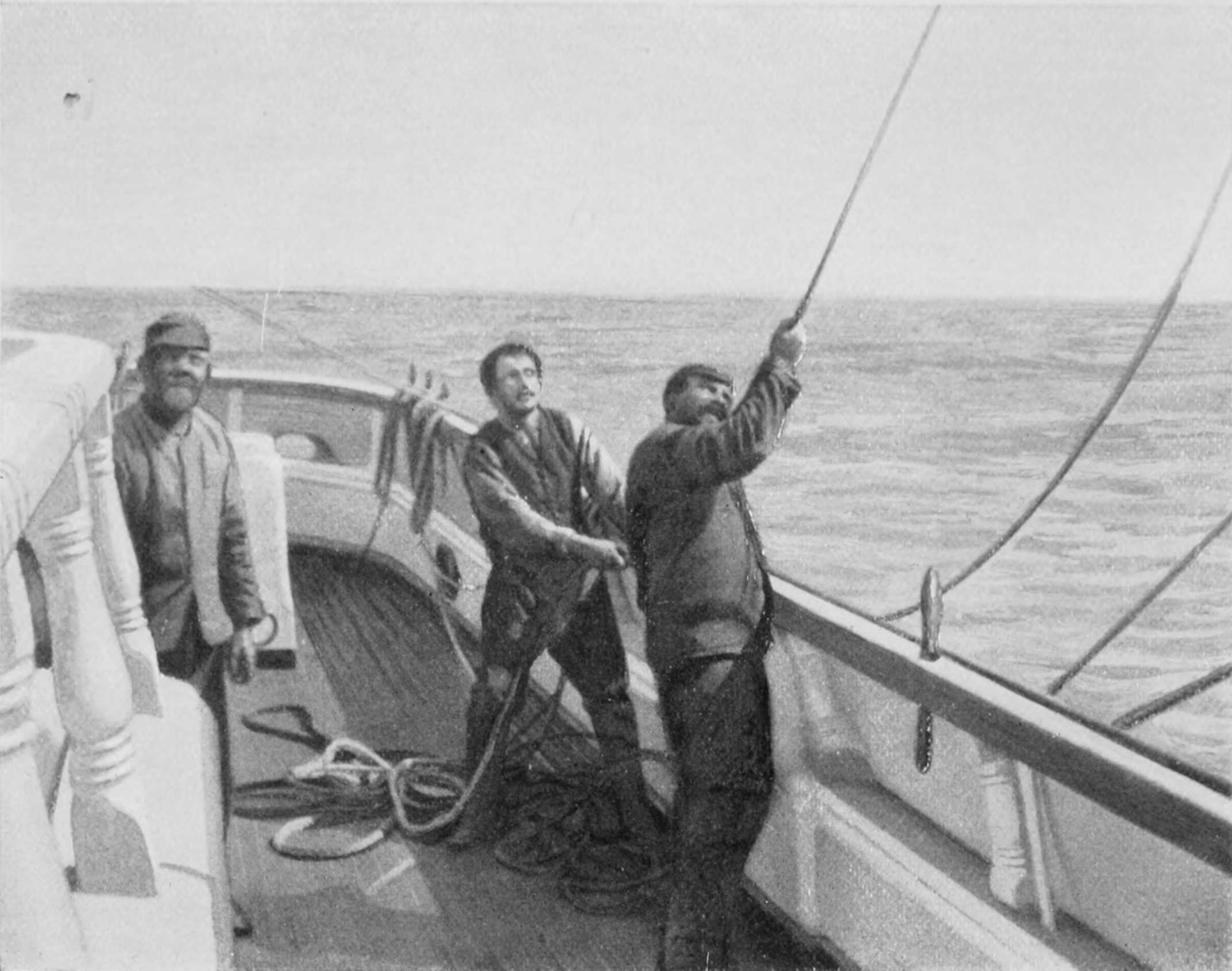
Hauling taut the braces
This oration is delivered in a hurricane voice to an accompaniment of roaring wind and flying spray, which sometimes enshrouds the whole forecastle like a snow-squall; and the mates whiz about, driving the men before them, and they in turn rend the air with their cries as they come in on the braces. Each man seems to have an individual ejaculation when hauling away, only one man, of course, singing out at each rope; but as there are often half a dozen knots of men at work, there are as many strange yells. Louis, the Frenchman, says, “Ho-ho-ho-ho-ho-ho-ho,” beginning very deep and ending in a falsetto; Broadhead, one of the youngest and smartest seamen in the ship, eases his mind with “Hoo-oop, come in with her; oh, fiddle-strings; oh, split the wind”; Olafsen cries, “Ha-joop, ha-joop”; while Timothy Powers, the wild, carrot-topped Irishman, screams, “Yah ha-a-a-a, yah ha-a-a-a,” like a freight train with the brakes on.
Best of all, though, are the chanties; and as the men know each other well by this time, there are plenty of them; and good old songs they are, songs of the days of ’49, into which the men throw heart and soul. Some of the best ones for hauling are, “Blow, my Bully Boys, Blow,” “A Long Time Ago,” and “A Poor Old Man,” which latter two I believe that I mentioned before; while some of the melodies sung to pumping ship are even better. One is “The Plains of Mexico,” entirely in the minor, with a weird effect; another, “The Banks of the Sacramento,” each verse of which ends,—
“For there’s plenty of gold, So I am told, On the banks of the Sacramento.”
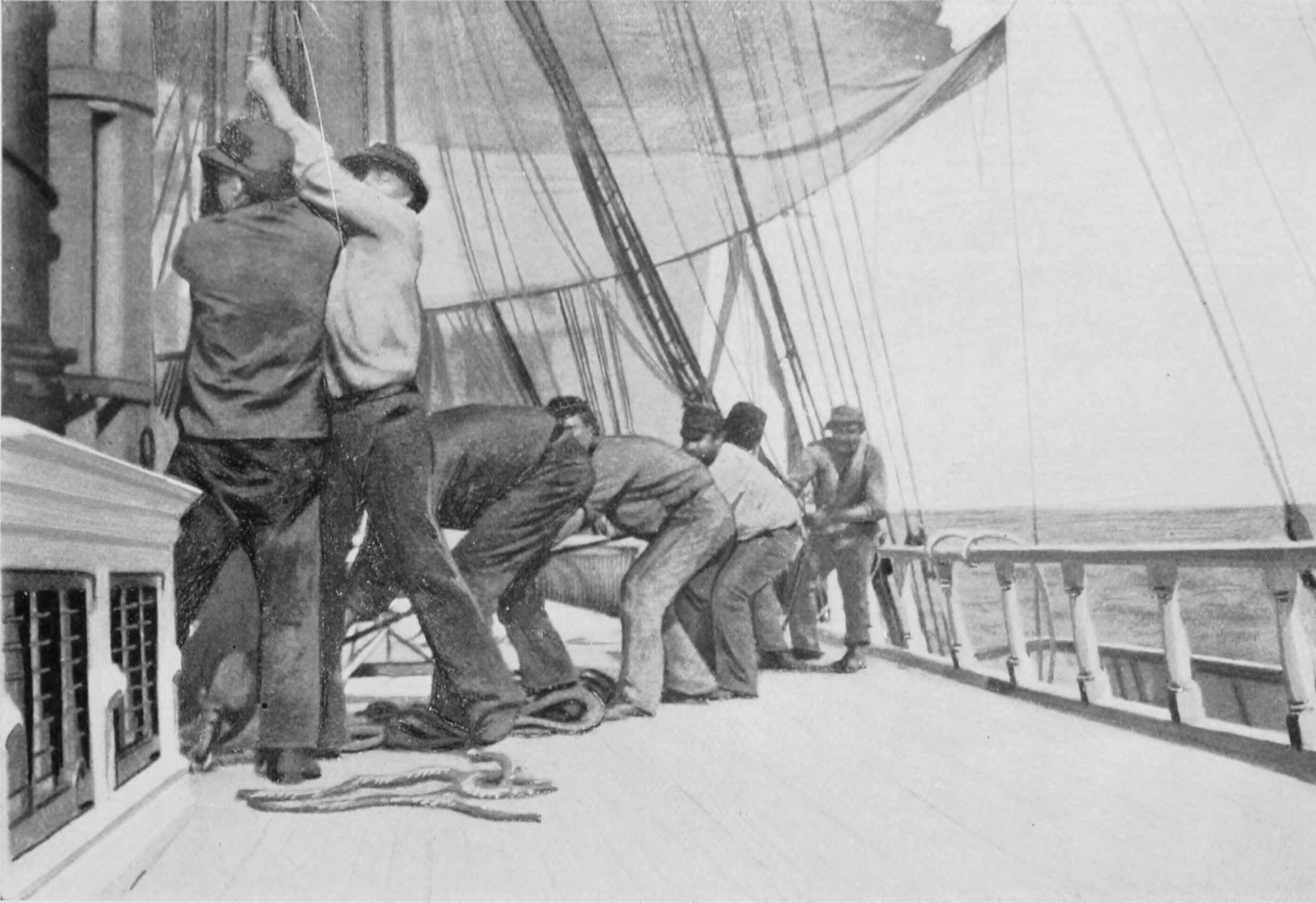
“Blow, my bully boys, blow”
Still another, “The Girls of Dublin Town,” is sung to the Southern tune of the “Bonnie Blue Flag,” the final words of each stanza being,—
“Then it’s hurrah, hurrah, For the girls of Dubberlin town; Hurrah for the bonnie green flag, And the harp without a crown.”
“John Brown’s Whiskey-Bottle’s Empty on the Shelf” and “Give a Man Time to Roll a Man Down” are too well known to need comment. It is a fine sight to see eight muscular fellows at the pump-handles in the dusk of the evening, their broad backs standing forth against the dark recesses, rising and falling as they sing their favorite choruses, MacFoy of the port watch and Murphy of the starboard always supplying the solo parts. Latitude, 7° 56′ south; longitude, 30° 4′ west.
June 13
Worse and worse! The wind is more ahead than ever, and in the last twenty-four hours we made six thousand and eighty feet of southing, or precisely one sea-mile. Between yesterday noon and six in the evening we did make a few miles of latitude, for we tacked ship at the latter hour close to Cape St. Agostinho in 8° 40′ south; but after standing over on the starboard tack till one o’clock to-day, we went back again to the northward, and at mid-day the sun told us that we had made only one mile of latitude to the good. I thought that the captain intended to stand off shore this time for at least two hundred and fifty miles; but when both watches had dined at one o’clock, we wore round again and once more stood in for the beach. What a pity it is that we can’t make better use of this magnificent breeze, which is too strong for even a main-royal! Free, eleven knots would be our speed now, instead of which we go diving hard into it jammed on the wind, pegging along at never more than six knots, four points off our course on the most favorable tack.
Last evening we were presented with a most exquisite panorama of the Brazilian coast. At noon we were immediately east of Pernambuco, about thirty-five miles off shore; and, continuing on our southwesterly course, we brought the land aboard twenty-five miles south of that city at five o’clock. All that we could make out of the shore at that time was that it consisted of a succession of lofty hills; and it was not until we came up from supper at six o’clock that we saw the land distinctly enough to appreciate aught of its beauty, lying as it did at that hour broad on the starboard beam and ahead. On the quarter appeared dimly the snow-white angular walls of a little town lying snugly on an arm of the sea, glowing warm and mellow in the rich light; while by the aid of glasses we perceived, shrouded in the mists of a thundering surf, broad stretches of coral sand fringed at high-water mark with clusters of palmettos and cabbage-palms; back of these, dancing and shimmering in heat-waves, rolled the sand-dunes; and then came the series of lovely hills rising tier on tier into the interior, rich in that wonderfully luxuriant vegetation that clothes the surface of equatorial Brazil, with the veils of night mist just beginning to form in the valleys and deep ravines. The whole of this fascinating scene lay steeped in the after-glow of a superb sunset, which touched everything with a reddish-golden tinge to be observed only in the tropics.
Lying almost entirely within the torrid zone, the climate of Brazil is naturally a very hot one, and is also extremely humid, the rainfall for the year at Maranhão amounting to the enormous total of two hundred and eighty inches, or seven times greater than that of New York. Such an excess of moisture has a corresponding effect upon its plant life, and has given Brazil a wealth of vegetation not excelled by any country of the world. Travellers assert that it is utterly beyond description, and that in the ravines and passes near the coast, where the humidity is intense, it defies man’s utmost efforts at restraint. Even as far south as Rio, trees split for palings send forth shoots and branches immediately; and on the banks of the Amazon, the level of which mighty stream is yearly raised forty feet by the immense rainfall, the loftiest trees destroy each other by their proximity, and are literally bound together by rich vines and lianes. In the province of Maranhão, the grasses, roots, and other plants extending from the brinks of pools in time weave themselves into vegetable bridges, along which the traveller wends his way, unaware that he has left terra firma until he perceives the scaly jaws of an alligator protruding through the herbage before him. On all sides the vegetation is bewildering, and every representative of plant life is of a gigantic size.
But to return to ourselves. Happening to glance ahead a little later we caught a glimpse of the great light-house on the extremity of Cape St. Agostinho just as its beacon flashed over the sea, sending its brilliant needles of light far out over the moon-lit ocean. Just at dusk a large coasting steamer came unexpectedly out from under the hills, in whose stern waved the green-and-gold flag of Brazil; and, heading south across the wide wake of the moon, suddenly vanished in the gloom beyond the sombre headland. The light on Cape St. Agostinho, by the way, can compare favorably with our most powerful ones, for its rays are visible twenty-five miles at sea; the tower being in the form of a white iron tripod one hundred and sixty feet high, whose apex is three hundred and sixty feet above the ocean. Indeed, on the whole of the South American seaboard, from the Guianas to Cape Horn, there is only one other light which equals it, and that is on Cape Frio, just to the eastward of Rio Janeiro.
Speaking of Cape Horn, I wonder when we’re going to see that famous rock? At this present rate we would be several months in beating down the coast; if we were only as far south now as the Abrolhos Islands, we could begin to keep off a little, that being about the first point at which ships bound to the westward begin to think of bearing away. The old mate told us the other day that coming to the eastward towards New York this last time, they unbent the foresail and made some repairs to it on the main-deck with Cape Horn in sight! This means that there was not enough sea there at the time to wet the decks, for a sail is never stretched there if there is any probability of water coming aboard.
The sea has now returned to its usual Prussian blue, for, being on soundings yesterday afternoon, it changed to a most beautiful, pale, transparent green, owing to the white, sandy bottom over which we sailed, only twenty fathoms away; our least distance from the land having been about eight miles. Latitude, 7° 57′ south; longitude, 32° 47′ west.
June 14
Though the Trades are still from the south-southeast, we have done very well, as an offing of one hundred and thirty miles has enabled us to hold on to the port tack all day; and as the coast-line south of Maceió trends slightly to the westward, we may be able to go free of the land until we reach the Abrolhoses, for which it will no doubt be necessary for us to make a slight hitch. We were more than seven days in making nine degrees of latitude; for, a week ago last night, we passed the St. Paul’s Rocks fifty-five miles north of the line, and yesterday we had not quite reached the eighth parallel. Can the reader duplicate this tortoise-like progression in the southeast trade-wind? It is more like the Doldrums in spite of a spanking breeze. Sometimes when there is a lull in the wind the deep voice of Captain Scruggs will be heard, “Loose the main-royal”; but five minutes later will come the order, “Let go the main-royal-halliards; and you can put the gaskets on, Mr. Rarx, we won’t want it any more.” This word “loose” is almost invariably used at sea, and you never hear “Set the mizzen-t’-gallant-s’l” or “Hoist the fore-sky-s’l”; they are always “loosed.”
At dinner to-day the skipper said, “I’ll bet they’ve been having trouble off the river Plate lately.” “Why?” said I. “Don’t you see this swell a-heavin’ up?” he replied; “they’ve been having a southerly buster down there.” Now, that portion of the South Atlantic in the vicinity of that vast estuary, the Rio de la Plata, is subject to terrific gales of wind known as pamperos, because they blow off the pampas or plains of the Argentine; but the skipper, having lived long on the coast of Australia, where the hardest gales are called southerly busters, usually gives that name to the pampero.
The Rio de la Plata should never be called the Plat River, pronouncing it as we do the Platte River in Nebraska; if the English form is used at all, it should be called Plate, which is so universal that one of the largest, if not the largest, shipping-houses doing business in South America is known as the Brazil and River Plate Steamship Company.
A rather singular fact in connection with the skipper is that he has never been to any one of the three largest and most important ports between Cancer and Capricorn,—Calcutta, Bombay, or Rio Janeiro. This is really astonishing, as it would be hard indeed to find another American sailor brought up in the last generation who had never been to either Calcutta or Rio; Bombay is more modern. Captain Scruggs is quite interested in the Nicaraguan Canal project, and he insists that with its completion will pass away the sailing ship from the face of the waters, though I do not entirely agree in this theory. People also thought that when the Suez Canal was cut through it would kill the long-voyage trade to the East; yet what are the facts? It is probable that nearly double the number of sailing vessels pass Agulhas per year as pass Cape Horn, fully eight hundred rounding Africa in both directions in a twelvemonth. The amount of case oil alone from New York and Philadelphia which goes East in sail bottoms is enormous. Few people, though, realize how much cheaper it is to ship goods from New York to either San Francisco or China in sailing vessels than by rail or steamer. For instance, the railway freights from the Atlantic to the Pacific Oceans averages about fifteen dollars per ton; sailing ship rates, from seven to eight dollars per ton, and often less. Eighty thousand cases of oil, which would be the cargo of a modern two-thousand net ton iron sailing vessel, are transported to Shanghai around Good Hope for seventeen thousand dollars; but if they were sent overland to San Francisco from New York, and then by steamer to destination, the freight charges would be trebled, for they would amount to fifty thousand dollars.
We have just finished reading aloud the book which contains perhaps the finest descriptions of tropical scenery in English,—Kingsley’s “Westward Ho.” Nothing could be more charming than the picture of the delight of the scurvy-ridden fellow-voyagers of Amyas Leigh upon first landing in the West Indies; while the description of a Barbadian sunrise is positively entrancing. Latitude, 10° 15′ south; longitude, 34° 35′ west.
June 15
Another very excellent run was the result of yesterday’s work, even though we could not steer a better course than southwest, for we made not far from three degrees of latitude, finding at noon that Bahia bore west, distant one hundred and twenty miles, so that we are at the moment some distance off the land. Last night was one of the grandest that we ever remember at sea. A strong breeze whistled from the southeast at an angle of about forty-five degrees to the long southerly swell, making a rather confused sea in which we sheared about considerably, our high, powerful bows crushing the steep head seas which came rushing ceaselessly at us, piling up on either hand a hissing wall of foam and then flinging it far away on both bows, which, meeting the next on-rushing wave, and impinging one against the other, would shoot up to an astonishing height, to be driven back again in a perfect hurricane of spray, which drenched the forecastle-head, completely obliterating for the moment the lookout, who emerged from these showers like the shade of Neptune, with the water dripping from his oil-skins in the moonlight in glistening rivulets. The moon herself was full almost at the moment of rising, shining with so great an effulgence as to necessitate the partial closing of the eyelids if one looked at the disk, and casting a weird light upon the abysses of a heavy rain-squall crossing our stern. I don’t know when we have enjoyed an evening as much as this one, lying at full length in deck-chairs, watching the mizzen-truck roll through the stars in tremendous arcs, and listening to the bursting of the seas against the bows and the hissing of the water as it rushed under the counter. There is but one word which describes it,—ideal.
Has any one ever seen a keg of root-beer tapped in hot weather after it has been well shaken up? Or has any one ever heard of a keg of root-beer at all. I have always thought of it in bottles. However, we have one on board, and if the expansive force of a superheated, well-agitated barrel of root-beer can be appreciated, it will be understood that we had a very animated and sprightly thirty minutes this forenoon. Ever since the commencement of the voyage a beer-keg of this fluid has been churning and rattling away under one of the alley-ways which extend aft on either side of the cabin-house. For some time past the skipper has been cautioning us to save all the Apollinaris bottles, as he wanted to fill them, in cool weather, with the root-beer. But he grew impatient, and concluded to broach the keg this morning, after the contents had been well shaken up for a week in equatorial heat. Therefore he gathered round about him a phalanx of empty bottles, and, assisted by the second mate and the boy Sammie, advanced hardily against the passive “kag.” After much ado, and the use of sundry expletives and the dripping of perspiration, they got it mounted on its side upon a low wooden box, wedged it, held a bottle under the spigot, turned the faucet, and stood by. But something was wrong; no liquor flowed, so that the spigot must have been plugged with something. “Mr. Rarx,” said the skipper, “go and get a bit of stiff wire.” Back came the second mate at the end of a minute, during which Captain Scruggs was engaged in impotently kicking and pounding the keg; and when Mr. Rarx had brought the wire, he spent ten minutes jabbing away with it, eliciting with great force now and then a little jet of brown foam, which generally hit him somewhere in the face, which he persisted in holding in front of the spigot. Tiring of this, which gave promise of lasting all day without bearing fruit, he despatched the carpenter for an auger, having finally reached the conclusion that it was for lack of a vent that nothing would flow. The second mate was intrusted with its manipulation, and very confidently proceeded to bore a hole in the bung in the upper side. The wildest dream could not have pictured huger success. No sooner had the instrument pierced the wood than, with a hissing shriek, a column of dark liquid as big as a pencil shot high into the air like the spouting of a whale, breaking full against Mr. Rarx’s head, after blowing the auger out of the hole. Then there were frantic shoutings for a plug, while the little cascade played merrily away, falling in a gentle shower of amber froth upon those who tried in vain to stay its impetuous flow. Finally it was plugged, and the skipper called for a tumbler, that he might draw a glassful of the godly nectar, and, sipping it, gain courage for the bottling operation. But, oh, misery! No sooner was the faucet turned than out shot a horizontal stream of root-beer as large as a garden-hose, and with such incredible force that the liquid was blown into a sticky foam a few inches from the spigot. Then there was a rush for utensils on every one’s part but the skipper’s, who stuck fearlessly to his post in spite of the thick jet of mucilaginous steam, trying to turn the faucet with a monkey-wrench. During this exhibition my wife and I stood at the break of the poop, looking down upon the actors, and simply howling at the old man, who, crouched low upon the deck, wrestled like a gladiator with the unruly “kag”; and when he finally emerged from his vapor-bath, with dripping beard and garments soaked to the skin, I feared that the second mate would die of apoplexy. However, most of the beer was saved, and we filled and corked away fully seventy-five bottles of the bubbling mixture. Latitude, 12° 51′ south; longitude, 36° 2′ west.