Introductory material (continued 6)
Reading edition
To add to our increasing sense of comfort, the sun is mounting very rapidly in the heavens, both on account of our northing and by reason of the lengthening of the southern days. The noon altitude was 21° 20′, a very respectable height, more than double that of a week ago, when at meridian the sun, if we had been able to measure his altitude, would not have been more than 9° 30′ above the horizon. The orb, besides, had sufficient power to raise the mercury two degrees at mid-day when we hung a thermometer in his rays.
Off Cape Horn in winter the temperature is usually somewhat lower than that of the North Atlantic between the British Isles and the Newfoundland Banks in January. It is only between the latter point and New York that vessels experience such an intensity of frost as to contract the mercury to zero and sheath them in several feet of solid ice. That is, in the deepest seclusions of the open sea, the weather, even in the coldest season in high latitudes, is generally mild and soft compared with that found at the same parallel near a great expanse of land. Indeed, the comparatively high temperature of the entire Southern Ocean in winter is due to the preponderance of sea, the long, narrow finger of Patagonia being the only land south of 45°, save some diminutive clusters of islands.
On the other hand, though, owing to the uniformity of temperature produced by such a waste of ocean, Cape Horn summers are but little warmer than the winters; the difference between the lowest of July and the highest of December being only 18°, the average for the year being 42°; whereas in Canada, far away from the mellowing influence of salt-water, there is an extreme thermometrical range of 150° between the seasons. Compare Cape Horn’s winter temperature of 30° in the latitude of 56° and that of Minnesota of 55° below zero, though St. Paul is six hundred and fifty miles nearer the equator. St. Paul’s average for the year, 44°, is almost identical with that of the Horn, the intense heat of the northern summers almost exactly balancing a degree of cold not exceeded by 20° on the Arctic Ocean. Contrary to the general opinion, the most intense cold is not to be found in the far northern sea where Nansen travelled, but in Siberia. In the centre of that desolate country is a town called Irkutsk in 52° north, or fifteen degrees south of the Polar Circle, at which the lowest natural temperature ever recorded by man has been observed, the spirit thermometers once showing a temperature of 93° below zero, or 53-1/2° below the freezing point of mercury. Artificial cold, though, has far exceeded this reading, as Professor Dewar obtained a temperature of about 370° below zero in the liquefaction of oxygen. This latter figure is about as conceivable as the unit of measure of the astronomer, who adopts as his basis of calculation for celestial distances that extent of space which a ray of light would cover in a year, moving at the rate of one hundred and eighty thousand miles per second. In other words, instead of using one mile, his unit of distance is 5,676,480,000,000 miles, which is known as a light year; and he further crushes us with the information that stars of the seventeenth magnitude are thirty thousand light years away.
By this time the exhausted reader has said to himself many times, “What’s all this got to do with the Southern Ocean?” So, with apologies for such an excursion into the infinite, let us continue.
We are now kept farther away than ever from the dining-room stove by a new aggregation of garments, very different from the others, which need a little explanation. All the oil-skins in the slop-chest were used up by the men last week, and we have had to manufacture some for them. Many ships make a practice of taking to sea several suits of heavy cotton (which oil-skins are made of), but without being treated with the usual mixture of wax and oil. When, therefore, a ship’s regular stock of oil-skins has been exhausted, the captain produces some of these cotton suits and has them well rubbed with three coats of boiled linseed oil, allowing each coat to dry; the result being thoroughly water-tight, pliable garments, which will not crack, as slop-chest oil-skins have a curious habit of doing.
Around our stove for three or four days there have been suspended several of these suits, so oil-sodden that to touch one means an immense grease-spot. Nor is this the only inconvenience, for the whole interior of the cabin reeks with the stifling fumes of hot, boiled oil.
As far as we have been able to discover, there is but one article sold from a slop-chest to sailors that is worth paying for, and that is the stiff, black sou’wester. They are very comfortable, though as rigid as a fireman’s leather helmet, and are lined with heavy red flannel, with a band of the same that extends over the ears and back of the neck, to the exclusion of the most penetrating snow-squalls. The face is protected by a wide visor of the same inflexible stuff, which extends far down over the neck. As the old man remarked, “One o’ these things would stop a battle-axe.” However exaggerated this may be, though, they do most effectively preserve the cranium from the severest Cape Horn hail-squalls; you might as well tie a handkerchief over your head as to wear an ordinary yellow sou’wester in one of these squalls, as far as protection from the hail is concerned.
We now have for tea every evening a dish entirely new to us. It is a hind-quarter of pig steeped in brine for a fortnight; in other words, an unsmoked ham; and it is the sweetest, juiciest pig meat imaginable. I would rather eat it than the tenderest young sucking pig I ever tasted. Another very successful article of food on board is the soup, which is made as follows: Empty one of the large one-gallon tins of mutton (put up in a liquor like canned sausages) into a saucepan; add tinned carrots, tomatoes, rice, and barley, boil them together for about thirty minutes, season well with a very little onion, pepper, etc., and a rich, well-flavored soup will be obtained which would pass for stock soup almost anywhere ashore. It is infinitely better than the finest tinned soup. The mutton before alluded to is often purchased by ships in large quantities and given to the men, alternating with salt beef and pork; it is also much used for making meat pies for the cabin table, for which it is well suited, the resemblance to fresh mutton being remarkable. Our last pig has just been slaughtered; it seemed a pity to kill the poor beast, for he was an intelligent, quaint little fellow, very tame, and fond of being petted. Latitude, 50° 14′ south; longitude, 90° 12′ west.
July 31
Our breeze from west-northwest has not been very strong for the past twenty-four hours, and in addition we made two degrees of easting, which is sad. This was the first morning for a month on which we were able to eat our breakfast without lamplight, and in another week we hope to dispense with it at supper also. The weather is by no means clear yet, though, and we are now crossing the famous Roaring Forties, that belt of fierce winds lying between the parallels of forty and fifty on both sides of the equator, and clear skies cannot be expected until we are north of 40° south at least.
I expect to suffocate with suppressed hilarity before long if Mr. Goggins continues to grow more absurd. Last night I went on deck about ten o’clock and found the mate silently pacing athwartships near the wheel-house. It was raining, and his costume itself was enough to generate mirth in an owl. He was wrapped as in a sable shroud, in some one’s long black oil-skin coat, which was so much too large for him as to touch the deck, and the sleeves hung down half-way to his knees like the arms of a walrus, while his head was covered with a very old, limp sou’wester, also black, which fitted him like a skull-cap; it possessed not even an indication of a brim, so that the drizzling rain trickled down along the musty creases of his face, glistening in the wake of the binnacle-lamp. His forsaken appearance was further enhanced by a couple of yards of ancient gray rattlin-stuff that girded up the folds of his coat and prevented his tramping on it.
Without a word he ranged up alongside, and dropping his voice to a rasping whisper, as is his wont whenever he is about to reveal a startling theory, he said, mysteriously and very suddenly,—
“The human race is on the decline, sir.”
I didn’t reply, and he continued, “Where are the strappin’ big fellows, five-foot ten, five-foot eleven, and five-foot twelve, you used to see? Where are they, I say? Gone. Gone. And wot do ye find now? The present generation is growin’ up small and feeble, sir. They’re weak and no good. And luk at the winds; they’re changin’ too. They hain’t wot they used to be in the Atlantic; nor in the Pacific; nor off Cape Horn. The Trades is changed. Everythink’s changed. I may be a hold fool, sir, but I knows a thing or two. There’s more in my ’ead than comes out with a fine-tooth comb.”
All this with the most intense earnestness and so much stifled emotion as to render him partially unintelligible, while he snapped and jerked his long sleeves about in the most uncomfortable manner.
Then he abruptly changed the thread of discourse and began, “You talk about seas comin’ aboard, but you ought to been with me once when I was mate o’ the ‘Commodore.’ ’Twas in the Santa Barbara Channel, and blowin’ a whole gale o’ wind. We were runnin’, but bime by the old man thought he’d heave her to. So we put the hellum down, and as she was comin’ up, be gar’s sakes, sir, she shipped a sea that I thought was goin’ to take the hatches off. ‘You’d better jump below and call the second mate,’ said the cap’n; so I slipped down the after-companion-way into the cabin, where the old man’s eight-year-hold son was jockeyin’ a sofy that had fetched away, and says he, ‘Dad’s a-givin’ of ’er ’ell, ain’t he?’ he says. Well, I called the second mate, and then the cap’n says to us, ‘Go down and cut the lashin’s o’ that ere water-cask by the after-hatch; she’ll wipe the houses off if she don’t free herself.’ ’Twas a funny thing to do, but he was cap’n; so we crawled down on the main-deck where the watch was knockin’ about and cut the barrel adrift. In less nor five seconds it went through the rail, and in a minute there warn’t a capful o’ water on deck. It cost about ten feet o’ the port bulwarks, but ’twas our only chance.”
Now that we are well up past the rigors of Cape Horn, it actually seems as though we were close to San Francisco, while five thousand miles of latitude remain and fully fifty degrees of longitude, as ships are forced well out into the Pacific by the northeast Trades. Latitude, 48° 30′ south; longitude, 88° 25′ west.
August 1
Oh, how divinely beautiful and grand the dark-blue floor of heaven is after four weeks of hard gales, leaden, lowering clouds, and gray, clammy mists! To-day for the first time the sun shone with dazzling splendor, and although the altitude at meridian was only 26° 51′, we agreed that never before in our lives had we known a day of equal magnificence. And, even making allowance for our enthusiasm, the weather was well-nigh perfect. Between sunrise and dusk not the smallest cloud blurred the blue sky, which was reflected in a sea of dazzling crests, whose valleys partook of that dark, superb, velvety blue which is seen only where the ocean-bed sinks to immense depths, and which Mark Twain says looks solid enough to walk upon. A sparkling breeze whistled out of the west as exhilarating as pure oxygen, giving us a speed for the twenty-four hours of nine knots. That blighting, killing chill has vanished and one’s ears no longer tingle on exposure; and at noon we enjoyed a temperature of 50°, a rise of twenty degrees from the lowest. What a change in six days from 60° south, 76° west, to 45° south, 88° west! Pretty good work that, in less than a week; it is so much better than the average that it seems incredible. We cannot believe that in so short a time we have been blown across what ought to have been the worst part of the entire voyage. It was all the work of the east wind.
Just now there is a long, deep roll coming in from the southwest, and I am earnestly looking for some of those immense waves for which the South Pacific is famous. According to sailors, they usually occur two or three days after new and full moon; and as we had a new moon last night, perhaps we will see some of these rollers. This reminds me, however, that scientists have determined, after protracted observations, that the moon’s phases have no influence at all on the weather. Sailors often say during a spell of bad weather, “Well, there’s a change in the moon to-night; we’ll have a fine day to-morrow”; and if chance supports their remark, heaven couldn’t shake their belief.
This heavy sea that is met with here is generally not at all ugly; only a deep heave-up from the southward, often without wind, and is said to be one of the most impressive of all oceanic phenomena. The South Atlantic as well as the Pacific is also visited periodically by immense seas during calm weather. At St. Helena and Ascension they are called “rollers,” while at Fernando de Noronha and on the West African coast they are known by the Portuguese name of “calemmas.” They seem to occur chiefly in January, and, strange to say, they invariably came from the northwest. The quotation that follows is from the pen of Captain S. P. Oliver, who visited St. Helena in 1881 in one of the Union steamers:
“These rollers set in from the northwest on Thursday, January 13, with unusual severity, but lulled somewhat on the following day, Friday, only to recur with abnormal force on Saturday, attaining their maximum strength on Saturday night, so that the spectacle on Sunday morning was grand and magnificent, while the weather was bright and calm. It was surprising to see the spray of these deep ocean waves hurled by sheer force, for there was no wind, like fountains over the huge cliffs of Goat Pound Ridge and Horse Pasture, which rise perpendicularly seven hundred feet sheer out of the sea. The force of these enormous billows was spent by Sunday night, and gradually subsided into the normal calm on Monday morning.”
At our present rate of sailing a fortnight would see us on the equator, but if we cross it in three weeks it will be fine work. What sort of luck are we going to have between these westerly winds and the southeast Trades? That is one of the crucial points of the voyage that remain, another being, how far south will the northeast Trades blow?
We had a little excitement to-day at dinner. Ever since our cabin fire has been going, it has been the custom of the steward to put a can of whatever vegetable we were to have that day for dinner upon the top of the stove to heat; the proper way, of course, is to place the can in a dish of water and that in turn upon the stove or what not. To-day it was a tin of string-beans, and the steward, fully an hour before dinner, put the can upon the stove, which was nearly red-hot. (The warmer the day the hotter the fire, here as elsewhere.) When the soup had been cleared away, the gentle, timid little Malay took the tin into the pantry and attacked it with a can-opener. But no sooner was the metal pierced than the whole pantry was filled with a suffocating steam that rushed hissing out of the vent with the most astonishing fury. We sat aghast. The old man cursed a little and the mate got up, but instantly thought better of it and sat down again. And still the steam came belching out of the can, which had fallen down and was shooting about the pantry like a demented steam-cylinder, while we could dimly perceive the slender form of the little steward through the pungent vapory clouds making courageous efforts to lay hold of the bewitched bean-can. For nearly a minute steam continued to escape with such force that it almost shrieked; and had the tin remained another five minutes on the stove it must certainly have exploded and scattered boiling water, beans, and jagged fragments of tin and lead about the room.
Last evening at supper a bottle of Apollinaris burst in my hand with a loud report as I was opening it, scaring the valiant Goggins into upsetting a full cup of tea upon a clean cloth, for which the old man fixed him with his eye and held him thus for quite half a minute during an awful silence.
If only for the sake of the sailors we are anxious to get into warm weather again as soon as possible. Now that they have removed the mufflers, etc., from their necks and heads, we can see how pale and washed out most of them are. There are only two among them who do not bear ocular proof of the hardships of a month in the Southern Ocean in July. Paddy is perhaps the worst looking of the whole crew, though he cannot be thirty years of age. This is due probably to his never, under any circumstances, shirking his work, and to his exerting himself more than any one else in the ship. Indeed, he was so full of nerve and energy in the worst weather, that the captain surprised us once by saying, pointing to Paddy on a yard-arm in a heavy squall, “There’s what I call a brave man; he doesn’t know what fear is.” The skipper didn’t mean to insinuate that Paddy was courageous for going out on the yard at that moment; he was thinking about his general conduct.
Poor Paddy’s arms from wrist to elbow are perfect mountain-chains of sea-boils, and he looks as ghastly and pallid as a corpse, with pointed nose and staring eyes; his entire appearance has changed. It may be interesting to add that the majority of foremast hands do not live to be forty-three years old.
I forgot to say that for the first time in five weeks the mate shaved for dinner to-day, and so sleek and blue and shiny and naked did it make him look, that it was almost a shock when he sat down opposite us. Latitude, 45° 2′ south; longitude, 87° 40′ west.
August 2
This day was even finer than yesterday, except that since ten this forenoon we haven’t had much wind. But the weather is warmer, 48° at 8 A.M., and the sea is as placid and still and clear as under the line. All the ground-swell has disappeared, and the great, level expanse of the mighty South Pacific stretches on all sides in tiny crinkles, frosted here and there by a crisp sparkle of froth; and the sea-rim bounds the view in a circle as sharp and black as ink. It was a day of almost tropic beauty, save that the air lacked the ineffable balm characteristic of a day at sea between Cancer and Capricorn. We rejoice at seeing the sky-sails once more expanded to the breeze, for to-day the three yards were crossed, giving to the ship a fine-weather look. Juan Fernandez will soon be abeam, and then only a few degrees more to the Trades, for we made three and a half degrees of latitude yesterday and hardly any easting. How pleasant it is to think of the approach of warm weather again, when we can lie in deck-chairs in the shadow of the wheel-house with a good book, or pass away the hours with a backgammon- or cribbage-board!
We are very much pleased to find how free this ship is from roaches that usually abound in sailing vessels; the only member of that objectionable family that we have yet perceived was a small red one; of the large, black cockroaches we have not seen one, though on the “Mandalore” we were told that they were numerous on all wooden ships. Neither have we discovered any of the more villanous creatures, which cannot be said of many transatlantic mail steamers.
A fact worthy of note, as deplorable as it was unexpected, is that since passing the meridian of Cape Horn we have not seen a single albatross. Indeed, during the whole passage we haven’t seen more than a dozen of them, they having been most numerous between the river Plate and Staten Land. In truth, the albatross seems to be disappearing, which is not astonishing when it is considered that many ship-masters either use them as rifle-targets or catch them by the half-dozen with hook and line, and take the quills and down home to sweethearts and wives. Is it not odd, by the way, that there are more benedicts among sea-captains than are to be found among the men of any other profession? Yet long-voyage skippers, who are invariably married men, see their wives only once a year.
Perhaps the albatross has been driven away into regions even more solitary than Cape Horn, but it is my belief that they are gradually vanishing, which is to be much lamented. They are of no apparent use to mankind, but neither is the tiger; yet if that royal beast were upon the eve of extermination, as our bison is, there would be a great wailing heard in the land. The albatross, be it said, has all the regal dignity of the bison; and no one who has not seen it can imagine the imperial flight of a full-grown wanderer. Latitude, 41° 35′ south; longitude, 86° 56′ west.
August 3
Pleasant northerly breezes, a smooth sea, and brilliant sunshine gladdened our hearts this morning, and at noon we found ourselves well north of 40°. The wind hauled to the northward somewhat during the night, though, so that, with the variation, we did not make good a better course than northeast by north, and are now heading for Juan Fernandez in 34° south.
We have made a disagreeable discovery about Timothy Powers in the port-watch. I don’t remember whether it was mentioned before or not, but Tim was said to have fallen off the forward house two weeks ago and sprained his right arm. From the first the captain never could discover anything wrong with it, but as the fellow insisted that he suffered terrible pains in that member, there was naught to do for a while but to believe him. At last the skipper grew tired of Tim’s loafing, and, going out on the main-deck this morning, he gave the Irishman a very sulphurous dressing down and compelled him to turn to. He was sent forward to clean out the pig-pen, and he went to work with a woful countenance to lift off two planks that served as an apology for a roof to the sty. He couldn’t move them with one hand, so he stopped, looked carefully about to see whether or not he was observed by the mates or any of his friends, deliberately took his arm out of the sling in which he still insisted on carrying it, lifted the heavy planks down with ease, put his arm back in the sling, resumed his pitiful look, turned to reach for a broom, and found the eyes of the second mate fixed steadily upon him. Mr. Rarx had been concealed and had witnessed the whole affair. That settled it. Tim almost fainted from shock, and from now till the end of the voyage his will not be a bed of roses. Think how this creature has been imposing not only on the captain and officers, but on his fellow-shipmates as well! For two entire weeks his most arduous duty consisted in keeping the lookout on the forward house in the daytime, perfectly well, with all night below, while his friends, ill and drenched to the skin, had to dive around the main-deck day and night with chattering teeth, two hands short in the worst weather,—two hands, because old Neilsen has been laid up in his bunk with general debility, too weak to even put his foot on the main-deck. Tim is the sort of animal who contributes much to the misery and suffering of sailors. A captain, for instance, catches a man in such a deceit, never forgets it and refuses to believe the next man, who actually has hurt himself, so that the real sufferer has to bear the penalty of the other’s fraud. It is not a criminal offence, but a low, contemptible trick; though just such a one as a man with a face like Tim’s would be guilty of. The mate’s powers of divination are not particularly acute, for he observed one day off the river Plate, looking at Tim, “There goes a feller that I call a good, faithful man.”
At dinner to-day I chanced to remark that, as we had had such benefits from the easterly wind, we ought to accept our three points of easting now without grumbling. Mr. Goggins, however, is a fearful kicker, even for a sailor; so, thinking to please the old man, he instantly replied, “We ain’t had forty-eight hours o’ good luck on the hull passage.” This was so remarkable a statement that my wife was provoked into saying, gently but positively, “The man who talks like that doesn’t deserve to reach port for six months more.” “Well, we ain’t,” quoth Goggins, doggedly. Then I took a hand (it is usually best not to argue with him and the skipper), and asked as sarcastically as I could, “I suppose that three days’ easterly gale doesn’t count? And how about the first sixteen days of the voyage? You’re enough of a sailor, I suppose, though, to have forgotten all that.” I thought that he was floored; but he was possessed of more vitality than one would have supposed, for he came back at me with, “Well, the yards was ag’in the backstays all the time in the North Atlantic.”
This was such a novel stand to take that we let him alone, so that he got up and tramped out of the cabin much inflated. What possible difference it could make whether or not the yards touched the backstays as long as the ship lay her course and went through the water was beyond my powers of reasoning.
We are now followed by an immense number of Cape pigeons. What merry, blithesome little fellows they are, apparently all good-nature and love for one another as they circle around the ship, almost brushing the standing-gear in their mad, tumbling flight, now skimming just above the sea, now soaring over the mast-heads, and sweeping down again for very joy that they are made! But let a bucket of table refuse be thrown over the side, and then away with good-fellowship and fraternal affection. It’s a true case of every one for himself and the devil take the hindmost. No sooner does the refuse touch the water than two or three catch sight of it, and in an instant fifty pigeons are involved in furious battle. They fairly scream in their excitement, and beat each other with their powerful wings, and snap viciously right and left with sharp, curved bills. Then one lucky one will perchance seize a choice morsel. Instantly he is set upon by a dozen of his companions, who mercilessly bear down upon him before he can rise from the surface with his prize, and actually beat him down under water in their fierce efforts to get at the tempting mouthful; but so plucky are they, that we have never seen one relinquish anything when his bill has once closed upon it.
While the pigeons are engaged in this deadly strife a great molly-hawk sometimes looms up astern, having sighted the combat from afar, and dashing into the centre of the squabbling flock, which scatters before his huge wings and wide, formidable beak, like crows before a vulture, he snaps up the bone of contention and soars away to enjoy it at his leisure. After the rapacious monster has departed from out their midst, the dejected little creatures return, and hover over any particle of food that may remain, ever and anon diving far below the surface for a crumb that they perceive deep down in the placid depths, rising again with such amazing buoyancy and energy as to lift themselves clear out of the water, like an inflated bladder suddenly released. They afford us much amusement; but another six hundred miles farther north will, no doubt, see the last of our merry little companions. Latitude, 39° 35′ south; longitude, 85° west.
August 4
Although the lovely clear skies have for a while disappeared, being obscured by the most clearly defined stratus clouds that I ever saw, the weather is bracing and dry, with a sea so smooth that it never would be supposed that we were hundreds of miles from any land larger than Juan Fernandez or its neighbor, Mas-á-Fuera. Each day sees a rise of two or three degrees in the air and sea, and we are moving well up into the heart of the thirties. We will, no doubt, soon fall in with vessels from Chilean ports bound around the Horn; but those from San Francisco have been driven so far to the westward by the Trades that in this latitude they are away over in 125°. The wind is still to the northward of west, and we continue to make more easting than is desirable; because, if we have to steer much farther in towards the land, our course when we take the Trades will have to be northwest in order to cross the line in the right place, which, of course, would be dead before the wind, an undesirable position in a square-rigger, as in that event only the after-sails draw.
Captain Scruggs was quite a treat at the mid-day meal, for he appeared in one of his majestic phases, when no one can tell him anything that he doesn’t already know. My wife unhappily mentioned that this would be fine yachting weather. Now, the mere mention of a yacht nearly always upsets him; and we, therefore, had to listen while he disputed vigorously with himself for some minutes; and he finally concluded with the assertion that he could take the “Volunteer” and sail right round the “Defender”; he knew the old one was better, anyhow, than that there new brass boat, or whatever she was made of. On suggesting that he might find some little difficulty in consummating such an undertaking, he replied, “Well, I’ve got that confidence in myself; I used to sail small boats when I was a boy, and I ain’t forgot how.”
He concluded his remarks, always delivered in explosions as though challenging you to deny them, with a disquisition on jams. He believes in the theory that all kinds of preserves are boiled down together, and that different labels are then stuck on the tins. “Look at that, now,” he growled, pointing to one on the table. “What d’ye call that?” I showed him the device of a fig on the wrapper, with the name beneath it. “Lemme taste it,” said he, plunging a knife deep into the preserves. “There, what’d I tell you? ’Taint fig jam, it’s currants; they hain’t got the right libel onto it,” he explained.
When dinner was over we repaired, as usual, to the after-cabin, while the old man strode heavily back into the dining-room, called the mate, and abruptly demanded, “Have you got that spigotti out yet?”
“What’s that, sir?” asked the mate.
“Spigotti, spigotti; like macaroni. Don’t you know by this time what spigotti is?” said the skipper, very angrily, for he knew that he didn’t have the name right and that we could hear him.
“No, sir, Cap’in Scruggs, sir, I’m d—— if I do,” stammered the hapless Goggins; for we could perceive the captain through a chink in the door bristled up like a ruffled bantam, and the hideous, grisly old mate, his eyes popping out like a pair of deviled kidneys, racking his brain for a translation of spigotti.
But the particularly scintillating jewel in the skipper’s galaxy of remarkable pronunciations is his name for the inhabitants of Chile. They become Chilaneans; though, now that I think of it, I have heard other ship-masters put themselves to the trouble of so pronouncing it. Where do they get that extra syllable from? Now, in the case of Cubians, it’s different. They all say Cuby, so why not Cubians? It’s logical. But Chilaneans is unreasonable.
Speaking of Cuba reminds me of what a Chesapeake Bay fisherman asked me once, “Hain’t Mayceo fit with the Cubians before?” This was just before Maceo was killed.
Captain Scruggs seems utterly unable to avoid contradiction, and, being possessed of very uncouth manners (which he nevertheless knows quite well how to correct), it may be conceived how trying an ordeal half an hour at the table with him must be. “Don’t talk with him, then,” is very easy to say; we don’t talk between meals to him, but at table it is almost necessary to make one or two observations in thirty minutes; and whenever the silence becomes overwhelming and we hazard a remark, it is disheartening to listen continuously to “I don’t think so.” Latitude, 37° 3′ south; longitude 83° 20′ west.
August 5
Just another such day as yesterday, with the sky obscured by sharply-cut, stratus clouds. The only perceptible difference is that to-day the air is a little more balmy; the wind and sea are precisely the same, and our experience so far has been that the Pacific is most aptly named. Of course we ought to be reaching smooth water now, though it is often rough in the southeast Trades; the surprising part is that we had such a quiet sea in the stormy forties. The air has been wonderfully soft all day, the thermometer indicating 58° at noon, although the sky was completely overcast.
Mas-á-Fuera bore east-northeast true at mid-day, distant in round numbers one hundred miles, with Juan Fernandez two hundred miles away in about the same direction. The appearance of this latter island is said to be strikingly beautiful, though in size it is only thirteen miles by four. It consists of a series of steep, rugged hills, formed by huge boulders piled one upon the other, the loftiest reaching an altitude of three thousand feet. Palms, tree-ferns, and a thick undergrowth partially cover these rocky declivities, growing in very shallow earth, which slips away when one attempts to scale the precipices, and it is said that on this account the culminating peak has never yet been ascended.
Juan Fernandez, which lies in the approximate corresponding latitude of the Madeiras, is indissolubly associated with Robinson Crusoe, Defoe having based his tale upon the adventures of one Alexander Selkirk, of Fifeshire, Scotland, who was put ashore there in 1704, at his own request, by Captain Straddling of the “Cinque Porte” galley, with whom, as master, Selkirk had quarrelled. It is highly improbable, however, that Juan Fernandez is the island pictured by Defoe, as his descriptions in Crusoe do not always tally with the conformations of Fernandez. Modern writers incline to the belief that Trinidad, off the Venezuelan coast, was the island in “Robinson Crusoe.” Selkirk lived on Juan Fernandez until 1709, when he was rescued by the ship “Duke” from what seems to have been a by no means intolerable imprisonment. Mas-á-Fuera, which means “more to sea,” called so by the Spaniards, though far smaller than its neighbor, is even loftier still, one peak attaining a height of four thousand feet.
In every spot where men do congregate there will nearly always be found one silent individual, from whom it is apparently impossible to extract a single syllable. We had one such on the “Mandalore,” an English seaman with a Board of Trade certificate. During the whole voyage of eighteen weeks he was never heard to utter a word unless he had some unavoidable reason. Aboard the “Higgins” there is a man who can give him cards and spades on taciturnity, for he hasn’t been known to speak by either mate since the eleventh of May. This contemplative genius is Karl, he whom Rarx so brutally struck in the face with the block away back in the South Atlantic. Even then no word passed his lips, though he did groan He isn’t surly—it is just his way—and the mates do not mind now when he doesn’t answer, as he is manifestly so willing. For torpid stupidity and phlegmatic stolidity his equal would be hard to find, and we have often watched him at work and wondered, “Can it really talk?” The most unexpected and painful surprise cannot draw from him the slightest exclamation. For instance, a fortnight ago, one afternoon at the pumps, a big sea surged over the side, but most of the men saved themselves by jumping up on the fife-rail, except Karl and Brün. Indeed, the latter had saved himself, and was kneeling on the rail holding fast to the mizzen-royal-braces; Karl’s mind, though, was far too numb to grapple with such an emergency, so the water carried him off his feet, wrenched away his grip on the pump-handle, and was sweeping him across the deck, when he grasped one of Brün’s feet in his flight. This broke the latter’s hold on the brace, and away both flew into the water-ways, where they bobbed around for a while in thirty-six inches of icy brine. Brün was in a rage, of course, but not so Karl. His wooden face arose by and by from the roaring scuppers, placid and tranquil; he then by degrees found his legs, waited for a weather-roll, shot back to the pumps, and resumed his place, totally unmoved. All this time he was as dumb as a giraffe.
Again, yesterday afternoon, he was doing some work on the starboard main-brace-bumpkin, when he slipped and went half under water before he caught the bight of a rope that luckily hung over the side. Even this didn’t trouble him in the smallest degree; he didn’t even wink his codfish eyes, but seated himself again upon the bumpkin and proceeded with his job.
Toward the end of the third month at sea most people begin to suffer somewhat from dyspepsia, induced, no doubt, by the absence of fresh meat and vegetables, though the best tinned varieties of the latter certainly taste as good as the fresh. In the old days people, it is true, did not have the great amount of such edibles to choose from as they do now in going to sea, but they had plenty of young pigs and sheep and chickens, which atoned in measure for the lack of canned vegetables. Indeed, the deck of a Yankee ship fifty years ago looked like the conventional barn-yard, with its pig-and sheep-stalls, hennery, and not infrequently an enclosure for a couple of cows. Latitude, 34° 5′ south; longitude, 83° 15′ west.
August 6
Gradually, since daylight, the form of the clouds has been changing till they have assumed that of cumulus, and as the wind is letting go, with an appearance of showers ahead, we seem to be upon the brink of a change in the weather. For seven days the wind has been at west-northwest, with never a shift of two whole points, while the variation of the aneroid during that period was not more than fifteen-hundredths of an inch. We are practically on the thirtieth parallel at present, so that in eleven days we have made thirty degrees of latitude. Steadily, too, the temperature has been rising, standing at 59° at eight this morning for both air and water; a still more significant indication of our northing, however, is that last night the fire in the cabin stove was allowed to die out, to-day being the first time in thirty-eight days that we have been without artificial heat; thus for almost six weeks has the stove been going full blast, for it was first lighted in 38° south in the Atlantic.
It is always an interesting thing to note the different attitude of captains toward their chief mates on long-voyage ships. Some are extremely affable, others are reserved and haughty to an absurd degree. Where men are confined together in so small a space as a ship’s deck for months at a stretch I think that a captain ought to be reasonably unbending, but always dignified, in his manner toward the chief officer, though, of course, much depends upon the sort of man the latter is. Captain Scruggs is by turns civil and positively wolfish toward Mr. Goggins; and one of the most curious phases of the old man’s character is that he invariably crushes the mate whenever the latter says something that he thinks will please the skipper. Night before last, at supper, during a conversation about British Columbia, the mate turned to the captain and beamingly said, “I remember the time, sir, thirty years ago, when you used to could talk Chinook with the best of ’em.” To his chagrin, though, the old man growled, “Never knew six words of Chinook in my life”; while as a matter of fact he used to talk it well. Mr. Goggins returned to the charge, however, and again essayed some remarks, during which he ventured to hope that the wind would back into the southward and let us make some westing, very reasonably supposing that here was a sentiment that any skipper would endorse. But, though the captain has been in a white heat lately at our easting, he observed that he “didn’t care a chew er terbakker where the wind went to,” which so angered the mate that he answered quite hotly, “Well, so far as I go, I’m sure I don’t care ’ow long we’re at sea; but I know you do and so do the owners.” “I say I don’t care a rap, rap, rap!” stormed the skipper, and we looked for a row; but the mate slid off the bench and disappeared.
Strange man; unfortunate disposition. He must contradict. He feels it his duty to differ from every one else, even if he knows that he is wrong. This morning I remarked, as we sat down to breakfast, “I see the thermometer’s 59° this morning.” “58-1/2°, I think,” he corrected. Now, in the first place, it was 59°; and in the second place, he wouldn’t have known it if it had been half a degree lower, for he can’t read a book without powerful lenses, much less the rusty scale of a thermometer a foot above his head. Latitude, 30° 44′ south; longitude, 82° 30′ west.
August 7
“Unhook that double main-sheet! Square the yards!” Oh, welcome, joyous words! Even if the wind is not more than a breath, it allows us now to lay the course and with a little to spare.
There are some ultra-nautical landsmen who will vigorously object to the first word in this day’s log, and will insist that I ought to have written “cast-off” instead; but if these individuals would go to sea they would learn that there are many expressions heard aboard ship which no argument could persuade them to use, for fear of not being considered au fait in nautical nomenclature. We have all seen the horror of the pale youth with the large steam yacht when some one in his hearing has suggested going “down-stairs” instead of “below.” Yet many deep-water sailors say “down-stairs.” And one of Captain Scruggs’s characteristic orders is, “Let the fore-t’gallant-yard run down, Mr. Rarx, and tie up the sail,” instead of “Clew up the fore-t’gant’-s’l,” while he himself ordered the double main-sheet “unhooked.”
To resume. For seven or eight days we have been jammed hard on the wind, and while we have made very excellent northing, we have fallen away to the eastward so much as to well-nigh overbalance our difference of latitude. In yesterday afternoon’s watch, however, the ship began to come up, and all last night we steered northwest, our course, making fairly good way, though it fell calm at daybreak, but breezed a bit again, and the yards were checked in a couple of points more at 10 A.M. According to Findlay, the average time from 50° south in the Pacific to San Francisco is fifty-four days, and as we are somewhat ahead of the average since leaving that parallel, we can stand a good deal of light weather and still make a fair passage. It cannot be denied, though, that from the equator to 40° south on the other side we had a remarkable streak of bad luck; and I expect that the “A. G. Ropes,” which sailed from New York thirteen days ahead of us, will make a faster passage than we will. In parenthesis I might remark that most of the large ship-owners give their captains ten dollars per day for every day under one hundred and twenty. For instance, if a man makes the passage in one hundred and ten days, he is entitled to one hundred dollars.
It may be that the curious would like to know how we passed those dreary weeks off Cape Horn, and here was our scheme, though, in truth, our habits then were about the same as they are now. I rose at seven, breakfasted at quarter to eight, and walked the poop alone till nearly eleven. On days that were very rough, it was a continual source of pleasure to chock myself off between the stern-bitts and speculate, when a particular wave was still several hundred yards off, whether it was going to break on board or whether we would clear it. It is a fascinating spectacle, this, and an hour often passed like five minutes as I gazed with ever-increasing awe at the resistless power of the huge, crested breakers.
Then down to our room, where we read “Farthest North” aloud till noon, when my wife made her first appearance. Dinner then occupied us till nearly one, when we went on deck to walk for half an hour, if not too rough. Down again to write up our journals, plot off the course on our own chart, and note down in the government book the meteorological observations made at Greenwich noon. This brought us to four o’clock, when we again went on deck to remain till dark, and then a book claimed us until supper, a little after five o’clock. Deck once more from six till seven, in spite of any weather; then books again until nine, when we went up for a breath of air again before turning in.
Exciting? No, truth compels me to admit that it was not, although no doubt some of the days would have been lively enough for almost anybody. Those who are sustained by excitement must never by any chance allow themselves to be persuaded to try a deep-water voyage, no matter how completely they may have convinced themselves of their fondness for the sea. A true and abiding love for the sea is a very rare attribute in any man. I mean that fondness for the ocean which enables him to live contentedly and happily upon it for half a year at a time, and to accept uncomplainingly whatever chance may provide. The monotony of a twenty weeks’ voyage to ninety-nine per cent. of civilized humanity would be nearly incalculable; and in the case of one sent to sea for health’s sake, it is entirely conceivable that the depression consequent upon such a voyage would, in some degree, counteract the beneficial effects of sea-air. It is owing to a peculiar temperament that a few people can stay at sea for an indefinite number of months without in any way tiring of the life. To these few the state of the weather and the direction of the wind are absolutely immaterial. A calm of a fortnight or a month of head-winds, either in the Tropics or the Southern Ocean, are regarded by them merely as events which they expected to encounter when they sailed.
In spite of everything said and written to the contrary, I believe that in every sailor, from seaman to master, his love for the sea is never extinguished. Let them assert, times innumerable, that they hate the life, and yet see how they all return to it after a little while ashore. It is of no avail to argue that because a man is bred to the sea he is incapacitated for duties ashore; I have known of several ship-masters who, through influence, obtained lucrative positions in various firms, but who resigned them, unable to further withstand the magic influence which the deep sea exerts over those who have once fallen under her resistless enchantment. Nor does the case of the common sailor differ. I once knew a respectable foremast hand who obtained the position of driver of a laundry-wagon in Boston. This was a nice job, but I awaited developments; and, sure enough, in three or four months he signed as bosun of a Japan-bound oil-ship. Even the most shiftless of sailors could surely use a pick or shovel dirt ashore, yet they prefer the less profitable and inconceivably more arduous duties of the life before the mast, simply because they cannot overcome the wondrous allurements of Old Ocean. Latitude, 28° 52′ south; longitude, 83° 12′ west.
August 8
We have almost every reason to believe that we have taken the southeast Trades. I say almost every reason, for the only cause for doubting is that we are so far south yet, and the wind, after all, may not amount to anything. In any event, we are all astonished at such an outburst of luck, except the skipper, who testily replies to interrogations, “This may go into the Trades; it certainly is not them yet.” At 4.30 yesterday afternoon, just as we had composed ourselves for the hazy, yellow calm that lay upon the sea, a light air from astern overhauled us, and backing into the southeast in a few minutes, breezed up from that desirable quarter in a most refreshing manner, so that ever since we have averaged seven knots. This, if it lasts, is a most remarkable stroke of fortune, as ships often lie idle for a week or more between the westerly and the southeasterly winds; and to run from one into the other, with only an hour’s calm, is as unusual as it is welcome. We are inclined to believe that, after all, we will make the voyage in one hundred and thirty days,—that is, in six weeks more. On this subject the old man is, of course, as dumb as a lobster, and resents any such suggestions by obstinately staring in the opposite direction; while Mr. Rarx, a man of great experience in the North Pacific, which is now probably the only bête-noir left to us, even goes so far as to say that five additional weeks will anchor us in San Francisco Bay.
We have now left behind us that most solitary and vast portion of the South Pacific almost entirely devoid of the smallest fragments of land, and we are entering that part thickly spattered with rocks and islets that most people never heard of, not to mention the thousands of islands to the westward that form the great clusters of the Society, Friendly, Samoan, Gilbert, Ellice, Marquesas, Caroline, New Hebrides, Ladrone, and Marshall groups. For instance, in our neighborhood at present are the islets of San Felix, San Ambrosio, Podesta, Sala-y-Gomez, and the Emily and Minnehaha rocks; doubtless there are dozens of others besides, too insignificant to appear on a chart of the world, such as I work with. These few, however, will serve to show how thickly sown the Pacific is with insular obstructions; and it is for this reason that this ocean, bar that part south of 30° south, has never seemed to me as desolate or lonely as the Atlantic, north or south. Behold how fittingly Nature has cleared the North Atlantic of nearly every indication of land and has left an abundance of clear, open water, through which rush the great steamers which connect Europe and America, safe in the knowledge that even if they drifted about for months with disabled machinery there would be practically nothing to interrupt their wanderings. The most remarkable proof of this was the case of the large schooner “Fannie E. Woolston,” timber-laden, which drifted about for thirty months, covering six thousand miles in that time, an average of over three knots per hour, without approaching land. This was ascertained by means of the reports of many different vessels which passed close to the “Woolston” during her perigrinations. Indeed, the only island that lies at all near the track of steamers bound from the more northerly European ports to those north of Baltimore is the terrible Sable Island, the “Graveyard of the Atlantic,” in 44° north, 60° west, about two hundred miles east of Halifax. More vessels are lost here than at any other spot in open water, and its number of casualties are probably only exceeded by such shoals as the Goodwin Sands.
Turn, then, to the North Pacific, and it will be seen that, with the exception of the higher northerly latitudes, through which lies the great circle track between San Francisco or Vancouver and Japan, that immense body of water is literally dusted with coral reefs and islands; though it is necessary to examine a large chart to appreciate this, as no geography will answer.
There are recognized among men several great classes or divisions of bores, such as those who magnify their own greatness, those who can remember how much colder the winters used to be in their boyhood, or, if in New York, those whose memory recalls the period when milch cows lowed where the City Hall now stands, and swine rooted in the dirt upon the site of the Post Office. But there remains yet a genus of bores so infinitely surpassing those mentioned that they may be said to form an entirely different family. Fortunately for mankind, comparatively few persons are victimized by them, by reason of their profession; but in those parts where they do congregate, they are as deadly as Mark Twain’s brain-fever bird. Allusion is made to those venerable and crusty master-mariners who extemporize by the hour upon that grand race of sailors who used to man the wind-jammers in days of yore. Start them once on this subject, and woe to the anguished wretch snared in their toils. One would think, in listening to them, that they were talking about an extinct race who inhabited the seas about the middle of the nineteenth century, and, like the apteryx and platypus, had been suddenly and mysteriously exterminated; and when one ventures to suggest that surely there must be some resemblance to those exalted beings in the men who now sail before the mast, these aged sea-hedgehogs bristle up and fly in a passion as they descant upon the puny breed who now defile the honorable name of sailor with their pampered notions and blubber-head stupidity. These persons ought to be confined in some retreat for the rest of their lives; the disease is incurable and terribly infectious, for every sea-captain over fifty years of age suffers more or less from the unhappy malady.
It is true that the steamer has cut huge swaths in the sailing-ship trade, but there are still a vast number of square-riggers left which pay good dividends. It seems to be the prevalent opinion that steam has spoiled seamen for sailing-ship work, but in reality the men who ship for long voyages never do anything else, and let steamers severely alone. Many good men, no doubt, begin their careers as lamp-trimmers, etc., in steamers, and usually remain in them, and in this way sailing ships, no doubt, lose a number of fine men; but it is well to bear in mind that deep-water and steamship foremast hands are very different beings in many respects.
As noted in an earlier page, some people are crying now that as soon as the Central American canal is cut through it will be the instantaneous death-knell of the long-voyage sailing vessel, but those who really understand the business of transportation by water do not agree to this by any means. Here are the words of Arthur Sewall, than whom few, if any, are more competent to speak on the matter: “As long as the wind blows and water flows there will be sailing ships built and business to keep them busy. There will always be a chance for them to compete against steam in traffic where time is not a factor, or where delay is actually a good thing. For instance, there is the wheat crop. In July or August it begins to be ready for delivery, and in a short time the whole year’s supply is ready for shipment. But the consumption of a crop stretches over a whole year. Shipping wheat in sailing vessels consumes several months’ time, which would otherwise require the storing of the wheat. Sailing freights are actually less than steam freights, plus storage charges. So, you see, here is business which sailing ships can hold. Then, again, take railroad materials, especially rails, which are manufactured faster than they can be used, and where the delay of sail over steam is better than storage. Of course, as in any other business, it is a case of the survival of the fittest, and as smaller ships are relatively more expensive than large ones, small ships cannot make money, and will have to make way for large ones.”
An excellent precedent in favor of the continuance of sailing vessels is that subject in connection with the Suez Canal. When this was a thing accomplished it was said that no more square-riggers would go out around Good Hope; yet consider the enormous amount of sail tonnage that is despatched every year to India, China, Australia, and Japan, for it is computed that eight hundred sailing vessels double Agulhas every year in both directions, and as but few of the ships in the Eastern trade have a carrying capacity of less than thirty-five hundred tons, the amount of merchandise that passes the southern extremity of Africa per annum foots up the imposing total of at least seven million tons.
Mr. Goggins appeared at dinner to-day in a frock-coat! Can one conceive the effect produced upon the mind by the contiguity of a frock-coat and a red-flannel shirt. Certainly not. No one could unless he had seen it. Goggins was monstrously proud of it, too, in spite of its being several sizes too small for him, and ostentatiously got up during the soup and officiated at the drawing of a pitcher of root-beer from the “kag” in the corner, during which evolution he suddenly became embarrassed at the unwonted attention centered upon himself, and in some way managed to upset the pitcher all over the floor; and when he sat down he was in such a state of excitement that his nasal whistlings and obligatos were more piercing than ever before. And just think of this creature’s name, Leander! Oh, heavens, it is too much! Latitude, 26° 54′ south; longitude, 84° 50′ west.
August 9
Ninety days at sea, and another month cannot take us in, nor do we desire it, in spite of our surroundings. The wind has freshened constantly, and, being to the eastward of southeast, it has sent us along at an eight-knot clip, steady and true, and we have done one hundred and ninety miles in the twenty-four hours by the log, for we have had no sights for three or four days. The temperature is almost perfect, about 65° day and night, and as there is no sun to dazzle one, reading on deck has once more become a joy.
Yesterday afternoon MacFoy returned Nansen’s “First Crossing of Greenland,” which he borrowed a few days ago; he is an intelligent man and knows all of Nordenskjold’s works pretty thoroughly. There is a notion, though, to which he clings with characteristic Scotch tenacity; in spite of everything, he insists that Nansen started upon his last great voyage in a steam whaler from San Francisco.
But if this fellow is well read, what can be said of old Kelly, in the mate’s watch. We pumped together yesterday afternoon and had much conversation, during which he said that he hailed from Charleston, but that his family had moved north to Troy when the war broke out, and that his parents had brought him up strictly and decently. He volunteered no reason for having turned sailor, but branched off into literature, beginning with a pertinent quotation from Burns and another from Moore. These led him on, and he expressed great admiration for ancient history, concluding with a well-turned eulogy on Gibbon’s “Rome,” with illustrations for preferring it to any other account of that great empire. At first it seems extraordinary to find so intelligent a man before the mast, living a beast’s life, and surrounded by men with whom he has but little in common. Yet such fellows are by no means uncommon at sea, for one often happens upon a man in a Cape Horner’s forecastle whom Nature did not intend should be there.
How different is old Kelly’s conversation from that of the mate, especially at dinner and supper, when he shouts out his witless jokes! To-day he burst in with the following silly story, and it was totally irrelevant to what we were talking about: “There was a hold feller I knoo onct that lived in the country, and when ’e saw the telegrapht wires put hup past ’is farm, ’e ’ung a pair ’o boots on ’em to send ’em to ’is son.” At the conclusion of such pleasantries his sense of humor is so agitated that he seems upon the brink of spasms, and his temporal arteries swell out as big as lead-pencils, while he chortles and wheezes and gasps like an old tattered bellows.
What quaint expressions sailors have, too! Mr. Rarx was talking about athletics last night, and incidentally asked who was now the greatest “hammer-heaver”; it must be remembered that objects at sea are never thrown, they are always hove.
As we approach the final quarter of the voyage we cannot help wishing that we were going to land at Calcutta as we did before. Oh, the incomparable delight, the unbounded pleasure of those two months in India which followed the termination of our voyage in the “Mandalore”! The memories of those nine weeks in British India carry with them a charm perfectly indescribable; and were it given us to visit but one more country on the globe during our lifetime, we would unhesitatingly choose another stay in the land of the Himalayas. Latitude, 24° 28′ south; longitude, 87° 5′ west.
August 10
Moderate southeasterly breezes, a smooth sea, and magnificent weather. He who would not be happy here now must needs be hard to please. At midnight we cut the circle of Capricorn, and have, happily, once more entered the torrid zone, after an absence of fifty days, for it was on June 20 that we passed Capricorn in the Atlantic. Verily, it doesn’t seem as though almost two months have elapsed since we first sighted the “Judas Dowes” that Sunday in the latitude of Rio. How time speeds on at sea! A week does not seem longer than twenty-four hours, and before we realize it they will be making ready the anchor. Our progress is very gratifying, though the perversity of the skipper will not allow him to believe or even to suppose that we have taken the Trades. He has surprised us much in the last few days by going down on the main-deck and assisting in the repair of the old sails. See how inconsistent he is! He considers himself so infinitely above the sailors that mere proximity to them under other circumstances, even for a moment, carries infection with it; yet now, down he stalks to the main-deck, off comes his coat, and down he drops flat, his short fat legs sticking wide out before him like a brownie’s, as he turns to in a cluster of the defiling sailors. For some days he sewed merrily away on top of the deck-house, which was a different affair altogether, and sail-making is a very agreeable pastime. But we were immeasurably astonished at the arrogant Scruggs’s consorting thus with the foe.
As the captain and I were pacing the poop at ten o’clock last evening, the sky at the time being cloudless and the moon almost full, suddenly, as we turned to go aft, we saw, over our shoulders, a dazzling glare of light from forward, like a very bright lightning-flash, and, turning quickly, we observed a ball of fire shoot by at right angles to our course and disappear behind the foretop-gallant-sail. “What was that?” said I. “Oh, that was just a meteor or whatever you call it,” answered the skipper; “you often see ’em hereabouts. Last voyage one bursted near the ship at night at the dark o’ the moon somewhere about 15° south, and most scared all hands to death.” Such exhibitions are met with in all parts of the world, even in cold, high latitudes. I remember the case of the large British ship “Cawdor,” Captain Jardella, during one of her recent voyages from Swansea to San Francisco. She made a very long passage on this occasion of one hundred and eighty-four days. She had a terrible battering in the Southern Ocean, and reported on arrival that off Cape Horn an enormous meteor plunged into the sea with a stunning explosion, so close as to flood the decks.
We learned last evening of a horrid accident that occurred on this ship six weeks before we sailed on the present voyage. The mate spun the yarn in these words: “We had just warped into the docks in Brooklyn to discharge, when a gang o’ stevedores came over the side to rig the gear for unloadin’. ‘Where’s the cargo pendant?’ says the boss stevedore. ‘There it is,’ says I, ‘and there’s a gantline, too,’ I says, pointin’ to a coil o’ brand-noo manila. Well, they began for to rig the falls, while I went into the cabin for dinner. I seen one o’ the fellers on the mainyard as I went in, but I didn’t think no more about it for maybe ten minutes, when I heard a sickenin’ crash, and out I jumped. Did you ever hear a man fall from aloft? Hit’s awful, sir. When I got out on deck there was a lot o’ stevedores standin’ around lookin’ at somethin’ on the main-’atch. I didn’t want to look at what I knew it was, but I had to; so I shoved my way through, and there lay the big, heavy man I’d seen on the mainyard. I didn’t see anythin’ wrong with him first off till I went round on t’other side, and there was his head cracked open just as if you’d dropped a mushmellon on the ground, and the hinsides was spattered all over the ’atch cover. Plenty o’ these here stevedores git hurt, and often it’s the fault o’ rotten gear, and then there’s a case ag’in’ the ship. But I’m too hold a bird to git took in like that, and I always gives ’em brand-noo rope.”
It is strange that more sailors are not killed by falling from aloft, for they not only appear to be, but really are, very careless, and two or three of our men have more than once just saved themselves from tremendous falls. Not long ago that handsome four-masted ship “Puritan” lost two men from the upper foretop-sail-yard, only two hundred miles from Sandy Hook, bound out to Hiogo; and it is a serious matter to start an eighteen-thousand-mile voyage short two hands, when ships are allowed to go to sea in these days with twenty seamen instead of thirty. Latitude 22° 19′ south; longitude, 89° 15′ west.
August 11
Still no change in anything but the thermometer, the instrument at mid-day showing 70° for the first time in many weeks. How superb, how glorious this weather surely is! There is not too much sun to render sitting anywhere on deck at all unpleasant, yet we have enough to give us all the necessary observations; the soft, rich southeast Trades come flowing smoothly over the quarter, while the ocean, the limitless South Pacific, lies motionless to the horizon, save for the brittle, little cat’s-paws that spangle the royal blue of this great but placid ocean. Oh, the enjoyment of these balmy days! Oh, the unutterable charm of the sea when for days together the ship moves serenely over its quiet surface with nothing to interrupt the profound peace to be obtained only in the solitude of the oceans!
“Oh! the sea, the sea, the open sea, The pure, the fresh, the ever free. Without a mark, without a bound, It runneth the earth’s wide regions round.”
Although everything in nature is so somnolent, not so the sailors; all day long both watches have wrought like bees unbending the heavy, new sails and sending aloft the old fine-weather ones. The mending was finished yesterday, and the old, brownish-gray canvas looks very dull after the glare of the new duck and changes the whole appearance of the ship. This is another point of usefulness in the donkey-engine, for steam was got up this morning, and the different sails were sent whizzing aloft like sacks of corn into a mill in a tenth of the time that would have been necessary in manual labor. Nor be it supposed that the sails of a two-thousand-ton ship are feather weights, for our main-sail alone would tip the balance at eight hundred pounds.
Last evening was the first occasion for at least two months on which we have been able to eat our 5.15 o’clock supper without lamplight; and it was a very grateful change to see the mellow rays of the setting sun streaming in at the open door, instead of the weak flicker of a very bad lantern. The cheerful air of the saloon was the cause of further very great volubility on the part of the mate, and he told the only humorous joke (is this tautology?) that he has uttered on the passage. He said that his wife once asked him why it was that a captain couldn’t keep tally of the size of his anchor so that he wouldn’t have to weigh it every time he left a harbor. This, for Goggins, wasn’t bad.
Some days ago we finished “Farthest North,” and so lucid and straightforward are his writings that we seem to know Fridjof Nansen personally. Three great characteristics stand forth pre-eminently in this book,—manliness, lack of affectation, and the total absence of the “I am.” Latitude, 20° 23′ south; longitude, 91° 20′ west.
August 12
Somewhat more cloudy to-day, and, since the morning watch, the Trades have been a good deal stronger, though last night the wind dropped to force 3, the average for the week having been force 4. A noticeable fact is that even though the weather is so cool for this latitude, 70° at noon, the Cape pigeons are still with us; I thought that they would have left us long since, for on the other voyage we saw our last pigeon in 30° south. One of the birds has been following us for weeks; we can always pick him out by the fact that two of his right-wing quills are broken, which renders him conspicuous at quite a distance.
The ship was pumped out with the donkey last night, after the sails were all bent, and having had no exercise for some days, the men having pumped only at four in the morning on account of sail-making, etc., I was constrained to take hold of the handle-bar and follow the wheel around, which afforded even more exercise than the ordinary way. If the men maintain constantly thirty strokes to the minute it is good work; whereas, with the donkey whirling the pumps around at more than sixty, the very exertion necessary to keep up with this speed is more than considerable. It is attended, too, with some danger of bodily harm; for if your foot should slip on the wet deck and you did not instantly let go the handle-bar, you would either be jerked over the wheel and slammed down on the other side, or at the next revolution the bar would catch you under the chin and knock your lower jaw into bone-dust. The captain conjectured later on that he, too, needed some exercise, for he went down and worked away with ferocious abandon for perhaps five minutes, standing forth in the bright moonlight a most ridiculous object. For his short, plump, little body was taxed to the very utmost to keep up with the machine, and when his coat-tails whisked wildly about and he staggered now and then to keep his balance, and his arms were jerked back and forth like shuttles, his coat up between his ears, he looked like John Gilpin in a cyclone. But funniest of all was his face. Whenever he exerts himself he always glares over at us to ascertain whether we are laughing at him or not; and last night, as he gazed up at us over the whizzing bar, with bursting cheeks and popping eyes, we thought we had never seen so ludicrous a sight; even more droll than the other day while he was “chinning” himself on the weather mizzen-sheerpole, when he peered over his shoulder at us with so distorted and writhing a countenance that we thought he was strangling. The skipper has a clipping-machine, with which he has almost denuded his head and face of their shaggy masses, and he insists that my own thick growth of hair and beard will be uncomfortable in hot weather, which is no doubt true; but when he offered to “run the machine over your whiskers,” as he expressed it, I thought it best to risk them as they are. Fancy reaping one’s beard with clippers!
Mention has not been made of a certain dish that was placed upon the supper-table a few nights after the last pig had been killed. In one of the compartments of the rack was a plate of cold salt beef; while in the other was something that we thought was mighty good, judging from the fragrance that rose from beneath the cover. When the latter was removed, though, there lay revealed some queer-looking, black fragments that might have been anything rather than meat. It turned out to be pig’s flesh right enough, but no one could guess what portions of his anatomy they were. Some of the objects were cylindrical; these were sections of the creature’s tongue. Others were very irregular and unusual-looking; these were the ears; while a villanous mass that stood aloof from the rest was recommended by the skipper as the heart. “I think you’ll like that,” he observed, “though some do say there’s too much muscle in it.”
The only really unsuccessful article manufactured by the merry little Cantonite is the pie-crust. It is very attractive and tempting to contemplate, which makes the reality harder to bear, for it is the only wholly indigestible article of food I ever came across; you can even feel your teeth gliding smoothly over flakes of sticky lard scattered freely through it. Nothing but hydrochloric acid could have the least solvent effect upon it. Oh, yes, there is something else,—the captain’s digestive organs. It will be recalled that when we first came on board he mentioned that he was a dyspeptic; but goodness, gracious me! it is a revelation to watch him denude meat or fruit pies of the armor-plate which invests them. He has another favorite dish, too, that he usually eats for breakfast; it looked familiar at first, and we tried some, but instantly desisted. It was like large grains of sand; the captain called it boiled hominy. Latitude, 18° 25′ south; longitude, 93° 55′ west.
August 13
Fresh Trades, moderate sea, and dazzling skies were ours during this day, and we made more than two degrees of latitude and only five miles less than three of longitude. It is glorious, and everything has assumed a tropical aspect: the sea, which undulates in swinging, dark-blue heaves, topped with sparkling froth; and the air, which sleepily fans one with its soft, drowsy breath. Even the men have begun to show the influence of warmer climes, and duck and dungaree garments, long buried in the noisome and impenetrable mysteries of a sailor’s chest, have suddenly bloomed forth like lilies in the spring. We have kept away a little to the westward of northwest so as to cross the line in about 116°.
The pumping took place last night at 7.30 as usual, and I took a hand in it, alongside of that villain, Tim Powers (he of the wounded arm), while opposite to us rose and fell the cadaverous countenance of Paddy. Neither of the mates was within hearing distance, but no one spoke till Jimmie Rumps, the little bosun, called out “Let her rest a minute,” and then Tim grew loquacious.
“I’m afeard this is too long a v’yage for the lady, sor; it’s a sight o’ sea.”
“Yes,” I answered, “but it’s not that that bothers us. We went out to Calcutta a couple of years ago and were at sea a hundred and twenty-seven days, so we knew it might be a hundred and fifty when we started.”
“Is thot so, sor,” said Tim, with immense energy and interest,—“to Calcutta? A grand place. If yez don’t mind, what was the name o’ the ship?”
“The ‘Mandalore.’”
“Oh,” with great satisfaction and relief, “an English ship. I’ll bet yez had a different——”
“Shake her up again, boys,” came from the main-hatch in Jimmie’s thin little voice, and we turned to in silence till the mate’s growl, “That’ll do the pumps,” put an end to the job. Then I asked Paddy how he was enjoying himself.
“To speak the truth,” he answered, wearily, “I’d rather be in me grave than where I am, and this is the first time I ever said such a thing aboard ship.”
“Why, what’s the matter?” I asked him. “You’re always skylarking with the cook and steward.”
“Well, what’s the good in tryin’ to make a row?” he philosophically demanded.
“Don’t you get enough to eat?”
“Ye-e-e-s, but it’s not what I’ve heard the mate tell you it’s like. It’s the drivin’ we mind. But even that’s not the worst of it; you can’t do a thing to please the mate or the old man. I dunno about Mr. Rarx; you know I ain’t in his watch, but I guess he’s no better than most second mates, and I guess you know what that means. Work, work, work till you split yer finger-ends and then kicked around and thumped for a farmer. But I’m not makin’ a row,” he added, “only you asked me.”
Paddy, it must be said, is one of a rare species, a fair-minded sailor, which I discovered some time ago by his taking the mate’s part when telling me of some trifling incident that happened on board.
A couple of hours later, it being the second mate’s watch, I asked him to tell me honestly why he liked American ships better than others, knowing that he has sailed in English vessels.
“Well, the principal thing is the pay,” he replied. “It’s a good deal better in our ships than in foreigners; and the cabin table’s generally better, too. Now, there’s the British ship ‘Fulwood’ (a fine steel ship she is), I know they don’t have soft bread on the table but once a week.” It seemed to me that this would be quite a recommendation for the “Fulwood,” for we have yet to see soft bread aboard ship much better than a worn-out sponge. But as for the wages, he is certainly right. Take the wages out of Hamburg as an example. The chief officers of the largest and fastest express steamers receive an amount equivalent to only sixty dollars of our money! What sort of remuneration is that for a man of ability, in many cases a university graduate, a man second in authority aboard a ten-thousand-ton mail steamer rippling through the most crowded ocean in the world at twenty-one knots, with fifteen hundred souls below-decks? And it makes one positively angry to think of a human being like Goggins, a densely ignorant and practically worthless creature, a person who can’t work a traverse and get the same answer twice, receiving the same amount as mate of a wind-jammer! Why, our steward, a Malay and a man of low intellect, has a good deal more than half as much wages as the first officer of the “Normannia” or “Augusta Victoria”! It is positively incredible. Latitude, 16° 14′ south; longitude, 96° 30′ west.
August 14
Another day, beautiful beyond expression. We never remember one in all our sea experience that was as fine. The sun poured down from a sky without a shred of cloud, and the Trades, still as fresh as ever, came singing so sweetly and cheerfully over the starboard quarter, that you were moved to lean back in your chair and think, “Who is so happy as I?”
Even if the weather were not so delightful, our fine progress would cover a multitude of grievances, for we have done five hundred and eighty-six miles in three days, a continuous average of eight knots. If credible, the nights are even finer than the days, and we sat late on deck last evening plunking away on the banjo, with everything steeped in the white light of the moon just past the full. So wonderfully brilliant were her beams that the shadows of the weather mizzen-rigging cast upon the immense concave expanse of the main-sail stood forth as from an arc-light. The serenity of such a night is almost unearthly.
The first step in the rehabilitation of the ship for port has been progressing for two days,—the tarring down of the standing rigging. It is always the dirtiest job aboard ship, and the men are plastered from crown to toe with the sticky fluid. Next after this comes the painting, then the holy-stoning, and lastly the varnishing of what little bright work there is on the poop.
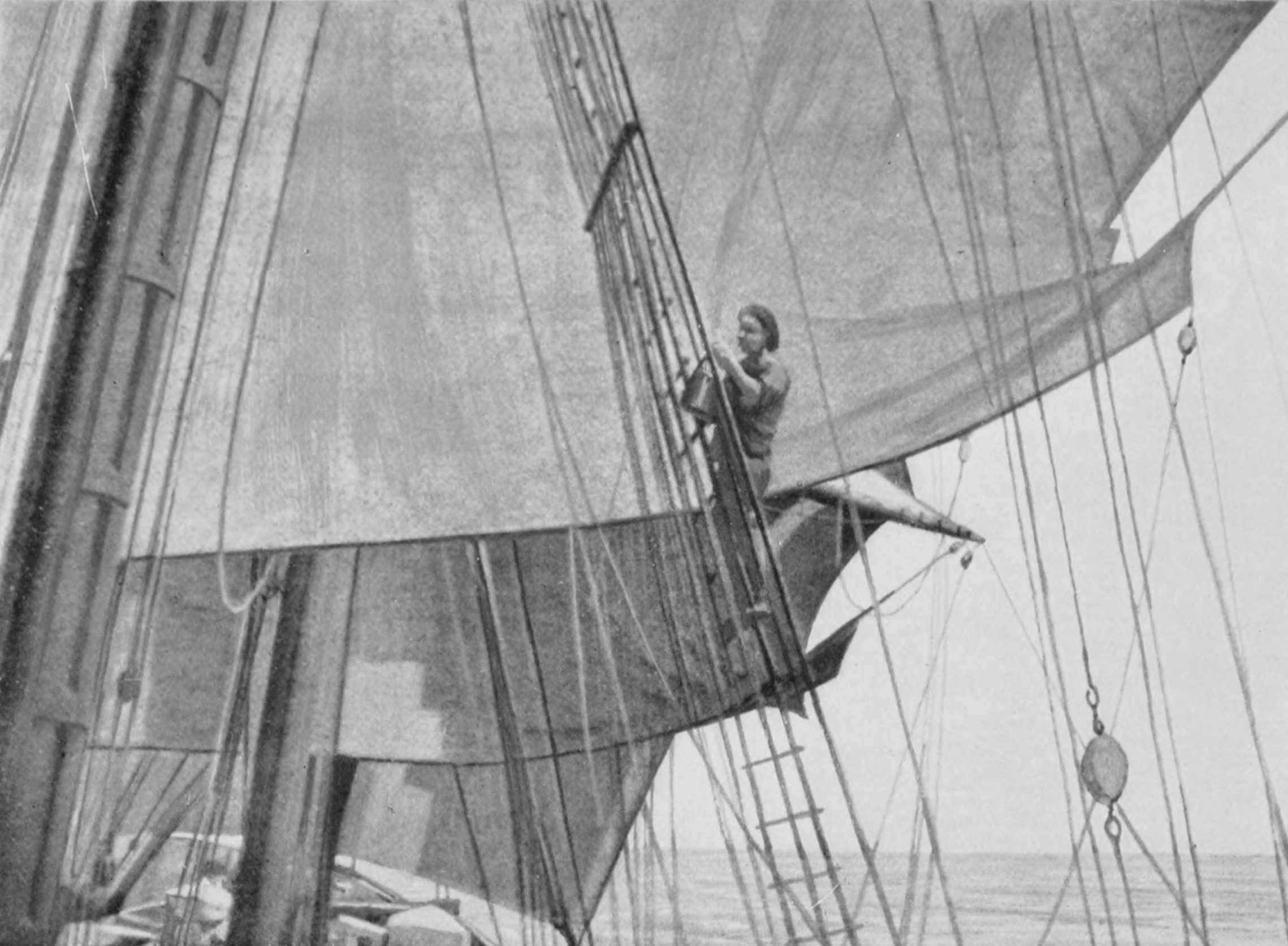
Tarring down
When at the pumps last evening I learned that the men had been deeply impressed with my having assisted the donkey the other night. Murphy especially seemed to extract much amusement from the fact, and when I told him that some exercise was necessary to health, he said that he never allowed that subject to bother him, adding, “There’s one thing I’m just grand at,—lyin’ in me bunk.” His appearance substantiates this statement, for he is as round and rugged as he was three months ago; I truly believe that he is the only man forward who doesn’t bear the marks of either Cape Horn or a belaying-pin. On the other hand, Louis the Gaul is the saddest and most dejected-looking man I ever saw. He has at all times that melancholy, dispirited look that one sees in the eyes of a captive ourang-outang. We talked together last night, and he informed me that this was his first American ship, and, please God, it would be his last. In very broken English, and in the deferential tones of a foreigner, he asked, “Sair, do your laws allow men to be treated as ze men are treated aboard zees sheep?”
“No,” I answered; “but so far there does not seem to have been any attempt made by the United States authorities to enforce the laws they have made.” Jacquin didn’t know enough English to go more deeply into the subject, and the talk drifted to the French navy, in which he has served sixteen years altogether; and when I told him that I knew the “Jean Bart” very well, his delight was child-like. Then he imparted a bit of rather astonishing news by saying that a man who has served for twenty years in the French navy (and it need not be all in one stretch) is pensioned by the government at three francs and a half per day. Besides possessing the second most powerful navy, France has some rattling fine square-riggers, such as the “La France,” the largest sailing vessel in the world bar the “Potosi,” the “Dunquerque,” and the “Quevilly,” the greatest tank sailing ship afloat, carrying one million gallons of oil in bulk between Philadelphia and Rouen.
Our pigeons have left us, and well they might, considering the latitude. What a distance they followed us! From 30° south in one ocean to 16° south in the other, and from the forty-fifth to the one hundredth meridian. Quite a stretch of salt-water that. Mother Carey’s chickens have come as a sort of compensation, hovering over our wake and darting down between the waves like swallows whizzing through the air after insects. Latitude, 14° 5′ south; longitude, 99° west.
August 15
Shall it be written that this day is the finest of all? It is even so, and I pray the reader to bear with me, and to remember that if he were in my place he would no doubt give expression to the same thought. If the entire voyage, except that part lying in the Pacific between the southern tropic and the equator, were composed of gales and snow-storms, it seems as though these winds would atone for any amount of previous distress and inconvenience. It seems wonderful that the atmosphere can possess simultaneously such exhilaration and such a smooth, luscious balminess. Oh, superb, glorious southeast Trades, thy equal is not in the world!
THE TRADE-WIND’S SONG.
Oh, I am the wind that the seamen love, I am steady and strong and true; They follow my track by the clouds above O’er the fathomless, tropic blue. For close by the shores of the sunny Azores Their ships I await to convoy; When into their sails my constant breath pours, They hail me with turbulent joy. I bring them a rest from tiresome toil, Of trimming the sail to the blast; For I love to keep gear all snug in the coil, And the sheets and the braces all fast. From the deck to the truck I pour all my force, In spanker and jib I am strong; For I make every course to pull like a horse. And worry the great ship along. As I fly o’er the blue I sing to the crew Who answer me back with a hail; I whistle a note as I slip by the throat Of the buoyant and bellying sail. I laugh when the wave leaps over the head, And the jibs through the spray-bow shine; For an acre of foam is broken and spread When she shoulders and tosses the brine. Through daylight and dark I follow the bark, I keep like a hound on her trail; I’m strongest at noon, yet under the moon I stiffen the bunt of her sail. The wide ocean through for days I pursue, Till slowly my forces all wane; Then in whispers of calm I bid them adieu, And vanish in thunder and rain. Oh, I am the wind that the seamen love, I am steady and strong and true; They follow my track by the clouds above O’er the fathomless, tropic blue.
Thus has Thomas Fleming Day delightfully written of the flowing Trades.
The men are busily engaged shearing away the great mops of hair that protected their heads in cold weather. Coleman (a man with a baneful eye and one who ought to be watched) seems to be the most accomplished tonsorial artist in the ship; he has already operated on half a dozen men, and all hands but one have assumed that appearance of cleanliness usual among sailors in the tropics. The exception is Tim, who, bar Mr. Goggins, is the dirtiest man on board. And now for a secret, profound and extraordinary! Let the peruser of these pages prepare himself for the concussion; let him brace himself for the impending blow! Mr. Goggins was seen to go forward to the galley an hour ago and return with a basin of water! Can it be possible that he is about to submit his face and hands to the purification of a quart, a whole quart of fresh water? But no; this could not be. Let us banish the thought. He would perish of shock. Yet it must be for this that he fetched the water, for it is the only conceivable use to which he could put it, so we live in hopes of a change at supper. We have never anywhere come in contact with a person so irreclaimably obnoxious, and we can only wonder why the captain allows him to come to the table in such a condition. If a man wants to be dirty, it’s his own personal affair; but when he becomes objectionable to others, steps ought to be taken to remedy the evil.
By far the most agreeable persons on board are the steward and cook, not to mention David MacFoy, who is so much more pleasant and entertaining than the rest that he forms a class all by himself. The cook, though, is a jolly little man, and welcomed us with much homely attention when we invaded his precinct the other day to learn how to make curry properly. To start with, it is hard to get good curry-powder even in India, and that which we brought back with us from Calcutta in glass jars is not as good as that which can be bought in San Francisco in square tins, that city being the only place in the United States where this particular sort can be obtained. But besides the necessity for good powder, there are certain proportions of chopped onion, flour, butter, etc., to be added in its preparation, so that in order to learn how to make curry properly it is necessary to witness the process as performed by an Indian or a Chinaman.
A rather interesting little fact to us to-day is that this is the first occasion on which three figures have ever been necessary to express our longitude. Latitude, 12° 5’ south; longitude, 101° 40′ west.
August 16
Fear not. I do not intend to say how much more beautiful to-day is than yesterday, though I should like to, and it is hard to refrain from doing so in such weather; but more than enough has been said on this subject. As a matter of fact, it is not quite so fine to-day, for the wind is dead aft, so that the after-sails are the only ones that do much good, and our run has not been quite up to the usual standard.
This has been a grand cleaning day forward. Every movable object was taken out of the forward house and spread on the forecastle-head in the baking sun, and a curious sight did the men’s old clothes and bedding present after lying mildewed and sodden for so many weeks. They lay in a wretched heap, the outside of which was composed of ancient, grimy bedticks, frowsy, ill-looking quilts, and disreputable, mouldy mufflers. The forecastle itself was then swept cleanly out and thoroughly washed with soap and water.
We have scores of snow-white birds with us now, about the size of common gulls, called bosuns. They are pretty creatures, with the most remarkable tails; for, instead of the usual fan-shaped arrangement of feathers, their bodies seem to be elongated into pointed spines, so thin and sharp that it is almost impossible to see the extreme end. These birds are very noisy and keep up a harsh croaking, whence their name, as a bosun is supposed to live in a continual state of exhortation. On coming up from supper last night just before six, we saw a plump, little feathered creature bearing down upon us, which had a very familiar appearance; and great was our surprise a moment later when we found that it was a Cape pigeon! Imagine one within six hundred miles of the equator! He must have been the last survivor of some vessel ahead of us, and, having abandoned her, concluded to stop and see if he couldn’t find some scraps here. He looked very calm sailing about on motionless wing among the flocks of bosuns and Mother Carey’s chickens that appear, in comparison, to make so great an effort at flying. This morning, though, we found that this, the last token of Cape Horn, had vanished. Mr. Rarx, however, didn’t seem much surprised at the appearance of the pigeon, and told us that he had seen them often in the harbor of Callao in 12° south.
In a maritime paper that the second mate showed us to-day there was rather an interesting article concerning the naming of ships. According to it, French merchant-vessels are usually called after provinces, towns, wines, and victories, but never after men, except the greatest men of French history. British ships are generally named after mythological characters, lakes, bays, glens, and cities; German vessels after rivers, ports, poets, states, and characters in German literature. The Italians name theirs after characters in Italian literature, and names of hope, courage, enterprise, and religion. Spanish ships are almost always called after cities or the great commanders in Spanish history. Norwegians and Swedes take the names of localities dear to them; while American ships are given the names of their owners, relatives, friends, or “any old thing.”
The same paper contained a short dissertation on scurvy. I wonder how many people there are who know that, according to the latest researches, scurvy is not a disease produced by eating salt meat? For many years Professor Torup, of the University of Christiania, has been studying this dreaded malady, scurvy, in all its forms, and about five years ago he proved to his own satisfaction that it is produced by ptomaine poisoning incident to putrefaction in meats which had not been properly cured or preserved. Fridjof Nansen believed in this theory, and when he was fitting out the “Fram” for her Arctic voyage he took the most extraordinary precautions to have every can or barrel of preserved meat that went on board in the best possible condition, particularly the salt meats. The sequel to this care was that upon his return every man on board was in perfect health, and had been during the three years’ voyage; this has been considered sufficient proof that it is poison in the meat, and not the salted meat itself, which produces that most ghastly of all diseases. Latitude, 10° 8′ south; longitude, 103° 56′ west.