LOUISA JEBB (MRS. ROLAND WILKINS) (continued 5)
Reading edition
The only gay and careless element is introduced by the Turkish soldiers. Mounted on splendid Arab mares they ride in front, sometimes dashing ahead at a wild gallop, holding out their rifles at arm's length, wheeling suddenly round and coming to a dead stop in front of an imaginary enemy, upright in their stirrups; in their more subdued moments breaking into song with the mournful Eastern refrains.
And so, forming one small world of our own, we "follow and follow the journeying sun," and as it sinks lower on the horizon and its fierce rays cease to beat pitilessly down on the parched ground and thirsty animals, a silence falls on the moving band. The spirit of the desert again holds sway. The men cease quarrelling, the animals' heads sink lower, the donkey looks more resigned, the mule more dogged, the camel more superior, the silent Arab more stern and forbidding; the soldier hums where he sang before. Then at last the walls of a solitary guard-house heave in sight. The men hail it with joyful cries, the soldiers dash ahead, the pack-animals prick their ears and quicken their steps to an amble. There is a general rush and tumble, culminating in a dead halt on the ground which has formed the place for caravans since caravans crossed the desert. All is noise and confusion. The loads are unloosed and fall in promiscuous heaps amongst the medley of animals, who, released of their burdens, roll over on their backs kicking up the dust. A line of men draw water from the well, pulling at a squeaky chain and invoking the aid of Allah in chorus as they pull. A fight is going on in one corner; men are knocking one another down, encouraged by a circle of yelling spectators. The din of excited quarrelling voices, the hammering of tent pegs, dominates everything, broken at times by the sudden neigh of a horse bitten by its neighbour or the harsh, imperious cry of the camel for its supper. And in the middle of it all the Turkish soldier spreads his cloak upon the ground, turns his face to Mecca, and offers up his murmured prayer to Allah, the one restful form in this scene of chaos.
"Allah Akbar" (God is great), prays this son of Islam, and with his hands upon his knees, he bows his head; "Subhana 'llah" (I praise God), and he falls upon his knees; "Allah Akbar" (God is great), and he bows his head to touch the earth; "Subhana 'llah, subhana 'llah, subhana 'llah," and he sits upon his heels; "Allah Akbar," and he again prostrates himself; "Allah Akbar, subhana 'llah."
And on this scene the sun casts his final rays of gold and red. As the shades of night draw in, quiet reigns once more; the men collect round the blazing camp-fire, and in its light we see the outline of their dark forms seated cross-legged, as they eat out of the common bowl or take turns at the bubbling narghile; to one side the mules are tethered in two lines forming a half square; a muleteer is grooming them, and one hears the rattle of his scraper and the ever tinkling bell. The cook is stirring our evening meal in a pot on the fire outside our tent. Hassan fetches our rugs and spreads them on the ground; we lie down and he covers us over with his sheepskin cloak. "Rahat" (Rest), he says, and lifts his hands over us as if pronouncing a blessing. Then he sits down beside us and lights a cigarette. "Bourda ehe," he goes on, describing the universe with a sweep of his hand. "Kimse yok" (It is well here—there is no one). "Is Allah here?" asks X. "Allah is here," he answers with simple reverence, "Allah is everywhere"; and we all lie motionless under the stars, unwilling to probe the silence by the sound of uttered thoughts. The murmur of the men's voices gradually dies away as, one by one, they doze off; a jackal cries in the distance; a star falls down to earth. The day is over, and in this land of the Oriental there is no thought of the morrow.
The passive silence of sleep; the active silence of communing souls; the silence of night—all fitful expressions of the one great Silence brooding over all, be one asleep or awake, by night and by day, in desert places and in busy haunts of men.
CHAPTER XXI
PALMYRA
It burst upon us all at once, Palmyra, in the desert—a chaos of golden pillars in the glow of the setting sun. We had been riding all day towards an indefinite shape on the horizon; slowly it had resolved itself into a barrier of yellow rock with dark lines becoming distinguishable against it. We had passed through the patches of rising corn, making green holes in the brown desert; we had wound through the gardens of pomegranate and plantations of palm trees and turned the corner of the ugly konak which barred the ruins from our view; and there it lay, the desert-girt city, in the unutterable lonely magnificence of its reckless confusion.
We drew rein under the Triumphal Arch; from here the eye is led on down the great colonnade from column to column, now upright, now fallen, to where a mile away a castle crowns a peak of the range under which Palmyra crouches—an old time harbour for the sand sea beyond.
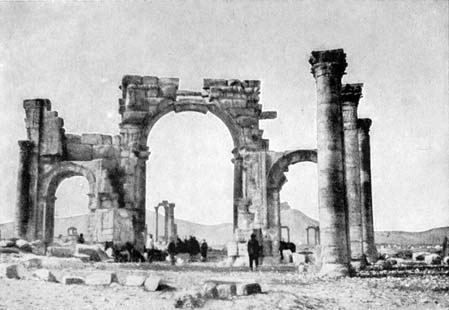
Palmyra. Triumphal Arch.
Behind us the present village of Tadmor was concealed inside the walls of the great Temple of the Sun; its mud hovels lie rotting behind the gigantic columns of the inner court in the dirt which chokes the massive archways. Here it is that the present life of Palmyra, such as it is, is slowly obliterating the remaining evidences of her past; while on the opposite side of the ruins, where the hills cleave to form a lonely valley, the dead of Palmyra, buried in a line of square tomb-towers, still keep alive the memory of her ancient greatness.
Was it the sun only, with its light on the yellow columns, that made one think of Palmyra purely as a city of gold? Or were one's thoughts unconsciously influenced by the fact that its traditions all rest on the getting of gold; its power was built up on trade; its great men were the successful traffickers of the desert; its statues and columns were raised to the memory of those who brought the caravans of goods from India and Persia unharmed through the dangers of the desert; its temples were dedicated to the Sun-god by those whose lives were spared in their getting of great wealth, or to the memory of those who perished in the attempt.
Those were the days when it was a man's boast that the blood of a merchant ran in his veins—when a youth could aspire to no higher goal than that of being a merchant prince of his proud city.
Her prosperity had been her ruin; the gold had led to her undoing; and now the Sun, to whom the temples had been raised at the time of her pride, mocked her ruins by giving them the semblance of scattered gold.
This is the best way to realise Palmyra—to make it the culmination of a long and tedious journey through the desert. The first sight of it under any conditions must indeed be wonderful, but coming in from Damascus, which is the natural approach for visitors to the ruins, one could never feel about it in quite the same way. Civilisation is only five days behind you; the country you pass through, moreover, although desert enough in a way, does not give you the same sense of being utterly cut off from everything in limitless space; there are chains of mountains to be seen in the distance, and cultivated patches stretching round villages are more frequent. Then when you arrive at Palmyra you ride first through the valley of tombs—it is the dead that give you the first greeting; you get glimpses through the opening ahead of the highest columns, and are slowly prepared for what is coming, until, emerging finally through the gap, the whole scene is laid out before you, with the gleaming desert beyond.
But approach it from the desert side, and all the meaning and force of its one time existence is borne in upon you with an overwhelming realisation. For three weeks you have been following the old trade route from the Persian Gulf. You have made one of a caravan amongst the doggedly jogging mules and the slow stepping camels, both heavily laden with the clumsy pack-saddles holding bales of merchandise; the sound of their jangling bells is the only sound you hear through the long, monotonous ride under the blazing sun; you have spent night after night in the circle round the camp-fire, with the men crouched under the bales of goods piled up on the ground to form a rude shelter; the places where you stop have been the regular halting places for caravans for all time—now they are oases big enough to support a village, now it is merely a well and a guard-house. As you ride through the immeasurable expanse every dark object on the horizon line forms a subject for speculation. Its appearance is a signal for the hasty consolidation of the straggling line of men and animals, arms are looked to, you all close up and ride on, apparently unconcerned, but equally prepared for a sudden onslaught or a friendly greeting. For it is not only the difficulties and dangers due to Nature's barrenness that have to be guarded against. What must it have been in the days when the countless hordes of wealth of a huge caravan were at stake, and when the whole desert was beset with marauding tribes specially on the look-out for such prey? What must have been the feelings of those responsible for its safe conduct when they once more saw the first dim outline of the Palmyra hills in the distance? The goal would be reached that day; the troubles, the anxieties, the sleeplessness of the watching nights would be over; proud and triumphant they would ride down the long colonnade, the pack animals jostling one another in the unaccustomed crush of the bounded way, and the noise of shouting drivers and jangling bells sounding strangely loud and near in the confining space. Down on them from the columns above would look the statues put up to honour those who had achieved the same feat which they themselves had just accomplished. Their names too would now be written up and handed down from generation to generation in remembrance of the service they had rendered their State. For such deeds as these had built up the great city, and their fellow-citizens honoured them in this way.
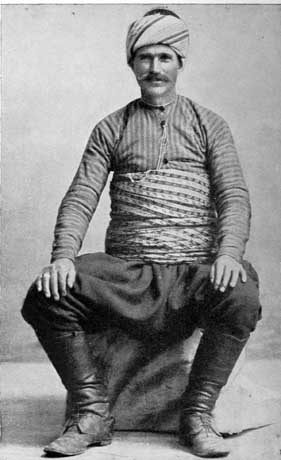
Hassan.
At first it would seem that Tadmor was merely an Arab encampment, a stopping place amongst others for the passing caravans. The abundance of its water and its position on the meeting point of two great trade routes would gradually cause it to become an important centre. Dues were levied on all goods passing in and out, and even the privilege of using the wells was heavily taxed. Slowly it became the market-place of the East and the West; its inhabitants were the carriers between the Persian Gulf and the Mediterranean Sea. As the foundations of the city were built up on trade, so commerce was a pursuit for its aristocracy, involved as it was with all the elements of warfare and danger. Its merchants would be pure Arabs of good blood, welcomed as equals by the shaykhs of the desert tribes through whose territory their goods had to pass. Palmyra had thus gradually built up her own existence as an independent State. Political events then added to her power. The wars of Rome with Persia made her an important military post; recognised by Rome more as a partner State than a dependency, she was able to pursue her own policy with such effect that she tried to assert her entire independence and cut herself adrift from the Western power. Taking advantage of the temporary ascendance of Persia over the Roman arms, the desert Queen, Zenobia, fulfilled her ambition as sole Queen of the East. After her defeat by Aurelian the town was partially destroyed; a change in the political factors which had contributed to her importance now hastened her downfall by lessening the significance of her geographical position; safer trade routes further south led to the decay of her commercial prosperity. Bit by bit she loses her place in historical records, and at the present day Palmyra stands a lonely ruin on a deserted trade route, inhabited by a score of Arab families.
In one sense Time has dealt gently with her; there is no decay from the growth of vegetation in this dry climate. Neither moss nor ivy has softened the aspect of destruction; the overturned columns show as true and sharp a face now as the day they were set up, and the ornate carving stands out in the same relief. One thinks of the place as built entirely of columns; they lie in rank profusion everywhere, like a great forest of trunks overturned by a gale. The great central avenue runs from the Temple of the Sun in a north-westerly direction to the castle on the range of hills which bounds the city to the north. It has been calculated that it alone contains 1,500 columns. Much of this still remains standing, but the gaps become more frequent, until at the castle end the whole thing has collapsed, forming a perfect sea of broken columns and fragments of carved pilasters. It is evident that the minor streets also were lined with pillars in the same way; short rows of them stand up here and there in various directions. Groups of twos and threes suggest also their attachment to some public building or temple. The statues were placed on brackets projecting from the upper part of the pillars, and the inscriptions below, which have escaped destruction, give the names and dates of those whom they were intended to honour.
As we had entered Palmyra with a vivid conception of its life, so we left it with an equally vivid conception of its death.
Standing guard like a row of sentinels at the base of the hills are the square tomb-towers in which Palmyra buried its dead. The proud merchants seem to have been imbued with two main ideas: the erection of columns in their lifetime and of resting places for their families in death. Many of the towers are over a hundred feet high and consist of five and six stories. The bodies were arranged in tiers in the recesses on either side of a central chamber. Some of these buildings are still nearly perfect, others are practically heaps of ruins. The bones of the proud merchants are mingled with the bones of the wild beasts who have sought refuge there through the long ages.
We turn our backs on the city and ride away through the gap in the hills. The city is hidden from view, but the tomb-towers still stand in silent rows down the valley on either side.
We forget the golden pillars and all the ruined magnificence; we can think of nothing but these ghostly towers seeing us out, as it were, from this city of the dead.
High up on the hill above, in the still morning air, a shepherd boy pipes merrily at them, and flocks of goats and sheep browse unconcernedly at their feet.
CHAPTER XXII
AN ARMENIAN AND A TURK
I. Arten.
Arten was an Armenian; he was quick, thin, methodical, dirty, intelligent, and untruthful; he was also the cook. I say the cook advisedly, for a cook he was not. No doubt he would have made an excellent cook if he had known anything about the art; but it was not till after we had engaged him in this capacity that we discovered that he had not thought this qualification necessary. At any rate, he knew, being a hungry man himself, that we were in need of food of some sort at stated intervals. In this he was a decided improvement on the Greek cook we had just dismissed; this man had a habit of coming to us, after we had been waiting hours in momentary expectation of a meal, and saying with a languid air, "Do you wish to eat?" He was a good cook, but always seemed overcome with astonishment when we expected him to cook.
Arten was a dirty man, and he looked dirtier than he was owing to his dark complexion and hairy hands; besides this, his unbrushed and greasy black European clothes showed off to disadvantage amongst the simpler Eastern garments of his companions.
"Arten is not a clean cook," Hassan would say, and Arten would smile sadly. He must have been slightly conscious of this defect, for he never handed me a plate or a spoon without saying "Temiz" (clean) as a forestalling measure before I had even looked at it. He spent a good deal of time rubbing smeary plates with a blackish cloth, murmuring "Temiz, temiz."
He had a sincere desire to please us; but he always imagined this object was attained by the vigorous assertion of any fact that seemed necessary for our pleasure. "Taze" (fresh) he would say every time he handed me an egg; and, when I cut off the top and an explosion followed, "Taze" he would say again.
"Eat it yourself then," I would suggest, handing it back to him; after putting his great nose right into it, "Taze," he would say. But he never ate it; he kept it for omelettes.
His nose was his chief feature. One saw the nose first and then the man behind it. On cold days, when we all wrapped our heads and faces entirely in keffiyehs, Arten would be always distinguishable from the others by this protrusion. He had a jet black drooping moustache which he was always wiping furtively with a jet black pocket-handkerchief, for Arten was a greedy man and the only person who loved the taste of his own cookery.
"I like to see him getting fat," X would say; "he looked half starved when he came to us."
But Hassan and I were not so charitable.
"Look," Hassan would say, "the door of the tent is shut; that pig Arten is stealing the food," and he would go and kick at the tent until Arten looked out, guiltily wiping his moustache.
"You are cold, I suppose," says Hassan with lofty sarcasm. Arten mops his perspiring brow—he was always perspiring.
"How cold?" he answers with well feigned surprise.
"Because you shut the tent door," answers Hassan.
"Amān," rejoins Arten, "what am I to do? if the muleteers see me cooking they come and ask for food; they are such greedy men, the muleteers."
Hassan returns to us snorting.
"Arten says the muleteers are greedy men. Mashallah! greedy men! We know who is the greedy man!" And he slaps his thigh vehemently.
Arten's notions of cookery were, as I have said, limited. His staple dish was a mixture of mutton, potatoes, onions, and rice, which were all cooked up together in the same pot, each ingredient being thrown in according to the length of time it took to cook. It certainly tasted very good, and I would suggest the method to those in England who dislike washing many saucepans. His other idea of cooking mutton was less satisfactory in results, though simpler in method, and I have no hesitation in not recommending it to English housewives, though I append the recipe as a matter of interest from its originality.
Take a piece of sheep, and with an axe cut it into chunks, regardless of bones or gristle; take a chunk and throw it on to red-hot charcoal in a brazier; when there is a distinct smell of burning and the hissing has nearly ceased, turn it over on the other side. When it resembles a piece of burnt charcoal, remove it and serve at once; swallow whole, as if you try to bite it your teeth will remind you of it for a considerable time, and in any case you will be conscious of its resting-place for the remainder of the day.
When staying at a consulate in the middle of our tour, the consul's wife, horrified at our fare, offered to let her cook teach Arten a few simple dishes which would considerably add to our comfort. Arten acquiesced with very good grace, and was inducted, amongst other things, in the art of making cutlets. On our departure our kind hostess, moreover, provided us with a piece of meat suitable for cutlets. The first evening there was an undercurrent of excitement in the air; there were to be cutlets for dinner. Arten had an important, self-conscious bustle about him and looked mysterious; the Zaptiehs seemed awed and asked questions under their breath; the greedy muleteers were distinctly interested; we pretended to be unmoved. Finally, with a modest air, through which bumptiousness glared furiously, Arten announced that supper was ready. There was a covered dish keeping warm under the brazier; Arten very deliberately placed it before us and with a dramatic flourish removed the cover. We were only conscious of a yellow-looking crumby paste.
"Where are the cutlets?" we asked, keeping up our courage nobly.
"That is cutlets, Pasha."
We tasted it; it appeared to consist of fried eggs and breadcrumbs. We felt justified in contradicting him, but he still persisted that it was cutlets.
"But we want the cutlets, like those the Effendi's cook showed you how to make."
"Yes, that is it, Pasha; that is what the Effendi's cook showed me."
"But cutlets are meat," we persisted.
"Yes, Pasha; but that is cutlets without the meat."
This reasoning was incontrovertible. We tried to fill up with dates and rice and went to bed crestfallen and hungry. The next day we returned to the charge. I undertook to show Arten how to cook cutlets, though I had not the smallest idea myself how it ought to be done. I had an inkling, however, that egg and breadcrumbs were in it somehow.
"Arten," I said, "cut the meat as the Effendi's cook did for cutlets." Arten obeyed.
"Make egg and breadcrumb," I said. He did this also.
"Now do with it what the Effendi's cook did," I said. Arten smeared the meat with it. I began to see light and breathed more freely, but I had still one venture to make.
"Now cook the meat as the Effendi's cook did," I said.
I held my breath; for all I knew they might now have to be boiled in a saucepan or toasted on a fork. But Arten appeared to know what he was doing. He took a frying-pan and fried them in fat. A glow of satisfaction crept all over me as I watched them beginning to resemble the finished appearance I was acquainted with. When they were actually on a dish, I said loftily:—
"Please remember for the future that when we say we want cutlets, this is what we mean."
"As you please," he answered affably; "I call them frisolen. I knew how to cook them before the Effendi's cook showed me," he went on.
"Why did you never let us have them, then?" I said severely.
"How could I know you would like them?" he answered with injured innocence.
"How did you know we liked tough chunks burnt on a brazier?" was my icy retort.
Arten shrugged his shoulders; there never has been any accounting for the whims of women.
Small differences of opinion such as these were continually cropping up between us; and I would tell him in calm and measured tones, though in forcible English, what I thought of him. As the language was unintelligible to him, this method had the advantage of relieving my feelings without hurting his. But there were secret bonds of sympathy between us. We both suffered intensely from the cold, and Arten would carefully wrap things round me so that the apertures and crevices were not on the windward side. There is a good deal of art in this, and he did it very scientifically.
"Little things feel the cold," he would say compassionately, and in such a kindly spirit that, for the moment, I forgave him his greed and forgot to feel undignified.
We were also on common ground when I tried to cook dishes which I did not know how to cook. Currents of great sympathy ran between us when things did not seem to be turning out right and Arten would tentatively suggest various ways and means. But he never did what a foolish or disagreeable person would have done: he never expressed in his looks that I was no better than himself, which obviously would not have been true, since I did not pretend to be a cook, while Arten did.
And then when the critical moments of our existence arrived and we placed the dish before X, we both watched with the same intensity for the expression of her face after the first mouthful. X was singularly appreciative, and, when she kept assuring us how excellent it was, Arten would glance at me encouragingly and appear to share the delight I experienced at my own prowess. X thought Arten's cookery good, too, but then she never knew what she was eating, and, if you do not know the name of the dish, how can you judge whether or not it is cooked as it ought to be?
"What is this?" X would ask one day.
"Mutton," Arten would answer.
"What is this?" she would say the next day, when the identical substance was handed to her.
"Chicken," Arten would answer. And X was perfectly satisfied.
The next day it would be "tinned meat," and it was all the same to her—and to me; but then I knew what a liar Arten was.
His kindness of heart and his desire to please us made it all the more difficult not to be irritated with him when circumstances did not draw out the better side of his nature. It is uncomfortable to despise people in a qualified manner, and I found it impossible to despise Arten unreservedly and therefore happily. There was no doubt that he was a horrible coward. If he had said, "I am a coward—I am afraid," he would have enlisted my sympathy for what it was worth, because I was a coward myself and admired sincerity. If he had even preserved a decent silence on the subject I should have been unable altogether to despise him, for that was the course I pursued myself. But when any real or imaginary danger was past he would come out with assumed and aggressive hilarity, and make tales about it and his prowess, which latter he had already made conspicuous enough by its absence. Yet his position was no doubt complicated: he knew that the Turks in our train despised not only him but his race; there was no one to suggest his courage if he did not do it himself, and, as he was unable to exhibit it in deeds, I have no doubt he saw no other course to pursue but that of publishing it by word of mouth. Moreover, he had suffered personally from bad treatment; the tale was a piteous one. Near his native town of Adana he had a small mill where he ground corn through the season. On one occasion he had done well and was on his way back to his wife and children in the town, carrying his earnings, which were to keep them through the winter. Half way home he was attacked by a band of robbers, who relieved him not only of his gold but of all his clothes. He had to remain in hiding by the roadside until some one passed from whom he could borrow a garment in which to return starved and penniless to his expectant family. Small wonder that the poor man shuddered at the word "Khursus" (brigand) which we laughingly joked about.
"What is it to you?" he said one day; "you have rich relations, kind friends, and a just Government. If you are robbed, justice is done to you. But what can I expect but more abuse and ill-treatment?—and I have a wife and small children into the bargain!"
When he was not posing as a hero, he was posing as a feature in the landscape. This was particularly exasperating, for no amount of pity for his condition would turn him into a picturesque martyr, even in the foreground of ancient ruins. No sooner was my camera produced than Arten produced himself. The only occasion on which I knew him keep out of sight was when I was trying to get a snap-shot of the band of Kurds who held us up on the Tigris. He seemed to have no desire to show himself, although I was considerate enough to invite him to occupy a prominent position for once. His appearance was not calculated to enhance the effect of any picture. He was like a starved black scarecrow dressed up in tight and clerical garments, with a fez on the top—and then there was the nose. He would have made any warm desert scene look cold, as it would not be obvious that he was perspiring, and in any group of picturesque natives he would look ludicrous.
I recall, as I write, isolated moments of exasperation—when, for instance, he sat, singing a hymn, kicking up the dust with his heels, when we were trying to inflate ourselves with worthy feelings on the contemplation of Babylon, awed by the silence and desolation of the scene around us. Or again, how in a fit of nervousness he hurled the whole of our dinner in agitation on the floor, while we, after an unusually long fast, could have cried for food.
But reviewing him calmly at a distance, one remembers a man that one alternately laughed at and pitied; who annoyed one by his transparent faults, but who commanded one's sympathy by his tragic condition, and one's admiration by his cheerful willingness in trying circumstances. A man who was meant by nature to be light-hearted and happy, kind to his fellows, energetic and interested in his work, ambitious for his children; but who fate dictated was to have his spirit quenched, his nature hardened, and mean and cowardly qualities developed owing to the fear, injustice, and poverty in which, like the rest of his countrymen, he was condemned to live.
II. Hassan.
Hassan was an Albanian Turk; he belonged to one of the old Turkish families and looked every inch the gentleman that he was. Introduced to us by a common friend, he accompanied us during our seven months' wandering through Asiatic Turkey in a semi-professional capacity, but what that capacity was it would be difficult to define by any particular name. A dragoman he was not, though he called himself our "tergeman." "Tergeman," literally translated, being "interpreter," he could claim nothing entitling him to this function, for he spoke no European language, and it was not till we learnt Turkish that we could hold any spoken communication with him. Briefly, he acted as a sort of amateur dragoman without any of the qualifications usually expected of these gentlemen—and possessing a great many of the virtues in which, as a rule, they are sadly lacking. Essentially he was our Figure-head, and a splendid one he made, six foot six in stature and broad in proportion, as straight as a die and as supple as a willow, with a handsome head set well back on strong shoulders, and keen, kindly eyes which looked out very straight from under shaggy eyebrows. When he walked he put into his great stride a grace and dignity which soon earned for him the nickname of "the Prince." His chief characteristics were that gentleness which comes of great strength under perfect command; the courtesy which arises from a sense of other people's worth measured by a sense of his own; and an imperturbability which could be as irritating as it was admirable. "Ne faidet?" (what is the use?), was a favourite expression of his, and "ne faidet," he looked all over. In scenes of human quarrel, excitement, or danger, one was chiefly conscious of his calm indifference of mind and manner as he silently surveyed his companions in fear of brigands or in joy over a piece of meat. Yet he was a man full of the passions of his race, capable of an iron self-control when he thought fit to make use of it, but occasionally roused into a state of temper bordering on madness. On these occasions he would afterwards say his "jan" had had him by the throat, and he did not know what he was doing.
A great man with a great imprisoned soul, as free and light-hearted as a careless boy when roaming in the great forests or on the bare mountain-side of his native home, fettered and fretful when the bonds of artificial civilisation held him.
"What a Kallabalak! what is the use of this Kallabalak?" he would say with a wave of disgust when he got into the middle of a noisy crowd. "This is good, this is keyf," was his comment, with great gasps of enjoyment, when we three sat on the ground together in some lonely spot of a lonely desert. One felt he was breathing freely again. A silent man by nature, he could not bear loquacious people. "Burra, burra, burra," he would say, pointing his thumb at them; "burra, burra, burra, what is the use of all this talking?" If the remarks were addressed to him, they were always answered with stern courtesy. A talkative young Armenian rode with us one day and tried to draw him into conversation. "Is not that mirage in front of us? What a wonderful sight—trees and water and mountains! Do you not think it must be mirage, Effendi?"
"With the eyes that Allah has given me, it does seem to be so, young man," was Hassan's grim answer, and he rode on without turning his head to right or left.
Yet on occasion he enjoyed a refined "Kallabalak." One night in Cairo, when we had done for the time with camping and were seated in cleanliness and finery in the hotel garden, a confetti feast was going on. Serious young men and maidens, larky old men and festive matrons, were diverting themselves in the essentially hilarious proceeding of scattering confetti on one another. The garden was hung with Chinese lanterns; fireworks hissed and spluttered, shooting flames of colour. Hassan sat in convulsed enjoyment of the gay scene. It was a revelation to him of the lighter side of life. And when a charming young lady, bolder than the many who cast coy and curious glances at the handsome Turk, came and administered a dose of confetti down the back of his neck, he was overcome with glee and merriment. Afterwards, on subsequent wanderings in wilds and deserts, he would turn to us after hours of silence, and, bursting into a deep roar of laughter, would say, "Do you remember the paper and the foolish men and women?"
His function, as I have said, was first and foremost that of Figure-head; he escorted us on our visits to Turkish officials and dignitaries, and, with grave dignity and courtly manner, unembarrassed by his own unshaven chin or the stains and dust of travel on our weather-worn and unwashed garments, he would make the most of anything entitling us to belong to "the great ones of England." He cast a general air of respectability over us, and we always felt it was largely due to him that we were shown so much consideration in a land where all travellers are treated with suspicion, and where women are not regarded in a particularly chivalrous light.
But beside this, he was general caretaker of our personal comforts: he put up our camp-beds and arranged our tent; he always sat beside us at meals, which we took seated cross-legged on the ground, either outside by the camp-fire, or in bad weather on the floor of the tent. His first self-constituted duty was to peel the oranges with which we generally finished a meal; he removed the peel to form two cups, in which he neatly piled the sections and placed them beside us, carefully counting the pieces to make sure that he had treated us alike. "Shimdi" (now) he would say when we had finished the first course and we would ask for dates. "Shimdi" he would say again when the last of these were demolished. "Shimdi Kahiveh," and coffee would come in its turn. "Shimdi." "Nothing more." "Nothing," he would exclaim; "nothing?" "We will smoke now." "Tütün (tobacco), aha, Shimdi tütün," and he would light us each a cigarette. Then, when this too was finished, "Shimdi"—"Shimdi Rahat" (now rest), we answer—and he makes pillows for us with our saddle-bags and covers us over with rugs. This process was repeated every day until it became a stock joke. His jokes were all of this kind; there were certain standing ones which had to be gone through periodically. My Turkish was limited to about fifty words, so that conversation between us did not flow, but X, who had learned to speak more fluently, would ride with him for hours together, holding endless conversations on Turkish religion, habits, and ideas. When X and he fell out he would come and joke with me: one day I teazed him about being a better friend to her than to me.
"How can that be?" he said gravely.
"Because," I answered, "you quarrel with the Vali Pasha" (X was the Vali Pasha and I was the Padishah), "and then you make it up and are great friends again. But you are never cross with me. If I were your friend you would quarrel with me, too. But I am glad I am not your friend, or you would get angry with me." This idea seemed to tickle him immensely, and every day after this conversation there would be a moment when he would ride alongside of me, and, feigning an air of great disgust, would shrug his shoulders and say, "Istemen, istemen" (I do not want you). It was his singularly primitive way of acting a quarrel with me, and thereby showing that he and I were also friends. X would also attack him on the subject.
"Why don't you go and scold the Padishah?" she said on one occasion; "she thinks the same as I do about these things, only she cannot talk Turkish, so she does not say them."
"The Padishah is but a child," he answered; "it would hurt her. It would be a shame to hurt a child."
As a matter of fact I was older than X in months, but her bodily proportions were larger than mine, and everything goes by size in the East.
As time went on, however, we too had our little rubs, and his methods of making friends again were what one would expect from his schoolboy nature. If I was in the tent, he would throw stones at it until I looked out smiling; this was taken as a sign that the quarrel was over; he would roll up an extra large cigarette for me, and we would sit on the ground and have a smoke of peace together. Our friendship was of a silent nature. I made my fifty words express everything I had to say, and to simplify matters only used the verbs in the infinitive and nouns in the nominative. Long custom had established a certain meaning to various sentences between us which would have been unintelligible to any other Turk.
"What Turkish, amān, what Turkish she speaks!" he used to say to X, holding up his hands in amused dismay.
We taught him a few English sentences, of which he was very proud.
"Pull it up," he invariably said when he held out his hand to help us off the ground.
"Pull it down," was his formula when he arranged our habit skirts after mounting us.
"Pull it off," when he helped us off with our oats.
When he was in a temper I made him say, "I am a silly man," which he pronounced:
"I am——
"A Silliman."
Although he did not know the meaning of the words, he connected them with his own misdemeanours.
"Silliman yok (not), silliman yok," he used to say fiercely when he was beginning to repent and get ashamed of himself. He always said "Good-bight" for "Goodbye," confusing it with "Good-night."
Great was his pleasure whenever in the course of our travels we came across a European, or any one who could speak a language which I understood.
"See now," he would exclaim at the unwonted sight of me talking with any one, "she has found a friend!" And then, when we parted and I relapsed into silence: "See now, how sad she looks! She is thinking of her friend."
And he would ride up to me compassionately.
"Where is your friend now, Padishah?"
"Where, indeed?" I answer. "I have no friend; you must buy me one in the bazaars next time we get to a town."
"And how much money must I give for him, Padishah?"
"You must not give much, because I am poor, but you must get a very good one."
"Amān, amān, see now what she says: I must get a good one, and yet not give much money. Do you hear, Vali Pasha?"
And when he came back from the bazaars:
"I have bought the friend, Padishah."
"Where is he? I don't see him."
"He is here, in my bag."
"How much did you give for him?"
"Ten piastres."
"He cannot be a good one if he is as cheap as that, and so small that he will go in your bag."
"Oh yes, he is a good friend," and he produces a roll of tobacco; "a good friend and little money. That was what you said, wasn't it, Padishah?"
And I reflect that there is many a true word spoken in jest.
"Has she no friend in England," he asked X one day, "or does she never speak in England either?"
"Yes," said X, "she has a friend in England, and she does not speak because she is thinking of him."
"And you, Vali Pasha, have you also a friend in England?"
"Yes," I answered for X; "she has twenty-nine friends in England, and you are only the thirtieth."
And Hassan would ride on in silence, pondering over the strange ways of English ladies.
Amongst his other duties he had to purchase the food, pay the muleteers and soldiers, and give tips; and it fell to my lot to do up the accounts with him periodically. The unusual mental exertion required by this he found very trying. His imperturbability would forsake him completely. On the first occasion he broke down altogether. "What can I do with figures?" he said, the tears rolling down his cheeks; "let me go back to my hills and forests; I am only a poor hunter. She brings out her little book and I shall not know how the piastres have gone, and she will think I have taken her piastres," and he laid his head on his knees and groaned aloud.
When we became better acquainted, however, "hisab" (accounts) became a joke, though they always caused him to perspire profusely.
At first my entire ignorance of the language made our intercourse over the account-book somewhat difficult. We would sit on the ground opposite one another, and Hassan would fumble in the folds of his belt until he had found his spectacles and his account-book.
"Are you ready?"
"Yes."
"Peki (very good), Effendim; yimurta (eggs), 2 piastres." I would write it down.
"Yasdin me?"
"Ne yasdin me?" (what is "yasdin me?").
"Yasdin me? yasdin me? yasdin me?"
I have not the smallest idea what "yasdin me" means, but I pretend to write it down and then say:
"How many piastres was it?"
Hassan makes a gesture of despair.
"Yasdin me? yasdin me? yasdin me?" he repeats again.
"X," I shout across the tent, "what does 'yasdin me' mean? I suppose it's some sort of food, only he won't tell me how many piastres it costs."
"It means 'Have you written it?'" said X calmly.
"Yasdin me?" repeats Hassan again.
"Yes," I answer meekly.
"Aha, now she know," says Hassan, and he mops his forehead vigorously. "I say 'Yasdin me' and she says, 'How many piastres?' Amān, amān!"
"Peki, Effendim" (very good), he goes on. "Etmek (bread), 3 piastres. Have you written it?"
"Yes."
"Peki, Effendim. Et (meat), 12 piastres. Have you written it?"
"Yes."
"Peki, Effendim. Pilij (chicken), 3 piastres."
"Ne Pilij?" (what is pilij?).
"Pilij, pilij, pilij."
"Yes, but what is it?"
"Pilij, pilij—she doesn't know pilij, and she learns it every day."
He begins to crow like a cock.
"Oh yes, I know."
"Ah, ah, now she knows! Peki; pilij 3 piastres. Have you written it?"
"Yes."
"Peki, Effendim."
And so we go on through all the items, and finally add up the total in our respective languages. By means of holding up our ten fingers a large number of times, we ascertain whether the results tally, for in those early days I could only count in Turkish up to twenty-nine, and knew the words for a hundred and a thousand. Then Hassan would give a great sigh, close his book, fold his spectacles, take off his fez, and wipe his head all over, and finally forget his troubles under the soothing influence of tobacco.
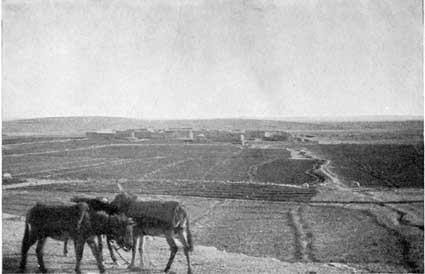
Erech. Syrian Desert.
And so the days slipped away. At the end of six months we landed out of the Syrian desert into Damascus. An immense change came over Hassan when he was released from the anxieties of piloting us through impossible places and rumoured dangers. He became more boyish and cheerful and amused at everything. His first care on arriving at the end of our journey was, after spending several hours in a public bath, to go a clean and happy man to the Mosque, to return thanks to Allah for having brought us safely through.
We had been to call at the consulate, and, as we drove up to the hotel on our return, I caught sight of Hassan in the street with a crowd round him; he was strutting up and down in his shirt-sleeves, with his head even more thrown back than usual and a wild look in his eye.
"Good heavens," I said to X, "the Prince must have got into one of his tempers and killed a few people in the street," and I anxiously looked round for signs of gore. The Prince took no notice of us, but stalked up and down, the crowd making way before him with looks of awe.
"What are we to do?" I said; "he looks as if he had gone off his head and would knock down any one who comes near him."
"He does look like a prize-fighter," said X; "I have never seen him look like that before."
Our cook was standing on the steps.
"What is the matter with Hassan?" I said to him.
The man stared.
"Nothing," he said, "it's only his new shirt."
We went inside, telling him to fetch Hassan to us.
The Prince stalked into the room with the same air with which he had been stalking the streets, and stood in front of us with an excited and expectant expression.
"The cook is right," said X; "it is his new shirt. He is overcome with pride and conceit; he is on parade, that's all."
He certainly had something to be conceited about. The shirt was of fine silk in gorgeous yellow and red stripes; round his waist was a wide, bright-coloured kammerband, round his head a new keffiyeh flashed all the colours of the rainbow. Clean and shaven, his tight-fitting shirt showing up the strong outline of his muscular frame, he exhibited, to say the least of it, a striking spectacle.
We were evidently expected to be overcome at the magnificence of his appearance, and certainly we did not disappoint him in this respect.
"You are grand," said X to him in his own language; "you quite surprise us."
Hassan put his hands into his trouser pockets and strutted up and down the room, speechless with delight.
"Who would have thought you could be such a turkey-cock, you old gander!" I said in English.
"What is she saying?" said Hassan to X.
"She says you are just like a very magnificent bird we have in England," answered X.
Hassan beamed triumphantly.
"You have fine clothes," he said; "I must not disgrace you."
"Is he always going about in his shirt-sleeves, I wonder?" I inquired. X asked him.
"It is quite usual in my country not to wear a coat in hot weather," he said; "my coat is old and dirty, and my shirt is new and clean: why should I wear my coat?"
And he rarely put it on again.
He loved to see us in nice clothes, and took great delight in wandering about the bazaars with us buying presents for the "twenty-nine friends" in England. But we used to sigh over the good old camping days.
"Hebsi bitdi" (all is over), he would say dolefully, when anything particularly brought them back to our thoughts.
We rode down Palestine and took him over to Egypt with us. Evading with difficulty the importunities of Cook, and the rush of tourists on the beaten track, we tried to steal days which brought back a sense of our old free-and-easy times.
But there came a day when there was an end to it all, an end to the long silent rides, an end to the quiet smokes in desert places, an end to the little daily jokes, an end to the serious talks and the foolish quarrels, an end to the Kallabalaks and the Keyfs.
We stood on the steamer which was to take Hassan back to his old life in the forests of the Turkmendagh.
"You will soon be going a long journey with some one else," said X cheeringly.
Hassan shook his head.
"No, indeed," he said; "I should take care not to go with two ladies again, and I shall not go with a man, for no man would be so much of a fool as to wish to go such a mad journey."
The steamer gave vent to its first hideous whistle. We put our fingers to our ears.
"Good-bight, little Padishah," he said, as we clasped hands for the last time; "good-bight. Go home to your friend in England; he will be glad to see you looking so fat."
"Silly man," I said with a lump in my throat.
"Silliman yok," he answered.
The whistle blew again, we turned and went our different ways. If there had been a stone he would have thrown it after me; as it was, when I turned he made a face and shouted, "Istemen, istemen!"
And now, looking back on those days, there rises invariably before us the memory of this companion in our many adventures—the memory of a simple-minded, honourable man, a trusted friend, a pleasant companion, and a devoted servant, who, whether he was sharing the discomforts and dangers of winter travel in a wild and lawless country, or experiencing the joyous freedom of the roaming desert life we loved so well, or enduring the terrors of critical and carping civilisation, invariably put us in the foremost place, and, without swerving an inch from the traditions of his race, never offended the susceptibilities of ours.
CHAPTER XXIII
RETROSPECTIVE
Last night we were dirty, isolated, and free; to-night we are clean, sociable, and trammelled. Last night the setting sun's final message written in flaming signs of gold was burnt into us, and the starry heights carried our thoughts heavenward and made them free as themselves. To-night the sunset passed all unheeded and we gaze, as we retire from the busy rush of the trivial day, at a never-ending, twisting, twirling pattern on the four walls that imprison us, oppressed by the confining ceiling of our room in the Damascus Palace Hotel.
We are no longer princesses whose hands and feet are kissed, whose word is law, sharing the simple hospitality of proud and dignified wayfarers in desert kingdoms. Our word is law according to the depth of our purses, our hands and feet are kissed according to the height of our floor in the hotel. We are no longer in a land where men and women are judged by their capacities for being men and women: the cost of our raiment apportions our rank.
We are now no longer amongst people to whom we say what we mean and are silent when we have nothing to say. We are in surroundings where to say what you mean is an offence, where silence is not understood and looked upon askance as an uncanny visitor. The less we have to say, the more we make an effort to say it; and the more we have to say, the greater the effort to suppress it.
Everything seems unreal or unnecessary, everything is dressed up.
All these people moving about, sitting still, in a hurry, catching trains, eating long dinners, dressing themselves, looking at each other dressed—what does it all mean? Was all this going on when we were in that other world which we have just left, that great silent world where everything was itself and big, and not confused by accessories? Was all this din and bustle going on? It is strange that we should have had no inkling of it, for it seems of so much importance to all these people, idle with a great restlessness; it seems essential to them.
It is hard, too, to realise that that other world still exists out there in the distance, and that it would be quite possible to reach it by merely riding out on a camel. Can it indeed be true that the same sun which lights all these moving streets, these buyers and sellers, these catchers of trains, is lighting the desert out there as imperturbably as it lit us, journeying on after it day after day in the silent places; did it see all these people from its inaccessible height, and, sharing its gifts equally with them and with us, give us no hint of what it was looking down upon? It showed then no more favour to us than to these dwellers in towns, and yet was it not more to us? Were we not more conscious of its innumerable gifts; and did we not receive more from it as a result of our greater appreciation? No bars of windows, no roofy outlines, no sleepy oblivion hid the glory of its first appearance for us. As far as its rays could range, so far, and further, could we see. Not a pale silver thread or wiry line of gold, or faint reflection of its glowing colours on the opposite horizon, was lost to our vision; and, as we rode through the chilly morning air, were we not conscious of every separate ray of warmth as it grew and grew until we were bathed in its delicious heat, and all day it served as our sole guide, indicating direction in boundless space and hour in limitless time. No finger-posts, no winding up of clocks; only this sun with its fixed and unalterable decrees.
The sun, then, we share, although apparently in divers degrees. But was not the moon more for us alone? For they can shut it out from their lives altogether. It, too, looked down upon this city, but not on the noise and chaos of it. As far as it was concerned all the bustlers were dead, buried away in their roofed houses behind their shuttered windows. The silence of night is the moon's heritage, and it exercises its autocratic sway to the full; it admits no disturbing rush or unseemly hurry beneath its gaze. What do they know of you who pull down blinds and light up the gas and dwell in curtained rooms? Accident may cause a benighted traveller to look at you with a passing sense of rest, a casual tossing sleeper may be half conscious of your charm, the weary toiler at the end of a long day may momentarily bless your soothing light, and in so far as they take hold of you they make themselves akin with us out there. But you are not a part of them, as you are a part of us; you do not enter into the very heart of their existence and carry their minds up, night after night, to the realms where you live serene and calm, making us forget the saddle rubs, the parching thirst, the driven sand, the fire that would not light, the kettle that would not boil—all the little near things, the things which matter so much in the day, and which you remind us do not matter at night. But here they matter so much more at night, all shut up with us inside these confining walls—inside these muslin curtains. The darkness and the enclosed space make them assume exaggerated dimensions; all the little trivialities in the room accentuate their importance. We see them cropping up again and again in that blue flower on the wall paper, or running round and round the red coils on the dado. We raise our eyes to heaven and encounter the fixed, inane smile of a painted lady with a wand, seated in a wreath of flowers. We shut our eyes, determined to forget her, but a terrible fascination makes us peep again and again, and always that same inane smile; and when at last the kindly shades of night hide it altogether in darkness, we are still conscious of her only, smiling away there, looking at us while we cannot see her. And all the time outside the steadfast moon and the stars eternally twinkling are telling the same tale that they told out in that other world, but we have shut them out and will not listen to their silent teaching.
In vain the Prophet of the Desert has said:
"And we have adorned the lower heaven with lamps and set them to pelt the devils with ... we touched the heavens, and found them filled with a mighty guard and shooting stars, and we did sit in certain seats thereof to listen; but whoso of us listens now finds a shooting star for him on guard."
Emblems of all the great abiding truths have been set up on high, where, one would have thought, every poor, striving mortal could not fail to see them; vastness and distance is displayed as a rest to those wearied with the smallness and nearness of things; solidity and eternity are there to comfort the grievers over passing men and disappointed hopes; the kindly darkness which hides us intermittently from our fellows is pierced with points of guiding light. And yet we do not habitually, and as a matter of course, accept these gifts for which no price is asked; we go blundering on, intensifying the grim blackness of night by shutting ourselves up with it, surrounded with all the small things of earth, and this when we might forget them by reason of their very smallness in the vast distances of the vaulted heavens. It almost seems as though we would deliberately wish to hide from ourselves and each other the few simple sufficient laws of existence, for in this as in other things we not only avoid the truth but appear ashamed of it, and dress it up in every possible accessory of human invention.
We dress everything up—our bodies, our minds, our food. I look down this long table d'hôte, and what do I see? I see a crowd of people dressed up, exchanging dressed-up commonplaces, eating dressed-up food.
I feel that nothing is real.
But this unreality is so real that I ask:
"Have, then, the unrealities, the non-essentials of existence become the realities, and have we, emerging from a world where only the essentials of existence concerned us, given them an undue importance? Coming out of a state of primitive civilisation, are we unable to appreciate the true meaning of our surroundings? These people wear the burdens of fashion so lightly, they talk these complicated nothings so simply, they toil so contentedly discontented through these endless disguised dishes: what is it behind it all that our minds cannot grasp?" I look again: I talk to them and they answer me; I eat another dressed-up dish. Here I feel a weary heart, there I touch a bored mind; now one gets a flash of intellect, now a gleam of soul, all alike so carefully wrapped up, and yet with a longing to be out. Why this unnatural dread of truth and simplicity? I am getting positively affected by it. I sit here amongst these smart people in my travelling clothes, and I confess to a new strange sense of discomfort in consequence. I feel ashamed of my old clothes. Opposite to me is a lady with a kindly face and a comfortable look about her; her mauve dress gives a pleasing sense of colour, but as she moves two beaded flaps keep jumping about, which detracts from the sense of repose suggested by her comfortable look; when she leans back an array of stitched beads catches on the carved projection of the chair, and she has to be disengaged by the waiter. Her sleeves drooping gracefully from the elbow require elaborate gymnastics to prevent them dipping into her plate as she eats, and twice they caught in the pepper-pot and overturned its contents on the floor. But she bore it all with a pleasant apologetic smile which called out my admiration for such a display of schooled temper under these trying circumstances. Then, with an unconscious transition of thought, I found myself comparing her to the Arab woman who brought the bowl of youart off which we supped last night. I recalled how I envied her the dignified carriage of her free unfettered form, the natural grace of her untrammelled manners. I recalled the simple graceful folds of her clinging single garment, so much a part of herself that she was quite unconscious of it, and I compare this lady trying to adapt herself to the elaborate creation in which she is enthralled. Long custom prevents her from realising how her form and movements are rendered artificial and ungraceful. As the Chinese lady, unconscious of her deformity in feet, would resent or wonder at our pity for her enslaved by the idea of a barbarous custom, so would my neighbour resent or wonder should I feel pity for her at this moment, equally a slave to a Western idea.
I glanced at my battered old coat and was pervaded with a sense of remorse at having been ashamed of it.
Here, in the middle of this bewildering appearance of unreality, it was telling me of so many solid facts. How often had it not covered the aching pangs of hunger, and the satisfied sense of that hunger appeased; it had felt the thumping of my heart stirred by danger, or hastened by exhilarating motion; it had known the long-drawn breaths of quiet enjoyment at a peaceful scene. That tear was made on the rocks the day we climbed to the "written stone" at the top of the Boulghar Mountains, and I mended it one long quiet evening by the Euphrates. I lost this button the night we scrambled up to the castle at Palmyra, my little friend Maydi pulled me up a rock by it and it broke. That burnt mark was made by Mahmet, who dropped the live charcoal with which I was lighting my cigarette in the shaykh's hut at Harran. All this and more is what my coat says to me.... I am no longer ashamed of it. I feel sure if the kind lady opposite realised all this she would not regard me as an outcast, for there is something very honest about the coat.
But I had got no further away from the feeling of unreality. I tried to recall what it had felt like to live in civilisation, but all I could remember was how difficult it had been to disentangle ourselves from it. While we were still in it, we had not known what we should want outside it. But, once outside, all these difficulties had disappeared: everything at once seemed to happen naturally; we missed nothing of the things we had left behind. And as it had been difficult while we were still in it to get disentangled from it, so now we experienced a difficulty in entering it again—a difficulty in once more taking up and using the things we had discarded for a time. It was as if we had never used them, so strange did they seem, and so little did we understand their meaning. Entering it differed, moreover, in this way from our entrance into the new life outside it; once in it nothing seemed to happen naturally. This was the more disconcerting since civilisation was not altogether a new world to us, in the sense that the other had been. We had spent many long years in it, and yet on returning we found it all strange and incomprehensible.
We rose and left the table. Hassan joined us at the door, and we all sat down on a red plush settee. Waiters hurried past us with trays of coffee and stronger drinks; ladies in bright colours rustled about the passage; and in the corners men in evening dress lounged and smoked. Hassan stroked the settee gingerly. "It is very soft," he said, "but the sand was better." Then he looked round and paused. "What are all these people doing?" he asked irritably; "why can't they sit down and be quiet. There is no quiet here; the sand was better." Earlier in the day he had been pleased with the bright colours and the sense of movement, but now they seemed to vex him.
"Why do they keep on looking at us?" he went on; "is it because you are great Pashas?"
"No," I answered, "they have no idea that we are great Pashas."
"My countrymen in the desert looked at you because you were strangers from another country and they had not seen women like you before; but these are your own countrymen: why do they stare at you?"
"It is because we are not dressed like them," I said; "we have not got our beautiful clothes yet; when these come they will no longer look at us."
"But can they not see that you are travelling?" he said. "The people of my country, the Valis and the Kaimakams who prepared feasts for us, knew that you also had beautiful clothes in your own country."
"Yes, but our travelling clothes are not quite the same as those worn by our countrymen here," I explained, "so they do not understand us."
"But why," persisted Hassan, "should that cause them not to understand you?"
"We all do alike in our country," I explained; "if one person wears no pockets and big sleeves, then we all do the same."
"Who is this person then?" said Hassan; "he must be a very great Pasha."
"We none of us know who he is," I said; "in fact, he is not any one particular person; it is more like a sort of jinn who spreads about an unwritten law."
Hassan looked perplexed.
"And are there no written words," he said, "to tell you the meaning of this law?"
"Yes," I said; "the people in our land who have the most money write out the meaning of the law."
"And if you do not follow the law, what then?"
"Your fellow-creatures are rather afraid of you; they do not ask you to their feasts, neither do they give you places of command, however capable you may be."
"Is it this jinn that makes your men wear the hard black hats and the tight black clothes?"
I nodded assent.
"And it is not only our clothes," I added; "the jinn says we may not think differently from other people, or if we do, we must hide it."
"Is it a sin that your country has committed that it is thus condemned," he went on, "or is the jinn an evil spirit under whose curse it lies?"
"We do not know," I said. "There are some of the younger men who are trying to discover; they do not do as the jinn says, and so they do not live happily amongst others; many of them live apart, and we call them cranks and are afraid of them."
"Are they wicked men, then?"
"No, they are good men as a rule, but in our country we do not understand the people who do not do what others do."
"But if you all do the same," said Hassan, "how can you progress? We in the East have not changed our customs, so we do not progress. Do you never change then either, you in the West?"
"We change very slowly," I answered, "because we tend to the thought that if a thing has always been, then it is good."
"Amān, amān," said Hassan.
APPENDIX
ITINERARY OF JOURNEY
Konia to Tarsus.
Chumra.
Kisilkeui.
Karaman.
Adeteppe.
Buadjik.
Eregli.
Tchaym.
Ulu Kishla.
Boulghar Maden.
Chiftekhan.
Ak Kupru.
Gulek Boghaz.
A Khan.
Tarsus.
(These stages are from 5 to 8 hours.)
Adana to Diarbekr. (18 stages.)
Hours.
Missis 4 Small village with khan.
Hamidieh 4½ Cotton-mills and town.
Kalakeui 5 Small Kurdish village.
Osmanieh 1½ Town.
Bagtsche 6 Village.
Shekasskeui 5 Village with khan.
Avjilar 5 Small Kurdish village. No khan.
Aintab 5 Town.
Urral 5 Village with khan.
Birejik 5 Town. Ferry across Euphrates.
Abermor 6 Kurdish huts.
Karekeui 6 Kurdish huts.
Urfa 3½ Town.
Sheksheligher 7 Khan.
Mismischen 7 Large khan.
Severek 6 Town.
Kaimach 7 Large khan.
Gergeli 6 Small Kurdish village.
Diarbekr 3½
Baghdad to Damascus. (27 stages.)
Hours.
Menasseyeh 5 No village.
Fellujah 6 Village on Euphrates.
Rumadeyeh 6 Village on Euphrates.
Hit 10 Town on Euphrates.
Bagdadi 8 Ruined water-mill on Euphrates.
Hadittah 8 Village on Euphrates.
Fukaymeh 6½ Large khan on Euphrates.
Ana 7 Town on Euphrates.
Niteyah 8 Guard-house on Euphrates.
Gayyim 9½ Guard-house on Euphrates.
Abu Kamal 5 Village on Euphrates.
Salihiyyeh 7 Khan with a few Arab huts.
Micardin 9½ Village.
Deir-el-Zor 7 Town.
Pools of brackish water 2½
Guard-house 8 Well of bad water.
Bir Jeddid 8 Well of bad water.
Suknak 9 Village with hot sulphur springs.
Erek 8½ Village.
Tadmor 6 Palmyra.
Baytha 6 Khan with bad water.
Gusayr 16 (Camping-place half-way, where water is found early in the year).
Karietein 7 Village.
Nasariyeh 12 Village.
Kutayfah 5 Village.
Guard-house 2
Damascus 4
THE END.
Footnotes
[6] Raft.