LOUISA JEBB (MRS. ROLAND WILKINS) (continued 2)
Reading edition
Our destinations and the distances formed fruitful topics of conversation with the men, and generally ended in amicable wrangles.
X having made out from the khanji [3] that it was ten hours' ride from Tchaym to Ulu Kishla, asked Rejeb's opinion on the matter.
Rejeb. Eleven hours.
Mustapha. No, no, twelve hours. Tchaym to Ulu Kishla twelve hours.
X. No, no, ten hours.
Rejeb and Mustapha (in chorus). No, no, the Pasha Effendi goes like the post.
X. It is ten hours; Rejeb and Mustapha go like camels. (Roars of laughter.)
Rejeb. It is Mustapha and the little Pasha Effendi who go like camels, javash, javash (slowly, slowly).
At Ulu Kishla we lunched in a huge khan, half in ruins, the size of which suggested the almost inconceivable size of the caravans which must have passed in better days. Here we decided to send the arabas on with half the escort, to await us at the next stage on the main road. Taking Hassan and Rejeb and one of the Zaptiehs with us, we branched off to visit Boulghar Maden, the highest village of the Taurus, noted for its silver mines. It was a rough ride up; now over chunks of rock, now along slippery grass slopes, then rock again and sliding bits of stone.
The hills shut us in all round until we neared the summit of the pass; here we reached a level above that of the heights we had skirted on the previous day, and we could see the whole long line of peaks ranging westward to the sea. In front of us the chain of mountains on the opposite side of the valley, whose heights looked down on the Cilician Plain, obscured the view in that direction. We rode towards them in a southerly direction and began the descent into the valley below. Boulghar Maden lies perched on the hillside, and stretches into the valley, so that standing outside the higher houses you looked down on a sea of flat roofs below you. Tall, thin poplar-trees, rising above the houses in rows, mark it out like a chess-board. The great hillside which backs it to the south and keeps off the sun till midday is scarred and marked with the entrances to the mines.
A small party of horsemen rode out of the town and came clambering up the hill towards us. Rejeb confessed to having sent a telegram from Ulu Kishla announcing our arrival to the Kaimakam, and suggested that this was a deputation sent out by him to receive us.
Our spirits sank when we got near enough to distinguish European clothes on the leader of the party; we had been feeling ourselves tolerably safe from "agents commercials" at this altitude. Already from afar we were greeted in voluble French, which heightened our fears. The man was accompanied by a Turkish official and two Zaptiehs. The road was so steep that they dismounted and led their horses, both men and animals panting furiously. Our horses slid down the rough track, scattering the loose stones before them in all directions, and we joined the party below.
"Salutations from Monsieur le Kaimakam, and he bids you welcome to Boulghar Maden." The man took off his fez and bowed. We saw that he was a cut above the enemy we had been fearing and we felt happier. He then explained that he was the representative in Boulghar Maden of our merchant friends in Constantinople, that he was an Armenian, that the Kaimakam was most perturbed lest we should not be received in proper manner, and had commissioned him, Onik Dervichian, at our service, to make all arrangements for our comfort. We were to be the guests of the Kaimakam, and he had caused rooms to be got ready for us in the house of a Greek family, where he would send down the feast he was preparing. But first he was expecting us at the Konak.
We all scrambled down the hill together and rode through the village to the Government buildings. A line of Zaptiehs was drawn up at the entrance and fired a salute as we passed. Then we dismounted, and were led through the usual mysterious curtain-hung doors into the Kaimakam's presence.
With our friend as interpreter, we felt sure the correct salutations would be delivered on our behalf. The health of the King of England and of our fathers, the great Pashas, was duly inquired after. Onik Dervichian then hustled us away to the Greek house. Here we found the women in a great state of perturbation and excitement. Our friend had sent down sheets for our beds, which were being constructed on the divans; would he show them where they were meant to go? Onik Dervichian threw off his coat and set to work on the beds himself, smoothing out the sheets with the fat Greek mother, who argued volubly with him the whole time. The two daughters of the house looked on and laughed; the little fat boy put his finger in his mouth and roared with laughter. Hassan stood in the doorway beaming with satisfaction. We were to sleep indoors, but was it not with Government sanction and under Government auspices? This was quite a different matter from the Karaman experience.
Rejeb was having a good time recounting our adventures to his brother officers at the Konak, whither he had hastened back after seeing us safely landed at the house.
A messenger arrived from the Kaimakam—were the ladies ready for the feast? The dishes had been prepared and the servants were awaiting commands. We invited Onik Dervichian to stay and help us through; for this was not the first time we had experienced Turkish hospitality and suspected that our powers would be taxed to the full.
The little low table was brought in, and Onik showed the Greek mother how to lay it "à la Franka." The dishes began to arrive: curries and pilafs and roasted kid; dolmas and chickens and kebabs; and then the nameless sweet dishes which Turkish cooks only know how to prepare. At the fourth course I made an attempt to strike, but Onik Dervichian was shocked.
"Ah, mademoiselle, pour faire plaisir au Kaimakam," and he piled up my plate.
At the fifth course he anticipated me.
"Now, mademoiselle, pour faire plaisir au Kaimakam."
At the sixth: "Now, mademoiselle."
"No," I said; "Kaimakam or no Kaimakam, I can't."
Onik Dervichian's face was a study.
"Mais, mademoiselle, seulement pour faire plaisir au Kaimakam."
"You will have to do it all yourself, then," I said; "he won't know which of us has eaten it."
Onik rose manfully to the occasion and did his best. Only at the last dish did he lean back and, rubbing himself gently, murmur:
"Ah, mon Dieu! et tout cela pour faire plaisir au Kaimakam."
There were "written stones," they told us, in this neighbourhood too; accordingly next day we hired a native as guide and set off in search of them.
A road roughly cut on the side of the mountain led out of Boulghar Maden down the valley to the east; below it, precipitous sides shot into the river's bed; above it, the range we had crossed the previous day towered overhead.
About a mile outside the village we turned off the road and wound up the mountain-side. Our horses pushed their way through the thorns and brambles which grew in rank profusion in and out amongst the rocky projections, until we had scrambled up to the summit of an outlying hill-top. Here a rocky projection stood out higher than the surrounding ones and showed a flat face of wall to the midday sun. It was just possible to make out that there was an inscription on this face. We could see that the characters were cut in relief and not incised. The Hittites were metal workers, and this characteristic of their inscriptions no doubt arose from their habit of embossing metal. That they were particularly fond of silver is suggested by the fact that many of their treaties were inscribed on tablets of that metal. Inscriptions are also found on stones near the Gumush Dagh, where silver-mines have been worked. We may presumably infer that the working of these mines at Boulghar Maden dates from Hittite times. The view in front of us was one vast breaking sea of mountain tops; the snow-clad heights forming the crests gleamed, in sudden flashes of sunlight, like the surf on a rising wave.
We left Boulghar Maden the next morning. The Kaimakam insisted that we should drive in his carriage down to Chifte Khan, the point on the main route where we were to meet our arabas. The road had only been made a few years and they were very proud of it; it was an exquisite road, we were told. The Kaimakam, we were also told, was very proud of his carriage. When he went to visit the mines he had it out; but his horse was led behind, for apparently his pride in it was not so great as regard for his own comfort, not to say safety. But here was an occasion for him to vaunt his pride with none of the accompanying discomforts.
It arrived: a springless box on wheels, a hard and narrow seat on each side, the top encased in a heavy roof, with rattling glass windows. The whole was painted a bright primrose yellow, and was drawn by two small Turkish horses.
X and I got in somewhat ruefully. It was a glorious fresh, sunny day, and we were about to pass through some of the finest scenery of the Taurus district.
Onik Dervichian, who came to start us on the way, and Hassan sat inside with us. The Kaimakam had sent his servants to ride our horses; they and the Zaptiehs followed in a long string behind. For the first mile or two the road was fairly smooth; the vehicle lumbered heavily along; when it struck a loose stone the glass rattled furiously. We peered longingly through the panes, trying to catch glimpses of the surroundings. Pine woods nodded in the light breeze, but the noise drowned their whispers. Valley and hills streaked with laughing shadows beckoned to us to come out and look at them. Every turn in the road displayed new vistas of pine-clad slopes, shooting long tongues of green into the brown-red rocks.
As time went on the road became very rough; great masses of solid rock lay across it, and the carriage, lurching up over them, jumped us about on the hard seats and knocked us up against one another. Hassan took it calmly; he merely ejaculated "Amān" when an extra lurch sent him flying off the seat.
Onik Dervichian, however, was sorely troubled.
"Ah, mon Dieu!" he cried out at intervals, "et tout cela pour faire plaisir au Kaimakam."
At times it was not only painful but positively dangerous. The side of the hill would rise up in perpendicular walls of rock, and a narrow ledge of road, cut at right angles to it, barely gave width enough for the wheels to pass; a jerk in the wrong direction would have precipitated us down the rocks into the valley beneath. [4]
At such moments Onik Dervichian, pink with terror and excitement, opening with difficulty the door at the back, would scramble out and follow on foot. The crisis over, his sense of humour would return and he would take his seat again, throw up his hands and ejaculate, "Et tout cela pour faire plaisir au Kaimakam!"
Then the carriage came to a dead stop. In front of us the ledge of rock had broken away, and two great boulders, fallen from above, blocked the narrow way.
X pointed down the steep precipice.
"Look, Hassan, look," she said, pretending to shudder.
Hassan looked.
"You go over, I go too," was his reply.
The driver got down and examined the obstruction. We all got out and examined it. The servants leading our horses behind, dismounted and examined it. The horses stood with their noses on it and stared stupidly. Then everybody took hold of the wheels and lifted and shoved the whole concern bodily over. With the wheels on one side falling well over the steep side, the driver carefully engineered horses and carriage round the corner.
Bruised and exhausted, shaken in body and nerves, we were finally safely landed at Chifte Khan, where we found our men and arabas awaiting us. We flung ourselves down on the grass of a little orchard and thanked God for our delivery from the task of pleasing Kaimakams. Hassan stood over us and gazed thoughtfully at the yellow carriage standing by the roadside, while the driver devoured pilaf at the door of the khan.
"It is well now," he said; "we have pleased the Kaimakam."
The driver clambered up on the seat again, and turned his horses' heads up the road we had left.
"Thank God," said Onik Dervichian, "that we are still alive to see it depart!"
From Chifte Khan we followed a good road, through the gorgeous vale of Bozanti, to Ak Kupru, where we pitched our camp for the night by the side of the river Chakut.
The weather broke suddenly, and we reached the place in torrents of rain.
The wind, tearing in gusts up the valley, shook the walls of the tent, and the ropes strained at the pegs. It drove the rain so hard against the white canvas that it forced the drops through almost against their will. It would have been so much easier for them just to run down the outside slope; but every force in nature seemed to be let loose to make the others worse. I moved my bed a little to try and get a clear course between two sets of drips. X surveyed my endeavours from where she sat, mechanically tilting a pool off her mackintosh rug when the accumulated drops showed signs of flowing in disastrous directions.
"It's no use trying not to be wet," she said, "when there is no way of keeping dry."
A new drip in the centre of the two original ones forced me to accept her philosophy, and we sat silently watching the scene outside. In front of us a bridge crossed the river and from it wound the road we should follow, zigzagging up until it disappeared round a corner. The Taurus Mountains rose like a black barrier in front of us, towering aloft in gigantic walls of rock; then layers of black forest and grassy slopes, then misty tops showing white snow where the clouds parted. At their feet on the other side lay the great Cilician Plain, covered with yellow crops and brown earth and clothed with mud-coloured villages. On the other side also was the Mediterranean, blue and calm; there was sun and warmth and quiet, and people quietly basking in the heat. But on this side there was turmoil and cold and wet; the earth's face was hard and bare, and over it angry waters dashed in heedless, headlong fury; angry clouds overhead vied with them, shooting down relentless torrents of rain. On the other side, the blue Cydnus wound gently in and out through the level plain, and made marshes of its low banks as its waters lazily crawled round in long, curving loops. On this side the Chakut Su, goaded on by the maddened waterfalls, rushed its black waters impatiently against obstructing rocks and turning white with fury foamed round them in angry swirls and dashed on through narrow gorges, lashing at their mocking, immovable walls.
We sought refuge in the khan for the evening meal, sharing the fire with our own men and the Zaptiehs. Onik Dervichian, always merry and full of resources even on such an evening, made the men sit round so as to leave an empty space in the centre of the room. Then he produced a walking-stick and laid it flat on the ground.
"Stand up, oh stick!" he said, waving his hand and addressing it in Turkish.
Not a sound could be heard in the room; all eyes were fixed on the stick, which slowly rose and stood up, apparently of itself.
"Ha! ha!" went round the room in deep murmurs.
"Lie down, oh stick!" said Onik.
And the stick, after giving a hop or two, went slowly down on the floor again.
For full half an hour did Onik Dervichian, by means of a fine thread invisible in the dim firelight, go through a series of tricks with the walking-stick.
The men never moved or took their eyes off it for a moment, but showed no curiosity about it. They took it, like everything else, as a matter of course.
Hassan and Rejeb, two silent men, talked together the whole night long just outside our tent. What with this and the wind and the rain, and the flapping of the tent and the drips, which, coursing down the canvas, found new points of entry at every moment, we got but little rest.
Hassan greeted us with an anxious look next morning.
"You were not frightened in the night, I hope?" he said.
"No," I answered, "but we did not get much rest."
"Rejeb and I," he went on, "were afraid you would be frightened by the noises, and we talked all night to show that we were close at hand."
The rain was still coming down in torrents. The khanji said it had come to stay, and he made a big fire, for he expected us to stay.
But X was inexorable. If the bad weather had begun, she said, we must push on and get through the pass before we were snowed up; that would be worse than getting a wetting.
We had all got into the habit of doing what X told us; so Hassan went out grimly and packed up the sodden tents. "Amān, amān," he murmured now and again, "it is the whim of a woman." The arabajis dejectedly fetched out the horses, who drooped their heads in the rain and blinked reproachfully. "It is the will of Allah," said the men, and they loaded up the tents. The Zaptiehs and Rejeb fetched their horses and mounted. "It is the will of Allah," said also the Zaptiehs; but their Lieutenant held his peace. The rain might be the will of Allah, but to ride through it was the whim of a woman.
One by one we filed out over the bridge and up the winding road opposite. The arabas creaked; their sodden, wooden wheels squeaked as they lurched along after us; and the khanji stood in the doorway and wondered a little; then he went back to his fire. And we rode up and up silently. Thick rain mists shrouded the heights above us; gradually we reached the forest line, and the grassy slopes were level with us on the opposite side of the valley; and still we rode gently up and up. The rain lessened a little bit, and we raised our heads and told each other so. Onik Dervichian burst into song and made the hills echo with his ringing voice. Then the rain poured down again and we rode silently on into it.
A string of camels laden with merchandise met us just as we were crossing a track, which was being temporarily turned into the bed of a stream for superfluous waters. Their great hoofs slipped on the greasy, muddy sides, and each one paused in its mechanical march as its turn came to slide down the slippery bank.
"Y'allah, y'allah!" shouted the drivers, prodding them, and they resignedly put forward their great hoofs and floundered after their companions.
The arabas made slow progress up the hill. We were getting wet through and decided to push on ahead with Rejeb and two of the Zaptiehs. Onik Dervichian announced his intention of returning; he could reach Boulghar Maden that evening if he went no further, and he did not relish the idea of another night such as the one he had just spent.
At midday we arrived at Gulek Boghaz, where we found a new detachment of Zaptiehs awaiting us, for we had crossed the borders of the Konia vilayet and were now under the Vali of Adana. The men took our horses and led them into the stable. Streams of water ran off horses and men alike and collected in pools about the uneven floor. We brushed past the horses' heels and went on into the living room leading out of the stable, where a roaring wood fire blazed at the far end. We lay on the rough divan in the corner and thawed and dried. The men came in from seeing to their horses, and the fire drew clouds of thick steam out of their soaking clothes.
Rejeb sent out a Zaptieh to see if there was any sign of the arabas, but he returned with no news save that of increasing rain. We dozed round the hot fire; the Zaptiehs sat at the far end of the room and smoked; there was no sound but the beating of the rain outside and of the horses munching and stamping in the adjoining room.
More than an hour passed and still no sign of the arabas. We roused ourselves and conjectured all the possibilities of mishap: a wheel had come off; they had stuck in the mud; they had lost their way; the roads were too heavy for the horses after the rain; they had been attacked by brigands.
X, however, had her own suspicions. The arabajis had been very loth to leave Ak Kupru, and they knew of our intention of pushing on after the midday rest. They were dawdling on the road or sheltering somewhere out of the rain—we had passed an open shed—so as to ensure arriving too late for us to get on to the next stage.
She cast round for a method of outwitting them, and at last hit on one.
"You take two of the new Zaptiehs," she said, "and ride on with them to the next khan; I will wait here until the arabas turn up. We cannot leave you alone, and that will be an excuse to make the men come on."
I always did as X told me, and rose obediently from the warm corner. As I drew on my dry overcoat, hot from the fire, and looked out at the drenching rain, I felt strongly drawn in sympathy towards the arabajis. My horse was saddled and dragged outside, as loth to leave its companions as I was. I mounted, and bid farewell to Rejeb and Mustapha, who were returning to Konia. It was a tearful parting, for they had been with us now for eleven days and we were fast friends. X stood in the doorway of the stable.
"When you get to the khan," she called out after me, "say 'Atesh getir.'"
"All right," I said obediently. What "atesh getir" meant I did not know; but X said I was to say it and that was enough. I was awfully afraid of forgetting it, and it was too wet to make a note, so I kept on repeating it at intervals. The Zaptiehs rode one behind and one before me, for the road was narrow. By and by we entered a defile not more than three or four yards across, where the rocks towered above us quite perpendicularly on one side and overhung us on the other; the road became almost coincident with the bed of the stream, and a large piece of fallen rock nearly blocked the way. The Zaptieh in front of me pointed with his whip at the rock just over our heads and also at the one fallen in the bed of the stream. The rain was pouring over the faces of both, and obscured them, but it was just possible to make out that these also were "written stones," and I concluded that we must be riding through the famous Cilician Gates, round which the historical interest of the Taurus centres.
I repeated "Atesh getir" devoutly, and we hurried on. A two hours' ride brought us to a khan on the side of the road. One of the Zaptiehs galloped ahead to announce our arrival. The yard, ankle deep in mud, was full of dripping animals and men. The khanji helped me to dismount, and I said "Atesh getir." He nodded and smiled and talked away at me hard as he led me into a vast room, perfectly bare, without even the usual divan. There was a wood fire burning up a tumble-down chimney in the middle, and they fetched me a little three-legged stool to sit on. I thanked them and said "Atesh getir" once more. The Zaptiehs came and turned my hat and coat round and round in front of the fire to dry, as an excuse to dry their own. A boy appeared with more logs of wood, which he threw on the fire. Every now and then the khanji would come and jabber at me, and I smiled and nodded and said "Atesh getir." It seemed now to have become a sort of joke, for every time I said it the Zaptiehs and the other men laughed, and I caught the words repeatedly in their conversation amongst themselves. Every few minutes the boy came and threw more wood on the fire, then he would turn and ask me a question. I had nothing but "Atesh getir" to say. But I felt a little nervous about the size of the fire. It was exceeding the bounds of the hearth, and I was afraid would soon burn down the rotten old place, for the heat was terrific. So I would point at the fire and shake my head when he threw on the logs, but he only grinned and went off to return with some more.
As I sat there waiting for X, I knew that I should always remember once for all that warmth is the one thing in the world which really matters. I was hungry, for we had not tasted much food that day. There was not much to sit upon, the stool had got very hard; the room was dirty and bare, and the smell of wet animals came up from the sheds below; but the fire made up for it all. One felt one had really got all one wanted, and I would not have exchanged that fire for the best of meals or the downiest of beds.
I was quite content to sit by it and wait for X for ever if need be. She had shipped me off with two strange men to a strange place with two strange words whose meaning I did not know—but there was the fire.
She arrived at last. The men all came tramping in with her and gathered round the blazing logs. Hassan fetched a bundle out of the araba, where the things had kept fairly dry, and made a seat for us. Constantin opened the last tin of sardines, and having demolished them we finished up with native bread and honey.
Hassan went out to look for a place to pitch the tent, and came back to say there was nothing but mud and water outside: should he put it up under an open shed just below the room? The floor was sodden with the smell of generations of passing caravans, but there seemed no other choice, and the tent was the only means of privacy.
Late at night a sudden thought struck me. I turned towards X and saw that she was awake.
"X," I said, "what does 'atesh getir' mean?"
"It means 'get a fire,'" said X sleepily.
We were awakened early by the departure, before sunrise, of the men and animals who, quartered in the yard of which our shed formed part, had not given us much peace during the night. We were not loth, on our part, to leave the tent, which had caught and retained the smell rising up from the sodden earth floor, until we were nearly choked with the fumes. It was still raining, and the peaks we had ridden under the day before were shrouded in mist. We kept on descending slowly, and by and by came out on a piece of open moor land. The sun began to appear again now. We were leaving it all behind, the cold and the wet and the storms of the hills. We were getting into the stillness of the plains again. The men took off their overcoats and rolled them up on their saddles behind. One by one we shed the wraps which had seemed so thin and inefficient under the snowy heights; they were getting unbearable here.
We expected at every turn to get a view of the sea. In spite of this, its first appearance was so sudden as to come as a surprise. We rounded a corner, and there it lay, as we had pictured it on the other side, still and bright, with no suggestion of storm and turmoil. It was not till that moment that we had the distinct feeling of having crossed the barrier. Each step forward now unrolled bit by bit the stretch of plain at our feet. There was the Cydnus winding its easy course through fertile lands as if there were no trouble in its rising waters. There was Tarsus, its flat roofs so sunk in gardens and fruit-trees that minarets and domes alone proclaimed the presence of a large town; and there, too, still faint and dim, but unmistakable, was the thin, moving line of smoke which proclaimed that we were nearing the land of the Monster once more.
Can it be that the day is not far distant when this one will join hands with its brother through the barrier we have crossed; and tearing through these silent plains and the rugged fastnesses of these great hills, destroy the mystery over which they have so long kept their sacred guard?
CHAPTER VI
ROYAL PROGRESS
In the line of country stretching from Tarsus eastward to Urfa, there is a series of stations of the American Mission Board. Travelling as we did, in the direction of this line, we made these stations our stages, and hired horses and men afresh at each place.
At Tarsus we camped in the playground of the mission school run by Dr. Christie. On the evening of our arrival out of the Taurus Mountains we were eating off spotless cloths with knives and forks, and were singing "Onward, Christian soldiers" with a hundred Armenian and Greek students.
The plunge out of rough travelling into these oases of civilisation is very sudden, and the contrast gives a full meaning to the advantages and disadvantages of both forms of existence.
The missionaries are the embodiment of hospitality. They know also what the discomforts of our journey have been, for they have gone through much the same experience themselves in order to arrive at their present homes; and so we find hot baths awaiting us and fresh supplies of hairpins; buttons are sewn on, and clothes sent to the wash. We are started off on the road again clean and tidy, and with a linen bag full of home-made white bread, which will see us through many days. We also carry with us thoughts of the splendid work which is being done by them, and of the hardship and danger many of them have gone through in carrying out this work of education among these Eastern Christians. Gathered round the fire at night we would listen to tales of bloodshed and massacre, of domestic tragedies and individual heroism, of anxiety and hope all told with that simplicity and quietness which bears the stamp of a personal experience which has come face to face with the real facts of life in a barbaric land.
But, once we were on the road again, we were glad to be there, glad to hear only the sound of the Turkish tongue; glad to lie out once more under the stars and eat our meal round the camp-fire at night.
Occasionally, too, we would get sudden reminders of the institutions we had left. A stray Armenian would accost us on the road with "Who are you? Where are you going? What is your name?" in the English tongue with a perceptible nasal twang. We would have a momentary unpleasant sense of impertinent familiarity. Then one would pull oneself together and remember the doctrine of universal brotherly love which was being instilled into the minds of mission students, and would try hard not to mind when the individual would proceed to tell us that we were his sisters, that he loved us very much, and would we give him a subscription towards a harmonium for his church.
It was during this stage of our journey, also, that we were taken to be royalties and received at the larger towns with military honours. The idea seems to have emanated from Konia after our departure from there. We had left cards on the officials at the Konak. Now X's Christian name was Victoria, and her address printed on the card was Prince's Gate. To the Turkish mind this was conclusive evidence that she was a relation of the great queen, and instructions for our suitable reception were accordingly telegraphed on. At Adana we found ourselves indisputably "daughters of the King of Switzerland." It was of no use denying it: "naturally we wished to preserve an incognito."
We were summoned to pay a state visit to the Vali of Adana and were accompanied by his secretary, who talked French.
Vali. Welcome; you have come.
X. Gladly we have found ourselves.
Vali. By your features and bearing I can see you are of the high aristocracy.
Interpreter. The ladies say that they also can see that you are a most high and noble prince. (Turns to us. You said that, didn't you?)
Vali. And how do the noble ladies find Adana?
Interpreter. The ladies find Adana the most charming and delightful spot in Turkey.
X. Please thank his Excellency for sending the Zaptiehs to meet us; we were very pleased with them.
Vali. The ladies are most welcome; if they should wish for fifty Zaptiehs they would be at their service.
(Mutual bows and salaams.)
Vali. And where do the ladies intend to travel after this?
X. We wish to go by Aintab and Diarbekr to Baghdad. Does his Excellency think the road is safe?
Vali. Wherever the ladies go their safety is assured; they are the guests of the nation. There is not a governor in the land who has not received orders to look after them in every way.
(Further bows and expression of thanks.)
Vali (continues). The ladies, however, will find it most uncomfortable travelling at this time of year. I would urge them to give up the idea of this journey.
X. We are obliged to your Excellency for your advice, but we do not really mind the discomforts of travel.
Vali (turns to his Muavin, the "Evet Effendi" already mentioned). This gentleman has just returned from Baghdad; he will tell you how very disagreeable the journey will be.
Muavin. Evet, Effendim; the road, of course, is safe as regards the tribes; but do not the ladies fear tigers and the many wild beasts which may be encountered?
Vali. I assure you it is not safe for you. You hear what this gentleman says. If the ladies will wait till the spring I will arrange for them to accompany my brother, the Prince of Kurdistan, in his expedition to the mountains.
Finding it impossible to dissuade us, the Vali then leads the way to the Council chamber, and makes X sit in the Presidential chair, where, he informs us, no one but the Vali has ever sat. He tells X she is now the Vali Pasha, this is her house, and he is at her commands.
X promptly seizes the opportunity, and asks for favour to be extended to a friend we had met in the course of our travels, who had been banished from Adana owing to having incurred the Vali's displeasure.
Vali. Because he was kind to you I will pardon him. He may come back if it will please the ladies.
X. We are much obliged to your Excellency.
Vali. Many people have spoken to me for him, but I would not listen; but to please the ladies I will now forgive him.
Vali. Will it please the ladies to dine with me to-morrow?
X. We thank your Excellency, it would give us much pleasure. But we must apologise for our clothes; we are travelling, and have no suitable dresses for dining with your Excellency.
Vali (waves his hand). The ladies must not mention it. I can see by their appearance how noble they are, and their clothes are therefore of no significance.
X. We will now say goodbye, and we thank your Excellency for all your kindness.
Vali. It is I that am indebted for your presence. Will you send my love to his Excellency your father? for he also is a Pasha, and we are brothers.
From Adana our next stage was to Aintab. Our luggage had now all to be conveyed on pack-mules, for we were going over tracks where wheels could not pass. This made our party seem larger, for we needed three mules for the baggage, and they were accompanied by three muleteers, who also looked after our horses and the mules ridden by our men. Our escort here consisted of four Zaptiehs and a Captain. This was the lowest number to which we had been able to reduce the fifteen men the Vali had pressed upon us. Nominally, they received no pay from us, but the "baksheesh" which we were expected to give them no doubt compensated for the arrears of pay from which the Turkish soldier invariably suffers.
We had parted with Constantin at Adana. He was not very suitable for really rough camping work, and we had asked the missionaries at Adana to recommend us a less civilised person, who would be more competent in tight places. Through them we engaged an Armenian, Arten by name. He could only speak Turkish, so we were now entirely thrown on our own resources as to Turkish conversation. X, however, had acquired quite enough of the language to be intelligible to Hassan, who interpreted our wants to the others.
We had hardly left Adana before incessant heavy rains came on, which turned the tracks into impassable mud swamps. We struggled on as far as Hamidieh, where we sought refuge in the house of an Austrian widow who ran a large cotton mill in the place. For three days the rain came down in torrents. I went to bed indoors with fever; X, however, still preferred to sleep out in the tent in pools of water, which the men vainly endeavoured to keep out by digging trenches all round. On the third day we sallied out again and pitched our camp in the middle of little green pasture fields in the bed of a lovely valley. Real milking cows strayed about in the little fields, and cocks and hens crowed and cackled familiarly close to us. This was a very different country from the one we had left. In spite of the fact that we had had to exchange wheels for pack-mules, it seemed far more civilised and cultivated. Trees and water everywhere gave one a feeling of life and growing things, unlike the stagnation of the waterless parts.
The Zaptiehs here, in greeting the town or village we were approaching, would always include in their praises its power of providing milk and eggs. Our former Zaptiehs had handed on to them that we had an insatiable desire for these luxuries, and they would use this as an inducement for us to come on to any place where they particularly desired to camp, a desire which generally arose from the vicinity of some large khan where they could spend a sociable evening.
"Oh, it is a lovely village; there are many eggs, there is much milk. The cows they are never dry, and the hens they never cease to lay. The chickens, too, they are not all legs, they are fat and juicy."
But we were getting out of the Cilician Plain and the Taurus was with us again. The branch which runs southwards from the main chain to the coast at Alexandretta, the beautiful Amanus range, still cut us off from the fertile plains of Mesopotamia.
For three days we rode on the outskirts, now climbing gentle, wooded slopes, now winding round a stony valley path; every evening we found ourselves at a higher altitude. We were getting into the Kurdish country. Their handsome women sat on the wide doorstep, which often formed the roof of a house beneath, grinding corn between two flat stones, or baking flat cakes of bread. They wore huge white headdresses, spotlessly clean, covered with silver ornaments, and short crimson zouave jackets. They were disposed to be very friendly, and used to come into our tent with offerings of oranges and eggs. At one small village we came in for a Kurdish wedding. We happened to arrive just as the bride was being torn, struggling and weeping, from her father's house by the bridegroom and his friends. At first we imagined ourselves witnesses of some domestic tragedy, but we were informed that the display of grief and resistance was part of the ceremony. The bride was plastered over with ornaments and her head was bedecked with a great crown of feathers. She was put, still sobbing, on a white horse, and led away to the bridegroom's village, to the sound of bagpipes and flutes and the shouts and laughter of a hundred brightly dressed natives.
Then we had a precipitous ride up to Avjila, a wild, Kurdish village, 3,000 feet above sea-level. Hidden away amongst the rocks, a few score of shepherds tended their mountain flocks. From Avjila the road wound round grassy hills and through richly wooded slopes, where the crimson berries of the carob-tree hung over our path and the leaves of the golden plane dazzled our eyes in the sunlight. The woodman would be busy too, and we would hear the sound of his axe in the pine-trees, or brush past a mule loaded with long, scratching bundles of firewood.
The Amanus range slopes very abruptly to the plain on the opposite side. It was not till the tenth day after leaving Adana, owing to our delay at Hamidieh, that we reached the gap in the trees at the summit of the pass which gives you one short glimpse of Aintab on the plain below. The muleteers stopped here to throw stones on a cairn beside the track and greeted the town with expressions of endearment and praise.
"Give us a coin for luck, Pashas," they said, "and that no evil may befall us in the place."
We rode straight into the Mission compound at Aintab, and found ourselves at once in a very academic atmosphere. The mission has been established here over sixty years and has a brave show of buildings: a college with five professors, a hospital, an orphanage, a girls' and a boys' boarding school, and a church. The women missionaries are mostly graduates of some American University, and one feels rather behind the times in conversation. Their work fills one with respect: there is no proselytising about it; their idea is to civilise by education.
From Aintab it is two short days' journey to the Euphrates. We were now in a country of rich red soils covered with olive groves and vineyards. Near the villages small sized black and yellow cattle, brought in from the pastures, munched maize straw in the rough enclosures of reed or straw round the houses. The road was lined with signs of primitive cultivation and luxurious crops, evident even in these winter months. But the peasants seemed miserably poor. They were partners mostly of city men, who provided the seed and the stock and took two-thirds of the produce in payment.
The Euphrates is visible a long way ahead as it winds southwards. At first you see it as a streak of light across the plain; then slowly you differentiate the banks, the alluvial shores, the flow of the waters. Then Birejik appears on the opposite side. Its houses, built on a limestone cliff four hundred feet high, rise up above the river tier upon tier; then the black marks on the face of the rock below the houses take on the shape of rock tombs. We descend a long, gentle slope towards the ferry, and find a few buildings on this side also. We wait while great herds of oxen and sheep going to the market at Killis are ferried across in the great, clumsy, flat-bottomed, flat-sided boat, whose one end rises up in a high, curved keel. Then our turn comes, and one by one our horses plunge into thick mud and up the slippery end of the boat, which lets down to form a gangway. Surely they are not going to take us all at once? Our horses get jammed up tighter and tighter at the far end as each animal enters the boat; they begin kicking and biting at one another. We draw our feet out of the stirrups and hunch them up on our horses' necks to be out of harm's way. There is no room now for the horses to kick—they are wedged too tight—but they struggle hard. We are shoved off the mud with long paddles, the cranky old boat lurches and wobbles, and we seem horribly near the water. The stream catches us and we are wafted down to a lower point on the opposite shore. Hassan, his great legs stretched up high and dry on his mule's neck, fumbles in his pouch and brings out the little bit of paper on which he writes down our expenses. He slowly puts on his spectacles and proceeds to write, holding the paper on the top of his thumb, and apparently oblivious of the struggles of his steed to kick the horse who is biting his flank behind. Then the gangway is let down and a terrific pandemonium ensues as each animal strives to get its saddle disentangled from the pack saddle of its neighbour and jump ashore. The hindmost land on the first, who have stuck hopelessly in the mud, the muleteers hit and shout, and we climb slowly on to firmer ground and wind up the steep path to the street at the top.
The next day we ride slowly out of red soils and cultivation. The road is dangerous here, we are told; two extra Zaptiehs and a Yuzbashi are sent with us. We are in a desert plain again. A fearful storm of wind gets up and howls weirdly round us; the sun is getting low, and we have somehow missed the village where we should camp. The small cluster of huts that we pass or see in the distance have no accommodation for the horses, and the muleteers will not let them stand out on such a wild night. The Yuzbashi, who is a mysterious Kizilbash with a long black beard, gets anxious and makes us push on hard. At last we reach another cluster of huts, where the shepherds are calling in the flocks. It is nearly dark and we can go no further that night. The muleteers are sulky about the shelter for their horses, so we take a house for the purpose and the family cram in somewhere else. The tents are pitched with difficulty in the teeth of the wind. All night long the Yuzbashi, apart from the other men, walks up and down and round and round our tent, muttering in his black beard.
The next day we ride over a bleak, stony country, exposed to fierce lashes of wind and rain. Smooth faces of rock lie across the scarcely perceptible path, less slippery for our flat-shod horses than the mud in which they are embedded. We can see nothing ahead but low, rounded hillocks covered with broken stone. Suddenly yellow dogs spring from under our very feet and tall figures emerge out of the bowels of the earth. We have stumbled into the middle of a Kurdish village. The huts are hollowed out of the earth and roofed over with the stones which cover the whole ground.
The chief of the village welcomes us at the door of his hut, and we descend the dark passage, blinded by the smoke of the dried camel-dung fire. We sit on strips of felt, thankful to be out of the wind and the rain, and stretch our frozen hands and feet in the direction of the thickest fumes.
The tears run down our cheeks from the smarting of our eyes, but we hardly notice it, for it is heaven to be out of the bluster outside. Slowly our eyes get more accustomed to the darkness and the fumes, and we find the hut is full of arms and legs and motionless bodies, and gleaming eyes fixed on our eyes. But they are friendly and curious, and we feel at home.
Then we crawl out to where Arten has prepared hot Maggi soup in the tent. It has been impossible to pitch ours, but they have tied the men's little tent on to the big stones forming the wall of our house, and the roof of another; we can see smoke mysteriously crawling out of the crevices of the ground at our feet. A sudden furious gust shakes the whole tent, and a Zaptieh's rifle, leant against the side, tumbles across and upsets the steaming soup. We pick our belongings ruefully out of the little trickling streams of thick liquid, and make a meagre meal by soaking bits of native bread in what remains. Then we get to bed as best we can, and all night long the wind howls and the tent flaps, and dogs sniff stealthily on the other side of the canvas.
A hard, broad, high-road runs ostentatiously some miles out of Urfa on the side which we were approaching. From the town it looks as if it were going on like that for ever. We stumbled suddenly out of our stony track on to it—where it ends abruptly in the middle of nowhere. The native does not walk on it much; he prefers the soft places at the margin, where the caravans, also shunning it, still make wobbly tracks. At one place, where it passes through a deep gully, the bank has been made up to make a more level run; but even here, as we rode over it, we noticed an old man and a boy driving a couple of mules, slowly crawling up the narrow path down below, which marked the line of the original road.
We could see Urfa some little way ahead of us, and wondered whether the missionaries would have heard of our arrival through their friends at Aintab. For the post travelled quicker than we did; it had passed us days ago, borne at a gallop by two mounted men.
"If ever we wanted cleaning up," I said, "it is at this moment; what with the rain and the mud and Maggi soup and camel-dung fumes, we are almost unfit to be seen even by a missionary."
The words were hardly out of my mouth when a party of some twenty mounted soldiers appeared in the distance. As they got nearer they fired off a volley into the air and ranged up in a line down the road. The Captain rode up and saluted us. There was no mistaking it. We were Royalties once more.
The Captain explained that the Governor was sending his carriage for their Royal Highnesses to make their entry into the town, and that he was expecting to receive them at the Konak. The carriage appeared up the road, a smart landau with red cushions, drawn by two splendid Arab horses, and followed by outriders in uniform.
In we got. It is very difficult under such circumstances to feel the least royal. We were only conscious of our dishevelled looks and dirty clothes. We made Hassan get in with us, for he always had the air of a prince. The driver cracked his whip and we went off at a great pace, headed by the Captain and Zaptiehs, including our own escort, and followed by the outriders. Borne along in the cavalcade came Arten on his mule, looking worse than any of us, in a seedy old black overcoat and a red scarf round his neck. The inhabitants of Urfa lined the streets and waved and cheered lustily. Flags and decorations were hung out. We bow hard—it is getting easier to forget our dirty clothes. I begin to wonder if indeed we are not Royalties. Why not? Hassan looks more princelike than ever, sitting opposite to us, very erect and very gravely gracious, acknowledging salutes.
At the main entrance to the town a smiling Armenian on a mule obstructs the way, and frantically waves a letter. The cavalcade stops, and riding up to the carriage he shoves a well-thumbed envelope into our hands. It is from the lady missionary, they tell us.
"The Government," she writes, "are making great preparations for your entertainment, but I hope that you will not despise such hospitality as my house affords, and that you will spend your time in Urfa with me."
What are the Government going to do with us? Once more I became conscious of our outward appearance. We sent a verbal message to say we would call later, and then we are dashed on again; the smiling Armenian whacking his mule and trying to keep pace with the formal, solemn officers.
Finally we draw up in front of the Government buildings. A red carpet is unrolled before us, over which we walk gingerly in our muddy boots between rows of salaaming Turks. Hassan stalks after us, grave and dignified, returning salaams.
We are received by an official, corresponding to the Mayor of the town, and his secretary. X tried to deliver the sentences she had been concocting as we were driven through the streets, but the general bewilderment of the situation and uncertainty as to what we were expected to do was making intercourse more difficult than usual. We were almost at our wits' end when the Head of the Education Department appeared on the scene. He talked French fluently, and explained that rooms had been prepared for us in the building and that the Pasha Effendi expected us to be his guests. After giving us tea, and thereby showing familiarity with the customs of foreign Royal personages, they conducted us to the Vali. He was of a very different type from those we had previously seen. A young, pleasant-mannered, intelligent Turk, he received us in a reserved, Western way, with no flowery greetings.
Hassan, in whose hands we felt safe as regards points of Turkish etiquette, had whispered to us that we had better camp outside as usual, for the Pasha's harem was absent at the moment and we could not therefore visit the ladies. For this reason we declined as best we could his offers of hospitality. The Head of the Education Department, instructed by his chief, said the Pasha Effendi was "désolé" at our decision. Would we not reconsider it? We were causing his Excellency intense disappointment. His Excellency indeed looked crestfallen, and we would also have enjoyed being royally entertained, but we knew Hassan's judgment was never at fault, and thought it best to be on the safe side. We were also conscious of the fact that in all probability this was but a polite form of espionage, for Urfa is the centre of the district where the worst Armenian massacres took place; European visitors, therefore, especially those who say they are "travelling solely for their health" in all the discomforts of winter, are suspected of being mere gleaners of damaging facts.
So we only accepted his Excellency's invitation to dine and, taking leave of him for the moment, were escorted to the Mission-house by the officers and Zaptiehs who had formed our escort, led by the smiling Armenian on the mule.
Thus ended our triumphal entry into Urfa, which some call the ancient city of Abraham—"Ur of the Chaldees."
CHAPTER VII
HARRAN: A DIGRESSION INTO THE LAND OF ABRAHAM
"And Terah took Abram his son, and Lot the son of Haran his son's son, and Sarai his daughter-in-law, his son Abram's wife; and they went forth with them from Ur of the Chaldees, to go unto the land of Canaan; and they came unto Haran, and dwelt there." And it happened that we, sojourning in this land, bethought ourselves of this journey of Abraham; we also, therefore, arose one morning and took two horses of the horses of Ur, and three Zaptiehs also upon horses, and we set our servants upon mules, and departed across the plain to visit this Harran, the city of Nahor; and there came with us a lady of the American Mission and her servant Jacobhan and a young Armenian friend; and they also were upon mules. And we all rode together across the plain of Mesopotamia, of which it is written: "When corn comes from Harran, then there is plenty; when no corn comes, then there is hunger." And, even as we rode, the villagers were gathering in barley, the clean white straw with its well-filled heads; and from time to time we came also upon a couple of sleek-skinned oxen drawing the wooden plough through the soil, making the furrows for the next year's seed; and the soil, where it was turned, was of a rich red colour, beside the yellow stubble which was yet unbroken. The villages stood at the space of one hour's ride apart, and by the side of every village, by the side of their bell-shaped huts, we saw great mounds of such a size that they covered as much ground as the villages themselves; and each of these mounds was of a rounded shape. And, looking across the plain as we rode, as far as we could see we saw also many such mounds far distant upon the horizon.
And we said to Hassan, "Wherefore these mounds?" And he answered and said, "Behold, Effendi, you see these villages at the space of one hour's ride apart, each with its cornfields and its unbroken stubble, its pasture and its flocks; so it was in the days when Abraham and Terah passed this way, even as you and I are now passing; but these villages that we see of the bell-shaped huts were not the villages that Terah and Abraham saw, for they are now buried under these same mounds."
Now Harran is eight hours across the plain from Ur; four hours we rode to Rasselhamur, a village by the side of a stream, where we ate and drank and rested awhile, and yet another four hours we rode from Rasselhamur to Harran.
Now consider the journey of Terah and Abraham. There were his women and his children, his camels, his man-servants and his maid-servants, his he asses and his she asses, his oxen and flocks of sheep; and they would cause him to delay on the road, for they cannot be over-driven: yet, even as the Arab tribes journey to-day, the caravan of Terah and Abraham would reach this Harran on the second day from the day they left Ur of the Chaldees; and the land of Canaan, the land towards which they journeyed, would still be far distant.
And we, marvelling, pondered on the words of the learned man who has said that the Harran of Terah and Abraham lies not here but at one day's journey from the city of Damascus.
But why should our souls be vexed over the words of learned men? for, whether it be that Terah stayed at this Harran, even the Harran we are approaching, or whether he journeyed on day by day over the plains to the city of Damascus, for us, as our noiseless steeds trod the soft earth, these silent plains yet echoed with the tinkling of his camel bells, the bleating of his innumerable herds, and the cries of his men-servants and his maid-servants.
And the sun was yet high in the heavens when the walls of the city of Harran rose up before us; and as we rode through the fields without the city walls we looked, and behold there was a well in the field, and near it were gathered flocks of sheep and herds of cattle, for it was out of that well that they watered the flocks. And it was at the time of the evening, the time that the women go out to draw water; and we drew rein and watched them, even as Jacob watched Rachel. And these daughters of the men of the city were dark-eyed and blue-smocked, and they balanced their pitchers on their heads; and they went down into the well, down the slippery stones which were worn by the feet of the generations which begat Rachel and Rebekah. And on beholding the strangers some of them ran back, even as Rebekah on beholding the servant of Isaac, and told their mothers; and some of them, even as Rachel on beholding Jacob, emptied their pitchers into the troughs and bade us water our horses. And the herdsmen gathered themselves together and looked at us in silence; and their look was long and straight, like the look of those who have the habit of looking far, as far as where the sun sinks on the horizon; and we, wondering, held our peace. Of what availed it, that we should vex ourselves as to whether this indeed were the Harran where Terah stayed on his way to the Land of Canaan, here are we in the fertile regions, without the walls of a city, by the side of a well where the maidens come down to fetch water and where the flocks are gathered at the going down of the sun. And we bethought ourselves of those ancient days, and we said unto the herdsmen, even as Jacob said unto the herdsmen as they tended the cattle of Laban, "Whence are ye?" and they answered us saying, "Of Harran are we."
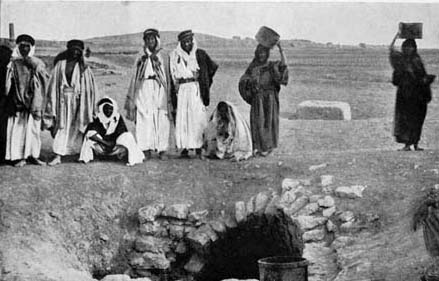
Jacob's Well. Harran.
And looking about us we saw also the black tents, the good camel-hair tents such as the Arabs use, and they stretched out from the side of the watering-place; and on the ground in front of them the young children rolled amongst the bleating flocks and herds. And the shepherds, haughty and silent amongst men, walked to the right and to the left in and out amongst the bleating flocks and herds; and their cloaks were of sheepskin, long and squarely cut—they hung from their shoulders, reaching nearly to the ankles; and looking at them we thought of Abraham who had left this city for the Land of Promise, of Isaac who sent his servant to seek out Rebekah, and of Jacob, who beheld Rachel even on this spot, and who tended the flocks of sheep and herds of cattle for her father Laban on these same fertile plains.
And as we tarried, marvelling on these things, there came out a messenger from the city, and he said, "Why standest thou without? we have prepared a house and room for thy horses"; and turning our horses' heads we followed him and rode into the city.
Now the people of Harran number at this day over 4,000 souls of the Moslem faith; of men there are 1,900, and of the women 2,300. And some of them live in the city and some of them live without, in the villages. Now in the generations that have passed Harran was a great city of merchants; they went forth to Tyre, they were her traffickers in choice wares, in wrappings of blue and broidered work, and in chests of rich apparel bound with cords and made of cedar.
Harran lay also on the highway from the north to the Land of Canaan, on the highway from the west, from Assyria and Babylonia to the shores of the Cilician Sea; hence also was Harran a great fortified city. And looking about us as we rode through the city, many and ancient were the ruins that we saw, showing that Harran had been great indeed in her time; and there stands to this day a four-sided tower, the walls of which are perfect even now; and at the summit of this tower the bricks are exceeding hard and of a bright yellow colour speckled with black spots withal. And still riding in and out amongst the bell-shaped huts we came at last to the ruins of a great castle; and still riding, our good horses picked their way amongst the columns which were fallen, of which there were many, and under the massive stone arches which were not yet fallen. And we came at last to an open space set right in the midst of the castle, and on this space the grass grew green all about in amongst the fallen stones. And, dismounting, we climbed yet a little way further until we came to a room in the walls, well covered in and newly built up with stones, so that neither wind nor rain could enter in. And at the door of this well-built room stood the Shaykh of the Beni-Zeid. And he welcomed us, bowing after the fashion of his country, and we also greeted him, bowing after the fashion of our country; and speaking to Jacobhan, for we knew not his language, neither did he know ours, he bade us welcome, and said that meat and drink would be laid before us, and provender should be found for our horses. And we rejoiced, for we were exceeding hungry. But the sheep was yet roasting on the great fire in a hut in the ruins of the castle below, and we said to Jacobhan, "Send these men away, for we are weary and would rest awhile." And, taking Hassan only with us, we climbed up to where the ruins of a great tower looked away over the plain, even the plain over which we had ridden and beyond also on the other side further than where we had ridden; and sitting down here we rested awhile; and down below the servants tended the horses, and Jacobhan and the lady from the American Mission unpacked the neatly folded bundles—and, further below, lay the ruins of the great city, and between them the little bell-shaped huts; but above us there was nothing but the sky. And looking away from the city, over the walls and over the plain even unto the far horizon where the sun was now setting, for the day was far spent, I said unto Hassan: "What think you, Hassan, can this indeed be the city whence Abraham departed, and think you that this is the plain over which Jacob fled with his women and children, his men-servants and his maid-servants, his asses and camels, his cattle and his sheep?"
And Hassan knit his great brows and pondered awhile, and then he made answer: "What matters it, Effendi, whether this was the city of Abraham, and whether this was the plain over which Jacob fled before the wrath of Laban? Look down below and see these fallen ruins, which are all that is left of the great nations who conquered this city in the generations that have passed; and look down again, and you will see the miserable huts of the people who are left; what do they care for the great people who have lived and died within these walls where you and I are sitting? In a short time they also will be dead, and you and I will be dead, and therefore why should we care whether or not this was the city of Abraham? for, where Abraham is, there shall we soon be also."
As he was speaking we heard a shout from below, and looking down we saw Jacobhan beckoning to us, for the meat was now served. And we made haste to come down, and entered the room. Here on the earthen floor stood a well-filled bowl, all hot and smoking, for the meat was mixed with swelling rice well cooked in fat. Now Jacobhan fetched a little red carpet and spread it on the floor by the side of the bowl, and on this we sat, crossing our legs after the fashion of the country.
On one side of us sat the lady from the American Mission, and on the other side sat Hassan.
And they brought us flat cakes of bread, which we dipped into the bowl and scooping out the rice and meat, we ate it thus, for we had neither spoons nor forks. And round about us as we ate sat the dark-eyed Arabs in the white robes. When we had finished eating, one of them rose and fetched a pitcher of water and another brought a bowl, and they poured water over our hands until they were clean. Then, making way for those who had not yet eaten, we caused the carpet to be spread on the far side of the room, where, lying on it, we watched the men eating, gathered round the bowl. Now, when all had finished, one removed the empty bowl and another fetched a brush and swept the floor, for much rice had been spilt about. Then each man folded his cloak together, and sitting back against the wall gazed at us out of the dark corners.
But Jacobhan the Armenian and his young friend, who was also of the same people, had no mind to sit thus quiet all the evening. For they were not as the Arabs are, content to smoke and make no sound. "Give us some song," he said to the assembled company, "that we may make merry, for the night is yet young."
And they pushed forward, out of the far corner, a young man who seated himself at our feet. After looking at us awhile, there being no sound in the room, he began to sing softly, and these are the words that he sang, as they were told to us later by Jacobhan: "As the swallows from a far country winging their way from the north to the south, so you come to us for the day and on the morrow you are gone. You have the soft eyes of a dove, your hair is of silken threads, and your skin is as the soft skin of the pomegranate. Your little feet they are as the feet of swift gazelles—and they will bear you hence so that your going will be as swift and silent as your coming. Oh, may the snows come in the morning to stay your going away, for my heart will be sick when you are no longer here, and my eyes no longer behold your eyes. The land will mourn and be desolate; the herbs of the field will wither and the waters of the river will dry up in the wilderness."
When the words of the song were finished, a silence fell upon us all; and the silence was so long in the quiet stillness of night that many of us fell half asleep sitting there in the dark room. And one by one the company glided out softly into the night until we were left only with our own men. There numbered thirteen of us in all, and wrapping ourselves each in his blanket we lay on the hard floor until morning.
Now on the morrow the son of the Shaykh came to us and said:
"My father sends you word he will be absent until evening, for he rode away this morning two hours before the rising of the sun. To-night, however, he prepares a feast for you and will return, Inshallah, with glad tidings for his people. He bids me meanwhile ask of the ladies what their pleasure will be to-day; and I am at their commands."
And we said to the son of the Shaykh:
"Take now thy father's lance and these our horses, and we pray thee call out one of your companions and let us see how the men of your country fight their enemies."
And the young chief, nothing loth, fetched the long spear which stood at the door of his father's house, and he mounted one of our horses; and he called another youth from amongst the many that would ride with him, and they rode out together into the field, without the city walls. And we climbed up upon the high walls of the castle which looked over the field that we should have the better view. And the two young men set their lances and rode their horses hard at one another, first to the one side and then to the other, now wheeling round, now holding the spear aloft, shouting with loud cries. And their cries were mingled with the cries of all the assembled company, and we also shouted with the others. For the space of an hour or more did they fight thus with one another until they and their horses were weary, but we were not weary with watching them.
Now as we were feasting that day at the time of the setting of the sun, the Shaykh entered the room where we sat, and greeted us.
And we, speaking through Jacobhan, said to him, "Has your business been well?" And he said, "Very well; to-day is a great day for myself and for my people."
And we said, "Tell us, we pray thee, how that is?" And he seated himself in our midst, and he told us how his tribe, the tribe of the Beni-Zeid, had offended the great Kurdish chief, Ibrahim Pasha, head of the Hamidieh, who lived not far distant at Viran-shahir. For some amongst them had stolen camels and mules belonging to his people. The wrath of Ibrahim Pasha was very great, and he caused his men to harass their men, and their beasts were no longer safe. Now the Shaykh knew not which among his people were the offenders, but after a year had gone by there came certain of the tribe to him and said, "Behold these camels and mules, are they not those which were stolen from Ibrahim Pasha? We pray thee restore them that we may no longer live in fear of having ours stolen." Thus it was, that on this same day the Shaykh had ridden out with his men, driving these animals, and had delivered them back to the Pasha at Viran-shahir. Inshallah, now they would no longer live under fear of his displeasure. For those who offended Ibrahim Pasha had no mercy at his hands; but those who pleased him had much kindness shown them.
And we and the whole company rejoiced together over the good deed that had been done that day, and there was much feasting and singing that night.
On the morrow we mounted our horses once more and rode away through the bell-shaped huts and past the ancient ruins, over the rich plains, back again into the city of Ur, at the foot of the grey hills.
CHAPTER VIII
THAT UNBLESSED LAND, MESOPOTAMIA
We were encamped in the khan, the native inn, at Severek, a dismal town in the dismal wilds of Mesopotamia; the weather and the depth of mud made it impossible for us to pitch our tent outside, and the dirty, windowless sheds round the courtyard, which afforded the only sleeping accommodation, were not inviting, so we had fixed our tent in a covered passage by tying the ropes to the pillars supporting the roof. The Zaptiehs deputed to guard us for the night hung about the door, plying Hassan and Arten with questions as to our sanity. Why should two foreign ladies choose the depth of winter to travel between Urfa and Diarbekr along the caravan route which had been long deserted owing to the raids of the Hamidieh Kurds? I had often asked myself the same question during the last few days, but had not yet thought of an answer.
A pale, dishevelled young man in semi-European clothes slouched into the courtyard and joined the group. The Zaptiehs spoke roughly to him and he gave a cringing reply. He forced his way past them up to me.
"Moi parle Français," he said, with an accent corresponding to his grammar.
"So it seems," I answered, in the same language.
"To-morrow I travel with you," he went on.
"Indeed!" I answered, with more of interrogation than cordiality.
"Yes, you and my mother and sisters will go in an araba, and I and my brother will ride your horses."
I made a closer inspection of the individual, but could detect no signs of insanity to harmonise with his utterances.
"Who are you?" I said.
"I am an Armenian," he answered. "I have a travelling theatre. We want to get to Diarbekr, and have been waiting here for weeks for an opportunity to join a caravan; the road is so unsafe that no one dares pass this way now, and if we do not go with you we may be here for months yet. You will start at seven to-morrow morning, and we shall do thirteen hours to K——."
"We shall start when it suits us," I replied, "and stop when we have a mind. We never travel more than eight hours, and shall not do the regular stages to Diarbekr. We shall be three days on the way."
"You must go in two days," he persisted; "we cannot afford to be so long on the road."
I began to get angry.
"Go away, strange young man," I said, "and don't bother me any more."
"I will have everything ready," he said.
"You may make your own arrangements for yourself," I rejoined, "if you wish to follow us on the road. It is a public way, but understand that we have nothing to do with you. We start when we like, stop when we wish, ride our own animals, and call our souls our own."
"My soul is Christian," he said anxiously, as I moved off; "are you not my sister?"
"Young man," I said sternly, "we may be brothers and sisters in spirit, and we may be travelling along the same road to heaven; but please understand that we travel to Diarbekr on our own horses and not in our sisters' arabas."
Next morning we left the khan at sunrise, and outside the town we found the whole of the Armenian theatre party ready to accompany us. A covered araba concealed the mother and daughters: we caught glimpses of tawdry garments and towzled heads. Another araba was piled with stage scenery and cooking-pots. Three or four men were riding mules and there were an equal number on foot. The men were dressed in flimsy cotton coats, showing bright green or red waistcoats underneath, and tight trousers in loud check patterns; they wore Italian bandit-looking hats, and their shirts seemed to end in a sort of frill round the neck, suggesting the paper which ornaments the end of a leg of mutton. The whole get-up seemed singularly inappropriate as they plunged ankle deep through the mud. Patches of snow lay in the hollows of the road; a furious gale was driving sleet at right angles into our faces; it was bitterly cold.
We rode for hours through a dreary country of broken grey stones with no sign of vegetation or life of any kind. At last we arrived at a collection of tumble-down deserted huts, built of the stones lying round, and hardly distinguishable from the rest of the country until we were actually amongst them. We were cold and wet and had hardly come half-way to our destination, but as neither of us could stand long hours in the saddle without rest or food, we called a halt here to recruit. The Zaptiehs forming our escort begged us not to stop. They could not understand the strange ways of these mad foreigners, who not only travelled in such weather, but sat down to picnic in it instead of pushing on to the shelter of the khan at the journey's end. But we were inexorable, and they reluctantly fastened the horses on the sheltered side of the remaining walls, against which they stood with their backs tightly pressed, drawing their ragged coats closely round them. The village had been but lately ransacked and destroyed by Ibrahim Pasha, the redoubtable Kurdish chief; he was still abroad in the neighbourhood, and any detention on the road increased the chances of our falling in with him or some of his stray bands. The knowledge of this and the discomforts of the journey made the men fretful and anxious. We picked out the least dilapidated looking house and clambered over fallen stones and half-razed walls until we found a roofless room which boasted of three undestroyed angles. In one of these the cook tried to make a fire with the last remnants of charcoal; we huddled in another to avoid, if we could, the blast which rushed across the broken doorways and whistled through the chinks of the rough stone walls. The arabas, accompanied by their bedraggled followers, rumbled heavily past us; the noise gradually died away as they disappeared in the distance; desolation reigned on all sides; the howling blast moaned weird echoes of destruction round the ruined walls.
We managed to boil enough water to make tea; and then, yielding to the men's protests, we mounted and rode on. Hour after hour passed; the driving wind hurled the hailstones like a battery of small shot right into our faces; the rain collected in small pools in the folds of my mackintosh, and I guided their descent outwards and downwards with the point of my riding-whip. The drop which fell intermittently from the overflowing brim of my hat had been the signal for a downward bob to empty the contents; but now the wet had soaked through and I let it run down my face unconcernedly. We were a silent and melancholy band. X rode in front with her chin buried in her coat collar; her face was screwed up in her endeavour to face the elements; the hump in her shoulders betokened resigned misery. The soldiers' heads were too enveloped to allow any study of their expressions, but the outward aspect of their bodies was a sufficient indication of their inward feelings; the very outline of their soaked and tattered garments bespoke discomfort and dejection.
The pale-faced little officer, straight from the military school at Constantinople, urged his horse alongside mine. "Nazil?" he said. It was a laconic method, essentially Turkish, of saying "How?" i.e., "How are you?" "How's everything?" "Hasta" (Ill), I answered. "Amān," he groaned. "Kach Saat daha?" I asked (How many hours more?). "Jarem Saat, Inshallah. Bak, khan bourda" (Half an hour, Inshallah. Look, the khan is there). I raised my head to follow the direction of his pointed whip; the jerk sent a trickle of wet down the back of my neck and the rain blinded my eyes. I dropped my head again. It was not worth while battling with the elements even to look upon our approaching haven of rest. I was too familiar with the aspect of the country to be particularly interested in the scenery; it had not altered at all for many days. If you looked in front, you saw an endless tract of slightly undulating country, the surface of which was a mass of stones; there were stones to the right, there were stones to the left, there were stones behind; you rode over stones, slippery, broken, loose, sliding stones; and now stones, stones of hail, were hurled at you from the heavens above. The very bread we had eaten for our midday meal seemed to have partaken of the nature of the country. I had accidentally dropped my share, and had to hunt for it, indistinguishable among the other particles on the ground. We were rapidly turning into stones ourselves. One seemed to be riding on a huge, dry river-bed, the waters of which had been drawn up into the heavens and were now being let down again by degrees.
The officer gave an order to a Zaptieh. The man tightened the folds of his cloak round him, wound the ends of his kafiyeh into his collar, and, digging his heels into the sides of his white mule, darted suddenly ahead. The crick in the back of my neck made it too painful for me to turn my head to look, but this must mean that we were near the khan and that he had gone on to announce our arrival. Visions of being otherwise seated than in a saddle faintly loomed in my brain; I hardly dared wander on to thoughts of a fire and something hot to drink. We turned at right angles off the track and plunged into a bed of mud, which led up to the door of a great, square, barrack-looking building with a low, flat roof and a general air of desolation. The Zaptieh stood grimly at the door. "Dollu" (Full), he said. Nevertheless we forced our way through the narrow entrance and found ourselves in the usual square courtyard lined with dilapidated sheds. The whole enclosure, inches deep in mud and indescribable dirt, was crowded with camels and mules and haggard, desperate-looking, shivering men, with bare legs and feet and dripping, ragged cloaks. The officer laid about him right and left with his riding-whip and ordered up the khanji (the innkeeper). "You must find room for us," he said; "I am travelling with great English Pashas." The khanji waved his hand over the seething, jostling mass of men and animals. "Effendi," he said, "it is impossible; I have already had to turn away one caravan. If we made way for the Pashas there would still be no room for their men and horses. But they are welcome to what shelter there is."
We gazed with dismay at the reeking scene.
"How far is it to the next stage?" asked X.
"Two hours," was the answer.
"We had better get on to it, then," she said, and turned her horse's head outwards. We followed in silent dejection. The wretched animals, who had been pricking their ears at the prospect of approaching food and rest, had literally to be thrashed out on the road again. We waded back through the mud and turned our faces once more to the biting blast and driving rain.
The track we followed was apparent only to the native eye; to the uninitiated we seemed to be going at random amongst the loose stones. One had not even the solace of being carried by an intelligent and sure-footed beast who could be trusted to pick its own way. The hired Turkish horse has a mouth of stone and his brain resembles a rock. Left to himself he deliberately chooses the most impossible path, until it becomes so impossible that he stops and gazes in front of him in stupid despair, and you have to rouse yourself into action and take the reins in your own hands once more. His one display of originality is a desire not to follow his companions, but to veer sideways until you are in danger of losing sight of the rest of the party and become hopelessly lost off the track. I struggled to keep straight and in pace with the others. Weariness and disgust had made my stupid animal obstinate and more stupid, and I finally gave in and lagged behind, letting him go at his own pace. The officer pulled up and waited for me.
"We must push on, Hanum" (lady), he said, "or we shall not get in by sunset."
"My horse is tired," I answered, "and I am tired," and I showed him my broken whip. It was the third I had worn out over this obstinate brute's skin.
He called back one of the Zaptiehs and muttered to him unintelligibly in Turkish. The man crossed to the other side of the road, and he and the officer, one on each side, urged my horse on with continual blows behind. I dropped the reins almost unconsciously, and, all necessity for action of mind or body being removed, sat between them numb, petrified, and hardly conscious of my surroundings.
Pitter, patter came the rain on the saddles; click, clack went the horses' hoofs on the stones; clank went the captain's sword; whack came the men's whips behind; each noise was hardly uttered before it was rushed away in the driving wind.
Expectation of something better had made the present seem unbearable in the earlier part of the day; now that one no longer held any hope of alleviation, the general misery had not the same poignant effect; or was it that weariness from long hours in the saddle, and the pains consequent on exposure to cold and wet, had numbed one's senses? Jog, jog; one was being jogged on somewhere, one did not care where and one did not care for how long.
The men were saying something; the sound fell vaguely on my ears, but the meaning did not travel on to my brain. Then we stopped suddenly and the jerk threw me forward on the horse's neck. I felt two strong arms round me and was lifted bodily off the horse. "Brigands at last," I thought vaguely; "well, they are welcome to all my goods as long as they leave me to die comfortably in a heap."
"Geldik" (We have arrived). It was Hassan's voice; we were at the door of the caravanserai. He deposited me on the floor of a bare, black hole on one side of the courtyard and carefully arranged his wet cloak round me. I was conscious of a motionless heap in the dark corner opposite.
"X?" I muttered interrogatively.
"Hm," came from the corner.
"Hm," I responded.
The muleteers came and flung the dripping baggage bales promiscuously about the floor. We were soon hemmed in by sopping saddles, bridles, saddle-bags, wet cloaks, and muddy riding-boots.
Hassan sat on a pile of miscellaneous goods, smoking reflectively and giving vent to great groans as he looked from one corner to the other, where each of his charges lay in a heap. The cook cleared a small space in the middle of the room and tried to make a fire with dried camel-dung, the only fuel to be had. The whole place was soon filled with suffocating smoke; there was no window, no hole in the roof to let out the fumes; we opened the door until the fire had burnt up, and a sudden gust of wind tearing round the room and out again drove the smarting fumes into our eyes, causing the tears to roll down mercilessly.
Another caravan was arriving, and the animals passed through the narrow passage by our open door, on into the courtyard beyond. Mules bearing bales of cloth or sacks of corn; camels laden with hard, square boxes stamped with letters that suggested Manchester; donkeys carrying their owners' yourghans, quilts which form the native bed, damp and muddy in spite of the protection afforded by a piece of ragged carpet thrown over them, the whole secured by a piece of rope which also fastened on a cooking-pot and a live hen. The procession wound slowly through to the sound of tinkling bells, until the whole caravan had entered the enclosed yard, which now presented a chaotic scene of indescribable crush and dirt. Kneeling camels, waiting patiently for the removal of their loads, looked round beseechingly at their own burdened backs; mules munched the straw out of each other's bursting saddles; slouching yellow dogs sniffed about the fallen bundles. The theatre ladies, in gaudy plushes and silks covered with tinselled jewels, sat about on the piles of stage scenery flirting with the young men in the bright waistcoats; stern Mahomedans, wrapped in long, severe cloaks, gazed with contemptuous disgust at these unveiled specimens of the unworthier race, while the short-coated and less particular muleteers and menials stared at them with open-mouthed, grinning wonder. Our little captain sat unconcernedly in a sheltered corner, deftly rolling up, with his delicate, finely shaped fingers, endless piles of neat cigarettes; a Zaptieh, with his face to the wall, bowed and murmured over the evening prayer. Each pursued his reflections and employments with that disregard of his neighbour's presence which is so impressive in any crowd in the East. Apart from these by-scenes, the dominating human note was one of quarrel, in strange contrast with the silent waiting of the dumb animals, for whose shelter in the limited accommodation their respective owners were fighting with clenched fists and discordant, strident voices. Then the hush of mealtime falls on all; men and animals, side by side, are busy satisfying their bodily needs. It is a strange mingling of men and beasts, where the man, in his surroundings and mode of life, savours of the beast; and the beast, with his outward aspect of patient and beseeching pathos, is tinged with human elements. We had shut the door on the scene, finding smoke preferable to cold and publicity. It suddenly burst open, and a camel's hind-quarters backed into the room, upsetting the pot of water on the fire. We had been anxiously waiting for its boiling point with the open teapot ready to hand. The men threw themselves upon the animal; and pushed it back; they pushed and hit and swore; it was ejected; the fire hissed itself out and the smoke cleared. A dishevelled looking official in uniform peeped through the door: "The Governor's salaams, and do the Princesses require anything?"
Hassan courteously returned his salute. He was now seated cross-legged by the dying fire, sorting nuts from tobacco which had been tied up together in a damp pocket-handkerchief. With the air of a king on his throne he graciously waved his hand towards a slimy saddle-bag: "Buyourun, Effendi, oturun" (Welcome; sit down). The man sat down, carefully drawing his ragged cloak round his patched knees.
"The ladies' salaams to his Excellency; they are very pleased for his inquiry and send many thanks. They have all they require."
The quiet dignity of Hassan's appearance and utterances seemed to dispel any sense of incongruity the visitor might have entertained as to the limitation of our wants and the methods of our Royal progress; he merely thought we were mad.
He departed, no doubt to glean information from the more communicative members of our escort. The cook came in with a pleasing expression.
"What will you have for supper?" he said.
"What can we have?" we answered, with the caution arising from long experience of limited possibilities.
"What you wish," he said, with as much assurance and affability as if he was presenting a huge bill of fare. I knew what one could expect in these places.