LOUISA JEBB (MRS. ROLAND WILKINS) (continued 4)
Reading edition
X was of a peaceable disposition, and I daresay she was laughing at me. She enjoyed seeing me get angry. But it was in our contract that I should do all the manual labour connected with keeping order, so I obediently seized a long pole, and let it descend gently on the offender's shoulder. He turned round and stared, dropping the rope with an astonished grin. The crowd burst into joyous shouts and pointed at the Evil One, who still stood expostulating angrily in their midst.
"Hit him!" they yelled, "he is the one to hit!" and quite believing them I transferred my attentions, along with the end of the pole, to his shoulder.
"Come!" I shouted. It sounds tame, but it was the only Arabic word I knew. The raft slowly drifted down-stream and the Evil One, dashing in up to his waist, clambered on board.
Ali explained to us that he refused to pay enough for his bread, and that the crowd would not let him go until he had done so.
The Evil One grinned, and, diving into the bag, offered me a dirty piece of native bread in his still dirtier fingers. He would share his food with us, though we refused to do so with him; a typical Eastern method of putting one in the wrong.
The waters were still sluggish, and the men seemed determined to do no work.
"I am beginning to think they are in league with some one on shore," said X. "It cannot be to their advantage to be so long on the way, as they are paid a lump sum to get us to Baghdad, and we are not feeding them. I quite expect we shall be held up and robbed before evening."
Finding that orders and threats were of no use and learning from Ali that Jedan, the second kalekji, was afraid of the Evil One, who would not allow him to row, I sat down facing them and produced my revolver.
"Tell the bad kalekji," I said to Ali Chous, "that if he does not row I will shoot him."
The Evil One, greatly to my astonishment, appeared to believe in the possibility of bloodshed and set to work at the oars. All the rest of the day I sat with my revolver at his head. It was a most fatiguing, if effectual, process.
"Supposing he does stop rowing," said X, "will you shoot him?"
"I cannot think what I shall do," I said; "the only way will be to fire over his head and pretend I've missed him."
"Mind you do miss him," said X languidly.
"Sure to," I answered hopefully.
Some hours before sunset we were held up in a manner which admitted of no blame being attached to the Evil One. A strong head-wind arose, before which the raft refused to make headway, and we were forced to take refuge on a dreary mud bank which sloped down to the water's edge under a low line of shaley rocks.
The men sat about cross and disconsolate. It was very unsafe, they said, to spend the night so far from a village. We should certainly be attacked; the Evil One had arranged this—wind and all. We might be there for days, and what should we do for food? Tired of looking at all their sulky faces, I clambered up the cliff above to see what I could see. The top of the hill was as level as if it had been flattened out by a giant with a hot iron. A low line of hills with equally flattened tops at a little distance hid the further view. I walked to the top of them, led on by the sort of fascination which makes one wish to see what is hidden between one and the horizon. Having reached the top there was nothing to be seen but repeated lines of naked, flat-topped hills. The dreary loneliness of the place, its utter nakedness, in which one seemed shut off from all the real things of life, colour, sound, space, and growth, descended like a physical weight on one's senses. It was all like one great senseless punishment, which from its sheer callousness held one, with mingled fascination and terror, rooted to the spot. With an effort I turned to retrace my steps, when my eye caught sight of a dark object on the same line of hills on which I stood, which made my blood turn cold. A wild-looking, half-naked Arab, who seemed to have dropped suddenly from the sky, was standing motionless gazing at me from a little distance. For one moment I stood transfixed with nameless dread; the whole feeling of terror which had been established by the mere aspect of the country seemed now to be concentrated and personified in this sudden apparition. What hordes of like beings might not be concealed behind these mysterious hillocks? He moved one step towards me and I turned and fled, down the slope and across the level plain to the edge of the cliff under which the raft was moored. The apparition pursued me silently. On reaching the edge of the cliff I peered over and could see the crew of the raft still occupying the disconsolate positions in which I had left them. My senses now slowly returned, and I sat down to await the arrival of the apparition out of consideration to my own self-respect. He was still some distance from me, and, on seeing me sit down, he also sat down and we gazed at one another. The comic element in the scene asserted itself. A savage and I holding each other at bay like two dogs preparing for a fight on the top of the cliff, and down below X sitting unconcernedly on the raft reading the "Meditations of Marcus Aurelius." I laughed out loud; the savage sprang to his feet with a yell, brandished his arms in the air, and darting up a neighbouring slope disappeared behind it as suddenly as he had appeared.
I slid down the cliff and joined X.
"Where have you been?" she said. "I was just going to send Ali to look for you; he says it is not safe to go out of sight of the raft."
"I was only on the top," I answered, too ashamed to enter into further details.
We discussed our general situation in bed that night.
"X," I said, "if you met a savage all alone in a wild piece of country what would you do?"
"Why, go up and speak to him, of course," said X; "it would be awfully interesting. What would you do?"
"I don't know," I answered; "I want to go to sleep now."
The wind dropped in the night, and at the first break of day we were off once more.
CHAPTER XV
ARAB HOSPITALITY
Fifty-three pairs of dark eyes were fixed upon us in unwavering scrutiny; it was dark and there was silence. The eyes, as they gleamed out of the darkness, might have belonged to a herd of wild beasts watching their prey; but we were privileged guests of the Arab Shaykh in whose tent we were sitting, and the gaze was but that of friendly curiosity. We had been placed on the seat of honour—a rush mat at one side of the tent; opposite to us squatted our host, a venerable old man with a white beard which flowed over his bare, wrinkled chest; with one arm he supported a small boy, who played with the beads round the old chief's neck.
Between us, in the centre of the hut, glowed a dying fire, and beside it, silently watching the pot on the ashes, sat the coffee-maker. Now and then he scraped the ashes together round the pot. A thin veil of smoke rose up slowly and dispersed itself under the low roof of the tent. The silence was almost religious; the darkness suggested witchcraft rather than night; a hobgoblin might have sprung out of the coffee-maker's pot and not been out of keeping with the natural sequence of events.
All at once, at the back of the tent, a hand was raised and a bundle of fine brushwood came down on to the fire; in sudden blaze it momentarily lit up the fifty-three dark faces, flared an instant, flickered, then as rapidly died away, and we only felt the gaze we had seen before. We silently watched the coffee-maker and our host, who, being nearest to the fire, were dimly visible in its remaining light; the attention of the one was concentrated on his pot; that of the other, in common with his companions, was on us. There was no call for speech, for we spoke in tongues unintelligible to one another, and the only sound which fitfully broke the ghostly silence was that language understood by all nations alike, the wail of an infant in its mother's arms.
"Salaam Aleikum," we had been received with as the Shaykh stood up to welcome us on our arrival, unexpected and uninvited, in the midst of his tribe. We had been guided to his tent by the long spear which stood upright at the door, and when he had offered us that token of Arab goodwill—the cup of coffee—we knew that we were amongst friends. He waved us to our seats, and then, seating himself, pulled the child towards him; he patted his own chest, and then pointed to the lad with pride.
"His youngest child," interpreted Ali, who accompanied us, and who understood a few words of Arabic.
We nodded back our looks of appreciation, and, these preliminary acts of courtesy having established the requisite good feeling, all need for further converse seemed at an end, and a comfortable silence fell upon us all.
The whole village had followed us into their chief's tent as a matter of course, and those for whom there was no room inside herded together at the door. The Eastern standard of ideas, which allows respectful equality with one's superiors, was responsible for the total absence of ill-mannered jostling which would have characterised a civilised crowd under similar circumstances on the reception of strange foreigners.
The coffee-maker reached out his hand without turning, and one amongst the crowd at his back handed him a massive iron spoon on to which was chained a copper ladle. The Shaykh's little son, obeying a nod from his father, pulled a bag out of a dark recess behind him; another bundle of brushwood was thrown upon the fire and by the light of its sudden, almost startling blaze, the lad untied the bag and carefully counted out the allotted number of coffee-berries. The coffee-maker dropped them into the spoon, for which he had raked out a hole in the ashes. The slight stir caused by these proceedings subsided, the blaze died away, and the attention of all was again riveted on us, save that only of the coffee-maker, who, sitting close up to the embers, now scraped the white ashes round the pot, now turned the roasting berries over with the ladle chained to the spoon. The Shaykh's hand stole on to the little boy's head, and the boy, looking up, stroked the old man's beard. On we sat in the dark silence, learning from these true masters of Time how neither to waste it nor to let it drag, but going step by step with it, to lay ourselves open to receive all that it had to give.
The silence was so prolonged and so intense that, silently as time flies, we could almost hear its moments ticking away. It has been said that we take no note of time except when we count its loss. It might be said of all Easterns that they are unconscious of the time they lose, because they take no note of it; they live unconsciously up to the fact that, the past being beyond recall and the future unfathomable, the present only is in our power. And the Eastern is master of Time because he spends it absorbing the present.
Meanwhile the berries had blackened, and the man emptied them into a copper mortar. As he pounded them he caused the pestle to ring in tune against the sides of the bowl. The child laughed gleefully and pointed at him; the stern old man smiled and shot a proud glance over at us.
"Fiddle away, old Time," rang out the tones of the metal pestle. It seemed to give voice to our joyful derision of Time; here was Time trying to weary us with himself, and we only laughed at him.
"Fiddle away, old Time— Fiddle away, old Fellow! Airs for infancy, youth, and prime, Times both shrill and mellow. Fiddle away, Or grave or gay, For faces pink or yellow— Scrape your song a lifetime long, Fiddle away, old Fellow!"
Not a soul moved. Outside in the dusk a stunted black cow thoughtfully chewed the maize stalks of which the enclosure round the tent was built, and a kid rubbed his head up and down against a child's bare leg. Beyond this the darkness had nothing to conceal. We were in the middle of a bare, largely uninhabited, desert land known only to a few wandering Arab tribes. Outside, the mysterious open vault of the dark sky with its many hundred points of light; inside, the mysterious recess of the dark tent with the fifty-three pairs of gleaming eyes, every one fixed upon ourselves. Now and then, as a flash of lightning in the sky at night will expose the immediate surroundings to view, so a sudden spark from the fire revealed the setting of the eyes—the solemn, dusky, Arab faces.
A splutter on the fire as the pot boiled over put an end alike to the tune and to the meditations called up by it. The man transferred the ground berries to a copper jug and, pouring the boiling water on to them, placed this second pot on the hot ashes. We had been sitting there for an hour watching these preparations, and it seemed as if we might now reasonably entertain hopes of tasting the results. Our expectations in this direction were also enhanced by the appearance of three tiny cups which had been unearthed from a dark corner, and handed to one of the men nearest the fire. He proceeded to rinse them out one by one with hot water, displaying a care and absorption in the process which contrasted strangely with the simplicity of his task.
The coffee on the fire came to the boil, the coffee-maker poured it back into the original pot, which he again set on the ashes. He then handed the empty jug to the cup-washer, who rinsed each cup out carefully with a few drops of the coffee left for this purpose. Very quietly, very precisely, he placed each cup on the ground within reach of the coffee-maker, and retreated into the background.
The coffee on the fire boiled up; we straightened ourselves in expectation as the coffee-maker reached out his hand. But he emptied the boiling liquid back again into the original pot and replaced it on the ashes.
The fire now burned very dimly. Even the man's form bending over the glowing ashes was discernible only as a black shadow. The stillness for a few moments was so great, and the concentration of all so centred on the bubbling coffee-pot, that one felt as if all the meaning of life, the past, the present, and the future, was being distilled in the black liquid, and that an incantation was only necessary for the future to take shape and, rising out of the pot, become visible to us all in this mysterious darkness.
Again the coffee boiled up. Again the man emptied the boiling liquid back into the other pot and replaced it on the fire.
The stillness and the concentration became more intense. Outside, a lamb's sudden cry and the mother's answering bleat rang out sharply in the black night, a distant reminder of a far-off world; it died away, and the broken silence was all the more intense.
The coffee boiled up.
By this time one had ceased to associate the drinking of coffee with the end of these mysterious rites. The coffee of Cook's hotels, the coffee of crowded railway stations, whole coffee, ground coffee, French coffee, coffee at 1s. 8d. a pound; the clatter of black saucepans, the hot and anxious cook, the bustling waiter, the impatient people of the world with only a minute to wait—calling for instantaneous coffee; what had coffee and all these associations to do with this? And so it was with a certain shock that we looked at this magician pouring the result of his black art into the cups, a few carefully measured drops only. Two are handed to us and one to the Shaykh. We sipped the oily black drink slowly and thoughtfully. A liquid which had been prepared with so much deliberation could not be quaffed down with the reckless indifference ordinarily displayed in the process. It was thick and bitter. We drained the last drop and returned the cups. Another spoonful was poured in and they were passed back to us. Etiquette required that we should not refuse till the third time of offering; then the remainder of the coffee was handed round to the rest of the company in order of rank.
There was a stir amongst the crowd round the door, and a woman forced her way through with a baby in her arms. She squatted in front of us, and held the child down for our closer inspection by the firelight.
"Khasta" (Ill), said Ali Chous; "she wants medicine."
The mother pointed to the sores on the child's face and body, the pleading eloquence in her dark eyes rendering unnecessary any explanations on the part of our interpreter.
It was a pathetic instance of the suffering induced by man, even when living so akin to Nature, when he tries to superimpose his own crude ideas of beauty and expediency on to the human frame. The baby, though only a few months old, had been pierced in the nose and ears for the reception of the ornaments which were to enhance its charms in after-life, and of the blue bead which would ensure its safety from the one recognised enemy—the Evil Eye. The wounds were healing badly, and the irritation set up had caused fever.
"Tell her we can give her medicine," we said to Ali, "but it is not medicine to drink, it is to wash the wounds with. If the baby drinks it, it will die."
The message was interpreted. "Aha, aha, Mashallah," was murmured all through the crowd. The baby became an object of intense interest. Ali threw back his head and pretended to swallow, then he pointed significantly to heaven and to the unconscious victim at his feet.
"Ha! ha!" murmured the crowd.
Hassan meanwhile had begun to fidget uneasily.
"There are fleas here," he said, "you must not stop any longer."
We rose, and silently salaaming our host, passed out of the tent. It was lighter outside; the moon had risen, casting mysterious black shadows round the huts, where weird black and white forms flitted stealthily in and out.
Owing to the shallowness of the water on the low shelving mud banks we had been unable to bring the raft right up to the shore, and it had been moored at a little distance out in the water. The kalekjis had carried us across on their backs and had returned to cook their evening meal on board. We now shouted across the water to them to come and carry us back. As we stood waiting, a woman came up to us dragging a child by the arm, who hid his head in his mother's dress and refused to allow himself to be examined.
"He is ill too," said Ali, "like the other child."
"We will give them some medicine when we get on the raft," we said; "tell them each to send a cup."
"And this one says he is ill," the man went on, as a tall, sheepish-looking youth touched me on the arm; "they will all say they are ill now that they know you have medicine."
"We can only give to those who are really ill," we answered; "what is the matter with this one?"
"He has fever, he cannot eat, and his head hurts."
I had some quinine pills in my pocket, and I gave three to the boy.
"Tell him to take two now, and not to keep them in his mouth," I explained, "but drink some water and swallow them down; then, when the sun has risen one hour to-morrow, let him take the other one."
A dozen interested spectators at once went through the whole process in pantomime; a pill was swallowed, and its downward course indicated by stroking the chest. "Ha!" was ejaculated all round. Then the second pill was swallowed with equally suggestive signs. The rising point of the sun was indicated, and one finger held up, and the third pill swallowed.
"Mashallah!" went up through the crowd, staring with bated breath.
We boarded the raft, and had scarcely established ourselves in our sleeping-hut when Hassan staggered to the door with a huge clay pitcher capable of holding several gallons; he deposited it at our feet.
"For the medicine," he said gravely.
"We said that the woman was to send a cup," we said; "the few drops of lotion will be lost in that."
"For the medicine," he answered, imperturbably.
"We had better send it in one of our cups," I said, and I measured out some lotion. Hassan took it; a few minutes later he returned laden with cups, jars, pitchers, and bowls of every size and description.
"For the medicine," he said, as he deposited them beside us.
We looked at one another aghast.
"Say that we have no more," we said.
"I have told them," he said, "but they will not go away."
We went outside, where a tremendous hubbub had arisen. Our men were standing round the edge of the raft resolutely pushing would-be intruders back into the river. Up to their waists in water, hanging on to the raft at every point, shouting out their ailments, pointing to their throats, their eyes, their heads, were the whole male population of the place. In vain our men strove to keep them off; the raft was besieged at every point. In desperation we unmoored and floated out into the middle of the river; the most determined swam out after us, and holding on to the raft with one hand stroked their chests and pointed to the absent sun with the other. Finally, as we drifted down-stream, they gave up, and the last sight we had was that of a row of disconsolate invalids, suddenly endowed with great evidences of health and strength, careering wildly on the mud flats in the starlight round a discarded heap of empty bowls and pitchers.
CHAPTER XVI
A STORM AND A LULL
The men were still very quarrelsome; the whole day their grating voices never stopped. They seemed, however, quite anxious to row now, and proposed at sunset that we should not moor to the shore as usual but, as the night was not very dark, keep on and make up for lost time. We had been in bed a little while and were dropping off to sleep in spite of the ceaseless quarrelsome voices, when a worse out-break than usual thoroughly awakened me.
"They are having a fight on board," said X, sleepily; "I suppose we must leave them at it."
I peered through the chinks of the door. Jedan had taken off all his clothes and was trying to jump off the raft into the middle of the river. Hassan and Ali were holding on to him for dear life, and the Evil One sat at the oars screaming with rage. Arten was offering him the remains of our dinner. Jedan seemed finally to yield to the other men's entreaties and sat down on the raft, the tears rolling down his cheeks. Ali sat beside him, holding his hand and murmuring soothing words. The Evil One occupied himself with devouring the dinner. General peace seemed, in fact, restored, and our slumbers were not again disturbed.
Next morning we threatened them both with dismissal at Tekreet, where we hoped to arrive that day, and which we knew was the seat of a Mudir, to whom we could make a show of appealing if the worst came to the worst. The cause of the disturbance was put down to Jedan, whose native village was close by, and who had threatened to leave the raft altogether if the Evil One bullied him any longer. Jedan begged to be allowed to visit his home, and it so happened that the wind rose again to such a pitch just opposite the place itself that we were compelled to put to shore. It was another Arab encampment, a collection of black tents with maize enclosures. Jedan at once disappeared amongst them, and, later on, as we strolled round the village, we came across him seated just inside a tent with two small children on his knees. He invited us to come in and sit down. The tent was full of his kindred. In the far corner a child shared with a bleating kid the quilted covering which constituted the bed of the establishment. A woman beside him was spinning wool and another one at the door was grinding dari for bread. A grown-up son sat opposite, industriously working the wool from his mother's wheel on to a leather sole for sandals.
Jedan appeared in quite a new light in the centre of his family circle; he suddenly seemed endowed with a dignity becoming his present position as monarch of all he surveyed. The children on his knee clung to him and stroked his head, and he softly patted their heads. All the gruff surliness and cringing hatred of the expression with which he regarded the Evil One on the raft had disappeared, and he smiled with benign content on his domestic surroundings. He sent the boy out into the village with orders to get some delicacy in our honour. In a few minutes the lad returned with a raw turnip, which was cut into chunks and offered to us with much ceremony. Then a bowl of youart was produced, and we felt compelled to drink out of the common stock.
At midday the wind had subsided and we insisted on starting off at once, with the hope of reaching Tekreet before evening. It was five days since we had left Mosul, and we had scarcely covered one hundred miles. As we had counted on reaching Baghdad in that time, our supply of provisions had got very low. The river was now deep and broad, and the strong current carried us along at a good pace. Jedan's visit to his family had put him in a very good humour, and even the Evil One, who had participated in the feast of raw turnip, worked quietly at the oars. Every moment took us further from the snow mountains and the bleak country of the north and nearer the sunny south. Already the sun's hot rays poured down soothingly, and everybody was in that state of quiet contentment known as "kief" in the East. Hassan, seated cross-legged with his back against the hut, dozed at intervals. Ali was rolling up long, fat cigarettes by the door, and Arten, stretched full length inside, was making up for his disturbed slumbers of the past night. X lay on a rug at the edge of the raft and I sat beside her, reading aloud the Prophetic utterances on Nineveh. The Bible is one of the few books that one can read in this sort of wandering life. This is, perhaps, because we are in the land where people live in rock houses, and hew their tombs in rocks, and wear girdles, and say "Aha," eat honey a lot, and go out to desolate lands, and say their prayers on the housetop. We were living with the shepherds who divided the sheep and goats at nightfall and watered their flocks at sundown; with the women who came down with their pitchers to the wells, and with the elders sitting at the gates. One felt that any other book made too great a demand on one's mental powers. Even now the sound of one's own voice was disturbing, and for some time we sat listening to the silence and imbibing the sun. A sudden chill crept into the atmosphere and a blackness covered the face of the waters. I looked up at the sky. A line of angry, black clouds had overtaken the sun, gathering up the scattered white fleeces in its path, and was advancing rapidly over our heads. An ominous sound of rising winds seemed to herald its approach. In less than three minutes we were swept up in the arms of a howling gale; sudden gusts caught the walls of the hut and swirled us round, the playthings of a merciless, raging force, at one moment tearing us into the middle of the stream, and the next dashing us with redoubled vigour against its rocky sides. The rain came down in blinding torrents, and the waves, breaking over the surface of the raft, made it seem as if we were being submerged altogether under the water. Then we rose on the crest of a wave once more, which dashed us against a wall of rock rising precipitously at the side, with a force which seemed as if it must shatter asunder all the bending, creaking poles of the raft. Ali and Hassan stood on the edge, trying to break the force of the blows with the butt end of their rifles, while the kalekjis struggled fruitlessly at the oars. The lowering black sky, the raging black waters, the unyielding black walls of rock gave a grim setting of darkness to this struggle, which proved to be no less than a fight with death itself. Our companions, the birds, clung huddled up with fright to sheltering walls of rock, or crept into niches, where they cowered together, hiding their heads under their wings. Even the noise of the wind and waters could not drown the wild, terrified shriek of startled crows when we were dashed against their hiding places, and they flew close past our heads to seek a fresh shelter.
This, then, was to be the end of our interlude of peace. It seemed as if the jealous gods, conscious of our forgetfulness of their authority, were proclaiming our powerlessness against their decrees. They tossed us ruthlessly about until we were reduced to a state of subordination, and then, as if repenting of their anger, they caused the wind to lull and shot out a gleam of sunshine through the dark clouds. We passed out beyond the walls of rock, on which the wet drops now gleamed like bits of silver, and drifted in a broad, slow stream with low, shelving banks. On the last ledge, with downcast heads, sat three great vultures, disappointed of their prey.
Hassan thoughtfully rolled some cigarettes; he lit one and handed it to me; then he lit another and handed it to X. She shook her head. "Smoke," he said sternly. X took the cigarette and, all need for action being over, we resumed our attitudes of contemplation. But the atmosphere of lazy indifference seemed to be dispelled. Where were we drifting to? Were we at any moment likely to be snatched from this state of peaceful acquiescence in our surroundings, and be hurled to destruction with no word of warning or choice in the matter?
"Ah, well, kim bilior?" (Who knows?) I said out loud.
"Who know what?" said Hassan.
"What is going to happen to us?" I said.
"Kim bilior?" repeated Hassan. "Allah bilior" (God knows), and then, after a minute's silence, he repeated:
"Kim bilior? Allah bilior!"
I looked up at him.
"It is so," he said, nodding his head solemnly; "Kim bilior? Allah bilior!"
The influence of the Eastern mind asserted itself; the future had no interest for them. Allah had arranged their destiny; it had nothing to do with them, and no thought or effort on their part would make any difference. Nor had the past any interest for them. They lived in the present, enjoying the pleasant places and accepting the unpleasant ones with no fear or resentment.
The storm was over, and they set about drying their clothes and making preparations for the evening meal. Jedan slowly unwound his keffiyeh and wiped his head all over, then he spread the coloured rag out to dry. Ali and Hassan rubbed their rifles carefully and hung them up inside the hut. Then Ali spread out his cloak on the far corner of the raft and went through the midday prayer; this over, he borrowed a needle and thread from me and began darning a tear in his ragged uniform.
The sun shone brightly and our clothes were soon dry. Birds appeared on the bank shaking their feathers and stretching out one limb after another. The lull that follows a great storm reigned over everything; all nature seemed resting after her exertions. Ali Chous finished his darn and began to sing; the kalekjis joined in the chorus, clapping their hands. An element of cheerful carelessness established itself on board. I went inside and began to invent a pudding for dinner. Arten was not enlightened in his profession as cook, and I was trying to supplement his deficiencies by the light of nature, for Arten did not seem to have that sort of light. I tied the mixture up in a handkerchief and set it to boil in a pot on the brazier. One by one the men came in and sat round the fire, gazing silently at the pot as they smoked away. After a time I took the lid off and examined its contents.
"Is it really going to be a pudding?" said X, with an agonized expression.
I tried to recall what puddings looked like in England, and then remembered that I had never seen one at this stage.
"I cannot say till it is finished," I said.
The pudding still clung ominously to the handkerchief; I had greased it well and have since heard that you only grease pans. I gave it a few minutes longer, then, as we were all hungry, I fished it out of the pot and untied the handkerchief.
"Bak!" (Look) said Arten.
"Bak!" said Hassan.
"Bak!" said Ali.
"Bak!" said the kalekjis.
It was a moment of extreme tension.
I slipped it on to a plate.
"Now look," said Arten.
"See now what a cook she is!" said Hassan, "a wonderful cook."
"Mashallah," said Ali.
"Mashallah," said the kalekjis.
"It is a pudding," said X, "a real pudding."
We all gazed at it for several moments in ecstatic excitement. I handed X a spoon and we each took a mouthful; then we looked at one another.
"It is a pudding," said X again.
It almost seemed as if she were trying to persuade herself of the fact against the dictates of reason. When we had finished, the men shared our spoons in turn; each one cautiously raised a spoonful and smelt it, then they swallowed it, very much as one remembers swallowing jam in the nursery when one knew there was a powder inside.
"Ehe" (Good), they said very deliberately, nodding their heads, and then, as they handed the spoon to their neighbour, "Inghiliz" they added. One felt that the first word was Turkish politeness; the second was a veiled warning to their brethren.
But on the whole it seemed a success; we had a sense of repletion; how often had we not swallowed bowls of rice and been only conscious of a great internal void.
The men carried our rugs outside and we stretched ourselves lazily out on the open end of the raft. I began to reflect upon Time and Destiny. No shadow of a cloud appeared to disturb the horizon, no obstruction in the river affected our steady onward course down the slow, wide stream; we took the current where it served, and so were not delayed in the shallows where the waters dallied about the banks; they in due course would arrive at their destination and pour themselves, unquestioning and unquestioned, into the oblivious sea. But what would Time, that unremitting, relentless current, do with us? Was it going to hurl us too into oblivion? Whatever it had to give was ours, and yet, because we could not stop it, we were not master of it. We could moor to the shore and let the river go on without us; the current did not wait for us, but we could pick it up again when we were ready for it and go on without loss; but in the current of Time, when we stay on one side and let the moments go past us, we have lost for ever what those moments had to give, and our arrival at our destination has not been delayed; it is so much the nearer.
"X," I said, "where do you think we are floating to?"
"Baghdad," said X.
"I wasn't thinking geographically," I answered, "I was thinking whether it was Eternity or Oblivion. Being hurried along by this current gives me an uncomfortable feeling of not being allowed any choice as regards time, which I resent. Do you mind it at all?"
"No," said X, "I feel that I have lost all conception of time, and that we are floating on, as it were, to Eternity."
"Do you?" I said dubiously; "I feel it's Oblivion we are getting to."
"But we are only three days off Baghdad," insisted X.
"Well," I answered, "I devoutly pray that we may get there first."
We arrived at Tekreet just before sunset, and at once sent Ali up to the Mudir with the request that he would help us in the dismissal of the Evil One.
"Tell the Mudir," we said, "that we cannot sleep for the noise he makes at night, and our heads ache from the noise he makes in the daytime, and that he has guided the raft so badly that we have spent five days getting here from Mosul."
Ali obediently disappeared. He first communicated the substance of our remarks to the kalekjis, who, after putting their heads together, landed and strolled down a rambling street of Arab huts. We also went on shore with Hassan, and wandered about along the rocky paths amongst labyrinths of tombs which ran down to the water's edge. Tekreet boasts of one palm tree, the first we had seen on the river, and an old castle, the ruins of which stand on a rock above. The town is a tumble-down sort of place, inhabited chiefly by Arabs, who ply rafts with merchandise between Mosul and Baghdad. Ali returned with the news that the Mudir had given orders for new kalekjis to be ready in the morning. He apologised in the name of the Sultan for the discomfort we had experienced in his Highness's domains. We asked what had become of the others, and were informed that they were frightened of being punished and had run away.
"That's curious," I said, "I should have thought that no Eastern would put fright before baksheesh, or mind what a Mudir said in this district."
Later on an emissary arrived from the Mudir with a piece of sheep and a message that he would travel with us the next day as far as Samarah. Accordingly we sent back word that we were starting at sunrise.
We went to bed that night with a greater sense of security then we had felt since leaving Mosul. We came, moreover, to the conclusion that there was, perhaps, a slight advantage in being under Government patronage, when we really had to apply for that protection which his Highness the Sultan so anxiously proffers to all travellers in his well-regulated country.
CHAPTER XVII
AN ENCOUNTER WITH FANATICS
It was long after sunrise when we awoke next morning; the raft was still tied up and the men showed no signs of moving.
"Hi!" shouted X to Hassan through the felt wall, "why haven't we started?"
"The Mudir has not arrived yet, Effendi."
We waited another ten minutes.
"Hi! Hassan, has the Mudir come?"
"No, Effendi, he will come soon."
We turned over and had another doze.
"Hi! Hassan, if the Mudir has not come we shall go without him. Send Ali to say we must start now."
"Yes, Effendi, he will go."
Turkish acquiescence, especially when very polite, is suspicious. I got out of bed and peeped through the door. Ali was sitting on the bank chatting with a local Zaptieh.
"Hi! Hassan, send Ali at once."
"Yes, yes, Effendi, this minute he goes."
From my point of observation I reported that neither Hassan nor Ali were making any move in the matter, so we decided to dress and become strenuous about it.
I relieved my feelings at intervals by trying to express in my best Turkish to Hassan, through the wall, what I thought of the Mudir who dared to keep great English Pashas waiting beyond the accustomed two hours which one concedes to Eastern ideas of punctuality.
Before we had finished dressing a sudden rocking of the raft and general bustle outside announced our departure. Through the window I took a last look at Tekreet and thanked my lucky stars that departure from it meant also deliverance from the Evil One.
"Do you think the Mudir will be angry with us for leaving him behind?" I said.
"Let us hope not," said X, as we emerged from the hut for breakfast; "we owe him something for ridding us of the Evil One."
The words were hardly out of my mouth before we became aware of the Evil One himself, sitting between the oars in his usual place. He greeted us with a bland smile. Beside him, instead of Jedan, sat a grinning boy.
We turned on Ali for an explanation.
"Ach, Effendi, he is good now; he will not speak: he will not say a word; he is changed: he is now a good kalekji. The ladies can now sleep at night."
The Evil One nodded affably at us and put his finger on his sealed lips. The grinning boy understood Turkish. "I am a good kalekji, Effendi; I do not talk, I never say a word."
We had become sufficiently Oriental to reconcile ourselves to the dictates of Destiny; there was no getting rid of him now, so we had to be content with threats of no baksheesh if a word was uttered on the way to Baghdad.
We caught sight of a stranger in the men's hut.
"Who is that?" I said.
"The Mudir, Effendi."
"How long has he been there?"
"Since sunrise, Effendi."
"Why did you say he had not come?"
"Ach, Effendi, the kalekjis' bread was not ready; they could not go without bread."
So all this time the local magnate had been sitting listening to our abuse of his person. There is only one way to live in the East, and that is to accept it. Its ways are stronger than your ways, especially when you come out freshly armed with the ardour of the West. Your best reasoning is worsted by gracious irrelevancy; your protesting attacks are turned by acquiescing politeness; and the East moves on its smiling, unalterable way.
The country below Tekreet began to have a more civilised look; there were plantations of cucumbers and melons on the banks and roughly constructed windlasses for raising the water in skins into irrigating channels. We passed several ruined villages, and caught sight in the distance of the remains of an old castle.
At noon, after floating about three or four miles, we arrived within sight of Samarah, a town which was made conspicuous by the huge blue dome of its mosque and which, we learnt later on, was a place of pilgrimage for Mahomedans of the Shieah sect. We drew up opposite it to land the Mudir, and Hassan announced his intention of landing also to replenish the store of charcoal.
"Then I'll get off too," said X, "I want to see inside that mosque."
X had a mania for looking at mosques; we had seen inside hundreds and she never seemed to get tired of them. I connected the process chiefly with having to unlace your boots, a proceeding I detest, and dawdle over cold floors in your stocking feet. Then you had to remember to cross your hands in front; if you put them behind your back or in your pockets you were a marked infidel.
The raft was run along the shore and we walked up to the town. It was enclosed by a high mud wall which was defended by towers and bastions. We entered through a large gateway and found ourselves amongst a collection of falling mud houses lining the usual dirty, narrow streets. Hassan went in search of charcoal, and we, accompanied by Ali Chous, strolled on to the mosque. We were followed by the usual crowd of curious-minded inhabitants, but being by this time quite used to these attentions, we did not notice them particularly. X was in front, and advanced towards the low line of chains which barred the entrance to the building; she was in the act of stepping over the chains when an excited-looking fanatic rushed at her and hurled her across the street with what appeared to be effusive execrations. In one moment we were hemmed in by an angry, buzzing mob; there was no mistaking the glaring menaces of their expressions and the significant handling of the long knives worn by all natives in their belts. We realised in a flash that we had unwittingly aroused the dangerous side of Eastern fanaticism. Resistance was out of the question; a sign of fear would have been fatal. All day-dreams were at an end: I recalled the vague forebodings the storm had first aroused in me. Was it only the day before that X had said she felt like floating to Eternity and I had maintained that we should be hurled into Oblivion? Were we only joking then? Now we were face to face with grim reality. Hassan's words rang in my ears, "Kim bilior? Allah bilior!" (Who knows? God knows!) We stopped and looked over the crowd. Ali Chous, our only protector, stood beside us white and trembling, appealing to some of the leading men, who hesitated and glared at us in wavering suspicion. Hassan was nowhere in sight.
"Let's stroll on as far as the end of the street," said X.
"Yes," I answered, "that seems a good idea."
"Don't let's hurry," she said.
"No," I replied, "we have plenty of time."
The crowd made way for us as we turned from the mosque, and we walked on beyond it up through the bazaars. The men had begun to fight and wrangle amongst themselves, the narrow street was tightly packed, and the crowd surged up behind us as we walked on. We were in the covered part of the bazaars; the usual bright-coloured keffiyehs hung outside; gaudy cotton coats of Eastern make lay on the top of bales of Manchester prints and flannelettes; there was the leather stall, with gorgeous beaded bridles and handsomely embroidered native saddles; and next it was the boot bazaar, with none of our blackness about it, but a mass of red and yellow sandals. We had seen it all, just the same, in a score of similar villages, but I took it all in this time as I had never taken it in before.
"What a funny baby's garment that is," said X.
The crowd behind were beginning to push.
"Yes," I said, "I wonder how it gets outside the baby."
An angry buzz arose just behind us; were they going to stick us in the back? We both disdained to turn our heads to see.
"I hope Hassan will think of getting some spinach," I said, "there was some in the vegetable bazaar."
"He knows you like it," X answered, "he is sure to get it."
We had come to the end of the row of stalls; we slowly turned and faced the mob.
"This is the obvious moment for annihilation," I thought to myself, "I wonder why I'm not afraid."
I was waiting in momentary expectation of death, but at the same time I could not realise that we were going to be killed. I did not seem to be able to take in what being killed was—I felt very indifferent, and noticed that I had lost a button off my coat. But the crowd made way for us and we sauntered back. Further down we met Hassan.
"What is all this crowd about?" he said.
X told him; he made no answer and we walked on together.
We got outside the gates of the town but were still a few minutes' walk from the river.
"I'm tired," said X; "let's rest here a minute," and she lay down on the ground.
I looked round. There was still a noisy crowd at the gates of the town, and we were being followed out by some of the rowdier members. I had a vague idea that it would have been more comfortable to lie down on the raft, but there was no accounting for tastes, and it was all in the day's work. I sat down beside X. There was a white stone a few yards away, larger than the others which lay about; I picked up a handful of the smaller stones.
"Best out of ten," I said to myself; "if I hit we get off, if I don't hit we are done for. There is no current about this, it's all chance," and I started lazily throwing at the large stone. Hassan stood by smoking. I missed the first, and the second, and the third. Ali Chous looked uneasily at the crowd beginning to straggle out towards us. The fourth hit, and the fifth; the sixth missed. Two more misses and we should be done for. Ali Chous begged us to come on. The seventh and the eighth hit, the ninth missed. The next throw would settle the question.
Two men had come up and stood looking at us.
"Let's come on now," said X, sitting up.
"One minute," I said, and I carefully picked out a nice round pebble. It hit.
"What a baby you are!" said X.
We boarded the raft and pushed off. It was a lovely calm evening. The current was straight enough for us to glide quietly along with no assistance from the oars; the last traces of the setting sun slowly disappeared, and gradually the stars reflected twinkling points of silver in the black water, dancing brightly in the moving current. A silence as of death reigned over everything; the blackness of death peered out of the deep waters; the slow but surely moving current was drifting us on relentlessly towards an uncertainty suggesting death. And with it there was a tremendous sense of stillness and peace.
I was sitting very near the edge looking into the dark waters.
"I don't want to die yet," I said.
"You are such a time taking things in," said X, "that you would not be aware that you were dead until so long after the event that it would hardly matter to you. You weren't afraid, were you?"
"No," I answered. We were silent for a while, then Hassan spoke.
"If you had crossed the chain," he said, "there would have been no more Pashas for me to travel with. Inside is the tomb of the last Imam of the race of Ali, and no Christian may look upon it and live." I looked again into the deep waters and began to take it all in—what I had seen in the men's faces, and how they would have done it. Hassan put a rug over me; I had shivered. I wasn't cold. It was all over, we were safe; but I was knowing what it was to be afraid.
CHAPTER XVIII
THE END OF THE RAFT
We were now only sixty-five miles from Baghdad, and with luck we should reach it next day. We travelled on all night, and on waking up next morning found ourselves floating past cultivated banks and creaking waterwheels, and sighted in the distance dark patches of palm-groves.
But, in spite of Ali's prayers to the "God of the favouring breeze," our enemy the wind rose up once more and compelled us to put to shore. From this point it was only a few hours by land to Baghdad. We could faintly see the town itself on the distant horizon line to the east, separated from us by a great expanse of sandy desert. We were told, however, that the river wound in and out so much that it was still a day's journey off by water.
We kicked our heels disconsolately on shore—a sandy shore this time; little sandy hillocks alternated with patches of struggling tufts of grass. We sat there all day. The sand blew into our faces, and the river rolled on past us—and just behind me a rat put its head occasionally out of a hole to see if we were still there. Arten also at intervals put his head out of the hut and held up his hand in the hurricane to feel if the wind was blowing. "There is still much wind," he would say, and as no one paid any attention to his original remark he retired again into the hut, and the rat looked out of his hole. I always mixed up Arten with rats after that day. By and by a goufa appeared on the scene. A goufa is a native boat made of pomegranate branches laced together with ropes and covered inside and out with bitumen. It is like a circular coracle, eight to ten feet across and about four feet deep, and is propelled with a single paddle. The crew disembarked just above us. First came half a dozen Arabs, then a veiled woman, then a donkey, then a buffalo, then another woman, then three more men. One donkey still remained inside with two men. He refused to be jumped over the side like his predecessors. All the people on shore yelled at him and the men in the boat hit him. Hits and cries were of no avail; he sneered at the yellers and kicked at the hitters. The donkey on land gazed mournfully at his companion and brayed. Finally the offender put his two fore feet on the edge of the boat and the men behind seized his hind legs and heaved him overboard. He rolled over in the water, shook himself unconcernedly, and started to browse the withered grass. Then everybody disappeared behind sandy hillocks, the goufa floated past us, and we were once more left alone with the wind and the rat.
Towards sunset we made a start again, and floated on most of the night. Small mud villages and plantations of palms and orange-trees were scattered thickly on each side of the river. We seemed to be quite close to Baghdad; gilded domes and minarets stood up on the sky-line above confused masses of flat-topped houses and groups of palm-trees. But all the morning we wound slowly round and round endless loops of the river and hardly seemed to get any nearer to our destination. The banks now teemed with life; goufas shot across past us from one bank to another with mixed consignments of men and animals; mules plodded up and down drawing skins of water over windlasses; groups of Arabs lay about on the sunny banks and shouted inquiries at the kalekjis as we passed. The houses, which had been mud hovels higher up the river, now looked more substantial, and were each surrounded by high walls enclosing shady orange gardens. Finally we hove in sight of the bridge of boats which guards the entrance to the town, and ran into the shore just above it. The bridge, we learnt, had to be broken down before the raft could pass through, and as this seemed likely to take some hours we landed and drove up to the Consulate. H.M. Vice-Consul was away, and so we proceeded to the Babylon Hotel.
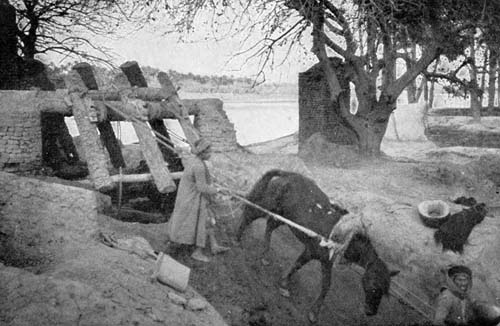
"Drawing Skins of Water."
Baghdad can be reached in a normal way up the Persian Gulf to Busra and from thence by the weekly mail steamer; it contains, therefore, certain concessions to the ideas of occasional European agents and commercial travellers. The Babylon Hotel is one of these concessions. There was a dining-room hung all round with the framed self-assertions of various wine and spirit merchants whose names, strangely familiar, mocked us from the wall as a first greeting from the borders of civilisation. Hassan stood in the middle of the room and gazed at them open-mouthed. These were to him English works of art, decorations of great English houses, in keeping with the gaudily covered chairs and meaningless glass ornaments. Each one had unmistakable pictorial aspects of the bottle. He pointed at first one and then another.
"Ingilhiz," he said in a tone of congratulation. He was always pleased when we met with anything which would seem to remind us of our native land. We were irresponsive; he studied them further.
"Raki?" (Whisky) he added, the note of inquiry tinged with apologetic scorn.
The hotel was built, like all the better modern houses, along the banks of the river, with overhanging balconies. I escaped from the further evidences of Western vulgarity, and, leaning over the rail of the balcony, let the passing river wash them away from the disturbed crevices of my brain. Just beneath, on one side, the narrow street which led to the hotel was continued past it down to the shore; and here came an incessant stream of natives; women with waterskins to fill and men with mules carrying baskets of town refuse to empty; the same spot served admirably for both purposes. The Eastern has an overwhelming love for "taze su" (fresh water); he drinks it, he sings to it, he worships it, he makes an emblem of it, and yet—with his extraordinarily consistent inconsistency—he makes the town midden and the town watering-place one and the same spot.
A nearly naked child sprawled about amongst the dirt and rubbish, unearthing hidden treasures in the form of bright tin lids. The mules strayed about at the water's muddy edge, putting in a drink on their own account whilst their masters, having emptied the loads, filled waterskins for the return journey.
A big, lumbering sailing boat was being unloaded just below me; the men swung themselves to and fro together as they pitched heavy bales overboard.
"Allāh, Allāh, Allāh," they sang out as they swung. Round their heads circled and swooped white gulls talking of the sea.
And now, through the distant broken bridge, clumsily floating down the current, came our raft, square and stubborn amongst the twirling, swiftly paddled goufas. Like a great, uncertain, bewildered animal, turning now this way and now that, guided by the unwieldy poplar poles, it lurched up the watering-place and stuck on the midden.
From every corner of the narrow, winding street sprang out half-clothed, jabbering Arab forms; gesticulating, fighting, jostling, they proffered their services in the task of unloading.
In a few moments all our belongings were removed; the cooking-pots, the rugs, the beds, all the personal requirements which had made it into our home for so many weeks. Stripped and deserted, looking almost ashamed of itself, it lay there in all its naked clumsiness. By to-morrow even this vestige of our journey will have disappeared for ever from the realms of historic evidence. The felt strips, the walls which have sheltered us through so many stormy nights, will be sold to the highest bidder; they will serve henceforth as carpets in some native hovel, on which the Mahomedan will kneel to say his prayers or squat to smoke his pipe. The poles and oars will go as firewood; and the skins, deflated, will return to the country we have left. Nothing will remain but the memory of it to a few human minds. We are glad that it is to be so; as it has been exclusively ours in the past, so will it remain ours only in the future. We made it what it was, and without us it will cease to be.
The waters gave it a farewell lap as they passed on. We had stopped; but they went hurrying on, taking with them all those mixed memories of peace and danger, of contemplation and exertion, of idleness and hurry which they, and they only, had shared with us. They had borne us from the wilds and fastnesses of the unconquered East to the gateway of the Western invasion; through the dreariness and desolation of desert lands, through the magnificent isolation of gorgeous mountain scenery, past the ruined evidences of ancient Western civilisations still mocked by the persistence of squalid tribal huts; and now, having deposited us to draw our own conclusions in this decayed city of the Khalifs, they hurried on, lapping scornfully in their course at the rocking pleasure-boat of Messrs. Sassoon's representatives and the white steam launch of H.M. British Vice-Consulate.
Impartially, as they had borne us up, so down here they bore up alike the brass trinkets shipped in their thousands from Manchester, the emissary of the British and Foreign Bible Society, the golf clubs and society papers for the English Club; and with an indescribable roar, as of grim laughter, rushed headlong into the salt blue waters of the Persian Gulf, where, surrendering irretrievably their own bounded individuality, they merged themselves in the larger life of the untrammelled Eastern seas.
PART III
BAGHDAD TO DAMASCUS
"I read on a porch of a palace bold,
In a purple tablet letters cast—
'A house though a million years old,
A house of earth comes down at last;
Then quarry thy stones from the crystal All,
And build the dome that shall not fall.'"
CHAPTER XIX
BABYLON
The eastern gate of heaven was unbarred; Shamash, the Sun-god of Babylonia, flamed forth and stepped upon the Mount of Sunrise at the edge of the world. As he had poured the light of heaven upon the luxuriant gardens and fertile corn-lands of the Babylonians, so was he pouring it upon the same spot, now an arid and deserted wilderness. We were crossing it on our way to visit Babylon. It was pitch dark when we had left Baghdad in the procession of covered arabas which conveyed pilgrims to Kerbela and merchants to Hillah. We had been roused at 2 a.m., and had threaded our way silently through the sleeping streets by the light of a dim lantern. Huddled human forms lay about in angles and on doorsteps, and at every moment we stumbled over the outstretched limbs of a yellow dog. We crossed the Tigris in one of the round native boats, and landed within a few minutes' walk of the khan from where the arabas started. We had an araba to ourselves: an oblong wooden box on four wheels, with a light canvas top and canvas sides that could be rolled up or let down at pleasure; a narrow wooden plank, with a singularly sharp edge and an uncomfortably hard face, ran down each side, and was called a seat. We were going to sit on it for twelve hours. We were drawn by four mules harnessed abreast. Our driver had knotted the reins and hooked them on to his seat; his hands were rolled inside his cloak, and he sat huddled up on the box in the freezing air of sunrise. The mules galloped ahead at their own discretion; the araba lurched over ruts; sudden jerks shot us against one another, or threw us in the air, from whence we descended with some emphasis in the vacuum between the two sharp edges.
Now the horizon on the left blazed orange and red, and the desert sands were pink. Stunted tufts of grey-green grass tried to assert themselves in the barren soil; mounds, marking the site of ancient villages, occurred at random; walls of sand, indicating the course of old irrigating canals, broke the level plain; they could almost be taken for the work of Nature, for the hand of Time had obliterated the marks of man. Every twenty minutes the arabas came to a sudden stop to give the mules breathing time; there is a general dismounting of the passengers; the plain is suddenly dotted with bending, praying forms, groups of excited talking Arabs, isolated, contemplative, smoking individuals, fussy superior Turkish officers flicking the specks of travel off their smart uniforms; veiled women peep from behind the curtain of a closely packed conveyance; a small Arab child plants himself with outstretched legs in front of us, and sucks his thumb in complete absorption as he gazes upon us like a little wild animal. Then the whole scene dissolves itself into a sudden rush for the carriages, as of so many rabbits bolting into a warren at the sound of an alarm, and off goes the whole train at a gallop; belated loiterers hang perilously on the step of any conveyance they can catch, and try to snatch the lash of the whip with which the driver good-humouredly flicks them. Finally, we approach a collection of mud huts; we dash through them, scattering hens and children, and draw up in a long line opposite a large khan in the centre of the village. This is one of the regular halting places for caravans, and we have a short wait while the mules are being changed. A stall close by is already closely besieged by our fellow-travellers clamouring for tea, which is sold in small glasses after the Persian custom. We buy a little blue dish of thick cream from an Arab girl in a blue smock, and make a sumptuous breakfast off it and dates.
With a fresh set of mules we start off again; the party is more lively. We dash up the sides of an embankment, catch a glimpse of a silted-up canal as we waver for a moment on the top; then a fearful double lurch throws us about as the two front wheels go downwards whilst the two back ones are still going upwards. A short, sharp descent follows, then comes a level stretch; the driver boys shout and race one another, we overtake and are overtaken, we jeer and are jeered at.
And the Sun-god pursues his journey in silence and unconcern across the dome of heaven.
We pass bands of Persian pilgrims on their way to the sacred Tomb of Hosein, son of Ali and grandson of the Prophet. Many of them trudge along on foot, grasping only the stout staff which one's mind associates with pilgrims; these give a true feeling of sackcloth and ashes. Some ride mules and carry a few worldly goods in saddle-bags. There is a Pasha mounted on a fine Arab horse and followed by servants; large pack trunks on mules in his train make one doubt the existence of his hair shirts. The women sit in covered wicker cradles suspended on each side of mules; donkeys bear rude coffins strapped crossways over their backs, for the ambition of the true believer is not only to make the pilgrimage during life, but that after death his bones may rest in peace in the holy ground of Hosein's martyrdom.
At Mushayhib we halt again to get a fresh relay of mules. Here the roads branch and we part company with the rest of the party, who are going to Kerbela. We jerk along over the ridged and rutty ground. I find myself wondering whether cushions in the chariots were amongst the luxuries of wicked Babylon; and if so, whether it was part of the punishment of the fourth generation that we should be deprived of them. We come to a marshy tract with water standing in pools; the driver thrashes the mules vigorously and shouts, the animals plunge forward, and the boy bends his body to and fro with them as they plunge. We go headlong into the marsh and stick; the boy uses his whip unsparingly; the light, energetic members of our party dismount, the fat and heavy ones remain seated; we all shout in anger or encouragement, and by means of these strenuous endeavours are landed on the other side.
On the horizon in front we see a black line; it is formed, we are told, by the rows of palm-trees which border the Euphrates. We are now soberly trotting towards a great mound which, rising abruptly out of the level plain, appears in the distance like a sudden thought of Nature's, tired of the monotony of her own handiwork. But as we approach, its symmetrical sides and flat table-top proclaim it to be the work of man. Our native escort tell us, in subdued tones of awe, how Marut and Harut, the fallen angels, are suspended by their heels in the centre awaiting the Day of Judgment. We leave it at some distance to the right. In front of us stretches a tract of land more desolate and naked even than that through which we have been driving; small heaps are scattered amongst a few larger mounds, and all are enveloped in a network of high-banked canals, now mostly silted up. There are marshy pools here and there, and rough tussocks of coarse grass catch the blown sand.
"And Babylon shall become heaps," said Jeremiah. It was the heaps of Babylon we were looking upon. Babylon, the "glory of nations," was laid out in front of us.
The Sun-god had reached the pinnacle of his height, and covered the spot with the brightness of heaven.
We made a detour round the edge to avoid the embankments and marshy places, and then struck to the right across the uneven ground, at a jolting foot's pace, towards a clump of palms on the banks of the river. The trees partially concealed the one stone house of the district, the home of three German professors who are superintending the work of excavation now going on. A mud wall separated it from a collection of mud huts; here live the natives employed in removing the sand which buries the architectural monuments of ancient times.
We were at the foot of one of the larger mounds; it is called the Kasr by travellers and Mujelibe (the overturned) by the Arabs, and represents the only part of Babylon which is not altogether buried. We climbed up the great square mass composed entirely of the débris of former habitations; the surface was strewn with broken bricks and tiles; in the centre stood the remains of solid blocks of masonry. Looking down into a large ravine at the further end we saw—half-blocked with rubbish—walls, courtyards, doorways, pilasters, and buttresses built of pale yellow-coloured bricks, each bearing the name of Nebuchadnezzar. Here and there architectural ornaments were built in with the walls; bits of bright-coloured enamel and pieces of broken pottery lay about. We wandered amongst the huge ruin, balancing ourselves on the edges of low remaining walls and clambering from one courtyard to another. A jackal darted from under our feet with a shrill bark; he was answered from behind distant walls by innumerable hidden companions. An owl flew out of a dark corner and perched, blinking, a little way off; a great black crow hovered uneasily overhead. The broad walls of Babylon were indeed utterly broken, and her houses were indeed full of doleful creatures. We sat down and listened to the wild beasts crying in her desolate houses; it was indeed "a dwelling-place for dragons, an astonishment, and an hissing without an inhabitant."
Shamash, the Sun-god, was nearing the western gate of heaven. The gate-bolts of the bright heavens were giving him greeting.
The Euphrates and its wooded banks lay between us and the horizon; above the river-line we saw a row of jet black palms in an orange setting, and below it a row of jet black palms standing on their heads in the rippled golden water. Shamash has reached the summit of the Mount of Sunset; he slowly descends; the orange changes to red, the general conflagration becomes streaked and barred; the waters of the river grow black, almost as black as the reflected palms, the streaks slowly die away. Shamash has entered into the Kirib Shame, the "innermost part of heaven, that mysterious realm beyond the heavenly ocean, where the great gods dwell apart from mankind."
"O Shamash, thou art the judge of the world, Thou directest the decisions thereof...."
Thus prayed the dwellers of the city four thousand years ago. And with the same light with which you lit the pomp and splendour of the works of their time, you light the decay and ruin and hideous desolation of the present.
"Verily there is a God which judgeth the earth," say we, four thousand years later.
And as you smiled on those who worshipped you as the supreme God and Creator of all things, so you smile on us who look upon you, bound and fixed, with no will of your own, following the inevitable laws of Nature. Will you, four thousand years hence, light with the same light sojourners in this land, and will they wonder at our conception of your nature and function, as we wonder at the faith that your ancient worshippers had in you? Or will you, before them, have run your allotted course and consumed the whole world, whether in the fiery furnace of your wrath or in the uncontrolled madness of your broken bonds?
The next morning we visited Babel, the mound we had passed the day before. We walked for more than a mile through the palm-groves by the river. Under the shade of the trees were numerous huts made of mud, covered and enclosed with piles of fine brushwood. There were various signs of human occupations. Two cows were toiling peacefully up and down an entrenchment, drawing water in skins over a rough windlass; the skins emptied themselves into a channel, and the water wandered about in vaguely directed irrigation. On the bank beside them lolled an Arab with a long pole, who prodded the sleepy beasts in the moments when he was more awake than they were. A large mass of brushwood was moving in front of us; it looked like one of the huts endowed with a pair of very thin brown legs. As we overtook it the mass half-turned towards us, and a woman's form, doubled in two, looked small in the middle of it.
At the doors of the enclosures naked children sprawled about, all with gleaming white teeth and closely shaven heads, save for the one lock of hair, with which they are to be pulled up to heaven; women with tattooed faces and dangling ornaments pounded barley in primitive stone mortars, and baked thin cakes of bread on flat stones.
Leaving the river-side we struck out to the right for half a mile across the bare, parched ground, where tufts of rough grass were trying to get a footing in the white, barren soil. We climbed up the mound, passing bands of workmen tunnelling in the sides and removing the bricks which lay about in tumbled heaps or in bits of standing walls.
From the top of Babel we could look right over the tract of land once enclosed by the walls of Babylon. The descriptions of Herodotus enable the traveller to call up some sort of idea of the scene in his time. We learn from him that the city was built in the form of a square, surrounded by walls of enormous strength; each side of the square was fourteen miles long, each side had twenty-five gates of solid brass and was defended by square towers built above the wall; twenty-five streets went straight across the city each way from gate to gate. The city was thus cut into squares. The houses, three or four stories high, faced the street and were built at a little distance apart from each other; between them were gardens and plantations. A branch of the river ran through the city; its banks were one long quay. The larger buildings stood in the centre of a square, each apparently fortified and surrounded by walls of its own. It is of these smaller walls only that any trace can be detected. From the foot of Babel, where we stood, remains of earthen ramparts could be traced for two or three miles southwards; they then turned at right angles towards the river and extended as far as its eastern bank. The mounds they enclosed were presumably the site of the more important buildings. Babel itself is supposed to represent the temple of Belus. The Mujelibe, or Kasr, lying to the south of us, is identified with the Palace of Nebuchadnezzar and the hanging gardens; further south still was a lesser mound, Amram. We knew that Birs Nimroud, the great ruin which is looked upon as the Tower of Babel, lay beyond this again, although we could not see it from where we stood.
The whole gleamed white in the strong sunshine. On our right the Euphrates rolled along, as unconcerned in his course as the Sun-god overhead. We could trace the direction of the river southwards to the horizon, marked by the palms along its banks. They made a thin, dark line across a wide, light plain—an alluvial tract which is only waiting to yield its hidden gifts on the day when Man joins hands with Nature and distributes the waters of the river. But not so the actual soil of Babylon; that soil, consisting as it does of building dust and débris, is of a nature which destroys vegetation. "The Lord of Hosts hath swept it with the besom of destruction," and it is doomed perpetually to be a "dry land, a wilderness, a land wherein no man dwelleth."
As we looked upon the great plain which stretched away all round until it carried the eye on into the sky above, we could almost believe with the ancients that the edge of the earth joined the dome of heaven and that both were supported by the waters of Apsn—the deep.
A great wave of silence rolled out of the desert and broke over us. It seemed natural to be immersed in silence; could anything else be expected from a land which had never been alive with the stir of humanity even in far-off ages, of which one might now feel the hush while listening for the echo? The desert had always been silent and would be silent for ever more—a dead, unconscious silence, with no significance save of absence of life. But when we looked at the site of Babylon stretched just beneath us, we became vividly conscious of a real, living silence; we were listening to the "hum of mighty workings"; voices of souls long since dead, the dust of whose bodies lay at our feet, were "wakening the slumbering ages." Had not Nebuchadnezzar entered into the House of the Dead in the great cavern Araltu, the Land of No Return? The dead had been stirred up, even the chief ones of earth, to greet him as he entered hell: "Art thou also become weak as we? Art thou become like unto us? Thy pomp is brought down to the grave, and the noise of thy viols: the worm is spread under thee, and the worms cover thee, ..." and they looked at him narrowly, saying, "Is this the man that made the earth to tremble?"
And yet still for us "the wind uttered" and "the spirit heard" his vainglorious cry: "Is not this the great Babylon that I have built for the house of the kingdom by the might of my power and for the honour of my majesty?"
The silent answer to it lay at our feet. And, listening, we heard the solemn warnings of Daniel, the sorrowful forebodings of Jeremiah, and, above all, the ironical voice of Isaiah:—
"Let them stand up and save thee, Mappers of heavens, Planet observers, Tellers of new moons, From what must befall thee."
As we listened again we heard the noise "like as of a great people; a tumultuous noise of the kingdoms of nations gathered together....
"A sound of battle is in the land and of great destruction....
"A sound of a cry cometh from Babylon and great destruction from the land of the Chaldeans....
"One post ran to meet another post, and one messenger to meet another to shew the king of Babylon that his city is taken."
Then we heard a sound of much feasting and revelling; we heard a solemn hush when there came forth fingers of a man's hand and wrote upon the wall. Even as we listened to the hush it seemed to grow into the great hush of ages, and we remembered that we stood alone in the living silence of these great dead, surrounded by the dead silence of an uninhabited land.
Overhead the Sun-god silently vaunted his eternal existence; at our feet the Euphrates rolled fresh waters of oblivion from an eternal source to an eternal sea.
CHAPTER XX
THE SOUND OF THE DESERT
The Syrian desert between Baghdad and Damascus; two white tents, a prowling jackal, and a starry sky.
There was a sense of stir in camp; a rattle of tins and a neighing of animals; a faint odour of lighted charcoal was wafted in at the tent door. I opened one eye; X still slumbered peacefully at the opposite side of the tent. Arten appeared at the door with a jug of water and a light. "One o'clock," he said laconically as he placed them on the ground and retired. The stars were still shining, my bed was very warm. True, it was one o'clock in Turkish time only, but no Christian ought to be roused at that hour. X fell out of bed with a determined thump. "It's late," she said. I made no response, but, knowing from experience that X was always right, tried to reconstruct my ideas about time and reconcile the fact that it was late with its being one o'clock in the morning. Besides, if X ordained that it was late, in another half-hour the tent ropes would be loosened regardless of the stage our toilet had reached, and a falling tent, when one has just got one's back hair into shape, is exasperating if not damaging. I got up, and just managed to hurl myself through the door, mostly clothed, as the tent collapsed on the ground. X was already seated cross-legged on a rug outside, holding one blue hand over a few charcoal embers while she munched a piece of dry bread held in the other. "You need not think I have eaten all the butter," she said, "because there wasn't any." Satisfied with the explanation, I munched my bread in silence and swallowed a cup of thick tea; we had been carrying water for three days and it was getting opaque.
The stillness of the night which reigned outside was being invaded by the cries and movements of men; dark forms flitted about as they watered the animals and adjusted the nose-bags for the morning's feed. A horse, impatient of his tether, had broken loose and was galloping defiantly round the camp, inspired to further mischief by the methods of his pursuers, whose idea of reassuming their authority over him was to rush in his direction flourishing whips and uttering piercing cries. He was finally brought to bay entangled in some tent ropes, and a sudden lull fell on the disturbed atmosphere. The Oriental can work himself into a pitch of excitement which would keep a European in hysterics for several hours, and then suddenly drop the matter and become instantly silent and unconcerned. There seems no half-way stage between excessive noise and an indifferent silence.
Somewhat awakened by this incident, the men set to work to pack up the camp; the mules were unloosed and stood about with looks of resignation as the loads were adjusted on the creaking pack-saddles and secured with ropes. There was a subdued din and confusion without any sense of hurry. "Allāh! Allāh!" the native cries when he exerts himself in any way. "Aha, aha!" he cries with equal ardour, mingled with satisfaction, when his task is accomplished.
And now the last knot has been tied, the last cloak laid across the saddle; the last ember of the dying charcoal fire has been carefully raked out to light the cigarette, and we straggle slowly out into the gloom, leaving one charred spot and a sardine tin in the sandy waste.
There had been a suggestion of redness in the gathering light for the last few moments; streaks of silver and bars of gold lined the dusky sky. It is disconcerting to be travelling westwards when one wishes to be aware of a rising sun. I twisted myself round in the saddle and, leaving my horse to pick his way, advanced backwards. The whole scene was soon a vast glow of colour, the yellow sand of the desert holding and reflecting the brilliant reds and yellows; and now the sun appeared on the horizon line and slowly rose, until the whole disc of fire stood out in glowing magnificence and then gradually grew paler as he shared his substance with the surrounding sky. The long straggling line of our caravan, which had looked like a black serpent twisting through a sea of fire, became less black in the growing light, and men and animals assumed individual shapes.
In another half-hour the broad light of day showed the surroundings in their common aspect. I twisted round again in the saddle, and, having turned my back on poetry and romance, became only conscious of the temperature of my extremities. The cold was intense; X and the soldiers were far ahead; the caravan lagged behind; I was alone with cold hands and feet. Poets and philosophers have talked of being alone with the sun and the earth: if ever conditions were favourable for enjoying the sole companionship of these two elements, it might seem to be under the present circumstances. But in the desert one can be more alone even than this, for in some frames of mind the sky and the earth give one no sense of companionship. Cold and implacable the grim silent desert stretched away in front beyond the realms of space; the hard blue sky overhead stared into the abyss of Time, offering no link between Nature and Man. There was nothing one could take hold of; no cloud in the sky of which to ask the question "Whither?"; no shadow on the earth to which one could say "Whence?" You were thrown back on yourself, were only conscious of your beating heart and a void. The words of a great lover of nature rose up in my mind: "There is nothing human in nature. The earth, though loved so dearly, would let you perish on the ground and neither bring forth food nor water. Burning in the sky the great sun, of whose company I have been so fond, would merely burn on and make no motion to assist me." You felt keenly alive in the middle of this cold dead space, and you knew there was something alive in you which demanded something of it: had you no place in the economy of this great silent Universe? was there no way of making yourself heard or felt? Is it that the soul of man must be there to make things alive, and you were now crossing earth where no soul of man had crossed before, and all things were dead? From sheer agony I cried out; no answering echo followed; the sound fell flat and dead. The cold heavens stared placidly on, the surface of the earth was unruffled. I drew rein and listened intently: I heard the roar of London streets; the cry of the newsboy, the milkman's call, the tramp of a million hurrying feet; I heard the rush of trains and the screech of engines; I heard a thousand discordant voices in divers tongues where men were struggling and rushing after material ends. And dominating all this, infinitely louder and more distinct, making itself heard supreme and all powerful, filling the great space in which one had seemed eternally lost, I heard—the Silence of the desert. Why wish to make one's self heard?—better be still and listen to the voice of silence; let its words sink into you and become part of you, and so take some of its quiet and peace back with you into those crowded cities of men.
If there is a link between anything in you and this grim stretch of barren sand and impassive depth of distant sky, it is the response of its silence to the silence in you. It is the material aspect of silence in its crudest form appealing to and recognising in you the unspeakable realms of silence which exist in the region you are dimly conscious of beyond your senses. As we pray to the sea for its depth and calm, to the wind for its freedom, to the sun for its light, so we pray to the desert for its silence. Let your nature expand to the width of this horizon, to the height and depth of this sky, and fill it all with the eternity of this silence.
Ask of the sun why it shines, and if there is light in you it will answer; ask of the wind why it blows, and to fettered and free alike it gives its answer; ask of the desert why it is silent, and if there is silence in you you need no answer.
Is there any calm for you in the sea until you put it there? Do you feel any freedom in the wind until you have created it? But can you, in any mood or under any circumstance, evade the silence of the desert? Its influence extends alike to those who receive it and those who resent it.
The men who have no region of silence in themselves are under the power of its physical aspect; to them it is oppressive, wearying, and deadening; there is an absence of life, a presence of monotony from which there is no escape. But once we recognise its silence as being of the nature of what we possess in ourselves, the shadow of monotony and oppressiveness is lifted. Can its effect be better described than it is in that fundamental doctrine of Islam, where it almost coincides with the teachings of Christianity in its endeavour to give expression to the truth? "Islam," that is the resignation of our own will to that of one great power, the effacement of self, the futility of putting our own will or mind against that of the great, silent, all powerful, inevitable laws of Nature—the Moslem idea of Fate and Power—the Christian's blending of his own will with the Divine will—the scientist's recognition of Law—you may put it how you will; are they not but different interpretations of the unseen power, which, silent in itself and only understood in silence, holds supreme sway in moments of silence, and, when expressed in its physical aspect in these barren regions of the earth, appeals through our eyes and ears to the regions in us, beyond these senses, where it exists in its essential condition?
I rode on; the sun had warmed my left side through and the right was beginning to thaw. My shadow, which had been keeping pace with the horse on the right, now began to creep in front as the sun rose higher. By the time its burning rays poured straight down overhead the foreshortened shadow seemed to be leading the way along the desert track. In time the heat became almost unbearable, and, suddenly awakening to the stern realities of physical discomfort, I brought my whip down on the horse's flank; he leaped, startled, in the air, and then flew after his shadow in a settled gallop. Air, of which one had become unconscious, rushed past one's face, and the muffled thud of his hoofs on the sand seemed to measure time and space. I dashed up to X and stopped dead beside her. She looked round inquiringly. "Let's eat," I said. She looked at her watch. "We have been riding four hours," she said; "we might stop at the next good place." I looked ahead significantly. "One place looks much the same as another," I said. "I think there is a dip in the ground further on," she answered, "where we might get a little shelter." There did seem to be a slight wave in the flat expanse and we rode on to it, but, like all dips in this country, when we arrived at it, it did not seem to be there. We had had so much experience in riding after delusive dips that we decided to stop here, and slid off our horses. The cook unpacked the lunch from his saddle-bags and placed hard-boiled eggs, biscuits, and dates beside us. He carefully filled a cup with a thick, brown liquid from the bottom of his waterskin. "Bitdi," he said, by which expression he conveyed that the fresh water was now finished. Then he and the men retired a few yards and ate their lunch. Nothing was heard but the steady munch of human jaws. Then they stretched themselves on the sand and absolute silence reigned, broken by occasional snores. We too lay back, each concealed from the other under two huge umbrellas, which seemed rather to focus the sun's rays than shade them from us.
When one was alone the desert had seemed full of unqualified silence; in company with others the silence seemed even greater, for the slight sounds which there were made one more conscious of the sound which was not. The clank of the horses' bits, the quiet breathing of one's companions, the stir of a foot, made one realise the intensity of the silence of the whole vast expanse. The far-off tinkling of the mule bells in the approaching caravan gave one a sense of distance in a way one would hardly experience by simply gazing at an unapproachable horizon. The heat and the slight fatigue added a feeling of drowsiness which would make even the solid things around one seem shadowy and distant. It was a waking sleep; one's senses were numb because of the absence of anything to call them into play, though one might "see, hear, feel, outside the senses." In the same way that one is alone in a London street one can live in a whirl in the desert; the throb of humanity—— X's umbrella shut with a bang. "Wake up, the caravan is coming." A cloud of dust, a stamping of animals, a shouting of men, and we were off once more. It was our habit to keep pace with the camp in the latter half of the day, and for the next three hours we dawdled along at caravan pace. It was a motley crew. The muleteers trudge along behind the laden animals, taking turns on the back of a patient, sorrowful donkey, on which they ride sideways with dangling legs, pricking its side with a long needle, the secondary object of which is the repairing of broken straps. The pack-mules go doggedly on in front, jostling one another with their unwieldy loads. Occasionally one gets off the track and wanders aside, only to be urged back into line with yells and blows. Another stops dead, feeling its load slip round sideways. The men rush at it with shouts of "Allāh! Allāh!" the load is shoved up and the ropes tightened. There is a general din of shouting and swearing and jangling of bells; and above it all the disdainful camel moves deliberately on with measured step and arched neck, unmindful of the petty skirmishes so far below it; its owner, infected by its spirit, rocking on the top, surveys the whole scene with a dejected, uninterested air. Bringing up the rear, motionless and erect on small donkeys, ride one or two older Arabs, wrapped in long sheepskin cloaks, their faces entirely concealed in the folds of a keffiyeh, save where two stern and solemn eyes gaze unceasingly at you with expressionless imperturbability. Wild sons of the desert, product of this eternal silence, are you so much a part of it that you are unconscious of its power?