Front matter (continued 5)
Reading edition
Common Wood-nymph or Grayling (Cercyonis alope). Expanse 2 inches. Eyes not hairy. Eye-spots on front wings, but not on upper surface of hind wings. The chief geographical races of this abundant species are indicated below, although in regions where the forms overlap many intermediate hybrids occur.
Blue-eyed Grayling (Cercyonis alope alope). A large yellowish-brown blotch near outer margin of each front wing, above and below, with two distinct eye-spots in middle spaces of the blotch. A southern race extending north to central New Hampshire, Michigan, and Wisconsin.
Dull-eyed Grayling (Cercyonis alope nephele). The yellowish brown blotch obsolete or nearly so, but eye-spots present. A northern race extending southward only to central New Hampshire, Michigan, and Wisconsin.
Maritime Grayling (Cercyonis alope maritima). Similar to the type form, but with the yellowish blotch tinged with reddish. A race found only near the seacoast.
Southern Wood-nymph (Cercyonis pegala). Expanse 3 inches. Eyes not hairy. General color brown with an orange-yellow blotch near outer margin of each front wing above and below with one eye-spot in middle space of the blotch on the male, and two on the female.
Little Wood-satyr (Cissia eurytus or Neonympha eurytus). Expanse 1½ inches. Eyes not hairy. General color fawn-brown with two eye-spots on upper surface of each front wing and several on each hind wing.
Gemmed Brown (Neonympha gemma). Expanse 1¼ inches. Eyes not hairy. General color mouse-brown with no markings on upper wing surface except a rather indistinct pair or more of spots next the margin of the middle of each hind wing. Under surface indistinctly striped with rusty lines and a few brown and silvery spots on the hind wings directly beneath the spots on the upper surfaces. Occurs in Southern states.
Georgia Satyr (Neonympha phocion). Expanse 1¼ inches. Distinguished from the related species by the four distinct eye-spots on lower surface of each hind wing, these spots being transversely elongated rather than round. Occurs in Southern states.
Carolina Satyr (Cissia sosybius). Expanse 1¼ inches. Distinguished by the row of round eye-spots near outer margins of lower wing surface. Occurs in Southern states.
THE HELICONIANS
Family Heliconidae
This is a tropical family with only a single species migrating northward to our Southern states. The butterflies of this group are characterized by having the wings so long and narrow that their length is usually twice as great as their width. The front legs in both sexes are so poorly developed that they are considered a modification approaching the complete dwarfing found in the Brush-footed butterflies.
The Zebra Butterfly Heliconius Charitonius
While the butterflies of temperate North America show many examples of marvelous beauty and coloring, one must go to the tropics to see the culmination of what nature has done in painting the outstretched membranes of butterfly wings with gorgeous colors. The great butterfly tribes that swarm in tropical forests seldom reach our temperate clime, and even when they do they are likely to show only a suggestion of the splendid size and rich coloring to be seen farther south. The Zebra butterfly (Heliconius charitonius) belongs to one of these tropical tribes. It shows its affinities by its coloring and the curious shape of its wings. In most of our northern butterflies, the wings are about as long as they are wide, but in the tropical family, Heliconidae, they are very much longer than wide. This gives the insect an entirely different look from our common forms so that one recognizes it at once as a stranger within our gates. Indeed, it does not penetrate far into our region, being found commonly only in Florida and one or two other neighboring states, its principal home being in tropical America.
The Zebra butterfly is well named. Across the brownish black wings there runs a series of yellow stripes, three on each front wing and one on each hind wing, with a sub-marginal row of white spots on each of the latter. The under surface is much like the upper, except that the coloring is distinctly paler. It is very variable in size: some specimens may be but two and a half inches across the expanded wings, while others are four inches. (See plate, page 224.)
The Zebra caterpillars feed upon the leaves of the passion flower. When full grown they are about an inch and a half long, whitish, more or less marked with brownish black spots arranged in transverse rows, and partially covered with longitudinal rows of barbed black spines. They change to chrysalids which are remarkable for their irregular shape, with two leaf-like projections on the head which the insect can move in a most curious fashion.
One of the most notable things about this insect is the fact that the male butterflies are attracted to the chrysalids of the females even before the latter emerge. Many observers have reported upon this curious phenomenon and have recorded experiments demonstrating that it is a general habit with the species.
The Roosting Habits
The adult butterflies flock together at night and rest upon the Spanish moss which festoons so many of the trees in the Far South, or upon dead branches. They take positions with heads upward and wings closed, many of them often flocking together to roost, and wandering out to the near-by fields when the morning sun gives them renewed activity. But these butterflies are essentially forest insects. Reliable observers have noticed that when one emerges from a chrysalis it flies up in the air and makes straight for the nearest woods. Others have noticed that when a butterfly in a field is alarmed it also makes for the woods. And in the regions where the species is abundant the butterflies are most likely to be found in paths and glades in the forest. Th767us they show the influence of their ancestral habitat in the tropical wilderness.
There seems to be a certain amount of ceremony attending the flocking together at night for roosting purposes. A famous English naturalist, Philip Henry Gosse, saw the performance in the West Indies many years ago and described it in these words:
"Passing along a rocky foot-path on a steep wooded mountain side, in the Parish of St. Elizabeth (Jamaica), about the end of August, 1845, my attention was attracted, just before sunset, by a swarm of these butterflies in a sort of rocky recess, overhung by trees and creepers. They were about twenty in number, and were dancing to and fro, exactly in the manner of gnats, or as Hepioli play at the side of a wood. After watching them awhile, I noticed that some of them were resting with closed wings at the extremities of one or two depending vines. One after another fluttered from the group of dancers to the reposing squadron, and alighted close to the others, so that at length, when only two or three of the fliers were left, the rest were collected in groups of half a dozen each, so close together that each group might have been grasped in the hand. When once one had alighted, it did not in general fly again, but a new-comer, fluttering at the group, seeking to find a place, sometimes disturbed one recently settled, when the wings were thrown open, and one or two flew up again. As there were no leaves on the hanging stalks, the appearance presented by these beautiful butterflies, so crowded together, their long, erect wings pointing in different directions, was not a little curious. I was told by persons residing near that every evening they thus assembled, and that I had not seen a third part of the numbers often collected in that spot."
THE MILKWEED BUTTERFLIES
Family Lymnadidae
So far as the great majority of readers of this book are concerned, this family includes but one species—the familiar Monarch or Milkweed butterfly. In the Southern states there is another—the Queen—and in Florida, still a third. The distinguishing characteristics are found in the dwarfed, useless front legs and the absence of scales upon the antennae.
The Monarch Anosia plexippus
From June until October one may often see the stately Monarch flitting leisurely about over fields and meadows. It is one of the largest and most distinctive of these "frail children of the air" and may be easily recognized by its resemblance to the picture opposite page 241. The veins of the wings are heavily marked in black, with large white dots upon the black bands along the margin. The color of the rest of the wings both above and below is reddish brown.
These butterflies come from the South in spring or early summer. They find milkweed plants and lay their eggs upon the leaves. These eggs soon hatch into small white and black caterpillars that feed upon the milkweed leaves and grow rapidly. One is likely to find them throughout most of the summer, wherever a milkweed shows partially eaten leaves. Bring in the half-grown caterpillars, place them in an open vivarium, and furnish fresh leaves every day or two. The caterpillars will soon mature and change to beautiful green chrysalids with golden markings. This chrysalis has been called "the glass house with the gold nails." (See plates, pages 32-33, 241.)
About two weeks later the glass house will burst open and the butterfly emerge. It will rest an hour or two while its wings and body harden and then it will want to fly away. It is not so anxious to do this, however, as most butterflies. If one is kept beneath a good-sized bell-glass, or in a glass-covered box, or even in a closed room, and fed with sweetened water it will soon become so tame that it will perch on one's finger and suck nectar from a flower held in one's hand. On this account it is a particularly desirable butterfly for the amateur photographer to cultivate, because he can easily get many interesting and beautiful pictures by posing the butterfly on different flowers.
The Change from Caterpillar to Butterfly
The change from the caterpillar to the butterfly is easier to watch in this species than in most others. The full-grown caterpillar spins—sometimes on the under surface of the milkweed leaf, sometimes elsewhere—a little mat of silk in which it entangles the hooked claws of its hind feet. Then it lets go with its fore feet, and hangs downward with the front end of its body curled upward. In this position it remains for some hours—perhaps a day—the body juices gravitating downward and causing a swollen appearance on the lower segments. Then the skin splits apart and is wriggled off by the contortions of the body. When it finally drops away, there is left a strange-looking creature, broader below than above. This is a transition stage that lasts but a very short time: soon the form is entirely changed so that the broadest part is above instead of below. The definite outline of the chrysalis is soon taken on, the outer tissues hardening into a distinct covering. The insect is now a beautiful green with wonderful golden spots upon its surface and a few black spots just below the black "cremaster" by which the chrysalis is connected with the web of silk upon the leaf.
In this quiet chrysalis the insect remains for nearly a fortnight. Then the structure of the forthcoming butterfly begins to show through the thin outer covering and you know that the period of the chrysalis is nearly ended. If you keep watch you will probably see the sudden bursting of the outer envelope and the quick grasping of its surface by the legs of the newly emerged butterfly. Its wings at first are short and crumpled, bearing little resemblance to those of the fully developed butterfly. But as it hangs there with one pair of legs holding to the empty chrysalis and the other to the leaf above, the wings rapidly lengthen, hanging limply downward, and the body juices penetrate the veins. A little later they expand in the other direction, the hind wings reaching full size before the front ones do. Finally both pairs of wings are fully expanded, and the butterfly is likely to walk to the top of the support, where it rests for an hour or two while its tissues harden, before it attempts to fly.
In early autumn out of doors these butterflies start southward on their long journey. They often gather in great flocks and roost at night on wayside shrubs and trees. At this season it is easy to catch them in an insect net and bring them indoors for pets. They live for a long while and lend interest and beauty to living room or window garden. To the photographer they offer opportunities for attractive indoor pictures. (See plates, pages 32-33, 160, 225.)
The Queen Anosia berenice
The general form and color patterns of this fine butterfly show at once that it is related to the Monarch. Its general colors are chocolate-brown and black, dotted and spotted with white. The eggs are laid upon milkweed and the life-history is much like that of the Monarch. One of the most interesting facts in connection with this species is that it seems to be mimicked by the Vicereine butterfly in the same way that the Monarch is mimicked by the Viceroy.
THE SNOUT BUTTERFLIES OR LONG-BEAKS
Family Libytheidae
One has a suggestion of Hobson's choice in the common names of this unique family. If Snout butterflies does not seem sufficiently elegant as a descriptive phrase for such delicate creatures, he can call them the Long-beaks, until he sees that this also is inadequate. As a matter of fact both are misnomers, for the projection from the head that gives them these names is neither a snout nor a beak. It is simply a pair of palpi unusually developed, which perhaps in an early stage of butterfly history served a useful purpose. At present, however, they serve chiefly to set the few owners apart from the other butterflies in the system of classification; although possibly they may also serve the butterfly by helping to give the impression of a leaf attached to a twig. (See plate, page 240.)
The Snout Butterfly Hypatus bachmani
There is a peculiar interest in any form of animal life which can be definitely traced far back through the geologic ages. In nearly every group of living creatures there are certain types which scientists have found were once abundant but which now are on the wane. As a rule these are better represented in the museums through fossil species than by those now living. To a considerable extent also such forms are likely to present various features which mark their primitive condition and the living allies have peculiarities which set them off as distinct from those of their own relations which have been modeled in a more modern fashion. Among the mammals the curious marsupials, of which our southern opossum is an example, furnish good illustrations of this general truth. Among the birds the curious little Least Bittern is an example. Among the butterflies the strange Snout butterfly is by far the best example.
These Snout butterflies, of which only two species are now living in North America, are the sole representatives with us of the family Libytheidae or the Long-beaks. Only one of these species occurs to any extent at least north of Texas. It is the curious little creature called the Snout butterfly. It has a strange appearance due to the angular outline of both front and hind wings and the long palpi which project forward from the head in a way to attract attention. The common name is due to these projecting palpi. Even the coloring is primitive, the general tone of the wings being blackish brown, distinctly marked with white and orange spots. The under surface is less primitive in its coloring, being toned in iridescent grayish brown in a way to suggest protective coloring, except in that part of each front wing which is not hidden when the insect is at rest. This shows the white and orange-brown markings.
Some years ago there were found in certain fossil deposits in the West about a dozen species of fossil butterflies. It is strange indeed that these ethereal creatures should be fossilized at all. One would think it scarcely possible that they could be so preserved that a million years after they had died man should be able to study them, determine to what families they belonged, and even guess with a high probability of accuracy upon what leaves their caterpillars fed. This little collection of fossil butterflies was studied by one of the great American authorities on living butterflies, the late Samuel H. Scudder, who said of them: "They are generally preserved in such fair condition that the course of the nervures and the color patterns of the wings can be determined, and even, in one case, the scales may be studied. As a rule, they are so well preserved that we may feel nearly as confident concerning their affinities with those now living as if we had pinned specimens to examine; and, generally speaking, the older they are the better they are preserved."
A curious fact is that out of the comparatively few species of these fossil butterflies two were easily recognized as members of this Long-beak family. They were given special scientific names and undoubtedly were closely related to the Snout butterfly which is still flying every year in various parts of the United States. Our modern species lays its eggs upon the leaves of hackberry and in these geologic deposits of that far-gone era there have been found well-preserved leaves of old hackberry trees, upon which it is extremely probable that the caterpillars of these ancient Long-beaks fed. What an opportunity for a modern collector of butterflies to work his fancy, as he thinks of those old times when these fossil creatures were flying in the sunshine, depositing their eggs upon the leaves of trees that made up landscape pictures probably very different from those of to-day! And how he wonders what flowers these butterflies visited for their nectar food, what birds chased them from tree to tree, and what mammals wandered through those ancient forests. What a suggestion also it gives of the continuity of life upon our old earth to realize that these butterflies of to-day are carrying on their brief existence in practically the same way that these forbears of theirs did so many millions of years ago.
Another way in which these butterflies are peculiar is the fact that the females have six well-developed legs while the males have only four. As already indicated the caterpillars feed upon hackberry. When full grown they are about an inch long, dark green, striped with yellow, with two blackish tubercules on the second ring behind the head. They apparently pass the winter in the chrysalis stage. The butterflies are likely to be found along the borders of brooks or streams running through woods, or along the margins of the forest. Occasionally they become abundant in certain localities, but on the whole they are rare and highly prized by collectors.
THE METAL-MARKS
Family Riodinidae
This small family of very small butterflies contains five genera and a dozen species found in the United States and Mexico. Only two, however, occur in the eastern region and only one extends much north of the Gulf states. Aside from certain peculiarities of the wing-venation (a costal and a humeral vein on the hind wings) these Metal-marks may be known by their minuteness and the bright metallic markings on the brown wings.
Both our eastern species belong to the genus Calephelis. The Small Metal-mark (C. caenius) has been collected in Florida and Georgia. The wings are rusty red on both surfaces, brighter below than above, and marked with blackish spots that almost converge to form stripes; in addition to which there are, beyond the middle of each wing, two lines made by special scales that glisten with a steel glitter. The wings expand only about three quarters of an inch. So far as I can learn, the egg, larva, or pupa have never been described.
The Large Metal-mark is called by science Calephelis borealis, but it deserves the latter name only in the sense that it is more northern than its allies. It has been collected as far north as New York and Michigan, but it seems to be very seldom found, at least in eastern regions. It expands a little more than an inch. The general color of the wings is yellowish brown, marked with blackish dots and lines, together with rows of steely spots on the under surface. In this case also the life-history is unknown.
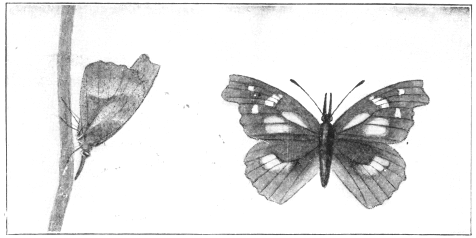
See page 236
THE SNOUT BUTTERFLY IN FLIGHT AND AT REST
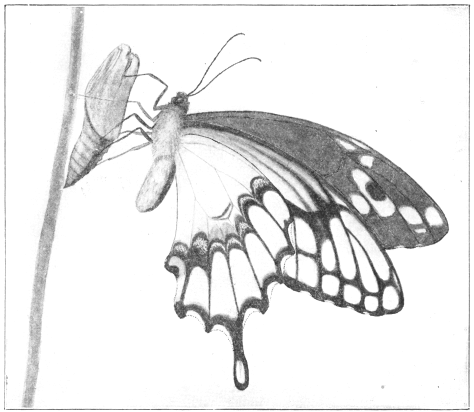
See page 62
GIANT SWALLOWTAIL JUST OUT OF THE CHRYSALIS
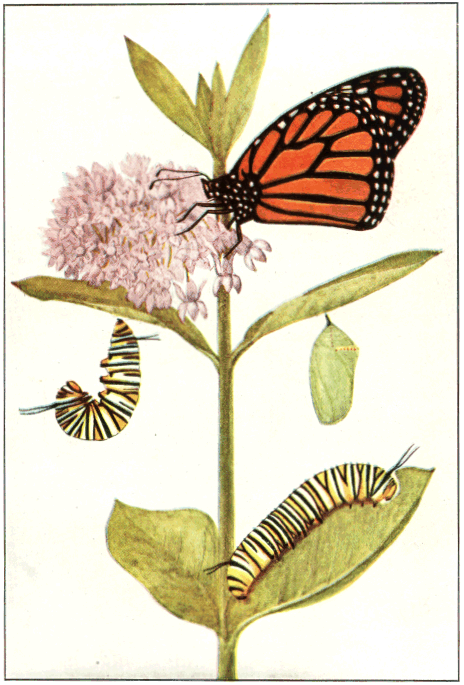
From a drawing by W. I. Beecroft
See page 233
THE MONARCH BUTTERFLY
Caterpillar feeding; caterpillar hung up for pupation; chrysalis, and adult
THE GOSSAMER-WINGS
Family Lycaenidae
The daintiest and most delicate of all our butterflies are included among the Gossamer-wings. Their bodies are small and slender, their antennae ringed with white and almost threadlike, their wings thin and of exquisite beauty. Many of them are marked with the slenderest of tailed projections from the hind wings. When the face is viewed from in front it is seen to be much narrower than its height. At the insertion of the antennae the eyes are notched, and they are also more or less surrounded with white scales. Most of the caterpillars have oval, slug-shaped, smooth bodies, with the under surface flattened, and very small heads, which in many species can be extended by means of an extensile neck. The chrysalids are held in place by silken threads both at the tail and over the middle. They are rounded, short, and stout.
Notwithstanding their small size, the Gossamer-wings are among the most spritely of all our butterflies. They seem indeed winged sprites, playing everywhere, in fields and open woods, along roads, lanes, and brooks, in door-yards and gardens—wherever, in fact, a bit of open space invites their presence. Not alone upon the wing but even when at rest does their liveliness appear. For most of these butterflies have the curious habit of keeping the hind wings in motion after alighting, rubbing them against each other in a vertical plane or "moving them backward and forward when half expanded." These habits are so fixed that when one sees a butterfly thus engaged one can pretty certainly conclude it is a member of this family.
The Gossamer-wings are commonly separated into three rather distinct tribes—the Hair-streaks, the Coppers, and the Blues. The characteristic features are these:
Three branches arising from the radius of each front wing. Under surface of hind wing commonly marked with threadlike streaks: the Hair-streaks.
Four branches arising from the radius of each front wing. Under surface of hind wing commonly marked with spots rather than lines.
Colors brownish red: The Coppers.
Colors blue: The Blues.
THE TRIBE OF THE HAIR-STREAKS
The Hair-streaks are small butterflies with the eyes notched to allow for the insertion of the bases of the antennae. The name is given on account of the fine, hair-like markings which extend across the under surface of the hind wings. In many species there is a tailed projection or two on the hind inner margin of the hind wing. The caterpillars are remarkable for the small head, so connected with the body that it can be pushed forward in a characteristic way.
The Hair-streaks are among the most exquisite and delicate of all our butterflies. A large proportion of them have the upper surface of the wings toned in beautiful hues of grayish brown and the under surface lighter gray, marked with dots and stripes, some of which are brilliant in coloring. A few of the larger species are brilliantly iridescent in purples, blues, and greens, marked with black. The males have well-developed scent-pockets in many species, these being commonly along the front border of the front wing.
A very interesting suggestion in regard to the possible function of the curious tail projections was made nearly a hundred years ago by some English entomologists and has since been discussed at considerable length in various publications. It is that the slender tails, together with the enlargement of the wing just back of them, give the impression of a false head. Along with this unusual development of the wing is to be considered the fact that these butterflies nearly always alight head downward so that the false head, furnished with what seem to be waving antennae, takes the place that would naturally be occupied by the true head. Instances have been reported in which this false head has apparently been nipped off by a lizard and much evidence has accumulated to indicate that this curious device may be a real protection in many cases. Of course, the loss of the tails and the part of the wings adjacent would be comparatively insignificant. In most cases, these projections on the wings are held at right angles to the plane of the wing.
While nearly half a hundred species of Hair-streaks have been found in North America, only a few of these are sufficiently abundant to require discussion in this little book.
The Great Purple Hair-streak Atlides halesus
It seems something of a reflection on the activities of American entomologists to say that, after the lapse of more than a century since Abbott studied the insects of Georgia, our knowledge of the early stages of two of the largest Hair-streak butterflies is still confined to the observations he made. Yet this is true, and one of them—the Great Purple Hair-streak—is the largest species of the group that occurs in the eastern United States. The other is the White-M Hair-streak.
The Great Purple Hair-streak is a beautiful, iridescent blue creature, as seen from above, with blackish borders around the blue. As seen from below, the wings are dark brown, with red spots near the body. The two tail-like projections are quite long. It is very large for the group to which it belongs, measuring nearly two inches across the expanded wings. It is a tropical form, extending into our southern borders from California to Florida and occasionally occurring north as far as southern Illinois. The larvae feed on oak. (See plate, page 256.)
The White-M Hair-streak Eupsyche M-album
The White-M Hair-streak is about two thirds the size of the Great Purple species with less blue and more black on the upper wing surface. The hind tail is slender and well developed, and the angle of the wing just back of it is rounded out in an unusual fashion. The lower surface of the wing is of a general grayish brown color, marked by a white stripe, which takes the form of the letter M: hence its name. This is also a southern species occurring at times as far north as Ohio and even Atlantic City, New Jersey. The caterpillars feed upon the leaves of oak and Astragalus or milk vetch.
There is also a third species of this group of whose history we are ignorant except for Abbot's observations. It is an exquisite little butterfly called the Least Purple Hair-streak (Calycopis cecrops) and is apparently a tropical form which has spread into our Southern states. It is especially beautiful because of the brilliant red and white lines running across the under surface of both wings. It occurs as far north as West Virginia and Kentucky and ranges westward at least to the Mississippi Valley.
The Gray Hair-streak Uranotes melinus
This exquisite little creature is capable of surviving under a great variety of climatic conditions. It ranges from New Hampshire to Florida and Central America, but apparently occurs only rarely north of the United States. Perhaps the most distinctive feature in the female is the orange spot just in front of a pair of tiny tails on each hind wing, the rear one being curiously curved and about three times as long as the other. In the male the shorter tail is absent. The general color of the upper surface is a dark bluish gray, relieved on the margin of each hind wing by a few white dots and the orange spot already mentioned. The under surface is much lighter gray, distinctly marked with two dark brown lines near the margin, the outer line little more than a row of spots and the inner line with a white edge. (See plate, page 257.)
These small butterflies lay tiny though beautiful eggs upon a variety of plants. The eggs hatch into curious little caterpillars that have the appearance of slugs with small heads which can be extended as if the little creature had really a rubber neck. The object of this extensile head is seen when one finds the larvae feeding upon the fruits or the seed-pods of its various food plants—hawthorn, hop, hound's-tongue, and St. John's-wort. The caterpillar is able to thrust its jaws into the interior of the seed-pods and devour their contents. There seem to be generally two broods in a season, even in the more northern parts of its range, while toward the south there are probably at least three broods. The butterflies are found upon the wing almost any time in summer, especially from early June until late in August.
The Banded Hair-streak Thecla calanus
This is one of the most familiar of the delicate little butterflies grouped in the genus Thecla. It occurs rather commonly in a great stretch of territory extending from Maine, west to Nebraska, south to New Mexico and Texas, and east to Alabama and Georgia. It also occurs in a limited area on the coast of California. The general color of the upper surface is a dark brown, which in the male is marked near the front edge of the fore wings with a distinct gray patch of scent scales. The under side is similar in color to the upper except that the outer half of the wing is marked by two series of broken lines in white, blue, and brown and a brilliant bit of coloring just in front of the tail projection of the hind wings; this coloring shows beautiful tones of red, blue, and black.
These little butterflies may often be seen visiting the midsummer flowers but are fully as likely to be found along the sides of a shady road, where they rest upon the leaves of trees, shrubs, and herbaceous plants. When disturbed, they fly up in small companies but soon settle back again into their previous positions. They are lovers of sunshine and may often be seen upon a leaf, with fully expanded wings, taking a sun-bath. There is but one brood a year, butterflies appearing early in summer and remaining for several weeks. They lay their tiny pale green eggs upon the leaves of various trees, especially oaks and hickories, and probably hawthorns. It is not known whether these eggs remain unhatched as a rule until the following spring, or whether they soon hatch and the young caterpillars hibernate without feeding. It is probable that both conditions occur. In spring the larvae eat holes in the leaves of their food plant and grow rather slowly, gradually becoming brown or green slug-like caterpillars about half an inch long. They finally change into greenish brown chrysalids from which the butterflies emerge in early summer.
The Striped Hair-streak Thecla liparops
In the Eastern states the distribution of this species is almost the same as that of the Banded Hair-streak, but in the Central West the outline of its region moves northward extending into Canada, above North Dakota, and into Montana and Wyoming. It does not go so far south, however, extending practically only to the southern borders of Kansas and Missouri. The butterfly bears a striking general resemblance to the other species just named, differing chiefly in the fact that the under surface of the wings is much more thickly marked with broken lines that extend nearer to the body. As a rule, it is not common and consequently it is prized by collectors. Some good observers have noticed that it is more likely to be found only on flowers, instead of sunning itself on leaves. It is single-brooded, hibernating either in the egg state or in that of the young larvae. The food plants are varied, there being good evidence that the caterpillar feeds upon all of these: apple, plum, shadbush, blueberry, holly, chestnut, willow, thorn, and several kinds of oaks. Mr. W. F. Fiske found a chrysalis of this species in the deserted nest of a tent caterpillar in New Hampshire in early June, the butterfly emerging later in the month.
The Acadian Hair-streak Thecla acadica
This is one of the numerous butterflies that offers some young student an opportunity to make real contributions to science. It is a beautiful little creature, expanding scarcely an inch across its outstretched wings, found from New England west to Montana along a rather restricted area, which coincides pretty closely with the southern part of the Transition Zone. There is a form on the Pacific Coast which is commonly considered to be this same species.
These butterflies appear during July and August. They visit various flowers but are especially likely to be found near willow thickets along the borders of brooks and swamps. It is supposed that the eggs are laid upon the willows and that they remain unhatched until the following spring. Then they develop into little caterpillars that feed upon the willow leaves and mature in time to form chrysalids early in June. These chrysalids in turn disclose the butterfly early in July. So far as I know the eggs themselves and the situation in which they are laid have never been described.
The Olive Hair-streak Mitoura damon
Very few butterflies have the distinction of showing a clear case of protective resemblance to one kind of plant in both the adult and the larval stages. This is the case, however, with this Olive Hair-streak which is so intimately associated with our common red cedar, that where one is found the other is likely to occur, although both caterpillars and butterflies are seldom seen because they resemble the twigs of the cedar so closely.
Along the Atlantic Coast this little butterfly occurs from New Hampshire to Florida, and westward to a line drawn from Dakota to Texas. The upper surface of the wings is rather dark olive-brown and the under surface, so far as it is exposed when the butterfly is resting, is of a greenish hue that harmonizes with the green of the red cedar twigs. There are also, on the under surface, some irregular lines and dots of red, brown, and white which probably help in rendering the insect inconspicuous when it is resting among a cluster of twigs.
The yearly history of this beautiful little butterfly differs from that of most of its relatives. The species winters in the chrysalis state, the first brood of butterflies bursting forth early in May. These lay their eggs upon or between the scales of the red cedar twigs, especially those which bear flowers. About a week later the eggs hatch into tiny caterpillars that feed upon the scale-like leaves, continuing to eat and grow for nearly six weeks before they reach their full size. These caterpillars are so similar in color that they are difficult to see, and they have a remarkable protective device in that the first ring behind the head is developed into a shield which covers the head, hiding it so completely that the movement of the jaws in feeding is effectively concealed. Late in June they change to chrysalids, part of which appear to remain in this condition until the following spring, while most of them give forth a second brood of butterflies in July. These butterflies lay eggs for a second brood of larvae that mature into chrysalids during September, and hibernate in this condition until the following spring. Consequently, in the Northern states, the collector should look for fresh specimens in May and early June and again in July and early August.
These butterflies visit various flowers, apparently preferring rather small blossoms, such as those of the Mouse-ear Everlasting, which is in bloom when the first brood is flying, and the various members of the mint family, especially spearmint, as well as the sumacs, which are in bloom when the second brood is on the wing. The time between flower visits seems to be spent at rest upon the red cedar branches, and one of the surest ways to find the butterflies is to give these trees a sudden jar, which starts them into flight. In fact, they may often be seen flying around the tops of the cedars a score of feet from the ground.
Synopsis of the Hair-streaks
Great Purple Hair-streak (Atlides halesus or Thecla halesus). Wing expanse 1¾ inches. Upper wing surface bright blue with blackish margins, the blackish coloring extending nearly to the middle in the female. Two distinct tails on each hind wing. Under surface sepia brown with blue and red spots. Abdomen orange below.
White-M Hair-streak (Eupsyche m-album or Thecla m-album). Wing expanse 11⁄3 inches. Upper wing surface blue with wide blackish margins in both sexes. Under surface marked with whitish lines suggesting the letter M, with a reddish spot near it. Each hind wing with two small tails.
Least Purple Hair-streak (Calycopis cecrops or Thecla cecrops). Wing expanse 1 inch or less. Upper wing surface dark brown, more or less marked with blue, especially at base of front wings and inner half of hind wings. Under wing surface marked with a brilliant red line edged outside with white. Two very fine tails on hind wings with brightly colored spots near their base on lower surface.
Gray Hair-streak (Uranotes melinus or Thecla melinus). Wing expanse 11⁄5 inches. Upper wing surface bluish gray with a brilliant red spot at base of tails on hind wing. Lower wing surface much lighter gray, each wing marked with a brown and white stripe and a row of dots nearer the margin.
Banded Hair-streak (Thecla calanus). Wing expanse 11⁄5 inches. Upper wing surface dull dark brown, commonly without markings although sometimes there is an orange spot on each hind wing. Lower wing surface a little lighter than upper with bright red and blue spots at the base of the tiny tails, and with distinct narrow blue and white broken bands extending across the outer half of each wing.
Striped Hair-streak (Thecla liparops). Wing expanse 1 inch. Very similar to the Banded Hair-streak, but having more white markings on the lower surface of the wings.
Acadian Hair-streak (Thecla acadica). Wing expanse 11⁄3 inches. Upper wing surface blackish brown with a slaty tinge, and red spots at base of the single short tail on each hind wing. Lower surface bluish gray with many small blackish spots edged with white arranged in two principal rows on the outer half of each wing. Larger orange-red spots on each side of base of the tail on each hind wing.
Olive Hair-streak (Mitoura damon or Thecla damon). Wing expanse 1 inch or less. Upper wing surface olive-brown, more yellow in the male than the female. Tips of tiny tails on hind wing whitish. Lower surface green except where upper wing is covered by lower: this part is brown. The green is marked with a row of white spots on each front wing and two distinct rows of brown and white spots on each hind wing, with black spots between.
THE TRIBE OF THE COPPERS
The members of this tribe are well characterized by their name, for most of them show on the upper wing surface tones of coppery brown, more or less marked around the margin with darker shades. On the under side of the tarsi there are numerous spines in irregular clusters. In the chrysalis there are curious hair-like projections on the skin, which are short and shaped like tiny toadstools or mushrooms.
While some of the Coppers are very abundant, the majority are rather rare. Only a few species are sufficiently widely distributed to require description here.
The Wanderer Feniseca tarquinius
In many orders of insects there are whole families whose larvae are habitually carnivorous, feeding entirely upon other kinds of insects. This is especially so in case of the beetles, the flies, the true bugs, and the great order to which the bees and wasps belong. Among the scale-winged insects, however, carnivorous caterpillars are rare, seldom occurring among the moths and in hardly more than one species among the butterflies. This one exception is the modest-looking little butterfly fancifully called the Wanderer, perhaps because instead of frequenting the flowery fields where other butterflies congregate it wanders in and out among the alders by brooks and ponds, alighting oftener upon a leaf or twig than upon a flower—the latter apparently lacking for it the attraction it has for other butterflies.
If you watch one of these copper-hued creatures for awhile, however, you will soon see that its wandering is not aimless but has rather a method all its own. Perhaps you will see it alight upon an alder twig on or above which you are likely to notice curious woolly white excrescences. If you are close enough you will probably see the butterfly uncoil its tongue and sip up a liquid on twig or leaf—the exudations of the woolly aphids that make up the supposed excrescence and suck the sap from the bark. Much of this sap passes through the bodies of the aphids and collects in liquid globules on twigs and leaves, forming a sort of honey-dew which is much sought after by flies, wasps, and other insects. It seems to form the chief sustenance of these Wanderers.
But many of these butterflies have another purpose besides that of sipping the honey-dew. Should you watch one of the mother butterflies carefully you would be likely to see her alight on or near a colony of woolly aphids and run rather rapidly over them in a wasp-like manner, finally stopping long enough to lay a tiny, roundish, slightly flattened egg upon the twig, generally on the under side, and only one in a place. Then she may continue her way, wandering lazily along the alder-bordered stream.
Let us now centre our interest upon the egg. Three or four days later it hatches into a curious caterpillar. Instead of having mouth parts fitted for biting leaves as is the case with most butterfly larvae, it has one fitted for grasping, piercing, and sucking the juices of the plump bodies of the aphids, which it finds hard by its place of birth. It also has silk spinnerets connected with its mouth, so it is able to spin a web to shelter it from being run over by its intended victims.
The newly hatched larva is not slow to take advantage of the facilities with which it is provided. It at once begins to spin a web above and around itself, from the end of which it reaches out for the nearest aphids, sucking their life-blood and casting their empty skins to the discard of its protecting web. The skins thus serve as an additional shelter so that, as the caterpillar moves forward, increasing the number of its victims from day to day, it extends its web and the protection of the cast skins intermingled with it, while through all—the cast skins, the silken web, and even the hairs on the body of the caterpillar—there runs a woof of the woolly excretion—effectually concealing the larva from sight.
The woolly aphids thus serve as the sole food of the caterpillar during its brief life as a larva. Perhaps because of the pre-digested nature of its food, it is able to mature much sooner than most butterfly larvae. In about eleven days after hatching it is ready to change to a chrysalis, having undergone during this period only three moults, instead of at least four as with other caterpillars. Each caterpillar then changes to a chrysalis which is remarkable because the form and color of its back bears a striking resemblance to the face of a miniature monkey. It remains in this condition nearly a fortnight and then emerges as a butterfly.
In New England and the Northern states the short life of the larva enables this insect to mature three broods each season. Farther south there are probably more, for this species is widely distributed in eastern North America, occurring from Nova Scotia to Georgia and west to the Mississippi Valley.
The American Copper Heodes hypophlaeas
This little butterfly is one of the most generally abundant insects in the northern part of North America. It commonly occurs from ocean to ocean, from the Hudson Bay region to the latitude of Georgia, and it flies freely in city parks and village yards as well as in the more open spaces of field and forest. When seen through a lens it is very beautifully colored, the coppery red of the wings being overspread with conspicuous black dots and a touch of orange around the outer border. The expanded wings measure just about an inch, so that this is one of the smallest of our common butterflies.
The caterpillars of the American Copper feed upon sorrel, one of the commonest weedy plants of waste places everywhere. The rusty red blossoms of the sorrel harmonize in color with the color of the butterfly, which is frequently to be seen flying slowly above the plants, stopping now and then to lay its eggs singly upon the leaves or stems. Each egg soon hatches into a curious caterpillar, which looks more like a slug than the usual type of butterfly larva. It feeds upon the succulent tissue of the sorrel leaf, at first biting small holes in the under surface. As it gets larger it feeds more freely and is likely to make channels instead of holes. It matures in about three weeks, changing into a chrysalis under the shelter of a stone or board. A little later it again changes to a butterfly.
There is an interesting variation in the number of broods of this butterfly each season. In regions where it has been studied it has been found to be double-brooded in northern New England and triple-brooded in southern New England and the Atlantic states. It is probable that in its far northern home in the Hudson Bay territory it is only single-brooded. It is thought that the insect hibernates as a chrysalis.
These little butterflies are so small and fly so near the ground that they are likely to be overlooked by the casual observer. They frequently alight to sun themselves or to sip nectar from many kinds of flowers. They begin their day's work early in the morning and continue well into the evening. Then they find a roosting-place, head downward upon a blade of grass, where they sleep until wakened by the morning sunshine.
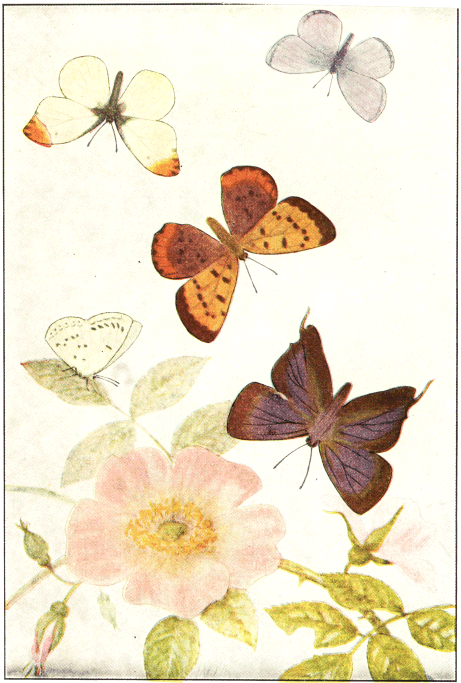
From a drawing by W. I. Beecroft
FIVE INTERESTING BUTTERFLIES
The Spring Azure (p. 258) at the top; the Falcate Orange-Tip (p. 94) next; the Bronze Copper (p. 257), female, next; the Spring Azure (p. 258) resting on a leaf, next; and the Great Purple Hair-streak (p. 243), female, below.
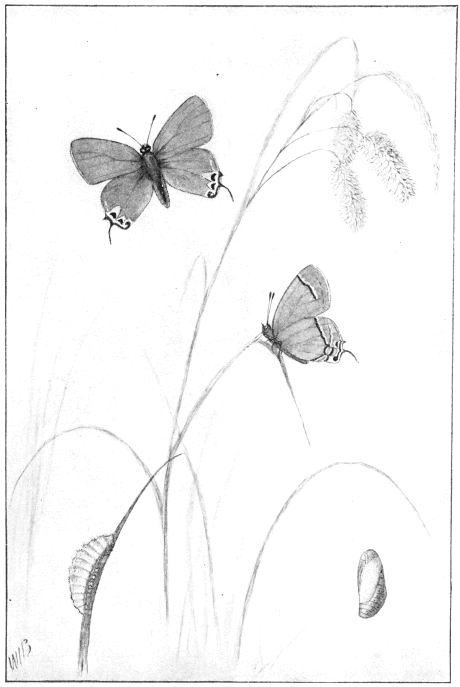
See page 245
STAGES OF THE GRAY HAIR-STREAK
The Bronze Copper Chrysophanus thoe
This butterfly is nearly twice as large as the American Copper to which the female of the present species bears a striking resemblance. The Bronze Copper is a rare species, occurring from New England nearly to the Rocky Mountains. The slug-shaped yellowish green caterpillar feeds upon dock and related plants. (See plate, page 256.)
Synopsis of the Coppers
The Wanderer (Feniseca tarquinius). Wing expanse 1¼ inches. Upper wing surface tawny brown, each wing more or less marked with dark brown spots, the distinction between the colors being clear-cut, and the lines between having an angular effect. Lower surface of front wings similar in colors to upper with dark spots rectangular. Under surface of hind wings mottled with irregular spots of pale brown.
American Copper (Heodes hypophlaeas or Chrysophanus hypophlaeas). Wing expanse 1 inch. Upper surface of front wings tawny orange with margins and rectangular spots blackish. Upper surface of hind wings coppery red with a tawny orange band on outer margin. Lower surface of front wings much like upper surface; that of hind wings grayish marked with dark spots and an orange line near the margin.
Bronze Copper (Chrysophanus thoe). Wing expanse 1½ inches. Male. Upper wing surface coppery brown marked with dark spots and a tawny orange sub-marginal band along outer margin of hind wings. Under surface of front wings lighter orange with blackish spots and of hind wings grayish with blackish spots and an orange sub-marginal band. Female. Upper surface of front wings tawny orange with blackish spots.
THE TRIBE OF THE BLUES
These beautiful little butterflies are well named, for the majority of them are colored in exquisite tints of blue. They are distinguished from the Coppers by this blue coloring, as well as by the fact that the spines on the under side of the tarsi are arranged in rows rather than in clusters and are comparatively few in number. The body is rather slender and the under surfaces of the wings are generally dotted in a characteristic fashion. Most of the two score or more species found in North America occur on the Pacific Coast or in the Southwest, less than half a dozen being common in the eastern region.
The Spring Azure Cyaniris ladon
For a wee bit of a gossamer-winged creature that expands scarcely an inch across its outstretched wings, the Spring Azure has caused American scientists an immense amount of patient labor. Over the vast territory from Labrador across to Alaska and south to the Gulf of Mexico, this little blue butterfly exists in so many different forms that it requires special analytical keys to separate them. Not only does it vary geographically so that in one locality we find one form and in another a different form, but it also varies seasonally to a marked degree. As one would expect there is a striking difference in its annual cycle between Labrador and the Gulf Coast. In the far northern region there is but one brood a year, while in the southern region there are at least two and perhaps more.
The variations in this butterfly are shown by the differences in the marking of both surfaces of the wings. These markings may run from a faint blackish border along the extreme margin and a few faint dots upon the under surface, to a wide black margin around the wings and a deep abundant spotting of the under surface. The markings of the various forms are so uniform that the varieties are easily distinguished. It is beyond the scope of this book to attempt to differentiate all these varieties but any reader interested will find an admirable summary of the conditions illustrated by an excellent plate in Comstock's "How to Know the Butterflies." The species as a whole may be known from the fact that the upper surface is blue, the lower surface ash-gray, more or less spotted with dark brown, and the wings are without tails. (See plate, page 256.)
The Strange Structures of the Larvae
A remarkable variation of the adults is sufficient to give this species a special interest, but the larvae also have a unique attraction for the naturalist. The mother butterflies lay their eggs upon the flower buds of various plants, especially those which have clustered racemes of blossoms. These eggs hatch into minute slug-like larvae which feed upon the buds, commonly burrowing through the calyx lobes and devouring the undeveloped stamens and pistils inside. They finally change to chrysalids, which are more or less securely attached to a central flower stalk, from which in due time the butterflies emerge. So far there is nothing remarkable about this story of the life of the Spring Azure, but that is yet to come.
These little caterpillars are subject to attack by tiny parasitic flies which lay eggs in their bodies. Each egg hatches into a still more tiny maggot that lives at the expense of the tissues of the caterpillar and finally kills it. When one of these little caterpillars has its head buried in the round ball of a flower bud, about half of its body is exposed defenseless, so that the little fly that lights upon it to lay her egg cannot even be dislodged by the head of the caterpillar, as is often the case with other species. There is a very curious provision for defense, however. If you look carefully through a lens at the hind part of the body you will find a little opening on the back of the seventh abdominal ring. This opening leads to a sort of tiny pocket, a pocket which the caterpillar can turn inside out when it so desires. Now the curious thing about it is that the caterpillar, while this pocket is concealed in its body, is able to secrete in it a drop of liquid which we presume to be sweet to the taste. When the little pocket is partly filled with this drop of liquid the caterpillar turns it inside out in such a way that the liquid drop remains in position on top of the protruded pocket.
Perhaps you ask what is the good of all this complicated arrangement? If you could see what happens when the little drop of what—for lack of a better name—we shall call honey-dew is exposed, you would begin to guess the reason. Wherever these larvae are found you will also find many ants wandering round among them, and the moment the honey-dew appears these ants begin to sip it up. When it is all gone the little caterpillar draws in its pocket again and presumably begins to store up another bit of liquid. It is certainly a curious example of what the naturalists call symbiosis, which simply means a living together of two animals, each helping the other in some way. In this case it is easy enough to see how the caterpillar helps the ant, but perhaps you are wondering in what possible way the ant may help the caterpillar. I hardly dare give the most plausible explanation for fear some one will cry out, "Nature-faker!" But fortunately the explanation is based upon at least one precise observation by W. H. Edwards, one of the most careful and reliable naturalists America has produced, who lived before the recent era of Nature-fakers and was never accused of sensationalism. Mr. Edwards saw an ant drive away from one of these caterpillars a little parasitic fly which apparently was searching for a victim. Consequently, it would appear that the ants helped the caterpillars by protecting them from these arch enemies.
This is by no means an isolated example of the relations between ants and other insects. It has been known for hundreds of years that the ants use the aphids as a sort of domestic milk-producer, attending the aphids at all times and even caring for their eggs throughout the winter season. As the plant-lice live in colonies, sucking the sap of their host plant, they are attended by great numbers of ants that feed upon the honey-dew which passes through their bodies. In many cases the ants have been observed to stroke the aphids with their antennae in a way which seems to induce the aphid to give out a drop of the sweet liquid for the ant to lap up. In a similar way these ants seem sometimes to stroke these little caterpillars with their antennae and thus to induce them to turn their little pockets inside out with the drop of liquid at the tip. This is certainly an unusual and most interesting relation between two insects far separated by their structural characters.
The little pocket that I have thus described is situated upon the seventh segment of the abdomen. Just back of it there are two other openings which are even more curious in their structure. These are provided with some slender tentacles on which there are circles of hairy spurs. These structures are a great puzzle to naturalists. It is difficult to explain what they are for unless we assume that they relate in some way to the honey-dew pocket on the seventh ring. The only plausible explanation is that these serve to advertise to the ants, by giving off a distinctive odor, that there is nectar near at hand to be had for the asking. They would thus be analogous in a way to the fragrant scent of flowers which is for the purpose of advertising to the bee the fact that nectar or pollen or both are near at hand and may be had for the asking. In the case of these caterpillars, however, if this is the true explanation it is a most wonderful provision and one which would be likely to tax the ingenuity of man's mind for a long while before it was originated.
So this little butterfly which greets us in every spring, like "a violet afloat," to quote Mr. Scudder's happy phrase, is full of interest at all stages of its existence. It should lead one to a new respect for the familiar things in the natural world when one learns how baffling to the wits of the wisest scientist is this little creature with its protean forms and the wonderful structure of its caterpillars.
Scudder's Blue Rusticus scudderi
This beautiful little butterfly is perhaps the most richly colored of all our northern Blues. The upper surface of the wings in the male is a nearly uniform hue, except for a narrow dark border around the margin. In the female there is, in addition, a series of black-centred orange spots inside of the black border, the series being more prominent on the hind wings than on the front ones. The under surface is very pale with distinct marks in black scattered over the basal two thirds, with a row of orange spots outside of these and another row of small blackish spots just inside of the blackish border stripe.
This butterfly is a northern species. It occurs in New England, New York, and Michigan, and thence extends far north into Canada. The caterpillar feeds upon blue lupine and apparently the butterfly is likely to be found in most places where this plant grows. The eggs are laid upon the leaves or stems and the little caterpillars come out of the shells through small holes which they have gnawed.
"The caterpillar," wrote Mr. Scudder, "has a very extensible head and flexible neck, and its manner of feeding immediately after birth is rather remarkable; it pierces the lower cuticle of the leaf, making a hole just large enough to introduce its minute head, and then devours all the interior of the leaf as far as it can reach—many times the diameter of the hole—so that when the caterpillar goes elsewhere, the leaf looks as if marked with a circular blister, having a central nucleus; the nearly colorless membranes of the leaf being all that is left, and at the central entrance to the blister the upper membrane only." Later in its life it often modifies this feeding habit somewhat, and as it approaches full growth it is likely to devour the entire blade of the leaf.
These larvae have the curious nectar-secreting glands on the seventh abdominal segment which are discussed in connection with the preceding species. Many ants are attracted by this secretion so that it often happens that the easiest way to find the caterpillars is to look for these attendants. In New England there are two broods of the butterfly, one appearing early in June and the other late in July.
The Tailed Blue Everes comyntas
The tiny, threadlike, white-tipped tail projecting from the hind angle of the hind wings distinguishes this species at sight from any other found in eastern North America. The species, however, occurs clear to the Pacific Coast and ranges north and south over most of the northern continent. The small slug-like caterpillar feeds upon the flowers of various clovers and other legumes.
The Silvery Blue Nomiades lygdamus
It would be a distinct privilege to work out the life-history of this exquisite little butterfly. Although the adult was described as long ago as 1842, the early stages seem to be still unknown. The species occurs in the South Atlantic states, extending west as far as Wisconsin.
Synopsis of the Blues
Tailed Blue (Everes comyntas or Lycaena comyntas). Wing expanse 1 inch or less. A slender tail projecting from each hind wing. Upper wing surface of varying tones of blue, the males lighter than the females. Lower wing surface grayish white with scattered spots.
Scudder's Blue (Rusticus scudderi or Lycaena scudderi). Wing expanse 1 inch or less. No tails on hind wings. Eyes without hairs. Upper wing surface blue; female has dusky margins on front wings and an orange border with blackish spots near outer margin of the hind wings. Lower wing surface bluish gray with many small spots.
Silvery Blue (Nomiades lygdamus or Lycaena lygdamus). Wing expanse 1 inch. No tails on hind wings. Eyes hairy. Upper wing surface silvery blue with dusky margins which are broader in the female. Lower wing surface ashy gray with many darker spots.
Spring Azure (Cyaniris ladon or Lycaena ladon). Wing expanse 1 inch. No tails on hind wings. Eyes hairy. Upper wing surface azure blue with black border markings varying greatly, more pronounced in the female. Lower wing surface slaty brown with many darker spots.
PART III
THE SKIPPER BUTTERFLIES
SUPERFAMILY Hesperioidea
The true butterflies are so distinct in their structure and many of their habits from the Skippers that the most careful students of the order are pretty well agreed in making the two great superfamilies—Papilionoidea, the true butterflies, and Hesperioidea, the Skipper butterflies. The latter includes these two families:
The Giant Skippers (Megathymidae).
The Common Skippers (Hesperiidae).
These insects as a whole are distinguished from the higher butterflies by their large moth-like bodies, small wings, hooked antennae (except in the Giant Skippers), by having five branches of the radius vein arising from the large central cell. The larvae spin slight cocoons in which to pupate and the pupae are rounded rather than angular.
The two families are readily distinguished by the differences in their size and the structure of the antennae. The Giant Skippers measure two inches or more across the expanded wings and have comparatively small heads, with the clubs of the antennae not pointed or recurved. The Common Skippers are smaller, and have very large heads with the antennal clubs drawn out and recurved.
THE GIANT SKIPPERS
Family Megathymidae
Although large in size, the Giant Skippers are few in numbers. Only one genus and five species are listed for North America, and practically all of these are confined to the Southwestern states and Mexico. Some of them extend as far north as Colorado and as far east as Florida.
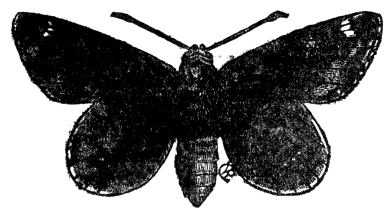
Megathymus yuccae. Female. (After Riley.)
So far as the story of its life is concerned, the best-known species is the Yucca-borer Skipper (Megathymus yuccae) which was carefully studied by the late Dr. C. V. Riley. As will be seen from the picture above which represents the adult, natural size, this skipper has a body so large as to suggest some of the heavy-bodied moths. The wings are dark brown, marked with red-brown spots and bands. They fly by day and when at rest hold the wings erect.
These adults lay eggs upon the leaves of Spanish needle or yucca. The eggs soon hatch into little caterpillars which at first roll parts of the leaves into cylinders, fastening the sides in place by silken threads, and later burrow into the stem and root, often making a tunnel a foot or more deep. Here the caterpillars remain until full grown. They are then nearly four inches long and half an inch in diameter. They now pupate in the top of their tunnel and in due season emerge as adults.
THE COMMON SKIPPERS
Family Hesperiidae
The Skippers are the least developed of the butterflies. They show their close relationship to the moths both by their structure and their habits. The larvae make slight cocoons before changing to chrysalids, and these chrysalids are so rounded that they suggest the pupae of moths rather than those of butterflies. The common name—Skippers—is due to the habit of the butterflies—a jerky, skipping flight as they wing their erratic way from flower to flower.
In North America the Skipper family includes nearly two hundred species grouped in about forty genera. From this point of view it is the largest family of our butterflies, but on account of the small size and limited range of most of the species it has by no means the general importance of such families as the Nymphs, the Swallowtails, or the Pierids.
The Skippers are remarkable for the uniformity of structure in each stage of existence. The butterflies have small wings and large bodies. The broad head bears large eyes without hairs, but with a tuft of curving bristles overhanging each. The antennae are hooked at the end and widely separated at the base. Each short palpus has a large middle joint and a small joint at the tip. The fore wings project out at the front angle and the hind wings are folded along the inner margin. There are six well-developed legs in both sexes. The colors are chiefly various tones of brown, dull rather than bright, and many of the forms resemble one another so closely that it is difficult to separate them.
The Skipper caterpillars have stout bodies and are easily known by the constricted neck. Most of these have the habit of making nests from the leaves of the food plants, weaving them together with silken threads. In a similar way each also makes a slight cocoon when it is ready to change to a chrysalis.
The Skippers found in eastern North America are commonly grouped into two types—the Larger Skippers and the Smaller Skippers. The characteristics are given in the paragraph immediately following and the one on page 278.
THE TRIBE OF THE LARGER SKIPPERS
The butterflies of this tribe have that part of the club of the antenna, which is recurved, about as long as the thicker part below it. As a rule, the abdomen is distinctly shorter than the hind wings. The caterpillars are rather short and thick, and the upper part of the head, when looked at from in front, is square or roundish rather than tapering. The chrysalids have the tongue case attached throughout its length and stopping short of the tips of the wing cases.
The Silver-spotted Skipper Epargyreus tityrus
One can seldom draw hard and fast artificial lines in nature. There are all sorts of intermediate conditions which disturb arbitrary classifications. It might seem simple enough to say that some insects are leaf-rollers and others are tent-makers, but as a matter of fact in the case of the Silver-spotted Skipper we have an insect which starts its larval life as a leaf-roller and finishes it as a tent-maker. Its life-history is rather interesting and easily observed, if one can find the larvae at work upon the leaves of locusts and other trees. (See plates, pages 272-273.)
The Silver-spotted Skipper is one of the largest butterflies of the interesting group to which it belongs. It lays its eggs upon the upper surface of the leaflets of locusts and other plants of the legume family. In less than a week each egg hatches into a little caterpillar with a very large head and a comparatively large body, tapering rapidly toward the hind end. This little creature cuts out from one side of the leaf a small round flap which it turns over and binds in place by silken threads to make a home for itself. This little home shows considerable variation in its construction but it usually has an arched dome held in place by strands of silk running from the eaten fragment to the surface of the leaf. It remains an occupant of this home until after the second moult. About this time it becomes too large for its house and deserts it to make a new one generally by fastening together two adjacent leaves. These are attached along the edges by silken strands in such a way as to give considerable room. It leaves one end open as a door out of which the caterpillar crawls to feed at night upon near-by leaves, returning to the house for shelter during the day. They continue to use this habitation until they are full grown as caterpillars and sometimes they change to chrysalids within it. More commonly, however, they crawl away both from the leafy case and the tree that bears it and find such shelter as they can upon the ground near by. Here they spin slight silken cocoons within which they change to chrysalids. In the more Northern states there is but one brood a year, so these chrysalids remain in position until early the following summer when they come forth as butterflies. Farther south there are two broods each summer, the second brood of butterflies appearing chiefly in August.
The Silver-spotted Skipper derives its name from the distinct silvery spots upon the under-wing surface against a background of dark brown. The butterflies appear in the Northern states early in June and remain upon the wing for several weeks, being found even in August. They fly very rapidly and are difficult to catch in an insect net except when they are visiting flowers.
This species is widely distributed, occurring from ocean to ocean over nearly the whole of the United States. It extends into Canada only in the eastern part and is not found in the Northwestern states.
The Long-tailed Skipper Eudamus proteus
This is perhaps the most easily recognized of all the Skippers found in the United States for it is the only one that looks like a Swallowtail. Its hind wings project backward as long, broad tails in a way that marks the insect at once as different from anything else. It expands nearly two inches and when the front wings are spread at right angles, the distance from the apex of the front wing to the end of the tail of the hind wing just about equals the expanse. The general color is dark brown, with about eight more or less rectangular silvery spots on each front wing.
This is distinctly a tropical species which is common along the Gulf Coast from Mexico to Florida. It ranges north along the Atlantic Coast to New York City and even to Connecticut. In the South Atlantic states it is common, but toward the northern limits of its range it is very rare.
In the West Indies this butterfly is very common and has been observed to rest with its wings vertical, the front ones held far back between the hind ones and the tails of the latter held at right angles to the plane of the wings. Apparently, this curious fact was first noted by Dr. G. B. Longstaff. Of course in museum specimens the wings have been flattened into the same plane during the process of drying, so that this peculiarity would not be noticed.
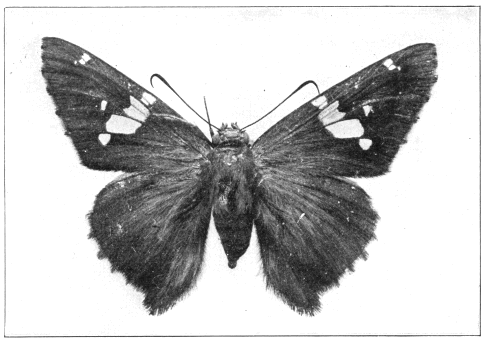
Upper Surface
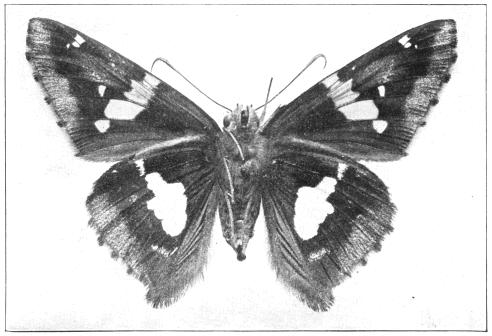
Photograph by A. H. Verrill
See page 270
Lower Surface
THE SILVER-SPOTTED SKIPPER
(About twice natural size)
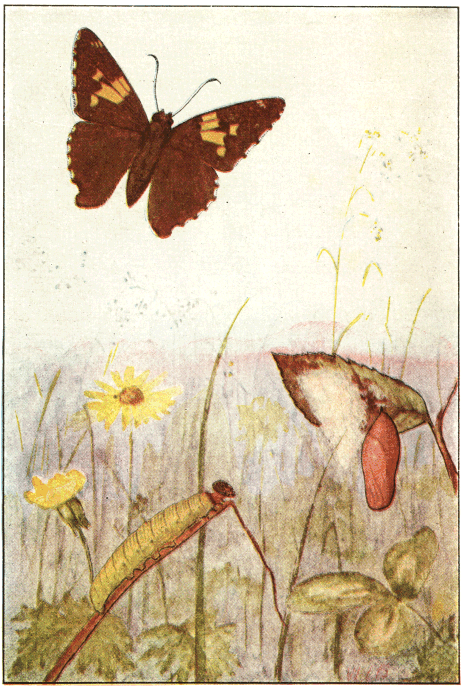
From a drawing by W. I. Beecroft
See page 270
THE SILVER-SPOTTED SKIPPER
Caterpillar, chrysalis and adult
Juvenal's Dusky-wing Thanaos juvenalis
There are few trees which have so interesting a set of insects attacking them as does the oak. It would be a simple matter to find abundant material for a large volume by making a study of the life-histories of the various insects that live upon or within the various tissues of this tree. The leaves alone provide a home for a remarkably large number of insect species scattered through a great many orders and families. The thickened blades seem to furnish an ideal opportunity for many larvae to get their living, and they are particularly useful to those which need to make a winter nest.
By a little searching almost any time after the middle of June, one is likely to find a curious caterpillar home upon some of the oak leaves. The margin of the blade has been turned over, generally from above downward but sometimes from below upward, and has been fastened down to the main expanse of the blade by means of golden threads; commonly this fastening is not continuous but is more or less intermittent, so that the turned-over margin is likely to have an irregular border where it joins the blade. Inside of this tubular construction a rather unusual looking worm-like caterpillar is probably to be seen. Late in the season it will probably be nearly an inch long, with a smooth greenish body and a head that may be a bit brownish and more or less marked on the sides with orange tones.
This is the larva of one of the most widely distributed Skippers—Juvenal's Dusky-wing. The species is found from southern New Hampshire west to the Great Plains and south to the Gulf of Mexico. In most localities it is seldom abundant but yet is so general that it may be found by almost every persistent collector. The wings expand about an inch and a half and are of a dull brownish color, more or less marked with darker and lighter spots. Toward the northern limits of its range there is but one brood a year but farther south there are two, although it is not improbable that some of the caterpillars of the first brood remain unchanged throughout the season, so that the insect is both single- and double-brooded in the same locality.
The Yearly Cycle
The yearly cycle in southern New Hampshire may be taken as an illustration of the life of the species in regions where there is but one brood. The butterflies appear in open woods and on cut-over lands in May and June. They lay eggs upon the twigs of oak trees, one egg in a place and generally near a leaf stem. The egg soon hatches into a little caterpillar that crawls upon a near-by leaf and begins the construction of its tubular nest by bending over the margin and sewing it with golden silk. It utilizes this nest chiefly as a tent for resting and sleeping and wanders away from it generally to another leaf when it is ready to feed. It grows very slowly, having before it all the weeks of summer to complete its caterpillar growth. As it gets larger it needs a new tent and is likely to desert its early one. When it does this some observers have noted a curious habit. It cuts loose all the silk that binds the margin of the leaf down upon the blade so that the flap is free to spring back to its original position. It would be difficult to suggest an adequate explanation for this habit.
When autumn comes our caterpillar is faced with the problem of passing through the winter successfully. It must shelter itself from birds, spiders, predaceous beetles, and many other enemies. It must find a means of keeping out of the reach of snow and rain, for while it can survive a great degree of cold as long as it keeps dry, it might easily be killed by freezing up with moisture. But the caterpillar is able to provide against these dangers. It has apparently an abundant supply of liquid silk to secrete from the silk glands in its head, so it lines its tubular tent with a dense silken web that effectually excludes enemies and moisture. It thus has on the outside of its nest the thick oak leaf and on the inside a dense soft lining that makes a most admirable winter protection. So it remains here throughout the winter, the leaf commonly staying on the tree until early spring. Then leaf, nest, and enclosed caterpillar are likely to drop to the ground to remain until spring arrives in earnest. Just what happens then seems to be a bit doubtful. The caterpillar changes to a chrysalis, but whether it first works its way out of its winter nest and makes a new and less dense covering seems not to be certainly known. Here is another good opportunity for some careful observations.
At any rate, the caterpillar changes to a chrysalis, and late in spring it changes again to an adult butterfly that flits about on dusky wing for a few weeks before it dies.
The Sleepy Dusky-wing Thanaos brizo
The appearance of this butterfly both as to size and marking is very similar to that of Juvenal's Dusky-wing except that the white spots are not present on the front wing of this species. The life-histories of the two species as well as their distribution seem to be closely parallel. The present butterflies are to be found early in summer in the same oak barrens as the other, the blueberry blossoms being freely visited for nectar by both species.
Persius's Dusky-wing Thanaos persius
This is a rather small, dark brown Skipper, with a few white spots toward the apex of the front wing, but otherwise not marked except for a very pale transverse band which is almost obsolete. The butterfly is found from ocean to ocean along the northern tier of states. It also occurs in the Eastern states as far south as Florida as well as in the states along the Pacific Coast.
The food plants of the caterpillars differ from most of those of the other Skippers. The butterflies lay their yellowish green eggs, one in a place, upon the leaves of willows and poplars. These soon hatch into little caterpillars each of which cuts out a small flap along the margin of the leaf and folds it over, fastening it in place with silken threads. It thus forms a protecting nest within which it remains during the day, going forth at night to a neighboring part of the same leaf or to another leaf, and feeding upon the green surface tissues. In this first caterpillar stage it does not eat the veins to any extent. As it becomes larger it constructs a larger nest and feeds more freely upon the leaf tissues. When about half grown it has the curious habit of biting out small holes here and there in the blade so that the leaf takes on a very unusual appearance. The presence of these holes is generally the easiest way to find the caterpillars, for when the holes are seen, a little searching is likely to show one the characteristic tent-like nest.
After a few weeks the caterpillars become full grown. They then sew themselves in for the winter, fastening all of the crevices in the nest so securely with silken webbing that a very serviceable winter cocoon is formed. An interesting fact is that this sewing up for the winter is likely to take place about midsummer, the caterpillars remaining quiet from this time until the following spring. The nests of course fall in autumn with the leaves and the caterpillars remain unchanged until April or May, when they transform into chrysalids to emerge in May as butterflies. There appears to be normally but one brood a year although there is some evidence of a partial second brood.
The Sooty Wing Pholisora catullus
This is one of the smallest of the blackish Skippers and may be known by its small size, expanding less than an inch, and the series of five white dots near the apex of the front wing, these dots being more distinct on the under surface. The species is widely distributed, occurring over practically the whole of the United States, except in the states along the Canadian border from Wisconsin west—and in several of these it is found along their southern limits.
This butterfly is of particular interest because it is one of the comparatively few species that habitually occur in gardens and cultivated fields. The reason for this is that the eggs are laid upon white pigweed or lambs' quarter, the common garden pest of the genus Chenopodium. The eggs are laid singly, generally on the upper surface, and hatch in about five days into tiny caterpillars that make a little shelter for themselves by cutting out the edge of a leaf and folding over the blade, sewing it in place by a few silken threads. Here they remain and feed upon the green pulp of the succulent leaves either within the nest or near by outside. They remain in these cases until the time for the first moult, when they are likely to line the inside of the silken web before moulting. After this they make new cases for concealment and shelter, the cases as they grow older being generally made of two or more leaves securely bound together by silken web along their margin. When they become full grown, they spin a silken cocoon and change to yellowish green chrysalids from which the butterflies emerge a little more than a week later.
This species is supposed to be double-brooded in the north. The full-grown caterpillars of the second brood sew up their leafy cases very carefully, making them of such thick silken webbing that they are watertight. They remain in these coverings until the following spring, when each changes, still within the case, into a chrysalis from which the butterfly comes forth in April or May.
THE TRIBE OF THE SMALLER SKIPPERS
In the members of this tribe the tip beyond the club of the antenna is short and the abdomen is long enough to extend as far as or farther than the hind wings. The caterpillars have long and slender bodies with the upper part of the head, when looked at from in front, tapering rather than roundish or square. The chrysalids have the tongue-case free at the tip and projecting beyond the tips of the wing-cases.
The Tawny-edged Skipper Thymelicus cernes
This is one of the commonest and most widely distributed of all our Skippers. It is found from Nova Scotia to British Columbia, south along the Rocky Mountains to New Mexico, Texas, and Florida. It is apparently absent west of the Rocky Mountains and along the Gulf Coast except in Florida. Its life-history was carefully worked out by Dr. James Fletcher, late entomologist to the Dominion of Canada, and in the north may be summarized thus: the butterflies come from the hibernated chrysalids in May or June. They remain upon the wing for several weeks so that worn specimens may be taken late in July or, rarely, even early in August. The females lay eggs upon grass blades. These eggs hatch about two weeks later, the larvae eating their way out of the shells so slowly that a whole day may be taken up by the operation. Each little caterpillar weaves a silken nest for itself, in which it remains concealed most of the time, reaching out to feed upon adjacent blades of grass but retiring into the nest at the least alarm. It is a sluggish little creature and grows so slowly that in the north it may require more than two months to become full fed as a larva. It is then about an inch long and has the characteristic outlines of the other Skipper larvae, with a black head and a greenish brown body. It now spins a cocoon, possibly using its larval nest as a basis, and some time later, before cold weather surely, it changes to a chrysalis that winters over.
This is the story of the life of the butterfly in the more northern parts of its range. Even in New Hampshire there seems to be at least a partial second brood, and farther south there are probably two regular broods with the possibility that a small percentage of the first set of chrysalids remains unchanged until spring.
The Roadside Skipper Amblyscirtes vialis
This little butterfly is found apparently in most parts of the United States, as it has been collected in New England, California, Texas, and many intermediate points. Over the northern part of its range there is but one brood a year. In New Hampshire the butterflies appear in May and early June and lay eggs upon the blades of various grasses. These hatch about ten days later into slender, silk-spinning caterpillars, each of which makes a nest for itself by sewing together the margin of one or more grass blades. When the larvae get larger, they make larger and denser nests with heavy linings of silken web. After the earlier moults, the thin skin is covered with very fine snow-white hairs, between which there is developed a curious whitish exudation, so that the caterpillars have a flocculent appearance. When full grown, they change to delicate green chrysalids which apparently in the North remain until the following spring before disclosing the butterflies. In more southern regions there are two broods each summer.
The Least Skipper Ancyloxipha numitor
The Least Skipper differs from the other Skippers both in structure and habits. Most of these butterflies have thick bodies and a distinct hook at the end of each antenna. This has a slender body and the antennae lack the hook. Most Skippers have strong wings and show their strength in their rapid, erratic flight. This has feeble wings that show their weakness in their slow, straight flight. But from the fact that it is about the smallest of all our butterflies, expanding little more than three quarters of an inch, it deserves our interested attention. The tawny wings are so marked with broad margins of dark brown that they show the tawny tinge chiefly in the middle spaces.
On account of its small size and its retiring habits this little butterfly is often overlooked by all but the most experienced collectors. It generally flies slowly just above the grass in sunny places in wet meadows and along the open margins of brooks and marshes. It rests frequently upon grasses, flowers, or bushes. Mr. Scudder noticed that when resting these butterflies have the curious habit of "moving their antennae in a small circle, the motion of the two alternating; that is, when one is moving in a forward direction, the other is passing in a reverse direction." This is the sort of observation that should challenge us all to sharper wits in watching living butterflies. It would be strange if no others thus twirled their feelers in their leisure moments. Who will find out?
The female butterflies at least have something to do besides sipping the nectar of flowers or idly twirling their feelers. They must lay their eggs and thus provide for the continuation of the species; to do this they find suitable blades of grass on which they deposit their tiny, half-round, smooth yellow eggs. A week or so later each egg hatches into a dumpy little yellow caterpillar with a black head and a body well covered with hairy bristles. This little creature is a silk spinner and makes a home instinctively by drawing together more or less the outer edges of a leaf blade and fastening them with transverse bands of silk. It then feeds upon the green tissues and as it grows larger it makes its nest more secure by thicker walls of silken web.
When full grown as a caterpillar it changes into a slender chrysalis generally of a grayish red color, thickly dotted with black. About ten days later it emerges as a butterfly.
The Least Skipper is one of the most widely distributed of all butterflies. It occurs from New England to Texas, south to Florida on the east coast, and west to the Rocky Mountains.
THE END
GENERAL INDEX
Abdomen,
4
Acadian hair-streak,
248
Admiral, Red,
160
Aestivation,
21-22
Agapetidae
,
214-229
Aglais milberti
,
182
Ajax
,
77
Amblyscirtes vialis
,
280
American copper,
255
American tortoise-shell,
182
Anatomy of butterflies,
3-5
Ancyloxipha numitor
,
281
Androconia,
15
Angle-wings, Synopsis of the,
190
Angle-wings, Tribe of the,
150-192
Anoea andria
,
208
Anosia berenice
,
235
Anosia plexippus
,
233
Antennae,
3-4
Anthocaris genutia
,
97
Anthocaris olympia
,
97
Antiopa,
112-115
,
171-182
Ants and caterpillar,
261
Aphids,
261
Apparatus for collectors,
51-54
Araulis vanillae
,
115
Arctic satyr,
225
Argynnis aphrodite
,
125
Argynnis atlantis
,
126
Argynnis cybele
,
122
Argynnis diana
,
118
Argynnis idalia
,
120
Argynnis montinus
,
127
Atlides halesus
,
243
Baltimore checker-spot,
135
Banded hair-streak,
246
Banded purple,
202
Basilarchia archippus
,
195-202
Basilarchia arthemis
,
202
Basilarchia astyanax
,
204
Basilarchia floridensis
,
206
Black-bordered yellow,
105
Black swallowtail,
59
Blue-eyed grayling,
215
Blue swallowtail,
65
Blues, Synopsis of the,
265
Blues, Tribe of the,
258-265
Brenthis bellona
,
128
Brenthis myrina
,
131
Brimstone butterfly,
98
Bronze copper,
257
Brown, Eyed,
221
Brown, Gemmed,
227
Buckeye,
188
Butterflies, Aestivation of,
21-22
Butterflies, Anatomy of,
3-5
Butterflies and Moths, Difference between,
13-14
Butterflies, Classifications of,
55
Butterflies, Collecting,
49-54
Butterflies, Coloration of,
24-35
Butterflies, feigning death,
22-23
Butterflies, General characteristics of
3-54
Butterflies, Hibernation of,
17-21
Butterflies, Migrations of,
16-17
Butterflies, Parasites of,
40-43
Butterflies, Photographing,
47-48
Butterflies, Rearing of,
43-47
Butterflies, Scents of,
15
Cabbage butterfly, Southern,
88
Cabbage butterfly, White or Imported,
83
Callidrayas eubule
,
98
Calosoma scrutator
,
181
Calycopis cecrops
,
251
Camberwell beauty,
see
Mourning-cloak
Carolina satyr,
227
Caterpillar cages,
44
Caterpillar collecting,
44
Caterpillar habits, curious,
198
Caterpillar hunter,
181
Caterpillar parasites,
260
Caterpillar to chrysalis,
8-10
Caterpillars,
5-9
Catopsilia eubule
,
c. philea
, or
c. agarithe
,
109
Cercyonis alope
,
215
,
228
Cercyonis pegala
,
218
Chalcid flies,
42
Charidryas nycteis
,
141
Checker-spot, Baltimore,
135
Checker-spot, Harris's,
140
Checkered white,
88
Chlorippe celtis
,
210
Chlorippe clyton
,
212
Chrysalis,
8-12
Chrysalis to butterfly,
10-13
Chrysophanus hypophlaeus
,
257
Chrysophanus thoë
,
257
Cinclidia harrisii
,
140
Cissia eurytus
,
226
Cissia sosybius
,
227
Classification of butterflies,
55
Clouded sulphur,
101
Cloudless sulphur,
98
Colias caesonia
,
110
Colias eurytheme
,
110
Colias philodice
,
110
Collecting butterflies,
49-54
Color changes,
7
Color sense, Selective
32
Coloration,
24-35
Comma,
153
Common skippers,
268-282
Common wood nymph,
215
Compton tortoise,
185
Copper, The American,
255
Copper, The Bronze,
257
Coppers, Synopsis of the,
257
Coppers, Tribe of the,
252-258
Cosmopolite,
166-171
Counter-shading,
24-25
Cremaster,
8
Crescent-spots, Synopsis of the,
149
Crescent-spots, Tribe of the,
135-150
Cyanide bottle,
51
Cyaniris ladon
,
258
Cynthia atalanta
,
191
Cynthia cardui
,
191
Cynthia kuntera
,
191
Cynthia Moth,
14
Dainty sulphur,
109
Dazzling coloration,
26-29
Death-feigning,
22-23
Debis portlandia
,
227
Diana fritillary,
118
Dog's-head butterfly,
100
Drying box,
54
Dull-eyed grayling,
228
Dusky-wing, Juvenal's,
272
Dusky-wing, Persius's,
276
Dusky-wing, Sleepy,
275
Eclipsing coloration,
26-29
Eclosion,
11
Egg-laying,
46
Emperors, Tribe of,
207-214
Encasement theory,
9
Enodia portlandica
,
219
Envelopes for collectors,
52
Epargyreus tityrus
,
270
Euchloe genutia
,
97
Euchloe olympia
,
97
Eudamus proteus
,
271
Eugonia J-album
,
185
Euphydryas phaeton
,
135
Eupsyche M-album
,
244
Euptoieta claudia
116
Eurema euterpe
,
111
Eurema lisa
,
106
Eurema nicippe
,
105
Eurymus eurytheme
,
102
Eurymus interior
,
104
Eurymus philodice
,
101
Euvanessa antiopa
,
191
Everes comyntas
,
264
Exuviae,
6
Eyed brown,
221
Falcate orange-tip,
94
Fenisequa tarquinius
,
253
Fritillaries, Synopsis of the,
133
Fritillaries, Tribe of the,
115-135
Gemmed brown,
227
Georgia satyr,
227
Giant skippers,
267-268
Giant swallowtail,
62
Goatweed emperor,
208
Gossamer-wings,
240-265
Grapta comma
,
190
Grapta faunus
,
190
Grapta interrogationis
,
190
Grapta J-album
,
192
Grapta progne
,
191
Gray comma,
158
Gray emperor,
210
Gray hair-streak,
245
Gray-veined white,
86
Grayling, Blue-eyed,
215
Great purple hair-streak,
243
Great southern white,
90
Great spangled fritillary,
122
Green-clouded swallowtail,
67
Green comma,
159
Gulf fritillary,
115
Hair-streaks, Synopsis of the,
250
Hair-streaks, Tribe of the,
242-252
Harris's checker-spot,
140
Heliconians,
229-232
Heliconidae
,
229-232
Heliconius Charitonius
,
229
Heliotropism,
35-37
Heodes hypophlaeus
,
255
Hesperiidae
,
268-282
Hesperioidea
,
55
,
266-282
Hibernation,
17-21
Honey-dew,
261
Hop merchant,
153
Hypatus bachmani
,
236
Ichneumon flies,
41-42
Imago,
10
Imported cabbage butterfly,
83
Iphiclides ajax
,
76
Junonia coenia
,
188
Juvenal's dusky-wing,
272
Killing bottle,
51
Laertias philenor
,
65
Larger Skippers, Tribe of the,
269-278
Least purple hair-streak,
251
Least skipper,
281
Lepidoptera
,
see
Butterflies
Libytheidae
,
236-239
Limenitis arthemis
,
206
Limenitis astyanax
,
207
Limenitis disippus
,
207
List observations,
37-40
Little sulphur,
106
Little wood nymph,
228
Little wood satyr,
226
Locusts, Coloration of,
29
Long-beaks, The,
236-239
Long-tailed skipper,
271
Lycaena comyntas
,
265
Lycaena ladon
,
265
Lycaena lygdamus
,
265
Lycaena scudderi
,
265
Lycaenidae
,
240-265
Lymnadidae
,
232-236
Marcellus
,
77
Maritime grayling,
228
Meadow-browns, The,
214-229
Meadow fritillary,
128
Meganostoma caesonia
,
100
Megathymidæ
,
267-268
Megathymus yuccae
,
267
Melitaea harrisii
,
M. phaeton
,
M. nycteis
,
or
M. tharos
,
149
Metal-marks, The,
239-240
Microgaster,
42
Migrations,
16-17
Milkweed butterflies, The,
232-236
Mimicry,
34-35
Mitoura damon
,
249
Monarch, The
,
12
,
233
Moths,
13-14
Moulting,
6-7
Mountain silver-spot,
126
Mourning-cloak,
112-115
,
171-182
Nathalis iole
,
109
Neonympha canthus
,
227
Neonympha eurytus
,
228
Neonympha gemma
,
227
Neonympha phocion
,
227
Net, Butterfly,
51
Nettle butterfly,
160
Nomiades lygdamus
,
265
Nymphalidae
,
111
,
214
Nymphs, The,
111
,
214
Odors,
see
Scents of butterflies
Oeneis norna jutta
,
225
Oeneis norna semidea
,
222
Olive hair-streak,
249
Olympian orange-tip,
96
"Orange dogs",
63
Orange sulphur,
102
Orange-tips, Synopsis of the,
97
Orange-tips, Tribe of the,
92-97
Orientation,
see
Heliotropism
Painted beauty,
163
Painted lady,
166-171
Palamedes swallowtail,
76
Palpi,
4
Papilio asterias
,
81
Papilio brevicauda
,
75
Papilio cresphontes
,
80
Papilio glaucus
,
72
Papilio palamedes
,
76
Papilio philenor
,
81
Papilio polyxenes
,
59
Papilio thoas
,
62
Papilio troilus
,
67
Papilionidae
,
57-81
Papilionoidea
,
55
,
265
Parasites,
40-43
Parasites of the Mourning-cloak,
177
Parnassians,
56-57
Parnassiidae
,
56-57
Pearl crescent,
143
Pearly eye,
219
Persius's dusky-wing,
276
Pholisora catullus
,
277
Photographing butterflies,
47-48
Phyciodes nycteis
,
149
Phyciodes tharos
,
143
Pieridae
,
82-115
Pieris napi
,
86
Pieris phileta
,
92
Pieris protodice
,
91
Pieris rapae
,
83
Pink-edged sulphur,
104
Pins for collectors,
53
Polygonia comma
,
153
Polygonia faunus
,
159
Polygonia interrogationis
,
150
Polygonia progne
,
158
Polygonias, Synopsis of,
190
Pontia monuste
,
90
Pontia protodice
,
88
Protective coloration,
see
Coloration
Purple hair-streak, Great,
243
Purple hair-streak, Least,
251
Purples, Banded and Red-spotted,
202-206
Pyrameis atalanta
,
191
Pyrameis cardui
,
191
Pyrameis huntera
,
191
Pyrrhanea andria
,
214
Queen, The,
235
Rearing butterflies,
43-47
Red Admiral,
160
Red-horns, Tribe of the,
97-115
Red-spotted purple,
204
Regal fritillary,
120
Riker mounts,
54
Riodinidae
,
239-240
Roadside skipper,
280
Rusticus scudderi
,
263
Satyr, Arctic,
225
Satyr, Little wood,
226
Satyrodes canthus
,
221
Satyrs, The,
214-229
Satyrs, Georgia and Carolina,
227
Scents of butterflies,
15
Scudder's blue,
263
Selective color sense,
32-33
Setting board,
52-53
Shadow observations,
37-40
Short-tailed papilio,
75
Silver-bordered fritillary,
131
Silver crescent,
141
Silver-spot fritillary,
125
Silver-spotted skipper,
270
Silvery blue,
265
Skippers,
55
,
266-282
Skippers, Common,
268-282
Skippers, Tribe of the larger,
269-278
Skippers, Tribe of the smaller,
278-282
Sleepy dusky-wing,
275
Smaller skippers, Tribe of the,