Front matter (continued 3)
Reading edition
In this quiet chrysalis, the insect is apparently almost as inert as a mummy. If you touch it it will wriggle a little, but otherwise it hangs there mute and helpless. On the inside, however, the tissues are being made over in such a wonderful way that, in about two weeks, from the mummy case into which the caterpillar entered there comes a beautiful butterfly.
When this butterfly first breaks through the mummy shell, its wings are very small, although its body, antennae, and legs are well developed. By means of the latter, it clings to the empty chrysalis, while its wings expand. At first these wings are short, but as soon as the insect takes a position in which the wings hang downward, they begin to expand, and soon reach full length, but are more or less crumpled longitudinally, and the front wings are not so wide as the hind ones, hanging limply inside the latter.
After the butterfly has thus reached its full form and size, it crawls from the chrysalis to some neighboring support, where it rests quietly for half an hour or more. During the latter part of this time it exercises its unused muscles by slowly opening and closing its wings, until it finally flies away.
THE TRIBE OF THE FRITILLARIES
This is one of the most distinctive tribes of the family of Nymphs. The clubs of the antennae are about twice as long as broad and curiously spoon-shaped. The palpi are large and bushy, with the last joint very short. Most of the species are rather large and practically all are beautifully mottled in various tones of brown, red, black, and silvery gray. A large proportion of our midsummer butterflies are members of this tribe.
The Gulf Fritillary Agraulis vanillae
In tropical America there is a genus of butterflies called Agraulis. These are fairly large insects, approximating the size of the Viceroy, which show most beautiful colors in the tropical sunshine. One member of this genus has come north to our Southern states, and is occasionally found as far up as Virginia and southern Illinois, extending below this from ocean to ocean. It reveals on its upper surface the most exquisite tints of iridescent purples and browns, suggesting by its form and color as thus seen a tropical species. The lower wing surface, when the wings are closed in their natural position, shows only a spangled effect of silver-white and brown, which is very suggestive of the under surface of our northern Spangled Fritillaries. So this beautiful species may fittingly be called the Gulf Fritillary, carrying over from the north some of its peculiar beauty and connecting with the equally distinctive beauty of the tropical south.
Like so many other southern butterflies the eggs of this species are laid upon the leaves of passion vines. The caterpillars develop very rapidly and when matured are yellowish or brownish yellow, striped with darker lines along the back and sides. There are black branching spines, arranged in rows beginning on the head and running backward on the body. The whole cycle of life from egg to butterfly may take place within the short period of a month and one brood succeeds another in so irregular and rapid a fashion that it is difficult to determine definitely the number of broods in a season.
The Variegated Fritillary Euptoieta claudia
There is something in the appearance of the upper surface of this butterfly that suggests the other Fritillaries on the one hand and the Emperors on the other. The coloring and marking is a bit like the former and the shape of the wings like the latter. The general color is a golden brown with darker markings arranged in bands and eye-spots in a rather complicated pattern. The under surface, so far as it is exposed when the butterfly is at rest, is a beautiful marbled combination of gray and brown which is probably distinctly obliterative in the haunts of these insects. The front wings have the outer margin concave in the middle, giving a special prominence to the shape of each front outer angle.
This butterfly is a southern rather than a northern species, but it is found occasionally from Montana to Massachusetts and southward to Arizona, Mexico, and Florida. Even in northern Indiana it is very seldom found and is considered rare in the southern part of that state. Around Buffalo, New York, it is also rare and is not common in the vicinity of New York City. In the more Southern states, however, it is abundant and extends well through the continent of South America.
There is considerable evidence to indicate that this butterfly hibernates as an adult. In the more southern regions it probably also hibernates in other stages, especially the chrysalis and the larva. In regions where it is double-brooded, as it appears to be in the latitude of New York City, the seasonal history seems to run something like this: the partly grown caterpillars which have passed the winter in shelter at the surface of the soil feed upon the leaves of violets and certain other plants. They change to chrysalids, probably in May, and emerge as butterflies in June. These butterflies lay eggs for a summer brood of caterpillars which may feed upon the leaves of violets, May apples, portulaca, and stonecrop. They grow into cylindrical worms of a general reddish yellow color, marked by longitudinal stripes of brown upon the sides and a row of whitish dots upon the back. They become matured in time to disclose the butterflies of the second brood in August and September. Presumably these butterflies lay eggs that develop into caterpillars which hibernate when partially grown.
Farther south there are probably three broods a year and hibernation may take place in various stages. There is good opportunity for careful work in determining the life-history of the species in different latitudes. The butterfly is found in much the same situations as the other Fritillaries, flying over meadows and along the borders of woods.
The Diana Fritillary Argynnis diana
This magnificent butterfly differs from the other Fritillaries in the fact that the females are so unlike the males that only a skilled naturalist would even guess that they are related. Both sexes are rather rare and are found only in a comparatively narrow range extending from West Virginia to Missouri, northward to Ohio and Indiana, and southward to Georgia and Arkansas.
This species was first described by Cramer a long time ago from specimens of the male sex. It was later described by Say and other writers all of whom saw only the males. The other sex was first recognized by William H. Edwards, whose account of its discovery as given in his splendid work on the Butterflies of North America is worth quoting:
"No mention is made of the female by any author," wrote Mr. Edwards, "and it seems to have been unknown till its discovery by me in 1864 in Kanawha County, West Virginia. On the 20th August, I saw, for the first time, a male hovering about the flowers of the iron-weed (Vernonia fasciculata), and succeeded in taking it. Two days afterwards, in same vicinity, while breaking my way through a dense thicket of the same weed, hoping to find another Diana, I came suddenly upon a large black and blue butterfly feeding so quietly as to allow me to stand near it some seconds and watch its motions. It seemed to be a new species of Limenitis, allied to Ursula, which it resembled in color. But on taking it, I saw it was a female Argynnis, and the general pattern of the under wing left little doubt of its affinity to the Diana male, despite its total difference in color and of upper surface. Subsequent captures confirmed this conjecture, and out of the large number that have since been taken the males have been of the known type and the females black, with no tendency in either to vary in the direction of the other.
"When my attention was called to the species I found it not very uncommon, always upon or near the iron-weed, which is very abundant and grows in rank luxuriance upon the rich bottom lands of the Kanawha River, frequently reaching a height from eight to ten feet and in August covered by heads of purple flowers that possess a remarkable attraction for most butterflies. Both sexes are conspicuous, the males from the strong contrast of color and the females from their great size and the habit of alighting on the topmost flower and resting with wings erect and motionless. It is an exceedingly alert and wary species, differing in this from our other Argynnids. At the slightest alarm it will fly high into the woods near which, upon the narrow bottoms or river slopes, it is invariably found. It is a true southern species, sensitive to cold, not to be looked for in the cooler part of the morning but flying down from the forest when the sun is well up. From eleven to three o'clock is its feeding time."
The life-history of this fine butterfly is similar to that of the lesser Fritillaries. The butterflies appear from midsummer onward, the males preceding the females, and the eggs are laid on or near violets in August or September. The larvae hibernate and mature early the following summer. As they approach the chrysalis stage they are rather large velvety black caterpillars with brown heads and rows of fleshy barbed spines that show an orange tint at their bases. There is thus but one generation each year.
The Regal Fritillary Argynnís idalia
The Regal Fritillary, fresh from the chrysalis, still showing the marvelous sheen of its iridescence, furnishes one of the most beautiful exhibitions of color in the world of nature. Over the whole wing surface there are tiny scales that reflect the sunlight in an almost dazzling manner, giving a distinct purplish tone especially to the hind wings.
The Regal Fritillary is one of the largest butterflies of the distinctive group to which it belongs. The wings expand some three inches and the rather thick body is more than an inch long. The general ground color of the wings is brown, with distinct markings of blackish which in the hind wings almost obscure the brown. On each of the latter as seen from above there is a distinct row of cream-colored spots across the middle, duplicated by a similar row of brown spots near the margin. The under surface of both pairs of wings is much lighter and thickly mottled all over with light cream-colored spots of a large size and more or less triangular shape. (See Frontispiece.)
Like the other Argynnids, the Regal Fritillary is single-brooded during the year and it has a rather remarkable longevity in each stage of its life. The newly hatched caterpillars go into hibernation and live through the winter without feeding, finding shelter at the surface of the ground, especially beneath the leaves of violets which form their chosen food plants. When the snow has disappeared and the warmth of the spring sun brings them out of their winter lethargy these tiny caterpillars feed upon the violet leaves and grow slowly for several weeks. They then change to chrysalids, the time for doing this varying considerably with the individual and doubtless with the warmth of the situation in which each is living. The length of time spent in the chrysalis varies also, but in general it seems to be less for those which develop into male butterflies than for the females. It is a curious fact that the former may be found for nearly two weeks before any of the latter appear.
The first butterflies of this species are usually disclosed from the chrysalis late in June or early in July. They continue to come forth for several weeks, apparently until nearly the middle of August. They lead a leisurely life, visiting freely the flowers of goldenrod, iron-weed, boneset, Joe Pye weed, and especially swamp milkweed. They are most likely to be found in lowlands and along the borders of swamps where these favorite flowers are growing. It evidently requires some time for the eggs to develop within the ovaries, for the butterfly cannot begin laying these until the latter part of August. They apparently are normally deposited on the under side of violet leaves, although so far as I know no butterfly has been seen thus laying her eggs. It would be an interesting point for some young observer to determine. Even the eggs take a long time to develop, not hatching for three or four weeks after they are laid. When they do hatch the tiny caterpillars seem not to eat at all but to go directly into hibernation.
These butterflies are to be found in their preferred habitats almost any time during July, August, and September. Apparently many of them live as adults for nearly three months so that whether we consider the egg, the larva, the chrysalis, or the adult we have in this species an unusual duration of life. This is doubtless an adaptation to the fact that the species must get through the year with only one brood.
This unity of habit with no such variations as occur in many butterflies with a wider range north and south is apparently correlated with the distribution of this butterfly. It is found in a belt of territory running from New England and the Atlantic states westward at least to Nebraska along a line which approximates the annual isotherm of fifty degrees Fahrenheit.
The Great Spangled Fritillary Argynnis cybele
To one who wanders much in the woods and open fields there are few summer scenes more characteristic of the season than that of a group of milkweeds in full flower, surrounded by a host of brown butterflies busily sucking the nectar from the curious pink blossoms. There are likely to be several species of these winged creatures, but in many regions of America the largest and most conspicuous will generally be the Great Spangled Fritillary. This butterfly is easily recognized by its large size and its combination of two colors of brown, with whitish or silverish spots scattered over the lower surface of the wings.
The life-history of this insect is of peculiar interest on account of the way in which it passes the winter. The mother butterfly remains upon the wing through many weeks in summer, so that toward the end of August or early September a large proportion of the specimens have a decidedly frayed appearance. They are patiently waiting for the season of the year when they can deposit their eggs, apparently knowing by instinct that this must not be done until early autumn. When the proper season arrives they lay their eggs upon the leaves or stems of wild violets, apparently without much reference to the particular species. Sometimes they have been reported simply to drop the eggs loosely upon the violet plant with no attempt to fasten them in place. Having thus deposited the eggs the mother butterflies soon die.
It would not seem strange if these eggs remained unhatched until the following spring, but the fact is that the eggs hatch very soon into small caterpillars that eat off part of the shells in order to escape and sometimes eat also part of the shell remaining after they have emerged. Various good observers have apparently established the fact that these tiny caterpillars eat nothing else before winter sets in. It seems curious indeed that they should not nibble at the leaves or stems of the violet plants in order to be slightly prepared for the long fast that awaits them before they will find food upon the young buds the following spring. The case is somewhat similar to that of the common tent caterpillar which becomes a fully formed caterpillar within the egg shell before the end of autumn, but remains unhatched until the following spring. In the present case the caterpillar hibernates outside of the egg shell rather than within it.
When at last the warm sunshine of spring starts the violets into new growth the tiny caterpillars begin feeding upon the succulent tissues. They nibble away day after day for a week or more before they become so large that they have to cast their skin for the first time. They then feed again and continue this process of feeding and moulting until early in summer. They are likely to hide themselves during daylight and have the reputation of being difficult to rear under artificial conditions.
The full-grown caterpillar wanders along the surface of the ground in search of suitable shelter for the chrysalis period. When it comes to a large stone with sides projecting more or less horizontally or a log lying upon the ground or even a large piece of loose bark it is likely to stop and change to the pupa or chrysalis. In this condition it is dark brown in color and well covered with thickened tubercles, especially along the back of the abdomen.
About a fortnight later the chrysalis breaks open and the fully developed butterfly comes forth. It rests quietly for a time while its wings expand and the tissues harden and then sallies forth for its long period of flight; for this insect is single-brooded in the Northern states at least and the butterflies that thus mature late in June or early in July are likely to remain alive until early in September. So they have a comparatively long life for a butterfly that does not hibernate as an adult.
The Silver-spot Fritillary Argynnis aphrodite
Our brown Fritillaries are seldom found without several species mingling together. This is not strange, for they have similar habits throughout their entire lives. So when you see a bevy of butterflies collected around the midsummer blossoms of the milkweed, you are pretty sure to find that the Great Spangled Fritillary is associated with the Silver-spot and probably one or two other related forms. The Silver-spot is generally decidedly smaller than the one first named and the surest way to be certain of it is to look on the under side of the hind wing and see whether there is a broad band of buff between the two outer rows of silver spots. If this band has disappeared or is nearly all taken up by the brown ground-color of the wing, you may be pretty sure we have the Silver-spot Fritillary.
When one has firmly fixed in mind the life cycle of one of these butterflies, one has a model after which to fashion the rest, for our several species are remarkably alike in this respect.
The Silver-spots are on the wing for several weeks in summer. During the latter part of this time the females lay eggs upon violet leaves. These eggs shortly hatch into caterpillars that go directly into hibernation, taking no food before winter sets in. The following spring they feed upon violet leaves and mature in time to change to chrysalids and emerge as butterflies in early summer. There is but one brood a year and the species is widely distributed over southern Canada and the Northern states. It extends south to Virginia and Pennsylvania and west to Nebraska, Montana, and Washington.
The Mountain Silver-spot Argynnis atlantis
If one were able to take a Silver-spot Fritillary and reduce its size about one third he would have a wonderfully good imitation of the present species. Except for the size, about the only difference in the markings is found in the blackish border along the margins of the Mountain Silver-spot which is not present in the other species. The buff sub-marginal border line on the under surface of the wings between the rows of silver spots is also wider in the mountain species.
The distribution of this butterfly justifies its name. It is preëminently a northern species, being especially abundant in the White Mountains of New Hampshire and ranging northward far into Canada and west through British America as far as the Mackenzie River. A pair of these butterflies were captured by Merritt Carey on July 16, 1903, on the summit of Mount Tha-on-tha, in the Nahanni Mountains, at an altitude of 2,500 feet. The southern limit of its distribution approximates the isotherm of forty-five degrees. It extends southward in mountainous regions through New York and Pennsylvania and is found in Michigan, Illinois, and Iowa. It also occurs in the Rocky Mountain region of Colorado.
The various species of Argynnis show a remarkable uniformity in their life-history. Like the others, this butterfly is single-brooded, laying the eggs on or near violets late in summer, the eggs hatching into larvae that take no food until the following spring. They then feed upon the violet leaves, become mature, and change to chrysalids in time for the butterflies to emerge in June in New Hampshire. These butterflies remain upon the wing for several weeks. They usually appear a week or two earlier than Aphrodite or Cybele in regions where all three species are found. It is worth while for the collector to take a hint from this fact and do his Silver-spot collecting early. For after the other species appear it is not so easy to tell which is Atlantis when the butterflies are on the wing. It is most likely to be found in open places in the woods, apparently preferring such situations to the broad expanse of fields and meadows.
The White Mountain Fritillary Argynnis montinus
This is distinctly a mountain butterfly, known to be found only near the top of Mount Washington and other neighboring parts of the White Mountains. It generally occurs between the altitudes of four thousand and fifty-five hundred feet. It is doubtless closely related to a somewhat similar form found farther north and west, but its isolation from them is complete. Apparently it is single-brooded and very little is known of the early stages. The butterflies visit the flowers of goldenrod and those of the alpine sand-wort which are abundant in the sub-alpine home of this species.
This variety is interesting as a living souvenir of the day when New England was buried beneath the ice-sheet.
The Meadow Fritillary Brenthis bellona
The fact of variation is one of the most universal things in nature. No two animals are exactly alike and every plant differs from every other plant. That this is true of the structure of living things is easily observed but it is not so well known, because not so easily observed, that most species of animals differ also in the precise phases of their growth. We know that the variation in form and color has brought about the remarkable adaptations to surroundings which we call mimicry and protective coloration. A little consideration will make it evident that the variation of different individuals in periods of growth must have led also to the adaptation of the life stages to the conditions of the changing seasons. This is particularly true in the great majority of insects which show remarkable adaptations in their various broods to the seasonal conditions of the localities where they live.
From this point of view the attractive little Meadow Fritillary is of especial interest. We are indebted to the studies of S. H. Scudder for our knowledge of the remarkable variations in its growth. These are so complicated that in order to make plain the varying conditions it seems necessary to separate the broods in a somewhat hypothetical manner.
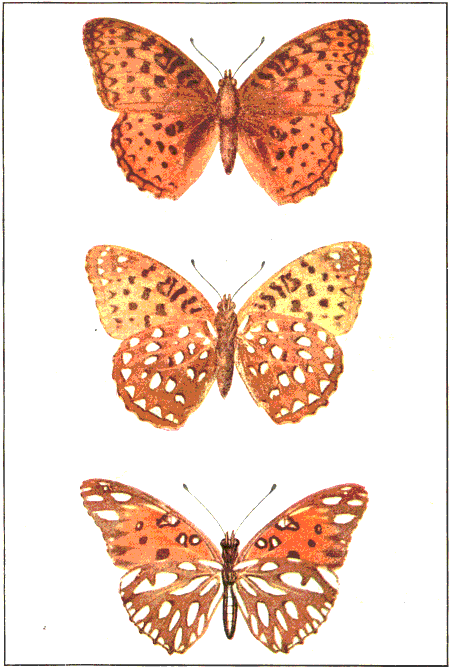
THE SILVER-SPOT FRITILLARY Upper and lower surfaces (see page 125) THE GULF FRITILLARY Lower Surface (see page 115)
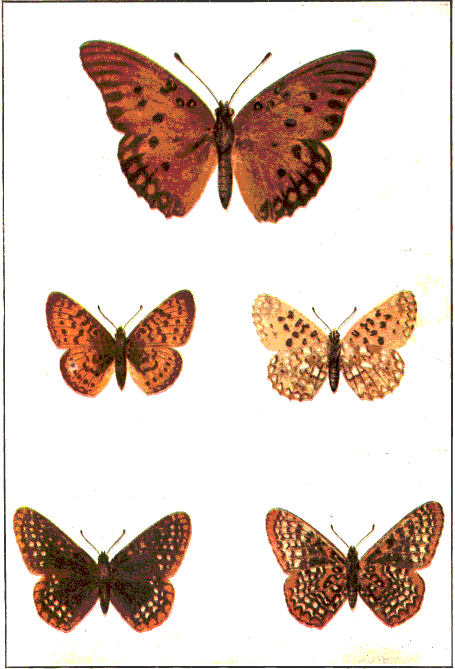
THE GULF FRITILLARY (see page 115) THE SILVER-BORDERED FRITILLARY Upper and under surfaces (see page 131) THE BALTIMORE CHECKER-SPOT Upper and under surfaces (see page 135)
We will begin with what we shall call Group A: The butterflies are on the wing in May and early June. They have just come from the chrysalis and continue living for three or four weeks before they deposit eggs, this time being required in order that the eggs may develop in the ovaries of the butterflies. These eggs hatch in about a week and the caterpillars become full grown a month later. They then change to chrysalids in which condition they remain another week, thus requiring five or six weeks for the newly laid eggs to mature into butterflies. Supposing the eggs were laid the first week in June, the butterflies of this second brood would appear about the middle of July. The eggs in the ovaries of some of these butterflies also require several weeks before they are ready to be laid, so that it may be about the tenth of August when this happens. These hatch and mature to chrysalids during the next six weeks, the butterflies of this brood emerging about the middle of September. These in turn lay eggs at once apparently, no extended period being required for their development before they are laid. The eggs hatch during the latter part of September and the young caterpillars feed upon the violet leaves for two or three weeks, moulting perhaps twice and becoming approximately half grown. They now stop feeding and go into a lethargic condition in which they hibernate. Then in spring they awaken and feed again upon the violet leaves for a short time, becoming mature and changing to chrysalids sufficiently early to emerge as butterflies late in May.
In this hypothetical group we have a fairly normal condition of a three-brooded butterfly hibernating in the stage of the half-grown larva and requiring some weeks for the development of the eggs in the ovaries of the butterflies in the case of the first two broods but not of the third.
In another group, which we may designate as B, the conditions may be similar except that the butterflies lay their eggs very soon after coming from the chrysalis in the case of all three broods. Obviously there would be a tendency here for hastening the earliness of the broods so that the hibernating caterpillars might either become larger or might go into the hibernating condition earlier than those of Group A.
In Group C, the variation takes place in the larvae rather than in the butterflies. These may go on in the normal way up to the time the caterpillars of the summer brood become half grown. Then they become lethargic, ceasing to feed and to all appearances going into hibernation. They remain in this condition until the following spring when they come forth from their winter's sleep and feed upon the violets in precisely the same way as the caterpillars of the third brood of Groups A and B.
In Group D we have another interesting variation of the larvae. These are the same as C up to the time of becoming lethargic, that is, the larvae of the summer or second brood become lethargic at the same time as those of Group C but instead of continuing in this condition until the following spring they remain in lethargy only three or four weeks, then they wake up (having apparently then changed their caterpillar minds) and begin to feed, soon maturing and changing to chrysalids from which butterflies emerge late in September or early in October. The result is that these butterflies lay eggs so late that the cold nights come on apace and the little caterpillars apparently take no food at all but go into hibernation immediately. In consequence these must eat for a longer period the following spring, so that the butterflies into which they mature will be likely not to appear until well along in June.
It is probable that even this rather elaborate statement does not do justice to all the variations in the development of this little butterfly. But perhaps enough has been said to help us to understand something of the way in which such insects are able to adapt their life habits to the conditions of their environment. It is easy to see that if conditions should so change as to give any one of these groups a decided advantage over the others, the tendency would be for the other groups to disappear and for the group of favored habits to survive.
The Meadow Fritillary is common in Canada and the Northern states east of the Rocky Mountains. It is found especially in lowland meadows and along the borders of swamps, the very situations chosen by the food plants of the larva, the blue and the white violets. The butterflies may be often seen sipping nectar from the various species of mint and related plants found in such situations. It is commonly associated with the Silver-bordered Fritillary, from which it is easily distinguished because it has no silver spots upon its wings.
The Silver-bordered Fritillary Brenthis myrina
This attractive little butterfly bears a close general resemblance to the Meadow Fritillary, from which it differs chiefly by the continuous row of silver spots along the border of the under side of both pairs of wings. It is found in the same localities as the other and its life-history is very similar.
The present species is widely distributed in North America, being found as far west as the upper Mississippi Valley and the Rocky Mountains, and southward as far as the Carolinas. In New England and the Atlantic states it is one of the commonest of the smaller butterflies.
Beginning with the butterflies which are seen in the fields and meadows in September, the yearly cycle of this insect may be summarized in this way: the eggs laid in September hatch in a few days into tiny caterpillars, some of which become lethargic at once, while others begin feeding upon the violet leaves and continue thus to feed until they are about half grown. These then also become lethargic and find shelter just above the soil surface where they remain until the following spring. They then begin to feed again upon the violet leaves and at about the same time the other caterpillars which became dormant as soon as hatched, also waken and feed upon these leaves. Naturally those which were half grown at the beginning of spring are likely to mature and change to chrysalids two or three weeks earlier than those which were so small at the beginning of the season. Consequently the fresh butterflies will be found from late in May to the latter part of June. Presumably those which first appeared have developed from the larger caterpillars and the later ones from the smaller caterpillars.
The butterflies of this first brood of the season lay their eggs upon the violet leaves, generally upon the upper surface of the blade, but occasionally upon the stems or upon near-by grasses. These eggs hatch in about a week into caterpillars that mature during the next three or four weeks, coming forth as a second brood of butterflies late in July or early in August. These in like manner lay their eggs and develop into a third brood which matures as butterflies in September. These lay eggs that hatch into the caterpillars which live through the winter. There are thus three broods of butterflies during the year and it is probable that there is the same remarkable variation in the habits of the different broods that have been found in the ease of the Meadow Fritillary.
Synopsis of the Fritillaries
Gulf Fritillary (Agraulis vanillae). Expanse 2¾ inches. Apex of each front wing produced into a distinct angle. Upper surface of all wings reddish brown, marked with black spots and an interrupted black border, the border on the hind wings enclosing round red-brown spots. Under surface, so far as it shows when insect is at rest, nearly covered with large silver-white spots. Found only in the more Southern states.
Variegated Fritillary (Euptoieta claudia). Expanse 2½ inches. Apex of each front wing produced into a distinct angle. Upper surface of all wings fulvous brown, thickly marked with buff and brownish black. A sub-marginal row of black dots on each of the wings, outside of which is a row of buff crescents on the blackish border. Under surface, as it shows when the butterfly is at rest, beautifully marbled in creamy browns and deeper browns. No distinct silver spots in either surface.
Diana Fritillary (Argynnis diana). Male. Expanse 3½ inches. Apex of fore wings rounded. Upper surface of all wings, with a little more than basal half, solid brownish black and the rest of the surface orange-brown, marked with darker brown round spots and vein lines. Under surface light buff, marked with black, with silver crescents and spots on hind wings. Female. Expanse 4 inches. Upper surface of all wings blackish with bluish or greenish iridescence, and marginal third marked with blue spots and stripes. These are more prominent on the hind wings. Under surface slaty brown with prominent silver crescents on the hind wings.
Idalia or Regal Fritillary (Argynnis idalia). Male. Expanse 3 inches. Front wings fulvous brown with black spots and markings. Hind wings black except at base with a row of fulvous brown sub-marginal spots and an inner row of whitish or bluish white spots. Female. Expanse 3½ inches. Similar to male except for larger size and the fact that the two rows of spots on the hind wings are yellowish brown.
Great Spangled Fritillary (Argynnis cybele). Expanse 3¼ inches. General color of wings fulvous brown with black markings on upper surface and black and silver markings on under surface. The yellow band between the rows of silver spots on hind wings is broad. There is a distinct narrow fulvous stripe on the upper side of the hind wing just inside the outer margin, and a similar stripe along the margin of the front wing, more or less interrupted by the veins.
Silver-spot Fritillary (Argynnis aphrodite). Expanse 3 inches. Similar to the Great Spangled but a little smaller, and with the buff yellow band between the rows of silver spots on the lower surface much narrower and almost disappearing at the rear.
Mountain Silver-spot (Argynnis atlantis). Expanse 2¼ inches. Known by its smaller size and the black marginal border stripe on all the wings, with no brown line dividing this stripe.
Silver-bordered Fritillary (Brenthis myrina). Expanse 1¾ inches. Known by its small size and a marginal row of silver spots on the under side of each of the wings, and with many other silver spots scattered over the under surface of the hind wings.
Meadow Fritillary (Brenthis bellona). Expanse 2 inches. Easily known by the absence of silver spots on all the wings. The wings are long in proportion to their width.
THE TRIBE OF THE CRESCENT-SPOTS
The members of this tribe have the following combinations of characters: scaly antennae, with a short stout club some three times as long as broad, and a pair of slender palpi in which the terminal joint is only about half as long as the middle one. There may or may not be a slight ridge running lengthwise of the naked part of the antennal club.
Although more than fifty distinct species belonging to this tribe have been found in North America, very few of these are distributed through the eastern part. Only four are so abundant and widely distributed that they need be treated of here.
Baltimore Checker-spot Euphydryas phaeton
To the naturalist those islands in the seas which are remote from the mainland have long been of especial interest. The life upon them is likely to show the results of many generations of living under unique conditions. The plants and animals are generally distinctive, many of the species having characteristics which differentiate them markedly from those upon the mainland. They show in a thousand ways the effect of isolation and so are of especial value when one attempts to determine the results of unusual conditions upon living things.
In a somewhat similar way the peat bogs or sphagnum swamps which occur here and there over a large part of North America are of especial interest, because in a way they are biological islands in which the conditions of a long past age are preserved until the present. These nearly always occur in a little valley surrounded on all sides by hills. Here the water has collected originally into a pond or lake, which has been gradually filling up through the growth of peat mosses and a special set of other plants that develop in such situations. One can still find many stages in the process. In some bogs the surface will be practically covered, although the water beneath may still be so abundant that the matted moss quakes as one walks over it. Sometimes such bogs are really dangerous because the walker may drop through to the water beneath. In most of the bogs, however, the little lake is nearly filled but shows the surface over a small area.
The conditions in these peat bogs have changed little since civilization began. They are relics of an earlier era which have come down to us as types of conditions that once existed very generally. The plant life is unique and consists almost entirely of forms which are found practically nowhere else. There are comparatively few animals living in these peat bogs and all of these are likely to be of especial interest. Among the insects none is more remarkable than the Baltimore Checker-spot butterfly which has several peculiarities that differentiate it from the other members of the group. It seems to have come down to us unchanged from a far remote past and to be living its tranquil life to-day in precisely the same manner as during the time when the mammoth and the mastodon were likely to invade its haunts.
The Baltimore is probably the most local in its distribution of any of the butterflies found throughout Canada and the Northern states. It is to be looked for only in peat bogs and swamps, and it has a remarkable unity in its life-history whether it be found in northern Canada or as far south as West Virginia. The butterfly itself is rather large, measuring a little more than two inches across its expanded wings and being colored with an unusual combination of fulvous and yellow upon a black background. It is present as a rule only from about the first of June to the middle of July. The eggs, in bunches of from one hundred to four hundred, are laid upon the leaves of the plant commonly called snake-head or turtle-head (Chelone glabra). They do not hatch for nearly three weeks; then the little caterpillars emerge together and usually each eats a little of the empty egg shell. They are then likely to form a thin web over the under surface of the leaf beneath which they remain as a small company feeding upon the succulent green tissue. A little later they are likely to begin the construction of a miniature nest by spinning a silken web over the young leaves at the top of the plant. From this time on this silken nest serves as their home, and they utilize it almost as effectively as do our familiar American tent caterpillars the nest which they make in the forks of the wild cherry tree. The Baltimore caterpillars often wander more or less from their tent-like home but they generally come back to feed as well as to moult. If the nest is injured by wind or rain, all the caterpillars turn out to repair it and as the need for new food supplies arises they also unite to enlarge the tent. This habit of working together for the common good is very suggestive of the similar habits of the American tent caterpillars. Doors for going in and out are left in the tent during its construction.
The tent thus made is likely to be deserted after the first moult and a new and larger one constructed on another part of the plant. Two or perhaps three such nests may be made from the time the caterpillar hatches until after the second moult. The last nest made is very likely to be upon some neighboring bushy plant or at least to include some branches of such a plant if the bulk of the nest is made upon snake-head. For after the third moult the caterpillars stop feeding and become more or less quiet, thus beginning a nine months' fast, during which they are simply to wait until the return of spring. This fast may be begun any time from the middle of August until early in September, and even when brought indoors the caterpillars cannot be induced to eat. It is evidently the way in which the species has bridged over the winter during the thousands of generations of its existence, and the instinct is so firmly fixed that it cannot be changed. Even in West Virginia, where the caterpillars would have plenty of time during the summer to mature as butterflies that would bring forth another generation of caterpillars that might pass the winter, the condition is the same as in the far northern regions.
So within the shelter of the silken nest these Baltimore caterpillars remain from the middle of August until May. Then when the spring sunshine has sufficiently warmed their cool retreats they come forth and feed greedily upon the young leaves. They now soon make up for lost time and complete their growth as caterpillars very quickly. When full fed they wander about in all directions, each hunting its own shelter before becoming a chrysalis. Having found a twig or branch that suits their purpose each hangs downward and changes to a brownish yellow chrysalis, more or less marked with black. It remains in this condition for about a fortnight, when it comes forth as the Baltimore butterfly which thus appears again about the first of June.
These butterflies seem to have some of the characteristics of their unique surroundings. There are very few flowers in the peat bogs and it is significant that the butterflies instead of flitting from flower to flower, as do most of our familiar species, fly rather in a slow and lazy fashion from leaf to leaf, lighting upon the foliage or frequently upon the surface of the moss or ground. They seem lethargic and have little of the animation which we usually associate with the name butterfly.
In my mind the Baltimore is associated with the White Mountain butterfly as a survivor of a former geologic period. The latter was developed under colder conditions and now survives only on a few isolated mountain peaks; but the former has survived wherever the peat bog has held its sway during the long ages that the surrounding landscape has been taking on its present-day condition. Many things in the life of the Baltimore point to its primitive condition: the laying of the eggs in loose clusters, the long lethargy of the caterpillars, the limited flight of the butterflies—all indicate a creature with habits firmly fixed by long ages of development in a definite environment.
No collector should feel sure that the Baltimore is not to be one of his trophies until he has visited in June every peat bog or sphagnum swamp in his locality. One may search years without finding it, and then come across a dozen in a single day. I well remember the interest with which I first found this species on the margin of a great swamp in Michigan when I was eager for every new butterfly to add to my collection. I had never seen it alive before and the thrill with which the first specimen was captured can be realized only by those remembering similar experiences.
Harris's Checker-spot Cinclidia harrisii
This little butterfly so closely resembles the Pearl Crescent and the Silver Crescent that on the wing it is easily mistaken for them. It really looks more like them than it does the Baltimore Checker-spot, which is considerably larger and darker colored than the present species. This is essentially a northern form occurring only in a narrow strip of country east of Minnesota and Wisconsin, running on the north through southern Canada and on the south through Michigan, New York, and Massachusetts.
This insect is one of the best-known botanists among all the butterflies. In the very difficult group of asters which has caused endless confusion to human botanists these insects seem always able to select the one species—Aster umbellatus. It has been repeatedly found that the caterpillars would starve rather than eat the leaves of other kinds of asters, and so far as known they have never been found feeding outdoors upon any other.
These butterflies appear along roadsides and in open fields about the middle of June. They are often very abundant and are much more generally distributed than the Baltimore Checker-spot. A few weeks later the females lay their eggs upon the aster leaves, the eggs being deposited in clusters of twenty or more on the under side of the leaf. Early in July the little caterpillars come forth and remain together in colonies as they feed upon the green tissues of the leaves. Each is able to spin a silken thread so that wherever they go they weave a web and they soon protect themselves with a slight silken shelter, which is suggestive of the nests made by the Baltimore caterpillar. They continue to live in this manner for several weeks in July and August, growing rather gradually and becoming approximately half grown before the frosts of autumn. Unlike the Baltimore caterpillars they now desert their nests and find shelter at or near the surface of the ground. Here they hibernate, to come forth the following spring and feed again upon the new growth of the aster plants, often doing considerable damage by denuding the young shoots of their leaves. They become full grown in time to change to chrysalids so that the butterflies may emerge in June.
The Silver Crescent Charidryas nycteis
While this species has not the broad distribution for which the Pearl Crescent is notable it occurs over a large part of the United States. Its distribution is bounded broadly by a line running from southern Canada north of Maine to a point in southern Canada north of Montana, whence it runs south through Wyoming and Utah to the corner of Arizona, and thence east through New Mexico and Texas to Ohio and West Virginia, extending south near the coast to North Carolina. It thus includes a broad belt of territory occupying fully one half of the area of the United States.
Throughout this vast area the Silver Crescent is often a purely local species, occurring abundantly during its brief season in some favorable locality but seldom being seen in other places near by. In the north it is single-brooded, the butterflies appearing on the wing during June and commonly disappearing early in July. Late in June the females lay their eggs in clusters of a hundred or less on the under surface of the leaves of various composite plants, notably sunflowers, asters, and a common species of Actinomeris. A week or more later these hatch into little caterpillars that feed together in colonies upon the green tissues of the leaf, taking only the succulent parenchyma and leaving the network of veins. As one leaf is thus denuded they migrate to another, in this way passing from leaf to leaf for several weeks in summer. They continue to feed until about half grown when they desert the food plant and find shelter at the soil surface. Here they become lethargic and hibernate until the following spring. They then arouse again and feed upon the tender leaves of the new growth, continuing to eat and grow for a few weeks before they become mature as caterpillars and change to chrysalids. A little later the chrysalids disclose the butterflies which as already indicated appear in June.
In more southern regions the life-story of the species is not so simple. There is at least a partial second brood and it is probable that in many localities the species is both single-brooded and double-brooded. In such a case some of the caterpillars go into hibernation probably about midsummer, remaining quiescent through the later weeks of summer and all the weeks of fall and winter, while others would mature to chrysalids and butterflies in summer, and the butterflies would lay eggs for a second brood of larvae which would hibernate when partially grown. There are opportunities for careful observers to do good work upon the life-history of this species in many parts of its range.
The Pearl Crescent Phyciodes tharos
Some years ago Mr. Samuel H. Scudder, the most notable student of New England butterflies, wrote a delightful essay with the title "Butterflies as Botanists." From his long experience in rearing the eggs of these insects he concluded that the egg-laying females know in a most remarkable way the precise kinds of leaves upon which to oviposit. He educed many illustrations in proof of the fact and quoted a remark of Asa Gray, the most eminent of American botanists, that is worth repeating. At that time Scudder had reason to believe that the Pearl Crescent laid its eggs exclusively upon the New England aster. Now the asters as a group have been a source of much trouble to the botanists who have attempted to classify them as to species and variety. The various forms are so similar to one another that different authorities have not agreed as to the limitations of the species. So when Gray was told that this little butterfly was able always to distinguish and select for her egg-laying a single species of this vexing tribe he replied: "If your butterfly selects only that, it is a better botanist than most of us."
While later observers have found that this beautiful little insect is not so exclusive in its choice of a food plant as was formerly believed, it serves to illustrate the fact that a large proportion of the caterpillars of this group have a very narrow range of food plants. In nearly every case where the food is thus restricted the insect feeds only upon species which are closely related to one another, generally falling within a single genus according to the classification of the botanists.
There has been much discussion in regard to the way in which the mother butterfly knows the particular species which she chooses for oviposition. Experiments apparently have shown that she is not dependent upon the sense of sight but rather upon the sense of smell, which as is well known is much more highly developed in insects than in the higher animals. I suppose it is not very strange that a creature which has fed from infancy upon leaves with a certain taste and odor should in its later life respond only to that particular odor and should neglect all others. In a way the butterfly itself is a product of the plant and it probably is not necessary to assume that each butterfly differentiates the odors of all kinds of plants but only that she responds to the fragrance of the one with which she has been particularly associated.
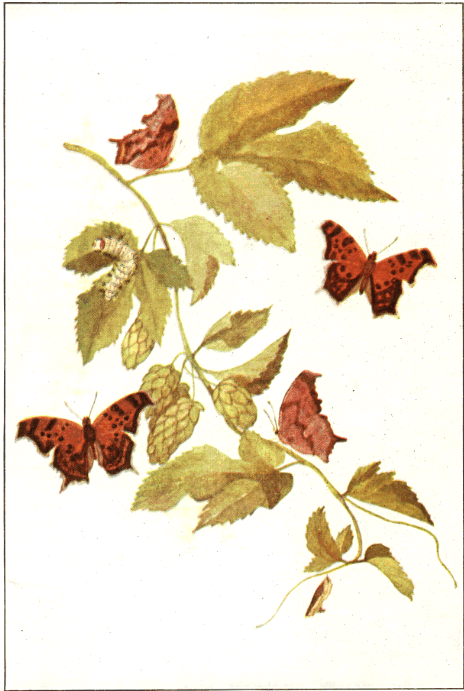
From a drawing by Mary E. Walker
See page 153
THE HOP MERCHANT
Caterpillar, chrysalis, and butterflies. (Reduced)
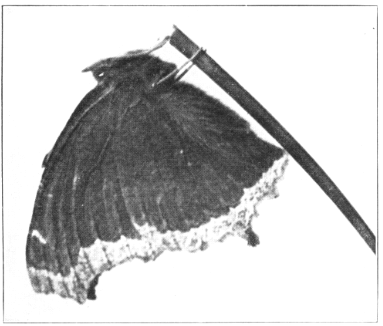
See pages 112, 171
Mourning-Cloak
See page 195
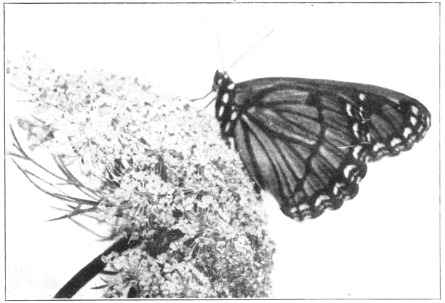
The Viceroy visiting wild carrot flowers
EXAMPLES OF FOUR-FOOTED BUTTERFLIES SHOWING USE OF THE FOUR LEGS
(Photographed from life)
This idea may suggest to various observers an interesting point of view. When you see a butterfly flying leisurely from plant to plant and alighting upon the leaves rather than the blossom, you may be pretty sure that she is bent upon egg-laying. Now watch her to see if she goes at once to the particular kind of leaves she finally selects or does she stop momentarily upon neighboring plants, apparently trying to find the one from which the fragrance emanates until at last she reaches it. Such observations have only rarely been recorded and if carefully made, notes being taken on the spot, they would have decided scientific value.
Abundance and Distribution
Few butterflies are more abundant or more widely distributed throughout North America than the beautiful little Pearl Crescent. It occurs over practically the whole of the United States and Canada and is found from early in spring until late in autumn. It is a rather small species with a wing expanse of only about an inch and a quarter, the upper surface of the wings being that tone of reddish brown called fulvous, more or less marked with black wavy lines and dots. The under surface is similar in color, with a small silver crescent near the outer margin of each hind wing.
These butterflies are not very active creatures, although they are commonly found in meadows and pastures along brooks and by the borders of open woods. Instead of laying their eggs singly as do so many of the more active butterflies, they lay them in clusters, often of a hundred or more, one layer of eggs being placed above the other upon the aster leaf. In at least one case observed, the caterpillars hatch from the layer farthest away from the leaf surface before those of the layer next the leaf surface emerge. This is an interesting provision, for were the latter to come out first they would be likely to disarrange the unhatched eggs. The caterpillars appear about a week after the eggs are laid and remain together in crowded colonies that feed upon the upper surface of the aster leaf. At first they eat only the green tissue, leaving the bare veins, although they are not careful to denude the entire surface of the leaf as so many other caterpillars do. As one leaf is exhausted they pass to another near by, continuing thus to feed in companies for a few weeks. Their general color is blackish, although the black is relieved with yellow dots along the back and a band of a similar color on each side. Unlike the larger social caterpillars of the Mourning Cloak and other butterflies these larvae do not spin any threads as they crawl from place to place, so there is absolutely no nest made upon the aster leaf. This may possibly be correlated with the fact that these caterpillars are sluggish creatures and when disturbed drop quickly to the soil beneath.
When the caterpillars are full grown, they fall or crawl to the ground and scatter more or less in search of shelter. Each attaches itself to any protection it may have found and changes to a grayish or brownish chrysalis more or less angular. It remains in this condition for a period that varies greatly with the weather conditions, averaging about two weeks.
There are two distinct forms of these butterflies which vary so greatly that they were once considered separate species. They are now known, however, to be only seasonal variations. In New England two broods of the insect occur, one in spring, the other in summer. The spring form is called technically Phyciodes tharos tharos. In this form the under surface of the hind wings is very distinctly marked with blackish spots. The summer form is called Phyciodes tharos morpheus. It is noticeably larger than the spring form and it has very few markings on the under surface of the hind wings.
The Yearly History
As it occurs in New England the yearly history of this little butterfly runs something like this. The spring form of the adult appears in May and lays eggs upon the aster leaves. These eggs hatch into caterpillars that feed upon the aster leaves for several weeks and then change to chrysalids, remaining in the latter stage ten days or two weeks. They then come from the chrysalids in the form of the summer butterflies which begin to appear about the middle of July and continue to emerge for at least a month. These lay eggs upon the aster leaves again and the little caterpillars that hatch from them feed for a few weeks or until about the last of September. They are then only partially grown, but they make no attempt to complete their transformation at this time. Instead they drop to the ground and go into hibernation, remaining in this condition until early the following spring. They then begin feeding again and complete their development in time to emerge as the spring form of the butterfly in May.
Some very interesting experiments by William H. Edwards have shown that the smaller, darker spring form of the butterfly is due to cold. He placed upon ice chrysalids that would normally produce the summer form and found that the specimens so treated produced the spring form.
This butterfly is one of the best known examples of the variation in the yearly cycle due to differences in latitude. This is readily shown by a brief summary of its life-history, from north to south.
In the far northern climate of Labrador there is but one brood a year and the butterflies belong to what I have been calling the spring form. The butterflies appear on the wing in early summer, lay their eggs upon the aster leaves, and die. The eggs hatch into caterpillars that feed for several weeks, then become dormant and remain in such shelters as they can find until the following spring. They then change to chrysalids to emerge as butterflies a little later. There is thus but one brood a year and the only form of the butterfly is the small, darker colored variety.
As far south as southern Canada there is a slight variation in this yearly cycle. The spring form of the butterflies appears in May and lays eggs. The eggs hatch into caterpillars; part of these caterpillars mature within a few weeks, change to chrysalids, and come out in July or August as the larger summer form of the butterfly, which in turn lays eggs for the caterpillars that are to winter over in a dormant condition and mature the following season. But the significant fact is that not all of the caterpillars which thus have hatched in spring go through this cycle. Part of them become dormant when partially grown and continue dormant through summer, autumn, and winter, just as they did in Labrador. Then in spring they develop into the spring form of the butterfly, along with the caterpillars that have hatched from the eggs laid in summer. There is thus what is called an overlapping of the broods.
Farther south, in southern New England, the life-history is more definitely two-brooded each year, as already described in an earlier paragraph. Still farther south, in the region of the Virginias, it is definitely three-brooded, there being at least two summer broods during the year. How is it that the instinct to become lethargic lies dormant in the summer broods of caterpillars and shows itself only in the autumn brood? Is it perhaps due to a reaction to the colder nights of the later season? If so, possibly one could get interesting light upon the subject by experimenting with placing the summer caterpillars temporarily in an ice chest.
Synopsis of the Crescent-spots
Baltimore Checker-spot (Euphydryas phaeton or Melitaea phaeton). Expanse 1¾ inches. General color purplish black with the upper surface marked thus: a marginal row of red-brown spots between the veins; two rows of creamy yellow spots inside of the row just mentioned; two or three small red and two or three small white spots near front border of each front wing. Under surface checkered in red-brown and creamy yellow on a blackish background.
Harris's Checker-spot (Cinclidia harrisii or Melitaea harrisii). Expanse 1¾ inches. This species bears a close general resemblance to the Silver Crescent. It may be distinguished by the fact that the middle joint of each palpus is of uniform size from end to end instead of tapering toward its outer end. The tibial joint of the first pair of legs of the male butterfly is very thick. The upper wing surface is so marked with black that the tawny red coloring shows only in the middle.
Silver Crescent (Charidryas nycteis, Melitaea nycteis or Phyciodes nycteis). Expanse 1¾ inches. This species may be known from Harris's Checker-spot by the fact that the middle joint of each palpus tapers from the middle to the tip and that the tibia of each front leg in the male is slender rather than stout. On the lower surface of the wings there is a narrow yellowish marginal line.
Pearl Crescent (Phyciodes tharos or Melitaea tharos). Expanse 1½ inches. General color much lighter than either of the preceding. Terminal joint of each palpus less than a third as long as the middle joint.
THE TRIBE OF THE ANGLE-WINGS
The special characteristic that distinguishes the members of this important group from the other Nymphs is the fact that on that portion of the club of each antenna which has not hairs there are three longitudinal ridges. The tribe includes a large number of our most familiar butterflies. Nearly all of them are rather large, with bright attractive colors. They fly freely along roadsides and in orchards, fields, and meadows so they are commonly seen by every one.
The Violet-tip Polygonia interrogationis
The Violet-tip is one of the largest of the Angle-wings, as well as one of the most beautiful of all our species. It has a wonderful violet iridescence which is especially marked on the projecting tip of the hind wing. On fresh specimens, however, it may be seen practically all over both surfaces of the wings and in bright sunlight gives them a sheen of remarkable beauty. The expanded wings measure nearly two and a half inches, the upper surface being marked with dark brown upon a ground of orange-brown. The under surface has a bark-like effect in brownish gray brought about by rather indefinite markings of varying tone. The most characteristic feature is a distinct silver semicolon on the middle of the under surface of each hind wing. This marking closely resembles the Greek interrogation point and so the species was given the specific name interrogationis by Fabricius early in the history of science. It has since often been called the interrogation butterfly as a translation of its Latin name, but in as much as the marking on the wings is not at all like the English interrogation point, this has led to considerable confusion and people have considered it a misnomer. It has also been called the Semicolon butterfly which is correct enough so far as this most characteristic feature is concerned; but it leads to confusion in connection with the Latin name. The recent practice seems the better, which is to call it the Violet-tip butterfly.
Life-history
The life-history of this butterfly is much like that of the related species. Briefly summarized, this is its story:
The adult butterflies, more or less worn and faded from their long hibernation, appear in fields and pastures in May. They fly for several weeks sipping nectar from many kinds of spring flowers. The females search for the leaves of the elm, hop, nettle, false nettle, and perhaps other related plants on which they deposit their ribbed eggs either singly or in small groups, it often happening that one egg will be laid directly on top of another. About a week later the eggs hatch into small spinose caterpillars which begin feeding upon the leaves near by. They continue to feed and grow rather rapidly until they become full size. Each then fastens a bit of pink silk to the stem of the plant or some other support, in which it entangles its hind legs and hangs downward to become a chrysalis which is remarkable for its numerous protuberances and the beautiful silvery and golden spots along the middle of the back. Within these chrysalids the change from larva to butterfly takes place, usually in less than two weeks, so that this new brood of adults appears on the wing early in July. Eggs are laid by these for a second brood of caterpillars that feed upon the host plants in the same way as the others, and mature as butterflies late in August or early in September. These butterflies visit the fall flowers and suck the juices of fallen fruits, until the cold weather of autumn warns them to seek shelter for the winter. They now find crevices within the bark of trees or places in hollow logs or stone piles or other similar situations, where they close their wings together, so that only the bark-like under surface shows, and remain quiet for long periods. They hibernate in this way, coming forth again the following season to start the cycle for the new year.
In regions where hops are grown commercially the chrysalids of these butterflies are often called "hop merchants." There is a quaint fancy that the price of the crop varies with the lustre of the golden spots upon the chrysalids. When these stand out conspicuously, according to this fancy, the hops are to sell high—bringing much gold to the owners. When these are inconspicuous the hops are to sell at a low price, with a corresponding diminution in the returns. But this fancy does not apply at all to the chrysalids when they are nearly ready to disclose the butterfly, for at this time they lose their metallic lustre.
The Hop Merchant or Comma Polygonia comma
There are two species of butterflies which commonly lay their eggs upon the hop and which resemble each other so closely in their earlier stages that they are frequently confused by ordinary observers. One is the Violet-tip or Semicolon and the other is the one which has long been called the Comma. The chrysalids of both are marked in silver and gold and the variation in the golden lustre has led hop growers to deduce from them the probable price of hops. On this account the chrysalids are commonly called Hop Merchants and the name has been transferred to the butterflies themselves. (See plate, page 144.)
The Comma is easily distinguished by the conspicuous silver mark in the middle of the under side of each hind wing. This bears a striking resemblance to a comma, hence the name. The butterflies are somewhat smaller than the Violet-tips and show to a remarkable degree the angularity in the borders of the wings. The under side is cleverly marked in imitation of the bark of trees, which is doubtless of much benefit to the species in eluding observation during the long months from October until April, when the butterflies are hibernating in such concealed shelter as each happens to find. The crevices beneath loose bark, the openings in fallen logs and hollow trees, the interspaces in stone piles, as well as the interior of buildings, all serve this purpose.
Like the other over-wintering butterflies, the specimens that come forth in spring are commonly faded and more or less frayed from their long wait since bursting forth from the chrysalis. They may often be seen sunning themselves on bright days in April and May, resting upon stones or logs in sheltered spots with their wings fully expanded to receive the greatest benefit from the rays of sunshine.
Eggs laid in string-like clusters on the under side of leaf. Magnified. (From Holland)
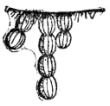
When spring has sufficiently advanced for the leaves of the elm and the hop to be fairly well developed, the mother butterflies lay their eggs in a curious and characteristic fashion. Under a lens these eggs look like tiny barrels with vertical ribs. They are deposited in columns, the egg first extruded being attached to the leaf, generally the under surface, and those which follow are placed one upon the other sometimes to the number of six or eight, the group thus making a miniature column. Now if the egg which was first laid should hatch before the others, when the little caterpillar came out it would be very likely to cause the others to fall off and when they hatched they would find themselves in what would be to them an impenetrable forest of weeds and grasses from which there would be small chance to escape to reach the elm or hop leaves. To avoid this calamity we find an interesting adaptation. The egg at the end of the column hatches first, although it was necessarily the one laid last. The tiny caterpillar eats its way out of the shell and crawls over the other eggs to the leaf. Then the others hatch in succession.
The eggs thus deposited by the hibernating butterflies are likely to be laid late in May or even early in June. They hatch into caterpillars less than a week later and these caterpillars feed for about a month, when they change to the characteristic chrysalids in which they commonly remain for a week or ten days. They then emerge as the summer brood of butterflies, most of them in New England appearing during July. These remain upon the wing for several weeks, the females laying their eggs upon the elm and hop leaves. These in turn soon hatch into caterpillars that change to chrysalids in August and emerge as butterflies late that month or during September. This autumn brood of butterflies is quite abundant for a time but soon seeks the seclusion of winter quarters to remain until the following April. There are thus two distinct broods during the year in the Northern states while as far south as West Virginia there are likely to be three broods.
These caterpillars at first simply eat small holes in the green substance of the leaf, but as they become larger each takes up its abode on the under surface of a single leaf and makes a sheltered tent in somewhat the same fashion that the Painted Lady does upon the nettle leaf. The caterpillar eats out more or less of the base of the blade on each side of the midrib, thus weakening the edges so that they can be fastened in a tent-like manner by silken threads. This serves as a resting place from which it sallies forth to feed, commonly only toward the tip of the leaf. As a result it often eats itself out of house and home and has to crawl to another leaf and construct a new shelter.
While the Comma is generally spoken of as a characteristic northern species it has a very wide range, being found from New England to Texas and from the Northwestern states to the Carolinas. It is one of those species which have two distinct forms of coloring. The winter form has been given the variety name harrisii. The butterflies of this brood are decidedly lighter in color than those of the summer brood to which the variety name dryas has been given. The latter was originally described as a distinct species by W. H. Edwards.
The Change to the Chrysalis
The manner in which a larva changes to a chrysalis is second in interest only to that in which a chrysalis changes to a butterfly. There are not a great many careful descriptions by competent observers of this process in print. One of the best of these is that by W. H. Edwards in his splendid work on "The Butterflies of North America," in which he describes the transformation of the Comma caterpillar. It is as follows:
"When about to transform, the caterpillar selects a convenient place on the under side of a projecting rock, or of a fence rail, or of a weather board of the house, or the midrib of a hop leaf, and having spun a little button of pale red silk fixes the hooks of its hind legs therein and hangs suspended, head downward, in the shape of a fishhook and remains immovable for the space of twenty-four hours, no change being perceptible except in the color of the skin, which becomes partly transparent and loses its dark color owing to its gradual parting from the chrysalis within. Suddenly, and to a looker-on without any premonitory symptom, a rent takes place in the skin at the back of the head, just wide enough to allow the passage of the chrysalis, the head of which at once emerges. By a rapid contraction and expansion of the folds of the abdomen the larva draws the skin upward, successively discovering the parts of the fully formed chrysalid until at last, and in scarcely more than one minute of time, the entire skin is gathered about the hind feet. It now bends itself violently to disengage the end of the chrysalis, which is long, pointed, and hard, furnished with several little hooks, meanwhile retaining its hold of the skin by the folds of its abdomen until after a severe effort, convulsively reaching out and feeling in all directions for the object of its search, it touches the button of silk and at once grasps it with its hooks and fixes them in it securely. Then by a twisting motion it manages to disengage the loose skin which falls to the ground and the chrysalis rests. The whole process is most interesting to witness and excites renewed wonder with every repetition at the ingenuity of the means employed and the delicacy of the instinct displayed. How to strip off the skin and much more the legs by which the creature is suspended without losing its hold, and at the same time to securely fasten the chrysalis, is a problem that would seem impossible to solve; and yet this little insect accomplishes it unerringly when to fail would be certain destruction. And not this species only, but the larvae of all butterflies which form suspended chrysalids, embracing the whole of the great family of Nymphalidae, that is, a large proportion of all the existing species of butterflies, undergo a similar transformation.
"The chrysalis is now green in color, soft and indefensible, susceptible to the slightest injury, and for a few moments the several parts of the future butterfly may be seen and readily separated; the wings folded close and enveloping the thorax, the antennae, and proboscis stretched at length along the back; but very speedily a complete casing is formed by the exuding from parts of the body of a viscous fluid, which binds together the tender parts and covers the whole with a coating like varnish. This soon hardens and the chrysalis is ready to take its chance against injury."
The Gray Comma Polygonia progne
This butterfly is rather darker colored, especially on its under side, than the one last discussed. The silver marking takes on a little more definitely the form of an L than a comma, and the under surface of the wings is darkened by many blackish threadlike lines running across the veins. When at rest with wings closed these butterflies are very easily overlooked.
Except for a difference in the food plants of the caterpillar, the life-history of the Gray Comma is very similar to that of the other Comma. The butterflies hibernate, and in spring lay eggs singly on the leaves of currants, gooseberries, and related plants. The eggs soon hatch into caterpillars that feed upon these leaves but do not make any suggestion of a nest. They grow slowly and change into angular chrysalids which disclose the summer brood of butterflies in July. These lay eggs for another brood of caterpillars which mature into butterflies in August and September. These generally go into hibernation before the middle of October, sometimes choosing simply the under side of a branch where their dark coloring, so near like that of the bark, is likely to cause them to be overlooked by their numerous enemies.
The Green Comma Polygonia faunus
The Angle-wings exhibit interesting variations in the geographical distribution of the species. Some are characteristic members of the Canadian fauna, others of the Alleghanian fauna. Some of those which are characteristic of the former are scattered south well into the latter, but the Green Comma is distinctively a northern species—being found abundantly in the great regions traversed by the trappers of the Hudson Bay Company and occurring south as far as northern New England, being very rare as far south as northern Massachusetts. It is abundant on the higher slopes of the White Mountains.
As one might expect from the short seasons of the far northern regions in which this butterfly lives, there is only one brood each year. In consequence the adult butterflies live a long time. Coming from the chrysalis generally the first weeks in August, they remain upon the wing a month or more before they go into hibernation. They come from their winter quarters in May and commonly continue alive until late in June. Thus it is evident that many of these butterflies must live at least ten months as adults, an extraordinary longevity for one of these frail creatures.
The caterpillars are known to feed upon the foliage of several kinds of plants. These include alder, currant, gooseberry, willow, and black birch, the last two named apparently being those most often chosen.
Mr. S. H. Scudder called attention to the fact that these butterflies are able to make a slight clicking noise as they start into flight. He described his experience in these words:
"Starting up a pair just at my feet on the Mt. Washington carriage road one day, I stopped abruptly to see whether they would settle again. After flying a few yards away to escape the cause of their disturbance, one turned back and dashed straight at my face, turning only when within three or four inches of my nose, and then suddenly whisked off with a distinct click as it did so, snapping its fingers, as it were, in my very face. There was no sort of doubt about this click, though if it had not been made so close at hand it would probably not have been heard. But other butterflies in the tropics have long been known to emit sounds like this, which can be heard at a considerable distance; others, including some of our own butterflies, are known to produce a rustling sound by the rubbing of one wing upon another; and movements of one sort and another have been so often observed, as of the opposite rubbing of the erect wings in most Lycaenids, and the tremulous agitation of the wings in many different sorts when excited, as to leave little doubt that sounds made by themselves and for the advantage of warning their brethren play a not unimportant part in the lives of butterflies."
See page 233
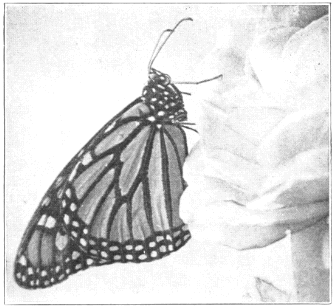
MONARCH BUTTERFLY IN RESTING POSITION
Photograph by Miss J. Brooks
See pages 17, 232
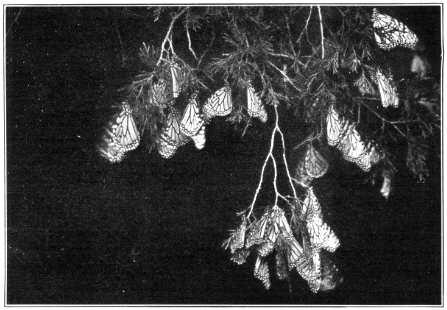
FLASHLIGHT PHOTOGRAPH OF MONARCH OR MILKWEED BUTTERFLIES IN MIGRATION
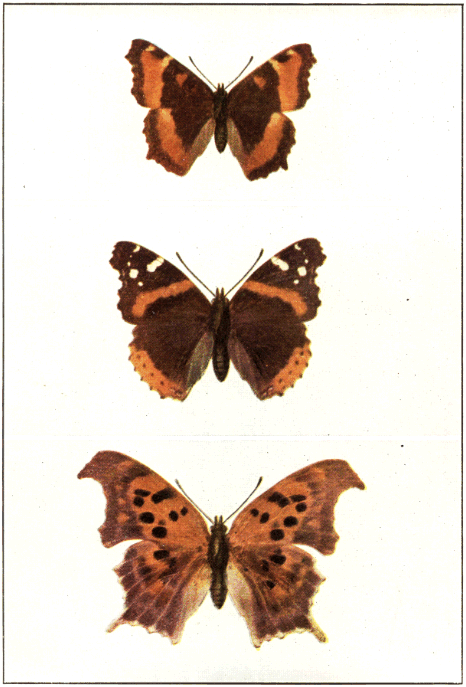
THREE ANGLE-WINGS: UPPER SURFACE The American Tortoise-shell (see page 182) The Red Admiral (see page 160) The Violet-tip (see page 150)
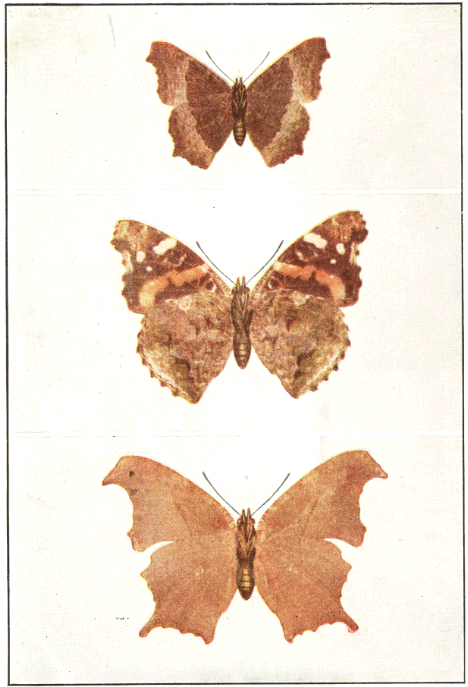
THREE-ANGLE WINGS: LOWER SURFACE The American Tortoise-shell (see page 182) The Red Admiral (see page 160) The Violet-tip (see page 150)
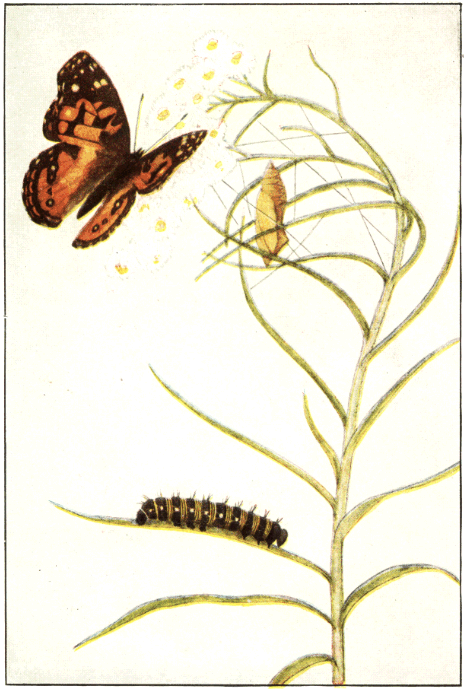
From a drawing by W. I. Beecroft
See page 163
THE PAINTED BEAUTY
Caterpillar, chrysalis, and butterfly
The Red Admiral or Nettle Butterfly Vanessa atalanta
Among the weedy plants which have been intimately associated with mankind ever since his slow upward progress in civilization began, the nettle has probably played almost as important a part as the thistle. While it lacks the winged seeds of the latter it is even more effectually protected from the attacks of vertebrate enemies on account of its irritating hairs. At any rate, nettles of various kind are widely distributed over the earth's surface, and consequently it is not surprising that the Nettle Butterfly or Red Admiral should be almost as cosmopolitan as the Thistle butterfly. The two species are closely related in structure and habits and the life-history of the one is very similar to that of the other.
About the middle of May one may see in open fields and along sunny highways these Red Admirals flitting from flower to flower, or stopping occasionally upon green leaves in search of opportunities to lay their eggs. Should you observe them closely you might notice that some of them seemed frayed and worn while others seemed perfectly bright and fresh.
The Life-story
Late in May and early in June these butterflies deposit their eggs upon the leaves of the nettles. As a rule only one or a few eggs are laid on a leaf, but when the butterflies are abundant many leaves upon the plant may become infested. About a week later the egg hatches into a larva, which is likely to eat more or less of the empty shell before crawling up the stem of the plant to the unfolding buds at the top. Here it makes its first nest by webbing together the still closed upper surface of a leaf not yet unfolded. It is thus able to furnish itself with protection from weather and enemies, as well as an abundant supply of succulent food. It remains in this first home about a week, then it casts its skin, still within its protection, and stays until it has recovered after the process. It now migrates to another larger, expanded leaf where it very cleverly proceeds to construct its second nest. In order to do this it weakens the midrib at the base of the leaf by biting nearly through it. Then it cuts a hole in the blade of the leaf at the base in such a way that the margins are made to droop, so that they can be fastened together with silk to form a little tent. We thus have a tent-like nest hanging down from the stem of the leaf on the under side of which the caterpillar will find shelter, while near at hand is the green tissue of the inner surface of the leaf waiting to be eaten. This improvised tent serves as the home during this second stage of the caterpillar. Here also the second moult commonly takes place, after which the caterpillar migrates to a new leaf and constructs its third nest. The rest of the story of the caterpillar's life consists of similar chapters. After each moult a new tent is formed and even the chrysalis is often hung within the last one.
The eggs which were laid late in May develop into butterflies during July. These in turn lay eggs for the second brood of caterpillars most of which develop into butterflies late in August or early in September, but some of which apparently remain in the chrysalis stage unchanged throughout the winter, and mature as butterflies about the middle of the following May. This is the explanation of the fact mentioned at the beginning of this discussion that one can find late in spring and early in summer some butterflies which seem worn and frayed while others seem perfectly fresh. They are all the progeny of the midsummer brood of the previous summer, but some of them have been living as full-grown butterflies through eight long months of tempestuous weather, while others have just been disclosed from the protecting walls of the chrysalis.
The world-wide distribution of this butterfly is shown in the statement that it occurs throughout Europe, and in North America from Newfoundland to Cuba and Guatemala. It is a safe guess that it is found in practically all localities where nettles grow.
It is not alone the association between a butterfly caterpillar and its host plant which has been brought about during the long ages through which one generation has been succeeding another, but there have been also many developments of similar associations between the caterpillars and their parasitic enemies. The Red Admiral is a good example of such a development. During its long growth as a species it has been exposed to attack by vast numbers of tiny foes which live at the expense of other insects. Several of these foes have found in the bodies of the caterpillars good opportunities for growth, so that now the Red Admiral, as a species, has to reckon with many enemies among these tiny parasites. The interaction between caterpillar host and uninvited parasitic guest has much to do with the great irregularity in the numbers of the butterflies. It is simply another example of that complicated struggle for existence, by means of which nature keeps ever a fairly even balance of her myriad forces.
The Painted Beauty Vanessa huntera
One of the most interesting phases of the study of butterflies is to learn how often they take advantage in their life-history of any peculiarity of the food plant which has a protective value. The Painted Beauty is an excellent illustration of this. The caterpillar feeds upon the leaves of the common Everlasting or Gnaphalium. This is an abundant and widely distributed plant, found along roadsides and in fields and pastures. It is notable for the woolly covering on stems, leaves, and flowers—this dry, hairy surface being so evident that the flowers will apparently continue in blossom when they have dried, hence its common name Everlasting or, as the French call a similar flower, Immortelle. (See plate, page 161.)
The utilization of the hairs upon the leaves is begun by the mother butterfly when she lays her egg upon the upper surface, pushing it down among the hairs so that it is almost concealed. Should you be fortunate enough to find one of these eggs you would see that it is a small, yellowish green object, looking like a tiny barrel with several vertical ribs upon its surface. A few days after the egg is laid it hatches into a minute caterpillar that begins eating off the hairs where they are attached to the leaf, in such a way that it soon has a free space beneath a bunch of these hairs which it has more or less matted together by means of silken thread. The little caterpillar has thus provided for itself a protecting nest that effectually conceals it from birds or other enemies. It now begins feeding upon the succulent surface of the rather thick leaf, where it has removed the hairs. After several days of such feeding it moults, still under the shelter of its hairy covering. This process of moulting and feeding continues for two or three weeks, the caterpillar occasionally making a new covering as needed for its food supply.
The later nests are likely to be made by folding two or three leaves together, binding them with silken thread. The caterpillar in doing this takes advantage of the fact that the terminal leaves are vertical before they have spread out, so that it is a comparatively simple matter to make a little house by binding their edges together with silken threads. The larva feeds upon the inner walls of the house it thus constructs, and as it becomes larger the buds and blossoms are also utilized for food.
When the caterpillar is full grown it thus finds itself fairly well concealed within a very substantial sort of a home. Many of them have the apparent good sense to realize that this is as safe a place as they are likely to find for shelter during the period of the chrysalis. So the caterpillar makes the nest especially secure near the centre of what might be called the ceiling and in this web it entangles its hind legs and hangs downward, preparatory to changing to the chrysalis. A few hours later the skin splits apart and is wriggled off, leaving the chrysalis hanging in place of the caterpillar. About a fortnight later the butterfly emerges and crawls at once to the outside of the nest, where it rests quietly while its wings expand and its tissues harden. Then it flies away in search of the nectar of thistles and many other flowers which it visits freely.
This Painted Beauty is a wonderful example of harmonious coloring. The general tone of the upper surface of the wings is fulvous, with some distinct white markings on a blackish background at the outer angles of the front pair. There is also more or less blackish shading on the base and margin of all the wings with an indistinct row of about four dots, more or less run together, near the margin of the hind wing. The under surface of the wings is even more beautiful than the upper, and furnishes a striking example of flower-picturing. There is a little fulvous background near the middle of the front wings, but the rest of the surface is spotted and striped with blotches and circles of gray and brown in a most intricate design. On each front wing near the outer angle are three indistinct eye-spots in a row, and on the outer half of each hind wing there are two bull's-eye circles, one smaller than the other, which form the most conspicuous feature in the marking of the insect.
When full grown the caterpillars are a little more than an inch long with a general color of velvety black, marked with fine yellow lines and more or less covered with bristly spines. There is also a distinct row of whitish spots along each side beginning a short distance back of the head.
This is a widely distributed butterfly, occurring from Canada to the Southern states and beyond. In most northern regions it seems to be two-brooded, the butterflies commonly hibernating as adults; but sometimes the winter is passed in the condition of the chrysalis. Along its southern range there are three and perhaps four broods each year.
The Painted Lady or the Cosmopolite Vanessa cardui
Our story of this beautiful butterfly ought really to begin with that of one of the most successful plants in the world. Now a plant is successful from its own point of view when it is able to multiply abundantly in many different sorts of situations and to spread easily over a large area. The plant I have in mind is the thistle, which from time immemorial has been one of the commonest neighbors of man. It is found over the whole habitable globe, as well as in many parts which are scarcely habitable. It has many advantages in its struggle for life. The roots penetrate deeply into the soil; the thickened, spiny leaves are so protected by their juices and their spines that they are molested by very few enemies; the flower stalks are also clothed in a similar armature; and the great heads of flowers are surrounded with prickly involucres that generally prevent their being eaten by browsing animals or even by phytophagous insects. The brightly colored blossoms are abundantly provided with nectar and pollen, and they attract great numbers of bees, moths, and butterflies, in order to bring about cross-fertilization. But all of these advantages are of little significance so far as wide distribution is concerned, compared with the feathery seeds which are produced in such abundance and so generally scattered by the slightest breath of wind that the word thistle-down has come into general use to express a lightly moving object. These airy seeds have been riding on the wings of the wind all over the surface of the earth for untold millions of years. Doubtless during severe storms they may be carried thousands of miles, and it is easy to think that one of them might readily go half-way round the world before it found a resting place. Wherever such a seed alighted and found the condition of a moist soil and slight protection, it would be likely soon to spring into growth and to start anew the development of its ancient race.
The thistle, however, has not been entirely unmolested during its aeons of existence. There has been developing along with it one of the most beautiful of our butterflies which has received various scientific names and the common name of the Painted Lady, although it is also often called the Thistle Butterfly and the Cosmopolite, which latter title perhaps is to be preferred. This butterfly, however, can scarcely be considered a troublesome enemy of its host plant, for it is seldom sufficiently abundant to injure the thistle appreciably. The relation between the two is rather suggestive of that mutual toleration by which two living things develop together with advantage at least to one and without serious disadvantage to the other. The universal distribution of the food plant has led to a like distribution of the butterfly. Consequently the Thistle butterfly has long been recognized as the most cosmopolitan species of its group. (See plate, page 176.)
Aside from the wide distribution of its food plant and possibly correlated with it through the diversity of climatic conditions under which the insect has developed, this butterfly is remarkable for its powers of flight. Many instances are known where it has been taken at sea long distances from land. This is due not only to the propensity of the individual for taking aërial journeys, but also to the fact that this is one of the butterflies which has the instinct to congregate in swarms and to migrate long distances when thus congregated. In 1879 such a flock started from Africa and migrated to Europe.
One of the most remarkable things about this butterfly is our ignorance of what it does with itself in winter. American entomologists are agreed that the adult butterfly hibernates, but where it does so seems not to be known. Here is an excellent opportunity for some young naturalist to go scouting, hunting in board piles, under loose bark, or with a flashlight searching the interiors of hollow trees to find between November and April living specimens of this butterfly. Such a discovery would be a real service to science and should at once be made known through some scientific journal. In Europe there seems to be a belief that the insect hibernates partially at least in the condition of the chrysalis.
The Life-story
While we may not know just where the butterflies have been throughout the winter, we do know that in southern New England they begin to be seen in fields and along roadsides about the middle of May. Many of the specimens then have a ragged appearance which is a pretty good indication that they came from the chrysalis the fall before and have been lying concealed through all the weeks since. These butterflies lay their small greenish, barrel-shaped eggs on the leaves of the thistle. The mother butterfly chooses the location rather carefully and deposits only one egg upon a leaf. The butterflies continue thus to visit flowers and to lay eggs until about the middle of June when apparently they perish.
About a week after the egg has thus been laid, it hatches into a small spiny caterpillar which does not take the trouble to devour its egg shell as so many other caterpillars do. Instead it crawls around to the lower side of the leaf and gnaws off enough of the silken surface of the leaf to furnish material for making a webby covering, the leaf particles being woven together by threads from the caterpillar's mouth. In this way the little creature soon provides itself with a snug enclosure which serves it as a temporary home. It remains in this home much of the time when not eating, going out occasionally to feed upon the green tissues of the adjacent parts of the leaf.
This first home of the young caterpillar, made as it is as a flat blanket upon a flat surface, can be used only by a very small larva. Consequently, the caterpillar soon finds these quarters too cramped and it deserts them to make a new home with larger space. This second nest is commonly made on the upper surface of a leaf, the edges of which are likely to be more or less drawn together and other supports connected from other leaves or a near-by stem. The caterpillar continues to use this nest number two as a place for remaining when not feeding and for protection during the process of moulting. But even this larger nest is likely to be given up about the time the caterpillar becomes half grown, and a third nest is begun in the upper part of the plant. This is likely to be very commodious, its walls being made of leaves or stems bound together by a silken web. Within this the caterpillar completes its growth, going out and in through one or more doors when it wishes to feed. Sometimes it even remains within this nest during the process of changing to the chrysalis, hanging downward from the upper part in much the same way that the caterpillar of the Painted Beauty butterfly does. In case it leaves the nest when fully developed it generally finds a place near-by in which to pupate.