Front matter (continued 4)
Reading edition
About ten days after the caterpillar has changed to a chrysalis it changes again to the adult butterfly. In southern New England these butterflies appear about the middle of July and lay eggs soon afterward, these eggs hatching into butterflies that change to chrysalids and change again to butterflies late in August or early in September. This autumn brood doubtless furnishes the butterflies that will be seen upon the wing the following May, so that it is pretty certain that they must find some shelter in which to pass the intervening months.
The full-grown caterpillar of the Thistle butterfly is about one and a quarter inches long and of a general yellowish color, more or less marked with blackish as well as with paler lines of color. There are many transverse rows of spines along the segments, each yellowish spine having a circle of smaller ones at the top.
Notwithstanding its fondness for thistles, these caterpillars occasionally feed upon various other plants. One might readily expect them to be able to live upon other composites upon which they are found, but it seems a bit strange that they should be recorded as being "especially fond of mallows."
The Mourning-cloak Vanessa antiopa
One of the most scholarly students of American insects has happily called the butterflies "the frail children of the air." It seems a fitting term for creatures so ethereal that they are readily wafted on the wings of the slightest breeze and so delicate in structure that they are likely to be sadly mutilated by the lightest touch of human hand. Such creatures one would say belong to regions of perpetual summer and have no place in the blizzard-swept winters of our Northern states.
Yet if one goes into the snow-clad woods during one of the midwinter thaws one is likely to see in every open glade several dark-colored butterflies flitting from tree to tree, or resting with expanded wings in the sunniest spots. These butterflies obviously have endured the coldest weather and if they are to survive until another season must continue to endure still more. This species is commonly called the Mourning-cloak butterfly—not a particularly happy name for so beautiful an insect. In England it has the more suggestive title of Camberwell Beauty, and country boys are said to call it the Yellow Edge butterfly. Its general life-story has already been told on pages 112-115.
The caterpillars of the Mourning-cloak butterflies are restricted to comparatively few food plants. In regions where they are not especially abundant, they are likely to be found upon willow, poplar, or elm. In general, as many observations indicate, they are as likely to be found upon any one of these food plants as upon either of the other two; but in certain localities where they become especially abundant it seems that they are more likely to occur upon the elm. On this account they have been called the Spiny Elm caterpillars. There is considerable evidence to show that they prefer the American elm to other species of the genus, although in the case of willow and poplar there seems to be little if any preference as to the species.
Miss Caroline G. Soule has seen the butterflies depositing their eggs upon the white and canoe birch, and it has been recorded as feeding in Labrador and Europe upon a species of birch. There is one record of the caterpillars having been found feeding upon the hackberry, and also of their having fed greedily upon the leaves of rose bushes, and still another of their having almost defoliated a pear tree. Linden and nettle are also included in the European lists of the food plants of this species. (See plates, pages 145, 176.)
It is evident, however, that all of these, except the three first named—willow, poplar, and elm—are to be regarded as exceptional cases, and that the normal food of the species is the foliage of a plant belonging to one of these three genera.
It has generally been supposed that this species is double-brooded in central and southern New England, the butterflies of the first brood appearing early in July. These are said to deposit eggs which hatch into caterpillars that mature into butterflies early in September. These butterflies live through the winter, laying eggs the following spring.
It is very probable that as far north as southern New Hampshire the species is commonly single-brooded. During one season when the caterpillars were unusually abundant, a very careful watch was kept for the second brood in New Hampshire and Vermont by several competent observers. Only one colony of caterpillars was found and this was at Durham in the southern part of New Hampshire near the seacoast. Consequently, it seems safe to conclude that in northern and central New England, at least, a single brood is the rule rather than the exception. This involves the conclusion that the butterflies seen upon the wing early in autumn are the same ones that developed in July, and that these same butterflies remain alive through the winter and until, in the following May, they lay their eggs. Thus there is a period of ten months of existence in the butterfly state, an extraordinary length of time for a butterfly to live.
To a large extent the butterflies disappear in August, and the question arises as to what becomes of them. Our observations lead to the conclusion that they go into summer quarters similar to those which they seek out for winter shelter. Apparently they fly about for a few days after coming from the chrysalis and then retire to cool woods, where under the side of a log or beneath the loose bark of a dead tree they settle down and to all appearances go to sleep. The instinct to remain quiet is very strong in these butterflies. In taking the accompanying photographs, I found that even shortly after coming from the chrysalis the butterflies when disturbed would fold their wings with the antennae between them, and drawing the legs against the body would lie quietly on their sides for a long time. These same butterflies would also hang downward from a limb by the hour in the hibernating position as shown in plate opposite page 32.
In the cooler weather of early autumn, the butterflies come from their retreats and fly about in the sunshine. They are especially likely to be seen along the borders of woods or in open glades. At this time they love the sunshine, and will settle in a sunny place to bask in it.
Going into Winter Quarters
When the warm days no longer tempt them abroad, the Mourning-cloaks seek shelter in many sorts of situations—under loose bark, in hollow trees, under culverts and bridges, in woodpiles, in crevices of rocks, or alongside logs lying on the ground. In such retreats they remain until the sunshine of spring again calls them forth.
Prof. G. H. Parker's observations indicate that these butterflies are very sensitive to changes of temperature, and he has seen the interesting action of the butterflies crawling into their hiding places, finding that this takes place each day after they had been sunning themselves. Thus he writes:
"These butterflies remain during cool spring nights in places similar to those in which they hibernate in winter, viz., in openings in stone walls, in old out-houses, in openings under the bark of trees, etc. They retire to these places with considerable regularity, so that in the open woods, where dozens of individuals may have been seen flitting about, all may have disappeared a quarter of an hour later. I have watched their retreat with some care. On a clear afternoon in early April I took my stand in a woodland where many Mourning-cloak butterflies were on the wing. They continued actively flying about till approximately four o'clock, when I began to notice a diminution in their numbers. By a quarter past four not a butterfly was to be seen. During the fifteen minutes from four o'clock on I followed two to their hiding places. One alighted on the front of a fallen tree and without expanding its wings crept immediately into a large crack in the bark. The second settled on a stone fence and crept into a hole between some loose stones. The period during which this occurred was marked not so much by a diminution of light as by a rapid fall of temperature."
That the habit of lethargy in cold and of resting upon the bark of trees is practically universal with this species is shown by a statement quoted by H. G. Adams in his book, "Beautiful Butterflies," published in England in 1871. The writer quoted says: "In a wood on the summit of the Drachenfels, when the wind was rather keen, I found numbers resting on the backs of fallen trees in a state of stupor. They made no attempts to escape and when thrown into the air their wings barely opened or flapping feebly eased their fall or enabled them to seek repose on the stem of a rotten trunk."
Its Rarity in England
In many books this species is spoken of by its English name Camberwell Beauty. It is so called because it was first observed in the neighborhood of Camberwell in the county of Surrey, England. It seems that in that country it is a very rare species. This is a bit curious considering the fact that in America it is so extremely abundant. In his attractive little book quoted above, Mr. Adams begins the discussion of this species with this statement: "This is the crowning glory of the British butterfly collector's cabinet, and a happy man is he who gets a perfect specimen of an insect which is at once so rare and so beautiful." And later in the same discussion is this further statement concerning the scarcity of the species: "In neither the larva nor the pupa state has the insect been found, we believe, in this country where its appearance occurs, except just here and there a single specimen or two, at long and uncertain intervals. About eighty years ago it was seen in many parts of the kingdom and again in 1819, but not since then although almost every year one or more specimens are taken or seen."
A curious fact in regard to the Mourning-cloak, as found in England, is that the border around the wings seems to be much more generally white than it is with us. J. O. Westwood in his book on British butterflies describes the margin as of a white or whitish color and other writers speak of the same fact. Kirby in his "Butterflies and Moths" makes this comparative statement: "The border is whitest in British specimens, and perhaps yellowest in American ones." He speaks of it also as one of the rarest British species. It is sometimes called by the common name the White Border and also occasionally the Grand Surprise, appellations which bear out what has been said above both in regard to the color of the border and the rarity of the insect.
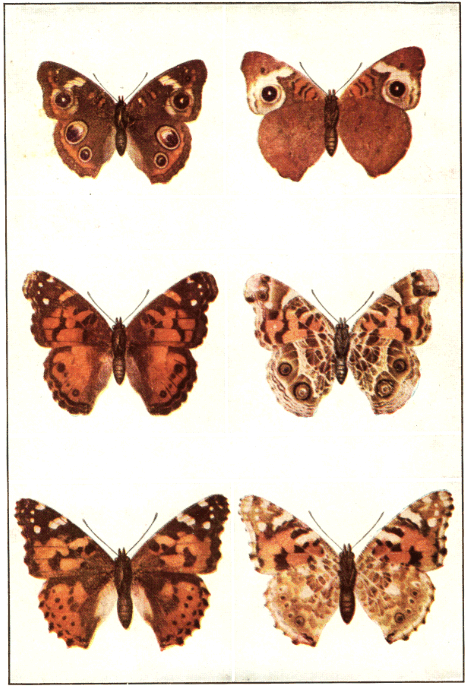
THREE MORE ANGLE-WINGS Upper surfaces at left; under surfaces at right, slightly reduced The Buckeye (see page 188) The Painted Beauty (see page 163) The Cosmopolitan (see page 166)
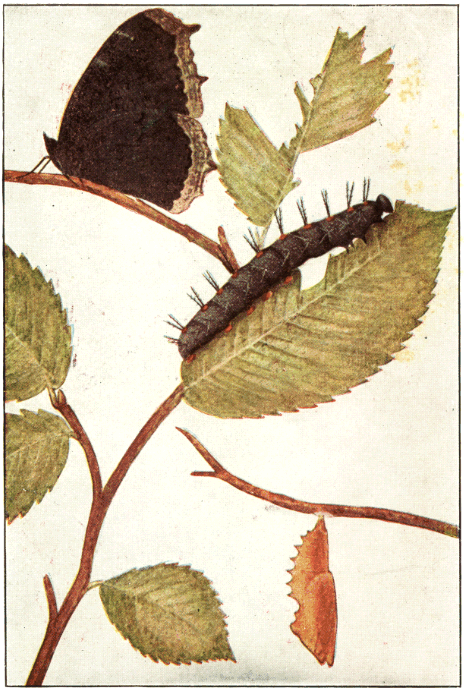
From a drawing by W. I. Beecroft
See pages 112, 171
THE MOURNING-CLOAK
Caterpillar, chrysalis, and butterfly
The Mourning-cloaks subsist upon a considerable variety of liquid food which they suck through their long tongues. In spring, when they first come from their winter quarters, they visit the stumps of recently cut trees and suck the exuding sap, a habit which they continue whenever opportunity offers. Mr. W. F. Fiske has noticed that they commonly sip the sap of maple twigs where the squirrels have gnawed the bark. A little later they visit the willow catkins to suck the nectar secreted by these blossoms, and still later they hover about the delicate blossoms of the mayflower, or trailing arbutus, for a similar purpose. Probably many other flowers are thus rifled of their sweets, although this butterfly seems to be a less regular visitor to flowers than are many of its allies. A little later, when the aphids, or plant-lice, have become sufficiently abundant so that the so-called "honey dew" is to be found upon the infested shrubs, these Mourning-cloaks sometimes sip the liquid sweet from the surface of the leaves. In April and May they occasionally visit the flowers of moosewood, and later in the season have been observed upon the blossoms of the common milkweed. From the time the early apples ripen these butterflies may often be seen beneath the orchard trees, sipping the liquids of the fallen and decaying fruit.
The Parasites of the Eggs
One fine spring morning I came upon a Mourning-cloak depositing a cluster of eggs upon a willow twig. She was so busily engaged that I was able to draw near and watch the operation for some time before she flew away. As soon as she was gone I was much interested to see a tiny parasitic fly running eagerly over the newly laid eggs, and this fly also was so busily interested in her work that I was able to cut the twig off and sit down to observe at leisure through a lens the actions of the insect. I dictated to a companion my notes of these observations and so was able to get rather a complete record of the process of oviposition.
The tiny fly would stop over one of the butterfly eggs, holding its body vertical with the hind legs far back and the other legs so straightened out as to hold the front of the body high up. Then it would insert its tiny ovipositor through the egg shell and proceed to deposit an egg of its own inside of the larger egg of the butterfly. At least it seemed a safe assumption that this was what happened although of course it was impossible to see the smaller egg at the time. While thus engaged the antennae of the tiny fly were bent directly downward to the egg beneath. In about a minute the fly withdrew its ovipositor and after running around for a few seconds again settled upon another egg and repeated the operation. Then it tried again on a third egg, after which I got out my watch and began timing the process. These are the results in the case of the next dozen eggs that were laid. It required:
94sec.tolay eggNo.4.Thenfly movedaround26sec.
120"""" "5.""""27"
83"""" "6.""""20"
92"""" "7.""""22"
75"""" "8.""""40"
90"""" "9.""""42"
102"""" "10.""""15"
120"""" "11.""""21"
120"""" "12.""""18"
60"""" "13.""""25"
120"""" "14.""""25"
60"""" "15.""""50"
It thus required an average of about two minutes per egg for the laying of these fifteen eggs. I then caught the little fly and sent her to Dr. L. O. Howard, our greatest authority on this group of insects, to learn the name of the parasite. He identified it as Telenomus graptae, a well-known parasite of the eggs of the Mourning-cloak and related butterflies.
The most interesting thing about this observation was the fact that the little fly had apparently begun its operation before the mother butterfly had finished laying her cluster of eggs. There were thousands of willow twigs in the immediate vicinity. How did this tiny creature arrive at this particular place at the particular moment when from its own point of view it was most needed? Had it been riding around upon the body of the butterfly waiting for the time when she should lay the eggs? Or was it attracted to them from somewhere in the immediate vicinity? That this early arrival probably takes place generally is indicated by the fact that a similar observation had been made in the White Mountains by Prof. C. W. Woodworth.
The history of the egg parasite after the laying of the egg seems to be comparatively simple. It soon hatches into a tiny larva that develops within the shell at the expense of the contents. It finally changes to a pupa which in turn changes to the little fly that gnaws a hole through the egg shell and emerges to the outer world.
The Parasites of the Caterpillars
After hatching from the egg, the Mourning-cloak caterpillars are also subject to the attacks of various parasites. One of these is quite minute, not a great deal larger than the egg parasite. It is a tiny four-winged fly which deposits many eggs in a single caterpillar. The eggs hatch into tiny maggots that grow at the expense of the caterpillar, finally killing it and changing to four-winged flies again. As many as 145 of these parasites have been known to emerge from a single dead caterpillar. These little flies are called Chalcids by entomologists.
There is still another group of four-winged flies, some of which attack the Antiopa caterpillars. These are much larger than the Chalcid flies and are called Ichneumon flies. In the case of these, only one or two parasites develop in each caterpillar or chrysalis.
In addition to these various four-winged flies, there are certain two-winged flies, called Tachinid flies, that develop at the expense of the caterpillars. In New Hampshire, during recent years, these appear to have been the most abundant parasites of these insects. An egg is laid on the skin of the caterpillar by a two-winged fly, similar in general appearance to the figure below. The contents of this egg shortly develop into a tiny grub that burrows through the egg shell and the skin of the caterpillar into the inside of the body. Here it remains, absorbing the body substance of its host and gradually increasing in size. In a few weeks it becomes fully developed in this grub state. By this time the caterpillar has become sluggish from the effects of the parasite. If the branch upon which it feeds is disturbed, the other caterpillars are likely to crawl away, but the enfeebled victim remains in its place.
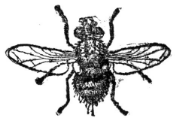
Tachinid Parasite. (Slightly magnified.)
Shortly after becoming full grown, the Tachinid grub breaks through the skin of the dying caterpillar and, falling to the ground, changes to a peculiar pupa; the outer skin of the grub turns brown and becomes hard, forming a protective covering for the body inside. A week or two later the insect undergoes another change and emerges as a two-winged Tachinid fly, like the one that laid the egg some weeks before.
Other Enemies
Besides those insects that develop on the inside of the bodies of these Antiopa caterpillars there are other insect enemies which attack them from the outside and devour them bodily. The most notable of these, perhaps, is a large beetle commonly called the Caterpillar Hunter; it is known to entomologists as Calosoma scrutator. This is a very active insect, with large strong jaws, that runs rapidly about in search of victims. In some cases it has been observed while destroying many of the Antiopa larvae.
In the Southern states a common reddish wasp—a species of Polistes—has also been observed attacking these caterpillars, and there are probably various other insects that destroy them, although definite observations showing this have not been recorded.
The Antiopa caterpillars are such spiny creatures that comparatively few birds attack them. They are devoured, however, by the two species of cuckoos—the yellow-billed and black-billed—and it is probable that they are sometimes killed by Baltimore orioles and various other birds. They are also greedily devoured by toads, but of course they do not often come within the reach of these useful animals.
Even the adult butterflies of this species have to be on the lookout for enemies. During the long months of their life many of them probably succumb to the attacks of birds or other creatures. I have seen but one such tragedy. While riding along a country highway with a bird-loving friend one spring day we saw a male Maryland yellow-throat flit by with a Mourning-cloak in his mouth. The bird lit on a fence, from which I startled him so that he dropped the butterfly, a worn and faded, half-dead specimen. The places where the bird held the insect were indicated by missing pieces of the wings.
The American Tortoise-shell Aglais milberti
This beautiful butterfly is one of the most distinctive of all our species. It is of moderate size, its wings rarely expanding more than two inches, and it has sufficiently irregular outlines to indicate its relationship with the Angle-wings. The most striking feature of the upper surface is the broad band of orange-brown extending clear across both wings a little inside the border. The remaining surface is a darker brown marked with two orange-brown spots near the front margin of each front wing and having scattered iridescent scales which show plainly under a lens. The suggestion of the coloring of a tortoise-shell is easily seen in these rich brown tones. The under surface is a wonderful illustration of protective coloring. With wings closed and resting against the bark of trees or lying beneath the trees among fallen leaves, it would require a keen eye to detect the insect. (See plates, pages 160-161.)
The American Tortoise-shell is distinctly a northern species. North of latitude forty-three degrees it seems to occur practically from ocean to ocean, extending far up toward the arctic region. It is commonly found in British America as far north as Fort Simpson in latitude sixty-one degrees. There are specimens in the British Museum collected by the explorer Ross in arctic America, and there are many in our own National Museum collected in the Hudson Bay region by various American explorers. In New England the species is abundant at times in New Hampshire, Vermont, and Maine. In the vicinity of New York City and Buffalo, New York, it is rather rare. And south of this latitude it is found chiefly at the higher elevations in mountainous districts. As a rule it is likely to vary in numbers from year to year, sometimes being extremely abundant while more commonly it is rather rare. These are the same sorts of fluctuations that we find in the case of the Mourning-cloak, the American tent caterpillar, and various other insects whose larvae live in colonies. The variation is probably due to the fact that when the caterpillars become unusually abundant they become correspondingly conspicuous and so provide a shining mark that is soon discovered by their insect enemies or by various fungous diseases.
The Story of Its Life
In its manner of laying eggs this butterfly differs from most others. The great majority of our familiar species lay their eggs one in a place or possibly two or three near together. Some species deposit several in a group, while some, like the Mourning-cloak, may lay two or three dozen in a cluster. Very few, however, deposit hundreds in a bunch. Two of these are the Baltimore and this American Tortoise-shell. In the case of the latter the eggs are loosely laid, hundreds together, upon the leaves of the common stinging nettle. Probably each female can deposit six or eight hundred eggs. In less than a week the eggs hatch into minute blackish caterpillars that feed upon the tender tissues of the leaf upon which they were born and then migrate together toward the top of the plant. In their habits they are quite similar to the caterpillars of the Mourning-cloak. As each walks it spins from its mouth a silken thread and the combined effect of hundreds of these threads is to make a noticeable silken web over the leaves. The caterpillars remain in colonies, feeding together from day to day and gradually denuding the upper branches of the nettle plant, leaving an unsightly silken web as a memento of their presence. This webbing is very suggestive of the similar result left behind by a colony of Mourning-cloak caterpillars upon the twigs of elm or poplar.
When about half grown these caterpillars are likely to scatter more or less in accidental groups which may make small shelter tents from the larger leaves. In each little nest there may be four or five or more of the dark-colored caterpillars. From these shelter tents they sally forth to feed upon the adjacent leaves and a little later become full grown as caterpillars. Each now wanders away and finding such shelter as it is able to, spins a button of silk and becomes a chrysalis. It remains in this condition but a short time before it emerges again as the beautiful butterfly.
This species is commonly reputed to have three broods a year, hibernating both as a butterfly and as a chrysalis. It has been suggested, however, by Mr. W. F. Fiske, one of our most painstaking entomologists who has studied the butterflies of New Hampshire for many years, that it is more probably double-brooded with a period of aestivation during the later weeks of summer. This seems a very probable condition and it is to be hoped that some observer will make such a careful study of this species as to settle the point definitely.
In the case of many butterflies the distribution of the species coincides with the distribution of the food plant. This American Tortoise-shell, however, is perhaps the exception that may prove the rule, for its southward limit is far north of the southern range of the stinging nettle. Evidently, it is a species which has developed in adjustment to the cool climate of northern regions or high altitude, and it does not easily adapt itself to a warmer territory.
The White-J Butterfly or Compton Tortoise Eugonia J-album
During bright days in March and April one is likely to find two kinds of butterflies on the wing in open glades of the woods. One is the familiar Mourning-cloak and the other is the Compton Tortoise—the latter generally much less abundant than the former. Both make the most of the brief periods of sunshine and quickly disappear when the sky is overcast.
The Compton Tortoise butterflies which are thus abroad in early spring have been in hibernation since October. They are helping to carry the species over from one season to another, and as the days become longer and warmer they appear on the wing more and more, seeking such liquid food as the field and forest yields during the days of early spring. The sap exuding from holes in bark made by woodpeckers, or from the tappings of the maple trees by man, the nectar of willow catkins, the moisture of roadside pools—these help to yield a precarious sustenance to these butterflies after their long winter fast. They remain upon the wing week after week, while spring slowly progresses in the northern regions they inhabit. When at last the leaves push out on their food trees—willow, birch, and elm—the females lay their eggs and then, having lived to what for a butterfly is a ripe old age, they die, after nearly ten months of adult existence.
Apparently the eggs are laid in clusters on the twigs, although this seems to be one of the many facts about butterflies awaiting observation by some careful student. The caterpillars feed together in small colonies but make no nest. They become full grown in about a month. They are then nearly two inches long with spinous, greenish bodies, striped with lighter lines. Some change to chrysalids about the middle of June and ten days later change again to butterflies, the first of which appear early in July while others continue to emerge for nearly a month.
These butterflies may be seen rather frequently from midsummer on, visiting various flowers and sipping the juices from decaying fruits beneath the trees. At times they seem to disappear in August to reappear in October, a fact which has led some observers to suggest that there is a second brood. The caterpillars of this brood, however, have never been observed and a much more probable explanation has been made by Mr. W. F. Fiske who studied the butterflies of New Hampshire carefully for many years. He found that in the hot summer weather this butterfly goes into a seclusion similar to that of its winter rest—that is, it aestivates in summer and hibernates in winter. "The possibility that the October J-album did not represent a second brood," writes Mr. Fiske, "was rendered almost a certainty by repeated observations which failed to disclose a single specimen approximating in freshness to average August individuals, and the question of their whereabouts during the interim was unexpectedly answered one warm August day by my finding several snugly packed away under the shingles on an old roof. The theory of the aestivation of the butterflies of this group will explain a good many points hitherto obscure in the life histories of the other species."
In October these butterflies seek their winter quarters, finding them in woods and groves. Apparently they commonly rest upon the bark of the trunk as well as crawl into such crevices beneath loose bark as they can find. Here they remain through fall, winter, and spring, except when called into brief periods of activity by the unwonted warmth of the winter sunshine. Then in spring they come forth again to lay the eggs for the caterpillars of the new generation.
The fresh butterflies are creatures of exquisitely modulated coloring. The name Compton Tortoise has reference to the rich brown tones of the upper wing surface, suggestive of those of fine tortoise-shell. In fresh specimens much of the surface, especially in the middle and along the front border, is overlaid with iridescent purple scales. Near the front outer angle of each of the four wings there is a distinct white spot, divided near the middle by a darker line of the vein running through it. The under surface is one of the best examples of mimicry of gray bark to be found in any butterfly. The tones vary considerably in different individuals, but in all the protection must be well nigh perfect when the insect is at rest with closed wings upon the bark of a tree. The striking angularity of the wing's border doubtless helps to conceal it, and the habit of dropping motionless to the ground when disturbed must also have protective value. Near the middle of each hind wing there is a small white J which led to the specific name J-album.
This butterfly is essentially a member of the Canadian fauna. It ranges from far north in Labrador, British America, and Alaska, south as far as Pennsylvania, but toward its southern limit it occurs only on the higher elevations of mountains like the Alleghanies.
The Buckeye Junonia coenia
Some genera of butterflies seem to belong almost exclusively to the north temperate regions, seldom occurring even in our Southern states. Others belong equally exclusively to tropical regions, seldom straying into the north. The Buckeye is an illustration of the latter group. The genus Junonia to which it belongs is essentially tropical, as it contains several species which are found throughout the tropics in both the Old and the New Worlds. In fact, this is apparently the only species which occurs north of the tropics. It has an extraordinary range, being found from Cuba to Massachusetts and from the Atlantic to the Pacific coasts. Toward the northern limits of its range it is very rare and one of the greatest prizes which the collector can obtain. In our Southern states it is an abundant and generally distributed butterfly and, as it hibernates as an adult and one group follows another throughout the season rather rapidly, it is likely to be taken at almost any time. (See plate, page 176.)
The mother butterflies select as food plants for the larvae various members of either the plantain or figwort families. They lay eggs, one in a place, upon the leaves of plantain, figwort, gerardia, and related plants generally near the tip of the leaves. Less than a week later these hatch into spiny caterpillars which feed upon the green substance of the leaves during the next few weeks. For the most part they eat between the veins leaving a ragged effect which may help in finding them. When full grown they change to chrysalids which hang straight downward and bear a general resemblance to those of the Thistle butterfly. Curiously enough, those chrysalids which are attacked by parasites take on a characteristic golden hue; although the normal healthy chrysalids are dark brown with a few touches of a decidedly lighter brown.
In its tropical home, where there is no winter period to interrupt its growth, this butterfly doubtless continues to develop generation after generation without any break in the sequence. As the species goes north, however, there is necessarily such an interruption—in which case the winter seems commonly to be passed by the adult butterfly. In our Southern states there are commonly three or four broods each year, while in the northern parts of its range there is but one brood a year. In the South there is such an overlapping that all stages of the insect may be found at one time.
Synopsis of the Angle-wings
I. The Polygonias
The most angular of the Angle-wings are grouped in the genus Polygonia. They are characterized by having the outer margin of the front wings projecting in two places in a way to give an angular effect, and by having the hind or inner margin distinctly excised toward the outer end, so that this margin is curved rather than straight.
Violet-tip (Polygonia interrogationis or Grapta interrogationis). Expanse 2½ inches. Under surface of each hind wing marked by a silvery semicolon, made up of a dot and a crescent.
Hop Merchant (Polygonia comma or Grapta comma). Expanse 2 inches. A white comma with expanded tips on lower surface of each hind wing. Lower surface of all the wings mottled with brown.
Green Comma (Polygonia faunus or Grapta faunus). Expanse 2 inches. A white comma with expanded tips on lower surface of each hind wing. The lower surface of all the wings more or less mottled with green toward the margins.
Gray Comma (Polygonia progne or Grapta progne). Expanse 2 inches. A white comma with tips narrowed rather than expanded on lower surface of each hind wing.
II. The Vanessids
Our beautiful species of the genus Vanessa may be known by the long scales that make up the fringe on the wing margins, in alternate groups of black and white. There are also several white spots on the upper surface of the outer angle of each front wing.
Red Admiral (Vanessa atalanta, Pyrameis atalanta or Cynthia atalanta). Expanse 2 inches. Upper surface of front wings blackish, marked with white spots on outer angle and a broad orange stripe across the middle.
Painted Beauty (Vanessa huntera, Pyrameis huntera or Cynthia huntera). Expanse 2½ inches. Upper surface orange-brown with black, white, and blue markings. Lower surface of each hind wing with two large eye-spots, each extending across two veins.
Painted Lady or Cosmopolite (Vanessa cardui, Pyrameis cardui or Cynthia cardui). Expanse 2½ inches. Easily distinguished from the Painted Beauty by the four or more small eye-spots on the lower surface of each hind wing, each eye-spot being included between two veins.
III. Other Angle-wings
The other common Angle-wings are readily distinguished by the following characters:
Mourning-cloak (Euvanessa antiopa or Vanessa antiopa). Expanse 3½ inches. Easily known by the nearly black wings with creamy white borders.
American Tortoise-shell (Aglais milberti or Vanessa milberti). Expanse 1½ inches. One of the smallest of the Angle-wings. Easily known by its small size and the broad orange band extending across the upper surface of all the wings just beyond the middle. Under surface dark mottled gray without distinct white markings.
Compton Tortoise (Eugonia j-album, Vanessa j-album or Grapta j-album). Expanse 3 inches. Best known by the straight line of the inner margin of the front wings and the white j on the under side of each hind wing.
The Buckeye (Junonia coenia or Vanessa coenia). Expanse 1¾ inches. Distinguished by the large eye-spots on the upper surface of the wings, one on each front and two on each hind wing. Eyes not hairy.
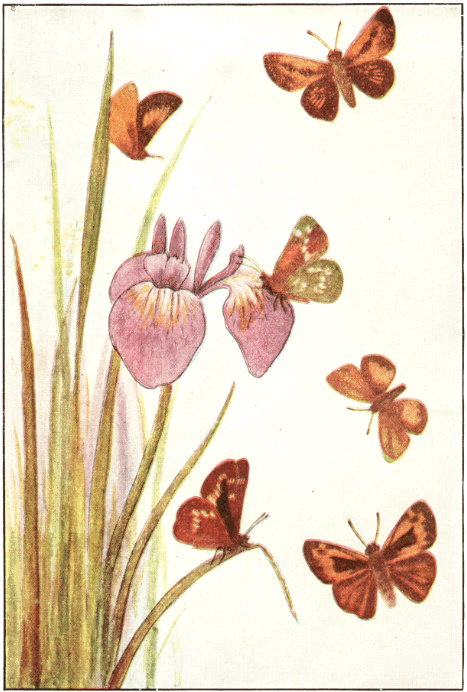
From a drawing by W. I. Beecroft
See pages 268-282
SOME COMMON SKIPPERS
The Long Dash, male, at top; the Vitellius Skipper, female, next below; the Canadian Skipper resting on iris flower in the middle; the Least Skipper, next below; Leonard's Skipper at rest on leaf, next; and the Sachem Skipper, male, at bottom
From a drawing by W. I. Beecroft
See pages 195-202
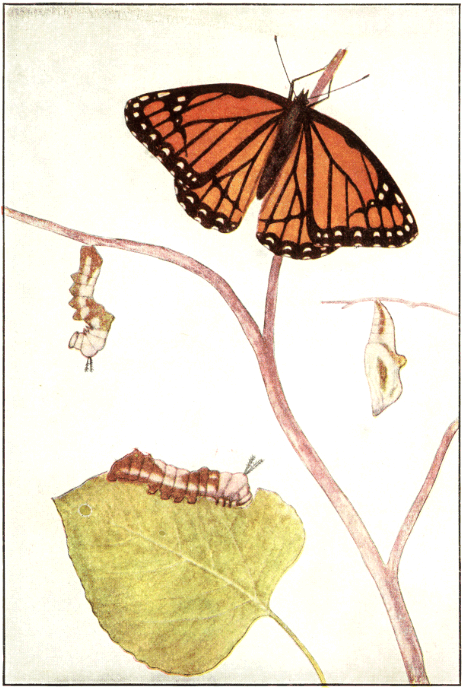
THE STAGES OF THE VICEROY
The butterfly freshly emerged; caterpillar hung up for pupation; the chrysalis; the caterpillar feeding
THE TRIBE OF THE SOVEREIGNS
No other small group of American butterflies has attracted so much attention as the species of the genus Basilarchia, which have been happily called the tribe of Sovereigns. These are rather large butterflies with rounded wings which are found in one species or another over practically the whole of North America. Some of them are of exceeding beauty and all of them present life-histories of extraordinary interest. At least two of the species are the most notable examples of the mimicry of other butterflies that are shown in our fauna. They also present some extremely interesting problems for the study of natural hybrids and they illustrate in their development some of the most wonderful cases of adaptation to environment that have ever been found.
These butterflies may be considered from so many interesting points of view that it is a bit difficult to know which phases to emphasize. In general, there is a striking similarity in their structure and habits in the earlier stages. The eggs are very nearly alike; the caterpillars resemble one another so closely that even expert entomologists sometimes have to decide what species a collected caterpillar belongs to by seeing what plant it is feeding upon, and the chrysalids are also very similar.
Some of the more interesting phases in the development of these insects are discussed in connection with the life-stories of the different species. A phase which is characteristic to all of them may well be emphasized here. From the time the caterpillars hatch until they change to chrysalids they illustrate to a marked degree an adaptation through structure and habit which must very largely protect them from attack by birds and other enemies. Their structure and markings are almost grotesque. The body is covered with strange club-like appendages and it is colored with a curious mottling of tones of green, drab, brown, and white which is very difficult to describe but which suggests, as the caterpillar rests upon rough bark, simply a bit of bird dung or some natural excrescence. The caterpillars have the habit of feeding at night and remaining upon their perches by day, often assuming positions which are very unusual among insect larvae. Such positions, in which they remain motionless for hours at a time, are undoubtedly of protective value and help to conceal the insect. After the caterpillars are half grown they rest not upon the leaves upon which they feed, but rather upon the bark of twigs or branches where their peculiar structure is likely to make them inconspicuous.
The chrysalids of the Sovereigns are also curiously mottled in color tones that will probably lead to their being overlooked.
Three distinct species of Sovereigns are found in eastern North America, namely:
The Viceroy, Basilarchia archippus.
The Banded Purple, Basilarchia arthemis.
The Red-spotted Purple, Basilarchia astyanax.
The first species, the Viceroy, has a much wider distribution than either of the others. It apparently is found in nearly all localities in which either of these occur, and so includes within its range almost the whole of the United States and much of Canada.
The second of these, the Banded Purple, is a northern form. It is found commonly at least as far north as the Mackenzie River region in British America and southward to central Massachusetts. It also occurs as far west as Nebraska so that it has a very wide distribution in northern regions. It is especially abundant in Canada and the White Mountains.
The third, the Red-spotted Purple, is the characteristic form south of latitude 42 degrees. Its range overlaps that of the Banded Purple for about one degree but it is seldom found north of latitude 42 degrees. It seems to range about as far west as the Banded Purple.
There are several other butterflies belonging to this genus which are rarely found and which occur only in certain limited regions. There has been much discussion in regard to these. Some entomologists have thought them simply varieties or dimorphic forms while others have considered them hybrids. An analysis of the conditions shows that these doubtful butterflies occur only in regions where the different species overlap. Thus in the boundary connecting the Banded Purple and the Red-spotted Purple there are forms which resemble these two species in such a way as to suggest that these are the parents of the hybrid. In localities where the Viceroy and the Banded Purple occur there are other forms which seem to connect these two species, and in the locality where the Viceroy and the Red-spotted Purple occur there are still other forms which seem to suggest these as the parents. So the evidence seems pretty conclusive that where these butterflies overlap there are likely to be occasional crosses between the species which result in these natural hybrids.
In the far Western states there are certain other species of Basilarchia which take the place of the eastern form. One of the most abundant of these on the Pacific Coast is sometimes called Lorquin's Admiral (B. lorquini). In Florida there is another species, B. floridensis, which is found in the Southern states. It is the only one whose coloring resembles that of the Viceroy.
The Viceroy Basilarchia archippus
The common name of this butterfly was probably given it in allusion to its resemblance to the Monarch butterfly. For the Monarch and the Viceroy have been closely associated in the minds of many observers ever since people began to study butterflies in America. These two insects have become famous as the most notable examples that we have of the mimicking of one butterfly by another. According to the theory which has been held by many naturalists, the Monarch is distasteful to birds and other animals and it advertises the fact by its bright combination of brown and black. The Monarch is thus an example of what has often been called warning coloration. On the other hand, the Viceroy is commonly supposed to have no objectionable taste when eaten by birds, but it so closely resembles the Monarch in its color pattern and its habits of flight that it has been assumed that birds would not touch it because of its resemblance to the distasteful butterfly. There has, however, recently been a reaction among naturalists in regard to the validity of many supposed examples of warning coloration and the whole subject is still open to careful investigation. (See cover; and plate, page 145.)
Whether the Viceroy deserves its celebrity as an insect mimic or not, it is well worthy of study for other reasons. It is a common and attractive butterfly and it has most interesting habits in the larval state. It is found over a large part of North America and flies freely from spring until autumn over meadows, fields, and open glades.
The Yearly Cycle of Life
To trace the yearly cycle of this butterfly's life, let us begin with one of the mother insects flitting along a stream in early summer. She stops now and then to lay an egg on the tip of a leaf on a willow or poplar. She then continues on her way occasionally sipping nectar from any early flowers she may chance to find, and continuing her leisurely life perhaps for several weeks.
The egg thus laid upon the poplar leaf remains in position for a week or more, unless it should be devoured by some wandering ant or discovered by some tiny parasite. If it escapes these dangers, it hatches into a minute caterpillar that escapes from the egg shell through a hole in its side. After it has come out it turns around and eats the remainder of the shell. It then begins feeding upon the tender tissue of the leaf it is resting upon, nibbling at the sides until its appetite is satisfied. Then it retires to the midrib on the lower surface where it remains quietly through the day and thereafter feeds chiefly at night. After about a week it becomes too large for the skin with which it was born, so it moults and immediately devours its cast skin. It continues these operations of feeding and moulting at occasional intervals for several weeks, finally becoming a rather large and curious looking caterpillar, mottled in greenish olive and light gray, with two large horn-like projections from the front of the body.
It finally becomes full grown in this larval state. Then it spins a web of silk upon the bark of the twig and entangles the hooked claws of its hind legs in the silken web. It thus hangs downward until the larval skin is shuffled off and the curious pupa with the conspicuous hump upon the middle of its back remains in its place. This chrysalis is of a mottled coloring, very similar to that of the caterpillar. A week or so later the chrysalis skin breaks open, and the butterfly comes out, catching hold of the twig with its legs and hanging quietly in position while its wings expand.
The butterflies of this brood are likely to appear late in summer. It is the second brood of adult butterflies for the season. These insects have the same leisurely habits as those that were on the wing earlier in the season. In a similar way the mother butterflies lay their eggs on the leaves of willows and poplars, and these eggs soon hatch into young caterpillars that look like those that hatched in early summer. The caterpillars, however, of this autumnal brood have a most interesting habit which was entirely lacking in those of early summer. Soon after hatching they begin to make for themselves little houses in which to pass the winter. This is very cleverly done by utilizing part of the leaf upon which they are feeding. Each side of the leaf toward its tip is eaten off with the midrib remaining untouched; then the lower half of the leaf which has not been eaten is rolled into a tube and securely sewed together with silken threads. The stem of the leaf is also covered with a similar silken web and securely fastened to the twig in such a way that it is impossible for the leaf to fall off when the other leaves do. The little caterpillar thus cleverly provides itself with a safe winter home into which it retreats on the approach of cold weather to remain until spring. They enter these little cases head first, and apparently seldom emerge again until the warm spring sun brings them forth to feed upon the developing willow catkins or the unfolding leaves.
The caterpillars that thus pass the winter in these pitcher-like cases are perhaps a third grown. They develop rapidly in spring and are likely to use the cases for resting purposes when they are not feeding. After a few weeks they become full-grown caterpillars and change to chrysalids, to change again a little later into the butterflies that appear in early summer. There are thus two broods of each stage of the insect during the year.
Curious Caterpillar Habits
This brief summary of the yearly history of the Viceroy is by no means adequate as a story of the many interesting things to be told about this insect, which has been carefully studied by several eminent naturalists. One of these is the strange habit the very young caterpillars have of fastening a few bits of leaf together by means of silken threads and then tying the bunch to the denuded rib of the leaf. To explain this, allow me to quote from an admirable essay of the late Samuel H. Scudder, whose studies of butterflies have added so much to our knowledge of these beautiful creatures:
"Soon after birth," wrote Mr. Scudder, "when it has eaten but a very few swaths down the leaf, the little fellow constructs a small and loose packet from minute bits of leaf and other rejectamenta, loosely fastened to one another and to the midrib, close to but scarcely touching the eaten edge of the leaf; and as fast as the leaf is eaten, it removes this packet (continually added to until it becomes almost as big as a small pea) farther and farther down the midrib away from its perch, always keeping it near the eaten edge. It should be noted that it is so loosely attached (the bits of leaf at all possible angles) that it is moved by the least breath. Meanwhile, the caterpillar has been growing larger and more conspicuous, and thus in greater peril from its enemies. There are two possible services that this odd packet may render. A spider wandering over a leaf and observing its motion may seize it, and thinking it has a prize, hurry away with it and leave its architect unharmed. This seems to me rather a strained suggestion, for a wandering spider would probably proceed to investigate it on the spot. Another explanation seems more probable. It should be remembered that the leaves preferred by these creatures as food are mostly such as are easily shaken by the wind, and as the caterpillar moves with the leaf and with all the surrounding leaves (in a continual fluttering in the case of the trembling aspen, and to a less degree in the other food plants), this of itself is a protection to it, as it would more readily escape observation as an object distinct from the leaves, all being in motion together; but on the more stable leaves, like the willow, the motion in a feeble wind would not be sufficient to be serviceable, and here, at least, the packet comes into play. An object in motion among others at rest is a noticeable thing; a fact well recognized among animals, as a host of them show when they fear being seen. This packet attached by loose silken threads moves, as stated, with a breath of wind, and so would distract attention from its architect near by, who has taken pains to place it at the farthest remove from his perch while still (to avoid undesirable steps) on his daily track. If this be really its object, it is surely one of the oddest devices in nature."
The curious winter cases of the Viceroy were first carefully described by the late Dr. C. V. Riley, in one of his classic reports on the insects of Missouri. It is one of the best accounts which has ever been written and is well worth quoting at some length:
"The larvae of the autumnal brood," wrote Doctor Riley, "when about one fourth or one third grown, build for themselves curious little houses in which they pass the winter. First and foremost—with wise forethought and being well aware through its natural instincts that the leaf which it has collected for its house will fall to the ground when the cold weather sets in unless it takes measures to prevent this—the larva fastens the stem of the leaf with silken cables securely to the twig from which it grows. It then gnaws off the blade of the leaf at its tip end, leaving little else but the midrib. Finally it rolls the remaining part of the blade of the leaf into a cylinder, sewing the edges together with silk. The basal portion of the cylinder is of course tapered to a point as the edges of the leaf are nearly drawn together, not overlapped; and invariably the lower side of the leaf forms the outside of the house so as to have the projecting midrib out of the way of the larva as it reposes snugly on the inside. The whole, when finished, has somewhat the appearance of the leaf of a miniature pitcher-plant (Sarracenia), its length being .50-.65 inch, and its diameter .11-.14 inch.
"These curious little cases may be commonly found upon our willows and poplars in the winter time. I have examined hundreds of them and although they are invariably built upon this plan, they vary greatly in the degree of perfection which the architect attained; and this is especially the case where they have been built in confinement. The blade on the tip piece is sometimes gnawed off right down to the rib; at others it is left almost as broad as the tube. Sometimes it is bent over the orifice; at others not. They are also much more irregular and ungainly when made with broad leaves, such as those of the silver poplar, than when made from the more narrow leaves of the willow tree. These autumnal larvae have also another peculiar habit: they exhibit a tendency to build from the time they are hatched and will always eat the leaves from the side, gnawing large holes and cutting along the sides of the midrib. They commence at the tip, and as they work downward toward the base, they collect the débris into a little bunch which they fasten with silk to the midrib. When the hibernaculum is finished the seam is perfectly smooth and the hole inside is lined with silk. The larva, having completed its work, composes itself for the winter with the hind end toward the orifice. Here it remains till the catkins are in bloom the next spring when it retreats from its house and commences feeding. Not the least wonderful part of this phenomenon is that it is only the autumnal brood of larvae that form pitcher-like houses to live in during the inclement season of the year—the summer brood having no occasion to shelter themselves from cold." It is an interesting fact that in most northern regions these winter cases are nearly always made so near the ground that they are protected by snow during most of the winter.
When an insect has such a curious habit as that of making these winter cases it seems comparatively easy to explain it as an acquired instinct brought about through the conditions of life during the long period in which successive generations have been laid. But, as Doctor Riley seems to suggest above, it is much more difficult to explain this sort of phenomenon when it occurs only in one of two or more broods during the season.
The Banded Purple Basilarchia arthemis
None of our common butterflies shows more striking color markings than the Banded Purple. A broad white stripe runs midway through the wings on both surfaces, the white making a strong contrast to the purplish or brownish black of the rest of the wings. This white band is supplemented by rows of fulvous and of blue dots, especially on both surfaces of the hind wings.
This butterfly is a northern form ranging to a large extent north of the regions occupied by the Viceroy. Its life-history is very similar to that of the latter insect. The caterpillars have the same curious habits and bear a close general resemblance to one another. The Banded Purple butterflies appear in June and lay their eggs in July upon the tips of the leaves of birches, especially the black birch. Almost all of these eggs are laid within two or three feet of the ground. They are of grayish green color. The caterpillars are greenish- or olive-brown.
About a week after the egg is laid it hatches into a small caterpillar that feeds upon the sides of the leaf and rests upon the midrib just as the Viceroy caterpillar does. It continues to feed through July and the early part of August, moulting once or twice before it begins to form the winter case. It usually goes into this during the latter part of August, when it is in the second or third caterpillar stage. From then on it remains quietly in its winter home, being covered by the deep snows during several months, and coming out about the middle of the following May, when the spring warmth starts the buds of its food plant. It then feeds for two or three weeks before it changes to a chrysalis to emerge in June as a butterfly. There seems to be normally but one brood each year although under exceptional conditions some of the eggs laid in July mature into butterflies the same season. But it is probable that these butterflies either do not lay eggs and perish as the cold comes on, or that if they do lay eggs the caterpillars that hatch from them do not get large enough to construct their winter cases. Consequently, it is doubtful if we can consider the insect really two-brooded even in part.
The Red-spotted Purple Basilarchia astyanax
Were it not for the wonderful iridescence of its wings the Red-spotted Purple would be one of the most plainly marked of the Sovereigns. But the upper surface of both pairs of wings is thickly covered with iridescent scales which give the insect a shimmering beauty that makes it conspicuous among northern butterflies, suggesting something of the marvelous coloring of the large tropical species. The general coloring is a purplish black with rows of white dots along the borders of the wings. The under surface shows much more of the fulvous brown which is so characteristic of the Viceroy, the brownish background being rather thinly overlaid with iridescent scales, but with a large number of spots and stripes, where the fulvous color alone shows.
The favorite food plants of this species belong to the great order Rosaceae which includes the apple, pear, cherry, rose, and many other common trees and shrubs. The egg is laid upon the extreme tip of the leaf, a characteristic habit of all the species of Basilarchia. It obviously must have decided advantages in preserving the eggs from attack by ants, spiders, Ichneumon flies, and other enemies. All of these creatures are constantly patrolling leaf surfaces in search of eggs and minute insects. They are much more likely to find their victims upon the broad general surface than upon the extreme tip of narrowly pointed leaves. The eggs of all these butterflies are small, and pitted much like a tiny little honeycomb with a large number of tiny hairs arising from the surface. These hairs are very similar to the hairs upon the surface of many leaves and they probably assist in leading other insects to overlook the eggs. Yet, notwithstanding these devices for protection, it remains true that a large proportion of the eggs are attacked by tiny parasites and probably many others are eaten by ants and spiders. This very fact emphasizes the necessity of such protective features as the laying of one egg in a place upon the tip of a leaf and the hairy covering on the egg shells.
A few days after the eggs are laid each hatches into a small caterpillar that immediately begins feeding upon the green tissues beside it—first, however, devouring the empty egg shell. It does not eat the midrib of the leaf, but utilizes it as a perch, generally winding it more or less with silken threads, apparently to make it stronger and to prevent it from curling up. The caterpillar seems to feed chiefly at night, resting quietly by day. After a week or so it moults and then continues feeding as before. It continues to feed and grow for several weeks, moulting regularly until it becomes full fed as a caterpillar. It then spins a web of silk closely upon the bark of twig or branch or possibly upon some other object near at hand. In this web it entangles the hooked claws of its hind legs and hangs downward preparatory to the change to the chrysalis. Soon afterward the last larval skin is shed and the chrysalis hangs in place of the caterpillar. This chrysalis has the characteristic form of all the members of this limited group, the outer skin being well hardened and there being a very prominent projection on the middle of the back.
The chrysalis hangs thus, buffeted more or less by wind and rain for about ten days, then the skin breaks apart and the butterfly emerges.
Over a large part of its range there are two broods of this butterfly each year. The adults appear in early summer and lay eggs which develop into butterflies again during the latter part of summer. The life-history of this generation is the one described in the last paragraph. The eggs laid by these late summer butterflies, however, require a somewhat different story. They hatch in the same way as the others but when the caterpillars have moulted about twice they form a winter case or hibernaculum, in exactly the same way as the caterpillars of the Viceroy. They remain within these winter homes till the following spring, when they come forth and complete their development producing the early summer brood of butterflies with which our story began.
The Vicereine Basilarchia floridensis
In Florida and some of the other Southern states there is a butterfly which looks almost like the Viceroy except that the brown coloring of the wings is very much darker. The species has been called the Vicereine as it is believed to mimic the Queen Butterfly, a species closely related to the Monarch and occurring in the Southern states. The Vicereine probably has a life-history very similar to that of its northern cousin.
Synopsis of the Sovereigns
Banded Purple (Basilarchia arthemis or Limenitis arthemis). Expanse 2½ inches. Ground color of upper surface of wings black with a distinct white band in bow-like form running across the middle of both wings. A row of six tawny spots just outside the white band on each hind wing and various sub-marginal blue spots outside of these. Under surface tawny brown with the white stripe distinct and many red-brown spots.
Red-spotted Purple (Basilarchia astyanax or Limenitis astyanax). Expanse 2½ inches. Ground color brownish black tinged with bluish, especially on the hind wings. No white band but various red and blue spots, especially near the outer margins of the upper surface of both pairs of wings.
Viceroy (Basilarchia archippus or Limenitis disippus). Expanse 2½ inches. General color reddish brown with veins and margins blackish. A narrow black band running across the hind wings just beyond the middle. A series of white spots in all the marginal bands.
Vicereine (Basilarchia floridensis). Expanse 2½ inches. Similar to the Viceroy but much darker in the brown coloring of all the wings.
THE TRIBE OF THE EMPERORS
The members of this small group are distinguished from the closely related Sovereigns by the tailed hind wings in one species, by the eye-spots on the upper surface of the wings of the others, and by the fact that on the club of the antennae there are three instead of four longitudinal ridges. There is also a distinction in the arrangement of the veins of the hind wings.
This tribe is represented in our northern fauna by only two genera. In the genus Chlorippe the antennae are as long as the front wings are wide. In the genus Anoea the antennae are much shorter than the width of the front wings. Only two species of the former and one of the latter are sufficiently abundant to be considered here.
The Goatweed Emperor Anoea andria
Comparatively few butterflies are confined so closely to the valley of the Mississippi River as the Goatweed Emperor. From southern Illinois south to the Gulf this insect is rather abundant in many localities where its food plant, the goatweed, is common. The life-history of the insect was carefully studied by Dr. C. V. Riley, and one of the best accounts was published in one of his early reports on the insects of Missouri. The excellent illustrations in that article first made the species familiar to many students.
Briefly summarized, the life-history runs something like this: the butterflies hibernate, coming forth in spring and visiting various spring and early summer flowers. The females deposit eggs singly upon the leaves of the young goatweed plants. In a week or less each egg hatches into a little caterpillar that feeds upon the tip of the leaf leaving the midrib and covering it with silk so that it may serve as a resting perch. Later each makes an excellent tent for itself by bending over and binding together the opposite margins of a leaf.[D] This bit of work is cleverly done, a hole being left at each end so that there is good ventilation and an opportunity for the caterpillar to go in and out. Quite frequently the nest is also lined with more or less silken webbing. This tent is used as a refuge from the heat of the sun and doubtless serves also in concealing the caterpillar from its many enemies. The larva goes out to neighboring leaves when it wishes to feed and only occasionally eats up the leaf of which its tent is made. When this is done it must of course construct another home.
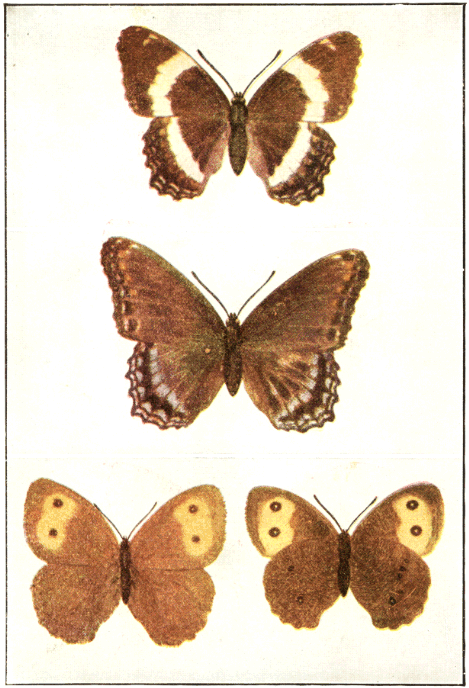
THE BANDED PURPLE (see page 202) THE RED-SPOTTED PURPLE (see page 204) THE BLUE-EYED GRAYLING OR COMMON WOOD-NYMPH (Upper and lower surface) (see page 215)
From drawings by W. I. Beecroft
See pages 207-214
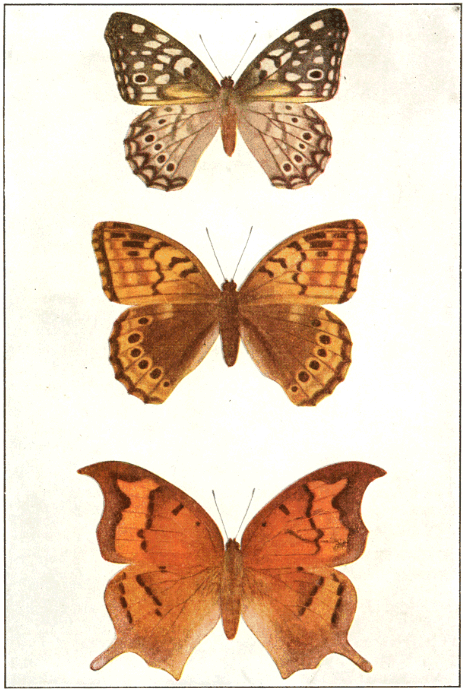
THREE EMPEROR BUTTERFLIES
The Gray Emperor, female (
top
)
The Tawny Emperor, female (
middle
)
The Goatweed Emperor, female (
bottom
)
After some weeks of this sheltered existence the caterpillar is ready to change to a chrysalis. It leaves the tent and commonly attaches a bit of silken web to the under side of a leaf or branch of its food plant or some other kind of shelter. Here it changes to a chrysalis, to emerge a little later as the beautiful burnt-orange butterfly. There are said to be two broods each season, in some regions, although in others there seems to be but one. The butterflies hibernate in hollow trees or in such other shelters as they may find.
Goatweed Butterfly: a, larva; b, chrysalis; c, larval case. (After Riley)
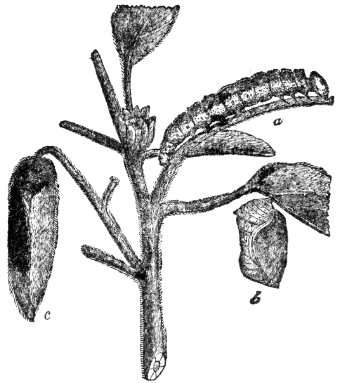
The full-grown caterpillar (a) is an inch and a half long and of a general grayish color, dotted thickly with slightly elevated points. The chrysalis (b) is suggestive of that of the Monarch butterfly. It is light green covered with whitish granules.
The adult butterfly is remarkable for the falcate shape of the outer margin of each front wing and the broad tail at the hind outer angle of each hind wing. In the male the upper surface of all the wings is of a dark orange tone, with a rather narrow brown marginal marking. In the female this marginal band is broader and is nearly paralleled by another narrower band a little nearer the body. In bright sunshine there is a distinct purplish red iridescence over practically the whole upper surface. The under side of both wings is of a color to suggest a dead brown leaf, with a purplish iridescence in certain angles of light.
The Gray Emperor Chlorippe celtis
This very distinctive medium-sized butterfly is found in the Southern states at least as far west as the Mississippi Valley. It extends north to Indiana and Ohio and probably occurs quite generally from Ohio eastward. This species is distinguished by the general gray-brown or olive-brown coloring of the wing surfaces, heavily marked with a much darker dusky brown and with many irregular white spots as well as one large eye-spot on each front wing near the border, and a row of seven more or less distinct eye-spots near the border of each hind wing.
Like the Tawny Emperor this species feeds in the larval state upon the leaves of hackberry. In Missouri the butterflies appear in June. A little later they lay eggs upon the under side of the hackberry leaves, commonly one in a place but sometimes several side by side. A few days later these eggs hatch into little yellow caterpillars that feed upon the leaves for about a month when they become full grown. They are then a little more than an inch long, of a general light green color with yellow spots along the middle of the back and three yellow lines along each side. The head has a pair of curious antlers much like those of the caterpillar of the Tawny Emperor. These caterpillars now spin a bit of silken web on the under side of the leaf or twig. They attach their hind legs into this web and hang downward for a day or two, before casting the last larval skin and changing to chrysalids. They change again to butterflies which are seen upon the wing early in August. These butterflies lay eggs in turn on the hackberry leaves, the eggs soon hatching into small caterpillars which according to Riley's observations are less active than those of the earlier brood. These caterpillars feed for a few weeks until they become nearly half grown and have passed their second or possibly their third moult. They now stop eating and get ready for a long fast through the winter. Apparently some of them at least attach themselves to the under side of the hackberry leaves and turn to a brownish color, remaining upon the leaves until the latter fall to the ground and presumably hibernating in the shelter thus provided. Whether or not all of the caterpillars have this rather curious habit seems to be doubtful. It has been suggested that some of them find shelter within the crevices in the rough bark of the tree. At any rate, the caterpillars remain in a sort of stupor until the following spring. Then they awaken, climb up the trees or bushes, and begin feeding upon the young leaves. They continue this until they become full grown in May when they change to chrysalids, to emerge as the first brood of butterflies the following month. Many of the caterpillars make a sort of nest for themselves by spinning a web of silk upon the under surface of the leaf and drawing together slightly the outer edges.
As is the case with so many other butterflies that hibernate as caterpillars, apparently the species is only partially double-brooded. Some of the earlier caterpillars become lethargic when half grown and remain in that condition throughout the later weeks of summer and all through the fall and winter.
The Tawny Emperor Chlorippe clyton
This handsome butterfly is easily distinguished from the Gray Emperor by the general reddish color of the wings which are thickly marked with bands and eye-spots of darker brown or black. The eye-spots are especially marked on the hind wing, there being a row of five of these on each hind wing in both sexes. The females are decidedly larger than the male and generally of a distinctly lighter color.
This butterfly is a southern species found more or less abundantly from southern New York to northern Florida and across the country to a line drawn from Iowa to Texas. It seems to be more common in the Mississippi Valley than in other regions and its life-history was first thoroughly worked out in Missouri and published in one of Riley's classic reports on the insects of that state. It has since been studied by Edwards and others, but even now there seems to be some uncertainty in regard to many points in its development, notably the number of broods in different localities and the habits of the larvae when preparing for hibernation.
The principal points in the life-history of the species may be outlined as follows: some time in July the eggs are laid on the leaves of hackberry in dense clusters, each of which may contain from two hundred to five hundred eggs. These are usually deposited in two or more layers, one upon another. A little more than a week later these eggs hatch, each caterpillar eating through one end in a way to cut out the rim of a tiny cap which is pushed up as the larva escapes. The whole brood emerges at practically the same time and collects upon one or more leaves where they begin to feed upon the succulent green tissues. Like so many caterpillars that feed in companies each spins a silken thread wherever it goes.
The little larvae remain together until after the third moult, at which time they are about half grown. In the more northern regions where they are found they are now likely to scatter about in search of quarters for hibernation. Having found suitable shelter, they remain through the winter to come forth early the following spring and feed upon the developing leaves of the hackberry trees. They continue to do this for a few weeks before they become full grown. They are then smooth-bodied, greenish worms about an inch and a half long, striped longitudinally in yellow and brown. The hind end of the body is forked in a curious fashion and the head is even more remarkable for the strange pair of tiny antlers projecting from it.
These full-grown caterpillars soon change to pale green chrysalids, lightly striped with longitudinal lines of yellow, with a distinctly pointed head. From these chrysalids butterflies emerge early in summer.
Evidently in the more Southern states there are two broods of these butterflies each year but there is great need of more precise knowledge in regard to them.
As is the case with so many other butterflies there is a dimorphic form, called ocellata, in which the outer half of the hind wing is very dark brown, with the eye-spot showing as black with red-brown circles.
Synopsis of the Emperors
Goatweed Emperor (Anoea andria or Pyrrhanea andria). Expanse 2½ inches. Front outer angle of each front wing projecting into a falcate tip. Rear outer angle of each hind wing projecting into a distinct tail. General color burnt-orange with darker marginal bands, and in the female on the upper surface other sub-marginal markings.
Gray Emperor (Chlorippe celtis). Expanse 2 inches. General color grayish brown with numerous markings of white and blackish. A distinct brown eye-spot on the upper surface of each front wing near the outer hind angle.
Tawny Emperor (Chlorippe clyton). Expanse 2 inches. General color tawny brown with markings of black and yellowish white. No distinct eye-spot on upper surface of front wings.
THE MEADOW-BROWNS OR SATYRS
Family Agapetidae
The Meadow-browns form one of the most distinctive family groups among all the butterfly tribes. They are characterized, at least so far as our eastern species are concerned, by their slender bodies and rather large wings, toned in various shades of brown, and marked chiefly with conspicuous and characteristic eye-spots. The larger veins of the front wings are swollen at the base. The caterpillars are rather slender and have a curious division of the last body segment into two parts, which gives them an appearance suggestive of the caterpillar of the Emperor butterflies, although the Meadow-brown caterpillars do not have, upon the head, the curious antlers borne by the Emperor larvae.
The Common Wood-nymph or Grayling Cercyonis alope
In the development of our knowledge of both birds and mammals as found upon the American continent the experience in many cases has been essentially this: a bird or a mammal was first described from some well-known region of North America, commonly from specimens carried to Europe by early voyagers. Later other species of the same genus were brought to light by various explorers and given specific names. As each section was thus explored a new form differing markedly from the others was found and named. At a later period, when great collections were brought together so that one observer was able to make a careful survey of specimens from all parts of the continent, it was found that many of these species merged into each other through intergrading forms from regions between the localities of the original species. So it has come about that in the case of a large number of our birds and mammals we have geographical races distinctly recognized instead of separate species.
While the study of butterflies has by no means received the degree of attention which has been given the birds and mammals, it is already evident that a similar condition prevails with reference to many species. As the size of collections has increased and more careful studies have been made of the various forms from different regions it has been found in numerous cases that they intergraded to so great an extent that it is impossible to distinguish many species which were formerly considered entirely distinct. One of the most striking examples of this is found in the case of our common Wood-nymph, which is sometimes called the Blue-eyed Grayling. The form which is one of our most abundant butterflies in southern New England and many of the Eastern states was described as Satyrus alope by the French naturalist Fabricius, who also described another species from the Southern states as Satyrus pegala, and a form found in northern Canada was described by the English entomologist Kirby as Satyrus nephele. Various other forms from isolated regions have been given specific names by other authorities. (See plate, page 81.)
During recent years many collectors have gathered these butterflies from all parts of North America and many specimens have been grouped together in the more important collections. When this occurred it became easy to see that this is essentially a variable species which under varying climatic conditions has assumed slightly different forms, so that we have a good illustration of well-developed geographical races. The more important of these are indicated in the synopsis of the Meadow-browns on page 227.
The Similar Life-histories
One good indication that these varying forms all have a common origin is found in the remarkable unity of their life-histories. It is essentially the same in all. The mother butterflies lay eggs late in summer upon the leaves of grasses and perhaps other plants. About three weeks later these eggs hatch into small caterpillars that immediately become lethargic and begin their hibernating condition without eating any vegetation. They remain thus fasting until spring when, after the weather warms up sufficiently, they begin to feed upon grasses and perhaps other herbage. But they have lots of time in which to complete their growth and they are very moderate in their eating and their movements. They grow slowly so that they do not become mature as caterpillars until June. They then change to chrysalids to emerge as butterflies during July and August. The female butterflies remain upon the wing for some weeks before they begin to lay their eggs. We thus have in this case an adaptation to single-broodedness in practically all stages of the insect's life. The twelve months of the year must be passed and egg, larva, chrysalis, and butterfly each seems to try to do its part in prolonging its period of life.
These butterflies are especially common along streams and near the borders of woods, as well as in upland pastures and meadows. They are interesting creatures with characteristic manner of flight. They are by no means so easy to capture as one might think who sees them apparently going with slow, erratic motions from flower to flower. Mr. S. F. Denton, a collector of long experience, has written this interesting paragraph upon this point:
"As the flight of these insects is weak, they have been obliged to resort to a number of tricks to outwit their enemies. In capturing these butterflies the collector will very soon become acquainted with their modes of escape, which are very interesting and show no small amount of cunning, scarcely to be looked for in an innocent little butterfly. Their first plan of escape on being disturbed is to make directly for a clump of bushes into the thickest part of which they dive and there remain until the danger is past. If one is startled from the grass at some distance from a safe retreat and the collector overtakes him, he will immediately dodge backward and forward, at one time high in air and again low down near the grass tops, and in spite of his slow flight keeping well clear of the net. If the net is at last brought very close to him he will try his last desperate scheme to elude his pursuer and shutting his wings quickly together will drop into the grass, disappearing as if by magic. If it were not for the cunning of the frail little creatures they would doubtless have gone to the wall long ago in the struggle for existence."
The Southern Wood-nymph Cercyonis pegala
This large southern butterfly is sufficiently distinct from the other Wood-nymphs to rank as a separate species. The yellow blotch has expanded into a large band extending practically across the front wings. On its upper surface there is one eye-spot in the male and two in the female. It is abundant in the extreme Southern states and has occasionally been taken much farther north.
The Pearly Eye Enodia portlandia
Most butterflies are creatures of open country, basking freely in the sunshine and visiting flowers of many sorts for their nectar food. Some of them are found at times along the borders of woods and others seek the woods especially in autumn for the purpose of hibernation. This exquisite Pearly Eye, however, is distinctly a woodland species, being found only in little glades in the midst of woods and apparently seldom even seeking flowers for their nectar. It is commonly considered one of the rarest of American butterflies, but many collectors who have searched their regions carefully have been able to find small areas in which the butterfly is quite abundant. In such situations it may be looked for in all parts of the United States east of the western limits of the Mississippi Valley and south of Canada, except perhaps the lower part of Florida.
In northern regions this butterfly is single-brooded: the adults appear shortly before midsummer and continue on the wing through July and at least part of August. The eggs are laid some weeks after the butterflies emerge. The caterpillars feed upon grasses and apparently hibernate after they become well grown, changing to chrysalids the following spring in time to emerge as butterflies in early summer.
These Pearly Eyes have certain characteristics which are of especial interest. No other species presents such exquisite modulation of brown coloring arranged in beautiful circles upon both surfaces of the wings. The males possess, perhaps to a greater degree than any other of our native butterflies, the ability to give off a peculiar, pleasant aroma which is noticeable whenever the insects are collected and which at least one careful observer has been able to detect in the open air as the butterfly flew near.
For many years Mr. W. F. Fiske made a special study of the butterflies prevailing in the region of Webster, New Hampshire. His word picture of the haunts of the Pearly Eye is more adequate than any other which has been published and seems well worth quoting in this connection:
"I have found them in several localities, always in some numbers, but nowhere more abundant than in a little wooded glen in Webster. Here a scattering group of tall pines, a few thick hemlocks, and a young growth of miscellaneous deciduous trees fill up the space between two rather steep banks. A small trout brook follows close by one of these banks, and near the lower end of the glen, in a space kept clear of underbrush by the overshadowing influence of the pines and hemlocks, is a little spring, the overflow from which keeps the ground moist for some space on each side of the channel which it follows to the brook. This is the great meeting place of these butterflies; here they may be seen at almost any time in the day except in the early morning—when they seek the outskirts of the woods—until the shades of evening render their flitting forms indistinguishable. Half-way up the bank on one side, half shrouded in the dense growth of underbrush which is springing up around it, is an old apple tree upon which the sapsuckers work yearly. The wounded limbs, dripping with sap, are frequented by many forms of insect life, most noticeable among them this butterfly, and such refreshment added to the moisture which they suck from the margin of the spring is all that I have ever seen them partake."
The Eyed Brown Satyrodes canthus
For delicacy of gray-brown color tones few butterflies can compare with this exquisite creature. It seems indeed to have succeeded in a modest attempt to obliterate itself, for even when the spread wings are placed against a clear white background they can scarcely be called conspicuous and it is very probable that when the butterfly is at rest in its native haunts, with wings closed together so that only the very delicate light brown color-tones of the under surface are revealed, it actually becomes invisible.
The upper surface of the wings is broadly washed with a gray-brown color which runs into a suggestion of a lighter band near the outer margin of the front pair. The upper surface of the hind wings is almost uniformly washed with this same brown color which is interrupted only by very fine, double lines at the outer margin and a sub-marginal row of delicate ocelli which are larger than the somewhat similar sub-marginal row of eye-spots on the front wings. The under surface is much lighter in color, with distinct striations extending across the main surface of both wings from front to back and with some very attractive ocelli arranged as a sub-marginal series each with a central white eye.
This is distinctly a northern species, having rather a limited range in Canada and New England. It extends south to Pennsylvania and Ohio and westward to Wisconsin and Iowa. It is more abundant in northern than in southern New England but it is often overlooked by collectors who are not familiar with its haunts. It is especially likely to be found among the tall grass of swamps and brooks running through lowlands. One of the best ways to discover it is to beat the grasses in such situations.
The life-history of the Eyed Brown is fairly well known. The eggs are laid chiefly on grasses and probably at times upon the grass-like sedges. The larvae feed upon these plants and become nearly full grown before winter sets in. They then hibernate in this larval stage and the following spring complete their growth and change to chrysalids in time for the butterflies to emerge in June. There is but one brood a year.
The White Mountain Butterfly Oeneis norna semidea
To appreciate the extraordinary distribution of this notable species one must let his fancy carry him back a million years or so until he reaches that old time when the whole northern part of the American continent was covered with an icy coating. Then he must follow the gradual retreating of the ice northward, carrying with it wonderful changes in climate and along with these climatic changes taking northward many plants and animals which were adapted to the cool temperature along the borders of the glacier. As the ice cap retreated most of these arctic forms retreated with it, and all along the lower levels they were replaced by others migrating from the south so that gradually there came about the distribution of plants and animals as we find them to-day.
When, however, the glaciers left the higher elevations of the White Mountains and the Rocky Mountains there were at the summits small areas in which the climatic conditions were of very much the same arctic character as prevailed along the margin of the ice cap. Consequently conditions were here favorable for the continuation of many of the arctic species which had disappeared from the warmer, lower levels. It was as if we had a great sea of air of a certain warmth and rising above this the islands of the mountain tops, these islands retaining the same arctic features as otherwise are found much farther northward.
Among the animals thus left stranded by the retreating ice cap this White Mountain butterfly has perhaps attracted the most attention from scientists. It is a butterfly of moderate size which shows in every phase of its structure and its life-history the results of the long process of adaptation to its unique environment. It has been carefully studied by many observers and has been considered one of the most desirable trophies by every collector of insects. As a result, notwithstanding its isolation and the difficulty of studying it, its life-history is better known than that of many a common and widely distributed species.
To appreciate the facts in regard to the structure and life of this butterfly one must know that its habitat is confined to a thousand feet or so at the summits of the mountain, that in this area there are no trees or even shrubs worth mentioning, and that the surface of the mountain is covered with rocks between which grow a few stunted sedges and over which grows the ever-present reindeer moss. It is a bleak, bare, gray environment, constantly swept by terrific winds, where snow is seen in August and is likely to remain until June. So the summer season is of briefest duration and the climatic conditions are so severe that one can only wonder how a fragile creature like a butterfly is able to survive the twelve long months.
Habits and Life-history
From a first glance at the mottled gray-brown wings of these insects one would guess that here was a distinctive example of obliterative coloring, and it is true as all observers testify that when the butterfly lights upon the stones and turns sideways, as apparently it does habitually in deference to the force of the wind, it becomes very difficult to see, for the wings are closed and only the rounded, mottled under surface shows. It appears also to have the habit of some of the Graylings when hard pushed of simply closing its wings and dropping to the ground feigning death. In deference also to the winds its flight is just above the surface. Doubtless if it rose high in the air it would be swept away to lower regions where evidently it is unable to survive for long periods.
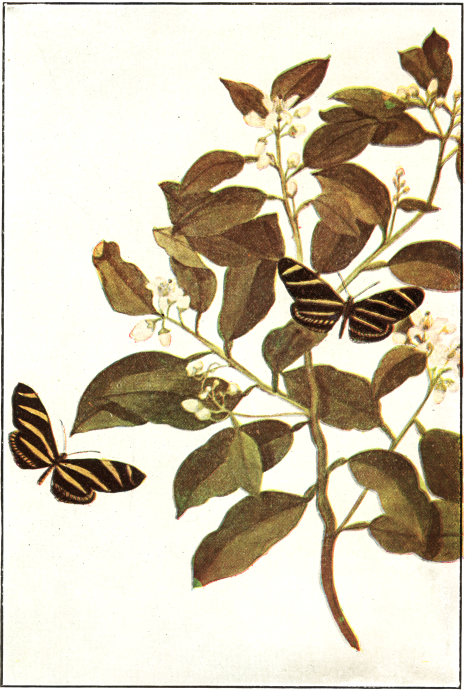
From a drawing by Mary E. Walker
See page 229
THE ZEBRA BUTTERFLY
On orange leaves and blossoms. (Reduced)
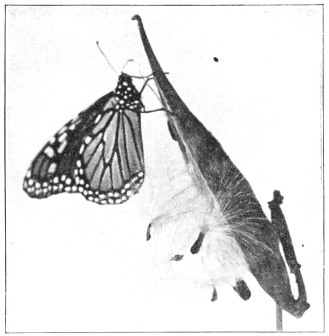
On a milkweed pod
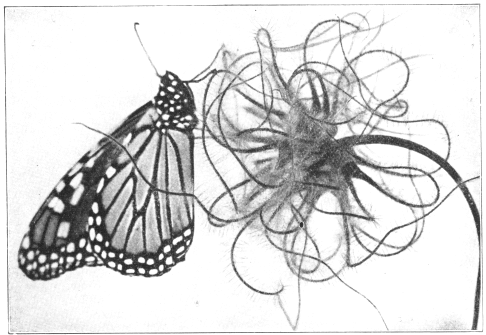
From "Seeing Nature First"
See pages 47, 235
On clematis seed-fruits
PHOTOGRAPHS OF A PET MONARCH BUTTERFLY
These butterflies appear early in July and continue on the wing for several weeks. They lay their small eggs upon or near a species of sedge which is abundant on these alpine summits. About two weeks later the eggs hatch into sluggish little caterpillars which feed upon the sedge leaves, apparently eating only at night and hiding in crevices between stones by day. As one would expect from the prevailing low temperatures these caterpillars grow very slowly and apparently a large proportion of them require two years to complete their development. There seems to be some uncertainty in regard to this phase of the insect's life-history, but most entomologists are of the opinion that some of the butterflies mature in one year while others require two years: that is, the broods are both annual and biennial. There is no doubt that the insect hibernates as a caterpillar, and if this statement about the number of broods is correct some of the caterpillars hibernate when very small, and recently hatched from the egg, while others hibernate when nearly full grown.
The full-grown caterpillars change to chrysalids beneath the shelter of the small stones in practically the same sorts of situation which they have chosen for hiding at night or for hibernation through the winter. Here without any button of silk or silken loop and with scarcely a suggestion of a silken cocoon they change to chrysalids, generally about the first of June. They remain in this condition for perhaps three or four weeks when they come forth as butterflies.
The Arctic Satyr Oeneis norna jutta
This is another butterfly of decided interest because of its geographical distribution. It is normally an inhabitant of the Far North, extending around the North Pole over parts of three continents. Apparently, the only place in the United States where it occurs is a bog a little north of Bangor, Maine. This locality is called the Orono-Stillwater bog and is the only place where collectors have been able to find this species.
⋆⋆⋆⋆⋆
An even more local insect is another of these mountain butterflies found by H. H. Newcomb on Mount Katahdin, Maine. So far as known this species is confined to the higher portion of this mountain and so is even more distinctly localized than the White Mountain butterfly. It is called the Katahdin butterfly (Oeneis norna katahdin).
The Little Wood Satyr Cissia eurytus
This elfin creature has well been named the Little Wood Satyr, although under our modern conditions it is often found in fields and along hedgeroads rather than in the woods. It has, to a marked degree, the delicacy of structure of its allies and its small size serves to emphasize this appearance. It has also a rather general distribution west to the Mississippi Valley, extending from the corner of Dakota, south through Nebraska, Kansas, and central Texas, and north to Wisconsin, Michigan, and New England. It occupies the whole of the United States east and south of the lines thus indicated.
The life-history of this species is very similar to the Common Grayling. The butterflies appear in early summer, deposit their eggs upon grasses, and the resulting larvae feed upon the grasses and grow slowly through the weeks of summer. They become nearly full grown by autumn and hibernate in this condition in such shelter as they can find at the soil surface. The following spring they come forth, probably feeding for a short time, and change to chrysalids in time to emerge as butterflies in May and early June. Practically all observers emphasize the fact that the butterflies are abundant only late in spring or early in summer, generally disappearing before the middle of July. There is thus but one brood a year.
Other Meadow-browns
The Gemmed Brown (Neonympha gemma) is a small southern species remarkable for the plainness of its gray-brown wings which are marked on the upper surface only with two or three dark spots on the middle margin of each hind wing. There are two broods a year.
The Georgia Satyr (Neonympha phocion) is another small southern form, remarkable for the four elongated eye-spots on the lower surface of each hind wing. The shape of these spots distinguishes it at once from the Carolina Satyr (Cissia sosybius) in which the eye-spots are rounded.
Synopsis of Meadow-browns
Pearly Eye (Enodia portlandia or Debis portlandia). Expanse 2¼ inches. Eyes hairy. Outer margin of hind wings projecting in a noticeable angle. Brown with many distinct eye-spots on both surfaces of wings.
Eyed Brown (Satyrodes canthus or Neonympha canthus). Expanse 2 inches. Eyes hairy. Margin of hind wings rounded, without an angle. Both surfaces of wings pale brown with four distinct blackish eye-spots on each front wing near the margin. Five or six such spots on each hind wing.