Samuel MacClintock, Ph. D. (continued 9)
Reading edition
In all the applications of reinforced concrete with which our attention has so far been occupied, the case has either been one of well-recognized practice or closely related to such practice—with the possible exception of concrete barges. There are two other lines of engineering application in which it is very desirable to employ concrete, but where we are scarcely entitled to regard its use as anything more than experimental. Reference is made to telegraph poles and cross-ties. If a concrete pole really proves adapted to its service, then we may expect a great reduction in maintenance expense. It is estimated that renewals of wooden poles in the United States cost yearly $13,000,000. The prospect of getting a pole which will not need renewal for a long period is certainly attractive. But the actual service is severe. This is due not so much to the load which must be carried as to the horizontal movements under wind pressure. But by using proper reinforcement, it is thought by some, the pole may be made to withstand the horizontal thrusts. Some experiments have been made of a type of pole recommended by the American Concrete Pole Company, Richmond, Indiana. Four vertical rods bound together by wire constitute the reinforcement. Such a pole 7 x 7 inches at the top and 12 x 12 inches at the bottom was tested to destruction. This pole was 30 feet long and had its butt end sunk 5 feet into the ground. The vertical rods were ⅝ inch in diameter and were bound with No. 9 wire. A horizontal thrust or pull at the top of 840 pounds accomplished a deflection of 6 inches. When this was increased to 1,780 pounds, the deflection amounted to 17 inches. When 2,800 pounds pressure was employed, the deflection was 30 inches accompanied by a slight cracking. A deflection of a full yard together with cracking at the ground line resulted from a pressure of 3,640 pounds. When 7,200 pounds pressure was employed, the cracking became bad and the deflection amounted to 60 inches. A cedar pole of the same size was deflected 11 inches by a pull of 840 pounds. With 1,780 pounds, the deflection was nearly a yard (33 inches); and with 2,200 pounds the pole broke about 3 feet from the ground. The problem of the telegraph pole will probably be solved, if this has not already been done.
With regard to the cross-tie the case is more difficult. Plain concrete slabs or beams cannot be used after the manner of the wooden tie because of their want of elasticity. What is called “center binding” would be disastrous to plain concrete. The rocking action of the passing load is also a factor which enters. One method of dealing with center binding is to divide the tie into two parts, connecting them with steel rods. The Corell tie is an example of this. In the Percival tie, the under part of the concrete block is given a sharpened edge. Beneath the rail itself, the cross-section is a kind of oval. There is longitudinal reinforcement in the form of four rods, three arranged at the top and one near the bottom. Three rods are bound with wire. There is a cushion block of wood which absorbs and distributes the shocks from the bottom of the rail. Screw spikes and metallic sockets are employed. Some three or more years ago a hundred such ties were put in service in a Texas railway. In June, 1909, seven only were found to have received serious injury. It is thought that this damage was scarcely chargeable to the ties themselves as when in position they were between wooden ones whose deterioration might easily have been the cause of undue disturbance being thrown on the concrete ties.
We have considered to a slight extent the use of steel as the material of concrete forms. This line of application, however, promises to become a very large one. Two notable constructions are now under way in which the steel form plays a large part. These are the great Gatun Locks of the Panama Canal and the Catskill Aqueduct. The three double locks at Gatun will require about 2,000,000 cubic yards of concrete. Each pair of locks is on a separate level and has three longitudinal walls. One separates the lock chambers. This central wall is 60 feet in width. It is not solid as so much concrete would not be required as the water level is approached. Consequently, there is a kind of V-section which traverses it longitudinally. This is filled in except for three galleries—one for drainage, one for the electric wires and one for the men. There is a longitudinal culvert arranged below the fill in the body of the concrete wall. In the side walls of the lock chambers are other longitudinal culverts. From the central supply culvert transverse distributing culverts run off beneath the floors of the adjacent lock chambers. These have vertical outlets into the lock chambers themselves. Similarly, but for purposes of emptying the locks, the longitudinal culverts arranged along the outside are connected by transverse culverts and vertical openings with the lock chambers. The members of the two systems of transverse culverts alternate with each other. The main supply culvert has a diameter of 22 feet part of the way and of 18 feet part of the way. Now these many culverts, various in form and size, are to be molded in the mass concrete by means of steel forms. As originally announced, there would be 12 forms of open hearth boiler steel for the main supply culvert. Each of these weighs 177,000 pounds. One hundred forms were to be required. The two main outlet culverts of similar dimensions to the main supply culvert were thought to require 21 forms, each 12 feet in length and having a weight of 300,000 pounds. The transverse culverts were to require 100 forms, each having a length of 10 feet and a weight of 217,000 pounds. There were thus to be 133 forms having an aggregate weight of 15,000 tons. It is possible that there may be some modifications of this plan in minor particulars. The side walls of the lock chambers are to be mainly vertical planes having a height of, say, 81 feet. To retain the fresh concrete in place, 12 face plates, constructed of sheet steel are to be used. These are 7½ inches in thickness, having face dimensions 78 x 36 feet. Steel towers running on suitable tracks control these face plates. It is estimated that towers and plates will have an aggregate weight of 26,000 tons. So that, quite apart from any possible reinforcement application, steel to the total of about 41,000 tons is to be used for forms and immediate accessories. But this 41,000 tons is not all. The concrete is to be cast in great monoliths and to retain the ends of these while the concrete is fresh, steel girders 6 feet high are to be employed. If these locks were to be of stone then steel would have played a rather subordinate part.
The Blaw Collapsible Steel Centering Company are engaged at Panama, but they are also applying their systems of molding concrete to the great aqueduct which is to supply New York City with water from the Catskill Mountain region on the other side of the Hudson River. A steel centering is used to give form to the interior. Steel forms are also employed to shape the upper part of the external surface. At Baltimore, more than three miles of sewer construction was carried out in accordance with the system of the same company. The centering used for one portion where the height was 11 feet and the width 12¼ feet (inside) was employed in 50-foot lengths. In 2 hours, 6 men could remove such a 50-foot section together with its falsework and have it in readiness for a repetition of its service. A typical half-round Blaw center consists of one or more steel plates bent to conform to a cross-section of a semi-circle. Turnbuckles retain this shell in position. If we are going to employ this form in sewer construction, we first dig out our trench to such dimensions and form as to furnish the mold for the outside surface of the lower part of the concrete sewer. We then lay concrete in a longitudinal strip along the bottom, giving the upper surface the form of a shallow gutter. When this is sufficiently hardened, the semi-circular center may be slid along it to suitable position. The center has its concavity opening upwards. The concrete of the invert of the sewer is now placed. The same or a duplicate center may now be used to mold the interior of the upper part of the sewer.
Portland cement has been in use for a long time. But reinforced concrete is so modern that in some important lines of engineering application the fundamental data underlying practice are not fully determined. In what may be regarded as the first decade (1870-1880) of the considerable manufacture of Portland cement in the United States, the total amount produced was only 42,000 barrels. Fifty years and more would be required for the production of enough cement to construct the Gatun Locks. Over a decade would be necessary to yield enough cement for the operations of the Hudson Companies. The price at this period was about $3.00 per barrel. In 1908 it was 85 cents. But the production in this year was more than 1,200 times that in 1880. The value per year of the present output is about $50,000,000.
CHEMISTRY AND THE INDUSTRIES.
BY BENJAMIN BALL FREUD, B. S.
[Assistant Professor of Analytical and Organic Chemistry, Armour Institute of Technology.]
Chemistry has always been a utilitarian science, a science whose direct applications to our every-day interests has been on every side recognized. Even in the days of alchemy, that fantastic forerunner of our present science, her devotees were concerned with the changing of the base metals into the noble ones, of lead into silver, and of copper into gold, and also with the search for the philosopher’s stone, that mysterious something which would give perpetual youth.
From these workers arose in the course of the years, the facts and the theories which were incorporated into the science of chemistry. But it is not entirely to the alchemists that chemistry owes its development. By far the greater number of facts, if not of theories, came down to us through the traditional knowledge of the chemical industries. Numerous animal and vegetable products, such as sugar, starch, the oils, gums and resins, had been familiar commodities as long back as history records. And the ancients were informed in such typically chemical industries as that of dyeing with vegetable dyes, pigment manufacture, varnish making, soap making, paper making and the fermentation industries. In fact the science of chemistry as we have it today owes much more to these unknown workers in the industries who transmitted their chemical facts from father to son, than it does to the creations of the imaginations of those picturesque, if not so truthful, alchemists.
It is entirely impossible to divorce the science of chemistry from its industrial applications. The science owes much to the industries. The industries owe even more to the science. And if that relationship has been very close in the past, it is much closer now than it ever was; and it is getting closer all the while. The utilitarianism of our age makes it absolutely necessary that the two shall be so united that the utmost of good shall result from the union.
The application of science in general, and of chemistry in particular, to the industries has this one general result. It takes that industry out of the “rule of thumb” class, and places it firmly on a sound basis. It is no longer conducted in a haphazard manner, but according to intelligent design, based on the most accurate scientific information. Of course the fierceness of business competition has ordered this change, more than any other factor. The pure science of chemistry would have developed without industrial applications, because there are investigators who are seeking the truth regardless of any of its immediate applications. But in the industries, it is a matter of dollars and cents. The most efficient is the winner. And the most efficient is the one who utilizes in his business all the scientific information that can be brought to bear on the subject, and who is always looking for new facts that can be applied.
Chemistry, then, is applied to the industries in two distinct ways, the first in discovery, in finding a new substance which can be used, or a new process by which some useful or necessary substance can be made; the second in improvement, in making a certain product better, or cheaper, in utilizing wastes, or in starting from cheaper raw materials.
There are but two kinds of industries: (a) Those which are based on processes which change the form of matter, such as the manufacture of furniture for example, and (b) those which are based on processes which change the composition of matter, such as the manufacture of Portland cement from clay and limestone. Now group “b” comprises by far the greatest number of industries, and since the science of chemistry concerns itself with just those changes in the composition of matter, it is evident that most of our industries are chemical in their nature. We have but recently come to realize this. A list of such industries and operations which are essentially chemical would be found to include almost every industry that we can think of. I need only make mention of the subject of fuels, gas and coke, of cement, mortars, brick and other building materials; of petroleum and its products; of asphalt; of the products of the destructive distillation of wood; of cellulose and of paper; of pigments, resins, varnishes; of rubber; of soap, fats and the fatty oils; of gums; of sugar and of starch; of the textile industries and of the dyes; of leather and glue; of explosives; of the heavy chemical industries, the manufacture of acids, alkalies and salts; of the manufacture of glass and the ceramic industries; of the fermentation industries; of the manufacture and standardization of medicines; of the subject of soils and artificial fertilization; of the subject of foods, and of nutrition; of the subject of water, sewage and sanitation; of photography; of all the electro-chemical industries and processes; of the production of steel, of copper, of lead and of all the other metals. I need only mention this formidable array of subjects and industries to convince the most sceptical one that chemistry does in fact, concern us, directly or indirectly, in all of our activities.
As I have said previously, chemistry influences industry in two distinct ways: First, in the discovery of new substances and new processes; secondly, in the perfection of known substances and known processes. In either of these fields the chemist is proud of his record. The conquests are so numerous that he is at a loss as to how or where to begin if he would tell of them. The whole field of industrial chemistry is one succession of chemical achievements, mammoth industries that had their humble birth in the chemist’s test tube, his beaker, or his retort; the wealth of by-products saved to the world from what was a few years ago sheer waste; and above all increased efficiency in the manufacture of all products. The chemist does not claim more than his due when he points out that his activity covers the whole field of our daily experiences, and that his activity has always been for the lessening of waste, for greater efficiency, in a word, for the development of civilization. To illustrate the points which have already been brought out, the story of the soda industry, the beginning of the modern chemical industries, can be used. The beginning is far back in another century, so intimately is the development of the soda industry bound up with the advance of civilization.
The value of what we now call the alkalies as detergent substances, was known from the earliest times. The first alkali recorded in history is burned lime, and was called “caustic” on account of its characteristic property. Caustic lime is but slightly soluble in water, hence its use is greatly limited. History fails to tell who it was who first solved the problem of making a more soluble alkali, but some one, early in the Middle Ages, discovered that by the action of caustic lime on the so-called potashes, the ashes which remained on burning wood, a very soluble caustic was formed. And to this, the long since forgotten chemist gave the name “caustic potash.” The chemistry of the discovery is as follows: All plants take potassium, a very light metal, in some form or other from the soil, to form the so-called mineral, or bony structure, in other words the skeleton, of the plant. When these plants are burned the potassium in the form of a salt, chiefly potassium carbonate, is formed in the ash. These potassium salts can be extracted by water, and recovered on the evaporation of the water. These potassium salts, the so-called “potashes,” were extensively used in the industries of the time, for example, in making soap, in making glass, in dyeing and in a score of other minor ways. But even as our forests cannot now meet the demand for timber, so they could not then meet the demand for the “potashes,” for it requires a large amount of wood to give a comparatively small amount of potashes, the percentage of potassium salts in wood being very small indeed. Simultaneously with all this, in northern Spain, on the seacoast, a number of towns were engaged in burning sea weeds. It was found that the ashes of sea weeds while not the same as potashes, nevertheless could be substituted for them. This is historically recorded as the “barilla” industry. Barilla consisted of 5 per cent of carbonate of sodium, a metal very similar to potassium. Sodium does for sea plants just what potassium does for land plants. Barilla was merely a substitute for potashes, and a very poor substitute at that. But it was destined to offer the key that solved the whole problem. The chemists of that time showed the chemical similarity between the active ingredient of potashes, carbonate of potassium, and the active ingredient of barilla, carbonate of sodium. The demand for these alkalies made by the industries was incessant and ever-increasing. The chemists realized that the direct natural sources of the two, namely, the wood of the forest and the weeds of the sea, were and always would be, inadequate to meet the enormously growing demands of the industries. They saw that some other source would have to be discovered, or the bodies would have to be prepared artificially. They realized that while potashes were better than barilla, nevertheless potassium salts, the ingredients of potashes, were much less widely distributed in nature than the sodium salts, the ingredients of barilla. So they set out with the definite object of preparing sodium carbonate. In 1791 LeBlanc took out a patent for his now famous process. He was not the only one who worked on the problem; he happened to be the successful one.
This was the first of the great triumphs of chemistry in the industrial field. The significant point in this story of soda, is that those industries which were using the alkalies had reached the limit of their development, because the supply of the alkalies was so limited. Remember, also, that those industries were fundamental ones. Some historian has said that you can measure the civilization of a people by the amount of soap it uses. And here, we see the soap industry of Europe, the seat of our present civilization, crippled for want of an alkali. The position of the chemist, his responsibility to society, is the significant thing in the story. Here was a crisis in the development of civilization, as important to us as the crisis of the battle of Marathon. Because the problem was solved in the retort, instead of on the battle plain, because the battle was fought by the quiet hand of the chemist, instead of by the fighting men of Greece, we do not hear so much of it. But it was a triumph, and the credit belongs to the chemist. To us, as much depended upon the result of the battle of the molecules in the retort, as upon the defeat of the great Darius.
Nor was this battle in the retort a tame one. LeBlanc’s method is an extremely complicated one. To conduct the process at all requires chemical knowledge of the most varied kind. And to apply the improvements that have been worked out in the laboratory, and to carry into practice the many subsidiary manufactures that have sprung from this main industry, demands so much technical ability that it has been said that this manufacture is not merely the foundation of the immense chemical industries of today, but is also the guiding spirit in them.
LeBlanc, of course, could not foretell the enormous development his industry was to attain. Nor could he conceive of the ramifications running from it into countless other activities of our present civilization. The manufacture of sulphuric acid, one of the most important products of modern industry, is intimately bound up with that of soda. And, in the manufacture of sulphuric acid, nitric acid is required, and must be made. Hydrochloric acid is a by-product of the soda process, and was for a long time permitted to go to waste. Now it is one of the most valuable products of the LeBlanc soda process. It is used to make bleaching powder, potassium chlorate, and otherwise in the industries. Also, the alkaline waste from the soda process is rich in sulphur. This sulphur is now recovered and put on the market as such, helping to meet the demand for sulphur that the Sicilian mines cannot supply.
All those varied industries that were either created or fostered by the soda industry have made possible the almost fabulously complicated processes that are now carried out in the manufacture of the aniline dyes, the artificial odors, like vanillin whose complexity can be gathered from its formula, C6H3OHOCH3CHO, which tells many things to the chemist, but not much to the layman, and the artificial febrifuges like antipyrin, whose formula is C11H12N2O. All these chemical industries that are the outgrowth of the soda industry, and that are so dove-tailed with our civilization, have been built up on the science of chemistry, and worked out by chemists. I have selected this story of soda to show the commanding position held by the science of chemistry in directing the course of civilization. It shows, too, how the entire structure of that civilization is built around the contributions of the chemist.
As has been already said, it is impossible to separate chemistry from industry. The farther we go and the more we develop and the more complex our civilization becomes, the closer become the ties uniting science and industry. And as everything that deals with the change in composition of matter is chemistry, it is evident that chemistry is omnipresent. In the light of what it has accomplished, who shall say that it is not omnipotent?
The story of soda is a beautiful example of how industry and the need of civilization can act as a beacon light for the science of chemistry. This illustration will show how the pure science has created new industries and opened up new activities for civilization. In 1838 in England, there was born a boy who afterwards was to be known as Sir Wm. Perkin. He came of a very intelligent family. Besides, he was gifted with a natural aptitude for chemistry. More than that, he was put under the direction of Professor Hofmann, one of the most brilliant of chemists. Perkin would have been called by any one, an ideal bit of raw material. Hofmann, like many others of those German chemists, had a faculty of instilling that enthusiasm that is necessary in the performance of an epoch-making advancement. Perkin caught that enthusiasm. He rigged up a laboratory in his house and worked at night and in his vacations on those interesting problems that Hofmann discussed in his lectures. During one of these vacations, he was trying to build up, artificially, the substance called quinine, which was up to that time a purely natural product. His work took an unexpected turn. Instead of building up quinine, he built what chemists call now phenyl-sufranine, or mauvëine. This was a new substance with properties that rendered it an excellent dye. Perkin established a factory in which the new substance could be prepared on a large scale; and within a year of its discovery, he had it on the market. This discovery of Mauve, the first of the artificial dyes, gave a great impetus to the study of coal tar, from which it was made. Coal tar, up to that time, was a waste product, made in the process of heating coal for the manufacture of gas. This coal tar is the raw material which is used in that enormous chemical industry, the manufacture of the derivatives of tri-phenyl methane, the so-called aniline dyes. There is invested in this industry alone, $750,000,000; and the whole structure, complex as it is, is built on the foundation of a pure chemical research that was undertaken merely to gratify the investigative desires of a true scientist, with no thought of its financial results. This achievement of Perkin stands out as one of the great discoveries of chemistry. And the story of Mauve shows how science has led the way for industry, just as the story of soda shows how industry has pointed out the way for science.
Many more stories of the victories of scientific industry could be told. Much has been done. But the chemist does not live in the glory of the past. He lives in the possibilities of the future. Every advancement of the past has opened up many fields of possibilities. If much has been done, much more remains to be done. And the work of the future will require the services of the scientist more than did the work of the past. Those problems whose answers were obvious, have all been solved. The problems of today are deep ones; they require all the ingenuity, all the ability that the trained chemist can bring to bear upon the problems. And they will all tend to increased efficiency.
While chemistry is a fundamental science, while it covers such a variety of subjects, while the total amount of its established facts is indeed enormous, nevertheless, it must be said with frankness that this vastness is made up for the most part by details and more or less isolated facts and ideas. Chemistry can boast of remarkable achievements. But the greatest achievements are yet before it. And the reason is this: Chemistry is not yet a really unified science. The real fundamentals which will string together all of the isolated facts and ideas, material of which the chemist has, indeed, reason to feel proud, are for the most part lacking. That is why the future is so much larger than the past. And that is why the world can expect from the chemists much greater achievements in the future than it has seen accomplished in the past, great as they have been.
In the most fundamental terms, chemistry concerns itself with the changes which the different kinds of energy produce upon matter. Chemistry concerns itself with two things, energy and matter. And yet chemistry must admit that it does not know the nature of matter or the nature of energy. And not knowing, it cannot appreciate.
In this direction lie the achievements of the chemistry of the future. As the nature of matter and the nature of energy gradually unfold themselves to the advances of chemical investigation, remarkable possibilities for future development are disclosed. We are beginning to see how really wasteful we have been. The frightful wastes which the movement toward the conservation of our natural resources has called to our attention, sink into utter insignificance when we consider what we have lost on account of our ignorance. We are just beginning to appreciate our wastefulness of chemical energy. A piece of coal, for example, has in it the possibility of doing ten times as much work as it is doing now. A piece of radium has stored in it an almost infinite amount of energy. How to change this internal or chemical energy into the other forms of energy with which we are familiar, into heat, or electricity, or ordinary mechanical energy, that is the problem of the future. The utilization of this vast amount of potential energy that is stored up in all forms of matter, the harnessing of it in the service of humanity, this is the problem which confronts the chemist. It goes down to the very fundamentals of his science.
But the start has been made. The point of the wedge has already found entrance. The discovery of radium, and the study of its decompositions, has opened wide our field of vision. The problem must yield, as the blows of chemical investigation fall upon the wedge and drive it home.
Chemistry has always been a utilitarian science. Its results have always been at the service of humanity. And if we can judge the future by the past, even discounting for the enthusiasm of the chemist, we can forsee improved processes which will reduce our present wasteful methods; we can see new processes making for us such things as india rubber from starch, for which we must now depend upon the bounty of nature; and we can dimly see the time when we shall be able to utilize some of that energy which is hidden away in the recesses of matter, and whose vastness we have just begun to appreciate.
THE CLOSE RELATION OF THE PRODUCER-GAS POWER PLANT TO THE CONSERVATION OF OUR FUEL RESOURCES.
BY ROBERT HEYWOOD FERNALD.
[Professor of Mechanical Engineering, Case School of Applied Science.]
Official reports show that the coal placed on the market amounts annually to between 450,000,000 and 500,000,000 short tons in the United States alone. These figures, however, are somewhat misleading as they do not in any way show the tremendous wastes that are going on due to our present methods of mining and restrictions in qualities of coal that can be transported and placed on the market at a reasonable profit. Careful investigation has shown that the coal wasted or left in the mines in such form as to be inaccessible to future generations amounts each year to practically 100 per cent of that placed on the market, or in other words, at the present time some 450,000,000 tons are annually lost as far as commercial value is concerned.
If this condition is allowed to continue it is estimated by the United States Geological Survey that our available supply of bituminous coal will be exhausted within the next two hundred years.
A realization of the seriousness of this situation has led to a careful and systematic study of the present lack of efficiency in the utilization of fuels for both power and metallurgical purposes, to investigations into more efficient use of the present marketable grades of fuel, and to a consideration of methods of using the so-called low-grade fuels, lignites and peats.
The United States Geological Survey has for several years been investigating the economic value of coals and lignites as gas-producer fuel. This work, begun with tests of coal and lignite at the coal-testing plant erected at the Louisiana Purchase Exposition, St. Louis, Mo., in 1904, was continued at St. Louis and at Norfolk, Va., and is now being carried on by the Survey at the fuel-testing plant in Pittsburg, Pa. The tests were undertaken because it was evidently desirable to determine the value of the gas producer as a means of increasing efficiency in the use of the coal supplies of the United States. The early tests proved decidedly encouraging, demonstrating that many coals now wasted or not mined because they are not satisfactory fuel for steam-power plants can, by conversion into producer-gas, be made to do from two to three times as much work as can be done by the best grades of steam coal burned in a boiler plant. In consequence, the making of producer-gas tests and the study of the processes that take place within the gas producer now form an essential part of the fuel investigations conducted at the Pittsburg plant under the provisions made by Congress for the analyzing and testing of mineral fuels.
Rapid Development of the Gas Engine.
It was not until late in the nineteenth century that the gas engine came into common use, and although many types have been devised within the last twenty or thirty years it is only within eight or nine years that large gas engines have been constructed. This development started eleven or twelve years ago in Germany, Belgium, and England, but marked progress has been limited to the last eight years.
For a long time the natural fuel of these internal-combustion engines was city gas, but this was too expensive except for engines of small capacity. It was seldom found economical to operate units of more than 75 horsepower with this fuel. Cheap gas was essential for the development of the gas engine, but the early attempts to produce cheap gas were somewhat discouraging, and for a time it seemed very unlikely that the gas engine would encroach to any extent on the field occupied by the steam engine. The theoretical possibilities of the internal-combustion engine operating with cheap fuel promised so much, however, that the practical difficulties were rapidly overcome, with the result that the internal-combustion engine has become a serious rival of the steam engine in many of its applications.
The development of the large gas engine within the last few years has been exceedingly rapid. It was only ten years ago that a 600-horsepower engine exhibited at the Paris Exposition was regarded as a wonder, but today four-cycle, twin-tandem, double-acting engines of 2,000 to 3,500 horsepower can be found in nearly all up-to-date steel plants, and there are installations in this country containing several units rated at 5,400 horsepower each.
Development of the Gas Producer for Power Purposes.
The rapid advance of the large gas engine was made possible by improvements in the production of cheap gas directly from fuel by means of the gas producer. An early form of producer introduced in Europe, and now in general use both abroad and in the United States, is known as the suction producer, a name suggested by the fact that the engine develops its charge of gas in the producer by means of its own suction stroke. Although many producers of this type are now used, most of them are small, seldom exceeding 200 horsepower. A serious limitation to the utility of the suction producer has been the fact that, owing to the manner of generating the gas, no tarry fuels could be used, a restriction that prevented the use of bituminous coals, lignites, peats, and other like fuels. The fuels in most common use for producers of this type are charcoal, coke, and anthracite coal, although attempts are being made so to construct plants that they can be operated with bituminous or tarry coals.
To meet the demand for the concentration of power in large units, instead of operating a large number of separate installations of small power capacity, the pressure producer was devised. This producer develops its gas under a slight pressure due to the introduction of an air and steam blast, and the gas is stored in a holder until it is required by the engine. As the gas may thus be stored before passing to the engine, and as its generation does not depend on the suction stroke of the engine, tar and other impurities may be removed from it by suitable devices, and the use of bituminous coal, lignite, and peat thus permitted.
The pressure producer was closely followed in the course of development by the down-draft producer, which fixes the tar as a permanent gas and therefore completely uses the volatile hydrocarbons in bituminous coal, lignite, and peat.
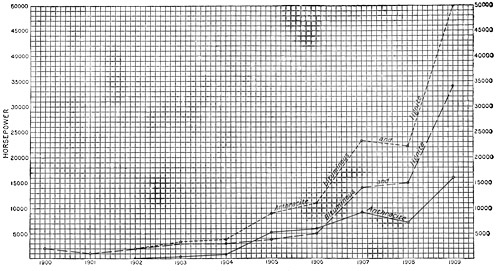
A few scattered producer-gas plants were installed for power purposes in the United States before 1900, but the application of this type of power in any general sense has been developed since that date. During the first few years of this period of development anthracite coal, coke, and charcoal were used almost exclusively, although occasionally pressure and down-draft plants ventured to use a well-tried bituminous coal known to be especially free from sulphur and caking difficulties and low in both ash and tar making compounds. The rapid development of the anthracite plant was to be expected, but it remained for the United States Geological Survey in its testing plants at St. Louis and Norfolk to demonstrate the possibility of using in such plants practically all grades of fuel of any commercial value, without reference to the amount of sulphur or tarry matter which they contain. Figures 1 and 2 illustrate the very rapid increase in the number of installations and in the total horsepower of the plants operating with bituminous coal and lignite since the beginning of these investigations by the Geological Survey in 1904.
Owing to the fact that the dates of installation of many plants are not ascertainable, it is impossible to present the exact growth either in number of installations or in horsepower. The relative rate is, however, approximately shown by Figures 1 and 2, the data for which were secured from 375 installations. The points for the year 1909 are estimated from the returns for the first five months. These points have been checked by two or three methods and indicate only the normal increase established by the rate of development before the business depression of 1908. It is probable that the actual figures for the entire year may exceed those indicated.
Relative Results of Steam and Producer-Gas Tests.
In considering the relation between the economic results of plants of the two types under discussion, namely steam and producer-gas, the fact should be remembered that today, in the ordinary manufacturing plant operated by steam power, less than 5 per cent of the total energy in the fuel consumed is available for useful work at the machine.
In this connection it is of interest and value to glance at the possibilities of the best-designed and most skilfully operated commercial plant now in use. The data concerning the steam plant selected for this determination are derived from a table prepared by Mr. Stott, superintendent of motive power, Interborough Rapid Transit Company, New York City, which, as Mr. Stott says, shows “the losses found in a year’s operation of what is probably one of the most efficient plants in existence today, and, therefore, typical of the present state of the art.”
Figure 1.--Annual increase in number of producer-gas power plants in the United States.
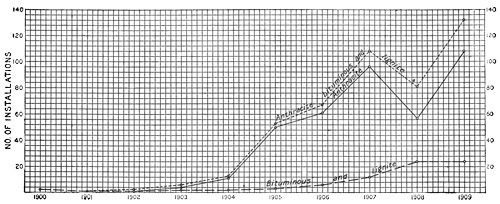
Figure 2.--Annual increase in the total horsepower of producer-gas power plants in the United States.
Average losses in steam plant of the Interborough Company in converting 1 pound of coal, containing 12,500 British thermal units, into electricity.
British thermal units. Per cent.
Loss by friction 138 1.1
Loss in exhaust 7,513 60.1
Loss in pipes and auxiliaries 275 2.2
Loss in boiler 1,000 8.0
Loss in stack 1,987 15.9
Loss in ashes 300 2.4
Total losses 11,213 89.7
Energy utilized 1,287 10.3
12,500 100.0
Mr. Stott further presents a table showing the thermal efficiency of producer-gas plants, concerning which he says:
The following heat balance is believed to represent the best results obtained in Europe and the United States up to date in the formation and utilization of producer gas.
Average losses in a producer-gas plant in the conversion of 1 pound of coal, containing 12,500 British thermal units, into electricity.
British thermal units. Per cent.
Loss in gas producer and auxiliaries 2,500 20.0
Loss in cooling water in jackets 2,375 19.0
Loss in exhaust gases 3,750 30.0
Loss in engine friction 813 6.5
Loss in electric generator 62 .5
Total losses 9,500 76.0
Converted into electric energy 3,000 24.0
12,500 100.0
The thermal efficiency of such plants, as given by different writers, runs as high as 33, 36, and 38.5 per cent, and for some plants figures as extravagant as “above 40” are boldly published. Although the present aim has been to give the figures for a producer-gas plant that may compare favorably with those of the steam plant of the Interborough Company, an effort has been made to keep well within obtainable efficiencies. Attention is also directed to the fact that the producer-gas plant considered should be large enough to compare favorably with the steam plant. This precludes comparisons with suction plants, which are relatively small but give higher proportional efficiencies than the larger pressure and down-draft plants, for these require more or less auxiliary apparatus.
Mr. Stott seems ready to accept a thermal efficiency of 24 per cent for the best producer-gas plants for comparison with 10.3 per cent efficiency for his steam plant, but a careful study of the problem has led to a more conservative estimate for the producer-gas plant, namely, 21.5 per cent.
The tables just given show the comparative efficiencies reached in plants of the best type, both steam and producer-gas, but these are seldom realized in common practice. The results obtained in the government plant at St. Louis are probably more nearly representative of the ordinary type of apparatus. These results are as follows:
Relative economies of steam and gas power plants at St Louis in the conversion of 1 pound of coal, containing 12,500 British thermal units, into electricity.
Steam Power. Gas Power.
British thermal units. Per cent. British thermal units. Per cent.
Losses in exhaust, friction, etc. 11,892 95.14 10,812 86.5
Converted into electric energy 608 4.86 1,688 13.5
12,500 100.00 12,500 100.0
The ratios of the total fuel per brake-horsepower hour required by the steam plant and producer-gas plant, under full load, not counting stand-by losses, are presented below as derived from 75 coals, 6 lignites, and 1 peat (Florida).
The curves in Figure 3 show graphically the great economy secured with the producer-gas plant. The figures for the producer-gas tests include not only the coal consumed in the gas producer, but also the coal used in the auxiliary boiler for generating the steam necessary for the pressure blast—that is, the figures given include the total coal required by the producer-gas plant.
Ratios of fuel used in steam and gas plants.
Average ratio, coal as fired per brake-horsepower hour under boiler to coal as fired per brake-horsepower hour in producer 2.7
Maximum ratio, coal as fired per brake-horsepower hour under boiler to coal as fired per brake-horsepower hour in producer 3.7
Minimum ratio, coal as fired per brake-horsepower hour under boiler to coal as fired per brake-horsepower hour in producer 1.8
Average ratio, lignite and subbituminous coal as fired per brake-horsepower hour under boiler to lignite as fired per brake-horsepower hour in producer 2.7
Maximum ratio, lignite and subbituminous coal as fired per brake-horsepower hour under boiler to lignite as fired per brake-horsepower hour in producer 2.9
Minimum ratio, lignite and subbituminous coal as fired per brake-horsepower hour under boiler to lignite as fired per brake-horsepower hour in producer 2.2
Average ratio, peat as fired per brake-horsepower hour under boiler to peat as fired per brake-horsepower hour in producer 2.3
In considering the possible increase in efficiency of the steam tests with a compound engine, as compared with the simple engine used, the fact should not be overlooked that a corresponding increase in the efficiency of the producer-gas tests may be brought about under corresponding favorable conditions. Not only is the producer passing through a transitional period, but the gas engine must still be regarded in the same light. In the larger sizes the vertical single-acting engine is being replaced by the horizontal double-acting engine. Other changes and improvements are constantly being made which tend to increase the efficiency of the gas engine, as compounding and tripling the expansions have already increased the efficiency of the steam engine.
As has already been stated, the gas engine used in the tests here reported is of a type that is rapidly becoming obsolete for this size, namely, the vertical, three-cylinder, single-acting.
A brief consideration of these points will lead at once to the conclusions that a comparison of the producer-gas plant and steam plant used in these tests is very favorable to the former, and that any increase in efficiency in the steam tests that might result from using a compound engine can be offset by the introduction of a gas engine of more modern type and a producer plant designed to handle the special kinds of fuel used.
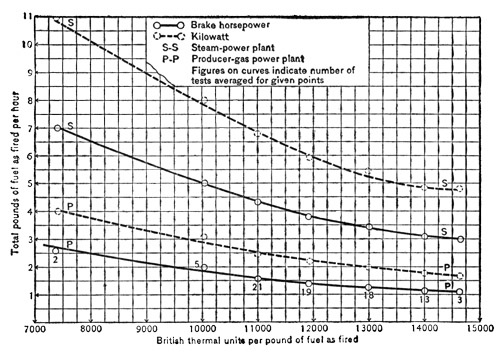
Figure 3.—Comparative service of coals and lignites in gas-producer and steam-boiler plants.
It should be noted that many fuels which give poor results under steam boilers have been used with great ease and efficiency in the gas producer, which thus makes it possible to utilize low-grade coals and lignites that have heretofore been regarded as practically useless. Several of the poorest grades of bituminous coals have shown remarkable efficiency in the gas producer, and lignites and peat have been used with great facility, thus opening the way to the introduction of cheap power into large districts that have thus far been commercially unimportant owing to lack of industrial opportunities. Experiments with “bone,” a refuse product in bituminous-coal mining, have given excellent results, showing an efficiency in the producer equal to that reached by good steam coal under boilers. Recent investigations with other low-grade fuels, such as mine roof slabs, culm, and washery refuse, have also demonstrated the possibility of using such material to advantage in the producer under proper commercial conditions.
Number and Class of Plants.
A list of producer-gas power plants recently secured indicates that at present there are over 500 such plants in operation in the United States, ranging in size from 15 to 6,000 horsepower.
Figure 4.—Summarized data of producer-gas power plants in United States.
No. of plants. Horsepower. Per cent of total number. Per cent of total horse-power.
Total. Average. Minimum. Maximum.
Anthracite coal:
Over 500 horsepower 8 7,550 950 600 1,500 … …
500 horsepower or less 407 40,550 100 15 500 … …
415 48,100 116 15 1,500 88 43
Bituminous coal:
Over 500 horsepower 20 49,000 2,450 750 6,000 … …
500 horsepower or less 17 5,150 300 35 500 … …
37 54,150 1,460 35 6,000 8 49
Lignite:
Over 500 horsepower 3 7,275 2,430 525 3,750 … …
500 horsepower or less 19 1,725 90 25 250 … …
22 9,000 410 25 3,750 4 8
All plants 474 111,250 235 15 6,000 100 100
No. of plants. Horsepower.
Total. Average.
Anthracite coal:
Over 500 horsepower 8 7,550 950
500 horsepower or less 407 40,550 100
415 48,100 116
Bituminous coal:
Over 500 horsepower 20 49,000 2,450
500 horsepower or less 17 5,150 300
37 54,150 1,460
Lignite:
Over 500 horsepower 3 7,275 2,430
500 horsepower or less 19 1,725 90
22 9,000 410
All plants 474 111,250 235
Horsepower. Per cent of total number. Per cent of total horse- power.
Mini- mum. Maxi- mum.
Anthracite coal:
Over 500 horsepower 600 1,500 … …
500 horsepower or less 15 500 … …
15 1,500 88 43
Bituminous coal:
Over 500 horsepower 750 6,000 … …
500 horsepower or less 35 500 … …
35 6,000 8 49
Lignite:
Over 500 horsepower 525 3,750 … …
500 horsepower or less 25 250 … …
25 3,750 4 8
All plants 15 6,000 100 100
Data secured from this list are summarized in the table on the previous page according to the type of fuel used, and separately for all plants above 500 horsepower and for those not exceeding 500 horsepower.
It will be observed from this table that about 88 per cent of the total number of installations in this country are operating on anthracite coal (a few using charcoal or coke), and that bituminous coal and lignite are used in the remaining 12 per cent. Of the total horsepower approximately 57 per cent is derived from bituminous coal and lignite and 43 per cent from anthracite coal, charcoal, and coke. In point of size it will be noted that the bituminous plants average 12½ times the size of the anthracite plants.
In 1906 a large number of these plants were carefully inspected in order to secure definite information from the owners and operators regarding the more or less successful operation of such installations. Similar inspections were made in 1908.
Deductions from Visits of Inspection.
The deductions made from the visits in 1906 were as follows:
1. The plants as a whole are giving remarkable satisfaction considering the very brief period of development that has passed since the introduction of this type of power.
2. The most serious difficulty seems to arise from the lack of competent operators to run the plants rather than from defects or troubles in the plants themselves.
3. Incompetent salesmen are undoubtedly to blame for serious misrepresentations and misunderstandings.
4. The neglect shown by some manufacturers in respect to their plants after they are installed and paid for has not been farsighted, and the failure of the manufacturers to give the purchasers or operators of plants full information regarding their construction and method of operating has certainly been detrimental to the business.
At the present time (1910) the following modifications might be advantageously made to the above statements:
1. Unchanged.
2. This situation still prevails, although there are many more competent operators today than three years ago. Time will eliminate this difficulty.
3. With stronger companies this situation is greatly improved.
4. Experience has shown that such neglect produces serious troubles and financial loss to the manufacturer, and a very decided change for the better has developed in the last few years. There are, however, a few small concerns still operating in the producer field on what may be considered a false basis.
Centralization of Power Development and Distribution.
Central stations for power and lighting are springing up all over the country. Electric lights are now in general use in towns numbering their population by hundreds only. Electric transmission for street-railway service is practically universal and electric power for shop drive is in great demand. The substitution of the electric locomotive for the steam locomotive for terminal service and even for line duty by several leading railway systems is no longer a mere expectation but is an every-day working reality.
These changes and developments in every section are, to a large extent, tending to do away with the individual small steam equipment, whether stationary or locomotive, and are bringing to the front the central power station, ranging in size from lighting and pumping plants of less than 100 horsepower in the smaller towns to those of 100,000 horsepower or more required to meet metropolitan demands.
European Examples of Advantageous Location.
In the development of central power plants and the reduction of the cost of power, the producer-gas power plant is an important factor. In this connection the question of locating such plants directly at the mines is well worth careful and unbiased attention in the engineering profession. The advantages to be derived from such a location have already attracted the commercial interests of Europe. As examples worthy of thoughtful consideration, the general conditions of operation of three typical European installations are here described:
Plant A.—This plant, although not situated directly at the mines, is but a short distance away, and the company owning the plant also owns the mines from which the fuel is secured. The plant is of the Mond by-product type and consists of eight pressure producers of 2,500 horsepower each. The fuel used is a run-of-mine bituminous coal said to contain 8 to 9 per cent ash and 1 to 2 per cent sulphur. This would indicate that they are utilizing the best grades of coal from their own mine in the local gas plant and allowing the lower grades to remain unmined, a fact which I verified before leaving the plant.
The plant is designed for the recovery of the sulphate of ammonia and for supplying gas to the neighboring towns for both metallurgical and power purposes. As one unit is always held in reserve, the plant is called 16,000 horsepower. The main distributing line is 3 feet in diameter, and at the time of my visit there were 37 miles of main, the longest single run being 6½ miles. Each producer gasifies, on an average, 20 tons of coal per twenty-four hours. The report of the engineer in charge indicates that the plant had been in operation twenty-four hours a day, seven days a week, for two and one-half years without a shut down.
Plant B.—This plant, which is located in the center of a peat bog, proved of especial interest. It has a capacity of 300 horsepower only, and is about 3 miles from the town to which the electric current is supplied. One-half of the plant (150 horsepower) was installed in 1904 and the remainder in 1906. This is probably the first as well as the smallest producer-gas installation to be located at the mine and transmit high-voltage current to a point some distance away. This installation, in 1909, consisted of two suction producers (special peat type) rated at 150 horsepower each, and two horizontal twin single-acting four-cycle gas engines of 150 horsepower each, direct connected to alternating-current three-phase generators, which were running splendidly in parallel at the time of my visit. The 3,000-volt current is transmitted to the town, where it is used during the day for lighting shops and for shop motors. At night the plant supplies the lights for the streets and residences. The charge for residence light is 9 cents per kilowatt hour. Both units are in operation from 5:30 a. m. to 6 p. m., and one continues to 11 p. m. each day.
A 35-horsepower peat machine is used for preparing the fuel. This is driven by an electric motor supplied with current from the power plant on the bog. As only 750 tons of dry peat are required per year there is no attempt to work the plant to its maximum. Local farmers are employed and they work as little or as much as they please, as there is no difficulty in getting out all the peat needed for a year during the working season, which in this locality is from April 15 to September 1. As a result 14 men are employed more or less of their time. They receive about 50 cents per day each and get out about 20 tons of peat per day.
Coal at this point in Europe costs $3.75 per ton. The dry peat delivered on the operating platform of the producer plant costs only 80 cents per ton.
Plant C.—This plant is installed at the collieries. At the time of my visit it was under full operation, using roof slabs that gave little indication, on casual inspection, of containing any combustible material. It was claimed that this fuel averaged over 60 per cent ash—a claim which seemed entirely reasonable. At the time of this visit (1908) the producers were not only supplying a number of furnaces with gas, but were also operating a 1,000-horsepower and a 250-horsepower gas engine. A 500-horsepower engine was being added to the equipment. The engines in use were direct connected to electric generators. The 10,000-volt current is used for operating the local mine machinery and also for furnishing lights for neighboring towns and power for a street railroad. The plant was reported to be using over 100 tons of this low-grade fuel per day.
Favorable Conditions in the United States.
In the United States cheaper power is constantly sought. The water-power possibilities of the country are being realized and the hydro-electric power plant is a wholesome cause of competition. The supply of fuel of marketable grades is not unlimited. Prices for such fuel must necessarily increase. The cost of transporting coal from the mines is high, and the possibility of obtaining a sufficient supply of cars to handle low-grade fuels is questionable. The power demands of the country are increasing, and this power must be developed at a reasonable cost. The time is approaching when the cheapest fuel obtainable must be used to the best economic advantage in order to develop power at a unit cost consistent with commercial progress.
Consideration of the conditions indicates that in order to keep the price of power developed from fuel down to a consistent figure—
(a) Grades of fuel which warrant transportation, or which may be defined as “marketable,” should be used with the greatest possible practicable economy.
(b) The very large percentage of coal of so-called low grade which today is left at or in the mine must be utilized.
(c) Advantage must be taken of the large deposits of lignite and peat which are found in many sections of the country.
It is undoubtedly true that in general, under conditions which do not require the use of steam for other than power purposes, the producer-gas power plant meets the requirements of (a).
At present the only method of advantageously handling the fuels mentioned in (b) and (c) is in the gas producer, and the utilization of these lower grades of fuel on an extensive scale demands concentration of the power plants within close proximity to the fuel supply.
The logical conclusion from a careful study of the producer-gas power situation is that the time is not distant when financial interests in power production will be directed toward the centralization of the producer-gas power plant at the mines and the distribution of the energy developed either by high-voltage long-distance electrical transmission or by pipe systems for conveying the gas.
EFFICIENCY IN SHOP OPERATIONS.
BY H. F. STIMPSON.
[Consulting Efficiency Engineer, New York. Published in The Iron Age, Jan. 6, 1910, and reproduced by special arrangement.]
Managers of industrial enterprises will undoubtedly agree that there are few qualities which are more to be desired in equipment, methods and men than that of efficiency. From an extensive study of this subject in various parts of the country, together with interviews and correspondence with several hundred concerns, the writer has become convinced that there is a general lack of definite comprehension of what efficiency is, whence it springs, how it may be measured and developed and the results which its cultivation will produce. The object of this monograph is an endeavor to throw some light upon these things and to afford a new viewpoint from which to study industrial operations.
The Evolution of Industrial Management.
In the first place we must realize that the management of industrial enterprises is in a state of evolution. The tremendous growth of the past few years has caused certain previously satisfactory methods to become inadequate to present needs. Many details which in the days of smaller affairs could be absorbed by personal inspection and mentally stored for use when needed must now, because of their very volume, be made matters of record.
The character of these records has much to do with their value. Because financial records are so ancient they have exerted an undue influence upon the character of all other records. While under our present civilization, the ultimate object of industrial operations is to create financial profits, there are many highly important records which cannot be adequately expressed in terms of money. The business of manufacturing consists of a repetition of mechanical operations. Mechanical operations necessarily involve considerations of weight, distance, time and effort, but not of money.
The reason for the failure of so many cost systems to serve the desired end is that they are based upon a wrong unit. These systems become useful only beyond a certain point. Other systems have been the result of a blind craving for aid, but being without broad underlying principles and not properly tied together and simply, in many cases, disjointed attempts to improve isolated details, they too have failed. The result is that attempts by specialists to improve industrial conditions have been often looked upon with suspicion and this is not altogether without reason. These very failures, however, have drawn the attention of men in certain lines of engineering to the rapidly developing needs of manufacturers. They have attempted to solve the problems by the use of engineering instead of by accounting methods, and the results which have been attained prove conclusively that a material advance has been made.
What Is Efficiency?
With this understanding of the present conditions, let us consider what efficiency really is. It has been defined as “the ability to produce certain results,” and this at the very outset necessitates the existence or creation of a standard of measurement. Our perception of efficiency, therefore, is correct only in proportion to the precision of the standard, which must be accurately developed from data which are not only exact, but complete. A machinist, believed to be operating at high efficiency, was observed while turning a shaft. His cut, feed and speed seemed to be beyond criticism. When the shaft was finished, however, he had to spend half as much time in hunting up a chain and pad to remove the shaft from the lathe, as he had taken in turning it. This cut his actual efficiency from 100 per cent down to 87 per cent, yet the man was not at fault. His normal work was to operate a lathe and not to hunt for things which should have been provided for him. The points to be observed here are not only the importance of using the right standard of measurement, but that the efficiency of the man depended very largely upon his surrounding conditions over which he had no control. These conditions depend upon the efficiency of the management in securing proper equipment from the owners. This in turn depends upon the efficiency of the management’s records in enabling it to state clearly and accurately what increase in output and consequently in profits will result from improving the conditions—thus justifying the expenditure required. We see from this that the true standard is not the possibility under existing conditions, but that which can be obtained under other and more desirable conditions.
Managerial Opposition to Change.
The management, which immediately controls the records and conditions should be the prime source of efforts towards the increase of efficiency throughout the plant. The opposition of managers to progress in this respect is exceedingly great, yet not altogether surprising for these reasons:
1. There is a widespread fallacy that so-called practical experience in the manual operations or technical processes of a business is the chief essential to success in its management. This is due to the fact that perfection of workmanship, of which he knows much, is more important in the eyes of the artisan than the actual cost of the operation, of which he knows little, or than the cause of this cost, of which he knows less.
2. It is only recently that educational institutions have afforded any opportunity for adequate instruction in the art of management, pure and simple, a principal feature of which is the intelligent regulation of cost.
3. There has been, and now is, as a result of these two things, a failure to appreciate the necessity and value of exact data, in proper terms, of refined and scientific methods of collecting and using it and of logical reasoning in the solution of industrial problems.
The highest degree of efficiency, therefore, is only to be realized in a shop where executive methods have reached a high stage of efficiency, for in these is unquestionably its source.
Time Measurement Important.
The first step is to recognize the necessity and value of a proper measurement of time, as a guide not only to the executive but to the workman. A man was observed during 8 successive repetitions of the operation of making a machine mold in a foundry. The unit times varied 5.2 to 23.6 minutes, the total time for the eight being 104 minutes. Under the method of timekeeping in use at that shop it was only ascertained that the eight operations took 1¾ hours or an “average” of 13 minutes each, and the labor cost and distribution of burden were made on that basis. Because of the absence of any standard time whatsoever it was not realized that had the man done each of the eight in 5.2 minutes, they would have been completed in 41.6 minutes, resulting in a saving of over 60 per cent of the total time. Had the man received a proper work ticket bearing this standard time, before he began the work, there is no doubt that he could have easily performed the work in the shorter time and a marked difference in proportionate burden and cost would have resulted. Under the existing methods the management could not know of the waste, and so was helpless to prevent or cure it.
Every item of time, therefore, is capable of division into two parts: A standard or necessary time and a (more or less) preventable waste, which latter is the easier thing of the two to determine.
An Example of Increased Efficiency in Riveting.
A gang of four were engaged in riveting some steel plates. By the use of a stop-watch it was found that a large proportion of the total time of the riveter and bucker-up was not utilized; yet some one was always at work. The reason was that the men proceeded along the work in such a way that the bucker-up covered with his body the holes as yet unfilled by rivets, he moving from left to right. When, therefore, a rivet was driven, these two men had to stand aside until another rivet was placed by the rivet passer. Upon the instruction of the engineer, they reversed the direction of their movements so as to cover only the filled holes, thus enabling the passer always to have a rivet ready for them and making their speed in driving the real gauge of the speed of the operation. Furthermore, when they encountered a hole that needed reaming (as was sometimes the case, until the fault was located with the fitters and remedied), the riveter would lay down the gun, pick up the reamer, ream the hole, lay down the reamer, pick up the gun and drive the rivet. When persuaded to test consecutively ten or more holes after driving the first rivet in a seam to anchor the plates and then to drive the ten consecutively, they progressed faster with less effort. These men, receiving not only a standard from the engineer, but kindly instruction as to how to attain it, and being stimulated, not by abuse, but by a scientifically determined bonus—increased their output over 150 per cent beyond the original amount.
In this plant, by the use of these methods, and in about seven months, the general increase in efficiency of the men was such that the force was reduced 67 per cent without reduction in volume of output, but with a great reduction in net total unit cost, even after paying the bonus alluded to and the cost of the expert services which alone produced this result.
The Use of Bonuses.
It is proper to say a word here on the subject of bonus as a means of increasing efficiency. The principal merit of this motive lies in the fact that immediate personal gain is the strongest incentive to immediate personal effort. It operates just as strongly on the employe as on the employer. Hope of promotion is too vague and the actual chances too limited to exert much pressure, but an extra sum in the pay envelope—or better still, in a separate one—for the disposal of the “old man himself,” will do wonders. To be most effectual a bonus must not begin at the point of standard efficiency, but at the point when average efficiency ceases and extra effort begins; and it should increase on a curve faster and faster as the point of standard efficiency is neared, because the accompanying effort will be correspondingly greater.
Efficiency Methods and Department Heads.
So much for the individual operator. And now for the executives. From foreman up to and including the highest official the same methods can and should be applied. Under ordinary circumstances, the workman in need of material, tools or instruction keeps his skirts clear by a more or less indefinite and unintelligible request to the foreman. He thinks it the foreman’s duty to look after him, but that if he does not do so it’s no business of his. Put that man on standard time and bonus and if there is anything he thinks the foreman should do or get for him he speaks loudly and directly. This the foreman does not resent—as would ordinarily be the case—for his efficiency is determined by the combined efficiency of his men and upon this his bonus depends. Anything, therefore, that interferes with the progress of the men touches him closely, and he will move heaven and earth to eliminate it. All kinds of defects which were previously hidden from the superintendent are now brought to his attention, and he welcomes them for exactly the same reason that actuated the foreman. Thus the change that comes over a shop when efficiency is accurately measured and adequately rewarded is often astounding.
But this is not all. The possession of exact data as to standard and actual times makes possible a certain great improvement in, and addition to, the executive staff and a material increase in the efficiency of the foreman and department heads. By this is meant the installation of a planning department, by which the apportionment of the time of men and machines is controlled. The advantage, indeed, the positive necessity, of the services of engineers and draughtsmen in apportioning the different parts of the product is well understood. The requirements of each part, the strains to which it will be subjected, the kind, quality and quantity of material required to resist these strains, the shapes of the pieces, their relations to each other and many other things are all given most careful attention. The value of fully constructing the design on paper, as a means of discovering possible errors or difficulties, and of correcting or overcoming them before large expense for material and workmanship has been incurred, are too well realized to need more than a simple statement for their acceptance. No sane executive would expect his department heads to take a copy of his customer’s order and individually work out the details with which they are particularly concerned and expect the parts to fit. Yet this is just exactly what is being done as regards the apportionment of productive time; and a tumult of broken promises of delivery, excessive cost of production, enormous wastes of time in changing jobs, etc., is the immediate and unavoidable result.
What Can Be Done.
It is perfectly possible, but only to one trained in the particular art, to schedule the different operations on all of the different parts of the product; to plot the productive times required, so that each may begin at such a time in relation to the others that all will arrive at the point of assembly at the proper time and in the proper sequence; to combine these studies of the different productive orders on a chart which will show the disposition to be made of all the men and machinery; to prepare advance programs for each man and machine engaged in productive labor; and thus to give to the superintendent and foremen the advantage of the same predisposition of time that they now have of material.
As it is now, the time of these persons is entirely too much occupied with this problem of the disposition of time for which they are only partly equipped, having, it is true, much of the necessary information, but no training in the scientific handling of it. They are, therefore, unable to devote the time they should to the immediate study of the operations and the provision of tools, material and instruction to the men. They try to be all over the shop at once and they depend on getting their information at first hand, and consequently fail more or less clearly to cover the ground. Having such schedules and programs as are above described, and with the proper work tickets distributed on a dispatching board, each one in the division representing the work upon which a man or machine is engaged, having the time of commencement and the standard time thereon, the foreman can see at a glance without leaving his office what men will shortly finish their work and what steps must be taken to see that the drawings, tools and materials for their next work are ready for them in time. Having seen to this he has some leisure to give his attention to matters immediately requiring it, knowing, if anything is obstructing the other men, that their anxiety to earn their bonus will cause them promptly to bring such matters to his attention. Having this schedule, moreover, the foremen are enabled to order material, etc., ahead and to do so intelligently, thus making the work of the shop transportation department much simpler. In one case by this means 25 men were able to handle the intra-shop transportation in a more satisfactory manner than 75 men had previously been able to do.
The planning department also greatly aids and is in turn aided by the purchasing department, for the times when material must or can be got can intelligently be determined to their mutual advantage. The sales department, too, when it once gets the idea that the shop is not working miracles, but has its limitations, can make delivery promises which really mean something and can be kept, and this is a trump card of no small importance when the fact becomes realized among the customers of the concern.
Responsibility of the Management.
In the opinion of those whose opportunities have enabled them to get at the facts, the inefficiency in manufacturing, which undoubtedly generally exists today, in spite of the prevailing impression to the contrary, is only about one-fourth due to the things over which the employes have control and three-fourths to conditions imposed upon them by the management. The methods outlined above have achieved results whenever they have been faithfully and honestly tried, with proper co-operation by the management and under the direction of skilled specialists, and the results have continued and will continue as long as the methods are followed. The effect upon the men is that from being often listless, indifferent and antagonistic, they become energetic, ambitious and loyal friends.
One thing more: Much has been done and overdone in the line of so-called welfare work. It is a highly creditable and necessary line of effort, when confined to attempts to remove from the path of the employe any obstacle which prevents him from developing his skill and efficiency to the highest degree. An uncomfortable, unhappy person cannot be efficient. But as steam is necessary to the engine, so is incentive necessary to the worker to get him to make the best use of the facilities provided for him. Under our present civilization, the same incentive which pushes on the master will push on the man, and that is direct personal gain in dollars and cents, not for itself, but for and what that gain will bring. It must come to him quickly after the exertion which its expectation calls forth, for if long delayed, the effect is lost. It must also come to him separately from his regular wage that its amount may be the more readily realized.
Moreover, the results of efficiency methods, within the writer’s knowledge, are sufficient to convince him that their general adoption would so increase the purchasing power of the employe, by increasing his wages and decreasing the cost production, as to have a markedly beneficial and steadying effect upon the business of the country.
Efficiency methods, however, cannot be successfully designed or installed by those trained in other lines and prejudiced by other associations. After these methods have been scientifically developed to suit the existing conditions and actually put into operation by those skilled in the art, they may gradually be relinquished into the control of those who have been educated in the process of installation, with some hope of success for their future operation.
THE BRIDGE BETWEEN LABOR AND CAPITAL.
BY JOHN MITCHELL.
[Former President United Mine Workers of America.]
If the interests of labor and capital were identical—as some contend—there would be no chasm between them to bridge; and if the interests of labor and capital were irreconcilable—as others contend—any effort to unite them would be futile. From an experience extending over a considerable period, I am quite convinced that neither of the foregoing propositions will stand the test of close analysis. My judgment is that the interests of labor and capital, though divergent in some respects, are nevertheless reciprocal and inter-dependent.
To elucidate in a practical way the subject of the proper relationship between employer and employe, it is necessary to review the activities of these two factors in the field in which their interests are common and to mark the point at which they diverge. The employer and the employe are mutually interested in the successful conduct of industry; the profits of the one and the wages of the other obviously are contingent upon it, as both profits and wages must be paid from the earnings of the enterprise in which the capital of the one and the labor of the other are jointly invested. This being true, the workman and the employer are equally concerned in the character of the product which is manufactured and sold by them, just as they are interested equally in good markets and regularity of employment. Having worked in co-operation up to the point of turning out an article that commands a wide and profitable sale, the question of dividing the earnings of their joint efforts presents itself. It is the failure of the attempt to adjust satisfactorily this controversy that gives rise to the differences between employers and workmen and is the basis of the labor problem as we have it today. True, there are many questions of discord apart from those of wages and profits, which result in serious industrial conflicts, but followed back to their source, it will be found that these issues are inseparably related to those of wages and profits. In other words, the demand for a shorter workday, for healthful, sanitary surroundings, has its origin in the irrepressible desire of the working people for a progressive improvement in their conditions of life and labor.
In ancient and mediaeval times when the structure of society was simple and each family consumed all the things it produced; or even at a later period when the master and the journeyman worked together side by side, and when the master had been a journeyman and the journeyman expected to become a master, there was little cause for controversy, and the problem of labor was not difficult of solution. It was not until the invention of machinery, the advent of the factory system, the use of steam, and the application of new processes that the question of the relationship of employer and employed grew so complex and impersonal that new methods became necessary in the proper adjustment of industrial affairs. As step by step industry developed from the stage of the privately owned factory to the firm and corporation, to the combination and the trust, the real employer was removed further and ever further from personal contact with his employes. As a consequence of this transition, the salaried manager took the place once held by the actual employer, and the simple and friendly relations of early days gave way to the intricate and complex industrial life of this generation.
Coincident with the development of industry which has revolutionized the whole life and history of our people and our civilization, have come the local, the district, the national, and finally the international organizations of labor. These gigantic associations and federations of workmen are the logical and the inevitable consequence of an industrial development which threatened the subjugation of the individual workman and forced him, in self-defense, to merge his interests and his identity with those of his fellow workmen. The momentous change in the status of the workman which accompanied the revolution of industrial processes, transformed the whole problem of labor from the question of production to that of distribution, and it is the effort to find an equitable adjustment of the problem of distribution that is taxing to the utmost the ingenuity of economists, philosophers, and statesmen.
In the search for a panacea to heal the industrial ills against which society so justly complains, many suggestions are made and innumerable remedies proposed. On the one hand are found forces that would deny to labor the right of organization and combination, although exercising and enjoying the benefit of these rights themselves; on the other hand are forces at work advocating and demanding the abolition of the whole competitive system; between these extremes stands a great army of workmen and employers earnestly striving to find grounds of mutual agreement upon which the rights and obligations of each may be defined and brought into harmony. With all due respect to the opinions of others, I submit that the path of safety, progress, and justice lies in the middle course—in the recognition of the right of organization on the part of both labor and capital, by which and through which these factors in our industrial progress may work out their inevitable destiny, contracting freely each with the other upon all questions of mutual concern.
The trade agreement is the bridge between labor and capital. It restores, so far as it is possible to do so, the personal relationship, the mutual interest which existed prior to the advent of the factory system. It is an acknowledgment of the inter-dependence of labor and capital, a recognition of the reciprocal interest of employer and employe. When the right of organization among workmen and employers is fully recognized and freely conceded, and when these forces adopt and practice the policy of collective bargaining, the day of the strike and the lockout, of the boycott and the blacklist, with their attendant evils, losses, and hardships, will have largely passed away.
THE UNEMPLOYED.
BY JOHN BASCOM, D. D., LL. D.
[Formerly President University of Wisconsin.]
A striking feature of the industrial world and one well fitted to occasion alarm is the large number of persons thrown, from time to time, out of employment. We are forced by it to accept one or other of two conclusions; that the economic world is mismade, incapable of a quiet and successful run, or that our handling of it has been in some way unskillful and misapplied. This fact of unemployment has become very conspicuous, and to those who suffer from it, and to those who sympathize with them, exceedingly grevious. A certain portion of the human family, and that in the most progressive nations, find themselves superfluous, out of connection with the means of living though others are obtaining support, comfort and luxury. They have nothing to do but to die in their tracks. Like the feeble ones in a forced march through an enemy’s country they first fall behind and then perish. This state of the case does not arise by accident and then pass away, it has periods of severity which frequently return, and stands among those constant dangers which may at any time overtake a few. This evil comes especially to industrious countries, like England, and to portions of our own country, like Pittsburg, noted for their enlarged production. The causes and remedies of this state of things become, therefore, subjects of anxious inquiry. We may assert that the want of employment is due in a general way, to the deficiencies and vices of men, but this assertion does not sufficiently point out the immediate occasion of the difficulty, nor furnish us its remedies.
Failure of the means of livelihood arises from indolence, ignorance, vice and unfavorable conditions on the part of those who suffer from it, conditions often of the nature of accident. But while the recipients of this disaster are plainly recognized, the disaster itself comes to them in a measure independent of their failures. We need to know not only those who are likely to suffer from a given disease, but how the disease itself arises. The central and most productive cause in this series of provocations is indolence; the others accompany indolence and more or less arise from it. By indolence we mean a want of life and hence a weakness of all the functions of life. We may mean physical inactivity or intellectual sluggishness or moral indifference, or may mean them all blended in one or other of the various ways in which a weak and perverted life manifests itself. The tramp is physically indolent, he hates work. This indolence readily extends to intellectual activity; the indolent person is ignorant of the value of success, of its motives and of its means. The world reveals few incentives to him and makes few appeals. This indolence and ignorance do not wholly arrest the wants and desires of men, and hence vice, as in the case of the thief, enters as the most ready and immediate means of gratification. The torpid nature of the moral judgment lends itself to this result, and nothing but fear, itself weak and vacillating, stands between the indolent man and habits of gross indulgence, inconsistent with personal and with social welfare.
The accidents, misjudgments and disappointments which are liable to overtake us all owe the injury which they inflict to the weak personality on which they fall, and so misfortune seems to follow and persecute those who are least able to bear it. The indolent, passive mood is a good medium for the accumulation and transfer of every form of disaster. The class of the helpless is much enlarged by this flow of every form of evil to these low places in conduct and character.
We may clearly recognize these facts and suppose them a sufficient explanation of the farther fact, that so many are thrown out of employment and find themselves the waifs of society with no secure attachment to it. They do, indeed, make conspicuous the failure of occupation and determine the direction it will take. Their numbers are seriously increased by it, and their very presence gives the conditions of its recurrence. They are both causes and effects. They stand on terms of action and reaction with all the embarrassments of production. They help to reduce wages, and when wages are reduced, they are the first to be driven out of employment. They are the symptoms of the disease, the product of the disease and the means by which it is carried farther. All failures in the productive process extend, in their worst results, to this class of defectives. They are the recipients of past evils, of present and of coming evils. They arise in connection with a false form of production, must be treated with it and removed with it. They are a composite product, their faults not being wholly their own but in part the faults of the economic system with which they are associated. They are not the scapegoat on whose head the sins of the people may be laid and then be borne into the wilderness.
In discussing the causes and remedies of unemployment, we shall see how far and in what way these feeblest workers are involved in it. We cannot improve society by simply striking off the evils that have been developed under it. Healthy growth alone can rid itself of failures. It often happens in physical disease that what is accepted as a remedy in the end aggravates the difficulty.
One dislikes to use the word pauper, it so frequently carries with it an unreasonable and cruel contempt. Yet there are paupers in the human household, and when the temper is once present it is most difficult of removal. It is a form of leprosy that eats out all vital power. The pauper temper indicates a disposition to secure immediate ease with no reference to the comfort of others. It accepts any advantage that offers without the slightest wish to return it. Yet even this spirit may offer some excuses for itself. The evils of society which may have originated far off in the action of the leaders of men, are apt to go booming downward till they reach, in their most distinctive form, the pauper class, or those but little above it. Diligence, thrift, skill, ward off the blow and escape with only a partial loss. Those who are always in the way of it are the weak ones, to whom prosperity brings but little and adversity occasions immediate overthrow. When those who at best are but partially occupied, find that labor is altogether failing them, the question of relief becomes most difficult. There is no profitable labor at disposal, and to provide labor means farther loss; it is charity in its most disguised, expensive and unrequited form. The worst lesson we can teach those already inclined to negligence is that a form of labor may be put in the place of real labor, and that the question of adequacy is one to be answered by society, not by the needy, recipient of favor. Whatever we may do for men of feeble productive power we are not to lead them still farther on in the direction of indolence and worthlessness. Actions are not to be separated from their normal results. We may frequently be called on to bear the injury which proceeds from another man’s wrongs, but we are never called on to disguise the wrong itself. A portion of the wrong is our own; that we should correct. While the evils are in the process of infliction we are to bear them sympathetically, but not in a form which disguises their true character.
Something of the same danger inheres in old-age pensions. Workmen of usual diligence should receive a return for their labor which would enable them to provide for age. As long as workmen, reaching the age of three score, generally become dependent on the public, it is perfectly plain that their wages are too low, that the returns of production are not fairly distributed. A pension acknowledges the evil, but does not remove it, it tends rather to confirm it. That the losses which accompany industrial accidents should be divided between workmen, managers and the community at large is plainly just, and is no temptation to remissness. The accident is not the fault of any one person or class of persons. If it falls upon a large number, it is more readily borne and increases the motives to care. Our machinery is operated for the benefit of the entire community, and it is only fair that the entire community should help to bear the increased dangers. That injuries should be still left with the workmen on whom they have accidentally fallen is another proof of the slight hold they have on the public mind.
Any remedy for the lack of employment which is prompted simply by compassion and still leaves the evil to overtake the workman is not social hygiene; is not a recognition of the partiality and disproportion which still inhere in our productive methods. Labor should be successful and rewardful when left to its own development. It is bad to create a pauper temper and most difficult to contend with it when it has once been called out. Men should be subject to their own incentives of hope and fear, success and failure, as far as possible. The same discipline which comes to the active, is the natural spring of action in the sluggish. Any compassion which reduces the motives of effort that should come to the entire community, or which leaves the community satisfied with a maladjustment of duties, can never provide an adequate correction of bad distribution. We are placed between a narrow and a wide humanity, between an immediate reduction of suffering and a removing of its conditions. The final result is the test of our wisdom and good will.
There are partial remedies of the failure of employment which are fitted to give relief without endangering the future or disturbing the general conditions of employment. Occupations especially irregular, like that of the stevedore, may receive especial attention, or may be united to other forms of labor so as to secure greater uniformity. In these occupations the employer may frequently have but little motive to correct an evil from which he prospers by reduced wages. Excess and deficiency in the various branches of work should be made, as far as possible, to correct each other. Workmen are often not in a position to meet successfully these evils. They accept the drift of the labor market with small power to control it.
Bureaus of intelligence should be established so that the variable demands for labor of different localities may be quickly met. This is a public service, and should have the ease and certainty of such service. The same reasons which lead the Government to take the direction of immigrants should lead it to render similar aid to workmen. Workmen are often ignorant of the extent and character of the employment offered in the distance, and are subject to the exactions which arise in connection with this want of knowledge. The greater one’s want the more difficult is the change of locality. Quickness of response demands both intelligence and nobility.
Savings banks and insurance, while not directly affecting the demand for labor, tend to equalize and reduce the losses which accompany variability. They also tend strongly to call out that forecast of evil and preparation for it which belong to thoughtfulness. The strokes of fortune lose something of their unexpected and injurious character, and men are put on voluntary and better terms with the world.
We are not, however, to look on these reductions of danger as covering the whole problem. Life has its accidents and we can greatly reduce the evil results of them by patience and prudence, but there still remains the more thoroughgoing effort by which the evil is anticipated and turned aside.
There should be that general harmony of effort, that proportion of its several parts to each other, that recognition of the common welfare, which fortify us against disaster, and force it in the background when it comes. There is a wise method in production, and a just relation of its agents to each other, which should greatly reduce the liability of a want of labor, and should ultimately remove it altogether. A true democracy should be exempt from this general failure in the results of activity. Much of our political economy has rested on inferences drawn from a faulty state of society, as if it and the conclusions contained in it expressed the real laws of our being. Society, in its most civilized forms, has always developed a proletariat, it has suffered drainage, and we have come to think this a sort of necessity, a natural result of social growth. With this starting point and expectation we are ready for periods of unemployment, and look at the misery which arises from them as a corrective. Superfluous lives cannot be gotten rid of on cheaper terms. We might as well suppose that disease is an inevitable attachment of physical life and must be left to go with it. Society never has too many workers, and when they are not wanted it is because they have been in some way misdirected. Strong men, industrious and intelligent men, are the wealth of society. There is never a time in which there is little or nothing to do in the world; if we think so it is because we cannot see, or see falsely. Our intelligence determines what is to be done and our diligence performs it. The world is never deficient in occasions for labor, no matter how defective we may be in performing it. Nor is well-devised labor wanting in its returns; intelligence and diligence, in full exercise, always contradict the notion. The world could not be the home of man on any other terms. Human life begins to be superfluous the moment labor miscarries, and the miscarriage sinks down to those who have the least intelligence and industry. The constitutional disease of society, that which it has propagated with most show of knowledge, is ignorance and indolence. When we reach this stratum we are always in difficulty; the more in difficulty because we come to it in a sluggish rather than in a corrective temper.