Front matter (continued 4)
Reading edition
The consequence of the disaster immediately flashed into his mind. He could only get back in company with the Rutlands. If they failed, he would fail too.
He had just assured himself that the damage was irreparable with such appliances as were at his command in the cave, when he became aware of light footsteps rapidly approaching. Expecting to see some of the Rutlands, who had been no doubt looking out for him, he raised his head towards the crest of the rise. Next moment he was in the grasp of two men, one of whom, mouthing guttural triumph, gripped his throat in a strangle hold.
V
About half an hour before Burton started from the aerodrome, Captain Bramarbas of the 19th Pomeranian infantry of the line laid down his knife and fork with a grunt of satisfaction. He wiped his lips, tossed off a glass of wine, and turning gleaming eyes upon Lieutenant Schnauzzahn of the same regiment, who sat opposite, he ejaculated--
"Gott sei dank! These French swine have one virtue: they can cook."
"It is wonderful!" the lieutenant agreed. "Who would have thought that an old French farmer would have had such resources? Cheap, too."
"Cheap indeed!" laughed the captain. "Between you and me, old Lumineau will have difficulty in turning our paper into good German money after the war ... Ist es aber entsetzlich--the noise of those swine."
The door had just opened to admit an old woman servant bearing coffee. From the adjoining room--the spacious farm kitchen given up to the captain's men--came a guttural roar. A hundred Germans feeding like one make a variety of unpleasant noises. It is not a mere coincidence, perhaps, that the Prussian loves a pig.
The officers took their cups of coffee, lit cigars, and lolled back in their chairs. The door closed behind the servant, reducing the sounds to a muffled hum, not loud enough to disturb the comfort of gentlemen. It was a pleasant hour. The day's work was done; they were three or four miles behind the firing line; the farm was a snug billet. They had been working late; supper had taken the place of dinner: when they had finished their cigars they might go with a good German conscience to bed.
Presently there was a knock at the door.
"Come in," said the captain drowsily.
A sergeant entered, and stiffly saluted.
"What do you want? It is late. I gave you your orders."
"Herr Captain, I ask pardon for disturbing you, but----"
"Waste no time, Ascher. Say what you have to say quickly, confound you!"
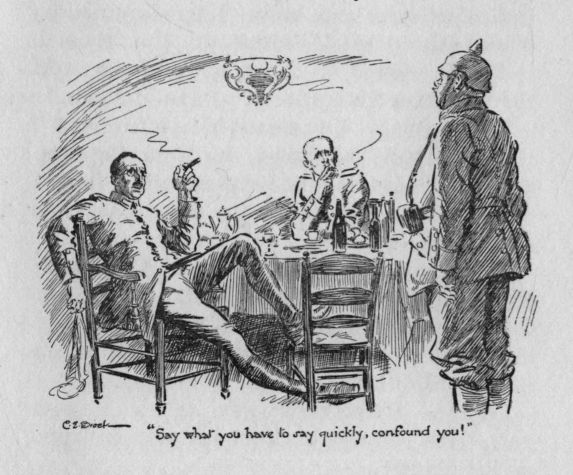
"Say what you have to say quickly--confound you!"
"It is important, Herr Captain. For some time I have been suspicious of the farmer, as the Herr Captain knows, though he does not condescend to share my doubts. True, the farmer, though a Frenchman, is very obliging" (here the sergeant glanced for a moment at the remains on the table), "but I felt that his amiability was a mere blind, and I watched him."
"Ha! Now what did you see?" said the captain, sitting up. "If there is treachery----"
"Once or twice at night the farmer has gone out towards the wood yonder. I asked myself, why? There is no farm work at night. To-night I followed him. It was difficult, Herr Captain, for he moved very cautiously, stopping and looking behind and around him."
"That itself is suspicious. Well?"
"He made his way beyond the wood, up the hill, and down into the hollow on the other side, and there, Herr Captain, he placed three small lamps on the ground, so." He moved to the table, and arranged three bottles triangularly. "He lit them."
"And you? You seized him, of course?"
"I thought of doing so, Herr Captain, and of demanding an explanation; but I felt it was a matter for the Herr Captain's discretion----"
"And you left him! Idiot! They were signals, of course. You ought to have put them out, tied him up, and brought him to me in the morning. Now I lose an hour's sleep. Idiot!"
Captain Bramarbas was active enough now. He got up, buckled his belt and put on his helmet.
"Come, Schnauzzahn," he said, "we will see to this ourselves."
"Why not send a squad?" suggested the lieutenant.
"Ach! the swine are probably drunk. They are dull fools at the best. Come along! We'll slip out through the window, to avoid warning the servants."
The two officers and the sergeant climbed out of the window and hastened towards the hill. They had scarcely gone when the servant who had waited on them knocked at the door, and receiving no answer, hearing no voices, quickly opened it and looked in. She glanced from the vacant chairs to the open window.
"Eh, mon Dieu!" she muttered, and closing the door, hurried back to the kitchen.
The three Germans had covered about half the distance to the hill when the sound of heavy firing from the right broke upon their ears. They stopped, and stood for a few moments watching the shells bursting in rapid succession in the neighbourhood of the trenches. The captain swore.
"It looks like an attack," he growled. "These cursed English! We must make haste in case we are called up in support. No sleep to-night, Schnauzzahn."
They hurried on, and in five minutes more were creeping up the low incline. At the crest they halted and peered into the hollow. A figure was bending over one of the lamps, which emitted a brighter light into the mist.
"Go and capture him, Ascher," whispered the captain.
"Shall I bayonet him, Herr Captain?"
"No; we must use him. We can shoot him later."
The sergeant crept silently upon the old farmer from the rear. It was the work of a few seconds to overpower him and cast him helpless on the ground.
The two officers went forward. As they descended the slope they became aware that the lights were less visible.
"They're intended as signals to an aeroplane," said Schnauzzahn, approaching them rapidly. "See! They are directed above."
"Villainous treachery! But our good German wits will defeat it. Listen! Do you hear an engine?"
"No," replied the lieutenant after a brief silence.
"Then we have still time. Ascher, move the lamps near the slope. We'll spoil his landing!"
The sergeant carried the lamps to the foot of the slope, and placed them close together.
"Not so, idiot!" cried the captain, "arrange them as they were before. Don't you understand?"
Hardly had the lamps been rearranged in their triangular position when the whirring of an engine was heard through the thunder of the distant guns.
"Here he is!" said Bramarbas. "I hope he'll break his neck. If he doesn't, you and I will seize him, Schnauzzahn; Ascher will guard the farmer."
They waited. The aeroplane could be heard wheeling above. The bombardment suddenly ceased.
"The English have changed their minds. They can't have done much harm in ten minutes. So much the better!" said the captain. The searchlights began to play. "Potztausend! I hope he won't be shot down. Much better for us to capture him. Can he see the lights through the mist?"
"No doubt he has seen them. The sound has stopped. He has shut off the engine."
"Bring the Frenchman over the crest, Ascher, and don't let him cry out."
Thus it happened that Burton, after his unlucky accident, found himself in the grasp of Captain Bramarbas and Lieutenant Schnauzzahn of the 19th Pomeranian infantry of the line.
The German officers were mightily pleased with themselves. They had supped well: French cooking and French wine predisposed them to rosy views. Nothing more delightful could have crowned their day. A French spy, an English aeroplane and an English airman--all in a single haul! The Iron Cross had often been awarded for much less. And, of course, there was something behind it all. An enemy aeroplane would not land thus in the German lines unless there was some important object to be gained. The English, no doubt, were mad; but after all there was method in their madness. The next move must be to discover the nature of this Englishman's scheme, and his means of communication with the farmer spy. Then compliments, promotion, and the Iron Cross!
Some such thoughts as these raced through the Germans' minds in the moment of exultation, when, for the first time, their hands laid hold of English flesh.
"Hand over your revolver," said the captain in German. "Do you speak German?"
"No," said Burton, making no resistance as Schnauzzahn relieved him of the weapon. He felt very wretched.
Captain Bramarbas was disappointed. Neither he nor his lieutenant spoke English, and it did not occur to him for the moment that the Englishman might speak French.
"We'll march our prisoners down to the farm," he said to Schnauzzahn.
"Wait a moment. They may have accomplices who will remove or destroy the aeroplane as soon as our backs are turned. That would be a pity."
"What then? If one of us stays to guard the machine, and there are accomplices, he would have to meet an unknown number single-handed."
He stood pointing his revolver at Burton. They must find a way out of this quandary.
"Why not send Ascher to the farm to bring up some men?"
"Again, he might be sprung upon by the enemy. Of course, they would have no chance in the end, but for the present, until we know more, we had better remain all three together. Listen! Do you hear anything?"
"No."
"They may be lurking somewhere to take us unawares, though how they could conceive such a scheme, so mad, so insolent---- Ach! I have it."
The captain had indeed at last made up his mind--and, as the sequel showed, chosen the wrong course. It was, perhaps, no worse than another, for it was chosen in ignorance of the circumstances; but his calculation sprang from a typically German misconception of the psychology of an Englishman.
A sentry was always on duty at the door of the farm. A couple of revolver shots would give him the alarm, and in a few minutes the Pomeranians, swine in their hours of ease, but good soldiers nevertheless, would rush to their captain's assistance.
Burton stood motionless. Schnauzzahn was a little to his left. Bramarbas faced him, holding the revolver. The captain suddenly fired off two rapid shots, moving the revolver to the right so as to avoid hitting his prisoner.
The airman's life is punctuated by swift decisions, depends on the perfect co-ordination of act with thought. Burton's mind worked quicker than lightning. Before the German had time to cover him again, he shot out his right arm, rigid as a rod of metal, struck up the captain's wrist with a sharp jerk that sent the revolver flying, and a fraction of a second later dealt him with the left fist a fierce upper cut beneath the jaw, and lifted him into the bushes.
A bullet scorched Burton's cheek as he spun round to deal with Schnauzzahn. Another stung his left shoulder. But he hurled himself upon the agitated lieutenant, and with a sledge-hammer blow sent him to join his captain.
There was now only the sergeant to dispose of. That worthy stood over the prostrate farmer some little distance away, and though he had heard the thudding blow and the crash as each of his superiors fell, he had not clearly seen what had happened. Burton was dashing towards him when a Verey light illumined the scene. And then the sergeant was transfixed with amazement and terror, for on one side of him he saw the figure of a British airman, on the other, sprinting up towards the lip of the hollow, a score of silent forms in the well-known khaki. Ordinarily, no doubt, he was a brave man, but at such a moment as this valour melted in discretion. He flung up his hands.
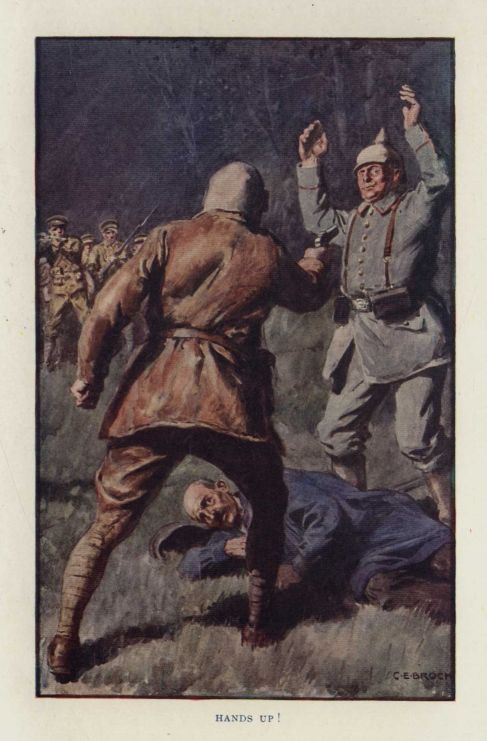
HANDS UP!
The German officers meanwhile had picked themselves up. They were surrounded and seized. The light had died away.
"Quick!" said Hedley. "I hear the Huns rushing out of the farm. Where's Lumineau?"
The farmer had risen, and came to him.
"Get away to the cave," said Burton. "I'll be after you in a second: must fire the machine."
He rushed to the aeroplane, poured some petrol out and applied a match, and as the flame shot up into the air, dashed after the Rutlands and their three prisoners, who, under the guidance of the farmer, were disappearing into the wood. Five minutes later, when the Pomeranians arrived on the scene, their amazed eyes beheld only a blazing aeroplane; not a man was in sight.
Arriving at the cave, the panting Englishmen threw themselves down; some laughed silently; the spectacle of three gagged Germans was very pleasing.
"What brought you up so opportunely?" asked Burton. "Not the shots? There wasn't time."
"No. Old Jacqueline warned us. She missed the officers, saw the open window, and guessed that they had got on the track of Lumineau. Trust a Frenchwoman's wits! But I say, what's your news?"
"It couldn't be better. The Brigadier, as it happened, had ordered an attack on the German trenches for to-night. When your C.O. explained the circumstances, he was quite keen to fit his arrangements to our scheme."
"That bombardment wasn't bluff, then?"
"He timed it to give me cover, and broke off to delude the Huns. The attack is fixed for two o'clock, when they'll have given up expecting it."
"That leaves us plenty of time to get to the trenches. It'll be ticklish work, getting through. I'll tell old Lumineau: we depend on his guidance. If he declines the job we shall be horribly handicapped."
He took the farmer apart, and held a quiet conversation with him. The old man readily agreed to guide the party to the vicinity of the third line of trenches.
"But you'll come with us all the way?" said Hedley. "The farm won't be safe for you after this. You'll be shot."
Lumineau shrugged and smiled.
"Perhaps not, monsieur," he said. "The Bosches did not see us; they will only be puzzled. I will go now back to the farm; do you see my amazement when they tell me their officers have disappeared? I will lead a search--not in this direction, par exemple!--and I will come back in good time to lead you. A bas les Bosches."
VI
Some few days later, Lieutenant Hedley was dispensing hospitality to a few friends in a neat little officers' estaminet in a village behind the lines. Among his guests were Captain Adams and other officers of the Rutlands' supporting battery, and Burton of the Flying Corps.
"It took us about forty minutes to smash that battery you spotted, Burton," said Adams, with an air of pride.
"Better than pig-killing," returned Burton solemnly.
"Oh, we cut up a few pigs too."
"How do you know?" asked Hedley.
"Well, you see, in the first place," Adams was beginning earnestly, when Laurence Cay interrupted him.
"We haven't time for firstly, secondly, thirdly, old man. We want to hear about Hedley and his missing platoon. By George! it must have been creepy work."
"A good deal of it was literally creeping," said Hedley. "Old Farmer Lumineau led us through woods and orchards for miles--a roundabout way, of course. It was ghastly, trudging along in the dark, trying to make no noise, afraid to whisper, stopping to listen, starting at the least sound. We got at last to a little copse just behind the farthermost line of trenches, and there Lumineau left us. We were on thorns, I can tell you. It seemed that the attack would never begin. We couldn't hear any Huns anywhere near us, but caught a note of a cornet now and then from some billet on our left rear. I looked at my trench map----"
"In the dark?" asked Adams.
"No, you juggins! in the light of my electric torch, screened by the men stooping over me. I got a pretty good idea of our whereabouts, and talked over a plan of action with my sergeant--a capital fellow--and Burton. I nearly yelled in sheer excitement when I heard the row as our chaps started bombing the first trenches. We heard the Huns then, too; rifles, machine-guns, whizz-bangs: it was an inferno. We crept out into the communication trench I had spotted, and had nearly got to the second line when we heard a crowd of Huns racing across from our right. We waited a bit, went on again, and came smack into a traverse. It was pitch dark, but we had no sooner scrambled over than a star-shell burst right overhead. We flung ourselves down, dashed on when the light died, and--well, I hardly know what happened next. All I know is that somehow or other we discovered that we were pressing on the rear of a lot of Huns who were being forced back by our fellows in front, and there was a good chance of our being scuppered by our own bombs. I passed along word to give a yell, and the men shouted like fiends let loose. That was enough for the Huns. Rutlands in front of them, Rutlands behind them! 'Kamerad! Kamerad!' they bawled when I called to them to surrender; and to make a long story short, we scooped the lot and got safe through with a few trifling casualties."
"What beats me," said Adams, "is how Burton managed to deal with three armed Germans single-handed. How was it, Burton?"
Now Burton was never very ready to talk about himself. He flicked the ash off his cigarette, and hesitatingly answered--
"Just a bit of luck, Adams."
"Yes, but what?"
"There were only two really."
"Hedley said there were three."
"So there were," said Hedley, "but there was only one upright when I arrived on the scene."
"What about the others, then? Come, Burton!"
"They weren't far away. The fact is, I knocked 'em down, if you must have it."
"Both at once? Right, left--that way?"
"No, one after the other. You see, the captain gave me an opening, and I took it, that's all."
The company were not satisfied with this far from lucid explanation, and pressed Burton with questions until the details were dragged out of him. He had to endure a flood of congratulations, until a diversion by Captain Adams, who had been meditating a tit-for-tat for Burton's "chipping" on the occasion of his visit to the battery, brought welcome relief.
"Well," said the captain, slowly unfolding a copy of the Times, "Burton has been gassing a good deal, but what does it all amount to? The official account won't shock his modesty. Listen! 'Last night we captured certain elements of the enemy's first and second lines of trenches in the neighbourhood of ----, and are now consolidating our gains!'"
THE END
PRINTED IN GREAT BRITAIN BY R. CLAY AND SONS, LTD., BRUNSWICK STREET, STAMFORD STREET, S.E., AND BUNGAY, SUFFOLK.
* * * * * * * *
HERBERT STRANG'S STORIES OF THE GREAT WAR
A HERO OF LIÉGE (Belgium). FIGHTING WITH FRENCH (Flanders). FRANK FORESTER (Gallipoli). BURTON OF THE FLYING CORPS. THROUGH THE ENEMY'S LINES (Asia Minor).
HISTORICAL STORIES
WITH DRAKE ON THE SPANISH MAIN (Elizabeth). HUMPHREY BOLD (William III and Anne). THE ADVENTURES OF HARRY ROCHESTER (Anne). ROB THE RANGER (Wolfe In Canada). ONE OF CLIVE'S HEROES (Clive in India). BOYS OF THE LIGHT BRIGADE (Peninsular War). BARCLAY OF THE GUIDES (Indian Mutiny). KOBO (Russo-Japanese War). BROWN OF MOUKDEN (Russo-Japanese War).
ROMANCES
JACK HARDY: A Story of One Hundred Years Ago. PALM-TREE ISLAND (Adventure in the Pacific). SETTLERS AND SCOUTS (East Africa). THE ADVENTURES OF DICK TREVANION (Smugglers). THE AIR SCOUT: A Story of National Defence. THE AIR PATROL: A Story of the North-West Frontier. TOM BURNABY (the Congo Forest). SULTAN JIM (German Aggression in Central Africa). A GENTLEMAN AT ARMS (the Times of Elizabeth) SAMBA (the Congo Free State). THE OLD MAN OF THE MOUNTAIN (Central Asian Mysteries).