Front matter (continued 3)
Reading edition
The Serb had taken a rifle from beneath the baggage.
"There are only three," he said. "I can shoot them one by one."
"No, no!" cried Burton. "The shots would alarm their friends above. Besides, they'll be more useful to us alive, as hostages, perhaps, even if we don't get useful information out of them."
"You are right," said the old man, "but it is a pity," and he reluctantly laid the rifle aside.
They had reason to commend young Marco's scouting, for only a few minutes after their preparations were completed, the horsemen were heard approaching the bend. The boy, whose eyes had been fixed on his grandfather, at a nod from him whipped up the oxen, and the cart lurched forward just as the horsemen came in sight. As if surprised by their appearance, Marco pulled up so that there was barely room for a horse to pass on the side where the bank shelved downwards. His grandfather and Burton were still hidden in the rear.
The three horsemen had been riding abreast, but at sight of the cart they moved into single file. The first was a German officer; then came the Serbian prisoner with the Bulgarian trooper holding the rope behind.
The German officer reined up, and asked Marco a question. The boy shook his head, and the German turned impatiently to the prisoner, ordering him to repeat the question. At this moment Burton, revolver in hand, slipped from behind the cart on the side of the declivity, while the old man with some difficulty squeezed himself between the wheel and the high bank on the other side. A gleam in the eyes of the prisoner apprised the German that something was happening behind him, and he was in the act of turning when his arm was seized and he saw himself confronted by a determined-looking young airman, levelling a revolver within a few inches of his head. One arm was held as in a vice, the other hand was engaged with the rein; it was impossible to draw his own revolver. He called to the trooper to shoot, but that warrior was otherwise engaged.
"Dismount, sir," said Burton, quietly. "You are my prisoner."
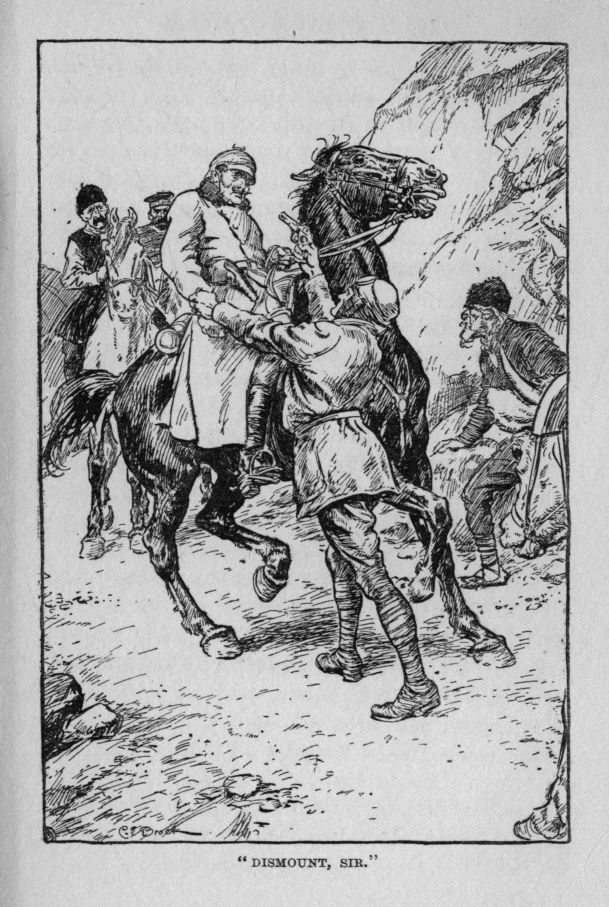
"DISMOUNT, SIR."
And seeing that there was no help for it, the German made haste to obey.
Meanwhile on the other side old Marco had performed his allotted part. The trooper, catching sight of Burton before the German, was for a moment too much surprised to be capable of action; but then, dropping the rope he held, he was about to spur forward to his superior's assistance, when the old Serb, who had crept round while the man's attention was occupied, suddenly hurled himself upon him. The old man was beset by no scruples. A Bulgar was always a Bulgar. A shot would raise an alarm; cold steel was silent. All the strength of his sinewy arm, all the heat of age-long national hatred, went into the knife-thrust that hurled the trooper from his saddle, over the edge of the track, and down the sharp-edged rocks of the slope beyond.
Within less than a minute the ambush had succeeded without any sound or commotion that could have been heard by the enemy in the tower nearly two miles away, and out of their sight.
IV
"Milosh Nikovich, this is a good day, old friend," said old Marco, as he released the prisoner.
"A good day indeed, Marco Kralevich. But I am amazed. Who is he that dealt with the German?"
"Hand me that rope, if you please," came from Burton in French. "Clasp your hands behind, sir," he added to the German, in English.
"You shpeak to me!" spluttered that irate officer. "Know you zat I am an officer, a captain of ze 59th Brandenburger Regiment? It is not fit zat I haf my hands bounden."
"You must allow me to judge of that, sir," remarked Burton, with a quiet smile.
"No, I protest. I refuse; it is insolence. You captivate me, zat is true; you seize me ven I look ze ozer vay; zat is not vat you call shport. But I gif you my parole----"
"I can't accept it, sir."
"Ze parole of a German officer----"
"It's no good talking, captain," Burton interposed, bluntly. "The word of a German has no value just now. If you do not submit quietly I shall have to use force. No doubt you will be released when you are safe in the British lines. Come now!"
Amid a copious flow of guttural protestation the captain allowed his hands to be tied behind him.
"I felt rather sorry for the chap," said Burton to Enderby afterwards. "He looked a decent fellow as Germans go, and perhaps I did him an injustice. But, being a German, we can't trust him; and we can't afford to take risks."
While he was engaged in securing his prisoner, the two Serbs had been conversing rapidly. Old Marco came up to him, and took him apart.
"We have gained time at least, monsieur," he said. "My friend Milosh Nikovich tells me that the others are remaining in the tower for the night; the main body is not expected until the morning."
"That will give us a chance to slip past in the darkness--if only your wheels didn't groan so. Stay! I have some vaseline in my wallet, I think; we can grease them with that. It's nearly four o'clock, I see; the mist is rising; that will help us. I suppose, by the way, the Bulgars in the tower will not expect this German to return?"
The old man spoke to his compatriot.
"He does not know," he said.
"Then we shall have to look out. Luckily the sun is going down; they can't heliograph any more; and it will be impossible for the people above to see the track through the mist, so they won't know that the horsemen have been checked. If the air had been clear they would certainly have become suspicious on failing to catch sight of the party on open stretches behind us. With luck we shall get through. What were they doing with your friend?"
The old Serb repeated what Milosh had told him during their colloquy. His village had been raided; most of the inhabitants had been massacred by the Bulgars; he himself had been impressed as guide, and forced to lead the patrol to the tower, which they knew by hearsay, though ignorant of the hill-track that led directly to it.
"I reproached him for his weakness," added the old man apologetically. "He ought to have refused to act as guide. Better that a Serb should have allowed himself to be shot. But a man does not always see clearly; he has a family--who are safe, praise to the Highest!"
"But why did they wish to reach the tower?"
"It commands the country for many miles. They could see from it the forces of your brave countrymen. Without doubt they signalled what they had discovered, and I suspect that to-morrow a force of light cavalry will come this way to fall on their flank at the cross-roads below."
"That is one reason the more for getting through. We must do it to-night. You know the country, my friend; we must act on your advice."
Since no move could be made until it was quite dark, they sat down on the rocks and took a meal, eating sparingly of their provisions as a matter of prudence. Who could tell what the night and the morrow would bring forth?
The Englishmen were amused at young Marco, who, munching a wheat-cake, solemnly watched their every movement, and eyed longingly the sandwiches they took from their tin. Burton beckoned him forward and gave him a sandwich. The boy took it, hesitated a moment, then shyly offered his wheat-cake in exchange, and ran back to his mother.
"I'm afraid you're in great pain, poor old chap!" said Burton, noticing the pallor and drawn expression of Enderby's features.
"Oh, that's all right. I can stick it out. I rather fancy our German friend feels worse. It must be horribly galling to his nobility. What's his name'?"
The German was sitting apart, moodily gnawing his moustache. Burton went over to him, loosed his hands, and offered him a sandwich and his flask. The former he accepted with a sort of unwilling graciousness; the latter he declined.
"Your visky I drink not; I haf in my own flask goot German vine. You permit me?" he asked, ironically.
"Of course. It isn't whisky, by the way. May I ask your name?"
"It is Captain von Hildenheim. I am not pleased. Zis is not ze handling zat is vorth a German officer. Vunce more--
"Sorry. We can't have it all over again. You must make the best of it. It won't be for long."
"No, zat is true; it vill not be for long," returned the German with a slight smile.
"He evidently thinks we shall be collared to-night or to-morrow," said Burton, when, having bound his prisoner again, he returned to Enderby. "Have you got a cigarette in your case? Mine's empty."
He sat by his friend, smoking in silence, meditating as he watched the wreaths mingling with the mist in the growing darkness. Presently he got up, and went to the spot where the Serbs were grouped. Young Marco, wrapped in a rug, was already asleep on the cart.
"What about this tower?" he asked the grandfather. "How is it placed? What is its strength and its state of repair? I don't ask idly; an idea occurred to me just now."
"I know it well," answered the old man. "Twenty years ago I held it during a Bulgar comitadji raid. It stands on a spur on the hill-top. The track passes not far beneath it. On two sides the ground forms a sort of glacis. The tower is solidly built of stone; it has two storeys. What is its condition, Milosh Nikovich? It is twenty years since I was there."
"It is strong and sound, Marco Kralevich, except inside. They took me only into the lower room. The woodwork was rotted away, or perhaps some of it has been removed."
"Yes, it may be so. In the last war the Greeks held it for a time against the Turks. The place is well chosen for a watch-tower. From the top you see for many miles, most freely towards the north-east, whence we have come; less freely, but still a great way, towards the south-west, in which direction the British Army is retreating, monsieur. Tchk! Why did not your country and France allow us to fall on the Bulgars before they were ready? Serbia pays a heavy price."
Burton felt he had nothing to say to this, and after a few condoling words returned to his place by Enderby's side. The information he had gathered had caused his half-formed idea to crystallise.
"I say!" he began, seating himself on the edge of the cart.
"Say on," returned Enderby, smiling at his friend's solemn face.
"Well, there are only ten or eleven in the tower above there."
"What is the precise force of your adverb?"
"What adverb? Oh, 'only.' Well, ten or eleven's not a great crowd. There are four of us, without counting you and the woman----"
"Three men and a boy! We'll assume for the moment that one Englishman is worth four of any other nation; but are your two and a half Serbs equal to the other six or seven? Of course I see what you are driving at."
"Well, isn't it worth trying? There's no doubt that a Bulgarian column intends to cut off our men's retreat, and if we could seize the tower, and hold them up even for an hour or two, it might make all the difference."
"But they're in possession; and remember, the attack needs more men than the defence. The odds are dead against you, Ted."
"Not altogether. You must allow for the darkness, surprise, and the cocksureness of the enemy. Didn't a corporal carry off twelve prisoners single-handed at Loos the other day? With a little luck----"
"We've a way of assuming that the luck is going to be on our side! Well, see what the old Serb says. I must be out of it, unfortunately; but you needn't consider me."
"That's very good of you, but, of course, I do consider you. If it wasn't for you I'd not hesitate a moment."
"Don't let that trouble you. At the worst they'll only collar me. The risks will be wholly yours."
Burton returned to the Serbs, sat down beside them, and talked to them until the dusk had deepened into night.
The upshot of their conversation was presently disclosed. While young Marco was thoroughly greasing the axle-trees, Burton inflicted a still deeper wound on the dignity of Captain von Hildenheim by gagging him. Milosh was already in possession of his revolver.
Then the little party started quietly on the upward track.
A cold wind had set in from the north-east, dispersing the mist, and carrying with it an occasional shower of powdery snow. Except during these brief showers the sky was clear and brilliant with starlight. A glance behind showed the red camp-fires of the enemy far in the plain below. Ahead, the tower, when they caught sight of it, loomed black like a sentinel against the indigo background. A faint glow shone from one of its shutterless windows, half-way up the wall.
The track was so well shadowed by its rocky banks that there was little risk of the party being seen. Yet, when they were still some distance from the tower, Burton deemed it prudent to call a halt. There was a whispered consultation, then Milosh went forward alone to reconnoitre.
Creeping up with every precaution, eyes and ears alert, he came within sight of a low wall some forty or fifty paces from the tower, pierced by a single aperture where at one time had been a gate. This wall shut off the tower and the crag on which it stood from the narrow bridle-path that mounted the hill to the north, and fell away to the south towards the valley.
In the gap in the wall a sentry stood, finding such shelter from the biting wind as the thickness of the stonework afforded. He blew upon his hands, stamped his feet, murmured his discomfort. At one moment he took out a watch, and seemed to caress it with his fingers. He did not lift it towards his eyes; he could not have seen the time in the starlight; and the shiver which visibly shook him as he returned it to his pocket was the shudder of physical cold; he had forgotten the ruthless butchery of the Serb who had, not long before, been the owner of the watch.
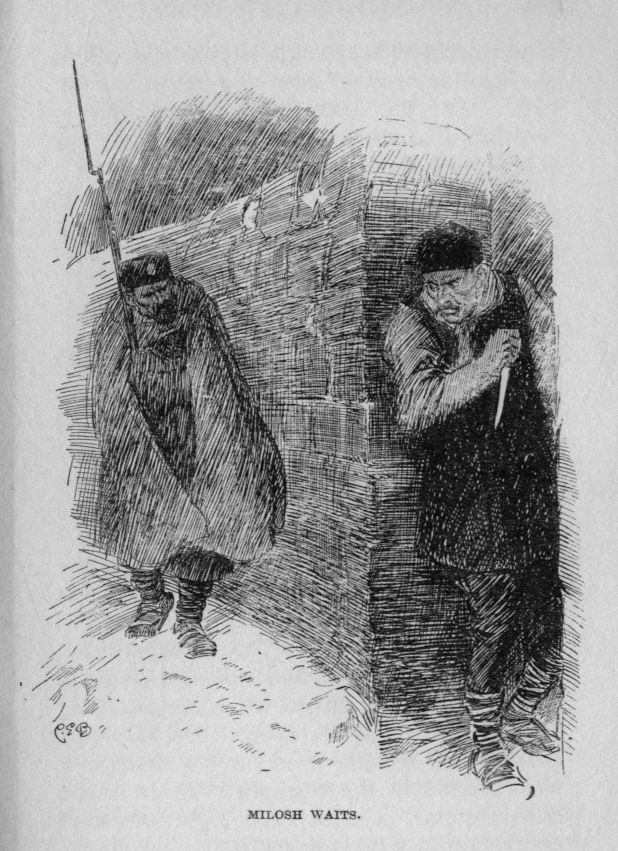
MILOSH WAITS.
All was quiet around. Only the feeble ray high up in the tower showed that the place was occupied. The sentry's faculties were numbed by the cold, or he might have noticed that the even contour of the wall, some few paces from him to the north, was broken by a dark protuberance which had not been there in daylight. It might have been a buttress, except that there were no buttresses on the outside of the wall. Astonished as he must have been if he had observed it, he would have been still more amazed had he been tramping his beat before the gate instead of cowering from the icy blast. For the dark shape moved, imperceptibly, like the hour hand of a clock, yet surely, and always towards him.
Within two paces of the gateway it suddenly stopped. The line of the wall was no longer broken. There was nothing now for the sentry to see.
A few minutes passed. The sentry muttered, growled, stamped on the ground. After all, he could not keep warm. He had sheltered his nose and ears at the expense of his feet. Only movement could restore the circulation of those chilled members. He picked up his rifle, came out through the gateway, swung round to the right, and tramped along close to the wall.
No sooner was his back turned than the dark shape that had remained motionless at the foot of the wall glided swiftly up to and into the gateway. The sentry turned at the end of his beat, and butted with quick step against the bitter wind, approaching the gateway--and his doom. He had just passed the opening when a few inches of steel glinted in the starlight. There was a stifled groan, a sigh. The rightful owner of the watch was avenged.
Three minutes later Milosh rejoined the little group that was waiting a couple of hundred yards below.
"Well?" old Marco inquired in a whisper.
"It is well, old friend. The way is clear."
V
During the scout's absence, Burton had become acutely conscious of the bruises which he had almost forgotten. He dreaded lest his aching body should not be equal to the strain of a fight against odds. But he resolutely turned his mind from his own condition, and set himself to concert a plan of action with old Marco and Captain Enderby.
They decided that while the attack was proceeding Nuta should remain with the cart. If it succeeded, she would be brought up to the tower; if it failed, and the enemy made their appearance, the possession of Captain von Hildenheim should serve as security for the safety of herself and Enderby. A threat to shoot him would no doubt induce his party to come to terms. The expression on the woman's face as she took Enderby's revolver was sufficient guarantee that she would not fail in the part assigned to her.
Five minutes after the return of Milosh the little party set off on their adventurous enterprise.
"Good luck, old man!" said Enderby, as Burton took his leave. "Sorry I can't be with you, but we'll meet again before long."
They stole up the road in single file, Milosh leading, followed by old Marco, Burton, and the boy in succession. Reaching the wall, they crept along its shadow to the gateway, noiselessly entered the enclosure, and, after a swift glance around, sped towards the tower. The clank of bridles and the pawing of hoofs did not alarm them; Milosh had already explained that the horses had been placed in the large chamber that formed the ground floor. To this there was no longer a door, but through the vacant doorway came a faint glint of light.
At the entrance they halted, and peered in. Ranged along the wall to the right stood the horses, which, scenting strangers, moved restlessly. In the left corner the rays of a lamp fell through an open trap-door above, lighting a rough wooden staircase. From the upper room came the sound of voices mingled with snores. At the uneasy movements of the horses the conversation ceased for a moment. A head appeared at the edge of the trap-door, and a rough voice ordered the animals to be quiet, as one might tell a dog to "lie down." Another voice from behind sleepily asked a question. The first man replied, and withdrew from the opening. Then the low-toned conversation was resumed.
There being but one entrance to the tower, and but one gateway in the wall, the single sentry whom Milosh had disposed of had no doubt been considered a sufficient guard; but old Marco had decided, leaving nothing to chance, to post his grandson at the doorway, to keep watch outside and give the alarm if any sudden interference should threaten. The boy grasped manfully the revolver given him, and stood against the wall out of the ray of light.
The others slipped silently across the room to the staircase. At its foot they halted a moment, looking up towards the trap-door. The staircase was clearly a rickety affair. Some of the treads were missing; the handrail and balusters which had formerly edged it on the outer side were now wholly removed. Signing to his companions to move carefully, Milosh began to ascend.
At his first step there was an ominous creak, masked, however, by a renewed stir among the horses. The old Serb and Burton followed in turn, treading as lightly as they could. Milosh was half-way up when, stepping over a gap, his foot came down heavily on the stair above, and the timber emitted a loud groan. The voices above ceased; then a gruff voice in the Bulgarian tongue muttered: "What was that?" Milosh hurried his ascent. A shadow fell on the men below him; something had moved at the edge of the trap-door. A cry of alarm ended in an inarticulate gasp; for the second time that night a Serbian knife had taken toll of the national enemy.
There was a loud shout from behind the fallen man, followed by confused cries from the awakened sleepers. Regardless now of any noise they might make the three men sprang up the remaining stairs. A shot rang out as Milosh flung himself into the room, with Marco close behind him, and when Burton stood upon the floor, he found himself in the thick of a furious mêlée that gave him no time to take in the scene.
Of the men in that upper room, only two had been awake--the Bulgarian officer and one of the troopers. When their conversation was interrupted by the sounds from below, the trooper had leant over to see what was happening. It was he that had fallen to Milosh's knife. The shot had been fired by the officer, and the other men, aroused by the noise, had disengaged themselves from the horse rugs beneath which they had been sleeping, and were now crowding in confusion to repel the unexpected attack. Only half awake, some of them had not even seized their arms. Behind them towered the bulky form of the second German officer who had led them earlier in the day. He alone had his wits about him. Shouting orders and curses, he threw a swift glance at the three intruders, then sprang to the lamp hanging from a bracket on the wall, and dashed it to the floor.
But this move, upon which he had calculated to assist the defence, giving the men time to collect their sleep-dulled senses and regain the advantage of numbers, turned in fact to their undoing. The darkness lasted only an instant. Then Burton whipped out his electric torch. The lamp had illuminated both parties alike; but now the electric beam dazzled the eyes of the Bulgarians while leaving their assailants dim and indistinct.
Burton could never afterwards clearly recall the incidents of the fight. The hollow tower rang with shots, fierce shouts, and even more significant cries. His one abiding impression was the Berserker fury of old Marco. With knife in one hand and revolver in the other, the Serb flung himself upon the foes, his stalwart form seeming to be everywhere at once. Even his heroic ancestor could never have disposed of more of the traditional enemy in equal time. Milosh fought with the fury generated by his recent wrongs, accompanying every knife-thrust with a yell of triumph. Some of the Bulgars threw themselves down, and tried to crawl towards the trap-door. But Burton, holding his ground there, cut off their escape, and while his torch lit up the scene for his friends, he assisted them with his revolver whenever he could do so without risk to them.
Long as it appeared to those engaged in it, the struggle was in reality a short one. Taken unawares, the Bulgars were no match for their assailants, nerved by desperate necessity. At the last, when the din had somewhat diminished, Burton staggered under the impact of a large form, and saved himself from being hurled down the staircase only by a stiffening of the muscles and a dexterous back-throw over his thrust-out knee. He stooped and grappled his fallen assailant.
"I surrender!" gurgled a panting voice in German.
The officer's revolver had slipped from his grasp at the moment when, tripping over one of the Bulgars, he lurched against Burton. The latter kicked it down the staircase. There was silence now in the upper room. Burton flashed his torch around it. Marco and Milosh stood panting above their prostrate foes. It seemed that of all the party only the German officer was left alive. But the electric beam fell on one shivering wretch cowering behind a trestle table in the far corner. Milosh instantly dashed towards him, and Burton had much ado to persuade the infuriated Serb that, the officer having surrendered, the fight was now at an end. Old Marco had sunk to the floor, exhausted by his efforts and his wounds, unheeded in the heat of the strife. The silence was broken only by the champing and pawing of the frightened horses below.
Burton was tying up the prisoners, Milosh was collecting the arms of the slain, when old Marco suddenly exclaimed--
"Monsieur, there are only eight!"
The words were scarcely out of his mouth when a shot rang out below, and the boy's voice shouted an alarm. Leaving the others to complete his work, Burton dashed down the staircase to the doorway, just in time to see two men sprinting along beyond the wall in the direction of the waiting cart. Young Marco babbled an explanation of their presence excitedly in his own tongue, but Burton could not wait for explanations; it was enough that two of the enemy's party had been outside the tower, probably en vedette to the south, and were now speeding towards the north and their main body. No doubt they had heard the uproar, guessed what had happened, and run off to carry the news.
Burton at once dashed after them, anxious about the safety of his friends at the cart, even more than about the peril of the whole party if the enemy's march should be hastened. Young Marco flew along at his heels. But the fugitives had had too long a start. Even the beam of the torch failed to discover them. Immediately after the torch flashed there was the report of a revolver, and Burton ran at break-neck pace down the rugged track. He came to the cart.
"Gone away!" cried Enderby.
"You're not hurt?"
"It was Nuta's revolver. We heard some one coming, but didn't know whether friend or foe until you flashed your torch. Then I guessed. But two men were just on us then; they swerved to avoid the cart, and dashed away beyond us there. The woman was quick, but it was too dark to aim, and I'm afraid they've both got clear."
"That's a pity. They'll report that we've got the tower, and the Bulgars may swarm up in an hour or two. We must get you out of harm's way."
He made signs to Marco that he wished the cart to be driven up at once. The boy whipped up the oxen, and the vehicle lumbered away with Hildenheim trudging disconsolately behind. At the gate in the wall they met old Marco.
"Let the woman and the boy go on with your wounded friend," he said to Burton. "They cannot help us; why should we endanger them? Moreover, they would then save the goods in my cart."
"As you please," said Burton. "But you yourself will hold to your agreement, and help us to check the enemy as long as we can?"
"Assuredly, and Milosh Nikovich will remain with me."
But when the matter was put to Nuta, she resolutely refused to leave the old man.
"It is well, my daughter," he said, laying his hand on her shoulder. "We will live or die together."
This being decided, they resolved to utilise the cart in the defence of the position. The more valuable parts of its load were removed, together with the British machine-gun, and carried into the tower. The cart was then drawn across the gateway to block it up, and the oxen were taken some distance away to the south, and tethered in a bush-covered dell. Meanwhile Milosh had cleared the upper room, and made some effort to obliterate the traces of the fray. There the party took up their quarters. They were all utterly weary. It was perhaps unlikely that the enemy would arrive before the morning, but Burton and the two Serbs arranged to take turns at watching through the night. What preparations could be made to meet an attack must be left until at least a partial rest had restored their exhausted energies.
VI
There was little conversation during the night. Every member of the party was so fatigued that, when not on watch, he slept heavily. Enderby alone was wakeful, from the pain of his wounds, and he addressed Burton only in occasional whispers, lest Hildenheim should overhear him. The two German officers conversed in their own tongue, pitching their voices low; but neither of the Englishmen understood German. At intervals the distant boom of heavy guns indicated that a night attack was in progress somewhere to the east.
Before daybreak Burton roused his companions. It was necessary to lay their plans in readiness for the expected advance of the Bulgarian troops. In company with old Marco, Burton took stock of their resources. They had the weapons of their enemies--ten rifles with about two thousand rounds of ammunition, three revolvers with thirty rounds apiece, their own machine-gun with three ammunition belts. There was a plentiful supply of provisions, but little fodder for the horses. Burton was tempted to make good their escape while there was yet time; but after a few moments' reflection he reverted to his purpose of delaying the enemy's advance to the last minute of endurance. The tower, commanding the narrow track, offered great advantages to the defence; and guessing that the Bulgars' advance guard would consist of cavalry unprovided with artillery, he hoped to be able to hold his own until help arrived.
The first necessity was to inform the British general of the anticipated flank attack.
"Your grandson can ride a horse?" he asked old Marco.
"Tchk! The boy sat a horse as soon as he could walk," replied the old man, with a laugh.
"Then I want to send him with a note to our men. Will you instruct him?"
He wrote in his pocket-book a note explaining that Captain Enderby, wounded, with himself and two Serbians, both slightly wounded, were holding a tower in the hills some ten miles south of Strumitza. They expected to be attacked by a Bulgarian column moving south-west across the hills to cut the British line of retreat, and would hold out as long as possible. Their greatest need, if attacked in force, would be ammunition; and he pointed out that the position would be hopeless against artillery. Tearing the leaf out, he folded it, addressed it to "Any British Officer," and gave it to Marco, who tucked it inside his tunic. As soon as dawn glimmered the boy mounted one of the horses and set off, disappearing into the mist.
"We had better take the horses out," Burton suggested. "They will only hamper us here; besides, we may as well keep them alive if we can."
On old Marco agreeing, Milosh led the horses to the dell where the oxen had been tethered overnight, tied them together, and hobbled them to heavy fragments of rock. Meanwhile the others strengthened the cart barricade, blocked up the entrance to the tower with stones, broken timber, and other rubbish, and placed the machine-gun at a narrow window commanding the track. Then Burton climbed the ladder leading to the top of the tower, to examine the country through his glasses; but the heavy white mist hid everything from view. Guns boomed incessantly; the sounds were little louder than they had been in the night. It was clear that the British retirement was being conducted without hurry.
When he came down he found that Nuta had got ready a meal for his party and the three prisoners. With these latter, since his arrival at the tower, he had had no conversation. Now, however, Captain von Hildenheim addressed him.
"Major Schwartzkopf demands to know vat you do," he said. "Ze major shpeak no English."
Burton glanced at the elder German, who stared at him with mingled insolence and sullenness.
"Tell him that I hope before the day is out to hand him over to the British provost-marshal," he said.
Hildenheim translated. The major gurgled out a rapid sentence.
"You mistake," Hildenheim went on. "Major Schwartzkopf vish to know vat you do here."
"That is my business. If the major has patience he will see."
The Germans talked together, and Burton gathered from their smiles that they supposed him ignorant of the Bulgarian advance, and flattered themselves that the tables would soon be turned on him.
When breakfast was finished, Marco asked Burton to accompany him to the chamber below.
"Twenty years ago," he said, "when I was here, we kept a few prisoners in a cellar below the floor. Shall we not place our prisoners there now, for safety's sake?"
"Let us have a look at it," Burton returned.
Scraping away the litter of hay, earth, and fragments of wood from a corner of the floor, Marco disclosed a trap-door. They lifted this, and Burton descended a short ladder, Marco following him with an improvised torch. They found themselves in a shallow cellar, stuffy but dry.
"What is this?" exclaimed Marco, pointing to a number of small wooden boxes ranged along one wall. "They were not here in my time."
The boxes were thickly covered with dust, and had evidently been long undisturbed. Burton carefully prised up the lid of one of them.
"It is full of sticks of dynamite!" he said, astonished. "A strange find, upon my word!"
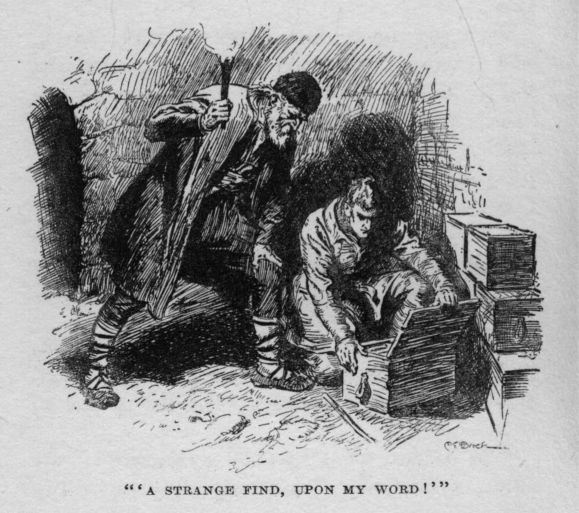
"'A STRANGE FIND, UPON MY WORD!'"
"And look!" added Marco. "There is a tunnel--that was not here either."
In one of the walls was an opening about four feet high. Entering this, the two men groped their way along a straight tunnel just wide enough for them to pass in single file.
"This must have been made by the Greeks when they held the tower," the old man continued.
"For what purpose? There's nothing in it."
"But there is the dynamite in the cellar behind. I think the tunnel must have been intended for a mine."
"To blow up something outside? Let us see in what direction it goes."
A glance at his compass showed him that the tunnel ran towards the north-east.
"It is plain," said Marco. "Here at the end we may be standing beneath the track. The Greeks intended to blow it up. I suppose the necessity passed when the Turks retreated, and the dynamite was left here and forgotten. Perhaps the Greeks who made the tunnel were killed in the fighting afterwards."
"Well, this may be a lucky find for us. We must see if it does end beneath the track."
Measuring his paces as they returned to the cellar, he went up, and counted an equal number from the doorway of the tower, following the direction of the tunnel as nearly as he could judge it. The thirty-second pace brought him to the wall; there were still nine more to take. At the forty-first he arrived at the centre of the track.
"You were right," he said; "the intention was clearly to have a means of blowing up the track. As you say, an explosion just there would make it impassable. This may be a lucky find for us, my friend. We must remove the dynamite to the end of the tunnel, and make some sort of fuse."
They returned to the tower. It was now half-past nine, the mist was thinning, and before taking in hand the preparation of the mine, Burton thought it well to make another survey from the top of the tower. With Marco he climbed the ladder. Even with the naked eye he was able to see, winding like a serpent across the white plain, a long column of troops, its rear merging into the mist. Through his glasses he distinguished its composition. In advance of the main body of infantry rode squadrons of cavalry. Here and there appeared files of pack-mules. He handed the glasses to Marco, whose face gloomed as he watched the unending stream.
"The mules carry mountain guns," he said. "That's bad. They are coming on quickly, too. We shall not have time to prepare our mine."
But as they went down again, to make final preparations for meeting the impending attack, an idea occurred to him. Taking Marco to the lower floor, he said in English, loud enough to be heard by the prisoners above--
"A bomb would blow us all to smithereens. I had no idea there was so much dynamite there."
The Germans instantly rose to the bait. They could be heard in excited discussion above. Waiting a few minutes to allow his words to produce their full effect, Burton returned to the upper room. The officers broke off their conversation and looked at him uneasily.
"I beg your pardon, sir," said Hildenheim at length, hesitatingly. "You shpeak of dynamite?"
"I did, yes--there is a considerable quantity in the cellar below."
Looking very grave, Hildenheim translated to his companion, whose alarm found vent in impassioned volubility.
"Major Schwartzkopf protests viz indignation," Hildenheim went on. "Ve are prisoners--so; but ze law of nations do not permit zat prisoners be confined in a place of danger."
"Danger, gentlemen! It was you who chose this place. What danger do you anticipate?"
"Our allies ze Bulgars zis vay come. Not understand? Zey attack zis place. Ve sit on high explosive below; ze Bulgars shoot high explosive above; ve are blowed to--vat you call it?--schmiddereens!"
"Surely your allies love you too well; they will not subject you to such risks."
"I know not so much about zat. Zey love us--yes; but if it is zeir duty zey blow us up all ze same."
"We shall all be in the same boat, then. But perhaps you have something to suggest?"
"It is ze law of nations zat you keep us safe."
"You are quite safe so far as we are concerned. Obviously I cannot remove you. If your friends shell us--well!"
"But you can remove ze dynamite. You can take it out, inter it, shuck it into--vat you call it?--a gully."
"We haven't time for that. But I have an idea. There is a long tunnel leading from the cellar. If you and your companions care to carry the dynamite to the farther end of the tunnel, it will be out of harm's way so far as the tower is concerned."
"Zat is not ze vork of German officers."
"No; quite so. If I were you I wouldn't do it. But, as you may have gathered, I intend to hold the tower as long as I can. Your cavalry is already on the move. It will not be long before they attack. If you care to remove the dynamite, you may stay in the cellar until--until I fetch you out. Otherwise you will remain here."
The Germans consulted.
"Ze Herr Major agree, viz protest," said Hildenheim presently.
"Agrees! To what?"
"To move ze dynamite--vat you ask."
"I beg your pardon, I ask nothing. You will do as you please. I said if I were you----"
"Ach! Ze Herr Major agree all ze same," interrupted Hildenheim, eagerly.
"Very well."
The Germans struggled to their feet.
"You shall unbind our arms," said Hildenheim.
"When you are in the cellar. Watch your footing as you go down."
He preceded them down the stairs. When the three men were in the cellar he left them his torch to work by, instructing them to carry the boxes to the end of the tunnel.
It was necessary to devise a train for exploding the dynamite at the pinch of necessity. Having no gunpowder this was a difficulty until Marco hit on a method. He bade Nuta bring some cotton cloths and some jars of grease that were among their belongings in the cart. The cloths he asked her to tear up into thin strips, and then to soak thoroughly with the grease. By knotting these strips together she could make, he hoped, a match as long as the tunnel.
There was no time to test it, or to judge how quickly it would burn. Scarcely ten minutes after the woman had begun her task Burton saw, from the loophole at which the machine-gun had been placed, the head of the enemy column appear on the track within effective rifle range. It consisted of a half-troop of cavalry, and was moving with cautious slowness. In another minute it came to a halt. Two officers in front held a consultation. One of them peered through his glasses at the silent tower. Their attitude suggested uncertainty. The lack of signals from the tower must have apprised them that their friends were not in possession of it; but the information conveyed by the men who had escaped overnight was necessarily vague, and they were ignorant whether the position was held by their foes, or had been abandoned.
At the window, but out of sight of the enemy, Burton and the two Serbs watched them keenly. Enderby had been placed at the remote end of the room, behind a barricade of timber, accoutrements, and rugs. In the last few moments Burton had discussed with him whether it would be well to open a parley with the enemy, and announce his intention of disputing their passage.
"My advice is to the contrary," said Enderby. "Deeds, not words. A shot will tell them all you wish them to know."
The consultation on the track came to an end, and the horsemen began to move forward slowly. Two of them, one apparently an officer, rode a little in advance of the rest. When they were still about half a mile distant, Marco raised his rifle to his shoulder and fired. Apparently he missed, for the two men instantly threw themselves from their horses and took cover among the rocks at the side of the track. A bugle rang out, and all down the column, as far as it was in sight, the troopers dismounted, left their horses, and advanced up the track on foot by short rushes from one patch of cover to another.
"What will they do?" Burton asked himself. He tried to put himself mentally in their position. All the information they could have was that the tower was in enemy hands. They could not know who its captors were, or how many they numbered. No doubt they would suppose that the patrol had fallen to a superior force, but they would infer that this force was a comparatively small one, since it was already clear that no attempt was to be made to dispute their passage on the track itself. Their natural course would be to feel the strength of the garrison, and perhaps to refrain from throwing themselves against a strong defensive position until they had brought up guns to bombard it. The wild and rugged nature of the ground made rapid movement difficult, and Burton hoped that the inevitable delay would not only enable the British Army to secure its retirement, but would also give time for the dispatch of a light force to bring off himself and his party. The latter event he did not count on; it might prove to be impracticable; in that case he could only look forward to the ultimate capture or destruction of the tower. It was his resolve to hold up the enemy till the last possible moment; if surrender were then necessary to save Nuta and Captain Enderby, he would at least have the satisfaction of duty well done.
Up to the present Marco's shot had been the only one fired. The two Serbs, if left to themselves, would have aimed again and again at the Bulgars, of whom they caught glimpses as they darted from rock to rock. But Burton prevailed on them to withhold their fire.
"They don't know exactly how we are placed," he said to Marco, "and we may as well keep them ignorant as long as possible. They are bound to leave cover if they mean to attack us; then will be our chance."
The position gave incomparable advantages to the defence. Standing on a spur of the hillside, the tower could be assailed only from the track; its rear face overhung a precipitous cliff which not even a goat could scale. For more than a hundred yards from the tower the track was wholly devoid of cover; the declivity on the one side and the high jagged ground on the other equally forbade an encircling movement. Burton's hope grew high as he weighed the chances for and against him.
The enemy had crept up to within about three hundred yards of the tower. The next fifty yards of the track were exposed, then there was a break in the bank in which they could find cover among low boulders and stunted bushes. It was at this point that they would first come in sight of the wall surrounding the tower enclosure. Burton concluded that as their mission was urgent, they would not wait the arrival of their artillery, which no doubt they had sent for at the first alarm, but would dash along the exposed portions of the track, shelter themselves temporarily below the wall, and then endeavour to carry the position with a rush. The gateway was blocked by the cart, but the wall could easily be scaled, and the slender defences of the tower entrance would yield in a few minutes. It was of prime importance, therefore, that the enemy should be prevented from reaching the wall. The track was wide enough for four or five men to move abreast. By means of the machine-gun, Burton could mow the enemy down if they advanced in mass; but having very little ammunition for it, he had decided to use it only as a last resource. In the early stages of the impending action he must depend on rifle fire, and he realised that, with no more than three rifles, a great deal depended on the extent to which the enemy could be intimidated. Personally he was at a disadvantage in respect of his unfamiliarity with the Bulgarian rifle. Marco had explained to him the sighting arrangements, which were adjusted to the metre scale; but he recognised that his first shots would be experimental. At short range he could hardly fail of success.
Some minutes passed; the enemy gave no sign of movement.
"Keep your eye upon them, while I go and see how the prisoners are getting on with their work," said Burton to Marco.
He went down to the cellar, observing on the way that Nuta had completed a large coil of the cotton rope. The Bulgar was staggering into the tunnel with the last of the boxes of dynamite. Hildenheim was donning his tunic, which he had stripped off for the sake of ease in working. From the coolness and the unsoiled appearance of Major Schwartzkopf, Burton inferred, with secret amusement, that that officer had not put himself to any exertion.
"I zink I hear a shot, sir," said Hildenheim.
"I thought so too," rejoined Burton. "But we are not engaged with your friends yet, and as I see that all the dynamite is removed, you are safe here--for the present."
"So! I know ze Bulgar language. Ven our allies haf ze tower taken, I vill haf much pleasure to--vat you call it?"
"Interpret for us? Thank you, captain. I am sure you are anxious to be useful."
The dull reports of two rifle-shots recalled him. As he closed down the trap-door, he heard Schwartzkopf guffaw. Springing up the stairs he rushed to the window, where the Serbs were now firing steadily, seized his rifle, and looked down the track. A small party of the enemy had broken cover, and were rushing uphill in irregular formation. Several had already fallen; one dropped to Burton's first shot; but the rest gained the cover of the stunted bushes before mentioned.
"How many have got through?" asked Burton.
"About half-a-dozen," Marco replied.
"They haven't answered your fire?"
He had hardly spoken when a hail of bullets pattered on the stone walls. Some had come from the advanced party in the bushes, some from their comrades concealed farther down the track. One flew through the window, and struck the wall a few feet above Enderby's head. The three men drew back.
"It is clear they have discovered where we are firing from," said Burton. "We had better give them the next shots from the roof. There are loopholes in the parapet."
They climbed up the ladder, and, kneeling behind the parapet, peered through the loopholes. For some minutes the enemy continued to fire at the window without exposing themselves. Presently, under cover of their shots, a second party, larger than the first, emerged from the rocks far down the track, and ran up to join their fellows hidden among the bushes. Instantly the three men opened fire; one after another the Bulgars fell, but eight or nine reached shelter in safety. The enemy's fire redoubled in violence; apparently they supposed that the defenders were shooting both from the window and from the roof, for Enderby called up that bullets were flying into the room, and at the same time splinters of stone were struck from the parapet.
Suddenly the firing ceased. Burton, looking through his glasses, saw reinforcements hurrying up along the track far below. Clearly the attack was to be pressed, and the worst was yet to come. So far he was well satisfied. The enemy had been held up for more than an hour; every minute gained might be of priceless service to the British forces. Every now and again the dull boom of artillery from the south told him that his comrades were still fighting a rearguard action against heavy odds. To prevent the enlargement of those odds was worth any sacrifice.
Burton realised that as yet he had had to deal with only a small advanced guard. The fight would take on quite a different complexion when the main body now pressing forward came into action. There was no sign of irresolution in the enemy. Even though he should sweep the track twice or thrice with the machine-gun, they would then discover that his ammunition was expended, and three rifles would avail nothing against the numbers who would pour upwards to the assault. It was time to prepare to play his last card--to light the train which, after an unknown interval, would explode the dynamite and render the track impassable. The tower was doomed. If not carried by assault, it would be shattered as soon as artillery was brought to bear on it. But even though it were destroyed, and all in it, the destruction of the track would delay the enemy for many hours, and his object would be gained.
He inferred, and rightly, as it proved, that the lull would continue until the enemy had come up in sufficient strength to burst through at all costs. But there was no time to spare, especially as so much uncertainty attended the action of the mine. Leaving the two Serbs to keep watch, Burton went below. Nuta was still knotting the lengths of cloth, but he saw at a glance that the coil she had completed would suffice. He made her understand by signs that she was to follow him to the cellar, carrying the revolver.
The eager looks with which the prisoners met him bespoke their confidence that he had come to beg their intercession with victorious Bulgarians. They were immediately undeceived.
"I am going to fire the dynamite," he said. "This place will no longer be safe for you. You must quit the tower. Follow my instructions to the letter. When you leave the entrance, you will cross the enclosure to the wall on the south side, climb it, and go as far along the track southward as you please. If you attempt to move in the opposite direction you will instantly be shot. That is quite clear?"
Hildenheim's looks had grown blacker and blacker as Burton spoke.
"It is a trick!" he burst out in a voice hoarse with rage. "It is against ze law of nations. Zere shall be reprisals. You make var prisoners vork to blow up zeir allies; you----"
"Nothing of the sort," Burton interrupted sharply. "You removed the dynamite for your own safety; you are at liberty to bring it back, and take the consequences. You must decide at once."
This reduced the German to silence.
"Was giebt es?" asked Schwartzkopf, evidently puzzled by the captain's agitation.
When Hildenheim had explained, the major came to a decision with great alacrity. It would be absurd to reject the chance of escaping with a whole skin. There was a short excited colloquy between the two Germans. Then Hildenheim sullenly announced their acquiescence, and they followed Burton and the woman up the stairs. When a passage had been opened in the entrance, the three prisoners made to issue together.
"Not so fast--one at a time, if you please," said Burton, anxious not to leave the tower himself. "The major first; turn to the right, that's your way. The woman will escort you."
At another time he might have been amused at the sight of the German hastening towards the wall with an effort to maintain his dignity, Nuta following with pointed revolver a couple of yards behind. But the situation was too tense for amusement. He was on thorns; at any moment warning shots might recall him to his post, and the mine had still to be completed. The instant the Bulgar, last of the three, reached the wall, Burton hurried into the cellar. He laid the cotton train on the floor of the tunnel, kindling its nearer end. At the farther end he upturned the open box of dynamite, placed a few cartridges at the extremity of the train, and packed the remaining boxes closely one upon another, so that the space between the floor and the roof was completely blocked. Then with feverish haste he scraped up loose earth from the floor, and dug stones out of the wall with his knife, and heaped them up against the boxes, so as to minimise the effect of the explosion towards the cellar. On his return he saw that the cotton appeared to be burning satisfactorily, and regained the roof of the tower after an absence of little more than twenty minutes.
The situation had apparently not changed. All was quiet. None of the enemy in the vicinity of the tower were in sight, but the columns were steadily rolling up the track in the far distance. A little later, however, there was a sudden rush from behind the rocks, accompanied by a hot fusillade. Bulgarian infantry swarmed up the track, and though many of them fell to the three rifles, many more got through, stumbling over the bodies of the fallen, and joined their comrades in the shelter of the bushes. Nuta had come up, and as the rifles became hot, she replaced them with fresh weapons.
The enemy advanced in an unending stream for five or six minutes. The crackle of rifle shots mingled with shouts and screams. Then at the blast of a whistle all movement ceased.
Burton calculated that at least sixty men had run the gauntlet and were now waiting among the bushes. Only about a hundred yards of open track separated them from the wall of the enclosure. To check the coming dash with three rifles would be impossible. Would the explosion in the tunnel happen in time? He dared not go below again to see how the train was burning, nor could any one else be spared. Suppose the mine failed? The rush must be checked somehow; nothing but the machine-gun would avail.
Leaving the Serbs on the roof, Burton went down into the room, and placed himself at the gun.
He had not long to wait. A whistle sounded shrilly. The men dashed from the cover of the bushes and poured up towards the tower, shouting and cheering. Behind them their comrades opened fire from the rocks. Burton held his hand for a few seconds. Then, when the foremost rank had covered about half the distance, the machine-gun rapped out a hail of bullets. In a few seconds the track was swept clear as by an invisible scythe.
Silence fell again. It was clear that the enemy had not reckoned with a machine-gun, for though, taking advantage of the charge, another body of men had rushed up to the bushes from the rear, they made no attempt to advance farther.
Minute by minute passed. Except for occasional sniping, the enemy took no action. But the lull seemed ominous, and Burton remained keenly on guard, keeping a look-out from behind the shield of the machine-gun.
"I don't like it," he said to Enderby once. "There isn't much doubt that they have sent word to their gunners, and we shall soon have shells hurtling upon us. There may be just time to carry you down and put you in safety beyond the tower."
"Nonsense!" Enderby returned. "It makes me sick to be idling here. I won't go and keep your Germans company. My arms are sound enough, and, hang it all! I won't stand this any longer. Lift me out, and give me a rifle."
"No, no! Anything rather than that. At this window you'd be potted to a certainty. Perhaps it's better as it is, for if you were outside, and the rest of us were smashed, you couldn't get away."
"And I'd rather peg out than fall a prisoner to those German-led Bulgars. Don't worry, old chap!"
"That wretched mine must have failed," said Burton, presently. "Nuta must go and relight the train."
But just as he was rising to call her, he noticed something far down the track that caused him to drop back again.
"They're smuggling a machine-gun into position!" he cried.
He had caught a glimpse of the barrel projecting over a ledge of rock. With instant decision he trained his own gun upon it, and before it could open fire, he pumped out a hail of lead that struck it from its position, and the men serving it, in spite of their shield, were killed or disabled either by direct shots, ricochets, or splinters.
"One belt empty!" he said, as he replaced it with a full one. "By George! Now we're in for it!"
He had heard the characteristic scream of a shell. Immediately afterwards there was a terrific explosion, and he saw a tall column of smoke, stones, and dust shoot into the air from the rocks not two hundred yards away. In another half-minute another shell exploded, a little nearer.
"They must be 'phoning the range," he said. "Look here, Enderby, I must get you out of it. I can't leave the machine-gun now, but the Serbs must carry you away. Marco Kralevich!" he shouted.
The old man hurried down.
"They'll have the range in a few minutes," said Burton. "I want you and your friend to carry Captain Enderby out along the track yonder, towards where the prisoners are. Take your daughter, too. When you come back, go down into the cellar and relight the train; it must have gone out. They will smash the tower; the only chance of holding them up is to explode the mine. Make haste, for Heaven's sake!"
Marco summoned Nuta and Milosh from the roof. They lifted Enderby, and were half-way down the stairs with him when the Bulgarian gunners made their first hit. A shell carried away a corner of the parapet. The tower shook under the explosion, and the falling masonry plunged into the enclosure, raising a dense cloud of dust. Burton trembled for the safety of his friends, but his thoughts were taken from them by a renewed movement among the enemy. Immediately after the crash, the men concealed in the bushes sprang out, and dashed forward with a cheer. They would have been wiser to wait. Burton saw them indistinctly through the dust, but he had the range to a yard, and again they melted away under his withering fire.
Shells were now bursting around the tower. There was another crash above; fragments of stone fell into the room, striking Burton in many places. It was a moment of racking anxiety. He dared not leave the gun until the track had been destroyed, yet the tower might crumple down upon him. His ammunition was running short--would Marco get back in time? Even if he relit the train, would the flame reach the explosives? And at that crisis he nerved himself for what must be regarded as a supreme act of self-sacrifice. If all else failed, at the last moment he must go himself into the cellar, and fire into the charge.
Deafened by the explosions that now recurred every few seconds, smothered in dust, struck by fragments of stone, half choked by fumes, he still held his place at the window. The enemy had learnt a lesson. They kept out of sight. Before long the guns would have done their work, and when the tower was in ruins the way would be clear.
"They won't charge again till we're smashed," he thought. "Now for it!"
Taking his rifle, he hurried down the stairs. At the trap-door he halted a moment. He knew the risk he was about to run. His work in the tunnel had been so hurried that the backward force of the explosion could not be wholly checked. He was taking his life in his hands; but it was the last hope. He gathered himself together. His foot was on the first step when he was brought to a halt by a rifle shot below. The next instant he was hurled back by a terrific concussion, and fell, an immense noise dinning in his ears. For a moment he lay dazed.
"Marco must have done it!" he said to himself as he staggered to his feet.
Down into the cellar he sprang, gasping in the noisome fumes. His electric torch, still gleaming, lay on the floor. Near the mouth of the tunnel he saw the heroic old Serb prostrate. He rushed to him, stooped over him. Was he yet alive? Burton could not tell. Exerting almost superhuman strength he managed to hoist the big man to his back, and staggered with him across the cellar, up the steps, and across the floor. Almost broken down under the weight of his burden, he was just reaching the entrance when there was an appalling crash. The tower tottered and collapsed, and the two men fell together.
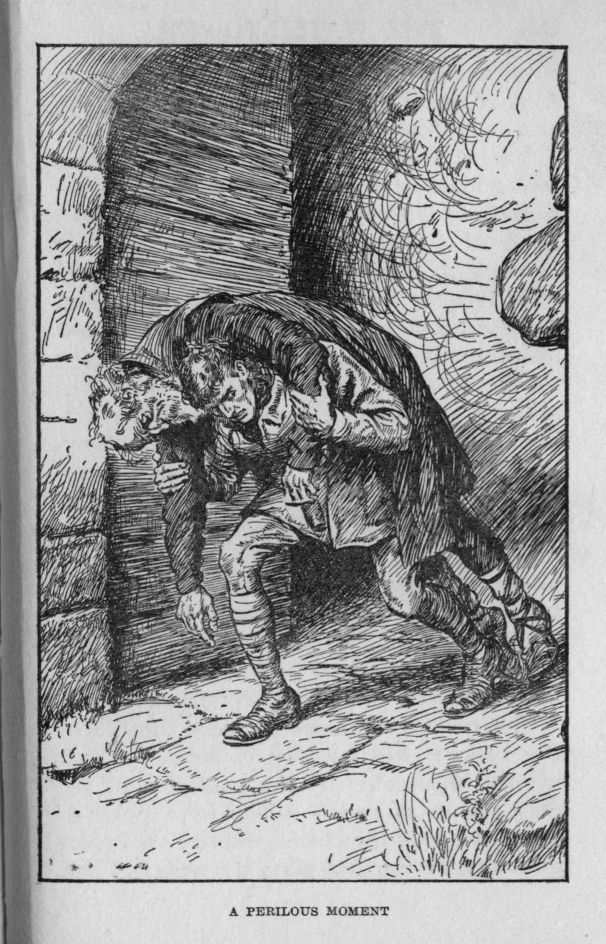
A PERILOUS MOMENT
VII
When Burton came to himself, it was to find an officer in khaki, with the red cross of the R.A.M.C. on his sleeve, bending over him.
"That's all right!" said a cheery voice. "He'll do now!"
"Where am I? Where's Marco?" Burton asked faintly.
"The old Serb? Don't worry about him. He has concussion, but he's a tough old boy, and we'll pull him through."
"And the Bulgars?"
"Toiling like niggers to make a new track a mile from here. It's all right. Take this morphine tablet. You shall hear all you want to know, twenty-four hours from now. Rather hard luck to be knocked out twice in one day, I must say."
Young Marco, after long wandering and losing his way several times, had lighted on a part of the British rearguard and delivered his note, which passed from a subaltern through his company commander and colonel until it came to the hands of the brigadier. An examination of the map decided that officer to dispatch a regiment of light cavalry to the tower. They reached it some ten minutes after it fell, having heard the outlines of the story from Captain Enderby, whom they met a few hundred yards away, keeping an eye on the three prisoners, as he said with a smile. Milosh and Nuta, who were returning to the tower when the explosion occurred, had narrowly escaped burial in the ruins. Rushing forward through the smoke and dust, they had found the two men unconscious but alive, protected by the only half-destroyed arch of the entrance.
The shelling had ceased with the fall of the tower; the track had been rendered utterly impassable by the explosion of the mine; and before the enemy were aware of the presence of the British cavalry, and their guns again came into play, the regiment had withdrawn with Burton, his party and the prisoners, and were well on their way to the British lines.
The value of the defence of the tower was handsomely acknowledged by the brigadier. It had saved his rearguard. The Serbs were compensated for the loss of their belongings in the abandoned cart, and young Marco, besides presents given him by the British officers, found himself the happy possessor of innumerable souvenirs from the men. Old Marco, who soon recovered, received special commendation and reward for his heroism in firing the mine at the risk of his life. As for Burton, no one was more surprised than he when he learnt that his name had been sent in for the V.C.
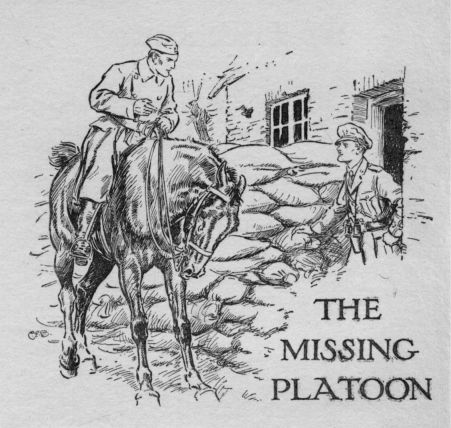
Chapter V Heading
THE MISSING PLATOON
I
Burton rode at an easy jog trot, smoking a cigarette. He had a day off, and by way of recreation had borrowed a horse to visit the battery for which he had done a good deal of "spotting," but which he had not yet seen. His only communication with it had been by wireless from the air.
It was a fine spring afternoon--rather ominously fine, he thought, for the sunlight had that liquid brightness which often preludes dirty weather. Dust flew in clouds from the white road before the gusty wind. From somewhere ahead came the booming of guns, and now and then he saw bursts of smoke above the trenches a few miles away.
He came to a solitary house at the roadside. It was partly demolished; but in the doorway, flanked by a solid wall of sandbags, a subaltern was standing. Burton reined up.
"Officers' quarters of No. 6?" he asked laconically.
"The same," was the reply.
"My name's Burton: thought I'd come over and have a look at you."
"You're the chap, are you? Well, I'll take you round. They're all in the gun-pits, waiting orders. Take your horse round to the back: we get pip-squeaks here occasionally."
Having placed the horse in safety, Burton accompanied his guide across the road, through what had once been a market-garden, to a turfy mound resembling a small barrow, such as may be seen here and there in the south of England. But this mound in France was obviously not an ancient burial-place. There was something recent and artificial in its appearance. A deep drain encircled it, and on its western side there was a small opening, like the entrance to an Eskimo hut.
"Here we are," said his guide, Laurence Cay, second lieutenant. "Mind your head."
Burton stooped and entered. He found himself in a spacious chamber, dimly lit through the doorway and the hurdles stretched across the farther end. To him, coming from the brilliant sunlight, the interior was at first impenetrably dark; but as his eyes became accustomed to the dimness, he saw the gun, clean, silent, on a bed of concrete; rows of shells placed in recesses in the walls; and the opening of a tunnel.
"That leads to our dug-out," said Cay. "We'll find some one there."
A few steps through the tunnel brought them to a large cave-like room, furnished with table and chairs, four bunks and a store cupboard. Two officers were taking a late luncheon.
"Let me introduce Burton, V.C., D.S.O., one of our spotters," said Cay. "Captain Adams, Mr. Mortimer."
"Hullo, Burton? So it's you. How d'ye do?" said the captain, shaking hands. "Haven't seen you for an age. Have a drink?"
"A cosy little place, this," said Burton, as he quaffed a mug of cider.
"H'm! Pretty fair. We're proof against anything but a 'Jack Johnson.' They haven't discovered us yet. We've had a few pip-squeaks and four-twos, by accident. We make better practice, I think."
"You missed a chance this morning."
"How's that?"
"Well, that mill, you know, just across the way--the Huns' divisional headquarters."
"Across the way! It's five miles--and a hill between!"
Burton, who knew Captain Adams of old, ignored the interruption. It was an easy amusement to "draw" Adams.
"With a little promptitude, and--h'm--accuracy, you might have bagged the whole lot; and who knows if Big or Little Willy mightn't have been there on a visit? But you were so slow getting to work that they all got away--except the cooks."
"But, hang it all! I gave the order 'Battery action' one second after we got the first call from O.P. and...."
"Yes, but your first shell plugged into a cabbage patch half a mile to the left."
"O.P. reported 300 yards," snorted the captain indignantly.
"Wanted to spare your feelings, old man. As I was saying, it only scared the Huns and gave them time to clear out. The second shell was just about as far to the right: demolished a pigsty."
"Come now, how the deuce do you know that?"
"Well, the divisional cooks started to make sauerkraut and sausage----"
At this point Adams noticed that his subalterns were writhing with the effort to contain their laughter; and perceiving at last that he was being "chipped," he caught Burton by the collar and hurled him towards one of the bunks. This was the opening move of a scrimmage which might have continued until both were breathless had not Adams suddenly remembered himself.
"Gad, Burton, this won't do!" he said. "Bad example to those young innocents" (indicating the subalterns). "Quite like old times at school, eh? But really----"
"How long have you been a captain, Adams?"
"Gazetted a fortnight ago; it came through orders a week later. Must give up skylarking now, you know. Have another drink."
They sat down, compared notes, talked over old times: the conversation became general.
"Trench raids are becoming more common," said Cay presently. "You heard what happened the other day?"
"What was that?"
"The better part of a platoon of the Rutlands is missing. They hold the trenches in front of us, you know. Well, they got up a night raid, and penetrated the Huns' first line: came back with a handful of prisoners and no casualties to speak of. But when they took stock, something over forty men of this platoon were missing."
"They went too far, I suppose, and were cut off. Very bad luck."
"If they're prisoners! Whatever happens to me, I hope I shan't be a prisoner. These raids are the order of the day now; I suppose they're useful. At any rate they give our fellows something to do."
At this moment Burton started as the words "Battery action" came from somewhere in a roar like that of a giant.
"Megaphone!" cried Adams, jumping up.
The officers rushed into the gun-pit. The men who had been working outside came racing in. In a few moments another order was shouted through a megaphone by the man in the telephone room--a shell-proof cave hard by. "Target M--one round battery fire."
Captain Adams took up a map of the German trenches, and with a rapidity that amazed Burton, angles and fuses were adjusted, and in a few seconds a shell went whistling and screaming towards its invisible target miles away. Cay had gone to the wireless instrument in the corner, and sat with the receiving telephones at his ears.
"Range right; shell dropped quarter-mile to the left," he called presently.
New adjustments were made; the gun fired again.
"How's that?" asked Adams.
It seemed only a few seconds before Cay, repeating the message he had received from the invisible aeroplane scouting aloft, replied: "Got him!" A moment later he added: "New battery----" He broke off: the burring of the instrument had ceased. He tried to get into communication again, but failed. "Ask O.P. if they've seen the 'plane," he called to the telephonist. Presently came the answer: "Went out of sight behind a wooded hill. Afraid a Hun 'Archie' has brought it down."
Meanwhile the order "Break off" had been received. The immediate task of the battery was accomplished.
II
The officers returned to their dug-out.
"Your colleague hasn't had your luck, Burton," said Adams. "It's more than a pity. He had evidently spotted a fresh battery. The Huns will have time to conceal it unless some one else spots it and tips us the wink."
They went outside and scanned the sky. No aeroplane was in sight.
"I think I'd better go up," said Burton. "I'm off duty to-day, but it would be a pity to lose the chance. The new battery must have been visible from where he saw your target. I ought to be able to find it if I go at once."
"A good idea! We might smash it before it gets to work. You'd better 'phone your flight commander. I'll lend you my trench map."
Burton hurried to the telephone room. In a few minutes he returned.
"O.K.," he said, "but I'll have to go alone. My observer's away, and there's no one else handy."
"That's awkward. You can't pilot and work the wireless too."
"Perhaps not, but if I can spot the battery I can return with my observer to-morrow, and then we'll be able to set you to work on it."
"Good! You've seen what we can do."
"Well, not exactly seen; but apparently it wasn't a pigsty this time. Look out for me in an hour or so."
He returned to the house, remounted, and rode back rapidly to the aerodrome. There he explained the circumstances at greater length to his flight commander, set the mechanics to work, and within ten minutes was ready to start.
"We're in for a storm, I fancy," said his commander as he got into his place; "but perhaps you'll be back before it breaks."
The weather had gradually changed. The sky had become thick, the air was sultry and oppressive. As Burton climbed in a wide spiral it was like going from a Turkish bath into the cooling room, fresh and exhilarating. He circled over the aerodrome until he had attained an altitude of six or seven thousand feet, then steered towards the German lines, still rising steadily. The spot for which he was making was four or five miles away. Soon the bewildering network of the British trenches glided away beneath him. Then the German trenches came into view. On the roads behind he noticed tiny black specks moving this way and that--supply wagons, no doubt, or motor-cars bringing up fresh men.
The whirr of his engine was broken into by something like the sound of a pop-gun. He looked around; a woolly ball of smoke hung in the air on his right. Immediately afterwards there were more pops, and the ball became the centre of a cluster. Burton swerved to the left, then dodged a long roll of greenish-yellow smoke with a red tongue of flame in the centre. The German "Archies" were at work. He flew on, swinging from side to side, until he calculated that he was about three miles behind the front line of trenches. Then he turned at right angles and commenced a methodical search of the ground stretched like a patchwork quilt below him. Here was a brown patch of plough-land, then a blob of vivid green denoting grass, or one of green speckled with white--an orchard in the blossom of spring. In the distance the silvery streak of a river pursued its winding way. A train was rolling across it, like a toy train on a toy bridge.
A dark mass below him broke apart, resolving itself into individual dots. "Afraid of bombs," he thought. At the spot where the centre of the crowd had been, the ground appeared to be blackened. "Shouldn't wonder if that's the missing aeroplane," he thought. "It caught fire, or they've burnt it. But where's that new battery? Things are getting hot." Shells were bursting all about him. Now and then the machine lurched, and he looked round anxiously to see the extent of the damage. A few wires, perhaps, were hanging loose; a few rents gaped in the fabric; nothing serious as yet. But it was getting very uncomfortable.
Up and down he flew, feeling the strain of doing double work. With his map pinned down in front of him he scanned the ground for some new feature. Ah! What is that? Peering through his glasses he descries a group of men in suspicious activity about a clump of bushes. They scatter as he passes over. A shell sets the machine rocking. He swings round and soars over the spot again, even venturing to descend a few hundred feet. The clump is not marked on the map. What is that in the middle of it? The flight has carried him beyond it before he can answer the question; but he turns again, and circles over the place. There is something unnatural in the appearance of the bushes. The shells are bursting thicker than ever. Something cracks just behind his seat. But he thrills as he realises that his reconnaissance has succeeded. "The battery is hidden in that clump, or I'm a Dutchman."
He marked the spot on his map, moved the elevator, soared aloft, and steered for home, making a circuit northward to avoid an anti-aircraft gun that lay directly between him and the aerodrome. And now for the first time he was aware that the threatening storm was about to burst. The westerly wind had increased in force; the sky was blacker; huge waves of cloud were rolling eastward. He flew into the wind and tried to rise above the clouds. Suddenly Heaven's artillery thundered around him; there was a blinding flash; he was conscious of pain as though he had received a heavy blow; then for a while he was lost to all about him.
When he partly recovered his senses and tried to regain control of the machine he was in a state of bewilderment. The aeroplane was nearly upside down. He scarcely knew which was top and which bottom. He struggled to right the machine: when he succeeded, with great creaking of the controls, he was alarmed to see that he was within a few hundred feet of the ground, above a wood. Exercising all his self-command he managed to swerve clear of the tree-tops, and in another moment or two the machine came to the ground with a bump that seemed to shake out of place every bone in his body.
Half dazed, he unstrapped himself with trembling fingers and scrambled from his seat. Rain was pouring in a deluge. The sky was black as night. His feet had just touched the sodden soil when he became aware of a number of figures rushing towards him from the undergrowth. Fumbling for his revolver, he was felled by a shrewd blow.
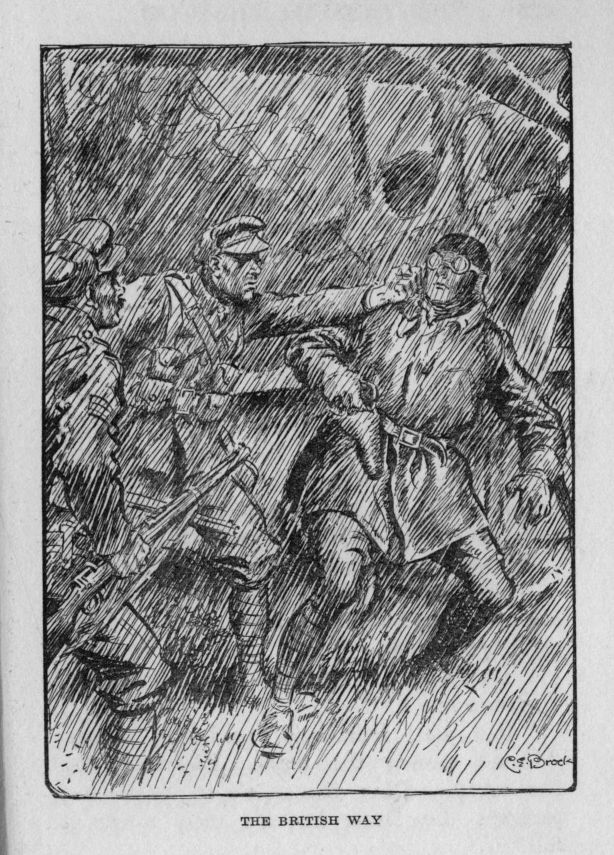
THE BRITISH WAY
Again he lost consciousness for a moment. Then he heard an English voice.
"You silly blighter! Couldn't you see?"
"He was going to shoot."
"Well, what of it? He couldn't hit a haystack. Didn't you see he was fair crumpled with the fall?"
"You may talk, but I wasn't going to be shot in mistake for a bloomin' Hun."
"I tell you any fool could see he was one of ours. I was sure of it. You ought to have made sure--striking your superior officer."
"Silence, you men!" called an authoritative voice. An officer had come up from the shelter of the wood. "The noise you are making can be heard a mile off. You'll bring the whole Hun army down on us."
As a matter of fact, the men had begun by speaking in stage whispers, their tones becoming louder and louder in their excitement as the altercation proceeded.
Burton rose stiffly and painfully to his feet.
"Beg pardon, sir," sheepishly muttered the man who had knocked him down. "It's raining so hard----"
"That's all right," Burton interposed. "Where am I?"
"It's you, Burton!" said the officer. "Come among the trees. You men, lug the aeroplane in; the rain's so thick that perhaps the Huns haven't seen where it fell."
"But we're in no danger in our own lines?" said Burton in surprise.
"We aren't in our own lines," rejoined the officer, dragging Burton into the wood. "We're marooned."
"Gad, Hedley, are you the missing platoon?"
"Yes; I'll tell you."
"Let me have a look at the machine first. By George! I thought I was done for."
"It was a narrow squeak. But you've always had wonderful luck. Here's the machine. What's the damage?"
Burton examined the aeroplane and gave a rueful shrug.
"Two holes in the engine cowl, a dozen in the planes, bracing wires shot away; they don't cripple her, but the worst thing is that one of the landing wheels is buckled. She's useless till that is put right."
"Well, perhaps we can get that done for you. You seem as badly crocked as the machine, and no wonder."
"But tell me, Hedley, where are we? And how did you get here?"
"Tell you by and by," said Hedley, who spoke in whispers and showed other signs of nervous apprehension. "Come on."
"But I can't leave the machine."
"You must. We can't take it with us. It won't be found while the rain lasts."
"I can't fly back unless I get this wheel straightened."
"All right. Stanbridge," he said, calling up a short, sturdily-built corporal, "get that buckled wheel off. Quick work!"
"Very good, sir."
"You'll find some tools on board," said Burton.
"And don't make a row," Hedley added.
It was the work of only a few minutes to detach the wheel. There was no conversation; everybody showed nervous impatience; two or three men kept watch at the edge of the wood.
"Now then," said Hedley.
He led the way, groping through the wood. Burton followed on his heels: he felt himself a compendium of aches. Rain was still falling. Through it could be seen the blurred lights of a distant building. A short walk brought the party to what appeared to be a thick hedge of bramble bounding a field. There was a whispered challenge.
"Potsdam," whispered Hedley in return, giving the password.
He turned, took Burton by the arm, and guided him through an opening which had suddenly disclosed itself in the bramble hedge. A sentry stood aside; the party filed in. Burton found himself moving down a sharp declivity, which by and by opened out into a spacious cave, lit by a single candle-lamp. Two or three men got up from the stools on which they had been sitting. The floor was roughly boarded. A table stood in the centre. Along one side were a number of large wooden bins.
"We sleep on them," said Hedley. "Rather stuffy quarters, you perceive."
"Concentrated essence of earth and candle smoke," said Burton, sniffing.
"Also bacon fat and the smell of our cooker. Sit down, you shall have something to eat and drink in a jiffy."
"You won't forget the wheel?"
"No. Stanbridge, get that wheel put right."
Among any score of British soldiers there will usually be found a factotum who can turn his hand to anything. It was not otherwise with these men of the Rutland Light Infantry. Having seen the work started, Hedley heaved a sigh of relief.
"Now we can talk," he said.
III
"You heard about the night raid? Well, we were completely cut off from the rest by a counter attack, from the flank. We tried to bomb our way back, lost heavily, got all muddled up. There seemed to be a whole brigade of Huns between us and our lines, so the only thing to be done was to give them the slip, and dodge around in the hope of finding a weak spot where we might break through. There are only twenty-four of us left. We managed to keep together, and were lucky enough to escape the Huns; but of course we got hopelessly lost. Just before daylight, dead beat, we stumbled into the wood yonder, not caring much what happened to us. In the early morning an old French farmer found us there. My hat! we felt pretty bad when he told us we were deep in the enemy's country, and a company of Huns billeted in his farm only half a mile away. Rummy, isn't it?--he's held on, working his farm in spite of everything, and the Huns don't seem to have bothered him much."
Here one of the men brought some freshly-fried bacon, biscuits, and light wine.
"Fall to!" Hedley went on. "It was a tremendous bit of luck, old Lumineau's finding us, because of this cave of his. It is on the outskirts of his farm, and he concealed here a lot of his spare stores when he had news that the Huns were coming up last September twelvemonth. The cave has had a history, it appears, and it's lucky again that the Huns don't know of it. The old farmer told me it used to shelter a famous band of outlaws centuries ago. During the Revolution a local nobleman's family lived in it for months. More recently it has been a store for smugglers running goods across the Belgian frontier. We're pretty safe here, though of course a strolling Hun may discover it any day, and then----"
"How did you happen to be in the wood when I came down?"
"We weren't there, but we heard your engine, and Stanbridge, who's got a wonderful ear, declared it was English, so we rushed up on the chance. If it hadn't been so dark and raining so hard, the Huns would certainly have seen or heard you; but you always had all the luck!"
"You've had a good share, anyway."
"We have, that's true. Old Lumineau has kept us well supplied, at Heaven knows what risk to himself. We're hanging on here in the hope of getting back some day. It's pretty hopeless, I expect; but I'm not going to give in till I must."
"Can I do anything for you?"
"I don't see how you can. We must trust to luck."
"When that wheel's straightened I'll fly back and report to your colonel."
"He can't do anything. Nothing short of a general push could gain this ground, and he won't risk hundreds for the sake of a score. Our only chance is to slip through when they're strafing one night; even then the odds are a hundred to one against us. Still, I dare say the C.O. would be pleased to know what's become of us, and I'll be glad if you'll tell him. But d'you think you're fit to fly back to-night after your gruelling?"
"Oh yes! I've had a bit of a shake, but a little rest will set me up. I've discovered a new battery the Huns have rigged up, and must report as soon as possible. Look: here's the spot."
He showed the mark recently made on his map.
"Good!" said Hedley, examining the map with interest. "But the Huns' trenches aren't marked so completely as on mine. Here you see we have them all plotted out: we know them as well as we know our own."
"That's useful. I say, Hedley, I don't see why we shouldn't make some practical use of your presence in the enemy's country, and get you away too."
"As for getting away, we shall have to depend on ourselves. As I said before, the C.O. won't risk hundreds for the sake of our little lot; and if he would, the Brigadier wouldn't allow it."
"I don't know. Could you make me a copy of the map so far as this neighbourhood is concerned, putting in the position of the cave?"
"Certainly: I'll scratch it in on a leaf from my order-book."
The rough drawing completed, Burton folded the paper and put it in his pocket, remarking, half in jest, half in earnest--
"If the Huns collar me, I'm afraid I'll have to eat it. Now this is my idea."
There ensued a long discussion, in the course of which Hedley passed from doubt to confidence and enthusiasm.
"Well, if you bring it off," he said in conclusion, "it'll be a tremendous score. You're a V.C. already: I don't see what more they can do for you--except make you a lord."
"My dear fellow! ... There's just one point. I ought to have a better landing-place than that wood. After to-night's affair I shall be nervous if there are trees about. Is there anything more suitable and safe?"
Hedley considered.
"There is," he said presently, "a little farther away. Beyond the wood the ground rises: it's the nearest thing to a hill these parts can show. Then it dips into a wide grassy hollow. That's your place. I'll get old Lumineau to show three small lights there to-morrow night at eleven. In the hollow they won't be seen by the Huns: besides, I'll get him to mask them except from the sky."
"That's capital. Well, if I don't turn up by eleven or soon after you'll know that either I have been winged on the way or that the Brigadier has turned down our little entertainment. In that case, you must do the best you can on your own."
"Right, old man. What I'm most afraid of is that you won't get away safely. There's no strafing to-night, and the Huns are bound to hear your engine. You'll make more noise going up."
"But it's dark: there's no moon; and I shall be well up before they spot me."
"Let's hope so."
"What's the time?"
"Ten minutes to nine. Better wait till midnight. Take a nap."
"I will. Wake me when the time comes."
Burton was one of those lucky mortals who can sleep anywhere at any time. In a few minutes he was sleeping soundly. At midnight Hedley roused him.
"Time's up," he said. "The rain has stopped, and the sky's clear: there's just enough starlight to show you the way. I'm sending Stanbridge and a squad to replace your wheel, carry the machine out and see you off. I'd better keep on the qui vive here, I think."
"Good-bye, then--till to-morrow."
Following the men, Burton stole out of the cave and crept with extreme caution into the wood. The neighbourhood was quiet; the only sound was the booming of guns far away. The wheel was replaced; the 'plane was quickly dragged or lifted to the open hollow about a quarter of a mile away. Burton spent a few anxious minutes in looking over the engine by the light of his electric torch; then he strapped himself into his seat, and ordered Stanbridge to whirl the propeller while the other men clung to the rear of the machine.
"Race back like mad when I'm off," he said. "'Ware Huns!"
The engine began to roar.
"Stand clear!" he said.
The machine rolled off along the grass, gathering momentum; the tail lifted; the wheels rose clear; and she skimmed the grass like a huge bird. In a few seconds Burton was slanting upward on the first round of his spiral course.
Ten minutes later a party of German infantry, some fully clothed, others in various stages of deshabille, rushed breathlessly over the rise into the now deserted hollow.
"I am sure," said one of them, "the first sound came from somewhere about here. Then an aeroplane rose like a big black bird above the trees. I gave the alarm the moment I heard the engine."
"You must have been dreaming, stupid," said his lieutenant, irritable at being wakened. "There was no aeroplane here at nightfall; one couldn't have gone up if it hadn't come down first, and I must have heard that. Think yourself lucky I don't report you for sleeping on duty. Feldwebel, bring the men back."
The lieutenant turned on his heel and plodded grumbling back down the hill. The glare of Verey lights, the bursting of shells in the sky westward, might have confirmed the man's story; but Lieutenant Schnauzzahn was never the man to admit himself in the wrong.
IV
A little before eleven on the following night, the Germans on that part of the front were thrown into agitation by a sudden burst of unusually violent gun-fire from the British artillery. Such a bombardment was commonly preliminary to an infantry attack, and the German soldier, though brave enough, is no longer quite easy in mind at the prospect of meeting British "Tommies." The few men in the front trenches cowered on the ground or in their dug-outs; the communication and support trenches filled up; and Verey lights illuminated the No Man's Land across which they expected the enemy to swarm when the bombardment ceased.
The deafening din and crash stopped as suddenly as it had begun. The Germans rushed into their front trenches. But there was no sign of movement on the now brightly lit space. There was no rifle fire, no bombs, no sound of cheering. All was quiet. They were puzzled. Was the attack postponed? The shelling had not lasted long enough to do very much damage. Perhaps it was intended to frighten them. None would admit that, if such were the object, it had succeeded. For a time they stood to arms, watchful, suspicious, uneasy. But the bombardment was not resumed. Nothing showed above the British parapets. They loosed off a few shots to relieve their feelings; then settled down to the weary night-work of the trenches.
At the moment when this brief bombardment opened, Burton made his ascent from the aerodrome behind the British lines. At the moment when it ceased he was circling behind the German lines, some 2000 feet in the air, vainly endeavouring to pick up the pre-arranged signal-lights in the hollow. His flight had been carefully timed with the bombardment; he ought to have landed under cover of the noise; but the best arrangements are apt to be nullified by the unforeseen. A mist blanketed the ground, dense enough to obscure completely any lights of less than electric intensity.
This was baffling. It was also alarming. The purring of the engine, hitherto smothered by the continuous gun-fire, must now be distinctly audible below. One searchlight had already begun to play; before long the aeroplane would be in the full glare of their intersecting rays. What should he do? To go back meant the breakdown of the whole scheme; the opportunity might not recur. Yet to land haphazard would be to court disaster; to land at all might throw him into the hands of patrols sent out to capture him.
While he was thus uneasily turning over the problem, his eyes, strained earthward, suddenly discovered three tiny points of light arranged triangularly. They as suddenly disappeared; a puff of wind had for the moment broken the mist, which had then rolled back and obscured them. But the glimpse was enough to decide him. He dropped a thousand feet, wheeling, so far as he could judge by guesswork, around the spot at which he had seen the lights. Once more he caught sight of them; they were brighter. Another searchlight was sweeping the sky: it was neck or nothing now. Keeping the lights in view, he dived steeply, coming to earth with a sharp jolt, within twenty paces of the apex of the triangle. Before the machine had lost its impetus, however, it crashed against the stump of a tree at the edge of the hollow. Burton was thrown forward in his seat; fortunately the strap prevented him from being hurled out. Recovering from the shock, he loosened the strap, climbed down, glanced around, and seeing no one, proceeded to examine the forward part of the machine. He gave a gasp of dismay. The propeller was smashed.