Front matter (continued 2)
Reading edition
Remorselessly he replaced the gag, and they left him to his reflections.
Returning to the invalid's room, they consulted in whispers. The captain had closed his eyes. Full of admiration for his self-control in giving no sign of having observed the stealthy approach from the door, Burton hoped that the wounded man might be strong enough to bear removal from the château to the curé's house, and thence to the British lines.
"Can we move him?" he asked Pierre.
"Ah, no, monsieur," replied the old man, bending over the bed and gazing with poignancy of affection at the haggard face. "It would kill him."
Burton pondered, while Pierre spoke gently to his master's son and poured wine between his lips. The captain's eyes were eloquent of gratitude.
"There is only one thing to be done," said Burton at last. "Our army is slowly advancing: we must hold the château until it comes."
"But, monsieur, it is impossible!" cried the old man. "The Bosches are in the house: they fill the village."
"True; but this wing is defensible against anything except artillery, and we have a valuable hostage in the major. Let us see what monsieur le marquis says."
They went to the room where they had left the old general and his wife. Burton explained to the former what he had already done, and what he proposed to do. There was a gleam in the old soldier's eyes.
"Ma foi, monsieur, la bonne idée!" he cried. "It makes me young again." Then he glanced at his wife, and his face was full of trouble. "Chérie," he said, "there will be danger. It will be no place for you. Will you not go to the curé's? It is dark: Pierre would lead you across the fields."
"Mon ami," replied the old lady firmly, taking the general's hand, "my place is with you and with Fernand. Is it for nothing that I am a soldier's wife?"
The marquis pressed her hand; his eyes were moist.
"Monsieur, it shall be," he said, simply, turning to Burton.
"Will you come with me then, monsieur?" said Burton. "Pierre, bring food and candles from the kitchen, also a chisel if you have one."
The marquise returned to her son's room; Burton, accompanied by the general, made a rapid tour of the floor. The head of the kitchen staircase came to the passage near the door of the servant's bedroom in which the captain was now laid. The window of the room, overlooking the parterres in front of the house, was opposite the door. There were two doors, one on each side of the passage, opening into rooms both of which communicated with the bedroom. One of these had been temporarily occupied by monsieur and madame; in the other, Major Schwikkard was confined. At the farther end of the passage was a door opening on to a landing, from which the grand staircase descended to the hall below.
The general's experienced eye marked the possibilities of the situation.
"They will come up the grand staircase, monsieur," he said. "This door is our outer defence. We must barricade it. If they fire through it, their shots will fly straight along the passage to the door of my son's room. They will hardly penetrate that and the barricade that we shall raise behind it. The Germans will break down this door and come into the passage. We must then defend the rooms."
"And if they attack from the outside, monsieur?"
"The windows are shuttered. You observed that, and sent for a chisel--to loophole the shutters?"
"That was my idea."
"It was good. We must barricade the shutters also in such a way that we can approach the loopholes obliquely. Their Mauser bullets will easily penetrate the shutters, although they are of oak."
"Here is Pierre. We must be very quiet and very quick; the sentry below will wonder at the prolonged absence of his chief."
"Is there a sentry?"
"There was to be. I will see."
He tip-toed to the head of the grand staircase, and peeped over the rail. One of the orderlies was standing bolt upright against the door.
The three men removed their boots, and carried every portable piece of furniture to the doors and windows, piling them one upon another, and strutting them with chairs, towel horses, and other small objects. The chisel proved a useless tool for boring the hard oak. There was a fire in the captain's room. Burton made a poker red hot, and with this burnt a few loopholes in the shutters. After nearly an hour's strenuous work, carried on with extraordinary noiselessness, the preparations were made.
The old marquis was now trembling with excitement and fatigue. His wife gave him some wine, and, while he rested, Burton looked to the weapons. The German's revolver and his own were full. The marquise brought out two more, a rifle, and ammunition, from the depths of a cupboard.
There was now only to await events. It was nearly midnight. How long would it be before the sentry became uneasy at his commander's absence? With German stolidity, and the Prussian soldier's fear of his officer, he might never think of moving from his post. But after a time he would certainly be relieved, and possibly a consultation with the relief would lead to action.
As Burton sat nursing the rifle, he was conscious of a smell of burning, distinct from the smell caused by boring the wood. Pierre had been absent for some little time in the room where the major lay. He came through the communicating door, followed by smoke. Burton started up.
"Have they set the place on fire already?" he asked.
"No, no, monsieur," the man replied, with a strange smile. "I was merely burning some paper."
Thinking that there were perhaps some documents which must not fall into the Germans' hands, Burton asked no further questions. Once or twice again the same grim smile appeared about the old servitor's lips, and Burton concluded that he was pleased at having accomplished a necessary task.
Two hours passed in almost silent waiting. The only movements were those of the marquise in tending her son. Then, about two o'clock, they heard some one try the handle of the door at the end of the passage. Burton had locked it. In a moment there was a tap at the door. No one answered. It was repeated, louder and more energetically. Burton nodded to Pierre.
"What is it?" the man asked in German.
"The Herr Major; is he here?"
"Yes; he is resting; he must not be disturbed."
Footsteps were heard receding. The sentry was apparently satisfied.
"We must give them warning some time before dawn," said Burton, "otherwise the man Vossling will carry out his orders, and set fire to the staircase."
"Knowing that the major is in this wing?" said the general.
"He may not know that. On the other hand he may. Then he will suspect that something is wrong. In the one case, we should be burnt alive; in the other, the man would be uneasy and come to wake the major. But the longer we delay the more chance of relief. The sun rises at about half-past six; the place was to be fired before dawn. How will the orderly interpret his instructions?"
"It is a nice calculation," said the marquis, who with renewed strength had recovered his keenness. "Will he wait until the darkness begins to thin, or abstain from setting up a rival to the sunlight? I do not know the German mind."
Time dragged for Burton. The marquis and his man dozed; the marquise, in the intervals of her ministrations, read a book of Hours. The slow clock ticked on the mantelshelf; three struck, and four.
At a little after four there was a loud knock on the door.
"At last!" said Burton, half in relief, half in misgiving. The old men started up, and grasped each a revolver. The lady put down her book and clasped her hands on her lap, pressing her lips together as if to shut in a cry.
"Who is there?" demanded Burton in French.
"Where is Major Schwikkard?" came the answer. An officer was speaking.
Burton saw that further concealment was useless.
"He is here," he called down the passage, "a prisoner."
The German swore.
"You dogs! You imbeciles!" he shouted, shaking the door. "Let me in. What do you mean by this buffoonery? If it is your trick, you white-headed old fool, you shan't escape hanging because you were once a soldier. You and your man are civilians in arms. You shall die by inches. Let me in, I say."
There was no reply. The officer shook the door again.
"Force it with your shoulder, Vossling," he said with an oath.
The door creaked, but the lock held. Next moment there was a crash; he had blown in the lock with a shot from his revolver. But the door banged against the wardrobe placed behind it. The German swore again. Then there was silence. In a few minutes, several voices were heard.
"Remove this barricade, you old French fools," said the captain, in a voice thick with sleep, wine and rage, "or we will blow the place to atoms."
"And Major Schwikkard?" said Burton, quietly.
"That is not an old man speaking," said the captain to his companions. "There was no one else in the house except the old hag and the wounded man."
"And the deaf mute," said one of the others.
"Potztausend! If that dirty fellow has played tricks on us I will crop his ears and cut his tongue out. Give them a taste."
Their revolvers spoke; three shots crashed through the wood, flew along the passage, through the open door opposite, and finally embedded themselves in the shutter. A moment later Burton, stepping to the edge of the doorway, lifted his rifle and fired. There was a cry from beyond the barricaded door, a volley of oaths, and a general stampede for safety to the landing.
For a few minutes there was silence. The marquise stroked her son's hot brow. Then a fusillade burst through the door and the stout barricade behind it. The bullets pattered on the shutters, but the three men had stood back out of the line of fire. None of them was struck by a shot, but a splinter of wood from the wardrobe glanced off the inner door ami grazed Pierre's cheek. Again and again the fusillade was repeated. The defenders, husbanding their ammunition, and careful not to expose themselves, did not reply; they waited in grim silence, to meet the enemy's next move.
The failure of their efforts enraged and nonplussed the Germans. Warned by the shot that had wounded one of them, they made no attempt to storm the barricade. There was a short interval, and they were heard discussing the situation in low tones. The result was made clear in a few minutes. Bullets began to crash through the shutters to all the windows.
"They have brought up men from the village, and surrounded the wing," said the general.
"We shall be in no danger," said Burton. "Firing from the ground, their shots will go through the ceilings."
In a short time this became apparent to the assailants. The attack ceased for a little; then, through the window of the room in which the major lay, bullets flew horizontally across the room, a few inches above his head.
"They will kill their own officer!" cried Burton. "We can't leave him helpless in his present position."
"He deserves no pity," said the general. "Still, we are not Germans. My camp bed is there, lower than the bed he is on, and easily moved. Let us place him on that."
"Mon Dieu! It is the bed you slept on in '70, monsieur," cried Pierre.
"What then, my friend?"
"It is sacrilege, monsieur; it is treason to France--pardon, mon maitre, I should not have said that, but it would tear my heart to see a German on that bed."
"Let that be our revanche," said the general, quietly.
"I hope a German bullet may find him," muttered the old man, as the others released the stiff figure upon the bed. They kept on their knees to avoid the flying bullets, and so transferred the German from the larger bedstead to the low single bed on which the general had made the campaign of '70. They placed it against the wall in the corner near the window, out of danger. Leaving Pierre on his knees to fire up if any German tried to enter the room through the window, they returned to the invalid's bedroom.
"Strange that they should be so reckless of killing their own officer," remarked Burton.
"They are callous ruffians," the general replied. "Besides, it is war; one life is of little account. That is what we all have to remember. The individual life is nothing; the cause is all."
The passage and the rooms were filling with suffocating fumes. The noise of shots, of splintering wood, of shouting men, was incessant. Hitherto, save for the single rifle shot fired by Burton, the defenders had not used their weapons. At the end of the passage they could not have escaped the hail of bullets; from the side doors they could not take direct aim. But the attack had now become so violent that reprisals must be attempted, or the defences would be utterly shattered. An idea came suddenly to Burton. Closing the door leading to the sick man's room, so that the passage was completely dark, he passed into the next room, shoved a table through the doorway, set a chair upon it, and waiting until there was a slight lull in the attack, climbed upon the chair.
Standing thus above the enemy's line of fire, and in darkness, he was able to see, through the gaps made in the barricade and the door, a faint light filtering through from the lamp in the hall below. A crowd of Germans had come quite close to the door, and were thrusting their rifles through the jagged rents in the panels. Burton took careful aim at one of them, fired, and a yell proclaimed that his bullet had gone home. A second shot claimed its victim. Then the enemy, cursing with rage, rushed back from the door, and for a time continued firing from the angles of the landing.
Meanwhile the window at which Pierre was left had been driven in, shutter and all, by repeated blows of an axe wielded by a man mounted on a ladder. The old man fired just as the German was stepping from the ladder to the window-sill. Shot through the heart, the intruder fell headlong. None of his comrades was bold enough to emulate his daring.
The general had been chafing at his inability to take a positive part in the fight. Stimulated by the success Burton had had from his post of vantage, the old warrior's Gallic spirit threw aside caution. Slipping into the passage, he was in the act of placing another chair on the table when a bullet fired from the angle on the landing struck a brass bracket on the wall at his left, rebounded from it, and buried itself with a splinter of brass in the old man's arm. He reeled. Burton sprang down to assist him, and carried him fainting into the bedroom, where his wife received him into her arms.
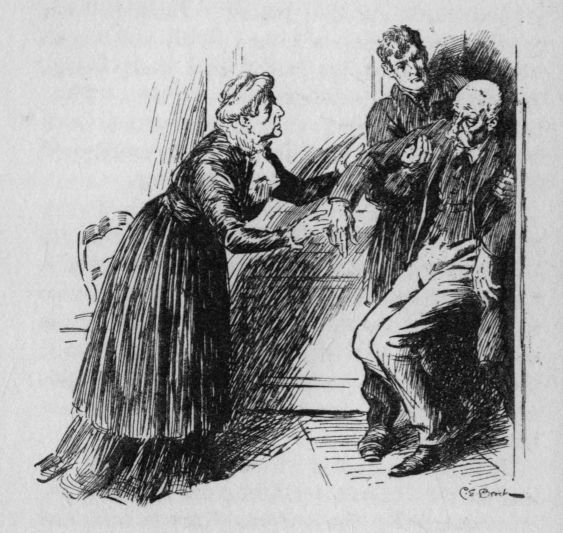
The marquis is hit
"Hard luck!" thought Burton, for the shot that wounded the general was the last to be fired for a considerable time.
VI
The enemy ceased firing, both within the château and without. Wondering what their next move would be, Burton remained heedfully on guard, rifle in hand. Pierre, overcome with grief at the collapse of his master, was assisting the marquise to restore him and to bind up his wound.
Presently the German's voice came through the door.
"General du Breuil!"
"What do you want?" Burton called.
"You treacherous hound! I have nothing to say to you," cried the German, angrily. "I speak to the general."
"The general deputes me to answer for him. If you will not speak to me, you will go unanswered."
"Who are you?" the German asked with an oath.
"The general's deputy," replied Burton.
"That will not avail you," cried the officer, sneeringly. "I have sent to the village to fetch that rascally smith who assisted your imposture. When he has told me who you are, he shall be deaf and dumb for his last minute in life."
Burton felt chill from top to toe. He had not thought of the peril in which his stratagem might involve the smith. The Germans were capable of any enormity. But he could do nothing--except gain time. Would the British advance guard arrive before all was lost?
"Well, if the general chooses to employ a cur as his deputy, so be it," the German went on. "Like man, like master. Take this message to the general: If he does not yield, I will fire the château."
"And if we surrender?" said Burton.
"We will deal with him as a soldier. He will be tried by court-martial."
"On what charge?"
"That, having been a soldier, with no excuse of ignorance of the laws of war, he, as a civilian, resists the military power."
"And if he is found guilty?"
"His fate will lie in the discretion of the court."
"And his old servant?"
The German, anxious to gain his ends without further fighting, hesitated, then replied, equivocally--
"The court will decide."
"And myself?"
"The court will decide," replied the officer, impatiently.
"Is that all?"
The German smote the door angrily.
"Your answer!" he cried.
"You will give us a few minutes for consultation?"
"Five minutes: no more."
Burton stood on his chair, holding his rifle.
"I heard it, monsieur," said the voice of the marquise in an undertone behind him. "My poor husband is incapable of speech. We must leave all to you. But can we resist fire?"
"Madame, I seek to gain time. We can expect no mercy from the Germans. There is but one hope--that our army will arrive in time. If that hope fails----"
"Spare us fire, monsieur, I implore you. It is frightful."
She wrung her hands piteously.
"Trust me, madame; hope, and pray," said Burton.
When the five minutes were up, the German hailed him. "Your answer--quickly."
"Monsieur le capitaine," said Burton, suavely, "we cannot surrender yet. We should like to kill a few more Germans."
The officer let out a vicious oath.
"Then roast!" he cried. "You and the rest."
"Including your worthy commandant, mon capitaine? Don't forget him."
"You have murdered him."
"That is the explanation of their reckless shooting," thought Burton. He replied: "Not at all. We are not Germans."
"You lie!" cried the captain, whose anger was rapidly getting the better of him.
"Did I not remind you, monsieur, that we are not Germans?"
The officer was speechless with rage. Burton imagined his quandary. It would be awkward for him if he set fire to the château and burnt his superior. His next words showed his state of mind.
"You say Major Schwikkard is alive. Prove it."
"Nothing easier, mon capitaine," said Burton. "You must give me a few minutes. He is a heavy man."
He saw that there was nothing to lose, possibly something to gain, by convincing the German. Slipping down from his perch, he hurried to Pierre, who was kneeling at his master's chair.
"Come with me," he said, and led him into the room where the major lay gagged and bound. The bed was a light one. They carried it to the window, and tilted it on end. Leaving Pierre to maintain it in that position, Burton returned to the chair, and kept silence until the captain impatiently demanded his proofs.
"I must trouble you to descend and go to the rear of the wing, monsieur," said Burton. "It is dark: no doubt you have a flashlight?"
"We have; what then? Do not play with me."
"Far from it, monsieur. I am aware of the gravity of your position. Go down to the garden at the rear, and look up at the window that will then face you. But do not flash your light up until I give the word."
The German snarled under his breath. Burton caught the sounds of a whispered consultation at the stair-head. A minute or two later the officer called up from the garden. Burton withdrew the piled-up furniture, opened the shutters, and helped Pierre to lift the bed, tilted as it was, to the window. The major's form, stretched upon it, somewhat resembled a mummy in a case.
"Now, monsieur!" Burton called.
The glaring light of an acetylene lamp was thrown up towards the window. It fell on the major's face, which, ghastly in itself, looked death-like in the glare.
"He is dead!" the captain shouted.
"Not at all--only afraid; he overheard your amiable intentions. We will demonstrate." He turned to Pierre, saying: "Fetch some pepper."
"There is none upstairs, monsieur. I dare not go below."
"Some snuff?"
"Ah, oui! monsieur le marquis likes his pinch. A moment, monsieur."
He went into the bedroom, took a snuff-box from his master's pocket, and returned. Burton opened the box, took a large pinch of snuff, and held it to the major's nose. There was a slight but dramatic pause. All was silent. Then the major's features became convulsed, and the silence was rent by a resounding sneeze.
"Now, monsieur le capitaine," cried Burton, "could a dead German sneeze like that?"
There were snarls of rage from below, mingled, Burton thought, with suppressed laughter from some of the troopers who had gathered in the background behind their officers.
"With your good pleasure we will resume our interesting conversation above," said Burton.
With Pierre he lowered the bed and carried it back to its former position. Then he replaced the shutters.
"Another ten minutes gained," he thought.
The ten minutes were prolonged to fifteen. The captain was consulting with his subordinates. Presently he called through the door--
"Are you there?"
"Always at your service, monsieur."
"Seeing that Major Schwikkard is apparently alive, we will permit you to surrender on terms."
"What terms, monsieur?"
"You shall be allowed to pass through the German lines."
"I should like to consult the general, monsieur," said Burton, still talking to gain time.
"Five minutes."
"Let us say ten, monsieur," Burton pleaded. "It is, you will admit, a serious matter."
"Ten, then; not a minute more."
At the end of the ten minutes the captain called for an answer.
"The general wishes to know, monsieur, what guarantee he has for safety."
"The word of a German officer," snarled the captain. "Be quick!"
Waiting a minute or so, Burton said--
"The general has a little difficulty in making up his mind--pardonable at his age. You give him another ten minutes, monsieur?"
"Three; not a second more," cried the German, completely hoodwinked by Burton's tone, and unaware of the vital consideration in Burton's mind--the return of Captain Rolfe to head-quarters.
"Very well, monsieur. I will bring the general's answer in three minutes."
The marquise and Pierre were holding their breath. The same thought possessed them both; to what lengths would this audacious Englishman go?
The period elapsed; the captain called peremptorily for an answer.
"The general, monsieur, has considered your offer," said Burton, "and he feels safer where he is."
At last the German's besotted intelligence was penetrated by the suspicion that he had been played with. He poured out his venom in a torrent of virulent abuse, snatched at his revolver, and fired point-blank into the darkness. The bullet struck one of the legs of Burton's chair, the chair broke under him, and he fell with a crash. The effect of the shot, heard but not seen by the Germans, was hailed by them with a shout of triumph. But Burton crawled into the bedroom, with no worse injury than bruised elbows and shins.
VII
Into the next few minutes were crowded, as it seemed to Burton in reminiscence, the events of hours. Emboldened by the supposed success of the captain's shot, the Germans renewed the attack with great violence and determination, both within and without. Repeated onslaughts were made on the tottering door, which was now almost completely splintered, and on the barricade of furniture behind it. Burton had lost no time in replacing the broken chair, and twice his steady fire from near the ceiling sent the attackers back in a disorderly heap.
Meanwhile two of the windows and their shutters had been riddled by long-distance fire, and men were again mounting on ladders to break into the rooms. At one, Pierre played a manful part; at the other, the general, bracing himself as the peril grew greater, stood holding his revolver in his left hand, and shot man after man.
The grey light of early morning was now stealing into the room, depriving the defenders of the advantage of darkness. The shouts of the men, the reports of the guns, the suffocating fumes, made the place an inferno. At the bedside the marquise still bravely held her post. Burton was too busy to notice the extreme pallor of her face, the trembling of her hands, the agonised look of terror in her eyes.
With a wild shout the infuriated Germans crashed through the broken door, and began to pull away the barricade at the end of the passage. While they were doing so, it was impossible for their comrades to continue firing; the attack was interrupted, and Burton shot down many of the enemy among the pile of shattered furniture. But he recognised that, the Germans having won an entrance to the passage, it was only a question of minutes before the defence was overwhelmed.
At this moment he heard a groan in his rear. Pierre, badly hit, had staggered from the window he had been defending through the communicating doorway into the invalid's room. "It is all over with me!" he moaned, sinking at his mistress's feet. The crack of the general's revolver still sounded at short intervals from the next room. Here and there the woodwork was smouldering; before long it would burst into flames.
"There is only one thing to be done," thought Burton, resolved to maintain the struggle to the end, desperate as the position was. "We must keep together, and make a last stand at the captain's bed."
Filling his magazine, he poured shot after shot into the enemy crowding in the doorway and bursting through the barrier. The survivors reeled back under this withering fire, giving Burton time to leap from his perch, run into the room, and call the general to his side. Pierre was helpless, the invalid was half dead, only the general and Burton remained to stem a tide which would soon flow back with tenfold force along the passage.
The two men posted themselves before the bed, ready to meet the final rush. Unknown to them, the marquise had taken the revolver from Pierre's hand and stood in front of her son, like a lioness defending her cub. The attack was renewed simultaneously on all sides, but a strange inadvertence on the part of the enemy intervened to deal a partial check. They were shooting from the demolished barricade at the end of the passage. At the same time their comrades outside had begun to fire through the window in a direct line with it. Several of the Germans in the passage fell to the bullets of their own friends.
Growling at this mishap, the unwounded men broke through the doors at the sides into the rooms. Burton had closed and barricaded, as well as he could, the communicating doors, but he felt with a sinking heart that a few seconds would bring the unequal contest to its inevitable end.
The din was terrific, and with it was now mingled a surprising sound from outside the house.
"A machine-gun!" said Burton to himself. "They will shatter their own men!" He had no more time to think about it. The door of the room to his left fell in with a crash; in the glimmer of dawn the opening was crowded with Germans. Burton and the general emptied their revolvers into the mass; it collapsed, and the two men hastily filled their chambers to meet the next, the final rush.
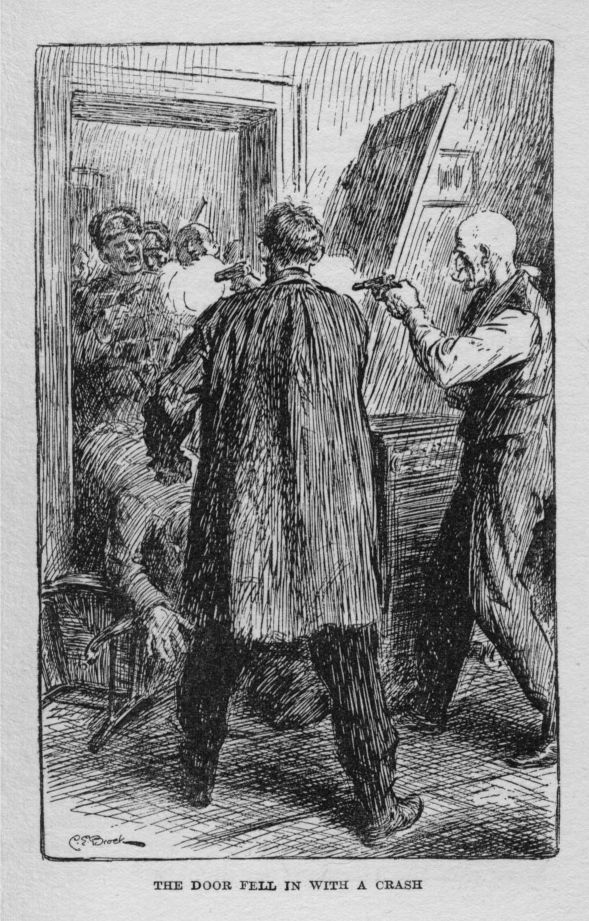
THE DOOR FELL IN WITH A CRASH
But there was a strange lull in the rifle fire. From outside again came the rattle of a machine-gun, and, in a momentary interval of silence, Burton caught the sound of cheers. Surely they were not German cheers? He thrilled with the conviction that the voices this time had the true British ring. He waited the expected rush; it did not come. The doorway was clear; heavy feet were trampling in frenzied haste along the passage. With the intermittent rattle of machine-guns close at hand came unmistakable British shouts.
Burton rushed to the window. The shutters were now in flames. Wrenching away the bars, he thrust his head through the shattered glass, and joyfully hailed the khaki-clad Lancers who had reined up below. There was not a living German to be seen. The greensward and the trampled parterres were strewn with prostrate forms. And with a rattle and clank a battery of horse artillery galloped upon the scene.
"We are saved, madame!" cried Burton, turning back into the room. "Our Lancers have put the Germans to flight."
"Dieu merci!" murmured the lady, falling on her knees at the bedside.
"Ah, les braves Anglais!" said the marquis, grasping Burton's right hand with his left, and jerking his arm up and down like a pump handle.
They looked at old Pierre, who had raised himself, and was feebly shouting: "Vivent les Anglais! Vive monsieur le sourd-muet!"
Then, to Burton's amazement, he cracked his fingers, and laughed like a lunatic.
"The poor fellow's brain is turned," said the marquis.
"No, no, monsieur, I am not crazy. Ah, ah! it was a trick to play!"
"What are you raving about, mon vieux?" asked the marquis.
"The smoke, monsieur! The paper! I gave the spy Schwikkard a foretaste. Ha! Surely he believed his last hour was come. See, monsieur, I burnt some brown paper in the stove under his nose. He would fire the château! Eh bien! assuredly he believed it was already on fire. It was drôle, monsieur--fine trick, n'est-ce pas?"
"Schwikkard is our prisoner, without doubt," said Burton to the marquis. "Shall we untie him?"
At this moment entered Major Colpus of the Lancers, stepping gingerly over the wreck of door and furniture.
"A pretty mess they have made of it," he said, with double intent. "You are Burton?"
"That's my name."
"Captain Rolfe told us we should catch a half-regiment of hussars if we hurried. He rather expected you would be a prisoner. We got to the village just as some of the Germans were hauling away one Boitelet, the village smith, it appears. They left him to us, and he gave us an inkling that you were concerned in the rumpus here. The Germans have skedaddled; we have a few prisoners below. You have had a whack or two, I see."
"I wasn't aware of it," said Burton, looking with surprise at dark stains on his blouse. "The marquis and his man are both wounded."
"Glad to meet you, monsieur," said the officer, who, with British shyness, had affected to ignore the presence of all but Burton. Now, however, he greeted monsieur and madame courteously, knelt down and rendered capable first-aid to the marquis and Pierre, and seeing at a glance that the man in bed was very ill, dispatched Burton for the regimental medico.
It was not until the doctor was engaged with his patients that Burton found an opportunity of releasing Major Schwikkard, and handing him as a prisoner to the British officer. He was scarcely recognisable. The long vigil, with the dread of being roasted by his own instructions, had broken him both in body and mind. He looked years older. His cheeks had fallen in, his whole frame shook, and his hair was patched with white. When Major Colpus addressed him cheerily, he stammered, tried to complete a sentence, and burst into tears.
"Poor wretch!" the major murmured. "Doctor, here's another patient for you. Now, Mr. Burton, come and tell me all that has happened."
"I want to get back to my aeroplane," protested Burton.
"No hurry for that. Your friend, the smith, has borrowed a spare mount, and ridden off to the town to fetch something or other for it. I shan't let you off."
Burton growled that there was not much to tell, and turned to take his leave of the old marquis and his wife. In their over-flowing emotion they could hardly speak.
"God bless you, monsieur!" said the marquise, brokenly. "You have saved us all. Your doctor says that my son will recover. Take a mother's thanks, and wear this, monsieur. May the good God preserve you!"
She took from her neck a chain bearing a richly jewelled cross, and pressed it into Burton's hand. He bade them good-bye.
"Adieu, monsieur!" said old Pierre, as Burton shook hands with him. "The wound--it is nothing. Your good doctor has stitched it up. I was not born to be killed by a Bosche. Ah, ça! It was a good trick, monsieur, n'est-ce pas?"
Chapter III Heading
BORROWED PLUMES
I
The tramp steamer Elpinike, bound from the Peiræus to the island of Tenedos with supplies for the Allied forces, was thrashing its way northwards through the blue waters of the Ægean Sea. It was a warm, sunny day; the Levantine crew lolled on the bulwarks, and a mixed group of passengers was gathered on the after-deck. Three or four French officers, smoking cigarettes, basked on deck-chairs; several men, whose nationality it were hard to determine, leant in picturesque attitudes against the wall of the deck-house; and a couple of Englishmen, wearing overalls and low cloth caps, and with blackened briar pipes between their lips, sat side by side on the third of the steps leading to the bridge. They eyed with faint amusement the centre of the group, a very fat man sucking a very fat cigar, who lay back in his creaking deck-chair and discoursed at large.
Mr. Achilles Christopoulos, as he had announced himself to his fellow-passengers, was the agent of the charterers of the vessel. He was, he assured them, a very busy man. He had broad, bulging, swarthy cheeks, a multiple chin, and a heavier moustache than is common among his compatriots; for Mr. Christopoulos was, by his own account, a Greek of Greeks. His English was fluent, with little oddities of accent and pronunciation; and after every few words he drew deep, audible gasps for breath.
"Yes, zhentlemen," said Mr. Christopoulos, waving his cigar towards the Englishmen and Frenchmen, "my country will remain neutral. Of war we have had enough; it is time we had a rest. And tell me, why should we pull your chestnuts out of ze fire? Tell me zat? What did you do to help us against ze Turks twenty years ago? Nozink. And two years ago? Nozink. We are nozink to you. We wait; zat is our policy; and when ze time comes, why, zen we show ze world we do not forget our history."
"Ah, bah!" exclaimed one of the Frenchmen, flinging a half-smoked cigarette into the sea. "You are egoist, monsieur. Your history--vat? I zink of Pericles; I zink of your patriots since a hundred years. Ah! zat vas not zeir policy."
"But ze time has changed, monsieur. Pericles, he is dead. Ze German Emperor, he is alive."
"Conspuez-le!" said the Frenchman.
Mr. Christopoulos smiled.
"Consider with calmness, zhentlemen," he said, as though appealing from the excitable Frenchmen to the more stolid English. "Ze Turk, with ze German Emperor at ze back, is to-day a new man. Ze King of ze Hellenes knows ze power of Germany. He runs no risks. We have men who are ignorant, who do not zink. Zey make a fuss, cry for war; ze king knows it is foolish, and holds tight ze reins. Greece owes much to Germany, and shall owe more."
The French officers burst into angry declamation. The Englishmen, who had taken no part in the conversation, listened for a few minutes longer, then got up and strolled along the deck.
"Talks too much, Teddy," said one of them.
"Let 'em talk," replied the other.
Edward Burton, of the Flying Corps, after several months' exhausting service in France, had been invalided home. On reporting himself at headquarters after his convalescence, he was ordered to the Dardanelles. Taking a P. and O. steamer for Alexandria, he had met on board an old friend, Dick Hunter, who had recently come into the corps from a line regiment, as observer. The supply ship in which they took passage at Alexandria had put into Athens with a broken shaft, and to save time they had joined the Elpinike at the moment of her leaving port.
The Elpinike was very old, very dirty, very smelly, and very slow, plodding along at seven or eight knots. The two airmen, accustomed to easy and rapid flights, were thoroughly weary of the voyage by the time the vessel reached harbour. They found themselves there in the midst of intense activity, reminding Burton of the bustle and orderly confusion at the bases in France. They reported themselves at headquarters, only to learn that, pending the arrival of new machines from England, there was no seaplane ready for them, and they had to resign themselves to kicking their heels for a time. There was, however, plenty to interest them. Troops--British, French, and Colonial--were continually arriving from Egypt and departing on transports for the Dardanelles. Warships came and went; airmen were present who had reconnoitred for the fleet in the attacks on the forts, and to discover the strength of the Turks on both sides of the strait. These retailed their experiences for the benefit of their comrades newly arrived, who grew more and more eager to set to work.
Now and then they ran up against Mr. Christopoulos, who was quartered near them, and found it a little difficult to shake off that garrulous man of business. He showed a disposition, they thought, to presume on the acquaintance made during the voyage from the Peiræus. As a rule they gave only perfunctory acknowledgments of his greetings; sometimes they were unable to escape him.
"You are still idle, zhentlemen?" he said one day. "Zere is a shortage of aircraft, I hear. How provoking!"
"It gives us time to get acclimatised," said Burton.
"Zat is true. It is very fine air. You like ze wine of ze country? It is very fine. You know, of course, zat here came ze fleet from my country for ze siege of Troy. Ah! we Greeks were ten years taking Troy, and I zink you will be ten years taking Constantinople."
"Let's hope not," said Burton. "Your ancestors hadn't aeroplanes, you see. Our planes will be even more useful than the Wooden Horse."
"Perhaps. And when do you expect to get to work?"
"All in good time."
"You will go to Enos, perhaps?"
"We shall go wherever we are sent. You'll go back to Athens in the Elpinike to-morrow, I suppose?"
"No. My business keeps me here. I am a very busy man."
He went on to describe some of his activities, and the Englishmen, breaking away at last, made but a cool response to his genial "Au revoir, zhentlemen."
It was ten days before their seaplane arrived. The engine required very little tuning up. They made a few trial trips, to accustom themselves to the atmospheric conditions of the Ægean Sea, and looked forward to an early call to action.
On returning to their quarters one night, they were surprised to see a British sentry at the door of the house where Mr. Christopoulos lodged.
"What's up?" asked Hunter, stopping.
"Got orders to guard this house, sir," replied the man.
"What for?"
"A party of us was sent to arrest the chap that lives here, sir--the fat Greek Christopoulos. Don't know what he's been doing; swindling somebody, perhaps."
"Did you get him?"
"No, sir. He can't be found."
They passed on, and, after changing, went to the restaurant for their evening meal. There they learnt that Mr. Christopoulos was suspected of spying. It appeared that he must have got wind of the order for his arrest, and had decamped; but his disappearance was a mystery, for no vessel had left the island since the morning, with the exception of a small country sailing-boat. It was conjectured that he had left on one of the small craft engaged in bringing provisions to the base; but though several of these had been overhauled at sea by fast despatch boats, no trace of the fugitive was discovered.
Two days later the airmen were summoned to headquarters.
"Your machine is in order?" asked the staff-officer.
"Yes, sir--ready for anything," Burton replied.
"Then you'll ship on board the ----." He named a cruiser lying in the harbour. "There are rumours of a large Turkish concentration at Keshan. You'll find out if they are true. The cruiser will take you up to the Gulf of Saros, and you will start your flight from the neighbourhood of the coast somewhere south of Enos. The cruiser will await your return."
They hurried down to the harbour. The seaplane was slung on board the cruiser, which steamed away northward, through the huge armada of British and French war-vessels, transports, and supply ships that thronged the sea. It was an open secret that the preparations for a combined attack by land and sea were far advanced. They heard the distant boom of heavy guns, which grew louder and more continuous as they neared the mouth of the strait. When they opened up the headland of Suvla Burun the course was altered a few points to the east, and another hour's steaming across the Gulf of Saros found them some five miles from the coast, off Kurukli. Here the cruiser hove-to, and the seaplane was slung out.
The captain had already given the airmen their bearings. North-west lay Enos and the river Maritza, with the Bulgarian port of Dedeagatch beyond. Keshan, their objective, was to the north-east, about thirty miles distant from the coast.
"I will cruise about for four or five hours," said the captain, "keeping well out to sea, out of range of the batteries in the Bulair lines yonder." He pointed due east to the neck of the Gallipoli peninsula. "You have plenty of petrol?"
"Enough for the job," replied Burton.
"Well, good luck to you. 'Ware shrapnel."
They slipped over the side into their places. Burton started the engine, and, after skimming the surface for a few moments, the seaplane rose like a bird and soared away, ever higher, towards the coast northward.
II
The sky was clear, the air calm--an ideal day for airmen. In a few minutes they passed over the rocky and precipitous line of the coast and pursued their flight inland. Hunter, closely scanning the country beneath through his glasses, presently exclaimed, "A gun!" and shortly afterwards, "A battery!" The guns were cleverly concealed from observation from the sea, behind a cliff, marked by a clump of the dense brushwood that flourishes on the shores of the Gulf of Saros. Hunter expected a shot or two from the gunners, but they made no sign, probably unwilling to reveal their position to the warships in the bay. They were saving their shot for more serious work than firing at seaplanes.
Northward they saw a river flowing east and west. Passing over a village--Kiskapan, according to the map--they crossed the river almost at right angles with its course, and beyond a range of low hills discovered their objective about five miles away. They had travelled some thirty-five miles by dead reckoning, which corresponded with the estimated distance from the cruiser.
Before they obtained a full view of Keshan itself they perceived evidences of a considerable concentration of troops. At several points around the town there were extensive encampments. Clouds of dust to the north, east, and north-east betrayed the movements of troops or convoys. And when they were still about two miles from the town they heard the familiar rattle of machine-guns and the long crackle of rifle fire. But they were too high up to feel any anxiety, and while Burton wheeled round and round in an extensive circle, Hunter busily plotted out on his map the positions of the camps, and made notes of the directions of the movements, the estimated number of the battalions, and the nature of their arms.
After a while Burton began gradually to drop, in order to give Hunter a chance of recognising gun emplacements. At about two thousand feet the enemy opened fire. White and creamy puffs of shrapnel floated and spread in the air. A shell burst some distance beneath them, another above them, and soon the machine was cleaving its way through a thin cloud of pungent smoke. It appeared that at least six guns were at work.
"Better get out of this," shouted Hunter. "I've got about enough information."
"We'll go a little farther north," replied Burton, "to see if any reinforcements are coming up towards Keshan."
"All right, but go a bit higher; I heard two or three smacks on the planes just now."
Rising a little higher, Burton swept round to the north. In a minute or two Hunter was able to see that the hill track from Rodosto was choked with transport of all kinds. Right and left, every possible route from Constantinople and Adrianople was equally congested. It was clear that a vast army was being concentrated within striking distance of Gallipoli, and on the flank of any force moving eastward from Enos or any other point of disembarkation.
Burton then headed west towards the Maritza, intending to return by way of Enos and discover, if possible, what force the Turks had available for the defence of that place. They were passing somewhat to the north of Keshan, to keep out of the way of the batteries, when Hunter suddenly caught sight of an object like a large bird low down in the sky on their left hand. A few moments' scrutiny through his glasses confirmed the suspicions which had seized him on the instant.
"An aviatik, coming our way," he called.
"Won't catch us," responded Burton with a smile.
"Stay and fight it?"
"It's tempting, but we mustn't. It won't do to run risks when our job's to collect information."
Hunter acquiesced with a sigh. Burton shifted his course a point or two to the west, so as to run nearly parallel with the enemy's aeroplane.
A moment or two later he gave a start of alarm.
"What's the matter?" asked Hunter.
"Afraid there's a leak. The petrol gauge is falling faster than it ought. They must have knocked a hole in the tank. See if you can find it."
Hunter twisted in his seat, bent over, and began to examine the tank.
"Can't find any leak," he said presently. "If there's one, it's out of reach. How's the gauge?"
"At this rate we shall be done in another ten minutes."
"Whew! How much farther to go?"
"At least twenty miles, perhaps more. I wish we had come straight. There's absolutely no chance of getting back before the petrol gives out. Where's the enemy?"
"Still on our port side, going strong. It looks as if she means to chase us, thinking we're running away. We shall have to fight now, shan't we?"
"Yes. We're bound to come down in a few minutes, and if we don't tackle her at once it's all up with us. How far is she off?"
"About a couple of miles, I think, and about the same height. Her course is between us and Enos, worse luck!"
"Wish we had a machine-gun! I'll come round; take a shot when we're within range, and for goodness' sake cripple her."
He brought the seaplane round in an easy curve, at the same time climbing to get above the enemy. His eye was all the time on the rapidly falling gauge. The aviatik held on its course for a little, then wheeled to the south-west, as if to cut the seaplane off. It was clear that the enemy airmen had no wish to avoid a fight.
Burton's wheeling movement had now made his course almost due east, so that the two machines were rushing obliquely towards each other at the rate of about a hundred miles an hour. When they crossed, Burton was slightly ahead of the enemy, and, to his surprise, somewhat lower. At almost the same moment Hunter and the enemy's observer opened fire with their rifles, but each was handicapped by the fact that he was firing from right to left, and no damage seemed to have been done on either side. As soon as Burton had passed the enemy, he banked his machine and wheeled to the left, climbing as rapidly as possible to make good the deficiency in height. The aviatik also made a spiral movement to the left, with the result that in a few seconds the machines were once more converging on each other. This time, however, Burton was slightly to the rear of the enemy, and when their tracks crossed, he shot up behind it on its left. The aviatik, a second or two too late, made a desperate effort to edge away eastward, but the movement only brought the two planes closer together.
"We can't stick it another minute," gasped Burton.
Hunter did not reply. He had dropped his rifle and seized his automatic pistol. The machines were at point-blank range. Hunter fired. The enemy's observer screwed himself round in his seat to reply. Aiming at the pilot, Hunter sent a stream of bullets from his pistol. The pilot fell forward. For a moment the aeroplane rocked and seemed on the point of capsizing. Then the observer seized the controls, and, with a recklessness that bespoke inexperience or want of skill, began a perilously steep volplané.
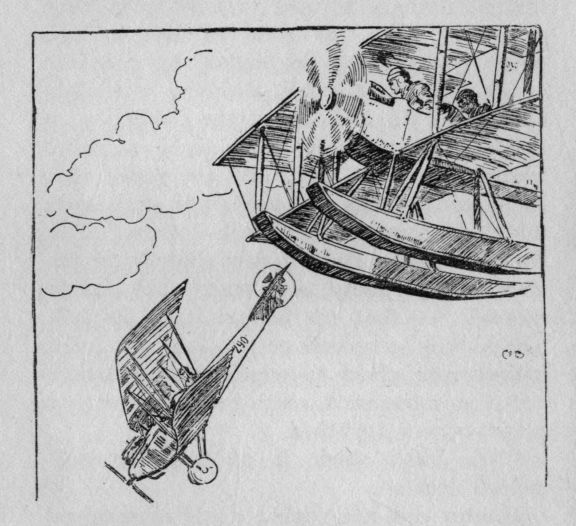
An aerial somersault
Hunter looked down. The machine was rapidly dropping towards the edge of the lake a little to the east of the Maritza River. Suddenly, while yet some distance from the ground, the aviatik's descent was averted, possibly by an air pocket over the lake. For a moment it seemed poised without motion, then it turned a somersault. The observer fell out, and dropped into the lake at the same instant as the machine crashed on to the bank.
Meanwhile Burton had circled round. His tank was nearly empty. He must either come down or fall down. There was no sign of life in the wrecked aeroplane; the observer had disappeared in the water; no one was in sight. Swinging round again Burton adjusted his elevator so as to descend on the lake, and in a few seconds the seaplane was resting on the surface within thirty yards of the spot where the aviatik lay, a mangled heap, on the bank.
III
"We can wade ashore," said Burton. "I can see the bottom."
"Hadn't we better mend the leak?" Hunter suggested.
"But I want to see if the German has any spare petrol. We've lost a lot."
They waded through a foot or two of water, and examined the wreck. One of the wings was crumpled up; otherwise the machine had suffered little injury. The pilot, a fair-haired German of Saxon type, was dead. There was plenty of petrol in the tank, and Hunter drew this off into a tin can while Burton returned to the seaplane, pulled it ashore, and set about discovering the leak. It turned out to be a long thin crack on the underside of the tank.
"How on earth are we to mend this?" said Burton, looking at it ruefully.
"Why not stuff it up with mud?" said Hunter. "This stuff at the edge of the lake seems to be clayey, and it will harden in no time."
"Good! It may last for the few miles we have still to cover. Just keep a lookout while I work at it."
Hunter went up the bank. A rough bridle-track skirted the lake and disappeared in a plantation that came down to within about a hundred yards of the water. To the south the view was shut in by a wooded knoll. There was neither man nor house in sight.
Burton had just kneaded some clay for stopping up the crack when they heard shouts in the distance, apparently from a southward direction. He ran up and joined Hunter, and they went together to the knoll some hundred and twenty yards away, from which they expected to get a view of the southern shore and perhaps of the men from whom the cries came. They were careful to keep under cover, and, on arriving at the knoll, lay flat on the ground. As they had hoped, they could now see a large portion of the lake which had previously been hidden from them, and caught glimpses, on the western side, of the bridle-track here and there among the trees. At intervals it disappeared behind slight hillocks or denser stretches of the plantation.
For a minute or two they saw no human beings. The sounds had ceased. But presently, about a third of a mile away to the south, they caught sight of a party of half a dozen horsemen searching the shore of the lake, now trotting into the wood, now riding at the edge of the water, now cantering along the bridle-track in the direction of the Englishmen.
"Turks!" murmured Burton.
"They must have seen the machines fall," said Hunter. "This is awkward, Teddy."
"It is, by Jove! and there are more of them. Look at that lot behind there. They'll be here in three or four minutes--no time to plaster the crack and get away."
"We had better scuttle our plane and dive into the woods. There's just a chance of our getting across the Maritza into Bulgaria."
"That means internment. Besides, it would be simply rotten to destroy the machine if we can help it. Perhaps there's some other way. In any case we must get back. Put on a sprint."
They raced back to the spot where they had landed, the knoll concealing them from the Turkish search-party. The sight of the body of the German pilot suggested an idea to Burton.
"Look here, we must trick them," he said rapidly. "There's a bare chance of saving our machine, and I doubt whether we've time enough even to destroy it. For the next quarter of an hour I'm a German, and you're my English prisoner. We are done if there's a German among them, but that's our chance."
Removing his own cap, he replaced it with that of the German pilot, borrowing at the same time one or two small articles of his equipment. Then he bound Hunter's hands and feet.
"Slip-knots, old man," he said. "You can free yourself in a jiffy. But don't do it too soon. Just in time! I hear them coming. Here goes!"
He uttered a loud shout. In a few moments the horsemen appeared on the crest of the knoll. Burton waved his left hand, with his right holding a pistol pointed at Hunter's head. The horsemen, led by an elderly Turkish officer in grey uniform and fez, galloped down towards them. While the officer was still several paces distant, Burton saluted and addressed him.
"Sprechen Sie Deutsch, mein Herr?"
No one would have guessed with what anxious trepidation he awaited the answer. He had used almost all the German he knew. His heart leapt when the Turk shook his head.
"Vous parlez Français, monsieur?" said Burton.
"Oui, certainement. Qu'est-ce que c'est que ça?"
"You have come in good time, monsieur le capitaine," said Burton in French. "I regret that I do not speak Turkish, and that our conversation must proceed in a language which, no doubt, you cordially detest. Our good Kaiser will soon forbid the use of it in Europe; German and Turkish are the languages of the future. Meanwhile! ... You see, monsieur le capitaine, there has been a duel in the air. My pilot was, unhappily, shot by the enemy. We both had to descend; the enemy, no doubt, had difficulties with his engine. No doubt he expected to find both the pilot and myself dead or disabled. But a true German, like a true Turk, is a hard man to kill. Single-handed I attacked the enemy as they landed. Imagine their consternation and fear! One of them, using the long legs which serve the cowardly English so well, fled into the wood. The other lies here."
The Turkish captain bent over his saddle to inspect the captured Englishman. For his benefit Hunter assumed an expression of sullen ferocity.
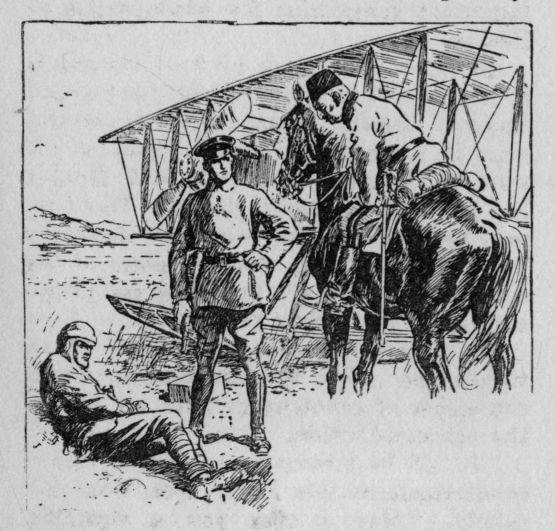
"He looks a terrible fellow"
"It was well done," said the Turk in French. "He looks a terrible fellow. I make you my compliments, monsieur. It was a brave deed to attack two men single-handed."
"Oh, that's nothing to us Germans," said Burton airily. "We never think of odds. We are like that; the greater the adverse odds, the better pleased we are."
"That is indeed the characteristic of your noble nation," said the Turk politely.
"Still, it is as well to reduce the odds when we can," Burton went on. "Half the enemy's force has escaped. Could you spare a few men, monsieur le capitaine, to scour the woods?"
"Certainly, though I have little time to spare. I am engaged, you will be glad to know, in escorting a fellow-countryman of yours, monsieur--a German in the secret service, who has just landed at Enos--with important information for headquarters at Keshan."
He broke off to give his troopers orders to hunt about in the woods for the escaped English airman. They were to return, even if unsuccessful, at the sound of his whistle. Meanwhile, Burton and Hunter had exchanged uneasy glances. The German could not be far away. No doubt he was coming up with other members of the escort. The sight of the falling aeroplanes had drawn the officer in advance.
The troopers galloped off. The officer turned once more towards Burton, whose expression of countenance gave no sign of the agitation within.
"It will be interesting to meet a fellow-countryman in this lonely spot," he said calmly. "May I offer you a cigarette, monsieur?"
The Turk took one from the opened case, thanked Burton, and turned the cigarette over in his fingers.
"Made in Cairo, monsieur?" he said.
"Yes, it is a privilege of us airmen to levy upon the enemy. Refugees have no need to smoke. With the airman it is a necessity--it steadies the nerves."
"True. And they make good cigarettes in Cairo." He lit the cigarette from an automatic lighter. "The Englishman looks frightened."
"He expects to be killed, I suppose, not knowing our German humanity. But you will excuse me, monsieur, if I examine the English aeroplane. It will come in useful."
Burton returned to the machine, and, after feigning to examine it, proceeded to plaster the crack with nervous haste. The Turk had followed him, and, remaining in the saddle, watched his operations with much interest.
"It was this injury that caused the Englishmen to descend," Burton explained. "German bullets never fail."
"An English bullet was more successful, however," said the officer, glancing at the dead pilot.
"Not more successful, surely, monsieur. We have scores of good pilots, we can replace every man that falls; but the English cannot afford to lose a single machine. And do not our German newspapers tell us that they have hardly any left? The earth is the Kaiser's; the sea is his; the air is his also. Turkey will flourish again in German air."
Having filled up the crack, Burton proceeded to pour petrol into the tank.
"This fellow-countryman of mine?" he said.
"He will be here soon, no doubt. He is a trifle stout, and a poor horseman. Consequently he travels slowly. When he saw the aeroplanes descending he insisted on our pushing on to render assistance to his fellow-countrymen. He cannot miss the track, there is only one. But he should be in sight."
The Turk looked backward over the track, then saying, "Excuse me," he wheeled his horse and began to trot towards the knoll. Burton had by no means completed the replenishment of the tank. He felt that something must be done.
"Monsieur le capitaine!" he shouted.
The Turk pulled up. Burton went towards him with an air of mystery.
"Your men are at fault, monsieur," he said. "It would be a pity to let the Englishman escape, and you have no time to waste. Perhaps if I show the way!"
He walked on up the knoll, the Turk riding by his side.
"There, monsieur, you see that big tree on the far side of the bay? If you do not find the fugitive thereabout you won't find him anywhere."
The Turk hesitated. Perhaps he was considering whether it comported with an elderly captain's dignity to take a personal part in the search. Burton eyed him anxiously, hoping that he would go, meet the approaching German, and take him with him. The pause was brief. The temptation to catch a live Englishman overbore all considerations of dignity. With a word of thanks to Burton the Turk cantered on towards the big tree.
Burton breathed again. He hurried back to the seaplane.
"Slip the knots, Dick," he said, "but don't get up. I'll give you the word. I hope I've got rid of the Turk for a while."
He was in the act of pouring petrol into the tank when a figure appeared from round the western base of the knoll. It was a big Sancho-Panza-like person, mounted on a mule.
"Great Scott!" murmured Burton.
Dropping the empty tin, he hastened to the aviatik for another.
"I say, Dick, do you recognise that fellow?" he asked.
"Christopoulos!" Hunter whispered.
"As large as life! What on earth are we to do? He will recognise us directly, even if he hasn't done so already."
"Shoot him and scoot!"
"I haven't enough petrol yet. The tank still leaks, though not so badly, and if we shoot, the Turks will swarm up before I can fill up and get away. I think I had better go on with the job, let him come up, and trust to luck."
Keeping his back to the pseudo-Greek, Burton carried another tin to the seaplane. Before he had emptied it into the tank the spy came within hailing distance and let out a jovial greeting in German. No doubt he had recognised the German airman's cap, and, without misgiving, hailed his supposed compatriot.
"Good-morning, my friend," he shouted. "I congratulate you. Another German victory!"
Burton, his back still towards the spy, finished pouring out the petrol, and placed the tin on the ground. As he straightened himself he discreetly drew his revolver and suddenly turned round. The spy was now within half a dozen paces of him.
"Thank you, Mr. Christopoulos," he said. "Another victory--but not a German victory. We shall presently see who is to be congratulated. Meanwhile, you will dismount."
The German, who had reined up at the first glance at Burton's face, turned a sickly colour and half-opened his mouth as if to shout.
"Silence!" cried Burton peremptorily. "If you make the slightest sound I will shoot you on the spot."
He held his revolver carelessly in his left hand, not pointing it at the German lest any of the Turks should come within view. The spy showed more alacrity than skill in dismounting. He clumsily clambered from his saddle, without daring to turn his head in the direction of the Turks, who could now be heard calling to one another beyond the knoll. Burton went up to him.
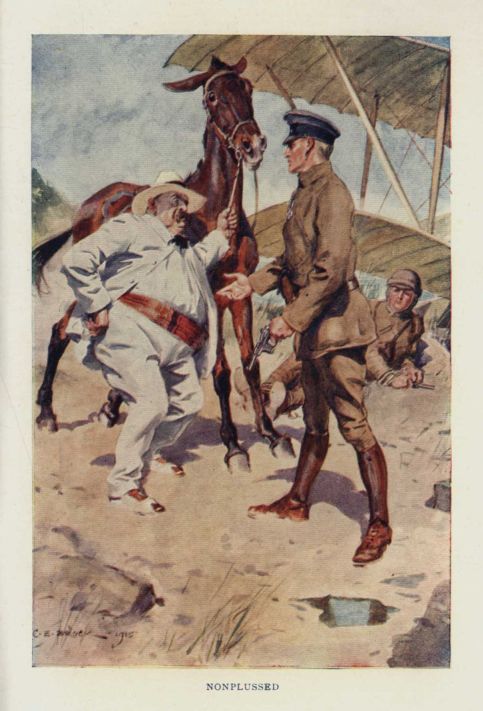
NONPLUSSED
"Hand over your revolver," he said.
"I haven't got----" the spy was beginning. Burton cut him short.
"No nonsense! Hand it over. Quick. At the word 'three' I fire. One--two----"
With an agonised look the German made a dive for his revolver. Burton took it with his right hand before it was released from the spy's tight pocket. From a distance they might have appeared to be shaking hands.
Burton had been rapidly casting about for a means of disposing of the German. He could not shoot him in cold blood; there might perhaps be time to tie him up, but he would then still be able to convey to the Turkish headquarters the information he had gathered at Tenedos. That must certainly be prevented. There was only one thing to be done: they must take him with them.
Just as Burton had reached this conclusion, a Turk appeared on the knoll.
"Come with me," said Burton sternly.
The German accompanied him to the seaplane. He might be supposed to be indulging his curiosity. Standing between him and the knoll, Burton said--
"You are interested in aviation. Seat yourself on the right-hand float."
The spy made as if to turn round. Burton lifted his revolver.
"Don't waste time," he said.
With a groan the spy sat on the spot indicated.
Burton seized the strap that bound him to his seat, and rapidly tied the German to the upright connecting the float with the body of the seaplane, calling to Hunter--who, still lying on the ground, had watched these proceedings with excitement--to cover the spy with his revolver.
The prisoner had hardly been secured when the Turkish captain cantered over the knoll, followed by two or three men.
"Now, Dick!" cried Burton.
Hunter sprang up and rushed to his place.
"Not there!" said Burton. "Get on to the left-hand float to balance the machine."
Meanwhile he had started the engine, in desperate anxiety lest it should not have gathered momentum before the Turks came up. The spy had heard the thudding of their horses' hoofs as they, seeing the supposed English prisoner spring up, galloped down the knoll. Turning his head, he let out a frenzied shout. But it was too late. Burton had vaulted into his seat, and, just three seconds before the amazed and furious Turks reached the brink of the water, the seaplane was skimming the surface.
The spy was now filling the air with his frantic cries. Burton afterwards said it was like the booming of a buzzard. The Turks dismounted, and from the edge of the lake fired at the fast-receding machine. One or two shots pierced the planes, and from a shrill cry of terror from the German, Burton supposed that he had been hit. But he was too busy to think of him. Forcing the engine to the utmost he was already manipulating the elevator. The machine rose steadily. At the first possible moment Burton swung it round to the west. In a minute or two he crossed the Maritza. Climbing ever higher, he shifted his course a point or two to the south, and within twenty minutes the machine swooped down beside the cruiser, a few miles out in the bay, and a number of laughing bluejackets hastened to assist two dripping objects to climb on board.
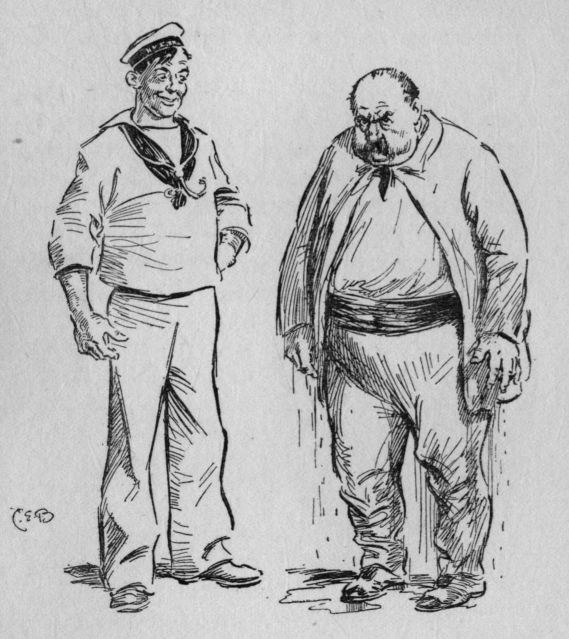
A discomfited spy
IV
The cruiser made all speed back to Tenedos. There the spy, a forlorn, chapfallen individual, was taken ashore under an escort of marines. Within a short time a drum-head court-martial was constituted. Papers found on the prisoner left no doubt of his occupation; his protest that he was a subject of King Constantine availed him nothing. When the sentence had been pronounced, he recovered his courage and confessed himself a German, and it was as a German soldier that he paid the final penalty.
Burton's exploit was reported to the Admiralty, and some weeks later, when he returned one evening from reconnoitring the Turkish trenches after the landing on the Gallipoli peninsula had been so magnificently accomplished, he was welcomed with the news that he had been awarded the Distinguished Service Medal by the King.
Chapter IV Heading
THE WATCH TOWER
I
A rough, lumbering ox-cart was crawling slowly up a steep winding hill-track in Southern Macedonia. The breath of the two panting oxen formed steam-clouds in the frosty air; slighter wreaths of vapour clung about the heads of the two persons who trudged along beside them. One was an old man, tall, broad, and vigorous, his hair straggling beneath his fur cap, his long white beard stiff with the ice of his congealed breath. The other was a boy, whose face, ruddy with health and cold, showed scantly under a similar cap much too large for him, and above a conglomeration of warm wrappings reaching to his feet and giving him the appearance of a moving bundle, thick and shapeless.
"I am tired, grandfather," murmured the boy, pausing at the foot of a steep ascent.
"Tchk!" the old man ejaculated, emitting a puff of white breath which the north-east wind from behind carried over the head of the nearest ox. "Put your shoulder to the wheel, Marco. Show yourself worthy of your name."
The boy obediently went round the cart and set his shoulder to the heavy wooden wheel on the off side. His grandfather shoving at the other, they helped the labouring oxen to drag the vehicle up the ascent, and then stopped to rest.
"That was well done, little son," said a woman of some thirty years, sitting in the forepart of the cart. She handed the boy a cake. Behind her the cart was piled high with bits of furniture and bundles of household gear. The boy seated himself on a rock and nibbled his cake. The oxen moved their heads about as if in search of provender. Straightening his tall form, the old man turned his back, and in the full blast of the bitter wind scanned the country to the north-east. A faint boom sounded far away in that direction. The woman started.
"Do you see anything, Father?" she asked, anxiously.
"Nothing, Nuta. But we must on. It will be two hours or more before we can call ourselves safe."
Smacking the heaving flank of the near-side ox, he set the beasts in motion, and the cart creaked and jolted on over the rough track. This was lightly covered with snow, which showed traces of those other travellers who in this December of 1915 had journeyed over the same route. Snow lay deeper in the hollows on either side, and on the heights in the distance. It was a bleak and desolate landscape, its rugged features somewhat softened, however, by the blanket of snow. Here and there dark patches stood out in the surrounding white, representing bushes or trees; but there was no house or cottage, no sign of life.
Old Marco, a small Serbian landed proprietor, had postponed his flight from before the invading Bulgars until all the other inhabitants of his village had departed. To the last he had hoped that the French and British forces would arrive in time to save him. His son was away fighting, as were all the men from the little estate. Having loaded all his portable possessions on to the cart, he waited with his daughter-in-law and grandson until the ever-approaching boom of guns warned him that further delay would mean ruin, and then set off southwards, to gain, if possible, protection from the Allied forces that were said to be retreating on Salonika.
The old man's pride was wounded. He traced his descent from that Marco Kralevich who, towards the end of the fourteenth century, struggled to maintain the independence of Serbia against the Turks, and whose name and knightly prowess live to-day in song and story. He had never tired of relating to young Marco the heroic deeds of his great ancestor, and it cut him to the heart that he was compelled, in the wreck of his country's fortunes, to abandon the homestead where he had kept alive the traditions of Serbian valour. Even now, old as he was, he would have borne a part in the national struggle but for the claims of his dear ones upon his protection.
The cart lumbered slowly on. From time to time the old man glanced anxiously behind, appealing to the boy--did he see anything moving there, or there? On one such occasion, when they stopped to rest themselves and the oxen, and the old man was looking to the rear, young Marco suddenly pricked up his ears, and stood intently listening.
"A strange sound, Grandfather," he said. "Where?"
The boy nodded towards the east. "What is it?"
"Like the hum of a bee far away."
The old man came to the boy's side and listened.
"I cannot hear it," he said after a few moments, adding impatiently, "Tchk! This is not the time of bees."
"But I hear it still," persisted Marco. "It is louder."
He looked around, puzzled to account for the unaccustomed sound.
"I hear nothing," said his mother.
"Look!" he cried, pointing excitedly into the grey sky.
The eyes of his elders followed his outstretched hand, but they saw nothing.
"It has gone," sighed the boy after a little. "But I did see something. Perhaps it was an eagle. I think it flew just behind the hills there."
His eyes ranged the horizon, where the rugged line of white indented the sky. A spot of blue appeared in the pale vault, and a ray of sunlight trickled through.
"Look!" cried Marco again, stretching out his hand this time to the north. "There is something moving on the snow."
The old man gazed northward, rubbed his eyes, shook his head.
"Can you see anything, Nuta?" he asked.
"Dark specks, miles and miles away--yes, Father, they are moving. There are more of them. They are like ants."
"The Bulgars!" muttered the old man. "Come, we must haste."
Returning to the cart, he whipped up the oxen, and the patient beasts, heaving their load out of the drift into which its wheels had settled, hauled it, creaking and groaning, towards the brightening south.
II
Meanwhile, in a broad gully not far away, a different scene was being enacted.
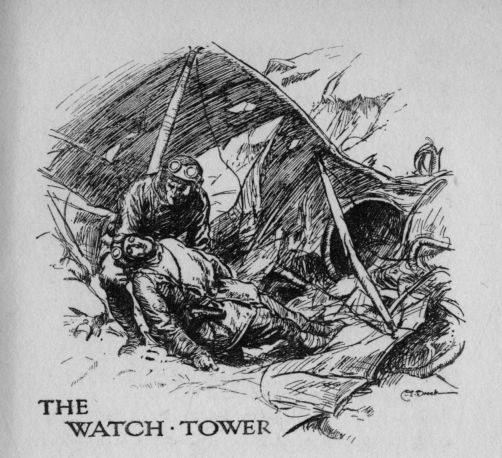
Across the gully lay the tangled ruins of a biplane. From the midst of the wreckage crawled a long figure, in the overalls, helmet, and goggles of a member of the Flying Corps. His goggles had been partially displaced, and lay askew upon his nose. There were spots of blood, already frozen, upon his cheek. His movements were slow and painful, and when, having emerged from the shapeless mass of metal and canvas, he tried to stand erect, he reeled, saved himself from falling by an effort, and dropping upon an adjacent rock, rubbed his eyes, groaned, and sat as one dazed.
His immobility lasted only a few moments. Staggering to his feet, his features twisted with pain, he walked unsteadily to the ruins of the aeroplane.
"Enderby, old chap," he called, bending down.
There was no answer.
Swiftly he pulled away the broken wires and fragments of the shattered framework, beneath which the form of his companion was pinned, then knelt and laid his finger on the wrist of the unconscious man.
"Thank Heaven!" he murmured.
Taking a flask from his pocket he poured a few drops of liquid between the half-open lips, then lifted the man carefully out of the wreckage and laid him down on the slope. Upon his brow he placed a little snow; he repeated his medicinal dose, and watched anxiously. It was some minutes before the eyelids opened, only to close again as a spasm of pain distorted the injured man's features.
"Where is it, old man?" asked Burton.
"My leg."
The answer came faintly.
"It doesn't hurt you to breathe?"
Enderby shook his head.
"Arms all right?"
And when Enderby had lifted them one after the other, Burton placed the flask in his comrade's right hand.
"Take another pull at that while I have a look at you," he said.
Removing the puttees and cutting away the stocking beneath, Burton saw that his friend's right leg was broken. He felt him all over, causing him to wince now and then as he touched a bruise. There was no other serious injury.
"Your leg's badly crocked, old man; but I'm jolly glad it's no worse. When that shell winged us I made sure our number was up."
"What about you?"
"I'm just one compound ache--must be bruised from top to toe. Our luck's out to-day. Just clench your teeth while I see what I can do in first aid. The machine's smashed to smithereens. How I'm to get you back to the M.O. beats me."
"Whereabouts are we?"
"Somewhere in Macedonia! In a gully, with hills all round, not a living thing in sight. I hoped we'd be able to flutter back to our lines, but it wasn't to be. Our troops must be miles away, and getting farther every minute, worse luck! What fate dogs us, that we must always be retreating? Ah! that made you squirm; sorry, old man, but you'll be easier now."
He had bound up the leg, and now brushed away the beads of sweat which the exertion, in his own sorry state, had brought out upon his brow.
"Now, look here, Enderby," he said, "the best thing I can do is to trudge off after our men and get a machine to bring you in. And the sooner I start, the better. You ought to be safe enough here. You're well hidden; the Bulgars' advance won't bring them past this spot, there's no road. But if I lose any time they'll be somewhere in the neighbourhood before a machine could arrive, and then it'll be hopeless. I'll rummage out some food from our wreck, and leave you that and my flask----"
"You'd better take it; you've a long tramp before you, and may come across some advance patrols of the Bulgars for all you know. Besides----"
He paused. Both men pricked up their ears simultaneously. Each looked an anxious inquiry at the other. From somewhere not far away came a rhythmic sound--a succession of strident, scraping sounds--which in a moment they recognised as the creaking of a cart.
Neither man spoke. Burton stole down the gully, and round the shoulder of a hill in the direction of the sound, which grew louder as he went. Apprehensive that his plans for the rescue of his friend were already defeated, he peered cautiously round the corner of rock. He beheld a rough hill-track winding upwards from right to left across his front. Some distance to the right another track ran into the first, skirting a spur from a north-westerly direction. Nothing was visible on either track, but the regular monotonous creaking of the cart was drawing nearer.
Burton drew back behind a rock and waited. Presently, from round one of the innumerable bends and twists in the main track, appeared the great heads of two oxen yoked together; then a woman's form came into view, perched on the forepart of a heavily laden cart; last of all, tramping in the rear, a tall old man, and, by his side, a boy whose head reached scarcely higher than his elbow.
The watcher breathed more freely. It was only a typical refugee party; he had already seen hundreds like it toiling along the southward roads to Salonika. There was nothing to fear here; on the contrary, it suggested a means by which Captain Enderby might be at once removed, without the delay that would be caused by his own going and coming.
The cart was creeping laboriously up towards him. When it was nearly opposite, Burton stepped forth from his hiding-place. His sudden appearance drew signs of momentary alarm. The woman stiffened; the old man whipped out a revolver; the boy ran round in front of the cart, and with a fierce expression, comical on his young face, stood before his mother, drawing from his belt a knife.
Burton threw out his hands and called out that he was an Englishman. But even before he spoke the attitude of hostility had relaxed, the woman had addressed a few words to the old man, and he had already replaced his weapon. They had recognised that the stranger was neither a Bulgar nor a German. Only the boy remained suspicious and alert, stoutly gripping his knife.
The cart had stopped. Burton walked towards it. He had picked up a few words of Greek during the eleven months he had spent in the East, and he explained in that language that he was a friend and an Englishman. Rather to his surprise the old man replied in French.
"Does monsieur speak French?"
The wall of nationality was down, and in the language of their common ally the Serbian and the Englishman held a rapid colloquy. Presently the old man turned to the boy.
"You were right, Marco," he said in his own tongue. "That thing you heard humming like a bee, that thing you saw moving like an eagle, was an English aeroplane. It has come to the ground and broken, struck by a Bulgar's shell."
"Oh! let me see it," cried the boy, eagerly, forgetting all else in the new object of excitement, slipping the knife back into his belt, and moving away from the cart.
"Wait!" said his grandfather, peremptorily. He resumed his conversation with Burton. There was anxiety, hesitancy in his air. He appeared to be struggling with himself. "The enemy is not far behind," he said. "We have far to go; every minute is precious." He looked nervously along the track behind him, then seemed to question his daughter with his eyes. She nodded. "Tchk!" he ejaculated. "I will do it. No true Serb, monsieur, much less a descendant of Marco Kralevich, can refuse to succour an ally of his nation. Show me the way."
Young Marco, to his disappointment, was left to guard the cart and to keep a lookout. The old man hastened with Burton to the spot where Captain Enderby lay beside the wreck of the aeroplane. As they went, Burton caught sight of a square tower on a hill-top far away to the south.
"What is that?" he asked.
"An old watch-tower," replied the Serb. "There are many such on high points in different parts of the country."
Burton paused a moment to scan the solitary tower through his field glasses, then resumed his course. On reaching the fallen man, the old Serb at once set about placing the injured limb in splints formed out of the wreckage, preparatory to carrying him back to the cart. He was still thus engaged when Marco came running up the gully.
"Grandfather," he said, breathlessly, "a party of horsemen are coming up the side track."
"How many are they, boy?"
"Ten or twelve. They are far away."
"I must go back," said the old man. "You will still be safe here."
"I will go with you," said Burton. "My glasses may be useful."
They followed the boy, who ran ahead, regained the cart, and went beyond it to the point where the two tracks met. The sky had now cleared, and the white-clad country glistened in the sunlight. Keeping under cover, Burton peered through his glasses along the winding track. At first he saw nobody, but presently a horseman came into sight round a bend, followed closely by two more riding abreast. After a short interval, another couple appeared, the first file of a party of ten, riding two by two. They were still too far distant for Burton to distinguish anything more than that they were in military uniform.
He told the old man what he had seen.
"Beyond doubt they are Bulgars," the Serb growled, drawing his fingers through his beard, which the sunlight had thawed.
He stood silent for a little, his eyes fixed in thought, his hands working nervously.
"They will overtake us," he said at length. "We must move the cart from the track. Come, monsieur."
They hurried back to the cart. At a word from the old man the woman dismounted, and going to the heads of the oxen, led them off the track over the rough ground of the hill-face, while the three others set their shoulders to the wheels. By their united efforts the unwieldy vehicle was hauled round the shoulder of the hill towards the gully, to a spot two or three hundred yards from the aeroplane, where it was out of sight from either of the tracks. Leaving it there in charge of Marco and his mother, the two men returned, obliterating the traces of the wheels in the snow, and finally posting themselves behind a rocky ridge near the junction of the tracks, where they could see the approaching horsemen when they should pass, without being seen themselves.
III
Some twenty minutes later they heard the tramp of hoofs, somewhat muffled by the snow, and guttural voices. Soon the first horseman passed before them--a Bulgarian officer. Immediately behind him came a group of three, the two on the outside being German officers, the horseman between them a middle-aged Serb in the characteristic dress of the peasant proprietor. The watchers noticed that he was tied round the middle by a rope, the other end of which was held by a Bulgarian trooper riding behind. Old Marco's eyes gleamed with the light of recognition. He told Burton later that the prisoner was one Milosh Nikovich, a friend of his, a small farmer whose property lay a few miles from his own estate.
On arriving at the junction of the tracks the officers halted. One of the Germans took a map from his pocket, and pored over it with his companions; they were apparently consulting together. Then they put questions to their prisoner. Their words were inaudible. The Serb's face wore an expression of sullen defiance, and it was clear that his replies were unsatisfactory, for the trooper who held the rope moved up his horse, and lifting a foot, drove his spur savagely into the prisoner's calf. The man winced, but remained motionless and silent. Burton heard old Marco mutter curses below his breath. Then one of the Germans pointed southwards questioningly; the prisoner gave what appeared to be an affirmative answer, and the party pushed on. It soon disappeared through the windings of the track. The watchers counted fourteen in all.
When the enemy were out of sight and hearing, Burton turned to the old man.
"A scouting party?" he said.
"Without doubt," replied the Serb. "The main body must be behind. Will you look for them through your glasses?"
Burton left their hiding-place for a spot whence he could view the tracks and the plain beyond. No troops were in sight, but the boom of guns came faintly on the air from the north-east. Burton knew, from what he had seen during the morning's reconnaissance, that somewhere eastward from the spot where he stood the British forces were steadily falling back in face of overwhelming numbers of Bulgars and Germans. Was it possible that the patrol that had just passed was the advance guard of a flanking force? Unluckily his reconnaissance had been cut short by the Bulgarian shell almost as soon as it was begun. The peril of Captain Enderby and himself, and of his Serbian friends, was complicated with a possible unexpected danger to the British army in retreat. To guard against the latter seemed to be out of his power. The immediate question was, how to ensure the safety of Enderby and the Serbian family with whose lot his own was for the moment cast.
Remaining at the spot from which he could detect any signs of an enemy advance from the north, he talked over the situation with old Marco.
"The enemy are in front and behind," he said. "It seems we have little chance of getting through. But if we don't get through----"
"We should be safe for a time in the gully. The enemy will keep to the tracks. But that would help us little in the end, for if they advance beyond us, they will form a wall without gates, and we must either surrender or starve."
"And meanwhile my friend is without proper treatment, and may have to lose his leg or be lamed for life. You have no stomach any more than I for being a prisoner with the Bulgars. Don't you think we had better push on, and try to slip past the scouting party? It is not likely they will go far in advance of their main body. Isn't there a way over the hills without taking to the track?"
"If we were on foot we might steal through the country, but not with the cart. That holds all my worldly possessions. And your friend cannot be moved without it. Look, monsieur; do not my eyes, old as they are, see masses of men moving on the plain yonder?"
"You are right," said Burton, after a glance northward. "The main body is on the move. We must decide at once. Let us carry Captain Enderby to the cart, push on, and trust to luck."
Hurrying back to the gully, they carried the injured man to the cart. While the Serb led this back to the track, Burton took the precaution of removing the carburetter and one or two other essential parts from the engine of the aeroplane. This was badly smashed, but it was just as well not to leave anything of possible use to the enemy. Then he hauled the machine-gun from the litter that covered it, expecting to find it hopelessly shattered. To his surprise it appeared to have suffered no injury except superficial dents, and the ammunition belts were evidently perfect. Hurrying after the others with the engine parts, he laid these on the cart, then took young Marco back with him to help him carry away the machine-gun and ammunition.
"We've saved something from the wreck, old man," he said to Enderby as he came up with the gun on his back.
"Hardly worth while, is it?" asked the captain. "There's precious little chance of our getting through. Hadn't you better shy it into a gully in case they capture us?"
"I will at the last minute if things look hopeless; but we'll stick to it as long as we can."
All being ready they set off along the track. Old Marco sent the boy ahead to scout. The woman resumed her seat on the cart, where a comfortable place had been arranged among the baggage for Captain Enderby. The two men followed on foot, pushing at the wheels where the gradient was too steep for the wearied oxen.
So they toiled along for upwards of an hour. Young Marco ahead had not caught sight of the horsemen; there was no sign of the enemy in the rear. It was the old man's hope that there would be time, if danger threatened, to rush the cart into some hollow or some gap between the rocks. Such a threat was more likely to arise from the scouting party than from the larger force behind, and the boy, as instructed by his grandfather, kept sufficiently in advance to give timely warning.
The track was continuously up hill, broad at some points, at others so narrow that the cart was only just able to pass between the rocky borders, sometimes as low as kerbstones, sometimes rising to a height of many feet. The frequent windings prevented the travellers from getting a direct view for any considerable distance ahead. Every now and then they had glimpses of the watch-tower which Burton had previously noticed, and which they were gradually approaching. At such times he scanned it through his glasses, half expecting to find that some of the scouting party had ascended it to survey the surrounding country. But no human figures yet showed above the summit.
At length, however, on rounding a corner, the travellers were startled by a sudden flash from the tower. They halted, Burton levelled his glasses, and declared that he saw two heads and pairs of shoulders projecting above the top. Other flashes followed, at intervals long or short.
"They are heliographing to the main body behind us," he said to Enderby, repeating the information in French to the Serb.
"Can they see us?" asked Enderby.
"They might perhaps if they looked, but they are gazing far beyond us, of course. We had better back a little, though."
They had, in fact, halted before the oxen had come completely into view from the tower, and by backing a few feet they were wholly concealed.
The three men held an anxious consultation. The tower was probably two miles ahead. To go on would involve discovery by the enemy. On the other hand, parties of Bulgarians might already be marching up the track behind them. It seemed that they were trapped.
"We had better wait a little," Burton concluded, "and see whether they leave the tower and go forward. In that case we might venture to proceed."
The signalling continued for some few minutes, then ceased. The men disappeared from the summit of the tower. Burton was on the point of suggesting that they should move on when he caught sight of a small figure flitting rapidly from rock to rock down the track towards them.
"It is the boy," he said, after a look through his glasses.
In a few minutes young Marco arrived, excited and breathless.
"Three horsemen are coming down the hill," he reported.
"Tchk!" muttered the old man, repeating the news. "How far away, child?"
"A mile or more. They are riding slowly; the track is steep."
For a few moments consternation and dismay paralysed their faculties. That the horsemen formed part of the patrol they had already seen was certain; no others could have safely passed the tower occupied by the enemy. Discovery and capture seemed inevitable. The fugitives might, indeed, clamber among the rocks and conceal themselves for a time; but the nature of the ground at this spot precluded the removal of the cart, and its tell-tale presence on the track unattended would put a short limit to their safety.
At this critical moment the old Serb's experience of half a century of mountain warfare came to his aid.
"We must ambush the Bulgars," he said. "Look there!"
He pointed to a spot a few yards in their rear, at the end of a narrow stretch of the track which had given him an anxious moment in leading the oxen. On one side the bank rose rugged and steep, on the other it fell away, not precipitously, but in a jagged slope which had threatened ruin to the cart if the wheel had chanced to slip over the edge of the track. Burton quickly seized the possibilities of the situation.
"By Jove! It's risky, but we'll try it," he remarked to Enderby.
The captain had already taken his revolver from its case. But old Marco had conceived a plan that would render Captain Enderby's co-operation unnecessary. He explained it rapidly to Burton, and they proceeded to carry it out. The woman was told to conceal herself behind a thorn bush growing in a cleft in the bank. The cart was backed to the chosen spot, and young Marco, his eyes alight with excitement and eagerness, clambered up to the driver's seat. A rug was thrown over Enderby and the machine-gun lying at his side, and the old man took up a position with Burton behind the cart, concealed by the pile of furniture from the eyes of any one approaching down the hill.