Front matter
Reading edition
Barr’s Buffon.

Buffon’s Natural History.
CONTAINING
A THEORY OF THE EARTH, A GENERAL HISTORY OF MAN, OF THE BRUTE CREATION, AND OF VEGETABLES, MINERALS, &c. &c.
FROM THE FRENCH. WITH NOTES BY THE TRANSLATOR. IN TEN VOLUMES. VOL. IX.

PRINTED FOR THE PROPRIETOR, AND SOLD BY H. D. SYMONDS, PATERNOSTER-ROW.
1807. T. Gillet, Printer, Wild-court.

CONTENTS OF THE NINTH VOLUME.
Page
The Loris 1
The Javelin Bat 3
The Serval 6
The Ocelot 9
The Margay 13
The Jackal and the Adil 17
The Isatis 25
The Glutton 29
The Stinkards 35
The Pekan and the Vison 41
The Leming 46
The Sea Otter 51
The Canakian Otter 52
The Seal, Walrus, and the Manati 55
The Seal 57
The Walrus, Morse, or Sea-Cow 78
The Dugon 89
The Manati 92
The Nomenclature of Apes 107
The Orang-Outang, or the Pongo and the Jocko 149
The Pithecos, or Pigmy 177
The Gibon, or Long-tailed Ape 185
The Magot, or Barbary Ape 188
The Papion, or Baboon, properly so called 192
The Mandrill 197
The Ouanderou, and the Lowando 199
The Maimon 202
The Macaque, and the Egret 205
The Patas 208
The Malbrouck, and the Bonnet Chinois 210
The Mangabey 216
The Mona 218
The Callitrix, or Green Monkey 221
The Moustac 224
The Talapoin 225
The Douc 227
The Sapajous and the Sagoins 231
The Ourine, and the Alouate 234
The Coati, and the Exquima 240
The Sajou 247
The Sai 249
The Siamiri 251
The Saki 252
The Tamarin 254
The Ouistiti 255
The Marikina 258
The Pinch 259
The Mico 261
Account of some Animals not expressly treated of in this Work 264
The White Bear 265
The Tartarian Cow 272
The Tolai 275
The Zizel 276
The Zemni 277
The Pouch 279
The Perouasca 279
The Souslik 280
The Golden-coloured Mole 282
The White Water-Rat 283
The Guinea-Hog 284
The Wild Boar of Cape Verd 285
The Mexican Wolf 293
The Alco 295
The Tayra, or Galeri 299
The Philander of Surinam 300
The Akouchi 302
The Tucan 304
The Field-Mouse of Brasil 305
The Aperea 306
The Tapeti 307
Supplement to the Quadrupeds 309
The Crab-eater 309
Anonymous Animal 312
Rat of Madagascar 314
Degeneration of Animals 315
Directions for placing the Plates in the Seventh Volume.
Page 1 Fig. 176, 177, 178, 179.
9 Fig. 180, 181.
29 Fig. 182, 183, 184.
35 Fig. 185, 186, 187, 188.
41 Fig. 189, 190, 191.
57 Fig. 192, 193, 194.
150 Fig. 195, 196.
189 Fig. 197, 198.
197 Fig. 199, 200.
202 Fig. 201, 202, 203.
208 Fig. 204, 205, 206, 207.
221 Fig. 208, 209, 210.
225 Fig. 211, 212, 215.
247 Fig. 213, 214, 216.
255 Fig. 217, 218, 219.
BUFFON’S
NATURAL HISTORY.
OF CARNIVOROUS ANIMALS.
THE LORIS.
The Loris (fig. 176.) is a small animal found in Ceylon, very remarkable for the elegance of its figure, and for the singularity of its conformation: it has, perhaps, of all animals, the longest body in proportion to its bulk, having nine vertebræ in the loins, whereas other quadrupeds have only five, six, or seven. The length of the body is the natural effect of this structure, and it appears the longer for having no tail; in other respects, it resembles the maki kind, as well in the hands and feet as in the quality of the hair, the number of teeth, and the sharpness of its muzzle. Independently of these singularities, which separates this animal from the makis, he has other particular attributes. His head is entirely round; his eyes are excessively large, and very close to each other; his ears are large, round, and, in their insides, have three auricles in the shape of small shells; but what is still more singular, and perhaps unmatched in the whole tribe of animals, is that the female discharges her urine through the clitoris, which is perforated like the sexual organ of the male, and who in these two parts perfectly resemble each other.
Linnæus has given a short description of this animal, which appears to be exactly conformable to Nature. It is also very correctly delineated by Seba; and evidently appears to be the same as that which Thevenot speaks of in the following terms: “I saw, (says he) in the Mogul country, monkeys which had been brought from Ceylon; they were greatly valued on account of their size, being not bigger than a man’s fist. They were different from the common monkey, having a flat forehead, eyes round and large, and of a bright yellow colour, like those of some cats: their muzzle is very pointed: the inside of the ears is yellow, and they have no tail. When I examined them they sat erect on their hind feet, folded the others across, and looked round at the spectators without the least signs of fear.”
Engraved for Barr’s Buffon.
FIG. 176. Loris. FIG. 177. Javelin Bat.
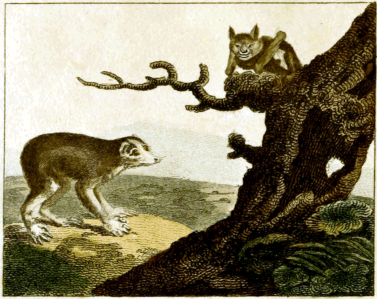
FIG. 178. FIG. 179. Lame Headed Bat. Shrew Bat.
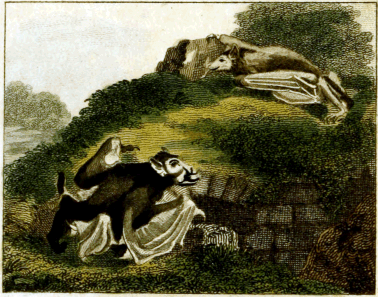
THE JAVELIN BAT.
AMONG the numbers of the bat species, which were neither named nor known, we indicated some by names derived from foreign languages, and others by denominations drawn from their most striking characters. We have called one the Horse-shoe Bat, from the exact resemblance the fore-part of its face bears to a horse-shoe, and the animal in question we have called the Javelin Bat, (fig. 177.) from a sort of membrane on its nose which perfectly resembles the head of an ancient javelin, or spear. Though this character alone is sufficient to distinguish it from all other bats, yet we may add, that it has scarcely any tail, that its hair and size are nearly like the common bat, but that instead of having six incisive teeth in the lower jaw, it has only four. This species of bat is very common in America, but is never found in Europe.
There is another bat in Senegal, which has also a membrane upon its nose, not in the form of a horse-shoe, or javelin, as in the two bats we have just mentioned, but in the shape of an oval leaf. These three bats, being of different climates, are not simple varieties but distinct and separate species. M. Daubenton has given the description of the Senegal bat, under the name of the leaf bat, in the Memoirs of the Royal Academy of Sciences, 1759, p. 374.
Bats which have great affinities to birds, by the power of flying, and the strength of their pectoral muscles, seem to resemble them still more in these membranes, or crests, which they have on their faces. These redundant parts, which, at first sight, seem only to be superfluous deformities, are real characters which fill up the visible shades between these flying quadrupeds and birds; for most of the latter have crests, or membranes, about their beaks and heads, which seem in every respect as superfluous as those of the bats.
SUPPLEMENT
WE have received from M. Pallas the figures and descriptions of two bats hitherto unknown to naturalists; the first he calls the cephalote, or large-headed bat, (fig. 178.) from its head being so very large in proportion to its body. This bat M. Pallas says is found in the Malacca islands; and from his finding but one fœtus in a female, which was sent to him to Amsterdam, and which he dissected, he concludes they have but one young at a time: this species differs also from all others in the teeth, which in some measure resemble those of the mouse or hedge-hog; it has a short tail, situated between the thighs, a large nose and a broad muzzle; its breast is very similar to that of a bird; it is very near four inches long, and its wings extend above a foot.
The second he calls the vespertilio soricinus, or shrew bat (fig. 179.); this one has no tail, and carries a peculiar membrane on its nose; it is the smallest that is met with without a tail, being not more than two inches in length. This species is very common in the warm climates of America, the Carribbee Islands, and Surinam.
At the same time M. Pallas sent us the account of these animals he remarked that we were in an error in our former description of the javelin bat, by confounding it with the American bat, mentioned by Seba, he, from a careful examination, being convinced of their being different species; and we feel ourselves indebted to this gentleman for the pains he has taken to rectify our mistake.
THE SERVAL.
THIS animal, which was kept alive several years in the royal menagerie, by name of the tiger-cat, seems to be the same with that described by the gentlemen of the Academy, under the denomination of chat-pard; and we should have still remained ignorant of its true name if the Marquis de Montmirail had not discovered it in an Italian book of travels which he has translated, and sent the following extract: “The maraputé, which the Portugueze in India, called serval (says P. Vincent-Marie) is a ferocious animal, larger than the wild cat, and something less than the civet, from which last he differs by his head being rounder and thicker, and his face sinking in about the middle. He resembles the panther in the colour of his hair, which is yellow on the head, back, and sides, and white under the belly; also by the spots, which are distinct, equally distributed, and a little less than those of the panther. His eyes are very brilliant; his whiskers are composed of long and stiff bristles; his tail is short; his feet large, and armed with long and hooked claws. He is found in the mountains of India; he is seldom seen on the ground, but remains almost continually on high trees, where he catches birds, which are his principal food. He leaps as nimbly as a monkey, and goes from one tree to another with such address and agility and passes over a great space in so short a time, that he may be said only to appear and disappear; he is ferocious in his nature, but flees at the sight of man, unless irritated, or his nest attacked, when he flies at the offender, and bites and tears nearly like the panther.”
Neither captivity, nor good nor bad treatment, will tame or soften the ferocity of this animal. That which we saw in the menagerie was always ready to rush on those who came near him: we could neither take a design nor a description of him, otherwise than betwixt the bars of his cage. He was fed with flesh, like the panther and leopard. This serval, or maraputé of Malabar and India, seems to be the same animal as the tiger-cat of Senegal and the Cape of Good Hope, which, according to the testimony of travellers, resembles our cat in its shape, and the tiger (that is the panther or leopard) by the black and white spots of his fur. “This animal (say they) is four times larger than a cat; is of a very voracious nature, and feeds on monkeys, rats, and other animals.”
From the comparison which we made of the serval and the chat pard, described by the gentlemen of the Academy, we discovered no other difference than the long spots on the back, and the rings on the tail of the latter, which the serval has not. The spots on the back of the serval are closer than those on the other parts of his body; but these little disagreements are so slight that we cannot doubt of the identity of the species of these two animals.
Engraved for Barr’s Buffon.
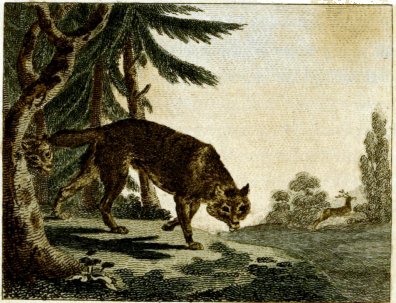
FIG. 180. Ocelot.
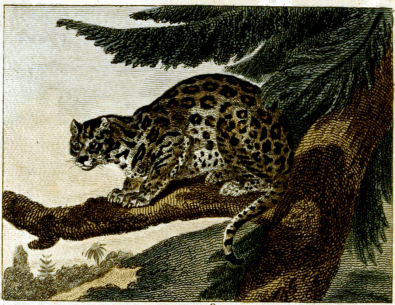
FIG. 181. Jackal.
THE OCELOT.
OCELOT is an abbreviation of tlalocelotl, the name of this animal in Mexico, its native country. It is ferocious and carnivorous, and may be ranked with the jaguar and cougar, for it is very nearly the same size, and resembles them in figure and dispositions. A male and female were shewn at the fair of St. Ovide, in September 1764. They came from the neighbourhood of Carthagena, and had been taken from their mother in the month of October, 1763. They became so strong and cruel at the age of three months as to kill and eat the bitch which had nursed them. When we saw them, at a year old, they were about two feet long, and they had then, probably, not attained more than one half, or two-thirds, of their growth. These animals were shewn by the name of the tiger-cat, but we have rejected this denomination as precarious and confused, especially as the jaguar, serval, and the margay, or Cayenne cat, were sent to us under the same denomination, although those three animals are very different from each other, as well as from the one we are at present treating of.
The first author who mentions this animal in a distinct manner is Fabri. He caused Recchi’s designs of it to be engraven, and composed his description from them. He gives also a kind of history of him from the writings and information of Gregoire de Bolivar. I made these observations with a view to throw light on the circumstance which had led all the naturalists into an error, and by which I acknowledge I was also deceived. This circumstance is to know whether the two animals designed by Recchi, the first by the name of tlatlauhquiocelotl and the second by that of tlacoozlotl, tlalocelotl, and afterwards described by Fabri as different species, are not the same animal. They were considered as distinct animals, notwithstanding the resemblance of their figures, because their names, and even descriptions, were different. I then supposed the first might be the same as the jaguar, and therefore gave him the Mexican name of tlatlauhquiocelotl, which I am now convinced does not belong to him; and since I have seen both the male and female, I am persuaded, that the two described by Fabri, are only the same animal, of which the first is the male, and the second the female. This error could only have been discovered by such a chance as we had of examining both the male and the female together. Of all animals whose skins are spotted, the robe of the male ocelot (fig. 180.) is certainly the most beautiful, and most elegantly varied. Even the skin of the leopard does not come near it for the liveliness of its colours, and the regularity of its marks; and far less those of the jaguar, panther, and ounce. The colours of the female ocelot are much weaker, and the design less regular; and this apparent difference it was that deceived Recchi, Fabri, and others, and was the occasion of their considering them as different species.
When the ocelot has arrived at its full growth, he is, according to Bolivar, two feet and a half high, and about four feet long. The tail, though of a good length, does not touch the ground when hanging down, and consequently is not more than two feet long. This animal is very voracious, but at the same time exceedingly timid. He seldom attacks the human species, and is terrified at the sight of a dog. When pursued, he flies to the forests, and climbs up a tree for safety, where he also sleeps and watches for small animals, on which he springs when he sees them within his reach. He prefers blood to flesh, and for this reason he destroys a great number of animals; for instead of satisfying his hunger by devouring their flesh, he only quenches his thirst by sucking their blood.
In a state of captivity he preserves his savage nature: nothing can soften his ferocious disposition, nor calm his restless motion, which makes it necessary to confine him constantly in a cage. “After these young animals (says M. de l’Escot) had devoured their nurse, I confined them in a cage, and had them fed with fresh meat, of which they eat from seven to eight pounds a day. The male had a singular superiority over the female, for however hungry the latter might be, she never touched any of the food until he was satisfied, or such pieces as he gave her, having previously rejected them. I several times gave them a live cat, whose blood they sucked until the animal died, but they never eat any of their flesh. I put two live kids on board the vessel for their subsistence, for they neither eat, nor touched boiled nor salted meat.”
From the testimony of Gregoire de Bolivar, these animals commonly produce but two young ones at a birth, which M. de l’Escot seems to confirm, by saying, he had killed the mother before the two ocelots we have been speaking of, were taken away.
THE MARGAY.
THE Margay is much smaller than the ocelot. He resembles the wild cat in the size and shape of his body, only his head is more square, his snout and tail longer, and his ears more rounded; his hair also is shorter than that of the wild cat, and he has black streaks and spots on a yellow ground. He was sent us from Cayenne by the name of the tiger-cat, and, in fact, he partakes of the nature of the cat, jaguar, and ocelot, animals to which the name of tiger has been affixed in the New Continent. According to Fernandes, when this animal has arrived at its full growth, it is not quite so big as the civet; and, according to Marcgrave, whose comparison seems more just, he is about the size of a wild cat, which he also resembles in his natural habits, living upon fowls and small animals. He is very difficult to tame, and never completely loses his natural ferocity. He varies greatly in his colours, though they are commonly such as we have described. This animal is very common in Guinea, Brasil, and all the other provinces of South America. It is probable that the pichou of Louisiana is the same animal, but the species is less common in temperate than in hot climates.
If we recapitulate those cruel animals, whose robes are so beautiful, and whose natures are so malign, we shall find the tiger, panther, leopard, ounce, and serval, inhabit the Old Continent; and the jaguar, ocelot, and margay, natives of the New. These three last appear to be miniatures of the former, and which, having neither their size nor strength, are as timid and cowardly in proportion as the others are bold and intrepid.
There is another animal of this class which the furriers call Guepard. We have seen many of their skins, and they have a resemblance to the lynx in the length of the hair; but the ears not being terminated by a brush of hair, the guepard cannot be a lynx. Neither is he a panther nor a leopard; for his hair is not so short as that of those animals, and he differs from all of them by a kind of mane, about four or five inches long on his neck, and between his shoulders. The hair on his belly is also three or four inches long, and his tail much shorter in proportion than that of the leopard, panther, or ounce. He is nearly of the size of the last animal, not being above three feet and a half long. He is of a very pale yellow colour, sprinkled with black spots like the leopard, but closer to each other, and much smaller.
I thought this animal might be the same as that which Kolbe mentions by the name of the tiger-wolf. He is common in the countries bordering on the Cape of Good Hope. He remains all the day in the clefts of the rocks, or in holes which he digs in the ground. In the night he seeks for prey, but as he howls when in search of game, he warns men and animals of his approach; so that it is very easy to avoid, or to kill him. The name guepard, is apparently derived from the word lepard; the mode in which the German and Dutch spell leopard. We have also observed there are many varieties in this species, both in respect to the ground colour, and that of the spots; but every guepard has the common character of long hairs on the belly, and a mane on the neck.
SUPPLEMENT
M. de la BORDE, in treating of the tiger-cat of Cayenne, says, he has a skin spotted very much like that of the ounce; that he is smaller than the fox, but whom he much resembles in habits and disposition; that he generally resides in the woods, and lives chiefly on the game which he destroys; as he climbs trees with great facility, he seizes their young in their nests, and upon the branches of trees he lies in wait for his prey; he rather leaps than walks, and yet does not proceed very fast; that at Cayenne they keep these animals chained in their houses; and the utmost degree they seem to be tamed, is to suffer themselves to be stroked on the back; they are there fed with fish or flesh, and will not take any other kind of food; and that they bring forth as well in the winter as summer, and generally two at a time.
M. Colinson mentions another species of tiger-cat as a native of Carolina, and of whom he has given me the following description: "The size of the male was nineteen inches from the nose to the tail; the latter of which was four inches long, and was encircled with eight white rings; his principal colour was a light brown mixed with grey, with black stripes along his sides; his belly was inclined to white sprinkled with black spots, as were also his legs, which were very slight; his ears were very open and covered with hair; under his eyes were two large black spots, and beneath them a tuft of stiff black hairs. The female was of a less make; she was more inclined to red, and had no black spots, except a single one on the belly."
THE JACKAL, AND THE ADIL.
We are not certain whether these two names denote animals of different species; we only know that the jackal (fig. 181.) is larger, more ferocious, and more difficult to be tamed, than the adil; but in other respects they bear a perfect resemblance. The adil, therefore, may possibly be the jackal become smaller, weaker, and more gentle, than the wild race, from being tamed and rendered domestic; for the adil is nearly the same, with respect to the jackal, as the lap-dog, or the little water spaniel, is to the shepherd’s dog. However, as this fact is only exemplified in a few particular instances; as the jackal is not, in general, domestic like the dog, and, as such great differences are seldom found in a free species, we are inclined to believe that the jackal and the adil are really two distinct species. The wolf, the fox, the jackal, and the dog, though they approach very nigh each other, form four distinct species. The varieties in the dog species are very numerous; the greatest part of which seems to proceed from their domestic state, to which they have been so long subjected. Man has multiplied the race in this species by mixing the great with the small, the handsome with the ugly, the long haired with the short, &c. But there are many varieties in the dog species, independently of those races produced by the care of man, which seem to derive their origin from the climate. The English bull-dog, the Danish dog, the spaniel, the Turkish dog, the Siberian dog, and others, derive their names from the countries of which they are natives; and there seems to be greater differences between them than between the jackal and the adil. The jackals, therefore, may have undergone several changes from the influence of different climates; and which supposition corresponds with the facts we have collected. From the writings of travellers it appears, that there are different sized jackals in all parts, that in Armenia, Silesia, Persia, and in all that part of Asia, called the Levant, where this species is very numerous, troublesome, and very hurtful; they are generally about the size of our foxes; but their legs are shorter, and the colour of their hair is of a glossy and bright yellow; and this is the reason why they have been called the yellow, or golden wolf. This species seem to have undergone many varieties in Barbary, the East Indies, the Cape of Good Hope, and in other provinces of Africa and Asia. In these hot countries they are large, and their hair is rather of a reddish brown than of a beautiful yellow; and some of them are of different colours. The species of the jackal is spread all over Asia, from Armenia to Malabar; and is found also in Arabia, Barbary, Mauritania, Guinea, and at the Cape of Good Hope. It seems to supply the place of the wolf, which is wanting, or at least, is very scarce in all these hot countries.
However, as both the jackal and the adil are found in the same countries; as the species cannot have been altered by a long continuance in a domestic state, and as there is always a considerable difference in the size, and even in the dispositions of these animals, we shall look on them as distinct species, until it be proved that they intermix and produce together. Our presumption on the difference of these two species is the better founded, as it seems to agree with the opinion of the ancients. Aristotle, after having spoken of the wolf, the fox, and the hyæna, gives some obscure intimations of two other animals of the same genus, one by the name of the panther, and the other by that of the thos. The translators of Aristotle have interpreted panther by lupus canarius, and thos by lupus cervarius; that is, the dog-wolf and the stag-wolf. This interpretation sufficiently indicates, that they considered the panther and thos to belong to the same species. But I observed, under the article lynx, that the lupus cervarius of the Latins is not the thos of the Greeks. This lupus cervarius is the same as the chaus of Pliny, which is our lynx, and which has not a single character that agrees with the thos. Homer, when painting the valour of Ajax, who singly rushes among a band of Trojans, in the midst of whom Ulysses, wounded, was engaged; compares him to a lion that suddenly springs on a troop of the thos, surrounding a stag at bay, disperses and drives them away as mean and contemptible animals. This word, thos, the commentator of Homer interprets by that of panther, which he says is a kind of weak and timid wolf: thus, the thos and panther have been considered as the same animal by some of the ancient Greeks. But Aristotle seems to make a distinction between them, without, however, giving them any distinct characters. “The thos (says he) have their internal parts like those of the wolf; they copulate like dogs, and bring forth two, three, or four young ones at a time, which are born with their eyes shut. The body and tail of the thos are longer than those of the dog; his legs are shorter, but that does not prevent him from being as swift, and he can spring much further. The lion and the thos are enemies, because they both live upon flesh, and seek their food from the same source; hence disputes arise between them. The thos never attacks, and is but little afraid of the human species. He fights with the dog and the lion, whence the lion and the thos are never seen in the same places. The smallest thos is esteemed the best. There are two species of them, and some authors even make three.[A]” This is all Aristotle says concerning the thos, and he speaks still less about the panther; for he mentions it but in one single passage in the 35th chapter of the sixth book of his History of Animals, and there says, “the panther produces four young ones at a time, which are born with their eyes shut like young wolves.” By comparing these passages with that of Homer, and other Greek authors, it seems almost certain, that the thos of Aristotle is the great jackal, and that the panther is the little jackal, or the adil. We find, that he admits the existence of two species of thos, and that he speaks of the panther but once, and that when treating of the thos. It is therefore very probable, that this panther is the small thos; and this probability seems to become almost a certainty by the testimony of Oppian, who places the panther among the number of small animals, such as the cat and dormice.”
Thus, then, the thos is the jackal, and the panther the adil, and whether they make two different species, or but one, it is certain that every thing which the ancients have said of the thos, or panther, applies to the jackal and the adil, and to no other animal. If, therefore, the true signification of these names have not been known till now, or, if they have been misinterpreted, it is because the translators were unacquainted with these animals, and that our modern naturalists were not better informed.
Though the species of the wolf approaches very near to that of the dog, yet the jackal finds a place between them both. The jackal, or adil, as Belon remarks, is an animal between the wolf and the dog. With the ferocity of the wolf he joins a little of the familiarity of the dog; his voice is a kind of howl mixed with barking and groaning. He is more noisy than the dog, and more voracious than the wolf. He never stirs out alone, but always in flocks of twenty, thirty, or forty. They collect together every day to go in search of their prey. They live principally on small animals, and make themselves formidable to the most powerful by their number. They attack every kind of cattle or poultry almost in the presence of men. They boldly enter stables, sheep-folds, and cow-houses, without any signs of fear, and when they cannot meet with any thing better, they will devour boots, shoes, harnesses, &c. and what they have not time to consume they take away with them. When they cannot meet with any live prey they dig up the carcasses of men and animals. The inhabitants are obliged to cover the graves of the dead with large thorns, to prevent these animals from scratching and digging up the bodies, for their being buried very deep in the earth is not sufficient, to prevent them from accomplishing their purpose. Numbers of them work together in this, and they accompany their labour with a doleful cry; when they are once accustomed to human bodies they search out burial places, follow armies, and keep close to the caravans. They may be stiled the ravens among quadrupeds, for they will eat the most infectious flesh. Their appetite is so constant, and so vehement, that the driest leather, skins, flesh, excrements, or the most putrified animal, is alike welcome to them. The hyæna has the same taste for putrid flesh, and also digs bodies out of their graves, on which account, though very different from each other, they have often been confounded. The hyæna is a solitary, silent, savage animal, which, though stronger and more powerful than the jackal, is not so obnoxious, and is contented with devouring the dead, without troubling the living, while all travellers complain of the cries, thefts, and gluttony of the jackal, who unites the impudence of the dog with the cowardice of the wolf, and participating of the nature of each, seems to be an odious animal composed of all the bad qualities of both.[B]
THE ISATIS.
IF a number of general resemblances, and a perfect conformity of internal parts, were sufficient to constitute unity of species, the wolf, the fox, and the dog, would form but one, for the resemblances are more numerous than their differences, and their internal parts are entirely similar. These three animals, however, form three species, not only distinct but sufficiently distant to admit intermediate ones. The jackal is an intermediate species between the dog and the wolf; and the isatis finds room between the fox and the dog. This animal has till now been regarded as a variety in the fox species, but the description given by Gmelin clearly proves them to be two different species.
The isatis is very common in all the northern countries adjacent to the frozen sea, and but rarely found on this side the 69th degree of latitude. He perfectly resembles the fox in the form of his body, and the length of his tail; but his head is more like that of a dog. His hair is softer than that of the common fox, and is sometimes white, and sometimes of a bluish ash. His head is short in proportion to his body; it is broad towards the neck, and terminates in a sharp-pointed snout. His ears are almost round. He has five toes and five claws on the fore-feet, and only four on the hind ones. The penis of the male is scarcely thicker than a quill; the testicles are as big as almonds, and so thickly covered with hair that it is difficult to perceive them. The hair on every part of the body is about two inches long, smooth and soft as wool. The nostrils, and under lip, have no hair on them, and the skin is black.
The stomach, intestines, viscera, and spermatic vessels of both male and female, are like those of the dog, and the whole skeleton entirely resembles that of a fox.
The voice of the isatis partakes of the barking of a dog and the yelping of a fox. Those who deal in furs distinguish two animals of this kind, the one white, and the other of a bluish ash-colour; the last are the most valuable. This difference in the colour is not sufficient to constitute two different species, for experienced hunters assured M. Gmelin that they have found in the same litter some of the young ones white and others ash coloured.
The isatis inhabits the northern climates, and prefers those countries which border on the frozen sea and the banks of the rivers which fall into it. They are found in the coldest, most mountainous, and most barren parts of Norway, Lapland, Siberia, and even Iceland. These animals copulate in the month of March, and being formed like the dog they do not separate for some time. The females continue in heat from fifteen days to three weeks, and after that time they retire into the holes, or burrows, which they have previously prepared. They make several passages to these burrows, which they keep very clean, and furnish with moss for their greater convenience. The time of gestation, like that of the bitch, is about nine weeks. They litter about the latter end of May, or beginning of June, and commonly produce from six to eight at a time. Those which are yellow when first littered become white as they grow up, and those which are blackish change to an ash. When young their hair is very short. The mother suckles them five or six weeks, after which time she drives them out of the burrow, and teaches them to seek for their own nutriment. By September their hair attains the length of half an inch, and it is then entirely white, excepting a longitudinal brown streak upon the back, and another across the shoulders; it is then called vulpis crucigera, or the crost fox; but this brown cross disappears before the winter, when the whole body of the animal is white, and the hair about two inches long. In May their hair begins to fall off, and continues to do so until July, by which time they have entirely shed their coats, so that their fur is only valuable in winter.
The isatis lives upon rats, hares, and birds, which he catches with as much subtlety as the fox. He plunges in the water, and traverses the lakes in search of water-fowl and their eggs: and the only enemy he has to dread in the desart and cold countries, is the glutton. As the wolf, the fox, the glutton, and other animals which inhabit the northern parts of Europe and Asia, have passed from one continent to the other, and are to be found in America; we must therefore conclude the isatis is to be met with in the New Continent, and I am inclined to believe that the grey fox of North America, which Catesby has given the figure of, may possibly be the isatis, instead of a simple variety in the species of the fox.
Engraved for Barr’s Buffon.
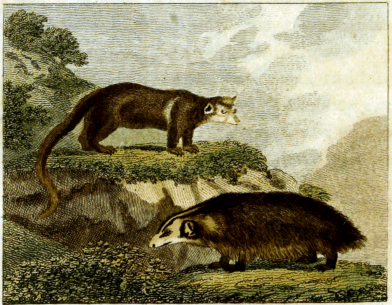
FIG. 182. Glutton.
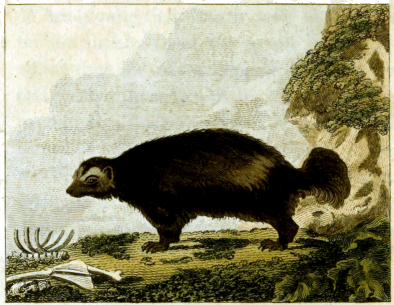
FIG. 184. Kmeajou. FIG. 183. Carcajou.
THE GLUTTON.
THE body of the Glutton (fig. 182.) is thick, and his legs short. He is somewhat of the form of a badger, but nearly as thick again. His head is short, his eyes small, his teeth very sharp and strong, his tail rather short, and covered with hairs to its extremity. He is black along the back, and of a reddish brown on the sides and flanks. His fur is exceedingly beautiful, and much valued. This animal is very common in Lapland, and in all neighbouring countries of the Northern Seas, both in Europe and Asia. He is called carcajou in Canada, and in the northernmost parts of America. It is also highly probable that the animal of Hudson’s Bay, which Edwards has called the quick hatch, or wolverin, is the same as the carcajou of Canada, or the glutton of the northern part of Europe. That also which Fernandes has mentioned, by the name of tepeytzcuitli, or the mountain dog, is, probably, of the glutton species, and which may possibly be dispersed as far as the desart mountains of New Spain.
Olaus Magnus seems to be the first who has mentioned this animal. He says, that it is of the size of a large dog, that his ears and face are like those of the cat; the feet and claws very strong; the hair brown, long, and tough; and the tail bushy, like that of a fox, but much shorter. According to Scheffer, the head is round; the teeth strong and sharp, like those of the wolf; the hair black, the body very broad, and the feet short like those of the otter. La Hontain, who is the first that speaks of the carcajou of North America, says, “Figure to yourself an animal of double the size and thickness of a badger, and you have a perfect resemblance of this animal.” According to Sarrazin, who possibly only saw a young carcajou, its body is only two feet long, and its tail eight inches. “It has (says he) a very short and very thick head; its eyes are small; its jaws very strong and furnished with thirty-two sharp teeth.” The young bear, or young wolf, of Edwards, which seems to be the same animal, was, according to him, as thick again as a fox; its back was crooked; its legs short; its belly almost trailing on the ground; and its tail of a middling length tufted towards the end. All agree that this animal is a native of the most northern parts of Europe, Asia, and America. Gmelin is the only one who affirms, that it travels even into hot countries. But this assertion appears very dubious, if not absolutely false. Gmelin, like many other naturalists, has perhaps confounded the hyæna of the South, with the glutton of the North, which bear some resemblance in their natural habits, especially that of voracity; but in every other respect they are entirely different.
The legs of the glutton are not formed for running; he cannot even walk except slowly; but cunning supplies the deficiency of swiftness. He conceals himself to watch for his prey; and to seize it with greater security he climbs up trees, from which he darts even on the elk and rein-deer, and fastens himself so strongly with his claws and teeth on their backs that all their efforts cannot remove him. The poor animal thus attacked, in vain flies with its utmost speed, in vain rubs himself against trees, to obtain deliverance from this cruel enemy; all is useless; fastened on his back or loins the glutton persists in digging into his flesh, and sucking his blood, till the animal, fainting with loss of blood, sinks a victim to his tormentor, when the glutton devours his flesh with the utmost avidity and cruelty; and several authors affirm, that it is almost inconceivable the length of time he will continue eating, or the quantity of flesh he will devour.
The accounts of travellers are doubtless exaggerated; but if we even retrench a great part of their recitals, there will still remain sufficient to convince us that the glutton is much more voracious than any other beast of prey; and from this circumstance he has, not unjustly been denominated the quadruped vulture. He is more insatiable, and commits greater depredations than the wolf; and would destroy every animal, if he had sufficient agility, but he is reduced to drag himself heavily along; and the only animal he is capable of overtaking is the beaver, whom he easily destroys. He even attacks that animal in his hole and devours both him and his young, unless they get to the water, in which case the beaver escapes his enemy by swimming, for the glutton stops his pursuit to feed on the fish he can find. When deprived of living food, he goes in search of carcases, scratches up the graves, and devours the flesh of dead bodies.
Although this animal is subtle and uses every art to conquer others, he does not seem to have the least instinct for his own preservation. This indifference, which seems to shew imbecility, is perhaps occasioned by a different cause; for it is certain the glutton is not a stupid animal, since he readily finds means to satisfy his perpetual appetite; he does not want for courage, since he attacks every animal indifferently that comes in his way, and does not fly at the sight of man, nor even shew the least mark of fear. But this negligence for his own safety does not arise from an indifference for his preservation, but from a habit of security. He is almost a stranger to men, for being a native and resident of desart countries where they seldom come, when he does meet them, he has no reason to take them for enemies; besides, in every contest with other animals he is certain of conquest; and therefore he moves with confidence, and has not the least idea of fear, which supposes some foreproved misfortune, or some experience of weakness and inability. We have an example of this intrepidity in the lion, who never turns his back on man, at least till he has tried his strength; so the glutton traverses the snow, in his own desart climate, in perfect security. In those regions he reigns supreme, as does the lion in the forests and burning sands; and if not like him, from superior prowess, he is no less so from the weakness and timidity of those with whom he has to contend.
The isatis is not so strong, but much swifter than the glutton; he serves the latter as a purveyor, for the glutton follows him in his pursuit of animals, and often deprives him of his prey; for as soon as he approaches, the isatis, to avoid his own destruction, takes to flight, and leaves to his pursuer what he has not had time to devour. Both these animals burrow under ground; but in every other habit they differ. The isatis will associate and often go in company; while the glutton always moves alone, or at most only with his female; indeed the male and female are frequently found together in their burrows. The most fierce dogs are averse from attacking the glutton, as he defends himself with his teeth and feet, and often mortally wounds them; but as he cannot escape by flight, when once beset it is not long before he is subdued.
The flesh of the glutton, like that of every other voracious animal, is very bad food. He is only hunted for his skin, which makes beautiful fur, not inferior to the sable and black fox. Some of them, when well-dressed, has a more beautiful gloss than any other skin, and is by no means inferior in appearance to a rich damask.
Engraved for Barr’s Buffon.
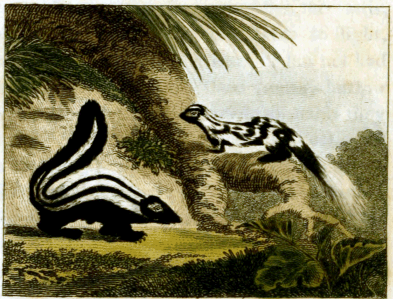
FIG. 185. Potot. FIG. 186. Chinch.
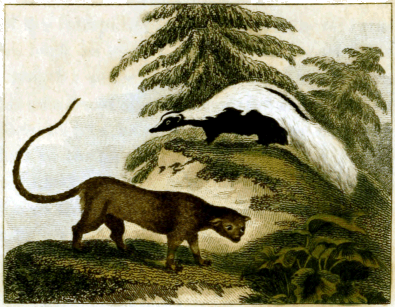
FIG. 187. Conepate. FIG. 188. Zorille.
THE STINKARDS.
THESE animals are found in every part of South America; but they have been very indistinctly described by travellers, and not only confounded with each other, but also placed with animals of a very distinct species. Hernandes has very clearly indicated three of these animals; the first he calls by its Mexican name ysquiepatl, and which is the same animal that Seba has given a figure of in his works, and is called squash in New Spain. The second Hernandes also denominates by the same name, (ysquiepatl) and which in South America is called the skink. The third he styles conepate, and which has been mentioned by Catesby, under the appellation of the American pole-cat, and by M. Brisson, by that of the striped pole-cat. Besides those mentioned by Hernandes, there is a fourth kind of these animals called zorille, in Peru, and in some parts of the Spanish settlements in India.
We are indebted to M. Aubry for the knowledge of the squash, the skink, and the zorille; the two last may be regarded as originals, as we do not meet with their figures in any other author.
The first of these animals came to M. Aubry under the name of pekan, the Devil’s child, or the wild cat of Virginia. I perceived it was not the real pekan, but the same animal that Hernandes has described by the name of ysquiepatl, and which has been indicated by travellers by the name of squash, or potot. (fig. 185.) It is about sixteen inches long; its legs are short, its muzzle rather pointed, its ears small, its hair of a deep brown, and its claws black and sharp. It chiefly dwells in the hollows and clefts of rocks, where it brings forth its young. It lives upon small animals, birds, &c. and often steals into a farm yard, where it kills the poultry, but eats only their brains. When it is pursued or offended, it calls up the most diabolical scents to its defence, and sends forth such a horrid stench, that it is dangerous for men or dogs to approach it. Its urine is apparently infected with this nauseous vapour, but which does not seem habitual to it. “I had one of these animals sent me from Surinam, (says Seba) which I kept alive in my garden during the summer; I fastened it with a small chain; it never attempted to injure any person; and when properly fed it might be managed like a little dog. It burrowed in the earth with its snout, assisted by its two fore-paws, the claws of which were long, and turned backwards: in the day-time it concealed itself in the hole it had dug; at night it came out, and after having cleaned itself it continued constantly running backwards and forwards, as far as its chain would permit. It only eat as much food as would satisfy its hunger; it never touched flesh nor bread, but seemed principally fond of caterpillars, spiders, worms, &c. One morning, towards the end of autumn, it was found dead, unquestionably from not being able to endure the cold. The hair along its back was of a deep chesnut; its ears were short, the fore-part of its head round, and of a lighter colour than that on the back; on the belly it was yellow. Its tail was of a middling length, covered with a brown and short hair, annulated with small rings.” Although the description and figure given by Seba agrees with that of Hernandes, we must, however, doubt their both being the same animal, since Seba does not make any mention of its detestable scent; and it is difficult to conceive it possible for him to have kept such a stinking animal a whole summer in his garden, without speaking of the inconvenience that would arise from such a circumstance; and we might suppose that the animal described by Seba was a different one from that mentioned by Hernandes; this suspicion, which at first sight seems to be well founded, must be entirely obviated, when it is known that this animal only sends forth this infectious scent when pursued or offended; and it has likewise been caught and tamed by many people in America.
Among the above four kinds of stinkards, which we distinguish by the names of the squash, or potot, conepate, chinch, or skink, and zorille: the two last belong to the warmest parts of South America, and may possibly be no more than two varieties, and not different species. The two first are of the temperate climate of New Spain, Louisiana, Carolina, &c. and seem to be distinct and different species from the others; particularly the squash, which has the peculiar character of having only four claws on the fore-feet, whereas all the rest have five. But in other respects these animals are all nearly alike, they have the same instinct, the same offensive scent, and only differ in size, and in the colour and length of the hair. The squash is of a pretty uniform brown colour, and its tail is not tufted like the rest. The conepate (fig. 187.) has five white stripes on a black ground, running longitudinally from the head to the tail. The skink, or chinch, (fig. 186.) is white on the back, and black on the sides, but quite black on the head, excepting a white streak from the nape of the neck to the forehead; its tail is tufted and cloathed with very long white hairs, mixed with some of a black colour.
The zorille, (fig. 188.) which is also called mauripita, is still smaller, and has a beautiful tail, as bushy as that of the chinch, from which he differs however in the disposition of the colours on his coat. He has several long white streaks, which run longitudinally from the head to the middle of the back, on a black ground, and others which pass transversely over the loins, the crupper, and the insertion of the tail, one half of which is black and the other white, whereas the back of the chinch is nearly all the same colour.
Kalm, speaking of this animal, says, “one of them came near the farm where I lived. It was in winter, and during the night; the dogs that were upon the watch pursued him until he discharged his urine against them. Although I was in bed, and he at that time had got to some distance, I thought I should have been suffocated, and the cows and oxen, by their lowings, shewed how much they were affected by the stench. About the end of the same year another of these animals crept into our cellar, but did not exhale the smallest scent. A foolish woman, however, perceiving him one night by the shining of his eyes, disturbed and killed him; from that moment the stench began to spread, the whole cellar was instantly filled with it to such a degree that the woman kept her bed for several days, and all the meat, bread, and other provisions in the place, were so infected that they were obliged to be thrown out of doors.”
These animals are somewhat like the European pole-cats; they also resemble them in their natural habits, and the physical results of their generation are the same. The pole-cat is the most offensive animal for its scent in this continent; it is only stronger in the stinkards, whose species are very numerous in America, whereas there is only one of the pole-cat race in all the old continent; for I do not believe, with Kolbe, that the animal he calls the stinking otter, and which seems to be a real stinkard, exists as a native at the Cape of Good Hope; and possibly Kolbe, who is not very exact, has borrowed his description from P. Zuchel, whom he has quoted as having seen that animal in Brasil. The animal of New Spain, called by Fernandes the ortohua, seems to be the same animal as the Peruvian zorille; and the tepemaxtle, mentioned by the same author, may probably be the conapate, which is found in New Spain, as well as in Louisiana and Carolina.
Engraved for Barr’s Buffon.
FIG. 190. Vison. FIG. 189. Pekan.
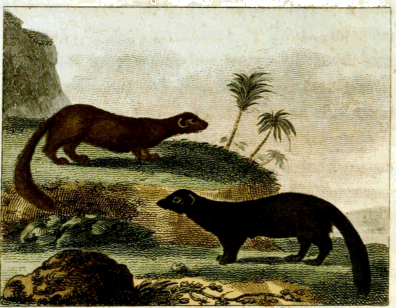
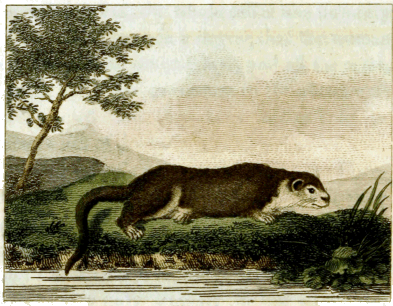
FIG. 191. Canadian Otter.
THE PEKAN, AND THE VISON.
THE fur merchants of Canada have long been acquainted with the name of pekan, without any knowledge of the animal to which it belongs. Naturalists have not even mentioned its name; and travellers have employed it to denote different animals, particularly stinkards, so that it was impossible to derive any precise knowledge of it from their erroneous remarks. The origin of the name of the vison is no less difficult to be traced than that of the pekan, and it is only said that they belong to two different animals of America. M. Aubry, in his cabinet, has two animals under this denomination, and from which, by his indulgence, we have been enabled to give a sketch of their figures, and the following description:
The pekan (fig. 189.) so strongly resembles the marten, and the vison (fig. 190.) the pole-cat, that we are inclined to consider them as varieties of those two species. They are of the same make and proportion, have the same length of tail, quality of hair, and number of teeth and claws; from which facts there is certainly sufficient reason to conclude that they are merely varieties, or at least as species approaching so near each other, that it is difficult to point out any real difference, except that the hair of the pekan and the vison is more soft, brown, and glossy, than that of the marten and pole-cat; but this difference is common to them as well as to the beaver, otter, and other animals of North America, whose fur is more beautiful than those of the same kind of animals in the north of Europe.
THE SABLE.
ALMOST every naturalist has treated of this animal without knowing any thing more of it than its skin. M. Gmelin is the first who has given its figure and description, from having seen two living ones at the Governor’s of Tobolski. “The sable (says he) resembles the marten in his shape and habit of body, and the weasel in the number of his teeth: he has six long incisive teeth, a little turned back, two long canine teeth in the lower jaw, and very sharp small teeth in the upper; he has very large whiskers about the mouth; and his feet are broad, and armed with five claws. These characters were common to these two sables, but one of them was of a dark brown, excepting the ears and throat, where the hair was rather yellow; the other, which was smaller was of a more yellowish tincture, its ears and throat being also much paler. These are the colours they both have in winter, and which they change in the spring, the former becoming of a yellowish brown, the other of a pale yellow. I have often admired, continues M. Gmelin, the agility of these animals. Whenever they perceived a cat they fixed themselves in an erect posture on their hind legs, as if they were preparing for an attack. Their inquietude in the night[C] was also remarkable, that being the natural time for seeking their prey, whereas in the day, especially after feeding, they generally slept an hour at a time, during which they might be taken up, rolled about, or carried to any distance without the smallest hazard of disturbing them.”
These animals inhabit the banks of rivers in shady places, and also the thickest woods: they leap with great ease from tree to tree, and are said to be afraid of the sun; the rays of which tarnish the lustre of their robes in a very short time. It has also, though erroneously, been asserted, that they conceal themselves in holes, and remain torpid during the winter, whereas that is the chief time for hunting them, as their skins are then in the greatest perfection. They live on rats, fish, and wild fruit. They have the same disagreeable odour common to animals of this kind, and which is strongest during their rutting season. They are most numerous in Siberia, being very few in Russia, and still less in Lapland and other northern countries. The blackest furs are the most esteemed.[D] The difference of this skin and which so particularly distinguishes it from all others, consists in the fur having no grain, but rubbed any way, is equally smooth and irresisting; whereas the furs of all other animals, rubbed against the grain, give a sensation of roughness from their resistance.
The sable is chiefly hunted by condemned criminals, who are sent to Russia into these dreary and extensive forests; or by soldiers who are sent there on purpose. These unfortunate wretches remain there many years, and are obliged to furnish a certain number of skins annually; they only employ a single ball to kill this animal that they may damage the fur as little as possible; sometimes instead of fire-arms, they make use of the cross-bow and very small pointed arrows. As the success of this hunting requires address and great assiduity, the officers are permitted to encourage the criminals, by allowing them to share among themselves the surplus of the number they are obliged to procure; and this in a few years, frequently amounts to a considerable sum.
Some naturalists have imagined the sable to be the satherius of Aristotle, and their conjecture seems to be well founded. The fineness of the sable’s fur indicates that he often goes into the water; and some travellers assert, that the greatest numbers are found in small islands; Aristotle calls the satherius a water animal, and joins it to the beaver and the otter. We must also presume, that when Athens was in its height of magnificence, these beautiful skins were not unknown to the Athenians, and that the animal which supplied them had some name affixed to him, and we know of no one that can be applied to the sable with greater propriety than that of satherius. If it be true that the sable eats fish, and often dwells in the water, he must also have a place among the number of amphibious animals.
THE LEMING.
OLAUS MAGNUS is the first who has taken notice of the Leming; and all that Gesner, Scaliger, Ziegler, Johnston, and others have said respecting him, is extracted from that author. But Wormius, who made very strict researches, speaks more particularly. “The leming (says he) is of the shape of a mouse, but has a shorter tail: his body is about five inches long, and is covered with fine hair of various colours. The extremity of the upper part of the head, the neck and shoulders are black, and the rest of the body is reddish, intermixed with small black spots of various figures excepting the tail, which is brown, and not above half an inch long. Some of them have red hairs about the mouth, resembling whiskers, six of which are considerably longer than the rest. The mouth is small, and the upper lip divided like the squirrel. Two sharp, incisive, and crooked teeth, shoot from the upper jaw, the roots of which penetrate to the orbit of the eyes: in the lower jaw they have teeth conformable to the upper; a little distance from these on each side are placed three grinders. The tongue is pretty large, and extends to the extremity of the incisive teeth. The remains of the food found in the throat of this animal, induces us to imagine he ruminates. The eyes are little and black; the ears round and inclining towards the neck; the legs before are shorter than those behind; the feet are cloathed with hair, and armed with five very sharp and crooked claws; the middle claw is the longest and the fifth is like the spur of a cock, sometimes placed very high up the leg. The hair on the belly is whitish, bordering a little on yellow, &c.”
This animal, though its legs are very short, and its body thick, runs very swiftly. They generally inhabit the mountains of Norway and Lapland, from whence they sometimes descend in such numbers, that the inhabitants look on their arrival as a terrible scourge, which there is no possibility of preventing. They move, for the most part, in the night, and remain still during day. It is in vain that attempts are made to stop their progress, for though thousands are destroyed, myriads seem to succeed. They generally move in lines about three feet from each other, and exactly parallel; and their march is always directed from the north-west to the south-west. Wherever their motions are directed nothing can turn them aside; if a lake, or river, interrupts their progress, they all take to the water and swim over it; even a fire, or a well, does not turn them out of their line of direction; they boldly plunge into the flames, or leap down the well, and are sometimes seen climbing up on the other side. If they are interrupted by a boat, while they are swimming across the river, they mount directly up its sides, and the boatmen, who know how vain resistance would be, calmly suffer the living torrent to pass over, which it does without further damage; and if they meet with a stack of hay or corn, they gnaw their way through. Happily, however, they never enter an house to destroy the provisions, but consume every root and vegetable that they meet, and lay waste every garden, meadow, or field of corn that comes in their way. If a man ventures to attack one of them, the little animal is no way intimidated by the disparity of strength, but furiously flies up at his opponent, and wherever he fastens, it is not easy to make him quit his hold; and when thus attacked they have a kind of bark somewhat like that of little dogs.
An enemy so numerous and destructive, would soon render the countries where they appear utterly uninhabitable, did it not fortunately happen, that the same rapacity that animates them to destroy the labours of mankind, at least impels them to destroy each other. After committing incredible devastations, they at last separate into two armies, opposed with deadly hatred, along the coasts of the larger lakes and rivers. The Laplanders, who observe them thus drawn up, instead of considering their mutual animosities as a happy riddance of the most dreadful pest, form ominous prognostics from the manner of their engagements: they consider their combats as a presage of war, and expect an invasion from the Russians or Swedes. The two divisions, however, continue their engagements, and from that time they begin to disappear, nor is it well known what becomes of either the conquerors or the conquered. Some suppose that they rush into the sea, others that they kill themselves, as some are found hanging on the forked branches of trees; and others that they are destroyed by the young spring herbage. But it is most probable, that having consumed the vegetable productions of the country, they then fall upon and devour each other. However this may be, they die in such numbers, that their carcasses have been known to infect the air, and to produce malignant disorders. They seem also to infect the plants which they gnaw, as the cattle often die that feed in the places where they passed. In fine weather, they go in droves into the water, but no sooner does the wind rise, than they are all drowned. As the inhabitants know not from whence they come, it is a vulgar opinion that they fall from the clouds with the rain.[E]
The male is generally larger, and its spots bigger than those of the female. The flesh of the lemings is horrid food, and their skins, though covered with a very beautiful fur, is of too little consistence to be serviceable.
THE SEA OTTER.
THEVET says, “the Saricovienne, or Sea Otter, is found by the sides of the river Plata; it is an amphibious animal, and lives as much in the water as upon land; it is full as large as a cat, its skin is a very dark grey, nearly black, and is extremely soft; its feet are webbed like those of water fowls; and its flesh is very good, and even delicate.”
Naturalists do not seem to have been acquainted with this animal, nor to have known that the carigueibeju of Brasil, which is certainly the same, had membranes between the toes, for Marcgrave, who has given a description of it, totally omits this essential character. I am also of opinion that the guachi, mentioned by Gumilla, which is a species of otter in South America, is the same as the saricovienne. Marcgrave and Desmarchais describe it to be as big as a middling sized dog: that the top of its head is round, and its nose long; that its teeth and whiskers resemble those of the cat; that it has small black eyes, round ears, five toes on each foot, with a kind of thumb shorter than the others, and all armed with brown claws; that its hair, which is short and soft, is black on the body, and has a white spot under the chin; that its voice is somewhat like that of a young dog; and notwithstanding it lives principally on crabs and fish, its flesh is very good, and its skin makes an excellent fur.
THE CANADIAN OTTER.
THIS Otter, (fig. 191.) which is larger than ours, and which must be a native of the north of Europe, as well as of Canada, occasioned me to enquire whether it was not the same animal as that called by Aristotle the latax, which, he says, is much larger and stronger than the common otter. But his observations do not entirely agree with the animal in question, and therefore as it perfectly resembles the common otter in other respects, I judged that it was not a particular species, but only a simple variety; and as the Greeks, especially Aristotle, have taken great care not to give different names, except to distinct species, we are therefore convinced that the latax is another animal. Besides, as the otters, like the beavers, are commonly larger, and their hair finer, and of a more beautiful black in America than in Europe; this Canadian otter ought, in fact, to be larger and blacker than our otter. But in attempting to discover what the latax of Aristotle might be, I conjectured that it was the same animal as Belon calls the marine wolf.
Aristotle mentions six amphibious animals, of which only three are known to us, namely, the seal, the beaver, and the otter; the three others, the latax, the satherion, and the satyrion, still remain unknown, because their names are only mentioned without any description of them. In this case, as in all those where we cannot draw any direct induction from a knowledge of the object, we must have recourse to the mode of exclusion: but we cannot make use of that mode with any success, unless we are nearly acquainted with every thing; when that is the case, we can conclude a negative from the positive, and this negative hence becomes a positive fact. For example, I believe that by long study, I have attained a knowledge of almost every quadruped. I know that Aristotle could not have had any knowledge of those peculiar to the continent of America. I also know those which are amphibious, and among these I separate those that belong to America, as the tapir, the cabiai, the ondatra, &c. and then there remains only the amphibious animals of our own continent, namely, the hippopotamus, the walrus, or sea-cow, the sea-wolf of Belon, the beaver, the otter, the sable, the water-rat, the Muscovy musk-rat, the water shrew-mouse, and we may include the ichneumon, which some have looked upon as an amphibious animal, and styled it the Egyptian otter. I retrench from this number the walrus, or sea-cow, the seal, or sea-cow, which being only met with in the northern seas, was not known to Aristotle; I also retrench the hippopotamus, the water-rat, and the ichneumon, because he speaks of them in another part of his work by their proper names; and I likewise retrench the seal, the beaver, and the otter, which are well known, and the water shrew-mouse, because it is too much like the land one to have received a different name. There then remains the sea-wolf of Belon, the sable, and the Muscovy musk-rat, for the latax, the satherion, and the satyrion. Of these three animals, the sea-wolf of Belon is the only one that is larger than the otter, therefore it alone can represent the latax; consequently the sable and the Muscovy musk-rat, must represent the satherion and the satyrion. It must, however, be perceived that these conjectures, which I believe to be well founded, are not among the number which time can elucidate, unless some Greek manuscripts shall be discovered which are unknown at present, where these names are made use of, and explained by new indications.
THE SEAL, THE WALRUS, AND THE MANATI.
SEAL, Walrus, and Manati, are rather generic denominations than specific names. Under that of the Seal, we shall comprehend, first, the phoca of the ancients, which is probably the same animal as the seal; 2. The common seal, which we call the sea-calf; 3. The great seal, of which Mr. Parsons has given a figure and description in the Philosophical Transactions, No. 496; and 4. The very large seal, which is called the sea-lion, the figure and description of which is given in Anson’s Voyages.
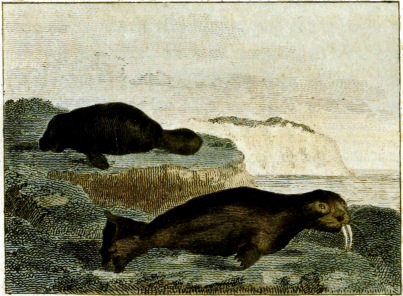
By the walrus we understand those animals commonly called sea-cows, or sea-horses. We know of two species of this animal, one found only in the northern seas, and the other only in the southern, which is called dugan or Indian walrus. And lastly, under that of manati, we comprehend those called lamantans, or sea-oxen, in St. Domingo, and other parts of South America, as well as that of Senegal, and other parts of the coast of Africa, and which seem to be only varieties of the American species.
The seal and the walrus approach nearer to quadrupeds than to cetaceous animals, because they have a kind of feet. But the manatis, which have only two before, are more of the cetaceous tribes than the quadrupeds. But they differ from every other animal by the following striking character. They are the only animals that can equally live in air and water, and consequently the only ones we can properly term amphibious. In man, and the other terrestrial viviparous animals, the foramen ovale of the heart, which permits the fœtus to live without respiration, is shut at the moment of its birth, and remains closed during life. In these, on the contrary, it is always open, notwithstanding the females bring forth their young on land; and their respiration begins and operates immediately after birth, as it does in every other animal. By means of this perpetual aperture in the septum, subsisting and permiting the communication of the blood from the vena cava to the aorta, these animals have the advantage of breathing or not at pleasure. This singular property is common to all three; but each has peculiar faculties, which we shall notice as far as possible, in the history of the different species.
Engraved for Barr’s Buffon.
FIG. 192.Seal.
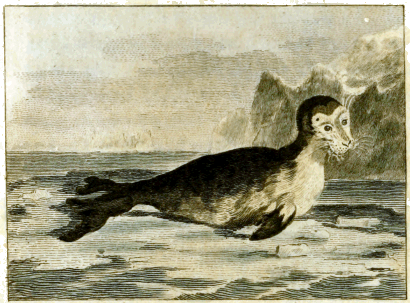
FIG. 193. Walrus. FIG. 194. Manati.
THE SEAL.
THE Seal (fig. 192.) in general has a round head, like the human species; a broad muzzle like the otter; eyes large and elevated; little or no external ears, having only two auditory passages on the sides of the head; whiskers about its mouth; teeth somewhat resembling those of the wolf; the tongue forked at the point; the body, hands, and feet, covered with a short and bristly hair; no arms but two membranes, like hands, with five fingers terminated by as many claws; no legs but two feet exactly like the hands, except being larger and turned backwards, as if designed to unite with a very short tail, which they accompany on each side; the body is thickest at the breast from whence it tapers down to the tail like a fish. He is so strange an animal that he appears fictitious, and has served as a model for the poets to form their tritons, syrens, and other sea deities, whom they feigned to have the head of a man, the body of a quadruped, and the tail of a fish. In fact, he seems to reign superior in the mute empire of the sea, by his voice, figure, and intelligence, which he possesses equally with any land animal; he is so far above the order of fishes, that he seems not only to belong to a different order of beings, but to a different world. Hence though of a nature very distant from that of our domestic animals, yet he seems susceptible of a kind of education. He is reared by putting him often in water; he is taught to give a salute with his head and his voice; he will come when called, and he gives many other signs of intelligence and docility.
His brain is proportionally larger than in man: his sensations are as perfect, and his intellects as active, as those of any quadruped; both are strongly marked in his docility, his social qualities, his strong instinct for the female, his great attention towards his young, and by the expressive modulation of his voice, which is superior to that of any other animal. His body is likewise firm and large; he is very strong and armed with sharp teeth and claws. He also enjoys many particular and singular advantages. He can, with perfect ease, endure heat or cold; he feeds indifferently on grass, flesh, or fish; and he can equally live on ice, land, or in the wafer. This animal, with the walrus alone, deserves the name of amphibious. They alone have the foramen ovale open, consequently they are the only animals who can exist without respiration, the elements of air and water being equally agreeable. The otter and the beaver cannot properly be termed amphibious, as the air is their real element, for not having this aperture through the septum of the heart, they cannot remain any length of time under the water, but are obliged to quit it, or raise their heads out of it in order to respire.
But these great advantages are counter-balanced by imperfections still greater. The seal may be said to be deprived of the use of his limbs, as his arms, thighs, and legs are almost entirely shut up within his body, while nothing appears without but his hands and feet, which are, it is true, furnished with five fingers or toes, but which are scarcely moveable, being united by a strong membrane, so that they might more properly be called fins than hands and feet, being more adapted for the purpose of swimming than walking. Besides the hind feet are turned backwards, therefore entirely useless upon land, so that when the animal is obliged to move, he drags himself forward like a reptile, and with efforts much more painful, for as he cannot bend himself in an arch, like the serpent, to obtain the support of different parts, and so advance by the reaction of the ground, he would remain like a lump on the earth if it were not for his hands and tail, and with which he seizes any thing within his reach with such dexterity that he drags himself up the steepest shores, rocks, and even shoals of ice, however steep or slippery. By this method he moves with a much greater degree of swiftness than could be expected, and often, though wounded, escapes the pursuit of the hunters.
The seal is a social animal, at least great numbers generally frequent the same places. Their natural climate is the north, but they live in the temperate and even hot countries, for they are seen on the shores of almost all the seas of Europe and even in the Mediterranean; they are found also in the southern seas of Africa and America; but they are infinitely more common and more numerous in the northern seas of Asia, Europe, and America. This species varies in size, colour, and figure, according to the difference of climates. We have seen some of these animals alive, and many of their skins have been sent to us; out of these we have chosen two for our present subject; the first is the common seal of our European sea, of which there are many varieties. We have seen one, the proportions of whose body seemed to differ from any other, its neck being shorter, its body longer, and its claws larger; but these differences are not sufficient to constitute a distinct species. The second is the seal of the Mediterranean and southern seas, which we presume to be the phoca of the ancients, and a distinct species, for it differs from the others in the quality and colour of the hair, which is flowing, and almost black, whereas that of the common kind is grey, and of a bristly nature. Its teeth and ears are also different, for it has a very small external ear, which the other has not; its incisive teeth are likewise terminated with two points, while the teeth of the other are smooth and sharp, like those of the dog, wolf, and other quadrupeds. Its arms, or fins, are also situated lower, that is to say, more backward. Nevertheless, these discrepancies are, perhaps, only varieties depending on the climate, and not specific differences; especially as in places where the seals abound, there are numbers of them found larger and smaller, thicker and thinner, and of different colours according to their sex and age.
From a similarity, which appeared at first sight but trivial, and by some fugitive accounts, we were induced to suppose this second seal, or small seal, was the phoca of the ancients. We were informed that the one we had was brought from India, and very probably it came from the Levant. It was an adult, as it had all its teeth. It was about a fifth less than the full-grown seals of our ocean, and about two-thirds less than those of the Frozen Sea, for it was not above two feet five inches in length, while that described by Mr. Parsons was seven feet and a half long, though not arrived at its full growth, as it wanted several teeth. Now the characters given by the ancients of their phoca do not denote so large an animal, but agree with the small seal, which they often compare to the otter and beaver.
There is another circumstance mentioned by the ancients as belonging to the phoca, which, though false, could never have been intimated as belonging to our seals, or those of the northern seas. They say that the phoca’s hair waves like the sea, and by a natural sympathy follows its motions, lying backward when it flows and forward when it ebbs, and that this remarkable effect remains long after the skin is separated from the animal. Now this could never be attributed to our seals, nor to those of the northern seas, since the hair of both is short and stiff; while, on the contrary, it rather agrees with that of the small seal, which is longer, and of a more supple nature than the hair of the common kind. Besides, Cardan positively asserts, that this property, which had been regarded as fabulous, is found to be a fact in India. Without placing more dependance on this assertion of Cardan’s than it deserves, we must allow it indicates that this circumstance belongs to the Indian seal, though possibly it is nothing more than an electric phenomenon, the effects of which the ancients being ignorant might ascribe it to the flowing and ebbing of the sea. However this may be, the above reasons are a sufficient foundation to presume, that the small seal is the phoca of the ancients; and there is also great reason to conclude, that it is the same as that M. Rondelatius calls the Mediterranean phoca, the body of which, according to him, is much longer and smaller, in proportion, than our seal. The great seal, described by Mr. Parsons, and which, probably, came from the northern seas, seems to be a different species from the other two, for, notwithstanding it had scarcely any teeth, it was as big again, in all its dimensions, as the common kind. Mr. Parsons, as Mr. Klein judiciously remarks, speaks a great deal on the subject of this animal in a few words, and has given the following observations in the Philosophical Transactions, No. 469, p. 383, 386.
"A sea-calf was shewn at Charing-cross, London, in the month of February, 1742-3. The figures given by Aldrovandus, Johnston, and others, being designed in profile, lead us into two errors. 1st. They make the legs apparent, though they are not visible externally in any position the animal is placed; and, secondly, the hind feet are represented like two fins, whereas they are two real feet, webbed like those of a water-fowl, each having five toes, composed of three articulations, and ending with darkish-coloured claws. The claws on the fore-feet are very large and broad, nearly like those of a mole, and seem to be designed for the purposes of crawling, and partly for swimming, as between each toe there is a narrow membrane; but the membranes of the hind feet are much larger, and only serve to row the animal along when in the water. It was a female, and died in the morning of the 16th of February, 1742-3. The hairs that were about its mouth were of a horny and transparent substance; its stomach, intestines, bladder, kidneys, ureters, diaphragm, lungs, great blood-vessels, and the parts of generation, were like those of a cow: the spleen was two feet long, four inches broad, and exceedingly thin; the liver was composed of six lobes, each of which was long and thin, like the spleen; the gall bladder was very small; the heart long, and of a soft texture, having a large foramen ovale, and the fleshy parts very considerable. In the lower stomach were about four pounds weight of sharp and angular pieces of flint, which seems as if the animal had swallowed them for the purpose of grinding its food. This animal is viviparous, and suckles its young by the mamilla, like quadrupeds, and its flesh is firm and muscular. Although it had attained seven feet and a half in length, yet it was but young, as it had scarcely any teeth; and it had four small holes regularly placed about the navel, which were the preceding signs of four teats to appear hereafter."
Thus it appears there are three kinds of seals, differing from each other. The small black seal of India and the Levant; the common seal of our seas; and the great seal of the northern ocean. To the first of these, therefore, we must refer all that the ancients have written about the phoca. Aristotle was acquainted with this animal, for he has described it of an ambiguous nature, an intermediate creature between aquatic and terrestrial animals; that is, an imperfect quadruped, having no external teats for suckling its young, and only very apparent auditory passages; that its tongue is forked, and has a small tail resembling that of a stag. This entirely agrees with the seal; but he is deceived in affirming that its has no gall-bladder. Mr. Parsons, indeed says, that the gall-bladder of the great seal which he describes, was very small; but M. Daubenton found a gall-bladder in the seal which he dissected proportionable to the size of the liver; and the gentlemen of the Academy of Sciences, who also met with a gall-bladder in the seal which they dissected do not speak of its being remarkably small.
Aristotle could not have had any knowledge of the great seal of the Frozen Sea, since in the time he lived all the north of Europe and of Asia was unknown, The Romans considered Gaul and Germany as their north, and the Greeks knew still less of the animals belonging to this part of the world; it is, therefore, very probable, that when Aristotle speaks of the phoca as a very common animal, he only means the Mediterranean seal.
These three species have many properties in common with each other; the females bring forth in winter, and place their young upon some sand-bank, rock, or small island. When they suckle their young they sit upon their hind legs, and continue to nourish them in this manner for twelve or fifteen days, after which she brings them to the water, accustoms them to swim, and to search for their food; she carries them on her back when they are fatigued. As each litter does not consist of above two or three, her cares are not much divided, and the education of her little ones is soon completed. In fact, these animals are very sagacious and docile; they understand and naturally assist each other in dangers. The young ones distinguish their mother among a numerous troop; and are perfectly obedient to her call. We are unacquainted with their time of gestation; but if we judge of it from that of their growth, the length of their lives, and the size of the animal, it must be many months; the time from their birth till they attain their full growth being many years, the length of their lives must be proportionably long. I am even inclined to believe that these animals live upwards of a hundred years, for we know that cetaceous animals, in general, live much longer than quadrupeds; and as the seal is the link between both it, ought to participate of the nature of the first, and consequently live much longer than the last.
The voice of the seal may be compared to the barking of an angry dog. When young, they have a shrill note, somewhat like the mewing of a cat. Those that are taken early from their dams mew continually, and often die of hunger sooner than take the food that is offered them. They bark at and endeavour to bite those who injure them, and are more of a courageous than timid nature. Instead of being terrified at thunder and lightning, it seems to delight them; they generally come on shore in tempests and storms, and even quit their icy abodes to avoid the shock of the waves; at such times they sport in great numbers along the shore: the tremendous conflict seems to divert, and the heavy rains that fall, to enliven them. They have naturally a disagreeable scent, and which is smelt at a great distance, when there are great numbers together. When pursued they often drop their excrements, which are of a yellow colour, and of a very abominable scent. They have a prodigious quantity of blood, and being also loaded with fat, they are, consequently, very dull and heavy. They usually sleep a great deal, and very sound, and are fond of taking their repose in the sun on flakes of ice, or sides of rocks, and they may be approached very nigh without being disturbed, which is the usual method of taking them. They are very seldom secured with fire-arms, for they do not immediately die, even if shot in the head, but plunge into the sea, and are entirely lost to the hunter; therefore the general method is to surprise them when asleep, or at a distance from the sea, and knock them on the head with clubs. “They are not easily killed, and are a long time dying (says an eye-witness), for although mortally wounded, their blood nearly exhausted, and even stripped of their skins, yet they still continue alive; and indeed it is a shocking sight to see them in this condition wallowing and rolling about in their blood. These remarks were made on an animal we killed, about eight feet long; after it was skinned, and deprived of the greater part of its fat, yet it attempted to bite, notwithstanding they had given him many powerful blows over the head and nose. It even seized a cutlass with as much vigour as if it had not been wounded; after which we pierced it through the heart and liver, from whence as much blood flowed as is contained in a young ox[F].”
The hunting, or perhaps, to speak more properly, the fishing of these animals is not very difficult, and is attended with great profit, the flesh being good food, and the skin exceedingly serviceable. The Americans fill them with air, and make a kind of raft, or small boats of them: their fat yields a clear and much sweeter oil than that drawn from the porpoise, or other cetaceous animals.
To these three kinds of seals already mentioned we may, perhaps, add a fourth, described in Anson’s voyages by the name of the sea-lion. These are found in great numbers on the Magellanic coasts, and at the island of Juan Fernandes, in the South Sea. The sea-lion resembles our seal, which is very common in the same latitudes, but it is much larger, being from eleven to eighteen feet long, and from eight to eleven in circumference, when it has acquired its full growth. They are so fat that when the skin is taken off, the blubber is about a foot thick all round the body, and from a single animal more than ninety gallons of oil may be drawn. They are, at the same time, very full of blood, and which, when deeply wounded, springs out with amazing force. Upon the throat of one of these animals being cut, two hogsheads of blood were taken out, besides what then remained in its body. Their skins are covered with a short hair of a brownish colour, but blackish on the tail and feet. Their toes are united by a membrane, which does not reach to their extremity, and each of them are terminated by a claw. The sea-lion differs from the common seal not only in its size and bulk, but also by other characters. The male has a kind of thick crest, or trunk, hanging from the end of its upper jaw, about five or six inches long. This character is not seen in the females, and forms a very striking distinction between them. The strong males collect together a flock of females, and permit no other male to approach them. These animals are truly amphibious; they remain all the summer in the sea, and go upon land in the winter; at which season the females bring forth, but never produce above one or two at a litter, which they suckle.
The sea-lions, while they are on land, feed on the herbage which grows by the sides of the sea. They are of a very heavy and drowsy nature, and delight to sleep in the mire. Though very indolent and difficult to waken, yet at those times they commonly fix some as centinels near the place where they sleep; and it is said, that these centinels give loud warnings when any danger is near. Their voices are very loud and of various tones; sometimes grunting like hogs, and sometimes neighing like horses. The males often fight about the females and wound one another desperately with their teeth. The flesh of these animals is not disagreeable to eat; particularly the tongue, which is as good as that of the ox. They are very easily killed, as they cannot defend themselves, nor fly from their enemies: they are so exceedingly heavy, that they move with great difficulty, and turn themselves with still greater. Those that hunt them have only to guard against coming too near their teeth, which are very strong, and with which they inflict deadly wounds.
By comparing other observations and accounts, and from the conclusions which may be drawn from them, the sea-lion of South America, appears to be nearly the same animal as that found on the northern coasts of the same continent. The large seal of Canada, spoken of by Denis, by the name of the sea-wolf, and which he distinguishes from the common seals, may possibly be of the same species as these sea-lions. “Their young, says this author, are bigger and longer at their birth than our largest hogs.” Now it is certain that our seals are never of that size, even when full-grown. The Mediterranean seal, or the phoca of the ancients, is still less; therefore there only remains the seal Mr. Parsons has described, which agrees with that mentioned by Denis. Mr. Parsons does not say whence this great seal was brought: but whether it came from the north of Europe, or from America, it might be the same as the sea-wolf of Denis, or the sea-lion of Anson, for it appears to be of the same size, since though not nearly full-grown it measured seven feet in length. Besides the size, there is the most apparent difference between the sea-lion and the seal, namely, the male of the first has a large crest on its upper jaw. Now Mr. Parsons did not see the male; he only described the female, which had no crest, and which perfectly resembled the female sea-lion, mentioned by Anson. To these similarities Parsons adds another still more precise; he says, that the great seal which he saw had a stomach and intestines like those of a cow; and the sea-lion also mentioned in Anson’s Voyages, is described as an animal which feeds on grass during the whole summer. Hence it is very probable that these two animals are formed alike, or rather they are the same animals, and very different from other seals, who have but one stomach, and which live entirely upon fish.