Front matter (continued 3)
Reading edition
The ape is, therefore, further removed from the human species in relative qualities, than most other animals: He likewise differs greatly by temperament. The human species can dwell in every climate; he lives and multiplies in the northern as well as in the southern regions; but the ape lives with difficulty in temperate countries, and can only multiply in the hottest parts of the earth. This difference of temperament supposes others in organization, which though concealed, are no less real; it must also have a great influence on his natural dispositions. The excess of heat so necessary to this animal renders all his affections, and all his qualities, excessive; and we need not seek for any other cause to account for his petulance, his lubricity, and his other passions, which seem to be as violent as they are extravagant.
Thus the ape, which philosophers, as well as the generality of people, have regarded as a being difficult to define, and the nature of which was at least equivocal, and intermediate between that of man and the brute, is, in fact, no other than a real brute, wearing externally a human mask, but internally destitute of thought, and every other attribute which constitutes the human species: an animal inferior to many others in his relative faculties, and most essentially different from the human race in his nature, temperament, and also in the time necessary to his education, gestation, growth, and duration of life; that is, in every real habitude which constitutes what we call Nature in a particular being.
Engraved for Barr’s Buffon.
FIG. 195. Jocko.
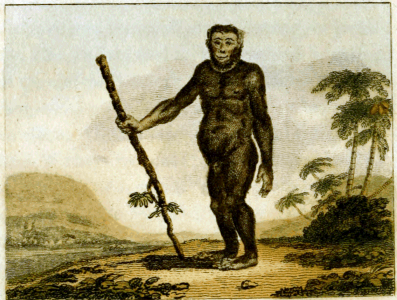
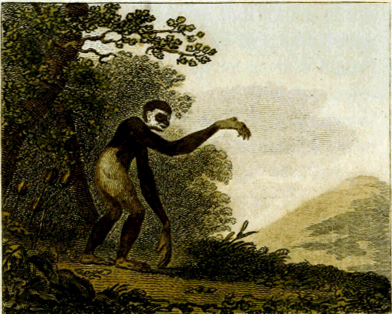
FIG. 196. Small Gibbon.

THE ORANG-OUTANG [L], OR THE PONGO, AND THE JOCKO.
WE shall present the Orang-outang and the Jocko together, because they, possibly, belong to the same species. Of all the ape and monkey kinds, these bear the greatest resemblance to the human form, and consequently, those which are most worthy particular notice. We have seen the small orang-outang, or jocko (fig. 195.) alive, and have preserved its skin; but we can only speak of the pongo, or great orang-outang, from the accounts given us by travellers. If their relations might be depended on, if they were not often obscure, faulty, and exaggerated, we should not doubt of its being a different species from the jocko, a species more perfect, and approaching still nearer to the human race. Bontius, who was head physician at Batavia, and who has left some excellent observations on the Natural History of that part of India, expressly says, that he saw with admiration, some individuals of this species walking erect on two feet, and among others a female (of which he gives a figure) who seemed to have an idea of modesty, covering herself with her hand on the appearance of men with whom she was not acquainted; who sighed, cried, and did a number of other actions, so like the human race, that she wanted nothing of humanity but the gift of speech. Linnæus, upon the authority of Kjoep and other travellers, says, that even this faculty is not wanting in the orang-outang, but that he thinks, speaks, and expresses his meaning in a whistling tone. He calls him the Nocturnal Man, and at the same time gives such a description of him, that it is impossible to decide whether he is a brute or human being. We must, however, remark, that, according to Linnæus, this being, whatever he may be, is not above half the height of a man; and as Bontius makes no mention of the size of his orang-outang, we should imagine them to be the same: but, then, this animal of Linnæus and Bontius would not be the true orang-outang, which is of the size of a very tall man: neither can he be what we call the Jocko, which I have seen alive; for although he was of the same size as that described by Linnæus, yet he differed in every other character. I can affirm, from having repeatedly seen him, that he neither spake nor expressed himself by a whistling noise, and that he did not perform a single thing which a well instructed dog could not perform: He differed in almost every respect from the description which Linnæus gives of the orang-outang, and agreed much better with that of the satyrus of the same author. I therefore greatly doubt the truth of the description of this nocturnal man; I even doubt his existence; and it was probably a white negro, a Chacrelas, whom those travellers, which Linnæus has quoted, have but superficially seen, and as blindly described, for the Chacrelas, like the nocturnal man of this author, has white, woolly, frizly hair, red eyes, a weak sight, &c. But then they are men, and do not whistle; nor are they pigmies of only 30 inches in height; they think, speak and act, like other men, and their stature is exactly the same.
Discarding, therefore, this ill-described being, and supposing a little exaggeration in Bontius’s relation concerning the modesty of his female orang-outang, there only remains a brute animal, namely, an Ape, of which we have information from authors of more credit; and which is described with the greatest exactness by Edward Tyson, a celebrated English anatomist. This learned gentleman says, that there are two species of this ape, and that the one he gives a description of is not so large as the other called barris, or baris, by travellers, and drill by the English. This drill is, in fact, the large orang-outang of the East-Indies, or the pongo of Guinea; and the pigmy described by Tyson is the jocko, which we have seen alive. The philosopher Gassendi having advanced, on the authority of a traveller, named St. Amand, that in the island of Java there was a creature which formed the shade between man and the ape, the fact was positively denied. To prove it, Peiresse produced a letter from M. Noël, a physician, who lived in Africa, in which it is asserted, that there is found in Guinea a large ape, called barris, which walks erect on its two feet, has an appearance of more gravity and sagacity than any of the other species, and has a very strong inclination for women. Darcos, Nieremberg, and Dapper, speak nearly the same of the barris. Battel calls it pongo, and assures us, “that, excepting his size, he is exactly like a man in all his proportions; but he is as tall as a giant; his face is like that of a man, his eyes deep sunk in the head, and the hair on his brows extremely long; his visage is without hair, as are also his ears and hands; his body is lightly covered with hair. He scarcely differs from man, except not having any calf to his legs; yet he always walks on his hind legs: he sleeps under trees, and builds himself a shelter against the sun and the rains. He lives only upon nuts and fruits, and is no way carnivorous: he cannot speak, and has no more understanding than any other animal of the brute creation. When the people of the country travel in the woods they make fires by which they sleep in the night, and being gone, in the morning this animal comes and sits by it until it goes out, but he has not skill enough to keep the flame alive by feeding it with fuel. They go together in companies, and if they happen to meet with one of the human species, remote from succour, they shew him no mercy. They even attack the elephants, whom they beat with their clubs, and oblige them to leave that part of the forest which they claim as their own. These creatures are never taken alive, for they are so strong that ten men would not be able to hold one of them. They sometimes destroy the young ones; the mother carries them, she herself being in an erect posture, and they cling to her body with their hands and knees. There are two kinds of this animal, both very much resembling the human race, the one the natives call pongo, is taller and thicker than a man; and the other engeco, or jocko, whose size is much smaller.” It is from this passage that I derived the names pongo and jocko. Battel further observes, that when one of these animals dies the rest cover his body with leaves and branches of trees. Purchas adds, in a note, that in the conversations he had with Battel he learned that a negro boy was taken from him by a pongo, and carried into the woods, where he continued a whole year, and that on his return he said, that they never attempted to do him any injury; that they were generally about the height of the human race, but much larger, and nearly double the bulk of a man. Jobson asserts to have seen, in places frequented by these animals, a sort of habitation composed of interwoven branches, which might serve them at least as a shelter from the heat of the sun. “The apes of Guinea, says Bosman, which are called smitten by the Flemings, are of a yellow colour, and grow to a very large size. I have seen some above five feet high. These apes are of a very disagreeable appearance, as well as those of another species, which resemble them in every particular except in size, not being one fourth part so big. They are very easily taught to do almost whatever their masters please.” Schouten says, “That the animals which the Indians call orang-outangs are nearly of the same height and figure as man, but that their back and loins are covered with hair, although they have none on the fore part of their bodies; that the females have two large breasts, that their face is coarse, their nose flat, and their ears like those of men; that they are robust, active, bold, and defend themselves against armed men; that they are passionately fond of women, who cannot pass through the woods which they inhabit, without these animals immediately attacking and ravishing them.” Dampier, Froger, and other travellers, assert, that young girls, about eight or ten years old, are taken away by these animals, and carried to the tops of high trees, and that it is a very great difficulty to rescue them. To all these testimonies we may add that of M. de la Brosse, mentioned in his voyage to Angola, in 1738, wherein he says that the orang-outangs (which he calls quimpezés) often attempt to surprise the Negresses, whom, when they succeed, they detain for the purpose of enjoying, feeding them very plentifully all the time. “I knew (says he) a Negress at Loango who had lived among these animals for three years. They grow from six to seven feet high, and are of great strength. They build sheds, and make use of clubs for their defence. They have flat faces, broad flat noses, ears without a tip, and their skins are fairer than that of a mulatto, but they are covered on many parts of their bodies with long and tawny-coloured hair: their bellies are extremely tense, their heels flat, rising behind about half an inch: they sometimes walk upright, and sometimes upon all fours. We purchased two of these animals, a male of about fourteen months old, and a female about twelve, &c.”
Thus we have given the most precise and perfect account we could collect of the great orang-outang, or pongo; and as magnitude is the only striking character in which it differs from the jocko, I must persist in my belief that they are of the same species; for two things are at least possible. 1. That the jocko may be a constant variety; that is, a much smaller race than that of the pongo; in fact, they are both of the same climate, they live in the same manner, and consequently ought to resemble each other perfectly, since they equally receive, and are subject to the same influences of earth and sky. Have we not an example of a like variety in the human species? The Laplander and Finlander, though living under the same climate, yet differ almost as much in size, and much more in other attributes, as the jocko differs from the great orang-outang. 2. The jocko, or small orang-outang, which we have seen alive, as well as those of Tulpius, Tyson, and others which have been transported into Europe, were, perhaps, only young animals which had not attained the whole of their growth. That which I saw was about two feet and a half high, and the Sieur Nonfouix, to whom it belonged, assured me that it was not above two years old; therefore, it possibly might have attained to the height of five feet if it had lived, supposing its growth to be proportionate to that of the human species. The orang-outang described by Tyson, was still younger, as it was not above two feet high, and its teeth were not entirely formed. Those of Tulpius and Edwards were nearly of the same size as that which I saw, therefore it is very probable that these animals, had they been at liberty in their own climate, would have acquired the same height and dimensions which travellers ascribe to the great orang-outang. From these circumstances we shall consider these two animals as belonging to one species, till a more precise knowledge of them shall be obtained.
The orang-outang which I saw walked always upright, even when carrying heavy burthens. His air was melancholy, his deportment grave, his movements regular, his disposition gentle, and very different from that of other apes. Unlike the baboon, or the monkey, whose motions are violent, and appetites capricious, who are fond of mischief, and only obedient through fear, a look kept him in awe. It may be urged that he had the benefit of instruction; but equally so had those with whom I mean to compare him, and yet neither the baboon, nor other apes, could be brought to obey without blows, while a word was enough for him. I have seen this animal give his hand to shew the company to the door that came to see him, and walk about as gravely with them, as if he formed one of the company. I have seen him sit down at table, unfold his napkin, wipe his lips, make use of a spoon or a fork to carry the victuals to his mouth, pour out its drink into a glass, and touch glasses with the person who drank with him; when invited to take tea, he would bring a cup and saucer, lay them on the table, put in sugar, pour out the tea, and leave it to cool before he drank it. All this I have seen him perform without any other instigation than the signs, or the commands of his master, and often of his own accord. He was gentle and inoffensive; he even approached strangers with respect, and appeared rather to solicit caresses than inclined to offer injuries. He was singularly fond of sweetmeats, which every body was ready to give him; and as he had a defluxion upon the breast, together with a cough, so much sugar contributed, no doubt, to shorten his life. He continued at Paris one summer, and died in London the following winter. He would eat almost every thing that was offered, but preferred dry and ripe fruits to all other aliments. He would drink wine, but in small quantities, and willingly left it for milk, tea, or any other sweet, or mild liquor. Frederick Henry, Prince of Orange, had one of these animals presented to him, the figure and description of which is given by Tulpius, and who relates nearly the same circumstances respecting him as we have done. But if we would know what peculiar instincts belong to this animal, and distinguish him from the improvements he had received from his master; we must compare those facts which we have witnessed, with the relations which travellers have given who have seen this animal in a state of nature, and in captivity. M. de la Brosse, who bought two orang-outangs from a negro, and which were but a year old, does not mention their having been educated; on the contrary, he asserts, that they performed many of the above actions by natural instinct. “These animals, says he, sat at table like men, they eat every sort of food without distinction, made use of a knife, a fork, or a spoon, to eat their meat and help themselves; they drank wine and other liquors. We carried them on ship board, and when they were at table, they made signs to the cabin-boy expressive of their wants; and whenever the boy neglected or refused to give them what they wanted, they became in a passion, seized him by the arm, bit and then threw him down. The male was sea-sick, and required attendance like a human creature: he was even twice bled in the right arm; and every time afterwards, when he found himself indisposed, he held out his arm, as if conscious of having been relieved by that operation.”
Henry Grose relates, “that these animals are to be met with to the north of Coromandel; that Mr. Horne, governor of Bombay, had two of them, a male and a female, sent him from a merchant of the name of Vancajee, who lived upon the sea-coast in that country, by Captain Boag, the master of a trading vessel; who, as well as some of his people, gave the following description of them: they were scarcely two feet high, but their form was entirely like the human: they walked erect upon their two feet, and were of a sallow white, without any hairs on any other part than those on which mankind generally have them. Many of their actions perfectly resembled the human, and their melancholy plainly evinced they felt the weight of their captivity. They made their bed very orderly in the cage in which they were sent on board the ship. When any person looked at them they hid those parts which modesty forbids to expose. Whether the sea air affected them, or they pined at their confinement, or whether the captain did not provide them proper food, the female first sickened and died, upon which the male shewed all the real signs of grief, and took the death of his companion so greatly to heart that he refused his food, and did not survive her more than two days.”
Such was captain Boag’s account to Governor Horne, on his return to Bombay; and upon being asked what he had done with their bodies, said he had thrown them overboard, not at the time thinking of preserving them. The governor was so desirous of possessing such a curiosity, that he sent to Vancajee, requesting him to procure more; to which Vancajee replied, he was afraid that would not be in his power, as they were caught upon the skirts of a forest about seventy leagues up the country, but they were so shy and cunning, that the inhabitants were scarcely able to take them, it not happening more than once in a century.
Francis Pyrard relates, “that in the province of Sierra Leona in Africa, there is a species of apes called baris, who are strong and muscular, and so very industrious, that, if properly fed and instructed, they serve as very useful domestics: they usually walk upright, will pound any thing in a mortar, fetch water from the river in little pitchers, which they carry on their heads; but if the pitchers be not taken off immediately on their return they let them fall to the ground; but when they see them broken, they begin to lament and cry for the loss." Father Jarrie says nearly the same, and almost in the same words. The testimony of Schouten agrees with Pyrard’s, on the education of these animals. “When taken, he says, they are taught to walk erect on their hind feet, and to make use of those before as hands, for certain works, as rinsing glasses, carrying the beer, and waiting at table, turning the spits, and other domestic business.” “I saw at Java (says Guat) a very extraordinary female ape; she was very large, and often walked erect on her hind feet, at which time she hid with her hands the parts which distinguish the sex. She had no hair on her face, except the eyebrows, and her face much resembled those grotesque ones of the Hottentot women which I have seen at the Cape. She made her bed every day with great neatness, slept with her head on a pillow, and covered herself with a quilt. When she had the head-ache, she would bind it round with a handkerchief, and it was amusing to see her thus dressed in bed. I could relate a number of other little circumstances which appeared extremely singular, but I own I did not admire them so much as most people; because I was aware of the design of bringing her to Europe to gratify curiosity, and was therefore inclined to suspect that she had been taught a number of these tricks, which the populace looked upon as natural to the animal. She died in our vessel about the latitude of the Cape. This ape greatly resembled the human species in figure, &c.”
Gemelli Careri speaks of one he saw which cried like a child, walked erect on its hind-feet, and carried a mat under its arm, on which it laid down to sleep. “These apes (he adds) seem in some respects to be more sagacious than men; for when they no longer find fruits on the mountains, they descend to the seashore, where they catch and feed on crabs, oysters, and other shell-fish. There is a species of oyster, called taclovo, which weighs several pounds, and often lies upon the shores with its shell somewhat open; but this animal being sufficiently sagacious to suspect they may close upon him, if he uses his paws, first puts a stone between the shells, and then eats the oyster at his pleasure.”
“On the coasts of the river Gambia (says Froger) there are apes larger and more mischievous than in any other part of Africa: the negroes are afraid of them, and they cannot travel alone where they frequent, without running a risk of being attacked by these animals, who make use of huge clubs. The Portuguese say that they frequently take away young girls of seven or eight years of age, and carry them up to the highest trees. Most of the negroes regard these animals as foreigners who are come to establish themselves in their country, and that their not speaking arises from a fear of being obliged to work.” Another traveller remarks, that at Macacar there are apes which walk upon their hind-feet like the human species, that they go in numbers, and that an encounter with them often proves fatal.
Thus we have nearly given every particular circumstance concerning this animal which has been related by travellers who may be the most depended upon. I have given their accounts entire, because every passage is important in the history of a brute which has so great a resemblance to man; and in order to determine its nature with the greater certainty, we shall now mention those differences and conformities which divide him from or give him an approximation to the human species. The first external difference is the flatness of the nose, the shortness of the forehead, and the defect of prominence in the chin. The ears are proportionally too large, the eyes too close to each other, and the interval between the nose and the mouth too great: these are the only differences between the face of the orang-outangs and that of man. With regard to the body and limbs, the thighs are proportionally too short, the arms too long; the fingers too small, the palms of the hands too narrow, and the feet rather resemble the hands than the human feet. The parts of generation differ only from those of man, by their having no frænum to the prepuce; but in the females the organs externally are nearly like those of women.
Internally this animal differs from man in the number of its ribs; having thirteen, whereas man has only twelve. The vertebræ of the neck are also shorter, the bones of the pelvis narrower, the haunches more flat, and the orbits of the eyes sunk deeper. There is no spiny apophysis to the first vertebræ of the neck; the kidnies are rounder than in the human species, and the ureters have a different figure, as well as the bladder and gall-bladder, which are much longer and narrower. In almost every other part, as well externally as internally, there is so perfect a resemblance to those of the human species, that we cannot compare them without expressing our wonder and admiration, that from such a similar conformation and organization the same effects are not produced. For example, the tongue, and all the organs of the voice, are exactly the same as in man, and yet this animal does not speak; the brain is absolutely of the same form and proportion, and yet it does not think. Can there be a more convincing proof, that matter alone, however perfectly organized, cannot produce either speech or thought, unless animated by a superior principle? or, in other words, by a soul to direct its operations? Man, and the orang-outang, are the only animals which have calfs to their legs, and their posteriors formed for walking erect. They likewise are the only ones which have a broad chest, flat shoulders, and the vertebræ conformable to each other; and the only animals whose brain, heart, lungs, liver, spleen, stomach, and intestines, are perfectly alike, and who have a vermicular appendix. In short, the orang-outang has a greater resemblance to man than even to baboons or monkeys, not only by all the parts which I have indicated, but also by the largeness of the visage, the form of the cranium, the jaws, teeth, and other bones of the head and face; by the thickness of the fingers and thumb; by the shape of the nails; by the articulations of the joints, sternum, &c. So that since we find, by comparing this animal with those which resemble it most, such as the magot, baboon, or monkey, it has a greater conformity with the human than the animal species, which have all been mentioned under the general name of apes, the Indians are excusable for having associated it with man by the name of orang-outang, or the wild man of the woods. As some of the facts we have mentioned may appear suspicious to those who have not seen this animal, we shall support them by the authority of the two celebrated anatomists Tyson[M] and Cowper, who dissected it with a most scrupulous nicety, and have given the results of the comparisons they made of all its parts with the human species. I shall only observe, that the English are not confined, like the French, to one single word to denote animals of this kind: they have, like the Greeks, two different denominations, one for those without tails, which they call apes, and the other for those with tails, which they term monkeys. Those which Tyson speaks of by the word apes must be the same animals as we have called pithecos, or pigmy, and the cynocephalus, or Barbary ape. I must also remark, that this author gives some characters of resemblance and difference which have not a sufficient foundation. I have therefore thought it necessary to make some observations on those particulars, as we cannot too minutely examine a creature, which, though it has the form of a man, nevertheless belongs to the brute species.
1. Tyson gives, as a particular character of man and the orang-outang, the having the hair on their shoulders inclined downward, and that on the arms upwards. It is true that most quadrupeds have their hair directed downwards, or backwards, but this is not without some exceptions. The sloth and the smallest species of ant-eater have the hair on their anterior parts inclined backward, and that on the crupper and loins directed forwards; therefore this character carries no great weight in comparing the orang-outang with man.
2. The four first differences also in the passage I have quoted are very slight, or ill-founded. The first is the difference of size, which character is very uncertain, especially as the author himself observes that his animal was very young. The second, third, and fourth, are drawn from the form of the nose, the quantity of hair, and other trivial circumstances. It is the same with many others, which may be retrenched; for example, the twenty-first character is drawn from the number of the teeth. It is certain that both this animal and man have the like number of teeth, and if the one in question had only twenty-eight, it ought to be attributed to its youth, for we know that the human race have not more in the early part of their days.
3. The seventh difference is likewise very equivocal; the scrotum of children is in general very tight, and this animal being young ought not to have had them pendulous.
4. The forty-eighth character of resemblance, and the twenty-first, twenty-second, twenty-third, twenty-fourth, and twenty-fifth marks of difference, only denote the presence or shape of certain muscles, which as they vary in most individuals of the human species, ought not to be considered as essential characters.
5. Every difference and resemblance drawn from parts too minute, such as the apophyses of the vertebræ, or that are taken from the position and magnitude of certain parts, should be considered only as accessory characters; so that Tyson’s whole anatomical table may be reduced to the essential differences and resemblances which we have already mentioned.
6. I have thought it necessary to point out other more general characters of this animal, some of which have been omitted by Tyson, and others but badly indicated. First, The orang-outang is the only one of all the apes that has no pouches within his cheeks on each side of the jaw, in which to put the provisions before they swallow them, for the inside of his mouth is perfectly like that of man. Secondly, the gibbon, the Barbary ape, and all the baboon and monkey kind, except the douc, have their posteriors flat, with callosities on them. The orang-outang is the only one which has those parts plump, and without callosities. The douc also has no callosities, but then his posteriors are flat and covered with hair, so that in this respect the douc forms the shade between the orang-outang and the monkeys; as the gibbon and magot form the same knot with respect to the pouches on each side of the jaw. Thirdly, the orang-outang is the only animal who has the calfs of the legs, and fleshy posteriors. This character shews that it is formed much better than any other animal to walk upright; but as its toes are very long, and its heels higher situated than in man, it runs with greater ease than it walks, and there would be occasion for artificial heels higher than those of our shoes to enable it to walk easily for a long time together. Fourthly, though the orang-outang has thirteen ribs, and man only twelve, this difference does not approximate it nearer to the baboon or monkey than it removes it from man, because the number of ribs varies in most of those species, some of them having twelve, others eleven, ten, and so on. So that the only differences between the body of this animal and that of man are reduced to two, viz. the figure of the bones of the pelvis, and the formation of the feet; these, therefore, are the only considerable parts by which the orang-outang bears a greater resemblance to the other apes than it does to the human species.
From this examination, which I have made with all the exactness I am capable of, we may form a tolerably correct judgment of this animal. If there were a step by which we could descend from human nature to that of the brutes, and if the essence of this nature consisted entirely in the form of the body, and depended on its organization, the orang-outang would approach nearer to man than to any other animal. Seated in the second rank of beings, if it could not command in the first, it would at least make others feel its superiority. If the principle of imitation, by which he seems so closely to copy the actions of man, were a result of thought or reason, this ape would be at a still greater distance from the brute species, and nearer the human; but, as we have observed, the interval which separates them is not trifling, and the resemblance in form, conformity of organization, and motions of imitation, which seem to result from those similitudes, neither bring it nearer the nature of man, nor raise it above that of the brutes.
Distinctive Characters of this Species.
The orang-outang has no pouches on the sides of the jaws, no tail, nor any callosities on the posteriors, which last are plump and fleshy: all his teeth are similar to those of man: his face is flat, naked, and of a swarthy colour; his hands, feet, ears, breast, and belly, are also naked: the hair on the head descends on the sides of the temples like tresses; on his back and loins there is but a very small quantity of hair[N]: he is about five or six feet high, and always walks erect on his two hind feet. We have not been able to verify whether the females are subject to periodical courses like women: analogy will scarcely suffer a doubt to arise to the contrary.
THE PITHECOS, OR PIGMY.
ARISTOTLE says, “there are animals whose nature are ambiguous, and partake, in some measure, of the human and quadruped species; such as the pithecos, the kebes, and the cynocephali. The kebe is a pithecos with a tail; the cynocephalus is perfectly like the pithecos, but larger, stronger, and has a more pointed muzzle, approaching very near that of a bull-dog, from which it derives its name: its manners are also more ferocious, and its teeth stronger than those of the pithecos, and more resemble those of a dog.” It is clear, from this passage, that neither the pithecos nor cynocephalus, mentioned by Aristotle, have any tail; for he says, that the pithecos with a tail, is called kebe; and that the cynocephalus resembles the pithecos in every particular, except the muzzle and teeth. Aristotle, therefore, speaks of two apes without tails, the pithecos and the cynocephalus; and of others with tails, which he calls kebes. Now, to compare what we at present know with what was known by Aristotle, we shall observe, that we have seen three species of apes without tails, namely, the orang-outang, the gibbon, and the magot, not one of which is the pithecos; for the two first were certainly unknown to Aristotle, being only found in the southern parts of Africa and India, which were not discovered till after his time: besides, they have very different characters from those he ascribes to the pithecos. But the third species, which we call the magot, or Barbary ape, is the cynocephalus of Aristotle, for it possesses all its characters; it has no tail, its muzzle is like that of a bull-dog, and its canine teeth are large and long. This animal is also found in Asia Minor, and in other provinces of the East, and with which the Greeks were well acquainted. The pithecos belongs to the same country, but we have not seen it, and know it only from the relations of travellers, and, although during twenty years, in which we have made the research of these animals our study, this species has not fallen under our inspection, yet we do not doubt but that it as really exists as the cynocephalus. Gesner and Johnston have given figures of this pithecos. M. Brisson mentions his having seen it, and he distinguishes it from the cynocephalus, which he also saw, and confirms Aristotle’s remark that these two animals perfectly resemble each other in every respect, excepting the face, which is shorter in the cynocephalus than in the pithecos. We have already observed, that the orang-outang, the pithecos, the gibbon, and the magot, are the only animals to which we can apply the generic name of ape, being the only animals which have no tail, and rather choose to walk on two legs than four. The orang-outang, and the gibbon, are very different from the pithecos and the magot. But, as the two latter perfectly resemble each other, except in the length of the muzzle, and size of the canine teeth, they have been often taken for each other. They have always been mentioned by the common name of ape, even in languages which have one name for apes without tails, and another for apes which have tails. They are both called by the name of aff in German, and ape in English; and it is only among the Greeks that we find that each of these animals has a proper name. The word cynocephalus is rather an adjective than a proper substantive, for which reason we have not adopted it.
It appears from the testimonies of the ancients, that the pithecos, or pigmy, was the most gentle and docile of all the ape species that were known to them; and that it was common in Asia, as well as in Lybia, and in the other provinces of Africa, frequented by the Greek and Roman travellers. Therefore I presume that we must refer the following passages of Leo Africanus, and Marmol to the pigmy. They say, that the apes with long tails, which are seen in Mauritania, and are called by the Africans mones, come from the negro country; but that those without tails are found in great numbers, and are natives of the mountains of Mauritania, Bugie, and Constantine. “These animals, says Marmol, have feet and hands like a man, and, if I may be allowed the expression, a human face; they have an appearance of much vivacity, and seem very malicious. They live upon corn, herbs, and all sorts of fruits, to obtain which they sally forth in large troops, to plunder the gardens or fields; but before they venture out on these expeditions one of the company ascends an eminence, and surveys the country round. If there be no person near, he makes a signal by a cry, for his companions to proceed, remaining himself, however, at his station: but as soon as he perceives any one coming, he sets up a loud cry, and the whole company scamper off with the utmost precipitation, and jumping from tree to tree, retreat to the mountains. It is a great curiosity to see these animals retreat; for the females carry four or five young ones upon their backs, and with this heavy load, leap with great agility from branch to branch; yet great numbers of them are taken, by different snares, notwithstanding all their cunning. When they are angry, they bite furiously, but by coaxing, they are easily tamed. They do great damage to the gardens and fields, because they pluck, pull down, and tear up, every thing that comes in their way, whether ripe or not, and often destroy more than they can eat or carry away. Those that are tamed, perform things almost incredible, and imitate almost every human action!” Kolbe relates nearly the same facts with respect to the apes of the Cape of Good Hope: but the description and figure he gives of them, plainly prove they are baboons, having a short tail, a long muzzle, sharp nails, &c. they are also much larger and stronger than the apes of Mauritania. We may therefore presume, that Kolbe only copied this passage from Marmol, and applied the natural habitudes of the Mauritania pigmies to the baboons of the Cape of Good Hope.
The pithecos, the magot, and the baboon, were known to the ancients: these animals are found in Asia Minor, Arabia, Upper Egypt and in all the northern parts of Africa. This passage of Marmol may, therefore, be applied to all the three; but it is clear it does not agree with the baboon, for it says these apes have no tails; and what makes me of opinion that it is not a magot, but a pithecos, is, that the former is not easily tamed, that it commonly produces only two young ones, and not four or five, like that of which Marmol speaks; and the latter, being also less, must produce a greater number at a time. Besides the pithecos, or pigmy, is more gentle and docile than the magot, or Barbary ape, which is scarcely ever thoroughly tamed. From these reasons I am convinced, that we must not apply this passage in the above author to the magot, but to the pithecos; and the same remark may be made to a passage of Rubruquis, who, in his discourse of the apes of Cathay, says, “that they nearly resemble the human form in every particular; that their height is not above a foot and a half, and their body covered all over with hair; that they live in holes; that the natives take them, by putting strong and inebriating liquors in the places they inhabit; that a number of them come together to drink liquors, at the same time making a cry which sounds like chinchin, whence they have obtained the appellation of chinchins; and that having intoxicated themselves they fall asleep, when the hunters easily surprise and carry them away.” These characters agree with the pithecos, and not at all with the Barbary ape. We have seen one of the latter alive, but never heard it pronounce the word chinchin. Besides it was above a foot and a half in height, and had a less resemblance to the human form than what this author asserts. We have the same reasons for applying Prosper Alpinus’s figure and description to the pithecos, rather than to the magot. He asserts, that the small ape without a tail, which he saw in Egypt, was sooner and more easily tamed, and more sagacious, lively, and diverting, than those of any other kind. This plainly distinguishes it from the magot, which is a filthy, sullen, vicious, untractable animal, and is never fully tamed, so that the characters given by Prosper Alpinus to his ape without a tail, do not agree in any respect with the Barbary ape, and can belong to no other animal than the pithecos.
Distinctive Characters of this Species.[O]
The pithecos, or pigmy, has no tail; his canine teeth are not proportionably larger than those of man; his face is flat, as are likewise his nails, which are rounded at the top like those of the human species; he walks erect, is about a foot and a half high, and of a gentle and tractable disposition. The ancients assert that the female is subject to a periodical emanation, and analogy leaves us no reason to doubt the fact.
THE GIBBON,[P] OR LONG-ARMED APE.
THE Gibbon (fig. 196.) always keeps itself erect, even when it walks on all four feet, its arms being as long as both its body and legs. We have seen one of these animals alive; it was but young, and not more than three feet high; we may therefore presume, that it had not attained its full size, and that when in a free state, it may grow to four feet. It has no appearance of any tail, and the character which evidently distinguishes it from all other apes, is the extraordinary length of its arms. It had a circle of white hair all round the face, which gave it a very remarkable appearance: its eyes are large but sunk deep in the head; its face is flat nearly resembling that of a man, and of a tawny colour, and its ears, though well proportioned, are naked. This animal, next to the orang-outang and the pithecos, would approach the nearest to the human form, were it not deformed by the excessive length of its arms: for man in a state of nature would have a strange appearance; his hair and beard, if they were neglected, would encircle his visage not unlike that which surrounds the face of the gibbon.
This ape appeared to be of a gentle and tractable disposition; its motions were neither too rash, nor too precipitate. It was fed on bread, fruit, almonds, &c. and calmly received the food that was presented. It was very averse to cold and wet, and did not live long after being brought into a foreign climate. It is a native of the East Indies, and particularly along the coasts of Coromandel, Malacca, and the islands of Molucca.[R] This animal is not to be met with in the less southern provinces, and there is every reason to conclude that the ape found in the kingdom of Ganaura, on the frontiers of China, ought to be referred to the gibbon, although it is called by some travellers fefé. This species varies both in size and colour, for there are two in the royal cabinet, one of which, although adult, is much smaller than the other, and is brown on those parts of the body where the other is black; but as they perfectly resemble each other in every other respect, we have not the least doubt that they both belong to the same species.
Distinctive Characters of this Species.
The gibbon has no tail; there are small callosities on his posteriors; his face is flat, brown, and surrounded with a circle of white hairs; his canine teeth are larger in proportion than those of man; his ears are naked; black, and round; his hair is black, brown, or sometimes grey with age; his arms excessively long; he walks erect, and is about two feet and a half, or three feet high. The female is subject to a periodical emanation.
THE MAGOT, OR BARBARY APE.
THIS animal, of all apes which have no tail, is that which can best bear with the temperature of our climate. We kept one for many years. In the summer it remained in the open air with pleasure; and in the winter might be kept in a room without any fire. It was filthy, and of a sullen disposition: it made use of grimace equally to shew its anger, or express its hunger: its motions were violent, its manners aukward, and its physiognomy more ugly than ridiculous. Whenever offended it grinned and shewed its teeth. It put whatever was given to it into the pouches of the cheeks, and commonly ate every thing that was offered, except raw flesh, cheese, or any thing that had undergone a kind of fermentation. When inclined to sleep it was fond of roosting on a wooden or iron bar. It was always kept chained, for, notwithstanding its long domesticity, it was neither civilized nor attached to its keepers. Apparently it had been badly educated, for I have seen others of the same species who were more sagacious, more obedient, more gay, and so tractable as to be taught to dance, keeping time, and suffer themselves quietly to be clothed.
Engraved for Barr’s Buffon.
FIG. 197. Magot.
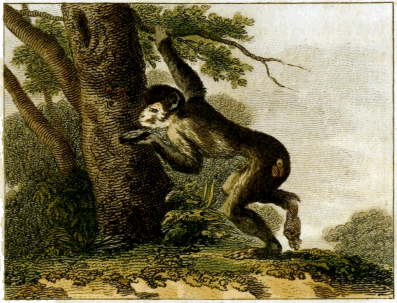
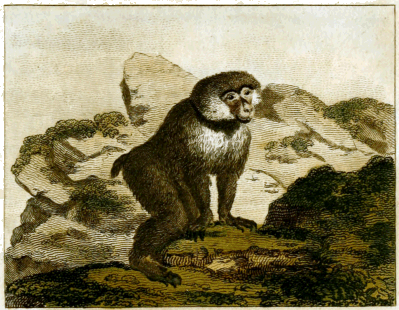
FIG. 198. Large Baboon.
This ape (fig. 197.) is two feet and a half, or three feet high, in its erect posture; but the female is not so large as the male. It prefers to walk on all four rather than on two feet. When it sleeps it is almost always sitting; supporting itself on two very prominent callosities on its posteriors; and the anus being placed higher, his body is more inclined when sitting than that of man. It differs from the pithecos; first, in the form of its snout, which is thick and long, like that of a dog; whereas, the pithecos has a flat visage. Secondly, in having long canine teeth. Thirdly, its nails are neither so flat nor so round; and, fourthly, because it is larger, and of a more sullen and untractable disposition.
There are also varieties to be met with in this species. We have seen some of different sizes, with various coloured hair, and more or less bushy. Even the five animals of which Prosper Alpinus has given us the figures and descriptions, under the name of cynocephali, seem to be all magots, differing only in size, and some other characters too slight to form distinct species. The magot seems to be dispersed over every warm climate in the Old Continent, and is found in Tartary, Arabia, Ethiopia, Malabar, Barbary, Mauritania, and as far as the Cape of Good Hope.
It is, probably, this species of ape which Robert Lade speaks of in the following terms: "We travelled over a large mountain in the neighbourhood of the Cape of Good Hope, where we diverted ourselves with hunting large apes, which are there in great plenty. I am not able to describe the various arts practised by these animals, while we were in pursuit of them; nor their swiftness, nor the impudence with which they returned. Sometimes they suffered us to approach so nigh, that I thought myself certain of securing them, but when I made the attempt, the one I meant to seize would make a sudden leap, spring above ten paces from me, climb up a tree with the greatest agility, and then looking down upon us with perfect indifference, seem to derive pleasure from our astonishment. There were some so exceedingly large, that if our interpreter had not assured us that they were not of a ferocious nature, our number would not have appeared sufficient to have protected us from their attacks. As it would have been useless to kill them, we made no use of our guns; but the captain, taking aim at a very large one, which was seated on a tree, after having tired us with a long pursuit, he had no sooner presented his piece but the animal, probably from the remembrance of the execution of some of his companions by the like manner, was so greatly terrified, that it fell almost motionless at our feet, and we had not the least trouble in securing it; however when it revived we had occasion for all our strength and address to keep it, defending itself by biting those who came near, and we were at last under the necessity of covering its head with our handkerchiefs."
Distinctive Characters of this Species.
The magot has no tail, though he has a small portion of skin, which has some appearance of one. He has pouches on the sides of his jaws, and thick callosities on his posteriors; canine teeth much longer in proportion than those of man; and the bottom part of the face turned up like that of a bull-dog: his visage is hairy or rather covered with a down: he is of a greenish brown on his body, and a pale yellow on the belly: he walks erect on his hind feet, but oftener on all four. He is about three feel and a half high, and there seems to be some of them still larger. The females have a periodical emanation.
THE PAPION[S], OR THE BABOON, PROPERLY SO CALLED.
IN man the physiognomy may deceive, and the figure of the body does not give an idea of the qualities of the mind; but in the brute creation we may always judge of their dispositions by their looks, and form a just conjecture of their internal qualities from their external form. For example, if we compare the ape and baboon we shall at once decide, that they greatly differ in their dispositions, and that the latter are infinitely more fierce, savage, and malicious, than the former. The orang-outang, which resembles man the most of any, approaches also nearest in intelligence, gentleness of manners, and pliancy of disposition. The magot, which is set further from the human figure, and approaches that of the brutes in form of its face and canine teeth, is wild, impetuous, and disobedient; but the baboon, which only resembles man in the hands, approaches still nearer, and is, in fact, of the savage tribe, having a tail, sharp nails, and a prominent muzzle. The baboon which I saw (fig. 198.) was not so extremely ugly, yet it excited horror. It seemed exceedingly savage and ferocious, continually gnashing its teeth; fretting with rage and furiously restless. It was obliged to be confined in an iron cage, the bars of which it so forcibly moved with its hands, that the spectators were struck with apprehension. It was a squat animal, whose short limbs and compact body indicated vast strength and agility. The long hair with which it was covered seemed to add to its apparent volume; however it is in reality so great, that it could easily overcome more than a single man, unless properly armed.[T] It constantly appeared excited by that passion which renders the mildest animals furious. It was insolently lascivious, and seemed fond of affecting to gratify its strong desires in public. In some measure we may say that Nature seems to have provided him for this detestable and uncommon kind of impudence; for in all other animals these parts are somewhat covered with a veil; but in the baboon they are naked, and more conspicuous from the other parts of the body being covered with hair; its posteriors are quite naked; its genitals are pendulous, the anus uncovered, and the tail always elevated; and instead of feeling any shame it seemed to make a parade of its nakedness, presenting its posteriors oftener to the spectators than its head, particularly in the presence of women, before whom he displayed a matchless impudence, which could proceed only from the most immoderate desires. The magot, and some others of the ape species, have the same strong inclinations, but as they are less in size, and not so petulant, they are more easily corrected, whereas the baboon is quite incorrigible, and totally untractable.
But however violent the desires of these animals may be, they do not breed in temperate climates. The female brings forth usually but one young at a time, which she carries in her arms, and clinging as it were to her breast: she is also subject to periodical emanations. These baboons though mischievious and ferocious, are not carnivorous; they principally feed upon fruits, roots, and corn. They generally assemble together in companies, for the purpose of sallying forth to commit their depredations on the neighbouring vineyards or orchards.
Of these animals Kolbe speaks in the following terms:—"The baboons are extremely fond of grapes, apples, and ripe fruit; they assemble together in great numbers, and proceed on their enterprize with previous deliberation. The dogs who are set to watch do not easily conquer them, unless rendered inactive by excess in eating, as they are extremely agile, and make dexterous use of their teeth and claws. On these occasions a part of them enter the inclosure, while some of the company stand on the wall as centinels; the rest are stationed without, at a small distance from each other, and thus form a line, which extends from the inclosure to their place of rendezvous, which is generally in some craggy mountain. Every thing being thus disposed the plunderers within the orchard begin their operations, and throw the fruit of all sorts to them without as fast as they can gather it; or if the wall or hedge be very high, then to those that sit at the top, who, with great address, toss it to those below; and thus the fruit is pitched from one to another all along the line, till it is safely deposited at their head-quarters. They are so dexterous and quick-sighted that they seldom suffer it to fall; and while the business is going forward, which they conduct with great expedition, a most profound silence is observed among them. The centinels during the whole time continue upon the watch, and if they perceive any person approaching, they instantly set up a loud cry, and at this signal the whole company retreat with astonishing expedition."
Distinctive Characters of this Species.
The papion, or baboon, has a pouch on each side of his cheeks; he has callosities on his posteriors, which are naked, and of a red colour; his tail is crooked, and about seven or eight inches long. The canine teeth are proportionally much thicker and longer than those of men. His muzzle is very thick and long, his ears naked, his body and limbs strong, thick, and short; his genitals are naked, and of a flesh colour, his hair long, bushy, of a reddish brown,[U] and pretty uniform over the whole body. He walks oftener on four than on two feet. When erect, he is from three to four feet high. There seem to be different sizes of this species; but after the most careful comparison, we could perceive no other differences between them than the size, which does not proceed from their age; for the small baboon seemed to be an adult as well as the large.
Engraved for Barr’s Buffon.
FIG. 199.Mandrill.
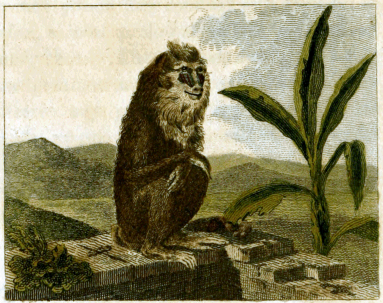
FIG. 200. Ouanderou.
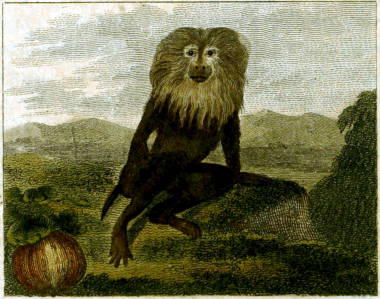
THE MANDRILL.
THIS baboon (fig. 199.) is an ugly disgusting animal; his nose, or rather two nostrils, are flat, from which constantly issues a thick matter, which he takes care at intervals to lick off with his tongue and swallow. His head is large, and muzzle very long. He is of a squat form, and his posteriors are of a blood red, his anus is placed almost as high as his loins, his face is of a bluish colour, and strongly seamed with wrinkles, which still increases his frightful and loathsome appearance. He is larger than the baboon, but more tame and gentle, and seemed to be more tractable and modest, although as disagreeable in every other respect.
This baboon is found on the Gold Coast, and in the other southern provinces of Africa, where the negroes call him boggo, and the Europeans mandrill. This animal is the largest of all the apes or baboons, the orang-outang excepted. Smith relates, that a female mandrill was given him, which was not above six months old, and had then attained the size of an adult baboon; he adds, that these animals walk always erect; that they sigh and cry like the human spcies; that they have a violent passion for women, which they never fail to gratify, if they get them within their reach.
Distinctive Characters of this Species.
The mandrill has pouches on the sides of his cheeks, and callosities on his posteriors. His tail is very short, not exceeding two or three inches; his canine teeth are much thicker and longer than those of man. The muzzle is very thick, long, and surrounded on both sides with deep longitudinal wrinkles. His face is flat, naked, and of a bluish colour. His ears, palms of his hands, and soles of his feet, are also naked. His hair is long, of a reddish brown over the body, and grey upon the breast and belly. He walks erect on two feet, but sometimes on all four; he is from four feet to four feet and a half high when upright. The females are also subject to the periodical emanations.
THE OUANDEROU, AND THE LOWANDO.
THOUGH these two animals seem to be but one species, we have preserved the two names which they bear in Ceylon, as they at least constitute two distinct breeds. The body of the ouanderou (fig. 200.) is covered with brown and black hairs; he has a large long white head of hair, and a monstrous white beard. The body of the lowando, on the contrary, is covered with whitish hairs, and the hair on his head and beard is black. There is also a third race, or variety, found in the same country, which may, possibly, be the common stock of the other two, because it is of a uniform white colour over the body, head, and beard. These animals are not apes but baboons, of which they have all the characters, as well in shape as in disposition; they are of the same savage nature, and even more ferocious. They have a long muzzle, a short tail, and are nearly of the same size as the baboon, but their hind parts seem to be more feeble. The person to whom this animal (from which our figure was taken) belonged, told us it came from South America, and that it was called cayouvassou. I immediately recollected that this word is a Brasilian term, which is pronounced sajououassou, and signifies sapajou; consequently, that this name was misapplied, for all sapajous have long tails, whereas the animal we are treating of is a baboon with a very short tail. Besides, there is not a single species of baboon existing in America. Errors, with respect to climate, often happen, especially among those who exhibit wild beasts, who, when they are ignorant of the real name of the animal, and the country it is a native of, seldom fail to apply a fictitious denomination, which, whether true or false, equally answers their purpose.
The ouanderous, when not tamed, are so exceedingly savage and mischievous, that they are obliged to be confined in iron cages, where they are often agitated with great fury. But when taken young they are easily tamed, and even seem to be more susceptible of education than any other baboon. The Indians take a pleasure in instructing them, and pretend that the rest of the ape and monkey tribes pay a great deference to these baboons, who are possessed of more gravity and knowledge. In their free state they are extremely wild, and remain constantly in the woods. If we may credit travellers, those which are all white are the strongest and most mischievous. They have a violent passion for women, and are strong enough to ravish them when found alone, and even to that degree that they often kill them.
“The white monkeys, says Forbin, are sometimes as big as the largest bull-dogs, and are more dangerous than the black. They have a strong desire for women, and often, after having greatly injured them, finish their cruelty with strangling. Sometimes they even come to their houses, but the natives of Macacar, who are very jealous of their wives, take care to prevent the entrance of such hideous rivals into their habitations; and the females, not liking either the manners or figure of such gallants, boldly assist their husbands to oblige their ugly suitors to retire, but which they are not able to accomplish before they have damaged or plundered every thing that lies in their way.”
Distinctive Characters of this Species.
The ouanderou has pouches on each side of his cheeks, and callosities upon his posteriors. The tail is seven or eight inches long. The canine teeth are much larger and longer than those of man. The muzzle is long and thick; his head is covered with long hair; and he has a great beard of course hairs. His body is long and slender behind. There are some among of this species which vary in the colour of their hair; some have it black on the body, with a white beard; and others, white on the body with a black beard. They walk more commonly on four than on two feet, and when erect they are about three feet, or three feet and a half high. The females are subject to a periodical emanation.
Engraved for Barr’s Buffon.
FIG. 201. Maimon.
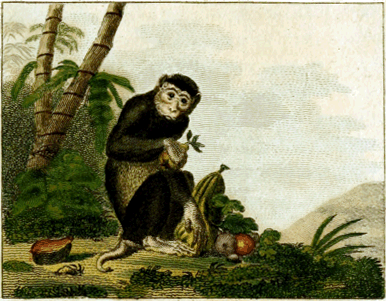
FIG. 202. Macaque. FIG. 203. Aigrette.
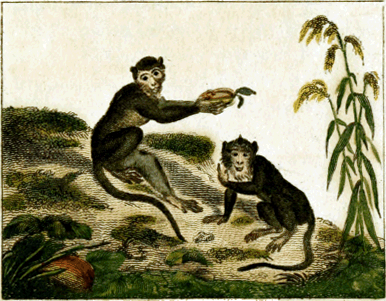
THE MAIMON.
THE apes, baboons, and monkeys, form three tribes, with intervals between each, the first of which is filled by the magot, and the second by the maimon: the latter forms the shade between the baboons and monkeys, as the magot does between the apes and baboons. The maimon resembles the baboons by his thick and large muzzle, and by his short and crooked tail; but he differs from them, and approaches nearer the monkeys, by his gentle disposition and smallness of his size. Edwards has given a figure and description of this animal by the denomination of the pig-tailed ape. This particular character is sufficient to distinguish him, for he is the only baboon or monkey that has a naked tail, curled like that of a pig. He is nearly of the same size as the magot, and so strongly resembles the macaque that he might be taken for a variety of that species, if his tail were not entirely different. His face is naked, and of a tawny colour; his eyes are of a chesnut, with black eyebrows. His nose is flat, his lips thin, and furnished with some rough hairs, but too short to form whiskers. His genital parts are concealed within the skin, therefore the maimon, though very spirited and full of fire, has none of that impudent petulance of the baboons. He is gentle, tractable, and even fond. He is found in Sumatra, and probably in some other southern provinces of India; of course it is with difficulty he can endure the cold of our climate. That which we saw at Paris lived but a very short time; and Edwards says, that which he describes lived only one year in London. “The pig-tailed monkey (says that author) was brought to England in 1752. It was extremely spirited and full of action, and was about the size of our common house-cat. It was a male, and lived under my care only one year. While I had mine, a female of the same species, but much larger, was shewn at Bartholomew-fair, London. I brought the two exiles together to compare them, and the moment they came into each other’s presence they testified their mutual satisfaction, and seemed quite transported at the interview.”
Distinctive Characters of this Species.
The maimon has pouches on each side of his cheeks, and callosities on his posteriors: his tail is naked, curled up, and about five or six inches in length. The canine teeth are not longer in proportion than those of men: the muzzle is very large; the orbits of the eyes are very prominent above; the face, ears, hands, and feet, are naked, and of a flesh colour. The hair on the body is of a dark olive, and of a reddish yellow on the belly: he sometimes walks erect, and at others upon all fours. When erect he is about two feet, or two feet and a half high. The female is subject to the periodical emanation.
THE MACAQUE, AND THE EGRET.
OF all the guenons, or monkeys, with long tails, the macaque (fig. 202.) approaches nearest the baboon. Like them his body is short and compact, his head thick, his muzzle broad, his nose flat, his cheeks wrinkled, and he is also larger and taller than most other monkeys. He is so extremely ugly that he might well be looked upon as a smaller kind of baboon, if his tail were not long and tufted; whereas that of the baboon, in general, is extremely short. This species is a native of Congo, and other southern provinces of Africa. It is numerous, and subject to many varieties, with respect to its size, colour, and disposition of the hair. The body of that described by Hasselquist was more than two feet long; and those we have seen were not above one foot and a half. That which we term the Egret, (fig. 203.) because it has on the top its head a tuft of hair, seems to be only a variety of the macaque, which it perfectly resembles, excepting in this and some other slight differences in the hair. Both of them are tractable and docile; but, independently of a disagreeable scent which they diffuse around them; they are so dirty, so ugly, and even so hideous when they grimace, that we cannot look on them without horror and disgust. These monkeys go in troops, especially to plunder orchards of the fruit and plants. Bosman relates, that they take a quantity of millet in each hand, the same under their arms, and some in their mouths, which they go off with, leaping on their hind feet; if pursued they first drop that from under their arms, then that from their hands; and this they do that they may use more speed on their four legs, but they always preserve that in their mouths. This traveller adds, that they examine carefully all they pull, and what does not please them they throw away, and tear up others: so that by this nicety they do much greater injuries than by the quantities they consume or take away.
Distinctive Characters of this Species.
The macaque has pouches on each side of his cheeks, and callosities on his posteriors. His tail is nearly as long us all the rest of the body, being about eighteen or twenty inches in length. His head is large, and his muzzle thick; his visage naked, pale, and wrinkled; his ears are covered with hair; his body short and compact; and his legs short and thick. The hair on the upper part of the body is of a greenish ash colour, and on the breast and belly of a yellowish. He has a kind of crest of hair on the top of his head. He walks on four and sometimes on two feet. The length of his body, including the head, is about eighteen or twenty inches. There appears to be varieties in this species, some larger and others smaller.
The egret seems to be only a variety of the macaque. He is about a third smaller in all his dimensions. Instead of a small crest of hair, which is found on the top of the head of the macaque, this animal has it sharp and pointed. The hair on the forehead of this is black, whereas that of the macaque is greenish. The egret also has a longer tail than the macaque, in proportion to the length of its body. The females are subject to the periodical emanation like women.
Engraved for Barr’s Buffon.
FIG. 204. Malbrouck. FIG. 205. Black Banded Patas.
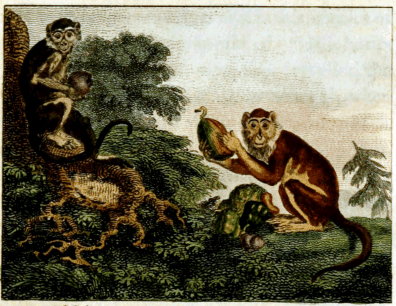
FIG. 206. Mangabey. FIG. 207. Chinese Bonnet.
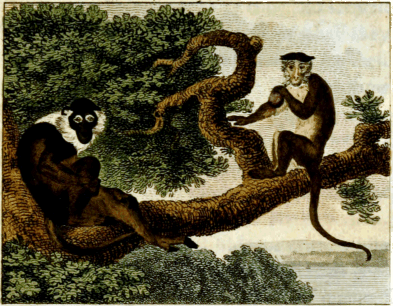
THE PATAS.
THIS animal (fig. 205.) is a native of the same country, and is nearly of the same size as the macaque; but the body is longer, the face not so ugly, and the hair much finer. He is remarkable for the colour of his hair, which is of so brilliant a red as to make him appear as if he were painted. We have seen two of these animals much varied; the first had a line of black hairs above the eyes, extending from ear to ear. The second differed from the first only by the colour of this line which was white. The hair about the cheeks and under the chin of both was long, which made them large beards: but the colour of the first was yellow, and the other white. This variety seemed to indicate others in the colour of the hair: and I am inclined to think, that the monkey spoken of by Marmol, which is said to be of the colour of the wild cat, and to be a native of Africa, is only a variety of the Patas. These monkeys are not so subtle as the other kinds, but are possessed of an extreme curiosity. “I have seen them, says Brue, descend from the top of very high trees, to the extremities of the branches to view the vessels on the water; they admired them for some time and seemed to discourse with each other about what they had seen; and then quit their stations for their companions, who came after to have the same sight. Some even became so familiar as to throw branches at the Frenchman, who returned their salute by the shots of their muskets; some were killed others wounded, and the rest were thrown into the utmost consternation. One party uttered most hideous cries, while another picked up stones to throw at their enemies, but perceiving at length, how unequal the battle was, they desisted, and prudently retired.”
It is to be presumed, that it is this species of monkey which le Maire speaks of. “It is hardly possible to express, says this traveller, the havock these animals make in Senegal, when the rice, millet, and other grains, on which they feed, are ripe. They assemble together in companies of forty or fifty: one of them remains as centinel on a tree, while the rest commit their depredations. As soon as the centinel perceives any person near, he utters a loud cry, as a signal to the rest, who immediately obey and scamper off with their plunder, leaping from tree to tree with prodigious agility. The females, who carry their young clinging to their breasts, retreat in the same manner as the rest, and leap as if they were not incumbered with any burthen.”
Distinctive Characters of this Species.
The patas has pouches on each side of his cheeks, and callosities on his posteriors. His tail is as long as both his head and body: the crown of his head is flat. His muzzle, body, and legs, are long. He has black hair on the nose, and a narrow line of the same colour over the eyes, extending the breadth of the face. The hair on the upper parts of his body is of a reddish colour; and that of the lower, as the throat, breast, and belly, of a yellowish hue. There is a variety in this species, with respect to the colour of the line over the eyes, which is black in some, and white in others. They do not make grimaces when they are angry, like other monkeys. They walk on all fours more frequently than erect. They are from a foot and a half to two feet long, from the muzzle to the origin of the tail. The females are subject to a periodical emanation.
THE MALBROUCK, AND THE BONNET CHINOIS.
MALBROUCK (fig. 204.) is the name of this animal in its native country, Bengal, and Bonnet Chinois (fig. 207.) is a term given to the long tailed monkey, which has a kind of trencher cap on the crown of the head, like the Chinese bonnets.
These two monkeys seem to belong to one species; and this species, though somewhat different from that of the macaque, is nevertheless, so far bordering on it, as to make us doubt whether the macaque, the egret, the malbrouck, and the bonnet chinois, are not merely four varieties, or permanent races of the same species. As these animals do not propagate in our climate, we have not been able to acquire any knowledge respecting the unity or diversity of their species, and therefore are obliged to judge only by the difference of their figures, and other external attributes. The macaque and the egret, appeared to us so similar, that we presumed them to be of one and the same species. It is the same with respect to the malbrouck, and the bonnet chinois; but, as they differ in a greater degree from the two first than between themselves, we thought it best to separate them.
With respect to the diversity of these two species, our presumption is founded, 1. On the difference of their external form; 2. On the colour and disposition of the hair; 3. On the difference which is found in the proportion of their skeletons; and 4. On the first two mentioned being natives of the southern countries of Africa, and the two that we are now treating of, being natives of Bengal. This last consideration is of as great weight as any of the rest, for we have had sufficient proofs, that in wild animals the distance of climate is a sufficient mark of the remoteness of the species. Besides, the malbrouck and the bonnet chinois, are not the only species or breeds of monkeys which are found in Bengal. By the testimonies of travellers there seem to be four varieties, white, black, red and grey; they likewise tell us that the black kind are more easily tamed than any of the rest. Those we saw were reddish, and appeared very docile and familiar.
"These animals, according to travellers, plunder whole fields of grain, and plantations of sugar-cane; and while one stands centinel on a tree, the others load themselves with the booty. If any person appears, the centinel gives notice by crying houp, houp, houp, which the rest perfectly understand, and all at once throw down the plunder which they hold in their left hands, and scamper off upon three legs; if close pursued they also throw down what they have in their right, and save themselves from their pursuers by climbing up trees, which is their general abode. They leap from tree to tree, and even the females, though loaded with their young ones, leap like the others; but they sometimes, in their haste, miss their aim and fall. They are very difficult to render in any degree docile, and are never so far tamed as to be suffered to go unchained. Even in their own country they will not produce unless at perfect freedom in the woods. When they cannot procure fruits they feed upon insects, and sometimes go to the sides of the rivers, for the purpose of catching fish and crabs, the latter of which they take by watching the opening of its claws and then putting their tails between; the crab instantly closes them, when they, with all speed, drag it ashore, and eat it at leisure. They are fond of cocoa-nuts, and are very expert in extracting the juice for drink, and afterwards getting at the kernel, the shell of which is generally made use of as a snare to catch them; a small hole being made in one of them, the animal who meets with it thrusts his paw in with difficulty, when those who have laid the trap run and seize him before he can disengage himself. They sometimes place bamboos on the tops of trees for the purpose of extracting the zari, which drops from them, and which they drink. In the provinces of India, where the Bramins reside, and whose religious tenets do not allow them to kill any animals, the monkeys are almost numberless. They assemble in large troops, come into the towns, and enter the houses with perfect freedom, and hesitate not to take such provisions, fruits, or herbs as they can meet with, and which it is very difficult to preserve from them." There are three kinds of hospitals in the town of Amadabad, which is the capital of Guzarat, for animals, and where not only the lame and sick monkeys but also such as are well, if they chuse to live there, are plentifully supplied with provisions. It is said that the monkeys in the neighbourhood regularly assemble twice a week in the streets of the town, that they go to the tops of the houses, which have a sort of terraces or flat roofs, where they lie in the sun; and that on these days the inhabitants are careful to lay upon these terraces rice, millet, sugar-canes, and other fruits in season; for if by chance they omit to do so, these animals pull off the tiles from the other part of the house, and do great damage to the inside. They do not eat a single thing without smelling at it for a long time, and when they have satisfied their hunger they fill the pouches on the sides of their cheeks for another occasion: they destroy the nests of birds, and never fail to throw the eggs on the ground when they want appetite or inclination to eat them.
The most formidable enemy these animals have is the serpent; no other animal of the forest being able to surprise them, as they are so exceedingly swift and subtle, that they climb up and seat themselves on the tops of the highest trees. “The apes, says a traveller, have it in their power to be masters of the forest, for neither tigers nor lions are able to dispute the possession with them. The only animal they have to fear is the serpent, which attacks them both night and day. There are some serpents in those forests of a prodigious size, which wind up the trees where the monkeys reside, and when they happen to surprise them sleeping, swallow them whole before they have time to make a defence.”
Distinctive Characters of this Species.
The malbrouck has pouches on each side of his cheeks, and callosities on his posteriors. His tail is nearly as long as both the body and head. The eyelids are of a flesh colour, and the face a cinereous grey; the eyes are large, the muzzle broad and turned upwards; the ears are large, thin, and of a flesh colour. They have a line of grey hairs on them like the mone, but the other parts of their bodies are of a uniform colour, a yellowish brown on the upper and a yellowish grey on the lower. He goes on all fours, and is about a foot and a half long from the muzzle to the insertion of the tail.
The bonnet chinois seems to be a variety of the malbrouck. They differ in the hair on the crown of the head, which in the latter is disposed in the shape of a cap or flat bonnet, and in the tail which is larger. The females of both are subject to a periodical emanation.
THE MANGABEY.[V]
WE have seen two individuals of this species, both of which were sent to us by the denomination of Madagascar apes. They are easily distinguished from all other monkeys by a very apparent character. The mangabey (fig. 206.) has its eyelids naked, and of a very striking whiteness. Their muzzle also is large, thick, and long; and they have a ring round their eyes. Those we are speaking of varied also in colour, the hair of one being of a blackish brown on the head, neck, and upper parts of the body, and white on the belly; and in the other it was much lighter over all the body, with a collar of white hair round the neck and cheeks. Both carry their tails turned backwards, the hair of which is long and bushy. They are natives of the same country as the vari, and as they resemble that animal in the length of the muzzle and tail, in the manner of carrying it, and in the varieties of colour; they seem to fill up the chasm betwixt the makis and guenons, or long-tailed monkeys.
Distinctive Characters of this Species.
The mangabey has pouches on each side of his cheeks, and callosities on his posteriors. His tail is as long as the head and body: he has a prominent ring of hair over his eyes, and his upper eyelids are particularly white. His muzzle is thick and long; his eyebrows are rough and bristly: his ears black, and almost naked. The hair of the upper parts of his body is brown, and those below are grey. There are varieties in this species, some being of an uniform colour, and others having a circle of white hair round the neck and the cheeks in the form of a beard. They walk on four feet, and are nearly a foot and a half long, from the point of the muzzle to the origin of the tail. The females are subject to the periodical emanation.
THE MONA.[W]
THIS animal (fig. 209.) is the most common of the monkey tribe; we kept one of them alive for many years, which, with the magot, seems to agree best with the temperature of our climate. This alone is sufficient to prove the mona is not a native of the southern countries of Africa and India. In fact, it is met with in Barbary, Arabia, Persia, and other parts of Asia which were known to the ancients, who denoted it by the name of kébos, cebus, and cœphus, because of the variety of its colours. The visage of this animal is of a brown hue, with a kind of white beard, mixed with yellow and a little black. The hair on the top of the head and neck is yellow and black intermixed; that on the back red and black; the belly and the inner parts of the thighs and legs whitish, though the external parts of the two latter are black, and the tail of a deep ash colour, marked with two white spots, one on each side, at its insertion. On its forehead there are some grey hairs in the form of a crescent; from the eyes to the ears there is a black stripe, as there also is from the ears to the shoulders and arms. Some persons have called this animal nonne, from a corruption of mone or mona; others have termed it the old man, from the grey colour of its beard; but the denomination by which the mona is most generally known is that of the variegated monkey; and this perfectly agrees with the name of kébos given it by the Greeks, and the definition of Aristotle, a monkey with a long tail, and of various colours.
In general the disposition of the monkeys is much more tractable than that of the baboons, and not so sullen as that of the apes. They are extravagantly spirited, but not ferocious, for they become docile through fear the moment they find themselves subjected by restraint. The mona is particularly susceptible of education, and even attached to those persons who take care of him. That which we brought up would suffer himself to be stroaked and handled by those he knew, but would not permit this freedom to strangers, whom he would often bite. He was kept chained, appearing very desirous of liberty, for when he either broke his chain, or got loose, he would fly to the fields, but he would suffer himself to be retaken by his master. He ate every thing that was offered him, roasted meat, bread, and grain; but his favourite food was fruits; and he would also search after spiders, ants, and insects. Whenever several pieces were given him together he put them in the pouches on each side of his cheeks. This practice is common to all the baboon and monkey kind, Nature having furnished them with those reservoirs, where they can store a quantity of food sufficient to support them for one or two days.
Distinctive Characters of this Species.
The mona has pouches on each side of his jaws, and callosities on his posteriors. His tail is about two feet long, which is longer by six inches than both his body and head. The head is small and round, and the muzzle thick and short. The colour of his face is a bright tawney; a stripe of grey hairs on the forehead, another of black from the eyes to the ears, and from the ears to the shoulders and arms. He has a kind of grey beard formed by the hairs on his throat and breast, which is longer than in any other part. His hair is of a reddish black on the body and whitish under the belly. The outside of his legs and thighs are black, and its tail of a dark ash with two white spots on each side of its insertion. He walks on all fours, and his length, from the snout to the origin of his tail, is about a foot and a half. The female is subject to periodical emanations.
Engraved for Barr’s Buffon.
FIG. 209.Mona.
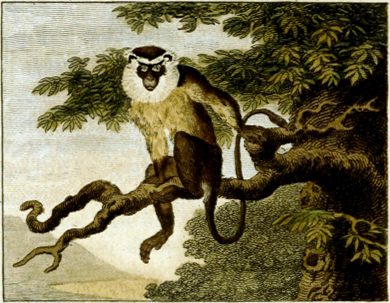
FIG. 210. Moustac. FIG. 208. Callitrix.
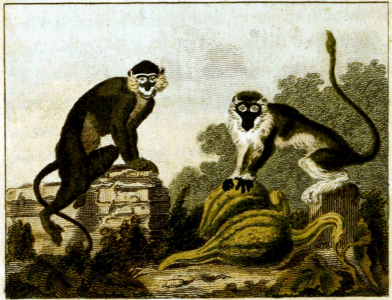
THE CALLITRIX, OR GREEN MONKEY.
CALLITRIX is a term made use of by Homer to express in general the beautiful colour of the hair of animals. It was not till many ages after Homer’s time, that the Greeks applied this name to some particular kinds of monkeys, and which, from the propriety of such application, we must suppose to be the animal in question (fig. 208.). The body is of a fine green colour, the neck and belly white, and the face of a beautiful black. He is found in Mauritania, and in Ancient Carthage; so there is reason to suppose he was known to the Greeks and Romans; and that he was one of the long-tailed monkeys, to which they gave the name of callitrix. There is also a species of white monkeys in the adjoining provinces of Egypt, both on the side of Ethiopia and of Arabia, which the ancients have also described by the name of callitrix. Prosper Alpinus and Pietro della Valle, speak of this white monkey, but we have never seen this species, which, perhaps, is only a variety of the green monkey, or the mona, which is very common in those countries.
The callitrix, or green monkey, appears to be known in Senegal, as well as in Mauritania and in the Cape Verd islands. M. Adanson relates, that the woods of Ponor, along the river Niger, are filled with green monkeys. “I discovered these animals, (says this author) only by their breaking off the branches of trees, and throwing them down; for they were so very quiet and nimble in their tricks, that it was scarcely possible to perceive them. I did not walk far, before I killed three of them without in the least terrifying any of the rest: however, when numbers felt themselves wounded, they began to retreat; some concealing themselves behind large branches, and others descending to the ground and running away; but the greatest number leaped from the top of one tree to another. During this bustle I kept firing at them and killed about twenty-three in less than an hour, without any of them uttering a single cry, although they several times assembled together, and made an appearance of attacking me.”
Distinctive Characters of this Species.
The callitrix has pouches on each side of his cheeks, and callosities on his posteriors. The tail is much longer than both the head and body. The head is small, the muzzle long, and the face and ears are black: instead of eyebrows, he has a narrow stripe of black hairs across the forehead. The body is of a fine green mixed with a little yellow. He walks on four feet; and the length of his body, including the head, is about fifteen inches. The female is subject to the periodical emanation.
THE MOUSTAC.
THE moustac (fig. 210.) seems to be a native of the same country as the macaque, because its body is, like that, shorter and more compact than the rest of the monkey tribe. This is, probably, the same animal as those who have been to Guinea call White Nose, from its upper lips being of a white colour, and all the rest of the face of a deep blue. It has also two tufts of yellow hair below its ears, which give it a very remarkable appearance, and as it is but small, it seems to be the most beautiful of the monkey kind.
Distinctive Characters of this Species.
The moustac has pouches on each side of his cheeks, and callosities on his posteriors. The tail is much longer than the head and body, being sometimes nineteen or twenty inches. His face is of a deep blue, with a large broad white mark that goes entirely across the upper lip directly under the nose, which is naked, except a slight edging of black hairs both on the upper and under lips. His body is short and compact. There are two tufts of hair, of a bright yellow, below the ears, and another tuft of bristly hair upon the top of the head. The hair on the body is of a greenish cast, and that on the breast and belly of an ash colour. He walks on all fours, and is about a foot and a half long. The female is subject to a periodical emanation.
Engraved for Barr’s Buffon.
FIG. 212. Douc.
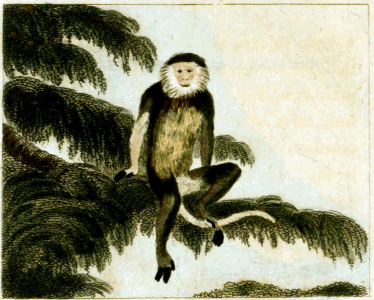
FIG. 211. Talapoin. FIG. 215. Sai.
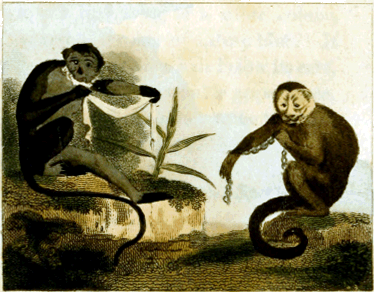
THE TALAPOIN.
THIS monkey, (fig. 211.) though small, is a beautiful animal. Its name seems to indicate that it is a native of Siam, and other eastern provinces of Asia; but though we cannot positively assert this, it is, however, certain that it belongs to the Old Continent, and is not found any where in the New, because it has pouches on each side of its cheeks, and callosities on its posteriors, which characters neither belong to the sagoins nor sapajous, which are the only animals of the New World that can be compared to the monkeys.
What inclines me to think, independently of its name, that this monkey is more common in the East-Indies than in Africa, is, the travellers affirming that most of the apes in this part of Asia have their hair of a brownish green colour. “The monkeys of Guzarat, they say, are of a greenish brown, with long white beards and eyebrows. These animals, which the Banians suffer to multiply in great numbers, from a religious principle, are so familiar that they enter the houses in such numbers that the fruiterers and confectioners have no little difficulty to preserve their merchandize.”
Edwards has given a figure and description of a monkey by the name of the middle-sized black ape, which seems to approach nearer to the talapoin than any of the rest. We have made a comparison between the two, and, excepting the size and colour, they have such a resemblance to each other, that there is at least a very great approximation between them, if they are not varieties of the same species. In this case, as we are not certain that our talapoin is a native of the East-Indies, and as that spoken of by Mr. Edwards is described by him as an animal belonging to Guinea, we shall refer our talapoin to the same climate, or at least suppose that this species is common in the southern parts both of Africa and Asia. It is also probable, that this is the same as the species of black monkeys mentioned by Bosman under the name of baurdmannetjes, the skin of which, he informs us, makes a good fur.
THE DOUC.
THE Douc (fig. 212.) is the last among that class of animals which we have called Apes, Baboons, and Monkeys. This animal, without belonging to any one of these three precisely, yet partakes of them all. Of the monkeys by the length of his tail; of the baboons by his size; and of the ape by the flatness of his face. By a very particular character he seems to form the shade between the monkey and the sapajous. These two tribes differ from the monkeys, having naked posteriors, and all the sapajous having them covered with hair; and the douc is the only monkey which has hair on the posteriors like the sapajous. He resembles them also in the flatness of the muzzle; but he is infinitely nearer to the monkey than the sapajous, from his long tail, and other very essential characters. Besides, the interval which separates these two families is immense, for the douc, and all the monkeys, are natives of the Old Continent, whereas the sapajous are only found in the New. We might also remark, that as the douc has a long tail like the monkeys, but no callosities on his posteriors, he forms the link which connects the orang-outang and the monkeys, as the gibbon does in another respect, having no tail, like the orang-outangs, but only callosities on the posteriors. Independently of these general relations, the douc has particular characters which render him very remarkable, and distinguish him from the apes, baboons, monkeys, or sapajous, at first sight. His skin, which is variegated with different colours, seems to indicate the ambiguity of his nature, and distinguishes his species in a very evident manner. He has a purple collar about his neck, a white beard, his lips are brown, and he has a black ring round his eyes; his face and ears are red, the top of his head and body grey, and the breast and belly yellow. His legs are white downwards and black upwards. His tail is white, with a large spot of the same colour on his loins; and his feet are black, intermixed with shades of different colours.