Front matter (continued 4)
Reading edition
This animal, which we were assured came from Cochin-China, seems to be likewise found at Madagascar, and is the same as that indicated by Flacourt by the name of sifac in the following terms: “There is, (says he) another kind of white monkey at Madagascar, which has a brown collar, and is often seen erect on its hind feet: its tail is white, with two brown spots on the flanks: it is larger than the vari (maucauco) but less than the varicossi (vari) and this animal is called sifac. It lives upon beans. There are great numbers of them towards Andrivoura, Dambourlomb, and Ranafoulchy.” The brown collar, the white tail, and the spots on the flanks, are characters which clearly indicate that this sifac of Madagascar is the same species with the douc of Cochin-China.
Travellers inform us that the large apes of the southern parts of Asia produce bezoars in their stomachs, which are superior to those of the goats and gazelles. These large apes are the ouanderou and the douc; to them, therefore, we must refer the production of the bezoar. It is pretended that the bezoars of the ape are always round, whereas the other bezoars are of different figures.
Distinctive Characters of this Species.
The douc has no callosities on his posteriors, and is cloathed all over with hair: his tail is not so long as his body and head: his face is covered with a reddish down: the ears are naked, and of the same colour as the face: the lips are brown, as are the orbits of the eyes. The colour of the hair is very bright and variegated: he has a purple coloured collar round his neck: his forehead, body, arms, and legs, are white, and on the chin is a kind of yellow beard: he is black on the top of the forehead and the upper part of the arms: the parts below the body are of an ash colour: the tail, and under parts of the loins, are white: he as often walks on two feet as on four: he is three feet and a half, or four feet, high when he is upright. I do not know whether the females in this species be subject to the periodical emanation.

CONCLUSION OF THE APES OF THE OLD CONTINENT.

THE SAPAJOUS AND THE SAGOINS.
WE shall now pass from one continent to the other; all the four-handed animals which we have described, and which we comprehended under the generic names of Apes, Baboons, and Monkeys, belong exclusively to the Old Continent; and all those which remain to be spoken of are only to be found in the New World. We shall first distinguish them by the two generic names of Sapajous and Sagoins. Both these animals have their feet nearly like those of the apes, baboons, and monkeys; but they differ from the apes by having tails, and from the baboons and monkeys by not having a pouch in each cheek, nor callosities on their posteriors; in short, they differ from the apes, baboons, and monkeys, by having a broad division between their nostrils, and the apertures being on the sides and not under the nose; therefore the sapajous and sagoins are not only specifically, but even generically different from the apes, monkeys, and baboons. When compared together they are also found to differ in some generic characters, for every sapajou has a long tail, which he can make use of to seize or lay hold of any object. This tail they bend, extend, and curl at pleasure, and by the extremity of which they suspend themselves from the branches of trees to reach whatever they want: the under part of this tail is commonly without hair, and covered with a smooth skin. The tails of the sagoins, on the contrary, are proportionably longer than those of the sapajous, and are weak, straight, and entirely covered with hair, so that they cannot make use of them either to lay hold of any object, or for the purpose of suspending themselves. This difference is alone sufficient to distinguish the sapajou from the sagoin.
We are acquainted with eight sapajous, which probably should be reduced to five species. The first is the ouarine, or gouariba, of Brasil. This sapajou is as large as a fox, and only differs from that which is called alouate in its colour. The ouarine has black hair, and the alouate red; and as they perfectly resemble each other in every other respect, I consider them as belonging to the same species. The second is the coaita, which is black like the ouarine, but not so large: the exquima seems to be a variety of this species. The third is the sajou, or sapajou, properly so called. This is small, has brown hair, and commonly known by the name of the capuchin monkey. There is a variety in this species, which we shall call the grey sajou, and which only differs from the brown sajou by this difference of colour. The fourth is the sai, called by some travellers the howler; he is larger than the sajou, and his muzzle is broader: there are two kinds, which differ only by the colour of the hair, the one being of a reddish brown, and the other of a lighter colour. The fifth is the samiri, commonly called the orange monkey. This last is the smallest and most beautiful of all the sapajous.
We are acquainted with six species of sagoins. The first and largest is the saki, whose tail is covered with hair so long and so bushy that it has acquired the name of the fox-tailed monkey. There appears to be a variety in this species, for I have seen two, both of which appeared to be adult, and yet one was almost twice as big as the other. The second is the tamarin, which is generally black, with four yellow feet, but they vary in colour, some being found of an olive brown, spotted. The third is the ouistiti, remarkable for large tufts of hair round his face, and an annulated tail. The fourth is the marikina which has a kind of mane on the neck, and a bunch of hair, like the lion, at the end of the tail, whence it has been called the small lion. The fifth is the pinche, whose face is of a beautiful black colour, with hairs descending from the top and sides of the head, in the form of long smooth tresses. And the sixth is the mico, which is the most beautiful animal of this kind; its hair is of a silver colour, and its face as red as vermilion. We shall now give the history of each of these sapajous and sagoins, most of which have been little known.
THE OUARINE AND THE ALOUATE.
THE Ouarine and the Alouate are the largest four-handed animals belonging to the New Continent: they surpass the size of the largest monkey, and approach that of the baboon. They have prehensile tails and are consequently of the sapajous family, in which they hold a very distinguished rank, not only with regard to stature, but also by voice, which resounds like a drum, and may be heard at a very great distance. Marcgrave informs us, “that every morning and evening the ouarines assemble in the woods; that one among them seats himself on an elevated place, makes a sign with his hand to the rest to seat themselves round him; that as soon as he sees them all seated, he begins an oration with so quick and loud a voice as to be heard at a great distance, and it might be imagined they were all making a noise together, but during the whole time the rest keep a profound silence; that when he has ended, he makes a signal to the others to reply, and immediately they all set up a cry together, till such time as by another sign with his hand, he orders them to be silent, and which they instantly obey; that then the first renews his discourse, or song, which, when finished, and the others have paid the utmost attention to it, the whole assembly break up.” These circumstances, of which Marcgrave says, he has many times been an eye-witness, may possibly be exaggerated, and seasoned a little with the marvellous. The whole, probably, is only founded on the frightful noise these animals make; they have in their throats a kind of bony drum, in the cavity of which the sound of the voice thickens, encreases, and forms a kind of howling reverberation; upon which account these sapajous have been distinguished from the rest by the name of howlers. We have never seen the ouarine, but we have the skin and the dried fœtus of an alouate, in which the instrument of the loud noise he makes, that is to say, the bone of the throat, is very apparent. According to Marcgrave, the face of the ouarine is broad, the eyes black and sparkling, the ears short and round, and a tail naked at the extremity, which holds firmly whatever it encircles; the hair of the body is black, long, and glossy; it is much the longest under the chin, and forms a kind of round beard; the hair on the hands, feet, and a part of the tail, is brown. The female is of the same colour as the male, and only differs from him in being smaller. The females carry their young on their backs, and thus loaded leap from branch to branch and from tree to tree. The young ones clasp the mother round the narrowest part of the body with the hands and arms, and thus remain firmly fastened, while she keeps in motion. These animals are so wild and mischievous, that they can neither be tamed nor subdued; they bite dreadfully, and although they are not among the carnivorous animals, yet they excite fear by their frightful voice and ferocious air. As they live only on fruits, grain, and some insects, their flesh is not bad eating. “The hunters, says Oexmelin, bring home in the evening the monkies they have killed in the Cape Gracias-a-Dio; they roast one part of these animals and boil the other; its flesh is very good, and resembles that of the hare, but being of a sweetish flavour, a good quantity of salt must be put to that part which is roasted; the fat is yellow like that of a capon, and is very good. We lived on these animals all the time we remained there, because we could procure no other food, and our hunters brought us every day as many of them as we could eat. My curiosity led me to see the method of hunting them, and I was surprised at their sagacity, not only in particularly distinguishing their enemies, but also in the manner in which they defended and secured themselves. When we approached towards them, they assembled together, set up loud and frightful cries, and threw branches at us which they broke from the trees; some voided their excrements in their hands, and threw them at our heads. I also remarked, that they never forsook each other; that they leaped from tree to tree with an almost imperceptible nimbleness; and that, though they took the most desperate leaps, they seldom fell to the ground; because they never missed catching hold of the branches either with their hands or tail, which rendered it very difficult to take them, even after they were shot, unless absolutely killed; for if only wounded, they remain clinging to the branch, where they often die, and do not drop off until they are putrefied. I have seen them hang in this manner for four or five days after death, and it is not uncommon to shoot fifteen or sixteen without being able to get more than two or three. What appeared still more singular, the moment one of them was wounded, the rest assembled round, and clapt their fingers into the wound, as if they were desirous of sounding its depth; and if the blood flow in any quantity, some of them keep it shut up, while others get leaves, which they chew and thrust into the orifice. I have seen this circumstance several times with admiration. The females bring forth only one at a time, which they carry on their backs in the same manner as the Negresses do their children. When they suckle their young, they take them in their paws, and present the breast to them like a woman. There is no other way of taking the young than by shooting its mother, for she never forsakes it; but when she is killed, it tumbles to the ground, and then it is easily taken.”
Dampier confirms most of these circumstances; but asserts, that these animals commonly bring forth two at a time, and that the mother carries one under her arm and the other upon her back. The smallest species of sapajous do not bring forth many, and it is therefore very probable that the largest produce not more than one or two at a time.
Distinctive Characters of this Species.
The ouarine has the apertures of the nostrils placed on the sides, and not under the nose; the partition which divides the nostrils is very thick. He has neither pouches on the sides of his jaws, nor callosities on his posteriors, those parts being covered with hair like the rest of the body. His tail is long and prehensile. His hair is long and black, and in his throat is a thick concave bone. He is about the size of a greyhound. The long hair under his neck forms a kind of round beard, and he generally walks on all fours.
The alouate has the same character as the ouarine, and seems to differ from him only in having a larger beard, and a reddish-coloured hair. I do not know whether the females of this species are subject to a periodical emanation; but from analogy, I should presume the contrary, for I have generally observed, that the apes, baboons, and monkeys, with naked posteriors, alone are subject to this emanation.
THE COAITA, AND THE EXQUIMA.
NEXT to the ouarine and the alouate, the coaita (fig. 213.) is the largest of the sapajous. I saw one alive at the Duke of Bouillon’s, where, by its familiarity and forward caresses, it deserved and obtained the affection of those who had it under their care; but notwithstanding all the good treatment and attention paid to it, it could not resist the cold of the winter 1764. It died regretted by its master, who was so kind as to send it to me to place it in the Royal Cabinet. I saw another at the Marquis de Montmirail’s, the latter was a male, and the former a female, and both were equally tractable and well tamed. This sapajou, by its gentle and docile disposition, differs greatly from the ouarine and the alouate, which are extremely wild and untameable. It also differs from them in not having a bony pouch in the throat. Like the ouarine, its hair is black, but rough. The coaita also differs from them, in having but four fingers and no thumb to the fore paws: by this character and its prehensile tail it is easily distinguished from the monkeys, who have all five fingers and a flaccid tail.
The animal which Marcgrave calls exquima is very similar to the coaita, and, perhaps, is only a variety of that species. This author seems to have been deceived when he said that the exquima was a native of Guinea and Congo. The figure he has given of it, is alone sufficient to demonstrate his error; for the animal is there represented with a tail curled at the extremity, a character which belongs solely to the sapajous; consequently, the exquima of Marcgrave is not, as he tells us, a monkey of Guinea, but a sapajou with a prehensile tail, which, without doubt, had been transported there from Brasil. The word exquima, or quima, expunging the article ex, ought to be pronounced quoima, and then it is not very distant from quoaita, which is written coaita by many authors. Every circumstance, therefore, concurs to prove, that this exquima of Marcgrave was a sapajou of Brasil, and only a variety of the coaita, which it resembles in nature, size, colour, and the prehensile tail. The only material difference consists in the exquima having a whitish hair on the belly, and a white beard under the chin, about two inches long. Our coaitas have neither this white hair nor the beard: but what makes me still presume that this difference is not sufficient to constitute two distinct species is the testimonies of travellers, who tell us, that there are both black and white coaitas, and that some of them have beards, and others are without.
"There are (says Dampier) in the isthmus of America, great numbers of monkeys, some of which are white, but the most of them black; some have beards, others none: they are of a middling size, and in dry weather when the fruits are in season they are very fat; their flesh is then extremely good, and we ate great numbers of them, which example was after a time followed by the Indians, who were shy of eating them at first. In the rainy seasons these animals have a quantity of worms in their bowels, and I have seen some of them several feet long.—These monkeys are very droll, and played a thousand grotesque tricks as we traversed the woods; leaping from branch to branch with their young upon their backs, making faces, chattering, and even seeking opportunities to make water upon our heads. When they are unable to leap from one tree to another, on account of the distance, their dexterity is very surprising; they form a kind of chain, hanging down by each other’s tails; one of them holding the branch above, the rest swing to and fro like a pendulum, until the undermost is enabled to catch hold of the branches of the other tree, when the first lets go his hold and thus comes undermost in his turn; and then, by degrees, they all get upon the branches of the tree without ever coming to the ground." All these particulars perfectly agree with our coaitas. M. Daubenton, in his dissection of these animals, found a great quantity of worms in their entrails, some of which were from twelve to thirteen inches long. We cannot, therefore, have any doubt but that the exquima of Marcgrave is a sapajou of the same, or at least of a very proximate species to that of the coaita.
We must likewise observe, that if the animal indicated by Linnæus, under the name of diana, be, in fact, as he says, the exquima of Marcgrave, he has omitted the prehensile tail, which is the most essential character, and which alone will decide whether this diana belong to the sapajou or monkey genus, and of course, whether it be found in the Old or New Continent.
Independently of this variety, the characters of which are very apparent, there are other varieties, though less striking, in the species of the coaita. That described by Brisson had whitish hair on all the lower parts of the body, while those which we have seen were entirely black, and had but very little hair on those parts, the skin being plainly seen, which was also of a black colour. One of the two coaitas spoken of by Mr. Edwards was black, and the other brown: they are termed, says he, spider monkeys, on account of their tail and limbs being so very long and slender.
Some years ago a coaita was presented to me by the name of chameck, which I was informed came from the coast of Peru. I had it measured, and made a description of it, in order to compare it with that which M. Daubenton had given of the coaita, and immediately discovered that this chameck of Peru, a few varieties excepted, is the same animal as the coaita of Guiana.
The sapajous are very sagacious and dexterous: they go in companies, and mutually warn and assist each other. Their tail serves them exactly like a fifth hand; and they seem even to employ that more than either their hands or feet. Nature by this addition seems to have recompensed them for the want of a thumb. It is asserted that they catch fish with this long tail, and which does not appear incredible, for we have seen one of our coaita’s lay hold of a squirrel, which had been put into the same apartment, with his tail, and drag him out. Russel, in his History of Jamaica, speaking of this animal, says, “this creature has no more than four fingers to each of its fore paws: but the top of the tail is smooth underneath, and on this it depends for its chief actions, for the creature holds every thing by it, and flings itself with the greatest ease from every tree and branch by its means. It is a native of the main continent, and a part of the food of the Indians.” They have the address to break the shell of the oysters, in order to eat them; and it is certain that many of them suspend themselves to the tail of each other, either to pass over a brook, or to swing from one tree to another. The females bring forth only one or two young ones at a time, which they always carry on their backs. They feed upon fish, worms, and insects, but fruit is their common food, and they grow fat when it is ripe, when, it is said, their flesh is good and exquisite eating.
Distinctive Characters of this Species.
The coaita has neither pouches on the sides of his jaws, nor callosities on the posteriors: he has a very long prehensile tail. The partition of the nostrils is very thick, and the apertures are placed on the side, and not under the nose. He has only four fingers on his hands or fore-feet: his hair and skin are black: his face is naked and tawny: his ears are also naked, and of the same form as the human race. He is about a foot and a half long, and his tail is longer than the head and body together; he walks on all fours.
The exquima is nearly of the same size as the coaita, and, like that animal, has a prehensile tail; his hair, however, is not black, but variegated. There are some which are black and brown on the back and white on the belly, with a very remarkable beard. These differences, however, are not sufficient to constitute two different species, especially as there are coaitas not entirely black, but which have a whitish hair on the throat and belly.
Engraved for Barr’s Buffon.
FIG. 213.Coati. FIG. 214. Brown Capuchin.
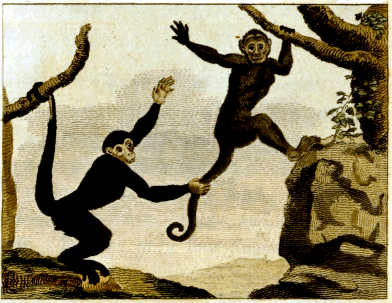
FIG. 216. Saki.
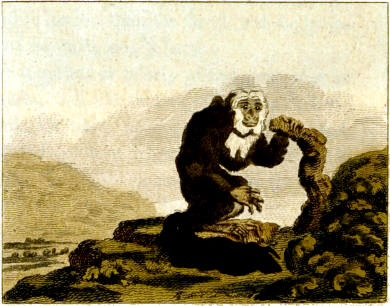
THE SAJOU.[X]
WE are acquainted with two varieties in this species, the Brown Sajou, (fig. 214.) commonly called the capuchin monkey; and the Grey Sajou, which differs from the other only in the colour of its hair. They are of the same size, the same shape, and the same disposition: both are lively, active, and very amusing, by their tricks and nimbleness. We have had them alive; and of all the sapajous they appeared to be those with which the temperature of our climate seemed least to disagree. They live here for many years without much trouble, provided they are kept in a warm room during winter. We can even give examples of their producing in this country. Two were brought forth at Madame de Pompadour’s, at Versailles, one at M. de Reamur’s, at Paris, and another at Madame de Poursel’s, in Gatinois; but these were only single productions, whereas in their own climate they often bring forth two. These sajous are very fantastical in their tastes and affections: they are extremely fond of some persons, and have as great an aversion for others.
We observed a singularity in these animals, which causes the females to be often taken for the males. The clitoris is prominent outwardly, and is as much seen as the sexual organ of the male.
Distinctive Characters of this Species.
The sajous have neither pouches on the sides of their jaws, nor callosities on their posteriors. Their face and ears are of a flesh colour, with a little down on them. The partition of the nostrils is thick, and their apertures are placed pretty close to each other. Their tail is prehensile, naked underneath at the extremity, and very bushy over every other part. Some have black and brown hair, as well about the face as on all the upper parts of the body. Others are grey about the face, and of a light brown on the body. Their hands are always black and naked. They are but a foot long from the extremity of the muzzle to the insertion of the tail. They walk on all fours.[Y]
THE SAI.
OF the Sai (fig. 215.) we have seen two which seem to make a variety in the species. The hair of the first was a deep brown, and that of the second, which we have called the White-throated Sai, has white hair on the breast, neck, and round the ears, and cheeks; and it differs also from the first, in its face being less hairy; but in other respects they perfectly resemble each other; being of the same disposition, size, and shape. Travellers have described these animals by the name of weepers, from their plaintive moan. Others have called them musk monkeys, because like the maucauco they have a musky odour. They have likewise been termed macaque, borrowed from the animals so called in Guinea; but the macaque is a monkey with a flaccid tail; while the animals we are speaking of belong to the sapajous, their tails being prehensile. The females have only two teats, and bring forth but one or two at a time. They are gentle, docile, and so timid, that their common cry, which resembles that of a rat, becomes a kind of groaning when they are threatened with danger. Their food in this climate is principally snails and beetles, which they prefer to any other; but in their native country of Brasil, they chiefly live upon grain and wild fruits which they pluck from the trees, from whence they seldom descend till they have stripped their habitation of its treasure.
Distinctive Characters of this Species.
The sai has neither pouches on the sides of his jaws, nor callosities on his posteriors. The partition of the nostrils is very thick, and the apertures are placed on the side, and not beneath the nose. The face is round and flat, and the ears almost naked. The tail is prehensile and naked towards the extremity. The hair on the upper part of the body is a deep brown, and on the lower parts, of a yellowish grey. These animals are not above fourteen inches long, and their tails are longer than the head and body together. They walk always on four feet. The females are not subject to the periodical emanation.
THE SAIMIRI.
THE Saimiri is commonly known by the name of the Aurora, the Orange, or Yellow Sapajou. It is very common at Guiana, for which reason many travellers have styled it the Cayenne Sapajou. From the gracefulness of its motions, the smallness of its size, the brilliant colour of its coat, the fullness and brightness of its eyes, and its small round visage, the saimiri has ever taken the lead of every other sapajou, and it is, in fact, the most beautiful and pleasing of this tribe; but it is also the most delicate and the most difficult to transport and preserve. From these characters, and particularly from that of the tail, which may be said to be but half prehensile, for though it makes use of it to climb up trees, yet it can neither strongly hold, nor firmly fix itself by it, it seems to form the shade between the sapajous and the sagoins.
Distinctive Characters of this Species.
The saimiri has neither pouches on each side the cheeks, nor callosities on the posteriors. The partition which divides the nostrils is thick, and the apertures are placed on the side and not under the nose. He may be said to have no forehead. His hair is of a bright yellow colour; and he has two flesh-coloured rings round the eyes. His nose is elevated at the root, and flat towards the nostrils. The mouth is small, the face flat and naked, and the ears are garnished with hair and a little pointed. The tail is half-prehensile and longer than the body. He is scarcely more than ten or eleven inches in length. He stands on his hind feet with great ease, but he commonly walks on all fours.
THE SAKI.
THE Saki, (fig. 216.) commonly called the Fox-tailed Monkey, from its tail being cloathed with very long hair, is the largest of the sagoins, being above seventeen inches long when full grown, whereas the largest of the other five species is not above nine or ten. The saki has very long hair on its body, and still longer on its tail: its face is red, and covered with a whitish down: it is easy to be known and distinguished from every other sagoin, sapajou, or monkey, by the following characters:
Distinctive Characters of this Species.
The saki has neither pouches on the sides of his jaws, nor callosities on his posteriors. His tail is not prehensile but flaccid, and half as long again as his head and body. The apertures of the nostrils are placed on the side of the nose, and the partition is very thick. The face is brown, and covered with a fine short, whitish down. The hair on the upper parts of the body is of a deep brown, and those of the lower of a reddish white. The hair is very long on the body, and still longer on the tail, extending near two inches beyond the point; this hair on the tail is generally of a deep brown colour. There seems to be a variety in this species with respect to colour, as there are sakis to be met with whose hair is of a reddish yellow colour. This animal goes on all fours, and is about a foot and an half long, from the tip of the nose to the insertion of the tail. The females of this species have not the periodical emanation.
THE TAMARIN.
THIS is the name which the animal bears in Cayenne: it is called the little black monkey by some, and the great-eared monkey by others. It is much smaller than that which we have just described, and differs from it in many characters, particularly in the tail, which is cloathed only with short hair, whereas that of the saki is furnished with very long. The tamarin has also large ears and yellow feet. It is a pretty and lively animal, and very easily tamed, but so exceedingly delicate as to be unable long to resist the intemperance of our climate.
Distinctive Characters of this Species.
The tamarin has neither pouches on the sides of his jaws, nor callosities on his posteriors. His tail is flaccid, and as long again as his head and body. The partitions between the nostrils are very thick, and the apertures are on the sides, and not under the nose. The face is of a dark flesh colour. The ears are square, large, naked, and of the same colour, and the eyes are of a chesnut. The upper lip is slit, nearly like that of the hare. The body, head, and tail, are covered with a dark brown hair, and the hands and feet with a short hair of an orange colour. The body and legs are well proportioned. He walks on all fours, and measures not above seven or eight inches in length, his head included.
Engraved for Barr’s Buffon.
FIG. 217. Ouistiti.
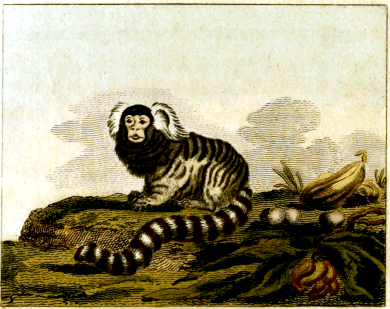
FIG. 218. Marikina. FIG. 219. Mico.
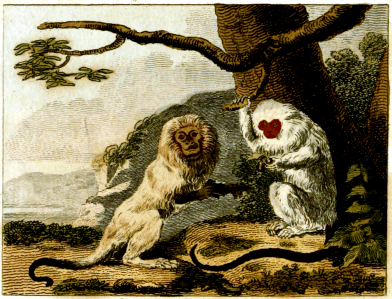
THE OUISTITI.[Z]
THIS animal (fig. 217.) is smaller than the tamarin, being not above six inches long, including the head; his tail is more than double that length, and annulated with black and white rings, like that of the maucauco, yet at the same time it is more bushy than that animal’s. The face of the ouistiti is naked, and of a flesh colour. He has two very singular tufts of long white hair on the fore part of the ears, which entirely conceals them when we look at the animal full in the face. Mr. Parsons has given a good description of this animal in the Philosophical Transactions; and Mr. Edwards has given a very good figure of it: he speaks of having seen several of them, and says that the largest did not weigh above six ounces, and the smallest only four and a half: he very judiciously observes, that the supposition of the small Ethiopian monkey, which Ludolph speaks of by the name of fonkes, or guereza, being the same animal as the ouistiti, has no foundation. It is very certain that neither the ouistiti, nor any other sagoin, is to be met with in Ethiopia; and it is very probable that the fonkes, or guereza, of Ludolph, is either the maucauco, or the loris, which are common in the southern parts of the Old Continent. Edwards farther says, that when the ouistiti (sanglin) is in good health he has a great deal of hair, and very bushy; that one of those which he saw, and which was healthy, fed upon several things, as biscuits, fruits, herbs, insects, and snails; that being one day unchained, he darted at a little gold fish in a glass globe, which he killed, and devoured with the greatest avidity; that afterwards some small eels were presented him, which frightened him at first, by twisting about his neck, but that he soon conquered and ate them. Mr. Edwards adds a fact which proves that these little animals might be multiplied in the southern parts of Europe. He says that they produced young in Portugal, where the climate is favourable to them. At first they have an ugly appearance, having scarcely any hair on their bodies; and they cling close to the teats of their dam. When they grow a little older they fix themselves on her back or shoulders, and when she is weary of carrying she releases herself by rubbing them off against the wall, which being done, the father, if he is by, will allow them to get upon his back.
Distinctive Characters of this Species.
The ouistiti has neither pouches on the sides of his jaws nor callosities on his posteriors. His tail is flaccid, very bushy, with alternate annulated bars of black and white, or rather brown and grey, and is as long again as the head and body. The partition of the nostrils is very thick, and the apertures are placed at the side. The head is round, and cloathed with black hair above the forehead, and above the nose is a white spot without hair. His face is almost all naked, and of a deep flesh colour. He has a tuft of long white hair on each side of the head before the ears. His ears are round, flat, thin, and naked. His eyes are of a chesnut colour. His body is covered with a soft, grey, ash-coloured hair; his throat, breast, and belly, of a light grey, with a slight tincture of yellow. He walks on all fours, and is often not above six inches long. The females are not subject to the periodical emanation.
THE MARIKINA.
THE Marikina (fig. 218.) is commonly known by the name of the little Lion Ape. We reject this compound denomination, because the marikina is not an ape but a sagoin, and no more resembles the lion than a lark resembles an ostrich, there being no affinity between them, except in the long hairs that surround the face of the marikina, and a tuft of hair at the end of his tail. His hair is long, soft, and glossy. His head is round, face brown, eyes red, ears round, and naked, and concealed under the long hairs which surround his face. These hairs are of a bright red, and those on the body and tail of a very pale yellow, approaching a white. This animal has the same manners, the same vivacity, and the same inclinations as the other sagoins. He seems to be of a more robust temperament, for we have seen one which lived five or six years in Paris, without any other particular care than keeping it during the winter in a chamber, wherein there was a fire every day.
Distinctive Characters of this Species.
The marikina has neither pouches on the sides of his cheeks, nor callosities on his posteriors. His tail is flaccid, and nearly as long again as both his head and body. The apertures of the nostrils are on each side of the nose, and the partition which divides them very thick. His ears are round and naked. The hair is long, of a yellowish red colour about the face[AA], and bright yellow hairs, nearly of an equal length, over every other part of the body; his tail is terminated with a considerable tuft of hair. He walks on all fours, and is not above eight or nine inches long.
THE PINCH.
THIS animal, though very small, is still larger than either the ouistiti, or the tamarin. Including the head and body, he is about nine inches long, and his tail is full eighteen He is remarkable for a kind of white smooth hair upon the top and sides of the head, more especially as this colour is wonderfully contrasted with that of the face, which is black, shaded by a small grey down. His eyes are black; his tail is of a bright red from its insertion to near the middle, where it changes to a deep brown, and continues so to the end. The hair on the upper parts of the body is of a yellowish brown colour; that on the breast, belly, hands, and feet, is white. The skin is black, even where covered with white hair. His throat is naked and black like his face. This animal, though of a very singular figure, is nevertheless very handsome. His voice is soft, and resembles more the chaunting of a little bird, than the cry of a quadruped. He is very delicate, and cannot be transported from America to Europe, without the greatest precaution.
Distinctive Characters of this Species.
The pinch has neither pouches on the sides of his cheeks, nor callosities on his posteriors. His tail is flaccid, and as long again as his head and body together. The partition of the nostrils is thick, and the apertures are placed at the side, and not under the nose. The face, throat, and ears are black. The hair on the head is white; the muzzle broad, and the face round. The hair on the body long, and of a reddish colour, until it approaches the tail, and then it becomes of an orange; it is white and shorter on the breast, belly, hands, and feet. The tail is of a bright red at its insertion, darker as it proceeds towards the middle, and entirely black at its extremity. He walks on four feet, and is not above nine inches long.
THE MICO.
WE are indebted for the knowledge of this animal (fig. 219.) to M. de la Condamine, and shall therefore give his account of it in his Voyage up the river Amazon. “The monkey, of which the governor of Para made me a present, was the only one of its kind that had been seen in the country. The hair on its body was of the most beautiful silvery white colour: and that on its tail was of a glossy chesnut approaching to black. Its ears, cheeks, and muzzle, were tinctured with so bright a vermilion, as to have the appearance of being the work of art. I kept it a year, and it was alive at the time I was writing this account, almost within sight of the French coast; but, notwithstanding the continual precautions that I took to preserve it from the cold, yet the rigour of the season killed it before my arrival. I preserved it in aqua vitæ, which will prove my description is not exaggerated.” By this recital of M. de la Condamine, it is obvious that his description will apply to no other animal than the mico; and that it is a different, and probably, scarce species, since no author or traveller before him has made any mention of it, though it is remarkable for the bright red which animates its face, and for the beauty of its hair.
Distinctive Characters of this Species.
The mico has neither pouches on the side of his cheeks, nor callosities on his posteriors. He has a flaccid tail, which is about half as long again as the head and body. The partition of the nostrils is not so thick as in other sagoins, but their apertures are at their sides. His face and ears are naked, and of a vermilion colour. The muzzle is short, the eyes are distant from each other; the ears are large; his hair is of a beautiful silver white colour, and of a glossy brown on the tail. He walks on all fours, and is about seven or eight inches long. The females are not subject to the periodical emanation.
ACCOUNT OF SOME ANIMALS NOT EXPRESSLY TREATED OF IN THIS WORK.
WE have now finished, to the utmost of our ability, the History of Quadrupeds, but in order to render it still more complete, we shall not pass over in silence those of which we have not been able to obtain an exact knowledge. They are but few, and of those few, many must be looked upon as varieties of those species we have before mentioned; yet feeling it as a duty to state all we knew, or could gain a knowledge of, in the animal kingdom, we determined to add the following, and in which we have been as particular as possible.
1. THE WHITE BEAR.
THIS is a noted animal in our most northern climates. Martin and some other travellers mention it, but none of them give a sufficient description of it to enable us positively to pronounce, whether it be a different species from the common bear. Supposing every thing they have written to be fact, then that must be the case: but as we know that the species of the bear varies greatly according to the difference of climate; that there are brown, black, white, and others variegated, the colour becomes a nugatory character in constituting different species; and, consequently, the denomination of white bear is insufficient to prove the species different. I have seen two small bears that were brought from Russia entirely white; nevertheless, they were most certainly of the same species as our bears of the Alps. These animals also vary greatly with respect to size; as they live a long time, and become larger and fatter in those parts of the world where they find ample provision, and are not disturbed, the character drawn from the size is still more equivocal; therefore, we have not a sufficient foundation to assert, that the bear of the northern seas is a particular species, merely because it is white and larger than our common bear. The difference of habits does not seem to be more decisive than that of colour and size. The bear of the northern seas lives upon fish; he never quits the sea coasts, and even often inhabits the floating islands of ice. But if we consider that the bear in general is an animal which feeds indifferently on every thing, and that when pressed with hunger, he has no particular choice, and that he has not the least dread of water, these habits will not appear sufficiently different to conclude that the species is not the same. The fish which the bears of the northern seas feed upon, may rather be termed flesh, as it chiefly consists of the carcasses of whales, seals, &c. and that too in a climate which produces no other animals, nor even grain nor fruits; and where, consequently, the bear is under the necessity of subsisting on the productions of the sea. Is it not probable, therefore, if the bears of Savoy were transported to the mountains of Spitzbergen, not finding any nutriment on land, they would plunge into the sea to seek for subsistence?
Colour, size, and method of living, being therefore insufficient, there remains only those essential characters which may be derived from their figure. Now, all that travellers have said of the sea-bear is simply, that his head, body, and hair, are longer than in our bears, and his head much harder. If these differences be real and striking, they would suffice to constitute a different species: but I am doubtful whether Martin examined them with accuracy, and whether the others, who copied from him, have not exaggerated. “These white bears (says he) are shaped quite otherwise than those in our country; they have a long head like that of a dog, and the neck is also long; they bark almost like dogs that are hoarse; they are not so clumsy, and more nimble than our bears; they are nearly of the same size; their hair is long, and softer than wool. It is said, that common bears have a very tender head, but it is quite contrary with the white bear, for though we gave one several blows over the head, he was not in the least stunned, although they were sufficient to have knocked down an ox.[AB]” We may remark from this description, first, that the author does not speak of these bears as being larger than ours, and that, consequently we ought to suspect the testimony of those who have affirmed, that the sea-bears were thirteen feet long. Secondly, that the hair being as soft as wool does not constitute a specific character, since an animal’s going frequently in the water is a sufficient cause for the hair becoming softer, and even more bushy, as is seen by the land and water beaver: those that live upon land, rather than in the water, having a rougher and thinner hair; and what makes me suspect that the other differences are not real, nor even so apparent as Martin speaks of, is that Dithmar Blefklein, in his description of Iceland, speaks of these white bears, and asserts having seen one of them killed in Greenland, which reared itself on his hind feet like other bears; but in this recital, he does not say a word which indicates that the white Greenland bear is not entirely like ours. Besides, when these animals find prey upon land, they do not seek for food in the sea: they devour rein-deer, and any other beast they can seize; they even attack men, and dig up dead bodies. But when almost famished, as they often find themselves in those desart and barren lands, they are obliged to frequent the water, in quest of seals, young walruses, and small whales. They get upon the islands of ice, where they wait for their prey; and as long as they find abundance of subsistence, they never quit their post; so that when the ice begins to float in spring, they suffer themselves to be carried away with it, and as they cannot regain the land, nor even quit the ice on which they are embarked for a long time, they frequently perish in the open sea. Those which arrive on the coasts of Norway or Iceland with these floats of ice, are so nearly famished, that they devour, with the greatest voracity, every thing they meet; and this may have occasioned the prejudice that these sea bears are more fierce and voracious than the common kind. Some authors have been persuaded that the sea-bears were amphibious, like the seals, and that they can remain as long as they please under water; but the contrary is evident, from the manner in which they are hunted. They can swim but a short time together, nor can they go above the space of a league: they are followed by a small boat, and are soon weary. If they could dispense with respiration they would plunge to the bottom, in order to rest themselves; but when they dive it is only for a short time, being obliged to rise to the surface of the water for fear of drowning, and then the hunters kill them.
The common prey of these white bears is seals, but the walruses, from whom they sometimes take away their young, wound them with their tusks and oblige them to retreat. The whales also drive them from the places they frequent by their weight and magnitude, but they sometimes devour the young whales. All bears are naturally very fat, and the white bears, which feed only on animals loaded with grease, are much more so than the rest. Their fat is also nearly like that of the whale. The flesh of these bears is said not to be bad eating, and their skin makes a very warm and durable fur.
SUPPLEMENT
I HAVE since received a drawing of a White Bear[AC], from Mr. Collinson, and if that be perfect, the land and sea-bears are certainly distinct species, the difference in the length of their heads being sufficient to constitute them such. By this drawing it also appears that the feet of the sea-bear are formed like those of dogs, and other carnivorous animals, whereas those of the land-bear are shaped like the human hand. From the assertion of several travellers we also understand, that the former of these bears are much larger than the latter; Gerard de Veira says, that the skin of one which he killed measured twenty-three feet in length, which is three times the length of a common bear. In the collection of Voyages to the North it is stated that these bears are larger and more ferocious than those of our parts; but in the same work it is said, that although they are of a different shape, their heads and necks being much longer, and their bodies more slender, yet they are nearly of the same size with the others.
It is generally admitted by travellers that the heads of these sea-bears are so hard that a blow which would fell an ox does not stun them, and that their voice is more like the barking of a dog than that of a common bear. Robert Lade says, that he killed two sea-bears near the river Rupper of a prodigious size, which were so ferocious that they attacked the hunters, wounded two Englishmen, and killed several savages. It is mentioned in the third Dutch Voyage to the North, that a sea-bear was killed by the sailors on the coast of Nova Zembla, whose skin was thirteen feet long. From all which I am inclined to believe that this animal, which has been so frequently distinguished for its ferocity, is a much larger species than the common bear.
2. THE TARTARIAN COW.
M. GMELIN, in the New Memoirs of the Academy at Petersburg, has given a description of this animal, which seems, at first sight, to be quite different from all those which we have spoken of under the article buffalo. “This cow (says he) which I saw alive, and of which I had a drawing made in Siberia, came from Calmuck. It was about the length of two Russian ells and a half; by this standard we may judge of its other dimensions, the proportion of which the designer has well executed. The body resembles that of a common cow: the horns bent inward; the hair on the body and head is black, except on the forehead and spine of the back, where it is white. The neck is covered with a mane, and the rest of the body with very long hair, which descends to the knees, so that the legs appear very short; the back is raised in the form of a hunch; the tail resembles that of a horse, is white, and very bushy; the fore legs are black, the hind ones white, and resemble those of the ox; there are two tufts of long hair upon the hind feet, one before and the other behind, but on the fore-feet there is but one, which is placed on the hind part. The excrements are more solid than those of the common cow; and in discharging its water the animal bends its body backward. It does not low like an ox, but grunts like a hog. It is wild, and even ferocious, for, excepting the man who gives it food, it strikes with its head all those that come near it. It dislikes the company of domestic cows, and when it sees one of them it grunts, which it seldom does on any other occasion." To this description M. Gmelin adds, “that it is the same animal spoken of by Rubruquis in his Travels into Tartary: that there are two species of these animals in that country; the first called sarluk, which is the same as he describes; the second chainuk, which differs from the other in the largeness of the head and horns, and also by the tail, which resembles that of the horse towards its insertion, and terminates like that of a cow: but that they both have the same dispositions.”
There is but a single character in all this description which indicates that the Calmuck Cows are of a particular species, which is their grunting instead of lowing, for as to all the rest, they so strongly resemble the bisons, that I do not doubt they are of the same species, or rather the same race. Besides, though the author says that these cows do not low but grunt, yet he acknowledges they do that only very seldom; and this was, perhaps, a particular affection of the individual he saw, for Rubruquis, and others whom he quotes, do not speak of this grunting; perhaps the bisons, when they are irritated, have also an angry grunt; even our bulls, especially in the rutting season, have a hollow interrupted voice, which much more resembles grunting than lowing. I am, therefore, persuaded that this grunting cow (vacca grunnicus) of M. Gmelin is no other than a bison, and does not constitute a particular species.
3. THE TOLAI.
THIS animal, which is very common in the country which borders on the Lake Baikal, in Tartary, is a little larger than a rabbit, which it resembles in figure, colour of the hair, taste of the flesh, and in the habit of burrowing in the earth to conceal itself. Their internal structure is also the same, and they differ only in the tail, which is considerably longer than that of the rabbit; it, therefore, seems very probable that it does not really constitute a different species, but is only a variety in that of the rabbit. Rubruquis, speaking of the animals of Tartary, says, “There are rabbits with long tails, which have black and white hairs at the end. There are no stags, few hares, many gazelles, &c.” This passage seems to indicate that our short-tailed rabbit is not to be met with in Tartary, or rather that it has undergone some variations in that climate, and especially in the length of the tail; for as the tolai resembles the rabbit in every other respect, I do not think it necessary to consider them as a distinct and separate species.
4. THE ZISEL.
SOME authors, and among the rest, Linnæus, have doubted, whether the zisel, or ziesel (citillus) were a different animal from the hamster[AD] (cricetus). It is true they resemble each other in many respects, and inhabit nearly the same country; but they differ by a sufficient number of characters to convince us they are really different species. The zisel is smaller than the hamster; its body is long and slender like the weasel; whereas that of the hamster is thick like the rat. It has no external ears, but only auditory passages concealed under the hair. The hamster has short ears, but they are very broad and apparent. The zisel is of a uniform cinereous grey colour, but the hamster is marked with three large white spots on each side of the breast. These differences, joined to that of their not mixing together, though natives of the same country, are sufficient to decide the fact of their being two different species, though they resemble each other in the shortness of their tails and legs, in their teeth, being like those of the rat, and have the same natural habits, such as burrowing in the earth, laying up magazines of provisions, destroying grain, &c. Besides, to leave no doubt on this subject, we shall observe, that Agricola, an exact and judicious author, in his little Treatise of Subterraneous Animals, gives a description of both, and so clearly distinguishes them, that it is impossible to confound them; therefore, we may certainly affirm that the hamster and the zisel are two different species; and, perhaps, as distinct from each other as the weasel and the rat.
5. THE ZEMNI.
THERE is another animal in Poland and Russia, called ziemni, or zemni, which is of the same genus as the zisel, but larger, stronger, and more mischievous. It is somewhat smaller than the domestic cat. Its head is large, its body slender, and its ears short and round. It has four large incisive teeth which project out of the mouth, the two in the lower jaw being thrice as long as the two in the upper. The feet are very short, and covered with hair; they are divided into five toes, and armed with crooked claws. The hair is soft, short, and of a mouse colour. The tail moderately large. The eyes small and hidden like those of the mole. Rzaczynski has called this animal the small subterranean dog. This author seems to be the only one who has spoken of the zemni, though it is very common in some provinces of the North. Its natural disposition and habits are nearly the same as those of the hamster and zisel. It bites dangerously, eats greedily, and plunders orchards and gardens. It burrows an habitation in the earth, and lives upon grain, fruits, and pot-herbs, which it stores in magazines for its winter support.
6. THE POUCH.
THE same author, Rzaczynski, mentions another animal, called by the Russians pouch: it is larger than the domestic rat; its muzzle is long, it burrows, and commits depredations in the gardens, &c. There were such numbers near Suraz and Volhinia, that the inhabitants were obliged to abandon the culture of their gardens. This pouch is possibly the same as what Seba calls the Norwegian rat, of which he gives a figure and description.
7. THE PEROUASCA.
THERE is also in Russia and Poland, especially in Volhinia, an animal which the Russians call perewiazka, and przewiaska by the Polanders, a name we may translate the girdled weasel. This animal is not so big as the pole-cat; it is covered with a whitish hair, transversally striped with a yellowish red, which appears like so many girdles. It lives in the woods, and burrows in the earth; its skin is sought after and makes a very beautiful fur.
8. THE SOUSLIK.
THERE is found at Casan, and in the provinces watered by the Wolga, and even in Austria, a small animal called souslik in the Russian language, which furnishes a beautiful fur. In figure and shortness of tail, it greatly resembles the short-tailed-field-mouse; but what distinguishes it from the mouse or rat kind, is its coat, which is in every part sprinkled with small spots of a glossy and shining white; these spots are exceedingly small, and placed at a little distance from each other; they are more apparent upon the loins, than on the shoulders and head. Mr. Pennant, an English gentleman, thoroughly versed in Natural History, favoured me with one of these sousliks, which had been sent him from Austria, as an animal naturalists were not acquainted with. I soon recognised it to be the same as that of which I had a skin in my possession, and of which M. Sanchez had furnished me with the following account. “The rats called sousliks, are taken in great numbers in the salt vessels in the river Kama, which descends from Solikamski, where the salt pits are, and falls into the Wolga above the town of Casan. The Wolga from Simbuski to Somtof, is covered with these salt vessels, in which these animals are taken, as well as in the lands which border on those rivers. They have been named souslik, that is, dainty-mouthed, because they are very fond of salt.”
SUPPLEMENT
WE have since learnt, that these animals generally live in the desart, and burrow in the sides of the mountains where the earth is blackish; that some of them make their holes seven or eight feet long, at the end of which they form different apartments for storing up provisions for the winter, which consist of ears of corn, peas, lint, and hemp seeds: or if they be not cultivated lands, different kinds of herbs, all of which they keep separate in different parts of their holes, to which they have from two to five entrances, always winding, and the mouths of them sometimes seven feet asunder; they also dig holes for their habitations separate from their magazines. Besides grain and herbs they feed upon young mice, but are unable to encounter the full-grown ones. The females have from two to five young ones at a time, which are first blind, and without hair; nor do they begin to see till after the hair appears.
9. THE GOLDEN-COLOURED MOLE.
IT is said that there is in Siberia a mole, called the golden-coloured mole, and whose species may probably be different from the ordinary mole, because the Siberian has no tail, and a very short muzzle; the hair is mixed with red and green, and of a gold shade; only three toes on the fore-feet, and four on those behind: whereas the common mole has five toes on each foot. We are ignorant of the proper name of this animal, of which Seba has given a figure.
10. THE WHITE WATER-RAT.
THE European Water Rat is found in Canada, but its colour is different; its back is brown, the rest of the body white, and in some few places yellow. The head, muzzle, and extremity of the tail, are white. The hair seems softer and more glossy than that of our water-rat: but they are perfectly alike in every other respect, and no doubt are of the same species. The whiteness of the hair is produced by the coldness of the climate: and, it is highly probable, that in the northern parts of Europe, there are white water rats as well as in Canada.
11. THE GUINEA-HOG.
THOUGH this animal differs from the common hog in some characters, nevertheless I presume it to be of the same species, and that these differences are only varieties produced by the influence of the climate. Of this we have an example in the Siam hog, which also differs from that of Europe, although it is certainly of the same species, since they intermix and produce together. The Guinea hog is nearly of the same figure as ours, and about the same size as the Siam hog, that is, smaller than the wild boar, or our domestic hog. It is a native of Guinea, and has been transported into Brasil, where it has multiplied as in its own native country. It is domestic and quite tame. Its hair is short, red, and glossy: it has no bristles, not even on the back; but the neck and the crupper near the tail, are covered with hair somewhat longer than the rest of the body. Its head is not so big as that of our hog, from which it also differs in the shape of its ears, which are very long, pointed, and turn backwards upon the neck. Its tail is much longer, almost touching the ground, and without hair. This race of hogs, which, according to Marcgrave, originally belonged to Guinea, is also met with in Asia, and particularly in the island of Java, from whence they have been transported to the Cape of Good Hope by the Dutch.[AE]
12. THE WILD BOAR OF CAPE VERD.
THERE is another hog, or wild boar, at Cape Verd, which, by the number of its teeth, and the enormous size of the tusks in the upper jaw, seems to be of a different race, if not of a different species from every other hog, and approaches nearer the babiroussa. These tusks resemble ivory horns more than teeth; they are half a foot long, and five inches round at the base, and bent nearly like the horns of a bull. This character alone would be insufficient however, to constitute a particular species; but what supports this presumption is, that he differs from every other hog in the length of the aperture of his nostrils, the largeness and form of his jaws, and in the number and form of his grinders; nevertheless we have seen the tusks of a wild boar, taken in the forests of Burgundy, which somewhat approached those of the wild boar of Cape Verd. These tusks were about three inches and a half long, and four inches in circumference at the base; they were turned like the horns of a bull, that is, they had a double curvature, whereas the common tusks have only a single one. They likewise seemed to be as solid as ivory; and it is certain that this wild boar must have had the jaws larger than the common kind. Therefore we may presume that this wild boar of Cape Verd is a simple variety, a particular race in the wild boar species.
SUPPLEMENT
WE have received an engraving of this animal from the celebrated M. Allamand, professor of Natural History at Leyden, and who has also written to M. Daubenton in the following terms:—"I conceive, Sir, that the animal represented in the plate which I sent you, is the same as that which you have treated of under the name of the wild boar of Cape Verd. The one whence it was taken is now living (May 5, 1767) in the menagerie of the Prince of Orange. I frequently visit him, and always receive pleasure from admiring the singular form of his head. It was transmitted by the Governor of the Cape of Good Hope, to whom I have written, requesting him to send me another, but of which I have little hopes, since even at the Cape it was regarded as a monster; yet should I succeed, I will send it to France, that you and M. de Buffon may have an opportunity of examining it. We put a common sow to the one we have, for the purpose of trying whether they would copulate, but the instant she came near him he darted at her, and tore her to pieces." In another letter M. Allamand remarks, that the most material difference between this and the common boar is in their heads, and in this boar’s having two very singular protuberances in the form of ears at the side of each eye. The aversion shewn by this animal to the sow, as well as the differences, both external and internal, in the forms of their heads, tends to prove it a distinct species from our hog; yet as it approaches nearer to that than to any other animal, and is found not only near Cape Verd but also in the neighbourhood of the Cape of Good Hope, we shall call it the African boar.
Vosmaër calls it the wild African boar, and very justly distinguishes it from the Guinea hog, the American peccari, and from the Indian babiroussa. This author, in his account, remarks, that, “M. de Buffon, speaking of the wild boar of Cape Verd preserved in the royal cabinet, says that it had cutting teeth; but no such teeth appear in the one I have. The animal came to me in a cage, but being informed he was not mischievous, I opened the door, and he came out, without shewing the least sign of rage; he bustled about in search of food, and greedily devoured whatever was given him. I left him alone for a few moments, and on my return found him busily employed in digging up the floor, in which, although paved with small bricks, closely cemented, he had made a very large hole, and it was not without the assistance of several men that I could make him give over and return to his cage, for he made much resistance, and expressed his resentment by sharp and mournful cries. He appears to have been taken in the woods of Africa when he was very young, for he has grown considerably since he was brought here; he is still alive, and was not much affected last winter, though the frost was very severe. He is far more agile than our hogs. He allows himself to be stroked, and appears fond of rough friction. When made angry he retires backwards, always facing his assailant, and shakes his head very forcibly. After having been confined for any length of time, on being let loose he is very sportive, leaps and pursues the deer, or other animals, and then carries his tail erect, which at other times is pendulous. He has a very strong odour, not disagreeable, yet I do not know any other smell with which it can be compared. He eats all sorts of grain; while bringing him over they fed him with maize, and as much fresh herbage as they could procure; but when he had tasted our barley and wheat he preferred them to other food, excepting roots dug out of the earth. He is so fond of rye-bread that he follows any person who holds him a piece of it. He sinks upon the knees of his fore legs when he eats or drinks, and in which position he often rests. He hears and smells very acutely, but from the smallness and situation of his eyes his sight is very limited; they are placed very high, and near each other, and have two large excrescences underneath them, so that he cannot perceive the objects which are round him.
His figure is very like that of the common hog, but he appears less, from his back being more flat and his legs shorter; compared with them also, he appears very deformed. His muzzle is large, flat, and hard; the nose is moveable, bent towards the base, and terminates obliquely; the nostrils are large, and distant from each other; the upper lip is hard and thick, very prominent round the tusks, and hangs pendulous over the corners of the muzzle. He has no front teeth, but the gums are smooth and hard. The tusks of the upper jaw are crooked, five inches and a half in length, pointed at the ends, and an inch thick at the base; those of the under jaw are much smaller, and from a constant friction against the upper appear to be cut obliquely. He would not permit us to examine his grinders. His eyes are small, the iris of a deep brown, and the cornea white; the upper eyelids have a brown, stiff, close cilia, longest in the middle, but there are no cilia on the under. The ears are pretty large, rather round, covered on the inside with yellow hair, and bent backwards. Besides the protuberances under the eyes there are two more, one on each side of the head. The skin appears to be thick; and there are several tufts of hair dispersed over his body. The forehead is covered with brown and white hairs; from thence is a narrow band of dark grey down to the beginning of the muzzle, where it divides and extends on each side of the head; the bristles are the longest and closest on the neck and anterior part of the back, they are of a brownish grey, and some of them seven or eight inches long; they are not thicker than those of the common hog, and split in the same manner; they have so few on the other part of the back, that it has the appearance of being naked; there are small white bristles on the flanks, breast, belly, and sides of the head and neck. Their feet are divided into two black pointed hoofs; the tail is naked, and hangs perpendicularly. The head is of a blackish colour, and the back and belly of a reddish grey. The width and flatness of the nose, together with the length of the snout, the protuberances under the eyes, and the long tusks, give this animal a dreadful aspect. He is about four Rhenish feet in length.”
Notwithstanding all these differences which M. Vosmaër has described, and the aversion which M. Allamand states it to have shewn to the common sow, I still have my doubts whether it be any thing more than a variety of the European hog; for we know that this species varies greatly in Asia, Siam, and China; and these doubts seem to be somewhat supported, by having found about thirty years since, an enormous head of a wild boar that had been killed in our own woods, the tusks of which were nearly as large as those of the Cape boar. To this may be added the information I received from M. Comerson, who says there are wild boars in Madagascar, whose heads are like the common kind from the ears to the eyes, but that under the eyes they have a protuberance, which decreasing gradually to the end of the snout, gives the animal the appearance of having two heads, the one being, as it were partly sunk in the other; and this information also made me conclude that the animal I have mentioned under the appellation of the wild boar of Cape Verd is the same as what is found in Madagascar.
13. THE MEXICAN WOLF.
AS the wolf is a native of cold climates, he must have passed northerly into America, since he is met with in both continents. We have spoken of the black and grey wolf of North America. It appears that this species is dispersed as far as New Spain and Mexico; and that in this warm climate it has undergone many varieties, without having changed either its disposition or nature, for the Mexican wolf has the same figure, appetites, and habitudes, as the European or North American wolf, and they all seem to be of the same species. The wolf of Mexico, or rather of New Spain, where he is much oftener found than in Mexico, has five toes on his fore-feet, and four on those behind. The ears are long and straight, and the eyes sparkling, like our wolves; but the head is larger, the neck thicker, and the tail not so bushy. Above the mouth there are some thick bristles, as large, but not so stiff as those of the hedge-hog. The body is covered with greyish hair, marked with some yellow spots. The head is of the same colour as the body, crossed with brown stripes, and the forehead adorned with sallow-coloured spots. The ears are grey, like the head and body. There is a long yellow spot on the neck, a second on the breast, and a third on the belly. The flank is marked with transverse bands from the back to the belly. The tail is grey with a yellow spot in the middle. The legs are striped from top to bottom with grey and brown. This wolf is the most beautiful of the kind, and its fur ought to be valued for its variety of colours.[AF] But in other respects there is not the least indication of its being a different species from the common wolves, which vary in colour from grey to white, and from white to black, without changing the species; and we see, by the testimony of Fernandes, that these wolves of New Spain vary like the European wolf, since even in that country they are not all marked agreeable to the above description, some being found of an uniform colour, and even all white.
14. THE ALCO.
WE have already observed that there were in Peru and Mexico, before the arrival of the Europeans, domestic animals called alco, which were of the same size, and nearly of the same disposition, as our small dogs; and which the Spaniards called Mexican or Peruvian dogs, from this similitude, and from their having the same attachment and fidelity to their masters. In fact, the species of these animals does not seem to be essentially different from that of the dog; and besides, the term alco may probably be a generic and not a specific term. Recchi has left us the figure of one of these alcos, which is called ytzcuinte porzotli in the Mexican tongue; it was prodigiously fat, and probably degenerated from its domestic state and too great an abundance of food. The head is represented so small, that it has not any proportion to the size of the body; its ears are hanging, which is another mark of domesticity. The muzzle resembles that of a dog; the fore-part of the head is white, and the ears are partly yellow. The neck is so short as to leave no interval between the head and shoulders. The back is curved and covered with yellow hair. The tail is white, short and pendulous, but does not descend lower than the thighs. The belly is large, tense, and marked with black spots; it has six very apparent tits. The legs and feet are white, and the toes, like those of a dog, are armed with long and pointed claws. Fabri, who has given this description, concludes, after a very long dissertation, that this animal is the same as that called alco, and I think his assertion well founded; but we must not look upon it as conclusive, for there is still another race of dogs in America, to which it applies equally as well. ”Besides the dogs, says Fernandes, which the Spaniards have transported into America, we met with three other species, which resemble ours both in their natures and manners, and which do not essentially differ in figure. The first and the largest of these American dogs is called xoloiztcuintli. This is frequently three cubits long, and what is particularly remarkable, he is entirely without hair, and only covered with a soft, close skin, marked with yellow and blue spots. The second is cloathed with hair, and in size resembles our little Maltese dogs. He is marked with white, black, and yellow. His deformity is singular but not disagreeable. His back is arched, and his neck so exceedingly short, that the head seems to shoot immediately out of the shoulders; in his own country he is called michuacanens, from the name of his country. The third, which also resembles our little dogs, is called techichi, but his look is dull and savage. The Americans eat his flesh.”
From comparing the testimonies of Fabri and Fernandes, it is clear that the second dog the last author calls michuacanens, is the same as the ytzcuinte portzotli, and that this species of animal existed in America before the arrival of the Europeans; and it must have been the same with the techichi. I am therefore persuaded that this word alco was a generic name, which equally applied to both, and perhaps to more races or varieties which still remain unknown to us. But with respect to the first, Fernandes seems to be deceived both with regard to the name and subject. No author has spoken of any naked dogs in New Spain. This race, commonly called Turkish dogs, comes from the Indies, and other warm climates of the Old Continent; and it is probable that those which Fernandes saw in America, were transported thither, especially as he expressly mentions that he had seen this species in Spain, before his departure for America. What further proves it to be so is, that this animal had no American name, and Fernandes, in order to give it one, borrowed that of xoloitzcuintli, which is the name of the Mexican wolf. Thus of three species or varieties of American dogs, there only remain two, which are indiscriminately called by the name of alco; for independently of the fat alco, which served as a lap dog for the Peruvian ladies, there was a lean and melancholy alco, used for the purpose of hunting, and it is not impossible that these animals, though very different to all appearance from that of our dogs, nevertheless spring from the same stock. The Lapland, Siberian, and Iceland dogs, may, like the wolves and foxes, have passed from one continent to the other, and afterwards degenerated by the influence of climate and a domestic state. The first alco, with a short neck, approaches the Iceland dog; and the techichi of New Spain, is probably the same animal as the koupara, or crab-dog of Guiana, which resembles the fox in its shape and the jackal in its hair. He is denominated the crab-dog, because he principally feeds upon crabs and other crustaceous animals. I have only seen a skin of one of these Guiana animals, and I am unable to decide whether it be a particular species, or whether it be related to those of the dog, fox, or jackal.
15. THE TAYRA; OR GALERA.
THIS animal, of which Mr. Brown has given a figure and description, is about the size of a small rabbit, and greatly resembles the weasel or marten. He burrows in the earth, and his fore-feet are very strong, but considerably shorter than those behind. His muzzle is long, a little pointed, and adorned with whiskers; the under jaw is much shorter than the upper. He has six incisive and two canine teeth in each jaw, without reckoning the grinders. His tongue is rough, like that of a cat. His head is oblong, as are also the eyes, which are at an equal distance from the ears and the extremity of the muzzle. His ears are flat, and resemble those of a man. His feet are strong and made for digging; the metatarsus is elongated, and he has five toes on each foot. His tail is long and decreases gradually to a point. His body is oblong, and greatly resembles that of a large rat. He is covered with brown hairs, some of which are pretty long, and others much shorter. This animal appears to be a small species of marten or pole-cat. Linnæus, with some probability, supposed, that the black weasel of Brasil, might be the galera of Mr. Brown, and in fact, the two descriptions sufficiently agree to give us reason to presume it. This black weasel of Brasil is also found in Guiana, where it is called tayra, and it is supposed that the word galera is a corruption derived from tayra, the true name of this animal.
16. THE PHILANDER OF SURINAM.
THIS animal belongs to the same climate, and is of a similar species to the other oppossums. Sibillas Merian, is the first who gave a figure and description of it. Seba considered that of Merian’s to be the female, and gave another figure for that of the male, with a kind of description; this animal, he says, has very sparkling eyes, surrounded with a circle of brown hair. The body is covered with a soft hair, or rather a kind of wool of a reddish yellow colour, which is mostly red on the back, and of a yellowish white on the snout, forehead, belly, and feet: the ears are naked and pretty hard. There are long hairs in form of whiskers on the upper jaw and above the eyes; its teeth are pointed and very sharp. Upon the tail of the male, which is naked, and of a pale red, there are dark red spots, which are not seen on the tail of the female. The feet resemble the hands of the ape; the fore-feet having four fingers and a thumb with short and obtuse nails, while only the thumb, or great toe, of the hind-feet is flat and obtuse, the rest being armed with small sharp claws. The young of these animals grunt somewhat like pigs. The teats of the female resemble those of the murine opossum. Seba justly observes, that in the figure given by Marian, the feet and toes are badly represented. The females produce five or six at a time. The tail is very long and prehensile, like that of the sapajous. The young ones get on the back of their mother, and fix themselves securely by twisting their tail round her’s. In this situation, which is familiar to them, they carry them with much swiftness and safety.
17. THE AKOUCHI.
THE Akouchi is common in Guiana, and other parts of South America. It differs from the agouti by having a tail, which the latter has not. The akouchi is generally smaller than the agouti, and its hair is not red, but of an olive colour. These are the only differences we are acquainted with between these two animals, which, however, seem sufficient to constitute two distinct and separate species.
SUPPLEMENT
BESIDES our former remark that the akouchi was a different species from the agouti from having a tail, the difference in size may also be added, in support of this opinion, as the former does not exceed the size of a young rabbit. The akouchi confines itself solely to large forests; he feeds upon fruits, and has the same natural habits as the agouti. He is called by the name of agouti in the islands of Grenada and St. Lucia. His flesh is very white, of a good flavour, and he is reckoned among the choicest game of South America; when pursued they will suffer the dogs to take them rather than attempt their escape by taking to the water. According to M. de la Borde they have but one or two young at a time, but this I doubt. They are very easily tamed, and sometimes, though very seldom, make a cry somewhat like a Guinea pig.
I have been assured by Messrs. Aublet and Oliver, that in Cayenne the hare is called agouti, and the rabbit akouchi, and that the former is the best food; and they farther add, that the flesh of the armadillos, except the nine-banded, is still better; that the paca is esteemed the best game next to the armadillo, and after them are ranked the agouti and akouchi; and these gentlemen also assert, that the inhabitants of this country eat the red cougar, and that its flesh nearly resembles veal.
18. THE TUCAN.
FERNANDES gives the name of Tucan to an animal of New Spain, whose natural habits approach nearer to that of the mole than to any other animal. It appears to me to be the same animal as that described by Seba, by the name of the American red mole; at least the descriptions given by these two authors agree sufficiently to admit such a presumption. The tucan is perhaps a little larger than our mole; like that it is flat and fleshy, and has such short legs, that its belly touches the ground. The tail is short, its ears small and round; and its eyes so very small, that they are, in a manner of speaking, useless. But it differs from the mole in the colour of its hair, which is of a reddish yellow; and by the number of toes, having only three to the fore-feet, and four to those behind, whereas the mole has five toes on each foot. It seems still farther to differ from the mole by its flesh being good to eat; and in not having the same instinct of recovering its retreat when it is once come out, but each time is obliged to burrow a fresh hole: so that in certain soils, which agree with these animals, the holes made by them are so very numerous, and so near each other, that great precaution is necessary to walk in safety.
19. THE FIELD-MOUSE OF BRASIL.
WE call this animal by this name because we are ignorant of the real one it bears in its native land, and because it resembles more the field-mouse than any other animal. It is, however, considerably larger, being about five inches long, from the extremity of the muzzle to the insertion of the tail, which is only two inches, and, consequently, much shorter in proportion than that of the common field-mouse. Its muzzle is pointed, and its teeth very sharp. There are three very broad black stripes on a ground of brown hair, which extend longitudinally from the head to the tail, below which the scrotum appears hanging between the hind legs. This animal, says Marcgrave, plays with the cats, who never appear inclined to eat them; and this is another thing which it has in common with the European field-mice, which the cats will kill, but they never eat them.
20. THE APEREA.
THIS animal, which is found in Brasil, is neither a rabbit nor rat, yet seems to partake of both. It is about a foot long by seven inches in circumference. It is of the same colour as our hares, but white upon the belly. It has also, like that animal, a slit lip, large incisive teeth, and whiskers about the mouth and sides of the eyes; but its ears are rounded like those of a rat, and very short: the fore-legs are not more than three inches long, those behind are a little longer. The fore-feet have four toes covered with a black skin, and furnished with small short claws: the hind feet have only three toes, the middlemost of which is longer than the other two. The aperea has no tail; its head is a little longer than that of the hare, and its flesh is like that of a rabbit, which it resembles in its manner of living. It conceals itself also in holes, yet it does not burrow like the rabbit, but retires into the cavities of rocks, where it is very easily taken. The animal spoken of by Oviedo, and after him Charlevoix and Montfrasier, by the name of cori, appears to be the same as the apereas. In some part of the West Indies these animals may be reared in houses or warrens, as we do rabbits, and which may be the reason why some are red, white, black, and others of different colours. This conjecture is not without foundation, for Garcilasso expressly says, that there are wild and domestic rabbits at Peru which have no resemblance to those of Spain.
21. THE TAPETI.
THE Tapeti seems to be very similar to, and, perhaps, a variety of that of the rabbit or hare. It is found at Brasil, and other parts of America. It resembles the European rabbit in figure, and the hare by its size and colour, being only somewhat browner. Its ears are very long, and of the same shape as those of the hare. Its hair is red on the forehead, and whitish on the throat; some have a circle of white hair round the neck; others are all white on the throat, breast, and belly. They have black eyes, and whiskers like the rabbit, but they have no tail. The tapeti resembles the hare in its manner of living, fecundity, and quality of its flesh, which is excellent food. It lives in the fields, or woods, like the hare, and does not burrow like the rabbit. The animal of New Spain, mentioned by Fernandes by the name of citli, seems to be the same as the tapeti of Brasil; and possibly both are only varieties of our European hares, which have passed by the north from one continent to the other.
THERE are still some animals which might be added to those in our preceding account, but they are so badly indicated as to be very uncertain; and I rather chose to confine myself to what is known with some degree of certainty, than deliver myself up to conjectures, and treat of fabulous for existing beings. Notwithstanding this limitation it will easily be perceived, that our HISTORY OF QUADRUPEDS is as complete as could be expected. It comprehends a great number of animals not observed or described before, and not any of those which were before known, have we omitted to take notice of in the course of this work.
The preceding account, though composed of twenty one-articles, yet really contains only nine or ten distinct species, for all the rest are only varieties. The white bear is only a variety of the common kind; the Tartary cow of the bison; the Guinea and Cape Verd hogs of the common hog, &c. therefore, by adding these ten species to about one hundred and eighty before spoken of, the whole number of quadrupeds, whose existence is certain and well ascertained, does not amount to more than two hundred species on the surface of the known world.
SUPPLEMENT TO THE QUADRUPEDS.
THE CRAB-EATER.
THIS animal has been called Crab-eater, or Crab-dog, from his principally living upon crabs. Some travellers have compared him to the dog and the fox, but he has much more affinity to the opossums, than whom, however, he is much larger, and the female does not carry her young in a pouch under her belly; therefore the crab-eater appears to be a different species, from any animal heretofore described.
There is a skin of one of these animals preserved in the royal cabinet, which when transmitted to us was very young; it was a male, and measured from the nose to the origin of the tail seventeen inches; the tail rather more than fifteen inches and a half, and which was of a greyish colour, scaly, and naked, gradually tapering to the point. He was about six inches and a half high. He was very short, and at a distance much resembled a terrier, his head being considerably like that of a dog. His eyes were small, the edges of the eyebrows black, and above the eyes there are hairs more than an inch long: he has similar hairs near his ears, and his whiskers were an inch and a half long, and black. He had a large crooked canine tooth on each side the upper jaw, which reached below the under. His ears were brown, naked, and round at the ends. His hair on the body woolly, of a dirty white at the bottom, and dark brown at the ends, which is intermixed with long coarse black hairs; the latter increase in length upon the thighs and spine of the back, upon the last of which they are so long as to form a kind of mane from the middle of it to the tail. On the sides and belly the hair is of a yellowish white, inclining more to yellow on the shoulders, thighs, neck, breast and head, mixed in some places with brown; and the legs and feet of a blackish brown. There are five toes on each foot; they are a little bent like those of a rat, the thumb alone being straight; the latter on the hind feet is broad, thick, and at a distance from the toes, as in apes, but on the fore-feet it is not separate from them; and the thumbnails are flat, while those on the other toes are crooked, and extend beyond the points.