Front matter (continued 5)
Reading edition
More docile than man, more tractable than any other animal, the dog is not only instructed in a very short time, but he even conforms himself to the manners, motions, and habits, of those who command him. He assumes all the modes of the family in which he lives; like other servants he is haughty with the great and rustic with the peasant. Always attentive to his master, and desirous of pleasing his friends, he is totally indifferent to strangers, and opposes beggars, whom he knows by their dress, voice, and gestures, and prevents their approach. When the care of a house is committed to him during the night he becomes more bold, and sometimes perfectly ferocious; he watches, goes his rounds, scents strangers at a distance, and if they stop, or attempt to break in, he flies to oppose them, and by reiterated barkings, and other efforts of passion, he gives the alarm to the family. He is equally furious against thieves as rapacious animals; he attacks, wounds, and forces from them what they were endeavouring to take away; but contented with having conquered, he will lie down upon the spoil, nor even touch it to satisfy his appetite; giving at once an example of courage, temperance, and fidelity.
To determine the importance of this species in the order of nature, let us suppose it had never existed. Without the assistance of the dog how could man have been able to tame and reduce other animals to slavery? How could he discover, hunt, and destroy noxious and savage beasts? To preserve his own safety, and to render himself master of the animated world, it was necessary to make friends among those animals whom he found capable of attachment to oppose them to others; and therefore the training of dogs seems to have been the first art invented by man, and the fruit of that art was the conquest and peaceable possession of the earth.
Almost all animals have more agility, swiftness, strength, and even courage than man. Nature has furnished them better; their senses, but above all that of smelling, is more perfect. To have gained over a tractable and courageous species like the dog, was acquiring new senses and faculties. The machines and instruments which we have invented to improve or extend our other senses, do not equal, in utility, those nature has presented to us; which by supplying the defects of our smelling, have furnished us with the great and permanent means of conquest and dominion. The dog, faithful to man, will always preserve a portion of his empire, and a degree of superiority over other animals; he reigns at the head of a flock, and makes himself better understood than the voice of the shepherd; safety, order, and discipline are the fruits of his vigilance and activity; they are a people submitted to his management, whom he conducts and protects, and against whom he never employs force, but for the preservation of peace and good order. But in war against his enemies, or wild animals, his courage shines forth, his understanding is displayed, and his natural and acquired talents are united. As soon as he hears the noise of arms, as soon as the horn, or the huntsman’s voice gives the alarm, filled with a new ardour, the dog expresses his joy by the most lively transports, and shews by his emotions and cries, his impatience for combat and his desire to conquer. Sometimes he moves along with cautious silence to discover and surprise his enemy; at others he traces the animal step by step, and by different tones indicates the distance, species, and even age of what he is in pursuit of. Pushed, intimidated, and despairing of safety in flight alone, animals make use of all their faculties and oppose craft to sagacity. In no instance are the resources of instinct more admirable: in order to make it difficult for the dog to trace him, the animal doubles, goes over its own steps again, by a single spring will clear a hedge or highway, and swims over brooks and rivers; but being still pursued and unable to annihilate himself, he endeavours to put another in his place; for this he seeks an unexperienced neighbour, with whom he keeps close until he supposes their steps are sufficiently intermixed to confound the scent of his, when he suddenly leaves him to become a victim to his deceived enemy. But the dog, by the superiority which exercise and education have given him, and by the excellence of his sensations, does not lose the object of his pursuit; by his scent he finds out all the windings of the labyrinth, all the false means adopted to make him go astray; and far from abandoning the one he was in pursuit of for another, he redoubles his ardour, at length overtakes, attacks, and puts him to death; thus drenching in his blood both his hatred and revenge.
The inclination for hunting or war is common to us with animals. Man, in a savage state, knows only how to fight and to hunt. All carnivorous animals which have strength and weapons hunt naturally. The lion and the tiger, whose strength is so great that they are sure to conquer, hunt alone, and without art. Wolves, foxes, and wild dogs, hunt in packs, assist each other and divide the prey, and when education in the domestic dog has improved this natural talent, when he is taught to repress his ardour and to regulate his motions, he hunts with art and knowledge, and always with success. In deserts and depopulated countries, there are wild dogs, which differ in their manners from wolves, in no case but in the facility with which they are tamed. They unite in large troops to hunt, and will attack wild boars, bulls, and even lions and tigers. In America the wild dogs spring from a domestic race and were transported thither from Europe; some of them having been forgotten or abandoned in those deserts, have multiplied in such a degree that they go in troops to inhabited places, where they attack the cattle, and will sometimes even approach the inhabitants, who are obliged to drive them away by force and kill them like other ferocious animals. Dogs however continue in this state only while they remain unacquainted with man, for if we approach wild ones with gentleness, they soon grow tame, become familiar, and remain faithfully attached to their masters; but the wolf though taken young and brought up in the house, is only gentle in his youth, never loses his taste for prey, and sooner or later gives himself up to his fondness for rapine and destruction.
The dog may be said to be the only animal whose fidelity will stand the proof; who always knows his master, and even his master’s friends; who points out a stranger as soon as he arrives; who understands his own name, and knows the voices of the domestics; who has not confidence in himself alone; who, when he has lost his master, will call upon him by his cries and lamentations; who in long journeys, and which he may have travelled but once, will remember his way, and find out the roads; in fine, the dog is the only animal whose talents are evident, and whose education is always successful. Of all animals he is also the most susceptible of impressions, most easily modified by moral causes, and most subject to alterations caused by physical influences. The temperament, faculties, and habits of his body vary prodigiously, and even his form is not uniform. In the same country one dog is very different from another, and the species seems quite changed in different climates; from thence spring the mixture and variety of races which are so great that it is impossible to enumerate or describe them. From the same causes arise that great variety so visible in the height, figure, length of the snout, form of the head, length and direction of the ears and tail, colour, quality and quantity of hair, &c. so that there seems to remain nothing constant in these animals but the conformity of their internal organization, and the faculty of procreating together. And as those which differ most from each other can intermix and produce fertile individuals, it is evident that dogs, however greatly they may vary, nevertheless constitute but one species. But what is most difficult to ascertain in this numerous variety of races, is the character of the primitive stock. How are we to distinguish the effects produced by the influence of the climate, food, &c.? How discover the changes which have resulted from an intermixture among themselves, either in a wild or domestic state? All these causes will, in time, alter the most permanent forms, and the image of nature does not preserve its purity in those objects of which mankind have had the management. Those animals which are independent and can chuse for themselves both their food and climate, are those which best preserve their original impressions, and we may believe the most ancient of their species are the most faithfully represented by their descendants. But those which mankind have subdued, transported from climate to climate, whose food, customs, and manners of living he has changed, may also be those which have changed most in their forms; and it is a fact that there are more varieties among domestic than wild animals; and as among domestic animals the dog is most attached to man, lives also the most regularly, and who possesses sentiments to render him docile, obedient, susceptible of all impressions, and submissive to all restraints, it is not astonishing that he should be that in which we find the greatest variety not only in figure, height, and colour, but in every other quality.
There are also other circumstances which contribute to this change. The life of the dog is short, his produce is frequent, and in pretty large numbers; he is perpetually beneath the eye of man, and whenever by an accident, which is very common in nature, there may have appeared an individual possessing singular characters, or apparent varieties, they have been perpetuated by uniting together those individuals, and not permitting them to intermix with any others; as is done in the present time, when we want to procure a new breed of dogs, or other animals. Besides, though all the species were equally ancient, yet the number of generations being necessarily the greatest in those whose lives are short, their varieties, changes, and even degenerations, must have become more sensible, since they must be further removed from their original stock than those whose lives are longer. Man is at present eight times nearer to Adam than is the dog to the first of his race, because man lives to fourscore years, and the dog to not more than ten. If, therefore, from any cause these two species equally degenerate, the alteration would be eight times more conspicuous in the dog than in man. Those whose lives are so short that they are succeeded every year by a new generation, are infinitely more subject to variations of every kind than those which have longer lives. It is the same with annual plants (some of which may be said to be artificial or factitious), when compared with other vegetables. Wheat, for example, has been so greatly changed by man that it is not at present to be any where found in a state of nature, it certainly has some resemblance to darnel, dog-grass, and several other herbs of the field, but we are ignorant to which its origin ought to be referred; and as it is renewed every year, and serves for the common food of man, so it has experienced more cultivation than any other plant, and consequently undergone a greater variety of changes. Man can, therefore, not only make every individual in the universe useful to his wants, but, with the aid of time, he can change, modify, and improve their species; and this is the greatest power he has over Nature. To have transformed a barren herb into wheat is a kind of creation, on which, however, he has no reason to pride himself, since it is only by the sweat of his brow, and reiterated culture, that he is enabled to obtain from the bosom of the earth this, often bitter, subsistence. Thus those species, as well among vegetables as animals, which have been the most cultivated by man, are those which have undergone the greatest changes; and as we are sometimes, as in the example of wheat, unable to know their primitive form, it is not impossible that among the numerous varieties of dogs which exist at present there may not be one like the first animal of his species, although the whole of these breeds must have proceeded virtually from him. Nature, notwithstanding, never fails to resume her rights, when left at liberty to act. Wheat, if sown in uncultivated land, degenerates the first year; if that is likewise sown it will be more degenerated in the second generation, and if continued for a succession of ages the original plant of the wheat would appear; and, by an experiment of this kind, it might be discovered how much time Nature requires to reinstate herself and destroy the effect of art, which restrained her. This experiment might easily be made on corn and plants, but it would be in vain to attempt it on animals, because they would not only be difficult to couple and unite but even to manage, and to surmount that invincible repugnance they have to every thing which is contrary to their dispositions or habits. We need not, therefore, expect to find out, by this method, which is the primitive race of dogs, or any other animals, which are subject to permanent varieties. But in default of the knowledge of these facts, which cannot be acquired, we may assimilate particular indications, and from those draw probable conjectures.
Those domestic dogs which were abandoned in the deserts of America, and have lived wild for 150 or 200 years, though then changed from their original breed, must notwithstanding, in this long space of time, have approached, at least in part, to their primitive form. Travellers say that they resemble our greyhounds; and they say the same of the wild dogs at Congo, which like those in America, assemble in packs to make war with lions, tigers, &c. But others, without comparing the wild dogs of St. Domingo to greyhounds, only say that they have long flat heads, thin muzzles, a ferocious air, and thin meagre bodies; that they are exceedingly swift in the chace, hunt in perfection, and are easily taken and tamed when young; thus these wild dogs are extremely thin and light; and as the common greyhound differs but little from the mastiff, or what we call the shepherd’s dog, it is not improbable that these wild dogs are rather of those species than real greyhounds; because on the other hand more ancient travellers have said that the dogs of Canada have ears erect like foxes, and resemble our middle-sized shepherd-dogs; that those of the Antille Isles had very long heads and ears, and had very much the appearance of foxes; that the Indians of Peru had only two kinds, a large and a small one, which they called Alco; that those of the isthmus of America, were very ugly, and that their hair was rough and coarse, which likewise implies they had ears erect. We cannot, therefore, have any doubt that the original dogs of America, before they had any communication with those of Europe, were all of the same race, and that they approached nearest to those dogs which have thin muzzles, erect ears, and coarse hair, like the shepherd’s dogs; and what leads me further to believe that the wild dogs of St. Domingo are not real greyhounds is the latter being so scarce in France, that they are brought for the king from Constantinople, and other parts of the Levant, and because I never knew of any being brought from St. Domingo, or any of our American colonies. Besides, in searching what travellers have said of dogs of different colonies, we find that the dogs of cold climates have long muzzles and erect ears; that those of Lapland are small, have erect ears, and pointed muzzles; that the Siberian, or wolf dogs, are bigger than those of Lapland, but they also have erect ears, coarse hair, and sharp muzzles; and that those of Iceland have a strong resemblance to the Siberian dogs; and, in the same manner, the native dogs of the Cape of Good Hope and other warm countries, have sharp muzzles, erect ears, long trailing tails, longhair, but shining and rough: that these dogs are excellent for guarding of flocks, and consequently not only resemble in figure but even in instinct our shepherd’s dogs. In climates still warmer, such as Madagascar, Madura, Calicut, and Malabar, the native dogs have all sharp muzzles, erect ears, and in almost every respect resemble our shepherd’s dogs; nay, that even when mastiffs, spaniels, water-dogs, bull-dogs, beagles, blood-hounds, &c. have been transported thither they degenerated at the second or third generation. In countries extremely hot, like Guinea, the degeneration is still more quick, since by the end of three or four years they lose their voice, can no longer bark, but only make an howling noise, and their immediate offspring have erect ears like foxes. The native dogs of these regions are very ugly; they have sharp muzzles, long erect ears, and long pointed tails; they have no hair on their bodies, their skin is usually spotted, though sometimes it is of an uniform colour; in short they are disagreeable to the eye and still more to the touch.
We may presume, therefore, and with some degree of probability, that the shepherd’s dog is that which approaches nearest to the primitive race, since in all countries inhabited by savages, or men half civilized, the dogs resemble this breed more than any other. On the whole continent of the New World, they had but these and no variety; nor is there any other to be found on the south and north extremities of our own continent; and even in France and other temperate climates, they are still very numerous, though greater attention has been paid to multiplying and rearing the more beautiful, than the preservation of those which are most useful, and which have been totally abandoned to the peasants who have the care of our flocks. If we also consider that this dog notwithstanding his ugliness, and his wild and melancholy look, is still superior in instinct to all others, that he has a decided character in which education has no share, that he is the only thing born perfectly trained, that guided by natural powers alone, he applies himself to the care of our flocks, which he executes with singular assiduity, vigilance, and fidelity, that he conducts them with an admirable intelligence which has not been communicated to him; that his talents astonish at the same time they give repose to his master, whilst it requires much time and trouble to instruct other dogs for the purposes to which they are destined; if we reflect on these facts, we shall be confirmed in the opinion that the shepherd’s dog is the true dog of nature; the dog that has been bestowed upon us for the extent of his utility; that he has a superior relation to the general order of animated beings who have mutual occasion for the assistance of each other; and, in short, the one we ought to look upon as the stock and model of the whole species.
The human species appear clownish, deformed and diminutive in the frozen climates of the north. In Lapland, Greenland, and in all countries where the cold is excessive, we find none but small and ugly men; but in the neighbouring countries where the cold is less intense, we all at once meet with the Finlanders, Danes, &c. who for figure, complexion and stature, are perhaps the handsomest of all mankind. It is the same with the species of dogs: the Lapland dogs are very ugly, and so small that they scarcely ever exceed a foot in length. Those of Siberia, though less ugly have ears erect, with a wild and savage look, while in the neighbouring climates, where we find those handsome men just mentioned, are also the largest and most beautiful dogs. The dogs of Tartary, Albania, the northern parts of Greece, Denmark and Ireland, are the largest and most powerful, and are made use of for drawing carriages. The Irish greyhounds (fig. 30.) are of very ancient race and still exist, though in small numbers in their original climate. They were called by the ancients, dogs of Epirus, and Albanian dogs; Pliny has recorded in terms as energetic as elegant, a combat of one of these dogs, first with a lion and afterwards with an elephant. These dogs are much larger than the mastiff; they are so rare in France that I never saw but one of them, and he appeared as he sat to be about five feet high, and in form resembled the large Danish dog; but exceeded him very much in his size. He was quite white, and his manner was perfectly gentle and peaceable. In all temperate climates, as in England, France, Spain, Germany and Italy, we find men and dogs of all kinds. This variety proceeds partly from the influence of the climate, and partly from the concourse and intermixture of foreigners. On the former we shall not enlarge here, but with respect to the dogs, we shall observe, with as much attention as possible, the resemblances and differences which care, food, and climate have produced among these animals.
Engraved for Barr’s Buffon.
Fig. 30 Irish Hound
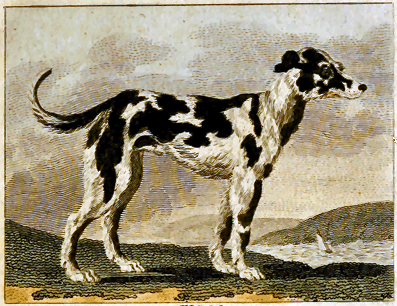
Fig. 31 Dane
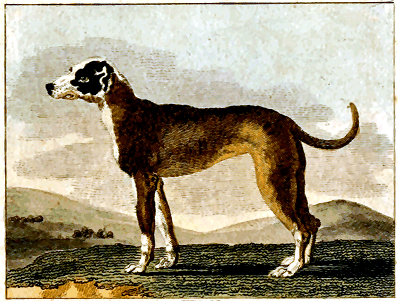
Fig. 32 Greyhound
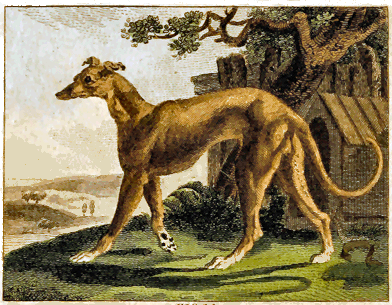
Fig. 33 Shepherd’s Dog
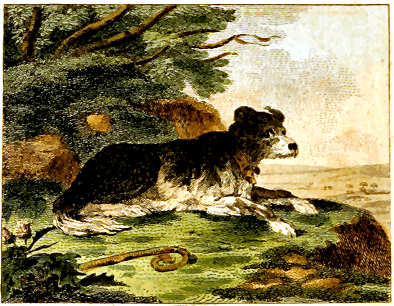
Fig. 34 Wolf Dog
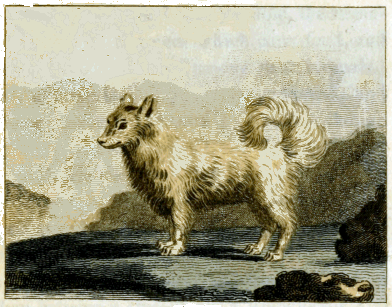
Fig. 35 Siberian Dog
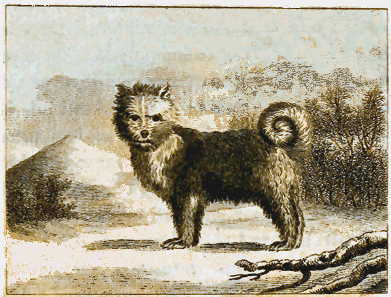
The large Dane, (fig. 31.) the mastiff, and the common greyhound (fig. 32.) though they appear different at the first sight, are nevertheless the same dog; the large Dane is no more than a plump mastiff; and the common greyhound is only the mastiff, rendered more thin and delicate by care; for there is no more difference between these three dogs than between a Dutchman, a Frenchman, and an Italian. In supposing the Irish greyhound to have been a native of France, he would have produced the Danish dog in a colder climate, and the greyhound in a warmer; and this supposition seems to be proved by the fact of the Danish dog’s coming to us from the north, and the greyhound from Constantinople and the Levant. The shepherd’s dog (fig. 33.), the wolf dog (fig. 34.) and the Siberian dog (fig. 35.) are but the same dog, and to which indeed might be added the Lapland, the Canadian, the Hottentot, and all those dogs which have erect ears; in short they only differ from the shepherd’s dog in their height, in being more or less covered with hair, and in that being more or less long, coarse or bushy. The hound (fig. 36.) the harrier (fig. 37.) the turnspit (fig. 38.) the water dog (fig. 39.) and even the spaniel (fig. 40.) may likewise be regarded as the same dog; the greatest difference between them being the length of their legs, and the size of their ears, which in them all are long, soft, and pendent. These dogs are natives of France; and I do not think we should separate them from what is called the harrier of Bengal (fig. 41.) as it only differs from our harrier in its colour. I am fully satisfied that this dog is not originally from Bengal, or any other part of India, and that he is not, as some have pretended, the Indian dog spoken of by the ancients, which they say was the produce of a dog and a tiger, for he has been known in Italy above 150 years, and never considered as a dog come from India but as a common harrier.[M]
Engraved for Barr’s Buffon.
Fig. 37. Harrier.
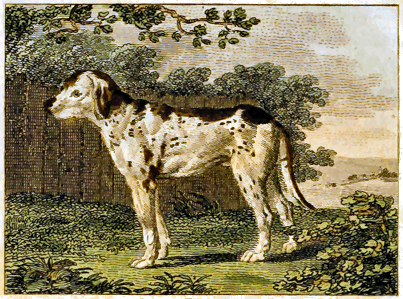
Fig. 36. Hound.
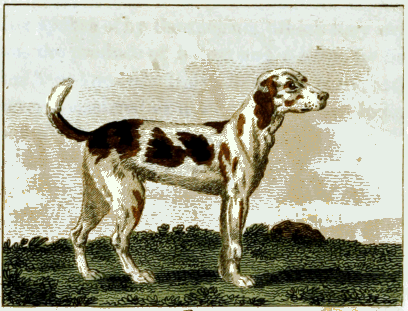
Fig. 38 Turnpit
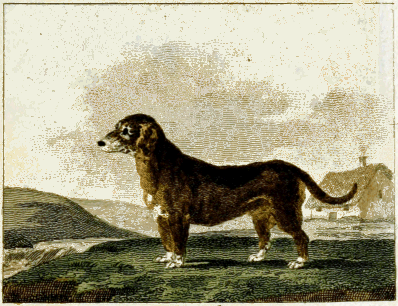
Fig. 39 Water Dog
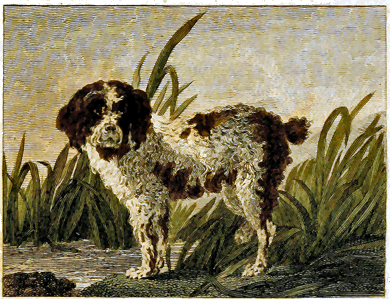
Fig. 40. Spaniel.
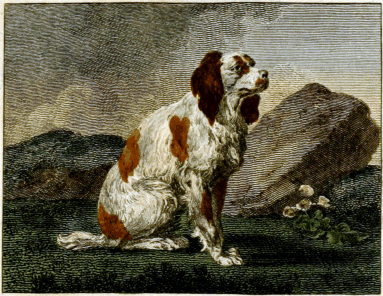
Fig. 41. Harrier of Bengal.
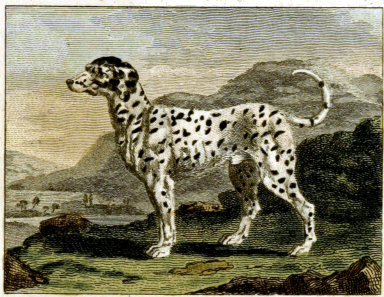
Fig. 42 Iceland Dog
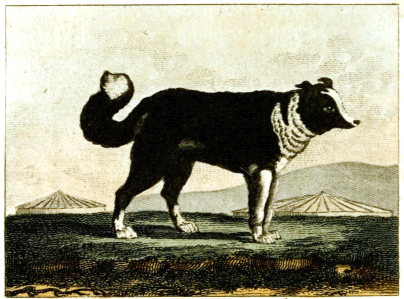
Fig. 43 Turkish Dog
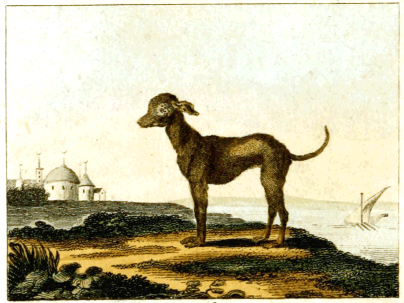
England, France, Germany, &c. appear to have produced the hound, the harrier, and the turnspit, for these dogs almost immediately begin to degenerate on being carried into Persia, Turkey, and such warm climates. But the spaniels and water dogs are natives of Spain and Barbary, where the temperature of the air occasions the hair to be longer and finer than in any other country. The bull-dog which is improperly called the little Dane, since he has no resemblance whatever to the large Dane except in having the hair short; the Turkish dog and the Iceland dog (fig. 42.) are but the same race, which being transported into a very cold climate has taken a strong covering, and in the warmer climates of Africa and India has lost its hair. The dog without hair known by the name of the Turkish dog (fig. 43.) is improperly so called, since it is not in the temperate climates of Turkey that dogs lose their hair, but in Guinea, and in the hottest climates of the Indies that this change happens; and the Turkish dog is no other than the small Dane, which had been transported into some very warm climate, and having lost its hair was afterwards brought into Turkey, where, from its singularity, care has been taken to multiply the breed. The first of them that was seen in Europe, according to Aldrovandus, were taken in his time into Italy, where they could not multiply upon account of the climate being too cold for them. But as he gives not any description of these naked dogs, we cannot determine whether they were like those which are now called Turkish dogs, or whether we should compare them to the small Dane, since dogs of every breed lose their hair in very warm climates; and as already observed, their voices also. In some countries they become quite mute: in others they only lose the power of barking, and howl like wolves, or yelp like foxes; and by this alteration they seem to approach their natural state, for they change also in their form and instincts; they become ugly and invariably have their ears assume an erect and pointed form.
It is only in temperate climates that dogs preserve their ardour, courage, sagacity, and other natural talents, the whole of which they lose when taken into very warm climates. But, as if Nature never made any thing perfectly useless, in those countries where they cannot serve the purposes for which we employ them, they are in great estimation for food, and the Negroes prefer their flesh to that of any other animal. Dogs are sold in their markets at as dear a rate as mutton, venison, or game of any sort; a roasted dog being the most delicious feast among the negroes. It is possible that their fondness for the flesh of this animal may be occasioned by an alteration in its quality by the heat of their country, and that although extremely bad in our temperate climates it may receive a superior flavour by the warmth of theirs. But I rather think this appetite dependent more on the nature of man than on the change in the flesh of the dog, for the savages of Canada have the same partiality for dog’s flesh as the Negroes; and even our missionaries sometimes eat of them without disgust. “Dogs,” says Father P. Sabard Theodat, “serve in the room of mutton at feasts. I have been several times at these dog-feasts, and I own that at first they excited in me a degree of horror, but after tasting them twice, I found the flavour to be good, and not unlike pork.”
In our climates the fox and the wolf are the wild animals which approach nearest the dog, particularly the shepherd’s dog, which I look upon as the stock and type of the species; and as their internal conformation is wholly the same, and their external differences very trifling, I had an inclination to try whether they would breed together: I hoped at least to make them couple, and that if they did not produce fertile individuals, they would bring forth a species of mules which might participate of the nature of both. For this purpose I procured a she-wolf, of about three months old, from the woods, and reared her with a shepherd’s dog of nearly the same age. They were shut up together in a pretty large yard, where no other beast could get access, and where they were provided with a shed for their retirement; they neither of them knew any individual of their own species, nor even any man but him who constantly supplied them with their victuals. In this manner they were kept together for the space of three years, without the smallest restraint. During the first year they played perpetually together, and seemed to be very fond of each other; in the second year they began to quarrel about their food, though they were always supplied with more than they could eat. The wolf always began the dispute. They had meat and bones carried to them on a wooden trencher, when the wolf, instead of seizing the meat, would drive off the dog, then take the trencher so dexterously between her teeth as to let nothing fall off, and carry away the whole; and I have frequently seen her run five or six times round the wall of the yard with it in her mouth, and only stop to take breath, devour the meat, or attack the dog if he came near. The dog was stronger than the wolf, but as he was less ferocious, we began to have some fear for his life, and therefore put him on a collar. After the second year their quarrels were sharper, and their combats more frequent, when a collar was also put upon the wolf, whom the dog began to treat more roughly. During these two years there was not the least appearance of desire in either of them; towards the end of the third they began to discover some marks of it, but it was without any signs of love, and instead of rendering them more gentle when they approached each other, they became ferocious and ungovernable. Nothing was now heard but dismal howlings mixed with cries of anger; in about three weeks they both grew very thin, and never came near each other without indications of mutual destruction. At length they grew so enraged and fought so dreadfully that the dog killed the wolf; and I was obliged to have the dog killed a few days after, because as soon as he was set at liberty, he sprung with fury on the poultry, dogs, and even men.
At the same time I had three young foxes, two males and a female, which had been taken with snares and kept in separate places. I had one of these fastened with a long light chain, and had an hut built to shelter him. I kept him in this manner several months, and though he seemed pensive and had his eyes constantly fixed on the country, which he could see from his hut, yet he had constantly good health and appetite. A bitch in season was put to him, but as she would not remain near the fox, she was chained in the same place and plenty of food was given them. The fox neither bit nor used her ill, and during the ten days they remained together, there was not the smallest quarrel between them, neither night or day, nor when they fed; he even approached her familiarly, but as soon as he scented his companion, the signs of desire disappeared, he returned in a melancholy manner to his hut, and no intercourse took place. When the ardour of this bitch was gone, another and even a third and fourth were put to him in the same manner; he treated them all with the same gentleness and with the same indifference; to ascertain whether it was natural repugnance, or the state of restraint he was kept in, prevented his coupling, I had a female of his own species brought to him, which he covered more than once the same day, and upon dissecting her a few weeks afterwards we found she was impregnated, and would have produced four young ones. The other male fox was successively presented with several bitches in season; who were shut up with him in a close courtyard, but he discovered neither hatred nor love to them; they had neither combats nor caresses, and he died a few months after either of disgust or melancholy.
These experiments prove at least that the wolf and fox are very different in their natures from the dog; and that their species are so distinct as to prevent their intermixture, at least in our climates; that consequently the dog does not derive his origin from the wolf or fox, and that the nomenclators who look on these two animals as nothing more than wild dogs, or who imagine the dog to be a wolf, or a fox, become tame, and give to all three in common the name of Dog, have deceived themselves by not having sufficiently consulted nature.
In climates which are warmer than ours, there is a ferocious animal which is less different from the dog than either the fox or wolf: this animal, which is called the jackall, has been taken notice of and tolerably well described by many travellers. They are found, we are told, in great numbers in Africa and Asia; about Trebisond and Mount Caucasus; in Mingrelia, Natolia, Hyrcania, Persia, India, Goa, Guzarat, Bengal, Congo, Guinea, and many other places; and though this animal is considered by the natives, where he is found, as a wild dog, yet as it is very doubtful whether they intermix, we shall treat of him as a separate species, as well as the fox and wolf, and keep their histories apart from each other as well as from the dog. Not that I pretend absolutely to affirm, that the jackall, or even the wolf and fox, have never in any age or country coupled with dogs. The ancients have so positively asserted the contrary, that there still remain some doubts, notwithstanding the proofs I have adduced. Aristotle says that although it is very rare for animals of different species to intermingle, yet it certainly happens among foxes, dogs, and wolves; and that the Indian dogs proceed from another wild beast like themselves and a dog; and we may suppose that this wild beast, to which he gives no name, is the jackall. But he says in another place that the Indian dogs come from the tiger and the bitch which appears to me more improbable, because the tiger is of a disposition and form more different from the dog than either the fox, wolf, or jackall. It must be allowed that Aristotle himself seems to invalidate his own argument, for after having said that the Indian dogs proceeded from a wild beast resembling the wolf or the fox, he afterwards says they come from the tiger. If they are from a tiger and a bitch, or from a dog and a tigress, he only adds, that it does not succeed until the third trial; that the first litter is solely tigers; that if dogs be tied up in deserts, unless the tigers are in season, they are often devoured; that the frequent production of monsters and prodigies in Africa is occasioned by the great heat and scarcity of water making a number of different animals assemble together to drink where they grow familiar, and often couple together. All this seems too conjectural, uncertain, and suspicious to deserve any credit; for the more we observe the nature of animals, the more we perceive that the indication of instinct is the more certain way to judge of them. By the most attentive examination of the interior parts we only discover slight differences. The horse and ass, though they have a most perfect resemblance in the internal parts, are, nevertheless, animals of very different natures. The bull, ram, and goat, differ but little in their internal formation, though they form three species more distant than the horse and the ass; and the same observation holds with respect to the dog, the fox, and the wolf. The inspection of the external form shews this more clearly; but as in many species, especially in those the least distant, there is even in the exterior much more resemblance than difference, this inspection is not sufficient to determine whether they are of the same or different species; and when the shades are still less we can only combine them with the agreements they have with instinct. It is from the disposition of animals that we should judge of their natures; if we suppose two animals quite the same in their forms, yet different in their dispositions, they would not copulate nor breed together, and however much alike they would therefore be two distinct species.
Engraved for Barr’s Buffon.
Fig. 44 Shock Dog
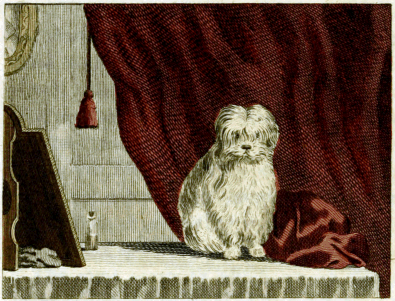
Fig. 45 Lion Dog.
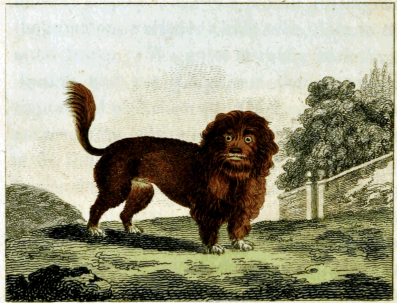
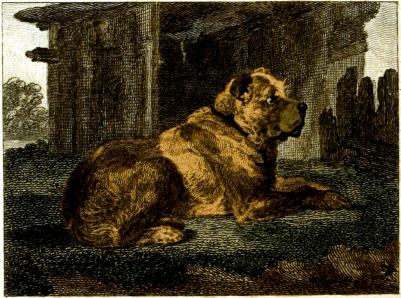
The same means to which we are obliged to have recourse to judge of the difference of neighbouring species, is what we ought still more to employ when we would distinguish the numerous varieties which take place in the same species. We know of thirty varieties in the dog, and yet it is certain that we are not acquainted with them all. Of these thirty there are seventeen which may be said to be owing to the influence of climate, namely, the shepherd’s dog, the wolf dog, the Siberian dog, the Iceland dog, the Lapland dog, the mastiff, the common greyhound, the great Dane, the Irish hound, the hound, the harrier, the terrier, the spaniel, the water-dog, the small Dane, the Turkish dog, and the bull-dog. The thirteen others, which are the mongrel Turkish dog, the greyhound with hair like a wolf, the shock dog, (fig. 44.) or lap dog, the pug dog, the bastard pug dog, the Calabrian, Burgos, and Alicant dogs, the lion dog, (fig. 45.) the small water dog, the Artois dog, and the King Charles’s dog, (fig. 46.) are nothing but mongrels which proceed from the first seventeen races; and by tracing these mongrels back to the two races from which they issue their natures will be easily known but with respect to the first seventeen races, if we would know what relation there is among them we must attend to their instincts, forms, and many other circumstances. I have put together the shepherd’s dog, the wolf dog, the Siberian, the Lapland, and the Iceland dogs, because there is a more striking resemblance between them than any others, in their forms and coats, and because they have all pointed noses somewhat like the fox, erect ears, and their instincts lead them to watch and follow the flocks. The mastiff, the greyhound, the large Dane, and the Irish hound, have, besides the resemblance of form and long snout, the same dispositions; they love to course and to follow horses; they have but indifferent noses, and hunt rather from their sight than their scent. The real hunting dogs are the hounds, harriers, terriers, spaniels, and water-dogs, and notwithstanding they differ in figure yet they have all thick muzzles, the same instincts, and therefore ought to be classed together; the only difference between the water-dog and the spaniel is, that those with long bushy hair take to the water with more facility than those whose hair is short and straight. The small Dane and Turkish dog must be ranked together, since they are in fact the same; the latter having only lost his hair by the effects of heat. Lastly, the bull dog, (fig. 47.) seems to form a particular variety, and even to belong to a particular climate; he is a native of England, and it is difficult to preserve the breed even in France. The pug-dog, (fig. 48.) and mastiff, (fig. 49.) are mongrels from him and they succeed much better; they all have short muzzles and but little scent. The acuteness of the scent, however, seems in general to depend more on the largeness than the length of the muzzle, for the greyhound, large Dane, and the Irish greyhound, have their scent very inferior to the hound, hairier, terrier, spaniel, and water-dog, although their muzzles are more than proportionally longer.
Engraved for Barr’s Buffon.
Fig. 46 K. Charles’s Dog
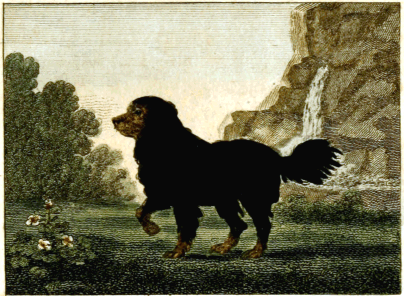
Fig. 47 Bull Dog
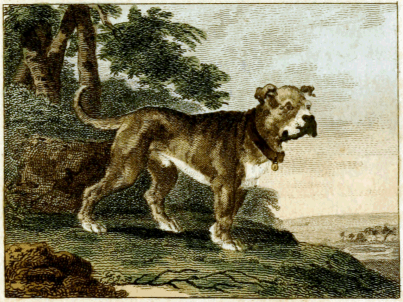
Fig. 48 Pug
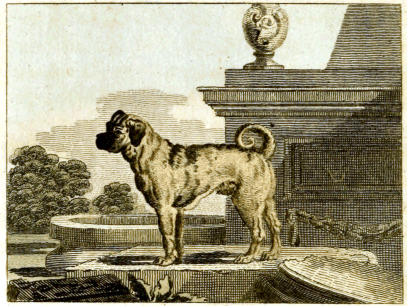
Fig. 49 Mastiff
These animals have all a greater or less perfection of the senses, and these differences, which in man occasion not any eminent or remarkable quality, give to animals all their merit, and produce as a cause all the talents of which their natures are susceptible. I shall not here take upon myself to enumerate all the qualities of the sporting dogs; it is well known how much the excellence of their sense of smelling, together with their education, gives them the superiority over other animals; but these details belong only to a distant part of Natural History. Besides the tricks and dexterity, though proceeding from nature alone, made use of by wild animals to elude the researches, or to avoid the pursuit of the dogs, are perhaps more wonderful than the most refined methods practised in the art of hunting.
The dog, as well as all animals which produce more than one or two at a time, is not perfectly formed at the time of its birth. Dogs are commonly whelped with their eyes shut; the two eyelids are not only closed together, but adhere by a membrane which breaks away as soon as the muscles of the upper eye-lid acquire sufficient strength to raise it and overcome this obstacle, which commonly happens about the tenth or twelfth day. At this time the bones of the skull are not finished, the body and snout swelled, and the whole form incomplete; but in less than two months they learn to make use of all their senses, begin to have strength, and their growth is very rapid. In the fourth month they lose some of their teeth, which, as in other animals, are soon replaced by others that do not fall out. They have in all 42 teeth, namely six incisive, and two canine at top and at bottom, fourteen grinders in the upper, and twelve in the under-jaw; but these latter are not always the same, as some dogs have more grinders than others. When very young, males and females bend down to void their water; about the ninth or tenth month, the males and some females begin to lift up their legs for that purpose, and at which time they begin to be capable of engendering. The male can couple at all times, but the females only at stated seasons, which are usually twice a year, and more frequently in winter than in summer; this inclination lasts ten, twelve, and sometimes fifteen days and shews itself by exterior signs; the male is apprized of her situation by his smell, although she seldom consents to his approaching her for the first six or seven days. Once coupling is sometimes sufficient for her to produce a great number of young, but if left at liberty she will admit many times a day almost every dog that presents himself. It has been observed that when allowed to choose for herself, she generally prefers the largest, without attending either to his form or beauty; and it frequently happens that small bitches who have received large mastiffs die in bringing forth their young. It is well known that these animals, from a singular conformation, cannot separate after consummation, but are obliged to remain united as long as the swelling subsists. The dog, like several other animals, has not only a bone in its member, but also a hollow ring, which is very apparent, and swells considerably during the time of copulation. The females have perhaps the largest clitoris of any animal, and while compressed, a swelling arises which probably lasts longer than that of the male, and forces him to remain; for when the act is finished he changes his position, to rest on his four legs; he has also a melancholy air, and the efforts for separation are never made on the female side. Bitches go nine weeks with young, that is 63 days, but never less than 60. Those of the largest and strongest make are the most prolific, and those will sometimes produce ten or twelve puppies at a litter; while those of a small kind do not bring forth more than four or five, and frequently but one or two; especially the first time, which is always the least numerous in all animals.
Though dogs are very ardent in their amours, it does not prevent their duration, for they continue to propagate during life, which is usually limited to fourteen or fifteen years, though some have been known to live till twenty. Length of life in dogs is, like that of other animals, proportioned to the time of his growth: for as they are about two years in coming to maturity, so they live to twice seven. The dog’s age may be known by his teeth, which, when he is young, are white, sharp, and pointed; and which, in proportion as he advances in age, become black, blunt, and unequal; it is also to be known by the hair, for it turns grey about the nose, forehead, and round the eyes. These animals, though naturally vigilant, active, and formed for exercise, become, by being over-fed in our houses, so heavy and idle, that they pass their lives in sleeping and eating. This sleep, which is almost continual, is accompanied by dreams, which is perhaps a mild manner of existing; and notwithstanding they are naturally voracious, yet they can subsist without eating a considerable time. In the Memoirs of the Academy of Sciences, there is an account of a bitch, who having been accidentally left in a country-house, subsisted 40 days without any other nourishment than the stuff on the wool of a mattress, which she had torn to pieces. Water seems to be more necessary for them than food, for they drink frequently and very abundantly; and it is even a vulgar opinion that if they want water for a length of time they become mad. It is a circumstance peculiar to them that they seem to make great efforts, and suffer pain in voiding their excrements. This is not occasioned, as Aristotle alleges, from their intestines becoming narrower in approaching the anus; for, on the contrary, it is certain, that in the dog, as in other animals, the great intestines grow bigger as they proceed downwards, and that the rectum is larger than the colon: the dryness of the temperament of this animal is sufficient of itself to produce this effect.
To give a clearer idea of the different kinds of dogs, of their propagation in different climates, and of the mixture of their breeds, I subjoin a kind of genealogical tree, in which all the different varieties may easily be distinguished. The shepherd’s dog is the stock or body of the tree. This dog, when transported into the rigorous climates of the north, such as to Lapland, becomes ugly and small, but in Russia, Iceland, and Siberia, where the climate is rather less rigorous, and the people more civilized, he is not only preserved, but even brought to greater perfection. These changes are occasioned solely by the influence of those climates, which produces no great alteration in his form, for in each of them he has erect ears, long and thick hair, and a wild look; he barks also less frequently, and in a different manner from those that in more favourable regions have been brought to greater perfection. The Iceland dog is the only one that has not his ears entirely erect, but which bend or fold a little at their extremities; and Iceland is, of all the northern countries, that which has been most anciently inhabited by half-civilized men.
The same shepherd’s dog, transported into temperate climates, and among people perfectly civilized, as those of England, France, or Germany, loses its savage air, erect ears, its long, thick, and rough hair, and takes the form of the hound, bull-dog, and mastiff. Of the two latter the ears are still partly erect, or only half-pendent; and in their manners and sanguinary dispositions very much resemble the dog, from which they draw their origin. The hound is the most distant of the three; his ears are long and pendent, and the gentleness, docility, and, we may say, the timidity of this dog, are so many proofs of the great degeneration, or, more properly, the great perfection he has acquired by a long state of domesticity, and a careful education bestowed on him by man.
The hound, the harrier, and the terrier, are only one race, for it has been remarked that in the same litter there have been harriers, terriers, and hounds, though the female hound had been only covered by one of the three dogs. I have coupled the Bengal harrier with a common harrier, because they differ only by the number of spots upon their coats. I have also coupled the turnspit, or terrier with crooked legs, with the common terrier, because the defects in the legs of this dog only proceed from a disease somewhat like the rickets, with which some individuals have been attacked, and transmitted the effects to their descendants.
The hound, if transported into Spain and Barbary, where all animals have the hair fine, long, and thick, would become the spaniel and water-dog. The great and small spaniel, which differ only in size, when brought into England change their colour from white to black, and, by the influence of the climate, have become the large and small King Charles’s dog, and the beagle, which is, in fact, the same as the others, but with liver-coloured marks on the fore feet, over the eyes, and on the nose.
The mastiff, transported to the north, is become the large Dane, and to the south changes into a common greyhound. The large greyhounds come from the Levant, those of a middling size from Italy, and the latter being taken into England have become still smaller. The large Dane, transported into Ireland, the Ukraine, Tartary, Epirus, and Albania, have become the large Irish dogs, which in size surpass all the rest of the species. The bull-dog, transported from England into Denmark, is become the small Dane, and this small Dane taken into warm climates changed into the Turkish dog. All these races, with their varieties, have been produced solely by the influence of climate, joined to the effects of food and education; the other dogs are not pure races, but proceed from a mixture of those above.
The greyhound and mastiff have produced the mongrel greyhound, which is called the greyhound with wolf’s hair. The nose of this mongrel is not so thin as that of the Turkish greyhound, which is very rare in France. The large Dane and the large spaniel have produced the dog of Calabria, which is a handsome dog, with long thick hair, and higher in stature than the largest mastiff. The spaniel and terrier produce what is called the Burgundy spaniel; and from the spaniel and small Dane has come the lion-dog, which is now very scarce. The dogs with long fine curled hair, which are called the Bouffe dogs, and which are bigger than the water dogs, come from the water dog and large spaniel. The little water dog comes from the small spaniel and the water dog. The bull-dog and the mastiff produce a mongrel, which is larger than the bull-dog, yet approaches him more than the other; and the pug comes from the bull-dog and the small Dane.
All these races are simple mongrels, and come from the mixture of two pure races; but there are other dogs which may be called double mongrels, because they proceed from a pure race and one already mixed. The bastard pug is a double mongrel, and comes from a mixture of the pug with the small Dane. The Alicant dog is also a double mongrel; he proceeds from the pug and the small spaniel. The Maltese, or lap-dog, is a double mongrel, and comes from the small spaniel and little water-dog. In fine, there are dogs which may be called triple mongrels, because they proceed from the mixture of two races which have already been mixed; as the Artois dogs and what is called the street dogs, which resemble all dogs in general, but no one in particular, since they proceed from races which have several times been mixed.
SUPPLEMENT.
The following curious fact I had from M. de Mailly, of the Academy of Dijon: "The curate of Norges, near Dijon, has a bitch, which has had all the symptoms of pregnancy, and having puppies without having been in either state. She was proud, but was not suffered to go with a dog, yet at the end of her usual term her paps were filled with milk, and she brought up some young puppies that were taken to her, with as much care and tenderness as if they had really been her own; and what is more singular, this same bitch, about three years since, suckled two young kittens, one of which has imbibed so much of the nature of her nurse, that her cries infinitely more resemble the tones of a dog than those of a cat." This is certainly a rare phenomenon, and were this production of milk without impregnation more frequent, it would render female animals more analogous to female birds who produce eggs without connection with the male.
The Russians have brought several dogs to Paris, as Siberians, a very different race from those which we have described; one in particular, both male and female, were about the size of a common greyhound, with pointed noses, ears half erect, and long tails; they were entirely black, excepting a spot of white which the female had upon the top of the head, and one which the male had upon his tail; they were very fond, but exceedingly dirty and voracious, and it was almost impossible to satisfy them with food; upon the whole, they were evidently of the same race as we have treated of under the denomination of Iceland dogs.
Mr. Collinson, who had made various researches concerning the Siberian dogs, informed me that their noses were pointed, and their ears long, that some of them carried their tails like the wolf, others in the same manner as the fox, and that they certainly engendered with both those animals; that he had himself seen dogs and wolves couple in England, and although he knew of no one who could say the same with regard to dogs and foxes, from the kind well known there by the name of the fox-dogs, he did not think there could be any doubt of the fact.
The Greenland dogs are mostly white, though some few are black, and have very thick coats; they employ them for drawing their sledges, by putting four or six of them together; they also eat their flesh, and make clothes of their skins. The Kamtschatka dogs are also either black or white, and are used for drawing sledges; they are suffered to run at large during the summer, and in winter they are fed with a sort of paste made with fish. These dogs of Greenland and Kamtschatka, as well as the Russian dogs just mentioned, have a strong resemblance to the Iceland dogs, and are most probably of the same race.
Notwithstanding the varieties I have described, there are still others remaining, which I have not been able to procure; I have myself seen two individuals of a wild race, but could not get a sufficient opportunity even to describe them. M. Aubry, curate of St. Louis, informed us that a few years since he saw a dog about the size of a spaniel, with long hair and a very large beard on his chin. Louis XIV. had some of these dogs sent to him by M. le Comte de Toulouse; and Comte de Lassai had some of the same breed, but there is not any of them to be found at present.
I have little to add with respect to the wild dogs, of which there are different races, to what is contained in my original work; and the following account of the wild dog found near the Cape of Good Hope, I had from M. le Vicomte de Querhoënt; he says, there are a great number of packs of wild dogs at the Cape; their skins are spotted with various colours, and some of them are very large; their ears are erect, they run extremely fast, and have no constant place of abode. They kill the deer in great numbers, are seldom destroyed themselves, and are very difficult to be caught in snares, from carefully avoiding every thing that has been touched by man. Several of their young have been taken in the woods, and some of those it has been attempted to render domestic, but they grow up so large and so ferocious that the attempt has been given up as in vain.
END OF THE FIFTH VOLUME.
T. Gillet, Printer, Wild-Court.
Transcriber Note
All obvious typographical errors were corrected. Where variant spellings were used, they were standardized to the most prevalent usage. All paragraphs split by illustrations were rejoined. The illustration’s header and figure captions were standardized. Cover image was created from an image made available on The Internet Archive and is placed in the Public Domain.