Front matter (continued 3)
Reading edition
The breed of these horses is dispersed throughout Barbary; the chiefs among the Moors, and even among the Negroes along the rivers Gambia and Senegal, have them of uncommon beauty. Instead of barley, or oats, they give them maize reduced to flour, which they mix with milk, when they are inclined to fatten them; and in this hot climate they seldom let them drink. The Arabian horses are also spread over Egypt, Turkey, and perhaps Persia, where there were formerly considerable studs. Mark Paul mentions one in which were 10,000 white mares; and he says, that in the province of Balascia there was a great number of large nimble horses, with their hoofs so hard that it was unnecessary to shoe them.
The horses of the Levant, as well as those of Persia and Arabia, have the frog of the foot very hard; they shoe them notwithstanding, but with shoes so light and thin that nails may be driven through any part of them. In Turkey, Persia and Arabia, the custom of taking care and feeding them is the same. Their litter is made of their own dung, which is first dried in the sun, to take off the ill smell, then reduced into powder, and a bed made with it in the stable or tent, four or five inches thick. This litter lasts a long time, for when soiled, it is dried in the sun a second time, and again loses its disagreeable odour.
In Turkey there are horses of Arabia, Tartary, and Hungary, beside the native horses of the country, which are very handsome and elegant, have a great deal of fire, swiftness and symmetry, but are soon fatigued. Their skins are so tender that they cannot bear the curry-comb, so that they are obliged to use a brush, and to wash them with water. These horses, although handsome, are much inferior to those of Arabia, and even those of Persia, which are, next to the Arabians, the most beautiful and the best horses of the east. The pasture of the plains of Media, Persepolis, Ardebil, and Derbent, is excellent, and by the order of government, a prodigious number of horses are raised there, most of which are very handsome, and almost all excellent. Pietro della Valle prefers the common horses of Persia to the most excellent of the kingdom of Naples. They are commonly of a middling size; some are very small, but equal in goodness and strength, while there are others bigger than the saddle-horses of England. They have small heads and thin necks; their ears are handsome and well placed; slim legs, handsome cruppers, and hard hoofs; they are docile, lively, light, bold, courageous, and capable of bearing great hardships. They run very swift, without ever stumbling. They are robust, and easily fed, being kept on barley mixed with straw chopped fine, and are only put to grass for about six weeks in the spring. Their tails are long, and the Persians never make geldings. They use coverings to defend their horses from the injuries of the air, and are particularly attentive in their care of them: they manage them with a bridle only, and without employing spurs. Numbers of them are transported into Turkey, but more to the Indies. Those travellers who are so lavish in their praises of the Persian horses agree in allowing that the Arabians are superior for their agility, courage, strength, and beauty; and that they are more valued, even in Persia, than the horses of that country.
The horses bred in the country are not good. Those used by the grandees of the country are imported from Persia and Arabia. They give them a little hay in the day, and in the evening pease boiled with butter and sugar, instead of oats or barley; this nourishment strengthens and gives them spirits; without it they would soon decay, the climate being contrary to their nature. The native horses of India are very small; some of them are so little that, Tavernier says, the young Prince of the Moguls, who was about eight years of age, rode on a handsome little horse, whose height did not exceed that of a large greyhound. It should seem that extreme hot climates are contrary to the nature of horses. Those of the Gold Coast, Juida, Guinea, &c. are also very bad. They carry their heads and necks very low; their walk is so tottering, that one would imagine they were always ready to fall; they would never stir if they were not to be continually beat, and the greatest part of them are so low that the feet of the riders almost touch the ground; they are most untractable creatures, and only fit to be eaten by the Negroes, who are as fond of their flesh as they are of that of dogs. This taste for horse-flesh is common to the Negroes, Arabians, Tartars, and Chinese. The Chinese horses are no better than those of India, they are weak, spiritless, ill-made, and very small; those of Corea are not more than three feet in height. In China almost all the horses are made geldings; and they are so timid that they cannot be made use of in war; so that it may with propriety be said that the Tartarian horses conquered China. Those horses are very fit for war, though commonly but of a moderate size, they are strong, vigorous, spirited, agile, and very swift. Their hoofs are hard, but the bottom is too narrow; their heads are small, their necks long and confined, and their legs are too long; with all these defects they may be considered as good horses, for they are not easily tired, and gallop extremely fast. The Tartars live with their horses in the same manner as the Arabians. When about seven or eight months old they are mounted by children, who make them walk or gallop a little way by turns. They thus break them by degrees, and oblige them to undergo long fastings; but they never mount them for travelling or hunting till they are six or seven years old, and then they make them support incredible fatigue, such as travelling two or three days together without stopping; passing four or five days without any other food than a handful of grass every eight hours, and also to go twenty-four without drinking, &c. These horses which are so robust in their own country become enfeebled and useless, when transported to China or the Indies; but they succeed better in Persia and Turkey. The little Tartars have a breed of small horses which they value so much, that they are not allowed to be sold to foreigners. These horses have all the good and bad qualities of those of Great Tartary, which shews how much the same manners and education give the same disposition to these animals. There are also in Circassia, and in Mingrelia, many horses which are even handsomer than those of Tartary. There are also some fine horses in the Ukraine, Wallachia, Poland, and Sweden; but we have no particular account of their qualities or defects.
If we consult the ancients on the nature and qualities of the horses of different countries, we shall find, that the horses of Greece, especially those of Thessaly and Epirus, were held in great esteem, and were very useful in war; that those of Achaia were the largest then known; that the handsomest came from Egypt, where there was a great number, and where Solomon sent to buy them at a great price; that in Ethiopia the horses did not thrive, on account of the great heat of the climate; that Arabia and Africa produced the finest horses, but above all the lightest and best calculated for the chace; that those of Italy were extremely good; that in Sicily, Cappadocia, Syria, Armenia, Medea, and Persia, there were excellent horses, remarkable for their swiftness and agility; that those of Sardinia and Corsica were small, but lively and courageous; that those of Spain resembled those of Parthia, and were excellent for war; that there were in Transylvania and in Walachia swift horses with small heads, large manes hanging down to the ground, and bushy tails; that the Danish horses were well made and good leapers; that those of Scandinavia were small, but well made and very agile; that the Flanders horses were strong; that the Gauls furnished the Romans with good horses for the saddle, and to carry burthens: that the German horses were ill-made, and so vicious, that no use was made of them; that the Swiss had great numbers fit for war; that the horses of Hungary were also very good; and lastly, that the Indian horses were small and weak.
From the above facts it results, that the Arabian horses have ever been, and are still, the first horses in the world, both for beauty and goodness; that it is from them, immediately, or by the means of Barbs, that the finest horses in Europe, Africa, and Asia are bred, that Arabia is perhaps not only the original climate for horses, but the best suited to their natures, because, instead of mixing the breed by foreign horses, the Arabs take care to preserve their own purity; that if the climate is not of itself the best for horses, the natives have produced the same effects, by the care they have taken, from time immemorial, to ennoble their breed by putting together only the most beautiful individuals, and of the first quality; and that by this attention, pursued forages, they have improved the species beyond what nature alone would have done in the most favourable climate. We may also conclude that warm climates rather than cold, but above all, dry countries agree best with the nature of horses; that in general, small are better than large horses; that care is as necessary for them as food; that familiarity and caresses will do more with them than force and chastisement; that the horses of warm countries have their bones, hoofs, and muscles, more firm than those of our climates; that although heat agrees better than cold with these animals, yet excessive heat does not agree with them; and lastly, that their habit and disposition depend almost entirely on the climate, food, care, and education.
In Persia, Arabia, and many other parts of the east, it is not customary to geld horses, although so general a practice in Europe and China. This operation deprives them of much of their strength, courage, and fire, but renders them gentle, quiet, and docile. The only seasons for performing this operation are spring or autumn, great heat and cold being equally hurtful. With respect to age, they have different customs in different countries; in some parts of France they geld horses at twelve or fifteen months old; but the general and best custom is, not to geld them till two or three years, because, in not doing it till that age, they preserve more of their masculine qualities. Pliny says, that they never lose the milk-teeth if they are made geldings before they have shed them. But this is not a fact; and it is probable that the ancients grounded this supposition merely on the analogy it bears to the falling of the horns of the stag, goat, &c. which, in reality, never fall off after castration. The gelding it is true, can never engender, but we have sometimes examples of their being able to copulate.
Horses of all colours shed their coats, like most animals covered with hair, once a year, usually in the spring, though sometimes in autumn; as they are then weaker than at other times, they should have more care, and be more plentifully fed. There are also horses which shed their hoofs; this usually happens in humid marshy countries, such as Holland.
Geldings and mares neigh less frequently than horses. Their voices are not so strong, but much more shrill. In all horses we may distinguish five kinds of neighing, relative to different passions; in the neigh of joy the voice begins and ends with sharp tones; the horse kicks up at the same time, but without attempting to strike. In the neigh of desire, whether of love or attachment, the horse does not kick, and the voice is dragged to a great length, and ends with a deep sound. The neigh of anger, during which the horse kicks violently with his foot, is short and sharp; that of fear, during which he kicks also, is scarcely longer than that of anger, the voice is hoarse and grave, and seems as if it came from the nostrils only. This neigh is something like the roaring of a lion. That of pain is more like groaning, or breathing with oppression, than of neighing; it is in a grave tone of voice, and follows the alternatives of respiration. It has also been remarked, that horses which neigh frequently from joy or desire, are the best and most generous. Horses, in general, have the voice stronger than mares and geldings; from the birth the male has the voice stronger than the female. At two years, or two years and a half, which is the age of puberty, the voice of males and females, as in mankind, and other animals, becomes much more strong and deep.
When the horse is impassioned with love he shews his teeth, and seems to laugh; he shews them also when he is angry, and would bite. He sometimes puts out his tongue to lick, but less frequently than the ox, who, notwithstanding, is less sensible to caresses. The horse remembers ill treatment much longer, and is sooner dispirited, than the ox. His natural spirit and courage induce him to make every effort, but when he finds more is expected from him than he is able to perform, he grows angry, and will not endeavour at all; instead of which, the ox, who is slow and idle, seldom exerts his utmost, and is not therefore easily dejected.
The horse sleeps much less than man, for when he is in health he does not rest more than two or three hours together; he then gets up to eat. When he has been much fatigued he lies down a second time, after having eat; but in the whole he does not sleep more than three or four hours in the twenty-four. There are even some horses who never lie down, but sleep standing, which is sometimes the case even with those who do lie down. It has also been remarked, that geldings sleep oftener and longer than horses.
Quadrupeds do not all drink in the same manner, though they are all equally obliged to seek with the head for the liquor, which they cannot get any other way, except the monkey, macaw, and some others, that have hands, and consequently drink like men, when a vessel is given to them which they can hold; for they carry it to their mouths, inclining the head, throwing down the liquor, and swallowing it by the simple motion of deglutition. Man usually drinks in the same manner, because it is most convenient; but he can drink many other ways by contracting the lips to draw in the liquor, or dipping the nose and mouth deep enough into it for the tongue to be environed therewith, and then perform the motions necessary for swallowing; he can also take in a fluid by the lips alone; and lastly though with more difficulty, stretch out the tongue, and, forming a kind of little cup, carry a small quantity of water into the mouth. Most quadrupeds could also drink in several different ways, but, like men, they chuse that which is most convenient. The dog, whose mouth is very large, and the tongue long and thin, drinks by lapping, or licking, forming with the tongue a kind of cup or scoop, which fills each time with a tolerable quantity of liquor, and so satisfies his thirst; and this mode he prefers to that of wetting the nose. The horse, on the contrary, whose mouth is small, and whose tongue is too short and thick to form a scoop, and who always drinks with more avidity than he eats, dips the mouth and nose quickly and deeply into the water, which he swallows largely by the simple motion of deglutition; but this forces him to drink without fetching his breath, whereas the dog breathes at his ease while he is drinking. Horses, therefore, should be suffered to take several draughts, especially after running; when respiration is short and quick, they should not be suffered to drink the water too cold, because that, independent of the cholic, which cold water frequently occasions, it sometimes brings on rheums, and often lays the foundation of a disorder called the glanders, the most formidable of all diseases to which this species of animals are subject; for it is known, that the seat of the glanders is in the pituitary membrane, and that it is consequently a real cold, which causes an inflammation in this membrane. Travellers, who give us a detail of the maladies of horses in warm climates, as in Arabia, Persia, and Barbary, do not say that the glanders are so frequent there as in cold climates, and it is for this reason the conjecture arises, that this malady is occasioned by the coldness of the water, because the animals are obliged to keep the nose and nostrils a considerable time under water, which would be prevented by never giving it to them cold, and by always wiping the nostrils after they have drank. Asses, who fear the cold more than horses, and who resemble them so strongly in the interior structure, are not so subject to the glanders, which may possibly be owing to their drinking in a different manner from horses; for instead of dipping in the mouth and nose deeply into the water, they scarcely touch it with their lips.
I shall not speak of the other diseases of horses, it would spin out Natural History too much to join to the history of an animal that of its disorders; nevertheless, I cannot leave the history of the horse without regretting that the health of this useful animal should have been hitherto abandoned to the care, and too frequently absurd practice, of ignorant people. The branch of physic, which the ancients called Veterinaria Medicina, is at present scarcely known but by name. I am persuaded, that if some physician would turn his views this way, and make this study his principal object, he would soon find it answer his purpose, both with respect to reputation and profit: instead of degrading himself he would render his name illustrious, and this branch of physic would not be so conjectural and difficult as the other. The diet, manners, and influence of sentiment, and all other causes of disorders, being more simple in animals than in man, the diseases must be less complicated, and consequently more easily investigated, and treated with success, without mentioning the advantages that would be derived from the entire liberty of making experiments, trying new remedies, and to be able to arrive, without fear or reproach, to a great extent of knowledge of this kind, from which, by analogy, inferences might be drawn useful to the art of curing mankind.
SUPPLEMENT.
Africa, it has already been observed, appears to be the original climate of the horse, and from the country being so dry and warm, admits many customs that cannot be practised in the northern regions, at least with any effect. In different countries they not only receive different food, but are also differently managed. In Arabia and Barbary they scarcely ever are allowed herbage or grain, but are principally kept upon dates and camel’s milk, which is given them morning and evening; they are seldom made use of till the seventh year, till when they suck the camels whom they constantly follow.
In Persia they are always kept in the open air, being sometimes covered with clothes to preserve them from the inclemency of the weather. The whole troop are tied to a rope, which is fastened at each end to iron rods fixed in the ground; they have also ropes tied to their hind legs, and fastened to pegs in their front, this latter method is to prevent them from doing any injury to each other; but notwithstanding both fastenings, they stand perfectly at ease, and have sufficient room to lie down. The Persians make use of nothing but sand or dry dust for litter, but the Arabians and Moguls litter their horses with their own dung dried to a powder. It is the custom in these countries not to let the horses eat from the ground, or racks, but to constantly put their barley, and cut straw into bags, which are tied round their necks. In spring they are fed with grass and green barley, but care is taken that they should not have too much, upon a supposition they would soon become fat and useless. They never use bridles or stirrups, but easily manage their horses with a single snaffle; whips and spurs are also seldom employed, and one or two strokes of the former is sufficient at all times to answer every purpose. The horses in Persia are very tall, strong, and sometimes heavy, and from being so plenty, the best of them sell at a low price. These people have a practice of tying a rope to the fore and hind foot on the same side, which teaches them to adopt an easy pace; they also slit their nostrils, for the purpose, they say, of making them respire with more ease.
Horses, however, succeed as well in cold as warm countries, if they are not damp. Denmark, Sweden, and Poland, it is well known, produce fine and beautiful horses; those in Iceland, where the cold is excessive, and where they frequently have nothing but dried fish to subsist upon, though small, are strong and vigorous. In this island the shepherds tend their flocks on horseback, for they are both plenty, and their keep is not attended with any expence. When not wanted they are turned loose into the mountains where they soon become wild; if the owners want them, they are hunted in troops, and caught with ropes, which is thought necessary when the mares have foaled, the owners of which put a mark upon the foals, and then turn them into the mountains again for the space of three years, and it is generally remarked that those left in this manner, are more fleet and better than those brought up at home.
The Norwegian horses possess a peculiarity well adapted to the country, for they travel through the roughest parts of it, and descend the steepest declivities, by putting their hind feet under their bellies with perfect safety. They are small, generally yellow, with a black stripe along their backs. They are frequently assaulted by the bear, and if a stallion happens to be among the mares and foals, when this destructive animal appears, he advances to meet him, and has the sagacity to attack with his fore feet, in which case he almost always is conqueror, but if he ever trusts to his hind legs he is as constantly subdued, the bear in that case leaping upon his back, which he never quits until he has worried him to death.
The Nordland horses are also small, and it is a pretty general remark, that the nearer we approach the pole the more diminutive are these animals. Those of the West Nordland are short and thick; the upper part of their legs is long, and the under short, and without hair; they are generally very temperate, sure-footed, and climb the highest mountains with the greatest steadiness and perseverance. The pasturage of this country is so rich that the horses are always fat and in good condition, which however, they soon lose if they are taken to Stockholm; and by the same rule if a weakly horse is carried to the Nordland he soon recovers.
The Japanese horses are small, as are also those of China, although in both places some few are of a tolerable size, which are brought from the mountainous parts of those countries. Those of Tonquin, according to M. Rhodes, are strong, of a tolerable size, and very easily managed.
Horses, as before remarked, there is every reason to believe, were unknown in America on its first discovery, but upon being transported thither they multiplied in a most surprising manner, especially in Chili, which, as M. Frezier remarks, is the more surprising, since the Indians killed many to eat, and numbers through fatigue and from want of proper care. In the Phillipine Islands also horses that were taken from Europe increased in an astonishing manner in a very short time.
Horses are suffered to live wild in the Ukraine, among the Cossacks, on the river Don; here they go in troops of four or five hundred together, seldom attended with more than one or two men on horseback; they have seldom any shelter when the ground is even covered with snow, which they scrape away with their fore feet to get at the pasture; and it is only in very hard winters, and then but for a few days, that they are lodged in the villages. These troops have a chief among them, whom they implicitly obey, and singular as it may appear, he directs their course, makes them proceed or stop at his pleasure. He seems also to have a regular command, and regulates all their movements when attacked by wolves or robbers: in this situation he assumes entirely the business of a commanding officer, and is busily engaged, during the whole time, in traversing round the troops, and if he perceives any out of their places he pushes them in with his shoulder, and actually compels them to resume their station. Without being arranged by men they march in perfect order, and pasture in perfect files or brigades, without ever mixing or separating, notwithstanding they are at perfect liberty, and without the smallest control. It is no less singular, that their chief generally maintains his situation for four or five years, but he no sooner discovers the least symptoms of inactivity than some one will come out of the herd and attack him; if he conquers he continues the command, but if subdued he is forced to fall into the ranks, and the victor becomes chief, and is obeyed by the whole troop.
The horses in Finland, as soon as the snow is off the ground, about the month of May, leave their stables, and assemble together in a particular part of the forests, where they form themselves into different troops, and afterwards no one ever separates from his own party, or intermixes with any other. When thus divided, each troop fixes upon a certain district for their pasturage, within the bounds of which they strictly keep, and never encroach even upon that belonging to another troop, though adjoining; in this manner they continue to graze while there remains any pasture, but on that becoming scarce, they all march off together to another spot, and these marches are conducted with so much order and regularity that the owners know exactly where to find their horses when they have occasion for them; in these cases, when fetched, and having done the service they were wanted for, they return back of themselves, and again join their own troop. In this manner they remain till about the month of September, when the approach of the inclement season induces them to come home, which they do in troops, and each regularly proceeds to his own stable. At this time they are generally in good case, but the fatigue they undergo in the winter, together with the small allowance of provisions, very soon reduces them. They are small, spirited, and very docile, and roll upon the snow as familiarly as other horses do on grass.
In the Island of St. Helena there are wild horses, which, although originally transported from Europe, are extremely savage and ferocious, and, to avoid being taken, will often leap from very high precipices into the sea. In the neighbourhood of Nippes there are some not bigger than asses, but they are strong, bold, and extremely industrious. The horses in St. Domingo are of a middle size, and though many of them are caught with ropes, they seldom become docile, but generally remain restless, and almost unmanageable. In Virginia there are also horses of domestic origin, yet, from feeding in the woods, are very ferocious, and hard to be taken, and when caught, they remain exceedingly stubborn.
In some parts of Tartary they make use of large birds of prey to hunt their wild horses; they are taught to seize him by the neck or head, upon which he sets off with the greatest speed, and continues running until he is quite exhausted, without being able to extricate himself from his tormentor. The wild horses of the Mongous, and Kakas Tartars, are so swift that they often escape the arrows of the most expert hunters; they generally keep in large numbers together, and if tame ones come near they will surround them, unless they instantly take to flight. There are a great number of wild horses in Congo; they at times are seen at the Cape of Good Hope, but the inhabitants preferring those from Persia they are scarcely ever caught.
In the early part of this work I mentioned, that from the observations of horse-breeders it was the general received opinion, that the male had more influence upon the offspring: than the female; and I then suggested some reasons which it rendered to me very doubtful, but experiments and observations have since convinced me, that the fact does not only hold good with respect to horses, but also in the human race, and in every species of animals, that the male has infinitely more influence on the exterior form of the young than the female, and that he in fact is the type of the race. Nor does the remark I have made, that the females constitute the unity of the species in the least controvert this position, because that cannot be extended further than her possessing the greater facility in representing the species, but this point is more amply discussed in this work under the article Mule; from which it will appear, that notwithstanding the female may have more influence on the character of the breed, yet from her it never receives any improvement, which faculty is solely possessed by the male.
THE ASS.
If we consider this animal with attention, he appears only to be a horse degenerated. The perfect similitude in conformation of the brain, lungs, stomach, intestinal conduit, heart, liver, and other viscera, and the great resemblance of the body, legs, feet, and the entire skeleton, supports this opinion. We may also attribute the slight differences, which are found between these two animals, to the influence of the climate and food, and to the fortuitous succession of many generations of small wild horses, which, gradually degenerating, have at last produced a new and fixed species; or, rather a succession of individuals alike, all vitiated in the same manner, sufficiently differing from a horse, to be looked upon as another species. What appears to favour this idea is, that horses vary much more than asses in their colour; they have consequently been longer domestic, since all domestic animals vary much more in their colour than wild ones of the same species. The greater number of wild horses, of which travellers speak, are small, and have, like the ass, grey hair, and the tail naked and frizzled at the end: there are also some wild horses, and even domestic ones, which have a black stripe on the back, and other marks, which nearly resemble both wild and domestic asses.
Again, if we consider the difference of the temperament, disposition, and manners; in a word, the organization of these two animals, and, above all, the impossibility of mixing the breed, so as to make one common species, or even an intermediate species, which may be renewed; it appears a better founded opinion to think that these animals are of a species equally ancient, and originally as essentially different as they are at present. The ass differs materially from the horse in the smallness of the size, largeness of the head, length of the ears, hardness of the skin, nakedness of the tail, the form of the rump, and the dimensions of the neighbouring parts, the voice, the appetite, manner of drinking, &c. Can we then suppose that the horse and the ass came originally from the same stock? are they of the same family, or not? and have they not always been different animals?
This question of which philosophers will find the generality, difficulty, and consequences, and which we treat of in this article, because it here offers itself for the first time, appertains to the production of beings nearest to each other, and renders it necessary that we should consider nature under a new point of view. If from the immense variety of animated beings which people the universe, we chuse an animal, or even the body of man, to serve as a foundation to our knowledge, and to find out, by way of comparison, the other organized beings, we shall find that each possesses an independent existence, and that all vary, by different gradations, almost to infinity; there exists also, at the same time, a primitive and general design, which we may trace very far, and of which the gradations are much slower than those of the form, and other apparent relations, for, without mentioning the organs of digestion, circulation and generation, which appertain to all animals, and without which they could neither subsist nor reproduce, there is even in the parts which contribute most to the variety of the exterior form a prodigious resemblance, which necessarily calls to our minds an original design, upon which all seem to have been projected and executed. The body of a horse, for example, which, by a single glance of the eye, appears so different from the body of a man, when it is compared part by part, instead of surprising by the difference, only astonishes by the singular and almost perfect resemblance, in fact, take the skeleton of a man, bend downwards the bones of the pelvis, shorten those of the thighs, legs, and arms, lengthen those of the feet and hands, join the phalanges, lengthen the jaws, by shortening the frontal bone, and extend the spine of the back, this skeleton would cease to represent the remains of a human figure, and would be the skeleton of a horse; for it is easy to suppose, that in lengthening the spine of the back and jaws we augment, at the same time, the number of the vertebræ, ribs, and teeth; and it is only by the number of those bones, which may be looked upon as accessory, and, by the prolongation, the shortening, or junction, of the others, that the skeleton of a horse differs from that of the human body. We see in the description of the horse these facts too well established to doubt; but, to follow these relations still further, let us consider separately some essential parts of the structure; for example, we find ribs in all quadrupeds, in birds, and in fish; and we find the vestiges even in the shell of the turtle. Let us also consider, that the foot of a horse, so different in appearance from the hand of a man, is, notwithstanding composed of the same bones, and that we have, at the extremity of each of our fingers, the same little bone resembling a horse-shoe, which terminates the foot of that animal. From this we may judge if this hidden resemblance is not more marvellous than the apparent differences; if this constant conformity and design followed from man to quadrupeds, from quadrupeds to cetaceous animals, from cetaceous animals to birds, from birds to reptiles, from reptiles to fish, &c. in which the essential parts, as the heart, intestines, spine, senses, &c. are always found, does not imply, that, in creating animals the Supreme Being has followed but one idea, and varied it, at the same time, in every possible manner, that man may equally admire the magnificence, execution, and simplicity of the design.
In this point of view, not only the ass and horse, but man, monkies, quadrupeds, and all animals, may be looked upon as making but one family; but ought we, therefore, to conclude, that in this great and numerous family, which the Almighty has conceived and created from nothing, there are smaller families projected by nature and produced by time? some of which are composed only of two individuals, as the horse and the ass; others of several individuals, as the weazle, the pole-cat, the ferret, &c. and also that in vegetables there are families of ten, twenty, thirty plants, &c. If these families existed, in fact, they could only be formed by the mixture, the successive variation, and the degeneration of the original species; and, if we admit, for once, that there are families in plants and animals, that the ass is of the family of the horse, and that he only differs because he has degenerated; we may say, with as much propriety, that the monkey belongs to the family of man, and he is a man degenerated; that man and the monkey had but one common origin, like the horse and ass; that each family, as well in animals as in vegetables, come from the same origin, and even that all animals are come from one species, which, in the succession of time, by improving and degenerating, has produced all the races of animals which now exist.
The naturalists, who have so easily established families and vegetables, do not seem to have considered the whole extent of these consequences, which would reduce the immediate product of the creation, to any number of individuals however small; for, if it was once proved, that animals and vegetables were really divided into families, and that there was a single instance of one species having been produced by the degeneration of another; if it was true, that the ass was only a horse degenerated, there would be no bounds to the power of nature, and, we might, with equal reason suppose, that from one single individual being, in the course of time, she might have produced all the organized bodies which are now spread over the universe.
But it is certain, by revelation, that all creatures have equally participated in the favours of creation; that the two first of each species, were formed by the hands of the Creator, and we ought to believe, that they were then nearly such as they appear at present in their descendants. Besides, since Nature has been observed with attention, from the time of Aristotle to the present, not a single new species has been seen, notwithstanding the rapid motion that drags on, or dissipates the parts of matter, notwithstanding the infinite number of combinations which must have been in the space of twenty centuries, notwithstanding the fortuitous couplings of different animals, from which nothing has ever resulted but vitiated and sterile individuals, and such as have not been able to become a stock for new generations. Were the exterior and interior resemblance in some animals still greater than they are between the horse and the ass, we ought not to confound these animals, nor give them to one common origin, for if they, in fact, came from the same stock, we might bring them back to their original state by new alliances, and undo by time, what time is already supposed to have done.
We must also consider, that although nature proceeds by gradual, and frequently by imperceptible degrees, the intervals are not always the same. The more exalted the species, the fewer they are in number, and the shades by which they are separated, are more conspicuous; the smaller species, on the contrary, are very numerous, and have more affinity to each other, so that we are the more tempted to confound them together in the same family; but we should not forget that these families are our own works, that we have made them for the ease of our memories, that if we cannot comprehend the real relations of all beings, it is ourselves, not nature that is in fault, who knows not these pretended families; and, in fact, contains only individuals.
An individual is a separate detached being, and has nothing in common with other beings, excepting that it resembles, or rather differs from them. All similar individuals which exist on the earth, are considered as composing the species of those individuals. Notwithstanding, it is neither the number nor collection of similar individuals which form the species, but the constant succession and renewing of these individuals which constitute them; for, a being which existed for ever would not be a species. Species, then, is an abstract and general term, the meaning of which can only be determined on by considering nature in the succession of time, and in the constant destruction and renewal of beings. It is by comparing the present state of nature with that of the past, and actual individuals with former, that has given us a clear idea of what is called species: for a comparison of the number or resemblance of individuals, is only an accessory idea, and frequently independent of the first; for, the ass resembles the horse more than the barbet the greyhound, notwithstanding the latter are but one species, since they produce fertile individuals, but the horse and ass are certainly of different species, since they produce together vicious and unfruitful individuals.
It is then in the characteristic diversity of the species, that the shades of nature are the most sensible and best marked; we may even say, that these shades between the species are the most equal and least variable, since we may always draw a line of separation between two species: that is, between two successions of individuals, who reproduce and cannot mix, as we may also unite into one species two successions of individuals which would reproduce by mixing. This is the most fixed point that we have in Natural History; all other resemblances, and differences that we can make in the comparison of beings, are neither so constant, real, nor certain. These intervals are the only lines of separation that will be found in this work; we shall not divide beings otherwise than they are in fact: each species, each succession of individuals which reproduce and cannot mix, will be considered apart, and treated separately; and we shall only make use of families, kinds, orders, and classes, which are marked out by Nature herself.
Species, then, being nothing more than a constant succession of individuals alike, and which reproduce, ought only to extend to animals and vegetables, and that it is only an abuse of the term, and confounding ideas when used to point out the different kinds of minerals. We should not then look on iron as one species, and lead as another species, but only as two different metals, and should be distinguished by lines of separation different from those made use of with respect to animals and vegetables.
But to return to the degeneration of beings, and particularly to that of animals. Let us examine more nearly still, the steps of nature, in the variety which she offers to our view; and, as the human species is best known to us, let us observe how far these steps of variation extend. Men differ in colour from black to white, they differ also one half in their height, bulk, lightness, strength, &c. and above all in their understandings; but this last quality having nothing to do with matter, ought not to be considered here. The others are the usual variations of nature, proceeding from the influence of climate and food; but, these differences of size and colour do not prevent the Negro and the White, the Laplander and Patagonian, the Giant and Dwarf, from mixing together, and producing fertile individuals; and consequently these men, so different in appearance, are all of one species, since this constant reproduction is that which constitutes distinct species. Besides these general variations, there are others more particular, which are also perpetrated; such as the enormous legs of the men who are called of the race of St. Thomas, in the island of Ceylon; the red eyes and white hair of the Dariens and Chacrelas, the six fingers and toes in certain families, &c. These singular varieties are either accidental defaults or excesses, which originating in some individuals, are propagated from race to race, like hereditary defects and diseases; but these differences should not be regarded as forming separate species, since the extraordinary races of these men with large legs, or six fingers, may mix with the ordinary races, and produce fertile individuals. The same thing may be said of all other deformities communicated from parents to their children. Thus far the errors of Nature, and the varieties among men extend, and if there are individuals which degenerate still more, those individuals reproducing nothing, neither alter the constancy nor uniformity of the species. Thus man constitutes but one and the same species, and, though this species is perhaps more numerous, inconstant, and irregular in all its actions, yet the prodigious diversity of nourishment, climate, and so many other combinations as may be supposed, have not produced beings different enough from each other to constitute new species, and at the same time so like ourselves, that we are not able to deny but that we are of the same race.
If the Negro and the White could not procreate together, or if their offspring remained unfruitful, they would be two distinct species; the negro would be to man what the ass is to the horse; or rather, if the white was the man, the negro would be a distinct animal like the monkey, and we might with reason think, that the white and the negro had not the same common origin. But this supposition is denied by the fact; for since all varieties of men can communicate together and transmit their kind, all men must have come from the same stock, and are of the same family.
When two individuals of the same species cannot produce together, it is possibly occasioned by some slight difference of temperament, or accidental fault in the organs of generation. For two individuals of different species, to produce other individuals which do not resemble the one or the other in no fixed particular, and can consequently produce nothing like themselves, there needs but a certain degree of conformity between the forms of their bodies, and their organs of generation. But what an immense number of combinations are even necessary, even to suppose that two animals, male and female, of a certain species, have so much degenerated as to form a new species, and are no longer able to produce with any of their own kind but themselves! And also to suppose that the production of these two degenerated animals should follow exactly the same laws which are observed in the procreation of perfect animals; for a degenerated animal is itself a vitiated production, and how can a vitiated, depraved origin, become a new stock, and not only produce a constant succession of beings, but even to produce them in the same manner, and by following the same laws which reproduce animals, the origin of which are pure and uncorrupted?
Although we cannot demonstrate that the production of a new species, by degeneration, is a thing impossible in nature, yet the number of probabilities to the contrary render it incredible, for if some species have been produced by the degeneration of others, if that of the ass absolutely originated from the horse, it can only have happened by a succession of imperceptible degrees, and there must necessarily have been a greater number of intermediate animals, the first of which would have differed but slightly in its nature from the horse, and the latter would have approached by degrees to that of the ass. Upon the ground of this supposition we might ask, what is become of these intermediate beings? Why do we not see their representatives, their descendants? and why do the two extremes alone remain?
The ass is then an ass, and not a horse degenerated; a horse with a naked tail. The ass is neither a stranger, an intruder, nor a bastard; he has like all other animals, his family, his species, and his rank; his blood is pure and untainted, and although his race is less noble, yet it is equally good, equally ancient, with that of the horse. Why then is there so much contempt for an animal so good, so patient, so steady, and so useful? Do men despise, even among animals, those which serve them best and at the smallest expence? We educate the horse, take care of, instruct, and exercise him, whilst the ass is abandoned to the power of the lowest servant, or the tricks of children, so that instead of improving, he must lose by his education, and if he had not a fund of good qualities he would certainly lose them, by the manner in which he is treated. He is the sport of the rustics, who beat him with staffs, abuse, overload, and make him work beyond his strength. We do not consider that the ass would be in himself, and, with respect to us, the most beautiful, best-formed, and most distinguished of animals, if there were no horse in the world; he, however, holds the second instead of the first rank, and it is from that only he appears to be of no value. It is comparison alone degrades him; we look at, and give our opinions, not of himself, but comparatively with the horse. We forget that he is an ass, that he has all the qualities of his nature, all the gifts attached to his species, and only think of the figure and qualities of the horse which are wanting in him, and which he ought not to have.
He is naturally as humble, patient, and quiet, as the horse is proud, ardent, and impetuous; he suffers with constancy, and perhaps with courage, chastisement, and blows; he is moderate both as to the quantity and quality of his food; he is contented with the hardest and most disagreeable herbs, which the horse, and other animals, will leave with disdain; he is very delicate with respect to his water, for he will drink none but the clearest, and from rivulets which he is acquainted with; he drinks as moderately as he eats, and does not put his nose in the water through fear, as some say, of the shadow of his ears: as care is not taken to comb him, he frequently rolls on the grass, thistles, and in dust. Without regarding his road, he lies down and rolls as often as he can, and seemingly to reproach his master for the little care he takes of him, for he never wallows in the mud or in the water; he even fears to wet his feet, and will turn out of his road to avoid it; his legs are also drier and cleaner than those of the horse; he is susceptible of education, and some have been seen sufficiently disciplined for a public shew.
When young, they are sprightly, handsome, light and even graceful, but they soon lose those qualities either from age or bad treatment, and become slow, stubborn, and headstrong. The ass is ardent in nothing but love, or rather when under the influence of that passion he is so furious that nothing can retain him; he has been known to exhaust himself by excessive indulgence, and die some moments afterwards. As he loves with a kind of madness, he has also the strongest attachment to his progeny. Pliny assures us, that when they separate the mother from her young, she will go through fire to recover it. The ass is also strongly attached to his master, notwithstanding he is usually ill-treated; he will scent him at a distance, and distinguish him from all other men. He also knows the places where he has lived, and the ways which he has frequented. His eyes are good, and smell acute, especially with regard to females; his ears are excellent, which has also contributed to his being numbered among timid animals, who it is pretended have all long ears, and the hearing extremely delicate. When he is overloaded, he shews it by lowering his head and bending down his ears: when greatly abused, he opens his mouth and draws back his lips in a most disagreeable manner, which gives him an air of derision and scorn. If his eyes are covered, he remains motionless; and when he is laid down, and his head so fixed, that one eye rests on the ground and the other being covered with a piece of wood, he will remain in that situation without endeavouring to get up. He walks, trots, and gallops like the horse, but all his motions are smaller and much slower. He can however run with tolerable swiftness, but he can hold it only for a small space, and whatever pace he uses, if he is hard pressed, he is soon fatigued.
The horse neighs, but the ass brays; which he does by a long, disagreeable, and discordant cry, by alternative discords of sharp and flat. He seldom cries but when he is pressed by love or appetite. The she-ass has the voice clearer and more shrill; those that are gelded, bray very low, and though they seem to make the same efforts, and the same motions of the throat, yet their cry cannot be heard very far.
Of all the animals covered with hair, the ass is least subject to vermin, which apparently proceeds from the peculiar hardness and dryness of the skin, and for the same reason he is less sensible than the horse to the whip, and stinging of flies.
At two years and a half old the first middle incisive teeth fall out, and the others on each side soon follow; they are renewed at the same time, and in the same order as those of the horse. The age of the ass is also known by his teeth in the same manner. From the age of two years and a half, the ass is in a state to engender; the female is still more early and quite as lascivious, so that unless she is beaten to allay her ardour, she seldom conceives. The usual time of her being in heat is May or June; when pregnant it soon goes off, and at the tenth month milk is found in her dugs; she brings forth at the twelfth, and frequently there are found solid pieces of flesh in the liquor of the amnios, resembling the hippomanes of a foal. Seven days after delivery she is capable of receiving the male, so that we may say she is constantly rearing and engendering. She only produces one foal, and we have scarcely ever heard of her having two. At the end of five or six months the foal may be weaned, and it is even necessary if the mother is pregnant. The stallion ass should be chosen from the largest and strongest of his species; he must at least be three years old, but should not exceed ten; his legs should be long, body plump, head long and light, eyes brisk, nostrils and chest large, neck long, loins fleshy, ribs broad, rump flat, tail short, hair shining, soft to the touch, and of a deep grey.
The ass, like the horse, is three or four years in growing, and lives also like him 25 or 30 years; it is said the female usually lives longer than the male; but, perhaps, this happens from their being often pregnant, and at those times having some care taken of them, instead of which the males are constantly worn out with fatigue and blows. They sleep less than the horse, and do not lie down to sleep, except when they are exceedingly tired. The male ass lasts also much longer than the stallion; the older he is the more ardent he appears, and in general the health of this animal is much better than that of the horse; he is less delicate and not near so subject to maladies. The ancients knew of no disease they had but the glanders, and which, as we have already said, they are much less subject to than the horse.
There are among asses different races, as among horses, but they are much less known, because they have not been taken the same care of, or followed with the same attention; but we cannot doubt that they originally came from warm climates. Aristotle assures us, that there were none in his time in Scythia, nor the other northern countries, nor even in Gaul; which, he says, is too cold a climate, and adds, that a cold climate either prevents them from procreating their species, or causes them to degenerate, which is the reason they are small and weak in Illyria, Thrace, and Epirus. They are still the same in France, though they have been for many ages naturalized, and though the coldness of the climate is much lessened within these two thousand years, by the number of forests destroyed, and marshes dried up; but it is more certain, they have been but newly introduced into Sweden and the other northern countries. They appear to have come originally from Arabia; and to have passed from Arabia into Egypt, from Egypt into Greece, from Greece into Italy, from Italy into France, and from thence into Germany, England, Sweden, &c. for they are, in fact, weak and small, in proportion to the coldness of the climate.
This migration seems to be well proved by the account of travellers. Chardin says, "that there are two kinds of asses in Persia, the asses of the country, which are slow and heavy, and which are only made use of to carry burthens, and a race of Arabian asses, which are very beautiful, and certainly the first asses in the world; their skin is glossy, their heads high, and have high light feet, which they raise with grace, walk well, and are solely employed to ride on. The saddles which they use with them are like a bat, round on one side, flat on the other; they are made of woollen cloth, or tapestry, and have harness and stirrups, and the rider sits on them nearer the crupper than the neck. There are some of these asses which even cost about 18 pounds sterling, and there are none sold under 25 pistoles. They are broke like horses, but are taught no other pace than the amble; the manner of teaching them is by tying their hind and fore-legs of the same side with two ropes of cotton, which are made to the length of the step the ass is to pace, and are suspended by a cord fastened to the girth. A groom mounts and exercises them in this pace morning and evening. Their nostrils are slit in order to enable them to breathe more freely, and they go so fast, that a horse must gallop to keep up with them."
It is to be regretted that the Arabians, who have so long taken care to preserve the breed of their horses, had not paid the same attention to the ass, since from the above it appears that Arabia is not only the first, but also the best climate in the world for both. From Arabia they have passed into Barbary and Egypt, where they are handsome and high in stature. In the Indies, and in Guinea, they are larger, stronger, and better than the horses of those countries: there are a great number of them at Madura, where one of the most considerable and noble tribes of the Indians pay particular homage to them, because they believe that the souls of all their nobles pass into the bodies of asses; in short, asses are found in great numbers in all parts of the east, from Senegal to China, and wild asses are more commonly found than wild horses.
The Latins, after the Greeks, have called the wild ass onager, which animal must not be confounded, as some naturalists and travellers have done, with the zebra, because the zebra is of a different species from the ass. The onager, or wild ass, is not striped like the zebra, and is not near so elegant in figure. Wild asses are found in some of the islands of the Archipelago, and particularly in that of Cerigo; there are also many in the deserts of Lybia and Numidia. They are grey, and run so fast that the horses of Barbary only can beat them in hunting. When they see a man they give a loud cry, turn themselves about, and throw up their legs, then stop, and do not attempt to fly till he comes very near them: they are taken in snares made with ropes, go in troops to pasture, and their flesh is also eaten. There were, in the time of Marmol, wild asses in Sardinia, but they were less than those of Africa; Pietro della Valle says he saw a wild ass at Bassora, whose figure differed in no respect from a domestic one, only of a lighter colour, and had from the head to tail a stripe of white; he was also much livelier and swifter than the asses usually are. Olearius mentions, that one day the King of Persia made him go up with him to the top of a little building, in form of a theatre, to eat fruit and sweetmeats; that after the repast, 32 wild asses were brought in, when the king amused himself for some time by firing at them, both with bullets and arrows, and having wounded some, he afterwards permitted the ambassadors, and other lords, to do the same; that it was no small diversion to see these asses with a number of arrows sticking in them, and, from the pain they felt, biting and rolling over each other; that when they were all killed and laid before the king they were sent to the royal kitchen at Ispahan; the Persians setting so great a value on the flesh of these wild asses that they have a proverb expressive of it. But it does not appear that these 32 wild asses were all taken in the forests, and therefore it is probable they were asses brought up in large parks, for the pleasure of hunting and eating them.
Neither asses nor horses were found in America, although the climate of South America is perfectly consonant with their natures. Those which the Spaniards have transported from Europe, and left in large islands, and on the Continent, have greatly multiplied. In some parts they are found in troops, and are taken in snares like wild horses.
The he-ass with the mare produce large mules, and the horse with the she-ass produce small mules, differing from the first in many respects; but as we shall treat of mules in a particular chapter, we shall finish the history of the ass with that of its properties, and the uses to which the animal may be put.
As wild asses are unknown in these climates we cannot in reality say whether their flesh is or is not good to eat; but it is certain, that the flesh of the domestic ass is extremely bad, and harder than that of the horse. Galen says, that it is a pernicious aliment, and occasions diseases. The milk of the ass, on the contrary, is an approved and specific remedy for certain complaints and its use has been transmitted to us from the Greek. To have it good we should chuse a young healthy she-ass, full of flesh, that has lately foaled, and has not since been with the male: the young one should be taken from her, and care must be taken to feed her well with hay, oats, barley, and grass, whose qualities may have an influence on the disease, with particular care not to let the milk cool, nor even to expose it to the air, which will spoil it in a little time. The ancients also attributed great virtue to the blood, &c. of the ass, but which experience has not confirmed.
As the skin of the ass is extremely hard, and very elastic, it is used for different purposes, such as to make drums, shoes, and thick parchment for pocket-books, which is slightly varnished over: it is also with asses’ skin that the Orientals make their sagri, which we call shagreen. It is also probable that the bones of asses are harder than those of other animals, since the ancients made their best-sounding flutes of them.
The ass in proportion to his size, can carry the greatest weight of any animal; and as it costs but little to feed him, and he scarcely requires any care, he is of great use in country business; he also serves to ride on, as all his paces are gentle, and he stumbles less than the horse; he is frequently put to the plough in countries where the earth is light, and his dung is an excellent manure.
THE OX.
The surface of the earth, adorned with its verdure, is the inexhaustible and common food from which man and animals draw their subsistence. Every thing in nature that has life, is nourished by that which vegetates; and vegetables, in turn, exist on the spoil of every thing that has lived or vegetated. To live, it is necessary to destroy; and it is only by the destruction of beings, that animals can live themselves and multiply. God, in creating the first individuals of each species of animals and vegetables, has not only given form to the dust of the earth, but also gave it animation, by inclosing in each individual a greater or less quantity of active principles, organs, living molecules, incapable of being destroyed, and common to all organized beings. The molecules pass from body to body, and are equally the causes of life, and the continuation of it, to the nourishment and growth of each individual. After the dissolution of the body, after its reduction to ashes, these organic molecules, on which death has no power, survive, circulate in the universe, pass into other beings and produce life and nourishment. Every production, every renovation, or increase by generation, by nutrition, or by growth, implies a preceding destruction, a conversion of substance, a translation of these organic molecules which never multiply, but always subsisting in an equal number, render nature always equally alive, the earth equally peopled, and ever equally resplendent with the primitive glory of Him who created it.
To take beings in general, the total quantity of life is always then the same; and death, which seems to destroy all, destroys nothing of that primitive life which is common to all organized beings. Like all other subordinate powers, death attacks only individuals, strikes only the surface, and destroys the form; but can have no power over matter, and can do no harm to Nature, which only appears to more advantage. She does not permit him to destroy the species, but leaves individuals to his power, to shew herself independent both of Death and Time; to exercise every instant, her power, which is always active; to manifest her plenitude by her fertility, and to make the universe, in reproducing and renewing its beings, a theatre always filled, and a spectacle always new.
That there may be a constant succession of beings, it is necessary there should be a mutual destruction; that animals may subsist and be nourished, vegetables, or other animals must be destroyed; and as, before and after the destruction, the quantity of life remains always the same, it should, as if it was indifferent to nature which species were more or less consumed; like an economical mother, however, in the midst of abundance, she has fixed bounds to her expences, and prevents unnecessary waste, in giving but to a few animals the instinct of feeding on flesh, while she has abundantly multiplied both the species and individuals which feed on plants and vegetables. She seems to have been prodigal to the vegetable kingdom, and to have bestowed on each great profusion and fecundity; greatly perhaps to second her views, in maintaining and even establishing this order on the earth; for in the sea, we find almost all the species are voracious; they live on their own kind, or on others, and devour perpetually, without ever destroying any particular species, because the fecundity is as great as the depredation, and because all the consumption turns to the profit of reproduction.
Man knows how to exercise his power on animals; he has chosen those whose flesh pleases his taste, has made them his domestic slaves, and multiplied them more than nature would have done; and by the pains he takes for their increase, seems to have acquired a right to slaughter them; but he extends this right much farther than his wants require; for he also makes war with savage animals, birds, and fishes, and does not even confine himself to those of the climate which he inhabits, but seeks at a distance, and even in the midst of the ocean, for new food. All nature seems insufficient to satisfy the intemperance, and the inconstant variety of his appetites. Man alone consumes more flesh than all the other animals together devour; he is, then, the greatest destroyer; and this more from custom than necessity. Instead of using with moderation the blessings which are offered him, instead of disposing of them with equity, instead of increasing them in proportion as he destroys, the rich man places all his glory in consuming, in one day, at his table, as much as would be necessary to support many families; he equally abuses both animals and his fellow-creatures, some of whom remain starving and languishing in misery, and labour only to satisfy his immoderate appetite, and more insatiable vanity, and who, by destroying others through wantonness, destroys himself by excess.
Nevertheless, man, like some other animals, might live on vegetables; and flesh, which seems so analogous to flesh, is not a better nourishment than corn or bread; that which contributes to the nutrition, development, growth, and maintenance of the body, is not that visible matter which seems to be the texture of flesh or herbs, but of those organic particles which they both contain, since the ox, by eating grass, acquires as much flesh as either man or beast, that live on flesh and blood. The only real difference between these aliments is, that, in an equal quantity, flesh, corn and seeds, contain more organic particles than grass, leaves, roots, and other parts of plants; of which fact we may be certain by observing infusions of these different matters, insomuch that man, and other carnivorous animals, whose stomachs and intestines are not sufficiently capacious to admit a great quantity of aliment at once, cannot eat herbs enough to receive a quantify of organic particles sufficient for their nutrition; and it is for this reason that man, and those animals which have but one stomach, can only live on flesh and corn, which, in a small bulk, contains a great quantity of these organic and nutritive particles, while the ox[C], and other animals, that chew the cud, who have many stomachs, one of which is very capacious, and consequently can contain a large mass of herbage, can extract therefrom a sufficient quantity of these organic particles for their nourishment, growth, and multiplication; the quantity here compensates for the quality of the food, but the foundation is the same; it is the same matter, the same organic particles, which nourishes man, the ox, and all other animals.
Some may observe that the horse has but one stomach, and even that very small; that the ass, the hare, and other animals, which live on herbage, have also but one stomach, and, consequently, this explanation, though it seems probable, is not well grounded. But these exceptions, so far from controverting, appear to confirm this opinion, for although the horse has one stomach he has pouches in the intestines, so very capacious that they may be compared to the paunch of ruminant animals; and hares have a blind gut of so great a length and diameter, that it is at least equal to a second stomach; thus it is not astonishing that these animals can live on herbage alone. We find in general it is wholly on the size of the stomach and intestines that their manner of feeding depends; for ruminating quadrupeds, as the ox, sheep, goats, camels, &c. have four stomachs, and the intestines of a prodigious length; these live on herbage, and that alone suffices them. Horses, asses, hares, rabbits, guinea pigs, &c. have but one stomach, but they have a gut equivalent to a second, and live on herbs and corn. Wild boars, hedgehogs, &c. whose stomachs and bowels are less capacious, eat but little grass, and live on corn, fruits, and roots. Those, such as the wolf, fox, tyger, &c. which have the stomach smaller than other animals, in proportion to the size of their bodies, are obliged to chuse the most succulent aliments; and those which abound most with organic particles, and to eat flesh and blood, corn, and fruits.
It is on this necessary and physical relation, then, much more than on the varieties of taste, that is founded the diversity which we see in the appetites of animals, for if necessity did not determine them oftener than taste how could they devour corrupted flesh with as much avidity as that which is fresh and juicy? Why do they eat equally of all kinds of flesh? We see that domestic dogs, which have it in their power to chuse, constantly reject certain meats, such as the woodcock, thrush, pork, &c. whilst wild dogs, wolves, foxes, &c. eat equally the flesh of the hog, woodcock, birds of all species, and even frogs, of which I once found two in the stomach of a wolf. When they can neither get flesh nor fish, they will eat fruit, corn, grapes, &c. but they always prefer that food, which, in a small portion, contains a large quantity of nutritive or organic particles, proper for the nourishment and subsistence of the body.
If these are not sufficient proofs let us consider the method made use of to fatten cattle. They begin by castration, thus stopping the passage through which the organic molecules escape in most abundance; then, instead of leaving the ox to his usual pasture, of herbage alone, they give him bran, corn, and turnips; in a word, more substantial aliments than grass. In a little time the flesh, juices, and fat of the animal augments, the fat abounds, and, from a flesh hard and dry, forms a viand so succulent and good, that it is the chief of our best repasts.
It also results from what has been said, that man, whose stomach and intestines are not so capacious with respect to the size of his body, could not live on herbage alone; yet it is proved by facts, that he can live on vegetables, corn, and seeds of plants, since there are whole nations, and particular orders of men, who are forbid by their religion to eat of any thing that has had life; but these examples, though supported by the authority of Pythagoras, and recommended by some physicians, do not appear sufficient to convince us, that it would benefit the health of mankind, or that the human species would multiply in a greater proportion, if they lived on vegetables and bread; the rather as peasants, whom the luxuries, and the sumptuousness of the great, reduce to this mode of living, languish and die much sooner than persons in a middle station of life, to whom wants and excesses are equally unknown.
Next to man, animals which live on flesh only are the greatest destroyers: they are both the enemies of nature, and the rivals of man. It is only by a careful attention that our flocks and fowls can be sheltered from birds of prey, the wolf, fox, weazle, &c. and it is only by a continual war that we can preserve our grain, fruits, and even clothing from the voracity of rats, moths, mites, &c. for insects are among those creatures which do more harm than good.
The ox, sheep, and those other animals which feed on grass, are not only the best, most useful, and most precious to man, but consume and cost him least. The ox, above all the rest, is the most excellent in this respect, for he gives as much to the earth as he takes from it, and even enriches the ground on which he lives; while the horse and the greatest part of other animals, in a few years impoverish the best pasture-lands.
But these are not the only advantages that this animal procures to man; without the ox, the poor and the rich would have much difficulty to live; the earth would remain uncultivated, the fields, and even the gardens would be dry and sterile; it is on him that all the work of the country falls, he is the most useful domestic of the farmer, and does all the labour of agriculture[D]. Formerly he formed the only riches of mankind, and still he is the basis of the riches of states, which only flourish, and are supported by the cultivation of the lands, and the number of their cattle; since these are the only real wealth we possess, all others, even gold and silver, being only arbitrary representations, and are of no worth but what the produce of the earth can give them.
That the ox is not so proper as the horse, ass, camel, &c. for carrying burthens, the form of his back and loins clearly demonstrate; but the thickness of his neck, and the broadness of his shoulders, sufficiently indicate his qualification for the yoke. Although it is in this manner that he draws with the most advantage, yet in some provinces of France they oblige him to draw with his horns; for which they give as a reason, that when harnessed in this manner he is managed with more ease. His head is very strong, and he may draw very well when so yoked, but certainly with much less advantage than when he draws by the shoulders. He seems to be made on purpose for the plough; the size of his body, the slowness of his motions, the shortness of his legs, and even his tranquillity and patience when he labours, concur in making him proper for the cultivation of the ground, and more capable than any other animal of overcoming the constant resistance that the earth opposes to his efforts. The horse, although perhaps as strong as the ox, is, however, less proper for this work, his legs are too long, his motions too great and sudden, and he is also more impatient, and more easily fatigued; we take from him his lightness, all the suppleness of his motion, and all the grace of his attitude, when he is put to this laborious work, which requires more constancy than ardour, and more strength and weight than swiftness.
In those species of animals which man has formed into flocks, and whose multiplication is his principal object, the females are more useful than the males. The produce of the cow, is a benefit almost perpetually renewed; the flesh of the calf is healthy and delicate, the milk; is excellent food at least for children; butter relishes the greatest part of our victuals, and cheese is the common food of the country people. How many poor families are reduced to live entirely on their cow! These same men who toil from morning to night, groan with anguish, exhausted with continual labour of cultivating the ground, obtain nothing from the earth but black bread, and are obliged to give to others the flour and substance of their grain. It is through them that the harvests are abundant, though they partake not thereof. These men who breed and multiply our cattle, who take care of, and are constantly occupied with them, dare not enjoy the fruits of their labour; they are debarred from the use of flesh, and reduced by the necessity of their condition, or rather by the brutality of the great, to live like horses, on barley and oats, common herbs, &c.
Engraved for Barr’s Buffon
Fig. 20 Bull
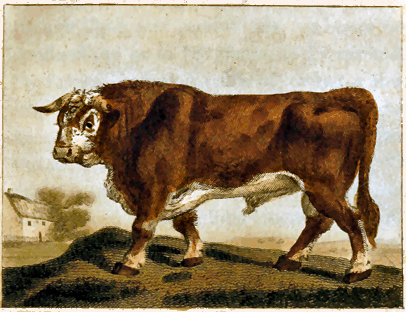
Fig. 21 Cow
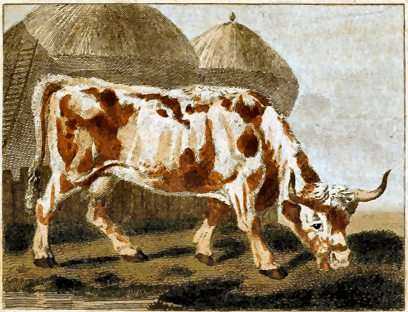
The cow (fig. 21.) may also be used for the plough; and though she is not so strong as the ox, yet she is often made use of to supply his place; but, if employed for this use, care should be taken to match her with an ox of the same size and strength; or with another cow, in order to preserve the equality of the draught, and to keep the plough in an equilibrium between the two powers attending to facilitate the labour, and preserving the tillage more regular. From six to eight oxen are frequently made use of for stiff land, but more especially in fallow grounds which break up in large clots, whilst two cows are sufficient to plough light, and sandy soils. The ancients confined the ox to 120 paces, as the extent of the furrow, he was capable of tracing without stopping; after which they suffered him to take breath a few moments before he went on with the same furrow, or began a fresh one. The ancients took delight in the study of agriculture and gloried in ploughing themselves, or at least in encouraging the labourer, and sparing him and the ox as much trouble as possible; but among us, those who enjoy the greatest share of the blessings of the earth are those who know least how to esteem, and to encourage the art of cultivation.
The bull (fig. 20.) serves chiefly for the propagation of his species, and though we can make him submit to work, yet we are less sure of his obedience, and must be on our guard against the improper use he may make of his strength. Nature has made him indocile and haughty; in rutting time he is unmanageable, and frequently furious; but by castration these impetuous motions cease, whilst it robs him of none of his strength; it rather renders him larger, weightier, and more proper for the work for which he is intended; it has also an effect upon his disposition, and makes him more tame and patient, more docile and less troublesome to the rest; a number of bulls would prove an unruly herd, which man could neither tame nor guide.
The country people adopt different modes for castration, but they in general consider the best time when the animal is between eighteen months and two years of age, as they seldom live when it is performed more early, yet those who do survive the operation, if performed while young calves, always become the largest and fattest oxen. If left to a late period they retain all the impetuous ferocity of the male sex, and are scarcely governable. The females are commonly in season from about the 15th of April to the 15th of July; they go nine months with young, and bring forth at the beginning of the tenth; therefore calves are always plenty during the spring and summer.
The bull, like the stallion, should be chosen from the handsomest of his species; he should be large, well made, and full of flesh; his eyes black, his looks haughty and fierce, forehead open, head short, horns thick, short, and black, ears short and soft, muzzle large, nose short and straight, neck fleshy and thick, shoulders and breast large, loins firm, back straight, legs thick and muscular, tail long and well covered with hair, step firm and sure, and his coat of a reddish colour. The cows frequently retain the first, second, or third time, and as soon as they are with calf the bull takes no more notice of them, although they have still some appearance of ardour; but this usually goes off as soon as they have conceived, and they also refuse the approaches of the bull.
Cows are also subject to abortion if put to the plough, and not properly managed; and care should be taken to prevent their leaping over hedges, ditches, &c. they should also be put into the richest pastures, which, without being too humid or marshy, afford plenty of herbage. For six weeks before they calve they should be more fed than usual, giving them grass in their stalls, if summer, and, during the winter bran, lucerne, saintfoine, &c. They should not be milked from that time; the milk being necessary for the nourishment of the f[oe]tus. There are some cows in which the milk ceases a month or six weeks before they calve, but those which have milk to the last are the best mothers, and the best nurses. The milk, towards the time of calving, is generally bad, and in small quantities. More care is necessary to be taken of the cow at and after her delivery than of the mare, being apparently more weakened and fatigued. She should be put into a stable and kept warm, giving her good litter, and feeding her well, during ten or twelve days, with bean-flower, corn, oats, &c. mixed with salt water, and plenty of lucerne, saintfoine, or good grass. This time is sufficient to re-establish her strength, after which she may be brought by degrees to her usual manner of living and pasturing. Not any of her milk should be taken for the two first months, but left solely to the calf; besides, the milk at this time is not of the best quality.
The calf should be left with his mother for five or six days, that it may be kept warm, and suck as often as it has occasion; it may then be removed, for it would weaken the cow too much if it was always kept with her. It is sufficient to let calves suck two or three times in a day; and to fatten them quickly, they should every day have raw eggs, and boiled milk and bread. At the end of four or five weeks calves thus taken care of will be excellent eating. It is sufficient to let a calf suck, designed for the butcher, thirty or forty days; but those which are intended to grow up should be suffered to suck for two months at least; the longer they are allowed to suck the stronger and larger cattle they become. Those brought forth in April, May, and June, are the fittest to be raised; for calves which come later never acquire strength enough to resist the injuries of the following winter, and almost all languish and perish with the cold. Before the milk is entirely taken from them, they should have a little good grass, or saintfoine, cut fine to accustom them by degrees to their future food; after which they should be entirely separated from the mother, and not suffered to go near her, either in the stable, or field. To the latter they should be taken every day, and suffered to remain from morning to night during the summer; but as soon as the cold begins in autumn, they should be taken out late in the morning and carried home soon in the evening; and during winter, as cold is extremely hurtful to them, they should be kept warm in a close well littered stable; and with their usual food, they should have saintfoine, lucerne, &c. and not suffered to go out, except in mild weather. Great care must be taken of them for the first winter, as it is the most dangerous time in their lives; for they get strength enough during the following summer not to fear the cold of a second winter.[E]
At 18 months old, the cow arrives at puberty, and the bull when he is two years; but though they can engender at this age, it is better to keep them asunder till they are three years old. These animals are in their greatest vigour from three weeks old till nine; after this, neither cows nor bulls are fit for any thing but to fatten for the slaughter. As at two years of age they are almost at their full growth, the length of their lives is also, like that of most other animals, seven times that, or about fourteen years; they seldom live beyond fifteen.
In all quadrupeds the voice of the male is stronger and deeper than that of the female; and I believe there is no exception to this rule; though the ancients say, that the cow, the ox, and even the calf, have deeper voices than the bull; but the contrary is certain, since he can be heard much the farthest. What has afforded grounds to think that his voice is less deep, is, that his bellowing not being a simple sound, but composed of two or three octaves, the highest of which strikes the ear most forcibly, and the others are not perceived, yet if we give attention thereto, we hear a grave sound, much deeper than the voice of the cow, ox or calf, whose lowings are also much shorter. The bull only bellows when he is enamoured; the cow more frequently lows through fear and dread, than from any other cause; and the calf bellows from pain, want of food, or a desire of being with its mother.
The dullest and most idle animals are not those which sleep the soundest, or the longest. The sleep of the ox is short, and not very sound; for he awakes on the least noise. He usually lies on his left side, and the left kidney is always larger and fatter than the right.
Oxen, like other domestic animals, differ in colour; but the red appears the most common colour, and the redder they are, the more they are esteemed; some prefer the black, while others assert that those of a bay colour last longest; that the brown are sooner fatigued and shorter lived; that the grey, brindled, and white, are not proper for work, and are only fit to be fattened for slaughter. But whatsoever be the colour, the coat of the ox should be shining, thick, and soft to the touch; for if it is rough and uneven, it indicates the animal is not well, or at least of a weak constitution. An ox for the plough should be neither too fat nor too lean; his head should be short and thick, his ears large, with a soft even coat, his horns strong, shining, and of a middling size, his forehead high, his eyes large and black, his muzzle large and flat, his nostrils wide, his teeth white and even, his lips black, his neck short, his shoulders thick and strong, his breast large, his dewlap, that is, the fore part of the neck, long, and hanging down to his knees; his loins very large, his belly spacious and prominent, his flanks thick, his haunches long, his rump round, his legs and thighs big and nervous, his back straight and full, his tail hanging down to the ground, and covered with a fine tuft of curling hair, his feet firm, his skin thick and pliable, and his muscles large and elevated; he should also be sensible of the goad, obedient to the call, and well trained: but it is only by degrees, and beginning early, that we can make him submit willingly to the yoke. At the age of two years and a half, or three years at most, we should begin to use him to subjection; if it is deferred later, he frequently becomes unmanageable. Patience, gentleness, and caresses, are the only methods to be used; violence and ill-usage only serve to make him sullen and untractable for ever: he should be stroked and caressed, and frequently fed with boiled barley, bruised beans, and other nourishing food of the same kind, mixed with a little salt, all of which he is very fond; he should be frequently tied by the horns some days before he is put to the yoke; and he should at first be yoked to the plough with another ox of the same size which is already trained. They should be tied together at the rack, and led to the same pasturage, that they may become acquainted, and habituate themselves to the same common motions. The goad should never be used at the beginning, as it would only serve to make him ungovernable. He should only work a little at a time, for he is soon fatigued when not perfectly broke; and for the same reason, he should then have more food than at another time.
The ox should only be worked from three years old to ten; and he should then be taken from the plough to fatten, as the flesh will be better than if he be kept longer. The age of this animal is known by his teeth and horns. The first front teeth fall out when he is ten months old, and are replaced by others which are larger and not so white; at 16 months those on each side of the middle teeth drop out, and are replaced by others; and at three years old, all the incisive teeth are renewed; they are then all long, white, and even; and, in proportion as the ox advances in years, they decay, and become unequal and black. It is the same with the bull and cow; so that neither sex nor castration makes any alteration in the growth or fall of the teeth, nor does either make any difference in the casting of the horns, for they fall off at three years equally from the ox, bull, and cow; these are replaced by other horns, which, like the second teeth, fall off no more, only those of the ox and cow grow longer than those of the bull. The growth of these second horns is not uniform. The first year, that is to say, the fourth of the animal’s age, two little pointed horns sprout, which are even, and terminate at the head by a kind of knob; the following year this knob grows from the head, pushed out by a cylinder of horn, which forms and terminates also by another knob, and so on; for as long as the animal lives, the horns continue to grow; these knobs are easily distinguished, and by which his age may be easily known, by adding three years to the number of intervals between the other knobs.
The horse eats slowly, but almost continually, the ox on the contrary, eats quick, and takes in a short time all the food which he requires; after which he lies down to ruminate. This difference arises from the different conformation of their stomachs. The ox, whose two first stomachs form but one vast bag, can, without inconvenience, receive a large quantity of grass, which afterwards, by chewing, digests at leisure. But the horse, whose stomach is single and small, can receive but a small quantity of grass, he therefore fills it in proportion as it digests, and passes into the intestines, where is performed the principal decomposition of the food. Having observed in the ox and the horse the successive product of digestion, but, above all, the decomposition of hay, I remarked in the ox, that at the entrance of that part of the paunch which forms the second stomach, it is reduced to a kind of green paste; that in this form it is retained in the plaits of the third stomach; that the decomposition is entire in the fourth stomach; and that scarcely any thing but the dregs passes into the intestines. In the horse on the contrary, the food is not decomposed at all, either in the stomach or in the first intestines, where it only becomes more flexible and supple, macerated with the liquor with which it is surrounded, it arrives at the cæcum and colon, without much alteration; it is principally in these two intestines, of which the enormous capacity answers to that of the paunch of ruminant cattle, that in the horse is performed the decomposition of the food; but this decomposition is never so entire as that which is made in the fourth stomach of the ox.