Front matter (continued 4)
Reading edition
For these reasons, and from the inspection of the parts, it seems easy to conceive how chewing the cud is effected, and why the horse neither ruminates nor vomits. Chewing the cud is but a vomiting without straining, occasioned by the re-action of the first stomach upon what it contains. The ox fills his two first stomachs, or portions of the paunch. This membrane acts with force on the food it contains; it is chewed but a little, and its quantity is greatly increased by fermentation. Were the food liquid, this force of contraction would occasion it to pass into the third stomach, which communicates with the other by a narrow conveyance, the orifice of which is situated in the posterior part of the first, and almost as high as the [oe]sophagus; thus this conduit cannot admit the food, until it has become somewhat fluid. The dry parts, must, therefore, rise up again into the [oe]sophagus, the orifice of which is larger than that of the conduit; in fact, they go up again into the mouth, and the animal again chews and macerates them, imbibes them afresh with its saliva, and thus by degrees liquefies them sufficient to pass into the third stomach, where it is again macerated before it goes into the fourth; and it is in this last stomach that the decomposition of the hay is finished, which is there reduced to a perfect mucilage.
What chiefly confirms the truth of this explanation is, that as long as the animals suck, or are fed with milk and other liquid aliments, they do not chew the cud; and that they chew the cud much more in winter, when they are fed with dry food, than in summer, when they eat tender grass. In the horse, on the contrary, the stomach is small, the orifice of the [oe]sophagus is narrow; and that of the pylorus very large. This alone would render chewing the cud impossible, for the food contained in this little stomach, though perhaps more strongly compressed than in the stomach of the ox, does not mount upwards, since it can easily descend through the pylorus, which is very large; and it is not necessary that the hay should be reduced to a soft running paste, because the force of the contraction of the stomach pushes the aliment through when almost dry.
It is by this difference, then, that the ox chews the cud, and that the horse cannot perform this operation. But there is still another difference in the horse, which hinders him from chewing the cud, and is the reason why he cannot vomit; the passage of the [oe]sophagus being placed obliquely in the stomach, the membranes of which are very thick, makes a kind of gutter in them so oblique that it must close still more instead of opening by the convulsive motions of the stomach. Although this difference, as well as many others we observe in the conformation of the bodies of these animals, depend on their constant nature, nevertheless, there are in the development, more particularly in the soft parts, differences constantly in appearance, but which may, and actually do, vary from circumstances. The vast capaciousness of the ox’s paunch, for example, is not entirely owing to Nature; it is not of that size in its primitive conformation, but attains it by degrees, from the large quantity of aliment it receives; for, in the calf, which is not very young, but has eat no grass, the paunch is much smaller in proportion than in the ox. This capaciousness of the paunch proceeds, then, from the extension which is occasioned by the large quantity of aliments, of which I was well convinced by an experiment that appeared to me decisive. I brought up two lambs of the same age, one on bread, the other on grass, and when they were a year old, on opening them, I found the paunch of the lamb which had lived on grass was much larger than that which had lived on bread.
It is said that oxen which eat slowly are more capable of working than those which eat quick; that oxen fed on high and dry lands are more lively, vigorous, and healthy, than those which live on low and humid grounds; that they are all stronger when fed on dry hay than when fed with grass; that they meet with more difficulty on the change of climate than horses, and that, for this reason, oxen for the plough should never be purchased but in their own neighbourhood.
In winter, as oxen do nothing[F], it is sufficient to feed them on straw, with a little hay; but at the season they work they should have more hay than straw, likewise a little bran, or a few oats. If hay is scarce they should have fresh-cut grass, leaves of ash, elm, oak, &c. but this food should be given in a small quantity, because the excess of it, being what they are very fond of, occasion them to avoid bloody urine; but lucerne, saintfoine, lupins, turnips, boiled barley, &c. are very good for them, and as they never eat more than is necessary, they should always be supplied with as much as they will take. They should not be put to pasture till about the middle of May; they should be kept at pasture all the summer; and, about the middle of October they should be brought back to fodder, only observing not to change them too suddenly from green to dry food, or from dry to green, but to bring them to it by degrees.
Great heat incommodes this animal more perhaps than great cold. During summer they should be brought to work at day-break, taken to the stable, or left to feed in the woods, during the heat of the day, and not yoked again till three or four in the afternoon. In spring, winter, and autumn, they may be worked from eight or nine in the morning, till five or six in the evening. They do not require so much care as horses, yet to keep them healthy and vigorous they should be curried every day, and their hoofs carefully greased and washed; they should be taken to drink at least twice a day; they are fond of water that is fresh and cool, while the horse loves it muddy and luke-warm.
Nearly the same food and care are requisite for the cow as the ox; but the cow that suckles requires more particular attention, as well in the chusing as in the management. It is said, that black cows give the best milk, and that white cows give the most: but of whatever colour, she should be fleshy, have a brisk eye, and be light in her walk; she should be young, her milk plentiful, and of a good kind; she should be milked twice a day in summer, and once in winter; and, if we would increase the quantity, she must be fed with more succulent food than herbage.
Good milk is neither too thick, nor too thin; its consistence should be such, that a drop should preserve its roundness without running. In colour it should be of a beautiful white: that which is inclinable to blue or yellow is worth nothing; its taste should be sweet, without any bitterness or sourness. It is better in the month of May, and during the summer, than in winter; and it is never perfectly good but when the cow is of a proper age, and in good health. The milk of young heifers is too thick, that of old cows is too dry, and during the winter it is too thick. The milk of the cow is not good when she is in season, near her time, or has lately calved. In the third and fourth stomachs of the calves which suck, there are clots of curdled milk, which, dried in the air, serve to make runnet, and the longer it is kept the better it is, and it requires but a small quantity to make a great deal of cheese.
Both cows and oxen love wine, vinegar, and salt, and they will devour with avidity a seasoned salad. In Spain, and some other countries, they place near the young calf one of those stones, called salegres, which are found in salt mines; they lick this salt stone all the time the mother is at pasture, which excites the appetite, or creates thirst so much, that the moment the cow returns, the young calf sucks with great eagerness; and this makes them grow fatter and faster than those to whom no salt is given. For the same reason, when oxen loath their food, they give them grass soaked in vinegar, or strewed with salt; salt may also be given to them, as it excites their appetites in order to fatten them in a short time. It is usual to put them to fatten when ten years old; if we stay longer, there is less certainty of success, and their flesh is not so good. They may be fattened in all seasons, but summer is generally preferred, because it is attended with less expence; and by beginning in May or June, we are almost certain of having them fat before the end of October. When we begin to fatten them they must not be suffered to work any longer. They should drink much oftener, and have succulent food in abundance, sometimes mixed with a little salt, and be left to chew the cud at leisure, and to sleep in the cow-house during the heat of the day. In four or five months, if thus attended to, they will become so fat that it will be difficult for them to walk, or be conducted to any distance but by small journeys. Cows and bulls, whose testicles are twisted, may also be fattened; but the flesh of the cow is drier, and that of the bull is redder and harder than that of the ox, and the latter has always a strong disagreeable taste.
Bulls, cows, and oxen, are very apt to lick themselves, especially when quiet and at rest; and as this is supposed to prevent their fattening, it is usual to rub all parts of their bodies which they can reach with their own dung. When this precaution is not taken, they raise up the hair of their coats with their tongue, and swallow it in large quantities. As this substance cannot digest, it remains in the stomach, and forms round smooth balls, of so considerable a size, as to incommode and prevent digestion. These balls in time get covered with a brown crust, which, though nothing but a thick mucilage, becomes hard and shining; they are only found in the paunch, and if any of the hairs get into the other stomachs, they do not remain, but seem to pass off with the aliments.
Animals which have incisive teeth, such as the horse and the ass, in both jaws, bite short grass more easily than those which want these teeth in the superior jaw; and if the sheep and goat bite the closest, it is because they are small, and their lips are thin. But oxen, whose lips are thick, can only bite long grass; and it is for this reason that they do no harm to the pasture on which they live; as they only bite off the tops of the young herbage, they do not stir the roots, and the growth is scarcely checked; instead of which, the sheep and the goat bite so close, that they destroy the stalk and spoil the root. Besides, the horse chuses the shortest and most delicate grass, leaving the largest to grow for seed; but the ox eats these thick stalks, and by little and little destroys the coarser grass; so that in a few years, the field in which the horse has lived becomes poor, and that on which the ox has broused, becomes an improved pasture.
Our oxen, which we must not confound with the buffalo, bison, &c. seem to be originally of this temperate climate, great heat, or excessive cold, being equally injurious to them. Besides this species, which is so abundant in Europe, is not found in the southern countries, and is not extended beyond Armenia and Persia; nor beyond Egypt and Barbary in Africa. For in India, the rest of Africa, and even in America, the cattle have a bunch on the back, or are animals of a different species, which travellers have called oxen. Those found at the Cape of Good Hope, and in many parts of America, were carried from Europe by the Dutch and Spaniards. In general, countries which are rather cold agree better with our oxen than hot climates; they are larger and fatter in proportion as the climate is humid, and as it abounds in goodness of pasture. The oxen of Denmark, Padolia, Ukraine, and Calmuck Tartary, are the largest; those of England, Ireland, Holland, and Hungary, are larger than those of Persia, Turkey, Greece, Italy, France, and Spain; and those of Barbary are the smallest. The Dutch every year bring from Denmark a vast number of large thin cows, which give more milk than those of France; and it is possible they are of the breed of cows which has been carried into Poitou, Aunis, and Charente, for those cows are larger and much thinner than common cows, and produce double the quantity of milk and butter. They have milk at all times, and may be milked all the year, excepting four or five days before they calve. Though they eat no more than common cows, their pasture, however, must be excellent; and as they are always lean it is certain that all the superabundance of their food turns into milk; instead of which, common cows become fat, and cease to give milk when they have lived some time in rich pastures. With a bull of this breed, and common cows, a bastard kind is produced, which is more fruitful, and abounds more in milk than the common race. These bastard cows have frequently two calves at a time, and they give milk all the year. These milch cows form a part of the riches of Holland, from which place they export butter and cheese to a considerable amount; they give as much milk again as French cows, and six times as much as those of Barbary.
In England, Ireland, Holland, Switzerland, and other northern countries, they salt and smoke the flesh of the ox in large quantities, both for the use of the navy and for the advantage of commerce. They export also from those countries large quantities of leather; the hide of the ox, and that of the calf, serving for an infinite number of uses. The fat is also very useful. The dung of the ox is the best manure for light dry soils. The horn of this animal was the first instrument ever made use of for drinking or augmenting sounds; the first transparent matter ever used for windows and lanthorns. It is now softened to make boxes, combs, and a thousand other things. But I must conclude, for, as I said before, Natural History finishes where the History of the Arts begin.
SUPPLEMENT.
Oxen are very numerous in Tartary and Siberia; and at Tobolski black cattle abounds. In Ireland I formerly remarked that both oxen and cows were without horns; but this I find applies only to the southern part, where there is either scarcely any grass, or it is very bad which gives strength to my position, that horns arise from a superabundance of nourishment. Adjacent to the sea the Irish boil their fish down extremely soft, with which they feed their cows, and of which they are very fond; and it is said the milk has not the smallest disagreeable smell or taste therefrom.
In Norway both cows and oxen are very diminutive; but on the Norwegian coast they are bigger probably owing to their having better pasture, and being allowed to range at perfect freedom; for they are left entirely to themselves without any guides, unless the rams may be so called who accompany them in winter and who scrape the snow from the ground both for themselves and companions, to get at the grass. Living in this wild state they sometimes grow very fierce, and are only to be caught by means of ropes.
Engraved for Barr’s Buffon
Fig. 22 Ram
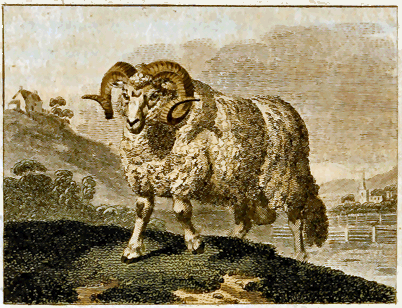
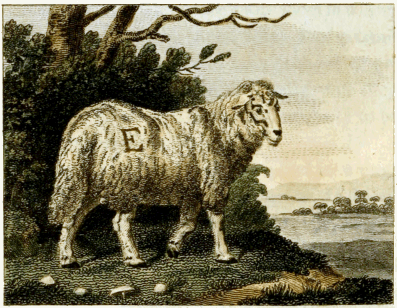
Fig. 23 Ewe
European cattle have multiplied in a most astonishing manner in South America. In the vicinity of Buenos-Ayres, they hunt them merely for their grease and hides, and frequently kill large quantities. The coast of Brazil produces very indifferent cattle; they are small, and their flesh has a bad savour, most probably owing to the bad quality of their pasturage. There are great numbers of oxen in some parts of Africa. The mountains are covered with wild cows from Cape Blanc to Sierra Leona; their colour is generally brown with black horns, and they are so exceedingly prolific, that both Europeans and Negroes find it necessary to be perpetually destroying them by hunting. There are also wild cows of a dark chesnut colour in many parts of Barbary, and in the deserts of Numidia; they are small, run fast, and frequently keep in flocks of one or two hundred together.
THE SHEEP.
It does not admit of a doubt, but that all animals which are now actually domestic were formerly wild. Those whose history has already been given, afford a sufficient proof of it; for there are still wild horses, asses, and bulls. Can man, who has conquered so many millions of individuals, boast of having subdued an entire species? As they were all created without his participation, is it not reasonable to believe that Nature enabled them to exist and multiply without his aid? If we consider, nevertheless, the weakness and stupidity of the sheep, and reflect, that this animal, without defence, cannot find safety in flight; that he has for his enemies all devouring animals, which seem to seek him in preference, and to devour him by choice; that formerly this species produced but few; and that the life of each individual is but short; we shall be tempted to think, that from the beginning sheep were confided to the care of man; that they had occasion for his protection to subsist, and of his care to multiply; especially as there never were any wild sheep found in the deserts. In all places where man does not rule, the lion, tiger, and wolf reign by force and cruelty; and these animals of blood and carnage, live longer, and multiply faster than sheep. In short, if we were to abandon the flocks, which we have rendered so numerous, they would soon be destroyed and their species entirely annihilated by the voracity of its numberless enemies.
It appears, therefore, that it is only by the help and care of man sheep have been preserved and that they could not have continued to subsist for themselves. The female is absolutely without resource, and without defence. The ram has but feeble arms; his courage is nothing but a petulance useless to himself, inconvenient to others, and which is destroyed by castration. The wedder is still more fearful than ewes. It is through fear that sheep gather so often in troops; the smallest noise to which they are unaccustomed, makes them get close together; and this fear is attended with the greatest stupidity, for they know not how to fly the danger, nor do they even seem to feel the hazard and inconvenience of their situation. They continue obstinately fixed wherever they are, and for neither rain nor snow will they stir. To oblige them to change their route, or situation, they must have a chief who is instructed to walk first, and whom they will follow step by step. This chief, however, would remain without motion if he were not driven off by the shepherd, or the dog which guards them, who, in fact, watches over their safety, defends, directs, separates, assembles, and in short, communicates to them every motion that is necessary for their safety.
Of all quadrupeds then sheep are the most insensible, and have the least resources from instinct. Goats, which in many things resemble them, have much more sagacity. They know how to conduct themselves, and to avoid danger, and are easily familiarized to new objects; the sheep neither knows how to fly from danger, nor to face it: let their wants be ever so great, they never come to man for assistance so willingly as the goat, and which in animals appears to be the last degree of timidity or insensibility, the female will suffer her lamb to be taken away without shewing any signs of anger, or trying to defend it, nor by the smallest difference in her bleating, expresses the smallest degree of sorrow[G].
But this animal, so contemptible in itself, so wanting in sentiment and interior qualities, is to man the most useful of all animals. Of itself it at the same time furnishes us with food and clothing; without reckoning the particular advantages we have from the milk, the fat, the skin, the bowels, the bones, and even the dung. This animal seems to evince that nature has given it nothing but what is for the advantage and convenience of man.
Love, which in all animals is the most general and lively sensation, seems to be the only one which gives any vivacity to the ram. When he feels any such emotions, he becomes petulant, fights, and will sometimes attack even his own shepherd. The ewe, however, even at those times, does not appear more animated; and has only instinct sufficient not to refuse the approaches of the male, to chuse her food and to know her own lamb. Instinct is more certain as it is more mechanical. The young lamb, among a numerous flock, will search and find out its mother, and will seize its teat, without ever being mistaken. It is also said, that sheep are sensible to the pleasures of musick; that they brouze with more assiduity, are better in health, and fatten sooner when they hear the shepherd’s pipe; but it appears more probable that music serves to amuse the shepherd, and that it is to this solitary, idle life, that we owe the origin of the art.
These animals, whose understandings are so simple, are also of a very weak constitution. They cannot walk long; travelling weakens and exhausts them; and when they run, they pant and are soon out of breath. The great heat of the sun, is as disagreeable to them, as too much moisture, cold, or snow. They are subject to many disorders, the greatest part of which are contagious. Superabundance of fat sometimes kills them, and always prevents the ewes from having young. They suffer a great deal in breeding, have frequent abortions and require more care than any other domestic animal.[H]
When the ewe is near her time, she should be taken from the rest of the flock, and watched in order to be near to help her in delivery. The lamb frequently presents itself cross-ways, or by the feet; and, in this case, the mother’s life is in danger if she is not assisted. As soon as she is delivered, the lamb should be lifted on its feet, and the milk drawn out of the mother’s teats; this first milk being bad would do much hurt to the lamb, and therefore it is necessary to stay till the teats are filled again, before it is suffered to suck. The lamb is kept warm, and shut up for two or three days with the mother, that it may learn to know her. For a few days, in order to re-establish the strength of the ewe, she should be fed with hay, barley wetted, or bran mixed with a little salt. The water she drinks should be luke-warm, with some wheat or bean flour, or millet put into it. In four or five days she may again be used, by degrees, to her common manner of living, and may be put amongst the others, only observing not to take her too far, lest it should overheat her milk. Some time after, when the lamb begins to have strength, and to skip about, it may, with safety, be suffered to follow its mother into the fields.
It is usual to send those lambs which appear weak to the butcher, and to preserve those which are the largest, are most vigorous, and have the thickest fleece; the first lambs are scarcely ever so good as those of the following litters. If those lambs are wanted to be reared which are brought forth in October, November December, January, or February, they are kept in the stable, and only let out to suck mornings and evenings, until the beginning of April. Some time before letting them out they should daily have a little grass, for the purpose of accustoming them by degrees to their new nourishment. They may be weaned as early as a month old, but it is better to let them suck for six weeks or two months. Lambs which are all white, and without spots, are always preferred because white wool always produces the best price. Lambs should not be castrated before they are five or six months old at the earliest, and then the operation should be performed when the weather is moderate, either in spring or autumn: it is done two ways, either by incision, or by destroying the vessels, which terminate in them, by a tight ligature. Castration makes lambs sick and melancholy, and to prevent the disgust which generally succeeds, they should have bran given them mixed with a little salt for two or three days.
At a year old, rams, ewes, and wedders, lose the two fore teeth of the under jaw; they have no incisive ones in the upper; six months after the two neighbouring teeth fall out also; at three years of age they are all replaced, are then tolerably even and pretty white, but as the animal increases in years they become uneven and black. The age of the ram is also known by his horns; they appear the first year, and sometimes at his birth, and a ring is added to them every year after as long as he lives. In general the ewes have no horns, but in their places two bony prominences; nor withstanding there are some which have two and even four horns. These ewes are like the others; their horns are five or six inches long, but less twisted than those of the ram, and when they have four, the two anterior are shorter than the other two. The ram is capable of generating at eighteen months, and the ewe to produce at a year old; but it is better not to couple them before the ram is three and the ewe two; as before that period the young will be feeble and weak, which indeed is generally the case with their first productions. One ram is sufficient to attend 25 or 30 ewes; he should be chosen from the strongest and handsomest of his species; he should have horns, for there are some rams in our climate which are without, but they are less vigorous, and less proper for propagation[I]. A good and handsome ram should have a large thick head, a wide forehead, large black eyes, broad nose, big ears, thick neck, long high body, large loins and crupper, and a long tail. The best rams are the white ones, well covered with wool on the belly, the tail, the head, the ears, and quite up to the eyes. Ewes which have wool in the greatest abundance, most bushy, whitest, and most silky, are the best for propagation; especially if they are large, have thick necks, and walk nimbly. It has also been remarked, that those which are rather lean than fat are the most successful breeders.
The ewes are commonly in season from the beginning of November to the end of April; but they conceive at any time if supplied with stimulating food, such as salted water, and bread made of hemp-seed. The ewes are allowed to go with the ram two or three times, after which they are separated from him; he invariably attaches himself to the oldest ewes, and despises the young ones. During the coupling season great care must be taken not to expose the ewes to rains or storms, for moisture prevents conception, and a clap of thunder often produces an abortion. A day or two after copulation they may return to their usual mode of living, for if the salted water, hempen bread, and other hot foods are continued, it will prevent their produce. They carry their young five months, and drop them at the beginning of the sixth. They commonly bring forth but one lamb, though they sometimes have two: in warm climates they produce twice a year, but in France, and those which are colder, never more than once. The ram is admitted to the ewes about the end of July, or beginning of August, for the purpose of having lambs in January; in September, October, and November, he is given to a greater number, from which we have plenty of lambs in February, March, and April; there are also quantities in May, June, July, August, and September; and it is only in October, November, and December, that they are scarce. The ewes have milk for six or seven months; it is tolerable nourishment for children and country people, and makes very good cheese, especially when mixed with cows’ milk. The time for milking the ewes is just before they go into the fields, or immediately after their return. In summer they may be milked twice a day, and once in winter.
Ewes fatten when they are with young, because they then eat more than at any other time. As they often hurt themselves they have frequent abortions, sometimes become barren, and often bring forth monsters; nevertheless, if they are well taken care of, they will produce through life; that is for ten or twelve years, though they commonly begin to grow old and useless by the time they are seven or eight. The ram lives till he is twelve or fourteen years old, but is unfit for propagation, after he is eight. He should then be castrated, and fattened with the old ewes. The flesh of the ram is always ill-tasted, that of the ewe insipid, while that of the wedder is the most succulent and best of our common meat.
Those who wish to form a flock with a view to profit, buy ewes and wedders from the age of eighteen months to two years, an hundred of which may be put under the care of one shepherd, and if he is careful and assisted by a good dog, he will lose but few. When he conducts them to the field he should always go first, accustom them to the sound of his voice, to follow him without going aside among the corn, vines, and cultivated lands, where they do considerable damage. Hills, or plains above hills, afford them the best and most agreeable pasture, and they should never be suffered to brouze in low and marshy grounds. In winter they should be fed in the stable on bran, turnips, hay, straw, lucerne, saintfoine, leaves of ash, elm, &c. and unless the weather is very bad they should be allowed to go out every day for the sake of exercise. In the cold season they should not be taken to the fields before ten o’clock in the morning, and remain for four or five hours; they should then be made to drink, and about three o’clock in the afternoon be reconducted home. In spring and autumn, on the contrary, they should be taken out as soon as the sun has dissipated the moisture and hoar frost, and not taken back again till near sun-set. It is sufficient in these two seasons if they drink once a day, and that just before they return to the stable, where there must always be forage for them, though in a smaller quantity than during winter. It is in summer alone that they ought to find all their food in the fields, where they should then be conducted twice a day, and taken twice to drink; they should be led out in the morning while the dew is on the ground, allowed to feed four or five hours, and after drinking led back to the fold, or some shady place. About three or four o’clock in the afternoon, when the excessive heat begins to diminish, they may be again taken into the fields and allowed to stay until the night comes on; and were it not for the danger of the wolf, it would be better to leave them out all night as they do in England, which would make them more vigorous and healthy. As violent heat greatly incommodes them, and the rays of the sun will give them the vertigo, they should always be kept, when brouzing, with their heads from the sun, so that their bodies may form a kind of shade. And it is also very necessary, to preserve their wool, that they should not be suffered to feed among thorns, briars, or bristles.
In dry and high grounds, where wild thyme and other odoriferous plants abound, the flesh of the sheep is of a much better quality than when fed on low plains and humid valleys; unless near the sea coast, where all the herbage having imbibed a degree of saltness, it renders the mutton superior to that fed on any other pasture; it gives also a pleasing flavour to the milk, and adds to its quantity. Nothing is more pleasing to the taste of these animals than salt, nor is there any thing more salutary for them when given in moderation; in some places they put a bag of salt, or salt-stone, into the sheep-fold, the which they will all lick by turns.
Every year those grown of a proper age to fatten should be picked out of the flock, as they require a different treatment. If in summer, they should be taken to the field before sun-rise that they may feed on the grass while the dew remains upon it. Nothing contributes more to fatten sheep than water taken in great quantities, and nothing retards it more than the heat of the sun; for which reason they should be taken into the shade by nine o’clock in the morning before the violent heat comes on, and a little salt should be given them to excite their appetite for water. About four o’clock in the afternoon they should be led out again to fresh and moist pastures. This care pursued for two or three months is sufficient to make them fleshy and fat; but this fat, which originates from the great quantities of water drank by the animal, is only a kind of pursy swelling, and would soon occasion the rot; it is therefore necessary to kill them immediately when they acquire this false fat: even their flesh, instead of having become firm and juicy, is frequently the more flat and insipid. If we would have good mutton, besides feeding them in the dew and giving them plenty of water, it is necessary they should have more succulent food than grass. In winter, nay in all seasons, they may be fattened by keeping them in stables and feeding them with the flour of barley, oats, wheat, beans, &c. mixed with salt to make them drink more frequently. But whatever mode is followed, it should be done quickly, and the sheep should be killed immediately, for they cannot be fattened twice, and almost all die with diseases of the liver.
We frequently find worms in the livers of animals; a description of those found in sheep and oxen is contained in the Journal des Savans of 1668, and in the German Ephimerides. It was thought that these worms were peculiar to animals who chew the cud, but M. Dauberton discovered some in the liver of an ass, and it is probable they might be found in those of many other animals. It has also been said that butterflies are sometimes found in the livers of sheep; and in confirmation of this M. Rouillé favoured me with a letter of M. Gachet de Beaufort, containing the following observations: “It has long been remarked, that our Alpine wedders frequently lose their flesh on a sudden; that their eyes turn white and gummy, that their blood becomes serous, having scarcely any red globules, their tongues parched, and their noses stuffed with a yellow purulent mucus. It is true this does not affect the appetite of the animal, but makes him extremely weak and terminates in his death. From repeated dissections it has been discovered, that animals so affected have always butterflies in their livers, which butterflies are white, and furnished with wings; their heads are nearly oval, hairy, and about the size of those of the silk-worm fly. Above seventy which I squeezed out of the two holes convinced me of the truth of this fact.” From this description of M. Beaufort I cannot admit myself as positively convinced of their being butterflies, because they have so near a resemblance to the common worms found in the livers of sheep, which are flat, broad, and of so singular a figure, as to appear at first rather leaves than worms.
It is customary for sheep to be shorn every year; and in warm countries where they apprehend no danger from leaving the animal quite bare, they do not shear the wool, but tear it off, and those frequently find a sufficiency to have two crops in a year. In France, and in colder climates, the fleece is shorn only once a year, and then a part of the wool is permitted to remain by way of preserving the animal from the intemperance of the weather. This operation is performed in the month of May, after the sheep have been well washed to render the wool as clean as possible. The month of April is too cold, and if delayed to July, there would not be sufficient time for the wool to grow to preserve them from the cold of the following winter. The wool of the wedder is generally better, and in greater abundance than that of the ewe or ram; that on the neck and top of the back, is much superior to that on the thighs, belly, tail, &c. and that taken from the bodies of the dead, or diseased animals, is by much the worst. White wool is preferable to grey, brown, or black, because in dying it will take any colour, and that which is smooth and sleek is better than the curled; it is even said, that sheep whose wool is curled are not so good as the others. Folding sheep is of great advantage to the land, and when it is wished to improve any by this means, the ground must be inclosed, and the flock shut in every night during the summer; the dung, urine, and heat of the animals, will soon enrich the most exhausted, cold, and infertile grounds. An hundred sheep in one summer will fertilize eight acres of land for six years.
The ancients have remarked that all animals which chew the cud have suet, but this is only true with the sheep and goat, and that of the sheep is more abundant, whiter, drier, and better than that of any other. Suet differs materially from fat or grease, as the latter remains soft, but the former hardens in cooling. The suet amasses in the greatest quantities about the kidneys, and there is always more about the left than the right; there is also a great deal in the epiploon, and about the intestines, but that is not near so firm and good as that of the kidneys, tail, and other parts of the body. Sheep have no other fat than suet, and this matter is so predominant in their bodies, that their flesh is covered with it; even their blood contains a considerable quantity, and their semen is so loaded with it, as to have a different appearance from that of any other animal. That of man, the dog, horse, ass, and probably of all animals which have not suet, liquefies by cold, and becomes more and more fluid from the moment it comes out of the body; but that of the ram, goat, and perhaps of all animals which have suet, hardens, and loses all its fluidity with its heat. I discovered these differences when examining their different liquors with the microscope. That of the ram fixes a few moments after it is out of the body, and in order to discover the living organic molecules, of which it contains great numbers, heat must be applied to keep it in a state of fluidity.
The flavour of the flesh, the fineness of the wool, the quantity of the suet, and even the size of the sheep, differ greatly in different countries. At Berri, in France, they abound; those of the environs of Beauvoise, and some other parts of Normandy, are the fattest, and have the greatest quantity of suet. They are very good in Burgundy; but the best are those which are fed upon the downs in our maritime provinces. The wool of Italy, Spain, and England is finer than the wool of France. In Poitou, Provence, in the environs of Bayonne, and several other parts of France, there is some sheep which appear to be of a foreign race; they are larger, stronger, and have a greater quantity of wool than those of the common breed. They are also more prolific, generally producing two lambs at a time. The rams of this breed engender with the common ewes and produce an intermediate race. In Italy and Spain there is a great variety in their races of sheep, but they should all be regarded as forming one species with our common sheep, which though so numerous does not extend beyond Europe. Those animals with large broad tails, so common in Asia and Africa, and which travellers have given the name of Barbary sheep, appear to be of different species from our common sheep, as well as from the pacos and lama of America.
Engraved for Barr’s Buffon.
Fig. 24. Wallachian Ram.
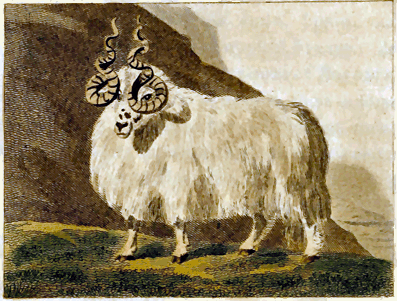
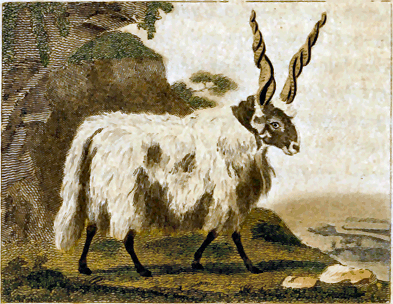
Fig. 25. Wallachian Ram.
White wool being most esteemed, those lambs which are black or spotted are commonly led to slaughter. There are some places however where almost all the sheep are black; and white rams and ewes will frequently produce spotted lambs. In France there are only white, black, and spotted; in Spain there is a reddish kind, and in Scotland there are some of a yellow colour; but these varieties in colour are more accidental than the difference and variety of the breed, which notwithstanding only happens from the influence of climate and the difference of nourishment.
SUPPLEMENT.
I was favoured with the drawings of two Wallachian Sheep[J] (fig. 24, 25.) by Mr. Colinson a Fellow of the Royal Society of London, whose horns are very different from ours, but I was never able to discover whether they were of the ordinary kind in Walachia or some accidental variety.
In Denmark, Norway, and in the northern part of Europe, the sheep are very indifferent; and it is customary there to improve the breed, to have rams frequently imported from England. In the islands near Norway the sheep are constantly left in the fields, and they are much larger and produce better wool than those who are attended by men. Pontopiddan asserts that those sheep which live in perfect liberty always sleep on that side of the island from whence the wind will blow the next day, and this is constantly attended to by the mariners.
The Iceland sheep have larger and thicker horns than the common sheep of these climates; some of them have four or five horns, but this is not common, and when they find any so ornamented, they are sent to Copenhagen and sold at a high price as great rarities.
THE GOAT.
Though the species of animals are all separated by an interval which Nature cannot overleap, yet some resemble others in so many respects that there seems only a necessary space to draw a line of separation. When we compare these neighbouring species, and consider them relatively to ourselves, some appear to be of the greatest utility, and others seem to be only auxiliary species, which might in many respects serve in the place of the former. Thus the ass might nearly supply the place of the horse, and the goat that of the sheep. The goat, like the sheep, furnishes both milk and suet in great abundance. Their hair, though coarser than wool, can serve the purpose of making very good cloth; their skins are more valuable than those of the sheep; and the flesh of a young kid nearly resembles that of lamb. These auxiliary species are wilder and more robust than the principals. The ass and the goat do not require near so much care as the horse and the sheep, for they every where find means of support, and browze equally on the most coarse as on the most delicate plants; they are less affected by the influence of the climate, and can do better without the aid of man; the less dependence they have on us, the more they seem to belong to Nature; and instead of considering these subordinate species as degenerations of the principal species; instead of looking on the ass as a degenerated horse; it might with more reason be said, the horse is an ass brought to perfection, and that the sheep is a more delicate kind of goat, which we have taken care of, brought to perfection, and propagated for our own use; and, in general, that the most perfect species, especially among domestic animals, take their origin from those wild and less perfect kinds which resemble them the most, as the powers of Nature are greatly augmented when united to those of man.
Although the goat is a distinct species, and possibly further removed from the sheep than the ass is from the horse, yet the buck will as willingly couple with the ewe as the he-ass with the mare; the ram with the she-goat in the same manner as the horse with the she-ass. But though these couplings happen very frequently, and are sometimes prolific, yet no intermediate species has been formed between the goat and the sheep. The two species are distinct, remaining at the same distance from each other; no change has been effected by the intermixture, no new or middle race has arisen therefrom; at most they have only produced individual differences, which have no influence on the unity of each primitive species, but, on the contrary, confirm the reality of their different characteristics.
There are, however, many cases in which we cannot distinguish these characters, nor pronounce on their differences with certainty: there are others in which we are obliged to suspend our opinions, and in a great number of others we have not the smallest ray of light for our guide; for, independent of the uncertainty arising from the contrariety of assertions respecting recorded facts, independent of the doubts resulting from the inaccuracy of those who have endeavoured to observe Nature, the greatest obstacle to the advancement of knowledge, is our ignorance of a great number of effects which time has not disclosed to us, and which can only be revealed to posterity by experience, and the most accurate observations; in the mean time we stray in darkness, perplexed between prejudices and probabilities, ignorant even of possibilities, and every moment confounding the opinions of men with the acts of Nature. Examples are in abundance; but, without quitting our subject, we know that the goat and the sheep couple together; though we are still to learn whether the mule from this commixture is sterile or fruitful. We are apt to conclude that mules in general, are barren, because those produced from the he-ass and mare, or the horse and she-ass, are sterile. But this opinion may have no foundation, since the ancients positively assert, that the mule produces at seven years old and that it can produce with the mare; they say also that the she-mule is capable of conception, but that she cannot bring her fruit to perfection. It is necessary therefore, to destroy or confirm the truth of these facts, since they obscure the real distinction of animals and the theory of their generation; and though we know distinctly the species of all the animals which surround us, yet we are ignorant what might be produced by an intermixture among themselves, or with foreign animals. We are but ill informed of the jumar, an animal said to be the produce of a cow and an ass, or a mare and a bull. We are also ignorant whether the zebra would not produce with the horse or the ass, or the broad-tailed Barbary ram with a common ewe; whether the chamois goat be any thing more than a common goat in a wild state, or whether an intermixture would not form an intermediate race; whether the monkeys are of different species, or, like that of the dog, it is one and the same, but varied by a great number of different breeds; whether the dog can produce with the fox and the wolf, the stag with the cow, &c. Our ignorance in most of these cases is almost invincible, and the experiments which would decide them require more time, care, and expence, than the life and fortune of most men can permit.
On the determination of these facts, however, depends our knowledge of animals, the exact distinction of their species, the intelligence of their genuine history and manner of treating them. But since we are deprived of knowledge so necessary, since it is not possible to proceed upon positive facts, we cannot do better than go step by step, to consider each animal individually, to look on those as different species who do not procreate together, and to write their history in separate articles, reserving for ourselves a power to unite or separate, as we shall acquire a more perfect knowledge from our own experience, or from that of others.
It is for this reason that though there are many animals which resemble the sheep and goat, we have taken notice of only the domestic kinds. We are ignorant whether foreign kinds would intermix and form new races with our common species; we are therefore authorized to consider them as distinct species, till it can be proved that these foreign kinds can procreate with the common and produce fertile individuals: this degree alone constituting the reality of what should be denominated species both in the animal and vegetable kingdoms.
The goat has naturally more sagacity than the sheep and can shift better for itself. He comes to man of himself and is easily familiarized; he is sensible of caresses, and capable of much attachment; he is more strong, light, agile, and less timid than the sheep; he is lively, capricious and lascivious, and it requires much trouble to conduct them into flocks. They are fond of straying into solitude, of climbing steep and rugged places, to stand and even to sleep on the tops of rocks or brinks of precipices. The female seeks the male with eagerness and ardour; she is robust and easily supported, eating almost all kinds of herbs and very few disagreeing with her. The bodily temperament, which in all animals has great influence on the dispositions, does not seem to differ essentially in the goat from that of the sheep. The interior organization of these two species of animals is almost entirely the same; they are fed, grow, and multiply in the same manner, and have the same diseases, except a few to which the goat is not subject. The goat is not, like the sheep, affected with too great a degree of heat, but voluntarily exposes himself to the liveliest rays of the sun, and sleeps therein without suffering a vertigo, or any other inconvenience. He is not alarmed by rains or storms, but appears sensible of the rigours of cold. The exterior movements, as already remarked, depend less on the conformation of the body than on the strength and variety of their sensations, for which reason they are more lively and less regular in the goat than in the sheep. The inconstancy of his disposition is strongly marked by the irregularity of his actions; he walks, stops short, runs, skips, jumps, advances, retreats, shews and conceals himself, or flies off, and all this from mere caprice, and without any other cause than what arises from the whimsicality of his temper; the suppleness of his organs and strength, and nervousness of his frame, are scarcely sufficient to support the petulance and rapidity of his natural motions.
That these animals are naturally fond of men, and that even in uninhabited countries they betray no savage dispositions, the following anecdote is a strong confirmation. In 1698, an English vessel having put into harbour at the island of Bonavista, two negroes went on board, and offered the captain as many goats as he chose to carry away. He expressing a surprise at this offer, the negroes informed him there were only twelve persons on the island, and that the goats multiplied so fast as to become exceedingly troublesome, for instead of being hard to be caught, they followed them about with a degree of obstinacy, like other domestic animals.
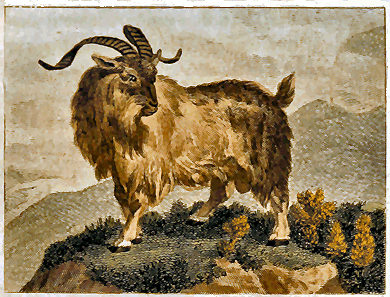
The male (fig. 26) goat is capable of engendering at a year, and the female at seven months old; but the fruits of this early coupling are generally weak and defective, and therefore they are commonly restrained until they are eighteen months or two years. The he-goat is handsome, vigorous, and ardent; and one is sufficient to accompany 150 females for two or three months; but this ardour, which soon consumes him, does not last more than three or four years, and by the age of five or six, he becomes aged and enervated. Therefore, in choosing a male for propagation, he should be large, handsome, and about two years old; his neck should be short and thick, his head light, his ears hanging down, his thighs thick, his legs firm, his hair black, thick and soft, his beard long and bushy. The choice of the female (fig. 27) is of less importance, only observing that those with large bodies, thick thighs, who walk light, have large udders, and soft bushy hair, are the most preferable. They are usually in season in September, October, and November, though they will couple and bring forth at all times. They retain, however, much surer in autumn; and the months of October and November are preferred, because the grass will be young and tender when the kids begin to eat. They go about five months with young and bring forth at the beginning of the sixth; they suckle their young a month or five weeks; so that about six and twenty weeks may be reckoned from the time of their coupling to the kids first beginning to feed on pasture.
Engraved for Barr’s Buffon
Fig. 27 She Goat
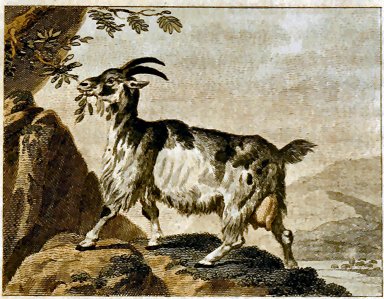
Fig. 26 He Goat
When kept among sheep they do not mix with them, but always precede the flock. They prefer feeding separately, are fond of getting upon the tops of hills, and even upon the most steep and craggy parts of the mountains. They find a sufficiency of food on heaths, barren and uncultivated grounds. Great attention is necessary to keep them from corn, vines, and young plantations as they are great destroyers, and eat with avidity the tender barks, and young shoots of trees, and thus prove fatal to their growth. They avoid humid and marshy fields, or rich pastures: they are seldom kept on flat lands, because it does not agree with them, and it makes their flesh ill-tasted. In most warm climates goats are raised in great numbers and never put into the stables. In France they would perish if not preserved from the inclemency of the winter. It is not necessary to give them litter in the summer, though absolutely so in winter; and as all moisture is very hurtful to them they should never be suffered to lie upon their own dung. They should be taken out into the fields very early in the morning, while the dew is on the grass, which, though hurtful to sheep, is very salutary for goats. As they are untractable and wandering animals, the most active and robust man cannot manage more than fifty of them. They should never be suffered to go out during snow or hoar frost, but be kept in the stable, and fed with herbage, small branches of trees gathered in autumn, or on cabbages, turnips, and other roots. The more they eat, the greater is their quantity of milk; to increase and preserve their milk still more, they are made to drink a great deal, and they mix sometimes a little nitre or salt in their water. They may be milked in fifteen days after they have brought forth, and will continue to give a considerable quantity twice a day for four or five months.
The female produces one kid, sometimes two, very rarely three, and never more than four; she continues to breed from one year or eighteen months, until she is seven years of age. The he-goat will propagate as long, and perhaps longer if proper care is taken of him; but he commonly becomes useless at about five. He is then sent to fatten among the old goats, and castrated kids which have been emasculated at six months old, to render their flesh more juicy and tender. They are fattened with great care, in the same manner as wethers, but they are never so good, excepting in very warm climates, where mutton is always ill-tasted. The strong smell of the goat does not proceed from his flesh but his skin. These animals are not permitted to grow old, or perhaps they might live to ten or twelve years; but it is usual to kill them as soon as they cease to multiply, because the older they are the worse is their flesh. Both male and female goats have horns, with a very few exceptions; they vary very much in the colour of their hair: it is said that those which are white, and have no horns, give the most milk, and that the black ones are the strongest. Though they cost very little for their food they produce a considerable profit; their flesh, tallow, hair, and skin, are all valuable commodities. Their milk is more wholesome and better than that of the sheep; it is used in medicine, curdles easily, and makes very good cheese. The females will allow themselves to be suckled by young children, for whom their milk is excellent nourishment. Like cows and sheep, they are sucked by the viper, and also by a bird, called in France, the goat-sucker, which fastens to their teats during the night, and, as some say, makes them lose their milk for ever after.
Goats have no incisive teeth in the upper jaw; those in the under fall out, and are replaced in the same time and manner as those of the sheep. Their age may be ascertained by the knobs in their horns, and their teeth. The number of teeth in the female goats is not always the same, but they usually have fewer than the male, whose hair is also more rough, and who has the beard and horns longer. These animals, like the ox and sheep, have four stomachs, and chew the cud. Their species is more generally diffused than that of sheep, and goats similar to ours are found in many parts of the world; only in Guinea, and other warm climates they are smaller, and in Muscovy and the more northern regions, they are larger. The goats of Angora and Syria, with ears hanging down, are of the same species with ours, as they intermix together, and will produce in these climates: the males have horns almost as long as the common kind, but their directions are very different, they are extended horizontally from each side of the head, and form spirals somewhat like a screw. The horns of the female are short, they bend backwards, then turn down, and their points come forward so as nearly to approach their eyes; but the directions of these sometimes vary. These descriptions are from a male and female goat which I have seen. Like most Syrian animals, their hair was very long and thick, and so fine that stuffs have been made of it almost as handsome and glossy as our silks.
SUPPLEMENT.
Pontoppidan says, that goats abound in Norway, and that more than 80,000 raw hides are annually exported from Bergen alone, besides those which are dressed. But they seem peculiarly calculated for this country, as they search for their food upon high and rugged mountains, are very courageous, and so far from fearing the wolf, will even assist the dogs in repelling their attacks upon the flock.
THE SWINE, THE HOG OF SIAM, AND THE WILD BOAR.
I shall treat of these three at the same time, because they form but one species. The one is wild, and the other two the same animal only domestic; and though they are different in some external marks, and perhaps in some of their habits, yet these differences are not very essential, but relate merely to their condition: they are not much changed by their domestic state; they will intermix and produce fertile individuals; which is the only character that constitutes a distinct and permanent species.
It is singular in these animals that their species seem to be entirely distinct by itself, and not connected with any other, which may be considered as principal or accessory, like that of the horse with the ass, or the goat with the sheep; nor is it subject to a variety of races like the dog; it participates of many species, yet essentially differs from all. Let those who would circumscribe the immensity of nature into narrow systems, attend to this animal, and they will find it surmounts their methodical arrangements. In its extremities it has no resemblance to whole-hoofed animals, being rather cloven-hoofed, and yet it does not resemble them fairly, because though it appears to have but two toes, yet it has four concealed within; nor does the hog resemble those which have the toes separated, since he walks only on two toes, and the other two are neither so placed, nor extended sufficiently, to be made use of in that respect. Shall we consider this as an error in nature, and that these two toes so concealed ought not to be reckoned? If so, it should be remembered that this error is constant: that besides, the other bones of the feet do not resemble cloven-footed animals, and that there are striking differences in many other respects, for the latter have horns and no incisive teeth in the upper jaw, they have four stomachs, chew the cud, &c. while the hog, on the contrary, has no horns, but one stomach, does not chew the cud, and has cutting teeth both above and below; thus it is evident, he neither belongs to the species of hoofed or cloven-footed animals, and with as little propriety can he be ranked among the web-footed animals since he differs from them not only in the extremities of the feet, but in the teeth, stomach, intestines, and internal parts of generation. All that can be said is, that in some respects he forms the shade between the whole and cloven-footed animals, and in others between the cloven-footed and digitated animals; for he differs less from the whole-hoofed quadrupeds in the form and number of his teeth than from others; he also resembles them in the length of his jaw, and, like them, has but one stomach; but by an appendage annexed to it, as well as by the position of the intestines, he seems nearly to approach the cloven-footed animals, or those who chew the cud. He likewise resembles them in the external parts of generation, and at the same time in the make of his legs, habits of body, number of young, he approaches very near to the digitated quadrupeds.
Aristotle was the first who divided quadrupeds into whole-hoofed, cloven-footed, and digitated, and he allows, that the hog is of an ambiguous species; but the only reason he gives is, that in Illyria, Pæonia, and some other places there are hogs with whole hoofs. This animal is also a kind of exception to the two general rules of nature, namely, that the larger the animals the less young they produce, and that digitated animals are the most prolific. The hog, though far above the middling size, produces more than any other quadruped. By this fertility, as well as by the formation of the ovary of the female, it even seems to form the extremity of the viviparous species, and to approach the oviparous. In short, the hog seems to be of an equivocal nature, or rather appears so to those who suppose the hypothetical order of their ideas to be the same as the common order of Nature, and who only perceive, in the infinite chain of beings, some apparent points to which they would refer every natural occurrence.
It is not by circumscribing the sphere of Nature that we can become perfectly acquainted with her: we cannot judge of her by making her act with our particular views; nor is it by ascribing our ideas to her Author that we can penetrate into His designs. Instead of confining and limiting the powers of Nature, we should extend them to immensity; we ought to look on nothing as impossible, but that every thing which may be, really has existence. Ambiguous species, and irregular productions, would then cease to surprise, and appear equally as necessary as others in the infinite order of things; they fill up the intervals, form the immediate points, and mark the extremities of the chain. These beings present to the human understanding curious examples, where Nature, appearing to act less conformably to herself, makes a greater display of her powers, and enables us to trace singular characters, which indicate that her designs are more general than our confined views, and that if she does nothing in vain, neither is she regulated by the designs we attribute to her.
Should we not reflect on this singular conformation of the hog? He appears not to have been formed on an original and perfect plan, since he is composed of parts peculiar to other animals, and has evidently parts of which he makes no use, particularly the toes above described, notwithstanding the bones are perfectly formed. Nature is therefore far from being influenced by final causes in the conformation of beings; why may she not sometimes give redundant parts, since she so often withholds those which are essential? How many animals are deficient both in senses and members? Why should we suppose, that in each individual every part is useful to others, and necessary to the whole? Is it not sufficient that they are found together, that they are not hurtful, can grow without hindrance, and unfold without obliterating each other? All things which are not hostile enough to destroy each other certainly can subsist together; and perhaps there are, in most beings, fewer relative, useful, or necessary parts, than those which are indifferent, useless, or superabundant; but as we would always refer things to a certain end, when parts have no apparent uses, we either suppose they have hidden ones, or invent relations which have no foundation, and only serve to lead us into errors. We do not consider that we alter the philosophy, and change the sense of the object, when instead of inquiring how Nature acts, we endeavour to divine the end and cause of her acting. This general prejudice, which is too frequently adopted, serves only to cover our ignorance, and is both useless and opposite to the inquiry after, and discovery of, the effects of Nature. Without quitting our subject we can give other examples, where the intentions we so vainly ascribe to Nature are evidently contradicted. It is said the phalanges are formed merely to produce fingers or toes, yet in the hog they are useless, since they do not form toes which the animal can make any advantage of; and in cloven-footed animals there are small bones which do not form phalanges.[K] If then it was the design of Nature to produce toes, it is evident that in the hog she has not more than half executed her purpose, and in the others she has scarcely began it.
The allantois is a membrane which is found in the f[oe]tus of the sow, mare, cow, and many other animals. This membrane adheres to the bladder of the f[oe]tus, and is said to be placed there for the purpose of receiving its urine while it is in the belly of the mother; and at the instant of birth, indeed, an inconsiderable quantity of liquor is found in the allantois; in the cow, where perhaps it is most abundant, it never amounts to more than a few pints; and the extent of the membrane is so great, there is not any proportion between that and the liquor. This membrane, when filled with air, forms a kind of double packet, in the shape of a crescent, thirteen or fourteen inches long, and from nine to twelve inches broad. Can it require a vessel capable of containing several cubic feet to receive three or four pints of water? The bladder of the f[oe]tus itself, if not pierced at the bottom, would suffice to contain this liquor, as it does in mankind, and those animals where the allantois has not been discovered; it is, therefore, plain this membrane is not designed to receive the urine of the f[oe]tus, nor for any purpose we are capable of imagining, for if it was to be filled it would form a bulk as large as the body in which it was contained; besides, as it bursts at the moment of birth, and is thrown away with the other membranes which envelop the f[oe]tus, it is certainly as useless then as it was before.
The number of teats, it has been said, in every species of animals, corresponds with the number of young which the female can produce and suckle. Why then has the male, which never produces, usually the same number of teats as the female? and why should the sow, which sometimes produces eighteen or twenty pigs, never have more than twelve teats, and sometimes less? Does not this prove that it is not by final causes that we can judge of the works of Nature, and that we ought not to determine but by examining how she acts, and by employing the physical reasons which present themselves in the immense variety of her productions? Allowing that this method, which is the only one that can conduct us to real knowledge, is more difficult than the other, and that there are an infinity of facts in Nature, which, like the preceding, cannot be applied with success, instead of searching for the use of this great capacity in the allantois, we ought to inquire into those physical relations which may indicate the origin of its production; by observing, for example, that in animals, whose stomachs and intestines are not very large, the allantois is either very small or does not exist, and that consequently the production of this membrane has some connection with the size of the intestines, &c. By considering, in the same manner, that the number of teats is not equal to those of the young, admitting only that the most prolific animals have the greatest number of teats, we may conceive that this numerous production depends on the conformation of the interior parts of generation, and the teats being also the external dependencies of the same parts, there is between the number and arrangement of those parts and that of the paps a physical relation, which we should endeavour to investigate.
But I here only endeavour to point out the right path, without entering into a discussion; yet I must observe, that numerous productions depend more upon the internal construction of the parts of generation than any other cause. It certainly does not depend upon the quantity of semen emitted, otherwise the horse, stag, ram, and goat, would be more prolific than the dog, cat, and other animals, who produce a great number of young, though they have but very little in proportion to their size; neither does the number of young depend upon the frequency of coition, for once coupling of the hog and the dog is sufficient to produce a great many young; the length of time occupied in the emission has no effect in this respect, for the dog remains long only because he is retained by an obstacle in the conformation of the parts; and though the boar has not this obstacle yet he remains longer coupled than most animals, but no conclusion can be drawn from that in favour of the numerous productions of the sow, since a cock requires not more than an instant to fecundate all the eggs an hen will produce in a month. I shall have occasion to unfold the ideas I have accumulated, with a view to prove that a simple probability, or doubt, when founded on physical relations, produces more light and advantages than all the final causes put together.
To the singularities already related we shall add some others. The fat of the hog differs from that of almost every other quadruped, not only in its consistence and quality, but its position in the body of the animal. The fat of man, and those animals which have no suet, such as the dog, horse, &c. is pretty equally mixed with the flesh; the suet of the sheep, goat, deer, &c. is found only at the extremities of the flesh; but the fat of the hog is neither mixed with the flesh nor collected at its extremities, but covers the animal all over, and forms a thick, distinct, and continued layer between the flesh and the skin. This peculiarity also attends the whale, and other cetaceous animals. A still greater singularity is, that the hog never sheds any of his cutting teeth, like man, the horse, ox, sheep, &c. but they continue to grow during life. He has six cutting teeth in the under jaw, and a corresponding number in the upper, but, by an irregularity, of which there is not another example in Nature, the bottom ones are of a very different form from the upper, for instead of being incisive and sharp, the latter are long, cylindrical, blunt at the points, and form an angle almost even with the upper jaw, so that their extremities apply to each other very obliquely. It is only the hog, and two or three other species of animals, which have the canine teeth very long; they differ from other teeth by coming out of the mouth, and growing during their whole lives. In the elephant, and sea-cow, they are cylindrical, and some feet in length; in the wild boar, and male hog, they are partly bent in the form of a circle, and I have seen them from nine to ten inches long; they are deep in the socket, and, like those of the elephant, have a cavity at the superior extremity; but the elephant and sea-cow have these tusks only in the upper jaw, and are without canine teeth in the under; while the male hog, and wild boar, have them in both jaws, and those of the under are the most useful to the animal; they are also the most dangerous, as it is with the lower tusks the wild boar wounds those he attacks.
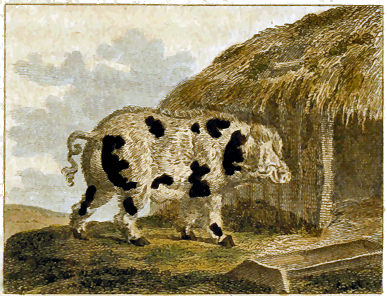
The sow, wild sow, and the hog which is cut, have these canine teeth in the under jaw, but they do not grow like those of the boar, and scarcely appear out of the mouth. Beside these sixteen teeth, that is twelve incisive and four canine, they have twenty-eight grinders, which make forty-four in the whole. The wild boar, (fig. 29.) has the tusks larger, the snout stronger, and the head longer than the domestic hog, (fig. 28.) his feet are always larger, his toes more separated, and his bristles always black.
Of all quadrupeds the hog appears the most rough and brutal, and the imperfections of his make seem to influence his nature; all his ways are uncouth, all his appetites unclean, all his sensations are confined to a furious lust and brutal gluttony; he devours, without distinction, every thing that comes in his way, even his own young soon after their birth. His voraciousness seems to proceed from the continual wants of his stomach, which is immoderately large; and the coarseness of his appetite is probably owing to the dullness of his senses, both as to taste and feeling. The roughness of the hair, hardness of the skin, and thickness of the fat, render these animals insensible to blows. Mice have been known to lodge on their backs, and to eat their skin and fat without their seeming sensible of it. Their other senses are good, and it is well known to huntsmen, that wild boars see, hear, and smell at a great distance, since in order to surprise them they are obliged to watch in silence during the night, and to place themselves opposite to the wind, to prevent them having notice of them by the smell, which invariably makes them change their road.
Engraved for Barr’s Buffon.
Fig. 29 Wild Boar
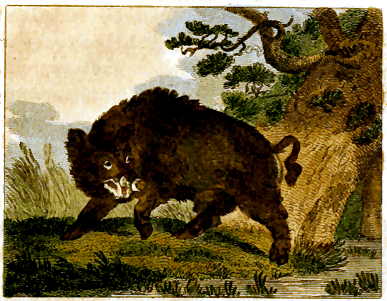
Fig. 28 Boar
The imperfections in the senses of taste and feeling is still more augmented by a leprous disease which renders him almost absolutely insensible. This disorder proceeds perhaps less from the texture of the skin and flesh of this animal than from his natural filth, and the corruption which must result from the putrid food which he frequently devours; for the wild boar who usually lives upon corn, fruits, acorns, and roots, is not subject to this distemper, nor is the pig while it continues to suck. The disorder is only to be prevented in the domestic hog by keeping him in a clean stable and feeding him with wholesome food: his flesh will become excellent and his fat firm and brittle, if he is kept for a fortnight or three weeks before he is killed in a clean paved stable, without litter, giving him no other food than dry wheat, and letting him drink but little; for this purpose a hog of about a year old and nearly fat should be selected.
The usual method of fattening hogs, is to give them plenty of barley, acorns, cabbages, boiled peas, roots, and water mixed with bran. In two months they are fat; their lard is thick but neither firm nor white; and their flesh, though good, is rather insipid. They may be fattened at less expence in woody countries, by conducting them into forests during autumn, when acorns, chesnuts, beech-mast, must quit their husks and fall from the trees. They eat indiscriminately all wild fruits, and fatten in a short time, especially if a little warm water mixed with bran and pease-meal is given to them every night on their return home; this drink makes them sleep and augments their fat to such a degree that they are sometime unable to walk or scarcely move. They fatten much the quickest in autumn, both on account of the plenty of food and because they lose much less by perspiration than in the summer months.
It is not necessary in fattening the hog, to wait, as with other cattle, until he is full grown, for the older he is the more difficult it is to fatten him, and his flesh decreases in goodness with age. Castration, which should always precede fattening, is usually performed when they are six months old, and either in spring or autumn, as both heat and cold are injurious to the healing of the wound. When this operation is performed in the spring, they are generally fit for fattening the following autumn. They continue growing for four or five years, and even to that period it is not limited, as boars kept for propagation sometimes increase in size during the sixth, and the wild boar is always larger in proportion to the number of his years: the life of which sometimes extends to 25 or 30. According to Aristotle hogs live twenty years, and both males and females are fertile till the fifteenth. They can couple by the age of nine or twelve months, but it is better to keep them separate until they are eighteen months or two years. The sows have but few young at the first litter, and those are generally weak, even when a year old; she is at all times in season and solicits the male; she goes four months after copulation, and litters at the beginning of the fifth; she will receive the male almost immediately after and consequently bring forth twice in the year. The wild sow has but one litter in the year, and as she perfectly resembles the domestic one in every other respect, this difference may arise both from her not having the same kind of nourishment, and being obliged to suckle her young much longer. In fifteen days pigs are fit to kill; as many females are unnecessary, and as castrated hogs bring most profit, it is customary not to leave with the mother, after that period, more than one or two females, and seven or eight males.
The boars kept for propagation should have a thick body, rather short than long, a large head, short snout, long ears, small fiery eyes, a thick neck, flat belly, broad thighs, short thick legs, and strong black bristles. Black hogs are always stronger than white ones. The sow should have a large body, spacious belly, and large dugs, and some attention should be paid to her being of a mild disposition. After conception she should be taken from the male, as he will sometimes do her an injury: she should be plentifully fed when she litters, and watched lest she destroys her young; and the male must then be carefully kept away, or he will devour the whole of them. It is common to let the females go with the males in the spring, that they may litter in the summer, and that the pigs may acquire strength before winter; unless when two litters are required in the year, then she is put to the male in November, and again at the beginning of May: some of them will regularly produce every five months. The wild sow generally goes with the male in January, and brings forth in June; she suckles her young three or four months, and they never separate from her before they are two or three years old; and it is not uncommon to see her accompanied with two or three different litters at a time. The domestic sow is not permitted to suckle her young more than two months; as early as three weeks even, they go with the mother to the fields, by way of being habituated to her mode of living, and five weeks afterwards they are weaned, when, for some short time they have a little milk, mixed with bran, given them morning and evening. Hogs are particularly fond of earthworms and roots, for the purpose of procuring which it is that they tear up the ground with their snouts. The wild boar, who has a stronger snout than the domestic one, digs deeper, and nearly in a straight line, while the latter does it very irregularly.
The wild boars do not separate from their mothers until the third year, and to which age they are called by hunters flock-beasts, from that circumstance. They never go alone until they are strong enough to encounter the wolf. At that time they form themselves into flocks, and if attacked, the largest and strongest front the enemy, and by pressing against the weak ones keep them in the middle; the domestic hogs follow the same method, and therefore require not to be guarded with dogs. They are very untractable, and one man cannot manage more than fifty of them at a time. They procure a number of wild fruits in autumn and winter by being taken to the woods, as they do worms and roots in moist lands in summer, both of which are good for them; and they may be allowed to go into waste and fallow lands during the spring. From March to October they are taken out as soon as the dew is off the ground, and kept to feed till ten o’clock; about two they are suffered to go out again, and continue till the evening. In the winter they are only let out when the weather is fine, as dew, snow, and rain, are very injurious to them. When a heavy rain or storm comes on, it is not uncommon to see them desert the flock one after another, and run and cry until they arrive at the stable-door; and it is the youngest which cry the loudest; this cry is different from their usual grunting, and resembles that which they make when tied up for slaughter. The male cries less than the female; and the wild boar seldom cries but when he is wounded in fighting with another; the wild sow cries more often, and when suddenly surprised will breathe with such violence as to be heard at a great distance.
Although these animals are great gluttons, yet they do not attack or devour other animals; sometimes, however, they eat corrupted flesh. Wild boars have been seen to eat horse-flesh, and the skin of the deer, and the claws of birds have been found in their stomach; but this is, perhaps, more from necessity than instinct. It cannot, nevertheless, be denied that they are very fond of blood, and of fresh and bloody flesh, since they will eat their own young, and even children in the cradle. Whenever they find any thing succulent or humid, fat or unctuous, they first lick and then swallow it. It is common for a whole herd of these animals to stop round a heap of new-dug clay, and though it is but very little unctuous, they will all lick it, and some of them swallow great quantities. Their gluttony is as gross as their nature is brutal: they have scarcely any distinct sentiments; the young ones hardly know their mothers, for they are very apt to mistake her, and to suck the first sow that will permit them. Fear and necessity seem to give more instinct and sentiment to wild hogs, for the young are more attached to their mother, who also appears more attentive to them than does the domestic sow. In the rutting season the male follows the female, and generally stays about a month with her in the thickest and most solitary parts of the forest: he is then more fierce than ever, and becomes perfectly furious if another male endeavours to occupy his place, in that case they fight, wound, and sometimes kill each other. The wild sow is never furious but when her young is in danger; and it may be remarked in general, that in almost all wild animals the males are more ferocious in the rutting season, and the females when they have young.
The wild boar is hunted by dogs, or taken by surprise in the night, by the light of the moon. As he flies slowly, leaves a strong odour behind him, defends himself against the dogs, and wounds them dangerously, he should not be hunted by dogs designed for the stag, &c. as it will spoil their scent, and give them the habit of moving slowly. Mastiffs will serve the purpose, and are easily trained to it. The oldest only should be attacked, and they are easily known by the tracks of their feet; a young boar of three years old is difficult to take, because he runs a great way without stopping; but the old boar does not run far, suffers himself to be close hunted, and has no great fear of the dogs. In the day he usually hides himself in the most unfrequented parts of the wood, and comes out in the night in quest of food. In summer it is very easy so surprise him, especially in the cultivated fields, where the grain is ripe, which he will frequent every night. As soon as he is killed the hunters cut off his testicles, for their odour is so strong that in five or six hours the whole of his flesh would be infected. Of an old wild boar the head only is good to eat, while every part of the young one, of not more than one year old, is extremely delicate. The flesh of the domestic boar is still worse than that of the wild one, and it is only by castration and fattening that they are rendered fit to eat. The ancients castrated the young wild boars, which they could get from their mothers, and then returned them again into the woods, where they soon grew fat, and their flesh was much better than that of domestics hogs.[L]
No one who lives in the country is ignorant of the profits arising from the hog; his flesh sells for more than that of the ox, and his lard for nearly double; the blood, intestines, feet, and tongue, are all prepared and used as food. The dung of the hog is colder than that of other animals, and should not be used for any but hot and dry lands. The fat of the intestines and web, which differs from the common lard, is employed for greasing wheels, and many other purposes. Sieves are made of the skin, and brushes and pencil-brushes are made of the hair and bristles. The flesh of this animal takes salt better, and will keep longer than that of any other.
This species, though very abundant, and greatly spread over Europe, Asia, and Africa, were not found on the New Continent till they were transported thither by the Spaniards, and who also took large black hogs to almost all the islands of America. They have become wild, and multiplied greatly in many places: they resemble our wild boars, and their bodies are shorter, their heads larger, and their skins thicker than the domestic hogs, which in warm climates are all black, like the wild boar.
By one of those prejudices which superstition alone could produce and support, the Mahometans are deprived of this animal; having been told hogs are unclean, they do not either touch or feed on them. The Chinese, on the contrary, are very fond of their flesh; they raise numerous herds of them, and pork is their principal food; and this circumstance is said to have prevented them from receiving the law of Mahomet. The hogs of China, Siam, and India, differ a little from those of Europe; they are smaller, have shorter legs, and their flesh is much more white and delicate. Some of them have been reared in France, and they will intermix and produce with the common hogs. The negroes raise great numbers of hogs, and though there are but few among the Moors, or in the countries inhabited by the Mahometans, yet wild boars are as plenty in Africa and in Asia as in Europe.
Thus these animals are not confined to any particular climates; it is only observable, that the boar, by becoming domestic, degenerates more in cold than in warm climates. A degree of temperature is sufficient to change their colour. Hogs are commonly white in the northern parts of France, as they are in Vivarais, while in Dauphiny, which is not far distant, they are all black; those of Languedoc, Provence, Spain, Italy, India, China, and America, are also of the same colour. The hog of Siam has a greater resemblance than the hog of France to the wild boar. One of the most evident marks of degeneration is furnished by the ears, which become more supple and pendant as the animal changes into a domestic state; in short the ears of the domestic hog are not so stiff, are much longer, and more pendant than those of the wild boar, which ought to be regarded as the model of the species.
THE DOG.
It is not the largeness of make, elegance of form, strength of body, freedom of motions, or all the exterior qualities, which constitute the noblest properties in an animated being; in mankind genius is preferred to figure, courage to strength, and sentiment to beauty; so we consider the interior qualities in an animal as the most estimable; for it is by those he differs from the automaton, rises above the vegetable species, and approaches nearer to man. It is sentiment which ennobles, regulates, and enlivens his being, which gives activity to all his organs, and birth to desire and motion. The perfection of an animal depends, then, upon sentiment alone, and the more this is extended the more are his faculties and resources augmented, and the greater are his relations with the rest of the universe. When this sentiment is delicate, exquisite, and capable of improvement, the animal then becomes worthy to associate with man; he knows how to concur with his designs, to watch for his safety, to defend and to flatter him with caresses; by a repetition of these services he conciliates the affection of his master, and from his tyrant makes him his protector.
The dog, independent of his beauty, strength, vivacity, and nimbleness, has all the interior qualities which can attract the regard of man. A passionate and ferocious temper, makes the wild dog dreaded by most animals, as much as the pacific disposition of the domestic dog renders him agreeable; to his master he flies with alacrity, and submissively lays at his feet all his courage, strength, and talents; he seems to consult, interrogate, and supplicate for orders, which he is solicitous to execute; a glance of the eye is sufficient, for he understands the smallest signs of his will. Without having like man, the faculty of thought, he has all the ardour of sentiment, with fidelity and constancy in his affections; neither ambition, interest, nor desire of revenge, can corrupt him, and he has no fear but that of displeasing; he is all zeal, warmth, and obedience; more inclined to remember benefits than injuries; he soon forgets ill-usage, or at least only recollects it to make his attachment the stronger. Instead of becoming furious or running away, he exposes himself to the severity of his master, and licks the hand which causes his pain: he only opposes by his cries, and in the end subdues by patience and submission.