BROWN OF MOUKDEN (continued 6)
Reading edition
"Excellenz," he said, "my Sin Foo——"
At the first word Schwab swung round with an alacrity that betokened as much pleasure as surprise.
"Ach!" he said, "I know you; you are imbostor. I am delighted. I abologize."
"That's very good of you, Herr Schwab, but I don't know why."
"Vy! Vy, for my vant of gombrehension, my zickness of shkull. But you did bretend; zat you muss gonfess; and I did bay you your vages, so!"
Jack smiled.
"I've nothing to complain of," he said. "To you I was a Chinese servant, and I never want a better master."
"Say you so? I vill shake hands viz you. Zere vas talk about you in Moukden; vy truly, zey gratulate me for because I haf, zey say, a so clever servant. Ach, mein freund! you see me; I am sad, I am broken; no longer am I vat I haf been."
Schwab proceeded to tell a pitiful story. He had started on the retreat in company with Sowinski, with whom he had arranged a great deal of business against the termination of the war. One night they had taken refuge in a Chinese hovel. Schwab had carefully put the satchel containing his papers and money under his head. In the night he had heard and felt a movement, and, springing up in the dark, seized and held an arm. The arm was wrenched away, then Sowinski's voice asked whether he had heard anything.
"'Yes, certainly,' I said, 'I zink zere is a zief. 'Shtrike a light!' I cry. Zere shtrikes a light; I look for my zinks; siehe da! eferyzink is gone. Against ze door had I blaced a big kettle, for to gif notice if anyvun intrude. Zere it is, in ze same sbot. I say: 'Sowinski, you are vun big scoundrel; gif me my money!' Zen he burst into fearful bassion; he bresent me a bistol and demand instant abology. For myself, I am berfeckly cool. I egsblain I am business man; certainly it is not my business to fight, ven ze ozer man hold a revolver. I abologize; Sowinski say he is satisfied; but zen he say I had cast asbersion on his honour; no longer could he travel in my gompany; he demand me to get out. Vat could I? Ze bistol muzzle vas at my head. It is gombulsion. I vat you call clear out, viz my photographabbaratus. But my trouble only begins. My mafoo, vere is he? Vizout doubt he has abbrobriated my bony. Zere am I, zen, viz no babers, no money, no bony, nozink in ze vide vorld but my camera. I cannot send a message to ze Illustrirte Vaterland und Colonien: vere is ze money to gome from? Ze Kaiser,—alas! he is in Berlin. I zink vat is var gorresbondence for a kind of business? I try to sell my camera; no vun buys. Ze Russian soldier is good comrade, ver' fine fellow; for zree days I eat nozink but vat he gif me. But ze officers—ach! ven I egsblain to zem, zey are all too busy to listen; zey tell me, abbly Colonel Egoroff. But Colonel Egoroff, vere is he? Nobody know. Nobody know vere nobody is. All is gonfusion and upside-down. I never see nozink so unbusinesslike novere."
As he told his story Schwab trudged along beside Jack's pony. Jack did not interrupt him; the man's relief in finding someone to lend him a sympathizing ear was so obvious.
"You have had an uncommonly hard time," he said. "I'm very sorry. What do you think of doing?"
"Zink! I zink nozink. My brain is no more vat it vas. All I can do, you see it; I valk and valk; I beg my bread, vich is Russian biscuit. Nefer shall I see ze Vaterland no more. Hildebrand Schwab is gome to an end."
"Cheer up! What do you say to taking me on as your servant again?"
"Zat is unkind, to mock at me."
"Believe me, nothing is further from my thoughts. I mean it. There will be some risk for you and for me, but it's worth chancing. Let me explain my plan."
Jack saw in Schwab's plight a means of advancing his own quest, and at the same time doing a good turn to the unfortunate representative of the Illustrirte Vaterland, for whom, in spite of certain unlovely characteristics, he had a real liking. As servant of a European, far from any place where he was likely to be recognized, Jack thought he would probably reach Harbin more quickly than as a masterless Chinese fugitive. He proposed that they should make for the railway. The nearest point was Erh-shih-li-pu, the junction of the Kirin branch with the main line. It was not unlikely that if Schwab told his story there the officials would give him a passage to Harbin. The German eagerly accepted the proposal. Jack insisted on his mounting the pony; it was necessary, he explained, to keep up appearances, but his firmness on the point was really due to the quite obvious fact that Schwab was completely worn out. At the first village both Jack and Hi Lo made a few alterations in their dress, so as to look as little like Schwab's former servants as possible; and without more than the expected difficulties and delays, the three at length reached Erh-shih-li-pu. Luckily at the station Schwab was recognized by a Russian officer, a member of Stackelberg's staff, who had once dined with the foreign correspondents at the Green Dragon in Moukden. On hearing the German's troubles he readily agreed to give him a pass to Harbin for himself and his servants, and would not allow the fares to be paid; Jack had previously pressed upon Schwab some of his rouble notes. Thus on a bright March day, when the frozen ground was sparkling in the sunshine, the three travellers arrived in Harbin. Schwab was lucky in obtaining quarters in the Oriental Hotel; Jack made his way at once with Hi Lo to the house of his uncle, the grain merchant, and there, as he had expected, found Hi An. The two brothers were delighted to see their visitors, and there was a touching scene of welcome between Hi Lo and his father.
For Jack there was but one crumb of information. Hi Feng, as he had promised, had set on foot such enquiries as seemed safe, especially along the railway line. About a fortnight after Jack left Harbin in the horse-box, a customer of Hi Feng came in with the news that he had seen a man answering to the description of Mr. Brown among a batch of prisoners at Imien-po on the Harbin-Vladivostok section. The train was apparently bound for Vladivostok, but it had remained for twenty-four hours on a siding, and the man's business had not allowed him to wait to see what became of it. Hi Feng had himself travelled to the place; the train had of course by that time departed; and the Chinese of the neighbourhood could give him no information about it; one train was to them like another, and delays at this siding were of constant occurrence.
Jack shuddered to think what his father's sufferings must have been during the protracted journey. His blood boiled when he saw Russian officers in the streets; his rage against Bekovitch poisoned his former good-will towards them. He fumed under his utter helplessness; he could do nothing. To some extent the information received narrowed the area of search. The fact of the train having been seen at Imien-po showed that the prisoners had been taken either to Eastern Siberia or to Sakhalin. Whichever it might be, Mr. Brown would be equally unable to communicate with his son, and his removal from Manchuria seemed to destroy all chance of help from the Chinese. To them Siberia and Sakhalin are foreign lands; and if Siberia was remote, Sakhalin was inaccessible. Being wholly a penal settlement, there was little chance of getting into or out of its ports undetected.
Jack remained for several weeks with Hi Feng, hoping against hope. Herr Schwab was still at the Oriental Hotel. Exposure to cold, lack of sufficient food, and his mental anxieties had broken down the German's robust health, and for a fortnight he lay at death's door. Monsieur Brin happened to be at the same hotel; he had missed every fight, solely through his own restlessness, which sent him backwards and forwards from place to place—never the time and the place and the correspondent together. He was a good-hearted fellow, and, finding a German lying ill and not too carefully tended, he constituted himself sick nurse, and devoted himself to his self-imposed duties with unusual constancy. He had his reward in the patient's convalescence. As soon as Schwab was able to sit up and take a little nourishment, Brin undertook to prove to him that the Kaiser in Berlin was the Man of Sin, and for a good fortnight he had much the better of the argument.
One day Hi Feng learnt that a great effort was at last being made against Ah Lum. He had already been defeated by a large force of Cossacks, and driven from the neighbourhood of Kirin north-eastwards towards the Harbin-Vladivostok railway. Strong columns were hard upon his heels in pursuit. Through his position as forage contractor to the Russians, Hi Feng already knew that a large body of Cossacks was shortly to leave Harbin for a place half-way between that town and Vladivostok. Putting the two pieces of news together, and making discreet enquiries, he found that it was intended to make a sudden dash upon Ah Lum's line of retreat and dispose of him once for all. The evacuation of Moukden and the narrowing of the area of country open to the Russians in Manchuria had made the presence of a strong guerrilla force within their lines insupportable. Ah Lum must be rooted out.
Hi Feng was to deliver a large quantity of forage within ten days; it was pretty safe to infer that the expedition would start from Harbin soon afterwards. Jack felt that Ah Lum must be warned at once. Furthermore, he was much disposed to rejoin the Chunchuses. Without overrating his abilities, he knew that he had been able to do something for them, and what he had learnt about his father's treatment did not make him more friendly to the Russians or less inclined to do what he could to thwart them. If he had seen any chance of reaching or communicating with his father he might have taken a different view: having left Ah Lum with that purpose there would be no call for him to abandon his quest. But it was now clear that his enquiries must be pursued through Russian agents. He therefore decided to rejoin Ah Lum. At the same time he would let it be known that a reward of 1000 roubles should be paid to anyone giving him certain information of his father's whereabouts. This offer, judiciously circulated through Chinese channels among the officials of the railway, might bring definite news.
There was another consideration. Among the Chunchuses, so long as Ah Lum held his own, Jack would be out of reach of the Russian authorities. If he remained in Harbin, or any other Russian centre, the news of his offer would at once put his enemies on his track. While he was in Ah Lum's camp Hi Feng or his brother the compradore could easily communicate with him if they received any information.
Once more, then, he set out to join Ah Lum, Hi Lo accompanying him. He travelled in the guise of a Chinese farmer. Each took two ponies, and they pushed on with great rapidity, riding the animals alternately. By means of the secret signs used by Ah Lum, Jack soon got upon the chief's track. Making a wide detour to avoid the Russian columns now steadily driving Ah Lum towards the point whence the Harbin force was to complete his encirclement, he came upon the Chunchuses from the east, and early one morning rode into the brigand camp.
His arrival was regarded as a favourable omen. It was likened by Ah Lum to the delightfulness of rain after long drought. Sin Foo was lucky; Fortune would now surely smile. The Chunchuses were, in fact, in a somewhat critical position. The camp, only one day old, was pitched in a valley of the Chang-ling hills some twenty miles above the Kan-hu lake—an extensive sheet of water nearly thirty miles long and of varying breadth. Fifty miles to the north lay the nearest point on the railway, about 150 miles from Harbin and twice as far from Vladivostok, the line threading a tortuous path among the hills. A considerable Russian force sent out from Kirin was known to be at Wo-ke-chan to the south-west; from this place a winter track led over the hills to the head of the La-lin-ho valley, within striking distance of Ah Lum's camp. Another column, at O-mu-so to the south, commanded the upper valley of the Mu-tan-chiang, and while cutting off access to Ah Lum's old quarters on the upper Sungari, threatened his left flank by the high-road to Ninguta. At that place, some eighty miles from O-mu-so, a third column covered the passes into the Lao-ling mountains on the east. The bandits were thus in a ring-fence. Only the north was open, and Jack's news confirmed the wary chief's suspicions that the apparent gap in the north had been left with the sole object of tempting him into the neighbourhood of the railway, on which an overwhelming force was held in readiness.
The confirmation of his suspicions roused the chief from the dejection into which the gradual tightening of the coils had thrown him. From an attitude almost of despair he now rose to a spirit of sullen determination. The Russians were gradually closing around him; they would drive him to bay.
"The tiger comes to eat the fly," he said. "Wah! he may prove a wooden tiger. The Russians shall see what it is to draw a badger. I own, honoured sir, I thought once of disbanding my force. But on reflection I have come to another mind. The very villagers who have been most willing to help me would probably turn against me retreating, and sell me to the Russians. He who advances may fight, but he who retreats must take care of himself. It is better to die fighting. Adversity is necessary to the development of men's virtues. I will choose a strong position and await the flood. It will not be long in coming. The Russians, I doubt not, when their arrangements along the railway are complete, will advance at the same time from east, west, and south, driving me against the spears of the Cossacks hiding behind the railway to the north. I have only 600 men left. There has been much fighting since you left, honoured sir; my men are exhausted with constant marching and insufficient food. It is not easy to stop the fire when water is at a distance."
Jack found that the Russian prisoners were no longer with the Chunchuses. Ah Lum had been glad to exchange them against as many of his band captured during the recent fight. But for this exchange his force would have been even smaller than it was. He was hopelessly outnumbered by the Russians, each of whose columns was about 1200 strong. Their horses were in good condition; and the work of chasing the Chunchuses having devolved on one only of the columns at a time, the Cossacks were not so much worn out as their quarry, who had been kept moving constantly.
Ah Lum and Jack discussed the situation in great detail. There seemed indeed no way out. To fight or to disband: those were the alternatives, each fraught with peril if not disaster. Another fight would probably be the last, for the Russians would hardly make a serious attack until they had the wily brigand who had given them so much trouble completely surrounded. With perhaps 5000 men engaged on one side and only 600 on the other there was but one result to be expected.
If the gap to the north had really been a gap—if the Russians had been as stupid as they wished Ah Lum to believe—there would still have been a chance. The chief explained that far to the north, in the high hills above the lower valley of the Mu-tan-chiang, he might hope to elude pursuit for an indefinite period. It was a wild, mountainous, almost uninhabited country, in which the only difficulty would be that of subsistence, not of hiding. But a Chunchuse can live on much less than a Cossack, little though the latter requires. If only Ah Lum could have gained those hills, he could have shown a clean pair of heels to his pursuers.
Regrets, however, were useless. "It is no good climbing a tree to hunt for fish." The appearance of the Chunchuses within twenty miles of the railway would be the signal for a simultaneous movement of squadron upon squadron of Cossacks from east and west, while the three columns now closing upon them would seize the opportunity of occupying the passes in their rear, hemming them within a small circle where they would soon be annihilated.
"No," said Ah Lum, "I can only eat my three meals in the day and look forward to sleeping at night. It is impossible to stand on two ships at once. I shall stay here, occupy the approaches on each side, and fight to the last gasp. Death has no terror for me. I can eat my rice looking towards heaven. My only trouble is my son, my only son Ah Fu. If I die, he will die; who then will do honour to my bones? True, I shall be remembered; as the scream of the eagle is heard when she has passed over, so a man's name remains after his death. But my cooking-range will go to a stranger; the ancestral tablets of my family will be broken; there will be none to sacrifice to my manes. And the boy: why should he be cut off? The growth of a mulberry-tree corresponds with its early bent. Ah Fu is a good boy, as you know, honoured sir. He is brave; I love him, and have been liberal in punishment, as the sage advises; his intelligence, though but a grain of millet, will in due time grow green to the height of a horse's head. I looked for him to endure the nine days' examination and write verses worthy of high office. Ai! ai!"
Through the scholar's pedantries Jack saw the man's heart throbbing. He expressed his sympathy.
"Wah!" returned Ah Lum. "Calamity comes from heaven. After the pig has been killed it is useless to speak of the price. I have done all I can. The one thing remaining is to meet the inevitable end with dignity. But as for you, honoured sir, you have done enough. I do not ask you to stay. You have your own quest to follow. Let every man sweep the snow from before his own doors, and not heed the frost on his neighbour's tiles."
"You are right, chief," said Jack. "But it has not come to that yet. There may be a way out even yet, and you have been so kind to me that I should not think of leaving you while there is any hope at all."
Ah Lum's remark about the possibility of evading pursuit if he could reach the farther side of the railway had set Jack thinking. Was there no way out of his strait? Could the Russians, he wondered, be led off the scent, thus gaining time for the band to make a dash across the line? In the privacy of his little hut of kowliang stalks Jack pondered the problem long. But the more he thought, the less feasible the thing appeared. The railway gave the Russians so great a mobility: they could move troops so quickly up and down it, and now that the main armies were for the time quiescent, they had so many men available, that with only 600 Chunchuses there seemed no hope of such a dash being successful. He racked his brains far into the night. As the hours drew on, it became very cold; the north wind struck keenly. Looking around for an additional garment, Jack saw a military cloak, part of the stock of clothing captured from the Cossacks. He put it on, and tramped up and down, thinking and thinking again. The fur-lined cloak warmed him, by and by he became hot with the excitement of an idea. He rolled himself up in the cloak and tried to sleep, but his eyes were still unclosed when the chill dawn stole over the mountains. With racking head he sought an interview with the chief. For some hours they remained in earnest consultation. When the talk was ended Ah Lum rubbed his hands together and said:
"If you succeed, honoured friend, we shall certainly escape the net. The task you have set yourself is difficult. It is like feeling after a pin on the bottom of the ocean. But whether you succeed or not, we shall owe you an unfathomable debt of gratitude. Choose what men you need; all will be proud to serve under you."
Then, weary but light of heart, Jack returned to his hut and slept.
CHAPTER XXII
Capturing a Locomotive
Overdue—A Special—The Vladivostok Train—The Sound of a Whistle—An Interrupted Message—A Correction—Bound East
"The fair at Wu-chi-mi will be well attended this month. I have not had so many bookings for a long time."
The station-master at Mao-shan looked appreciatively at the motley gathering. With true oriental patience they had come at least an hour before the train was due, and in Manchuria that was probably two hours before it would arrive. Flanked by the enormous bundles and parcels that in the East represent personal luggage, they were squatting on rugs and mats under the station shed, waiting for the gates leading on to the platform to be opened.
"I only hope there'll be room for them all. But it's wonderful how tight these Chinamen can pack. And they haven't far to go. The long-distance passengers will grumble."
The waiting crowd was not really large, but the station was small. There might be seventy or eighty in all—men, women, and children. Some of them were chattering volubly in their high-pitched voices; others were stolidly smoking or doing nothing at all. One big, burly fellow was joining in a game of knuckle-stones with a bright-looking boy, the man playing with the deepest solemnity, the child bubbling with merriment as he got the better of his elder. All were protected from the cold by garments so thickly wadded that the heads of the people looked entirely out of proportion to their bulk of body.
"It's extraordinary," continued the station-master, who was doing the most of the talking, his companion, a tall captain of Cossacks wearing long felt boots, a large fur hat, and a fur-lined cloak up to his ears, interjecting only an occasional brief word—"it's extraordinary, your nobility, how the Chinese have taken to the railway. When I came here four years ago, the most of them looked on it with suspicion, even dread; now they use it as freely as the folk in Moscow or Petersburg. But this is a poor district hereabouts, and they can't afford to travel much, though it's cheap enough, goodness knows."
"She's late, is she not?" enquired the captain, breaking into the official's monologue. "It's past eight"—glancing at the station clock.
"True, little father. Half an hour late at Hsiao-ten-shan-ling, and that's less than usual. She may make up five or ten minutes; it is downhill on the whole. But the government is keeping a sharp eye on the fuel. They won't burn extra to make up lost time; and for the matter of that, there's no need. The only train that mattered ran through two hours ago."
"Ah! a special?"
The station-master dropped his voice, as if fearful of being heard by the Chinese outside the barrier.
"Yes, a special. We were warned by telegraph not to let the news spread among the natives. But seeing you are an officer, there's no harm in mentioning there were three hundred of your own men—Cossacks, and a sprinkling of Siberian Rifles. I suppose you are going on the same errand?"
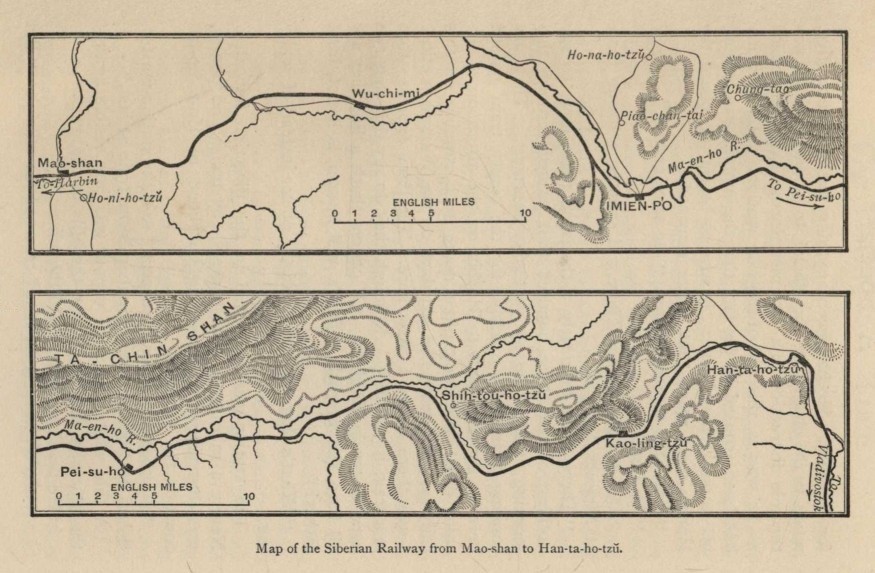
Map of the Siberian Railway from Mao-shan to Han-ta-ho-tzü.
There was much curiosity in the station-master's voice. He was himself a soldier, and keenly interested in military matters, in which, indeed, he was more at home than in the routine of railway work. A green-coated railway sentinel passed and saluted. The captain, who was unknown to the station-master, had ridden in from Ho-ni-ho-tzü an hour before, and purchased a ticket for Hai-lin, the station for Ninguta. He had been anything but communicative, much to the chagrin of the official, to whom a gossip was the sole distraction in a very monotonous existence, exiled as he was in this out-of-the-way station. His curiosity had been aroused by the fact that the captain was leaving his horse in his charge. It was to be put on board the Harbin train when that officer returned.
"Yes," the captain replied, "the same errand."
"Ah Lum?"
"Da, da! Ah Lum. There will soon be a strong force at Ninguta."
"There must be nearly a thousand there now, to say nothing of the three hundred that passed through this morning, and as many yesterday morning. They are running them very quickly, for the empty train passed here on the way back to Harbin on the afternoon of the same day. We don't often make such running on this railway. It's more like old days on the Warsaw section. I was there before I came here. The Paris express—that is a train if you like. Although they do say that they run even faster in England. Of course that's a lie; they are all liars, the English. That's well known, is it not, little father?"
"What's that yonder?" said the officer instead of replying.
The station-master looked in the direction indicated. Nearly a mile away a cart, drawn by mules and ponies, was hurrying from the neighbourhood of Ho-ni-ho-tzü towards the station.
"Another passenger, I suspect," said the station-master. "And he'd better hurry, for there's the train at last."
A thin white riband of vapour was just visible against the blue sky, floating above the hills to the west.
"He won't catch it," said the officer.
"I sha'n't keep it for him," returned the official. "But he may just do it. He's cut it rather fine for a Chinaman. The train's late as it is; should have been half-way to Wu-chi-mi by this time."
As he spoke, the engine came in sight round a curve of the hilly track. The Chinamen in waiting rose to their feet, grasped their bundles, and closed up against the barrier. Three riflemen emerged from their little blockhouse and began to patrol the platform; two or three station attendants appeared. A few seconds later the huge train, looking far too large for the station, rumbled in and came to a stop. It consisted of several old and shaky carriages already well filled with passengers, and one saloon in the centre. The few passengers for Mao-shan alighted and passed through the barrier; then the waiting crowd surged through and hurried along the platform in search of vacant places, which seemed hard to find.
A train attendant handed an official-looking paper to the station-master, who passed with it into his office; there was a signature to affix. Two of the Chinese passengers followed him as he left the platform; two others halted near the attendant. There were cries from the officials to the Chinamen to take their seats. Meanwhile the Cossack captain had sauntered into the room of the telegraph operator, and half a dozen Chinamen, having, it seemed, failed to discover vacant places in the forward carriages, were moving on towards the engine, followed by the voluble protest of one of the riflemen, who hurried after them to bring them back. Two or three, among them the big man and the boy who had been playing knuckle-stones, were peering in at the windows of the saloon carriage, apparently in great curiosity to see the occupants.
By this time the rest of the passengers had squeezed themselves into the already crowded compartments. Faces were pressed against all the windows; there was much speculation as to the chance of the belated passenger in the cart catching the train, its progress being eagerly watched, and the Chinamen in the carriages betting freely on the event.
Suddenly a shrill whistle rang out from the room of the telegraph operator. There was an instant change of scene. Here and there along the platform, groups of Chinamen, who a moment before had all the guise of peaceable passengers, threw themselves with startling rapidity upon the officials and the riflemen. There was a series of brief swift struggles; a revolver shot was heard; but that was all. Inside and outside of the train the guard and attendants were in a few seconds bound and helpless; the men who had gone forward to the engine grappled with the driver and fireman; the station-master was tied up in his own office. The passengers, alarmed and apprehensive, were staring open-mouthed at the proceedings. The door of the saloon carriage was thrown open, and there appeared at it two men, one a tall long-bearded Russian officer, whose uniform betokened high rank, the other a fair hook-nosed civilian, who stared round the other's shoulder.
"What is this, what is this?" cried the officer, stepping out of the train revolver in hand.
The last word was hardly out of his mouth when the burly Chinaman hurled himself at the Russian's knees from behind; he fell backwards; the revolver was wrenched from his hand, and the Chinaman held him pinned to the platform. His companion meanwhile had run back into the saloon; before he could slam the door the Chinese boy interposed, flinging himself flat on the floor of the doorway. Two Chinamen forced their way in, and did not reappear.
The prostrate officer was now trussed up. His captor had given a brief order to the rest of the assailants, now ranged along the platform awaiting instructions. At once they boarded the train, and peremptorily ordered the passengers to alight. Then the Chinamen found their tongues; there was a great hubbub and commotion among them; their first hesitation was quickly overcome by the pistol butts of the bandits, who hastened their exit by ruthless and well-directed kicks and buffets. One of the passengers, a heavy man, roared an imprecation and showed fight; but he was matched in size by the big fellow who had tackled the officer, and who now, his work with him being finished, seized the protester and flung him out on to the platform. Bruised and shaken, he rolled over and squatted on his hams; there was no more fight in him.
As soon as the train came to a standstill the Cossack officer had entered the little room of the telegraphist, and at a sign from him the Chinaman close behind him blew the shrill blast on a whistle that had been the signal for the attack.
"Excuse me," said the captain, "I have a message to send."
The operator, interrupted in the midst of a message, was startled by the abrupt entrance of the soldier, the sudden whistle, and the sharp crack of a revolver immediately following. He looked round, half-rising from his chair, his hand still on the key of the instrument.
"Finish your message," said the officer quietly. His uniform, his calm air of authority, impressed the man. Dropping back into his seat he ticked off the remainder of his message: it was merely a service intimation of the arrival of the train. The sounds of commotion on the platform were increasing; when the operator had finished he said:
"Is there a fight, your nobility? Perhaps I ought to assist. We are a small staff."
"No. Stay where you are. It is all over. Now please, my message. To Wu-chi-mi——"
"But, your nobility, if you will write the despatch out—we are not allowed——"
"There is no time for that. At once, if you please."
The man still hesitated: the officer sternly continued:
"My business will not admit of a moment's delay. You can attend to formalities afterwards."
"Well, your nobility, if you insist—— But you will take the responsibility?"
"Certainly. Call up Wu-chi-mi, if you please."
The man ticked off the call. There was an immediate reply.
"Say this: 'Station on fire'——"
The operator almost sprang from his stool; his eyes were wide with alarm.
"But——"
"You heard what I said. 'Station on fire!'"
A pistol's cold muzzle at the man's ear sent him cowering to his post. Pale to the lips, with trembling fingers he ticked off the words. It was clear that the officer could follow his rapid movements, for he suddenly pointed the pistol full at his brow, saying:
"That is enough: recall your last word; another mistake of the kind may cost you your life."
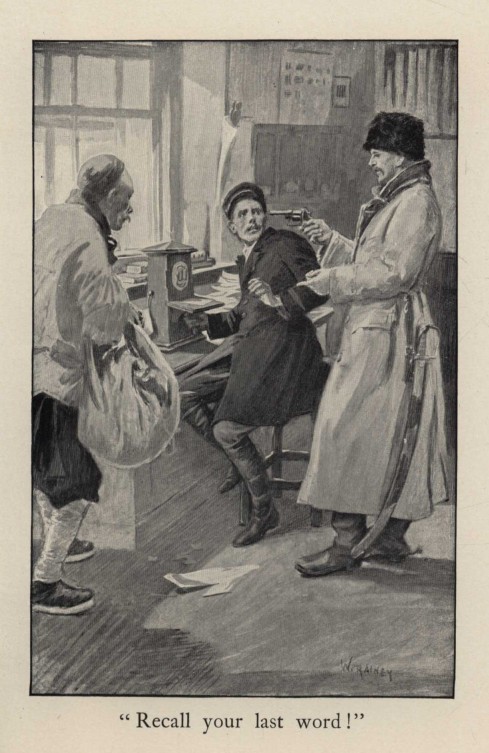
"Recall your last word!"
Seeing that his attempt to warn the operator at the other end had been detected, the man corrected the word.
"Now add: 'Vladivostok train can get through; expect temporary cessation of messages: will try to save instruments'. That will do."
The man sank back, and wiped his clammy brow. The officer turned to the Chinaman, beckoning him forward. In his arms he bore a bulky parcel. At a sign from the captain he placed the bundle beneath the operator's desk; opening it, he disclosed a heap of greasy shavings. He struck a match and set light to the pile; the man sprang from his chair and made for the door, but was caught and held by the Chinaman. Dismantling the apparatus, the officer gave it into the free hand of his follower; then, the room being full of smoke, he hurried out to the platform, the cowed and bewildered official being pushed along in front.
Only a few minutes had elapsed since the train came to a stop at the platform. As the captain emerged, the cart which had been sighted in the distance had just arrived. While twenty men stood with levelled revolvers overawing the crowd, a dozen muscular bandits hauled crowbars, spades, and long spanners from the cart across the platform into the brake-van, and the noticeably big man carefully carried a small box to the saloon carriage. At a sign from the captain, a gang of the Chinamen had hurried up the line some distance from the station and were now cutting the wires in two places a hundred yards apart. Breaking open the store-room, yet another group found what they were evidently in search of: a reserve instrument and a heavy coil of wire. These, with the wire cut from the line, with which the other men came hastening up, were bundled into the train; and within a quarter of an hour from the beginning of the attack the brigands were aboard, the Cossack captain was in the cab of the locomotive, and, watched by the ejected passengers in silent amazement, the train rumbled slowly out of the station.
CHAPTER XXIII
From Mao-shan to Imien-po
Wrecking a Bridge—Through Wu-chi-mi—More Dynamite—At Imien-po—Clearing the Line—Pelion upon Ossa—A Puff of Smoke—Two Minutes' Grace
Jack felt an extraordinary sense of exhilaration as the train, gathering speed, rolled eastward over the single track towards Wu-chi-mi. The country was hilly. The line at this point is some 900 feet above sea-level, but although there are steep gradients the main altitude for a considerable distance varies little. Jack was satisfied at first with a speed of about thirty miles an hour—a speed indeed rarely exceeded on the railway—for the curves are at times very sharp, and not knowing the line he felt that there was some risk of running the train off the metals. More than once, keeping a sharp look-out, he had to shut off steam and apply the brakes at a particularly ugly corner. His hobnobbing with railwaymen during the construction of the line was now bearing fruit; and he remembered with a curious pleasure, even while he kept his hand on the regulator handle and his eye on the gauges, a saying of his father's: "Never lose a chance of picking up odd bits of information: you never know when they may come in handy". He had not actually driven a locomotive before, but he had often ridden in the cab, and watched the driver, so that he felt no nervousness at having the Alexander the Second under his control.
As the train rattled past the block-houses of the railway guard, placed at every tenth verst along the line, the men stared to see it make such unusual speed; but no doubts troubled their sluggish minds, for they caught sight of the well-known caftan and head-dress of the Cossacks at every window. In their innocent-looking bundles the Chunchuses had carried the uniforms captured with Captain Kargopol's convoy, and they had donned them as soon as the train started.
Though he gave close attention to the engine, and saw that from time to time the furnace and boiler were replenished with fuel and water, Jack was keeping a sharp look-out for a spot at which he could do sufficient damage to the line to check a pursuing train. That he would be pursued he had no doubt; he only wondered how long it would be before news of his escapade reached the nearest point whence a train could be despatched after him. Mile after mile was passed, without his seeing works of any importance. The culverts were small, the water-courses only a few feet broad, until, about twelve miles out, the train approached a stream of some size spanned by a small bridge. At this point a special guard of three riflemen was stationed. The train slowed down, ran a few yards past the bridge, and came to a stand. At a word from Jack a dozen men leapt from the carriages on to the track, and before the astonished guards, deceived by the Cossack uniform, knew what was happening, they were seized, disarmed, and stretched bound upon the embankment.
The bridge was of brick, and consisted of two small arches, the central buttress sunk in the stream, which here ran only a few feet deep. Jack sent three men into the water above and below the bridge, each party armed with a large hand drill. The water was bitterly cold, but the men set to work quickly, both parties simultaneously attacking the buttress near the water-line. Fortunately the brickwork was soft; Jack was glad that his father had not had the contract for it, for then their labours might have been indefinitely prolonged. By a system of relief gangs a fair-sized hole was drilled at each end of the buttress in the course of twenty minutes. Then Wang Shih brought from the saloon two articles from the box he had so carefully carried from the cart. They were dynamite cartridges, part of the spoil of a Russian convoy. One was placed in each aperture, and in a few seconds two muffled explosions sent rumbling reverberations as of distant thunder among the hills. Jack hoped the noise would not be heard at Wu-chi-mi, about six miles off; it could not escape the ears of the guards in the intervening block-houses, and it would probably carry much farther. But the true explanation was not likely to occur to the staff at Wu-chi-mi, who in any case would be quite unable to verify any suspicions they might have.
The result of the explosions was the collapse of the middle portion of the bridge, only the jagged foundations of the central buttress appearing above the water. Followed by his men, Jack ran at once to the train, which had been taken two hundred yards away, out of reach of harm, and started the engine full speed ahead. Although twenty minutes had been spent at the bridge, the rate of progress from Mao-shan had been so much above the average that the lost time might almost be made up before the train arrived at Wu-chi-mi.
The general trend of the line from this point was downhill, and the train tore along at furious speed over the six or seven miles into Wu-chi-mi. Slackening speed slightly during the last mile, it rattled at about forty miles an hour through the station. Jack noticed that the staff was collected on the platform, excited probably by the noise of the explosions, and by the reported fire at Mao-shan. They evidently expected the train to stop. But any hopes they may have formed of authentic information were disappointed. Sounding the whistle, Jack ran the train through the station, and it was soon lost to sight. But he could not afford to take any risks. If the suspicions of the Wu-chi-mi men were aroused, it was certain that they would warn Imien-po, the next station, some twenty miles distant. In that case he would probably be stopped at the points and questioned. About a mile beyond Wu-chi-mi, therefore, he stopped the train and sent half a dozen men to cut the telegraph wire, hoping that the officials at the station behind would be still discussing the unexpected passing of the train instead of instantly sending a message ahead of him.
The bare hills had now given place to wooded slopes, the trees standing gaunt and brown, awaiting the touch of spring. The line crossed several small water-courses and irrigation ditches. Though he grudged the loss of time Jack decided to pull up at one of the smaller culverts and expend his last two dynamite cartridges in completing the work of destruction begun at the bridge beyond Wu-chi-mi. Although the explosions raised a huge cloud of dust the actual damage was not great. But as he was about to start the train, Jack hit upon an idea for supplementing the work done by the cartridges and at the same time lightening the load upon his engine. Quickly uncoupling the third carriage from the rear, he sprang into the cab and threw over the reversing lever, setting the train in motion backwards. When it had gained sufficient momentum, he brought the engine to a stop; the three rear carriages rushed down the incline and dashed with tremendous force into the wreckage. Then, relieved of nearly half its load, the engine again started eastward. The cutting ran parallel with the Ma-en-ho, a wide stream flowing northwards into the Sungari. Glancing at the map of the railway which had been found in the saloon carriage, he saw that within a few miles he would come to a short stretch of line branching off on the right, but apparently leading to no village, and having no station at its end. It seemed probable that it was a light line connected with a mine. At first he thought that the junction would be a good place to lift a few rails. But seeing at a second glance that the station of Imien-po was not far beyond, he dared not run the double risk of another delay. On went the train, then, past the junction, where the single pointsman looked amazed at the speed with which it thundered by. Passing a brief instruction along the train, Jack shut off steam and drew up sharply at the Imien-po station. It was time, he thought, to reassure the railway officials ahead.
On entering the station he noticed that an empty goods train bound west stood on a siding waiting for the passenger train to pass. Obviously he must not leave this intact behind him. Imien-po was a place of some size; for all he knew, it might contain Russian troops sufficient in number to deal with his handful of Chunchuses; and the goods train, being empty, could soon be manned and sent after him in hot pursuit. But what could he do with it? At first sight only two courses seemed open to him: either to take the engine with him, or to destroy some of its working parts. Coupled to his own train, the engine would probably be only an encumbrance, and he had almost decided to adopt the second alternative, when, just as he drew up at the platform, a third course suggested itself. Bidding Wang Shih take half a dozen men and secure the personnel of the goods train, he leapt on to the platform and accosted the station-master.
"You will please give orders to preserve quietness. General Bekovitch, who is in the saloon, is indisposed." The general was in fact lying bound hand and foot on one of the luxurious divans, just able to see Sowinski in a similar plight at the opposite side. "Be so good as to wire down the line to shunt all traffic. We are already late; the train has been shortened to lighten us; and it is imperative that the lost time be made up. The service, you understand. The general"—here he became confidential—"is in charge of the operations against the brigand Ah Lum."
The station-master looked duly interested and impressed, and was about to speak when Jack moved towards the telegraph office, saying:
"Follow me, if you please."
Wondering what this young Cossack officer of the authoritative manner wished to do, the station-master, a burly little man, toddled at Jack's heels. The other officials had watched the short colloquy, and were now approaching the carriages, surprised that none of the train attendants had yet appeared. Meanwhile the station-master had himself ticked off the brief message to the next station. The instant it was complete Jack stepped to the door of the office and held up his hand. A dozen men in Cossack uniform sprang from the nearest carriage.
"Now, sir, you have been very obliging, and I am sorry that you and your clerk must consider yourselves my prisoners."
The station-master stared in stupefaction. Before his slow tongue could find words two of the bandits ran into the room, and while their comrades outside were dealing with the other officials, the poor man and his equally amazed clerk were securely tied up. At the same time Wang Shih and his men, slipping out of the opposite side of the train, had swarmed on to the goods train and surprised the driver and fireman, the only men to be found on it, relieving them of their coats and caps, and tying the men up. The garments were afterwards donned by two of the bandits who rode beside Jack on the engine. Leaving his men to destroy the telegraphic fittings, Jack hurried to the newly-captured engine. He released the brakes, then opened the regulator valve to its full extent. The train began to move westwards; Jack jumped to the ground, and a few seconds brought him to his own train. Glancing down the platform to see that all his men were on board, he started the engine, and it snorted out of the station just as one or two railway officials and the guard of the goods train came running up from an outbuilding where it is to be supposed they had been beguiling the time with vodka.
There was a grim smile on Jack's face as, leaning from the cab, he watched the tail of the empty goods train rapidly dwindling as it raced away on its uncontrolled journey westward. In a few minutes it would crash into the ruins of the bridge and the wreckage of the carriages already cut off from his own train. The resultant block would tax all the ingenuity of the railwaymen to clear away in time to get on Ah Lum's track, if the chief succeeded in reaching the appointed spot at the appointed time.
Jack examined his stock of fuel and the water in the tender tank. There was enough wood to serve for an hour's run, he thought; but he would require to water in half that time at the most. This was a necessity he had foreseen: how to surmount it must perforce be left to the chances of the journey. He could only face each difficulty as it arose. The pressing matter at present was to guard against an attempt to stop him at Pei-su-ho. Two miles from the station he had just left he stopped the train at a bridge. The half-dozen watchmen at this point were easily overpowered, though not before one of Jack's men was wounded; the telegraph wire was cut, and the rifles of the Russians were added to the stock. With those already captured the little party of Chunchuses had now some twenty Mausers and a fair supply of ammunition.
The pause offered another opportunity for bridge destruction, but the supply of dynamite cartridges was exhausted, and after what had been done it was not worth while to expend precious time; there was still ample work to do in providing against a dash of the Russians from the neighbourhood of Ninguta. The train once again started on its adventures, the line still clinging to the valley of the Ma-en-ho; a gradual ascent of some thirty miles, up which the engine snorted furiously, leading to one of the highest points touched by the railway in this district—a spur of the Chang-ling hills some 1200 feet above the sea.
Five minutes after the journey was resumed, Hi Lo, who was on the railed-in space on the right of the engine, drew Jack's attention to a small white puff of smoke in the direction of Imien-po, apparently no more than two or three miles behind, and easily visible from the higher position now attained. Jack started, swung out on the foot-board, and gazed intently down the hill.
"They are after us!" he ejaculated. "But how in the world did they manage it? They can never have got over the wreckage."
He looked long and earnestly. Then he turned to Hi Lo.
"What is it, boy?"
"Tlain, masta, no-fea'," he replied without hesitation.
There was no room for doubt. The Russians were on his track. Springing back into the cab, Jack ordered the man acting as fireman to put more fuel into the furnace, and opened the regulator valve to its full extent. Dense spark-laden smoke poured from the wide funnel; the pistons flew backward and forward; the great locomotive seemed to leap over the line, and Jack wondered whether the roughly-laid track would hold together. But, looking anxiously back, he found in a few moments that the pursuing train had appreciably gained. It must be either lighter or better engined, or had still the advantage of the momentum acquired before it had been discovered.
Danger acted on Jack like a tonic. He instantly grasped the situation and braced himself to cope with the peril. Shouting to Wang Shih to tear up the rails behind the train as soon as it came to a stop, he shut off steam and applied the brakes hard, bringing the engine with a jolt and a screech to a stand-still. Instantly the men told off leapt on to the line; with feverish energy they loosened the fish-plates, forced up with crowbars the spikes holding the rails to the sleepers, and threw the lifted rails over the embankment. Glancing anxiously back along the track Jack, though the pursuing train was as yet invisible, saw its smoke growing larger and larger in volume over the hills. At last the train itself came into view. Jack saw with surprise that the engine was at the other end of it; could the goods train, he wondered, have been stopped in some inexplicable way and started back after him? In two minutes it would be upon him. He waited for one minute; then, seeing that a gap of some fifteen or twenty yards had been made in the track, he summoned his men back to the train and pressed the regulator handle. To his eager impatience it seemed that the engine would never get under way. The wheels slipped on the rails; he had pushed the regulator too far; he drew it back, the wheels held, and, gathering speed every moment, the locomotive raced on once more.
The thunder of the pursuing train was roaring in Jack's ears. It seemed to him, looking back, that the foremost carriage was charging at the gap. He hoped the work of destruction had not been perceived; but in this he was disappointed, for when the rear of his own train was barely two hundred yards from the break, steam was shut off on the engine of the pursuer, and, helped by the rising gradient, it succeeded in coming to a stand-still just as the buffers of the foremost carriage were within half a dozen yards of the gap.
CHAPTER XXIV
Lieutenant Potugin in Pursuit
From a Hilltop—Mystified—In Full Chase—A Runaway—In Sight—A Railway Duel
"Those Cossacks are taking their time, Akim Akimitch."
"Yes, little father; 'tis to be hoped Ah Lum has not swallowed them."
Lieutenant Potugin smiled.
"Ah Lum has been a bogey to them, truly, ever since Captain Kargopol walked into his trap. But I think we'll run the fox to earth this time. General Bekovitch will soon start the rounding up; and 'tis high time."
A half-company of Siberian infantry, including a few engineers, were seated on the rocks in the hills above the Ma-en-ho, engaged in a meagre luncheon of black bread and vodka. They had arrived early that morning by special troop train, in company with a sotnia of Cossacks, from Harbin. Their errand was to establish a temporary signal-station on a convenient hilltop. The hole for the signal-pole had been dug, not without difficulty, in the hard and frozen soil, and before the completion of the job was taken in hand, Lieutenant Potugin, in command of the working party, was allowing his men a short respite for rest and food. The Cossacks meanwhile were scouting in the hills beyond—a task they were by no means fond of,—and seeking a suitable place for the erection of a corresponding signal some miles distant, whence communication could be established with the height now occupied by the infantry.
Lieutenant Potugin was very popular with his men, largely because he never overworked them and was quite content when on duty to share their humble rations. He was seated now beside the sergeant, in the midst of the circle, munching his bread, and every now and then raising his field-glass to scan the surrounding heights. It was a fine morning; a breath of spring was already in the air, even in these heights; the atmosphere was clear, and the outlines of the country were sharply defined against the unclouded sky.
Over the shoulder of a low hill beneath him he could just see a stretch of the main railway line, some three miles away. The little branch line along which his train had come that morning was out of sight immediately below; but he expected every moment to see the empty train reappear on the main line. It was to return to Harbin; rolling stock was urgently needed on all parts of the system; and when his work was done Lieutenant Potugin was to report himself to General Bekovitch and join that officer's carefully-planned expedition against the Chunchuses. The branch line ended at a disused quarry which had been largely drawn upon when the main railway was under construction; and there was no telegraphic communication between the main line and the terminus of the branch—if, indeed, the latter could be said to have a terminus: it simply left off. The empty troop train would doubtless remain at the junction until it was signalled by trolley-car from Imien-po to proceed.
The sergeant, a famous raconteur, was telling a story, long-winded, not at all humorous, yet received by the men with shouts of laughter. Lieutenant Potugin smiled good-humouredly at the naïve amusement of the honest fellows, and once more idly scanned the panorama beneath him. In the far distance he saw a dense line of smoke lying flat in the still air, betokening a train travelling eastward at a high speed. He watched it with languid curiosity as it appeared in the open and vanished into cuttings in the winding valley of the river. It passed the junction, slackening speed, and then, to his surprise, pulled up. Distant though it was, he could distinctly see through his powerful glass a little knot of men hurrying from the train up the line. They disappeared for a time, apparently beneath a culvert. The circumstance awakened Lieutenant Potugin's curiosity; he watched with a certain eagerness for the men to reappear; one or two small groups could be seen against the snow, but a considerable time elapsed before the most of the men joined them and the whole party ran back to the train. Scarcely had they reached it when a cloud of dust rose high into the air above the bridge, and a few seconds later the sound of two dull explosions reached the lieutenant's ear, followed by miniature echoes from the rocks.
The lieutenant sprang up and gazed intently through his glass. The sounds had been heard by the men also; they turned their heads for a moment, but, seeing nothing, resumed their conversation. But Potugin stood as if stupefied. An attempt had been made to wreck the culvert; that was clear. But who were the wreckers? Were they Russians, cutting the railway to check pursuit by the Japanese? Surely the enemy was not already at Harbin? Accustomed as he was in this terrible war to sudden and startling movements, the lieutenant could not believe that the Japanese had made such strides. No, he thought; it was more likely to be a party of Japanese who had captured the train and were engaged on a wrecking foray. Such things had happened south of Moukden; a flying squadron might have evaded the Cossacks and made a daring attack on some inadequately protected train.
The train was moving forward. But what is that? It has stopped again; it is running back towards the stream. The madmen! Are they going to hurl themselves to destruction on the ruins of the culvert? Potugin's gaze is fascinated. Ah! he sees through it now; three carriages have left the rest of the train, which is again at a standstill; they are rushing down the gradient, faster, faster. Good heavens! they have crashed into the culvert, piling themselves one above another, and the sound comes to him like the breaking of some giant's crockery afar.
Then Potugin found his wits. Nothing in the whole course of the war had given the Russians so much anxiety as their railway. Depending on it for the rapid transit of reinforcements and munitions of war, they were constantly in nervous dread of this their sole communication with St. Petersburg being cut by Japanese or Chunchuses. The dreaded thing had happened. Fully realizing the situation, Lieutenant Potugin was prompt to act.
"Fall in!" he shouted.
The men sprang from their seats and were aligned in a twinkling.
"Sergeant, signal the Cossacks that a train is in the hands of the enemy, and going eastward. Men, follow me."
He led the way at a breakneck pace down the hill towards the spot where they had left the empty troop train. Three minutes brought them within sight of the train; at that moment the engine whistled and began to puff along. The officer shouted, waving his hand; the engine-driver saw his urgent gesture, and shut off steam. In another ten minutes sixty breathless men, heated with their headlong scamper, were on board the train; the lieutenant was beside the driver; and the engine was steaming as rapidly as the crazy irregular track permitted towards the main line.
Arrived at the junction, Lieutenant Potugin himself leapt down and switched the points close. The pointsman had apparently been startled by the crash and run off to inform the guardsmen at the nearest block-house. The troop in was just moving forward to cross the points when a tremendous rumbling was heard from the direction of Imien-po, moment by moment increasing. The engine of the troop train was already on the main line. But the lieutenant, standing with his hand on the switch and looking down the track, was horrified at what he saw rapidly approaching.
"Reverse the engine!" he shouted; "for God's sake reverse the engine!"
The driver with frenzied haste threw over his reversing lever and put on more steam; the engine stopped, moved slowly backward; it had reached safety by only a few inches when a goods train came thundering past at furious speed, and disappeared in the direction of the bridge. As it flashed by, Lieutenant Potugin was almost sure that the engine had neither driver nor fireman. Startled though he was by the hair's-breadth escape from destruction, he immediately recovered his presence of mind. Setting the points, he ran to his retreating train, clambered into the cab, and before the driver had pulled himself together the lieutenant seized the lever, reversed the engine, and drove the train on to the main line, then sprang down, unlocked the points, and in two minutes was running the train backward towards Imien-po.
The engine was a powerful Baldwin; the train though long was nearly empty; it gathered way, and with the regulator fully open had soon attained a high speed. But the engine was at the wrong end; it was difficult to see ahead. The lieutenant was now outside the engine, hanging on to the rail, and bending outwards in order to get a clear view down the line. Half-way to Imien-po he caught sight of a trolley approaching. He called to the driver to shut off steam and apply the brakes. The man working the trolley stopped the moment he caught sight of the train, and seemed in doubt whether to go back or to remain. The train had almost come to rest; the officer bellowed a few words to the trolley-man; he sprang to the ground, promptly tipped the trolley off the track and over the embankment, and, running to the engine, climbed up beside Potugin, the train still moving. Again the brakes were released and the regulator opened, and as the train forged ahead the trolley-man explained in a few words to the lieutenant what had occurred.
At Imien-po a few minutes' stop was made while appliances for repairing the line were hastily brought on board and a number of skilled platelayers taken up. The opportunity was taken to shunt several of the carriages on to a siding. The engine could not be transferred to the front of the train without a serious waste of time, and every second was precious. A fresh start was made; greatly lightened, the train made fine running for some miles. Then the lieutenant, using his glass, saw the smoke of a train about five miles down the line. As he watched it, the smoke ceased; the train must have stopped, for the gradient was rising. A few minutes more and the runaway came in sight. But the fireman, stooping from his side of the engine, observed with his trained eyes that a portion of the track had been torn up, and steam was shut off and the brakes applied only just in time to avert a disaster. Jumping from the train, half a dozen platelayers hurried with their tools behind the engine, and, spurred by the voice of the officer and helped by his men, in an incredibly short space of time they had wrenched up some rails from the track already covered, and bridged the gap at the other end.
Slowly and carefully the train was run over the shaky metals only half-secured to the sleepers. When the danger point was passed, the driver opened the valve and the engine pushed along at full speed. It was to be a trial, not only of speed between the two magnificent engines, but of wits between the two leaders: between the ingenuity of the pursued in obstructing the progress of the pursuer, and of the pursuer in overcoming the obstacles raised by the pursued. It was more; it was a competition in daring and the readiness to take risks. The track was hilly, winding, roughly laid; not intended for, wholly unsuited to, great speed; with steep gradients and sharp curves never rounded by the regular drivers of the line but with caution. Over this track the two trains were leaping at a pace unknown on the Siberian railway—a pace that would have turned the chief engineer's hair white with dismay. On the one train Jack Brown, on the other Lieutenant Potugin, had to think out their decisions, or rather to flash them unthought, clinging to the outer rail of a rattling, swaying, jolting, throbbing engine threatening at any moment to jump the rails, with the noise of escaping steam, the roaring of the furnace heaped to the mouth with fuel, the whistle constantly sounding to warn off any obstruction ahead, small though the chances were that the signal, if needed, could be heard and acted on in time. Accident apart, the race would be to the coolest head and the quickest wit. On the one side the stake was life or death. Into whose hand would fortune give it?
CHAPTER XXV
The Pressure-Gauge
Timber on the Track—Fuel and Water—The Station House—A Trap—Neck or Nothing—Screwing down the Valve—A Slip Carriage—Nearing the End—Kao-ling-tzü—Indiscreet Zeal—A Lady Passenger—Traffic Suspended
Jack glanced anxiously back along the line; his engine was jolting, bumping, up the incline at the rate of forty miles an hour; steam was escaping from the safety-valves; the gauge registered over 10 atmospheres, considerably above working pressure; yet to his impatience it seemed to be moving with exasperating slowness. Dust was whirling behind; through the cloud, five minutes after he started, he saw a puff of steam in the distance; the pursuing train was again under way. Turning to see if he could put on more steam, he was dismayed to find that the water was just disappearing in the gauge glass. In a few minutes—he could not tell how few—the water would be below the level of his fire-box crown, the fusible plug would drop, and the fire would be put out by the escaping steam. This was ominous indeed.
There were, he saw, two conditions in his favour: he had a start of nearly five minutes; and he could choose his own place to obstruct the pursuer. But the other conditions were all against him. He must needs stop for water, and at the present rate of consumption for fuel also; and whenever he passed a station it would be necessary to cut the telegraph wires. Moreover, on board the pursuing train there must be men skilled in repairing the line, or the chase could not have been resumed so promptly; and Jack could not expect to do more damage in a given time than could be remedied by expert hands in the same period. Worst of all, the pursuing engine was evidently more powerful than his; and though it was somewhat handicapped by its position at the wrong end of the train, yet an experienced driver can always get more work out of his engine than a tyro,—and Jack was making his trial trip!
He cudgelled his brains for some means of checking the pursuit without bringing his own train to a stand-still. He wished that he had thought to instruct his men when tearing up the rails to lift some of the sleepers into the train; these placed on the line would prove serious obstacles. It was too late to repine; he made up his mind not to lose the chance if it should occur again. While his thoughts were still on the matter, his eye caught the balks of timber used for fuel on this part of the line. The stock in the tender was much diminished; more fuel must soon be obtained; but surely one or two might be spared for the experiment. Without delay he sent Hi Lo to the back of the tender with an order to Wang Shih to carry two of the balks through the train and to drop them on the line from the communication door at the rear of the last carriage. In a few moments the command was carried out, but Wang Shih reported that owing to the high speed he had found it difficult to see what happened to the logs when they reached the ground. One, he thought, had remained on the inside rail; the other appeared to jump off. Narrowly watching the riband of steam from the pursuing train, Jack believed he detected a momentary diminution about the time when it should have reached the spot where the logs had been thrown out; but if there was a delay it was very brief, and a few minutes later the tail of the advancing train came into full view, the growing size of the carriage-end showing that it was making up on him.
Looking ahead with greater anxiety, Jack saw a station within a mile. This must be Pei-su-ho. He had already decided that to stop there would be absolutely necessary, and in a short colloquy with Wang Shih when he returned from throwing the logs on the track he had arranged what should be done. Immediately on the stoppage of the train twelve men were to engage the station staff and destroy the telegraphic instruments; ten were to tear up the rails behind the train, and, if possible, bring some sleepers on board; four were to cut the telegraph wire, and twenty to load wood from the station stock on to the nearest carriage. In the meanwhile he himself, with the assistance of the man acting as fireman and others riding on the engine, would take in a supply of water from the tank.
The train rattled into the station. In his anxiety Jack found that he had shut off steam too late; the engine ran some yards beyond the water-tower. As he had already found at Imien-po, it was not easy to the amateur to bring a train to a stand-still at a given spot. But although the greater part of the train had run beyond the platform, the Chunchuses, who were standing ready with the doors open, swung themselves out, and before the gaping officials were aware of what was happening they were disarmed and helpless. Not for the first time had Jack reason to be glad that his men were the pick of Ah Lum's band, and a standing proof of the efficacy of discipline with the Chinese.
While Jack was backing the engine to the tank the work of ripping up the track and demolishing the wire had already been begun, and a string of men were hauling timber into the nearest carriage. But before the supply of water was fully replenished Jack had to blow his whistle to recall the various parties; the pursuer was drawing perilously near. The train moved off before all the men were in their places; the last of them running along the platform and being helped in by his comrades. Up came the second train; again it had to halt before the gap, and the driver, being at the other end, was compelled for safety's sake to reduce speed earlier than he would have done had he been able to judge the distance more exactly. But this time the gap was shorter; the time required to restore the line would be correspondingly less. Yet Jack had gained one advantage; knowing that the enemy's water supply, like his own, must have run low, he had brought the station hose away with him, and he looked at it with grim satisfaction, lying coiled at the rear of the tender.
As Jack's engine, Alexander the Second, gained impetus and charged up the gradient towards the hills looming in the distance, it was followed by a dropping fire from the pursuing train: some of Lieutenant Potugin's men had climbed to the roof of the stationary carriages. Whether any of the bullets struck the train was doubtful; no harm was done; and in the excitement of the moment the idea of firing rifles seemed almost as childish as shooting at the moon. Nothing less than a siege-gun would have appeared formidable in the circumstances.
The brigands' last cutting of the line and the removal of the hose had evidently gained several minutes for the fugitive, for many miles had been covered before the smoke of the pursuer was again seen. With so considerable a start Jack felt it safe to pull up once more and try a device that had occurred to him. His engine was at the summit of a long descent where the line curved. Hitherto his track-breakers had forced up both the rails, but the curve was here so sharp that he thought he might save time by having only one rail lifted, hoping that the partial gap might not be seen by the enemy until it was too late to do more than check the train, which would in all probability be derailed. An alternative plan suggested itself, only to be dismissed. It was to remove the rail, and then replace it without the bolts. The pursuer would then rush on at full speed expecting no danger; the train would be hurled from the track, and probably all on board would be killed or injured. But even in the heat of the moment, and with the knowledge that if he were caught he could expect no mercy from the Russians, Jack could not bring himself to compass such wholesale destruction. "Play the game": the phrase of the school song stuck to him. His purpose would be amply served by the mere derailment of the train, the speed of which would no doubt be sufficiently checked, when the gap was descried, to avert fatal consequences.
So confident was he of the success of his scheme that when, after the single rail was removed and flung over the embankment, he again crowded on steam, his mind was occupied rather with the question of what should be done at the next station than with the prospect of further difficulties with his dogged pursuer. He was now approaching the place in the hills to which Ah Lum was to advance by forced marches, and whence he was to be prepared to dash across the line on receiving a message that the scheme had succeeded. Jack had already selected his messenger; the man was clinging to the rail of the engine, and only awaited the word to spring during a temporary slackening of speed and plunge into the hills.
The chosen spot lay between Pei-su-ho and Kao-ling-tzü, and had been minutely described by Ah Lum. Jack was glad that his anxieties appeared to be over, for the country flashed by so rapidly that he ran the risk of over-shooting the mark unless he could keep a good look-out. He was narrowly watching for the opening on his right when Hi Lo suddenly drew his attention westward. With greater alarm than he had yet felt, even when he first caught sight of the pursuer, he saw, scarcely a mile and a half behind him, the relentless enemy leaping along in his wake. He was half-way up a steep incline; the second train was rushing with wholly reckless speed down a steep straight gradient on which Jack, no longer fearing pursuit, had thought it desirable to clap on the brakes. All notion of going cautiously must now be abandoned. Amazed at the failure of his last effort to delay the pursuer, Jack set his men with desperate energy to pile up the furnace to its utmost capacity; and when he topped the hill, and the enemy was just beginning the ascent, he let the engine go at its own pace down the opposite side. He and his men had to hold on with both hands as they rounded another sharp curve; the wheels on the inside seemed to be raised from the track, the train keeping the rails only by the grip of the outside wheels. Jack held his breath as the panting engine plunged along; would it come safely on to the straight? Even in the excitement of the moment he solved as in a flash the mystery of the pursuers' escape from derailment, and he could have beaten his head for his thoughtlessness. The rail that had been lifted was an inside rail; rounding a curve the weight of a train going at speed is always thrown on the outer rail, which is raised above the level of the other. Either designedly or by accident the pursuing train had passed at full speed over the gap, its very speed proving its salvation.
Although there were many ups and downs, the general trend of the line was still chiefly on the up grade, and Jack found that while the enemy made as good timing as himself down the slopes, their more powerful engine gained rapidly wherever the track began to rise. As mile after mile was passed, the huts of the line guards at intervals of ten versts seeming like the milestones on an ordinary journey, the space between the two trains steadily diminished. Every now and again the pursuer was lost to view; but whenever it next came in sight it was always perceptibly nearer. The noble Alexander the Second rattled and groaned like a creature in pain; the working parts were smoking; some of the bearings were melting, and Jack dared not risk the perils of oiling. He knew that he was getting out of it every ounce of which it was capable, unless indeed he adopted the desperate expedient of screwing down the safety-valve, from which a dense cloud of steam was escaping. He glanced at the gauge—13 atmospheres; then his eye went backwards along the track—the pursuer was still gaining; he turned to look ahead, there was a long steep ascent to be climbed. The pace lessened to an alarming extent: puffing, panting, creaking, the engine toiled up a hillside on which the track could be seen rising for at least two miles. He must risk it.
Three minutes later, the valve now screwed down, he again glanced at the gauge—14 atmospheres. Bursting pressure, Jack knew, was calculated at five or six times the working pressure; but the Alexander the Second was an old engine, he doubted whether her boilers would stand anything like this strain.
For a time Jack's train drew away; but the gain was only temporary; the pursuers, he guessed, must have adopted the same desperate expedient. Gradually they crept up, while Jack alternately watched them and the track ahead, and the gauge, which now registered 15 atmospheres—the limit which it was constructed to indicate. Beyond this point he had no means of knowing how the pressure was increasing. The rapidity of his thoughts seemed to keep pace with the tremendous speed at which he was travelling. His mind worked with marvellous clearness; the minutes seemed like hours; he even found himself speculating which of the three risks was the greatest—derailment, capture by the Russians, or the imminent explosion of the boiler.
To look for the spot chosen for the despatch of his messenger was out of the question; it had probably been already passed. Jack felt that he had no longer any alternative; he must play what seemed his last card. The pursuing train was only half a mile behind on the steep upward track when at his order Wang Shih, at the risk of his life, uncoupled the rearmost of the three carriages. For a short distance it followed the rest; then it stopped, and began to run back at a pace that threatened to telescope at least one carriage of the oncoming train. A turn in the track hid both the detached carriage and the pursuer from sight; Jack listened with a beating heart for the sound of the collision, which he felt would be audible even above the thundering roar of his own train.
Lightened of part of its load, his engine was forging its way uphill at considerably higher speed. At one moment he thought he heard the expected crash, and it seemed that the move had been successful, for when next he obtained a fair view of the line behind, the enemy was not in sight. Alternating between compunction and elation, he ventured, the line being more level, to reduce speed until it was safe to drop his messenger, who must perforce find his way to Ah Lum. But the man had barely left the track when, to Jack's amazement, the indomitable pursuer reappeared. A glance showed him that it was pushing the discarded carriage before it. His move had been detected, probably before the cast-off carriage began its backward journey; the pursuing engine had been able to reverse in time; chased and overtaken by the runaway carriage, the train had no doubt been badly bumped, but not with force enough to cause any serious damage. Now, to all appearance, it was following the quarry at the same breakneck pace as before. Jack felt a glow of admiration for the wary Russians, who showed themselves so intent to mark his every move, so quick to take measures to defeat it.
His mouth hardened as he watched the pursuer gaining upon him yard by yard. He knew that the pressure must now be enormous; would the boilers stand the strain? Yet in spite of all he was steadily being overhauled. Yard by yard the gap lessened. Nothing but an accident could now prevent him from being overtaken; his only course seemed to be to stop before the enemy was too close, reverse his engine, and with his men take to the hills. But then he reflected with a kind of agony that the task he had set himself was even yet only half done. There was no longer, indeed, any chance of Ah Lum's retreat being cut from the west; but the Russians could still despatch a force from Ninguta in ample time to check the Chunchuses before they got across the railway; and if they were once checked, the forces behind would at once close in and crush them. While, therefore, the slightest hope remained, Jack resolved to cling to his train; but he gave his men orders to jump clear at a moment's notice. They must now be very near to Kao-ling-tzü: if they failed to cut the line there the race was clearly run, for a warning would certainly be flashed over the wire to the next station at Han-ta-ho-tzü, giving ample time for preparations to be made to meet him. He was in a bath of sweat; his throat was parched; his limbs were trembling; but collecting all his forces, he watched the gauge and grasped the lever.
There remained, he clearly saw, one small chance, and only one. If there happened to be a train at Kao-ling-tzü side-tracked in obedience to his instructions, it might be possible—how long would it take?—to interpose it between himself and his pursuers. There would be a minute, nay, less than a minute, to gain possession of it and set it in motion. Could he increase the margin? Yes; by detaching the saloon, now the rearmost carriage, and crowding the whole of his men and the two prisoners into the single carriage in front. The enemy had all along shown himself so alert that he would doubtless be on the look-out for such a move; there was no longer any likelihood that it would end the chase; but at least it would check the pursuer's progress, forcing him to stop or reverse. Even if it caused the delay of only a few seconds, it was worth attempting; a few seconds might make all the difference.
The station was already in sight when, the transference of men having been quickly effected, Wang Shih broke the couplings and left the saloon solitary upon the line. Looking with blood-shot eyes ahead, Jack saw—and his labouring heart leapt at the sight—not one, as he had hoped, but two trains, one behind the other, completely filling a siding, where they were halted to allow General Bekovitch's expected train to pass.
But the same glance that gave Jack such elation showed him that he had to deal with perhaps the greatest danger he had yet encountered. He had intended to follow the same plan that had proved successful at the other stations: dispose of the officials, cut the wires, and block the line. But he saw almost with dismay that the platform here was thronged. Drawn, no doubt, by curiosity to see the train of General Bekovitch, and excited by the urgent messages received along the wire, not only the station officials were waiting, but a considerable number of workers on the railway, Russian riflemen, and Chinese passengers. These, together with the attendants of the standing passenger train, were massed upon the platform. They formed so numerous a crowd that it would tax all the energies of the Chunchuses to deal with them; there might be a prolonged fight, and, even if it ended in a victory for the brigands, so much time would have been consumed that the pursuers must arrive before anything could be done to stop their progress. It was a moment when many a man might have despaired. But Jack was not made of the stuff that yields. As his engine plunged along towards the station he conceived an alternative plan; it would test his nerve and self-command to the uttermost; but it might succeed by its very audacity.
Passing the word to his men that they were to remain in the carriage and hold their revolvers ready in case an attack was made, he halted the engine with a jerk a yard beyond the spot where the station-master was standing. He sprang to the platform, clutched the astonished official by the arm, and dragged him along, speaking in low, rapid, urgent tones.
"Come with me. There is not a moment to lose. We are pursued by a train in the possession of the enemy. General Bekovitch is laid up. We have done our best to check the pursuit, but they'll be upon us in a few minutes. Only one thing can be done: uncouple the engine on the siding, and start it up the line. Quick! our lives depend on it. I will take the responsibility."
As Jack had hoped, the suddenness and unexpectedness of the news, and the urgency of his manner, bereft the station-master of all power of independent thought. He hurried along the platform, shoving aside all who stood in his path, every man in the crowd looking on with wonderment. He sprang on to the line, with his own hands uncoupled the engine, signalled for the points to be closed, and ordered the driver to send it ahead at full speed.
"Two minutes saved!" thought Jack, as the engine started. But he could not afford to let the flurried official regain his self-command.
"That is not enough," he said. "They will see the engine, reverse, couple it on, and come at greater speed. I've tried it already. You must empty the passenger train, and then push it along with the goods engine. It would be well to throw a carriage or two off the rails at the points. Anything to block the line."
"Certainly, your nobility," said the station-master. "It is the only way."
They were now on the track between the waiting train and Jack's. Many of the passengers had their heads out of the windows, wondering what was going on. Waving his arms, the station-master summoned them in urgent tones to alight.
"I'll now push on," said Jack. "Do your best, nichalnik; remember how much depends on you."
He walked rapidly along between the trains to reach his engine. Passengers, anxious, wonder-struck, were already leaving the train. One of them, a Russian army doctor, stopped Jack and asked what was the matter.
"Train behind in possession of the enemy," returned Jack laconically.
"Bozhe moï!" ejaculated the doctor, drawing his revolver and making for the platform.
Jack passed on, not venturing to delay even long enough to assist a lady, for whom the jump from carriage to track was somewhat difficult. She sprang down unassisted.
"Monsieur Brown, Monsieur Brown!"
Jack shivered from top to toe, and never in his life felt so much inclined to take to his heels as then. He could hardly believe he had heard aright; yet amid the bustle now filling the station he had caught the whisper of his name. On a sudden impulse he swung round.
"Monsieur Brown," said Gabriele Walewska, running up to him, "I have news for you: I have something to show you."
"Come with me, Mademoiselle," said Jack instantly. "I haven't a minute to lose."
"But Masha is here; I cannot leave her."
"For heaven's sake, Mademoiselle, climb up into this carriage. I will fetch Masha."
With anxiety tearing at his heart Jack hurried back down the train. He saw Gabriele's old nurse at the door of a carriage; she was almost the only passenger who had not yet alighted.
"Spring into my arms," he said, forgetting that she knew no tongue but Polish. But his outstretched arms spoke for him. The woman jumped clumsily; but Jack kept his feet, and, straining his muscles, he carried the burden, as rapidly as he could stagger, to his own train. Gabriele's hands were ready to help the woman; with an unceremonious heave Jack pushed her into the carriage. Then he ran to his engine, swung himself up, and pressed the lever just as the empty passenger train moved off in the other direction. Before he had run a hundred yards he heard a crash behind. Glancing back, he saw that the first carriage had jumped the points, ploughed up the permanent way, and overturned. One after another the other carriages followed; and in a brief minute there was a pile of wrecked trucks and coaches in inextricable confusion across the rails.
Jack had not time to give a second thought to Gabriele. He was again urging Alexander the Second along at full speed. He must run to within a few miles of the next station, and lift enough rails to delay for some hours any train despatched from the direction of Ninguta. Twenty minutes brought him to a likely spot—a high culvert over a brawling hill stream. Employing the whole strength of his detachment in the work, he lifted fifty yards of the track and flung the rails and sleepers into the stream's rocky bed.
"At last!" he exclaimed. The load of anxiety he had borne for over two hours was gone. From the place where he had wrecked the bridge nearly a hundred miles westward to the spot where he now stood, traffic on the Siberian railway was hopelessly blocked.
CHAPTER XXVI
A Double Quest
Gabriele's Story—A Hasty Word—Lex Talionis—Bribery and Corruption—Cause and Effect—The Natural Man—The Filial Obligation—The Choice of Routes—A Fair Pleader—In the Circumstances—Improving the Occasion
Jack's part was done. The way had been cleared for the passage of the Chunchuses across the railway, and knowing Ah Lum's rapidity of movement he felt tolerably sure that the crossing might easily be made. He could now afford to think of his own safety. He determined to run the train back as near as he dared to Pei-su-ho, then to leave it standing on the line and make off in a northerly or north-westerly direction, trusting to join hands with Ah Lum at some distance north of the line. The railway guards were amazed to see the train running swiftly backwards; but, whatever their suspicions, they were powerless. Jack came to a stop between two of the block-houses; in a few minutes his men alighted with Bekovitch and Sowinski, Gabriele, and her nurse; and then Jack abandoned the noble Alexander the Second that had served him so well, and started on his northward march. Some distance above the line he instinctively turned for a last look. There was the short train, motionless on the rails, a derelict in a vast solitude. But it represented activities that had disorganized the whole traffic of the line for a hundred miles, nullified a military scheme, and saved hundreds of lives. It was not without a certain grim amusement Jack remembered that the final card in that game had been played by the Russians themselves. "I only hope the station-master won't be cashiered," he thought, as he turned his back upon the scene.
Not till now had he an opportunity of learning what strange fate had entrusted Gabriele to his care. Some time after he had left the missionary's house the girl, unable to endure the separation from her father, again ventured into Vladivostok. Acting on the knowledge that Jack had bribed a Russian official, she succeeded in persuading a colonist about to re-embark for Sakhalin to carry a letter from her to Count Walewski. She told him of her intentions, assuring him that in spite of her failure to gain permission to enter the island, she still meant to persevere. Several weeks later she received a reply, brought by the same man, who had crossed the sea in probably the last boat before the ports became ice-bound. It was addressed in a strange handwriting, and as she tore it open she was oppressed by the fear that her father was dead. But the first line of the letter, written in French, dispelled her anxiety. The count was ill in hospital, unable to write; but he had availed himself of the ready help of a fellow-prisoner—a political prisoner who had recently arrived in the island. He thanked his daughter for her affectionate solicitude, but pled with her to abandon her purpose: Sakhalin was no place for a woman; she would only suffer without alleviating his lot. As for himself, until the arrival of his new friend he had despaired of ever regaining his liberty. But the surprising news that the Japanese were winning victory after victory had sown a seed of hope. The prisoners on the island had been fed with lies by the officials, who reported constant victories for Russia. But the new-comer had thrown a fresh light on the war; he could not foresee its end: the Russians had still enormous powers of resistance; it was possible that the great fleet on its way eastward might break through to Vladivostok and change the aspect of things. Yet, if it should be defeated, the Japanese might capture Sakhalin; possibly the political prisoners would then be released if they had not been previously removed to the mainland. It was only a possibility, but sufficient to give new courage to a sorely-tried man.
Jack read all this himself, for Gabriele, immediately after explaining how the letter came into her possession, handed it to him. The writing was his father's. At the first moment he felt unutterable relief in finding that his father was alive; then rage burned within him as he saw before him, marching at some distance apart, each manacled to a Chunchuse, the two men whose villainy had sent Mr. Brown to the bleak "island of the dead". Gabriele noticed his look.