BROWN OF MOUKDEN (continued 3)
Reading edition
CHAPTER IX
Ah Lum
Ishmaels—The Chief—Fair Words—Wise Saws—Ah Fu's Tutors—An Honorary Appointment—Chopping Maxims—A Deputation—Hunting the Boar—A Forest Monarch—Charging Home—The Knife—A Close Call
The Chunchuse camp, Jack learnt as he rode, was some thirty miles distant in the hills. It had been shifted; it was always shifting; that was why the intervention of Wang Shih had been so nearly too late.
Jack was somewhat amused when he reflected on the strange company in which he found himself. He had heard a good deal about these redoubtable bandits, but never till this day had he seen any of them. Their bands were, he knew, very miscellaneous in their composition. Escaped prisoners, whether guilty, or innocent like Wang Shih, frequently sought refuge with one or other of the brigand chiefs. Men who had been ruined in business, or were too indolent for regular work; men possessed of grievances against the mandarins, or by a sheer lust of adventure and lawlessness; helped to swell their numbers; and Mr. Brown had once remarked that they reminded him of the motley band that gathered about David in the cave Adullam: "Every one that was in distress, and every one that was in debt, and every one that was discontented".
The name Chunchuse means "red beard", and was originally applied by the natives to any foreigner. Since the bandits were almost all clean-shaven, like the majority of Chinamen, Jack could only conjecture that they were styled "red beards" from some fancied resemblance of their predatory ways to the methods of the hated foreigners. They were held in terror by all the law-abiding inhabitants, and the machinery of the Chinese government was totally unable to keep them down. Since the coming of the Russians they had grown in numbers and in power. Knowing every inch of the country they were able to wage an effective guerrilla warfare against the invaders, often surprising scouting parties of Siberian riflemen or Cossacks, raiding isolated camps, damaging the railways, and capturing convoys.
Jack was interested in taking stock of his strange companions. They were tall strapping fellows, powerfully built, with muscular and athletic frames, and they included men of every race known in Manchuria. Their costumes differed as greatly as the men themselves. Some were clad in the usual garb of Chinamen; others had black cloth jackets with brass buttons, tight-fitting trousers, and long riding-boots reaching to the knees. Their heads were covered with knotted handkerchiefs of red, black, or yellow cotton, beneath which their pigtails were coiled up out of sight. Each carried a rifle and a revolver stuck in his leather belt.
On the way to the camp Wang Shih gave Jack a few particulars about the band, in which he had already risen to a high position. Ah Lum, the chief, had been for many years notorious for the daring with which he would swoop with a few men on rich merchants travelling through the country, even though they might be escorted by Chinese soldiers. But since the outbreak of the war such sources of gain had ceased, and he had gradually collected a very large following for the purpose of conducting irregular operations against his country's despoilers. All were magnificent horsemen; the Russians had in vain endeavoured to hunt them down; and the very rifles they carried were the spoil of successful raids.
After a ride of about five hours through the hills, Wang Shih's party reached the Chunchuse camp. It was a strange mixture of shelters, many of them huts built of the stalks of kowliang, yet arranged, as Jack noticed, in a certain order. Conspicuous in the middle of the camp was a large tent, in which, as they approached, Jack recognized the Russian service pattern. This too was evidently part of the spoil of a raid.
At the outskirts of the camp Wang Shih dismissed his men, proceeding alone with Jack to the tent. It was the head-quarters of the chief. There was no sign of state, no sentinel at the entrance; Wang Shih rode up unquestioned, and unceremoniously shouted into the tent for Mr. Ah. If Jack had expected to see the typical brigand of romance he must have been disappointed. Ah Lum was the shortest member of the band, a wiry figure with a slight stoop. His appearance was that of a university professor rather than a warrior. He was apparently between forty and fifty years of age, with an intelligent and thoughtful cast of countenance, enhanced by a pair of horn spectacles over which he looked searchingly when Jack was introduced to him. Ah Lum was, in fact, a man of considerable education and even learning. He had taken the highest honours in the examinations for the successive degrees of Cultivated Talent, Uplifted Literary Man, and Exalted Bookworm; and the poems he composed when competing for a place in the Board of Civil Office were acknowledged as superior to anything recently written in the Mandarin language. But his success on this occasion awoke a bitter jealousy in the breast of a "same-year-man" who had kept pace with him throughout his career until this last promotion. The disappointed candidate adopted a characteristically Chinese mode of wreaking vengeance. He committed suicide on Ah Lum's door-step. According to Chinese belief Ah Lum would not only be haunted ever after by his rival's spirit, but would also have to clear himself before the mandarin's court of a charge of murder. Unluckily the mandarin was an enemy of Ah Lum; his price for a favourable judgment was more than the Exalted Bookworm could offer; and the latter, seeing that his condemnation was certain, discreetly vacated his desk at the Board of Civil Office and betook himself to the mountains.
Jack only learnt all this gradually. His first impression of Ah Lum as a spectacled, courteous, polished savant left him wondering how such a man had succeeded in imposing his authority on the hard-living, hard-faring, reckless set of outlaws who composed his band. That he had some personal force of character was a foregone conclusion, for his position could depend on nothing else. He received Jack very kindly, and, having Heard his story from Wang Shih, promised to do all he could to help him.
"Mr. Wang," he said, bowing to his lieutenant, "does me the honour to be my friend. Has he not rendered me great services? Surely it becomes me to serve his friends when my insignificant capabilities permit. Meanwhile deign, sir, to regard all our contemptible possessions as your own, and excuse our numberless shortcomings. Where good-will is the cook, the dish is already seasoned."
He paused, as though expecting a comment on the proverb.
"Quite so," said Jack, feeling that he ought to say something.
The chief proceeded at once to warn him of the danger of pursuing further his attempt to enter Moukden in disguise. If he tried to pass as a Canton man he might at any moment meet a real Cantonese, as had already happened to his cost; and, besides, the Cantonese were not loved in Manchuria. As a Manchu, on the other hand, he would be apt to betray himself in endless little ways. However, if he were bent on it, Ah Lum would do what he could to secure him good treatment. Meanwhile, after what he had gone through, a few days' rest in camp would do him no harm.
"Haste is the parent of delay," he said; "whereas if one has a mind to beat a stone, the stone will in due time have a hole in it."
Again he paused, like an actor waiting for the gallery's applause to his tag.
"A very sound maxim," said Jack, thinking it well to humour this singular moralist.
The chief concluded with an offer of hospitality so cordial, that Jack, anxious as he was to pursue his mission, could not well decline it.
Wang Shih, Jack found, was third in command. His enormous strength, allied to a bull-dog courage, had enabled him to force his way to the front in a community where those qualities were esteemed above all others. That they were not the only titles to respect was proved by the position of the chief; and the longer Jack stayed in the camp the more he was impressed by the ease and firmness with which Ah Lum swayed his band.
The chief had a son, a boy of twelve, who from the first took a great liking to Jack. Ah Fu was a bright boy, vivacious for a Chinese; and Ah Lum loved him with even more than the usual Chinaman's devotion. He doted on the child. He never tired of talking about him to Jack.
"If," he said, "a man has much money, but no child, he cannot be reckoned rich: if he has children, but no money, he cannot be reckoned poor. And I am blessed in my son: he is dutiful, respectful, voracious of knowledge. 'A bad son', says the Sage, 'is as a dunning creditor; but a good son as the repayment of a long-standing debt'."
At great pains he had kidnapped two graduates for the express purpose of having Ah Fu carefully trained in the elements of Chinese culture. Himself a man of education, he set the highest value on learning. "Weeds are the only harvest of an untilled field," he would say. "Though your sons be well disposed, yet if they be not duly instructed, what can you expect of them but ignorance?" In addition to his daily instruction in the philosophers and poets, the boy went through all kinds of physical exercises—practising with the bow and the rifle, riding a spirited little pony, learning fearless horsemanship from the best rider in the band; and the Chunchuses rival the Cossacks in the superb management of their steeds. Before Jack had been a day in the camp he was requested by the chief to teach his son English. He agreed, though he thought that in the short time he was to spend with them not much could be done. Ah Lum was very pressing in the matter. Jack, he was sure, had all the learning of the west (this tickled Jack; how the fourth-form master at Sherborne would have roared!). The learning of the east Ah Lum himself could get for the boy. In addition to the kidnapped graduates he had his eye on an astronomer of distinction at Kirin, and at Tieling there lived a very learned man, skilled in the casting of horoscopes. But he had naturally few opportunities of providing European instruction. "True doctrine cannot injure the true scholar," he said. "An ounce of wisdom is worth a world of gold." He was particularly anxious that Ah Fu should lack nothing in education through his father's outlawed condition. Himself a poet, he set much store by poetry; and having learnt from Jack that the most popular English poet was Tennyson, he made it a special point that the boy should from the first learn some of his poems. Jack was amused; he did not tell the chief that poetry was not so highly esteemed in England as in China; but happening to know a few odds and ends of Tennyson's verse, he got Ah Fu to repeat them after him until the boy could recite them faultlessly. Jack had his doubts whether the poems thus recited would have been recognized by an Englishman, but that was nothing to the point.
After a week, when he felt his strength thoroughly recruited, Jack spoke of continuing his journey. But Ah Lum, in his politest manner, urged excellent reasons why he should remain a little longer. It had been raining almost continuously since his arrival; the streams were in flood; the rivers were not fordable. Moreover, a large body of Russian troops was moving between the camp and Moukden; and Chinamen were being narrowly questioned and examined under suspicion of being Japanese spies in disguise. Day after day passed; every hint of Jack's that he wished to be off was met by some new excuse enforced by maxims, and turned by a question as to how Ah Fu was getting on with his poetry. At last Jack grew uneasy and suspicious; it appeared as if Ah Lum intended to keep him as an additional tutor, unpaid. He began to think of taking French leave, but was restrained by several considerations: the fact that he owed his life to the brigands; the danger lest his disappearance should cause a quarrel between Wang Shih and the chief; the hope that he might find the Chunchuses useful in prosecuting his search; and the risk of recapture, for he knew that the country people would certainly give him up to the chief if they caught him.
He abandoned therefore the idea of flight, resolving to stay on with what patience he could muster, and hoping to obtain his end by mild persistence. But his courteous and repeated applications were met by still more courteous and equally firm refusals—not direct refusals, but regrets that on one pretext or another the "Ingoua superior man" could not safely leave the camp. Ah Lum's stock of proverbs and maxims was again drawn upon. "Though powerful drugs be nauseous to the taste, they are beneficial to the stomach. So, candid advice may be unpleasant to the ear, but it is profitable for the conduct. The carpenter makes the cangue that he himself may be doomed to wear."
"Exactly."
There was a want of conviction in Jack's stereotyped reply. He was growing tired of these eternal copy-book headings, which seemed to him often the merest platitudes—tired of expressing the assent which his sententious host always looked for. He asked Wang Shih to expostulate with the chief; but when the Chinaman ventured to suggest that the young Englishman's dutiful regard for his father ought to be respected and his errand furthered, he got a good snubbing for his pains.
"It is easy to convince a wise man," said Ah Lum with a snap; "but to reason with fools, that is a difficult undertaking. You cannot turn a somersault in an oyster-shell."
Greatly daring, Wang Shih cited a maxim very pertinent, he thought, to the case.
"True, honourable sir; but is it not written: 'Of a hundred virtues, filial piety is the best'?"
"No doubt," retorted Ah Lum, still more snappishly. "But remember that if a man has good desires, heaven will assuredly grant them."
And Jack had to kick his heels, and drum poetry into Ah Fu, thinking disrespectfully of proverbial philosophy.
Thus three weeks passed. During this period the band grew steadily stronger. Jack reckoned that it now numbered at least eleven hundred. The rains having ceased, the camp was moved some twenty miles to the north-west, not in a direct line to Moukden, but nearer to that city. To Jack this was a crumb of comfort; but there were disadvantages in the change, for with the finer weather and the removal to somewhat lower ground, the midges and mosquitoes became more lively and troublesome, and he spent many a hot hour of pain and smart.
Another fortnight went by. The Chunchuses had been inactive so far as brigandage was concerned, and, except that they did no work, they might have been nothing but a peaceful mountain tribe. But one day a deputation came to the chief from a village lying in the midst of a woody and well-cultivated valley a few miles from the camp. They announced that their plantations of young bamboos were being devastated by a herd of wild boars with which they were unable to cope, and they had been deputed to beg the Chunchuse chief to come to their assistance. Ah Lum was never unwilling to please the country people when he saw a chance of gaining a substantial advantage. "Let no man," he would say, "despise the snake that has no horns, for who can say that it may not become a dragon?" Food was running short, and but for the deputation it was probable that some fine night the village would have been raided and plundered. But the request for assistance opened the way for a deal; Ah Lum consented to organize a battue in return for a large supply of food and fodder; and after half a day had been spent in haggling, the deputation returned, promising to send in the quantity first demanded.
The chief was exceedingly pleased.
"Do not rashly provoke quarrels, but let concord and good understanding prevail among neighbours. Seeing an opportunity to make a bargain, one should think of righteousness."
Jack welcomed the impending hunt as a pleasant change, and appeared to gratify the chief when he asked to be allowed to join in it. As a diversion from the sugared sweetness of Tennyson, he bethought himself to teach Ah Fu Fielding's fine song "A-hunting we will go"; and when the boy learnt the meaning of the words, he was all afire to share in the chase. Ah Lum was pleased with his spirit; but being unwilling that his only son should run any risk, he at first declined his request. The boy persisted, pointing out that he was already a good shot, and asking what was the good of his learning poems of hunting if he was not allowed to express in action the ardour thus fostered. This argument appealed to the chief's sense of the fitness of things; he would have agreed with Socrates that action was the end of heroic poetry; he yielded, stipulating, however, that throughout the hunt the boy should remain at his side.
Jack soon found that the hunt was not to be conducted on the lines of pig-sticking in India. He remembered the vivid account of such an adventure given him by a Behar planter whom he had once met on board a steamer between Shanghai and Newchang. Nor were the animals to be caught in artfully-contrived pits, as is the custom in Manchuria. The chief was ignorant of the Indian method, and was possessed of too strong a sporting instinct to be content with the work of a trapper; it was to be a real hunt, as he understood it. The cover in which the boars were known to lurk was about a square mile in extent. Ah Lum intended to take advantage of the large force at his disposal and arrange for beaters to drive the animals to a comparatively open space, at the end of which he and a select few would take up their positions and shoot down the boars as they emerged from cover. This seemed likely to be a safe way of effecting the desired object; and though not sport in the British sense, it would at any rate make some demand on their nerve and their marksmanship.
The important day came. On a bright fresh morning, soon after the sun had gilded the hilltops, when the air was clear and a cool breeze tempered the summer heat, Ah Lum, accompanied by seven of his best marksmen and by Ah Fu and Jack, rode down to skirt the base of the hill and gain the northern side of the clearing to which the boars were to be driven. Jack had been provided with a rifle and a long knife; his pupil rode at his side, armed with a carbine; and very proudly the boy bore himself. At the foot of the hill the party were met by some of the villagers, come to guide them to their destination. When they reached the spot they found that the clearing was about a furlong across, with thin plantations behind them and on either side, and in front a mass of dense, almost impenetrable scrub interspersed with trees.
The party of ten took up their position in line facing the scrub, standing a few feet apart; Ah Lum was in the centre, with the boy on his left, and Jack one place farther in the same direction. Jack felt that if the Manchurian boar was anything like the Indian specimen of which his planter friend had told him, the party might have a lively time should two or three of the beasts break cover at the same moment, especially if they should charge down through the plantations on left and right. The Chunchuses, however, were evidently secure in their numbers and the stopping power of their military rifles.
The beaters, nearly a thousand strong, had been sent to their allotted positions earlier in the morning. They formed a rough semicircle more than two miles in length. When all was ready, the chief sent a horseman to the farthest point with orders to begin the beat. The clang of a gong soon rang out in the still morning air; immediately the sound was taken up all along the arc; drums, gongs, rattles, shrill yells combined to form a pandemonium of noise. Flocks of birds clattered out of the tree-tops and flew in consternation over the country; hares and rabbits darted out of the underwood as the beaters closed in; a fox or two, even a wolf, came padding out, stopped at the edge, gave a glance at the line of men, and disappeared on either side. All these passed unmolested; the ten stood in silent expectation, ready to bring their weapons to the shoulder.
Suddenly from the centre of the scrub pounded with lowered tusks a large boar. He had advanced some yards into the open before he was aware of the ten human figures ranged opposite to him. Then, swerving heavily to the left, he trotted towards the plantation. At the same moment two shots rang out as one; the chief and his son had fired together, the others waiting in courtesy. Ah Lum, for all his spectacles, his poetry, and his sentences, was an excellent shot; the boar fell within a yard of the trees; the chief's bullet had penetrated his brain.
Hardly had the smoke cleared away when two other boars appeared at different parts of the scrub. Eight rifles flashed; the boar to the right fell; but the other, unhurt, instead of making towards safety in the plantation, dashed straight across the open. As by a miracle it survived a volley from the whole party of ten, and had come within twenty yards of them before it was struck mortally and rolled over. The hunters, their attention fixed on the gallant beast that had just succumbed, did not notice that he was followed at a few yards by a huge tusker, the glare of whose red eyes sent a thrill through one at least of the party. Dashing at headlong speed through the plantation almost in a line with the hunters, the boar came on unswervingly, heedless of a scattering fire. The hunters impeded each other; Ah Lum and the men on his right could hardly fire as they stood without hitting their companions. There was a moment's hesitation; then the chief, with a cry to his boy to run, stepped calmly to the front, preparing to fire at a range of only a few yards. But one of his men on the left, in a nervous anxiety born of the emergency, rushed forward, and, stumbling against his leader, spoilt his aim. The shot flew wide. The unfortunate man paid dearly for his clumsiness. In another moment the boar was among the party, making frantic rushes, ripping and tearing with his formidable tusks, his bloodshot eyes glaring with the concentrated fury which only a wounded boar can express. Several shots were fired, but the beast's movements were so rapid that they either missed him, or, hitting him at a non-fatal spot, served only still further to infuriate him. The inexperienced hunters, indeed, were in greater danger than the boar from each other's firearms. They hesitated in confusion, moving this way and that to avoid each other; then, in a sudden panic, several of them took to their heels and made for the shelter of the trees.
But Ah Fu stood his ground, as though fascinated. His father and Jack perceived at the same moment that the boar in desperate and vengeful rage was heading straight for the boy, who held his carbine at the slant, looking on as at some fearful thrilling spectacle. Ah Lum and Jack, separated from the boy in their movements for securing good aim, sprang to his assistance. But before they could reach his side the beast was upon him. Awake to his danger, the little fellow raised his carbine to his shoulder and fired almost point-blank; but the Russian service bullet has no stopping power to check a wild boar in full career; the boy was toppled over, receiving a gash in the leg from the mighty tusk. Then the animal wheeled in his tracks to pursue his vengeance. Jack's rifle was empty; even if it had been loaded he could hardly have fired without running the risk of hitting the boy. The chief was still a few yards away, he, too, rendered helpless by the same appalling danger. Jack saw that in an instant his little pupil, now gamely struggling to his feet, must be gored to death. Dropping his rifle, he drew his knife, and flung himself upon the blinded, maddened brute, driving the weapon between its shoulders. So great was his impetus that he stumbled full across the boar, which, intent upon its purpose, struggled on a foot or two, staggering under the blow, but making light of Jack's weight. Even as Jack was wondering whether his stroke had failed, the beast uttered a long squealing grunt, fell on its knees, then rolled over stone-dead within a few inches of Ah Fu.
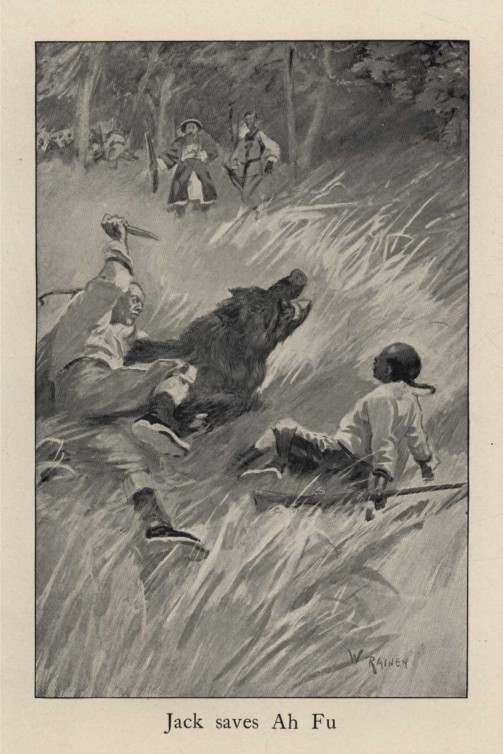
Jack saves Ah Fu
The chief caught the boy in his arms and held him in a warm embrace; the runaway Chunchuses, no more boars being visible, came dropping back from the plantations; and Jack, his coat covered with blood, rose panting from the back of the victim.
CHAPTER X
The Hired Man
Gratitude—On Humanity—A Broken Thread—The Hill Country—Nearing Moukden—The Compradore—News at Last—Sowinski's Address—Burnt Offerings—A Little Black Box—Toitshe!—Pidgin—Excellence—Herr Schwab—Photographabbaratus
After the rescue of Ah Fu, Jack stood in a new relationship to Ah Lum. The boy was the apple of the chief's eye; nothing was too good for his deliverer. When the party reached camp after the memorable adventure, Ah Lum paraded his whole band, and, his voice broken by unwonted emotion, proclaimed the Englishman his friend. In all such moments of ceremony the literary man, the university graduate, appeared through the brigand chief. After reciting the heroic deed in the flowery language a scholarly Chinaman always has at command, he continued:
"Forgetfulness of a favour received is a sure sign of a bad heart. Let me speak in a similitude. A man is on a long journey; his money is all spent; he is destitute, far from home, without friends, and perishing from want. To him comes a stranger whose goodness of heart leads him to present the wanderer with a few hundred cash, thereby preserving his life. Should he afterwards see this man, his benefactor, ought he not to make some expression of gratitude? It is a common saying, if we receive from others a favour like a drop of water, the return should be as an overflowing fountain. How much more when a man snatches from death a male child! Does not the Sage say: 'The three greatest misfortunes in life are: in youth to bury one's father; at the middle age to lose one's wife; and, being old, to have no son'? Heaven has already afflicted me with the first and the second of these tribulations; the honourable foreigner by his magnanimous courage has spared me the last. It is a true saying, 'The brave act like tigers, not like mice'. Some of you, to the shame of your ancestors, acted like mice; the Ingoua leapt forth like a tiger and saved my pearl from the snout. He is my friend; whosoever does him a service does a greater service to me. As the Poet says:
"'The Spring that feeds the Mountain Rill
Helps the great River to grow greater still'."
Making allowances for the chief's surcharged emotion, Jack felt that there could be no longer any obstacle to his departure. Ah Lum, indeed, was torn between two impulses. He wished to keep by his side the youth who had shown that he could not only teach English poetry, but display courage and readiness in a moment of danger. He wished also to show his gratitude practically, and knew that he could do so in no more acceptable way than by furthering Jack's search for his father. After a night of indecision his generosity prevailed; he called Jack into his tent, and promised, if he still wished to go, to do all that he could to help him. But he pointed out that it would be very dangerous for him to venture into Moukden. There were both the Chinese and the Russians to reckon with. As for the former, he could furnish Jack with a pass which would probably secure him from molestation; but if it were found upon him by the Russians, it would in itself be sufficient to hang him. Jack, however, felt that there was little chance of tracing his father except by beginning at Moukden and working along the railway, and he once more expressed his unalterable determination to face whatever risks this course might involve.
Ah Lum then settled down to a serious discussion of ways and means. He agreed that Jack's best plan would be to try his luck again as a Chinaman; but not this time as a Cantonese; there were too many Cantonese about. It would be better to pass as a native of one of the interior provinces, such as Sz-chuen. The dialect was not likely to be known to anyone in Moukden, so that the matter of speech would not be a difficulty. He might be supposed to have come down the Yang-tse-kiang on river boats, and to have drifted to Manchuria with an Ingoua; the Ingoua, as every Chinaman knew, were great travellers; this would explain his knowledge of pidgin English.
The chief spoke with great simplicity and earnestness; evidently he was sincerely anxious on Jack's behalf. It was only at the end of the conversation that he reverted to his academic manner.
"Prudence," he reminded Jack, "is what is most necessary to be cultivated by the young. Your path will be beset with perils; a chance word may be your undoing. When you converse in the road, remember there are men in the grass. For myself, I am old enough to be your father; this and my affection must be my excuse for offering words of advice. What says the proverb? 'In a melon-patch, do not stoop down to arrange your shoes; under a plum-tree, do not lift your hand to adjust your cap.'"
Jack knew from experience that, being fairly mounted on his hobby, the chief could not easily be stopped, and settled himself to listen in patience.
"There are three things mainly to strive for: filial piety, that is the most important; integrity; and humanity. Let us take the last first. Humanity is among the greatest of the virtues. If a man wish to attain the excellence of superior beings, let him cultivate the attributes of humanity. They include benevolence, charity, clemency——"
At this moment a voice was heard at the entrance: "The august decree is fulfilled."
The curtain was parted, and there entered the chief's second in command, a big ferocious-looking fellow, holding up to Jack's horrified gaze two ghastly blood-stained human heads. Ah Lum looked at the hideous objects with unmoved countenance.
"That is well," he said. "Affix them on poles, and set them in the centre of the camp, with this scroll in large characters from the poet P'an T'ang-she'n:
"'Virtue is best; hold Knavery in dread;
A Thief gains nothing if he lose his Head.'"
The incident interrupted the chief's homily before his first heading was developed. The flow of his ideas seemed broken, for on the departure of his lieutenant he turned the conversation into another channel.
Jack afterwards learnt that the unfortunate wretches decapitated were two members of the band who had stolen fowls from a farmer. Since robbery was a principal reason of the Chunchuses' existence, Jack was amazed at such an offence meeting with so terrible a punishment, until he heard that the farmer thus robbed had purchased immunity from Ah Lum by a gift of fodder, and the chief was inexorably merciless to any who were guilty, or who made him appear guilty, of a breach of faith. Jack was now convinced, if he had not been before, that Ah Lum was no mere spectacled pedant.
One fine morning Jack set off on his long journey to Moukden. His appearance was indistinguishable from that of a well-to-do Manchu. Every detail of his costume was correct, from the round black hat and glossy pigtail to the cloth boots with white felt soles. He was mounted on a good pony, and accompanied by a trusty Chunchuse. Ah Fu shed tears at parting; Ah Lum and Wang Shih were undisguisedly sorry to lose him, and the former indeed declared his willingness at any time to welcome him back, and even to give him a command in his band. Jack thanked him warmly, pressed his closed fists to his breast in Chinese salutation, and rode away.
It was nearly a thousand li—more than 300 miles—from the camp to Moukden; not as the crow flies, for in that country of forest, mountain, and river a straight course is impossible. The traveller has to proceed by pack roads, to ford streams deep and swift, to ascend and descend rugged forest-clad slopes; and if his journey is timed in the rainy season he suffers inconveniences and perils without number. It was fortunate for Jack that the rains were not so persistent and continuous this year as is sometimes the case. He was delayed at one or two stages of his journey by thunder-storms and swollen rivers; but, thanks to his guide, who knew the country perfectly, he was able to cover an average of about twenty-five miles a day. At another time nothing would have delighted him more than to take things easily, for he passed through some of the most magnificent scenery in the world, a country teeming with game of all kinds, and dotted at out-of-the-way spots with interesting monuments. But, determined to reach Moukden as soon as possible, he was not to be allured by the cry of pheasants or the trails of the tiger and the deer.
Furthermore, unequipped for such travelling as attracts the globe-trotter, he found the inevitable discomforts of the route somewhat trying to his patience. On fine days he was plagued for hours at a time by myriads of midges, which swarmed about his head, biting with fiendish ferocity. But his own sufferings were slight in comparison with his pony's. From sunrise to sunset huge gadflies infested the poor animal, settling upon its tough hide, and piercing it till the beast was streaming with blood. Jack spent the greater part of the day in smashing the terrible insects with his whip, slaying hundreds and still leaving hundreds unslain. The nights also were times of torment. Putting up at some inn, he had to pass the hours in a crowded room, sealed up to prevent the ingress of midges, filled with smoke and the sickening odours of stewed pork and rancid vegetables. He slept on the k'ang, sometimes wedged in among a crowd of natives by no means too clean, never knowing but that he might have the dangerous company of an adder before the morning. He had to put up with such food as the inn afforded, mostly Chinese pork and salted eggs, with an occasional bonne bouche in the way of a trout when there happened to be Korean fishermen in the neighbourhood. But night by night he rejoiced in the completion of another good stage of his journey; and, thanks to his prudence and the clever management of his guide, he aroused no suspicions, and was accepted as a native, morose and uncompanionable indeed, but excused as being a wanderer from a distant province.
At length, on the fourteenth day after leaving the Chunchuse camp, the two travellers reached a village some twelve miles from Moukden. They were squatting at dinner in an inn when a detachment of Cossacks rode up, in the course of a foraging expedition. Jack felt a little anxious as they entered, but to them he was a mere Chinaman like the rest; he escaped notice, yet was relieved when they rode off in the direction of Moukden. When they were well on their way he suggested to his guide that it would be good policy to follow hard on their heels; entering the city in their wake he might hope to pass without attracting special attention.
It was late in the day, near the time for the closing of the gates, when the Cossacks approached the city. To Jack's disappointment, instead of entering they rode off to the north-west, in the direction of the railway. He thought it advisable to put up in a little hamlet some two miles from the walls and wait till morning. There was sure to be a considerable crowd of country people awaiting the opening of the gates, and in the crush he was likely to pass unrecognized. Early in the morning, therefore, he took leave of the Chunchuse and turned his pony's head towards Moukden. Though outwardly calm, he had many an inward tremor as he joined the crowd of people—labourers, farmers with carts loaded with beans, drovers with black pigs, women with fowls and geese slung round their necks—a miscellaneous throng, all too intent on their business, however, to give more than a passing glance to a rider hardly distinguishable from themselves.
The gates were thrown open, and Jack passed through with the rest, feeling tolerably secure now that he was at last within the walls. Turning off from the main road, he made his way by narrow and tortuous alleys to the street where the compradore lived in his cottage at the foot of Mr. Brown's garden. The man was smoking at the door, and his son Hi Lo was playing at knuckle-stones on the ground near him. Jack reined up and dismounted, saying nothing at first in order to test the efficacy of his disguise. The compradore looked up, but did not recognize him. The boy was quicker. At the first glance he jumped up, ran to his father, and whispered in his ear. The man started, kowtowed, then, looking hurriedly and anxiously around and up and down the street, invited Jack to enter. When the door was shut he expressed his delight at seeing his young master once more. He had heard from his brother at Harbin of the successful stratagem by which Jack had managed to start for Vladivostok, but, knowing what risks the journey involved, he had ever since been fearful lest some harm should have befallen him.
"I have had some narrow escapes," said Jack, "but here I am, you see, safe and sound. I'll tell you all about it by and by; but first tell me, Mr. Hi, have you discovered anything about my father?"
The compradore's face fell as he related the result of his enquiries. A Chinaman once in Mr. Brown's employment had been working at the railway-station at Shuang-miao-tzü, about half-way between Moukden and Harbin, when, on a siding in an open truck, among a crowd of malefactors in chains, he had been amazed to recognize his former master. The truck had remained there for two days; the man had tried to get speech with Mr. Brown, but in vain. By questioning and comparing notes Jack came to the conclusion that this was the very truck he had seen from the window of the train on his way to Harbin. His blood boiled at the recollection of the miserable wretches and the thought that his father was among them; he felt an insane desire to rush off at once and confront General Bekovitch with the discovery; but he knew how fatal such a step would be; and after an explosion of wrath which he could not control, and at which Hi An looked on with every mark of sympathy, he regained his composure, and, recognizing that there was no hope save in patience, settled down to discuss his future course of action. He knew full well that an unlucky accident might at any time put an end to his quest and perhaps his life, and resolved that so far as in him lay he would not fail through lack of caution.
After the first moment of relief and happiness at seeing Jack again, the compradore showed himself seriously concerned for his young master's safety. If he were detected by the Russians he ran the risk of being shot as a spy. His disguise was perfect; Moukden was probably the last place where his enemies would expect to find him; but while the Russians were in possession there would always be found Chinamen ready to curry favour with them, and earn a little cash. After some discussion it was arranged that the compradore should give out that Jack was a distant relative from Sz-chuen, and Hi An himself suggested that he should feign illness for a time until his future movements could be carefully thought out.
"I shall want a name," said Jack with a smile. "What can you call me?"
"Sin Foo, master. I had a nephew of that name; he is dead, poor boy; it is a good name."
"Very well. Now we must make further enquiries along the line to see what has become of that truck. I have plenty of money; the flour we expected came safely to Vladivostok, and I sold it. You have friends you can employ?"
"Yes. But it will take a long time."
"Of course. I wish I could go up the line myself. Is it impossible?"
"You must not think of it, master. If it were known that questions were being asked about an Englishman arrested by the Russians, suspicion would be awakened, and what could you say if you were caught? No, leave it to my countrymen; they will know exactly how to enquire, without seeming too curious. As for you, it is best to remain in Moukden, and wait until we get more news."
"I'm afraid you are right. Well, let it be so for the present. Tell me, is Sowinski in the city?"
"Yes, he is living in your father's house."
At that Jack fired up again. Red with anger he strode up and down the room, itching to do something, yet feeling all the time his helplessness. Then he checked himself with a laugh.
"I'll never do for a Chinaman," he said, "if I show temper so easily. You must teach me to fix my face, Mr. Hi."
"Yes, master," said the compradore seriously. "I will buy a little image of Buddha, and put it in a corner of the room. If you look at it for two hours every day your face will be as calm as a still pool."
The compradore's house was very small, and before a week was out Jack was terribly sick of being cooped up in it from morning till night. Only after dark, when the quarter was quiet—and that was at a very late hour, for when Chinamen start playing fan-tan it becomes a trial of endurance—only then did the compradore think it safe for his guest to issue forth for a breath of air. The proximity of Sowinski was itself a danger. Moreover, his acquaintances, among them Sowinski's Chinese servants, were becoming curious. It was impossible to harbour a stranger long in secret; for a couple of days the story of a sick cousin passed muster, but the compradore had omitted to state the nature of the illness, and his friends began to enquire whether they might not be allowed to see the sick man and join Hi An himself in the charms and exorcisms proper to cure him. Thus pushed into a corner, the worthy man drank in their sight the ashes of burnt yellow paper, and whispered that he feared his relative was sickening for a fever; it would not be safe to admit visitors. He was about to sacrifice to the divinities on the sick man's behalf; and, taking his courage in both hands, he invited a number of his friends to accompany him.
Jack rolled with laughter when he afterwards learnt what had happened. His amusement was all the greater because the compradore was so obviously ill at ease lest he should have incurred the displeasure of the divinities by sacrificing for a man who was not ill. Professing to be not quite sure of the disease, he had gone first to the roadside shrine of his Excellency the Small-Pox and burnt incense there; then to the Honourable Divinity the Plague; finally, to make short work of it and cover all imaginable complaints, he had proceeded to the deity known as Mr. Imperfect-In-Every-Part-Of-His-Body, a hideous idol with sore eyes, hare-lip, and ulcerated legs. Convinced now that the travelled relative must be in a desperately bad state, the inquisitive neighbours gave a wide berth to Hi An, and no longer desired to cross his threshold.
But when a week had passed, Jack, finding his inactivity intolerable, came to the conclusion that it would really be safer if he moved about a little. The neighbourhood would expect to be invited either to his funeral or to a feast in celebration of his recovery, and the talk that would ensue when neither event happened might develop danger both for himself and for his host. One evening the compradore, on returning home, chanced to mention that during the day he had been asked by a foreign war-correspondent if he could recommend a servant. The stranger already had a capable mafoo, or groom, but this man had absolutely refused to carry or have anything to do with a little black box on which his master set great store, and the foreigner had met with the same refusal from every native to whom he applied. Hi An himself was somewhat amused at the situation. Having served Mr. Brown for so many years, and in so many different places, including the southern treaty ports, he was well aware that the black box was a harmless photographic camera: had not Master Jack himself possessed one in Shanghai? But the Moukden natives, not yet accustomed to the kodak of the globe-trotter, were convinced that the mysterious box was choke-full of little black devils impatiently waiting for any confiding Chinaman simple enough to be lured within their influence. The correspondent, being somewhat stout and far from active, was loth to carry the camera himself, and had almost resigned himself to the dead-lock.
"Poor fellow!" said Jack, laughing. "How did you come across him, Mr. Hi?"
The compradore explained that the correspondent appeared to be a business connection of Mr. Brown's, for he had tried to find the merchant when he arrived in Moukden some weeks before, and was greatly disappointed and distressed when he learnt what had happened.
"How should I suit?" said Jack, as an idea struck him.
"Ch'hoy!" exclaimed the compradore. "Master a servant?"
"Why not? I should be able to move about then; as the servant of a European I should run less risk of being suspected either by Russians or Chinese than if I were a masterless man; and I might—the chance is small, but still it is a chance—I might come upon some trace of my father if attached to a foreign correspondent, whose duties will surely take him from place to place."
"But, master, a servant! And to a foreigner; not even a Yinkelis or a Melican man, but a Toitsche! Ch'hoy!"
There was a world of contempt in the Chinaman's tone. To the average Chinaman all "foreign devils" are alike; only those whose business brings them into relations with Europeans recognize degrees.
"I know you don't like the Germans; but what does it matter, Mr. Hi? A German is less likely to see through my disguise than an Englishman. Besides, of a hundred virtues, filial piety is the best. You know the maxim?"
The compradore scratched his head. He found these ideas difficult to reconcile. But after some further talk he yielded, and promised to go to the correspondent early next morning and offer the services of Sin Foo, a young man whose honesty and industry he could guarantee.
A little before noon next day he returned. The correspondent was delighted with the prospect of engaging a suitable man, but must see the candidate first. He was living with a number of other correspondents at the Green Dragon Hotel, and wished to see Sin Foo at once.
"Is Monsieur Brin there?" asked Jack instantly.
"No, master. He went to Harbin a week ago. He was very sad."
"Lucky for me! Then we'll go at once, Mr. Hi."
The neighbours had already been prepared to see Hi An's relative out-of-doors at last; the application to Mr. Imperfect-In-Every-Part-Of-His-Body had been abundantly successful. Most of them were engaged in their usual occupations at that time of day, and Jack attracted little notice as he walked through the streets at Hi An's side. At the hotel he was presented to a short, corpulent German, wearing gold spectacles and a battered wide-awake, and smoking a huge pipe.
"He belongey Sin Foo," said Hi An.
Jack made the kowtow in the most approved style. The German looked him up and down.
"So!" he said. "You been servant before?"
"Suttingly," replied Jack, remembering his fagging days at school.
"So! You strong?"
"My plenty stlong, masta!"
"Not afraid of little box?"
"No fea'! My cally littee box this-side, that-side, allo-side, all-same."
"Goot! You are shust ze man I seek. Now to fix ze so imbortant business of vages. Business are business. Vat you say to ten yen—ach! I zink still I am in Japan: vat say you to ten dollar per mensem—ze monce?"
"Allo-lightee—" began Jack, but the compradore interposed.
"Ch'hoy! Ten piecee dollar! Ph'ho! My hab catchee Sin Foo—one piecee first-chop man; he numpa one boy; my fetchee he this-side; no can makee pidgin so-fashion for littee bittee cash. Sin Foo, come wailo chop-chop; folin genelum no savvy pidgin China-side fashion."
The compradore's intervention showed Jack that he must needs exercise every care if he was to play his part properly. To have accepted the German's first offer without bargaining would have betrayed him to any travelled man. After an hour's discussion an arrangement was concluded between the stranger and Hi An. Sin Foo was to have nothing else to do but to take charge of the photographic apparatus. The terms agreed upon were so high that the German declared that he must dismiss his mafoo and engage a cheaper man. Whereupon the compradore suggested Hi Lo to fill the place, and Jack regarded the opportunity as almost a special providence, for he had been dreading the discomforts and dangers that might arise from enforced companionship with a Chinese mafoo. With Hi Lo for a fellow-servant, however, he need fear neither danger nor discomfort, and he was pleased when the German accepted the boy, but at ridiculously low wages.
Jack was to enter upon his duties at once. As soon as the compradore had gone to fetch Hi Lo, the German took the opportunity to explain who and what he was.
"I cannot shpeak your bidgin talk," he said. "You understan' blain English, boy?"
"My savvy littee bit Yinkelis; my tly understan' masta—he talkee Yinkelis first-chop."
"Ver' vell. Now you call me Excellenz; you can say zat?"
"No, not a bit of it."
The phrase slipped out before Jack could check it. Luckily the German was not aware of the lapsus linguae.
"Zat is not bolite English; you should say, 'No, sir, I am sorry, or I regret, zat I cannot say Excellenz.' Vell, can you call me 'mein Herr-r-r'?"
"He no belongey lightee China-side. My no can talkee so-fashion. China boy tly; he say 'mine hell'."
"Ach!" grunted the German. "Zat vill nefer do, not at all. But I cannot vaste ze time to egsblain. You must zen call me—master. Ver' vell. Now, my name is Schwab—Hildebrand Schwab." Jack suddenly remembered the letter his father had shown him on the day before the arrest; this, then, was the representative of Schlagintwert & Co. and correspondent of the Illustrirte Vaterland und Colonien. "And remember zis," continued Schwab. "If you meet any man vat vant Birmingham screw, Manchester soft goots, Viltshire bacon, or hair-oil, superfine, you vill let me know at vunce—at vunce. Ven ze var is ofer I shall do goot business in all zose zinks—ja, and many more. It is only in var zat I am gorresbondent; in beace I rebresent ze solid firma Schlagintwert Gombany of Düsseldorf. You understan'?"
"Allo lightee, Herr."
"Ver' goot, ver' goot inteed. You say it not so bad. Now I tell you ozer zink. I haf come at great egsbense from San Francisco to take photographs of ze scenes of var. I am already some veeks here, vaiting, vaiting, for bermission to go to ze front. You understan'? At last it come. I haf it now in my pockett. How do I get it? Ach! it vas qvite simble. Ven I am tired of vaiting, I go to Herr Oberst Pesteech, bresscensor, and I say: 'Your servant, noble sir; Hildebrand Schwab. Entweder you give me ze bermission to see zis var business, or I vire to our Kaiser who is in Berlin. At Berlin, and viz ze Kaiser, business are business.' Zat is ze vay I shpeak. So I return to my hotel: siehe da! ze bermission is already zere. Zat vere business. Ver' vell. Now I tell you vat ve do. To-morrow ve go to ze front, vere ze var is. You vill haf ze camera; you vill assist me to make my photographs. I vill learn you how. And give notice, boy, zat I am not bermitted to photograph ze bositions of ze Russian army; nor Russian troops on ze march; nor Russian troops in action, egzept I get anozer bermission from ze Russian general. Vat is zat for a kind of bermission I do not say. Zerefore you vill take photographs ven I tell you, and no ozer time. You understan'?"
"Savvy allo masta talkee; my tinkey velly nice."
"So; come zen viz me; I vill learn you ze—ze—ze control of ze photographabbaratus."
CHAPTER XI
War-Look-See
Schwab is Shocked—Snapshots—The Coming Battle—To Liao-yang—Schwab's Opportunity—Carpe Diem—Suobensius—Shimose—Last Wishes—Stackelberg—Something Accomplished—Rhapsody—Two-Piece Pony
That night Jack shared a tiny room with Hi Lo. The boy had become accustomed to see his master in Chinese dress, but the situation was entirely changed now that he had to regard him as an equal and address him as Sin Foo. Jack impressed on the little fellow that everything depended on his caution—Jack's own safety, and the prosecution of his quest; and Hi Lo showed a quite painful anxiety to behave with discretion and yet with naturalness.
Next day Schwab spent several hours in explaining to Jack, not too lucidly, the working of the camera; the development of the negatives he reserved for himself. Then he prepared to sally forth to make a few experiments. An American correspondent, standing with his hands in his pockets at the door of the little Chinese hotel, observed Jack as he passed.
"Hello, Schwab!" he shouted. "Caught a Tartar at last, eh?"
"Yes, Mr. Vanzant—if zat is not a shoke. Zis man is not afraid—he gif sign of modicum of intelligence; I zink he vill do."
"I guess he will do for your camera; well, so long!"
Walking out of the city, Schwab set Jack to take photographs of a few prominent objects—the Temple of Earth beyond the eastern gate, the Tomb of Wen-Hsiang, the statesman who rose from being a table-boy to the highest official appointments, Dr. Christie's Hospital, where the little Scots doctor had dispensed the blessings of Western surgery and medicine to thousands of grateful patients. Schwab was delighted with Sin Foo's rapid progress; it amazed him.
"Truly I zink ze Manchu is not such a fool as he look," he said.
"My plenty muchee glad masta likee Sin Fool," said Jack gravely.
"Ach! You do so vell zat to-morrow ve go to take var pictures. Zere vill soon be a great battle; ze Russians shall at last do goot business."
In the afternoon they went up to the railway-station to see if seats could be booked in next morning's train, Jack carrying the camera in case anything of interest should offer. The station was crowded. For many days troops had been passing towards the south; the platform was now thronged with soldiers, surgeons, nurses, camp-followers. Schwab was amazed, his German sense of discipline was shocked, to see colonels walking arm in arm with lieutenants; still more when he noticed a placard stuck up in the buffet, signed by General Sakharoff, threatening with dire punishment any officer who should presume to criticise his superiors or their conduct of the operations. He was disgusted also to observe, in a siding, a superb dining-room car in which a company of officers and ladies were eating and drinking with a light-hearted gaiety that ill matched the occasion, if the rumours of the stupendous battle approaching were well founded.
"You, Sin Foo," said Schwab, "I tell you zis; zat is not var. Zat is not ze vay ve Gairmans shall behave ourselves ven ve go to invade England; zen you vill see var zat is var. You understan'?"
Seeing little probability of obtaining a seat in the train, Schwab decided to return to the hotel and journey south on ponies.
As they left the station a number of Russian soldiers who had just marched in were lying dead-beat in a sort of trench parallel with a siding. A troop train was being slowly made up, doubtless to convey these and other men southward to the front. Schwab stood contemplating them for a moment. Then he turned to Jack.
"Boy, upfix ze camera; ve vill take schnapshot of zese men."
"Allo lightee, masta," replied Jack, wondering at the German's choice of a subject. He was to be enlightened on that point later.
It was late in the day by the time they reached the city. Passing along the principal street, they saw a crowd of natives hurrying down a side alley uttering piercing shouts. Jack noticed that two or three of them had buckets suspended from the ends of a long bamboo pole carried on the shoulder.
"My tinkey house hab catchee fia."
"A gonflagration in Moukden! Zat vill be ver' interesting to ze abonnenten of my baber. Ve vill take it on ze hop."
Schwab led the way, his tall bulky form making a path through the crowd. A pawn-shop was ablaze. The roof had already fallen in. Siberian infantrymen were trying to keep order in the crowd—hundreds of Chinamen yelling, jostling each other, going hither and thither with their buckets, splashing through the mud. Many of them were laughing uproariously; to the Chinaman a fire is purely a spectacle, to be enjoyed without any disturbing sympathy for the victims, whose efforts to save themselves and their goods are greeted as the most enjoyable farce. Some of the crowd were waving bright-coloured flags; in the glare from the burning house it was like a scene from a country fair. Here and there Chinamen were squirting feeble and futile jets of water on the house from tiny copper pumps, like the syringes used at home for watering flowers. An old mandarin in yellow silk forced his way through the press, paying no heed to the fire, anxious only to get home without soiling his white socks. But the throng was becoming unwieldy; there was danger of the whole quarter being set ablaze; and at last a Russian captain came up with a squad of men at the request of the Chinese Viceroy himself, and set about clearing the street in a business-like way. For a few minutes the confusion seemed redoubled; the Chinamen scampered this way and that as the Russians came at the double along the street. This moment was seized by Schwab, who evidently had a keen eye for a tableau. At his bidding Jack took a snap-shot of the strange scene—a scene that would have been appropriate to the stage of a comic opera. Then he returned with his employer to the Green Dragon. The correspondents there—French, Italian, English, and American—were in the bustle of preparation for moving out next day to Liao-yang, where a big battle was expected to take place.
Jack, it must be confessed, was considerably excited at the prospect of seeing something at close quarters of this terrible war, which had brought forth so many surprises for the world. Hitherto he had seen nothing but its fringe; and of the many contradictory rumours he had heard he was not disposed to believe too much. The Russian officers with whom he had talked were divided into two classes: the partisans of Alexeieff and those of Kuropatkin. The majority pinned their faith to Kuropatkin. If he had been left alone, they said, the war would have followed an entirely different course. He would have waited patiently at Harbin until his army had been raised to overwhelming strength; then he would have taken the offensive and driven the Japanese into the sea. But his strategy had been dictated either by Alexeieff or from St. Petersburg. Worse than that, he had not been able to devote his whole energies to the proper work of a commander-in-chief. That in itself was a stupendous task for one man, afflicted with a poor staff. But the general had been compelled to attend to details of commissariat, hospital arrangements, the supply of clothes, the preparation of maps. His was a harassing struggle against corruption, incompetence, and drunkenness. Once, alighting at a railway-station to make an inspection, he found the platform strewn with intoxicated officers. With a burst of anger, unusual in a man habitually patient and calm, he ordered the wretched men to be sent on by the first train to the front.
What had been the course of the war since that memorable May day when the invading army crossed the Yalu? General Kuroki's brilliant dash was followed by several weeks of what to the outside world seemed comparative inaction. But during that period both sides were straining every nerve: the Russians to hurry forward reinforcements and complete the great fortified positions along the railway; the Japanese to perfect the arrangements for the three great armies which were, first, to cut off Port Arthur, and then to move northwards against the main Russian forces concentrating in the neighbourhood of Liao-yang. General Stackelberg having failed at Wa-fang-ho in his forlorn hope against the army investing Port Arthur, the northward movement of the Japanese was slowly resumed, the Russian right being steadily driven back along the railway with occasional half-hearted attempts to stem the Japanese advance. Meanwhile General Kuroki on the east had forced the mountain passes at Motien-ling, and General Nodzu, in command of the centre, was preparing for the attack on the Russian position at To-ma-shan that resulted in the evacuation of Hai-cheng. The beginning of August found the three Japanese armies relentlessly driving the Russian forces towards the fortified positions south of Liao-yang which General Kuropatkin had prepared as the scene of his first serious attempt to roll back the tide of invasion.
It was a warm, dry morning, the 29th of August, when Schwab, Jack, and Hi Lo, mounted on hardy ponies, hit the Green Dragon for their forty miles ride to Liao-yang.
Just before they reached the gate, Jack had an exceedingly uncomfortable moment when he noticed his father's enemy Sowinski hurrying in the opposite direction in a Pekin cart. The Pole passed without recognizing the tall figure in Chinese dress, though he gave a nod to Schwab. Jack knew that to the European all Chinamen look pretty much alike; but he did not wish to come to too close quarters with the Pole, and was glad that for a time at any rate he would run no risk of being recognized in the streets.
The rains had ceased some days before; the wind was beginning to dry the mud which in the wet season renders all traffic impossible. The other correspondents had already gone to the front, and when our riders left the mud walls of Moukden behind them they saw nobody on the road except a regiment of Cossacks marching off behind their band, and a number of Greek camp-followers going south in the hope of reaping some profit from the battle.
As they approached Liao-yang they heard the dull boom of guns in the distance. For several days the three Japanese armies under Generals Kuroki, Oku, and Nodzu had been marching through mountain passes and the valleys opening upon the Tai-tse-ho, and the Russians had been falling back on the circular line of defences which for three months they had been strengthening. As he heard the thunderous reverberations, Schwab exulted.
"So!" he exclaimed, "I haf vaited long time. At last my obbortunity haf come. Zis are business. Ze Illustrirte Vaterland und Colonien shall haf fine bictures taken egsbress by a Gairman viz native assistance on ze sbot. Famos!"
Liao-yang is a walled city lying on the direct road from Moukden to Newchang and Port Arthur, and even more picturesquely situated than the capital. Three miles north of the city flows the Tai-tse-ho, taking a northerly course by the north-east corner of the walls. The railway passes at some distance to the west, making an acute angle with the western end of the city. Southward the ground rises gradually. Here the Russians had prepared their defences; the crests of the hills were scored with several lines of trenches, the result of three months' diligent spade-work.
Schwab and his two companions, entering the city from the north, found themselves in the midst of great bustle and activity. The streets were thronged with soldiers; long lines of transport wagons were arriving; and the merchants, native and foreign, were plying a brisk trade. Schwab had some difficulty in finding a lodging; the hotel, kept by a Greek, was full; but he at length secured a small cottage near the wall at an exorbitant rental. It was evening when they arrived; Hi Lo prepared a supper consisting of tinned sausages and biscuit brought from Moukden, and pears purchased from a local fruiterer. The booming of artillery had ceased, but the city was full of noise, and Jack was amazed at the careless light-hearted mood in which the soldiers, officers and men, were preparing for the struggle.
Before seeking repose on his frowsy k'ang that night, Herr Schwab went out to prospect for a spot on which to place his camera next day. He returned in a state of exaltation.
"Zere shall be colossal combat," he said. "I haf shtood on ze blatform by ze reservoir, and zere I converse viz high Russian officer, his gloves vite as snow. No more shall zere be evacuation, he tell me; ze fight shall now be to ze death. Boy, ve shall see shtubendous zinks. You are afraid?"
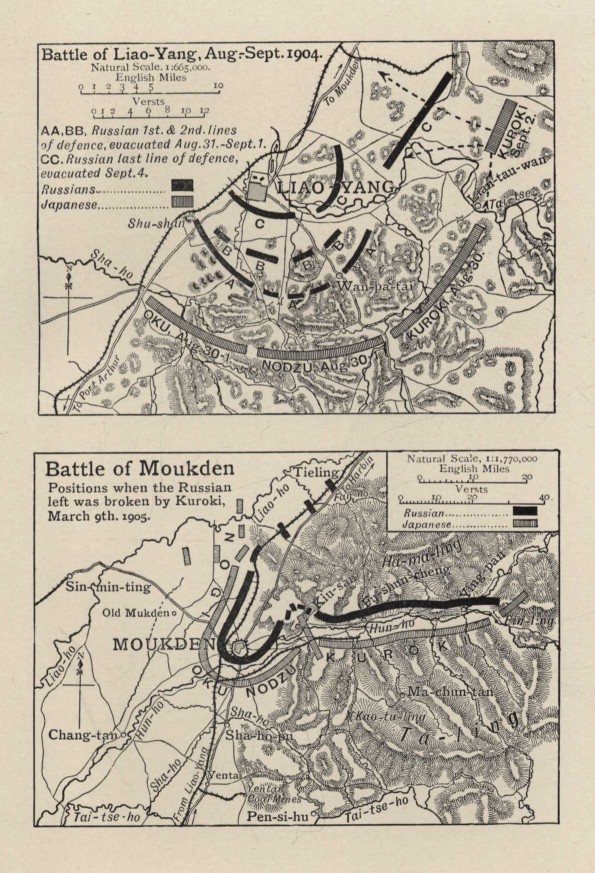
Map of Battle of Liao-Yang, Aug-Sept. 1904. Map of Battle of Moukden.
"My no aflaid this-time, masta; allo-same my tinkey no hab look-see bobbely yet; what-time guns makee big bang-lo, that-time masta talkee 'bout Sin Foo he belongey aflaid."
"Vell, you muss screw your gourage to ze shticky place, for vizout doubt ve shall be in ze midst of schrapnells. It insbires me: I breeze deep. I zink of my ancestor Hildebrand Suobensius, a great fighter, a Landsknecht, in ze Middle Age. Vun say zat I am ver' like."
Herr Schwab struck his chest, and continued:
"It is in ze blood. Zerefore vake me early in ze morning; ve shall be early out to secure a goot blace."
But there was no need for Sin Foo to wake his master. Before day had fully broken, Herr Schwab was shocked from his sleep by the boom of heavy guns—the opening of a cannonade that broke the paper windows and set the crockery rattling. Springing up, he bade Hi Lo saddle the two ponies, and, stuffing some biscuits into his pocket, set off with Jack and the camera, leaving Hi Lo to guard the house.
He led the way to the north-west of the town, past the reservoir and the brick-built government offices near the railway-station, which was already crowded with officers scanning the horizon through their binoculars. On the previous night he had marked a solitary hill, known as the Shu-shan, some distance south-west of the city, as an ideal place for a general view of the battle-field. An old Korean signal-tower crowned its summit; it was approached on two sides by easy slopes, but on the north was precipitous, its rocky face cut by ravines dark with overhanging clumps of firs. At the western base a battery of artillery was posted.
Arriving at the hill, Schwab saw that it was impossible to ride up its northern face, while to ascend on either side would be to court death from the Japanese shells. But in his zeal on behalf of the Illustrirte Vaterland he was determined to gain the summit. Hitching the pony's reins to a tree, he bade Jack follow him up the steep acclivity nearer the road, warning him to be very careful of the camera. After a stiff climb they, panting, reached the top. Just as they appeared there was a prolonged whistle followed by a sharp crack; the new-comers were assailed with loud shouts; several hands seized upon Schwab and forced him into a trench cut in front of the tower, and rough Russian voices informed the puffing German that he had narrowly escaped a shrapnel. He did not understand what they said; but Jack, who had slipped into the trench behind him, whispered:
"My tinkey this plenty nasty place. Japanese he shoot too stlaight."
Herr Schwab mopped his face with a red bandanna and glanced somewhat nervously around. But the shock wore off, and finding himself to all seeming well protected, his courage soared into antiquity.
"My ancestor, Hildebrand Suobensius——" he began.
There was a shriek above him; another shell had burst but a few yards away. He dropped flat in the trench. Twisting his neck until one side of its fleshiness was creased with deep furrows, he said:
"Tell me, boy, do you see any more shells goming?"
Jack peeped cautiously over.
"My no look-see no mo'e, masta. He come long-long chop-chop all-same."
Schwab slowly rose to his knees, again mopping his brow.
"Zis is most terrible. Never did I zink zat var vas such a business! Gnädiger Himmel! vy haf I gome? Boy, I haf a bresentiment." His voice sank on a tragic note. "I feel it here." He laid his hand on the lower buttons of his ample waistcoat. "I, Hildebrand Schwab, shall vizout doubt be killed." He wrung the bandanna out. "Listen, boy, gif notice: ven I am killed you shall send all my goots to Schlagintwert Gompany in Düsseldorf, all egzept ze letter to Schneiders Sohne, vich gontain order for vun dozen trouser stretchers for General Belinski; zat you shall bost. And listen, boy:"—here his voice sank to a confidential whisper—"in my writing-desk zere is a visp of my hair tied up viz bink ribbon, and a boem, a boem of lov; zese you vill send to ze Frau Jane Bottle, at ze address on ze envelope, and you vill register ze packett. Yes—and insure it—you shall insure it for hundert dollars."
Herr Schwab sighed deeply, at the same time keeping an eye on the direction whence the last shell had come.
Another shrapnel burst a few yards in his rear. He groaned, lamenting bitterly. The men of Stackelberg's 1st Siberian Infantry paid no attention to him; in the trench they were secure. General Stackelberg himself was at the other end, grimly peering through his glasses over the epaulement.
Suddenly the projectiles ceased to pass over them. Jack ventured to raise his head and scan the surrounding country. Before him stretched a plain dotted with villages, the fields covered with the waving green stalks of kow-liang. On the crests beyond, some two miles away, lay the batteries of the Japanese; their infantry was swarming in the intervening level, but concealed by the kow-liang. To the left, separated from the Shu-shan hill by the An-shan-chan road, was an irregular line of lower heights, stretching as far as the eye could reach and out of sight. Here were posted the main forces of the Russian infantry, ensconced in cunningly devised trenches. In every gap between the rocky hills batteries were placed, concealed by every possible device. To the west of Shu-shan the Russian cavalry, with a portion of the 1st Siberian Army Corps, was stationed to protect the railway and the right flank. Behind, between the hills and the town, large forces of infantry were held in reserve, with the hospital tents and field ambulances. Temporary lines of rail had been laid from the station to the rear of the hills, and on these trolleys containing ammunition were pushed along by men.
Jack explained as much of the position as he could see to Schwab, who, in the security of the trench, took diligent notes, for reproduction in the Illustrirte Vaterland as first-hand evidence.
"But tell me, boy, do you see General Kuroki? I do not lov General Kuroki; he ill-use me, he gif me vat zey call beans, ven I vas in Korea last year. Is he in sight?"
"My no can look-see one piecee Japanese. Allo hidee inside kowliang."
"So! I make a note of zat. All ze Japanese hide. Ver' goot."
Jack now became aware that General Stackelberg was standing erect at the end of the trench, fully exposed to the Japanese gunnery. The general, in hooded cloak, wearing white gloves, spick and span as if on parade, was calmly sweeping the plain with his glass, issuing orders, dictating telegrams, slowly, deliberately. Shells again began to fly around; but Stackelberg, summoned to the telephone installed behind the tower, walked erect towards the spot heedless of a shrapnel that burst within a few yards of him, bespattering his clothes with black dust. Jack felt a thrill of admiration; the general was giving the lie to the slanderers who said that at Wa-fang-ho he had skulked in his carriage.
Now the sharp crackle of musketry was mingled with the shrieking of the shells. Long lines of Japanese were threading their way through the fields, endeavouring to turn the Russian right. Stackelberg marked the movement; he gave an order; the Russians in the trenches sprang to their feet and ran down the slope to reinforce the threatened position. Rain began to fall, and Schwab raised his head from the trench.
"Ach! it rains. Vill it shtop ze battle, zink you?"
"My no tinkey so," said Jack. "Japanese, he fetchee plenty big guns; he come this-side chop-chop."
"Ach, ich Unglücklicher!" Schwab hastily dropped back into safety. "Nefer shall I leave ze Vaterland again. But I shall not return; Düsseldorf shall zee me no more; no; I haf a bresentiment; I feel it here."
Jack, following the movement of his employer's hand, made a suggestion.
"P'laps masta he belongey hungly; p'laps he want-chee chow-chow." He offered him a biscuit.
Schwab shook his head dismally.
"No, no; I haf no abbedide."
"My eat he."
Nibbling the biscuit, Jack, in a lull of the firing, ventured to leave the trench. A moment later he called to Schwab.
"My hab catchee one-piecee pictul. Japanese lunning long-side kowliang; littee littee black t'ings inside gleen stalks."
"Gott sei dank! I shall not die vizout agomblishing somezink for ze Vaterland. Ach! zere is anozer!"
There was a gentle sound overhead, like the cry of a wounded bird. An aide-de-camp crossing the hill-top fell with a groan. A bearer-party marked with the Red Cross appeared from behind the tower and swiftly bore him out of sight.
Schwab flattened himself as much as his rotund form permitted against the floor of the trench. The cannonade was resumed with redoubled fury. The din was incessant; shells whistling and shrieking; musketry crackling; the Russian batteries in their emplacements thundering as they replied to the Japanese.
Whole ranks of the Japanese were mowed down in the fields; still they pressed on. They were attempting to turn the Russian right. Reinforcements were hurried to the threatened regiments; battery answered battery; the ground trembled under the repeated shocks. The attack was repulsed, and long blood-stained tracks marked the path of the bearers as they conveyed thousands of wounded to the rear. Stackelberg had held his own.
Dusk was falling, the rain ceased, and a steaming mist rose over the ground. There was a lull in the firing. Jack stood upon the epaulement. To the left he saw a village in flames.
"My hab catchee nuzza velly good pictul, masta," he said.
"Goot boy! Zink you it is now safe for me to shtand opp?"
"My tinkey so. He fightey man tinkee hab plenty nuff."
Schwab got up slowly on his knees, peered over the edge of the trench, then stood upon his feet. He was beginning to regain his spirits.
"So! Famos!" he exclaimed. "I see all ze whole fielt of battle; I see burning villages, black fielts, hundert or tousand dead men. Zis is var. Vat a—vat a"—Herr Schwab was at a loss for words—"vat a zink is var!" He threw out his chest and snuffed the smoke-laden breeze. "But I muss go and describe ze battle for my journal, illusdraded viz photographs taken by a Gairman sobjeck on ze sbot. My ancestor Hildebrand——"
They were turning to walk down the hill; a belated shrapnel shell burst within a few yards of them, peppering the ground in all directions. A splinter shaved off an inch or two of the leather cover of the camera. Schwab cut short his reminiscence by dropping flat upon the rain-soaked ground. When he arose, a pitiable object, after a short period of self-communing, without further words he hastened towards the path.
Another shell crashed upon the rocks to the left, hurling a lofty fir-tree into the ravine.
"Ach! gome alonk, gome alonk! Ve shall be killed. Let us go to find our bonies."
Scrambling down to the spot where they had left the animals, Schwab uttered a woeful cry; they had disappeared. A Siberian infantryman was passing; him the German interrogated. But the Russian shook his head; he knew no German. Jack ventured to question him in broken Russian.
"Yes, I did see two ponies. A Chinaman led them. That was long ago."
"He say-lo China boy hab catchee two-piecee pony, wailo long-time."
Schwab lifted up his voice in bitter lamentation. It was growing dark; the ground had been made a miry swamp by the rain; there was no alternative but to tramp back through it to Liao-yang. They reached the mandarin road. Their feet sank ankle-deep in mud; at every step they almost left their boots behind. Long stretches of the road were under water. Carts were passing drawn by long teams of mules. Schwab tried to bargain for a seat, but the drivers refused to listen to him; their loads were wounded men, who at every jolt uttered heart-rending moans. Jack suggested that they should leave the road and cut across the fields to the railway; they would find the embankment easier walking. This they did, pursued, as it seemed, by the whistling bullets of the Japanese. At length, unharmed, untouched, they reached the northern gate, and, entering, made their way all bemired, weary and famished, to the cottage where Hi Lo awaited them.
CHAPTER XII
The Retreat from Liao-yang
Rifle and Bayonet—Kuroki—Schwab's Strategic Movement—The Moukden Road—At Yentai—One of the Wounded—Pawns in the Game—Our Friends the Enemy—Story and Song—Schwab Smokes
Next day dawned bright and clear. The fusillade had continued almost throughout the night, and the Japanese had made repeated assaults on the Russian trenches in the centre, only to be driven back every time with enormous slaughter. The first day's battle had no decisive result; the Japanese had failed to dislodge the Russians from any part of their line of defences. Jack was eager to go out again; his excitement had been kindled by what little he had been able to see of the opposing movements; after the first tremors, the shriek of shells and whistling of bullets had left him unmoved, and he was all afire to witness the continuation of the great struggle. But Schwab absolutely refused to budge.
"It vas not a bresentiment," he said. "It vas a bileattack. Zose shells, zeir schmell vas vorse zan Schwefelwasserstoffgas—I forget ze English name, but ze schmell is ze same; it is a schmell of eggs suberannuated. I suffer egstremely. Besides, zey haf shtole my bonies. And vat do I discover? I discover a damage in ze ubber egstremity of ze camera. Vy you tell me nozink about zis? I discover it, I say. Who done zat? Vy you bermit it? It is not business: it annoy me egstremely. I lose many dollars ven I shall gome to sell ze photographabbaratus. My gustomers vill now see it is not new. Venever I zink of it I suffer bile. I go not again to zis battle, no more does ze camera; I vait for ze next. I vill stay and cure ze bileattack. You shall see ze battle; I vill take notes ven you return."
Jack had no intention of running unnecessary risks in order that Schwab might make "copy" out of his experiences. But he made his way towards the railway-station, expecting to obtain from the embankment as good a view as was possible without venturing again on the shell-swept hills. His choice was fortunate, for it happened that the closest fighting of the day took place west of the railway. General Oku had made up his mind to force this, the weakest spot in the Russian position. While, therefore, General Nodzu in the centre was repeating the first day's bombardment, the Russian right, throughout the day, was the scene of as terrible a series of infantry attacks as the world's history has known. Time after time the Japanese advanced to storm the trenches; time after time they were mowed down by the pitiless bullets of the enemy; but again and again they returned to the charge, recking nothing of death or wounds, thinking it a privilege indeed to end their lives in their country's cause. On both sides the bayonet did its fell work; at one point a trench was captured by a company of Japanese, but their ammunition was spent, they were unsupported, and their plight being perceived from a Russian trench a hundred yards distant, they were bayoneted to a man. As the hot day wore on, the Russians were driven back against the railway embankment; streams of wounded, their cries of agony mingled with the horrid sounds of war, flowed incessantly towards Liao-yang; and when sunset put an end to the firing, the bearer-parties went about their awful work on the battle-field.
Except for the slight impression made on the right, the Russian position was intact. The Siberian regiments had held their own with splendid tenacity, and were almost recompensed for their terrible sufferings by the message of thanks from General Kuropatkin, who had witnessed their heroic resistance from his train beyond the railway-station. Jack started to return to Schwab with the impression that the force of the Japanese attack was broken, and that on the morrow the Russians would take the offensive. The day closed with a terrible rain-storm that turned the fields and roads into a quagmire. The streets of the city were thronged; soldiers, Chinamen, camp-followers, pedlars improving the occasion, all jostling one another in noisy confusion.
Standing at the door of his cottage, Schwab hailed an American correspondent who was passing just as Jack appeared.
"Is ze battle finished gomblete?" asked Schwab eagerly.
"Yes; the Russians have won. It is their first victory. I am on my way to telegraph the news to New York—if I can get a wire."
"Zen I vill write my account of ze closing scenes," said Schwab to Jack. "To-morrow, if ze sun shine, you can take more pictures of ze Japanese defeat."
But half an hour later the American looked into the house on his way back to his own quarters.
"I was mistaken, Schwab," he said; "it is not a victory after all."
"Eh?" said Schwab, looking up from his papers.
"The Russians are leaving their positions; evacuation has begun."
"Himmel! Vat is ze meaning of zat?"
"Kuroki has crossed the Tai-tse-ho, and is threatening our communications. You had better clear out."
Schwab might well be amazed. During the desperate and persistent attacks on the Russian right and centre, General Kuroki had crept steadily round their left, and forced a passage at a ford twenty-five miles east of the town. The news, as conveyed to Kuropatkin, was that the Japanese general had four divisions; he had, in truth, only two; and, misled by the exaggeration, Kuropatkin had felt it necessary to detach some of the seasoned Siberian regiments from Stackelberg's command in order to reinforce the less trustworthy European corps whom Kuroki was attacking. But the American was mistaken in speaking of evacuation. The commander-in-chief had only decided to abandon his advanced position, which had always been too widely extended for effective defence, and to withdraw his forces to the inner entrenchments, forming a large arc almost encircling the town, and resting at each end on the river.
Overpowered by the terrors of "war that was real war", Schwab was goaded into feverish activity by the news of the withdrawal. His own pony was gone; so was Jack's; but Hi Lo's remained, and this the German ordered to be instantly prepared for himself. Whether the interest of the Schlagintwert Company or the safety of his own rotund skin was the more important consideration did not appear; but it is certain that, within half an hour after receiving the news of Kuropatkin's order, Schwab was riding as fast as the congested traffic would allow towards the north. He carried the precious camera and the negatives with him, leaving the tripod with Jack.
"You muss shift for yourself," said he at the moment of leaving. "You and Hi Lo muss gome on behind. I muss go qvick; it is a matter of business. Vun bony vill not carry zree, and if I do not arrive in Moukden before ze Russians zere vill be no money left to bay your vages. Take most egstreme care of ze dribod."
Jack was not ill pleased to see the back of his employer. In other circumstances he might have been amusing; as it was, he was a trial of patience.
"I think we will wait till morning," said Jack to Hi Lo. "I am not sure all is over yet. In any case the Japanese won't come into the city in the dark; the firing has stopped; and we shall see our way better by daylight."
So they stretched themselves on the k'ang and slept until the dawn. When they arose it was obvious that Schwab's flight was premature. True, the roads northward were crowded with fugitives, but they were in the main natives; the Russians held their positions; and Jack saw a fine regiment marching, not northward, but southward, in the direction of the enemy, singing the Russian national anthem with a spirit that little betokened a failing cause. But Jack felt that Schwab would expect his two servants to follow him; he would be helpless without them. The exodus from the city was already so great that it seemed best to go northwards by the pontoon bridge while it was possible. He therefore started on his way back to Moukden. Hi Lo had managed to secure a mule—Jack did not enquire how; and on this, with the boy trudging by his side, Jack crossed the river by the pontoon and gained the mandarin road.
He found himself in a scene of terrible confusion. The road was blocked with vehicles of all descriptions,—droshkies, Pekin carts, ammunition wagons, country carts with their unwieldy teams; and crowds of camp-followers and Chinese tradesmen. Drivers were shouting, soldiers cursing, women shrieking. Chinamen staggered along with poles over their shoulders, a basket slung at each end containing a child barely awake, but laughing with glee at what seemed to its innocence a novel and pleasing adventure. Women passed, bent under heavy bundles containing their household gear; carts were heaped with bits of furniture, ambulance wagons with wounded and dead; here was a soldier leading a little donkey with a battered drum upon its back, there a farmer whose clumsy cart was filled with cackling ducks and squealing pigs. Now an axle would break, and the contents of the wagon were scattered over the ground; now the wheels of one cart would become locked with those of another, and the tangled teams plunged and kicked in the mud. Then the uproar became still more furious; riders, careless of what damage they might do, pressed their horses through the throng in haste to make good their escape from the terrible shells whose coming was announced from afar. The Japanese had begun to bombard the station.
Jack saw that he had little chance of making his way through the crush. Calling to Hi Lo, he turned aside into a field of kowliang, already trampled, and rode on over the ruined crop. In the distance, on the left, he caught sight of train after train steaming northwards. Behind, dense clouds of smoke obscured the city: the Russian quarter of Liao-yang was in flames. Ever and anon a detonation shook the air, and by and by the whistle of bullets was heard; the Japanese had occupied the Shu-shan hill, and with their terrible long-range weapons were firing into the Russian settlement.
The fourteen miles from Liao-yang to Yentai took Jack six hours. It was evening when he arrived—too late to go farther; and he put up for the night in a ruined hut. Russians were massed in the town, and covered the slopes towards the mines. The Russian left wing had been driven back in this direction, and it was to reinforce the hard-pressed troops here that Kuropatkin had withdrawn Stackelberg with his Siberians. But it was too late. Next day Kuroki flung his divisions upon the Russian entrenchments. At a critical moment General Orloff, professor in a Russian military college, attacked, contrary to his instructions. The Japanese hidden in the kowliang awaited the onset, then poured in a terrible fire, which threw the first regiment, composed of raw recruits, into confusion. They broke and fled; the regiment behind, prevented by the high stalks from seeing what had happened, opened fire upon their own comrades; a third was led into the same fatal error; and the entire left wing, bewildered, disorganized, sought safety in flight. Yentai was filled with the Russian wounded; surgeons, with coats off and shirt sleeves tucked up, went about their work in the open streets; the air was filled with the screams and groans of men in agony.
Jack hurried through the town, and came again into the open country. A mile north of the town he overtook a bearded veteran crawling painfully along; he was wounded in the chest. He looked with haggard, covetous eyes on Jack's mule; his face was drawn and white; sweat was streaming from his brow. Jack stopped and sprang to the ground.
"Get on my mule," he said in Russian. "Hi Lo, help me to lift him up."
The man broke into sobbing exclamations of thanks. Supported by Jack on one side, by Hi Lo on the other, he rode on during the rest of that hot day. At dusk they entered a straggling village, and Jack was thinking of looking for a shelter for the night when a rough voice from a cottage cried:
"Ach, Strogoff! come here, comrade."
"Nu, Chapkin," said the wounded man. "I am wounded, old friend."
Jack led the mule to the door, and helped to carry the man into the cottage. It had been appropriated by a group of Russian soldiers who had become separated from their regiment. They received their wounded comrade with rough expressions of sympathy; and, learning from him of the Chinaman's kindness in lending his mule, they invited Jack and Hi Lo to stay with them. Jack was nothing loth. He shared his few remaining biscuits with the men, and sent Hi Lo out to buy some fruit if possible.
The boy returned with some pears and peaches, which formed a welcome addition to their black bread and cakes of buckwheat.
Sitting on the k'ang, Jack was an interested listener to the soldiers' talk. He did not understand all they said; they were simple moujiks, whose broad dialect was not easy to follow; but he picked up a good deal of their conversation.
Strogoff had to relate how he had received his wound. His story was long in the telling, punctuated by many an "Ach!" "Och!" "Eka!" "Nu!" from his comrades.
"Ach!" he concluded, "the Japanese are fine fellows, but they are too little to use the bayonet. A bigger man would have made a better job of it, and I should be dead now."
"Da! But you'd rather be alive, Strogoff?"
"How can I tell, Kedril? Will the doctors be able to mend my wound?"
"Not if they're such fools as the generals," grunted Kedril, a big, shaggy rifleman who had lost an arm.
"True, there are some fools among them. But better be a fool than a knave, like the commissaries. Why, half the biscuits served out to us to-day were full of maggots, and my boots—look at them!—are made of paper. Do you think the Little Father knows how we are cheated?"
"No, no; the Emperor does not know, Almazoff. He would not suffer these evils if he knew them. Nu! he cannot be everywhere, like the Lord God."
"Things will be better some day. We've done our part, little pigeon. But the Emperor would not like it if he knew what lies they have told us. Why, they said the Japanese were dirty little men like monkeys; but they're cleaner than you and me, Strogoff."
"And they said they walked with their heads downwards."
"No, Chapkin, that's the English. They say the English walk upright in their own country, but when they go to another place of theirs called Australia they turn upside down and walk on their heads."
"That can't be true, because Australia belongs to Germany. It's a part of America, I believe."
"Nu! America belongs to England, so I dare say I was right after all. Anyway, the Japanese walk on their feet like us, and they fight well. I wonder what made them so angry with us?"
"I don't know. What do we get angry about when we're at home? Perhaps the Little Father called the Emperor of Japan a sheep; if you called me a sheep I should fight you; but emperors can't fight; of course not, for they've no one to give them orders except the Lord God, and He couldn't give orders to both at once."