BROWN OF MOUKDEN (continued 5)
Reading edition
Jack thus found himself lieutenant in a regiment of some twelve hundred men, armed for the most part with Mausers, and well mounted. Except for a wholesome dread of their chief, however, they had very little discipline, and but scant military cohesion. Although there was no lack of arms and ammunition, Ah Lum was not too well provisioned. He had been driven by the encircling Russian movement into a somewhat poor district, the hills being more fruitful in forest trees than in grain. The valley of his encampment was fertile enough, but its products would soon be exhausted, and it was separated from the grain-bearing plains to the west by a chain of barren heights. The bandits were being driven farther and farther into the mountainous regions, where it would become increasingly difficult to feed so large a force. Messengers had recently come in, reporting that Russian troops operating on the northern frontier of Korea were pushing reconnoitring parties into the hills in their rear with the object of locating them. There were many smaller parties of Chunchuses scattered over the country, but Ah Lum's was the only considerable band left in the angle between the two railway lines connecting Harbin with Kirin and Vladivostok respectively. The lull after the battle of Liao-yang had enabled the Russians to devote more attention than heretofore to clearing their flanks of these troublesome irregulars. Ah Lum was well served by scouts, the country people being anxious to purchase immunity by giving such information as they could without risk; and from them the chief had learnt that the largest force opposed to him was at this time about two marches away. Some days would probably pass before they came on his trail. It had been throughout the war the Russians' experience that the Chinese were very reluctant to give them news of any kind, and this reluctance had been still more marked since the unbroken success of the Japanese had become common knowledge through the country.
Day after day passed, and the bandits were still left unmolested. Jack, settling down to his new position, had his hands fully occupied. He gave Ah Fu lessons in English daily, to his father's great delight. But he had wider scope for his tutorial faculty. He had felt a little natural amusement at the idea of being placed—he, a civilian, with just as much military experience as his school drill-ground and some practice at the butts afforded—in command of a troop of warriors—a motley horde, indeed, but all seasoned, determined, fearless fellows. But, as was inevitable in a force indiscriminately recruited and entirely lacking in regular training, the men had much to learn; and Jack had not made a whole-hearted study of the Boer war without feeling that, civilian though he was, he was better acquainted with the general principles of warfare than possibly any other member of the band. The Chunchuses were little accustomed to organized movements on any considerable scale; they were most adept in sniping at single travellers or small bodies whom they could attack unawares from the vantage of cover. Something more was required if they were to defeat the serious attempts now being made to crush them, and Jack was determined to show himself worthy of Ah Lum's confidence by his manner of handling his own division of two hundred and fifty men.
Marksmanship and cover: these he took to be the principal factors in modern warfare. So far as the use of cover was concerned, he found that his men had little to learn; several months of hard fighting against troops carrying arms of precision had enforced the value of cover in the most practical way. In each engagement the Russians had taken toll of those who failed to recognize its importance: their bodies lay among the hills from the Yalu to the Sungari. But in marksmanship the Chunchuses were not so efficient. A large proportion of them had never handled, perhaps never even seen, a rifle until they joined the band. Without definite instruction they were apt to blaze away at their own will and pleasure, absolutely reckless of the wastage of ammunition, which had hitherto, owing to one or two lucky raids, been plentiful. Jack suspected that the proportion of hits to misses was woefully small. He therefore set earnestly to work to effect an improvement in this respect. He rigged up butts, put every man in his command through a course, and, taking advantage of the Chinaman's love of competitive examination, started a shooting competition, with badges of different form and colour for the prizes. This especially pleased Ah Lum; it aroused a keen spirit among his men; the example of Jack's division was soon followed by the rest, and the general proficiency was very largely increased.
Among Jack's men were the greater part of the company he had rescued. One of them was Hu Hang, the ex-constable. This man showed extraordinary skill with the rifle. As Hi Lo said:
"Policeyman he can shootee allo plopa first-chop what-time no piecee man he shootee back."
This was a somewhat caustic remark; but Hi Lo had no love for the constable, who indeed was not popular among the band. His comrades would have been hardly human if they had not made the most of their opportunities of paying off against Hu Hang the scores that many of them owed to members of his hated class. He kept a good deal apart, finding a congenial soul only in C'hu Tan, the former second in command, who had been deposed for grave neglect of duty, and replaced by Wang Shih. The two malcontents were often together, condoling with each other on their wrongs; and their animus against Wang Shih extended to Jack, who struck them as an additional supplanter, the more hateful from being a foreigner. Jack knew nothing of this himself; but it did not escape the shrewd eyes of Hi Lo, who kept quiet and unobtrusive watch upon C'hu Tan, dogging him at every turn.
After a fortnight's steady practice Jack felt that the fighting value of his little force was well-nigh doubled. But at the end of that time Ah Lum suddenly ordered the rifle practice to be stopped. A scout had reported that the Russians had approached within striking distance, and the chief feared lest the sound of the firing should betray his whereabouts.
At last one morning, after hearing a messenger who came in faint and gasping after a long night's ride, Ah Lum felt that the coil was being drawn too tightly around him. He gave a sudden order to decamp; the band quitted the valley that had sheltered them so long, and set off into the hills. Lack of provisions was beginning to be felt. The ponies, hardy little animals, were able to pick up a subsistence on the hillsides, sparse though the grazing was at this time of year; and for them stalks of kowliang could always be obtained as a last resource. But the supply of rice and buckwheat, on which the men depended, was running short. Ah Lum somewhat dismally told Jack that it would now be necessary to reduce the rations. He confessed that he was in a tighter place than ever before. At no time previously had the Russians made such determined efforts to crush him. In addition to the Korean frontier force far to his rear, which for the present need not be reckoned with, there were, as he had learnt, three large forces of Cossacks, each stronger than his own band, converging upon him from north, east, and west. General Kuropatkin had hitherto been able to make little use of these characteristic cavalry of the Russian army, so that they were available for the less dignified but very necessary work of bandit-hunting. The three forces directed against Ah Lum were still a considerable distance apart from one another, but it was clear to him that in a few days he would have to try conclusions with one of them before they got into touch. He had only escaped this necessity so long because the Cossacks were unaccustomed to hill work. Matchless in rapid furious charges on the plain, they had shown little capacity for mountain fighting or even for scouting; and, as Jack learnt afterwards, they were desperately chagrined at their hard luck in having so few chances of the kind of work that suited them.
The Chunchuses marched for several days into the hills, their condition going from bad to worse. The rations were verging on exhaustion. The Cossacks were no doubt well supplied, and Ah Lum felt that the moment had come for an attack on one of their forces. The nearest was only a long march distant. Breaking up his camp early one morning, when the night's frost lay white on the ground, he led his men across the hills northward, and, proceeding with great caution, located the enemy late in the afternoon. Throwing out scouts in advance—men intimately acquainted with the country—he sighted the Cossacks before they sighted him, and at once fell back behind a forest-clad ridge so that his presence might not be discovered that day. During the night his scouts reported, apparently by a calculation from the enemy's watch-fires, that the Cossacks were at least a thousand strong, and thus about equal numerically to Ah Lum's effective force, with the advantage of better discipline and training. But the chief, in common with all his countrymen, had shrewdly studied the invaders; he had not been blind to the Cossacks' failure in the war, and he was hardly the kind of man to allow himself to be terrorized by the mere name of Cossack, the effect of which was due merely to the memory of past exploits when the conditions of warfare were different.
An hour or two before they sighted the Russians, the bandits had advanced through a narrow pass, enclosed between steep and rugged bluffs. Upon this pass Ah Lum decided to fall back; it offered every advantage for an ambuscade. Withdrawing thither during the hours of darkness, he allowed his men a brief spell of sleep; then, while the dawn was yet but a glimmer, he set them to fell trees in the copses that crowned the hills, and to pile them across the pathway at the far end. It was still early when he placed half his men in cover upon the heights overlooking the track; the rest, consisting of the divisions of Wang Shih and Jack, were sent to threaten the Russian rear. A mist hung over the hills; it was bitterly cold, and the ponies often slipped on the frosty ground. Luckily Wang Shih had with him a peasant of the neighbourhood who acted as guide. But for him the Chunchuses could hardly have found their way.
It was but an hour after daybreak when they found themselves on the right rear of the Russians about two miles from the latter's camp. Wang Shih's orders were to wait until the Cossacks had advanced to the end of the pass and been checked by the ambuscade there. Then, before the enemy could recover from the confusion into which they would be thrown, he was to follow up rapidly in the hope that a movement seeming to threaten their line of retreat might complete their disorder. He therefore waited until, from a secure hiding-place, he saw them quit their camp and march out. Then he moved his men with Jack's down the hill somewhat closer to the enemy's line of march, and awaited the sound of firing in the distance that would announce the beginning of the fight at the ambuscade.
Meanwhile Jack narrowly scanned the surrounding country. The mist had cleared away, and a bright cold October sun was painting the distant hills with various charming tints. Suddenly Jack's attention was attracted by a dark, narrow, tape-like something moving down a slope far to the north-west. Before many seconds were past he was convinced that it was a body of horsemen. The question was, what horsemen? In the distance their character could not be distinguished; the one thing certain was that they were not Japanese, for their clothes were very dark; the Japanese were wearing khaki. They were scarcely likely to be Chunchuses; from their regular even progress Jack concluded that they could not be native carriers; surely they must be a second body of Cossacks who had advanced by forced marches to co-operate with those now approaching the ambush.
Jack had moved some little distance in advance of his troop. What he had seen sent him in haste to rejoin Wang Shih.
"We must get our men under cover," he said. "There are Cossacks, I believe, descending the opposite hills. They may not have seen us yet."
The Chunchuses moved within cover of the nearest trees, and Wang Shih sent forward his keenest scout on foot to ascertain whether the new-comers were enemies or friends. He returned in a few minutes declaring that even at this distance he had distinguished the characteristic head-dress of the Cossacks. Wang Shih was disposed to remain in cover until the time came for him to carry out Ah Lum's orders. In his present position he ran little risk of being seen by the oncoming party, and being entirely without imagination it did not occur to him that the situation was now perhaps radically altered. But to Jack the discovery seemed to be serious. The line of advance taken by the second body of Cossacks would bring them within an hour across Ah Lum's rear. The position had been strangely reversed. While Ah Lum believed that Wang Shih was cutting off the retreat of the first body, his own rear was in process of being threatened by a force twice as numerous as the one he could dispose of. He was probably in ignorance of the danger, for the advancing Cossacks were shut from his view by the contours of the hills, and there was little likelihood now of a warning being conveyed to him by a Chinese villager. It was impossible for a messenger to reach him from Wang Shih, for the first Russian force lay between.
Jack pointed out to Wang Shih the peril in which his chief lay. The Chunchuse admitted it, but asked what he could do. With his assistance Ah Lum might beat the first body of the enemy before the second could arrive, and then could turn his attention to it in its turn.
"But suppose the fight takes a long time? And suppose we do not succeed in beating the first Russian force? If they hold us until the second arrives, Mr. Ah's men will be attacked from the rear, and they will certainly be crushed between the two."
"It is as you say. But the chief has given me orders; he will be angry if I disobey. It is better to carry out orders."
It was evident that Wang Shih was disinclined to assume any responsibility. Jack was by no means satisfied that things must be allowed to take their course. It appeared to him of the utmost importance that the second Russian force should be held in check until the first had been disposed of. He went through the clump of bare trees until he reached the summit of the crest, and looked anxiously towards the advancing band.
About a mile away the hill path it was following disappeared in a cleft in the hills, reappearing a quarter of a mile farther on. It seemed to Jack that at this spot, resembling somewhat the position Ah Lum had taken up, it was possible to hold the Russians in check. So far as he could see, there was no better place along their route for such an attempt, and he instantly made up his mind that the attempt must be made. It was doubtful whether the Chunchuses could reach the cleft in time to occupy it before the Cossacks arrived, but there was a bare chance, and he resolved to take it.
Hastening back to Wang Shih he explained that he proposed with his own division of men to make for the cleft, leaving the rest to carry out Ah Lum's instructions. Wang Shih raised no objection; he merely stipulated that Jack should accept the full responsibility for his action. In a few minutes, therefore, Jack rode off at the head of his band; almost immediately after starting he heard the dull sound of firing in Ah Lum's direction; the fight in the pass had begun. Clearly there was no time to lose, for the same sound would certainly quicken the approach of the second body of Russians.
Keeping down the hill in order to screen his movements as long as possible from the enemy, Jack led the way at as rapid a trot as the rugged ground allowed. Only a few minutes had passed when the little force rode out on to the open hillside, where they must be seen by the Russians. Jack fancied that the enemy was at this time nearer to the cleft than his own men; but the Chunchuses were riding downhill, the Russians up, which gave room for hope that he might reach the position first. He was helped also by the more open character of the ground on his side, and by the fact that for some time the Russians failed to recognize the object of the horsemen riding at full speed towards them. During these precious moments Jack's party gained several hundred yards. Keeping one eye on the rough ground and the other on the enemy, Jack noticed that the leading files broke from a walk into a trot and then into a headlong scramble. It was now neck or nothing. Throwing caution to the winds, he dug his spurs into his pony, and clattered at breakneck speed down the slope, the Chunchuses hard at his heels. Several ponies stumbled and came to their knees, flinging their riders; but the rest, intoxicated with the excitement of the race, rode unheeding after their leader. A dip in the ground now hid the two forces from one another; they would not again come in sight until the cleft was reached. Between the Chunchuses and the point they aimed at lay a comparatively clear space, dotted by a few single boulders without any of the smaller stones that for most of their ride had impeded their progress. Now Jack urged his panting steed to a mad gallop; the quarter-mile was covered in a few seconds; he dashed into the cleft, the foremost of his men but a length behind.
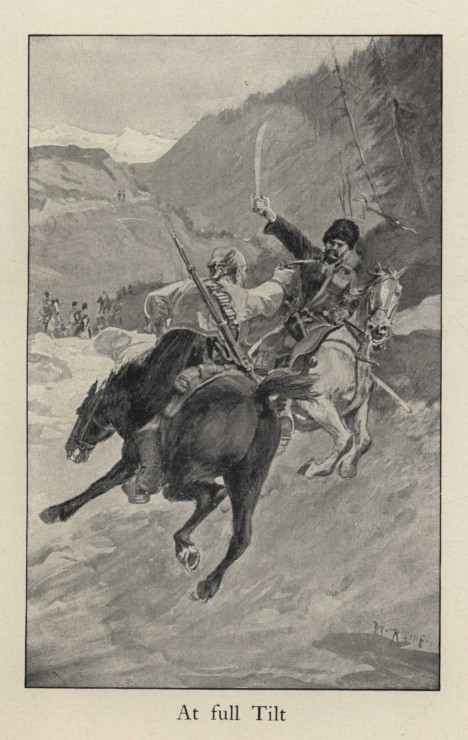
At full Tilt
Eagerly he peered ahead through the narrow tortuous passage. None of the Cossacks was in sight. He galloped on, hoping to reach the other end before they arrived; it would be easy to hold the entrance against them. He had almost reached the farther opening when he came full tilt on the leading Russian horseman, a Transbaikal Cossack riding with loose rein, pistol in hand. He was some twenty yards in advance of the troop. In the heat of the race Jack had not anticipated the chance of a fight on horseback. Before he could draw his pistol the Russian had fired: the bullet whizzed harmlessly past Jack's head. With astonishing dexterity the Russian whipped his sword from the scabbard; by the time Jack had his pistol ready only a few yards separated the two. Then Jack fired; the Russian's uplifted sword dropped from his hand, and the ponies came together with a thud. Both riders fell to the ground, Jack being thrown lightly on the slope to the right, thus fortunately escaping the hoofs of the ponies following. He arose dazed, saw a confused mass of men in front of him, heard shouts and the crack of pistols. Pulling himself together, he ordered his men to dismount and line the sides of the gully. In an instant some scores of them were scrambling up the bluffs on both sides, leaving their ponies to be gradually passed to the rear by their comrades.
The men in front, finding themselves unsupported, began to give way, but slowly and stubbornly. As the Russians could only advance two abreast, and that with difficulty, two or three precious minutes were gained, during which the crests of the slopes on either side were manned by the Chunchuses. Now Jack gave the word to open fire. His men were breathless; their limbs were quivering; and their hasty ill-directed shots did little execution. But several horses and men fell in the Russian van; the pressure on the mounted Chunchuses who were stemming the Russian advance was reduced; and then, as the marksmen steadied and took deliberate aim, a hot and deadly fire was poured into the enemy's ranks. The Russians made an attempt to reply, taking advantage of cover where they could, some of them sheltering themselves behind the ponies that had fallen. But the bandits had all the advantage of position; the Cossacks, after a gallant stand, were forced to give way; and leaving more than thirty of their number on the ground they galloped back a half-mile to a shoulder of the hill, where they found protection from the rifle-fire of the Chunchuses.
CHAPTER XVIII
A Fight in the Hills
Playing the Game—A Sprint—Hit—Waiting—Across the Open—Hard Beset—Between two Fires—The Raising of the Siege—The Spoils—The Rear-Guard—The Outlook
The onfall had been so violent and the fight so brisk and rapid that Jack had had no time to form any plans or give any but the most obvious orders demanded by the exigency of the moment. He was exceedingly glad of the breathing space afforded by the withdrawal of the enemy. If he had checked them, it was only because he was able to forestall them in the cleft; the real struggle was to come.
He utilized the pause to make good his position in the pass. The narrow path was strewn with boulders. With these each bandit made his own little fort, so arranging them, when they were not too heavy to be moved, as to give the maximum of cover against the enemy's fire. Jack wondered what form the Russian attack would take. The pass was so narrow, its course so uneven, that direct fire from the farther end would not, he thought, be very effective. That he was right was soon proved. In about a quarter of an hour the Cossacks opened a spasmodic rifle-fire from the rough ground about three-quarters of a mile away. It made no impression on the Chunchuses, except that one man was shot dead by a ricochet.
Apparently convinced of the hopelessness of loosening the bandits' hold upon the pass, the Russians ceased firing. As the minutes passed in silence, Jack wondered what their next move was to be. Faint sounds of shots came from the distance; Ah Lum's band was evidently still engaged; surely the commander of the men opposed to Jack must know that he was losing precious time, and would make some real effort to join hands with the other force. Jack could not but suspect that some movement was being developed quietly and out of sight, a suspicion strengthened when firing again broke out, intermittent, absolutely ineffective, probably designed to withdraw his attention from anything beyond his immediate front. From his position in the pass he could see nothing of the surrounding country; but about a hundred yards nearer the Russians there was a point from which he thought a good view might be obtained. To reach it, however, he would have to run the gauntlet of the Russian fire; for at least thirty yards he would be fully exposed without possibility of taking cover. Should he risk it?
For a time he hesitated. The weighty reasons against endangering his life flocked one after another through his mind; uppermost of all, the thought of his father, and of his friends at home so anxiously waiting for news of him. But he felt that having brought his men into their present hot corner it was his duty, at whatever personal risk, to get them out of it; and only by ascertaining the Russian plan of attack, if they had one, could he hope with his mere handful of men to hold his own. He hesitated no longer. Not that he was disposed to forget prudence and play the dare-devil. He would not throw away any chance. Shouting to the men nearest to him he told them what he proposed to do, and arranged that when he reached the limits of cover three of the bandits should draw the Russian fire by the old Indian trick of displaying the corner of a garment above their lurking place, as if they were exposing themselves to take aim. The trick when tried for the first time was almost certain to provoke a fusillade from the enemy, and Jack could then seize the opportunity to make a dash across the open ground. The same device could be employed again when he signalled his desire to return; but it was less likely to prove successful then, for the Russians would be on the watch, and the more intelligent of them would have seen through the ruse. Still, it would be worth the trial even in the second case. Accordingly, having arranged for the signal which should announce his return, he started to worm his way to the limit of cover.
When he arrived there he halted, turned round, and, lifting his hand to show that he was ready, braced himself for the sprint across the open. The appearance of a hat and portion of a coat above the rocks behind was followed instantly by the rattle of musketry from the Russian position. Setting his teeth, Jack sprang from cover and raced at full speed up the hill to a little knot of boulders above him. Before he had gone half the distance there was a second crash of volleying rifles; but the Russians had clearly taken very flurried aim; Jack heard the hissing flight of the bullets, but reached the shelter of the rock without a scratch.
As soon as he had taken breath, he set himself to make a careful survey of the scene beneath him. There was a party of Cossacks, whose numbers it was impossible to estimate, more or less hidden in the rough ground immediately in front of the pass. Half a mile in their rear was another body, apparently in reserve, numbering, as he guessed, about 300. But the force he had seen an hour before, winding its way down the hillside, had consisted of more than 1000 men. Where, then, were the rest? Jack's eye travelled from the lower to the upper slopes of the hill. For a few moments he could distinguish nothing resembling a body of men; then—yes, about a mile and a half away was a dark object moving diagonally across the field of view, and this soon resolved itself into a column of horsemen. The remnant of the Cossack force, about a third of its strength, had presumably returned some distance along the path of their advance, then swept round to the right. In a few minutes they disappeared from view; Jack could hardly doubt that they intended to turn his position by following a bridle path that would probably bring them out upon his rear. He must go back and question the guide. He made the signal to his men; again they raised the garments; there was a scathing volley from the Russians, but some, not to be caught napping a second time, held their fire, and as Jack bounded forth he heard the flying bullets whistling unpleasantly around him. One tore the felt from his Chinese shoe; another stung him like a whip in the forearm; but, owing, doubtless, to the fact that he was racing downhill, and that in consequence both the range and the elevation were rapidly changing, he reached cover in safety except for these slight mishaps.
While his wound was being bound up, he questioned the man who had guided the bandits to the district. The Chinaman, on Jack explaining what he had seen, agreed that there was a path through the hills in the direction indicated. It led to a ledge of rock jutting out from a shoulder of the hill about half a mile in the rear of Jack's position. An enemy holding that narrow platform could command the southern outlet of the pass, and completely cut off the Chunchuse force. For a moment Jack thought of stealing a march on the Cossacks and occupying the ledge, but a little reflection showed how useless this would be. Not only would he weaken the body holding the pass, every man of whom would be required when the serious attack was delivered, but the ledge itself and the path in its neighbourhood were scarcely tenable against a force so largely outnumbering his own.
Another move that suggested itself was to abandon the pass and fight a rearguard action as he retraced his steps towards Ah Lum's position. But to do this would be, he felt, to abandon his whole object, which was to relieve Ah Lum as long as possible of pressure from the second Russian force. After taking anxious thought, he decided that he must stick to the pass if the chief was to have any chance of escaping the net now closing around him. So long as there was a fighting force in the pass the Russians would not venture to attack Ah Lum, for they could not spare enough men to bottle up Jack's division and at the same time strike an effective blow at the chief so strongly placed. Accordingly Jack withdrew his men from the section of the pass likely to be covered by the flanking force, and settled down to await developments. Sounds of firing still came across the hills in the rear, showing that Ah Lum, and possibly by this time Wang Shih also, were at grips with the first Russian column.
Fronting the southern end of the pass was a small clump of trees that would give the Russians ample cover if they could reach it. But in order to reach it they would have to cross a quarter of a mile of comparatively level ground, affording little cover, and exposed to the direct fire of the defenders. For a moment Jack was tempted to occupy the clump; but that would involve the splitting of his force, and any detachment he might send to hold the position would be completely cut off from support except by rifle-fire. Fortunately the clump was not approachable from the rear; the attempt would involve a laborious climb uphill, the climbers all the time exposed to fire from the mouth of the pass. This end being less defensible than the northern, Jack had already placed the greater number of his men in cover here in anticipation of the arrival of the Russian turning column.
Some twenty minutes passed, during which Jack impressed upon his men the necessity of husbanding their ammunition. They had but a small supply, with no reserve to draw upon; it was imperative that they should not reply to the Russian fire until they could see their enemy distinctly. The near approach of the Cossacks was heralded by a sudden hail of bullets falling upon the rocks on either side of the pass. This was the signal for a warm fusillade from the original point of attack. To neither was any reply made by the Chunchuses, among whom not a man was touched. After a few minutes there was a sudden lull in the firing; it had become evident to the Russians that unless they rushed the clump of trees they could make no impression on an enemy so well protected. Intuitively Jack knew what was impending; he called to his men to be on the alert; and scarcely had he spoken when forty or fifty big horsemen, in open order, dashed across the open space towards the trees. Then Jack gave the word. The Cossacks had covered but a few yards when a terrible fire was poured upon them from the pass. Here a man dropped from his saddle; there a horse rolled over; but with the fine courage that had distinguished the Russian soldier throughout the war, the others held on in their terrible race with death. As they galloped forward man after man fell; only a gallant remnant reached the clump, and with it comparative safety. Scarcely a third of the troop gained the shelter of the trees, but tactically the movement was worth the sacrifice. There was silence for a brief space; then the men in the clump opened fire. From their new position they were able to enfilade a considerable section of the pass. One by one Jack's men began to fall; then there was a second rush from the Cossack main body to reinforce the men in the copse; and the defenders of the pass, enfiladed as they were, were unable to stop it. Most of the Russians got across; and with the reinforcements they had received, the men in the clump poured a still more damaging fire into the Chunchuses, only half-concealed now by rocks and boulders, and hampered by the necessity of sparing their ammunition. The Russians, feeling that they had the upper hand, began to expose themselves both in the copse and on the rough ground whence their rushes had been made; and the bandits, with the fear of their cartridges running short, durst not take full advantage of their opportunities of picking off incautious individuals among the enemy; they had to content themselves with firing whenever a group of two or more presented a broad target, and directing occasional close volleys into the copse. Still, the distance separating the combatants was so short—barely three hundred yards—that even in the comparative shelter of the trees the Russians suffered heavily; every now and then their fire slackened, and it was necessary to reinforce them by further detachments from the main column.
While the battle was thus waged at the south of the pass, there had been constant firing at the other end. Hi Lo went backwards and forwards between the two divisions of Jack's band, with news of the enemy's movements and the progress of the fight—a duty involving considerable risk; but the boy could make use of rocks and inequalities of the ground that would not have sheltered a grown man, and he was indeed exceedingly proud of being selected to assist in this way.
He reported now that the enfilading fire of the Russians in the copse at the south had driven the Chunchuses from the western face of the pass at the north end, allowing the Cossacks to creep round the hillside on the north-east of the entrance, and gain a position from which they were able to inflict serious loss on the defenders. Jack felt that the coils were gradually being drawn around him; and when a number of men, covered by a brisk rifle-fire, dashed from the copse towards the steep hillside overlooking the pass, and in spite of the loss of several of their number began laboriously to climb the slope, he could not but recognize that the game was well-nigh up. The fight had lasted three hours. His men were worn; the strain had been very great; and they were reduced to half a dozen rounds a rifle. But they were still steady and undismayed; how much their tenacity owed to Jack's training and how much to their native courage it would be difficult to say; but two things were certain: their marksmanship was distinctly superior to that of the Cossacks, and the temptation of undisciplined troops to blaze away at random had been quite heroically resisted.
The men climbing the face of the hill soon passed out of sight; but in about ten minutes they opened fire from a ridge high up the slope. In excellent cover themselves, they had many of the Chunchuses in full view; and the Chinamen could not move into shelter without exposing themselves to the fire of the Cossacks in the copse. Nevertheless the bandits, with the characteristic doggedness of the Chinese in face of peril, clung to their positions, flattening themselves against the rocks and boulders, which gave them less and less protection, attacked as they now were from several sides. More than once Jack made a hazardous trip to the northern end of the pass, encouraging his men; each time he noticed with a sinking heart that the number of still and prostrate forms was greater. What caused the keenest pang, it was impossible to bring the wounded to a place of safety. As soon as a man fell, he almost inevitably lost the complete protection of his boulder; a portion of his body lay outside the zone of safety, and the poor wretch thus became the mark for a score of bullets. His heart torn with pity for the men, Jack at one time thought of surrender. But then he recollected that they would merely exchange the bullet for the noose; and there was always a bare chance of relief. He himself was wounded in the shoulder; at least half his men were out of action; the Russians were gradually closing in towards both entrances of the pass; and a simultaneous rush at each end must finish the struggle. Jack wondered why such an assault had not already been made. It would entail a certain loss of life; but perhaps less in the end than would result from prolonging the struggle. Even as the thought struck him, he saw signs of the movement he so much dreaded, and hurrying back to the southern end, where the worst of the fighting must take place, he was about to urge his men to sell their lives dearly, when from the steep pathway beyond the rocky platform previously pointed out by his guide there came the discharge of half a hundred rifles. The combat in the pass ceased instantly; both sides were startled and amazed—Jack wondering whether the first Russian force had disposed of Ah Lum, and was now returning to complete the destruction of his followers; the Cossacks apparently uncertain whether the shots came from friend or foe. Another volley flashed from the height; immediately afterwards a swarm of horsemen was seen to descend. By the manner of their riding it was plain they were not Cossacks. They were making direct for the rear of the Russian force, threatening to cut off its retreat. The Cossacks beyond the copse waited no longer. In one wild rush, some throwing away their rifles in their haste, they fled towards the pathway by which they had come, hoping to reach the ponies tethered beyond the zone of fire. The men in the copse, less fortunately placed than their comrades, offered a desperate resistance to the Chunchuses now enveloping them—Jack leading some of his men in a charge from the pass, the new-comers sweeping round at headlong speed to intercept the fugitives. A few of the Cossacks, seeing their flight hopeless, surrendered; the rest died fighting; while those on the hillside, taken in reverse, were shot down almost to a man.
Thus reinforced, Jack sent a detachment round towards the northern end of the pass, and led a strong body to make a frontal attack on the Cossacks there. But they did not await the assault. Perceiving their danger, they withdrew towards their reserve; and becoming aware within a few minutes of the Chunchuses rapidly approaching on their flank, they abandoned their position and galloped swiftly away, many of them falling to the rifles of the bandits.
The detachment which had come so providentially to Jack's relief proved to be Wang Shih's force. By the time they returned from pursuing the fleeing Russians, Ah Lum himself arrived at the pass. Jack then learnt what had happened. The first Russian force had been completely routed. They had lost heavily in the ambuscade, but had rallied and attempted to rush Ah Lum's position. Then, however, Wang Shih had come down upon their flank, and, discouraged by their heavy losses at the ambuscade, they had retreated. Closely followed up by Ah Lum, they were taken between two fires, and their retirement, at first orderly, soon became a headlong flight.
Ah Lum made the handsomest acknowledgments to Jack for the part he had played. And his was indeed a notable achievement. Though threatened by nearly thrice their numbers, his men by their gallant fight had prevented the junction of the two Cossack forces, and thus enabled Ah Lum to secure his object, and win the victory on which so much had depended. His combined force was not strong enough to follow up the advantage gained; for among the hills the Cossacks would easily find a defensible position, and if they once succeeded in checking the pursuit, the Chunchuses would soon be opposed by overwhelming numbers. But in the hastily evacuated position the victors discovered a considerable supply of food, fodder, and ammunition abandoned by the Cossacks, and this proved a welcome addition to their depleted stores.
Ah Lum had now to consider his future movements. He had learnt from a scout, who had overtaken him as he rode towards the pass, that a strong Cossack force was pushing northwards from the Korean frontier. To escape the ring-fence in which the Russians were evidently determined to enclose him, it seemed best to strike north-east, and endeavour to gain a position that had more than once been occupied by Chunchuses in their conflicts with Chinese troops. Arrangements were hastily made for the transport of the wounded, on both sides unfortunately very numerous. Mindful of his engagement with Jack, Ah Lum would not allow his men to despatch the wounded Russians, as was their wont. Forming a long column, he started on his march, leaving Jack with 300 men to watch the Cossacks and hold them at bay, should they return, until the main body had got a good start. Jack held the pass for the remainder of the day; he was glad of the rest, for it enabled him to have his injured arm bathed and dressed. Fortunately the wounds were slight. No sign of further attack being seen, he thought it safe to follow up his chief. They joined forces within twenty-four hours of Jack's leaving the pass. Ah Lum's march had been delayed by the wounded, whom, however, he left in groups at friendly villages en route. All the wounded having been thus disposed of, the combined Chunchuse column regained its former mobility, and, marching rapidly, in three days reached the hill fastness where Ah Lum hoped to enjoy a breathing-space to rest and recruit.
In the course of the march he gathered up ample food supplies for man and beast, but was still beset by the scarcity of ammunition. A great deal had been expended in the recent fight, and the wastage was by no means made up by what had been captured from the Russians. The band, too, was constantly being recruited, mainly from men who had been wounded and left behind in the villages after previous engagements; and in spite of its recent losses it was now again fully twelve hundred strong. But when the stock of ammunition came to be examined, it was found that there scarcely remained a dozen rounds a man. Unless, therefore, a fresh supply could in some way be procured, it would be necessary to disband the force. The dilemma gave Ah Lum serious concern.
CHAPTER XIX
Captain Kargopol finds the Chunchuses
Grumbles—Pai-chi-kou—The Masterful Muscovite—A Midnight Council—The Inn—A Summons—Betrayal—Confirmation—Miss-fire—The Rounds—Ivan Ivanovitch
Captain Vassily Nikolaeitch Kargopol was not in the best of tempers. His pony, which had carried him all day over some of the worst mountain tracks in Manchuria, slipped at the frozen edge of a rut, and nearly rolled over. The rider, as a captain of Transbaikal Cossacks, was too good a horseman to be thrown; but he was severely jolted, and he brought the poor jaded beast up with a smart lash of his whip. This seemed to relieve his feelings; and further consideration, together with a comically reproachful look on the face of his companion, brought repentance. Leaning forward he patted the animal's neck.
"You needn't look at me like that, Borisoff," he said. "I know it's too bad of me to visit the sins of this accursed country on the beast. Never mind; he shall have an extra feed of buckwheat to-night, and I'll see that he gets it."
"That's more like you, Kargopol," returned Lieutenant Casimir Andreitch Borisoff. The cloud had indeed cleared like magic from the captain's round, jovial, somewhat rubicund face; evidently he was not a man on whom ill-temper sat long or heavily.
"The truth is, I am becoming a little uneasy. Isn't there something in the Scriptures about hunting after a dead dog, after a flea? I confess I'd rather stick to our proper work, and smash Oyama instead of running after this Ah Lum and his Chunchuses."
"Yes, confound the fellow! He's as agile as the little unmentionable fellow you were beguiled into naming, though by all accounts he's more like a live lion than a dead dog. That fight of his was a masterly piece of work."
"I only wish we could get to grips with him. Here have I been for weeks—months—on the hunt, and haven't so much as sighted a bandit. Hi there! Ivan Samsonitch, ask the Chinaman how far it is to this precious village."
The trooper addressed, riding beside a burly Chinaman twenty paces ahead, translated the question into a barbarous mixture of Chinese and pidgin Russian. The Chinaman, whose legs as he bestrode his little pony almost touched the ground, bowed humbly upon the animal's neck, and barked a reply.
"He says, little father," said the sergeant, translating, "that Pai-chi-kou is about seven li farther; that is four versts; but there is a river to be forded."
"Another river! That makes a round dozen since we started. And the water's icy cold, confound it!"
The captain had drawn up to the sergeant; only to him and the Chinaman was his mild grumble audible. The sergeant was a man of responsibility with whom he could to a certain extent unbend; the men must hear no complaints. For nine hours the detachment of 150 Cossacks had marched up hill and down dale over tracks slippery with frost, wading streams that in another month would be deeply coated with ice. Their progress was hampered by the necessity of watching and assisting the heavily-laden pack-mules that formed the major part of the column. Their destination was the village of Pai-chi-kou, where they were to be joined by the larger force for which they were carrying ammunition and supplies. As verst succeeded verst, the captain thought, and said to Lieutenant Borisoff, hard things of the transport officer who had drawn out the itinerary. The want of good service maps was a terrible disadvantage. Once the detachment had lost its way altogether; and only after an hour had been spent in futile search was a countryman opportunely discovered and pressed into the service as guide. The man was very unwilling to act; he protested his wish to go in an entirely different direction, to a village where his grandfather awaited burial rites. But Captain Kargopol had had enough dealings with Chinamen to regard this grandfather as an oriental Mrs. Harris; he turned a deaf ear to the man's protests, and was unmelted by his facile tears. Under his guidance the troops had trudged along, the men bearing the fatigues of the march with the fine cheerfulness of the Russian soldier, breaking out every now and then into song, their rich voices ringing out gloriously in the clear, frosty air.
The twelfth river was waded, only one of the mules losing its footing and submerging its load. Shortly afterwards, just as dusk was falling, the column arrived at a long, straggling village.
"This is Pai-chi-kou?" said the captain.
"Yes, little father," replied the sergeant, after questioning the guide.
"H'm! It seems very populous. Where do they stow all the people? And what is the noise about?"
The street was crowded with Chinese men, women, and children, making a terrible din with gongs, drums, and crackers. The guide explained that a great number of people had come into the village to keep the annual Dragon-boat Festival; if the Russians had arrived a little earlier they would have seen the river covered with long, narrow, gaily-painted boats paddled by crews of twenty in fantastic costumes, the banks thronged with onlookers.
"A pity we missed it, Borisoff," said the captain. "However, I'm glad we have arrived safely at last."
If Captain Kargopol had known a little more about Chinese customs, he would certainly have asked why in this village the Festival—a summer festival held on the fifth day of the fifth moon—was being celebrated four months after the proper time. Moreover, it is only celebrated where the rivers are broad; on a hill stream the procession of boats must be a mere travesty. But the captain could hardly be expected to know that.
The captain rode up to the only inn, where the one habitable room was crammed with Chinamen. After a short colloquy with the innkeeper these natives were unceremoniously bundled out into the courtyard; the captain had declared his intention of occupying the room with Lieutenant Borisoff for the night. He then sent his sergeant to find quarters for the troopers in the village. The man reported that every house was full up.
"Then we must empty them," said the captain, who was tired and grumpy. "Make the Chinese turn out. The men have more need of rest than they."
This was unanswerable, if illogical. The sergeant went to do his bidding, and soon the street was noisier than ever, the dispossessed Chinamen in scattered knots cackling away in their high-pitched voices, some of them weeping, and crowding to suffocation the few houses that were not required by these masterful foreign devils.
With military punctiliousness Captain Kargopol set a strong guard at each end of the village, arranged for the single street to be patrolled, and the inn to be watched by a sentry; then threw himself on the k'ang with a weary sigh, and prepared to eat, if not digest, the meal which the innkeeper soon had ready for his guests. It was quite clear that, though the Chinamen had all been turned out, some had ventured to creep back into the passage and a sort of shanty adjoining the room. The innkeeper kow-towed and apologized; he hoped the honourable officer would not object to the men occupying this shelter for the night; they had paid their scot in advance, and if he did not give them house-room he would have to refund the money and pay compensation in addition.
"Poor wretches!" said the captain to Borisoff. "We're pretty hard on them at the best. They won't interfere with us, I suppose, unless they snore; and even then, I fancy I'm so dead beat I could sleep through anything."
When the officers had finished their supper, they wrapped themselves in their cloaks, and lay, Captain Kargopol on the k'ang, the lieutenant on the floor. Though the inn was now quiet, and the troopers were no doubt sleeping as soundly as their superiors, it was evident from the sounds proceeding from the houses that the Chinese were wakeful, possibly through the excitement of their festival.
Towards midnight, under the shelter of a low shed not far from the inn, where they crouched for protection from a biting north wind, two Chinamen were talking in low tones. One was the guide who had so reluctantly accompanied the Russians; the other a much younger man. All at once, out of the darkness crept a short Chinese boy, looking fatter than he was by reason of his thickly wadded clothes. He came to the younger of the two men, and addressed him in an excited whisper. To anyone who overheard him it would have been clear that he had been hiding, according to instructions, in the inn. He said that he had overheard a conversation between Hu Hang and C'hu Tan, who were among the Chinamen in the shanty. He had seemingly heard more than was expected. The ex-constable and Ah Lum's ex-lieutenant were going to seize and gag the innkeeper, and then to waken the Russian officers and give them an important piece of information. The howl of a dog outside the village was to be the signal for carrying this plan into effect. They had said that between the first howl and the second there would be plenty of time for what they meant to do.
"Hai-yah!" growled the larger of the two listeners, following up the exclamation with an oath. The other made no comment on the news he had just heard, but, turning to the boy, he said rapidly:
"Run and tell Pai Ting there are to be two howls, not three. What was to have been the first will now be the second. The signal will be given as soon as the moon goes down behind yonder clump of trees. You understand?"
The boy nodded, and without a word crept away, wriggling down a narrow passage between the shed and the next house towards the outskirts of the village.
As soon as he had gone, the two men rose quietly and went into the street. Dodging the patrol, they hurried to the inn, passed to the rear, and cautiously made their way into the shanty or lean-to. There were several Chinamen in the stuffy den, to all seeming fast asleep; but a close observer might have noticed that the entrance of the new-comers was at once remarked, and that, as they passed by or actually stepped over the recumbent forms, they were the object of a keen scrutiny. The inspection appeared to satisfy the men, for they at once resumed their attitude of complete repose.
To any but ears keenly alert the progress of the two men would have been inaudible; for there was a constant noise from the courtyard and a large open space behind the inn, where the greater number of the ponies of the convoy were picketed under a Cossack guard. A Cossack was also doing sentry-go in front of the inn, but approaching from the back the two Chinamen had avoided him.
When they came in sight of the main room they exercised the extremest caution. The door was but half-closed, and through the opening came the faint yellow light of a small oil-lamp. Coming to a spot whence they could see the greater part of the interior, they halted, and peeped within. Near the door they could just make out the forms of three Chinamen huddled on the floor—doubtless the innkeeper, and the two men whose little plot the boy had overheard and reported. The Russian officers had apparently been too much fatigued to resent this invasion of their privacy.
Waiting merely to get a mental photograph of the position in the room, the younger of the two Chinamen moved gently backward, and, touching one of the dormant figures on the shoulder, beckoned him towards the back door. Then he whispered an instruction. The man was to enter the room, boldly but not aggressively, and summon the innkeeper to join Wang Shih at the house of the village headman. This was but a move in the game shortly to be played out. The two conspirators would doubtless be relieved to find themselves—by a lucky accident, they would suppose—free from the presence of the innkeeper; it would no longer be necessary to dispose of him; at the same time they would be reassured as to the whereabouts of Wang Shih. The man crept in as directed. His entrance caused the captain to stir.
"What is it?" he growled.
The innkeeper explained as well as he could that he was called away.
"Out with you, then, and tell the sentry to allow no one else in. I want to sleep."
He then turned over, and was instantly oblivious. The innkeeper, coming out, was surprised to find Wang Shih at the door, but was warned by that burly man's younger companion not to open his lips.
He had scarcely left the room before one of the two Chinamen lying within the room began to wriggle towards the officers. The other man, none other than Hu Hang, once a constable, now a disappointed Chunchuse, bent forward, intent upon his companion's progress. At a hint from the younger of the two watchers, the elder, Wang Shih himself, slipped into the room and stood silent and unnoticed behind Hu Hang.
The creeping Chinaman came first to Lieutenant Borisoff, stretched on the floor. He nudged him; the Russian grunted. A second gentle nudge provoked another grunt. Then the officer awoke with a start, and seeing by the dim light a Chinaman bending over him, he instinctively felt for and grasped the revolver beneath the cloak that formed his pillow. The Chinaman held up his hands to show that he wras unarmed.
"What do you want, confound you?" asked Borisoff in pidgin Russian.
"Ss-s-h!" was the answer. "Listen quietly, honourable nobility. There is danger."
"What is it?" asked the lieutenant, raising himself on his elbow. "Tell me quickly, and be sure you tell me the truth, or——"
There was an ominous movement of the revolver. He touched Captain Kargopol's foot, and that officer, awake in an instant, sat up on the k'ang and looked about him.
"This village is not Pai-chi-kou, honourable nobility. It is Ta-kang-tzü. The Chinamen here are all Chunchuses. Very soon honourable master will hear the howl of a dog. It will not be the voice of a dog, but of a man. It is a signal. Ah Lum's men are outside. At the signal they will surround the village."
Both officers were now on their feet, gripping their revolvers.
"Afterwards another howl," continued the informer. "The Chunchuses in the village will seize rifles and pistols hidden in the gardens and pig-sties. Afterwards a third signal; every house with Russians in it will be attacked, every honourable soldier captured or killed."
The captain rapped out an oath. The Chinaman, still on his knees, lifted up his hands and spoke earnestly.
"I can show the honourable nobility how to cheat them; honourable master will reward his humble slave. Is it not so?"
The captain, none too quick-witted, nodded to the man to proceed. The Chinaman stood erect.
"At the first howl, master will cut a hole in the window—quickly, so that the men in the passage hear nothing; they are all Chunchuses. He will whisper to the sentry outside; the soldier will warn the patrol, and they will in haste make the round of the houses where soldiers are. Before the second signal is given, honourable master's men will be ready; they can shoot down the Chunchuses in the village, and Ah Lum will have to retreat, for honourable nobility's countrymen are only ten miles away."
For a moment the captain gazed doubtfully at the man.
"Do you think it a trap?" he asked Borisoff.
The long-drawn howl of a dog as if baying the moon rose and died away at some distance from the village. The officers started.
"Trap or not, we can't go far wrong in doing what he says. Even if he is lying we are no worse off."
"Honourable nobility's servant asks fifty ounces of silver for——"
"By and by, by and by. Your story must be proved. It sounds likely enough——"
"You are quite right, your nobility," said another voice in good Russian. "It is more than likely; it is literally true."
As the figure of a young Chinaman advanced from a dark part of the room, the startled officers backed and cocked their revolvers; the informer, turning a sickly green under his yellow skin, stared mouth agape at the speaker; while, from the corner where the man's fellow-conspirator had been waiting, the sound of a choking gurgle showed that Wang Shih was busy with his old friend the constable.
The scene in the dimly-lit room was one not likely to be soon forgotten by the actors in the drama.
While the two officers stood fingering their weapons in amazed irresolution, and the wretched traitor leant for support against the k'ang, the new-comer continued:
"What this man says, gentlemen, is perfectly true, so far as he knows. But he doesn't know all. Before you do anything rash allow me to explain. The howl you have just heard was the second, not the first signal. Ah Lum's men have already surrounded the village, and eighty men inside are prepared to rush the quarters occupied by your troops. The inn is watched; the slightest commotion here will be the third signal."
The news was in itself sufficient to provoke the deepest wrath, but the coolness with which the explanation was given enraged the captain beyond all bounds. Springing forward with an oath he cried, "I will risk it!" and snapped his revolver within a foot of the Chinaman's head.
There was no report.
"It is fortunate for you, sir, that we drew the charges while you slept. But for that, your fate and that of your men would have been sealed. If you will give me your word of honour not to make a sound, I will give you ocular proof of what I have said. Believe me, it is only to save your detachment from annihilation. But you shall judge."
The officer, pale and quivering with rage and chagrin rather than fear, threw a glance at Lieutenant Borisoff, who nodded.
"Agreed," said Kargopol fiercely.
Going to the door, the Chinaman said a few words to those outside. They rose and stood, fully armed, in the passage.
"They are Chunchuses, you observe, sir; not peaceful countrymen, as you believed, but the men you are hunting. We will pass outside. Be careful not to alarm your Cossacks."
They passed by the row of silent Chinamen out into the street. The officers were saluted by the sentry, who supposed them to be making the rounds. They came to the largest house in the village. In front, on the street, nothing was to be seen. But at the back, and in a dark passage-way at the side, were at least twenty dim figures, armed at all points with rifle, pistol, and dagger. The silent group passed to another house, and to yet another; at each, cunningly placed out of sight of the patrol, Chunchuses lurked, awaiting the signal for the terrible work of the night.
"We have but a few minutes, gentlemen, before the signal. Are you satisfied? Nothing stands between your men and extermination, save yourselves. What is your decision?"
The captain bit his moustache.
"Let things take their course," said Borisoff quietly. "We had better die fighting than be tortured to death after surrender."
"I can promise you and your men good treatment as prisoners of war—always supposing your general is willing to exchange you for our men, and does not hang any more of ours in the meantime. You need not fear torture."
The Russians laughed grimly.
"What are your assurances worth—you, a Chunchuse?"
"A Chunchuse—yes, Captain, but in this case also an Englishman."
"An Englishman!" cried Kargopol with a start of surprise. Borisoff stepped nearer to Jack and peered into his face.
"An Englishman, sir."
"And a Chunchuse?"
"A Chunchuse, by compulsion of your countrymen. But, gentlemen, we waste precious time. In a few seconds the matter will be beyond your discretion—or mine."
The captain stopped and faced the speaker. Borisoff's face wore a look of perplexity.
"You give me your word?" said Kargopol after a moment.
"Yes."
"As an Englishman?"
"As an Englishman."
"Then I surrender."
"Believe me, sir, it is the wisest, the most humane course."
"Your name is Brown?" said Borisoff suddenly.
"Ivan Ivanovitch Brown, Lieutenant Borisoff."
"Batiushki! I was puzzled by something familiar in your voice. What in the world——"
"Pardon me, the situation is still full of danger, a spark may fire the train. I will explain everything afterwards."
Peering into the dark, Jack in a moment beckoned to a small figure crouching under the shelter of a wall. Hi Lo came bounding up, and to him Jack gave a rapid order. The boy sped away at full speed.
"I have told him that the third signal is not to be given. I hope he may be in time."
CHAPTER XX
The Battle of Moukden
Reservations—The Cupboard—Perfidious—"The Little More"—Winter Quarters—More Perfidy—Russians Concentrating—Captured Maxims—A Missing Messenger—The Battle Ground—Nogi dashes North—Hemmed In—Nogi cuts the Railway—The North Road—A Carnival of Blood
"You have sold us completely, Ivan Ivanovitch," said Borisoff as they walked back towards the inn. "I suppose that rascally guide of ours led us into this trap."
"All's fair in war, you know. He is Wang Shih, Ah Lum's principal lieutenant."
"He deserves to be hanged!" growled the captain. "So do you, Mr. Brown."
"We seldom get our deserts, Captain. But I think Lieutenant Borisoff had better make a round of the houses and tell your men of the surrender. I will send word to our man outside bidding him keep his Chunchuses in hand for the present. In a few minutes I will rejoin you at the inn."
As the lieutenant visited house after house he recognized how hopeless resistance would have been. At the given signal every dwelling would have been rushed, and before the Cossacks could have realized what was happening they must have fallen to a man. The crestfallen troops were paraded and disarmed in the street; then by the light of flares the convoy was got ready, and an hour and a half later it set off from the village up the hillside, escorted by the Chunchuses, to join Ah Lum some fifteen miles away. Jack stood at the door of the inn beside Captain Kargopol as the convoy and prisoners filed past. Nearly a hundred pack-mules heavily laden with ammunition, winter clothing, and provisions, and a hundred and fifty Cossacks, formed the prize of his ingenuity.
Several mules and their loads were left behind for the benefit of the villagers who had assisted in the plot.
"You had better hide them," said Jack to the headman. "There is a large Cossack force only ten miles away: they may be down upon you at any moment."
He learnt later that hardly were the last of the ponies and their loads secured in caves and hollows among the hills when, shortly after dawn, a squadron of Cossacks galloped up—the advance guard of the twelve hundred men whom Captain Kargopol was to have joined with his convoy. The commander was furious when he heard the news, told him with much sympathy by the headman, who reserved none of the details save only the participation of the villagers. Finding the track followed by the Chunchuses, the commander sent a galloper back with the news and himself pushed on in pursuit. But after three hours' hard riding his squadron was effectually checked by a handful of men in a defile, and by the time he had received sufficient support to force the pass the convoy had reached Ah Lum's encampment, and nothing but a battle could recover it.
During the northward march Jack rode between Captain Kargopol and Lieutenant Borisoff. They were eager for the promised explanation of his partnership with brigands. Jack had already made up his mind to be chary of details. He would give no hostages to fortune in the shape of information that might be used against him later; nor would he say anything about the friends whose assistance had been so valuable to him. Of Gabriele Walewska and the missionary, of Herr Schwab and the compradore's brother, he therefore said never a word. The gist of his explanation was that, being uncertain and suspicious in regard to his father's fate, he had resolved to stay in the country, and found that he could only do so safely in disguise. This being penetrated by Sowinski's acuteness, he had perforce taken refuge with Ah Lum, one of whose lieutenants was an old friend of his.
"That rascally guide of ours, I suppose," said Borisoff. "Well, it happens that I can give you a little information——"
"About my father?'
"No, I know nothing about him. A few weeks ago a curious thing happened to that fellow Sowinski, a man I loathe. Kuropatkin received a telegram from Petersburg asking for particulars of the charges brought against your father, and for information as to his whereabouts. Your Foreign Office had apparently been making enquiries. Kuropatkin knew nothing about it, of course; after some delay he discovered that Bekovitch had dealt with the matter. Bekovitch produced a number of letters found in your father's office conclusively showing that he had been in treasonable correspondence with the Japanese——"
"That's a lie!" said Jack.
"Well, there were the letters," said Borisoff with a shrug. "Kuropatkin asked if there was any independent evidence. Bekovitch at once sent Sinetsky for Sowinski. He couldn't find the man, and though he left an urgent message he didn't turn up. So he went to his house again early next morning. There was nobody about, the door was wide open, and he walked in. The house was empty, but he thought he heard a strange rustling in a big press in the dining-room; Sowinski had appropriated your house, by the way. He opened the door, and there was the Pole, gagged, tied hand and foot, and nearly dead from exhaustion. Sinetsky cut him loose; the poor wretch couldn't speak for half an hour, his tongue was so much swollen. He'd been tied up by a Chinese servant, it appeared, though the job must have taken more than one man."
"Yes—I was the other."
"You!" The officers laughed heartily. "You're a perfect demon of ingenuity, Ivan Ivanovitch. Why didn't he say it was you?"
"He had his reasons, I suppose. What happened then?"
"He went to Kuropatkin and swore to all manner of things against your father. The information was telegraphed to Petersburg, and that's all I know about it."
"But where is my father?"
"I don't know. Bekovitch didn't know, or professed he didn't. I fancy he had taken care not to know, in case any unpleasant questions were asked."
"But someone must know. Confound it, Lieutenant, is the whole Staft a conspiracy of silence?"
"It appears that Bekovitch sent your father to Kriloff, and Kriloff is dead. I suppose enquiries were made, but so far as I know nothing has come to light."
"I never heard of such villainy!" said Jack, his indignation getting the better of him. "I had always believed the Russian officer was a gentleman."
"Oh, come now!" said Captain Kargopol, "you English haven't a monopoly of the virtues. You can't throw stones, after the dirty trick your government has played us."
"What do you mean?"
"You haven't heard? I forgot: I suppose your Ah Lum doesn't subscribe to the Manchurian Army Gazette. The Baltic Fleet was attacked by British torpedo-boats in the North Sea; Admiral Rozhdestvenski very properly fired and sank one or two. Some trawlers got in the way and were rather knocked about: unfortunately a few men were killed, and your canting press of course set up a howl and clamoured for war. But it's we who are the injured party: you may be the ally of Japan, but that's no excuse for an unprovoked attack on our fleet."
"Really, Captain, pardon me, but the story's absurd. When did this torpedo attack take place?"
"At night, of course; you don't suppose they'd dare to attack battleships in broad daylight."
"Then depend upon it there was a mistake. Someone was scared by the sight of a trawler. It's ridiculous to suppose that our government sent torpedo-boats on such a silly errand as that."
"Well, they might have hired Scandinavian boats, to save their face."
Jack repressed a smile. It was evidently of no use to argue with the captain.
"Time will show," he said. "By the way, Mr. Wang," he added, seeing the Chunchuse a few paces away, "what did you do with Hu Hang?"
"I am very sorry, sir," said Wang Shih with a look of sincere penitence. "It was quite a mistake—I was excited, and I squeezed too hard."
"You strangled him?"
"Yes. It is a pity—a great waste. I fear the chief will be angry. Hu was a strong man—he would have lasted for days."
"Oh!"
Understanding what he meant, Jack thought it just as well. He doubted whether his influence with Ah Lum and the band would have been enough to preserve the informer from the most gruesome and lingering tortures Chinese inventiveness could devise.
"And what became of Ch'u Tan?"
"He stabbed himself."
"Anticipating a worse fate," Jack explained to the officers.
"We are aware of our good fortune in falling into your hands, Ivan Ivanovitch," said Borisoff gravely; "and if, when we are rescued, I can do anything——"
"Thanks, Lieutenant! I don't owe much to the Russians," he added bitterly, "my father less. When he is righted I shall hope perhaps to pick up my old friendships again."
Towards the close of the day the convoy reached Ah Lum's mountain fastness. The chief's little eyes gleamed when he saw the great haul made by his son's tutor.
"You are bold enough to stroke a tiger's beard," he said. "Where there is musk, there will of course be perfume."
The supplies captured were very welcome. Ah Lum had found it necessary to lie low, to avoid the forces on the hunt for him. But after a few days he learnt that the troops from the Korean frontier had been recalled, and the only Russian column now in the mountains was nearly a hundred miles away. He could therefore afford to live on his gains for a time.
The band settled down to a period of quiet camp life. The Cossacks were distributed over the settlement and carefully guarded. Jack proceeded with the education of Ah Fu, and the further training of his men. There was considerable competition among the Chunchuses for enrolment in his corps; he was looked upon as lucky, a special favourite of heaven. For himself, he regarded his position differently. Harassed with anxiety as to his father's fate; among uncongenial surroundings; an exile, without anyone to confide in as a friend; he felt anything but lucky. As week after week passed he grew terribly weary of his life; winter had settled down upon the hills; the snow lay inches thick, and even the warm clothing captured from the Cossacks—the fur caps, thick gray overcoats, felt-lined boots, ear gloves, and what not—proved but insufficient protection against the intense cold. He volunteered for what active work was going; but there was little, and he did not covet the command of any of the parties that went out from time to time to replenish the larder. Ah Lum was punctilious in giving receipts for the supplies he requisitioned from the country people, but Jack felt that they were little likely to be paid for: it was a mere form at the best. And the villagers could ill afford the contributions demanded, though after all they were better off than their countrymen living in the main current of the war. To all except the few merchants and contractors, who made huge profits by supplying the rival armies, the war had brought blank ruin.
Occasionally news of the progress of the war filtered through the country. Jack learnt that Admiral Alexeieff, after continual wrangling with Kuropatkin, had been recalled; that the combatants had gone into winter quarters on opposite sides of the Sha-ho, both Russians and Japanese living in dug-outs, called by the Russians zemliankas; that Port Arthur was still holding out, though from Chinese reports it seemed inevitable that the end must soon come; that fresh troops were continually arriving from Europe. One day a dirty copy of the Manchurian Army Gazette was brought into the camp; the Chinese are always loth to destroy anything written or printed. The most interesting item of news it held for Jack, and one on which he had a battle-royal of argument with the Russian officers, was the statement that the Ocean, a British battleship on the China station, had been sold to the Japanese, and would appear in the next naval fight as the Yushima, which the Russians declared had been sunk by a mine while blockading Port Arthur. Captain Kargopol stoutly maintained that this was another instance of British perfidy, and came very near to losing his temper when Jack refused to take the report seriously, and bantered him on his anti-British prejudice.
At last, one bright cold January day a Chinaman came in with the news that Port Arthur had fallen. Jack could not but sympathize with the captive officers. Personally they were the best of comrades; their distrust of England did not alloy the cordiality of their relations with Jack; and their air of hopeless dejection was distressing to one who bore neither to them nor to their nation any enduring ill-will.
A few days afterwards Ah Lum learnt that the Russian column which had been watching him had suddenly decamped. The inference was obvious. The fall of the great fortress had released a large number of Japanese troops, and Kuropatkin was concentrating against the forward movement now to be expected. This information had considerable importance for Ah Lum. He had been canvassing the desirability of moving towards Kirin, leaving only a small force in the hills to watch the Russians. Their sudden retreat, however, caused him to change his plan. He resolved to follow them. There was more chance of safety for him if he kept to the hills within a few marches of the combatant armies than if he was completely isolated and likely to be cut off by several mobile columns operating against him. It was hardly likely that the Russians would now spare any troops from the fighting line to interfere with him. He was only a mosquito after all, though his sting had more than once proved extremely irritating. His only concern was to be near enough without being too near. In the last resort he could go over to the Japanese; but he disliked the Japanese only less than the Russians, and preferred to keep aloof. It would be time enough to approach the Japanese when they were well on the road to Harbin and the area of his possible operations became more restricted.
The camp was therefore struck. By easy marches the band came to within eighty miles of Moukden. Then, having made complete arrangements for the approach of any Russian force to be signalled to him from point to point, Ah Lum encamped and awaited a favourable opportunity of cutting across the Russian line of communications.
To none was the change of scene more welcome than to Jack. He had been worrying for some time past at the absence of news from the compradore; that he had sent no message made Jack fear that the man had returned to Moukden and been made to suffer by Sowinski or General Bekovitch for his young master's escape. Growing more and more restless, disappointed also that no news of his father had been gleaned by any of Ah Lum's agents in different parts of the country, he at last made up his mind to venture once more into Moukden. It was necessary to ask leave of Ah Lum; and Jack, in his present state of mind, was not disposed to be fobbed off with maxims and proverbs.
As he expected, the chief looked very solemn and endeavoured to dissuade him from his purpose.
"It is like a blind fowl picking at random after worms," he said. "It is like attempting to carry an olive on the pate of a priest. You have already had a very narrow escape. You may not be so fortunate next time."
"I must insist, Mr. Ah," said Jack. "Anything is better than suspense."
"I will send a man for you. A wise man never does himself what he can employ another to do for him."
"Yes; but if one will not enter a tiger's lair, how can he obtain her whelps?"
He cited the proverb with the utmost gravity. Ah Lum was taken aback. Were his own maxims to be turned against him? He pondered for a moment.
"All things are according to heaven," he said with a resigned air. "Still, I will send a man with you; let him go before you into Moukden; then you must act as you think best on receipt of information. To die or to live is according to fate."
When it became known in the camp that Jack, or Sin Foo as he was there known, was about to leave, many of the Chunchuses were eager to accompany him. He found his popularity, and the extraordinary belief in his luck, rather embarrassing. He thanked these willing volunteers, but declined their company: Hi Lo and the man selected by Ah Lum were to be his only attendants.
Soon after dark on a bitter February night Jack, with his two companions, rode up to the farm of Wang Shih's people, some fifteen miles from Moukden. They were overjoyed to see him, and to hear news of their son and brother. Old Mr. Wang, when he learnt that his son was now Ah Lum's chief lieutenant, rubbed his hands with delight and foretold that he would die a mandarin. It would not be the first time in the history of China that a successful brigand had been bought back to the cause of law and order by the bribe of high official rank. Mrs. Wang was garrulous about a second visit paid them about Christmas-time by Monsieur Brin, who had consoled himself for his failures as a war correspondent by studying Chinese social arrangements at first hand. The simple folk readily agreed to put Jack up for a few days; it would have been impossible to find more comfortable quarters during his period of waiting.
Next morning Ah Lum's man went into Moukden. By mid-day he had returned. The compradore had never been seen in the city since he left for Harbin on the morning of Jack's departure. But the Chunchuse agent Me Hong had learnt one trifling fact about Mr. Brown; he was surprised that his chief was still in ignorance of it. The English merchant had been seen and recognized among a gang of convicts at Kuan-cheng-tzü. Me Hong had sent off the news at once by a messenger to Ah Lum; the runner had vanished. He had not returned to Moukden; certainly he had never reached the Chunchuse camp. Sowinski was still in the city; so, the messenger believed, was the "Toitsche war-look-see man"; but there were so many of the fraternity living in Moukden that he was not sure that his information on that point was correct.
He brought other news. Another great battle was evidently impending. The Japanese had for weeks been steadily pushing forward. They had cut the railway-line south of Moukden; two regiments of their cavalry had crept round the Russian left, and had been seen within a few miles of Harbin; and it was reported among the Chinese that Generals Nogi and Oku were preparing a great turning movement on the right. The city was full to overflowing with refugees; many were streaming northward; the Russo-Chinese bank had packed up its chests and decamped; and the Chinese viceroy was in a terrible state of anxiety for the safety of the palace and the ancient tombs of the Manchu emperors.
This news almost tempted Jack to venture again within the city. But on second thoughts he decided to run no risks of meeting Sowinski. The imminence of another great battle, however, perhaps to prove the decisive battle of the war, created a keen longing to witness the scene; and next day, taking leave of his kind hosts, he set off with Hi Lo for a little village lying between the Moukden railway-station and Sin-min-ting. Hi Lo had relatives there with whom they could safely stay.
The battle-ground was in essentials a repetition of that of Liao-yang, though on a much larger scale. The Russians had thrown up an immense line of entrenchments extending in a rough semicircle from Sin-min-ting on the north-west of the city to Ping-ling on the east, with Moukden as the centre. Comprising a range of low hills for the greater part of its course, the position was naturally strong, and it had been fortified for months with all the devices known to the military engineer—pits, abattis, barbed-wire entanglements, forts of solid masonry bristling with huge guns. Snow lay upon the ground, frozen so hard that the passage of cavalry across it raised clouds of white dust. The plain to the west and south of the city was one vast whiteness: yet that peaceful scene was the arena on which three-quarters of a million of men were preparing to spill their blood in blind obedience to duty—to contend with desperate earnestness in one of the decisive battles of the world.
The Russian right wing was composed of the Second Manchurian Army under General Kaulbars, resting on an arc between Sin-min-ting and Moukden. The centre, south of the city, was held by General Bilderling with the Third Army; the left, thrown out as far south-east as Tsin-khe-chen, was entrusted to General Linievitch and the First Army. It was here that the first attack was made. On February 19 General Kawawura threw his right flank detachment against the Russian works, and, after a fight prolonged over five days, drove the Russians back towards Fa-ling. Meanwhile General Kuroki moved forward upon Kao-tu-ling, and succeeded in forcing his way northward, and General Nodzu, from his position on the Sha-ho, opened a furious bombardment on the exact centre of the Russian lines. By these movements General Kuropatkin was led to expect that the brunt of the fighting would fall upon his centre and left; in reality they were designed to hold his attention while more formidable operations were developed on his right.
It was on the last day of February that General Oku's army deployed between the Sha-ho and the Hun-ho, and General Nogi started with incredible rapidity on his northward march. By the time General Kuropatkin became aware of the danger threatening his communications on the right, Nogi had made such progress and so skilfully disposed his forces that to crush him was out of the question; all that Kaulbars could do was to fall back towards Moukden and oppose as stubborn a resistance as possible. The assaults of Kuroki and Nodzu on the centre were so fierce and persistent that Kuropatkin had no troops to spare for the reinforcement of his jeopardized right flank. Doggedly, intrepidly, the indomitable Japanese pressed home their attack. The Russians clung heroically to their positions, and rolled back charge after charge; but still the enemy returned, seeming to gain in vigour and enthusiasm after each repulse. They charged with bayonets, with grenades, with shovels and picks; sometimes, when they penetrated the Russian entrenchments, flinging down their weapons and going to it with their fists. The trenches were filled with corpses; the frozen ground all around was dyed red with blood; there was no respite day or night; men fell, their places were filled, and foe met foe over the bodies of the slain.
For ten days the issue was in doubt. Then, on March 5, Kuroki was across the Sha-ho; Nogi had swept through Sin-min-ting towards the railway; Marshal Oyama's huge army was flinging its octopus tentacles around the Russian position, vast as it was. Kuropatkin, most unfortunate of generals, on March 8 found it necessary to withdraw his centre and left behind the line of the Hun-ho, and collect every unit that could be spared by Kaulbars and Bilderling to stem the advance of Oku and Nogi.
Meanwhile the Russian left had opposed a bold front to Kuroki and Kawawura. Unable to make a successful offensive movement, Linievitch stubbornly retreated in good order beyond the Hun-ho, and entrenched himself in a new position there. But around Moukden the plight of the Russian army was becoming desperate. As the terrible enemy crept on towards the city from all sides save the north-east, the Russian troops, packed into a constantly diminishing space, and exposed to a converging fire, fell in thousands. More than once the Russians attempted to break through. The gallant Kuropatkin in person led a terrific attack on Oku at the head of sixty-five battalions, and his splendid men fought with such courage and determination that for a while it seemed the Japanese advance must be checked. But at this critical moment, when the Russians were at least holding their own on the right centre and left, and Oyama was concentrating to hurl them back, an event had taken place at the left centre that proved to be Fortune's cast of the die. Early on the morning of March 9, Kuropatkin received the news that Kuroki had driven a wedge between Bilderling and Linievitch. Those generals in falling back on the Hun-ho had temporarily lost touch: and the Japanese general, who had never made a mistake throughout the war, was quick to seize this opportunity of breaking the enemy's line. On the same day Nogi got across the railway between Moukden and Tieling; nothing but instant retreat could save the Second and Third Russian armies from annihilation or capture; and at nightfall on that fifteenth day of the battle the order to retreat was given.
Next day at ten in the morning the Japanese entered the city, and with their entrance burst the bubble of Russian domination in Manchuria. Scattered parties of Russians fought on for several days in the neighbouring villages; but with Nogi astride of the main line of retreat and every northern road, the Russians were forced to abandon everything and take to the hills. Two days afterwards the Japanese had chased their enemy full thirty miles to the north; Kuropatkin's great army, broken, routed, had well-nigh ceased to be.
Jack is never likely to forget that terrible fortnight. During the first few days he witnessed nothing of the fighting; he heard the reverberations of the guns, and saw crowds of natives hastening from the villages in the line of the Japanese advance, bearing with them everything portable that could be saved from the impending ruin. At night, standing on the broken mud wall, he beheld in the far distance a dull glow in the sky that told of houses burning, and thought of the untold misery inflicted upon a peaceable and industrious people by the greed of rival governments. But as the tide of battle rolled northward, and the roar of the guns grew louder, other evidences of the terrific struggle came within his ken. Ever and anon a train would rumble northward along the line, with wagon-loads of wounded. The darkness of the nights was now illuminated with bursting star-shells, and the red flare of burning villages nearer at hand. One morning, in the twilight before dawn, he saw an immense column of smoke rise over the Russian settlement by the station. It was in flames. Venturing out with Hi Lo, he soon came upon stragglers from the army, and by and by upon a huge block of horse and foot and artillery, field-telegraph wagons, mess carts, ambulances—all in inextricable confusion, jammed in their frantic efforts to escape. Trains rolled along, crowded to the roofs of the carriages, even to the engine itself, with soldiers; carts lay overturned, broken, wheelless, on the roads and fields; the air was loaded with the acrid fumes from piles of blazing goods, clothing, and forage, burnt to prevent their falling into the hands of the conquerors.
The retreat from Liao-yang had been orderly and not uncheerful; the retreat from Moukden was an orgy of riot and misery. There was no order in the ranks: the officers made no efforts—made, they would have been in vain—to check the insubordination of their men. Some as they fled had looted the sutlers' carts and roamed at large, defenceless, intoxicated, singing wild songs, dropping to the ground, to be frozen stiff in a few minutes. Others tramped along, moody, taciturn, mad, going blindly they knew not whither, they knew not why. Here a horse's head could be seen above the crowd, its eyes bloodshot and haggard, its nostrils dilated. There a horse fell; the throng thickened around it; harsh voices were raised in imprecation; then the movement recommenced, and nothing was heard but the tramping of feet and the crunching of wheels. Wounded men dropped and froze in their blood; others staggered this way and that, having lost all power to govern their limbs; and still in the distance artillery boomed, flames crackled, and the smoke of burning homesteads rose into the sky.
Sick at heart, Jack returned to the village. That evening the Japanese entered it, bringing with them a number of Russian prisoners and wounded, these having been carefully tended by the Japanese ambulance corps. Jack lent what assistance he could in finding cottages where the more seriously injured could remain. "Strange," he thought, "that war, which brings out the worst in men, should bring out also all that is best."
CHAPTER XXI
Ah Lum at Bay
Schwab again Retreats—A Business Friend—Reinstated—A Little Light—Ah Lum Threatened—A Thousand Roubles Reward—The Lessening Circle—A Mountain Tiger—Mirage—Ah Lum's Lament—A Cossack Cloak
It was not merely curiosity that had held Jack within the area of fighting. He clung with a sort of superstition to the belief that his father's fate was inwoven with the fate of the Russian army. He had a conviction, perfectly illogical, that a victory for Japan would favour his quest. There was so much truth in this idea as that amid the disorders of a Russian retreat he might hope to pass undetected in his disguise. The Russians would be too busy to look closely into the bona-fides of a mere Chinaman, one of thousands who would be swept northwards on the tide. He could easily keep out of sight of the few who might recognize him.
He thus had a purely personal interest in the result of the battle. Convinced that the compradore must have remained with his brother in Harbin, he had resolved to go north and learn from the man's own lips the issue of his enquiries. When the victorious army had rolled by, he set off with Hi Lo in its wake.
One day, a few miles north of Tieling, he was riding slowly along, contrasting his present position with the different circumstances under which he had made the retreat from Liao-yang, with Mr. Schwab's precious tripod in his care, when, a little ahead of him, he caught sight of a solitary figure trudging wearily along. It needed but one glance at the broad back. The tired pedestrian was Schwab himself—and he was carrying the camera.
Jack's lips twitched. To this had come the descendant of the great Hildebrand Suobensius, the itinerant representative of Germany's imperial might! There was matter for amusement in the reflection, and for sympathy too: Schwab's patriotism was genuine; his little vanities were harmless enough; and whatever else might be said of him, he was devoted to the interests of the Schlagintwert company. Jack resolved to make himself known to the correspondent, who could have no interest in betraying him to the Russians. Cantering up behind, he heard Schwab sighing and muttering under his breath.