THE BIRD'S EDUCATION
Reading edition
I.
owletstrainingeducatedworms
hungrynobodyraspberriesslipped
protectquietlywoodpeckerflutter
Copyright, 1900, by A. R. Dugmore.
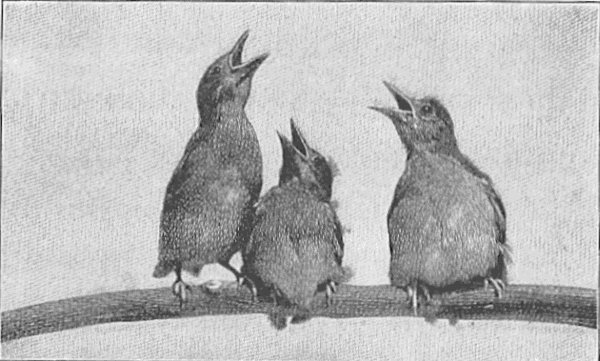
The young bird needs to be educated just as a child needs to be, though not exactly in the same way.
After the young bird can fly, he needs to be taught to find his own food, and also where to sleep.
He needs to know the different calls and cries of his family, and what they all mean. He has to learn to fly, and he must learn to sing. Then he must learn what to be afraid of, and how to protect himself from his enemies. No doubt there are many lessons for him to learn that we do not know about.
If you watch little birds just out of the nest, you may see them being taught how to find their food.
The robin mother takes her little one to the ground and shows him where the worms live, and how to get them. The owl mother finds a mouse creeping about in the grass. She teaches the owlets how to pounce upon it by doing it herself before them.
The old swallow takes her young ones into the air and shows them how to catch little flies on the wing.
If you watch long enough, you may see the old bird, who is training a young one, fly away. She may leave the young one alone on a tree or on the ground and be gone a long time.
Before many minutes the little one will begin to call for food. But by and by, if nobody comes to feed him, he will look around for something to eat. Thus he will get his first lesson in finding food for himself.
Once I saw a woodpecker bring his little one to a fence close by some raspberry bushes. He fed the young bird two or three raspberries, and then quietly slipped away.
When the young bird began to feel hungry, he cried out; but nobody came. Then he looked over at the raspberries and tried to reach one. After trying three or four times he got one. Then how proud he was!
The father stayed away an hour or more. Before he came back that young woodpecker had learned to help himself very well. But the minute his father came, he began to flutter his wings and beg to be fed.
II.
watcherhoppedscatterperch
knockedalightnaughtybathe
supposecoaxingflutteredplunge
It is very easy to see the birds teaching their little ones to fly. You will find the young birds sitting quietly on fences or trees. All at once the parents begin to fly around, with strange, loud calls. In a minute the little birds will fly out and join them.
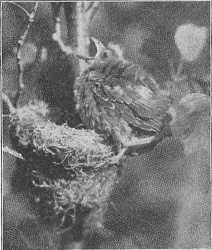
Around and around they all go till their little wings are tired, and then they come down and alight again.
Once I saw a young crow who did not fly when his parents called. All the others flew around many times.
The mother's sharp eyes saw her naughty son. She flew right at him, and knocked him off his perch. The next time she called, he flew with the rest.
An old robin wanted to teach her young one to bathe. She brought him to a dish of water kept for their use by some people who were fond of birds.
The little one stood on the edge and watched his mother go in and splash and scatter the water. He fluttered his wings and was eager to try it for himself, but seemed afraid to plunge in.
At last the mother flew away and left him standing there. In a moment she came back with a worm in her mouth. The young robin was hungry, as young birds always are. When he saw the worm, he began to flutter his wings and cry for it.
But the mother jumped into the middle of the water dish and stood there, holding the worm in his sight. The little bird wanted the worm so much that he seemed to forget his fear and hopped in beside his mother.
She fed him, and then began to splash about. The little fellow stayed in the water and took a good bath.
A careful watcher can see the birds teach many interesting things to their young ones. But one must be quiet and patient, and not frighten the birds.
—Olive Thorne Miller.