LONGFELLOW WITH HIS CHILDREN
Reading edition
I.
eagerbirthdaynurseryelm
plannedquestionmusicianlawn
The famous old house looks very quiet and lonely in the picture. But there was a time when many children ran about its halls and played upon the lawn.
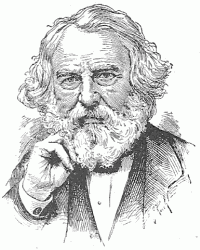
"How many children did Mr. Longfellow have? Did he have any boys? What were their names?"
These questions are asked again and again by little people who keep the birthday of the poet and wish to learn about his life.
In his journal, Mr. Longfellow tells us about his children, and it is there we may find answers to all our questions.
The poet's eldest son was named Charles. When Charles was two years old his little brother Ernest was born. Longfellow then moved his books into another room and gave up his study to his babies.
And so the room in which Washington had planned battles became the nursery of the Longfellow children. Did any children ever have a more famous nursery?
In this room which once belonged to Washington we like to think that the children heard again and again the story of our first President.
When Ernest was but a few days old his father told a friend that the little newcomer was a great musician. Do you know what the poet meant by this?
While Charles and Ernest were still little boys, their baby sister Fannie came to live in the nursery. Just as she was old enough to run about, the dear little girl died. Then the house was full of sorrow. Many of the poems Longfellow wrote at this time tell the story of his grief at the loss of his little daughter.
Charles was six years old and Ernest four, when their father first took them to school. He left them sitting on little chairs among the other children in an old house near a large elm tree.
It was under this same tree that Washington took command of the American army.
As time went on three little girls took the places of the boys in the nursery. How all these children loved their father! They thought him the best playfellow in the world, and so he was.
He made toys for them, taught them games, and wrote letters which he placed under their pillows for them to find in the morning.
II.
belovedlossprovidingwreaths
sealinggriefhappinesspackage
coastingmeantplayfellowpleasure
Longfellow writes in his journal about coasting with the boys for hours upon the hillside, and of working hard with all the children making a snow house in the front yard.
Again he tells of charming birthday parties when children played in the hay and scrambled for sugar plums. These parties always ended with a fine birthday supper.
On the first of May the children sometimes had a May party. The girls wore wreaths upon their heads and danced around the May pole. Then they all went to the summer house for a feast.
In summer the Longfellow children often went to the seaside with their father and mother. All day long they played in the sand and waded in the water.
But a great and terrible sorrow came suddenly to the Longfellow home. One morning, as Mrs. Longfellow was sealing a package with hot wax, her dress caught fire. Before the flames could be put out she was so badly burned that she died soon after.
Never again was the poet full of joy as he had always been before. For him the happiness of life was over. But he never forgot to provide for the pleasure of his children.
Longfellow has told us about his three daughters in a beautiful poem called "The Children's Hour." He has also written about them in a letter to a little girl which you will be glad to read.