HANA AND TORA
Reading edition
Their Home
I.
ToraJapanJapanesegowns
Hanamirrorcarriagehastens
Hana is a little Japanese girl. Her name, in the language of Japan, means flower or blossom. If you should see her you would say that she is as beautiful as the gayest flower in the garden.
Tora is her brother and his name means tiger. He is called Tora because his father and mother wish him to be as strong and as brave as a tiger.
Hana and Tora live in one of the beautiful islands of Japan. Let us visit them in their home on the other side of the world.
We must cross the ocean to reach this far away land. So we go on board a great steamer and for days and days we sail over the sea.
At last we come to the city where our little friends live. We leave the ship and climb into a two-wheeled carriage which is drawn by a man. He runs along the street with our carriage almost as fast as a horse can trot.
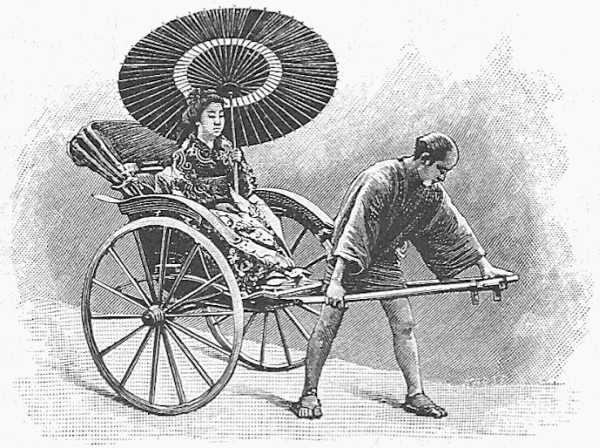
How strange everything seems. The men, women, and children all wear gowns that look like dresses. They clatter along in wooden shoes, and they carry paper umbrellas. We ride through narrow streets. There are no sidewalks nor green lawns.
And now our carriage stops. We have come to the home of Hana and Tora. The front of the house is open like a doll's playhouse, and we can see through to the garden beyond.
How clean everything looks! The porch shines like a mirror. All the floors are covered with matting made of the whitest straw. Even the road in front of the house is swept.
We walk toward the house, and a little girl comes in from the garden. She has a clear yellow skin, bright black eyes, and smooth black hair. This is Hana, and she hastens to greet us.
She drops down on her knees, and bows so low that her head touches the matting. Her mother will soon be at home, Hana says, and she begs us to come in.
Does she ask us to take off our hats? Oh, no, she expects us to take off our shoes. The Japanese always leave their shoes outside when they go into a house.
Again and again the polite little girl bows her head to the floor as we enter. We sit down on the thick matting, for in the houses of Japan there are no chairs.
II.
closetpicklesalphabetknives
parlorpocketsembroideredquilts
observegreetingsmaidservantscreens
Little Hana looks like a butterfly in her loose dress embroidered all over with bright flowers. Her sleeves are very large, and a wide sash of soft red silk is tied around her waist.
And now Hana's mother returns, and Tora comes running in from his play. There are more bows and more greetings.
Tora is dressed in a plain blue gown very much like his sister's. Both the children have large pockets in their sleeves where they carry their playthings.
Our friends invite us to spend the night with them. We are very glad to do so. They take us to the parlor, which is at the back of the house.
It is now time for supper. A small table, about ten inches high, is placed before each person in the room. We sit on the floor as we eat. A little maidservant brings in cakes and candies shaped like flowers. She kneels and bows low as she hands them to us.
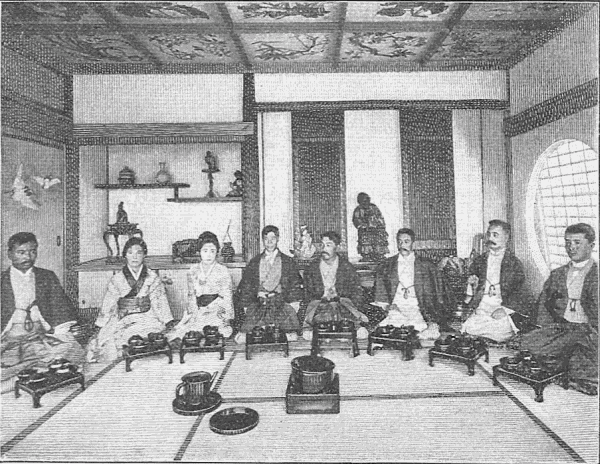
Next we have soup, which we drink from small bowls. Then come pickles and strange kinds of food that we have never before seen. Last of all rice is served from a large, round, wooden box, and we drink our tea from tiny cups.
There are no knives and no forks, and so we observe our Japanese friends as they eat with two long wooden sticks. Then we take our chop sticks and try to eat the rice as they do. Hana and Tora watch us, but they are too polite to smile.
After the supper is over, the grown people sit on the floor and talk to one another, or watch the children at their games. Hana and Tora play with small cards on which are printed the strange-looking letters of the Japanese alphabet.
And so the evening passes and bedtime comes. The little maidservant takes us upstairs. We see no beds, and we wonder where we shall sleep. But screens are soon drawn together, and a room is made for us.
Then the little maid slides back another screen, and there in the wall is a closet. Out of this she takes soft, thick quilts, and spreads them on the matting, one on top of another. For a pillow she brings each of us a small block of wood.
We do not like the wooden pillows, but we sleep soundly all night in our beds on the floor.