THE GORDON HIGHLANDERS ("Scotland for Ever")
Reading edition
"You have saved the day, Highlanders, but you must return to your position. There is more work to be done."—Sir Denis Pack at Waterloo.
Sir Denis Pack's words at Waterloo are as true to-day as they were then. The Gordons have always saved the day, and now they must return to their position. There is more work to be done and the Gordons are there to do it, as before.
The following is an extract from a letter to Sir Walter Scott from Viscount Vanderfosse, first Advocate of the Superior Court of Justice of Brussels, dated January 5th, 1816:
"Since the arrival of the British troops on the Continent, their discipline was remarked by all those who had any communication with them. Among these respectable warriors the Scotch deserve to be particularly commemorated, and this honourable mention is due to their discipline, their patience, their humanity, and their bravery almost without example. Constant and unheard of proofs were given of devotion to their country quite extraordinary and sublime; nor must we forget that these men, so terrible in the field of battle, were mild and tranquil out of it."
Such a testimonial from so high an authority is a treasured document in the hands of the Gordons, and many are the accounts received to-day from the front, which go to show that their cheery optimism has not been dimmed by the passage of a century.
Perhaps there is no regiment that blends so nicely the simple humour characteristic of the Scot with the grim determination in which no section of our army is wanting. There are many points which soften to our hearts the fierce homicidal glory of the Gordon Highlanders. But first in importance is their grim and terrible side.
On the eventful night of the Duchess of Richmond's ball on the eve of Waterloo, Colonel Cameron, and some of the N.C. officers of the Gordon Highlanders, had been invited to give the guests of different nations there assembled a display of the Highland dances. Poets have sung the sudden call to arms at the "Cannon's opening roar," but it was not until daybreak that the Gordons marched off through the Namur Gate towards the scene of action.
On this occasion their panoply of war set everyone a-thrill. With their dark plumes waving in the breeze, and the bright sun shining on their polished accoutrements, they marched to the screel of the bagpipes. Never had the spectators beheld a prouder, braver, more athletic body of men; there was not a downcast look among them; only the fearless eye, the undaunted mien, the cheerful bearing-things which tell of strength.
In this mood they marched as far as the forest of Soignies, near Waterloo. Thence, as the day advanced, they proceeded towards Quatre Bras. The heat was intense, the dust suffocating, but, after a wearisome march, they reached Genappe, where the people were waiting for the thirsty regiment with large tubs of water, and of milk, from which the Highlanders dipped and drank as they passed through the town. Hard on this refreshment, as they came into the plain beyond, was a further refreshment to the warlike spirit of the Highlanders; it was the sound of cannon that fell upon their ears "nearer, clearer than before." There was a general quickening of pace as the excitement of promised action ran quickly through the ranks, but Colonel Cameron checked their eagerness, and held them back, though with difficulty.
It so chanced, by good luck, or good management, that the Gordons arrived at Quatre Bras just at the very moment they were needed. Wellington had come in with full information from Blücher as to the position of the Prussian army, and a fuller scorn of their tactics in selecting that position—a scorn which was justified by the event. "If they fight here," he said, in his terse and forcible way, "they will be damnably mauled." The Duke was a true prophet. They were, in two words, "mauled."
The enemy's action began with a fierce cannonade, under cover of which a brigade of infantry and lancers were hurled forward, Our Belgian-Dutch allies fell back, and their retreat was converted into a rout by the enemy, who speedily became masters of the situation. Things were critical, but, at that moment, in came the Gordon Highlanders by the Namur road. Their march broke into a double, and their ranks opened and overflowed each side of the road, deploying for immediate action. At once came an answer from a battery of the enemy perched on one of the surrounding heights. By this time the Duke was amongst the Highlanders, giving orders to seek cover in the ditches and behind the banks of the road; he and his staff following their example. They had not long to wait, under a terrible fire, before the French cuirassiers came sweeping through the fields towards them. On they came, with furious cries, a formidable body; but the Highlanders under command of the Duke, waited in grim silence, reserving their fire. "Highlanders!" the Duke cried, "don't fight until I tell you," and so the Gordons lay, ready for the signal. It came when the charging cuirassiers were within thirty yards of them. Then a fierce volley rang out, and havoc lighted on the horsemen. Horses and steel-clad riders went down pell mell, and, in the confusion, the survivors turned and fled before the coming steel. Many, whose horses were shot beneath them, attempted to cope with the Scots, but all their valour was as nothing before the bayonets of the Gordons.
At another stage of the battle, when the Duke of Brunswick's hussars were in flight before the red (Polish) lancers and French light infantry, Wellington, involved in the charge, and carried away in their mad career, was in great danger; but, seeing a way out, he headed his horse for a position that had been taken up by the Gordons. As he neared them, at full gallop, he ordered them to lie still; then he leapt the intervening fence clearing, at one jump, fence, trench, and men. With the Gordons now between him and the foe, he wheeled his horse to a standstill, and ordered the Highlanders to get ready. The Brunswickers had passed, severely handled by the French bayonets, and the grenadiers, on the right, retired to the road, leaving the Gordons an opportunity to fire obliquely upon the oncoming cavalry. These shared the same fate as the cuirassiers, being met at short distance with a volley which threw them into confusion. Those in front were cut off, by dead and wounded, from those in the rear, who retreated in disorder, while the front passed on in their headlong career, which was really a retreat, through the village. Meanwhile, the Gordons turned their attention to the rest, and put them to rout.
Now Napoleon had impressed upon Ney to act in a manner that must prove decisive. The British had to be swept entirely off the field—the fate of France depended upon this. Ney's position was a difficult one, especially as he saw that reinforcements were coming up against him. Accordingly, he attacked again vigorously, and sent two columns of cavalry down upon the posts held by the Gordons. But these met with a similar fate to those who had tried that way before. But Ney still persisted and the Gordons were suffering heavily. How the day would have gone, and what would have happened to our Highlanders had not the Guards come up on their left soon afterwards, military experts alone can conjecture; but even with their assistance—and very welcome it was—the Gordons were yet to experience a severer trial.
It came in this way. Two columns of French infantry advanced rapidly, by means of the Charleroi road, and the outskirts of the wood of Bossu, and occupied a roadside house, with a thick hedge running some distance into a field, a part of their number gaining the cover of a thickly-hedged garden on the other side of the road. The main body of these troops, some 14,000 strong, took up a position in the rear of this garden.
Colonel Cameron with difficulty curbed his eagerness to let his men go, but the Duke, who foresaw a prolonged struggle, refused to allow it. He was, as usual, waiting for the right moment. When that moment came, and the order was given, Cameron leapt the ditch, at the head of his men, with old General Barnes at his side, crying, "Come on, my old 92nd!" Then, to the shrill piping of the pibrochs, the intrepid Gordons leapt from the ditch and fell upon the enemy with an impetus that was irresistible. The bayonet did its terrible work, and the opposing column fell back in confusion.
Meanwhile other sections advanced upon the hedged garden, the house, and the field hedge, suffering heavily from these points. It was in this advance that the staff of the colour was split into six pieces by three bullets, and the staff of the king's colour by one. It was here, too, that Cameron himself was wounded. Being shot in the groin, he lost control of his horse, which galloped away with him, and finally stopped suddenly before his own groom, who was holding a second horse. There Cameron, in a fainting condition, was thrown out of the saddle violently on to the road.
Colonel Cameron died of his wound late that night, but not before he had learnt that the British arms had conquered—a fact which forms the theme of Sir Walter Scott's immortal verse:
And Sunart rough, and wild Ardgour, And Morven long shall tell, And proud Ben Nevis hear with awe, How, upon bloody Quatre-Bras, Brave Cameron heard the wild hurrah Of conquest as he fell.
Meanwhile, the Gordons had fully avenged their leader's death. With repeated rushes upon the roadside house, they did deadly work with the bayonet, and, amid the hail of bullets from superior forces of the enemy, they still continued their fierce onslaughts under conditions that would have demoralized soldiers less cool and experienced.
In the midst of the appalling fire, they separated and formed up in three parts, one part moving to the right of the house and garden, another part to the left, while a third prepared to assault the garden itself. At a given moment, when the whole battalion was ready, the order to charge was given. Then, with a resounding cheer, they rushed forward, "the bagpipes screaming out the notes of the 'Cameron's Gathering,' as they levelled their bayonets, and charged with the elastic step learnt on the hillside."
The enemy stood firm for a little while against the oncoming array of determined men; then they broke and fled, showing their backs as targets for the Highlanders, who scattered the passage of their retreat thickly with their dead bodies. In this action many prisoners were taken.
The British troops, though in the minority in guns, as well as men, stood like a rock against the searching assaults of the enemy. Ebb and flow was the order of battle, until at last the flow of our indomitable troops gained ground, and the enemy finally ebbed away.
Our last victory in that furious battle was gained foot by foot, and when, in the end, the day was won, and the stars looked down upon 10,000 slain, the piper of the Gordon Highlanders took his stand in front of the village of Quatre Bras to call the Highlanders in. "Loud and long blew Cameron," says one who heard that call of the highland mountain and the glen, "but his efforts could not gather above half of those whom his music had cheered on their march to the battlefield."
Our Gordons had been through the thick of the fight; at the close of the day they were terribly hungry, and with the cool sang-froid which is the necessary complement to the bravery of such men, they took their supper cooked and served in the cuirasses which had shone in the enemy's forefront of battle some hours before.
Various writers tell of the extreme kindness received by the Gordons after the battle from the inhabitants of Brussels and Antwerp. The "good and brave Scots" came in on drays and wagons, apparently none the worse for the fierce encounter, saving merely the loss of a leg, or an arm or two. "We're a' wantin' a leg or a' airm," cried one from the midst of a wagon-load of wounded, as if it were a kind of fraternal greeting. The good folk, seeing their plight, and not understanding the language, brought them wine in abundance, but the Highlanders did not understand the colour of it, and called for "guid sma' ale" as the next best thing to their own "white wine of the north."
Tales of suffering in those days cannot vie in magnitude with the tales of to-day, but it is interesting to note that the endurance and patience of the Highlanders, as they lay on the wagons, or came in on foot, fainting with weariness and loss of blood, called forth the remark, as they passed through the street, "the men of your country must be made of iron."
It remains to touch on the Highlanders' own account of this battle. It was simple and unpretentious in the extreme. One who had been severely wounded, and was lying on the paving stones, waiting to be attended to, was accosted by an English resident. "How you and your comrades fought!" he said. "Your bravery will be the talk of the world. There is no doubt, as the people here say, you and your countrymen are made of iron." "Hoots, man," replied the Highlander, "need ye mak' sic a din aboot the like o' that? What did we gang oot for but to fecht?"
It goes without saying that false reports of any considerable engagement were spread through the countryside, even in those days. A chronicler states that Mercer, when making his way to the scene of action, happened on a Gordon Highlander, toiling painfully along the road, badly wounded in the knee. "Halt!" cried Mercer. "Have you any information? The Belgians tell me that our army has been forced to retreat." "Na, na," replied the Scot; "it's a damned lee! When I cam' awa' they were fechtin', an' they're aye fechtin' yet." With that, he sat down on the roadside and calmly lit his pipe, while a prentice surgeon probed for the bullet in his knee.
Another incident preserved in the records of the Gordons is related by a Scotch lady who resided at that time in Antwerp. She had heard reports of a retreat from Quatre Bras, and other mis-statements concerning Mont St. Jean had also reached her ears, all to the effect that the British had suffered severe defeat; that Wellington was dangerously wounded, and that all of any account in our army were either killed or taken prisoners. Moreover, thousands of French troops had entered Brussels, and that on the heels of death and destruction came panic and dismay. Needless to say, this was not true, except in one point only—that 2,000 French had entered Brussels; but it was in the rôle of prisoners, not victors! On the following day the Scotch lady went out in search of news, and was met by a long procession of vehicles laden with the wounded. Not a word of victory could she get on any hand, until she observed, in the very last wagon, a group of Gordon Highlanders, badly wounded, and heavily bandaged. They evidently knew something, for they were throwing their bonnets in the air, and shouting: "Bony's beat! Hurrah for Bonnie Scotland! Hurrah for Merrie England! Bony's beat!" Recognizing the Highland spirit, the lady sought to learn the cause of their excitement, and they told her, between their wild cries of joy, that a rider had just sped by, bringing the glad news of victory.
It was not easy for the people of Brussels to gather the real import of this news either from the lady or the Highlanders, but it began to spread about, in what to them was an unknown tongue, though forcible in vociferation, that "Bony was beat and runnin' awa' to his ain country just as fast as he could gang." Yet there was no explaining it to them, and it was in vain that a brawny, bearded Highlander took a Belgian woman to task with the words, "Canna ye hear, ye auld witch? Are ye deaf? Bony's beat, I tell ye! I tell ye, Bony's beat, wumman!" It was no good! But the full significance of the fact was soon made known in the city, and then there was wild rejoicing on every hand.
In those times the Belgian people conceived and fostered a great love for the Gordon Highlanders, and no doubt the tradition has been handed down to this day that they are the best of soldiers, sweet and gentle in peace, and terrible in war.
The part played by the Gordons in the repulse of the Boer attack on Ladysmith, January 6th, 1900, is never to be forgotten. It was here that Lieutenant Colonel Dick-Cunyngham, V.C., fell at the head of his men. It was during the Afghan campaign that this hero of the Gordons received his V.C., when they were fighting outside Kabul in 1879. Staggered for a moment by a terrific onslaught on the part of the Afghans, the Gordons, their leading officer and colour-sergeant being killed, seemed to hesitate, when Dick-Cunyngham sprang forward, and, by his remarkable coolness and gallantry, saved the situation.
In later days, the Gordon Highlanders have maintained and even added to the reputation thus bravely won. One signal instance is found in their attacks on the Dargai heights. On October 18th, 1897, the Gordons formed part of the flanking movement under Brigadier-General Kempster. The heights were won, but were shortly re-occupied by the enemy. On the following day, a second battle was joined about this position. Under Sir William Lockhart the Gordons displayed their usual fighting power. In the "Broad Arrow" of February, 18th, 1898, Sir William Lockhart himself described the part they played:
"The Gordon Highlanders went straight up the hill without check or hesitation. Headed by their pipers, and led by Colonel Mathias, with Major Macbean on his right, and Lieutenant A. F. Gordon on his left, this splendid battalion marched across the open. It dashed through a murderous fire, and in forty minutes had won the heights, leaving three officers and thirty men killed or wounded on its way. The first rush of the Highlanders was deserving of the highest praise, for they had just undergone a very severe climb, and had reached a point beyond which other troops had been unable to advance for over three hours. The first rush was followed at short intervals by a second and a third, each led by officers; and, as the leading companies went up the path for the final assault, the remainder of the troops streamed on in support, but few of the enemy waited for the bayonet, many of them being shot down as they fled in confusion."
Supremely heroic on a point of romantic sentiment is our Gordon Highlander. When Cameron fell at Quatre Bras, he was not only mortally wounded, but pinned down by his horse. In this helpless condition he was recognised by one of the enemy, who swiftly rushed forward to bayonet him. But swifter still came the cold steel of Ewen Macmillan (the Colonel's foster brother) and pierced the would-be murderer to the heart. Ewen extricated his leader and bore him off; then, his master safe, he turned back with the set purpose of securing the saddle on which he had sat through many a victorious battle. In the thick of the fight the imperturbable Scot, amid a hail of bullets, secured that saddle and returned safely with it to his company, exhibiting it with a fine mingling of triumph and regret. "We must leave them the carcase," he said, "but they shan't get the saddle where Fassiefern sat." That was what he had risked his life a thousand times a minute for—the saddle where Fassiefern had sat!
And not only in stirring deeds of deathless glory have the Gordon Highlanders shone in the starry sky of Britain's fame. In the course of their long career they have been called upon to suffer and endure tests of hardship and privation, which prove the true mettle of the British soldier. They have played many parts in the theatre of war where the limelight did not fall. It was even their fate to take part in the terrible retreat to Bremen. Mr. W. Richards gives a grim description of some of these hardships:
"The high, keen wind carried the drifted snow and sand with such violence that the human frame could scarcely resist its power; the cold was intense; the water, which collected in the hollow eyes of the men, congealed as it fell, and hung in icicles from their eyelashes; the breath froze, and hung in icy incrustations about their haggard faces, and on the blankets and coats which they wrapped about them."
But, with the Gordons, the hardy spirit in which they weathered all this was only a modification of that which carried them into their most glorious triumphs on the field of battle. Speaking of hardships and remembering the strong spirit of camaraderie which has always existed between our soldiers of all regiments, we cannot help reminding the Gordons that their 2nd Battalion owes the Coldstreamers one ration. It happened in this way. When the Gordons arrived at Fuentes d'Onoro both officers and men were literally starving, owing to a faulty commissariat; and no sooner did the Guards get wind of this than they volunteered a ration of biscuits, from their haversacks. Now, as the Coldstreamers will not be able to get those biscuits from the enemy, who appears to have "embarked without them," they may require them again from the Gordons and they should insist on having them well buttered.
THEIR BADGES AND BATTLE HONOURS, ETC.
Badges.—The Sphinx, superscribed Egypt. The Royal Tiger, superscribed India.
Battle Honours.—Mysore, Seringapatam, Egmont-op-Zee, Mandora, Corunna, Fuentes d'Onoro, Almaraz, Vittoria, Pyrenees, Nive, Orthes, Peninsula, Waterloo, S. Africa 1835, Delhi, Lucknow, Charasiah, Kabul 1879, Kandahar 1880, Afghanistan 1878-80, Egypt 1882-84, Tel-el-Kebir, Nile 1884-85, Chitral, Tirah, S. Africa 1889-1902, Paardeberg, Defence of Ladysmith.
Uniform.—Regular and Reserve Battns., scarlet with yellow facings.
[To the first regiment (the 89th), raised in 1759, there belong the romances of two notable men. One was the Duke's brother, Lord William, who afterwards ran away with Lady Sarah Bunbury, and the other was Lord George, the future rioter. A further romance belongs to the Gordons proper. When, in 1794, the 4th D. of G. was commissioned to raise a regiment for the King, with the Duke's son, Lord Huntly, as its colonel, his wife Jane, "the Bonnie Duchess," acted as her son's recruiting sergeant. Day after day she rode in among them at their gatherings, and with the King's shilling between her teeth, kissed them into the army. "Now, lads; whose for a soldier's life—and a kiss o' the Duchess Jean?" Her ambition for her son in the way of masculine counterpoise to the brilliant alliances of her daughters does not matter so much as that the Gordons sprang into being at the touch of her lips—which is a legend greatly treasured among Highlanders.]
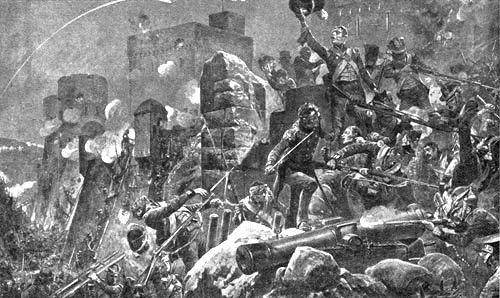
THE CONNAUGHT RANGERS AT BADAJOZ. From a Painting by R. Caton Woodville.